Conductometry
Introduction
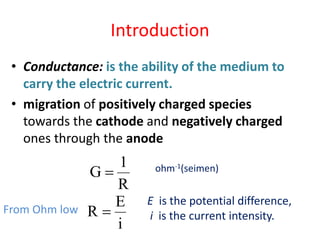
• Conductance: is the ability of the medium to
carry the electric current.
• migration of positively charged species
towards the cathode and negatively charged
ones through the anode
R
1
G 
i
E
R 
From Ohm low
ohm-1(seimen)
E is the potential difference,
i is the current intensity.
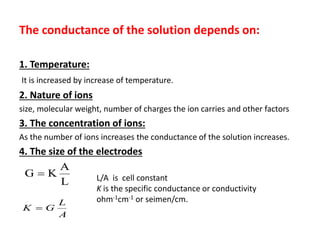
The conductance of the solution depends on:
1. Temperature:
It is increased by increase of temperature.
2. Nature of ions
size, molecular weight, number of charges the ion carries and other factors
3. The concentration of ions:
As the number of ions increases the conductance of the solution increases.
4. The size of the electrodes
L
A
K
G 
A
L
G
K 
L/A is cell constant
K is the specific conductance or conductivity
ohm-1cm-1 or seimen/cm.
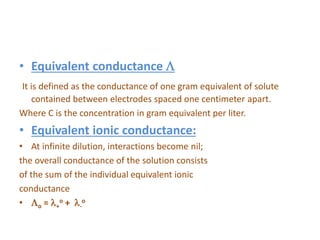
• Equivalent conductance 
It is defined as the conductance of one gram equivalent of solute
contained between electrodes spaced one centimeter apart.
Where C is the concentration in gram equivalent per liter.
• Equivalent ionic conductance:
• At infinite dilution, interactions become nil;
the overall conductance of the solution consists
of the sum of the individual equivalent ionic
conductance
• o = +
o + -
o
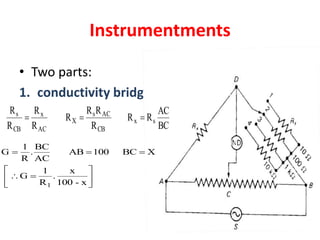
Instrumentments
• Two parts:
1. conductivity bridgee.
BC
AC
R
R
R
R
R
R
R
R
R
R
s
x
CB
AC
s
X
AC
x
CB
s



x
-
100
x
.
R
1
G
X
BC
100
AB
AC
BC
.
R
1
G
1











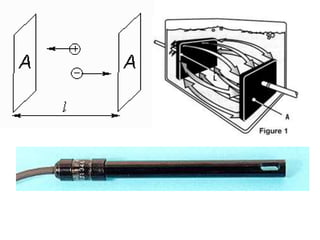
1. Conductance cell
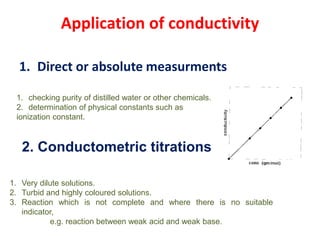
Application of conductivity
1. Direct or absolute measurments
1. checking purity of distilled water or other chemicals.
2. determination of physical constants such as
ionization constant.
2. Conductometric titrations
1. Very dilute solutions.
2. Turbid and highly coloured solutions.
3. Reaction which is not complete and where there is no suitable
indicator,
e.g. reaction between weak acid and weak base.
1. Titration of strong acid with strong base:
The reaction is represented by the following equations
e.g. H+ + Cl- + Na+ + OH-  H2O + Na+ + Cl-
2. Very weak acid with strong base or a very
weak base with stronger acids
• Determination of mixture of hydrochloric acid
(strong acid) and acetic acid (weak acid) with
sodium hydroxide (strong base)
3. Precipitation and complex formation reaction
Na+ + Cl- + Ag+ + NO3
-  AgCl + Na+ + NO3
-
Conductivity as a function of the volume of added standard
solution in the titration of an approximately 0.1 molar acetic
acid solution (V = 5 ml) with a sodium hydroxide solution (c =
0.1 mol · l-1)

conductometry.ppt

  • 1.
  • 2.
    Introduction • Conductance: isthe ability of the medium to carry the electric current. • migration of positively charged species towards the cathode and negatively charged ones through the anode R 1 G  i E R  From Ohm low ohm-1(seimen) E is the potential difference, i is the current intensity.
  • 3.
    The conductance ofthe solution depends on: 1. Temperature: It is increased by increase of temperature. 2. Nature of ions size, molecular weight, number of charges the ion carries and other factors 3. The concentration of ions: As the number of ions increases the conductance of the solution increases. 4. The size of the electrodes L A K G  A L G K  L/A is cell constant K is the specific conductance or conductivity ohm-1cm-1 or seimen/cm.
  • 4.
    • Equivalent conductance It is defined as the conductance of one gram equivalent of solute contained between electrodes spaced one centimeter apart. Where C is the concentration in gram equivalent per liter. • Equivalent ionic conductance: • At infinite dilution, interactions become nil; the overall conductance of the solution consists of the sum of the individual equivalent ionic conductance • o = + o + - o
  • 6.
    Instrumentments • Two parts: 1.conductivity bridgee. BC AC R R R R R R R R R R s x CB AC s X AC x CB s    x - 100 x . R 1 G X BC 100 AB AC BC . R 1 G 1           
  • 7.
  • 12.
    Application of conductivity 1.Direct or absolute measurments 1. checking purity of distilled water or other chemicals. 2. determination of physical constants such as ionization constant. 2. Conductometric titrations 1. Very dilute solutions. 2. Turbid and highly coloured solutions. 3. Reaction which is not complete and where there is no suitable indicator, e.g. reaction between weak acid and weak base.
  • 13.
    1. Titration ofstrong acid with strong base: The reaction is represented by the following equations e.g. H+ + Cl- + Na+ + OH-  H2O + Na+ + Cl-
  • 14.
    2. Very weakacid with strong base or a very weak base with stronger acids
  • 15.
    • Determination ofmixture of hydrochloric acid (strong acid) and acetic acid (weak acid) with sodium hydroxide (strong base)
  • 16.
    3. Precipitation andcomplex formation reaction Na+ + Cl- + Ag+ + NO3 -  AgCl + Na+ + NO3 -
  • 17.
    Conductivity as afunction of the volume of added standard solution in the titration of an approximately 0.1 molar acetic acid solution (V = 5 ml) with a sodium hydroxide solution (c = 0.1 mol · l-1)