INTRODUCTION TO EPI
VACCINES
BY DR. KOMAL
FINAL YEAR MBBS
LUMHS
Group A-6
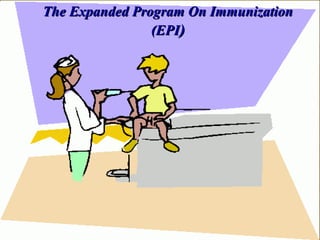
The Expanded Program On ImmunizationThe Expanded Program On Immunization
(EPI(EPI))
 Expanded program on Immunization (EPI) is a world
health organization program, with the goal to make
vaccines available to all children throughout the world.
 Experience with smallpox eradication program showed the
world that immunization was the most powerful and cost-
effective weapon against vaccine preventable diseases.
 In 1974, the WHO launched its “ Expanded program of
immunization” (EPI) against six most common preventable
diseases (diphtheria, pertussis, tetanus, polio,
tuberculosis, measles and recently added pneumococcal
vaccine).
 Expanding the number of diseases to be covered
 Expanding the number of children and target
population to be covered
 Expanding coverage to all corners of the country
and spreading services to reach the less privileged
sectors of the society.
Routine Immunization:
 Children 0-23 months – immunization with 8 EPI antigens
 Pregnant ladies by TT.
Supplemental Immunization Activities:
 Routine immunization does not ensure 100% coverage of the mobile
population i.e. nomads, NAs, hard to reach areas / missed areas. So SIAs
are scheduled to ensure coverage of this population / areas.
 NIDs / SNIDs: children < 5 years receive polio drops (3-days campaign)
Disease Surveillance:
 To detect every case of target diseases, the suspected cases of seven
VPDs are reported by health facilities to the district health authorities for
immediate launching of the control measures.
Mopping up:
 Special campaigns 5-8 km around the infected locality to localize the
disease and stop its transmission.
 
1. To achieve 100% coverage with all EPI vaccines.
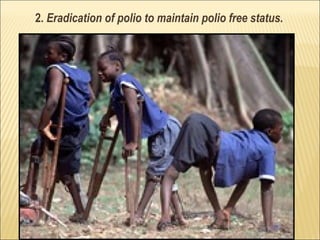
2. Eradication of polio to maintain polio free status.
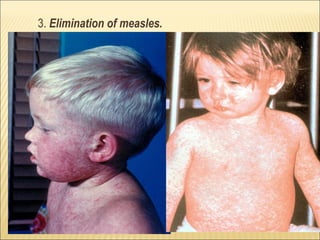
3. Elimination of measles.
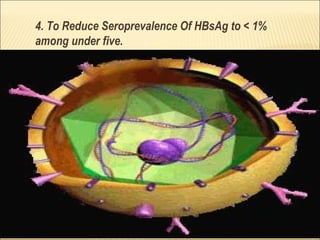
4. To Reduce Seroprevalence Of HBsAg to < 1%
among under five.
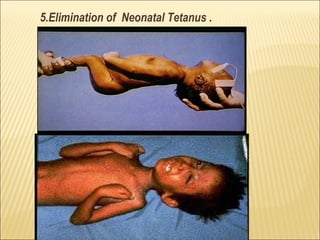
5.Elimination of Neonatal Tetanus .
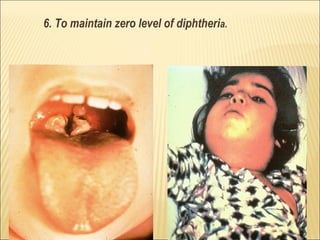
6. To maintain zero level of diphtheria.
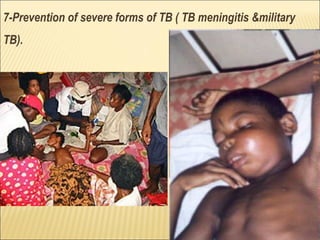
7-Prevention of severe forms of TB ( TB meningitis &military
TB).
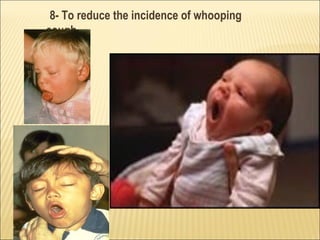
8- To reduce the incidence of whooping
cough
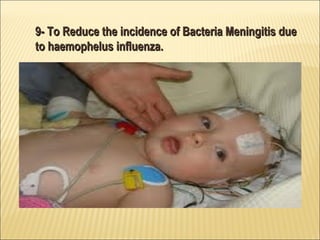
9- To Reduce the incidence of Bacteria Meningitis due9- To Reduce the incidence of Bacteria Meningitis due
to haemophelus influenza.to haemophelus influenza.
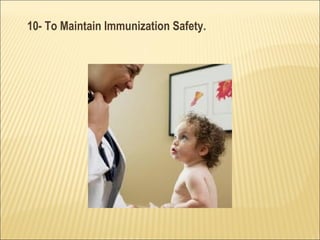
10- To Maintain Immunization Safety.
11-To prepare for introduction of new vaccines
 Expanded program on immunization was launched in Pakistan in
1978.
 The purpose of EPI is to initiate a collective effort to reduce the
mortality results from the seven EPI target disease by immunizing
children of the age 0-11 months and women of child bearing age.
 Although Pakistan has made impressive gains in increasing the EPI
coverage in the recent years ,the public awareness and thus public
support and participation in immunization derives of the ministry of
health, government of Pakistan needs to improve further to enable
us to achieve the target set under the Millennium developmental
Goals.
 Reduction of mortality and morbidity resulting from 7 EPI target
diseases by immunizing children of age 0-11months and women of
child bearing age.
 90% routine immunization coverage of all EPI antigens by 2012.
 Interruption of polio virus transmission by 2012
 Elimination of the Neonatal Tetanus by 2015
 Reduction of The Diphtheria, Pertusis, Childhood TB, by maximum
level
 Control of the other diseases by Introduction of new vaccines EPI
EPI SCHEDULE
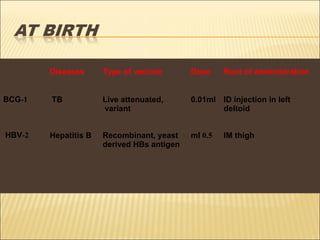
Diseases Type of vaccine Dose Rout of administration
1-BCG
2-HBV
TB
Hepatitis B
Live attenuated,
variant
Recombinant, yeast
derived HBs antigen
0.01ml
0.5ml
ID injection in left
deltoid
IM thigh
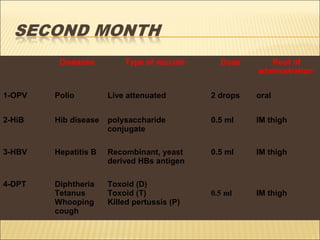
Diseases Type of vaccine Dose Rout of
administration
1-OPV Polio Live attenuated 2 drops oral
2-HiB Hib disease polysaccharide
conjugate
0.5 ml IM thigh
3-HBV Hepatitis B Recombinant, yeast
derived HBs antigen
0.5 ml IM thigh
4-DPT Diphtheria
Tetanus
Whooping
cough
Toxoid (D)
Toxoid (T)
Killed pertussis (P)
0.5 ml IM thigh
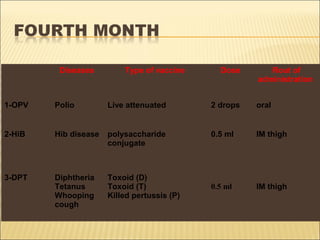
Diseases Type of vaccine Dose Rout of
administration
1-OPV Polio Live attenuated 2 drops oral
2-HiB Hib disease polysaccharide
conjugate
0.5 ml IM thigh
3-DPT Diphtheria
Tetanus
Whooping
cough
Toxoid (D)
Toxoid (T)
Killed pertussis (P)
0.5 ml IM thigh
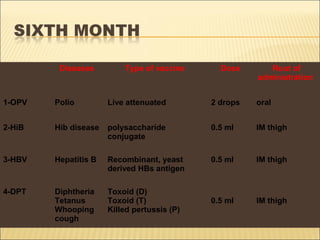
Diseases Type of vaccine Dose Rout of
administration
1-OPV Polio Live attenuated 2 drops oral
2-HiB Hib disease polysaccharide
conjugate
0.5 ml IM thigh
3-HBV Hepatitis B Recombinant, yeast
derived HBs antigen
0.5 ml IM thigh
4-DPT Diphtheria
Tetanus
Whooping
cough
Toxoid (D)
Toxoid (T)
Killed pertussis (P)
0.5 ml IM thigh
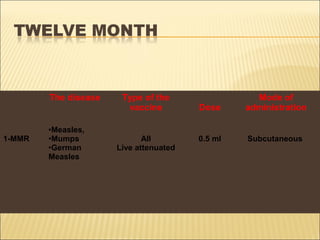
The disease Type of the
vaccine Dose
Mode of
administration
1-MMR
•Measles,
•Mumps
•German
Measles
All
Live attenuated
0.5 ml Subcutaneous
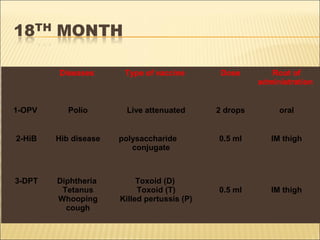
Diseases Type of vaccine Dose Rout of
administration
1-OPV Polio Live attenuated 2 drops oral
2-HiB Hib disease polysaccharide
conjugate
0.5 ml IM thigh
3-DPT Diphtheria
Tetanus
Whooping
cough
Toxoid (D)
Toxoid (T)
Killed pertussis (P)
0.5 ml IM thigh
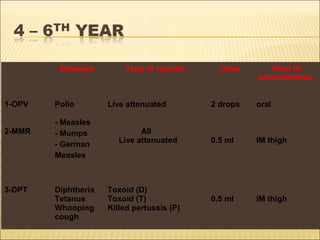
Diseases Type of vaccine Dose Rout of
administration
1-OPV Polio Live attenuated 2 drops oral
2-MMR
- Measles
- Mumps
- German
Measles
All
Live attenuated 0.5 ml IM thigh
3-DPT Diphtheria
Tetanus
Whooping
cough
Toxoid (D)
Toxoid (T)
Killed pertussis (P)
0.5 ml IM thigh
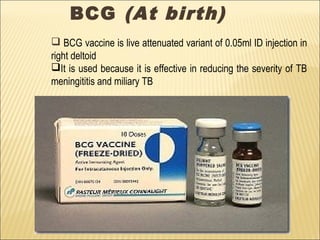
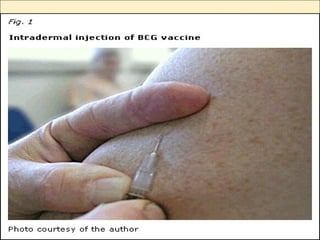
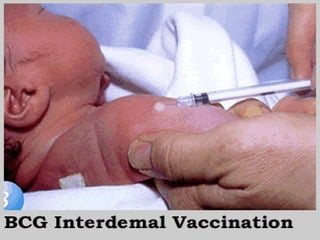
BCG (At birth)
 BCG vaccine is live attenuated variant of 0.05ml ID injection in
right deltoid
It is used because it is effective in reducing the severity of TB
meningititis and miliary TB
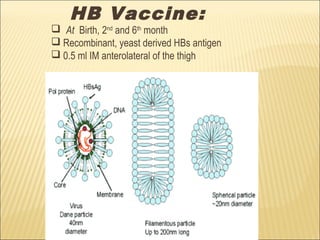
HB Vaccine:
 At Birth, 2nd
and 6th
month
 Recombinant, yeast derived HBs antigen
 0.5 ml IM anterolateral of the thigh
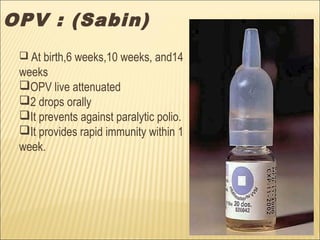
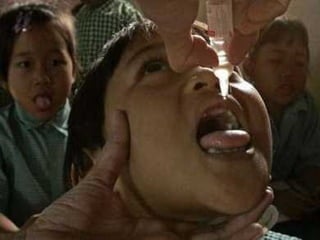
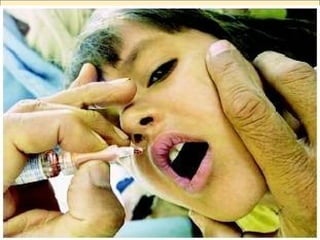
OPV : (Sabin)
 At birth,6 weeks,10 weeks, and14
weeks
OPV live attenuated
2 drops orally
It prevents against paralytic polio.
It provides rapid immunity within 1
week.
Severe bacterial infection, particularly among infants
During late 19th century believed to cause influenza
Immunology and microbiology clarified in 1930s
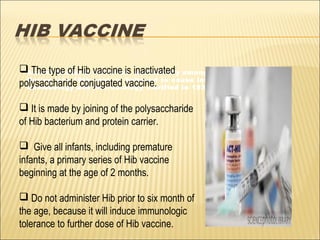
 The type of Hib vaccine is inactivated
polysaccharide conjugated vaccine.
 It is made by joining of the polysaccharide
of Hib bacterium and protein carrier.
 Give all infants, including premature
infants, a primary series of Hib vaccine
beginning at the age of 2 months.
 Do not administer Hib prior to six month of
the age, because it will induce immunologic
tolerance to further dose of Hib vaccine.
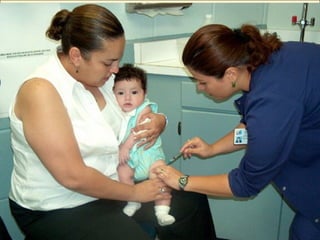
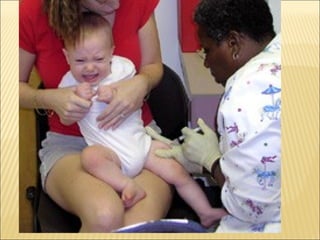
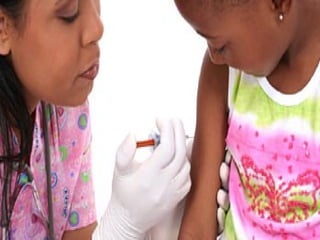
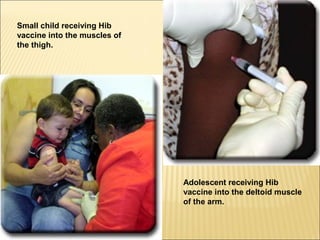
Small child receiving Hib
vaccine into the muscles of
the thigh.
Adolescent receiving Hib
vaccine into the deltoid muscle
of the arm.
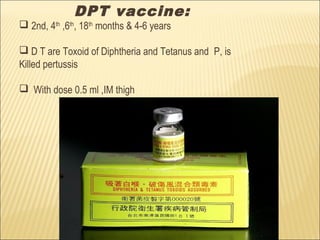
DPT vaccine:
 2nd, 4th
,6th
, 18th
months & 4-6 years
 D T are Toxoid of Diphtheria and Tetanus and P, is
Killed pertussis
 With dose 0.5 ml ,IM thigh
•DPT:
2nd, 4th ,6th, 18th months& 4-6 years
•DT:
No pertussis component
It is given as subsequent doses to an
infant who showed severe adverse effects
due to pertussis component.
•dT:
No pertussis component.
A small dose of diphtheria toxoid is given
at school entry or after the age of six years.
At 6 weeks,10 weeks,14 weeks,18 months,5 years,10
years.
Tetanus toxoid(inactivated toxin with formaldehyde).
Dose:0.5 ml I/M
Two 0.5 ml doses I/M injection administered at 4-8
weeks interval 3rd
dose after 1 year.
Diphtheria causes a thick covering in the back of the throat.
It can lead to breathing problems, paralysis, heart failure,
and even death. There are several combination vaccines
used to prevent diphtheria: DTaP, DT, and Td.
Pertussis is a bacterial infection caused by Bordetella pertussis. The germ is
spread when infected people cough or sneeze.
Available Vaccines:
No pertussis-only vaccine is available. The pertussis vaccine is available as:
DTaP (Diphtheria Toxoid-Tetanus Toxoid-acellular Pertussis vaccine)
DTaP in combination with Haemophilus influenzae type b (Hib) vaccine
DTaP in combination with hepatitis B and inactivated polio vaccines
DTaP in combination with Hib, hepatitis B and inactivated polio vaccines
Tdap (Tetanus Toxoid reduced-Diphtheria-acellular Pertussis vaccine)
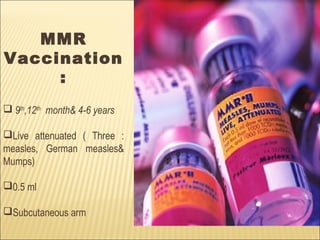
MMR
Vaccination
:
 9th
,12th
month& 4-6 years
Live attenuated ( Three :
measles, German measles&
Mumps)
0.5 ml
Subcutaneous arm
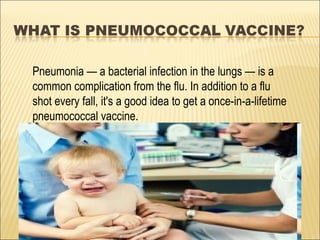
Pneumonia — a bacterial infection in the lungs — is a
common complication from the flu. In addition to a flu
shot every fall, it's a good idea to get a once-in-a-lifetime
pneumococcal vaccine.
Pneumococcal vaccines. (Minimum age: 6 weeks for pneumococcal conjugate
vaccine [PCV]; 2 years for pneumococcal polysaccharide vaccine [PPSV]).
• Administer 1 dose of PCV to all healthy children aged 24 through 59 months
who are not completely vaccinated for their age.
• For children who have received an age-appropriate series of 7-valent
PCV (PCV7), a single supplemental dose of 13-valent PCV (PCV13) is
recommended for:
— All children aged 14 through 59 months
— Children aged 60 through 71 months with underlying medical conditions.
• Administer PPSV at least 8 weeks after last dose of PCV to children aged 2
years or older with certain underlying medical conditions, including a cochlear
implant
 Acute diarrhoea is responsible
for nearly 1.9 million deaths per
year in children under age five.
 Rotavirus is responsible for as
much as one fourth of these
casualties, almost all of which
occur in developing countries.
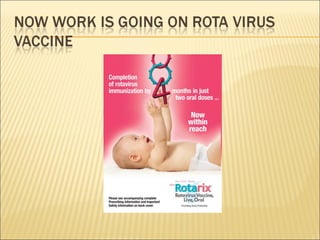
 Rotavirus (RV) vaccines. (Minimum age: 6 weeks for both RV-1
[Rotarix] and RV-5 [Rota Teq])
 The maximum age for the first dose in the series is 14 weeks, 6
days; and 8 months, 0 days for the final dose in the series.
Vaccination should not be initiated for infants aged 15 weeks, 0
days or older.
 If RV-1 (Rotarix) is administered at ages 2 and 4 months, a
dose at 6 months is not indicated.
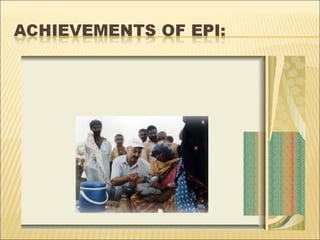
 80.2 %( 0-11 months) children fully immunized (CES-2006).
 35.8 Million Children immunized against measles through special
campaign in 2008.
 TT Immunization to target women (15-49 yrs.) in 6 high risk Districts in
Punjab.
 Vitamin-A supplementation –twice a year with coverage >95%.
 Storage capacity enhanced for the buffer stocks of all vaccines for the
period of 3 months.  
Improved monitoring & supervision through
 Provision of 59 single cabin vehicles for DO(H) under GAVI.
Provision of 3652 motorcycles to EPI staff under GAVI.
Provision of cold chain equipment to 8 flood hit districts.
Capacity building of health managers and EPI staff, (17,804).
Orientation training workshops for medical officers LHVs, LHWs, etc.
Training of health personnel for cold chain repair and maintenance.
Training workshops for vaccine stock management carried out in all
districts during 2010, 2011 and 2012.
EPI

EPI

  • 1.
    INTRODUCTION TO EPI VACCINES BYDR. KOMAL FINAL YEAR MBBS LUMHS Group A-6
  • 2.
    The Expanded ProgramOn ImmunizationThe Expanded Program On Immunization (EPI(EPI))
  • 3.
     Expanded programon Immunization (EPI) is a world health organization program, with the goal to make vaccines available to all children throughout the world.
  • 4.
     Experience withsmallpox eradication program showed the world that immunization was the most powerful and cost- effective weapon against vaccine preventable diseases.  In 1974, the WHO launched its “ Expanded program of immunization” (EPI) against six most common preventable diseases (diphtheria, pertussis, tetanus, polio, tuberculosis, measles and recently added pneumococcal vaccine).
  • 5.
     Expanding thenumber of diseases to be covered  Expanding the number of children and target population to be covered  Expanding coverage to all corners of the country and spreading services to reach the less privileged sectors of the society.
  • 6.
    Routine Immunization:  Children0-23 months – immunization with 8 EPI antigens  Pregnant ladies by TT. Supplemental Immunization Activities:  Routine immunization does not ensure 100% coverage of the mobile population i.e. nomads, NAs, hard to reach areas / missed areas. So SIAs are scheduled to ensure coverage of this population / areas.  NIDs / SNIDs: children < 5 years receive polio drops (3-days campaign) Disease Surveillance:  To detect every case of target diseases, the suspected cases of seven VPDs are reported by health facilities to the district health authorities for immediate launching of the control measures. Mopping up:  Special campaigns 5-8 km around the infected locality to localize the disease and stop its transmission.  
  • 7.
    1. To achieve100% coverage with all EPI vaccines.
  • 8.
    2. Eradication ofpolio to maintain polio free status.
  • 9.
  • 10.
    4. To ReduceSeroprevalence Of HBsAg to < 1% among under five.
  • 11.
  • 12.
    6. To maintainzero level of diphtheria.
  • 13.
    7-Prevention of severeforms of TB ( TB meningitis &military TB).
  • 14.
    8- To reducethe incidence of whooping cough
  • 15.
    9- To Reducethe incidence of Bacteria Meningitis due9- To Reduce the incidence of Bacteria Meningitis due to haemophelus influenza.to haemophelus influenza.
  • 16.
    10- To MaintainImmunization Safety.
  • 17.
    11-To prepare forintroduction of new vaccines
  • 19.
     Expanded programon immunization was launched in Pakistan in 1978.  The purpose of EPI is to initiate a collective effort to reduce the mortality results from the seven EPI target disease by immunizing children of the age 0-11 months and women of child bearing age.  Although Pakistan has made impressive gains in increasing the EPI coverage in the recent years ,the public awareness and thus public support and participation in immunization derives of the ministry of health, government of Pakistan needs to improve further to enable us to achieve the target set under the Millennium developmental Goals.
  • 20.
     Reduction ofmortality and morbidity resulting from 7 EPI target diseases by immunizing children of age 0-11months and women of child bearing age.  90% routine immunization coverage of all EPI antigens by 2012.  Interruption of polio virus transmission by 2012  Elimination of the Neonatal Tetanus by 2015  Reduction of The Diphtheria, Pertusis, Childhood TB, by maximum level  Control of the other diseases by Introduction of new vaccines EPI
  • 21.
  • 22.
    Diseases Type ofvaccine Dose Rout of administration 1-BCG 2-HBV TB Hepatitis B Live attenuated, variant Recombinant, yeast derived HBs antigen 0.01ml 0.5ml ID injection in left deltoid IM thigh
  • 23.
    Diseases Type ofvaccine Dose Rout of administration 1-OPV Polio Live attenuated 2 drops oral 2-HiB Hib disease polysaccharide conjugate 0.5 ml IM thigh 3-HBV Hepatitis B Recombinant, yeast derived HBs antigen 0.5 ml IM thigh 4-DPT Diphtheria Tetanus Whooping cough Toxoid (D) Toxoid (T) Killed pertussis (P) 0.5 ml IM thigh
  • 24.
    Diseases Type ofvaccine Dose Rout of administration 1-OPV Polio Live attenuated 2 drops oral 2-HiB Hib disease polysaccharide conjugate 0.5 ml IM thigh 3-DPT Diphtheria Tetanus Whooping cough Toxoid (D) Toxoid (T) Killed pertussis (P) 0.5 ml IM thigh
  • 25.
    Diseases Type ofvaccine Dose Rout of administration 1-OPV Polio Live attenuated 2 drops oral 2-HiB Hib disease polysaccharide conjugate 0.5 ml IM thigh 3-HBV Hepatitis B Recombinant, yeast derived HBs antigen 0.5 ml IM thigh 4-DPT Diphtheria Tetanus Whooping cough Toxoid (D) Toxoid (T) Killed pertussis (P) 0.5 ml IM thigh
  • 26.
    The disease Typeof the vaccine Dose Mode of administration 1-MMR •Measles, •Mumps •German Measles All Live attenuated 0.5 ml Subcutaneous
  • 27.
    Diseases Type ofvaccine Dose Rout of administration 1-OPV Polio Live attenuated 2 drops oral 2-HiB Hib disease polysaccharide conjugate 0.5 ml IM thigh 3-DPT Diphtheria Tetanus Whooping cough Toxoid (D) Toxoid (T) Killed pertussis (P) 0.5 ml IM thigh
  • 28.
    Diseases Type ofvaccine Dose Rout of administration 1-OPV Polio Live attenuated 2 drops oral 2-MMR - Measles - Mumps - German Measles All Live attenuated 0.5 ml IM thigh 3-DPT Diphtheria Tetanus Whooping cough Toxoid (D) Toxoid (T) Killed pertussis (P) 0.5 ml IM thigh
  • 29.
    BCG (At birth) BCG vaccine is live attenuated variant of 0.05ml ID injection in right deltoid It is used because it is effective in reducing the severity of TB meningititis and miliary TB
  • 32.
    HB Vaccine:  AtBirth, 2nd and 6th month  Recombinant, yeast derived HBs antigen  0.5 ml IM anterolateral of the thigh
  • 34.
    OPV : (Sabin) At birth,6 weeks,10 weeks, and14 weeks OPV live attenuated 2 drops orally It prevents against paralytic polio. It provides rapid immunity within 1 week.
  • 37.
    Severe bacterial infection,particularly among infants During late 19th century believed to cause influenza Immunology and microbiology clarified in 1930s  The type of Hib vaccine is inactivated polysaccharide conjugated vaccine.  It is made by joining of the polysaccharide of Hib bacterium and protein carrier.  Give all infants, including premature infants, a primary series of Hib vaccine beginning at the age of 2 months.  Do not administer Hib prior to six month of the age, because it will induce immunologic tolerance to further dose of Hib vaccine.
  • 38.
    Small child receivingHib vaccine into the muscles of the thigh. Adolescent receiving Hib vaccine into the deltoid muscle of the arm.
  • 40.
    DPT vaccine:  2nd,4th ,6th , 18th months & 4-6 years  D T are Toxoid of Diphtheria and Tetanus and P, is Killed pertussis  With dose 0.5 ml ,IM thigh
  • 41.
    •DPT: 2nd, 4th ,6th,18th months& 4-6 years •DT: No pertussis component It is given as subsequent doses to an infant who showed severe adverse effects due to pertussis component. •dT: No pertussis component. A small dose of diphtheria toxoid is given at school entry or after the age of six years.
  • 42.
    At 6 weeks,10weeks,14 weeks,18 months,5 years,10 years. Tetanus toxoid(inactivated toxin with formaldehyde). Dose:0.5 ml I/M Two 0.5 ml doses I/M injection administered at 4-8 weeks interval 3rd dose after 1 year.
  • 43.
    Diphtheria causes athick covering in the back of the throat. It can lead to breathing problems, paralysis, heart failure, and even death. There are several combination vaccines used to prevent diphtheria: DTaP, DT, and Td.
  • 44.
    Pertussis is abacterial infection caused by Bordetella pertussis. The germ is spread when infected people cough or sneeze. Available Vaccines: No pertussis-only vaccine is available. The pertussis vaccine is available as: DTaP (Diphtheria Toxoid-Tetanus Toxoid-acellular Pertussis vaccine) DTaP in combination with Haemophilus influenzae type b (Hib) vaccine DTaP in combination with hepatitis B and inactivated polio vaccines DTaP in combination with Hib, hepatitis B and inactivated polio vaccines Tdap (Tetanus Toxoid reduced-Diphtheria-acellular Pertussis vaccine)
  • 45.
    MMR Vaccination :  9th ,12th month& 4-6years Live attenuated ( Three : measles, German measles& Mumps) 0.5 ml Subcutaneous arm
  • 48.
    Pneumonia — abacterial infection in the lungs — is a common complication from the flu. In addition to a flu shot every fall, it's a good idea to get a once-in-a-lifetime pneumococcal vaccine.
  • 49.
    Pneumococcal vaccines. (Minimumage: 6 weeks for pneumococcal conjugate vaccine [PCV]; 2 years for pneumococcal polysaccharide vaccine [PPSV]). • Administer 1 dose of PCV to all healthy children aged 24 through 59 months who are not completely vaccinated for their age. • For children who have received an age-appropriate series of 7-valent PCV (PCV7), a single supplemental dose of 13-valent PCV (PCV13) is recommended for: — All children aged 14 through 59 months — Children aged 60 through 71 months with underlying medical conditions. • Administer PPSV at least 8 weeks after last dose of PCV to children aged 2 years or older with certain underlying medical conditions, including a cochlear implant
  • 52.
     Acute diarrhoeais responsible for nearly 1.9 million deaths per year in children under age five.  Rotavirus is responsible for as much as one fourth of these casualties, almost all of which occur in developing countries.
  • 53.
     Rotavirus (RV)vaccines. (Minimum age: 6 weeks for both RV-1 [Rotarix] and RV-5 [Rota Teq])  The maximum age for the first dose in the series is 14 weeks, 6 days; and 8 months, 0 days for the final dose in the series. Vaccination should not be initiated for infants aged 15 weeks, 0 days or older.  If RV-1 (Rotarix) is administered at ages 2 and 4 months, a dose at 6 months is not indicated.
  • 55.
     80.2 %(0-11 months) children fully immunized (CES-2006).  35.8 Million Children immunized against measles through special campaign in 2008.  TT Immunization to target women (15-49 yrs.) in 6 high risk Districts in Punjab.  Vitamin-A supplementation –twice a year with coverage >95%.  Storage capacity enhanced for the buffer stocks of all vaccines for the period of 3 months.   Improved monitoring & supervision through  Provision of 59 single cabin vehicles for DO(H) under GAVI. Provision of 3652 motorcycles to EPI staff under GAVI. Provision of cold chain equipment to 8 flood hit districts. Capacity building of health managers and EPI staff, (17,804). Orientation training workshops for medical officers LHVs, LHWs, etc. Training of health personnel for cold chain repair and maintenance. Training workshops for vaccine stock management carried out in all districts during 2010, 2011 and 2012.