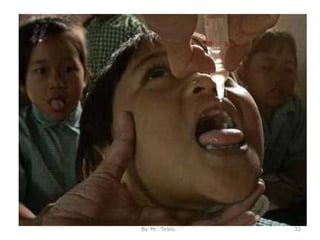
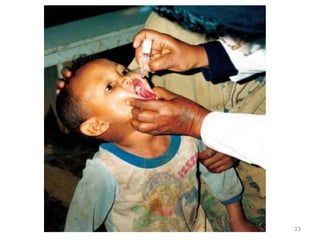
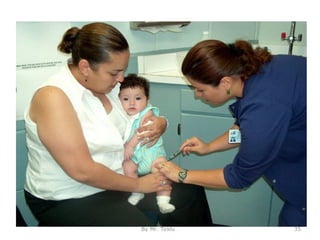
The Expanded Program
On Immunization
On Immunization
(EPI)
(EPI)
By Mr. Teklu w.
By Mr. Teklu w.
OBJECTIVES
At the end of the session you will be able to:
 Define immunization
 Explain the schedule for vaccination
 Discuss strategies of immunization
 Explain the cold chain
By Mr. Teklu . 2
IMMUNITY
Brainstorming
What is Immunity ?
What is Immunization ?
Types of Immunization ?
What is Vaccination ?
By Mr. Teklu . 3
Cont…
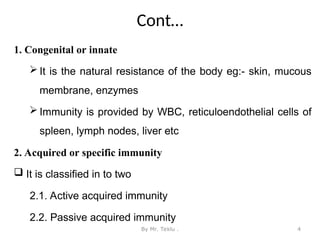
1. Congenital or innate
 It is the natural resistance of the body eg:- skin, mucous
membrane, enzymes
 Immunity is provided by WBC, reticuloendothelial cells of
spleen, lymph nodes, liver etc
2. Acquired or specific immunity
 It is classified in to two
2.1. Active acquired immunity
2.2. Passive acquired immunity
By Mr. Teklu . 4
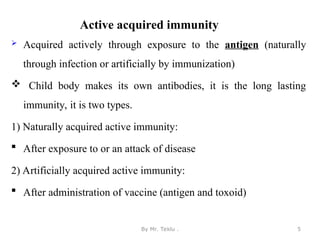
Active acquired immunity
 Acquired actively through exposure to the antigen (naturally
through infection or artificially by immunization)
 Child body makes its own antibodies, it is the long lasting
immunity, it is two types.
1) Naturally acquired active immunity:
 After exposure to or an attack of disease
2) Artificially acquired active immunity:
 After administration of vaccine (antigen and toxoid)
By Mr. Teklu . 5
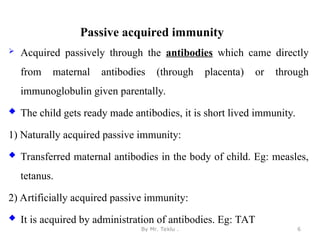
Passive acquired immunity
 Acquired passively through the antibodies which came directly
from maternal antibodies (through placenta) or through
immunoglobulin given parentally.
 The child gets ready made antibodies, it is short lived immunity.
1) Naturally acquired passive immunity:
 Transferred maternal antibodies in the body of child. Eg: measles,
tetanus.
2) Artificially acquired passive immunity:
 It is acquired by administration of antibodies. Eg: TAT
By Mr. Teklu . 6
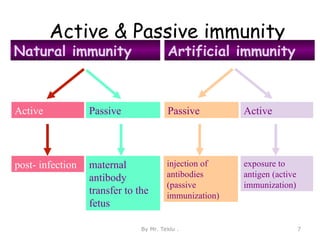
Active & Passive immunity
Natural immunity Artificial immunity
post- infection
Active
maternal
antibody
transfer to the
fetus
Passive
exposure to
antigen (active
immunization)
Active
injection of
antibodies
(passive
immunization)
Passive
By Mr. Teklu . 7
IMMUNIZATION
 A process of inducing immunity artificially by either vaccination
(active) or administration of antibodies (passive).
• Vaccination is administration of any vaccine or toxoid for
prevention of disease.
 Active immunization:- stimulating the immune system to produce
antibodies and cellular immune responses by giving antigens.
 Passive immunization:- providing temporary protection by
administration of exogenously produced antibodies or naturally
from the mother to the child.
By Mr. Teklu . 8
Expanded Program on Immunization
• The Expanded Program on Immunization is a World Health
Organization program with the goal to make vaccines
available to all children in order to prevent certain diseases.
• The objective of the EPI is to reduce mortality and morbidity
in children from the EPI target diseases through immunization
of all children under the age of one.
• “Expanded” means:-
By Mr. Teklu . 9
Objectives of EPI
1. To achieve 100% coverage with all EPI vaccines.
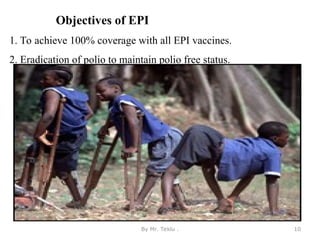
2. Eradication of polio to maintain polio free status.
By Mr. Teklu . 10
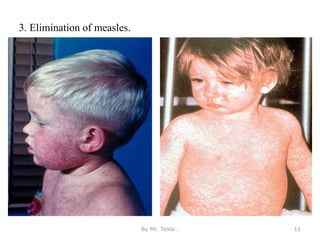
3. Elimination of measles.
By Mr. Teklu . 11
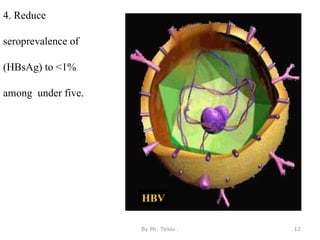
4. Reduce
seroprevalence of
(HBsAg) to <1%
among under five.
HBV
By Mr. Teklu . 12
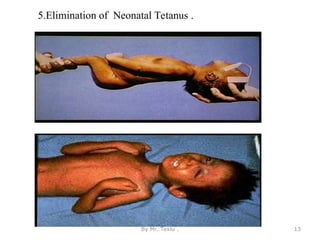
5.Elimination of Neonatal Tetanus .
By Mr. Teklu . 13
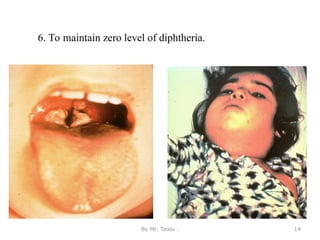
6. To maintain zero level of diphtheria.
By Mr. Teklu . 14
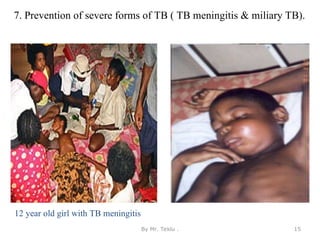
7. Prevention of severe forms of TB ( TB meningitis & miliary TB).
12 year old girl with TB meningitis
By Mr. Teklu . 15
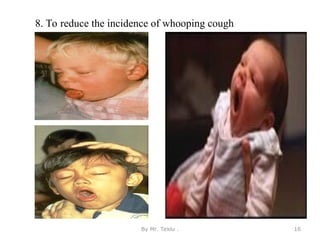
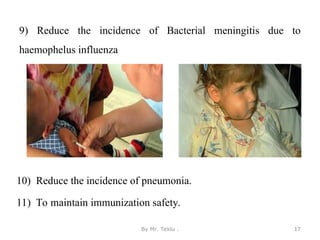
8. To reduce the incidence of whooping cough
By Mr. Teklu . 16
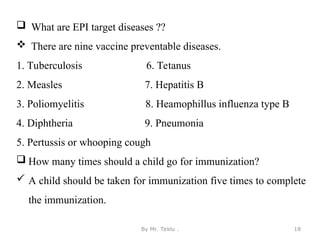
9) Reduce the incidence of Bacterial meningitis due to
haemophelus influenza
By Mr. Teklu . 17
10) Reduce the incidence of pneumonia.
11) To maintain immunization safety.
By Mr. Teklu . 18
 What are EPI target diseases ??
 There are nine vaccine preventable diseases.
1. Tuberculosis 6. Tetanus
2. Measles 7. Hepatitis B
3. Poliomyelitis 8. Heamophillus influenza type B
4. Diphtheria 9. Pneumonia
5. Pertussis or whooping cough
 How many times should a child go for immunization?
 A child should be taken for immunization five times to complete
the immunization.
By Mr. Teklu . 19
 The target groups for immunization are:-
 Under 1-years children and
 Women in the child bearing age (15-49 years).
 Acceptable proof of immunization are:-
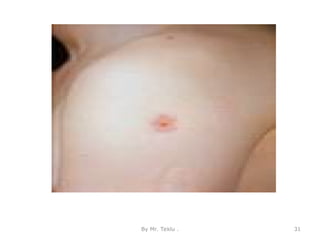
 BCG scar
 Immunization card.
 The recommended interval between two doses of live attenuated
and inactivated vaccine is only minimum limit of 1 month but
there is No maximum limit.
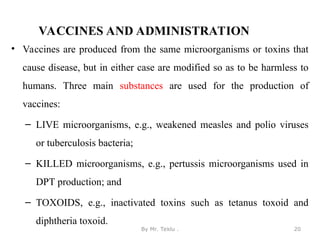
VACCINES AND ADMINISTRATION
• Vaccines are produced from the same microorganisms or toxins that
cause disease, but in either case are modified so as to be harmless to
humans. Three main substances are used for the production of
vaccines:
– LIVE microorganisms, e.g., weakened measles and polio viruses
or tuberculosis bacteria;
– KILLED microorganisms, e.g., pertussis microorganisms used in
DPT production; and
– TOXOIDS, e.g., inactivated toxins such as tetanus toxoid and
diphtheria toxoid.
By Mr. Teklu . 20
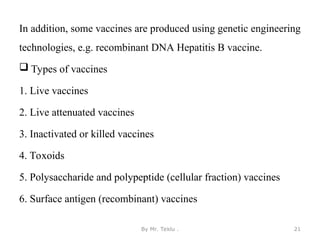
In addition, some vaccines are produced using genetic engineering
technologies, e.g. recombinant DNA Hepatitis B vaccine.
 Types of vaccines
1. Live vaccines
2. Live attenuated vaccines
3. Inactivated or killed vaccines
4. Toxoids
5. Polysaccharide and polypeptide (cellular fraction) vaccines
6. Surface antigen (recombinant) vaccines
By Mr. Teklu . 21
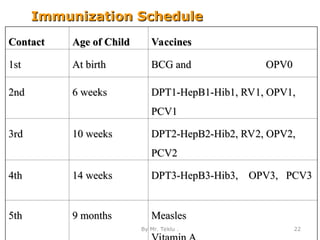
Contact
Contact Age of Child
Age of Child Vaccines
Vaccines
1st
1st At birth
At birth BCG and OPV0
BCG and OPV0
2nd
2nd 6 weeks
6 weeks DPT1-HepB1-Hib1, RV1, OPV1,
DPT1-HepB1-Hib1, RV1, OPV1,
PCV1
PCV1
3rd
3rd 10 weeks
10 weeks DPT2-HepB2-Hib2, RV2, OPV2,
DPT2-HepB2-Hib2, RV2, OPV2,
PCV2
PCV2
4th
4th 14 weeks
14 weeks DPT3-HepB3-Hib3, OPV3, PCV3
DPT3-HepB3-Hib3, OPV3, PCV3
5th
5th 9 months
9 months Measles
Measles
Immunization Schedule
By Mr. Teklu . 22
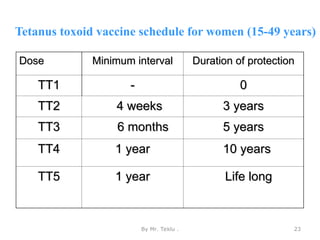
Dose
Dose Minimum interval
Minimum interval Duration of protection
Duration of protection
TT1
TT1 -
- 0
0
TT2
TT2 4 weeks
4 weeks 3 years
3 years
TT3
TT3 6 months
6 months 5 years
5 years
TT4
TT4 1 year
1 year 10 years
10 years
TT5
TT5 1 year
1 year Life long
Life long
Tetanus toxoid vaccine schedule for women (15-49 years)
By Mr. Teklu . 23
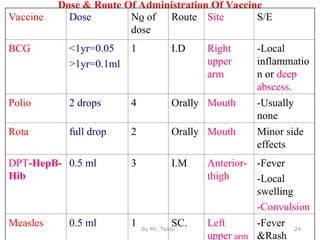
Dose & Route Of Administration Of Vaccine
Vaccine Dose No of
dose
Route Site S/E
BCG <1yr=0.05
>1yr=0.1ml
1 I.D Right
upper
arm
-Local
inflammatio
n or deep
abscess.
Polio 2 drops 4 Orally Mouth -Usually
none
Rota full drop 2 Orally Mouth Minor side
effects
DPT-HepB-
Hib
0.5 ml 3 I.M Anterior-
thigh
-Fever
-Local
swelling
-Convulsion
Measles 0.5 ml 1 SC. Left
upper arm
-Fever
&Rash
By Mr. Teklu . 24
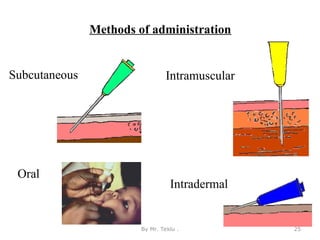
Methods of administration
Subcutaneous Intramuscular
Intradermal
Oral
By Mr. Teklu . 25
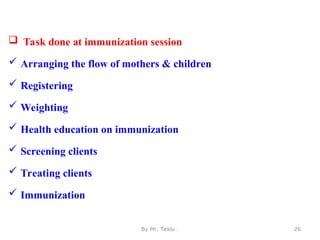
 Task done at immunization session
 Arranging the flow of mothers & children
 Registering
 Weighting
 Health education on immunization
 Screening clients
 Treating clients
 Immunization
By Mr. Teklu . 26
By Mr. Teklu . 27
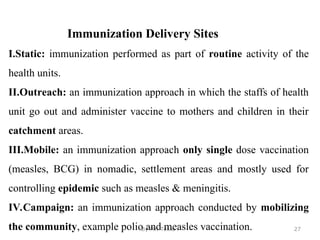
Immunization Delivery Sites
I.Static: immunization performed as part of routine activity of the
health units.
II.Outreach: an immunization approach in which the staffs of health
unit go out and administer vaccine to mothers and children in their
catchment areas.
III.Mobile: an immunization approach only single dose vaccination
(measles, BCG) in nomadic, settlement areas and mostly used for
controlling epidemic such as measles & meningitis.
IV.Campaign: an immunization approach conducted by mobilizing
the community, example polio and measles vaccination.
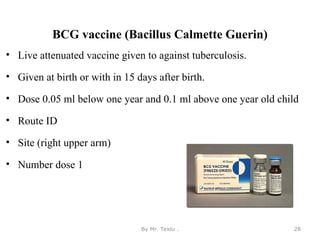
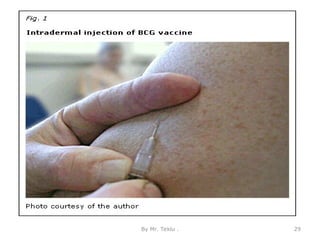
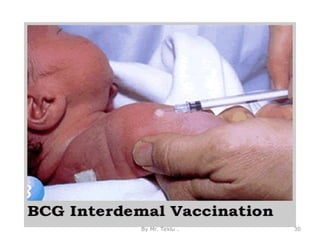
BCG vaccine (Bacillus Calmette Guerin)
• Live attenuated vaccine given to against tuberculosis.
• Given at birth or with in 15 days after birth.
• Dose 0.05 ml below one year and 0.1 ml above one year old child
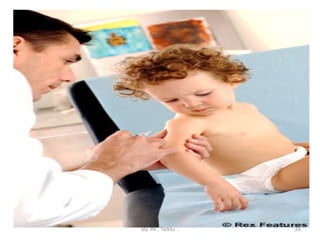
• Route ID
• Site (right upper arm)
• Number dose 1
By Mr. Teklu . 28
By Mr. Teklu . 29
By Mr. Teklu . 30
By Mr. Teklu . 31
By Mr. Teklu . 32
By Mr. Teklu . 33
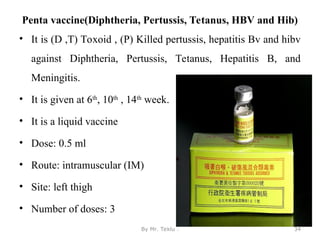
Penta vaccine(Diphtheria, Pertussis, Tetanus, HBV and Hib)
• It is (D ,T) Toxoid , (P) Killed pertussis, hepatitis Bv and hibv
against Diphtheria, Pertussis, Tetanus, Hepatitis B, and
Meningitis.
• It is given at 6th
, 10th
, 14th
week.
• It is a liquid vaccine
• Dose: 0.5 ml
• Route: intramuscular (IM)
• Site: left thigh
• Number of doses: 3
By Mr. Teklu . 34
By Mr. Teklu . 35
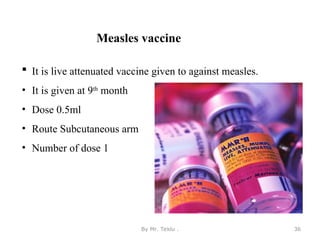
Measles vaccine
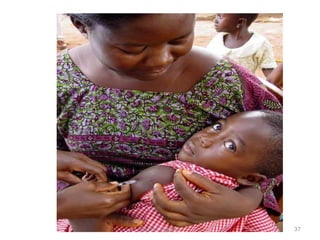
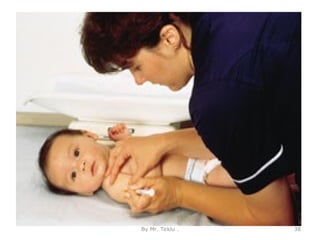
 It is live attenuated vaccine given to against measles.
• It is given at 9th
month
• Dose 0.5ml
• Route Subcutaneous arm
• Number of dose 1
By Mr. Teklu . 36
By Mr. Teklu . 37
By Mr. Teklu . 38
By Mr. Teklu . 39
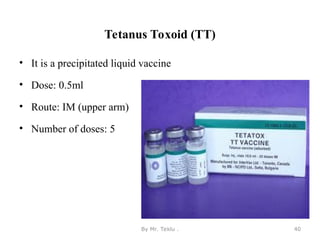
Tetanus Toxoid (TT)
• It is a precipitated liquid vaccine
• Dose: 0.5ml
• Route: IM (upper arm)
• Number of doses: 5
By Mr. Teklu . 40
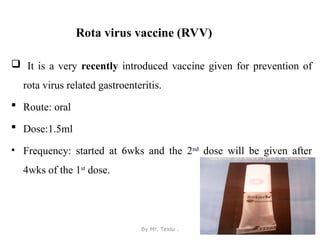
Rota virus vaccine (RVV)
 It is a very recently introduced vaccine given for prevention of
rota virus related gastroenteritis.
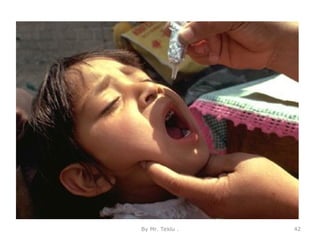
 Route: oral
 Dose:1.5ml
• Frequency: started at 6wks and the 2nd
dose will be given after
4wks of the 1st
dose.
By Mr. Teklu . 41
By Mr. Teklu . 42
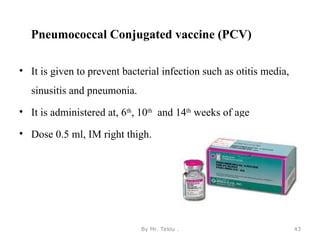
Pneumococcal Conjugated vaccine (PCV)
• It is given to prevent bacterial infection such as otitis media,
sinusitis and pneumonia.
• It is administered at, 6th
, 10th
and 14th
weeks of age
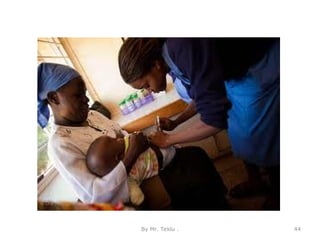
• Dose 0.5 ml, IM right thigh.
By Mr. Teklu . 43
By Mr. Teklu . 44
Contraindications to vaccinations
1. Absolute
• History of anaphylactic reactions.
• Subsequent doses of pertussis vaccines are absolutely
contraindicated if the child gets (within 48 hours of vaccination.
– Fever (40.5ºc) ,
– Collapse or shock .
– Persistent crying for 3 hours without apparent cause.
– Convulsion with or without fever within 3 hours after
vaccination.
By Mr. Teklu . 45
• A vaccine should not be administered to any patient who has
previously experienced a severe reaction to that vaccine.
This is because they are at risk of another potentially serious
allergic reaction.
• Just in case a vaccine should suffer a severe allergic reaction
to vaccination, a solution of 1:1000 adrenaline or
epinephrine should always be available for immediate
injection to counter such a reaction.
By Mr. Teklu . 46
• The presence of a minor infection is not a contra-indication to
vaccination.
• Vaccinations are generally not carried out during pregnancy, with
the exception of tetanus vaccination of pregnant women or women
of child bearing age, in order to prevent neonatal tetanus or
tetanus in the mother at the time of delivery.
 HIV infection with clinical AIDS is an absolute contraindication
to administer live attenuated vaccines (OPV & BCG), so infants
with clinical AIDS should not receive BCG vaccination.
By Mr. Teklu . 47
2. Invalid contraindication
• Mild to moderate local reaction.
• Prematurity and low birth weight.
• Malnutrition
• Mild acute illness with or without low grade fever
By Mr. Teklu . 48
Side effects of vaccines
BCG
1. Normal reaction
– a small red, tender swelling about 10 mm appears at the place of
immunization after about 2 weeks
– Abscess: due to injection errors
– Ulcer
– Scar
• NB:- Advise not to put any medicine on the sore (it heals in 2-3
months & leave a scar).
By Mr. Teklu . 49
Cont’d…
2. Severe reaction
– Sometimes there is severe local inflammation or deeper abscess.
– Sometimes the lymphatic glands near the elbow or in the axilla
swell.
– This may be because:-
 of using a needle that is not sterile
 of giving too large dose of vaccine.
 of injecting too deeply under the skin by mistake & it causes
abscess and enlarged glands
By Mr. Teklu . 50
Cont’d…
Cont’d…
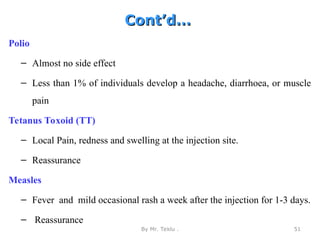
Polio
– Almost no side effect
– Less than 1% of individuals develop a headache, diarrhoea, or muscle
pain
Tetanus Toxoid (TT)
– Local Pain, redness and swelling at the injection site.
– Reassurance
Measles
– Fever and mild occasional rash a week after the injection for 1-3 days.
– Reassurance
By Mr. Teklu . 51
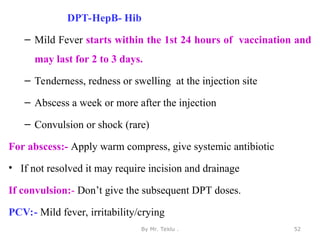
DPT-HepB- Hib
– Mild Fever starts within the 1st 24 hours of vaccination and
may last for 2 to 3 days.
– Tenderness, redness or swelling at the injection site
– Abscess a week or more after the injection
– Convulsion or shock (rare)
For abscess:- Apply warm compress, give systemic antibiotic
• If not resolved it may require incision and drainage
If convulsion:- Don’t give the subsequent DPT doses.
PCV:- Mild fever, irritability/crying
By Mr. Teklu . 52
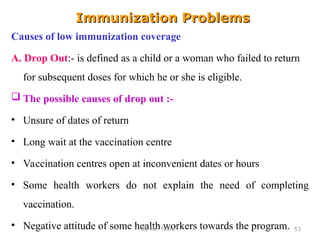
Immunization Problems
Causes of low immunization coverage
A. Drop Out:- is defined as a child or a woman who failed to return
for subsequent doses for which he or she is eligible.
 The possible causes of drop out :-
• Unsure of dates of return
• Long wait at the vaccination centre
• Vaccination centres open at inconvenient dates or hours
• Some health workers do not explain the need of completing
vaccination.
• Negative attitude of some health workers towards the program.
By Mr. Teklu . 53
Cont’d…
Cont’d…
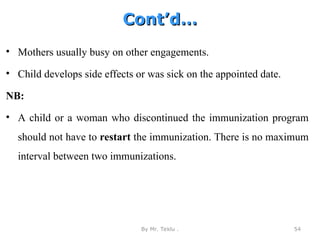
• Mothers usually busy on other engagements.
• Child develops side effects or was sick on the appointed date.
NB:
• A child or a woman who discontinued the immunization program
should not have to restart the immunization. There is no maximum
interval between two immunizations.
By Mr. Teklu . 54
Cont’d…
Cont’d…
Drop out rate calculation
i. Over all drop out rate =
Coverage with BCG - coverage with measles X 100
Coverage with BCG
ii. Drop out rate of a single antigen (e.g. DPT) =
Coverage with DPT1 - coverage with DPT3 X 100
Coverage with DPT1
NB: If drop out rate >10%, it is essential to determine why the failure
occurred.
By Mr. Teklu . 55
B. Missed opportunities:- it occurs when a child or a woman
in child bearing period comes to the health facility or
outreach site and does not receive any of the vaccine
doses for which he or she is eligible.
• Current policy is that all children and mothers at the
health facility for any reason should be screened for
immunization status and vaccinated if eligible.
The reasons for missed opportunity are:
Health workers practices.
health workers screen but tell patients to return later
health workers only vaccinate women with TT if they are
pregnant
health workers only open a vial if there are enough clients
who need it By Mr. Teklu . 56
• Logistical problems such as vaccine shortages, poor clinic
organization, and
• Failure to administer simultaneously all the vaccines for which
the child is eligible.
• Accessibility: time (women carry household responsibilities),
distance, cost of transportation
• Acceptability: culture, rumours, beliefs, etc.
• False contraindications to immunization, for example; not giving
polio vaccine to a child with diarrhea.
By Mr. Teklu . 57
Cont’d…
Cont’d…
False contraindications to immunization:
 Conditions that are wrongly considered as contraindications:
 Minor illness( respiratory tract infections, diarrhea, fever < 38.5°C).
 Premature or small for date infants.
 Child being breast-feed.
 Family history of convulsion.
 History of jaundice at birth
By Mr. Teklu . 58
 Drop out & missed opportunities are the major cause of low
vaccination coverage.
 What are the possible solutions ????
Potential solution
Social mobilization
Drop out tracing mechanisms
Get commitment by the local leaders
Monitoring & supervising the program
In service training to community HEW
Ensure financial & logistic support for the health institutions
By Mr. Teklu . 59
60
By Mr. Teklu . 60
What damages vaccines?
• Vaccines are biological substances that may lose their effectiveness
quickly if they become too hot or too cold, especially during transport
and storage. May result in failure of the vaccine to protect, as well as
resulting in vaccine wastage.
• Vaccine can easily damaged if not handled properly.
• If the vaccine is in good condition, and able to make a child
immune, it is potent.
• If the vaccine is damaged and not able to make a child immune, it
has lost its potency.
By Mr. Teklu . 61
 What damage the Vaccines?
1. Any defect in the cold chain.
2. Out date expiry.
3. Using skin antiseptic at the site of injection (e.g. BCG).
4. Using the reconstituted vaccine ( measles, BCG) after the
recommended period ( 6 hours).
5. Exposure of the vaccine to unacceptable temperature
during the immunization session.
6. Exposure of the vaccine to direct sunlight (BCG)
By Mr. Teklu . 62
Heat, sun light and freezing
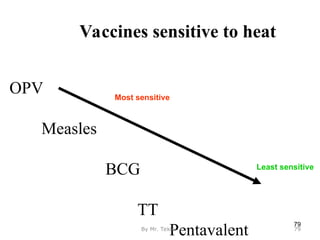
• Heat and sunlight damage all vaccine, but (live vaccine) most
sensitive
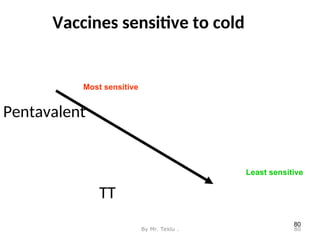
• Freezing damage DPT and TT vaccine.
• Keep all vaccine at the correct cold temp.
• If vaccine once damaged, you can’t make potent it again.
• Chemicals (disinfectant, soap) etc, can damage the vaccine.
• The correct temperature to store vaccine is between +20c and
+80c (+20c to +80c)
• Use thermometer in your refrigerator or vaccine carrier to
measure the temperature of your vaccine.
• Polio-Vaccine is damaged very quickly by heat than other
vaccines. It does not damage by freezing.
By Mr. Teklu . 63
BCG-Vaccine B=Bacillus C= Calmette G=Guerin:
- has come as dry powder in container
- is damaged most easily by sun light.
- Damaged by heat but not as quick as (polio and measles)
DPT & TT Vaccine
• Has contains “3” vaccine.
• Damaged by heat but not as quickly as the live vaccine.
– Are liquid vaccine
Measles vaccine
• It is freeze dried vaccine which needs reconstitution.
• is easily damaged by heat.
• Reconstituted vaccine losses its potency very quickly, you must
use it in same immunization session, or throw it out.
By Mr. Teklu . 64
Cold Chain
 System that ensure potency, quality & safety of vaccines by
maintaining the correct temperature from manufacturer to
children/women.
 The cold chain system is a means for storing and transporting
vaccines in a potent state from the manufacturer to the person being
immunized.
 Maintaining the cold chain ensures that vaccines are transported
and stored according to the manufacturer's recommended temp
range +20c to +80c until point of administration.
By Mr. Teklu . 65
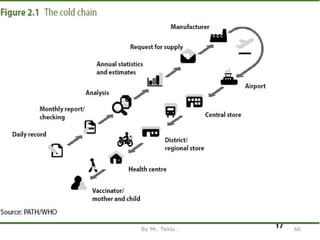
The levels of cold chain
By Mr. Teklu . 66
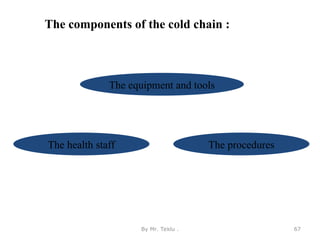
The equipment and tools
The procedures
The health staff
The components of the cold chain :
By Mr. Teklu . 67
Refrigeration equipment:
 Refrigerator
 Cold boxes
 Vaccine carriers
 The ice packs retained in the freezer
- To stabilize the temperature of the refrigerator at the
optimum level.
- Fully frozen ice-packs are used for lining the vaccines
- Carriers and the cold boxes during storing the vaccines
By Mr. Teklu . 68
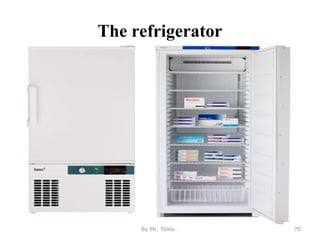
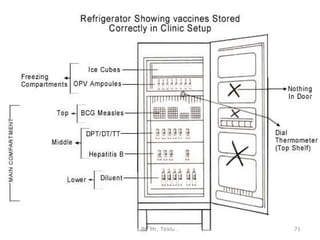
The refrigerator
• Placed in the coolest place of the health centers away from sunlight
• Well ventilated and adequate air circulation around it .
• Kept locked and open only when necessary.
• Ice packs are kept in the freezer.
• Its temperature is recorded twice daily.
• Drugs, drinks or food must not be stored in the refrigerator
• Both the monitor and thermometer are placed in the refrigerator.
• The temperature chart is stuck on the door outside the refrigerator.
• The diluents should be kept on the lowest shelf.
By Mr. Teklu . 69
The refrigerator
By Mr. Teklu . 70
By Mr. Teklu . 71
Cold Boxes And Vaccine Carriers
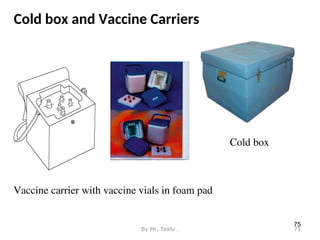
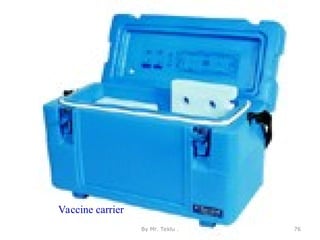
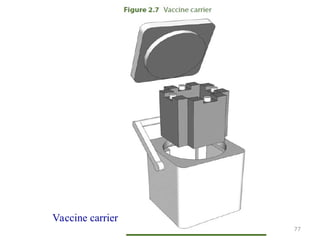
• Vaccine carriers and cold boxes must be well dried after their use. If
they are left wet with their lids closed, they will become mouldy.
Mould may affect the seal of the cold boxes and vaccine carriers.
• Knocks and sunlight can cause cracks in the walls and lids of cold
boxes and vaccine carriers. If this happens the vaccines inside will
be exposed to heat.
By Mr. Teklu . 72
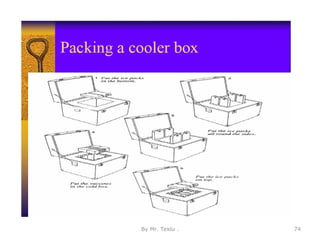
Packing a cooler box
1. Take all the frozen ice packs you need from the freezer and
condition them.
2. Put ice packs against each of the four sides of the cold box or
vaccine carrier.
3. Take all the vaccines and diluent you need from the main section of
the refrigerator and close the door.
4. Put the vaccines and diluent in the middle of the cold box or carrier.
Vials may be kept in their boxes or packed without them, depending
on how many vials you need.
By Mr. Teklu . 73
74
By Mr. Teklu . 74
Cold box and Vaccine Carriers
Vaccine carrier with vaccine vials in foam pad
Cold box
75
By Mr. Teklu . 75
Vaccine carrier
By Mr. Teklu . 76
Vaccine carrier
By Mr. Teklu . 77
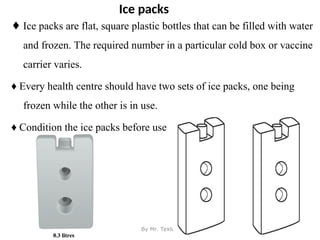
Ice packs
♦ Ice packs are flat, square plastic bottles that can be filled with water
and frozen. The required number in a particular cold box or vaccine
carrier varies.
♦ Every health centre should have two sets of ice packs, one being
frozen while the other is in use.
♦ Condition the ice packs before use
78
By Mr. Teklu . 78
Vaccines sensitive to heat
OPV
Measles
BCG
TT
Pentavalent
Most sensitive
Least sensitive
79
By Mr. Teklu . 79
Vaccines sensitive to cold
Pentavalent
TT
Most sensitive
Least sensitive
80
By Mr. Teklu . 80
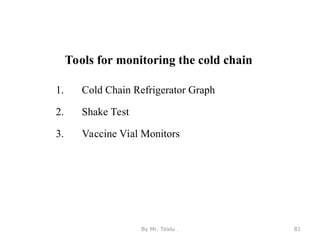
Tools for monitoring the cold chain
1. Cold Chain Refrigerator Graph
2. Shake Test
3. Vaccine Vial Monitors
By Mr. Teklu . 81
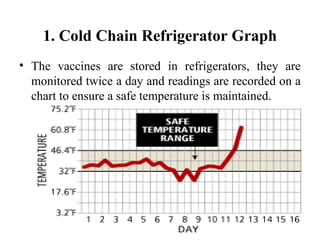
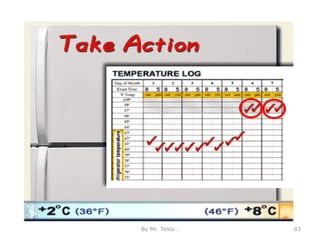
1. Cold Chain Refrigerator Graph
• The vaccines are stored in refrigerators, they are
monitored twice a day and readings are recorded on a
chart to ensure a safe temperature is maintained.
By Mr. Teklu . 82
By Mr. Teklu . 83
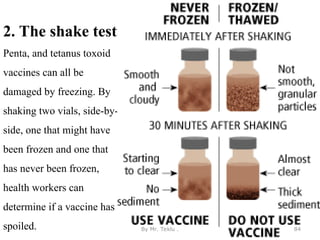
2. The shake test
Penta, and tetanus toxoid
vaccines can all be
damaged by freezing. By
shaking two vials, side-by-
side, one that might have
been frozen and one that
has never been frozen,
health workers can
determine if a vaccine has
spoiled. By Mr. Teklu . 84
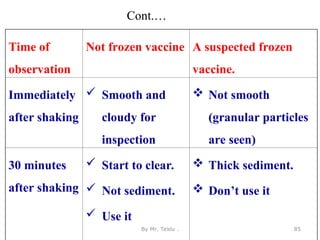
Cont.…
Time of
observation
Not frozen vaccine A suspected frozen
vaccine.
Immediately
after shaking
 Smooth and
cloudy for
inspection
 Not smooth
(granular particles
are seen)
30 minutes
after shaking
 Start to clear.
 Not sediment.
 Use it
 Thick sediment.
 Don’t use it
By Mr. Teklu . 85
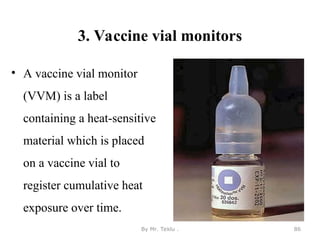
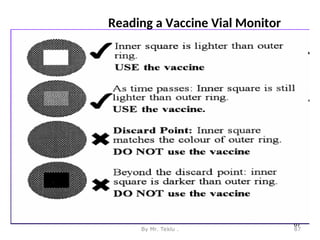
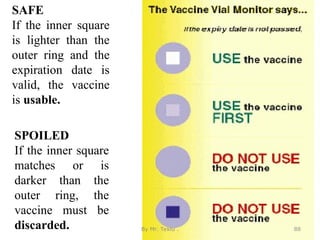
3. Vaccine vial monitors
• A vaccine vial monitor
(VVM) is a label
containing a heat-sensitive
material which is placed
on a vaccine vial to
register cumulative heat
exposure over time.
By Mr. Teklu . 86
Reading a Vaccine Vial Monitor
87
By Mr. Teklu . 87
SAFE
If the inner square
is lighter than the
outer ring and the
expiration date is
valid, the vaccine
is usable.
SPOILED
If the inner square
matches or is
darker than the
outer ring, the
vaccine must be
discarded. By Mr. Teklu . 88
By Mr. Teklu . 89
By Mr. Teklu . 90
Quiz (5%)
1.What are EPI target groups ?
2.Write tools used to monitor cold chain
3.Write factors w/c determine nature and magnitude of immune
response
4.List & explain immunization delivery sites
5.What are acceptable proof of immunization ?

the expanded program on immunization (Epi.ppt

  • 1.
    The Expanded Program TheExpanded Program On Immunization On Immunization (EPI) (EPI) By Mr. Teklu w. By Mr. Teklu w.
  • 2.
    OBJECTIVES At the endof the session you will be able to:  Define immunization  Explain the schedule for vaccination  Discuss strategies of immunization  Explain the cold chain By Mr. Teklu . 2
  • 3.
    IMMUNITY Brainstorming What is Immunity? What is Immunization ? Types of Immunization ? What is Vaccination ? By Mr. Teklu . 3
  • 4.
    Cont… 1. Congenital orinnate  It is the natural resistance of the body eg:- skin, mucous membrane, enzymes  Immunity is provided by WBC, reticuloendothelial cells of spleen, lymph nodes, liver etc 2. Acquired or specific immunity  It is classified in to two 2.1. Active acquired immunity 2.2. Passive acquired immunity By Mr. Teklu . 4
  • 5.
    Active acquired immunity Acquired actively through exposure to the antigen (naturally through infection or artificially by immunization)  Child body makes its own antibodies, it is the long lasting immunity, it is two types. 1) Naturally acquired active immunity:  After exposure to or an attack of disease 2) Artificially acquired active immunity:  After administration of vaccine (antigen and toxoid) By Mr. Teklu . 5
  • 6.
    Passive acquired immunity Acquired passively through the antibodies which came directly from maternal antibodies (through placenta) or through immunoglobulin given parentally.  The child gets ready made antibodies, it is short lived immunity. 1) Naturally acquired passive immunity:  Transferred maternal antibodies in the body of child. Eg: measles, tetanus. 2) Artificially acquired passive immunity:  It is acquired by administration of antibodies. Eg: TAT By Mr. Teklu . 6
  • 7.
    Active & Passiveimmunity Natural immunity Artificial immunity post- infection Active maternal antibody transfer to the fetus Passive exposure to antigen (active immunization) Active injection of antibodies (passive immunization) Passive By Mr. Teklu . 7
  • 8.
    IMMUNIZATION  A processof inducing immunity artificially by either vaccination (active) or administration of antibodies (passive). • Vaccination is administration of any vaccine or toxoid for prevention of disease.  Active immunization:- stimulating the immune system to produce antibodies and cellular immune responses by giving antigens.  Passive immunization:- providing temporary protection by administration of exogenously produced antibodies or naturally from the mother to the child. By Mr. Teklu . 8
  • 9.
    Expanded Program onImmunization • The Expanded Program on Immunization is a World Health Organization program with the goal to make vaccines available to all children in order to prevent certain diseases. • The objective of the EPI is to reduce mortality and morbidity in children from the EPI target diseases through immunization of all children under the age of one. • “Expanded” means:- By Mr. Teklu . 9
  • 10.
    Objectives of EPI 1.To achieve 100% coverage with all EPI vaccines. 2. Eradication of polio to maintain polio free status. By Mr. Teklu . 10
  • 11.
    3. Elimination ofmeasles. By Mr. Teklu . 11
  • 12.
    4. Reduce seroprevalence of (HBsAg)to <1% among under five. HBV By Mr. Teklu . 12
  • 13.
    5.Elimination of NeonatalTetanus . By Mr. Teklu . 13
  • 14.
    6. To maintainzero level of diphtheria. By Mr. Teklu . 14
  • 15.
    7. Prevention ofsevere forms of TB ( TB meningitis & miliary TB). 12 year old girl with TB meningitis By Mr. Teklu . 15
  • 16.
    8. To reducethe incidence of whooping cough By Mr. Teklu . 16
  • 17.
    9) Reduce theincidence of Bacterial meningitis due to haemophelus influenza By Mr. Teklu . 17 10) Reduce the incidence of pneumonia. 11) To maintain immunization safety.
  • 18.
    By Mr. Teklu. 18  What are EPI target diseases ??  There are nine vaccine preventable diseases. 1. Tuberculosis 6. Tetanus 2. Measles 7. Hepatitis B 3. Poliomyelitis 8. Heamophillus influenza type B 4. Diphtheria 9. Pneumonia 5. Pertussis or whooping cough  How many times should a child go for immunization?  A child should be taken for immunization five times to complete the immunization.
  • 19.
    By Mr. Teklu. 19  The target groups for immunization are:-  Under 1-years children and  Women in the child bearing age (15-49 years).  Acceptable proof of immunization are:-  BCG scar  Immunization card.  The recommended interval between two doses of live attenuated and inactivated vaccine is only minimum limit of 1 month but there is No maximum limit.
  • 20.
    VACCINES AND ADMINISTRATION •Vaccines are produced from the same microorganisms or toxins that cause disease, but in either case are modified so as to be harmless to humans. Three main substances are used for the production of vaccines: – LIVE microorganisms, e.g., weakened measles and polio viruses or tuberculosis bacteria; – KILLED microorganisms, e.g., pertussis microorganisms used in DPT production; and – TOXOIDS, e.g., inactivated toxins such as tetanus toxoid and diphtheria toxoid. By Mr. Teklu . 20
  • 21.
    In addition, somevaccines are produced using genetic engineering technologies, e.g. recombinant DNA Hepatitis B vaccine.  Types of vaccines 1. Live vaccines 2. Live attenuated vaccines 3. Inactivated or killed vaccines 4. Toxoids 5. Polysaccharide and polypeptide (cellular fraction) vaccines 6. Surface antigen (recombinant) vaccines By Mr. Teklu . 21
  • 22.
    Contact Contact Age ofChild Age of Child Vaccines Vaccines 1st 1st At birth At birth BCG and OPV0 BCG and OPV0 2nd 2nd 6 weeks 6 weeks DPT1-HepB1-Hib1, RV1, OPV1, DPT1-HepB1-Hib1, RV1, OPV1, PCV1 PCV1 3rd 3rd 10 weeks 10 weeks DPT2-HepB2-Hib2, RV2, OPV2, DPT2-HepB2-Hib2, RV2, OPV2, PCV2 PCV2 4th 4th 14 weeks 14 weeks DPT3-HepB3-Hib3, OPV3, PCV3 DPT3-HepB3-Hib3, OPV3, PCV3 5th 5th 9 months 9 months Measles Measles Immunization Schedule Immunization Schedule By Mr. Teklu . 22
  • 23.
    Dose Dose Minimum interval Minimuminterval Duration of protection Duration of protection TT1 TT1 - - 0 0 TT2 TT2 4 weeks 4 weeks 3 years 3 years TT3 TT3 6 months 6 months 5 years 5 years TT4 TT4 1 year 1 year 10 years 10 years TT5 TT5 1 year 1 year Life long Life long Tetanus toxoid vaccine schedule for women (15-49 years) By Mr. Teklu . 23
  • 24.
    Dose & RouteOf Administration Of Vaccine Vaccine Dose No of dose Route Site S/E BCG <1yr=0.05 >1yr=0.1ml 1 I.D Right upper arm -Local inflammatio n or deep abscess. Polio 2 drops 4 Orally Mouth -Usually none Rota full drop 2 Orally Mouth Minor side effects DPT-HepB- Hib 0.5 ml 3 I.M Anterior- thigh -Fever -Local swelling -Convulsion Measles 0.5 ml 1 SC. Left upper arm -Fever &Rash By Mr. Teklu . 24
  • 25.
    Methods of administration SubcutaneousIntramuscular Intradermal Oral By Mr. Teklu . 25
  • 26.
     Task doneat immunization session  Arranging the flow of mothers & children  Registering  Weighting  Health education on immunization  Screening clients  Treating clients  Immunization By Mr. Teklu . 26
  • 27.
    By Mr. Teklu. 27 Immunization Delivery Sites I.Static: immunization performed as part of routine activity of the health units. II.Outreach: an immunization approach in which the staffs of health unit go out and administer vaccine to mothers and children in their catchment areas. III.Mobile: an immunization approach only single dose vaccination (measles, BCG) in nomadic, settlement areas and mostly used for controlling epidemic such as measles & meningitis. IV.Campaign: an immunization approach conducted by mobilizing the community, example polio and measles vaccination.
  • 28.
    BCG vaccine (BacillusCalmette Guerin) • Live attenuated vaccine given to against tuberculosis. • Given at birth or with in 15 days after birth. • Dose 0.05 ml below one year and 0.1 ml above one year old child • Route ID • Site (right upper arm) • Number dose 1 By Mr. Teklu . 28
  • 29.
  • 30.
  • 31.
  • 32.
  • 33.
  • 34.
    Penta vaccine(Diphtheria, Pertussis,Tetanus, HBV and Hib) • It is (D ,T) Toxoid , (P) Killed pertussis, hepatitis Bv and hibv against Diphtheria, Pertussis, Tetanus, Hepatitis B, and Meningitis. • It is given at 6th , 10th , 14th week. • It is a liquid vaccine • Dose: 0.5 ml • Route: intramuscular (IM) • Site: left thigh • Number of doses: 3 By Mr. Teklu . 34
  • 35.
  • 36.
    Measles vaccine  Itis live attenuated vaccine given to against measles. • It is given at 9th month • Dose 0.5ml • Route Subcutaneous arm • Number of dose 1 By Mr. Teklu . 36
  • 37.
  • 38.
  • 39.
  • 40.
    Tetanus Toxoid (TT) •It is a precipitated liquid vaccine • Dose: 0.5ml • Route: IM (upper arm) • Number of doses: 5 By Mr. Teklu . 40
  • 41.
    Rota virus vaccine(RVV)  It is a very recently introduced vaccine given for prevention of rota virus related gastroenteritis.  Route: oral  Dose:1.5ml • Frequency: started at 6wks and the 2nd dose will be given after 4wks of the 1st dose. By Mr. Teklu . 41
  • 42.
  • 43.
    Pneumococcal Conjugated vaccine(PCV) • It is given to prevent bacterial infection such as otitis media, sinusitis and pneumonia. • It is administered at, 6th , 10th and 14th weeks of age • Dose 0.5 ml, IM right thigh. By Mr. Teklu . 43
  • 44.
  • 45.
    Contraindications to vaccinations 1.Absolute • History of anaphylactic reactions. • Subsequent doses of pertussis vaccines are absolutely contraindicated if the child gets (within 48 hours of vaccination. – Fever (40.5ºc) , – Collapse or shock . – Persistent crying for 3 hours without apparent cause. – Convulsion with or without fever within 3 hours after vaccination. By Mr. Teklu . 45
  • 46.
    • A vaccineshould not be administered to any patient who has previously experienced a severe reaction to that vaccine. This is because they are at risk of another potentially serious allergic reaction. • Just in case a vaccine should suffer a severe allergic reaction to vaccination, a solution of 1:1000 adrenaline or epinephrine should always be available for immediate injection to counter such a reaction. By Mr. Teklu . 46
  • 47.
    • The presenceof a minor infection is not a contra-indication to vaccination. • Vaccinations are generally not carried out during pregnancy, with the exception of tetanus vaccination of pregnant women or women of child bearing age, in order to prevent neonatal tetanus or tetanus in the mother at the time of delivery.  HIV infection with clinical AIDS is an absolute contraindication to administer live attenuated vaccines (OPV & BCG), so infants with clinical AIDS should not receive BCG vaccination. By Mr. Teklu . 47
  • 48.
    2. Invalid contraindication •Mild to moderate local reaction. • Prematurity and low birth weight. • Malnutrition • Mild acute illness with or without low grade fever By Mr. Teklu . 48
  • 49.
    Side effects ofvaccines Side effects of vaccines BCG 1. Normal reaction – a small red, tender swelling about 10 mm appears at the place of immunization after about 2 weeks – Abscess: due to injection errors – Ulcer – Scar • NB:- Advise not to put any medicine on the sore (it heals in 2-3 months & leave a scar). By Mr. Teklu . 49
  • 50.
    Cont’d… 2. Severe reaction –Sometimes there is severe local inflammation or deeper abscess. – Sometimes the lymphatic glands near the elbow or in the axilla swell. – This may be because:-  of using a needle that is not sterile  of giving too large dose of vaccine.  of injecting too deeply under the skin by mistake & it causes abscess and enlarged glands By Mr. Teklu . 50
  • 51.
    Cont’d… Cont’d… Polio – Almost noside effect – Less than 1% of individuals develop a headache, diarrhoea, or muscle pain Tetanus Toxoid (TT) – Local Pain, redness and swelling at the injection site. – Reassurance Measles – Fever and mild occasional rash a week after the injection for 1-3 days. – Reassurance By Mr. Teklu . 51
  • 52.
    DPT-HepB- Hib – MildFever starts within the 1st 24 hours of vaccination and may last for 2 to 3 days. – Tenderness, redness or swelling at the injection site – Abscess a week or more after the injection – Convulsion or shock (rare) For abscess:- Apply warm compress, give systemic antibiotic • If not resolved it may require incision and drainage If convulsion:- Don’t give the subsequent DPT doses. PCV:- Mild fever, irritability/crying By Mr. Teklu . 52
  • 53.
    Immunization Problems Immunization Problems Causesof low immunization coverage A. Drop Out:- is defined as a child or a woman who failed to return for subsequent doses for which he or she is eligible.  The possible causes of drop out :- • Unsure of dates of return • Long wait at the vaccination centre • Vaccination centres open at inconvenient dates or hours • Some health workers do not explain the need of completing vaccination. • Negative attitude of some health workers towards the program. By Mr. Teklu . 53
  • 54.
    Cont’d… Cont’d… • Mothers usuallybusy on other engagements. • Child develops side effects or was sick on the appointed date. NB: • A child or a woman who discontinued the immunization program should not have to restart the immunization. There is no maximum interval between two immunizations. By Mr. Teklu . 54
  • 55.
    Cont’d… Cont’d… Drop out ratecalculation i. Over all drop out rate = Coverage with BCG - coverage with measles X 100 Coverage with BCG ii. Drop out rate of a single antigen (e.g. DPT) = Coverage with DPT1 - coverage with DPT3 X 100 Coverage with DPT1 NB: If drop out rate >10%, it is essential to determine why the failure occurred. By Mr. Teklu . 55
  • 56.
    B. Missed opportunities:-it occurs when a child or a woman in child bearing period comes to the health facility or outreach site and does not receive any of the vaccine doses for which he or she is eligible. • Current policy is that all children and mothers at the health facility for any reason should be screened for immunization status and vaccinated if eligible. The reasons for missed opportunity are: Health workers practices. health workers screen but tell patients to return later health workers only vaccinate women with TT if they are pregnant health workers only open a vial if there are enough clients who need it By Mr. Teklu . 56
  • 57.
    • Logistical problemssuch as vaccine shortages, poor clinic organization, and • Failure to administer simultaneously all the vaccines for which the child is eligible. • Accessibility: time (women carry household responsibilities), distance, cost of transportation • Acceptability: culture, rumours, beliefs, etc. • False contraindications to immunization, for example; not giving polio vaccine to a child with diarrhea. By Mr. Teklu . 57
  • 58.
    Cont’d… Cont’d… False contraindications toimmunization:  Conditions that are wrongly considered as contraindications:  Minor illness( respiratory tract infections, diarrhea, fever < 38.5°C).  Premature or small for date infants.  Child being breast-feed.  Family history of convulsion.  History of jaundice at birth By Mr. Teklu . 58
  • 59.
     Drop out& missed opportunities are the major cause of low vaccination coverage.  What are the possible solutions ???? Potential solution Social mobilization Drop out tracing mechanisms Get commitment by the local leaders Monitoring & supervising the program In service training to community HEW Ensure financial & logistic support for the health institutions By Mr. Teklu . 59
  • 60.
  • 61.
    What damages vaccines? •Vaccines are biological substances that may lose their effectiveness quickly if they become too hot or too cold, especially during transport and storage. May result in failure of the vaccine to protect, as well as resulting in vaccine wastage. • Vaccine can easily damaged if not handled properly. • If the vaccine is in good condition, and able to make a child immune, it is potent. • If the vaccine is damaged and not able to make a child immune, it has lost its potency. By Mr. Teklu . 61
  • 62.
     What damagethe Vaccines? 1. Any defect in the cold chain. 2. Out date expiry. 3. Using skin antiseptic at the site of injection (e.g. BCG). 4. Using the reconstituted vaccine ( measles, BCG) after the recommended period ( 6 hours). 5. Exposure of the vaccine to unacceptable temperature during the immunization session. 6. Exposure of the vaccine to direct sunlight (BCG) By Mr. Teklu . 62
  • 63.
    Heat, sun lightand freezing • Heat and sunlight damage all vaccine, but (live vaccine) most sensitive • Freezing damage DPT and TT vaccine. • Keep all vaccine at the correct cold temp. • If vaccine once damaged, you can’t make potent it again. • Chemicals (disinfectant, soap) etc, can damage the vaccine. • The correct temperature to store vaccine is between +20c and +80c (+20c to +80c) • Use thermometer in your refrigerator or vaccine carrier to measure the temperature of your vaccine. • Polio-Vaccine is damaged very quickly by heat than other vaccines. It does not damage by freezing. By Mr. Teklu . 63
  • 64.
    BCG-Vaccine B=Bacillus C=Calmette G=Guerin: - has come as dry powder in container - is damaged most easily by sun light. - Damaged by heat but not as quick as (polio and measles) DPT & TT Vaccine • Has contains “3” vaccine. • Damaged by heat but not as quickly as the live vaccine. – Are liquid vaccine Measles vaccine • It is freeze dried vaccine which needs reconstitution. • is easily damaged by heat. • Reconstituted vaccine losses its potency very quickly, you must use it in same immunization session, or throw it out. By Mr. Teklu . 64
  • 65.
    Cold Chain  Systemthat ensure potency, quality & safety of vaccines by maintaining the correct temperature from manufacturer to children/women.  The cold chain system is a means for storing and transporting vaccines in a potent state from the manufacturer to the person being immunized.  Maintaining the cold chain ensures that vaccines are transported and stored according to the manufacturer's recommended temp range +20c to +80c until point of administration. By Mr. Teklu . 65
  • 66.
    The levels ofcold chain The levels of cold chain By Mr. Teklu . 66
  • 67.
    The equipment andtools The procedures The health staff The components of the cold chain : By Mr. Teklu . 67
  • 68.
    Refrigeration equipment:  Refrigerator Cold boxes  Vaccine carriers  The ice packs retained in the freezer - To stabilize the temperature of the refrigerator at the optimum level. - Fully frozen ice-packs are used for lining the vaccines - Carriers and the cold boxes during storing the vaccines By Mr. Teklu . 68
  • 69.
    The refrigerator • Placedin the coolest place of the health centers away from sunlight • Well ventilated and adequate air circulation around it . • Kept locked and open only when necessary. • Ice packs are kept in the freezer. • Its temperature is recorded twice daily. • Drugs, drinks or food must not be stored in the refrigerator • Both the monitor and thermometer are placed in the refrigerator. • The temperature chart is stuck on the door outside the refrigerator. • The diluents should be kept on the lowest shelf. By Mr. Teklu . 69
  • 70.
  • 71.
  • 72.
    Cold Boxes AndVaccine Carriers • Vaccine carriers and cold boxes must be well dried after their use. If they are left wet with their lids closed, they will become mouldy. Mould may affect the seal of the cold boxes and vaccine carriers. • Knocks and sunlight can cause cracks in the walls and lids of cold boxes and vaccine carriers. If this happens the vaccines inside will be exposed to heat. By Mr. Teklu . 72
  • 73.
    Packing a coolerbox 1. Take all the frozen ice packs you need from the freezer and condition them. 2. Put ice packs against each of the four sides of the cold box or vaccine carrier. 3. Take all the vaccines and diluent you need from the main section of the refrigerator and close the door. 4. Put the vaccines and diluent in the middle of the cold box or carrier. Vials may be kept in their boxes or packed without them, depending on how many vials you need. By Mr. Teklu . 73
  • 74.
  • 75.
    Cold box andVaccine Carriers Vaccine carrier with vaccine vials in foam pad Cold box 75 By Mr. Teklu . 75
  • 76.
  • 77.
  • 78.
    Ice packs ♦ Icepacks are flat, square plastic bottles that can be filled with water and frozen. The required number in a particular cold box or vaccine carrier varies. ♦ Every health centre should have two sets of ice packs, one being frozen while the other is in use. ♦ Condition the ice packs before use 78 By Mr. Teklu . 78
  • 79.
    Vaccines sensitive toheat OPV Measles BCG TT Pentavalent Most sensitive Least sensitive 79 By Mr. Teklu . 79
  • 80.
    Vaccines sensitive tocold Pentavalent TT Most sensitive Least sensitive 80 By Mr. Teklu . 80
  • 81.
    Tools for monitoringthe cold chain 1. Cold Chain Refrigerator Graph 2. Shake Test 3. Vaccine Vial Monitors By Mr. Teklu . 81
  • 82.
    1. Cold ChainRefrigerator Graph • The vaccines are stored in refrigerators, they are monitored twice a day and readings are recorded on a chart to ensure a safe temperature is maintained. By Mr. Teklu . 82
  • 83.
  • 84.
    2. The shaketest Penta, and tetanus toxoid vaccines can all be damaged by freezing. By shaking two vials, side-by- side, one that might have been frozen and one that has never been frozen, health workers can determine if a vaccine has spoiled. By Mr. Teklu . 84
  • 85.
    Cont.… Time of observation Not frozenvaccine A suspected frozen vaccine. Immediately after shaking  Smooth and cloudy for inspection  Not smooth (granular particles are seen) 30 minutes after shaking  Start to clear.  Not sediment.  Use it  Thick sediment.  Don’t use it By Mr. Teklu . 85
  • 86.
    3. Vaccine vialmonitors • A vaccine vial monitor (VVM) is a label containing a heat-sensitive material which is placed on a vaccine vial to register cumulative heat exposure over time. By Mr. Teklu . 86
  • 87.
    Reading a VaccineVial Monitor 87 By Mr. Teklu . 87
  • 88.
    SAFE If the innersquare is lighter than the outer ring and the expiration date is valid, the vaccine is usable. SPOILED If the inner square matches or is darker than the outer ring, the vaccine must be discarded. By Mr. Teklu . 88
  • 89.
  • 90.
    By Mr. Teklu. 90 Quiz (5%) 1.What are EPI target groups ? 2.Write tools used to monitor cold chain 3.Write factors w/c determine nature and magnitude of immune response 4.List & explain immunization delivery sites 5.What are acceptable proof of immunization ?

Editor's Notes

  • #7 Naturally acquired immunity We may acquire immunity naturally, as a consequence of infection. This involves activation of the immune system, and is referred to as natural active immunity. Naturally acquired immunity is very solid. However during the process the patient may develop disease, complications or even die. Passive immunity can also acquired naturally, when maternal antibodies are transferred across the placenta to an unborn child. These antibodies provide passive protection to babies during their first few months of life. Since there’s no active contribution from the immune system of the baby, this type of immunity is described as natural passive immunity. Artificially acquired immunity Antibodies can be transferred from an immune to a non-immune, or susceptible subject. These antibodies react with the corresponding antigens and neutralise them, providing short-lived protection against pathogens accessible in the blood circulation. In passive immunisation there is no trigger nor involvement of the subject’s immune system. And finally, it’s possible to stimulate immunity actively, by exposure to an antigen so as to induce an active and lasting immune response in the form of antibodies but also in the form of immune memory mechanisms. This, of course, is how effective vaccines work. It’s worth noting that the terms immunisation and vaccination are often used to mean the same thing. For clarity, we prefer to use the word immunisation to refer to the passive transfer of pre-formed antibodies and use vaccination to mean the administration of an antigen.
  • #23 Note: If a woman was given 3 doses of DPT vaccine when she was a child, provided that a written document of her immunization is available, and the doses are given at the right intervals, the 3 doses of DPT can be counted as two doses of TT.
  • #25 Vaccines are usually given by injection. Most live-attenuated viral vaccines or non-adjuvanted vaccines are given by the subcutaneous route. Adjuvanted and sub-unit as well as combined vaccines are generally given intramuscularly. Injections are usually made into the antero-lateral muscle of the thigh in babies and into the deltoid muscle of the upper arm in older subjects. Vaccines should not be injected into the buttocks because then they may be deposited in fat layers which reduces their immunogenicity. The BCG tuberculosis vaccine is injected intradermally. This route shouldn’t be used for any other vaccines as it is unlikely to provoke an adequate immune response or serious local side effects. Other ways of administering vaccines are continually being investigated. People who don’t like injections would find orally administered vaccines much more acceptable than injectable vaccines but, to date, the only oral vaccines are the Sabin polio vaccine and a live-attenuated typhoid fever vaccine. Intranasal vaccination may be feasible for some vaccines to prevent respiratory diseases. Vaccines are never given intravenously. There is a serious risk of a severe reaction if antigens were to be administered directly into the blood stream. Adrenalin or epinephrin solutions should always be readily available in case of rare anaphylactic reactions.
  • #45 All vaccines share certain contra-indications. A vaccine should not be administered to any patient who has previously experienced a severe reaction to that vaccine or to any component of it. This is because they are at risk of another potentially serious allergic reaction. Just in case a vaccinee should suffer a severe allergic reaction to vaccination, a solution of 1:1000 adrenaline or epinephrin should always be available for immediate injection to counter such a reaction. If a severe reaction is going to occur, it will occur within a few minutes of vaccination so all vaccinees should remain within each of medical attention for about half an hour after vaccination. Vaccines should not be administered to subjects with severe acute febrile illnesses. This is because some subjects may have a feverish reaction to vaccination and, if this occurs on top of a pre-existing fever, the body’s temperature control mechanisms may be thrown out of balance with a possible risk of fitting and neurological damage. However, the presence of a minor infection is not a contra-indication to vaccination. Vaccinations are generally not carried out during pregnancy, with the exception of tetanus vaccination of pregnant women or women of childbearing age, in order to prevent neonatal tetanus or tetanus in the mother at the time of delivery as per WHO/PAHO policies.
  • #48 If a severe reaction is going to occur, it will occur within a few minutes of vaccination so all vaccinees should remain within each of medical attention for about half an hour after vaccination. Vaccines should not be administered to subjects with severe acute febrile illnesses. This is because some subjects may have a feverish reaction to vaccination and, if this occurs on top of a pre-existing fever, the body’s temperature control mechanisms may be thrown out of balance with a possible risk of fitting and neurological damage.
  • #58 Chronic health problems: Malnutrition ,allergy, asthma, other atopic manifestations, hay fever, chronic diseases of heart, lungs, kidney or liver, cerebral palsy & Down syndrome, dermatomes, local skin lesion. Treatment with antibiotics, low dose corticosteroids( local or inhaled)
  • #59 Sensitizing the population through health education and discussion about the program (Social mobilization) Developing Dropout tracing mechanisms like using community health extension worker In service training to community health extension workers and utilization of other motivation mechanisms. Get commitment by the local leaders. Monitoring and supervision the program Ensure financial and logistics support for the health institutions. Monitor coverage periodically. Daily integrated health servic
  • #61 When using vaccines it is vital to transport and store them properly. If a vaccine is exposed to extremes of temperatures and loses its potency, it may not provide the protection it’s expected to. Some live-attenuated viral vaccines are particularly sensitive to heat and light, particularly in liquid form. For this reason measles, mumps, rubella and varicella vaccines, are distributed as freeze-dried powders to be reconstituted with water for injection before they’re administered. The potency of these vaccines when they leave the manufacturer is higher (release titer) than the minimum required for an adequate immune response (expiry titer) , to compensate for loss of potency over the shelf-life of the vaccine. Most vaccines are stored in a refrigerator at +2C to +8C until they’re needed although, since they are freeze-dried, they can also be stored in a freezer. (The diluent that’s shipped with the vaccine musn’t be frozen though – it’s container may break!). Once the vaccines have been reconstituted, they should be administered as soon as possible. OPV or polio Sabin vaccine is best kept at freezing temperatures, but has been shown to remain potent also at +2°C to +8°C (although for a shorter shelf-life period).
  • #64 To use the vaccine, mix the dry vaccine with diluent’s water.
  • #66 Manufacturer national airport  central vaccine stores  regional store  zonal stores  district - health center  health post or child & mother.
  • #77 Can be used To transport vaccines and diluents to outreach sites and store them during health facility immunization sessions. To store vaccines temporarily when the health facility refrigerator is out of order or is being defrosted. To transport monthly vaccine supplies from the district store to small health facilities
  • #84  To find out if freezing has damaged DPT or TT vaccine, look for the following conditions after shaking it.