TRANDES AND ISSUES
IN
NURSING PROFESSION
Pro. DR NILIMA SONAWANE
Institute Of Nursing Education
Mumbai-08
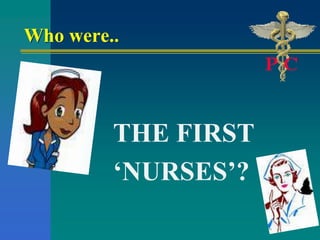
Who were..
THE FIRST
‘NURSES’?
HISTORY …..
 Pre Historic Period
God, evil ,Sin Cause Disease
Making Holes In Body To Ward Off
Disease
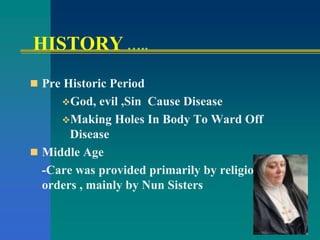
 Middle Age
-Care was provided primarily by religious
orders , mainly by Nun Sisters
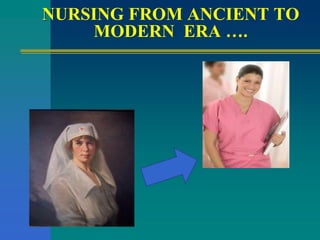
NURSING FROM ANCIENT TO
MODERN ERA ….
 King Ashoka, Charaka,Susrutha
are important persons
 East India company introduced
Nursing
 Kashibai Ganpat first trained
nurse.
IN INDIA
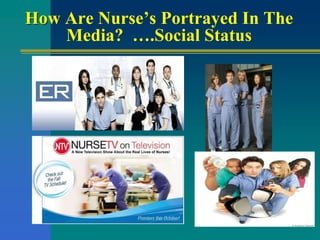
How Are Nurse’s Portrayed In The
Media? ….Social Status
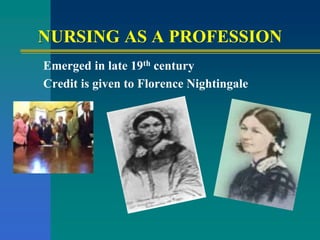
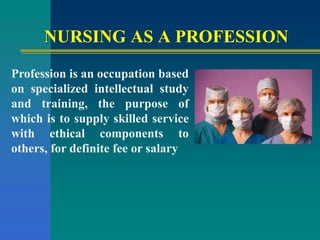
NURSING AS A PROFESSION
Emerged in late 19th century
Credit is given to Florence Nightingale
NURSING AS A PROFESSION
Profession is an occupation based
on specialized intellectual study
and training, the purpose of
which is to supply skilled service
with ethical components to
others, for definite fee or salary
KELLY’S CRITERIA OF
PROFESSION
 The services provided are vital to humanity and the
welfare of the society.
 There is a special body of knowledge which is
continually enlarged through research.
 The services involve intellectual activities,
individual responsibility (accountability) is a strong
feature.
 Practitioners are educated in institutions of higher
learning.
 Practitioners are relatively independent and control
their own policies and activities (autonomy).
KELLY’S CRITERIA OF
PROFESSION
 Practitioners are motivated by service and
consider that work on important component of
their lives.
 There is a “code of ethics” to guide the
decisions and conduct of practitioners.
 Thee is an organization (association) which
encourages and supports high standards of
practice.
TRENDS
 Trends:-It denote changes taken place
 Nursing trends:-refers to direction towards
which the different nursing events have moved
or are moving.
 These do not occur independently but each one
has a basis of related changes in other fields.
 Trends in nursing that is changes currently
taking place in any area of nursing
TRENDS
 Nursing profession serves to meet the need of
the society particularly the needs related to
health
 The changes in society will influence to bring
about changes in nursing profession.
 At present, efforts are made by government of
India to deliver the health care to the
community especially in rural area.
 Overall improvement in the education of
people with ever growing awareness about
health, well being and health need.
TRENDS
 After independence, government began to
make serious efforts to meet health need of
nation by implementing recommendation of
Bhore Committee.
 Advancement of technology e.g.
Automatization, Industrialization,
Urbanization etc.
TRENDS
 Medical profession is fastly changing profession.
 Trends in nursing profession are closely related
to those in medical profession.
 The era of specialization & Biomedical science
have far advanced resulting in newer diagnostic
equipment such as scanner, New drugs,
monitoring system in field of health care all over
the world.
 Modern health care facility like ICU, ICCU,
renal unit, organ transplant unit etc super
specialization has come.
TYPES OF TRENDS IN NURSING
 Nursing practice
 Nursing education
 Nursing service
 Nursing administration
 Ethical views
 Legal views
 Health care delivery system
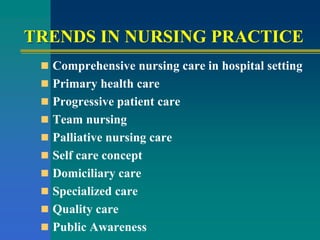
TRENDS IN NURSING PRACTICE
 Comprehensive nursing care in hospital setting
 Primary health care
 Progressive patient care
 Team nursing
 Palliative nursing care
 Self care concept
 Domiciliary care
 Specialized care
 Quality care
 Public Awareness
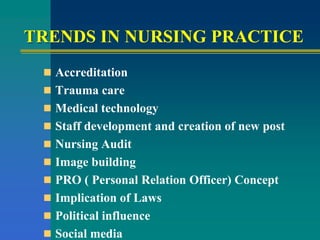
TRENDS IN NURSING PRACTICE
 Accreditation
 Trauma care
 Medical technology
 Staff development and creation of new post
 Nursing Audit
 Image building
 PRO ( Personal Relation Officer) Concept
 Implication of Laws
 Political influence
 Social media
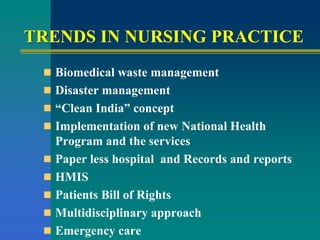
TRENDS IN NURSING PRACTICE
 Biomedical waste management
 Disaster management
 “Clean India” concept
 Implementation of new National Health
Program and the services
 Paper less hospital and Records and reports
 HMIS
 Patients Bill of Rights
 Multidisciplinary approach
 Emergency care
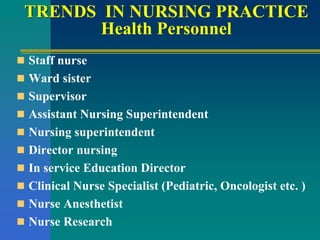
TRENDS IN NURSING PRACTICE
Health Personnel
 Staff nurse
 Ward sister
 Supervisor
 Assistant Nursing Superintendent
 Nursing superintendent
 Director nursing
 In service Education Director
 Clinical Nurse Specialist (Pediatric, Oncologist etc. )
 Nurse Anesthetist
 Nurse Research
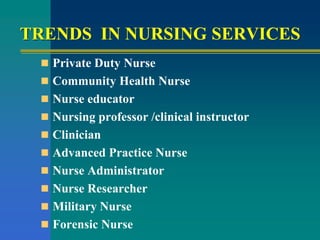
TRENDS IN NURSING SERVICES
 Private Duty Nurse
 Community Health Nurse
 Nurse educator
 Nursing professor /clinical instructor
 Clinician
 Advanced Practice Nurse
 Nurse Administrator
 Nurse Researcher
 Military Nurse
 Forensic Nurse
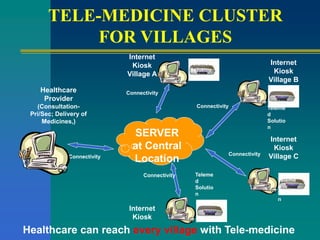
TELE-MEDICINE CLUSTER
FOR VILLAGES
Healthcare can reach every village with Tele-medicine
SERVER
at Central
Location
Healthcare
Provider
(Consultation-
Pri/Sec; Delivery of
Medicines,)
Connectivity
Connectivity
Internet
Kiosk
Village A
Connectivity
Internet
Kiosk
Connectivity
Internet
Kiosk
Village B
Connectivity
Internet
Kiosk
Village C
Telemed
Solution
Teleme
d
Solutio
n
Teleme
d
Solutio
n
Teleme
d
Solutio
n
ETHICAL TRENDS IN
NURSING
Ethics compromises distinction attitudes,
cultural outlook of professional group.
Ethics are distinction between right and
wrong based on a body of knowledge, not
just opinion.
Tran cultural nursing
TECHNOLOGY - TRENDS
 Robotics in OTs
 Robotics in Path-labs / Research.
 Laser Technology in surgery
 Instrumentation in medical and surgical
practices.
 Biotechnology, Genomics, Molecular Biology and
Stem cell research.
TRENDS IN NURSING
EDUCATION
 Auxiliary Nurse Midwife (ANM)
 General Nursing and Midwifery (GNM)
 Post Basic B.Sc Nursing
 M.Sc.
 M. Phill
 PhD in Nursing
 Specialty care
 Nurse practioner
 Expanded and extended education
TRENDS IN NURSING
EDUCATION
SPECIALIZATION
 Pediatric Nursing
 Oncology Nursing
 Thoracic Nursing
 Operation Theater Nurse
 Certified Registered Nurse Anesthetists
(CRNA)
 Technology in education
TRENDS IN NURSING
ADMINISTRATION
 Participative administration
 Delegation of responsibilities
 Departmentalized administration
 Separate nursing directorate
 Right to information Act
 Consumer protection act
ISSUES IN NURSING PRACTICE
 Status of nursing profession in society
 Nurse patient ratio
 Diploma Vs degree in
 Nursing care standards
 Values reflected in our nursing performances.
 Attitude, human approach
 Quality in nursing v/s education and practice.
 Legal implication
 Media
ISSUES IN NURSING
ISSUES IN NURSING PRACTICE
 Separate Directorate
 Higher education for senior positions in
nursing
 Different levels of nurses that we need in our
country.
 Non involvement of nurses in nursing matters.
 No political involvement
 Poor pay structures.
ISSUES IN NURSING PRACTICE
 Many hospitals in India had no nurses at all.
 Lack of security and safety.
 Less promotional opportunities
 Harassment by other personnel
 Influence by the medical fraternity
 Inadequate health supplies
 Internal conflict and influence by others
 Disorganization
ISSUES IN NURSING
EDUCATION
 Nursing Training schools multiplied.
 Lack of independent building for schools and
colleges
 Lack of independent principal for schools and
colleges
 Inadequate hostel facilities for students
 Shortage of qualified teachers in nursing
 Inadequate library facilities
 No UGC pay scales for college teachers in
nursing
ISSUES IN NURSING
EDUCATION
 Very less or no stipend for nursing students
 Less supply of A.V. aids
 Less promotional opportunities for teachers of
both schools and colleges
 Insufficient efforts to prepare nurses for the job
they are accepted to perform in their work field
in terms of appropriate skills, knowledge and
right attitude and the desired behavior patterns
reflecting the values for caring.
 Non attending education
ISSUES IN NURSING
ADMINISTRATION
 Non involvement of nursing administrators in
planning and decision making in hospital
administration
 Lack of knowledge in management among
nursing administrators
 Interference of non nursing personnel in
nursing administration
 No written nursing policies or manuals
 No separate budget
ISSUES IN NURSING
ADMINISTRATION
 No proper job description for various nursing
cadres.
 No organized staff development programs for
nurses like orientation, in-service education,
continuing education etc.
 No special incentives
 Inefficiency of nursing councils of state and
union to maintain standards in nursing
LEGAL ISSUES IN NURSING
 Nurse Practice Act
 Standards of Professional Practice
 Licensure
 Good Samaritan Laws
 Public Health Laws
 Physician-Assisted Suicide
OTHER ISSUES IN NURSING
 Nursing Shortage
 Patient Satisfaction
 National Patient Safety Initiatives
 Evidence-Based Practice
 Information Age
 Genetics
 Globalization of Health
 Aging Population
 Global burden of infectious diseases
 Global burden of non infectious diseases
 Political will
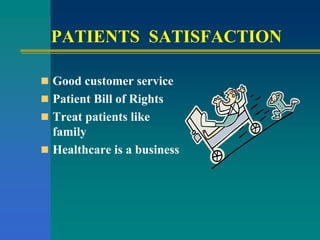
PATIENTS SATISFACTION
 Good customer service
 Patient Bill of Rights
 Treat patients like
family
 Healthcare is a business
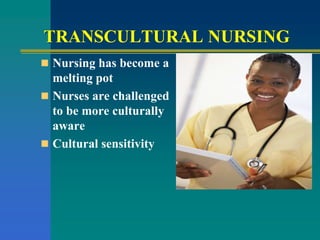
TRANSCULTURAL NURSING
 Nursing has become a
melting pot
 Nurses are challenged
to be more culturally
aware
 Cultural sensitivity
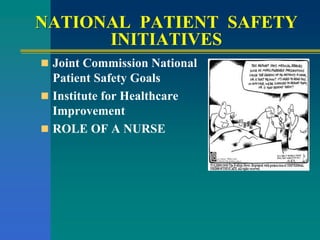
NATIONAL PATIENT SAFETY
INITIATIVES
 Joint Commission National
Patient Safety Goals
 Institute for Healthcare
Improvement
 ROLE OF A NURSE
ACREDITATION
 Improve the accuracy of patient identification
 Improve the effectiveness of communication
among caregivers
 Improve the safety of using medications
 Reduce the risk of health care-associated
infections
 Accurately and completely reconcile
medications
EVIDENCE BASED PRACTICE
 Goal is to achieve cost-effective, high quality
patient care based on scientific inquiry
 Nurses need to understand research process
involved
 Nursing care should not be based on opinions,
past practices, but on the results of scientific
research
 Clinical journals
 Practice guidelines
 Nursing research
INFORMATION AGE
 Consumers today are
more computer savvy
regarding healthcare
 More info on internet
 Consumers could
possibly be more
informed than health
care worker
GLOBALIZATION OF HEALTH
 Healthcare has
become a global issue
 People are mobile,
diseases can travel
 Nurses need to have
an understanding of
the issues pertaining
to global health
AGING POPULATION
 Population is aging
 Growing concerns
regarding the unique
needs of the elderly
 Gerontological nursing
NURSING ROLES
 KNOWLEDGE
 Caregiver
 Clinical Decision Maker
 Client Advocate
 Rehabilitator
 Comforter
 Communicator
 Collaborator
 Teacher
PROFESSIONAL ROLES &
RESPONSIBILITIES
 Autonomy & Accountability
 Caregiver
 Client Advocate
 Educator
 Manager/Clinical Decision Maker
 Communicator
 Collaborator
 Career Development
AUTONOMY &
ACCOUNTABILITY
 Autonomy is the essential element of
professional nursing
 Person is reasonably independent and self-
governing in decision making & practice
 Increased autonomy=Increased responsibility
 Accountability- nurse is responsible
professionally & legally for type & quality of
care provided
 Regulated through Standards of Practice and
Nurse Practice Act
CLINICAL DECISION MAKER
 Utilizes critical thinking skills
and the nursing process
 Nursing Process: Assessment,
Diagnosis, Planning,
Implementation, Evaluation
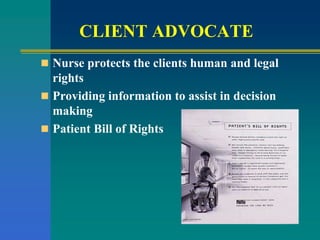
CLIENT ADVOCATE
 Nurse protects the clients human and legal
rights
 Providing information to assist in decision
making
 Patient Bill of Rights
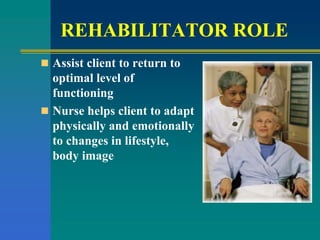
REHABILITATOR ROLE
 Assist client to return to
optimal level of
functioning
 Nurse helps client to adapt
physically and emotionally
to changes in lifestyle,
body image
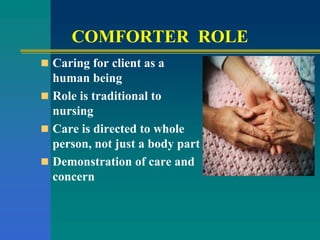
COMFORTER ROLE
 Caring for client as a
human being
 Role is traditional to
nursing
 Care is directed to whole
person, not just a body part
 Demonstration of care and
concern
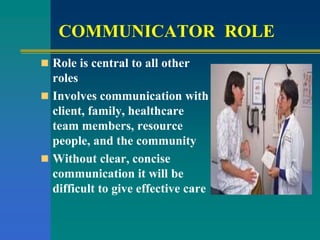
COMMUNICATOR ROLE
 Role is central to all other
roles
 Involves communication with
client, family, healthcare
team members, resource
people, and the community
 Without clear, concise
communication it will be
difficult to give effective care
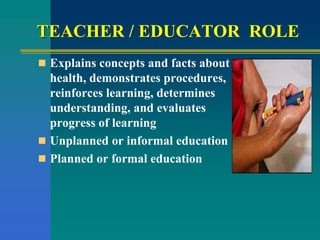
TEACHER / EDUCATOR ROLE
 Explains concepts and facts about
health, demonstrates procedures,
reinforces learning, determines
understanding, and evaluates
progress of learning
 Unplanned or informal education
 Planned or formal education
“
By demonstrating their knowledge in
nursing practice , education and
administration nurses can demonstrate
their expert power. This knowledge may
increase the amount of respect that they
are given by physicians and the society as
such along with personal professional
satisfaction.
“Today’s issues are tomorrow’s trends”

Trends and issues in nursing

  • 1.
    TRANDES AND ISSUES IN NURSINGPROFESSION Pro. DR NILIMA SONAWANE Institute Of Nursing Education Mumbai-08
  • 2.
  • 3.
    HISTORY …..  PreHistoric Period God, evil ,Sin Cause Disease Making Holes In Body To Ward Off Disease  Middle Age -Care was provided primarily by religious orders , mainly by Nun Sisters
  • 4.
    NURSING FROM ANCIENTTO MODERN ERA ….
  • 5.
     King Ashoka,Charaka,Susrutha are important persons  East India company introduced Nursing  Kashibai Ganpat first trained nurse. IN INDIA
  • 6.
    How Are Nurse’sPortrayed In The Media? ….Social Status
  • 7.
    NURSING AS APROFESSION Emerged in late 19th century Credit is given to Florence Nightingale
  • 8.
    NURSING AS APROFESSION Profession is an occupation based on specialized intellectual study and training, the purpose of which is to supply skilled service with ethical components to others, for definite fee or salary
  • 9.
    KELLY’S CRITERIA OF PROFESSION The services provided are vital to humanity and the welfare of the society.  There is a special body of knowledge which is continually enlarged through research.  The services involve intellectual activities, individual responsibility (accountability) is a strong feature.  Practitioners are educated in institutions of higher learning.  Practitioners are relatively independent and control their own policies and activities (autonomy).
  • 10.
    KELLY’S CRITERIA OF PROFESSION Practitioners are motivated by service and consider that work on important component of their lives.  There is a “code of ethics” to guide the decisions and conduct of practitioners.  Thee is an organization (association) which encourages and supports high standards of practice.
  • 11.
    TRENDS  Trends:-It denotechanges taken place  Nursing trends:-refers to direction towards which the different nursing events have moved or are moving.  These do not occur independently but each one has a basis of related changes in other fields.  Trends in nursing that is changes currently taking place in any area of nursing
  • 12.
    TRENDS  Nursing professionserves to meet the need of the society particularly the needs related to health  The changes in society will influence to bring about changes in nursing profession.  At present, efforts are made by government of India to deliver the health care to the community especially in rural area.  Overall improvement in the education of people with ever growing awareness about health, well being and health need.
  • 13.
    TRENDS  After independence,government began to make serious efforts to meet health need of nation by implementing recommendation of Bhore Committee.  Advancement of technology e.g. Automatization, Industrialization, Urbanization etc.
  • 14.
    TRENDS  Medical professionis fastly changing profession.  Trends in nursing profession are closely related to those in medical profession.  The era of specialization & Biomedical science have far advanced resulting in newer diagnostic equipment such as scanner, New drugs, monitoring system in field of health care all over the world.  Modern health care facility like ICU, ICCU, renal unit, organ transplant unit etc super specialization has come.
  • 15.
    TYPES OF TRENDSIN NURSING  Nursing practice  Nursing education  Nursing service  Nursing administration  Ethical views  Legal views  Health care delivery system
  • 16.
    TRENDS IN NURSINGPRACTICE  Comprehensive nursing care in hospital setting  Primary health care  Progressive patient care  Team nursing  Palliative nursing care  Self care concept  Domiciliary care  Specialized care  Quality care  Public Awareness
  • 17.
    TRENDS IN NURSINGPRACTICE  Accreditation  Trauma care  Medical technology  Staff development and creation of new post  Nursing Audit  Image building  PRO ( Personal Relation Officer) Concept  Implication of Laws  Political influence  Social media
  • 18.
    TRENDS IN NURSINGPRACTICE  Biomedical waste management  Disaster management  “Clean India” concept  Implementation of new National Health Program and the services  Paper less hospital and Records and reports  HMIS  Patients Bill of Rights  Multidisciplinary approach  Emergency care
  • 19.
    TRENDS IN NURSINGPRACTICE Health Personnel  Staff nurse  Ward sister  Supervisor  Assistant Nursing Superintendent  Nursing superintendent  Director nursing  In service Education Director  Clinical Nurse Specialist (Pediatric, Oncologist etc. )  Nurse Anesthetist  Nurse Research
  • 20.
    TRENDS IN NURSINGSERVICES  Private Duty Nurse  Community Health Nurse  Nurse educator  Nursing professor /clinical instructor  Clinician  Advanced Practice Nurse  Nurse Administrator  Nurse Researcher  Military Nurse  Forensic Nurse
  • 21.
    TELE-MEDICINE CLUSTER FOR VILLAGES Healthcarecan reach every village with Tele-medicine SERVER at Central Location Healthcare Provider (Consultation- Pri/Sec; Delivery of Medicines,) Connectivity Connectivity Internet Kiosk Village A Connectivity Internet Kiosk Connectivity Internet Kiosk Village B Connectivity Internet Kiosk Village C Telemed Solution Teleme d Solutio n Teleme d Solutio n Teleme d Solutio n
  • 22.
    ETHICAL TRENDS IN NURSING Ethicscompromises distinction attitudes, cultural outlook of professional group. Ethics are distinction between right and wrong based on a body of knowledge, not just opinion. Tran cultural nursing
  • 23.
    TECHNOLOGY - TRENDS Robotics in OTs  Robotics in Path-labs / Research.  Laser Technology in surgery  Instrumentation in medical and surgical practices.  Biotechnology, Genomics, Molecular Biology and Stem cell research.
  • 24.
    TRENDS IN NURSING EDUCATION Auxiliary Nurse Midwife (ANM)  General Nursing and Midwifery (GNM)  Post Basic B.Sc Nursing  M.Sc.  M. Phill  PhD in Nursing  Specialty care  Nurse practioner  Expanded and extended education
  • 25.
    TRENDS IN NURSING EDUCATION SPECIALIZATION Pediatric Nursing  Oncology Nursing  Thoracic Nursing  Operation Theater Nurse  Certified Registered Nurse Anesthetists (CRNA)  Technology in education
  • 26.
    TRENDS IN NURSING ADMINISTRATION Participative administration  Delegation of responsibilities  Departmentalized administration  Separate nursing directorate  Right to information Act  Consumer protection act
  • 27.
    ISSUES IN NURSINGPRACTICE  Status of nursing profession in society  Nurse patient ratio  Diploma Vs degree in  Nursing care standards  Values reflected in our nursing performances.  Attitude, human approach  Quality in nursing v/s education and practice.  Legal implication  Media
  • 28.
  • 29.
    ISSUES IN NURSINGPRACTICE  Separate Directorate  Higher education for senior positions in nursing  Different levels of nurses that we need in our country.  Non involvement of nurses in nursing matters.  No political involvement  Poor pay structures.
  • 30.
    ISSUES IN NURSINGPRACTICE  Many hospitals in India had no nurses at all.  Lack of security and safety.  Less promotional opportunities  Harassment by other personnel  Influence by the medical fraternity  Inadequate health supplies  Internal conflict and influence by others  Disorganization
  • 31.
    ISSUES IN NURSING EDUCATION Nursing Training schools multiplied.  Lack of independent building for schools and colleges  Lack of independent principal for schools and colleges  Inadequate hostel facilities for students  Shortage of qualified teachers in nursing  Inadequate library facilities  No UGC pay scales for college teachers in nursing
  • 32.
    ISSUES IN NURSING EDUCATION Very less or no stipend for nursing students  Less supply of A.V. aids  Less promotional opportunities for teachers of both schools and colleges  Insufficient efforts to prepare nurses for the job they are accepted to perform in their work field in terms of appropriate skills, knowledge and right attitude and the desired behavior patterns reflecting the values for caring.  Non attending education
  • 33.
    ISSUES IN NURSING ADMINISTRATION Non involvement of nursing administrators in planning and decision making in hospital administration  Lack of knowledge in management among nursing administrators  Interference of non nursing personnel in nursing administration  No written nursing policies or manuals  No separate budget
  • 34.
    ISSUES IN NURSING ADMINISTRATION No proper job description for various nursing cadres.  No organized staff development programs for nurses like orientation, in-service education, continuing education etc.  No special incentives  Inefficiency of nursing councils of state and union to maintain standards in nursing
  • 35.
    LEGAL ISSUES INNURSING  Nurse Practice Act  Standards of Professional Practice  Licensure  Good Samaritan Laws  Public Health Laws  Physician-Assisted Suicide
  • 36.
    OTHER ISSUES INNURSING  Nursing Shortage  Patient Satisfaction  National Patient Safety Initiatives  Evidence-Based Practice  Information Age  Genetics  Globalization of Health  Aging Population  Global burden of infectious diseases  Global burden of non infectious diseases  Political will
  • 37.
    PATIENTS SATISFACTION  Goodcustomer service  Patient Bill of Rights  Treat patients like family  Healthcare is a business
  • 38.
    TRANSCULTURAL NURSING  Nursinghas become a melting pot  Nurses are challenged to be more culturally aware  Cultural sensitivity
  • 39.
    NATIONAL PATIENT SAFETY INITIATIVES Joint Commission National Patient Safety Goals  Institute for Healthcare Improvement  ROLE OF A NURSE
  • 40.
    ACREDITATION  Improve theaccuracy of patient identification  Improve the effectiveness of communication among caregivers  Improve the safety of using medications  Reduce the risk of health care-associated infections  Accurately and completely reconcile medications
  • 41.
    EVIDENCE BASED PRACTICE Goal is to achieve cost-effective, high quality patient care based on scientific inquiry  Nurses need to understand research process involved  Nursing care should not be based on opinions, past practices, but on the results of scientific research  Clinical journals  Practice guidelines  Nursing research
  • 42.
    INFORMATION AGE  Consumerstoday are more computer savvy regarding healthcare  More info on internet  Consumers could possibly be more informed than health care worker
  • 43.
    GLOBALIZATION OF HEALTH Healthcare has become a global issue  People are mobile, diseases can travel  Nurses need to have an understanding of the issues pertaining to global health
  • 44.
    AGING POPULATION  Populationis aging  Growing concerns regarding the unique needs of the elderly  Gerontological nursing
  • 45.
    NURSING ROLES  KNOWLEDGE Caregiver  Clinical Decision Maker  Client Advocate  Rehabilitator  Comforter  Communicator  Collaborator  Teacher
  • 46.
    PROFESSIONAL ROLES & RESPONSIBILITIES Autonomy & Accountability  Caregiver  Client Advocate  Educator  Manager/Clinical Decision Maker  Communicator  Collaborator  Career Development
  • 47.
    AUTONOMY & ACCOUNTABILITY  Autonomyis the essential element of professional nursing  Person is reasonably independent and self- governing in decision making & practice  Increased autonomy=Increased responsibility  Accountability- nurse is responsible professionally & legally for type & quality of care provided  Regulated through Standards of Practice and Nurse Practice Act
  • 48.
    CLINICAL DECISION MAKER Utilizes critical thinking skills and the nursing process  Nursing Process: Assessment, Diagnosis, Planning, Implementation, Evaluation
  • 49.
    CLIENT ADVOCATE  Nurseprotects the clients human and legal rights  Providing information to assist in decision making  Patient Bill of Rights
  • 50.
    REHABILITATOR ROLE  Assistclient to return to optimal level of functioning  Nurse helps client to adapt physically and emotionally to changes in lifestyle, body image
  • 51.
    COMFORTER ROLE  Caringfor client as a human being  Role is traditional to nursing  Care is directed to whole person, not just a body part  Demonstration of care and concern
  • 52.
    COMMUNICATOR ROLE  Roleis central to all other roles  Involves communication with client, family, healthcare team members, resource people, and the community  Without clear, concise communication it will be difficult to give effective care
  • 53.
    TEACHER / EDUCATORROLE  Explains concepts and facts about health, demonstrates procedures, reinforces learning, determines understanding, and evaluates progress of learning  Unplanned or informal education  Planned or formal education
  • 54.
    “ By demonstrating theirknowledge in nursing practice , education and administration nurses can demonstrate their expert power. This knowledge may increase the amount of respect that they are given by physicians and the society as such along with personal professional satisfaction. “Today’s issues are tomorrow’s trends”