By Jeanne Acton, UIL/ILPC Journalism Director
Editorial	

An article that states the newspaper’s
stance on a particular issue. Basically, it is
a persuasive essay that offers a solution to
a problem.
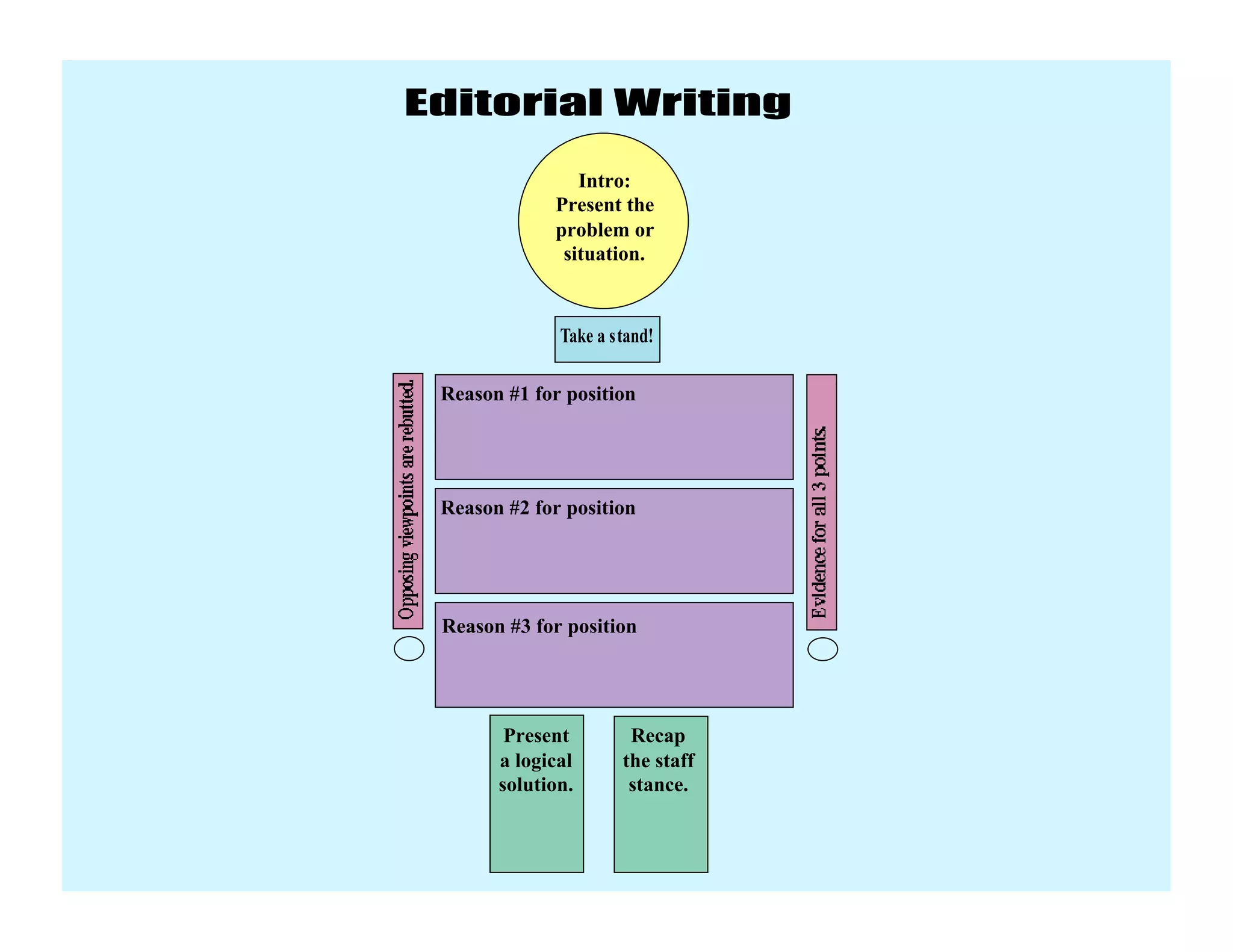
Editorial Writing
Intro:
Present the
problem or
situation.
Take a stand!
Reason #1 for position
Reason #3 for position
Reason #2 for position
Present
a logical
solution.
Recap
the staff
stance.
Intro:
Present the
problem or
situation.
The HEAD of our Editorial	

For example:	

After working with teachers,
administrators and parents, the
school board adopted a new, more
rigid dress code for high school
students for next school year. The
administration said it wanted
students to dress more
professionally. According to the
new policy, students will not be
allowed to wear flip flops or shorts
to school next year.
Take a stand!
The NECK of our Editorial	

For example:	

The new dress code is too
restrictive and is not
necessary for our school.
Students dress appropriately
and do not need to be turned
into mini-adults in business
suits.	

What is your opinion???
Reason #1 for position
Reason #3 for position
Reason #2 for position
The BODY of our Editorial	

Give three reasons why
you are taking your
stand.	

1)  The new dress code
limits individuality.	

2)  Students should be
not be expected to
dress like adults.	

3)  It is an issue of
economics. Flip flops
and shorts are cheaper
than jeans and tennis
shoes.
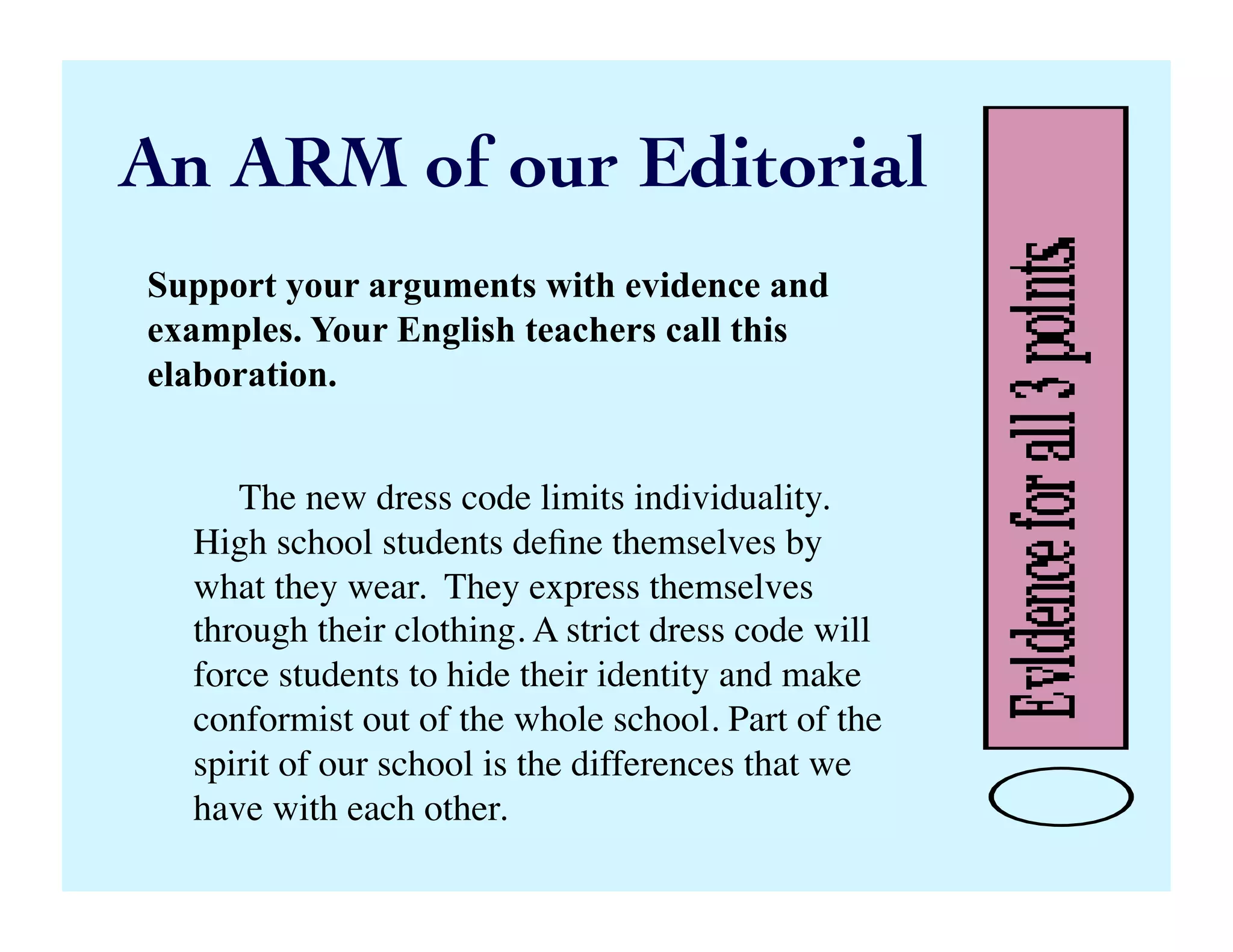
An ARM of our Editorial	

Support your arguments with evidence and
examples. Your English teachers call this
elaboration.	

The new dress code limits individuality.
High school students define themselves by
what they wear. They express themselves
through their clothing. A strict dress code will
force students to hide their identity and make
conformist out of the whole school. Part of the
spirit of our school is the differences that we
have with each other.
The other ARM of our 	

editorial	

Opposing viewpoints are rebutted. You
shut down the opposition.	

The administration says they created the new
dress code because they wanted students to look
professional. This is absurd. Students are not
professionals yet. Students are just students and
should be allowed to dress that way. When we
graduate from high school and college, it will be
important that we dress professionally, but it makes
no sense for a 15-year-old student to wear a
business suit to a science class.
Present
a logical
solution.
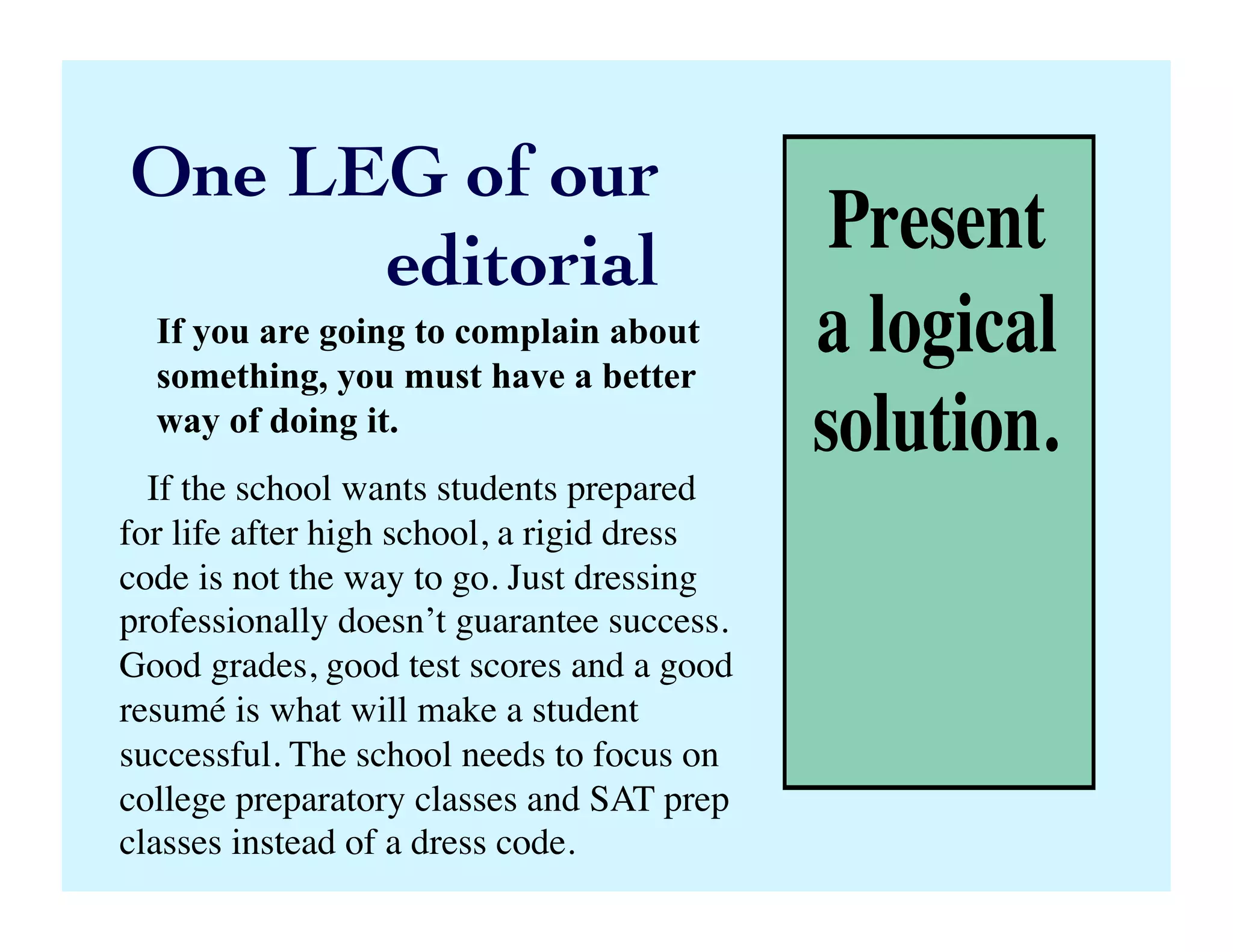
One LEG of our 	

editorial	

If you are going to complain about
something, you must have a better
way of doing it.	

If the school wants students prepared
for life after high school, a rigid dress
code is not the way to go. Just dressing
professionally doesn’t guarantee success.
Good grades, good test scores and a good
resumé is what will make a student
successful. The school needs to focus on
college preparatory classes and SAT prep
classes instead of a dress code.
The other LEG 	

of our editorial	

 Recap
the staff
stance.
The school does not need a dress
code. Instead the school should
focus on real issues that will help
students be prepared for life after
high school.
What went wrong?	

 You didn’t take a stand.	

 The argument was trite and generalized.	

 You asked too many rhetorical questions
without stating an opinion.	

 You used quotes. One quote (maybe two) is
enough for an editorial. You don’t need any.
What went wrong?	

 The wording was pompous or pretentious.	

 You turned into a preacher.	

 You got off topic.	

 Your argument lacked credibility.	

 You used stereotypes or made personal
attacks.
Remember the
key to a
successful
Editorial …
 Make the lead interesting to grab the reader	

 Provide strong evidence to support your
stance	

 Use active voice	

 Be mature, fair and reasonable	

 Offer a solution	

 Write in third person most of the time
(some 1st person plural)

Editorial writing-tips

  • 1.
    By Jeanne Acton,UIL/ILPC Journalism Director
  • 2.
    Editorial An article thatstates the newspaper’s stance on a particular issue. Basically, it is a persuasive essay that offers a solution to a problem.
  • 3.
    Editorial Writing Intro: Present the problemor situation. Take a stand! Reason #1 for position Reason #3 for position Reason #2 for position Present a logical solution. Recap the staff stance.
  • 4.
    Intro: Present the problem or situation. TheHEAD of our Editorial For example: After working with teachers, administrators and parents, the school board adopted a new, more rigid dress code for high school students for next school year. The administration said it wanted students to dress more professionally. According to the new policy, students will not be allowed to wear flip flops or shorts to school next year.
  • 5.
    Take a stand! TheNECK of our Editorial For example: The new dress code is too restrictive and is not necessary for our school. Students dress appropriately and do not need to be turned into mini-adults in business suits. What is your opinion???
  • 6.
    Reason #1 forposition Reason #3 for position Reason #2 for position The BODY of our Editorial Give three reasons why you are taking your stand. 1)  The new dress code limits individuality. 2)  Students should be not be expected to dress like adults. 3)  It is an issue of economics. Flip flops and shorts are cheaper than jeans and tennis shoes.
  • 7.
    An ARM ofour Editorial Support your arguments with evidence and examples. Your English teachers call this elaboration. The new dress code limits individuality. High school students define themselves by what they wear. They express themselves through their clothing. A strict dress code will force students to hide their identity and make conformist out of the whole school. Part of the spirit of our school is the differences that we have with each other.
  • 8.
    The other ARMof our editorial Opposing viewpoints are rebutted. You shut down the opposition. The administration says they created the new dress code because they wanted students to look professional. This is absurd. Students are not professionals yet. Students are just students and should be allowed to dress that way. When we graduate from high school and college, it will be important that we dress professionally, but it makes no sense for a 15-year-old student to wear a business suit to a science class.
  • 9.
    Present a logical solution. One LEGof our editorial If you are going to complain about something, you must have a better way of doing it. If the school wants students prepared for life after high school, a rigid dress code is not the way to go. Just dressing professionally doesn’t guarantee success. Good grades, good test scores and a good resumé is what will make a student successful. The school needs to focus on college preparatory classes and SAT prep classes instead of a dress code.
  • 10.
    The other LEG of our editorial Recap the staff stance. The school does not need a dress code. Instead the school should focus on real issues that will help students be prepared for life after high school.
  • 11.
    What went wrong?  Youdidn’t take a stand.  The argument was trite and generalized.  You asked too many rhetorical questions without stating an opinion.  You used quotes. One quote (maybe two) is enough for an editorial. You don’t need any.
  • 12.
    What went wrong?  Thewording was pompous or pretentious.  You turned into a preacher.  You got off topic.  Your argument lacked credibility.  You used stereotypes or made personal attacks.
  • 13.
    Remember the key toa successful Editorial …  Make the lead interesting to grab the reader  Provide strong evidence to support your stance  Use active voice  Be mature, fair and reasonable  Offer a solution  Write in third person most of the time (some 1st person plural)