Magnifyingwhat isFEATURE  WRITING
What is feature writing?Features are not meant to deliver the news firsthand. They do contain elements of news, but their main function is to humanize, to add color, to educate, to entertain, to illuminate. They often recap major news that was reported in a previous news cycle
Functions of a Feature Article
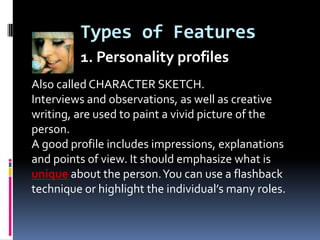
Types of Features1. Personality profilesAlso called CHARACTER SKETCH.Interviews and observations, as well as creative writing, are used to paint a vivid picture of the person.A good profile includes impressions, explanations and points of view. It should emphasize what is unique about the person. You can use a flashback technique or highlight the individual’s many roles.
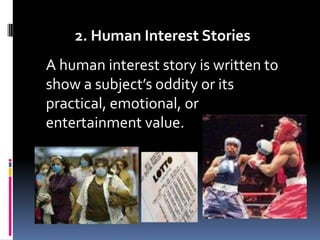
2. Human Interest StoriesA human interest story is written to show a subject’s oddity or its practical, emotional, or entertainment value.
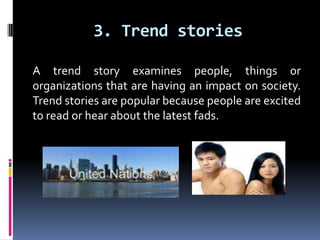
3. Trend storiesA trend story examines people, things or organizations that are having an impact on society. Trend stories are popular because people are excited to read or hear about the latest fads.
4. In-depth storiesThrough extensive research and interviews, in depth stories provide a detailed account well beyond a basic news story or feature.
5. Backgroundersalso called an analysis piece--adds meaning to current issues in the news by explaining them further. These articles bring an audience up-to-date, explaining how this country, this organization, this person happens to be where it is now.
Writing & Organizing Feature StoriesFeature writers seldom use the inverted pyramid form. The Commonly used styles are:chronology that builds to a climax at the end,
a narrative, or
a first-person article about one of their own experiences or a combination of these. - stories are held together by a thread, and they often end where the lead started, with a single person or event.
HOW TO WRITE A GOOD FEATURE
Useful tips* Some good feature leads include: Narrative, Descriptive, Striking statement and Punch or astonisher*  Be clear about why you are writing the article. Is it to inform, persuade, observe, evaluate, or evoke emotion?* FOCUS! Whenyou prepare for your feature story, you will gather a large amount of information through interviews and background research. Before you begin writing, focus on the main idea. WHY??? Because focusing will narrow your topic
* After writing the lead, you need a structure in which to place the information. A structure is an organizational pattern used to synthesize, that is to establish relationships between relevant pieces of information.*  Provide vital background information. If appropriate, a paragraph or two of background should be placed high in the story to bring the audience up to date.
Write clear, concise sentences. Sprinkle direct quotations, observations and additional background throughout    the story. Paragraphs can be written chronologically or in order of     importance. Be creative, watch,  & listen...Read  & Research
Keep up to date, take notes  and play with words!
Use transition. Connect paragraphs with transitional words, paraphrases, and direct quotations.

Feature Writing

  • 1.
  • 2.
    What is featurewriting?Features are not meant to deliver the news firsthand. They do contain elements of news, but their main function is to humanize, to add color, to educate, to entertain, to illuminate. They often recap major news that was reported in a previous news cycle
  • 3.
    Functions of aFeature Article
  • 4.
    Types of Features1.Personality profilesAlso called CHARACTER SKETCH.Interviews and observations, as well as creative writing, are used to paint a vivid picture of the person.A good profile includes impressions, explanations and points of view. It should emphasize what is unique about the person. You can use a flashback technique or highlight the individual’s many roles.
  • 5.
    2. Human InterestStoriesA human interest story is written to show a subject’s oddity or its practical, emotional, or entertainment value.
  • 6.
    3. Trend storiesAtrend story examines people, things or organizations that are having an impact on society. Trend stories are popular because people are excited to read or hear about the latest fads.
  • 7.
    4. In-depth storiesThroughextensive research and interviews, in depth stories provide a detailed account well beyond a basic news story or feature.
  • 8.
    5. Backgroundersalso calledan analysis piece--adds meaning to current issues in the news by explaining them further. These articles bring an audience up-to-date, explaining how this country, this organization, this person happens to be where it is now.
  • 9.
    Writing & OrganizingFeature StoriesFeature writers seldom use the inverted pyramid form. The Commonly used styles are:chronology that builds to a climax at the end,
  • 10.
  • 11.
    a first-person articleabout one of their own experiences or a combination of these. - stories are held together by a thread, and they often end where the lead started, with a single person or event.
  • 12.
    HOW TO WRITEA GOOD FEATURE
  • 13.
    Useful tips* Somegood feature leads include: Narrative, Descriptive, Striking statement and Punch or astonisher* Be clear about why you are writing the article. Is it to inform, persuade, observe, evaluate, or evoke emotion?* FOCUS! Whenyou prepare for your feature story, you will gather a large amount of information through interviews and background research. Before you begin writing, focus on the main idea. WHY??? Because focusing will narrow your topic
  • 14.
    * After writingthe lead, you need a structure in which to place the information. A structure is an organizational pattern used to synthesize, that is to establish relationships between relevant pieces of information.* Provide vital background information. If appropriate, a paragraph or two of background should be placed high in the story to bring the audience up to date.
  • 16.
    Write clear, concisesentences. Sprinkle direct quotations, observations and additional background throughout the story. Paragraphs can be written chronologically or in order of importance. Be creative, watch, & listen...Read & Research
  • 17.
    Keep up todate, take notes and play with words!
  • 18.
    Use transition. Connectparagraphs with transitional words, paraphrases, and direct quotations.