Ms. Anubha Rastogi
Astt. Prof, Vidya School Of Business
2015-16
‘Strategy is
problem solving
in unstructured
situations.’
Lester Dignam
‘There is a gap
between the
rhetoric and the
reality of SHRM.’
Lynda Grattan
‘Strategy consists
of illusions in the
board room.’
John Purcell
‘Strategy is
emergent and
flexible.’
Sean Tyson
‘Strategy is a
pattern in a
stream of
activities.’
Henry Mintzberg
‘Strategy is often
fragmentary,
evolutionary and
largely intuitive.’
James Quinn
THE CLOUDY NATURE OF STRATEGY
STRATEGY
 At the core, its is the debate between best fit and best practice
 Used for gaining a competitive advantage
 Innovation: Offer something new; different from competitors
 Quality Enhancement: Products and services
 Cost Reduction: to be the lowest cost provider
 Optimal strategy depends on the wants of customers and nature of
competitors
What is a strategy
• Text book definition: The company’s long-term plan for how
it will balance its internal strengths and weaknesses with its
external opportunity and threats to maintain a competitive
advantage
• Simply speaking: A plan that is expected to make an
organization adaptive and competitive
• Simplest speaking: A plan to make money
What is Strategic Management?
The Meaning of “Strategy”
 A critical factor that affects Firm Performance
 A factor that contributes to Competitive Advantage in markets
 Having a long-term focus
 Plans that involve the top executives and/or board of directors
of the firm
 A general framework that provides a perspective for selecting
specific policies and procedures
• Strategic Management is a process for analyzing a company's
competitive situation, developing the company's strategic goals,
and devising a plan of action and allocation of resources that will
help a company achieve its goals.
• Strategic human resource management is the pattern of
planned human resource deployments and activities
intended to enable an organization to achieve its goals.
Aware of
business
context
Understand
the
business
Appreciate
how HR
can add
value
See the big
picture
Act as
change
agent
Make
convincing
business
case
for
innovation
Practice
evidence-
based
management
SEVEN STEPS TO BEING STRATEGIC
TYPES OF STRATEGY
 Business
 Examines correspondence between each firm’s competitive
strategy and its system of high performance work practices
 Operations
 An internal approach; connected to the work organization inside
a firm
 Resource View
 Views human resources as sources of sustained competitive
advantage
Example Of Strategic Choices
• Defender vs. Prospector
• Exploitation vs. Exploration
• Quality vs. Quantity
• Focused vs. Diversified
Strategic HRM is the process of defining
how the organization’s goals will be
achieved through people by means of HR
strategies and integrated HR policies and
practices.
STRATEGIC HRM DEFINED
The Linking Of The Human Resource
Function With The Company’s Strategies
To Accomplish That Strategy.
HR Strategy: Strategic Fit
Training Rewards
Corporate Strategy
Business Strategy
HR Strategy
HR System
(Performance Mgmt.)
A good HR strategy:
Satisfy business needs
Is founded on detailed analysis
Can be turned into actionable programmes
Is coherent and integrated
Takes account of the needs of line managers, employees and other stakeholders
MODEL OF STRATEGIC HRM
SO WHAT IS STRATEGIC HUMAN RESOURCE
MANAGEMENT?
Is it about long-range strategic planning?
Is it about day-to-day strategic management?
Or is it about both?
•Aligned to corporate goals
•Set out clear aims
•Supported by business case
•Take account of individual as well as business
needs
•Contain realistic and achievable plans for
implementation
CRITERIA FOR HR STRATEGIES
STRATEGIC HRM GUIDELINES
• Be clear on what has to be achieved and why
• Ensure that what you do fits the business strategy, culture and
circumstances of the organization
• Aim for continuous improvement – evolution not revolution
• Don’t follow fashion – do your own thing
• Keep it simple – over-complexity is a common reason for
failure
• Don’t rush – it takes longer than you think
• Assess resource requirements and costs
• Manage change – involve,communicate and train
Advantages And Disadvantages Of
Strategic HRM
Advantages:
 Help gain a competitive edge
 Help solve HRM problems
 Make the efficient use of
employees and reduce costs
 Help anticipate and plan for
changes
 Benefit long term
Disadvantages:
 Difficulty in predicating the people
behavior
 Problems with predicating external
events affecting HR planning
 Needing constantly monitoring
 Leading to industrial relation
problems
The Flexible Workforce
Definition:
 A workforce that can respond quickly in quantity and
type to changes in demand a business may face.
Traditional HR versus Strategic HR
The Role of HRM in Strategy
Formulation
 Administrative Linkage — Lowest level of integration; HRM
function's attention is focused on day-to-day activities. No input
from the HRM function to the company's strategic plan is given.
 One-Way Linkage — The strategic business planning function
develops the plan and then informs the HRM function of the plan.
HRM then helps in the implementation.
 Two-Way Linkage — Allows for consideration of human resource
issues during the strategy formulation process. The HRM function
is expected to provide input to potential strategic choices and
then help implement the chosen option.
 Integrative Linkage — Is based on continuing, rather than
sequential, interaction. The HR executive is an integral member
of the strategic planning team.
Strategy Formulation
 Five components of the strategic management
process:
 A mission is a statement of the organization's reasons for being.
 Goals are what the organization hopes to achieve in the medium-to
long-term future
 External analysis consists of examining the organization's operating
environment to identify strategic opportunities and threats.
 Internal analysis attempts to identify the organization's strengths
and weaknesses.
 Strategic choice is the organization's strategy, which describes the
ways the organization will attempt to fulfill its mission and achieve
its long term goals.
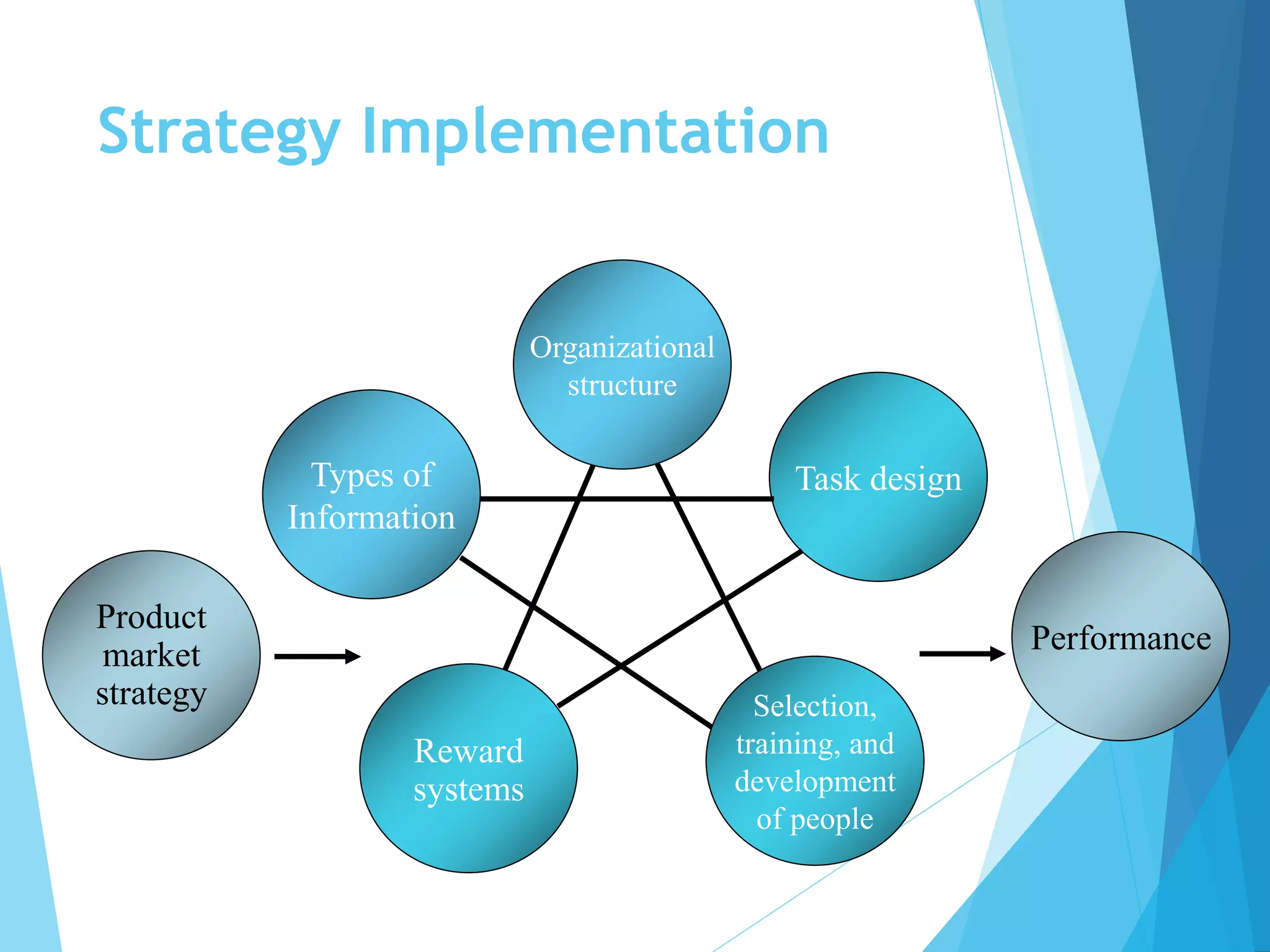
Strategy Implementation
Organizational
structure
Types of
Information
Task design
Selection,
training, and
development
of people
Reward
systems
Product
market
strategy
Performance
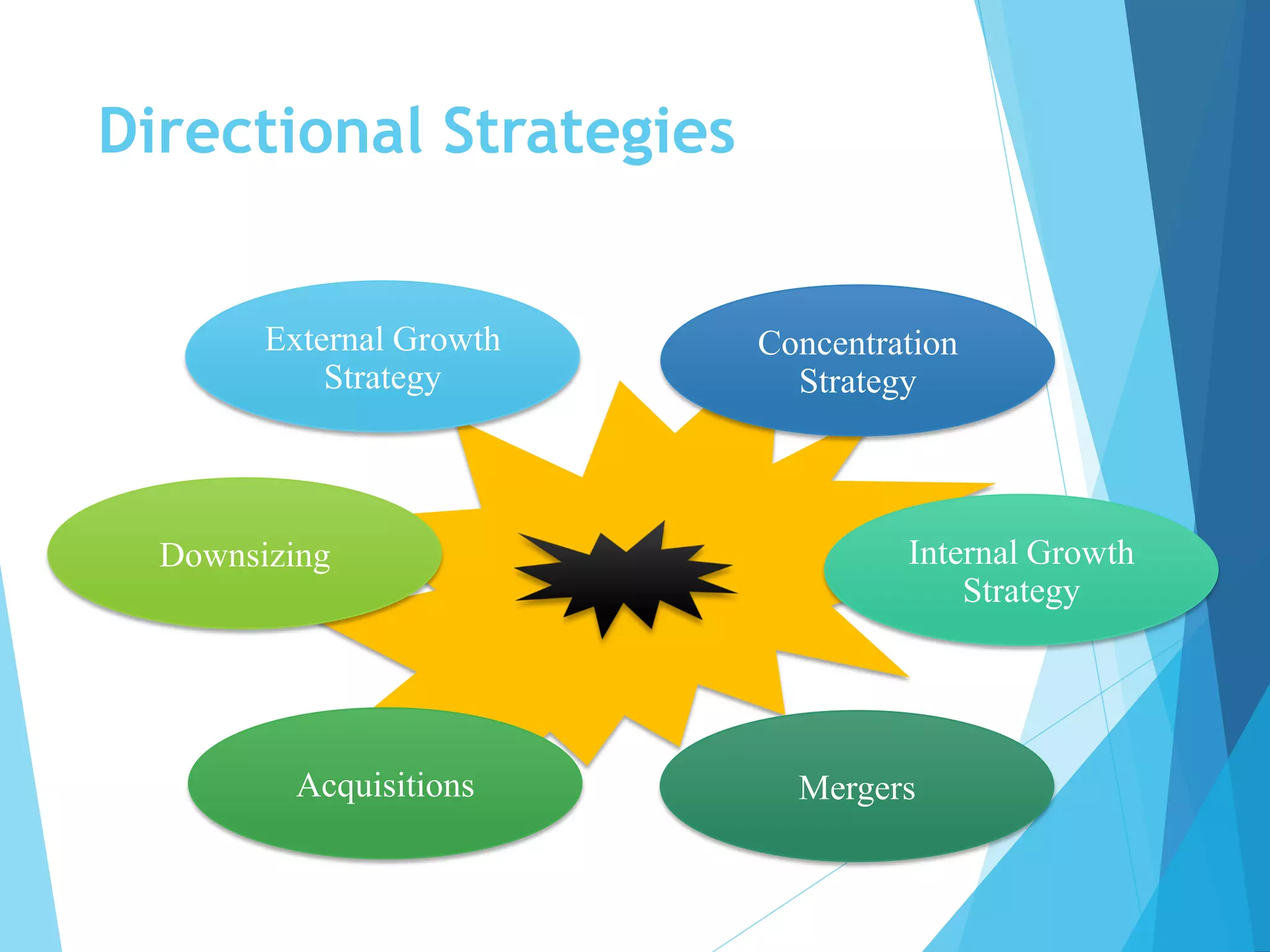
Directional Strategies
External Growth
Strategy
Concentration
Strategy
Internal Growth
Strategy
Downsizing
Acquisitions Mergers
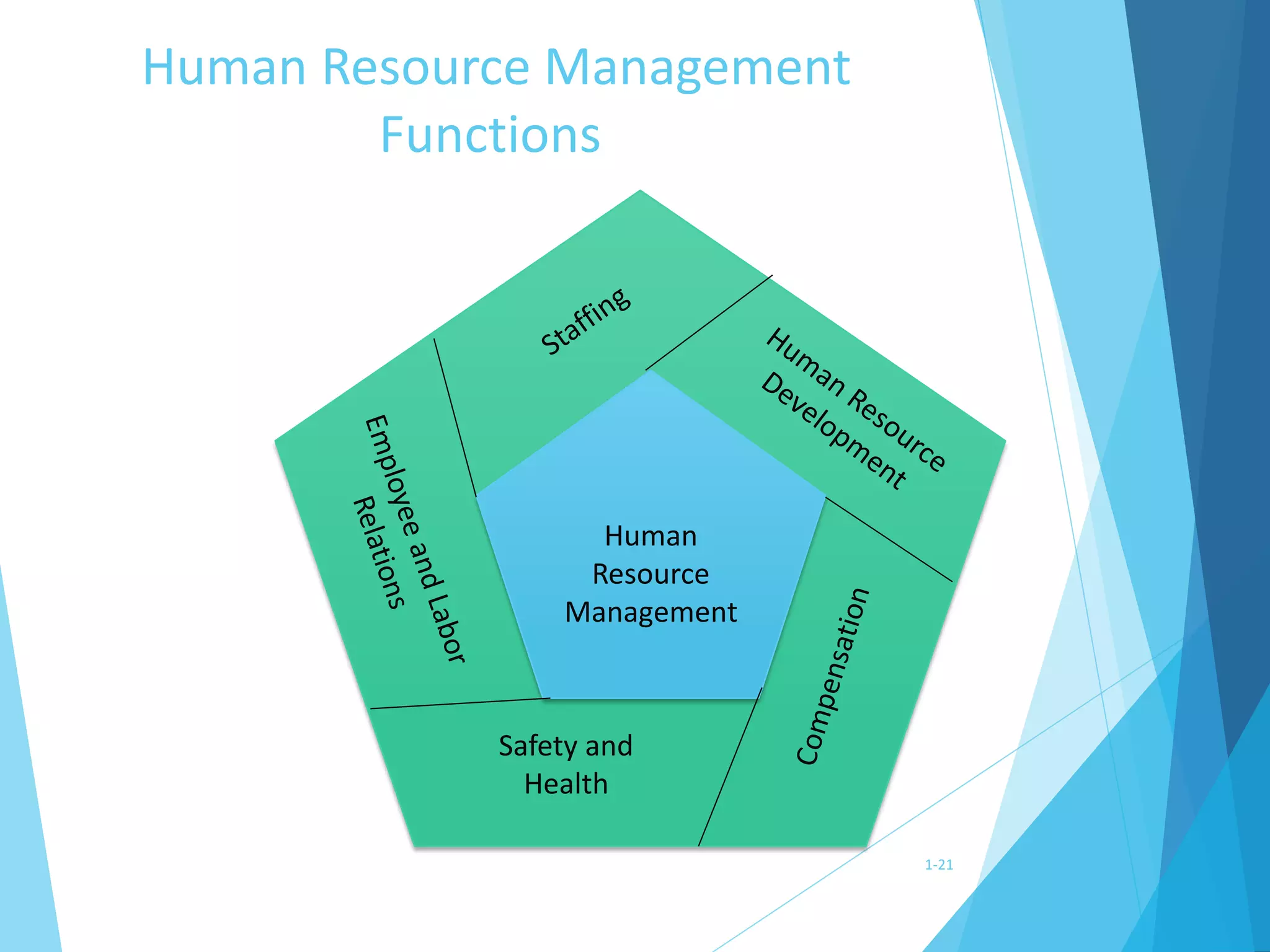
1-21
1
Human
Resource
Management
Safety and
Health
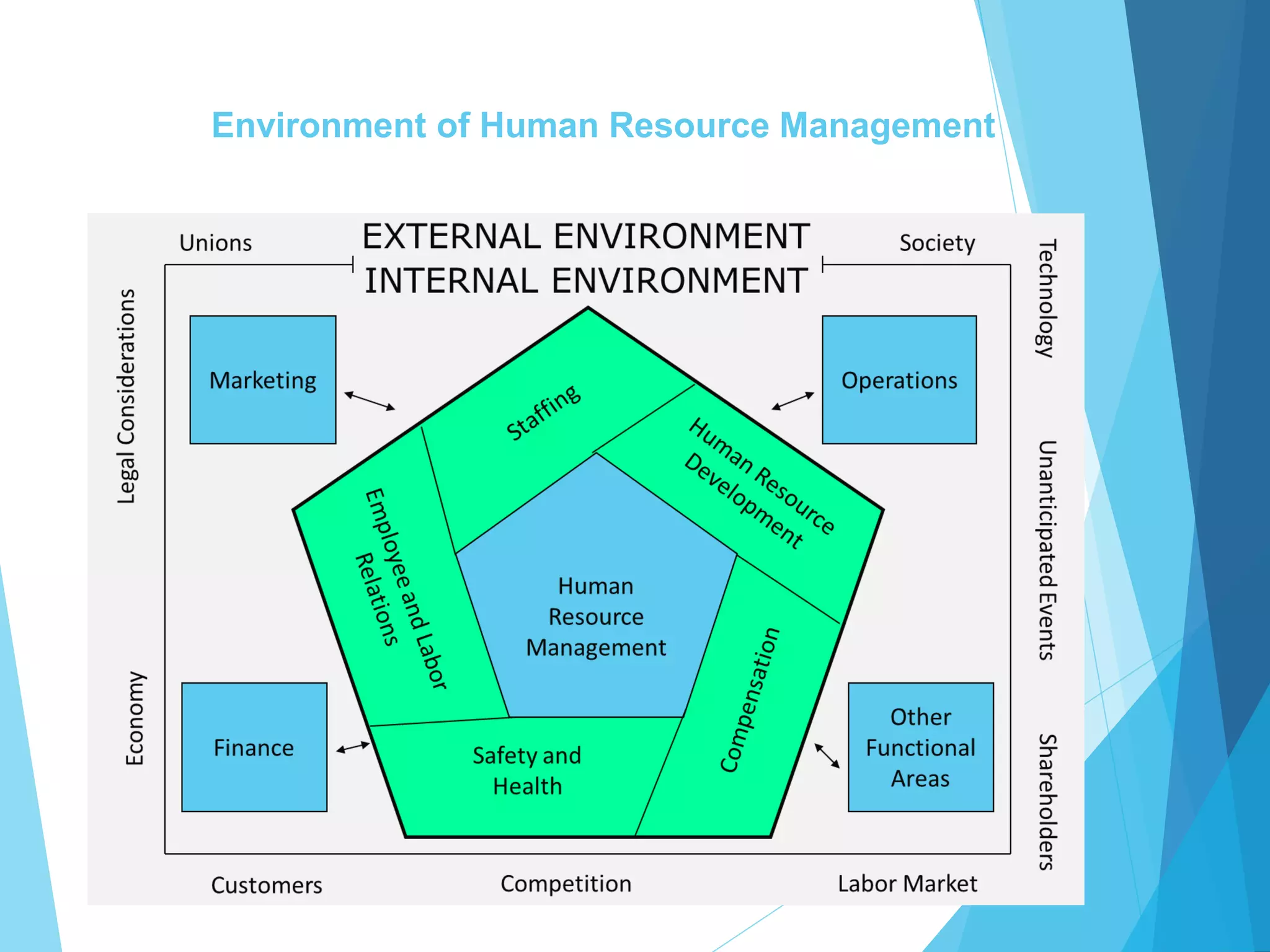
Human Resource Management
Functions
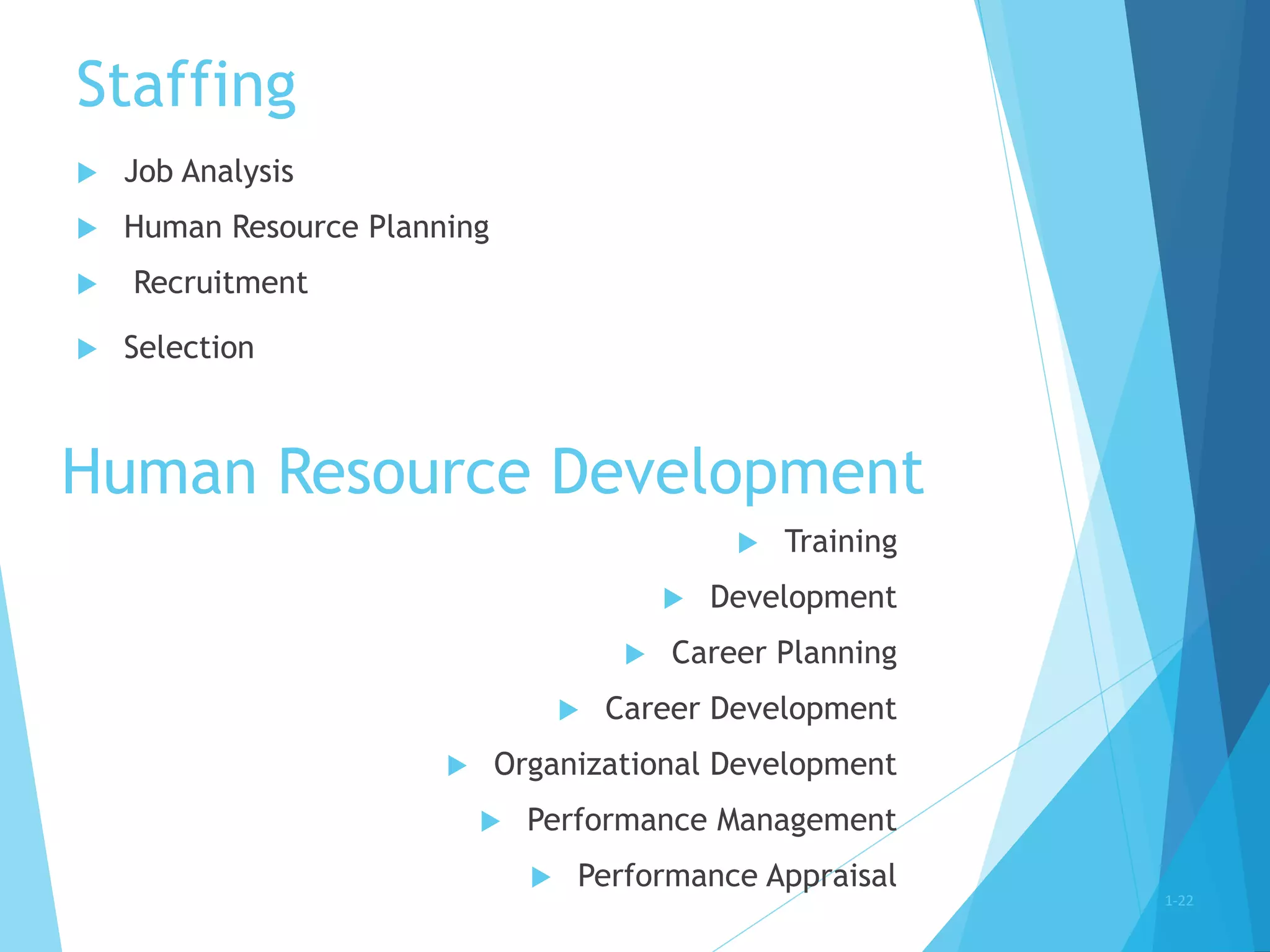
Staffing
 Job Analysis
 Human Resource Planning
 Recruitment
 Selection
1-22
Human Resource Development
 Training
 Development
 Career Planning
 Career Development
 Organizational Development
 Performance Management
 Performance Appraisal
Compensation
Compensation - All rewards that individuals receive as a result
of their employment
1-23
Safety and Health
Employees who work in safe environment and enjoy good health are more
likely to be productive and yield long-term benefits to organization.
Employee and Labor Relations
 Private-sector union membership has fallen from 39 percent in 1958 to 7.8
percent in 2005.
 Business is required by law to recognize a union and bargain with it in
good faith if the firm’s employees want the union to represent them
 Human resource activity is often referred to as industrial relations
 Most firms today would rather have a union-free environment
Environment of Human Resource Management
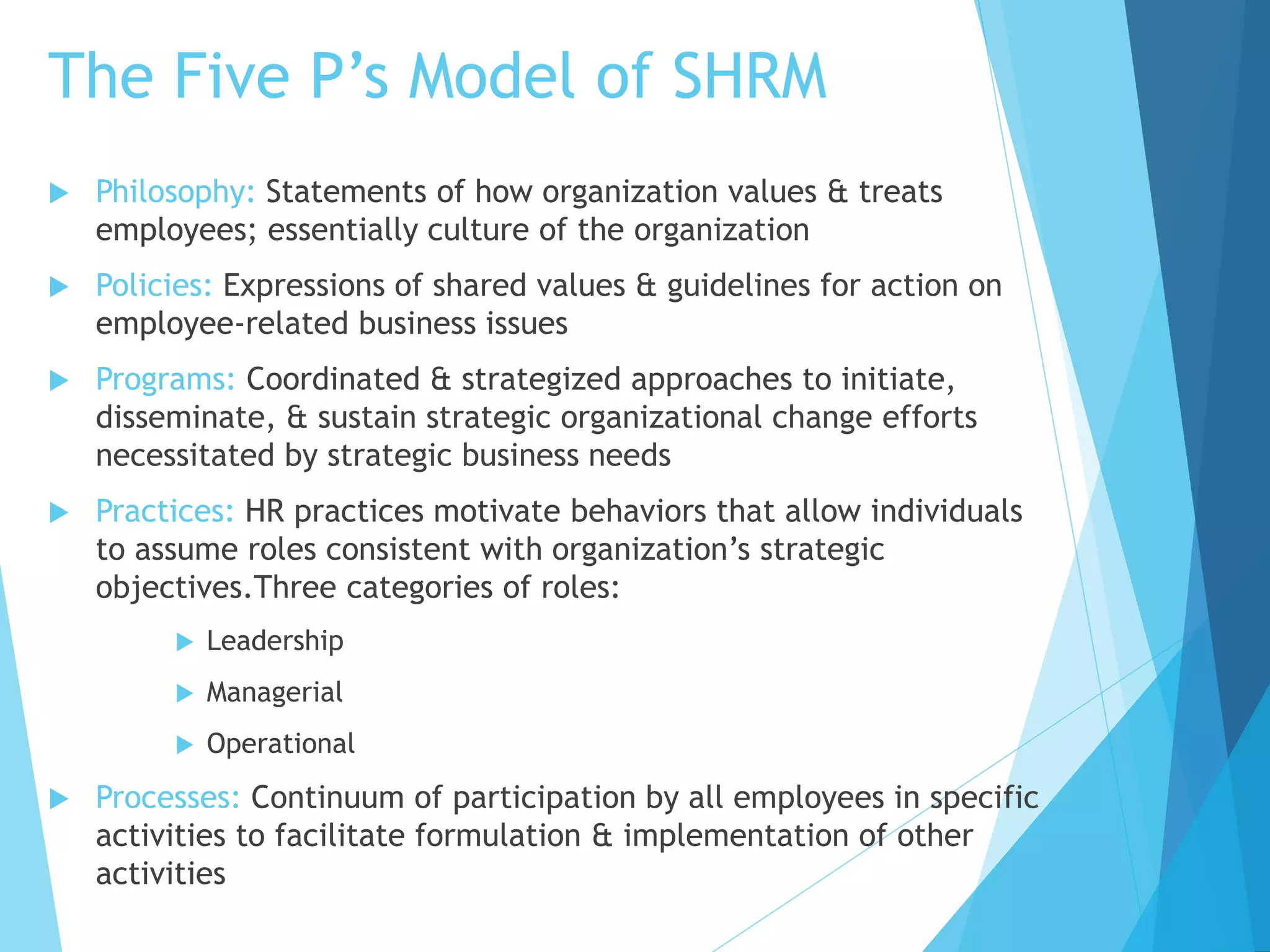
The Five P’s Model of SHRM
 Philosophy: Statements of how organization values & treats
employees; essentially culture of the organization
 Policies: Expressions of shared values & guidelines for action on
employee-related business issues
 Programs: Coordinated & strategized approaches to initiate,
disseminate, & sustain strategic organizational change efforts
necessitated by strategic business needs
 Practices: HR practices motivate behaviors that allow individuals
to assume roles consistent with organization’s strategic
objectives.Three categories of roles:
 Leadership
 Managerial
 Operational
 Processes: Continuum of participation by all employees in specific
activities to facilitate formulation & implementation of other
activities
Strategic Human Resource Management

Strategic Human Resource Management

  • 1.
    Ms. Anubha Rastogi Astt.Prof, Vidya School Of Business 2015-16
  • 2.
    ‘Strategy is problem solving inunstructured situations.’ Lester Dignam ‘There is a gap between the rhetoric and the reality of SHRM.’ Lynda Grattan ‘Strategy consists of illusions in the board room.’ John Purcell ‘Strategy is emergent and flexible.’ Sean Tyson ‘Strategy is a pattern in a stream of activities.’ Henry Mintzberg ‘Strategy is often fragmentary, evolutionary and largely intuitive.’ James Quinn THE CLOUDY NATURE OF STRATEGY
  • 3.
    STRATEGY  At thecore, its is the debate between best fit and best practice  Used for gaining a competitive advantage  Innovation: Offer something new; different from competitors  Quality Enhancement: Products and services  Cost Reduction: to be the lowest cost provider  Optimal strategy depends on the wants of customers and nature of competitors What is a strategy • Text book definition: The company’s long-term plan for how it will balance its internal strengths and weaknesses with its external opportunity and threats to maintain a competitive advantage • Simply speaking: A plan that is expected to make an organization adaptive and competitive • Simplest speaking: A plan to make money
  • 4.
    What is StrategicManagement? The Meaning of “Strategy”  A critical factor that affects Firm Performance  A factor that contributes to Competitive Advantage in markets  Having a long-term focus  Plans that involve the top executives and/or board of directors of the firm  A general framework that provides a perspective for selecting specific policies and procedures • Strategic Management is a process for analyzing a company's competitive situation, developing the company's strategic goals, and devising a plan of action and allocation of resources that will help a company achieve its goals. • Strategic human resource management is the pattern of planned human resource deployments and activities intended to enable an organization to achieve its goals.
  • 5.
    Aware of business context Understand the business Appreciate how HR canadd value See the big picture Act as change agent Make convincing business case for innovation Practice evidence- based management SEVEN STEPS TO BEING STRATEGIC
  • 6.
    TYPES OF STRATEGY Business  Examines correspondence between each firm’s competitive strategy and its system of high performance work practices  Operations  An internal approach; connected to the work organization inside a firm  Resource View  Views human resources as sources of sustained competitive advantage Example Of Strategic Choices • Defender vs. Prospector • Exploitation vs. Exploration • Quality vs. Quantity • Focused vs. Diversified
  • 7.
    Strategic HRM isthe process of defining how the organization’s goals will be achieved through people by means of HR strategies and integrated HR policies and practices. STRATEGIC HRM DEFINED The Linking Of The Human Resource Function With The Company’s Strategies To Accomplish That Strategy.
  • 8.
    HR Strategy: StrategicFit Training Rewards Corporate Strategy Business Strategy HR Strategy HR System (Performance Mgmt.)
  • 9.
    A good HRstrategy: Satisfy business needs Is founded on detailed analysis Can be turned into actionable programmes Is coherent and integrated Takes account of the needs of line managers, employees and other stakeholders
  • 10.
  • 11.
    SO WHAT ISSTRATEGIC HUMAN RESOURCE MANAGEMENT? Is it about long-range strategic planning? Is it about day-to-day strategic management? Or is it about both?
  • 12.
    •Aligned to corporategoals •Set out clear aims •Supported by business case •Take account of individual as well as business needs •Contain realistic and achievable plans for implementation CRITERIA FOR HR STRATEGIES
  • 13.
    STRATEGIC HRM GUIDELINES •Be clear on what has to be achieved and why • Ensure that what you do fits the business strategy, culture and circumstances of the organization • Aim for continuous improvement – evolution not revolution • Don’t follow fashion – do your own thing • Keep it simple – over-complexity is a common reason for failure • Don’t rush – it takes longer than you think • Assess resource requirements and costs • Manage change – involve,communicate and train
  • 14.
    Advantages And DisadvantagesOf Strategic HRM Advantages:  Help gain a competitive edge  Help solve HRM problems  Make the efficient use of employees and reduce costs  Help anticipate and plan for changes  Benefit long term Disadvantages:  Difficulty in predicating the people behavior  Problems with predicating external events affecting HR planning  Needing constantly monitoring  Leading to industrial relation problems
  • 15.
    The Flexible Workforce Definition: A workforce that can respond quickly in quantity and type to changes in demand a business may face. Traditional HR versus Strategic HR
  • 17.
    The Role ofHRM in Strategy Formulation  Administrative Linkage — Lowest level of integration; HRM function's attention is focused on day-to-day activities. No input from the HRM function to the company's strategic plan is given.  One-Way Linkage — The strategic business planning function develops the plan and then informs the HRM function of the plan. HRM then helps in the implementation.  Two-Way Linkage — Allows for consideration of human resource issues during the strategy formulation process. The HRM function is expected to provide input to potential strategic choices and then help implement the chosen option.  Integrative Linkage — Is based on continuing, rather than sequential, interaction. The HR executive is an integral member of the strategic planning team.
  • 18.
    Strategy Formulation  Fivecomponents of the strategic management process:  A mission is a statement of the organization's reasons for being.  Goals are what the organization hopes to achieve in the medium-to long-term future  External analysis consists of examining the organization's operating environment to identify strategic opportunities and threats.  Internal analysis attempts to identify the organization's strengths and weaknesses.  Strategic choice is the organization's strategy, which describes the ways the organization will attempt to fulfill its mission and achieve its long term goals.
  • 19.
    Strategy Implementation Organizational structure Types of Information Taskdesign Selection, training, and development of people Reward systems Product market strategy Performance
  • 20.
  • 21.
  • 22.
    Staffing  Job Analysis Human Resource Planning  Recruitment  Selection 1-22 Human Resource Development  Training  Development  Career Planning  Career Development  Organizational Development  Performance Management  Performance Appraisal
  • 23.
    Compensation Compensation - Allrewards that individuals receive as a result of their employment 1-23 Safety and Health Employees who work in safe environment and enjoy good health are more likely to be productive and yield long-term benefits to organization. Employee and Labor Relations  Private-sector union membership has fallen from 39 percent in 1958 to 7.8 percent in 2005.  Business is required by law to recognize a union and bargain with it in good faith if the firm’s employees want the union to represent them  Human resource activity is often referred to as industrial relations  Most firms today would rather have a union-free environment
  • 24.
    Environment of HumanResource Management
  • 25.
    The Five P’sModel of SHRM  Philosophy: Statements of how organization values & treats employees; essentially culture of the organization  Policies: Expressions of shared values & guidelines for action on employee-related business issues  Programs: Coordinated & strategized approaches to initiate, disseminate, & sustain strategic organizational change efforts necessitated by strategic business needs  Practices: HR practices motivate behaviors that allow individuals to assume roles consistent with organization’s strategic objectives.Three categories of roles:  Leadership  Managerial  Operational  Processes: Continuum of participation by all employees in specific activities to facilitate formulation & implementation of other activities