Group 9
Presented by :
Madhu Rana
Priyanka
Jitendra Singh
Bhumika Ratan
Charu Goel
• Formulating HR policies and introducing practices that
produce staff competencies and behaviors that the
company needs to achieve its strategic goals.
• HR managers today are more involved in partnering with
their top managers in both designing and implementing
their companies’ strategies
• Top management wants to see, precisely, how the HR
manager’s plans will make the company more valuable.
‘seeing the people of the organization as
a strategic resource for the
achievement of competitive advantage’
The set of managerial decisions and actions that determines the long-
run performance of a corporation. It includes:
 environmental scanning (internal & external)
 strategy formulation
 strategy implementation
 evaluation and control
It focuses on integrating management, marketing, finance/accounting,
production/operations, research and development, and computer
information systems to achieve organizational success.
HR Practices Linked With
Competitive Strategy
Recruitment
Training
Career Path
Promotions
Socialization
Openness
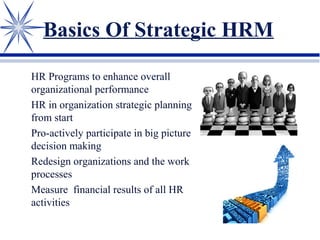
Basics Of Strategic HRM
HR Programs to enhance overall
organizational performance
HR in organization strategic planning
from start
Pro-actively participate in big picture
decision making
Redesign organizations and the work
processes
Measure financial results of all HR
activities
AIMS OF STRATEGIC HRM
“To generate strategic capability by ensuring
that the organization has the skilled,
engaged and well-motivated employees it
needs to achieve sustained competitive
advantage.”
Benefits of Strategic Management
Clearer sense of strategic vision
Sharper focus on what is strategically important
Improved understanding of rapidly changing environment
Identifying and analyzing external opportunities and threats that may be crucial to
the company's success.
Provides a clear business strategy and vision for the future.
To supply competitive intelligence that may be useful in the strategic planning
process.
To recruit, retain and motivate people.
To develop and retain of highly competent people.
To ensure that people development issues are addressed systematically.
To supply information regarding the company's internal strengths and weaknesses.
To meet the expectations of the customers effectively.
To ensure high productivity.
To ensure business surplus thorough competency
Role of HR Manager
• HR managers
increasingly rely on IT to
help support the
company’s strategic aims
• Change Agent - translate
vision statements into
meaningful format.
• Strategic partner -
training centre, design
centre..
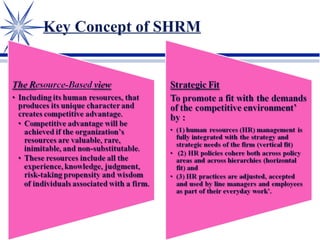
Strategic HRM is based on
three propositions:
1. The human resources or human capital of an organization play a
strategic role in its success and are a major source of competitive
advantage.
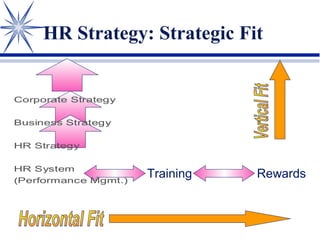
2. 2. HR strategies should be integrated with business plans (vertical
integration ) ‘The central premise of strategic human resource
management theory is that successful organizational performance
depends on a close fit or alignment between business and human
resource strategy
3. 3. Individual HR strategies should cohere by being linked to each
other to provide mutual support (horizontal integration)
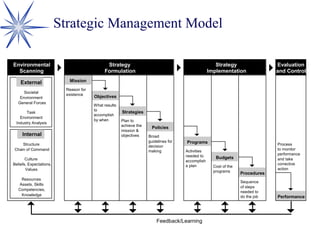
Strategic Management Model
Strategy
Formulation
Strategy
Implementation
Evaluation
and Control
Mission
Objectives
Strategies
Policies
Feedback/Learning
Environmental
Scanning
Societal
Environment
General Forces
Task
Environment
Industry Analysis
Structure
Chain of Command
Resources
Assets, Skills
Competencies,
Knowledge
Culture
Beliefs, Expectations,
Values
Reason for
existence
What results
to
accomplish
by when Plan to
achieve the
mission &
objectives Broad
guidelines for
decision
making
Programs
Activities
needed to
accomplish
a plan
Budgets
Cost of the
programs
Procedures
Sequence
of steps
needed to
do the job
Process
to monitor
performance
and take
corrective
action
Performance
External
Internal
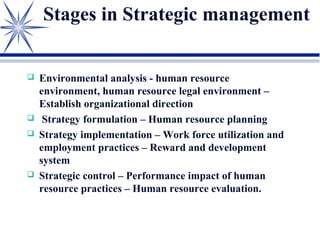
Stages in Strategic management
 Environmental analysis - human resource
environment, human resource legal environment –
Establish organizational direction
 Strategy formulation – Human resource planning
 Strategy implementation – Work force utilization and
employment practices – Reward and development
system
 Strategic control – Performance impact of human
resource practices – Human resource evaluation.
Strategy Formulation
The process of developing long-range plans to deal
effectively with environmental opportunities and threats
in light of corporate strengths and weaknesses.
Composed of:
Mission
Objectives
Strategies
Policies
Mission
The purpose or reason for the corporation’s
existence. It tells who the company is, what
they do as well as what they’d like to become.
Objectives
The end results of planned activity. They state
WHAT is to be accomplished by WHEN. They
should be quantified, if possible.
Should be specific, measurable and obtainable.
Strategies
A strategy is a comprehensive master plan stating HOW the
corporation will achieve its mission and objectives. There are
three types:
Corporate - a corporation’s overall direction and the management
of its businesses.
Business - emphasizes improving the competitive position of a
corporation’s products or services in a specific industry or market
segment.
Functional - concerned with developing a distinctive competence
to provide a company or business unit with a competitive
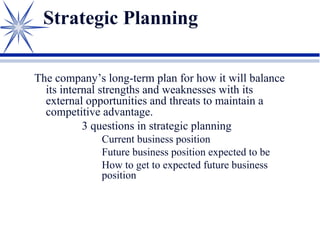
Strategic Planning
The company’s long-term plan for how it will balance
its internal strengths and weaknesses with its
external opportunities and threats to maintain a
competitive advantage.
3 questions in strategic planning
Current business position
Future business position expected to be
How to get to expected future business
position
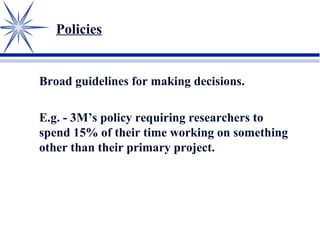
Policies
Broad guidelines for making decisions.
E.g. - 3M’s policy requiring researchers to
spend 15% of their time working on something
other than their primary project.
Key Concept of SHRM
HR Strategy: Strategic Fit
Training Rewards
Corporate Strategy
Business Strategy
HR Strategy
HR System
(Performance Mgmt.)
Conclusion
Strategic HRM is in some ways
an attitude of mind that
expresses a way of doing
things.

strategic Hrm

  • 2.
    Group 9 Presented by: Madhu Rana Priyanka Jitendra Singh Bhumika Ratan Charu Goel
  • 3.
    • Formulating HRpolicies and introducing practices that produce staff competencies and behaviors that the company needs to achieve its strategic goals. • HR managers today are more involved in partnering with their top managers in both designing and implementing their companies’ strategies • Top management wants to see, precisely, how the HR manager’s plans will make the company more valuable.
  • 4.
    ‘seeing the peopleof the organization as a strategic resource for the achievement of competitive advantage’ The set of managerial decisions and actions that determines the long- run performance of a corporation. It includes:  environmental scanning (internal & external)  strategy formulation  strategy implementation  evaluation and control It focuses on integrating management, marketing, finance/accounting, production/operations, research and development, and computer information systems to achieve organizational success.
  • 5.
    HR Practices LinkedWith Competitive Strategy Recruitment Training Career Path Promotions Socialization Openness
  • 6.
    Basics Of StrategicHRM HR Programs to enhance overall organizational performance HR in organization strategic planning from start Pro-actively participate in big picture decision making Redesign organizations and the work processes Measure financial results of all HR activities
  • 7.
    AIMS OF STRATEGICHRM “To generate strategic capability by ensuring that the organization has the skilled, engaged and well-motivated employees it needs to achieve sustained competitive advantage.”
  • 8.
    Benefits of StrategicManagement Clearer sense of strategic vision Sharper focus on what is strategically important Improved understanding of rapidly changing environment Identifying and analyzing external opportunities and threats that may be crucial to the company's success. Provides a clear business strategy and vision for the future. To supply competitive intelligence that may be useful in the strategic planning process. To recruit, retain and motivate people. To develop and retain of highly competent people. To ensure that people development issues are addressed systematically. To supply information regarding the company's internal strengths and weaknesses. To meet the expectations of the customers effectively. To ensure high productivity. To ensure business surplus thorough competency
  • 9.
    Role of HRManager • HR managers increasingly rely on IT to help support the company’s strategic aims • Change Agent - translate vision statements into meaningful format. • Strategic partner - training centre, design centre..
  • 10.
    Strategic HRM isbased on three propositions: 1. The human resources or human capital of an organization play a strategic role in its success and are a major source of competitive advantage. 2. 2. HR strategies should be integrated with business plans (vertical integration ) ‘The central premise of strategic human resource management theory is that successful organizational performance depends on a close fit or alignment between business and human resource strategy 3. 3. Individual HR strategies should cohere by being linked to each other to provide mutual support (horizontal integration)
  • 11.
    Strategic Management Model Strategy Formulation Strategy Implementation Evaluation andControl Mission Objectives Strategies Policies Feedback/Learning Environmental Scanning Societal Environment General Forces Task Environment Industry Analysis Structure Chain of Command Resources Assets, Skills Competencies, Knowledge Culture Beliefs, Expectations, Values Reason for existence What results to accomplish by when Plan to achieve the mission & objectives Broad guidelines for decision making Programs Activities needed to accomplish a plan Budgets Cost of the programs Procedures Sequence of steps needed to do the job Process to monitor performance and take corrective action Performance External Internal
  • 12.
    Stages in Strategicmanagement  Environmental analysis - human resource environment, human resource legal environment – Establish organizational direction  Strategy formulation – Human resource planning  Strategy implementation – Work force utilization and employment practices – Reward and development system  Strategic control – Performance impact of human resource practices – Human resource evaluation.
  • 13.
    Strategy Formulation The processof developing long-range plans to deal effectively with environmental opportunities and threats in light of corporate strengths and weaknesses. Composed of: Mission Objectives Strategies Policies
  • 14.
    Mission The purpose orreason for the corporation’s existence. It tells who the company is, what they do as well as what they’d like to become.
  • 15.
    Objectives The end resultsof planned activity. They state WHAT is to be accomplished by WHEN. They should be quantified, if possible. Should be specific, measurable and obtainable.
  • 16.
    Strategies A strategy isa comprehensive master plan stating HOW the corporation will achieve its mission and objectives. There are three types: Corporate - a corporation’s overall direction and the management of its businesses. Business - emphasizes improving the competitive position of a corporation’s products or services in a specific industry or market segment. Functional - concerned with developing a distinctive competence to provide a company or business unit with a competitive
  • 17.
    Strategic Planning The company’slong-term plan for how it will balance its internal strengths and weaknesses with its external opportunities and threats to maintain a competitive advantage. 3 questions in strategic planning Current business position Future business position expected to be How to get to expected future business position
  • 18.
    Policies Broad guidelines formaking decisions. E.g. - 3M’s policy requiring researchers to spend 15% of their time working on something other than their primary project.
  • 19.
  • 20.
    HR Strategy: StrategicFit Training Rewards Corporate Strategy Business Strategy HR Strategy HR System (Performance Mgmt.)
  • 21.
    Conclusion Strategic HRM isin some ways an attitude of mind that expresses a way of doing things.

Editor's Notes

  • #7 Human Resource managers must: Focus on developing HR programs that enhance organizational performance Involve HR in Big Picture organizational strategic planning from start Pro-actively participate in big picture decision making on mergers, acquisitions, and downsizing Redesign organizations and the work processes to enhance overall organizational performance Measure and document the financial results of all HR activities