MAPPING THE
GLOBAL MUSLIM
POPULATION
A Report on the Size and
Distribution of the World’s
Muslim Population

October 2009
About the Pew Forum on Religion & Public Life

This report was produced by the Pew Research Center’s Forum on Religion & Public Life. The Pew
Forum delivers timely, impartial information on issues at the intersection of religion and public
affairs. The Pew Forum is a nonpartisan, nonadvocacy organization and does not take positions
on policy debates. Based in Washington, D.C., the Pew Forum is a project of the Pew Research
Center, which is funded by The Pew Charitable Trusts.

This report is a collaborative effort based on the input and analysis of the following individuals:

Pew Forum on Religion & Public Life                 Communications and Web Publishing
Luis Lugo, Director                                 Erin O’Connell, Associate Director, Communications
                                                    Oliver Read, Web Manager
Research                                            Loralei Coyle, Communications Manager
Alan Cooperman, Associate Director, Research        Robert Mills, Communications Associate
Brian J. Grim, Senior Researcher                    Liga Plaveniece, Program Coordinator
Mehtab S. Karim, Visiting Senior Research Fellow
Sahar Chaudhry, Research Analyst                    Pew Research Center
Becky Hsu, Project Consultant                       Andrew Kohut, President
Jacqueline E. Wenger, Research Associate            Paul Taylor, Executive Vice President
Kimberly McKnight, Megan Pavlischek and             Scott Keeter, Director of Survey Research
Hilary Ramp, Research Interns                       Michael Piccorossi, Director of Operations
                                                    Michael Keegan, Graphics Director
Editorial                                           Alicia Parlapiano, Infographics Designer
Sandra Stencel, Associate Director, Editorial       Russell Heimlich, Web Developer
Andrea Useem, Contributing Editor
Tracy Miller, Editor
Sara Tisdale, Assistant Editor


Pew Forum on Religion & Public Life
1615 L St., NW, Suite 700
Washington, D.C. 20036-5610
Phone (202) 419-4550
Fax (202) 419-4559
www.pewforum.org

© 2009 Pew Research Center
Mapping the
      Global Muslim Population
               A Report on the Size and Distribution
                 of the World’s Muslim Population

                                               Table of Contents

Executive Summary .................................................................................................... 1
    Asia Predominates .................................................................................................. 5
    Living as Majorities and Minorities ....................................................................... 7
    Sunni and Shia Populations................................................................................... 8
Regional Distribution of Muslims ............................................................................ 12
    Asia-Pacific ............................................................................................................ 12
    Middle East-North Africa ...................................................................................... 16
    Sub-Saharan Africa ............................................................................................... 19
    Europe.................................................................................................................... 21
    Americas ................................................................................................................ 24
World Muslim Population by Region and Country ................................................. 27


Appendix A: Methodology for Muslim Population Estimates .............................. 35
Appendix B: Methodology for Sunni-Shia Estimates ........................................... 38
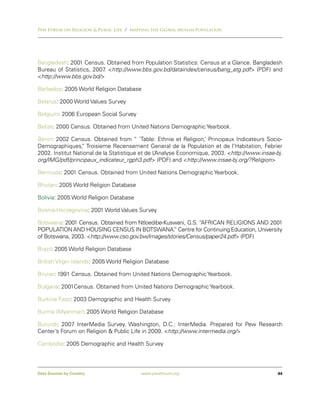
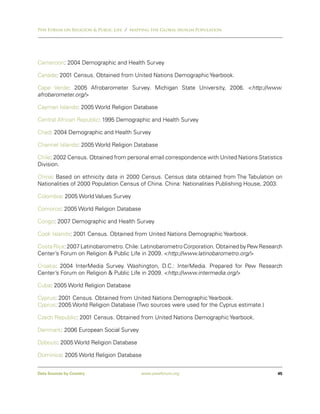
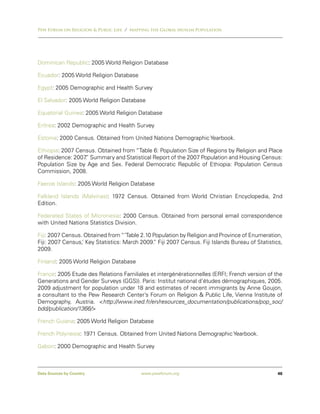
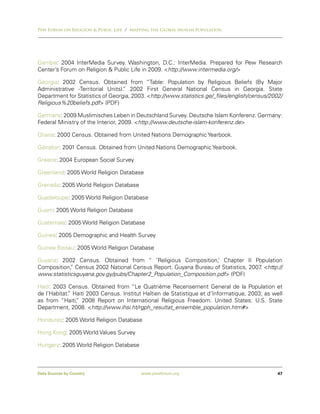
Appendix C: Data Sources by Country ................................................................... 42
Appendix D: Advisers and Consultants .................................................................. 56
Pew Forum on Religion & Public Life / Mapping the Global Muslim Population


Executive Summary

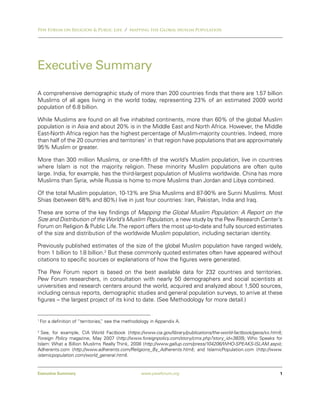
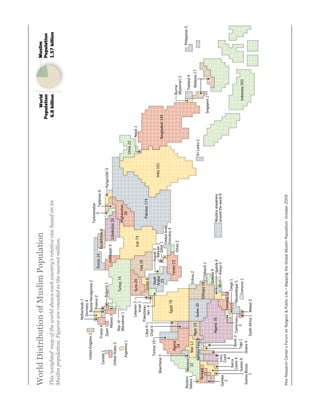
A comprehensive demographic study of more than 200 countries finds that there are 1.57 billion
Muslims of all ages living in the world today, representing 23% of an estimated 2009 world
population of 6.8 billion.

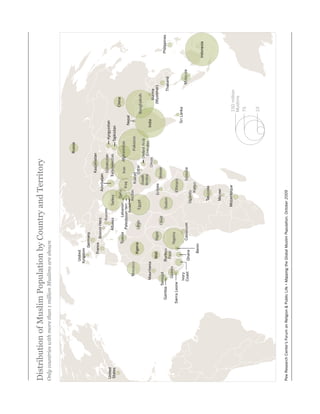
While Muslims are found on all five inhabited continents, more than 60% of the global Muslim
population is in Asia and about 20% is in the Middle East and North Africa. However, the Middle
East-North Africa region has the highest percentage of Muslim-majority countries. Indeed, more
than half of the 20 countries and territories1 in that region have populations that are approximately
95% Muslim or greater.

More than 300 million Muslims, or one-fifth of the world’s Muslim population, live in countries
where Islam is not the majority religion. These minority Muslim populations are often quite
large. India, for example, has the third-largest population of Muslims worldwide. China has more
Muslims than Syria, while Russia is home to more Muslims than Jordan and Libya combined.

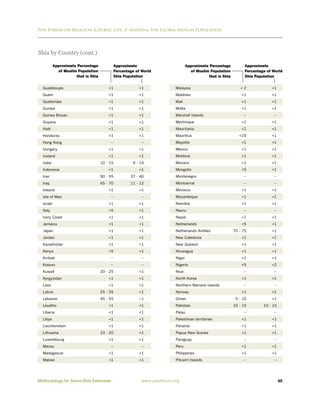
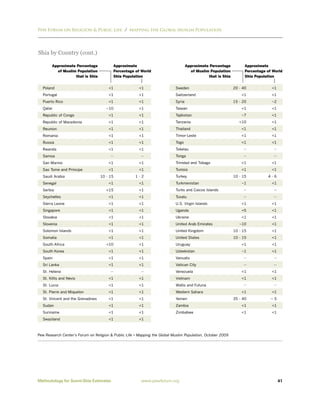
Of the total Muslim population, 10-13% are Shia Muslims and 87-90% are Sunni Muslims. Most
Shias (between 68% and 80%) live in just four countries: Iran, Pakistan, India and Iraq.

These are some of the key findings of Mapping the Global Muslim Population: A Report on the
Size and Distribution of the World’s Muslim Population, a new study by the Pew Research Center’s
Forum on Religion & Public Life. The report offers the most up-to-date and fully sourced estimates
of the size and distribution of the worldwide Muslim population, including sectarian identity.

Previously published estimates of the size of the global Muslim population have ranged widely,
from 1 billion to 1.8 billion.2 But these commonly quoted estimates often have appeared without
citations to specific sources or explanations of how the figures were generated.

The Pew Forum report is based on the best available data for 232 countries and territories.
Pew Forum researchers, in consultation with nearly 50 demographers and social scientists at
universities and research centers around the world, acquired and analyzed about 1,500 sources,
including census reports, demographic studies and general population surveys, to arrive at these
figures – the largest project of its kind to date. (See Methodology for more detail.)


1
    For a definition of “territories, see the methodology in Appendix A.
                                    ”

2
  See, for example, CIA World Factbook (https://www.cia.gov/library/publications/the-world-factbook/geos/xx.html);
Foreign Policy magazine, May 2007 (http://www.foreignpolicy.com/story/cms.php?story_id=3835); Who Speaks for
Islam: What a Billion Muslims Really Think, 2008 (http://www.gallup.com/press/104206/WHO-SPEAKS-ISLAM.aspx);
Adherents.com (http://www.adherents.com/Religions_By_Adherents.html); and IslamicPopulation.com (http://www.
islamicpopulation.com/world_general.html).


Executive Summary                                   www.pewforum.org                                            1
Pew Forum on Religion & Public Life / Mapping the Global Muslim Population


The Pew Forum’s estimate of the Shia population (10-13%) is in keeping with previous estimates,
which generally have been in the range of 10-15%. Some previous estimates, however, have
placed the number of Shias at nearly 20% of the world’s Muslim population.3 Readers should
bear in mind that the figures given in this report for the Sunni and Shia populations are less
precise than the figures for the overall Muslim population. Data on sectarian affiliation have been
infrequently collected or, in many countries, not collected at all. Therefore, the Sunni and Shia
numbers reported here are expressed as broad ranges and should be treated as approximate.

These findings on the world Muslim population lay the foundation for a forthcoming study by the
Pew Forum, scheduled to be released in 2010, that will estimate growth rates among Muslim
populations worldwide and project Muslim populations into the future. The Pew Forum plans to
launch a similar study of global Christianity in 2010 as well. The Pew Forum also plans to conduct
in-depth public opinion surveys on the intersection of religion and public life around the world,
starting with a 19-country survey of sub-Saharan Africa scheduled to be released later this year.
These forthcoming studies are part of a larger effort - the Global Religious Futures Project, jointly
funded by The Pew Charitable Trusts and the John Templeton Foundation - that aims to increase
people’s understanding of religion around the world.


3
 See, for example, IslamicWeb.com (http://www.islamicweb.com/beliefs/cults/shia_population.htm); “Shia Muslims in
the Middle East, Council on Foreign Relations, June 2006 (http://www.cfr.org/publication/10903/); and “The Revival of
                 ”
Shia Islam, Vali Nasr speaking at a Pew Forum event, July 2006 (http://pewforum.org/events/?EventID=120).
           ”

Executive Summary                                www.pewforum.org                                                  2
Distribution of Muslim Population by Country and Territory
Only countries with more than 1 million Muslims are shown


                                                                                                                                               Russia
                                                                    United
                                                                   Kingdom
                                                                              Germany
                                                                                                                                   Kazakhstan
                                                                         France
                                                                                    Bosnia-Herz.                    Azerbaijan
                                                                                                Kosovo                            Uzbekistan
 United                                                                                                                                                  Kyrgyzstan
 States                                                                                    Albania       Turkey                 Turkmenistan
                                                                                                                                                        Tajikistan
                                                                                                                Syria                                                           China
                                                                               Tunisia            Lebanon                         Iran   Afghanistan
                                                                                           Palestinian terr.            Iraq
                                                                                                     Israel                                                          Nepal
                                                           Morocco                                             Jordan                           Pakistan
                                                                                                                           Kuwait
                                                                         Algeria           Libya                                Qatar
                                                                                                       Egypt                                                                 Bangladesh
                                                                                                                          Saudi        United Arab
                                                                                                                          Arabia         Emirates
                                                         Mauritania                                                                 Oman                        India
                                                                                                                                                                                    Burma
                                                                      Mali         Niger                          Eritrea                                                         (Myanmar)
                                                                                              Chad                              Yemen
                                                      Senegal
                                             Gambia                Burkina                             Sudan                                                                                               Philippines
                                                                                                                                                                                          Thailand
                                                                    Faso
                                                          Guinea
                                                                               Nigeria
                                          Sierra Leone                                                             Ethiopia
                                                                                                                                                                      Sri Lanka
                                                         Ivory
                                                         Coast                     Cameroon                                    Somalia                                                        Malaysia
                                                                      Ghana                                Uganda
                                                                                                                Kenya
                                                                         Benin
                                                                                                                                                                                                         Indonesia
                                                                                                               Tanzania


                                                                                                               Malawi


                                                                                                         Mozambique
                                                                                                                                                                             150 million
                                                                                                                                                                             Muslims
                                                                                                                                                                             75


                                                                                                                                                                             10


Pew Research Center’s Forum on Religion & Public Life • Mapping the Global Muslim Population, October 2009
World Distribution of Muslim Population                                                                                                                                                 World                            Muslim
                                                                                                                                                                                     Population                            Population
  This ‘weighted’ map of the world shows each country’s relative size based on its                                                                                                    6.8 billion                          1.57 billion
  Muslim population. Figures are rounded to the nearest million.


                                                  Netherlands 1
                                                    Germany 4
                   United Kingdom 2                   Bosnia-Herzegovina 2
                                                                                                                    Turkmenistan
                                                         Kosovo 2
                                                                                        Russia 16                        5 Tajikistan 6
                Canada 1             France 4                                                        Kazakhstan 9
                                      Spain 1                     Bulgaria 1                                                              Kyrgyzstan 5
                                           Albania 3                                        Azerbaijan 9
                                                                                                           Uzbekistan 26
                United States 2
                                         Rep. of                      Turkey 74
                                         Macedonia 1                                                                 Afghanistan
                      Argentina 1                                                                                        28
                                                                                                                                                             China 22
                                                    Lebanon 3         Syria 20                                                                                            Nepal 1
                                                                                                      Iran 74
                                                       Israel 1                        Iraq 30
                                                 Palestinian                                                           Pakistan 174
                                      Libya 6        terr. 4           Jordan 6
                                      Chad 6
                      Tunisia 10                                          Saudi           Kuwait 3
                                                                          Arabia            Bahrain 1                                           India 161
           Mauritania 3                                                                        Qatar 1                                                                    Bangladesh 145
                                                                           25
                                                                                                     United Arab
                                                       Egypt 79                                      Emirates 4
                           Algeria                                                 Yemen 23
                                                                                               Oman 2                                                                                                    Burma
                             34                                                                                                                                                                          (Myanmar) 2
Western     Morocco                                                                                                                                                                                                             Philippines 5
                                                                                                                                                                                                           Thailand 4
Sahara 1      32          Mali 12                                          Eritrea 2
                                      Niger 15                                                                                                                                                               Malaysia 17
                   Burkina Faso 9                  Sudan 30                                                                                                 Sri Lanka 2
     Senegal                                                      Ethiopia 28
       12                                                                         Djibouti 1
                                                                                                                                                                                           Singapore 1
                                                                           Somalia 9
                                   Nigeria 78                                    Uganda 4                            Muslims elsewhere
                 Ivory                                                          Kenya 3                              around the world 8
 Gambia
   2             Coast
                   8                             Tanzania 13
             Sierra                                          Congo 1
            Leone 4       Benin 2 Cameroon            Mozambique 5
          Guinea 9       Togo 1        3                   Comoros 1                                                                                                                              Indonesia 203
  Guinea Bissau        Ghana 4
        1                        South Africa 1 Malawi 2


  Pew Research Center’s Forum on Religion & Public Life • Mapping the Global Muslim Population, October 2009
Pew Forum on Religion & Public Life / Mapping the Global Muslim Population


Asia Predominates

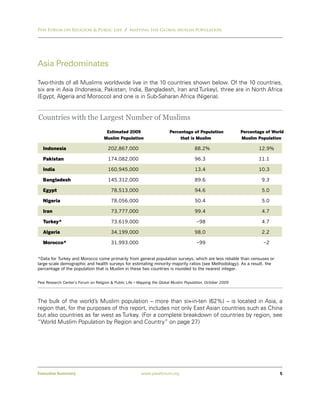
Two-thirds of all Muslims worldwide live in the 10 countries shown below. Of the 10 countries,
six are in Asia (Indonesia, Pakistan, India, Bangladesh, Iran and Turkey), three are in North Africa
(Egypt, Algeria and Morocco) and one is in Sub-Saharan Africa (Nigeria).


Countries with the Largest Number of Muslims
                                     Estimated 2009                      Percentage of Population            Percentage of World
                                    Muslim Population                         that is Muslim                 Muslim Population

  Indonesia                           202,867,000                                      88.2%                         12.9%

  Pakistan                            174,082,000                                      96.3                          11.1

  India                               160,945,000                                      13.4                          10.3

  Bangladesh                          145,312,000                                      89.6                           9.3

  Egypt                                 78,513,000                                     94.6                           5.0

  Nigeria                               78,056,000                                     50.4                           5.0

  Iran                                  73,777,000                                     99.4                           4.7

  Turkey*                               73,619,000                                      ~98                           4.7

  Algeria                               34,199,000                                     98.0                           2.2

  Morocco*                              31,993,000                                      ~99                            ~2


*Data for Turkey and Morocco come primarily from general population surveys, which are less reliable than censuses or
large-scale demographic and health surveys for estimating minority-majority ratios (see Methodology). As a result, the
percentage of the population that is Muslim in these two countries is rounded to the nearest integer.


Pew Research Center’s Forum on Religion & Public Life • Mapping the Global Muslim Population, October 2009


The bulk of the world’s Muslim population – more than six-in-ten (62%) – is located in Asia, a
region that, for the purposes of this report, includes not only East Asian countries such as China
but also countries as far west as Turkey. (For a complete breakdown of countries by region, see
“World Muslim Population by Region and Country” on page 27       .)


Executive Summary                                        www.pewforum.org                                                     5
Pew Forum on Religion & Public Life / Mapping the Global Muslim Population


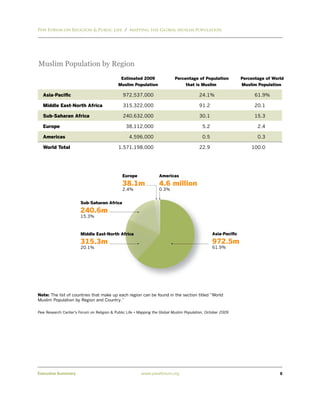
Muslim Population by Region
                                             Estimated 2009                 Percentage of Population           Percentage of World
                                            Muslim Population                    that is Muslim                Muslim Population

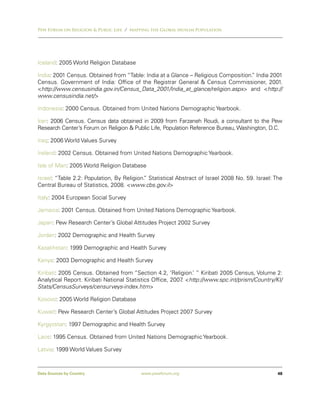
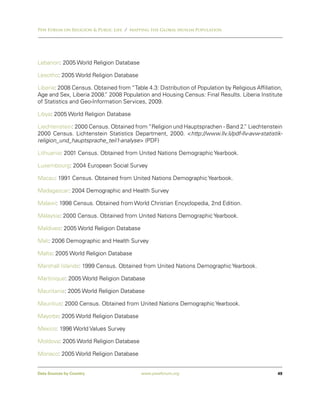
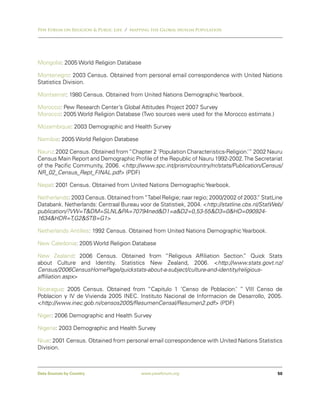
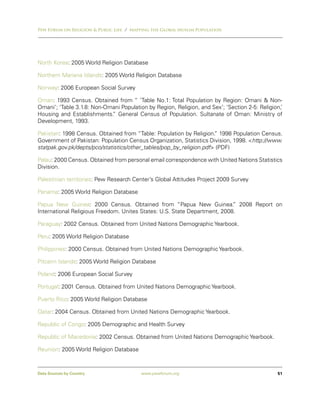
  Asia-Pacific                                  972,537,000                               24.1%                       61.9%

  Middle East-North Africa                     315,322,000                               91.2                        20.1

  Sub-Saharan Africa                           240,632,000                               30.1                        15.3

  Europe                                        38,112,000                                 5.2                        2.4

  Americas                                        4,596,000                                0.5                        0.3

  World Total                               1,571,198,000                                22.9                      100.0


                                              Europe               Americas
                                              38.1m                4.6 million
                                              2.4%                 0.3%


                       Sub-Saharan Africa
                       240.6m
                       15.3%


                       Middle East-North Africa                                                  Asia-Pacific

                       315.3m                                                                    972.5m
                       20.1%                                                                     61.9%


Note: The list of countries that make up each region can be found in the section titled “World
Muslim Population by Region and Country.”

Pew Research Center’s Forum on Religion & Public Life • Mapping the Global Muslim Population, October 2009


Executive Summary                                        www.pewforum.org                                                       6
Pew Forum on Religion & Public Life / Mapping the Global Muslim Population


Living as Majorities and Minorities

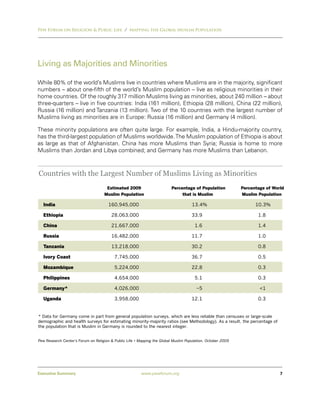
While 80% of the world’s Muslims live in countries where Muslims are in the majority, significant
numbers – about one-fifth of the world’s Muslim population – live as religious minorities in their
home countries. Of the roughly 317 million Muslims living as minorities, about 240 million – about
three-quarters – live in five countries: India (161 million), Ethiopia (28 million), China (22 million),
Russia (16 million) and Tanzania (13 million). Two of the 10 countries with the largest number of
Muslims living as minorities are in Europe: Russia (16 million) and Germany (4 million).

These minority populations are often quite large. For example, India, a Hindu-majority country,
has the third-largest population of Muslims worldwide. The Muslim population of Ethiopia is about
as large as that of Afghanistan. China has more Muslims than Syria; Russia is home to more
Muslims than Jordan and Libya combined; and Germany has more Muslims than Lebanon.


Countries with the Largest Number of Muslims Living as Minorities
                                     Estimated 2009                       Percentage of Population           Percentage of World
                                    Muslim Population                          that is Muslim                Muslim Population

  India                               160,945,000                                    13.4%                         10.3%

  Ethiopia                              28,063,000                                   33.9                           1.8

  China                                 21,667,000                                    1.6                           1.4

  Russia                                16,482,000                                   11.7                           1.0

  Tanzania                              13,218,000                                   30.2                           0.8

  Ivory Coast                             7,745,000                                  36.7                           0.5

  Mozambique                              5,224,000                                  22.8                           0.3

  Philippines                             4,654,000                                   5.1                           0.3

  Germany*                                4,026,000                                    ~5                            <1

  Uganda                                  3,958,000                                  12.1                           0.3


* Data for Germany come in part from general population surveys, which are less reliable than censuses or large-scale
demographic and health surveys for estimating minority-majority ratios (see Methodology). As a result, the percentage of
the population that is Muslim in Germany is rounded to the nearest integer.


Pew Research Center’s Forum on Religion & Public Life • Mapping the Global Muslim Population, October 2009


Executive Summary                                        www.pewforum.org                                                     7
Pew Forum on Religion & Public Life / Mapping the Global Muslim Population


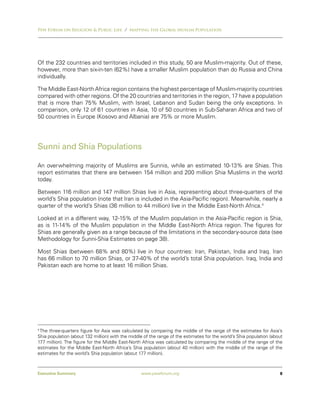
Of the 232 countries and territories included in this study, 50 are Muslim-majority. Out of these,
however, more than six-in-ten (62%) have a smaller Muslim population than do Russia and China
individually.

The Middle East-North Africa region contains the highest percentage of Muslim-majority countries
compared with other regions. Of the 20 countries and territories in the region, 17 have a population
that is more than 75% Muslim, with Israel, Lebanon and Sudan being the only exceptions. In
comparison, only 12 of 61 countries in Asia, 10 of 50 countries in Sub-Saharan Africa and two of
50 countries in Europe (Kosovo and Albania) are 75% or more Muslim.


Sunni and Shia Populations

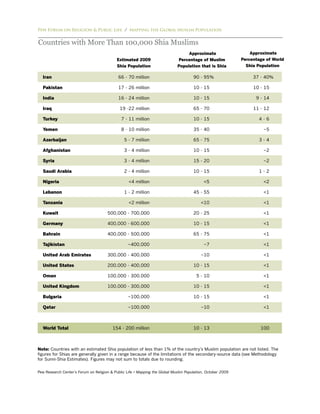
An overwhelming majority of Muslims are Sunnis, while an estimated 10-13% are Shias. This
report estimates that there are between 154 million and 200 million Shia Muslims in the world
today.

Between 116 million and 147 million Shias live in Asia, representing about three-quarters of the
world’s Shia population (note that Iran is included in the Asia-Pacific region). Meanwhile, nearly a
quarter of the world’s Shias (36 million to 44 million) live in the Middle East-North Africa.4

Looked at in a different way, 12-15% of the Muslim population in the Asia-Pacific region is Shia,
as is 11-14% of the Muslim population in the Middle East-North Africa region. The figures for
Shias are generally given as a range because of the limitations in the secondary-source data (see
Methodology for Sunni-Shia Estimates on page 38).

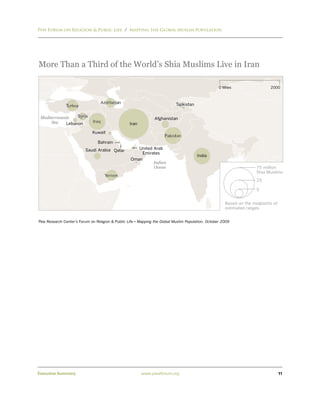
Most Shias (between 68% and 80%) live in four countries: Iran, Pakistan, India and Iraq. Iran
has 66 million to 70 million Shias, or 37-40% of the world’s total Shia population. Iraq, India and
Pakistan each are home to at least 16 million Shias.


4
 The three-quarters figure for Asia was calculated by comparing the middle of the range of the estimates for Asia’s
Shia population (about 132 million) with the middle of the range of the estimates for the world’s Shia population (about
177 million). The figure for the Middle East-North Africa was calculated by comparing the middle of the range of the
estimates for the Middle East-North Africa’s Shia population (about 40 million) with the middle of the range of the
estimates for the world’s Shia population (about 177 million).


Executive Summary                                 www.pewforum.org                                                    8
Pew Forum on Religion & Public Life / Mapping the Global Muslim Population


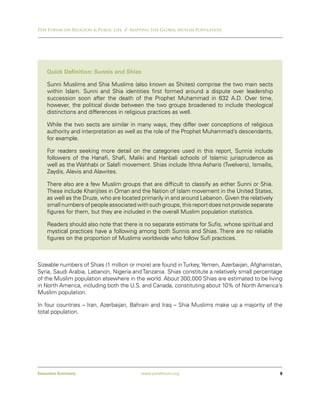
    Quick Definition: Sunnis and Shias

    Sunni Muslims and Shia Muslims (also known as Shiites) comprise the two main sects
    within Islam. Sunni and Shia identities first formed around a dispute over leadership
    succession soon after the death of the Prophet Muhammad in 632 A.D. Over time,
    however, the political divide between the two groups broadened to include theological
    distinctions and differences in religious practices as well.

    While the two sects are similar in many ways, they differ over conceptions of religious
    authority and interpretation as well as the role of the Prophet Muhammad’s descendants,
    for example.

    For readers seeking more detail on the categories used in this report, Sunnis include
    followers of the Hanafi, Shafi, Maliki and Hanbali schools of Islamic jurisprudence as
    well as the Wahhabi or Salafi movement. Shias include Ithna Asharis (Twelvers), Ismailis,
    Zaydis, Alevis and Alawites.

    There also are a few Muslim groups that are difficult to classify as either Sunni or Shia.
    These include Kharijites in Oman and the Nation of Islam movement in the United States,
    as well as the Druze, who are located primarily in and around Lebanon. Given the relatively
    small numbers of people associated with such groups, this report does not provide separate
    figures for them, but they are included in the overall Muslim population statistics.

    Readers should also note that there is no separate estimate for Sufis, whose spiritual and
    mystical practices have a following among both Sunnis and Shias. There are no reliable
    figures on the proportion of Muslims worldwide who follow Sufi practices.


Sizeable numbers of Shias (1 million or more) are found in Turkey, Yemen, Azerbaijan, Afghanistan,
Syria, Saudi Arabia, Lebanon, Nigeria and Tanzania. Shias constitute a relatively small percentage
of the Muslim population elsewhere in the world. About 300,000 Shias are estimated to be living
in North America, including both the U.S. and Canada, constituting about 10% of North America’s
Muslim population.

In four countries – Iran, Azerbaijan, Bahrain and Iraq – Shia Muslims make up a majority of the
total population.


Executive Summary                        www.pewforum.org                                         9
Pew Forum on Religion & Public Life / Mapping the Global Muslim Population


Countries with More Than 100,000 Shia Muslims
                                                                                  Approximate                    Approximate
                                            Estimated 2009                   Percentage of Muslim            Percentage of World
                                            Shia Population                  Population that is Shia           Shia Population

  Iran                                      66 - 70 million                           90 - 95%                    37 - 40%

  Pakistan                                  17 - 26 million                           10 - 15                     10 - 15

  India                                     16 - 24 million                           10 - 15                      9 - 14

  Iraq                                       19 -22 million                           65 - 70                     11 - 12

  Turkey                                      7 - 11 million                          10 - 15                       4-6

  Yemen                                       8 - 10 million                          35 - 40                         ~5

  Azerbaijan                                    5 - 7 million                         65 - 75                       3-4

  Afghanistan                                   3 - 4 million                         10 - 15                         ~2

  Syria                                         3 - 4 million                         15 - 20                         ~2

  Saudi Arabia                                  2 - 4 million                         10 - 15                       1-2

  Nigeria                                         <4 million                                <5                        <2

  Lebanon                                       1 - 2 million                         45 - 55                         <1

  Tanzania                                        <2 million                              <10                         <1

  Kuwait                              500,000 - 700,000                               20 - 25                         <1

  Germany                             400,000 - 600,000                               10 - 15                         <1

  Bahrain                             400,000 - 500,000                               65 - 75                         <1

  Tajikistan                                      ~400,000                                  ~7                        <1

  United Arab Emirates                300,000 - 400,000                                   ~10                         <1

  United States                       200,000 - 400,000                               10 - 15                         <1

  Oman                                100,000 - 300,000                                 5 - 10                        <1

  United Kingdom                      100,000 - 300,000                               10 - 15                         <1

  Bulgaria                                        ~100,000                            10 - 15                         <1

  Qatar                                           ~100,000                                ~10                         <1


  World Total                            154 - 200 million                            10 - 13                        100


Note: Countries with an estimated Shia population of less than 1% of the country’s Muslim population are not listed. The
figures for Shias are generally given in a range because of the limitations of the secondary-source data (see Methodology
for Sunni-Shia Estimates). Figures may not sum to totals due to rounding.


Pew Research Center’s Forum on Religion & Public Life • Mapping the Global Muslim Population, October 2009
Pew Forum on Religion & Public Life / Mapping the Global Muslim Population


More Than a Third of the World’s Shia Muslims Live in Iran

                                                                                                    0 Miles                 2000


                                     Azerbaijan                             Tajikistan
               Turkey

 Mediterranean    Syria
                                                                Afghanistan
      Sea                     Iraq
             Lebanon                              Iran

                             Kuwait
                                                                      Pakistan
                                Bahrain
                          Saudi Arabia Qatar          United Arab
                                                        Emirates
                                                                                         India
                                                   Oman
                                                             Indian
                                                             Ocean                                                    75 million
                                                                                                                      Shia Muslims
                                       Yemen
                                                                                                                      25

                                                                                                                      5


                                                                                                       Based on the midpoints of
                                                                                                       estimated ranges


Pew Research Center’s Forum on Religion & Public Life • Mapping the Global Muslim Population, October 2009


Executive Summary                                        www.pewforum.org                                                          11
Pew Forum on Religion & Public Life / Mapping the Global Muslim Population


Regional Distribution of Muslims

This report divides the world into five regions to take a closer look at the geographic distribution
of Muslims. (For a list of the countries in each region, see “World Muslim Population by Region
and Country” on page 27   .)

The five regions are presented in descending order of Muslim population, with the region with the
highest number of Muslims (Asia-Pacific) appearing first and the region with the lowest number
of Muslims (Americas) appearing last.


Asia-Pacific (61 countries and territories)

Muslims living in the Asia-Pacific region constitute 62% of all Muslims worldwide.

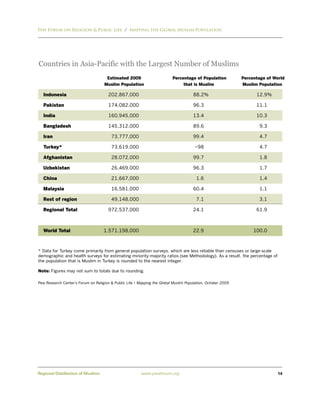
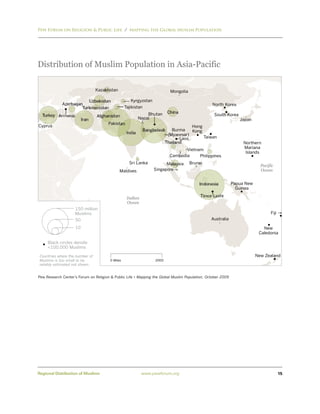
The six Asian countries with the largest Muslim populations are: Indonesia (203 million), Pakistan
(174 million), India (161 million), Bangladesh (145 million), Iran (74 million) and Turkey (74 million).
Together these six countries are home to about 85% of Asia’s Muslim population and more than
half (53%) of the global Muslim population.

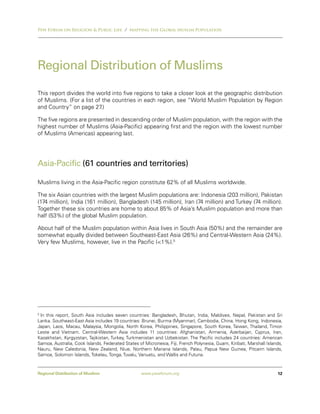
About half of the Muslim population within Asia lives in South Asia (50%) and the remainder are
somewhat equally divided between Southeast-East Asia (26%) and Central-Western Asia (24%).
Very few Muslims, however, live in the Pacific (<1%).5


5
 In this report, South Asia includes seven countries: Bangladesh, Bhutan, India, Maldives, Nepal, Pakistan and Sri
Lanka. Southeast-East Asia includes 19 countries: Brunei, Burma (Myanmar), Cambodia, China, Hong Kong, Indonesia,
Japan, Laos, Macau, Malaysia, Mongolia, North Korea, Philippines, Singapore, South Korea, Taiwan, Thailand, Timor-
Leste and Vietnam. Central-Western Asia includes 11 countries: Afghanistan, Armenia, Azerbaijan, Cyprus, Iran,
Kazakhstan, Kyrgyzstan, Tajikistan, Turkey, Turkmenistan and Uzbekistan. The Pacific includes 24 countries: American
Samoa, Australia, Cook Islands, Federated States of Micronesia, Fiji, French Polynesia, Guam, Kiribati, Marshall Islands,
Nauru, New Caledonia, New Zealand, Niue, Northern Mariana Islands, Palau, Papua New Guinea, Pitcairn Islands,
Samoa, Solomon Islands, Tokelau, Tonga, Tuvalu, Vanuatu, and Wallis and Futuna.


Regional Distribution of Muslims                   www.pewforum.org                                                   12
Pew Forum on Religion & Public Life / Mapping the Global Muslim Population


                      Muslims in Asia-Pacific by Subregion
                                             Pacific
                                             0.5 million
                                             <1%


                     Central-Western Asia
                     235m
                     24%


                                                                             South Asia
                     Southeast-East Asia                                     484m
                                                                             50%
                     253m
                     26%


                     Pew Research Center’s Forum on Religion & Public Life
                     Mapping the Global Muslim Population, October 2009


Indonesia is the country with the world’s largest Muslim population (203 million); about 13% of
all Muslims in the world live in Indonesia. Indonesia’s Muslim population accounts for about 80%
of all Muslims living in Southeast-East Asia.

In South Asia, three of the seven countries – Pakistan, India and Bangladesh – together are
home to nearly a third (31%) of the world’s Muslim population and 99% of South Asia’s Muslim
population.

Other Asian countries with more than 20 million Muslims include Afghanistan (28 million),
Uzbekistan (26 million) and China (22 million). There are Muslims in every province of China,
but the highest concentrations are in the west, primarily in Xinjiang, Ningxia and Gansu, with
other significant populations in Henan, Qinghai, Yunnan, Hebei and Shandong. Xinjiang is the only
Muslim-majority province of China, with Muslims accounting for approximately 53% of the total
population.


Regional Distribution of Muslims                       www.pewforum.org                        13
Pew Forum on Religion & Public Life / Mapping the Global Muslim Population


Countries in Asia-Pacific with the Largest Number of Muslims
                                     Estimated 2009                       Percentage of Population           Percentage of World
                                    Muslim Population                          that is Muslim                Muslim Population

  Indonesia                           202,867,000                                     88.2%                        12.9%

  Pakistan                            174,082,000                                     96.3                         11.1

  India                               160,945,000                                     13.4                         10.3

  Bangladesh                          145,312,000                                     89.6                          9.3

  Iran                                  73,777,000                                    99.4                          4.7

  Turkey*                               73,619,000                                    ~98                           4.7

  Afghanistan                           28,072,000                                    99.7                          1.8

  Uzbekistan                            26,469,000                                    96.3                          1.7

  China                                 21,667,000                                     1.6                          1.4

  Malaysia                              16,581,000                                    60.4                          1.1

  Rest of region                        49,148,000                                     7.1                          3.1

  Regional Total                      972,537,000                                     24.1                         61.9


  World Total                       1,571,198,000                                     22.9                        100.0


* Data for Turkey come primarily from general population surveys, which are less reliable than censuses or large-scale
demographic and health surveys for estimating minority-majority ratios (see Methodology). As a result, the percentage of
the population that is Muslim in Turkey is rounded to the nearest integer.

Note: Figures may not sum to totals due to rounding.

Pew Research Center’s Forum on Religion & Public Life • Mapping the Global Muslim Population, October 2009


Regional Distribution of Muslims                         www.pewforum.org                                                    14
Pew Forum on Religion & Public Life / Mapping the Global Muslim Population


Distribution of Muslim Population in Asia-Pacific

                                 Kazakhstan                                Mongolia

                          Uzbekistan                 Kyrgyzstan
             Azerbaijan                                                                         North Korea
                       Turkmenistan               Tajikistan
                                                               Bhutan     China
  Turkey Armenia                 Afghanistan                                                     South Korea
                         Iran                              Nepal                                                Japan
                                      Pakistan
Cyprus                                                                               Hong
                                                            Bangladesh      Burma    Kong
                                                   India                  (Myanmar)
                                                                                Laos      Taiwan
                                                                         Thailand                                 Northern
                                                                                  Vietnam                         Mariana
                                                                                                                   Islands
                                                                           Cambodia     Philippines
                                                    Sri Lanka           Malaysia      Brunei
                                                                                                                           Pacific
                                              Maldives            Singapore                                                Ocean


                                                                                          Indonesia          Papua New
                                                                                                               Guinea
                                                                                           Timor-Leste
                                                   Indian
                                                   Ocean
                    150 million
                    Muslims                                                                                                     Fiji
                    50                                                                          Australia

                    10                                                                                                      New
                                                                                                                          Caledonia

     Black circles denote
     <100,000 Muslims

 Countries where the number of                                                                                           New Zealand
 Muslims is too small to be             0 Miles                   2000
 reliably estimated not shown.


Pew Research Center’s Forum on Religion & Public Life • Mapping the Global Muslim Population, October 2009


Regional Distribution of Muslims                            www.pewforum.org                                                           15
Pew Forum on Religion & Public Life / Mapping the Global Muslim Population


Middle East-North Africa (20 countries and territories)

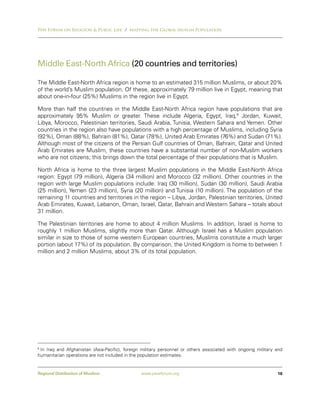
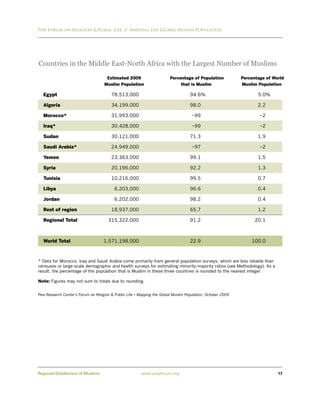
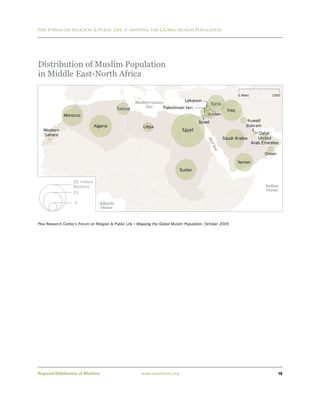
The Middle East-North Africa region is home to an estimated 315 million Muslims, or about 20%
of the world’s Muslim population. Of these, approximately 79 million live in Egypt, meaning that
about one-in-four (25%) Muslims in the region live in Egypt.

More than half the countries in the Middle East-North Africa region have populations that are
approximately 95% Muslim or greater. These include Algeria, Egypt, Iraq,6 Jordan, Kuwait,
Libya, Morocco, Palestinian territories, Saudi Arabia, Tunisia, Western Sahara and Yemen. Other
countries in the region also have populations with a high percentage of Muslims, including Syria
(92%), Oman (88%), Bahrain (81%), Qatar (78%), United Arab Emirates (76%) and Sudan (71%).
Although most of the citizens of the Persian Gulf countries of Oman, Bahrain, Qatar and United
Arab Emirates are Muslim, these countries have a substantial number of non-Muslim workers
who are not citizens; this brings down the total percentage of their populations that is Muslim.

North Africa is home to the three largest Muslim populations in the Middle East-North Africa
region: Egypt (79 million), Algeria (34 million) and Morocco (32 million). Other countries in the
region with large Muslim populations include: Iraq (30 million), Sudan (30 million), Saudi Arabia
(25 million), Yemen (23 million), Syria (20 million) and Tunisia (10 million). The population of the
remaining 11 countries and territories in the region – Libya, Jordan, Palestinian territories, United
Arab Emirates, Kuwait, Lebanon, Oman, Israel, Qatar, Bahrain and Western Sahara – totals about
31 million.

The Palestinian territories are home to about 4 million Muslims. In addition, Israel is home to
roughly 1 million Muslims, slightly more than Qatar. Although Israel has a Muslim population
similar in size to those of some western European countries, Muslims constitute a much larger
portion (about 17%) of its population. By comparison, the United Kingdom is home to between 1
million and 2 million Muslims, about 3% of its total population.


6
  In Iraq and Afghanistan (Asia-Pacific), foreign military personnel or others associated with ongoing military and
humanitarian operations are not included in the population estimates.


Regional Distribution of Muslims                www.pewforum.org                                                16
Pew Forum on Religion & Public Life / Mapping the Global Muslim Population


Countries in the Middle East-North Africa with the Largest Number of Muslims

                                     Estimated 2009                      Percentage of Population            Percentage of World
                                    Muslim Population                         that is Muslim                 Muslim Population

  Egypt                                 78,513,000                                  94.6%                           5.0%

  Algeria                               34,199,000                                  98.0                            2.2

  Morocco*                              31,993,000                                   ~99                             ~2

  Iraq*                                 30,428,000                                   ~99                             ~2

  Sudan                                 30,121,000                                  71.3                            1.9

  Saudi Arabia*                         24,949,000                                   ~97                             ~2

  Yemen                                 23,363,000                                  99.1                            1.5

  Syria                                 20,196,000                                  92.2                            1.3

  Tunisia                               10,216,000                                  99.5                            0.7

  Libya                                   6,203,000                                 96.6                            0.4

  Jordan                                  6,202,000                                 98.2                            0.4

  Rest of region                        18,937,000                                  65.7                            1.2

  Regional Total                      315,322,000                                   91.2                           20.1


  World Total                       1,571,198,000                                   22.9                         100.0


* Data for Morocco, Iraq and Saudi Arabia come primarily from general population surveys, which are less reliable than
censuses or large-scale demographic and health surveys for estimating minority-majority ratios (see Methodology). As a
result, the percentage of the population that is Muslim in these three countries is rounded to the nearest integer.

Note: Figures may not sum to totals due to rounding.


Pew Research Center’s Forum on Religion & Public Life • Mapping the Global Muslim Population, October 2009


Regional Distribution of Muslims                         www.pewforum.org                                                    17
Pew Forum on Religion & Public Life / Mapping the Global Muslim Population


Distribution of Muslim Population
in Middle East-North Africa

                                                                                                                   0 Miles            1000

                                                       Mediterranean           Lebanon
                                                                                                  Syria
                                             Tunisia        Sea     Palestinian terr.
                                                                                                            Iraq
              Morocco                                                                         Jordan
                                                                                         Israel                         Kuwait
                                Algeria                   Libya                                                         Bahrain
  Western                                                                       Egypt
  Sahara                                                                                                                        Qatar
                                                                                                          Saudi Arabia          United


                                                                                             Re
                                                                                                                             Arab Emirates


                                                                                               dS
                                                                                                 ea
                                                                                                                                   Oman

                                                                                                                   Yemen
                                                                              Sudan

                   50 million
                   Muslims                                                                                                         Indian
                                                                                                                                   Ocean
                   25

                    5             Atlantic
                                   Ocean


Pew Research Center’s Forum on Religion & Public Life • Mapping the Global Muslim Population, October 2009


Regional Distribution of Muslims                         www.pewforum.org                                                                 18
Pew Forum on Religion & Public Life / Mapping the Global Muslim Population


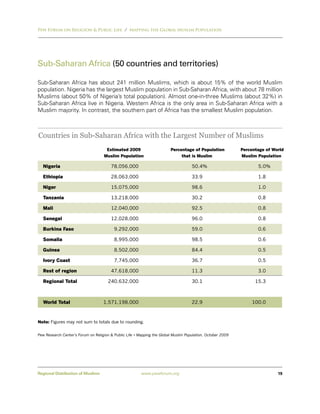
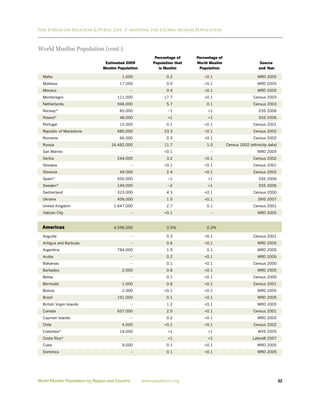
Sub-Saharan Africa (50 countries and territories)

Sub-Saharan Africa has about 241 million Muslims, which is about 15% of the world Muslim
population. Nigeria has the largest Muslim population in Sub-Saharan Africa, with about 78 million
Muslims (about 50% of Nigeria’s total population). Almost one-in-three Muslims (about 32%) in
Sub-Saharan Africa live in Nigeria. Western Africa is the only area in Sub-Saharan Africa with a
Muslim majority. In contrast, the southern part of Africa has the smallest Muslim population.


Countries in Sub-Saharan Africa with the Largest Number of Muslims
                                     Estimated 2009                      Percentage of Population            Percentage of World
                                    Muslim Population                         that is Muslim                 Muslim Population

  Nigeria                               78,056,000                                   50.4%                          5.0%

  Ethiopia                              28,063,000                                   33.9                           1.8

  Niger                                 15,075,000                                   98.6                           1.0

  Tanzania                              13,218,000                                   30.2                           0.8

  Mali                                  12,040,000                                   92.5                           0.8

  Senegal                               12,028,000                                   96.0                           0.8

  Burkina Faso                            9,292,000                                  59.0                           0.6

  Somalia                                 8,995,000                                  98.5                           0.6

  Guinea                                  8,502,000                                  84.4                           0.5

  Ivory Coast                             7,745,000                                  36.7                           0.5

  Rest of region                        47,618,000                                   11.3                           3.0

  Regional Total                      240,632,000                                    30.1                          15.3


  World Total                       1,571,198,000                                    22.9                         100.0


Note: Figures may not sum to totals due to rounding.


Pew Research Center’s Forum on Religion & Public Life • Mapping the Global Muslim Population, October 2009


Regional Distribution of Muslims                         www.pewforum.org                                                    19
Pew Forum on Religion & Public Life / Mapping the Global Muslim Population


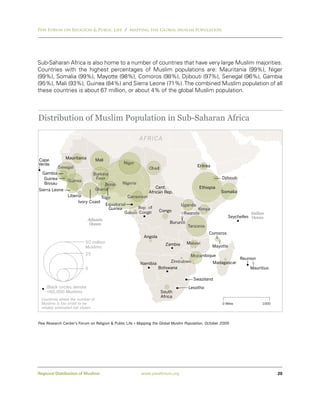
Sub-Saharan Africa is also home to a number of countries that have very large Muslim majorities.
Countries with the highest percentages of Muslim populations are: Mauritania (99%), Niger
(99%), Somalia (99%), Mayotte (98%), Comoros (98%), Djibouti (97%), Senegal (96%), Gambia
(95%), Mali (93%), Guinea (84%) and Sierra Leone (71%). The combined Muslim population of all
these countries is about 67 million, or about 4% of the global Muslim population.


Distribution of Muslim Population in Sub-Saharan Africa

                                                        A F R I CA


Cape           Mauritania         Mali
Verde                                          Niger
            Senegal                                                                     Eritrea
                                                             Chad
  Gambia                       Burkina
   Guinea                       Faso                                                                  Djibouti
                Guinea
   Bissau                             Benin   Nigeria
                                  Ghana                          Cent.                   Ethiopia
Sierra Leone                                                                                         Somalia
                                                             African Rep.
                Liberia          Togo         Cameroon
                     Ivory Coast
                                   Equatorial                                  Uganda
                                    Guinea        Rep. of                            Kenya
                                            Gabon Congo            Congo
                                                                                Rwanda                              Indian
                                                                                                         Seychelles Ocean
                            Atlantic
                             Ocean                                       Burundi
                                                                                   Tanzania
                                                                                              Comoros
                                                          Angola
                          50 million                                  Zambia       Malawi
                          Muslims                                                                 Mayotte
                          25                                                 Mozambique
                                                                                                 Reunion
                                                                     Zimbabwe         Madagascar
                                                        Namibia
                          5                                     Botswana                             Mauritius

                                                                                      Swaziland
    Black circles denote                                                           Lesotho
    <60,000 Muslims                                                 South
                                                                    Africa
  Countries where the number of
  Muslims is too small to be                                                                          0 Miles            1000
  reliably estimated not shown.


Pew Research Center’s Forum on Religion & Public Life • Mapping the Global Muslim Population, October 2009


Regional Distribution of Muslims                         www.pewforum.org                                                       20
Pew Forum on Religion & Public Life / Mapping the Global Muslim Population


Europe (50 countries and territories)

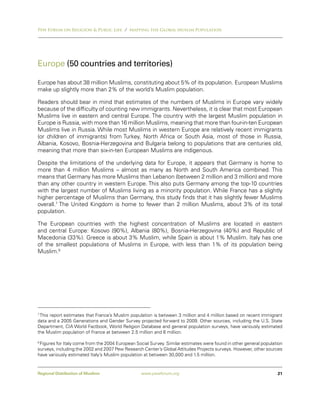
Europe has about 38 million Muslims, constituting about 5% of its population. European Muslims
make up slightly more than 2% of the world’s Muslim population.

Readers should bear in mind that estimates of the numbers of Muslims in Europe vary widely
because of the difficulty of counting new immigrants. Nevertheless, it is clear that most European
Muslims live in eastern and central Europe. The country with the largest Muslim population in
Europe is Russia, with more than 16 million Muslims, meaning that more than four-in-ten European
Muslims live in Russia. While most Muslims in western Europe are relatively recent immigrants
(or children of immigrants) from Turkey, North Africa or South Asia, most of those in Russia,
Albania, Kosovo, Bosnia-Herzegovina and Bulgaria belong to populations that are centuries old,
meaning that more than six-in-ten European Muslims are indigenous.

Despite the limitations of the underlying data for Europe, it appears that Germany is home to
more than 4 million Muslims – almost as many as North and South America combined. This
means that Germany has more Muslims than Lebanon (between 2 million and 3 million) and more
than any other country in western Europe. This also puts Germany among the top-10 countries
with the largest number of Muslims living as a minority population. While France has a slightly
higher percentage of Muslims than Germany, this study finds that it has slightly fewer Muslims
overall.7 The United Kingdom is home to fewer than 2 million Muslims, about 3% of its total
population.

The European countries with the highest concentration of Muslims are located in eastern
and central Europe: Kosovo (90%), Albania (80%), Bosnia-Herzegovina (40%) and Republic of
Macedonia (33%). Greece is about 3% Muslim, while Spain is about 1% Muslim. Italy has one
of the smallest populations of Muslims in Europe, with less than 1% of its population being
Muslim.8


7
 This report estimates that France’s Muslim population is between 3 million and 4 million based on recent immigrant
data and a 2005 Generations and Gender Survey projected forward to 2009. Other sources, including the U.S. State
Department, CIA World Factbook, World Religion Database and general population surveys, have variously estimated
the Muslim population of France at between 2.5 million and 6 million.

8
  Figures for Italy come from the 2004 European Social Survey. Similar estimates were found in other general population
surveys, including the 2002 and 2007 Pew Research Center’s Global Attitudes Projects surveys. However, other sources
have variously estimated Italy’s Muslim population at between 30,000 and 1.5 million.


Regional Distribution of Muslims                  www.pewforum.org                                                  21
Pew Forum on Religion & Public Life / Mapping the Global Muslim Population


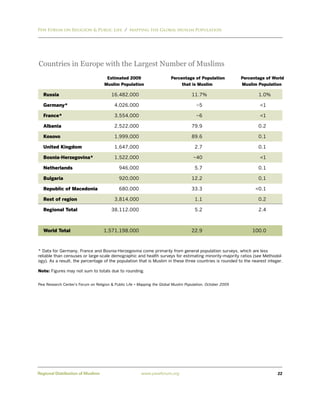
Countries in Europe with the Largest Number of Muslims
                                     Estimated 2009                      Percentage of Population            Percentage of World
                                    Muslim Population                         that is Muslim                 Muslim Population

  Russia                                16,482,000                                   11.7%                          1.0%

  Germany*                                4,026,000                                    ~5                            <1

  France*                                 3,554,000                                    ~6                            <1

  Albania                                 2,522,000                                  79.9                           0.2

  Kosovo                                  1,999,000                                  89.6                           0.1

  United Kingdom                          1,647,000                                   2.7                           0.1

  Bosnia-Herzegovina*                     1,522,000                                   ~40                            <1

  Netherlands                               946,000                                   5.7                           0.1

  Bulgaria                                  920,000                                  12.2                           0.1

  Republic of Macedonia                     680,000                                  33.3                          <0.1

  Rest of region                          3,814,000                                   1.1                           0.2

  Regional Total                        38,112,000                                    5.2                           2.4


  World Total                       1,571,198,000                                    22.9                         100.0


* Data for Germany, France and Bosnia-Herzegovina come primarily from general population surveys, which are less
reliable than censuses or large-scale demographic and health surveys for estimating minority-majority ratios (see Methodol-
ogy). As a result, the percentage of the population that is Muslim in these three countries is rounded to the nearest integer.

Note: Figures may not sum to totals due to rounding.


Pew Research Center’s Forum on Religion & Public Life • Mapping the Global Muslim Population, October 2009


Regional Distribution of Muslims                         www.pewforum.org                                                    22
Pew Forum on Religion & Public Life / Mapping the Global Muslim Population


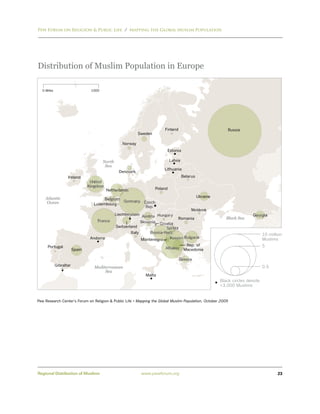
Distribution of Muslim Population in Europe

  0 Miles                        1000


                                                                         Finland                               Russia
                                                            Sweden

                                                   Norway
                                                                              Estonia

                                        North                                 Latvia
                                         Sea
                                                                         Lithuania
                                                  Denmark
                   Ireland                                                              Belarus
                                 United
                                Kingdom
                                           Netherlands               Poland

    Atlantic                                                                                      Ukraine
                                       Belgium
     Ocean                                     Germany Czech
                                  Luxembourg
                                                        Rep.
                                                                                       Moldova
                                                Liechtenstein Austria Hungary                                               Georgia
                                                                                 Romania                       Black Sea
                                    France                    Slovenia Croatia
                                                Switzerland                Serbia
                                                        Italy      Bosnia-Herz.
                                                                                                                                   10 million
                                 Andorra                      Montenegro     Kosovo Bulgaria                                       Muslims
     Portugal                                                                             Rep. of                                  5
                        Spain                                            Albania         Macedonia

                                                                                   Greece
            Gibraltar              Mediterranean                                                                                   0.5
                                        Sea
                                                               Malta
                                                                                                            Black circles denote
                                                                                                            <3,000 Muslims


Pew Research Center’s Forum on Religion & Public Life • Mapping the Global Muslim Population, October 2009


Regional Distribution of Muslims                             www.pewforum.org                                                             23
Pew Forum on Religion & Public Life / Mapping the Global Muslim Population


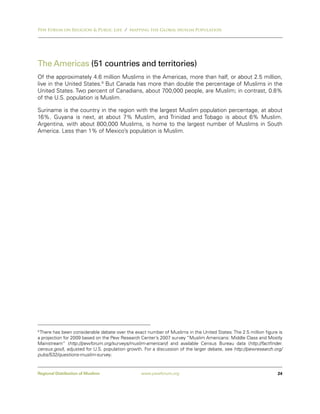
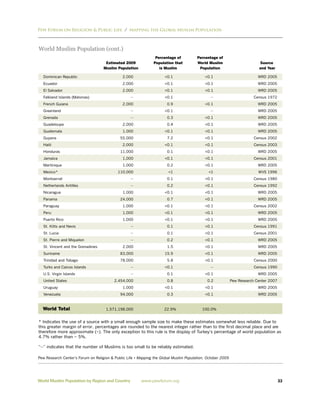
The Americas (51 countries and territories)
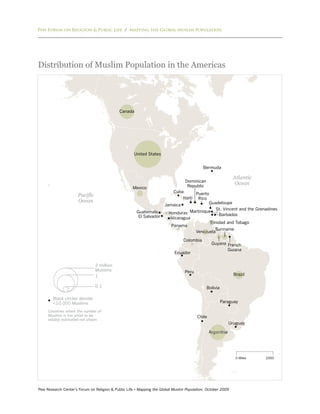
Of the approximately 4.6 million Muslims in the Americas, more than half, or about 2.5 million,
live in the United States.9 But Canada has more than double the percentage of Muslims in the
United States. Two percent of Canadians, about 700,000 people, are Muslim; in contrast, 0.8%
of the U.S. population is Muslim.

Suriname is the country in the region with the largest Muslim population percentage, at about
16%. Guyana is next, at about 7% Muslim, and Trinidad and Tobago is about 6% Muslim.
Argentina, with about 800,000 Muslims, is home to the largest number of Muslims in South
America. Less than 1% of Mexico’s population is Muslim.


9
 There has been considerable debate over the exact number of Muslims in the United States. The 2.5 million figure is
a projection for 2009 based on the Pew Research Center’s 2007 survey “Muslim Americans: Middle Class and Mostly
Mainstream” (http://pewforum.org/surveys/muslim-american/) and available Census Bureau data (http://factfinder.
census.gov/), adjusted for U.S. population growth. For a discussion of the larger debate, see http://pewresearch.org/
pubs/532/questions-muslim-survey.


Regional Distribution of Muslims                 www.pewforum.org                                                 24
Pew Forum on Religion & Public Life / Mapping the Global Muslim Population


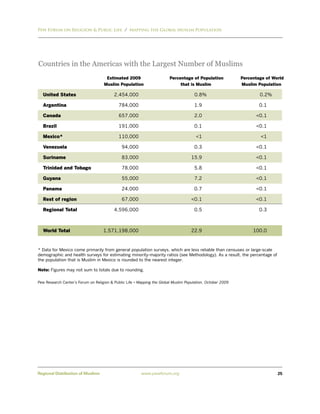
Countries in the Americas with the Largest Number of Muslims
                                     Estimated 2009                      Percentage of Population            Percentage of World
                                    Muslim Population                         that is Muslim                 Muslim Population

  United States                           2,454,000                                   0.8%                           0.2%

  Argentina                                 784,000                                   1.9                            0.1

  Canada                                    657,000                                   2.0                          <0.1

  Brazil                                    191,000                                   0.1                          <0.1

  Mexico*                                   110,000                                    <1                            <1

  Venezuela                                   94,000                                  0.3                          <0.1

  Suriname                                    83,000                                 15.9                          <0.1

  Trinidad and Tobago                         78,000                                  5.8                          <0.1

  Guyana                                      55,000                                  7.2                          <0.1

  Panama                                      24,000                                  0.7                          <0.1

  Rest of region                              67,000                                 <0.1                          <0.1

  Regional Total                          4,596,000                                   0.5                            0.3


  World Total                       1,571,198,000                                    22.9                         100.0


* Data for Mexico come primarily from general population surveys, which are less reliable than censuses or large-scale
demographic and health surveys for estimating minority-majority ratios (see Methodology). As a result, the percentage of
the population that is Muslim in Mexico is rounded to the nearest integer.

Note: Figures may not sum to totals due to rounding.

Pew Research Center’s Forum on Religion & Public Life • Mapping the Global Muslim Population, October 2009


Regional Distribution of Muslims                         www.pewforum.org                                                    25
Pew Forum on Religion & Public Life / Mapping the Global Muslim Population


Distribution of Muslim Population in the Americas


                                             Canada


                                                     United States


                                                                                           Bermuda

                                                                                                             Atlantic
                                                                                 Dominican
                                                                                  Republic
                                                                                                              Ocean
                                                    Mexico
                                                                          Cuba       Puerto
                     Pacific                                                   Haiti Rico
                     Ocean                                                                 Guadeloupe
                                                                      Jamaica
                                                                                                St. Vincent and the Grenadines
                                                      Guatemala         Honduras Martinique      Barbados
                                                       El Salvador       Nicaragua
                                                                                            Trinidad and Tobago
                                                                         Panama
                                                                                               Suriname
                                                                                     Venezuela

                                                                                Colombia
                                                                                                 Guyana French
                                                                                                        Guiana
                                                                           Ecuador


                               2 million
                               Muslims                                           Peru
                               1                                                                              Brazil

                               0.1                                                           Bolivia

        Black circles denote
        <10,000 Muslims                                                                                Paraguay

     Countries where the number of
     Muslims is too small to be                                                         Chile
     reliably estimated not shown.
                                                                                                            Uruguay

                                                                                                Argentina


                                                                                                               0 Miles   2000


Pew Research Center’s Forum on Religion & Public Life • Mapping the Global Muslim Population, October 2009
Pew Forum on Religion & Public Life / Mapping the Global Muslim Population


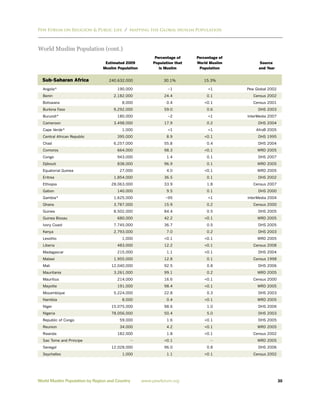
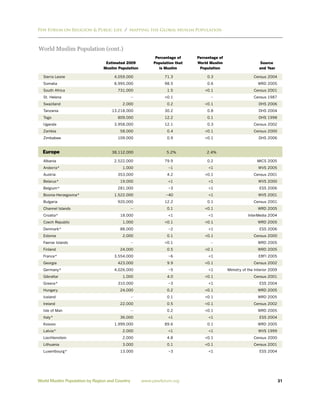
World Muslim Population by
Region and Country

For information about how data for each country or territory were collected and analyzed, see
Appendix C. Sources include national censuses, demographic and health surveys, and other
general population surveys and studies. Population figures for previous years have been projected
forward to 2009 based on the assumption that the Muslim population of the country is growing
at the same rate as the general population. (See Methodology in Appendix A.)

Data for countries marked with an asterisk (*) are drawn primarily from general population surveys,
which have smaller sample sizes than demographic surveys and are not designed to measure the
size of small minority populations. This may lead to undercounts of Muslims in countries where
they represent a small minority of the population and overcounts where they represent the vast
majority of the population. Those numbers, therefore, should be considered more approximate.


World Muslim Population by Region and Country   www.pewforum.org                                 27
Pew Forum on Religion & Public Life / Mapping the Global Muslim Population


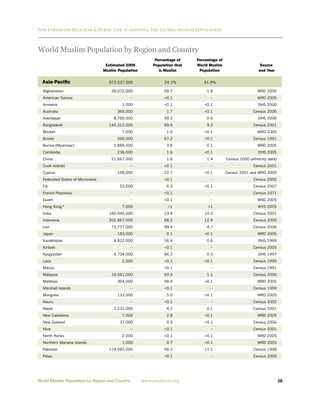
World Muslim Population by Region and Country
                                                             Percentage of    Percentage of
                                    Estimated 2009          Population that   World Muslim                      Source
                                   Muslim Population           is Muslim       Population                       and Year


  Asia-Pacific                        972,537,000                 24.1%           61.9%

  Afghanistan                          28,072,000                99.7              1.8                         WRD 2005
  American Samoa                                --               <0.1               --                         WRD 2005
  Armenia                                   1,000                <0.1            <0.1                          DHS 2000
  Australia                              365,000                  1.7            <0.1                        Census 2006
  Azerbaijan                            8,765,000                99.2              0.6                         DHS 2006
  Bangladesh                         145,312,000                 89.6              9.3                       Census 2001
  Bhutan                                    7,000                 1.0            <0.1                          WRD 2005
  Brunei                                 269,000                 67.2            <0.1                        Census 1991
  Burma (Myanmar)                       1,889,000                 3.8              0.1                         WRD 2005
  Cambodia                               236,000                  1.6            <0.1                          DHS 2005
  China                                21,667,000                 1.6              1.4        Census 2000 (ethnicity data)
  Cook Islands                                  --               <0.1               --                       Census 2001
  Cyprus                                 198,000                 22.7            <0.1         Census 2001 and WRD 2005
  Federated States of Micronesia                --               <0.1               --                       Census 2000
  Fiji                                     53,000                 6.3            <0.1                        Census 2007
  French Polynesia                              --               <0.1               --                       Census 1971
  Guam                                          --               <0.1               --                         WRD 2005
  Hong Kong*                                7,000                  <1              <1                          WVS 2005
  India                              160,945,000                 13.4            10.3                        Census 2001
  Indonesia                          202,867,000                 88.2            12.9                        Census 2000
  Iran                                 73,777,000                99.4              4.7                       Census 2006
  Japan                                  183,000                  0.1            <0.1                          WRD 2005
  Kazakhstan                            8,822,000                56.4              0.6                         DHS 1999
  Kiribati                                      --               <0.1               --                       Census 2005
  Kyrgyzstan                            4,734,000                86.3              0.3                         DHS 1997
  Laos                                      2,000                <0.1            <0.1                        Census 1995
  Macau                                         --               <0.1               --                       Census 1991
  Malaysia                             16,581,000                60.4              1.1                       Census 2000
  Maldives                               304,000                 98.4            <0.1                          WRD 2005
  Marshall Islands                              --               <0.1               --                       Census 1999
  Mongolia                                133,000                 5.0            <0.1                          WRD 2005
  Nauru                                         --               <0.1               --                       Census 2002
  Nepal                                 1,231,000                 4.2              0.1                       Census 2001
  New Caledonia                             7,000                 2.8            <0.1                          WRD 2005
  New Zealand                              37,000                 0.9            <0.1                        Census 2006
  Niue                                          --               <0.1               --                       Census 2001
  North Korea                               2,000                <0.1            <0.1                          WRD 2005
  Northern Mariana Islands                  1,000                  0.7           <0.1                          WRD 2005
  Pakistan                           174,082,000                 96.3            11.1                        Census 1998
  Palau                                         --               <0.1               --                       Census 2000


World Muslim Population by Region and Country          www.pewforum.org                                                      28
Pew Forum on Religion & Public Life / Mapping the Global Muslim Population


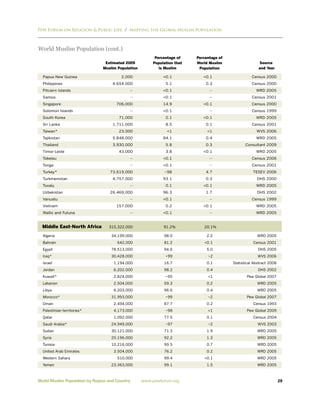
World Muslim Population (cont.)
                                                         Percentage of    Percentage of
                                Estimated 2009          Population that   World Muslim                  Source
                               Muslim Population           is Muslim       Population                   and Year

  Papua New Guinea                      2,000                <0.1            <0.1                   Census 2000
  Philippines                       4,654,000                 5.1             0.3                   Census 2000
  Pitcairn Islands                          --               <0.1               --                     WRD 2005
  Samoa                                     --               <0.1               --                  Census 2001
  Singapore                           706,000                14.9            <0.1                   Census 2000
  Solomon Islands                           --               <0.1               --                  Census 1999
  South Korea                          71,000                 0.1            <0.1                      WRD 2005
  Sri Lanka                         1,711,000                 8.5             0.1                   Census 2001
  Taiwan*                              23,000                  <1              <1                      WVS 2006
  Tajikistan                        5,848,000                84.1             0.4                      WRD 2005
  Thailand                          3,930,000                 5.8             0.3                Consultant 2009
  Timor-Leste                          43,000                 3.8            <0.1                      WRD 2005
  Tokelau                                   --               <0.1               --                  Census 2006
  Tonga                                     --               <0.1               --                  Census 2001
  Turkey*                          73,619,000                ~98              4.7                    TESEV 2006
  Turkmenistan                      4,757,000                93.1             0.3                      DHS 2000
  Tuvalu                                    --                0.1            <0.1                      WRD 2005
  Uzbekistan                       26,469,000                96.3             1.7                      DHS 2002
  Vanuatu                                   --               <0.1               --                  Census 1999
  Vietnam                             157,000                 0.2            <0.1                      WRD 2005
  Wallis and Futuna                         --               <0.1               --                     WRD 2005


  Middle East-North Africa        315,322,000                91.2%           20.1%

  Algeria                          34,199,000                98.0              2.2                     WRD 2005
  Bahrain                             642,000                81.2            <0.1                    Census 2001
  Egypt                            78,513,000                94.6              5.0                      DHS 2005
  Iraq*                            30,428,000                 ~99              ~2                       WVS 2006
  Israel                            1,194,000                16.7              0.1        Statistical Abstract 2008
  Jordan                            6,202,000                98.2              0.4                      DHS 2002
  Kuwait*                           2,824,000                 ~95              <1                 Pew Global 2007
  Lebanon                           2,504,000                59.3              0.2                     WRD 2005
  Libya                             6,203,000                96.6              0.4                     WRD 2005
  Morocco*                         31,993,000                 ~99              ~2                 Pew Global 2007
  Oman                              2,494,000                87.7              0.2                   Census 1993
  Palestinian territories*          4,173,000                 ~98              <1                 Pew Global 2009
  Qatar                             1,092,000                77.5              0.1                   Census 2004
  Saudi Arabia*                    24,949,000                 ~97              ~2                       WVS 2003
  Sudan                            30,121,000                71.3              1.9                     WRD 2005
  Syria                            20,196,000                92.2              1.3                     WRD 2005
  Tunisia                          10,216,000                99.5              0.7                     WRD 2005
  United Arab Emirates              3,504,000                76.2              0.2                     WRD 2005
  Western Sahara                      510,000                99.4            <0.1                       WRD 2005
  Yemen                            23,363,000                99.1              1.5                      WRD 2005


World Muslim Population by Region and Country      www.pewforum.org                                                   29
Pew Forum on Religion & Public Life / Mapping the Global Muslim Population


World Muslim Population (cont.)
                                                         Percentage of    Percentage of
                                Estimated 2009          Population that   World Muslim         Source
                               Muslim Population           is Muslim       Population          and Year


  Sub-Saharan Africa              240,632,000                30.1%           15.3%

  Angola*                             190,000                  ~1              <1         Pew Global 2002
  Benin                             2,182,000                24.4              0.1           Census 2002
  Botswana                              8,000                 0.4            <0.1            Census 2001
  Burkina Faso                      9,292,000                59.0              0.6             DHS 2003
  Burundi*                            180,000                  ~2              <1         InterMedia 2007
  Cameroon                          3,498,000                17.9              0.2             DHS 2004
  Cape Verde*                           1,000                  <1              <1             AfroB 2005
  Central African Republic            395,000                 8.9            <0.1              DHS 1995
  Chad                              6,257,000                55.8              0.4             DHS 2004
  Comoros                             664,000                98.3            <0.1              WRD 2005
  Congo                               943,000                 1.4              0.1             DHS 2007
  Djibouti                            838,000                96.9              0.1             WRD 2005
  Equatorial Guinea                    27,000                 4.0            <0.1              WRD 2005
  Eritrea                           1,854,000                36.5              0.1             DHS 2002
  Ethiopia                         28,063,000                33.9              1.8           Census 2007
  Gabon                               140,000                 9.5              0.1             DHS 2000
  Gambia*                           1,625,000                 ~95              <1         InterMedia 2004
  Ghana                             3,787,000                15.9              0.2           Census 2000
  Guinea                            8,502,000                84.4              0.5             DHS 2005
  Guinea Bissau                       680,000                42.2            <0.1              WRD 2005
  Ivory Coast                       7,745,000                36.7              0.5             DHS 2005
  Kenya                             2,793,000                 7.0              0.2             DHS 2003
  Lesotho                                1,000               <0.1            <0.1              WRD 2005
  Liberia                             483,000                12.2            <0.1            Census 2008
  Madagascar                          215,000                 1.1            <0.1              DHS 2004
  Malawi                            1,955,000                12.8              0.1           Census 1998
  Mali                             12,040,000                92.5              0.8             DHS 2006
  Mauritania                        3,261,000                99.1              0.2             WRD 2005
  Mauritius                           214,000                16.6            <0.1            Census 2000
  Mayotte                             191,000                98.4            <0.1              WRD 2005
  Mozambique                        5,224,000                22.8              0.3             DHS 2003
  Namibia                                8,000                0.4            <0.1              WRD 2005
  Niger                            15,075,000                98.6              1.0             DHS 2006
  Nigeria                          78,056,000                50.4              5.0             DHS 2003
  Republic of Congo                    59,000                 1.6            <0.1              DHS 2005
  Reunion                              34,000                 4.2            <0.1              WRD 2005
  Rwanda                              182,000                 1.8            <0.1            Census 2002
  Sao Tome and Principe                     --               <0.1               --             WRD 2005
  Senegal                          12,028,000                96.0              0.8             DHS 2006
  Seychelles                             1,000                1.1            <0.1            Census 2002


World Muslim Population by Region and Country      www.pewforum.org                                         30
Pew Forum on Religion & Public Life / Mapping the Global Muslim Population


World Muslim Population (cont.)
                                                           Percentage of    Percentage of
                                 Estimated 2009           Population that   World Muslim                      Source
                                Muslim Population            is Muslim       Population                       and Year

  Sierra Leone                       4,059,000                 71.3              0.3                       Census 2004
  Somalia                            8,995,000                 98.5              0.6                         WRD 2005
  South Africa                        731,000                   1.5            <0.1                        Census 2001
  St. Helena                                    --             <0.1               --                       Census 1987
  Swaziland                              2,000                  0.2            <0.1                           DHS 2006
  Tanzania                          13,218,000                 30.2              0.8                          DHS 2004
  Togo                                809,000                  12.2              0.1                          DHS 1998
  Uganda                             3,958,000                 12.1              0.3                       Census 2002
  Zambia                                58,000                  0.4            <0.1                        Census 2000
  Zimbabwe                            109,000                   0.9            <0.1                           DHS 2006


  Europe                            38,112,000                  5.2%            2.4%

  Albania                            2,522,000                 79.9              0.2                         MICS 2005
  Andorra*                               1,000                   ~1              <1                          WVS 2005
  Austria                             353,000                   4.2            <0.1                        Census 2001
  Belarus*                              19,000                   <1              <1                          WVS 2000
  Belgium*                            281,000                    ~3              <1                           ESS 2006
  Bosnia-Herzegovina*                1,522,000                  ~40              <1                          WVS 2001
  Bulgaria                            920,000                  12.2              0.1                       Census 2001
  Channel Islands                               --              0.1            <0.1                          WRD 2005
  Croatia*                              18,000                   <1              <1                    InterMedia 2004
  Czech Republic                         1,000                 <0.1            <0.1                          WRD 2005
  Denmark*                              88,000                   ~2              <1                           ESS 2006
  Estonia                                2,000                  0.1            <0.1                        Census 2000
  Faeroe Islands                                --             <0.1               --                         WRD 2005
  Finland                               24,000                  0.5            <0.1                          WRD 2005
  France*                            3,554,000                   ~6              <1                           ERFI 2005
  Georgia                             423,000                   9.9            <0.1                        Census 2002
  Germany*                           4,026,000                   ~5              <1         Ministry of the Interior 2009
  Gibraltar                              1,000                  4.0            <0.1                        Census 2001
  Greece*                             310,000                    ~3              <1                           ESS 2004
  Hungary                               24,000                  0.2            <0.1                          WRD 2005
  Iceland                                       --              0.1            <0.1                          WRD 2005
  Ireland                               22,000                  0.5            <0.1                        Census 2002
  Isle of Man                                   --              0.2            <0.1                          WRD 2005
  Italy*                                36,000                   <1              <1                           ESS 2004
  Kosovo                             1,999,000                 89.6              0.1                         WRD 2005
  Latvia*                                2,000                   <1              <1                           WVS 1999
  Liechtenstein                          2,000                  4.8            <0.1                        Census 2000
  Lithuania                              3,000                  0.1            <0.1                        Census 2001
  Luxembourg*                           13,000                   ~3              <1                           ESS 2004


World Muslim Population by Region and Country        www.pewforum.org                                                       31
Pew Forum on Religion & Public Life / Mapping the Global Muslim Population


World Muslim Population (cont.)
                                                         Percentage of    Percentage of
                                Estimated 2009          Population that   World Muslim                      Source
                               Muslim Population           is Muslim       Population                       and Year

  Malta                                 1,000                 0.2            <0.1                          WRD 2005
  Moldova                              17,000                 0.5            <0.1                          WRD 2005
  Monaco                                    --                0.4            <0.1                          WRD 2005
  Montenegro                          111,000                17.7            <0.1                        Census 2003
  Netherlands                         946,000                 5.7              0.1                       Census 2003
  Norway*                              65,000                  ~1              <1                           ESS 2006
  Poland*                              48,000                  <1              <1                           ESS 2006
  Portugal                             15,000                 0.1            <0.1                        Census 2001
  Republic of Macedonia               680,000                33.3            <0.1                        Census 2002
  Romania                              66,000                 0.3            <0.1                        Census 2002
  Russia                           16,482,000                11.7              1.0        Census 2002 (ethnicity data)
  San Marino                                --               <0.1               --                         WRD 2005
  Serbia                              244,000                 3.2            <0.1                        Census 2002
  Slovakia                                  --               <0.1            <0.1                        Census 2001
  Slovenia                             49,000                 2.4            <0.1                        Census 2002
  Spain*                              650,000                  ~1              <1                           ESS 2006
  Sweden*                             149,000                  ~2              <1                           ESS 2006
  Switzerland                         323,000                 4.3            <0.1                        Census 2000
  Ukraine                             456,000                 1.0            <0.1                          DHS 2007
  United Kingdom                    1,647,000                 2.7              0.1                       Census 2001
  Vatican City                              --               <0.1               --                         WRD 2005


  Americas                          4,596,000                  0.5%            0.3%

  Anguilla                                  --                0.3            <0.1                        Census 2001
  Antigua and Barbuda                       --                0.6            <0.1                          WRD 2005
  Argentina                           784,000                 1.9              0.1                         WRD 2005
  Aruba                                     --                0.2            <0.1                          WRD 2005
  Bahamas                                   --                0.1            <0.1                        Census 2000
  Barbados                              2,000                 0.8            <0.1                          WRD 2005
  Belize                                    --                0.1            <0.1                        Census 2000
  Bermuda                               1,000                 0.8            <0.1                        Census 2001
  Bolivia                               2,000                <0.1            <0.1                          WRD 2005
  Brazil                              191,000                 0.1            <0.1                          WRD 2005
  British Virgin Islands                    --                1.2            <0.1                          WRD 2005
  Canada                              657,000                 2.0            <0.1                        Census 2001
  Cayman Islands                            --                0.2            <0.1                          WRD 2005
  Chile                                  4,000               <0.1            <0.1                        Census 2002
  Colombia*                            14,000                  <1              <1                          WVS 2005
  Costa Rica*                               --                 <1              <1                       LatinoB 2007
  Cuba                                   9,000                0.1            <0.1                          WRD 2005
  Dominica                                  --                0.1            <0.1                          WRD 2005


World Muslim Population by Region and Country      www.pewforum.org                                                      32
Pew Forum on Religion & Public Life / Mapping the Global Muslim Population


World Muslim Population (cont.)
                                                                 Percentage of          Percentage of
                                     Estimated 2009             Population that         World Muslim                       Source
                                    Muslim Population              is Muslim             Population                        and Year

  Dominican Republic                          2,000                   <0.1                  <0.1                           WRD 2005
  Ecuador                                     2,000                   <0.1                  <0.1                           WRD 2005
  El Salvador                                 2,000                   <0.1                  <0.1                           WRD 2005
  Falkland Islands (Malvinas)                      --                 <0.1                     --                        Census 1972
  French Guiana                               2,000                    0.9                  <0.1                           WRD 2005
  Greenland                                        --                 <0.1                     --                          WRD 2005
  Grenada                                          --                  0.3                  <0.1                           WRD 2005
  Guadeloupe                                  2,000                    0.4                  <0.1                           WRD 2005
  Guatemala                                   1,000                   <0.1                  <0.1                           WRD 2005
  Guyana                                     55,000                    7.2                  <0.1                         Census 2002
  Haiti                                       2,000                   <0.1                  <0.1                         Census 2003
  Honduras                                   11,000                    0.1                  <0.1                           WRD 2005
  Jamaica                                     1,000                   <0.1                  <0.1                         Census 2001
  Martinique                                  1,000                    0.2                  <0.1                           WRD 2005
  Mexico*                                   110,000                     <1                    <1                           WVS 1996
  Montserrat                                       --                  0.1                  <0.1                         Census 1980
  Netherlands Antilles                             --                  0.2                  <0.1                         Census 1992
  Nicaragua                                   1,000                   <0.1                  <0.1                           WRD 2005
  Panama                                     24,000                    0.7                  <0.1                           WRD 2005
  Paraguay                                    1,000                   <0.1                  <0.1                         Census 2002
  Peru                                        1,000                   <0.1                  <0.1                           WRD 2005
  Puerto Rico                                 1,000                   <0.1                  <0.1                           WRD 2005
  St. Kitts and Nevis                              --                  0.1                  <0.1                         Census 1991
  St. Lucia                                        --                  0.1                  <0.1                         Census 2001
  St. Pierre and Miquelon                          --                  0.2                  <0.1                           WRD 2005
  St. Vincent and the Grenadines              2,000                    1.5                  <0.1                           WRD 2005
  Suriname                                   83,000                   15.9                  <0.1                           WRD 2005
  Trinidad and Tobago                        78,000                    5.8                  <0.1                         Census 2000
  Turks and Caicos Islands                         --                 <0.1                     --                        Census 1990
  U.S. Virgin Islands                              --                  0.1                  <0.1                           WRD 2005
  United States                           2,454,000                    0.8                    0.2            Pew Research Center 2007
  Uruguay                                     1,000                   <0.1                  <0.1                           WRD 2005
  Venezuela                                  94,000                    0.3                  <0.1                           WRD 2005


  World Total                        1,571,198,000                    22.9%                100.0%


* Indicates the use of a source with a small enough sample size to make these estimates somewhat less reliable. Due to
this greater margin of error, percentages are rounded to the nearest integer rather than to the first decimal place and are
therefore more approximate (~). The only exception to this rule is the display of Turkey’s percentage of world population as
4.7% rather than ~ 5%.

“--” indicates that the number of Muslims is too small to be reliably estimated.

Pew Research Center’s Forum on Religion & Public Life • Mapping the Global Muslim Population, October 2009


World Muslim Population by Region and Country            www.pewforum.org                                                               33
Pew Forum on Religion & Public Life / Mapping the Global Muslim Population


World Muslim Population (cont.)
Source Abbreviations

  AfroB                                      Afrobarometer
  Census (ethnicity data)                    Based on ethnicity data from census
  Consultant                                 Consultant to the Pew Forum on Religion & Public Life
  DHS                                        Demographic and Health Survey
  ERFI                                       Etude de Relations Familiales et Intergénérationnelles
  ESS                                        European Social Survey
  InterMedia                                 InterMedia Survey
  LatinoB                                    Latinobarometro
  MICS                                       Multiple Indicator Cluster Survey
  Ministry of the Interior                   Germany’s Federal Ministry of the Interior
  Pew Global                                 Pew Research Center’s Global Attitudes Project Survey
  Statistical Abstract                       Statistical Abstract of Israel
  TESEV                                      Turkish Economic and Social Studies Foundation Publications
  WRD                                        World Religion Database
  WVS                                        World Values Survey


For more information, see List of Sources.


World Muslim Population by Region and Country              www.pewforum.org                                34
Pew Forum on Religion & Public Life / Mapping the Global Muslim Population


Appendix A: Methodology for
Muslim Population Estimates

The Pew Forum’s Mapping the Global Muslim Population: A Report on the Size and Distribution
of the World’s Muslim Population seeks to provide the most up-to-date and comprehensive
demographic estimate of the number of Muslims in the 231 countries and territories for which
the United Nations Population Division provides general population estimates.10 In order to have
statistics that are comparable across countries, wherever possible this study counts all groups
and individuals who self-identify as Muslim. (The method for identifying Sunnis and Shias is
different; see Appendix B for a complete explanation.)

The number of Muslims in each of the countries and territories is calculated by multiplying the
United Nations’ 2009 total population estimate for each country and territory by the single most
recent and reliable demographic or social-scientific estimate of the percentage of Muslims in
each country’s population, based on the conservative assumption that Muslim populations are
growing at the same rate as each country’s general population. (A 2010 Pew Forum report will
provide estimates of the differential growth rates of Muslim populations.)

Sources include national censuses, demographic and health surveys, and general population
surveys and studies. The specific source used for each country is indicated in Appendix C. Readers
should note, however, that general population surveys generally have smaller sample sizes than
demographic surveys and are not designed to measure the size of small minority populations.
This may lead to undercounts of Muslims in countries where they represent a small minority of
the population and overcounts where they represent the vast majority of the population. See
below for more detail.

With all sources, results may have been affected by methodological decisions with respect to
how the data were collected and managed. Social, cultural or political factors could also have
affected how answers to census and survey questions are provided and recorded.


10
   Population estimates for 2009 for Taiwan and Kosovo are from the Population Reference Bureau. Taiwan’s population
is deducted from the U.N.’s China estimate and Kosovo’s from the U.N.’s Serbia estimate.


Methodology for Muslim Population Estimates     www.pewforum.org                                                 35
Pew Forum on Religion & Public Life / Mapping the Global Muslim Population


Discussion of Sources

Censuses
For this study, Pew Forum researchers acquired and analyzed religious affiliation data from 81
censuses that were conducted since 1999, comparing more current sources of data with older
census data on religious affiliation for an additional 103 countries as a cross check. Religious
affiliation questions from national censuses are the best source for estimating the number of
Muslims because they generally cover the entire population and are conducted on a fairly regular
basis. The chief limitation in using census data is that fewer than half of recent country censuses
included a religious affiliation question. In addition, these surveys are conducted only once every
10 years.


Demographic Surveys
Where recent census data on religion are not available, religious affiliation questions from large-
scale demographic surveys, such as Macro International’s MEASURE Demographic and Health
Surveys (DHS) (http://www.measuredhs.com/), are the second-best source because of their
large sample sizes, sampling frame and representative results at the province level. Though less
comprehensive than census data, demographic surveys complete sufficiently high numbers of
household interviews to produce a generally accurate demographic profile of the country. For this
report, DHS data were acquired and analyzed for more than 60 countries, or nearly two-thirds of
the countries where census data are lacking or are older than 1999. For most of the DHS surveys,
both women and men are interviewed and Macro International provides the data in separate
male-female datasets. Pew Forum staff pooled the female and male datasets in consultation
with sampling experts at Macro International so that the combined dataset retains nationally
representative results. In countries where only females are interviewed, Pew Forum staff used
those data to make the overall Muslim population estimate for the country.


General Population Surveys
Pew Forum researchers acquired and analyzed religious affiliation data from general population
surveys for some 100 countries. In more than 20 of those countries, these surveys provide
religious affiliation data where a recent census or demographic survey is lacking. Since general
population surveys typically involve only 1,000 to 2,000 respondents, however, they provide less
accurate numbers. This is especially true where the size of the Muslim population is quite small or
Muslims live in concentrated locations that are not oversampled. As a result, data drawn primarily
from these sources is marked with an asterisk in the tables throughout this report.


Methodology for Muslim Population Estimates   www.pewforum.org                                   36
Pew Forum on Religion & Public Life / Mapping the Global Muslim Population


World Religion Database
Pew Forum researchers also used estimates from the World Religion Database (www.
WorldReligionDatabase.org), primarily for countries where census and survey estimates were
out-of-date, unavailable or lacked sufficient coverage. Besides census and survey reports, WRD
estimates also take into account other sources of information on religious affiliation, including
anthropological and ethnographic studies as well as reputable statistical reports from religious
groups themselves. The WRD is an outgrowth of the international religious demography project
at Boston University’s Institute on Culture, Religion and World Affairs.


A Note on Country and Territory Designation

The word “country” in this report refers to all countries recognized as such by the United Nations.
The word “territory” in this report does not have a technical definition, but rather is a general term
for distinct geographical entities not recognized as countries by the United Nations but that have
separate population estimates reported by the United Nations. Territories in this report include
such entities as Hong Kong and Macau (special administrative regions of China), Greenland (an
autonomous constituent country within the Kingdom of Denmark) and the Commonwealth of
Puerto Rico (an unincorporated territory of the United States).


Methodology for Muslim Population Estimates   www.pewforum.org                                      37
Pew Forum on Religion & Public Life / Mapping the Global Muslim Population


Appendix B: Methodology for
Sunni-Shia Estimates

For the purposes of this report, sectarian differences among Muslims were simplified into two
categories: Sunni and Shia. It should be noted, however, that both these groups contain self-
identified Muslim communities that may be considered heterodox or nonmainstream by other
Muslims.

Unlike estimates for Muslim populations overall, almost no censuses and relatively few surveys
ask Muslims about their Sunni or Shia affiliation. Accordingly, Pew Forum researchers have relied
on three primary sources to generate Sunni-Shia estimates:

      •	    Analyses	by	more	than	20	demographers	and	social	scientists	at	universities	and		         	
            research centers around the world who are acting as consultants on this project;

      •	    Ethnographic	analyses	published	in	the	World	Religion	Database	(WRD);	and

      •	    A	review	of	other	published	or	frequently	used	estimates.

For most countries with sizeable Muslim populations, one or more experts provided the Pew
Forum with their best estimate of the Sunni-Shia breakdown based on their own review of the
published sources and other expert analyses available to them.

Additionally, for all countries and territories in the study, Pew Forum researchers consulted the
WRD estimates of the proportion of Muslims who are Sunni and Shia in each country. The WRD
estimates are based in turn on the WRD’s ethnicity database of more than 4,300 ethno-linguistic
groups. Readers should note, however, that these estimates are limited both by the initial
assumptions made about the Sunni-Shia composition of each ethnicity and by the variability of
ethnicity information available in each country.

As a result, the Sunni-Shia estimates presented in this report are based primarily on data gathered
via ethnographic and anthropological studies, necessitated by the fact that many Muslims either
cannot or will not identify themselves as Sunni or Shia. Therefore, Pew Forum staff are not able
to estimate the possible margin of error associated with any one particular estimate. Taking
into account the three different sources, this study provides a likely range of the proportion of
Muslims worldwide that are Shia based on an analysis of each country. Some ranges are broader
than others because the sources consulted provided different estimates or because the sources
suggest a wider range due to the lack of more precise information for a particular country.

Finally, for nearly 200 countries, Pew Forum researchers also consulted estimates contained in
the religious demography section of the annual International Religious Freedom reports published
by the U.S. State Department as well as estimates published in the CIA World Factbook.

Methodology for Sunni-Shia Estimates      www.pewforum.org                                       38
Pew Forum on Religion & Public Life / Mapping the Global Muslim Population


Estimated Percentage Range of Shia by Country
       Approximate Percentage          Approximate                         Approximate Percentage          Approximate
         of Muslim Population          Percentage of World                   of Muslim Population          Percentage of World
                  that is Shia         Shia Population                                that is Shia         Shia Population

  World Total                     10-13%           100%
                                                                   Chad                                  <1             <1
  Afghanistan                    10 - 15            ~2             Channel Islands                       <1             <1
  Albania                            <5             <1             Chile                                 <1             <1
  Algeria                            <1             <1             China                                 <1             <1
  American Samoa                      --             --            Colombia                              <1             <1
  Andorra                            <1             <1             Comoros                               <1             <1
  Angola                              --             --            Congo                                 <1             <1
  Anguilla                           <1             <1             Cook Islands                           --             --
  Antigua and Barbuda                <1             <1             Costa Rica                             --             --
  Argentina                         <10             <1             Croatia                               <1             <1
  Armenia                            <1             <1             Cuba                                  <1             <1
  Aruba                              <1             <1             Cyprus                                <1             <1
  Australia                         <10             <1             Czech Republic                        <1             <1
  Austria                            <1             <1             Denmark                               <5             <1
  Azerbaijan                      65-75           3-4              Djibouti                              <1             <1
  Bahamas                             --             --            Dominica                              <1             <1
  Bahrain                         65-75             <1             Dominican Republic                    <1             <1
  Bangladesh                         <1             <1             Ecuador                               <1             <1
  Barbados                           <1             <1             Egypt                                 <1             <1
  Belarus                            <1             <1             El Salvador                           <1             <1
  Belgium                            <1             <1             Equatorial Guinea                     <1             <1
  Belize                             <1             <1             Eritrea                               <1             <1
  Benin                              <1             <1             Estonia                               <1             <1
  Bermuda                             --             --            Ethiopia                              <1             <1
  Bhutan                             <1             <1             Faeroe Islands                         --             --
  Bolivia                            <1             <1             Falkland Islands (Malvinas)            --             --
  Bosnia-Herzegovina                 <1             <1             Federated States of Micronesia         --             --
  Botswana                           <1             <1             Fiji                                  <1             <1
  Brazil                            <10             <1             Finland                               <1             <1
  British Virgin Islands             <1             <1             France                               2-3             <1
  Brunei                             <1             <1             French Guiana                         <1             <1
  Bulgaria                       10 - 15            <1             French Polynesia                       --             --
  Burkina Faso                       <1             <1             Gabon                                 <1             <1
  Burma (Myanmar)                    <1             <1             Gambia                                <1             <1
  Burundi                            <5             <1             Georgia                           15 - 25            <1
  Cambodia                           <1             <1             Germany                           10 - 15            <1
  Cameroon                           <1             <1             Ghana                                 <1             <1
  Canada                            ~10             <1             Gibraltar                             <1             <1
  Cape Verde                         <1             <1             Greece                            10 - 15            <1
  Cayman Islands                     <1             <1             Greenland                             <1             <1
  Central African Republic           <1             <1             Grenada                               <1             <1


Methodology for Sunni-Shia Estimates                 www.pewforum.org                                                         39
Pew Forum on Religion & Public Life / Mapping the Global Muslim Population


Shia by Country (cont.)

           Approximate Percentage          Approximate                       Approximate Percentage          Approximate
             of Muslim Population          Percentage of World                 of Muslim Population          Percentage of World
                      that is Shia         Shia Population                              that is Shia         Shia Population


  Guadeloupe                             <1            <1             Malaysia                            <2              <1
  Guam                                   <1            <1             Maldives                             <1             <1
  Guatemala                              <1            <1             Mali                                 <1             <1
  Guinea                                 <1            <1             Malta                                <1             <1
  Guinea Bissau                          <1            <1             Marshall Islands                      --             --
  Guyana                                 <1            <1             Martinique                           <1             <1
  Haiti                                  <1            <1             Mauritania                           <1             <1
  Honduras                               <1            <1             Mauritius                           <10             <1
  Hong Kong                               --             --           Mayotte                              <1             <1
  Hungary                                <1            <1             Mexico                               <1             <1
  Iceland                                <1            <1             Moldova                              <1             <1
  India                              10 - 15        9 - 14            Monaco                               <1             <1
  Indonesia                              <1            <1             Mongolia                             <5             <1
  Iran                               90 - 95       37 - 40            Montenegro                            --             --
  Iraq                               65 - 70       11 - 12            Montserrat                            --             --
  Ireland                                <1            <1             Morocco                              <1             <1
  Isle of Man                             --             --           Mozambique                           <1             <1
  Israel                                 <1            <1             Namibia                              <1             <1
  Italy                                  <5            <1             Nauru                                 --             --
  Ivory Coast                            <1            <1             Nepal                                <1             <1
  Jamaica                                <1            <1             Netherlands                          <5             <1
  Japan                                  <1            <1             Netherlands Antilles             70 - 75            <1
  Jordan                                 <1            <1             New Caledonia                        <1             <1
  Kazakhstan                             <1            <1             New Zealand                          <1             <1
  Kenya                                  <5            <1             Nicaragua                            <1             <1
  Kiribati                                --             --           Niger                                <1             <1
  Kosovo                                  --             --           Nigeria                              <5             <2
  Kuwait                             20 - 25           <1             Niue                                  --             --
  Kyrgyzstan                             <1            <1             North Korea                          <1             <1
  Laos                                   <1            <1             Northern Mariana Islands              --             --
  Latvia                             25 - 35           <1             Norway                               <1             <1
  Lebanon                            45 - 55           ~1             Oman                              5 - 10            <1
  Lesotho                                <1            <1             Pakistan                         10 - 15        10 - 15
  Liberia                                <1            <1             Palau                                 --             --
  Libya                                  <1            <1             Palestinian territories              <1             <1
  Liechtenstein                          <1            <1             Panama                               <1             <1
  Lithuania                          10 - 20           <1             Papua New Guinea                     <1             <1
  Luxembourg                             <1            <1             Paraguay                              --             --
  Macau                                   --             --           Peru                                 <1             <1
  Madagascar                             <1            <1             Philippines                          <1             <1
  Malawi                                 <1            <1             Pitcairn Islands                      --             --


Methodology for Sunni-Shia Estimates                    www.pewforum.org                                                        40
Pew Forum on Religion & Public Life / Mapping the Global Muslim Population


Shia by Country (cont.)

       Approximate Percentage             Approximate                               Approximate Percentage          Approximate
         of Muslim Population             Percentage of World                         of Muslim Population          Percentage of World
                  that is Shia            Shia Population                                      that is Shia         Shia Population


  Poland                               <1               <1                  Sweden                            20 - 40            <1
  Portugal                             <1               <1                  Switzerland                           <1             <1
  Puerto Rico                          <1               <1                  Syria                             15 - 20            ~2
  Qatar                               ~10               <1                  Taiwan                                <1             <1
  Republic of Congo                    <1               <1                  Tajikistan                            ~7             <1
  Republic of Macedonia                <1               <1                  Tanzania                             <10             <1
  Reunion                              <1               <1                  Thailand                              <1             <1
  Romania                              <1               <1                  Timor-Leste                           <1             <1
  Russia                               <1               <1                  Togo                                  <1             <1
  Rwanda                               <1               <1                  Tokelau                                --             --
  Samoa                                 --               --                 Tonga                                  --             --
  San Marino                           <1               <1                  Trinidad and Tobago                   <1             <1
  Sao Tome and Principe                <1               <1                  Tunisia                               <1             <1
  Saudi Arabia                     10 - 15            1-2                   Turkey                            10 - 15          4-6
  Senegal                              <1               <1                  Turkmenistan                          ~1             <1
  Serbia                              <15               <1                  Turks and Caicos Islands               --             --
  Seychelles                           <1               <1                  Tuvalu                                 --             --
  Sierra Leone                         <1               <1                  U.S. Virgin Islands                   <1             <1
  Singapore                            <1               <1                  Uganda                                <5             <1
  Slovakia                             <1               <1                  Ukraine                               <1             <1
  Slovenia                             <1               <1                  United Arab Emirates                 ~10             <1
  Solomon Islands                      <1               <1                  United Kingdom                    10 - 15            <1
  Somalia                              <1               <1                  United States                     10 - 15            <1
  South Africa                        <10               <1                  Uruguay                               <1             <1
  South Korea                          <1               <1                  Uzbekistan                            ~1             <1
  Spain                                <1               <1                  Vanuatu                                --             --
  Sri Lanka                            <1               <1                  Vatican City                           --             --
  St. Helena                            --               --                 Venezuela                             <1             <1
  St. Kitts and Nevis                  <1               <1                  Vietnam                               <1             <1
  St. Lucia                            <1               <1                  Wallis and Futuna                      --             --
  St. Pierre and Miquelon              <1               <1                  Western Sahara                        <1             <1
  St. Vincent and the Grenadines       <1               <1                  Yemen                             35 - 40            ~5
  Sudan                                <1               <1                  Zambia                                <1             <1
  Suriname                             <1               <1                  Zimbabwe                              <1             <1
  Swaziland                            <1               <1


Pew Research Center’s Forum on Religion & Public Life • Mapping the Global Muslim Population, October 2009


Methodology for Sunni-Shia Estimates                     www.pewforum.org                                                              41
Pew Forum on Religion & Public Life / Mapping the Global Muslim Population


Appendix C: Data Sources by Country

The below list of general sources provides bibliographic information for sources that were used
to provide estimates for the Muslim populations of multiple countries. The subsequent list of
sources by country provides abbreviated bibliographic information identifying which general
sources were used to provide estimates for countries, as well as fuller bibliographic information
for sources that were used for one country only.


General Sources

Demographic and Health Surveys (DHS). MEASURE DHS. Calverton, Maryland: Administered by
Macro International, 1995-2007 <http://www.measuredhs.com/>
                              .

European Social Survey (ESS). London: Led by Centre for Comparative Social Surveys, City
University, 2004, 2006. <http://www.europeansocialsurvey.org/>

Pew Research Center’s Global Attitudes Project 2009 Survey <http://pewglobal.org/datasets/>

Pew Research Center’s Global Attitudes Project 2007 Survey <http://pewglobal.org/datasets/>

Pew Research Center’s Global Attitudes Project 2002 Survey <http://pewglobal.org/datasets/>

United Nations Demographic Yearbook. “Special Census Topics Volume 2 - Social characteristics,
‘Table 6: Population by religion, sex, urban/rural residence and percentage: each census,
1985-2004.’ ” New York: United Nations Statistics Division, 2006. <http://unstats.un.org/unsd/
demographic/sconcerns/popchar/popchar2.htm>

World Christian Encyclopedia, 2nd Edition. David B. Barrett, George T. Kurian, and Todd M. Johnson,
eds. United States: Oxford University Press, 2001.

World Religion Database: International Religious Demographic Statistics and Sources (WRD).
Todd M. Johnson and Brian J. Grim, eds. Leiden, Netherlands and Boston, Mass.: Brill, 2008.
(Muslim population estimates from 2005.) <http://www.worldreligiondatabase.org>

World Values Survey (WVS). “Values Survey Database. World Values Survey Association, 1999-
                                                  ”
2006. <http://www.worldvaluessurvey.org/>


Data Sources by Country                  www.pewforum.org                                        42
Pew Forum on Religion & Public Life / Mapping the Global Muslim Population


Sources by Country

Afghanistan: 2005 World Religion Database

Albania: 2005 Albania Multiple Indicator Cluster Survey (MICS). Obtained from “Table HH.3:
Household Composition: Percent distribution of households by selected characteristics. Albania
                                                                                           ”
Multiple Indicator Cluster Survey 2005, Final Report. Tirana, Albania: Albanian National Institute of
Statistics, 2009. <http://www.childinfo.org/mics3_surveys.html>

Algeria: 2005 World Religion Database

American Samoa: 2005 World Religion Database

Andorra: 2005 World Values Survey

Angola: Pew Research Center’s Global Attitudes Project 2002 Survey

Anguilla: 2001 Census. Obtained from United Nations Demographic Yearbook.

Antigua and Barbuda: 2005 World Religion Database

Argentina: 2005 World Religion Database

Armenia: 2000 Demographic and Health Survey

Aruba: 2000 Census. Obtained from “Table P-A.5: Population by religion, age, and sex. Fourth
                                                                                    ”
Population and Housing Census: Aruba October 14, 2000. Aruba Central Bureau of Statistics,
2001. <http://www.cbs.aw/cbs/readBlob.do?id=467> (PDF)

Australia: 2006 Census. Obtained from “Category No. 2068.0 – 2006 Census Tables: Religious
Affiliation(a) (Full Classification List) by Sex. 2006 Census of Population and Housing. Australian
                                                ”
Bureau of Statistics, 2007 <http://www.abs.gov.au/>
                              .

Austria: 2001 Census. Obtained from United Nations Demographic Yearbook.

Azerbaijan: 2006 Demographic and Health Survey. (Survey excluded the Kalbajar-Lachin region
and four out of the seven districts of the Yukhari Garabakh region.)

Bahamas: 2000 Census. Obtained from personal email correspondence with United Nations
Statistics Division.

Bahrain: 2001 Census. Obtained from “Part 2, ‘Table - 0603.0: POPULATION BY RELIGION, AGE
GROUPS, NATIONALITY AND SEX – 2001.’ ” Bahrain Census 2001. Bahrain: Directorate of Statistics
in Central Informatics Organization, 2001. <http://www.cio.gov.bh/CIO_ENG/sitemap.aspx>


Data Sources by Country                   www.pewforum.org                                         43
Pew Forum on Religion & Public Life / Mapping the Global Muslim Population


Bangladesh: 2001 Census. Obtained from Population Statistics: Census at a Glance. Bangladesh
Bureau of Statistics, 2007 <http://www.bbs.gov.bd/dataindex/census/bang_atg.pdf> (PDF) and
                          .
<http://www.bbs.gov.bd/>

Barbados: 2005 World Religion Database

Belarus: 2000 World Values Survey

Belgium: 2006 European Social Survey

Belize: 2000 Census. Obtained from United Nations Demographic Yearbook.

Benin: 2002 Census. Obtained from “ ‘Table: Ethnie et Religion,’ Principaux Indicateurs Socio-
Demographiques, Troisieme Recensement General de la Population et de l’Habitation, Febrier
                  ”
2002. Institut National de la Statistique et de LAnalyse Economique, 2003. <http://www.insae-bj.
                                                 ’
org/IMG/pdf/principaux_indicateur_rgph3.pdf> (PDF) and <http://www.insae-bj.org/?Religion>

Bermuda: 2001 Census. Obtained from United Nations Demographic Yearbook.

Bhutan: 2005 World Religion Database

Bolivia: 2005 World Religion Database

Bosnia-Herzegovina: 2001 World Values Survey

Botswana: 2001 Census. Obtained from Ntloedibe-Kuswani, G.S. “AFRICAN RELIGIONS AND 2001
POPULATION AND HOUSING CENSUS IN BOTSWANA. Centre for Continuing Education, University
                                                   ”
of Botswana, 2003. <http://www.cso.gov.bw/images/stories/Census/paper24.pdf> (PDF)

Brazil: 2005 World Religion Database

British Virgin Islands: 2005 World Religion Database

Brunei: 1991 Census. Obtained from United Nations Demographic Yearbook.

Bulgaria: 2001Census. Obtained from United Nations Demographic Yearbook.

Burkina Faso: 2003 Demographic and Health Survey

Burma (Myanmar): 2005 World Religion Database

Burundi: 2007 InterMedia Survey. Washington, D.C.: InterMedia. Prepared for Pew Research
Center’s Forum on Religion & Public Life in 2009. <http://www.intermedia.org/>

Cambodia: 2005 Demographic and Health Survey


Data Sources by Country                  www.pewforum.org                                     44
Pew Forum on Religion & Public Life / Mapping the Global Muslim Population


Cameroon: 2004 Demographic and Health Survey

Canada: 2001 Census. Obtained from United Nations Demographic Yearbook.

Cape Verde: 2005 Afrobarometer Survey. Michigan State University, 2006. <http://www.
afrobarometer.org/>

Cayman Islands: 2005 World Religion Database

Central African Republic: 1995 Demographic and Health Survey

Chad: 2004 Demographic and Health Survey

Channel Islands: 2005 World Religion Database

Chile: 2002 Census. Obtained from personal email correspondence with United Nations Statistics
Division.

China: Based on ethnicity data in 2000 Census. Census data obtained from The Tabulation on
Nationalities of 2000 Population Census of China. China: Nationalities Publishing House, 2003.

Colombia: 2005 World Values Survey

Comoros: 2005 World Religion Database

Congo: 2007 Demographic and Health Survey

Cook Islands: 2001 Census. Obtained from United Nations Demographic Yearbook.

Costa Rica: 2007 Latinobarometro. Chile: Latinobarometro Corporation. Obtained by Pew Research
Center’s Forum on Religion & Public Life in 2009. <http://www.latinobarometro.org/>

Croatia: 2004 InterMedia Survey. Washington, D.C.: InterMedia. Prepared for Pew Research
Center’s Forum on Religion & Public Life in 2009. <http://www.intermedia.org/>

Cuba: 2005 World Religion Database

Cyprus: 2001 Census. Obtained from United Nations Demographic Yearbook.
Cyprus: 2005 World Religion Database (Two sources were used for the Cyprus estimate.)

Czech Republic: 2001 Census. Obtained from United Nations Demographic Yearbook.

Denmark: 2006 European Social Survey

Djibouti: 2005 World Religion Database

Dominica: 2005 World Religion Database


Data Sources by Country                  www.pewforum.org                                   45
Pew Forum on Religion & Public Life / Mapping the Global Muslim Population


Dominican Republic: 2005 World Religion Database

Ecuador: 2005 World Religion Database

Egypt: 2005 Demographic and Health Survey

El Salvador: 2005 World Religion Database

Equatorial Guinea: 2005 World Religion Database

Eritrea: 2002 Demographic and Health Survey

Estonia: 2000 Census. Obtained from United Nations Demographic Yearbook.

Ethiopia: 2007 Census. Obtained from “Table 6: Population Size of Regions by Religion and Place
of Residence: 2007” Summary and Statistical Report of the 2007 Population and Housing Census:
                  .
Population Size by Age and Sex. Federal Democratic Republic of Ethiopia: Population Census
Commission, 2008.

Faeroe Islands: 2005 World Religion Database

Falkland Islands (Malvinas): 1972 Census. Obtained from World Christian Encyclopedia, 2nd
Edition.

Federated States of Micronesia: 2000 Census. Obtained from personal email correspondence
with United Nations Statistics Division.

Fiji: 2007 Census. Obtained from “‘Table 2.10 Population by Religion and Province of Enumeration,
Fiji: 2007 Census,’ Key Statistics: March 2009. Fiji 2007 Census. Fiji Islands Bureau of Statistics,
                                              ”
2009.

Finland: 2005 World Religion Database

France: 2005 Etude des Relations Familiales et intergénérationnelles (ERFI; French version of the
Generations and Gender Surveys (GGS)). Paris: Institut national d’études démographiques, 2005.
2009 adjustment for population under 18 and estimates of recent immigrants by Anne Goujon,
a consultant to the Pew Research Center’s Forum on Religion & Public Life, Vienna Institute of
Demography, Austria. <http://www.ined.fr/en/resources_documentation/publications/pop_soc/
bdd/publication/1366/>

French Guiana: 2005 World Religion Database

French Polynesia: 1971 Census. Obtained from United Nations Demographic Yearbook.

Gabon: 2000 Demographic and Health Survey


Data Sources by Country                   www.pewforum.org                                        46
Pew Forum on Religion & Public Life / Mapping the Global Muslim Population


Gambia: 2004 InterMedia Survey. Washington, D.C.: InterMedia. Prepared for Pew Research
Center’s Forum on Religion & Public Life in 2009. <http://www.intermedia.org/>

Georgia: 2002 Census. Obtained from “Table: Population by Religious Beliefs (By Major
Administrative -Territorial Units). 2002 First General National Census in Georgia. State
                                  ”
Department for Statistics of Georgia, 2003. <http://www.statistics.ge/_files/english/census/2002/
Religious%20beliefs.pdf> (PDF)

Germany: 2009 Muslimisches Leben in Deutschland Survey. Deutsche Islam Konferenz. Germany:
Federal Ministry of the Interior, 2009. <http://www.deutsche-islam-konferenz.de>

Ghana: 2000 Census. Obtained from United Nations Demographic Yearbook.

Gibraltar: 2001 Census. Obtained from United Nations Demographic Yearbook.

Greece: 2004 European Social Survey

Greenland: 2005 World Religion Database

Grenada: 2005 World Religion Database

Guadeloupe: 2005 World Religion Database

Guam: 2005 World Religion Database

Guatemala: 2005 World Religion Database

Guinea: 2005 Demographic and Health Survey

Guinea Bissau: 2005 World Religion Database

Guyana: 2002 Census. Obtained from “ ‘Religious Composition,’ Chapter II Population
Composition, Census 2002 National Census Report. Guyana Bureau of Statistics, 2007 <http://
            ”                                                                     .
www.statisticsguyana.gov.gy/pubs/Chapter2_Population_Composition.pdf> (PDF)

Haiti: 2003 Census. Obtained from “Le Quatrième Recensement General de la Population et
de l’Habitat. Haiti 2003 Census. Institut Haïtien de Statistique et d’Informatique, 2003; as well
            ”
as from “Haiti, 2008 Report on International Religious Freedom. United States: U.S. State
               ”
Department, 2008. <http://www.ihsi.ht/rgph_resultat_ensemble_population.htm#>

Honduras: 2005 World Religion Database

Hong Kong: 2005 World Values Survey

Hungary: 2005 World Religion Database


Data Sources by Country                  www.pewforum.org                                      47
Pew Forum on Religion & Public Life / Mapping the Global Muslim Population


Iceland: 2005 World Religion Database

India: 2001 Census. Obtained from “Table: India at a Glance – Religious Composition. India 2001
                                                                                   ”
Census. Government of India: Office of the Registrar General & Census Commissioner, 2001.
<http://www.censusindia.gov.in/Census_Data_2001/India_at_glance/religion.aspx> and <http://
www.censusindia.net/>

Indonesia: 2000 Census. Obtained from United Nations Demographic Yearbook.

Iran: 2006 Census. Census data obtained in 2009 from Farzaneh Roudi, a consultant to the Pew
Research Center’s Forum on Religion & Public Life, Population Reference Bureau, Washington, D.C.

Iraq: 2006 World Values Survey

Ireland: 2002 Census. Obtained from United Nations Demographic Yearbook.

Isle of Man: 2005 World Religion Database

Israel: “Table 2.2: Population, By Religion. Statistical Abstract of Israel 2008 No. 59. Israel: The
                                           ”
Central Bureau of Statistics, 2008. <www.cbs.gov.il>

Italy: 2004 European Social Survey

Jamaica: 2001 Census. Obtained from United Nations Demographic Yearbook.

Japan: Pew Research Center’s Global Attitudes Project 2002 Survey

Jordan: 2002 Demographic and Health Survey

Kazakhstan: 1999 Demographic and Health Survey

Kenya: 2003 Demographic and Health Survey

Kiribati: 2005 Census. Obtained from “Section 4.2, ‘Religion.’ ” Kiribati 2005 Census, Volume 2:
Analytical Report. Kiribati National Statistics Office, 2007 <http://www.spc.int/prism/Country/KI/
                                                            .
Stats/CensusSurveys/censurveys-index.htm>

Kosovo: 2005 World Religion Database

Kuwait: Pew Research Center’s Global Attitudes Project 2007 Survey

Kyrgyzstan: 1997 Demographic and Health Survey

Laos: 1995 Census. Obtained from United Nations Demographic Yearbook.

Latvia: 1999 World Values Survey


Data Sources by Country                   www.pewforum.org                                        48
Pew Forum on Religion & Public Life / Mapping the Global Muslim Population


Lebanon: 2005 World Religion Database

Lesotho: 2005 World Religion Database

Liberia: 2008 Census. Obtained from “Table 4.3: Distribution of Population by Religious Affiliation,
Age and Sex, Liberia 2008. 2008 Population and Housing Census: Final Results. Liberia Institute
                           ”
of Statistics and Geo-Information Services, 2009.

Libya: 2005 World Religion Database

Liechtenstein: 2000 Census. Obtained from “Religion und Hauptsprachen - Band 2. Liechtenstein
                                                                               ”
2000 Census. Lichtenstein Statistics Department, 2000. <http://www.llv.li/pdf-llv-avw-statistik-
religion_und_hauptsprache_teil1-analyse> (PDF)

Lithuania: 2001 Census. Obtained from United Nations Demographic Yearbook.

Luxembourg: 2004 European Social Survey

Macau: 1991 Census. Obtained from United Nations Demographic Yearbook.

Madagascar: 2004 Demographic and Health Survey

Malawi: 1998 Census. Obtained from World Christian Encyclopedia, 2nd Edition.

Malaysia: 2000 Census. Obtained from United Nations Demographic Yearbook.

Maldives: 2005 World Religion Database

Mali: 2006 Demographic and Health Survey

Malta: 2005 World Religion Database

Marshall Islands: 1999 Census. Obtained from United Nations Demographic Yearbook.

Martinique: 2005 World Religion Database

Mauritania: 2005 World Religion Database

Mauritius: 2000 Census. Obtained from United Nations Demographic Yearbook.

Mayotte: 2005 World Religion Database

Mexico: 1996 World Values Survey

Moldova: 2005 World Religion Database

Monaco: 2005 World Religion Database


Data Sources by Country                   www.pewforum.org                                        49
Pew Forum on Religion & Public Life / Mapping the Global Muslim Population


Mongolia: 2005 World Religion Database

Montenegro: 2003 Census. Obtained from personal email correspondence with United Nations
Statistics Division.

Montserrat: 1980 Census. Obtained from United Nations Demographic Yearbook.

Morocco: Pew Research Center’s Global Attitudes Project 2007 Survey
Morocco: 2005 World Religion Database (Two sources were used for the Morocco estimate.)

Mozambique: 2003 Demographic and Health Survey

Namibia: 2005 World Religion Database

Nauru: 2002 Census. Obtained from “Chapter 2 ‘Population Characteristics-Religion.’” 2002 Nauru
Census Main Report and Demographic Profile of the Republic of Nauru 1992-2002. The Secretariat
of the Pacific Community, 2006. <http://www.spc.int/prism/country/nr/stats/Publication/Census/
NR_02_Census_Rept_FINAL.pdf> (PDF)

Nepal: 2001 Census. Obtained from United Nations Demographic Yearbook.

Netherlands: 2003 Census. Obtained from “Tabel Religie; naar regio; 2000/2002 of 2003. StatLine
                                                                                        ”
Databank. Netherlands: Centraal Bureau voor de Statistiek, 2004. <http://statline.cbs.nl/StatWeb/
publication/?VW=T&DM=SLNL&PA=70794ned&D1=a&D2=0,53-55&D3=0&HD=090924-
1634&HDR=T,G2&STB=G1>

Netherlands Antilles: 1992 Census. Obtained from United Nations Demographic Yearbook.

New Caledonia: 2005 World Religion Database

New Zealand: 2006 Census. Obtained from “Religious Affiliation Section. Quick Stats
                                                                            ”
about Culture and Identity. Statistics New Zealand, 2006. <http://www.stats.govt.nz/
Census/2006CensusHomePage/quickstats-about-a-subject/culture-and-identity/religious-
affiliation.aspx>

Nicaragua: 2005 Census. Obtained from “Capitulo 1 ‘Censo de Poblacion.’ ” VIII Censo de
Poblacion y IV de Vivienda 2005 INEC. Instituto Nacional de Informacion de Desarrollo, 2005.
<http://www.inec.gob.ni/censos2005/ResumenCensal/Resumen2.pdf> (PDF)

Niger: 2006 Demographic and Health Survey

Nigeria: 2003 Demographic and Health Survey

Niue: 2001 Census. Obtained from personal email correspondence with United Nations Statistics
Division.


Data Sources by Country                  www.pewforum.org                                      50
Pew Forum on Religion & Public Life / Mapping the Global Muslim Population


North Korea: 2005 World Religion Database

Northern Mariana Islands: 2005 World Religion Database

Norway: 2006 European Social Survey

Oman: 1993 Census. Obtained from “ ‘Table No.1: Total Population by Region: Omani & Non-
Omani’; ‘Table 3.1.8: Non-Omani Population by Region, Religion, and Sex’; ‘Section 2-5: Religion,’
Housing and Establishments. General Census of Population. Sultanate of Oman: Ministry of
                            ”
Development, 1993.

Pakistan: 1998 Census. Obtained from “Table: Population by Religion. 1998 Population Census.
                                                                     ”
Government of Pakistan: Population Census Organization, Statistics Division, 1998. <http://www.
statpak.gov.pk/depts/pco/statistics/other_tables/pop_by_religion.pdf> (PDF)

Palau: 2000 Census. Obtained from personal email correspondence with United Nations Statistics
Division.

Palestinian territories: Pew Research Center’s Global Attitudes Project 2009 Survey

Panama: 2005 World Religion Database

Papua New Guinea: 2000 Census. Obtained from “Papua New Guinea. 2008 Report on
                                                                           ”
International Religious Freedom. Unites States: U.S. State Department, 2008.

Paraguay: 2002 Census. Obtained from United Nations Demographic Yearbook.

Peru: 2005 World Religion Database

Philippines: 2000 Census. Obtained from United Nations Demographic Yearbook.

Pitcairn Islands: 2005 World Religion Database

Poland: 2006 European Social Survey

Portugal: 2001 Census. Obtained from United Nations Demographic Yearbook.

Puerto Rico: 2005 World Religion Database

Qatar: 2004 Census. Obtained from United Nations Demographic Yearbook.

Republic of Congo: 2005 Demographic and Health Survey

Republic of Macedonia: 2002 Census. Obtained from United Nations Demographic Yearbook.

Reunion: 2005 World Religion Database


Data Sources by Country                  www.pewforum.org                                       51
Pew Forum on Religion & Public Life / Mapping the Global Muslim Population


Romania: 2002 Census. Obtained from United Nations Demographic Yearbook.

Russia: Based on ethnicity data in 2002 Census. Obtained from Heleniak, Timothy. “ ‘Table 4:
Russia’s Ethnic Muslim Population by Region, 1989 and 2002,’ Regional Distribution of the Muslim
Population of Russia. Eurasian Geography and Economics. Volume 47 No. 4. 2006.
                    ”                                               ,

Rwanda: 2002 Census. Obtained from “Table TA06E. Distribution of the Resident Population in
Ordinary Households by Religious affiliation, Urban/Rural Residence and by Sex. The Rwanda
                                                                              ”
2002 Census of Population and Housing. Rwanda: National Census Service, 2004. <http://www.
statisticsrwanda.gov.rw/TablesEnglish/TA06E.htm>

St. Helena: 1987 Census. Obtained from United Nations Demographic Yearbook.

St. Kitts and Nevis: 1991 Census. Obtained from United Nations Demographic Yearbook.

St. Lucia: 2001 Census. Obtained from United Nations Demographic Yearbook.

St. Pierre and Miquelon: 2005 World Religion Database

St. Vincent and the Grenadines: 2005 World Religion Database

Samoa: 2001 Census. Obtained from personal email correspondence with United Nations
Statistics Division.

San Marino: 2005 World Religion Database

Sao Tome and Principe: 2005 World Religion Database

Saudi Arabia: 2003 World Values Survey

Senegal: 2006 Demographic and Health Survey

Serbia: 2002 Census. Obtained from United Nations Demographic Yearbook.

Seychelles: 2002 Census. Obtained from United Nations Demographic Yearbook.

Sierra Leone: 2004 Census. Obtained from “Table 1.9: Percentage distribution of Heads by
Religion by Region and Residence. Sierra Leone Integrated Household Survey (SLIHS) 2003/04.
                                ”
Government of Sierra Leone, 2007 <http://www.statistics.sl/SLIHS_REPORT.pdf> (PDF)
                                .

Singapore: 2000 Census. Obtained from United Nations Demographic Yearbook.

Slovakia: 2001 Census. Obtained from United Nations Demographic Yearbook.

Slovenia: 2002 Census. Obtained from United Nations Demographic Yearbook.


Data Sources by Country                  www.pewforum.org                                     52
Pew Forum on Religion & Public Life / Mapping the Global Muslim Population


Solomon Islands: 1999 Census. Obtained from “Table P01-3: Relationship, Ethnicity, and Religion
by Province of Enumeration, Solomon Islands: 1999. Solomon Islands 1999 Census. PacificWeb.
                                                 ”
org. <http://www.pacificweb.org/DOCS/Other%20P   .I/SolomonIs/Si1999/PROVINCE.doc> (PDF)

Somalia: 2005 World Religion Database

South Africa: 2001 Census. Obtained from United Nations Demographic Yearbook.

South Korea: 2005 Census. Obtained from personal email correspondence with United Nations
Statistics Division.

Spain: 2006 European Social Survey

Sri Lanka: 2001 Census. Obtained from United Nations Demographic Yearbook.

Sudan: 2005 World Religion Database

Suriname: 2005 World Religion Database

Swaziland: 2006 Demographic and Health Survey

Sweden: 2006 European Social Survey

Switzerland: 2000 Census. Obtained from United Nations Demographic Yearbook.

Syria: 2005 World Religion Database

Taiwan: 2006 World Values Survey

Tajikistan: 2005 World Religion Database

Tanzania: 2004 Demographic and Health Survey

Thailand: 2009 estimate by Aree Jampaklay, a consultant to the Pew Research Center’s Forum on
Religion & Public Life, Institute for Population and Social Research, Mahidol University, Thailand.
Estimate adjusts for a probable census undercount of Muslims in southern Thailand.

Timor-Leste: 2005 World Religion Database

Togo: 1998 Demographic and Health Survey

Tokelau: 2006 Census. Obtained from “‘Table 2.5: Lotu i te Fenua e Mahani Nofo ai (Religion by Atoll
of Usual Residence),’ Tabular Report, Section 2, Social Profile. Tokelau 2006 Census of Population
                                                               ”
and Dwellings. Statistics New Zealand and the Office of the Council for the Ongoing Government
of Tokelau, 2006. <http://www.spc.int/prism/country/tk/stats/Reports/2006censusrpts/2006%20
Census%20Tabular%20Report%20-%20Final.pdf> (PDF)


Data Sources by Country                   www.pewforum.org                                        53
Pew Forum on Religion & Public Life / Mapping the Global Muslim Population


Tonga: 2001 Census. Obtained from United Nations Demographic Yearbook.

Trinidad and Tobago: 2000 Census. Obtained from “Non-Institutional Population: Religion. Trinidad
                                                                                       ”
and Tobago 2000 Census: 2007 Pocket Digest. Central Statistical Office, 2007 <http://cso.gov.tt/
                                                                             .
files/cms/Pocket%20Digest%202007    .pdf> (PDF)

Tunisia: 2005 World Religion Database

Turkey: Carkoglu, Ali and Binnaz, Toprak. Religion, Society and Politics in a Changing Turkey.
Istanbul: Turkish Economic and Social Studies Foundation Publications, 2006.

Turkmenistan: 2000 Demographic and Health Survey. Obtained from “Table 3.2: Residence,
ethnicity, and religion by region. Turkmenistan Demographic and Health Survey 2000. Calverton,
                                 ”
Maryland: Gurbansoltan Eje Clinical Research Center for Maternal and Child Health (GECRCMCH)
and ORC Macro; Turkmenistan: Ministry of Health and Medical Industry. Calverton, Maryland:
GECRCMCH and ORC Macro, 2001. NOTE: The DHS dataset for Turkmenistan has never been
released, but data on religious affiliation was included in the text of the DHS report cited here.

Turks and Caicos Islands: 1990 Census. Obtained from World Christian Encyclopedia, 2nd
Edition.

Tuvalu: 2005 World Religion Database

Uganda: 2002 Census. Obtained from United Nations Demographic Yearbook.

Ukraine: 2007 Demographic and Health Survey

United Arab Emirates: 2005 World Religion Database

United Kingdom:
England and Wales: 2001 Census. Obtained from “Table KS07: Religion. United Kingdom 2001
                                                                         ”
Census: England and Wales. London: Office for National Statistics, 2001. <http://www.ons.gov.
uk/census/index.html>
Scotland: 2001 Census. Obtained from “Table T25: Theme Table on Current Religion, Scotland.  ”
United Kingdom 2001 Census: Scotland. General Register Office for Scotland, 2002. <http://www.
gro-scotland.gov.uk/files/theme24-55.xls#T25!a1> (Excel file) and <http://www.gro-scotland.gov.
uk/census/censushm/scotcen2/index-of-census-results.html>
Northern Ireland: 2001 Census. Obtained from “Table T30: Theme Table on Religion. United
                                                                                      ”
Kingdom 2001 Census: Northern Ireland. Northern Ireland Statistics and Research Agency, 2004.
<http://www.nisranew.nisra.gov.uk/census/pdf/theme_tables.pdf> (PDF) and <http://www.
nisranew.nisra.gov.uk/census/start.html> (Several sources were used for the United Kingdom
estimate.)

Uruguay: 2005 World Religion Database


Data Sources by Country                  www.pewforum.org                                       54
Pew Forum on Religion & Public Life / Mapping the Global Muslim Population


United States: Muslim Americans: Middle Class and Mostly Mainstream. Washington, D.C.: The
Pew Research Center, 2007 <http://pewresearch.org/assets/pdf/muslim-americans.pdf> (PDF)
                         .

Uzbekistan: 2002 Demographic and Health Survey

Vanuatu: 1999 Census. Obtained from “Table D: The three most common religious groups by
province”; “Table 2.10: Population by religion and island of residence. 1999 Population and
                                                                      ”
Housing Census. Vanuatu National Statistics Office, 2001.

Vatican City: 2005 World Religion Database

Venezuela: 2005 World Religion Database

Vietnam: 2005 World Religion Database

U.S. Virgin Islands: 2005 World Religion Database

Wallis and Futuna: 2005 World Religion Database

Yemen: 2005 World Religion Database

Zambia: 2000 Census. Obtained from “CSO, 2000 Census of Population and Housing, ‘Table 8:
Population percentage distribution of religion by sex.’ ” International Human Rights Instruments:
Core Document Forming part of the Reports of State Parties Zambia, Zambia 2000 Census.
United Nations, 2004. <http://74.125.47  .132/search?q=cache:Hyqbhl5z-4cJ:www.unhchr.ch/tbs/
doc.nsf/0/acd8c3e025cdebb7c1257054002dcfa5/%24FILE/G0540810.DOC+Burundi+1990+cen
sus+and+religion&cd=23&hl=en&ct=clnk&gl=us>

Zimbabwe: 2006 Demographic and Health Survey


Data Sources by Country                  www.pewforum.org                                      55
Pew Forum on Religion & Public Life / Mapping the Global Muslim Population


Appendix D: Advisers and Consultants

Project Advisers

Mohamed Ayad, Macro International, Demographic & Health Surveys
John Casterline, Ohio State University
Carl Haub, Population Reference Bureau
Amaney Jamal, Princeton University
Charles Westoff, Princeton University
Peter Xenos, University of Hawaii at Manoa
Tukufu Zuberi, University of Pennsylvania


Consultants

Below is the list of demographers and social scientists with whom the Pew Forum consulted to
arrive at the estimates included in this report as well as the growth rate and future population
size estimates that will appear in a forthcoming report. Most were working in their individual
capacities rather than as representatives of their institution or organization.

All Muslim population estimates were arrived at using multiple sources and may not be identical
to the estimates used or suggested by a particular country expert.


Niveen ME Abu-Rmeileh, Institute of Community and Public Health, Birzeit University, West Bank,
Palestinian territories (Country Focus: Palestinian territories)

Victor Agadjanian, Arizona State University, Tempe, Ariz. (Country Focus: Kazakhstan)

Tauseef Ahmed, Freelance Consultant in Population and Reproductive Health, Pakistan (Country
Focus: Pakistan)

Ahmed Mohamed Al-Haddad, Population Studies and Training Center, Sana’a University, Yemen
(Country Focus: Yemen)

Yousef Hayder Nimer Al-Madi, Palestine Central Bureau of Statistics, Syria (Country Focus: Syria
and Palestinians living in Syria and Lebanon)

Evi Nurvidya Arifin, Institute of Southeast Asian Studies, Singapore (Country Focus: Indonesia)


Advisers and Consultants                 www.pewforum.org                                     56
Pew Forum on Religion & Public Life / Mapping the Global Muslim Population


M’hamed Ayed, Tunisia (Country Focus: Tunisia)

Jennifer B. Barrett, Department of Sociology, Loyola University Chicago, Chicago, Ill. (Country
Focus: Uzbekistan)

Cem Behar, Bogaziçi University, Turkey (Country Focus: Turkey)
                ˘
Ali Çarkoglu, Sabancı University, Turkey (Country Focus: Turkey)
         ˘
Rufat Efendiyev, Institute of Economy, National Academy of Sciences of Azerbaijan, Azerbaijan
(Country Focus: Azerbaijan)

Karl Feld, Zarlasht Mirbacha, David Peng and John Willingham, D3 Systems, Inc., Vienna, Va.
(Country Focus: Afghanistan)

Robert W. Hefner, Institute on Culture, Religion, and World Affairs, Boston University, Boston,
Mass. (Country Focus: Indonesia)

Timothy Heleniak, Department of Geography, University of Maryland, College Park, Md. (Country
Focus: Russia)

Mohammad Irfan, International Institute of Islamic Economics, International Islamic University,
Pakistan (Country Focus: Pakistan)

Aree Jampaklay and Sureeporn Punpuing, The Institute for Population and Social Research,
Mahidal University, Thailand (Country Focus: Thailand)

M.A. Muqtedar Khan, University of Delaware, Newark, Del. (Regional Focus: Middle East and
South Asia)

Khalid Khawaja, Arab Institute for Training and Research in Statistics, Jordan (Country Focus:
Jordan)

Rshood M. Khraif, King Saud University, Saudi Arabia (Country Focus: Saudi Arabia)

Barkat-e-Khuda, University of Dhaka, Bangladesh, with Nurul Alam, International Centre for
Diarrhoeal Disease Research, Bangladesh (Country Focus: Bangladesh)

Ali Kouaouci, University of Batna, Algeria, and University of Montreal, Canada (Country Focus:
Algeria)

Idrissa Alichina Kourgueni, Centre International D’Etudes et De Recherches Sur Les Populations
Africaines, Niger (Country Focus: Burkina Faso, Chad, Mali, Mauritania and Niger)

Jianxin Li, Department of Sociology, Peking University, China (Country Focus: China)


Advisers and Consultants                 www.pewforum.org                                    57
Pew Forum on Religion & Public Life / Mapping the Global Muslim Population


Aslam Mahmood, Centre for the Study of Regional Development, Jawaharlal Nehru University,
India (Country Focus: India)

Gisele Maynard-Tucker, Center for the Study of Women, University of California at Los Angeles,
Los Angeles, Calif. (Country Focus: Guinea)

Khaleel Mohammed, San Diego State University, San Diego, Calif. (Country Focus: Argentina,
Brazil and Guyana)

Khan Mohammad Mohsin, University of Dhaka, Bangladesh (Country Focus: Bangladesh)

Abdul Ghaffar Mughal, University of California at Los Angeles, Los Angeles, Calif., and South and
East European University, Republic of Macedonia (Country Focus: Kosovo, Kyrgyzstan, Republic
of Macedonia, Tajikistan and Turkmenistan)

Mohamed Nimer, School of International Service, American University, Washington, D.C. (Country
Focus: United States)

Martha Brill Olcott, Carnegie Endowment for International Peace, Washington, D.C. (Country
Focus: Azerbaijan, Kazakhstan, Kyrgyzstan, Russia, Tajikistan, Turkmenistan and Uzbekistan)

Zahia Ouadah-Bedidi, Institut National d’Études Démographiques, France (Country Focus: Libya
and Morocco)

Kolawole Azeez Oyediran, John Snow Incorporated, Nigeria; with Ibrahim Olatunde Uthman,
Department of Arabic and Islamic Studies, University of Ibadan, Nigeria, and Sama’ila Madaki
Yusuf, USAID/ACCESS-JHPIEGO, Nigeria (Country Focus: Nigeria)

Farzaneh Roudi, Population Reference Bureau, Washington, D.C. (Country Focus: Iran)

Abdul Majid Salleh, Independent Consultant, Malaysia, with Wan Hashim Wan Jaffar, Independent
Consultant, Malaysia (Country Focus: Malaysia)

Hussein Abdel-Aziz Sayed, Cairo University, Egypt (Country Focus: Egypt)

Vegard Skirbekk, Marcin Stonawski and Samir KC, International Institute for Applied Systems
Analysis, Austria; Bilal Barakat and Anne Goujon, Vienna Institute of Demography, Austria; Eric
Kaufmann, Birkbeck College, University of London, United Kingdom; and Erling Lundevaller,
Umeå University, Sweden (Country Focus: Albania, Bosnia-Herzegovina, United Kingdom, France,
Germany, Netherlands, Spain and Sweden)

Eldaw Abdalla Suliman, Dubai Health Authority, United Arab Emirates (Country Focus: Sudan)

Charles H. Teller, Population Reference Bureau, Washington, D.C., and Institute for Population
Studies, Ethiopia (Country Focus: Ethiopia)


Advisers and Consultants                 www.pewforum.org                                      58
Pew Forum on Religion & Public Life / Mapping the Global Muslim Population


Peter Xenos, University of Hawaii at Manoa, Honolulu, Hawaii (Country Focus: Philippines)

Guiping Yang, Oxford Centre for Islamic Studies, United Kingdom, and Department of Philosophy
and Religious Study, Central University of Nationalities in China, China; with Yinan Chen, Lixin
Zhang, Siying Zhang, Qiang Zhen and Meng Zhu, Foreign Language Teaching and Research Press,
China (Country Focus: China)

Farhat Yusuf, Department of Business, Macquarie University, Australia (Country Focus: Australia,
Canada and New Zealand)


Advisers and Consultants                 www.pewforum.org                                     59

Mapping the Global Muslim Population

  • 1.
    MAPPING THE GLOBAL MUSLIM POPULATION AReport on the Size and Distribution of the World’s Muslim Population October 2009
  • 2.
    About the PewForum on Religion & Public Life This report was produced by the Pew Research Center’s Forum on Religion & Public Life. The Pew Forum delivers timely, impartial information on issues at the intersection of religion and public affairs. The Pew Forum is a nonpartisan, nonadvocacy organization and does not take positions on policy debates. Based in Washington, D.C., the Pew Forum is a project of the Pew Research Center, which is funded by The Pew Charitable Trusts. This report is a collaborative effort based on the input and analysis of the following individuals: Pew Forum on Religion & Public Life Communications and Web Publishing Luis Lugo, Director Erin O’Connell, Associate Director, Communications Oliver Read, Web Manager Research Loralei Coyle, Communications Manager Alan Cooperman, Associate Director, Research Robert Mills, Communications Associate Brian J. Grim, Senior Researcher Liga Plaveniece, Program Coordinator Mehtab S. Karim, Visiting Senior Research Fellow Sahar Chaudhry, Research Analyst Pew Research Center Becky Hsu, Project Consultant Andrew Kohut, President Jacqueline E. Wenger, Research Associate Paul Taylor, Executive Vice President Kimberly McKnight, Megan Pavlischek and Scott Keeter, Director of Survey Research Hilary Ramp, Research Interns Michael Piccorossi, Director of Operations Michael Keegan, Graphics Director Editorial Alicia Parlapiano, Infographics Designer Sandra Stencel, Associate Director, Editorial Russell Heimlich, Web Developer Andrea Useem, Contributing Editor Tracy Miller, Editor Sara Tisdale, Assistant Editor Pew Forum on Religion & Public Life 1615 L St., NW, Suite 700 Washington, D.C. 20036-5610 Phone (202) 419-4550 Fax (202) 419-4559 www.pewforum.org © 2009 Pew Research Center
  • 3.
    Mapping the Global Muslim Population A Report on the Size and Distribution of the World’s Muslim Population Table of Contents Executive Summary .................................................................................................... 1 Asia Predominates .................................................................................................. 5 Living as Majorities and Minorities ....................................................................... 7 Sunni and Shia Populations................................................................................... 8 Regional Distribution of Muslims ............................................................................ 12 Asia-Pacific ............................................................................................................ 12 Middle East-North Africa ...................................................................................... 16 Sub-Saharan Africa ............................................................................................... 19 Europe.................................................................................................................... 21 Americas ................................................................................................................ 24 World Muslim Population by Region and Country ................................................. 27 Appendix A: Methodology for Muslim Population Estimates .............................. 35 Appendix B: Methodology for Sunni-Shia Estimates ........................................... 38 Appendix C: Data Sources by Country ................................................................... 42 Appendix D: Advisers and Consultants .................................................................. 56
  • 4.
    Pew Forum onReligion & Public Life / Mapping the Global Muslim Population Executive Summary A comprehensive demographic study of more than 200 countries finds that there are 1.57 billion Muslims of all ages living in the world today, representing 23% of an estimated 2009 world population of 6.8 billion. While Muslims are found on all five inhabited continents, more than 60% of the global Muslim population is in Asia and about 20% is in the Middle East and North Africa. However, the Middle East-North Africa region has the highest percentage of Muslim-majority countries. Indeed, more than half of the 20 countries and territories1 in that region have populations that are approximately 95% Muslim or greater. More than 300 million Muslims, or one-fifth of the world’s Muslim population, live in countries where Islam is not the majority religion. These minority Muslim populations are often quite large. India, for example, has the third-largest population of Muslims worldwide. China has more Muslims than Syria, while Russia is home to more Muslims than Jordan and Libya combined. Of the total Muslim population, 10-13% are Shia Muslims and 87-90% are Sunni Muslims. Most Shias (between 68% and 80%) live in just four countries: Iran, Pakistan, India and Iraq. These are some of the key findings of Mapping the Global Muslim Population: A Report on the Size and Distribution of the World’s Muslim Population, a new study by the Pew Research Center’s Forum on Religion & Public Life. The report offers the most up-to-date and fully sourced estimates of the size and distribution of the worldwide Muslim population, including sectarian identity. Previously published estimates of the size of the global Muslim population have ranged widely, from 1 billion to 1.8 billion.2 But these commonly quoted estimates often have appeared without citations to specific sources or explanations of how the figures were generated. The Pew Forum report is based on the best available data for 232 countries and territories. Pew Forum researchers, in consultation with nearly 50 demographers and social scientists at universities and research centers around the world, acquired and analyzed about 1,500 sources, including census reports, demographic studies and general population surveys, to arrive at these figures – the largest project of its kind to date. (See Methodology for more detail.) 1 For a definition of “territories, see the methodology in Appendix A. ” 2 See, for example, CIA World Factbook (https://www.cia.gov/library/publications/the-world-factbook/geos/xx.html); Foreign Policy magazine, May 2007 (http://www.foreignpolicy.com/story/cms.php?story_id=3835); Who Speaks for Islam: What a Billion Muslims Really Think, 2008 (http://www.gallup.com/press/104206/WHO-SPEAKS-ISLAM.aspx); Adherents.com (http://www.adherents.com/Religions_By_Adherents.html); and IslamicPopulation.com (http://www. islamicpopulation.com/world_general.html). Executive Summary www.pewforum.org 1
  • 5.
    Pew Forum onReligion & Public Life / Mapping the Global Muslim Population The Pew Forum’s estimate of the Shia population (10-13%) is in keeping with previous estimates, which generally have been in the range of 10-15%. Some previous estimates, however, have placed the number of Shias at nearly 20% of the world’s Muslim population.3 Readers should bear in mind that the figures given in this report for the Sunni and Shia populations are less precise than the figures for the overall Muslim population. Data on sectarian affiliation have been infrequently collected or, in many countries, not collected at all. Therefore, the Sunni and Shia numbers reported here are expressed as broad ranges and should be treated as approximate. These findings on the world Muslim population lay the foundation for a forthcoming study by the Pew Forum, scheduled to be released in 2010, that will estimate growth rates among Muslim populations worldwide and project Muslim populations into the future. The Pew Forum plans to launch a similar study of global Christianity in 2010 as well. The Pew Forum also plans to conduct in-depth public opinion surveys on the intersection of religion and public life around the world, starting with a 19-country survey of sub-Saharan Africa scheduled to be released later this year. These forthcoming studies are part of a larger effort - the Global Religious Futures Project, jointly funded by The Pew Charitable Trusts and the John Templeton Foundation - that aims to increase people’s understanding of religion around the world. 3 See, for example, IslamicWeb.com (http://www.islamicweb.com/beliefs/cults/shia_population.htm); “Shia Muslims in the Middle East, Council on Foreign Relations, June 2006 (http://www.cfr.org/publication/10903/); and “The Revival of ” Shia Islam, Vali Nasr speaking at a Pew Forum event, July 2006 (http://pewforum.org/events/?EventID=120). ” Executive Summary www.pewforum.org 2
  • 6.
    Distribution of MuslimPopulation by Country and Territory Only countries with more than 1 million Muslims are shown Russia United Kingdom Germany Kazakhstan France Bosnia-Herz. Azerbaijan Kosovo Uzbekistan United Kyrgyzstan States Albania Turkey Turkmenistan Tajikistan Syria China Tunisia Lebanon Iran Afghanistan Palestinian terr. Iraq Israel Nepal Morocco Jordan Pakistan Kuwait Algeria Libya Qatar Egypt Bangladesh Saudi United Arab Arabia Emirates Mauritania Oman India Burma Mali Niger Eritrea (Myanmar) Chad Yemen Senegal Gambia Burkina Sudan Philippines Thailand Faso Guinea Nigeria Sierra Leone Ethiopia Sri Lanka Ivory Coast Cameroon Somalia Malaysia Ghana Uganda Kenya Benin Indonesia Tanzania Malawi Mozambique 150 million Muslims 75 10 Pew Research Center’s Forum on Religion & Public Life • Mapping the Global Muslim Population, October 2009
  • 7.
    World Distribution ofMuslim Population World Muslim Population Population This ‘weighted’ map of the world shows each country’s relative size based on its 6.8 billion 1.57 billion Muslim population. Figures are rounded to the nearest million. Netherlands 1 Germany 4 United Kingdom 2 Bosnia-Herzegovina 2 Turkmenistan Kosovo 2 Russia 16 5 Tajikistan 6 Canada 1 France 4 Kazakhstan 9 Spain 1 Bulgaria 1 Kyrgyzstan 5 Albania 3 Azerbaijan 9 Uzbekistan 26 United States 2 Rep. of Turkey 74 Macedonia 1 Afghanistan Argentina 1 28 China 22 Lebanon 3 Syria 20 Nepal 1 Iran 74 Israel 1 Iraq 30 Palestinian Pakistan 174 Libya 6 terr. 4 Jordan 6 Chad 6 Tunisia 10 Saudi Kuwait 3 Arabia Bahrain 1 India 161 Mauritania 3 Qatar 1 Bangladesh 145 25 United Arab Egypt 79 Emirates 4 Algeria Yemen 23 Oman 2 Burma 34 (Myanmar) 2 Western Morocco Philippines 5 Thailand 4 Sahara 1 32 Mali 12 Eritrea 2 Niger 15 Malaysia 17 Burkina Faso 9 Sudan 30 Sri Lanka 2 Senegal Ethiopia 28 12 Djibouti 1 Singapore 1 Somalia 9 Nigeria 78 Uganda 4 Muslims elsewhere Ivory Kenya 3 around the world 8 Gambia 2 Coast 8 Tanzania 13 Sierra Congo 1 Leone 4 Benin 2 Cameroon Mozambique 5 Guinea 9 Togo 1 3 Comoros 1 Indonesia 203 Guinea Bissau Ghana 4 1 South Africa 1 Malawi 2 Pew Research Center’s Forum on Religion & Public Life • Mapping the Global Muslim Population, October 2009
  • 8.
    Pew Forum onReligion & Public Life / Mapping the Global Muslim Population Asia Predominates Two-thirds of all Muslims worldwide live in the 10 countries shown below. Of the 10 countries, six are in Asia (Indonesia, Pakistan, India, Bangladesh, Iran and Turkey), three are in North Africa (Egypt, Algeria and Morocco) and one is in Sub-Saharan Africa (Nigeria). Countries with the Largest Number of Muslims Estimated 2009 Percentage of Population Percentage of World Muslim Population that is Muslim Muslim Population Indonesia 202,867,000 88.2% 12.9% Pakistan 174,082,000 96.3 11.1 India 160,945,000 13.4 10.3 Bangladesh 145,312,000 89.6 9.3 Egypt 78,513,000 94.6 5.0 Nigeria 78,056,000 50.4 5.0 Iran 73,777,000 99.4 4.7 Turkey* 73,619,000 ~98 4.7 Algeria 34,199,000 98.0 2.2 Morocco* 31,993,000 ~99 ~2 *Data for Turkey and Morocco come primarily from general population surveys, which are less reliable than censuses or large-scale demographic and health surveys for estimating minority-majority ratios (see Methodology). As a result, the percentage of the population that is Muslim in these two countries is rounded to the nearest integer. Pew Research Center’s Forum on Religion & Public Life • Mapping the Global Muslim Population, October 2009 The bulk of the world’s Muslim population – more than six-in-ten (62%) – is located in Asia, a region that, for the purposes of this report, includes not only East Asian countries such as China but also countries as far west as Turkey. (For a complete breakdown of countries by region, see “World Muslim Population by Region and Country” on page 27 .) Executive Summary www.pewforum.org 5
  • 9.
    Pew Forum onReligion & Public Life / Mapping the Global Muslim Population Muslim Population by Region Estimated 2009 Percentage of Population Percentage of World Muslim Population that is Muslim Muslim Population Asia-Pacific 972,537,000 24.1% 61.9% Middle East-North Africa 315,322,000 91.2 20.1 Sub-Saharan Africa 240,632,000 30.1 15.3 Europe 38,112,000 5.2 2.4 Americas 4,596,000 0.5 0.3 World Total 1,571,198,000 22.9 100.0 Europe Americas 38.1m 4.6 million 2.4% 0.3% Sub-Saharan Africa 240.6m 15.3% Middle East-North Africa Asia-Pacific 315.3m 972.5m 20.1% 61.9% Note: The list of countries that make up each region can be found in the section titled “World Muslim Population by Region and Country.” Pew Research Center’s Forum on Religion & Public Life • Mapping the Global Muslim Population, October 2009 Executive Summary www.pewforum.org 6
  • 10.
    Pew Forum onReligion & Public Life / Mapping the Global Muslim Population Living as Majorities and Minorities While 80% of the world’s Muslims live in countries where Muslims are in the majority, significant numbers – about one-fifth of the world’s Muslim population – live as religious minorities in their home countries. Of the roughly 317 million Muslims living as minorities, about 240 million – about three-quarters – live in five countries: India (161 million), Ethiopia (28 million), China (22 million), Russia (16 million) and Tanzania (13 million). Two of the 10 countries with the largest number of Muslims living as minorities are in Europe: Russia (16 million) and Germany (4 million). These minority populations are often quite large. For example, India, a Hindu-majority country, has the third-largest population of Muslims worldwide. The Muslim population of Ethiopia is about as large as that of Afghanistan. China has more Muslims than Syria; Russia is home to more Muslims than Jordan and Libya combined; and Germany has more Muslims than Lebanon. Countries with the Largest Number of Muslims Living as Minorities Estimated 2009 Percentage of Population Percentage of World Muslim Population that is Muslim Muslim Population India 160,945,000 13.4% 10.3% Ethiopia 28,063,000 33.9 1.8 China 21,667,000 1.6 1.4 Russia 16,482,000 11.7 1.0 Tanzania 13,218,000 30.2 0.8 Ivory Coast 7,745,000 36.7 0.5 Mozambique 5,224,000 22.8 0.3 Philippines 4,654,000 5.1 0.3 Germany* 4,026,000 ~5 <1 Uganda 3,958,000 12.1 0.3 * Data for Germany come in part from general population surveys, which are less reliable than censuses or large-scale demographic and health surveys for estimating minority-majority ratios (see Methodology). As a result, the percentage of the population that is Muslim in Germany is rounded to the nearest integer. Pew Research Center’s Forum on Religion & Public Life • Mapping the Global Muslim Population, October 2009 Executive Summary www.pewforum.org 7
  • 11.
    Pew Forum onReligion & Public Life / Mapping the Global Muslim Population Of the 232 countries and territories included in this study, 50 are Muslim-majority. Out of these, however, more than six-in-ten (62%) have a smaller Muslim population than do Russia and China individually. The Middle East-North Africa region contains the highest percentage of Muslim-majority countries compared with other regions. Of the 20 countries and territories in the region, 17 have a population that is more than 75% Muslim, with Israel, Lebanon and Sudan being the only exceptions. In comparison, only 12 of 61 countries in Asia, 10 of 50 countries in Sub-Saharan Africa and two of 50 countries in Europe (Kosovo and Albania) are 75% or more Muslim. Sunni and Shia Populations An overwhelming majority of Muslims are Sunnis, while an estimated 10-13% are Shias. This report estimates that there are between 154 million and 200 million Shia Muslims in the world today. Between 116 million and 147 million Shias live in Asia, representing about three-quarters of the world’s Shia population (note that Iran is included in the Asia-Pacific region). Meanwhile, nearly a quarter of the world’s Shias (36 million to 44 million) live in the Middle East-North Africa.4 Looked at in a different way, 12-15% of the Muslim population in the Asia-Pacific region is Shia, as is 11-14% of the Muslim population in the Middle East-North Africa region. The figures for Shias are generally given as a range because of the limitations in the secondary-source data (see Methodology for Sunni-Shia Estimates on page 38). Most Shias (between 68% and 80%) live in four countries: Iran, Pakistan, India and Iraq. Iran has 66 million to 70 million Shias, or 37-40% of the world’s total Shia population. Iraq, India and Pakistan each are home to at least 16 million Shias. 4 The three-quarters figure for Asia was calculated by comparing the middle of the range of the estimates for Asia’s Shia population (about 132 million) with the middle of the range of the estimates for the world’s Shia population (about 177 million). The figure for the Middle East-North Africa was calculated by comparing the middle of the range of the estimates for the Middle East-North Africa’s Shia population (about 40 million) with the middle of the range of the estimates for the world’s Shia population (about 177 million). Executive Summary www.pewforum.org 8
  • 12.
    Pew Forum onReligion & Public Life / Mapping the Global Muslim Population Quick Definition: Sunnis and Shias Sunni Muslims and Shia Muslims (also known as Shiites) comprise the two main sects within Islam. Sunni and Shia identities first formed around a dispute over leadership succession soon after the death of the Prophet Muhammad in 632 A.D. Over time, however, the political divide between the two groups broadened to include theological distinctions and differences in religious practices as well. While the two sects are similar in many ways, they differ over conceptions of religious authority and interpretation as well as the role of the Prophet Muhammad’s descendants, for example. For readers seeking more detail on the categories used in this report, Sunnis include followers of the Hanafi, Shafi, Maliki and Hanbali schools of Islamic jurisprudence as well as the Wahhabi or Salafi movement. Shias include Ithna Asharis (Twelvers), Ismailis, Zaydis, Alevis and Alawites. There also are a few Muslim groups that are difficult to classify as either Sunni or Shia. These include Kharijites in Oman and the Nation of Islam movement in the United States, as well as the Druze, who are located primarily in and around Lebanon. Given the relatively small numbers of people associated with such groups, this report does not provide separate figures for them, but they are included in the overall Muslim population statistics. Readers should also note that there is no separate estimate for Sufis, whose spiritual and mystical practices have a following among both Sunnis and Shias. There are no reliable figures on the proportion of Muslims worldwide who follow Sufi practices. Sizeable numbers of Shias (1 million or more) are found in Turkey, Yemen, Azerbaijan, Afghanistan, Syria, Saudi Arabia, Lebanon, Nigeria and Tanzania. Shias constitute a relatively small percentage of the Muslim population elsewhere in the world. About 300,000 Shias are estimated to be living in North America, including both the U.S. and Canada, constituting about 10% of North America’s Muslim population. In four countries – Iran, Azerbaijan, Bahrain and Iraq – Shia Muslims make up a majority of the total population. Executive Summary www.pewforum.org 9
  • 13.
    Pew Forum onReligion & Public Life / Mapping the Global Muslim Population Countries with More Than 100,000 Shia Muslims Approximate Approximate Estimated 2009 Percentage of Muslim Percentage of World Shia Population Population that is Shia Shia Population Iran 66 - 70 million 90 - 95% 37 - 40% Pakistan 17 - 26 million 10 - 15 10 - 15 India 16 - 24 million 10 - 15 9 - 14 Iraq 19 -22 million 65 - 70 11 - 12 Turkey 7 - 11 million 10 - 15 4-6 Yemen 8 - 10 million 35 - 40 ~5 Azerbaijan 5 - 7 million 65 - 75 3-4 Afghanistan 3 - 4 million 10 - 15 ~2 Syria 3 - 4 million 15 - 20 ~2 Saudi Arabia 2 - 4 million 10 - 15 1-2 Nigeria <4 million <5 <2 Lebanon 1 - 2 million 45 - 55 <1 Tanzania <2 million <10 <1 Kuwait 500,000 - 700,000 20 - 25 <1 Germany 400,000 - 600,000 10 - 15 <1 Bahrain 400,000 - 500,000 65 - 75 <1 Tajikistan ~400,000 ~7 <1 United Arab Emirates 300,000 - 400,000 ~10 <1 United States 200,000 - 400,000 10 - 15 <1 Oman 100,000 - 300,000 5 - 10 <1 United Kingdom 100,000 - 300,000 10 - 15 <1 Bulgaria ~100,000 10 - 15 <1 Qatar ~100,000 ~10 <1 World Total 154 - 200 million 10 - 13 100 Note: Countries with an estimated Shia population of less than 1% of the country’s Muslim population are not listed. The figures for Shias are generally given in a range because of the limitations of the secondary-source data (see Methodology for Sunni-Shia Estimates). Figures may not sum to totals due to rounding. Pew Research Center’s Forum on Religion & Public Life • Mapping the Global Muslim Population, October 2009
  • 14.
    Pew Forum onReligion & Public Life / Mapping the Global Muslim Population More Than a Third of the World’s Shia Muslims Live in Iran 0 Miles 2000 Azerbaijan Tajikistan Turkey Mediterranean Syria Afghanistan Sea Iraq Lebanon Iran Kuwait Pakistan Bahrain Saudi Arabia Qatar United Arab Emirates India Oman Indian Ocean 75 million Shia Muslims Yemen 25 5 Based on the midpoints of estimated ranges Pew Research Center’s Forum on Religion & Public Life • Mapping the Global Muslim Population, October 2009 Executive Summary www.pewforum.org 11
  • 15.
    Pew Forum onReligion & Public Life / Mapping the Global Muslim Population Regional Distribution of Muslims This report divides the world into five regions to take a closer look at the geographic distribution of Muslims. (For a list of the countries in each region, see “World Muslim Population by Region and Country” on page 27 .) The five regions are presented in descending order of Muslim population, with the region with the highest number of Muslims (Asia-Pacific) appearing first and the region with the lowest number of Muslims (Americas) appearing last. Asia-Pacific (61 countries and territories) Muslims living in the Asia-Pacific region constitute 62% of all Muslims worldwide. The six Asian countries with the largest Muslim populations are: Indonesia (203 million), Pakistan (174 million), India (161 million), Bangladesh (145 million), Iran (74 million) and Turkey (74 million). Together these six countries are home to about 85% of Asia’s Muslim population and more than half (53%) of the global Muslim population. About half of the Muslim population within Asia lives in South Asia (50%) and the remainder are somewhat equally divided between Southeast-East Asia (26%) and Central-Western Asia (24%). Very few Muslims, however, live in the Pacific (<1%).5 5 In this report, South Asia includes seven countries: Bangladesh, Bhutan, India, Maldives, Nepal, Pakistan and Sri Lanka. Southeast-East Asia includes 19 countries: Brunei, Burma (Myanmar), Cambodia, China, Hong Kong, Indonesia, Japan, Laos, Macau, Malaysia, Mongolia, North Korea, Philippines, Singapore, South Korea, Taiwan, Thailand, Timor- Leste and Vietnam. Central-Western Asia includes 11 countries: Afghanistan, Armenia, Azerbaijan, Cyprus, Iran, Kazakhstan, Kyrgyzstan, Tajikistan, Turkey, Turkmenistan and Uzbekistan. The Pacific includes 24 countries: American Samoa, Australia, Cook Islands, Federated States of Micronesia, Fiji, French Polynesia, Guam, Kiribati, Marshall Islands, Nauru, New Caledonia, New Zealand, Niue, Northern Mariana Islands, Palau, Papua New Guinea, Pitcairn Islands, Samoa, Solomon Islands, Tokelau, Tonga, Tuvalu, Vanuatu, and Wallis and Futuna. Regional Distribution of Muslims www.pewforum.org 12
  • 16.
    Pew Forum onReligion & Public Life / Mapping the Global Muslim Population Muslims in Asia-Pacific by Subregion Pacific 0.5 million <1% Central-Western Asia 235m 24% South Asia Southeast-East Asia 484m 50% 253m 26% Pew Research Center’s Forum on Religion & Public Life Mapping the Global Muslim Population, October 2009 Indonesia is the country with the world’s largest Muslim population (203 million); about 13% of all Muslims in the world live in Indonesia. Indonesia’s Muslim population accounts for about 80% of all Muslims living in Southeast-East Asia. In South Asia, three of the seven countries – Pakistan, India and Bangladesh – together are home to nearly a third (31%) of the world’s Muslim population and 99% of South Asia’s Muslim population. Other Asian countries with more than 20 million Muslims include Afghanistan (28 million), Uzbekistan (26 million) and China (22 million). There are Muslims in every province of China, but the highest concentrations are in the west, primarily in Xinjiang, Ningxia and Gansu, with other significant populations in Henan, Qinghai, Yunnan, Hebei and Shandong. Xinjiang is the only Muslim-majority province of China, with Muslims accounting for approximately 53% of the total population. Regional Distribution of Muslims www.pewforum.org 13
  • 17.
    Pew Forum onReligion & Public Life / Mapping the Global Muslim Population Countries in Asia-Pacific with the Largest Number of Muslims Estimated 2009 Percentage of Population Percentage of World Muslim Population that is Muslim Muslim Population Indonesia 202,867,000 88.2% 12.9% Pakistan 174,082,000 96.3 11.1 India 160,945,000 13.4 10.3 Bangladesh 145,312,000 89.6 9.3 Iran 73,777,000 99.4 4.7 Turkey* 73,619,000 ~98 4.7 Afghanistan 28,072,000 99.7 1.8 Uzbekistan 26,469,000 96.3 1.7 China 21,667,000 1.6 1.4 Malaysia 16,581,000 60.4 1.1 Rest of region 49,148,000 7.1 3.1 Regional Total 972,537,000 24.1 61.9 World Total 1,571,198,000 22.9 100.0 * Data for Turkey come primarily from general population surveys, which are less reliable than censuses or large-scale demographic and health surveys for estimating minority-majority ratios (see Methodology). As a result, the percentage of the population that is Muslim in Turkey is rounded to the nearest integer. Note: Figures may not sum to totals due to rounding. Pew Research Center’s Forum on Religion & Public Life • Mapping the Global Muslim Population, October 2009 Regional Distribution of Muslims www.pewforum.org 14
  • 18.
    Pew Forum onReligion & Public Life / Mapping the Global Muslim Population Distribution of Muslim Population in Asia-Pacific Kazakhstan Mongolia Uzbekistan Kyrgyzstan Azerbaijan North Korea Turkmenistan Tajikistan Bhutan China Turkey Armenia Afghanistan South Korea Iran Nepal Japan Pakistan Cyprus Hong Bangladesh Burma Kong India (Myanmar) Laos Taiwan Thailand Northern Vietnam Mariana Islands Cambodia Philippines Sri Lanka Malaysia Brunei Pacific Maldives Singapore Ocean Indonesia Papua New Guinea Timor-Leste Indian Ocean 150 million Muslims Fiji 50 Australia 10 New Caledonia Black circles denote <100,000 Muslims Countries where the number of New Zealand Muslims is too small to be 0 Miles 2000 reliably estimated not shown. Pew Research Center’s Forum on Religion & Public Life • Mapping the Global Muslim Population, October 2009 Regional Distribution of Muslims www.pewforum.org 15
  • 19.
    Pew Forum onReligion & Public Life / Mapping the Global Muslim Population Middle East-North Africa (20 countries and territories) The Middle East-North Africa region is home to an estimated 315 million Muslims, or about 20% of the world’s Muslim population. Of these, approximately 79 million live in Egypt, meaning that about one-in-four (25%) Muslims in the region live in Egypt. More than half the countries in the Middle East-North Africa region have populations that are approximately 95% Muslim or greater. These include Algeria, Egypt, Iraq,6 Jordan, Kuwait, Libya, Morocco, Palestinian territories, Saudi Arabia, Tunisia, Western Sahara and Yemen. Other countries in the region also have populations with a high percentage of Muslims, including Syria (92%), Oman (88%), Bahrain (81%), Qatar (78%), United Arab Emirates (76%) and Sudan (71%). Although most of the citizens of the Persian Gulf countries of Oman, Bahrain, Qatar and United Arab Emirates are Muslim, these countries have a substantial number of non-Muslim workers who are not citizens; this brings down the total percentage of their populations that is Muslim. North Africa is home to the three largest Muslim populations in the Middle East-North Africa region: Egypt (79 million), Algeria (34 million) and Morocco (32 million). Other countries in the region with large Muslim populations include: Iraq (30 million), Sudan (30 million), Saudi Arabia (25 million), Yemen (23 million), Syria (20 million) and Tunisia (10 million). The population of the remaining 11 countries and territories in the region – Libya, Jordan, Palestinian territories, United Arab Emirates, Kuwait, Lebanon, Oman, Israel, Qatar, Bahrain and Western Sahara – totals about 31 million. The Palestinian territories are home to about 4 million Muslims. In addition, Israel is home to roughly 1 million Muslims, slightly more than Qatar. Although Israel has a Muslim population similar in size to those of some western European countries, Muslims constitute a much larger portion (about 17%) of its population. By comparison, the United Kingdom is home to between 1 million and 2 million Muslims, about 3% of its total population. 6 In Iraq and Afghanistan (Asia-Pacific), foreign military personnel or others associated with ongoing military and humanitarian operations are not included in the population estimates. Regional Distribution of Muslims www.pewforum.org 16
  • 20.
    Pew Forum onReligion & Public Life / Mapping the Global Muslim Population Countries in the Middle East-North Africa with the Largest Number of Muslims Estimated 2009 Percentage of Population Percentage of World Muslim Population that is Muslim Muslim Population Egypt 78,513,000 94.6% 5.0% Algeria 34,199,000 98.0 2.2 Morocco* 31,993,000 ~99 ~2 Iraq* 30,428,000 ~99 ~2 Sudan 30,121,000 71.3 1.9 Saudi Arabia* 24,949,000 ~97 ~2 Yemen 23,363,000 99.1 1.5 Syria 20,196,000 92.2 1.3 Tunisia 10,216,000 99.5 0.7 Libya 6,203,000 96.6 0.4 Jordan 6,202,000 98.2 0.4 Rest of region 18,937,000 65.7 1.2 Regional Total 315,322,000 91.2 20.1 World Total 1,571,198,000 22.9 100.0 * Data for Morocco, Iraq and Saudi Arabia come primarily from general population surveys, which are less reliable than censuses or large-scale demographic and health surveys for estimating minority-majority ratios (see Methodology). As a result, the percentage of the population that is Muslim in these three countries is rounded to the nearest integer. Note: Figures may not sum to totals due to rounding. Pew Research Center’s Forum on Religion & Public Life • Mapping the Global Muslim Population, October 2009 Regional Distribution of Muslims www.pewforum.org 17
  • 21.
    Pew Forum onReligion & Public Life / Mapping the Global Muslim Population Distribution of Muslim Population in Middle East-North Africa 0 Miles 1000 Mediterranean Lebanon Syria Tunisia Sea Palestinian terr. Iraq Morocco Jordan Israel Kuwait Algeria Libya Bahrain Western Egypt Sahara Qatar Saudi Arabia United Re Arab Emirates dS ea Oman Yemen Sudan 50 million Muslims Indian Ocean 25 5 Atlantic Ocean Pew Research Center’s Forum on Religion & Public Life • Mapping the Global Muslim Population, October 2009 Regional Distribution of Muslims www.pewforum.org 18
  • 22.
    Pew Forum onReligion & Public Life / Mapping the Global Muslim Population Sub-Saharan Africa (50 countries and territories) Sub-Saharan Africa has about 241 million Muslims, which is about 15% of the world Muslim population. Nigeria has the largest Muslim population in Sub-Saharan Africa, with about 78 million Muslims (about 50% of Nigeria’s total population). Almost one-in-three Muslims (about 32%) in Sub-Saharan Africa live in Nigeria. Western Africa is the only area in Sub-Saharan Africa with a Muslim majority. In contrast, the southern part of Africa has the smallest Muslim population. Countries in Sub-Saharan Africa with the Largest Number of Muslims Estimated 2009 Percentage of Population Percentage of World Muslim Population that is Muslim Muslim Population Nigeria 78,056,000 50.4% 5.0% Ethiopia 28,063,000 33.9 1.8 Niger 15,075,000 98.6 1.0 Tanzania 13,218,000 30.2 0.8 Mali 12,040,000 92.5 0.8 Senegal 12,028,000 96.0 0.8 Burkina Faso 9,292,000 59.0 0.6 Somalia 8,995,000 98.5 0.6 Guinea 8,502,000 84.4 0.5 Ivory Coast 7,745,000 36.7 0.5 Rest of region 47,618,000 11.3 3.0 Regional Total 240,632,000 30.1 15.3 World Total 1,571,198,000 22.9 100.0 Note: Figures may not sum to totals due to rounding. Pew Research Center’s Forum on Religion & Public Life • Mapping the Global Muslim Population, October 2009 Regional Distribution of Muslims www.pewforum.org 19
  • 23.
    Pew Forum onReligion & Public Life / Mapping the Global Muslim Population Sub-Saharan Africa is also home to a number of countries that have very large Muslim majorities. Countries with the highest percentages of Muslim populations are: Mauritania (99%), Niger (99%), Somalia (99%), Mayotte (98%), Comoros (98%), Djibouti (97%), Senegal (96%), Gambia (95%), Mali (93%), Guinea (84%) and Sierra Leone (71%). The combined Muslim population of all these countries is about 67 million, or about 4% of the global Muslim population. Distribution of Muslim Population in Sub-Saharan Africa A F R I CA Cape Mauritania Mali Verde Niger Senegal Eritrea Chad Gambia Burkina Guinea Faso Djibouti Guinea Bissau Benin Nigeria Ghana Cent. Ethiopia Sierra Leone Somalia African Rep. Liberia Togo Cameroon Ivory Coast Equatorial Uganda Guinea Rep. of Kenya Gabon Congo Congo Rwanda Indian Seychelles Ocean Atlantic Ocean Burundi Tanzania Comoros Angola 50 million Zambia Malawi Muslims Mayotte 25 Mozambique Reunion Zimbabwe Madagascar Namibia 5 Botswana Mauritius Swaziland Black circles denote Lesotho <60,000 Muslims South Africa Countries where the number of Muslims is too small to be 0 Miles 1000 reliably estimated not shown. Pew Research Center’s Forum on Religion & Public Life • Mapping the Global Muslim Population, October 2009 Regional Distribution of Muslims www.pewforum.org 20
  • 24.
    Pew Forum onReligion & Public Life / Mapping the Global Muslim Population Europe (50 countries and territories) Europe has about 38 million Muslims, constituting about 5% of its population. European Muslims make up slightly more than 2% of the world’s Muslim population. Readers should bear in mind that estimates of the numbers of Muslims in Europe vary widely because of the difficulty of counting new immigrants. Nevertheless, it is clear that most European Muslims live in eastern and central Europe. The country with the largest Muslim population in Europe is Russia, with more than 16 million Muslims, meaning that more than four-in-ten European Muslims live in Russia. While most Muslims in western Europe are relatively recent immigrants (or children of immigrants) from Turkey, North Africa or South Asia, most of those in Russia, Albania, Kosovo, Bosnia-Herzegovina and Bulgaria belong to populations that are centuries old, meaning that more than six-in-ten European Muslims are indigenous. Despite the limitations of the underlying data for Europe, it appears that Germany is home to more than 4 million Muslims – almost as many as North and South America combined. This means that Germany has more Muslims than Lebanon (between 2 million and 3 million) and more than any other country in western Europe. This also puts Germany among the top-10 countries with the largest number of Muslims living as a minority population. While France has a slightly higher percentage of Muslims than Germany, this study finds that it has slightly fewer Muslims overall.7 The United Kingdom is home to fewer than 2 million Muslims, about 3% of its total population. The European countries with the highest concentration of Muslims are located in eastern and central Europe: Kosovo (90%), Albania (80%), Bosnia-Herzegovina (40%) and Republic of Macedonia (33%). Greece is about 3% Muslim, while Spain is about 1% Muslim. Italy has one of the smallest populations of Muslims in Europe, with less than 1% of its population being Muslim.8 7 This report estimates that France’s Muslim population is between 3 million and 4 million based on recent immigrant data and a 2005 Generations and Gender Survey projected forward to 2009. Other sources, including the U.S. State Department, CIA World Factbook, World Religion Database and general population surveys, have variously estimated the Muslim population of France at between 2.5 million and 6 million. 8 Figures for Italy come from the 2004 European Social Survey. Similar estimates were found in other general population surveys, including the 2002 and 2007 Pew Research Center’s Global Attitudes Projects surveys. However, other sources have variously estimated Italy’s Muslim population at between 30,000 and 1.5 million. Regional Distribution of Muslims www.pewforum.org 21
  • 25.
    Pew Forum onReligion & Public Life / Mapping the Global Muslim Population Countries in Europe with the Largest Number of Muslims Estimated 2009 Percentage of Population Percentage of World Muslim Population that is Muslim Muslim Population Russia 16,482,000 11.7% 1.0% Germany* 4,026,000 ~5 <1 France* 3,554,000 ~6 <1 Albania 2,522,000 79.9 0.2 Kosovo 1,999,000 89.6 0.1 United Kingdom 1,647,000 2.7 0.1 Bosnia-Herzegovina* 1,522,000 ~40 <1 Netherlands 946,000 5.7 0.1 Bulgaria 920,000 12.2 0.1 Republic of Macedonia 680,000 33.3 <0.1 Rest of region 3,814,000 1.1 0.2 Regional Total 38,112,000 5.2 2.4 World Total 1,571,198,000 22.9 100.0 * Data for Germany, France and Bosnia-Herzegovina come primarily from general population surveys, which are less reliable than censuses or large-scale demographic and health surveys for estimating minority-majority ratios (see Methodol- ogy). As a result, the percentage of the population that is Muslim in these three countries is rounded to the nearest integer. Note: Figures may not sum to totals due to rounding. Pew Research Center’s Forum on Religion & Public Life • Mapping the Global Muslim Population, October 2009 Regional Distribution of Muslims www.pewforum.org 22
  • 26.
    Pew Forum onReligion & Public Life / Mapping the Global Muslim Population Distribution of Muslim Population in Europe 0 Miles 1000 Finland Russia Sweden Norway Estonia North Latvia Sea Lithuania Denmark Ireland Belarus United Kingdom Netherlands Poland Atlantic Ukraine Belgium Ocean Germany Czech Luxembourg Rep. Moldova Liechtenstein Austria Hungary Georgia Romania Black Sea France Slovenia Croatia Switzerland Serbia Italy Bosnia-Herz. 10 million Andorra Montenegro Kosovo Bulgaria Muslims Portugal Rep. of 5 Spain Albania Macedonia Greece Gibraltar Mediterranean 0.5 Sea Malta Black circles denote <3,000 Muslims Pew Research Center’s Forum on Religion & Public Life • Mapping the Global Muslim Population, October 2009 Regional Distribution of Muslims www.pewforum.org 23
  • 27.
    Pew Forum onReligion & Public Life / Mapping the Global Muslim Population The Americas (51 countries and territories) Of the approximately 4.6 million Muslims in the Americas, more than half, or about 2.5 million, live in the United States.9 But Canada has more than double the percentage of Muslims in the United States. Two percent of Canadians, about 700,000 people, are Muslim; in contrast, 0.8% of the U.S. population is Muslim. Suriname is the country in the region with the largest Muslim population percentage, at about 16%. Guyana is next, at about 7% Muslim, and Trinidad and Tobago is about 6% Muslim. Argentina, with about 800,000 Muslims, is home to the largest number of Muslims in South America. Less than 1% of Mexico’s population is Muslim. 9 There has been considerable debate over the exact number of Muslims in the United States. The 2.5 million figure is a projection for 2009 based on the Pew Research Center’s 2007 survey “Muslim Americans: Middle Class and Mostly Mainstream” (http://pewforum.org/surveys/muslim-american/) and available Census Bureau data (http://factfinder. census.gov/), adjusted for U.S. population growth. For a discussion of the larger debate, see http://pewresearch.org/ pubs/532/questions-muslim-survey. Regional Distribution of Muslims www.pewforum.org 24
  • 28.
    Pew Forum onReligion & Public Life / Mapping the Global Muslim Population Countries in the Americas with the Largest Number of Muslims Estimated 2009 Percentage of Population Percentage of World Muslim Population that is Muslim Muslim Population United States 2,454,000 0.8% 0.2% Argentina 784,000 1.9 0.1 Canada 657,000 2.0 <0.1 Brazil 191,000 0.1 <0.1 Mexico* 110,000 <1 <1 Venezuela 94,000 0.3 <0.1 Suriname 83,000 15.9 <0.1 Trinidad and Tobago 78,000 5.8 <0.1 Guyana 55,000 7.2 <0.1 Panama 24,000 0.7 <0.1 Rest of region 67,000 <0.1 <0.1 Regional Total 4,596,000 0.5 0.3 World Total 1,571,198,000 22.9 100.0 * Data for Mexico come primarily from general population surveys, which are less reliable than censuses or large-scale demographic and health surveys for estimating minority-majority ratios (see Methodology). As a result, the percentage of the population that is Muslim in Mexico is rounded to the nearest integer. Note: Figures may not sum to totals due to rounding. Pew Research Center’s Forum on Religion & Public Life • Mapping the Global Muslim Population, October 2009 Regional Distribution of Muslims www.pewforum.org 25
  • 29.
    Pew Forum onReligion & Public Life / Mapping the Global Muslim Population Distribution of Muslim Population in the Americas Canada United States Bermuda Atlantic Dominican Republic Ocean Mexico Cuba Puerto Pacific Haiti Rico Ocean Guadeloupe Jamaica St. Vincent and the Grenadines Guatemala Honduras Martinique Barbados El Salvador Nicaragua Trinidad and Tobago Panama Suriname Venezuela Colombia Guyana French Guiana Ecuador 2 million Muslims Peru 1 Brazil 0.1 Bolivia Black circles denote <10,000 Muslims Paraguay Countries where the number of Muslims is too small to be Chile reliably estimated not shown. Uruguay Argentina 0 Miles 2000 Pew Research Center’s Forum on Religion & Public Life • Mapping the Global Muslim Population, October 2009
  • 30.
    Pew Forum onReligion & Public Life / Mapping the Global Muslim Population World Muslim Population by Region and Country For information about how data for each country or territory were collected and analyzed, see Appendix C. Sources include national censuses, demographic and health surveys, and other general population surveys and studies. Population figures for previous years have been projected forward to 2009 based on the assumption that the Muslim population of the country is growing at the same rate as the general population. (See Methodology in Appendix A.) Data for countries marked with an asterisk (*) are drawn primarily from general population surveys, which have smaller sample sizes than demographic surveys and are not designed to measure the size of small minority populations. This may lead to undercounts of Muslims in countries where they represent a small minority of the population and overcounts where they represent the vast majority of the population. Those numbers, therefore, should be considered more approximate. World Muslim Population by Region and Country www.pewforum.org 27
  • 31.
    Pew Forum onReligion & Public Life / Mapping the Global Muslim Population World Muslim Population by Region and Country Percentage of Percentage of Estimated 2009 Population that World Muslim Source Muslim Population is Muslim Population and Year Asia-Pacific 972,537,000 24.1% 61.9% Afghanistan 28,072,000 99.7 1.8 WRD 2005 American Samoa -- <0.1 -- WRD 2005 Armenia 1,000 <0.1 <0.1 DHS 2000 Australia 365,000 1.7 <0.1 Census 2006 Azerbaijan 8,765,000 99.2 0.6 DHS 2006 Bangladesh 145,312,000 89.6 9.3 Census 2001 Bhutan 7,000 1.0 <0.1 WRD 2005 Brunei 269,000 67.2 <0.1 Census 1991 Burma (Myanmar) 1,889,000 3.8 0.1 WRD 2005 Cambodia 236,000 1.6 <0.1 DHS 2005 China 21,667,000 1.6 1.4 Census 2000 (ethnicity data) Cook Islands -- <0.1 -- Census 2001 Cyprus 198,000 22.7 <0.1 Census 2001 and WRD 2005 Federated States of Micronesia -- <0.1 -- Census 2000 Fiji 53,000 6.3 <0.1 Census 2007 French Polynesia -- <0.1 -- Census 1971 Guam -- <0.1 -- WRD 2005 Hong Kong* 7,000 <1 <1 WVS 2005 India 160,945,000 13.4 10.3 Census 2001 Indonesia 202,867,000 88.2 12.9 Census 2000 Iran 73,777,000 99.4 4.7 Census 2006 Japan 183,000 0.1 <0.1 WRD 2005 Kazakhstan 8,822,000 56.4 0.6 DHS 1999 Kiribati -- <0.1 -- Census 2005 Kyrgyzstan 4,734,000 86.3 0.3 DHS 1997 Laos 2,000 <0.1 <0.1 Census 1995 Macau -- <0.1 -- Census 1991 Malaysia 16,581,000 60.4 1.1 Census 2000 Maldives 304,000 98.4 <0.1 WRD 2005 Marshall Islands -- <0.1 -- Census 1999 Mongolia 133,000 5.0 <0.1 WRD 2005 Nauru -- <0.1 -- Census 2002 Nepal 1,231,000 4.2 0.1 Census 2001 New Caledonia 7,000 2.8 <0.1 WRD 2005 New Zealand 37,000 0.9 <0.1 Census 2006 Niue -- <0.1 -- Census 2001 North Korea 2,000 <0.1 <0.1 WRD 2005 Northern Mariana Islands 1,000 0.7 <0.1 WRD 2005 Pakistan 174,082,000 96.3 11.1 Census 1998 Palau -- <0.1 -- Census 2000 World Muslim Population by Region and Country www.pewforum.org 28
  • 32.
    Pew Forum onReligion & Public Life / Mapping the Global Muslim Population World Muslim Population (cont.) Percentage of Percentage of Estimated 2009 Population that World Muslim Source Muslim Population is Muslim Population and Year Papua New Guinea 2,000 <0.1 <0.1 Census 2000 Philippines 4,654,000 5.1 0.3 Census 2000 Pitcairn Islands -- <0.1 -- WRD 2005 Samoa -- <0.1 -- Census 2001 Singapore 706,000 14.9 <0.1 Census 2000 Solomon Islands -- <0.1 -- Census 1999 South Korea 71,000 0.1 <0.1 WRD 2005 Sri Lanka 1,711,000 8.5 0.1 Census 2001 Taiwan* 23,000 <1 <1 WVS 2006 Tajikistan 5,848,000 84.1 0.4 WRD 2005 Thailand 3,930,000 5.8 0.3 Consultant 2009 Timor-Leste 43,000 3.8 <0.1 WRD 2005 Tokelau -- <0.1 -- Census 2006 Tonga -- <0.1 -- Census 2001 Turkey* 73,619,000 ~98 4.7 TESEV 2006 Turkmenistan 4,757,000 93.1 0.3 DHS 2000 Tuvalu -- 0.1 <0.1 WRD 2005 Uzbekistan 26,469,000 96.3 1.7 DHS 2002 Vanuatu -- <0.1 -- Census 1999 Vietnam 157,000 0.2 <0.1 WRD 2005 Wallis and Futuna -- <0.1 -- WRD 2005 Middle East-North Africa 315,322,000 91.2% 20.1% Algeria 34,199,000 98.0 2.2 WRD 2005 Bahrain 642,000 81.2 <0.1 Census 2001 Egypt 78,513,000 94.6 5.0 DHS 2005 Iraq* 30,428,000 ~99 ~2 WVS 2006 Israel 1,194,000 16.7 0.1 Statistical Abstract 2008 Jordan 6,202,000 98.2 0.4 DHS 2002 Kuwait* 2,824,000 ~95 <1 Pew Global 2007 Lebanon 2,504,000 59.3 0.2 WRD 2005 Libya 6,203,000 96.6 0.4 WRD 2005 Morocco* 31,993,000 ~99 ~2 Pew Global 2007 Oman 2,494,000 87.7 0.2 Census 1993 Palestinian territories* 4,173,000 ~98 <1 Pew Global 2009 Qatar 1,092,000 77.5 0.1 Census 2004 Saudi Arabia* 24,949,000 ~97 ~2 WVS 2003 Sudan 30,121,000 71.3 1.9 WRD 2005 Syria 20,196,000 92.2 1.3 WRD 2005 Tunisia 10,216,000 99.5 0.7 WRD 2005 United Arab Emirates 3,504,000 76.2 0.2 WRD 2005 Western Sahara 510,000 99.4 <0.1 WRD 2005 Yemen 23,363,000 99.1 1.5 WRD 2005 World Muslim Population by Region and Country www.pewforum.org 29
  • 33.
    Pew Forum onReligion & Public Life / Mapping the Global Muslim Population World Muslim Population (cont.) Percentage of Percentage of Estimated 2009 Population that World Muslim Source Muslim Population is Muslim Population and Year Sub-Saharan Africa 240,632,000 30.1% 15.3% Angola* 190,000 ~1 <1 Pew Global 2002 Benin 2,182,000 24.4 0.1 Census 2002 Botswana 8,000 0.4 <0.1 Census 2001 Burkina Faso 9,292,000 59.0 0.6 DHS 2003 Burundi* 180,000 ~2 <1 InterMedia 2007 Cameroon 3,498,000 17.9 0.2 DHS 2004 Cape Verde* 1,000 <1 <1 AfroB 2005 Central African Republic 395,000 8.9 <0.1 DHS 1995 Chad 6,257,000 55.8 0.4 DHS 2004 Comoros 664,000 98.3 <0.1 WRD 2005 Congo 943,000 1.4 0.1 DHS 2007 Djibouti 838,000 96.9 0.1 WRD 2005 Equatorial Guinea 27,000 4.0 <0.1 WRD 2005 Eritrea 1,854,000 36.5 0.1 DHS 2002 Ethiopia 28,063,000 33.9 1.8 Census 2007 Gabon 140,000 9.5 0.1 DHS 2000 Gambia* 1,625,000 ~95 <1 InterMedia 2004 Ghana 3,787,000 15.9 0.2 Census 2000 Guinea 8,502,000 84.4 0.5 DHS 2005 Guinea Bissau 680,000 42.2 <0.1 WRD 2005 Ivory Coast 7,745,000 36.7 0.5 DHS 2005 Kenya 2,793,000 7.0 0.2 DHS 2003 Lesotho 1,000 <0.1 <0.1 WRD 2005 Liberia 483,000 12.2 <0.1 Census 2008 Madagascar 215,000 1.1 <0.1 DHS 2004 Malawi 1,955,000 12.8 0.1 Census 1998 Mali 12,040,000 92.5 0.8 DHS 2006 Mauritania 3,261,000 99.1 0.2 WRD 2005 Mauritius 214,000 16.6 <0.1 Census 2000 Mayotte 191,000 98.4 <0.1 WRD 2005 Mozambique 5,224,000 22.8 0.3 DHS 2003 Namibia 8,000 0.4 <0.1 WRD 2005 Niger 15,075,000 98.6 1.0 DHS 2006 Nigeria 78,056,000 50.4 5.0 DHS 2003 Republic of Congo 59,000 1.6 <0.1 DHS 2005 Reunion 34,000 4.2 <0.1 WRD 2005 Rwanda 182,000 1.8 <0.1 Census 2002 Sao Tome and Principe -- <0.1 -- WRD 2005 Senegal 12,028,000 96.0 0.8 DHS 2006 Seychelles 1,000 1.1 <0.1 Census 2002 World Muslim Population by Region and Country www.pewforum.org 30
  • 34.
    Pew Forum onReligion & Public Life / Mapping the Global Muslim Population World Muslim Population (cont.) Percentage of Percentage of Estimated 2009 Population that World Muslim Source Muslim Population is Muslim Population and Year Sierra Leone 4,059,000 71.3 0.3 Census 2004 Somalia 8,995,000 98.5 0.6 WRD 2005 South Africa 731,000 1.5 <0.1 Census 2001 St. Helena -- <0.1 -- Census 1987 Swaziland 2,000 0.2 <0.1 DHS 2006 Tanzania 13,218,000 30.2 0.8 DHS 2004 Togo 809,000 12.2 0.1 DHS 1998 Uganda 3,958,000 12.1 0.3 Census 2002 Zambia 58,000 0.4 <0.1 Census 2000 Zimbabwe 109,000 0.9 <0.1 DHS 2006 Europe 38,112,000 5.2% 2.4% Albania 2,522,000 79.9 0.2 MICS 2005 Andorra* 1,000 ~1 <1 WVS 2005 Austria 353,000 4.2 <0.1 Census 2001 Belarus* 19,000 <1 <1 WVS 2000 Belgium* 281,000 ~3 <1 ESS 2006 Bosnia-Herzegovina* 1,522,000 ~40 <1 WVS 2001 Bulgaria 920,000 12.2 0.1 Census 2001 Channel Islands -- 0.1 <0.1 WRD 2005 Croatia* 18,000 <1 <1 InterMedia 2004 Czech Republic 1,000 <0.1 <0.1 WRD 2005 Denmark* 88,000 ~2 <1 ESS 2006 Estonia 2,000 0.1 <0.1 Census 2000 Faeroe Islands -- <0.1 -- WRD 2005 Finland 24,000 0.5 <0.1 WRD 2005 France* 3,554,000 ~6 <1 ERFI 2005 Georgia 423,000 9.9 <0.1 Census 2002 Germany* 4,026,000 ~5 <1 Ministry of the Interior 2009 Gibraltar 1,000 4.0 <0.1 Census 2001 Greece* 310,000 ~3 <1 ESS 2004 Hungary 24,000 0.2 <0.1 WRD 2005 Iceland -- 0.1 <0.1 WRD 2005 Ireland 22,000 0.5 <0.1 Census 2002 Isle of Man -- 0.2 <0.1 WRD 2005 Italy* 36,000 <1 <1 ESS 2004 Kosovo 1,999,000 89.6 0.1 WRD 2005 Latvia* 2,000 <1 <1 WVS 1999 Liechtenstein 2,000 4.8 <0.1 Census 2000 Lithuania 3,000 0.1 <0.1 Census 2001 Luxembourg* 13,000 ~3 <1 ESS 2004 World Muslim Population by Region and Country www.pewforum.org 31
  • 35.
    Pew Forum onReligion & Public Life / Mapping the Global Muslim Population World Muslim Population (cont.) Percentage of Percentage of Estimated 2009 Population that World Muslim Source Muslim Population is Muslim Population and Year Malta 1,000 0.2 <0.1 WRD 2005 Moldova 17,000 0.5 <0.1 WRD 2005 Monaco -- 0.4 <0.1 WRD 2005 Montenegro 111,000 17.7 <0.1 Census 2003 Netherlands 946,000 5.7 0.1 Census 2003 Norway* 65,000 ~1 <1 ESS 2006 Poland* 48,000 <1 <1 ESS 2006 Portugal 15,000 0.1 <0.1 Census 2001 Republic of Macedonia 680,000 33.3 <0.1 Census 2002 Romania 66,000 0.3 <0.1 Census 2002 Russia 16,482,000 11.7 1.0 Census 2002 (ethnicity data) San Marino -- <0.1 -- WRD 2005 Serbia 244,000 3.2 <0.1 Census 2002 Slovakia -- <0.1 <0.1 Census 2001 Slovenia 49,000 2.4 <0.1 Census 2002 Spain* 650,000 ~1 <1 ESS 2006 Sweden* 149,000 ~2 <1 ESS 2006 Switzerland 323,000 4.3 <0.1 Census 2000 Ukraine 456,000 1.0 <0.1 DHS 2007 United Kingdom 1,647,000 2.7 0.1 Census 2001 Vatican City -- <0.1 -- WRD 2005 Americas 4,596,000 0.5% 0.3% Anguilla -- 0.3 <0.1 Census 2001 Antigua and Barbuda -- 0.6 <0.1 WRD 2005 Argentina 784,000 1.9 0.1 WRD 2005 Aruba -- 0.2 <0.1 WRD 2005 Bahamas -- 0.1 <0.1 Census 2000 Barbados 2,000 0.8 <0.1 WRD 2005 Belize -- 0.1 <0.1 Census 2000 Bermuda 1,000 0.8 <0.1 Census 2001 Bolivia 2,000 <0.1 <0.1 WRD 2005 Brazil 191,000 0.1 <0.1 WRD 2005 British Virgin Islands -- 1.2 <0.1 WRD 2005 Canada 657,000 2.0 <0.1 Census 2001 Cayman Islands -- 0.2 <0.1 WRD 2005 Chile 4,000 <0.1 <0.1 Census 2002 Colombia* 14,000 <1 <1 WVS 2005 Costa Rica* -- <1 <1 LatinoB 2007 Cuba 9,000 0.1 <0.1 WRD 2005 Dominica -- 0.1 <0.1 WRD 2005 World Muslim Population by Region and Country www.pewforum.org 32
  • 36.
    Pew Forum onReligion & Public Life / Mapping the Global Muslim Population World Muslim Population (cont.) Percentage of Percentage of Estimated 2009 Population that World Muslim Source Muslim Population is Muslim Population and Year Dominican Republic 2,000 <0.1 <0.1 WRD 2005 Ecuador 2,000 <0.1 <0.1 WRD 2005 El Salvador 2,000 <0.1 <0.1 WRD 2005 Falkland Islands (Malvinas) -- <0.1 -- Census 1972 French Guiana 2,000 0.9 <0.1 WRD 2005 Greenland -- <0.1 -- WRD 2005 Grenada -- 0.3 <0.1 WRD 2005 Guadeloupe 2,000 0.4 <0.1 WRD 2005 Guatemala 1,000 <0.1 <0.1 WRD 2005 Guyana 55,000 7.2 <0.1 Census 2002 Haiti 2,000 <0.1 <0.1 Census 2003 Honduras 11,000 0.1 <0.1 WRD 2005 Jamaica 1,000 <0.1 <0.1 Census 2001 Martinique 1,000 0.2 <0.1 WRD 2005 Mexico* 110,000 <1 <1 WVS 1996 Montserrat -- 0.1 <0.1 Census 1980 Netherlands Antilles -- 0.2 <0.1 Census 1992 Nicaragua 1,000 <0.1 <0.1 WRD 2005 Panama 24,000 0.7 <0.1 WRD 2005 Paraguay 1,000 <0.1 <0.1 Census 2002 Peru 1,000 <0.1 <0.1 WRD 2005 Puerto Rico 1,000 <0.1 <0.1 WRD 2005 St. Kitts and Nevis -- 0.1 <0.1 Census 1991 St. Lucia -- 0.1 <0.1 Census 2001 St. Pierre and Miquelon -- 0.2 <0.1 WRD 2005 St. Vincent and the Grenadines 2,000 1.5 <0.1 WRD 2005 Suriname 83,000 15.9 <0.1 WRD 2005 Trinidad and Tobago 78,000 5.8 <0.1 Census 2000 Turks and Caicos Islands -- <0.1 -- Census 1990 U.S. Virgin Islands -- 0.1 <0.1 WRD 2005 United States 2,454,000 0.8 0.2 Pew Research Center 2007 Uruguay 1,000 <0.1 <0.1 WRD 2005 Venezuela 94,000 0.3 <0.1 WRD 2005 World Total 1,571,198,000 22.9% 100.0% * Indicates the use of a source with a small enough sample size to make these estimates somewhat less reliable. Due to this greater margin of error, percentages are rounded to the nearest integer rather than to the first decimal place and are therefore more approximate (~). The only exception to this rule is the display of Turkey’s percentage of world population as 4.7% rather than ~ 5%. “--” indicates that the number of Muslims is too small to be reliably estimated. Pew Research Center’s Forum on Religion & Public Life • Mapping the Global Muslim Population, October 2009 World Muslim Population by Region and Country www.pewforum.org 33
  • 37.
    Pew Forum onReligion & Public Life / Mapping the Global Muslim Population World Muslim Population (cont.) Source Abbreviations AfroB Afrobarometer Census (ethnicity data) Based on ethnicity data from census Consultant Consultant to the Pew Forum on Religion & Public Life DHS Demographic and Health Survey ERFI Etude de Relations Familiales et Intergénérationnelles ESS European Social Survey InterMedia InterMedia Survey LatinoB Latinobarometro MICS Multiple Indicator Cluster Survey Ministry of the Interior Germany’s Federal Ministry of the Interior Pew Global Pew Research Center’s Global Attitudes Project Survey Statistical Abstract Statistical Abstract of Israel TESEV Turkish Economic and Social Studies Foundation Publications WRD World Religion Database WVS World Values Survey For more information, see List of Sources. World Muslim Population by Region and Country www.pewforum.org 34
  • 38.
    Pew Forum onReligion & Public Life / Mapping the Global Muslim Population Appendix A: Methodology for Muslim Population Estimates The Pew Forum’s Mapping the Global Muslim Population: A Report on the Size and Distribution of the World’s Muslim Population seeks to provide the most up-to-date and comprehensive demographic estimate of the number of Muslims in the 231 countries and territories for which the United Nations Population Division provides general population estimates.10 In order to have statistics that are comparable across countries, wherever possible this study counts all groups and individuals who self-identify as Muslim. (The method for identifying Sunnis and Shias is different; see Appendix B for a complete explanation.) The number of Muslims in each of the countries and territories is calculated by multiplying the United Nations’ 2009 total population estimate for each country and territory by the single most recent and reliable demographic or social-scientific estimate of the percentage of Muslims in each country’s population, based on the conservative assumption that Muslim populations are growing at the same rate as each country’s general population. (A 2010 Pew Forum report will provide estimates of the differential growth rates of Muslim populations.) Sources include national censuses, demographic and health surveys, and general population surveys and studies. The specific source used for each country is indicated in Appendix C. Readers should note, however, that general population surveys generally have smaller sample sizes than demographic surveys and are not designed to measure the size of small minority populations. This may lead to undercounts of Muslims in countries where they represent a small minority of the population and overcounts where they represent the vast majority of the population. See below for more detail. With all sources, results may have been affected by methodological decisions with respect to how the data were collected and managed. Social, cultural or political factors could also have affected how answers to census and survey questions are provided and recorded. 10 Population estimates for 2009 for Taiwan and Kosovo are from the Population Reference Bureau. Taiwan’s population is deducted from the U.N.’s China estimate and Kosovo’s from the U.N.’s Serbia estimate. Methodology for Muslim Population Estimates www.pewforum.org 35
  • 39.
    Pew Forum onReligion & Public Life / Mapping the Global Muslim Population Discussion of Sources Censuses For this study, Pew Forum researchers acquired and analyzed religious affiliation data from 81 censuses that were conducted since 1999, comparing more current sources of data with older census data on religious affiliation for an additional 103 countries as a cross check. Religious affiliation questions from national censuses are the best source for estimating the number of Muslims because they generally cover the entire population and are conducted on a fairly regular basis. The chief limitation in using census data is that fewer than half of recent country censuses included a religious affiliation question. In addition, these surveys are conducted only once every 10 years. Demographic Surveys Where recent census data on religion are not available, religious affiliation questions from large- scale demographic surveys, such as Macro International’s MEASURE Demographic and Health Surveys (DHS) (http://www.measuredhs.com/), are the second-best source because of their large sample sizes, sampling frame and representative results at the province level. Though less comprehensive than census data, demographic surveys complete sufficiently high numbers of household interviews to produce a generally accurate demographic profile of the country. For this report, DHS data were acquired and analyzed for more than 60 countries, or nearly two-thirds of the countries where census data are lacking or are older than 1999. For most of the DHS surveys, both women and men are interviewed and Macro International provides the data in separate male-female datasets. Pew Forum staff pooled the female and male datasets in consultation with sampling experts at Macro International so that the combined dataset retains nationally representative results. In countries where only females are interviewed, Pew Forum staff used those data to make the overall Muslim population estimate for the country. General Population Surveys Pew Forum researchers acquired and analyzed religious affiliation data from general population surveys for some 100 countries. In more than 20 of those countries, these surveys provide religious affiliation data where a recent census or demographic survey is lacking. Since general population surveys typically involve only 1,000 to 2,000 respondents, however, they provide less accurate numbers. This is especially true where the size of the Muslim population is quite small or Muslims live in concentrated locations that are not oversampled. As a result, data drawn primarily from these sources is marked with an asterisk in the tables throughout this report. Methodology for Muslim Population Estimates www.pewforum.org 36
  • 40.
    Pew Forum onReligion & Public Life / Mapping the Global Muslim Population World Religion Database Pew Forum researchers also used estimates from the World Religion Database (www. WorldReligionDatabase.org), primarily for countries where census and survey estimates were out-of-date, unavailable or lacked sufficient coverage. Besides census and survey reports, WRD estimates also take into account other sources of information on religious affiliation, including anthropological and ethnographic studies as well as reputable statistical reports from religious groups themselves. The WRD is an outgrowth of the international religious demography project at Boston University’s Institute on Culture, Religion and World Affairs. A Note on Country and Territory Designation The word “country” in this report refers to all countries recognized as such by the United Nations. The word “territory” in this report does not have a technical definition, but rather is a general term for distinct geographical entities not recognized as countries by the United Nations but that have separate population estimates reported by the United Nations. Territories in this report include such entities as Hong Kong and Macau (special administrative regions of China), Greenland (an autonomous constituent country within the Kingdom of Denmark) and the Commonwealth of Puerto Rico (an unincorporated territory of the United States). Methodology for Muslim Population Estimates www.pewforum.org 37
  • 41.
    Pew Forum onReligion & Public Life / Mapping the Global Muslim Population Appendix B: Methodology for Sunni-Shia Estimates For the purposes of this report, sectarian differences among Muslims were simplified into two categories: Sunni and Shia. It should be noted, however, that both these groups contain self- identified Muslim communities that may be considered heterodox or nonmainstream by other Muslims. Unlike estimates for Muslim populations overall, almost no censuses and relatively few surveys ask Muslims about their Sunni or Shia affiliation. Accordingly, Pew Forum researchers have relied on three primary sources to generate Sunni-Shia estimates: • Analyses by more than 20 demographers and social scientists at universities and research centers around the world who are acting as consultants on this project; • Ethnographic analyses published in the World Religion Database (WRD); and • A review of other published or frequently used estimates. For most countries with sizeable Muslim populations, one or more experts provided the Pew Forum with their best estimate of the Sunni-Shia breakdown based on their own review of the published sources and other expert analyses available to them. Additionally, for all countries and territories in the study, Pew Forum researchers consulted the WRD estimates of the proportion of Muslims who are Sunni and Shia in each country. The WRD estimates are based in turn on the WRD’s ethnicity database of more than 4,300 ethno-linguistic groups. Readers should note, however, that these estimates are limited both by the initial assumptions made about the Sunni-Shia composition of each ethnicity and by the variability of ethnicity information available in each country. As a result, the Sunni-Shia estimates presented in this report are based primarily on data gathered via ethnographic and anthropological studies, necessitated by the fact that many Muslims either cannot or will not identify themselves as Sunni or Shia. Therefore, Pew Forum staff are not able to estimate the possible margin of error associated with any one particular estimate. Taking into account the three different sources, this study provides a likely range of the proportion of Muslims worldwide that are Shia based on an analysis of each country. Some ranges are broader than others because the sources consulted provided different estimates or because the sources suggest a wider range due to the lack of more precise information for a particular country. Finally, for nearly 200 countries, Pew Forum researchers also consulted estimates contained in the religious demography section of the annual International Religious Freedom reports published by the U.S. State Department as well as estimates published in the CIA World Factbook. Methodology for Sunni-Shia Estimates www.pewforum.org 38
  • 42.
    Pew Forum onReligion & Public Life / Mapping the Global Muslim Population Estimated Percentage Range of Shia by Country Approximate Percentage Approximate Approximate Percentage Approximate of Muslim Population Percentage of World of Muslim Population Percentage of World that is Shia Shia Population that is Shia Shia Population World Total 10-13% 100% Chad <1 <1 Afghanistan 10 - 15 ~2 Channel Islands <1 <1 Albania <5 <1 Chile <1 <1 Algeria <1 <1 China <1 <1 American Samoa -- -- Colombia <1 <1 Andorra <1 <1 Comoros <1 <1 Angola -- -- Congo <1 <1 Anguilla <1 <1 Cook Islands -- -- Antigua and Barbuda <1 <1 Costa Rica -- -- Argentina <10 <1 Croatia <1 <1 Armenia <1 <1 Cuba <1 <1 Aruba <1 <1 Cyprus <1 <1 Australia <10 <1 Czech Republic <1 <1 Austria <1 <1 Denmark <5 <1 Azerbaijan 65-75 3-4 Djibouti <1 <1 Bahamas -- -- Dominica <1 <1 Bahrain 65-75 <1 Dominican Republic <1 <1 Bangladesh <1 <1 Ecuador <1 <1 Barbados <1 <1 Egypt <1 <1 Belarus <1 <1 El Salvador <1 <1 Belgium <1 <1 Equatorial Guinea <1 <1 Belize <1 <1 Eritrea <1 <1 Benin <1 <1 Estonia <1 <1 Bermuda -- -- Ethiopia <1 <1 Bhutan <1 <1 Faeroe Islands -- -- Bolivia <1 <1 Falkland Islands (Malvinas) -- -- Bosnia-Herzegovina <1 <1 Federated States of Micronesia -- -- Botswana <1 <1 Fiji <1 <1 Brazil <10 <1 Finland <1 <1 British Virgin Islands <1 <1 France 2-3 <1 Brunei <1 <1 French Guiana <1 <1 Bulgaria 10 - 15 <1 French Polynesia -- -- Burkina Faso <1 <1 Gabon <1 <1 Burma (Myanmar) <1 <1 Gambia <1 <1 Burundi <5 <1 Georgia 15 - 25 <1 Cambodia <1 <1 Germany 10 - 15 <1 Cameroon <1 <1 Ghana <1 <1 Canada ~10 <1 Gibraltar <1 <1 Cape Verde <1 <1 Greece 10 - 15 <1 Cayman Islands <1 <1 Greenland <1 <1 Central African Republic <1 <1 Grenada <1 <1 Methodology for Sunni-Shia Estimates www.pewforum.org 39
  • 43.
    Pew Forum onReligion & Public Life / Mapping the Global Muslim Population Shia by Country (cont.) Approximate Percentage Approximate Approximate Percentage Approximate of Muslim Population Percentage of World of Muslim Population Percentage of World that is Shia Shia Population that is Shia Shia Population Guadeloupe <1 <1 Malaysia <2 <1 Guam <1 <1 Maldives <1 <1 Guatemala <1 <1 Mali <1 <1 Guinea <1 <1 Malta <1 <1 Guinea Bissau <1 <1 Marshall Islands -- -- Guyana <1 <1 Martinique <1 <1 Haiti <1 <1 Mauritania <1 <1 Honduras <1 <1 Mauritius <10 <1 Hong Kong -- -- Mayotte <1 <1 Hungary <1 <1 Mexico <1 <1 Iceland <1 <1 Moldova <1 <1 India 10 - 15 9 - 14 Monaco <1 <1 Indonesia <1 <1 Mongolia <5 <1 Iran 90 - 95 37 - 40 Montenegro -- -- Iraq 65 - 70 11 - 12 Montserrat -- -- Ireland <1 <1 Morocco <1 <1 Isle of Man -- -- Mozambique <1 <1 Israel <1 <1 Namibia <1 <1 Italy <5 <1 Nauru -- -- Ivory Coast <1 <1 Nepal <1 <1 Jamaica <1 <1 Netherlands <5 <1 Japan <1 <1 Netherlands Antilles 70 - 75 <1 Jordan <1 <1 New Caledonia <1 <1 Kazakhstan <1 <1 New Zealand <1 <1 Kenya <5 <1 Nicaragua <1 <1 Kiribati -- -- Niger <1 <1 Kosovo -- -- Nigeria <5 <2 Kuwait 20 - 25 <1 Niue -- -- Kyrgyzstan <1 <1 North Korea <1 <1 Laos <1 <1 Northern Mariana Islands -- -- Latvia 25 - 35 <1 Norway <1 <1 Lebanon 45 - 55 ~1 Oman 5 - 10 <1 Lesotho <1 <1 Pakistan 10 - 15 10 - 15 Liberia <1 <1 Palau -- -- Libya <1 <1 Palestinian territories <1 <1 Liechtenstein <1 <1 Panama <1 <1 Lithuania 10 - 20 <1 Papua New Guinea <1 <1 Luxembourg <1 <1 Paraguay -- -- Macau -- -- Peru <1 <1 Madagascar <1 <1 Philippines <1 <1 Malawi <1 <1 Pitcairn Islands -- -- Methodology for Sunni-Shia Estimates www.pewforum.org 40
  • 44.
    Pew Forum onReligion & Public Life / Mapping the Global Muslim Population Shia by Country (cont.) Approximate Percentage Approximate Approximate Percentage Approximate of Muslim Population Percentage of World of Muslim Population Percentage of World that is Shia Shia Population that is Shia Shia Population Poland <1 <1 Sweden 20 - 40 <1 Portugal <1 <1 Switzerland <1 <1 Puerto Rico <1 <1 Syria 15 - 20 ~2 Qatar ~10 <1 Taiwan <1 <1 Republic of Congo <1 <1 Tajikistan ~7 <1 Republic of Macedonia <1 <1 Tanzania <10 <1 Reunion <1 <1 Thailand <1 <1 Romania <1 <1 Timor-Leste <1 <1 Russia <1 <1 Togo <1 <1 Rwanda <1 <1 Tokelau -- -- Samoa -- -- Tonga -- -- San Marino <1 <1 Trinidad and Tobago <1 <1 Sao Tome and Principe <1 <1 Tunisia <1 <1 Saudi Arabia 10 - 15 1-2 Turkey 10 - 15 4-6 Senegal <1 <1 Turkmenistan ~1 <1 Serbia <15 <1 Turks and Caicos Islands -- -- Seychelles <1 <1 Tuvalu -- -- Sierra Leone <1 <1 U.S. Virgin Islands <1 <1 Singapore <1 <1 Uganda <5 <1 Slovakia <1 <1 Ukraine <1 <1 Slovenia <1 <1 United Arab Emirates ~10 <1 Solomon Islands <1 <1 United Kingdom 10 - 15 <1 Somalia <1 <1 United States 10 - 15 <1 South Africa <10 <1 Uruguay <1 <1 South Korea <1 <1 Uzbekistan ~1 <1 Spain <1 <1 Vanuatu -- -- Sri Lanka <1 <1 Vatican City -- -- St. Helena -- -- Venezuela <1 <1 St. Kitts and Nevis <1 <1 Vietnam <1 <1 St. Lucia <1 <1 Wallis and Futuna -- -- St. Pierre and Miquelon <1 <1 Western Sahara <1 <1 St. Vincent and the Grenadines <1 <1 Yemen 35 - 40 ~5 Sudan <1 <1 Zambia <1 <1 Suriname <1 <1 Zimbabwe <1 <1 Swaziland <1 <1 Pew Research Center’s Forum on Religion & Public Life • Mapping the Global Muslim Population, October 2009 Methodology for Sunni-Shia Estimates www.pewforum.org 41
  • 45.
    Pew Forum onReligion & Public Life / Mapping the Global Muslim Population Appendix C: Data Sources by Country The below list of general sources provides bibliographic information for sources that were used to provide estimates for the Muslim populations of multiple countries. The subsequent list of sources by country provides abbreviated bibliographic information identifying which general sources were used to provide estimates for countries, as well as fuller bibliographic information for sources that were used for one country only. General Sources Demographic and Health Surveys (DHS). MEASURE DHS. Calverton, Maryland: Administered by Macro International, 1995-2007 <http://www.measuredhs.com/> . European Social Survey (ESS). London: Led by Centre for Comparative Social Surveys, City University, 2004, 2006. <http://www.europeansocialsurvey.org/> Pew Research Center’s Global Attitudes Project 2009 Survey <http://pewglobal.org/datasets/> Pew Research Center’s Global Attitudes Project 2007 Survey <http://pewglobal.org/datasets/> Pew Research Center’s Global Attitudes Project 2002 Survey <http://pewglobal.org/datasets/> United Nations Demographic Yearbook. “Special Census Topics Volume 2 - Social characteristics, ‘Table 6: Population by religion, sex, urban/rural residence and percentage: each census, 1985-2004.’ ” New York: United Nations Statistics Division, 2006. <http://unstats.un.org/unsd/ demographic/sconcerns/popchar/popchar2.htm> World Christian Encyclopedia, 2nd Edition. David B. Barrett, George T. Kurian, and Todd M. Johnson, eds. United States: Oxford University Press, 2001. World Religion Database: International Religious Demographic Statistics and Sources (WRD). Todd M. Johnson and Brian J. Grim, eds. Leiden, Netherlands and Boston, Mass.: Brill, 2008. (Muslim population estimates from 2005.) <http://www.worldreligiondatabase.org> World Values Survey (WVS). “Values Survey Database. World Values Survey Association, 1999- ” 2006. <http://www.worldvaluessurvey.org/> Data Sources by Country www.pewforum.org 42
  • 46.
    Pew Forum onReligion & Public Life / Mapping the Global Muslim Population Sources by Country Afghanistan: 2005 World Religion Database Albania: 2005 Albania Multiple Indicator Cluster Survey (MICS). Obtained from “Table HH.3: Household Composition: Percent distribution of households by selected characteristics. Albania ” Multiple Indicator Cluster Survey 2005, Final Report. Tirana, Albania: Albanian National Institute of Statistics, 2009. <http://www.childinfo.org/mics3_surveys.html> Algeria: 2005 World Religion Database American Samoa: 2005 World Religion Database Andorra: 2005 World Values Survey Angola: Pew Research Center’s Global Attitudes Project 2002 Survey Anguilla: 2001 Census. Obtained from United Nations Demographic Yearbook. Antigua and Barbuda: 2005 World Religion Database Argentina: 2005 World Religion Database Armenia: 2000 Demographic and Health Survey Aruba: 2000 Census. Obtained from “Table P-A.5: Population by religion, age, and sex. Fourth ” Population and Housing Census: Aruba October 14, 2000. Aruba Central Bureau of Statistics, 2001. <http://www.cbs.aw/cbs/readBlob.do?id=467> (PDF) Australia: 2006 Census. Obtained from “Category No. 2068.0 – 2006 Census Tables: Religious Affiliation(a) (Full Classification List) by Sex. 2006 Census of Population and Housing. Australian ” Bureau of Statistics, 2007 <http://www.abs.gov.au/> . Austria: 2001 Census. Obtained from United Nations Demographic Yearbook. Azerbaijan: 2006 Demographic and Health Survey. (Survey excluded the Kalbajar-Lachin region and four out of the seven districts of the Yukhari Garabakh region.) Bahamas: 2000 Census. Obtained from personal email correspondence with United Nations Statistics Division. Bahrain: 2001 Census. Obtained from “Part 2, ‘Table - 0603.0: POPULATION BY RELIGION, AGE GROUPS, NATIONALITY AND SEX – 2001.’ ” Bahrain Census 2001. Bahrain: Directorate of Statistics in Central Informatics Organization, 2001. <http://www.cio.gov.bh/CIO_ENG/sitemap.aspx> Data Sources by Country www.pewforum.org 43
  • 47.
    Pew Forum onReligion & Public Life / Mapping the Global Muslim Population Bangladesh: 2001 Census. Obtained from Population Statistics: Census at a Glance. Bangladesh Bureau of Statistics, 2007 <http://www.bbs.gov.bd/dataindex/census/bang_atg.pdf> (PDF) and . <http://www.bbs.gov.bd/> Barbados: 2005 World Religion Database Belarus: 2000 World Values Survey Belgium: 2006 European Social Survey Belize: 2000 Census. Obtained from United Nations Demographic Yearbook. Benin: 2002 Census. Obtained from “ ‘Table: Ethnie et Religion,’ Principaux Indicateurs Socio- Demographiques, Troisieme Recensement General de la Population et de l’Habitation, Febrier ” 2002. Institut National de la Statistique et de LAnalyse Economique, 2003. <http://www.insae-bj. ’ org/IMG/pdf/principaux_indicateur_rgph3.pdf> (PDF) and <http://www.insae-bj.org/?Religion> Bermuda: 2001 Census. Obtained from United Nations Demographic Yearbook. Bhutan: 2005 World Religion Database Bolivia: 2005 World Religion Database Bosnia-Herzegovina: 2001 World Values Survey Botswana: 2001 Census. Obtained from Ntloedibe-Kuswani, G.S. “AFRICAN RELIGIONS AND 2001 POPULATION AND HOUSING CENSUS IN BOTSWANA. Centre for Continuing Education, University ” of Botswana, 2003. <http://www.cso.gov.bw/images/stories/Census/paper24.pdf> (PDF) Brazil: 2005 World Religion Database British Virgin Islands: 2005 World Religion Database Brunei: 1991 Census. Obtained from United Nations Demographic Yearbook. Bulgaria: 2001Census. Obtained from United Nations Demographic Yearbook. Burkina Faso: 2003 Demographic and Health Survey Burma (Myanmar): 2005 World Religion Database Burundi: 2007 InterMedia Survey. Washington, D.C.: InterMedia. Prepared for Pew Research Center’s Forum on Religion & Public Life in 2009. <http://www.intermedia.org/> Cambodia: 2005 Demographic and Health Survey Data Sources by Country www.pewforum.org 44
  • 48.
    Pew Forum onReligion & Public Life / Mapping the Global Muslim Population Cameroon: 2004 Demographic and Health Survey Canada: 2001 Census. Obtained from United Nations Demographic Yearbook. Cape Verde: 2005 Afrobarometer Survey. Michigan State University, 2006. <http://www. afrobarometer.org/> Cayman Islands: 2005 World Religion Database Central African Republic: 1995 Demographic and Health Survey Chad: 2004 Demographic and Health Survey Channel Islands: 2005 World Religion Database Chile: 2002 Census. Obtained from personal email correspondence with United Nations Statistics Division. China: Based on ethnicity data in 2000 Census. Census data obtained from The Tabulation on Nationalities of 2000 Population Census of China. China: Nationalities Publishing House, 2003. Colombia: 2005 World Values Survey Comoros: 2005 World Religion Database Congo: 2007 Demographic and Health Survey Cook Islands: 2001 Census. Obtained from United Nations Demographic Yearbook. Costa Rica: 2007 Latinobarometro. Chile: Latinobarometro Corporation. Obtained by Pew Research Center’s Forum on Religion & Public Life in 2009. <http://www.latinobarometro.org/> Croatia: 2004 InterMedia Survey. Washington, D.C.: InterMedia. Prepared for Pew Research Center’s Forum on Religion & Public Life in 2009. <http://www.intermedia.org/> Cuba: 2005 World Religion Database Cyprus: 2001 Census. Obtained from United Nations Demographic Yearbook. Cyprus: 2005 World Religion Database (Two sources were used for the Cyprus estimate.) Czech Republic: 2001 Census. Obtained from United Nations Demographic Yearbook. Denmark: 2006 European Social Survey Djibouti: 2005 World Religion Database Dominica: 2005 World Religion Database Data Sources by Country www.pewforum.org 45
  • 49.
    Pew Forum onReligion & Public Life / Mapping the Global Muslim Population Dominican Republic: 2005 World Religion Database Ecuador: 2005 World Religion Database Egypt: 2005 Demographic and Health Survey El Salvador: 2005 World Religion Database Equatorial Guinea: 2005 World Religion Database Eritrea: 2002 Demographic and Health Survey Estonia: 2000 Census. Obtained from United Nations Demographic Yearbook. Ethiopia: 2007 Census. Obtained from “Table 6: Population Size of Regions by Religion and Place of Residence: 2007” Summary and Statistical Report of the 2007 Population and Housing Census: . Population Size by Age and Sex. Federal Democratic Republic of Ethiopia: Population Census Commission, 2008. Faeroe Islands: 2005 World Religion Database Falkland Islands (Malvinas): 1972 Census. Obtained from World Christian Encyclopedia, 2nd Edition. Federated States of Micronesia: 2000 Census. Obtained from personal email correspondence with United Nations Statistics Division. Fiji: 2007 Census. Obtained from “‘Table 2.10 Population by Religion and Province of Enumeration, Fiji: 2007 Census,’ Key Statistics: March 2009. Fiji 2007 Census. Fiji Islands Bureau of Statistics, ” 2009. Finland: 2005 World Religion Database France: 2005 Etude des Relations Familiales et intergénérationnelles (ERFI; French version of the Generations and Gender Surveys (GGS)). Paris: Institut national d’études démographiques, 2005. 2009 adjustment for population under 18 and estimates of recent immigrants by Anne Goujon, a consultant to the Pew Research Center’s Forum on Religion & Public Life, Vienna Institute of Demography, Austria. <http://www.ined.fr/en/resources_documentation/publications/pop_soc/ bdd/publication/1366/> French Guiana: 2005 World Religion Database French Polynesia: 1971 Census. Obtained from United Nations Demographic Yearbook. Gabon: 2000 Demographic and Health Survey Data Sources by Country www.pewforum.org 46
  • 50.
    Pew Forum onReligion & Public Life / Mapping the Global Muslim Population Gambia: 2004 InterMedia Survey. Washington, D.C.: InterMedia. Prepared for Pew Research Center’s Forum on Religion & Public Life in 2009. <http://www.intermedia.org/> Georgia: 2002 Census. Obtained from “Table: Population by Religious Beliefs (By Major Administrative -Territorial Units). 2002 First General National Census in Georgia. State ” Department for Statistics of Georgia, 2003. <http://www.statistics.ge/_files/english/census/2002/ Religious%20beliefs.pdf> (PDF) Germany: 2009 Muslimisches Leben in Deutschland Survey. Deutsche Islam Konferenz. Germany: Federal Ministry of the Interior, 2009. <http://www.deutsche-islam-konferenz.de> Ghana: 2000 Census. Obtained from United Nations Demographic Yearbook. Gibraltar: 2001 Census. Obtained from United Nations Demographic Yearbook. Greece: 2004 European Social Survey Greenland: 2005 World Religion Database Grenada: 2005 World Religion Database Guadeloupe: 2005 World Religion Database Guam: 2005 World Religion Database Guatemala: 2005 World Religion Database Guinea: 2005 Demographic and Health Survey Guinea Bissau: 2005 World Religion Database Guyana: 2002 Census. Obtained from “ ‘Religious Composition,’ Chapter II Population Composition, Census 2002 National Census Report. Guyana Bureau of Statistics, 2007 <http:// ” . www.statisticsguyana.gov.gy/pubs/Chapter2_Population_Composition.pdf> (PDF) Haiti: 2003 Census. Obtained from “Le Quatrième Recensement General de la Population et de l’Habitat. Haiti 2003 Census. Institut Haïtien de Statistique et d’Informatique, 2003; as well ” as from “Haiti, 2008 Report on International Religious Freedom. United States: U.S. State ” Department, 2008. <http://www.ihsi.ht/rgph_resultat_ensemble_population.htm#> Honduras: 2005 World Religion Database Hong Kong: 2005 World Values Survey Hungary: 2005 World Religion Database Data Sources by Country www.pewforum.org 47
  • 51.
    Pew Forum onReligion & Public Life / Mapping the Global Muslim Population Iceland: 2005 World Religion Database India: 2001 Census. Obtained from “Table: India at a Glance – Religious Composition. India 2001 ” Census. Government of India: Office of the Registrar General & Census Commissioner, 2001. <http://www.censusindia.gov.in/Census_Data_2001/India_at_glance/religion.aspx> and <http:// www.censusindia.net/> Indonesia: 2000 Census. Obtained from United Nations Demographic Yearbook. Iran: 2006 Census. Census data obtained in 2009 from Farzaneh Roudi, a consultant to the Pew Research Center’s Forum on Religion & Public Life, Population Reference Bureau, Washington, D.C. Iraq: 2006 World Values Survey Ireland: 2002 Census. Obtained from United Nations Demographic Yearbook. Isle of Man: 2005 World Religion Database Israel: “Table 2.2: Population, By Religion. Statistical Abstract of Israel 2008 No. 59. Israel: The ” Central Bureau of Statistics, 2008. <www.cbs.gov.il> Italy: 2004 European Social Survey Jamaica: 2001 Census. Obtained from United Nations Demographic Yearbook. Japan: Pew Research Center’s Global Attitudes Project 2002 Survey Jordan: 2002 Demographic and Health Survey Kazakhstan: 1999 Demographic and Health Survey Kenya: 2003 Demographic and Health Survey Kiribati: 2005 Census. Obtained from “Section 4.2, ‘Religion.’ ” Kiribati 2005 Census, Volume 2: Analytical Report. Kiribati National Statistics Office, 2007 <http://www.spc.int/prism/Country/KI/ . Stats/CensusSurveys/censurveys-index.htm> Kosovo: 2005 World Religion Database Kuwait: Pew Research Center’s Global Attitudes Project 2007 Survey Kyrgyzstan: 1997 Demographic and Health Survey Laos: 1995 Census. Obtained from United Nations Demographic Yearbook. Latvia: 1999 World Values Survey Data Sources by Country www.pewforum.org 48
  • 52.
    Pew Forum onReligion & Public Life / Mapping the Global Muslim Population Lebanon: 2005 World Religion Database Lesotho: 2005 World Religion Database Liberia: 2008 Census. Obtained from “Table 4.3: Distribution of Population by Religious Affiliation, Age and Sex, Liberia 2008. 2008 Population and Housing Census: Final Results. Liberia Institute ” of Statistics and Geo-Information Services, 2009. Libya: 2005 World Religion Database Liechtenstein: 2000 Census. Obtained from “Religion und Hauptsprachen - Band 2. Liechtenstein ” 2000 Census. Lichtenstein Statistics Department, 2000. <http://www.llv.li/pdf-llv-avw-statistik- religion_und_hauptsprache_teil1-analyse> (PDF) Lithuania: 2001 Census. Obtained from United Nations Demographic Yearbook. Luxembourg: 2004 European Social Survey Macau: 1991 Census. Obtained from United Nations Demographic Yearbook. Madagascar: 2004 Demographic and Health Survey Malawi: 1998 Census. Obtained from World Christian Encyclopedia, 2nd Edition. Malaysia: 2000 Census. Obtained from United Nations Demographic Yearbook. Maldives: 2005 World Religion Database Mali: 2006 Demographic and Health Survey Malta: 2005 World Religion Database Marshall Islands: 1999 Census. Obtained from United Nations Demographic Yearbook. Martinique: 2005 World Religion Database Mauritania: 2005 World Religion Database Mauritius: 2000 Census. Obtained from United Nations Demographic Yearbook. Mayotte: 2005 World Religion Database Mexico: 1996 World Values Survey Moldova: 2005 World Religion Database Monaco: 2005 World Religion Database Data Sources by Country www.pewforum.org 49
  • 53.
    Pew Forum onReligion & Public Life / Mapping the Global Muslim Population Mongolia: 2005 World Religion Database Montenegro: 2003 Census. Obtained from personal email correspondence with United Nations Statistics Division. Montserrat: 1980 Census. Obtained from United Nations Demographic Yearbook. Morocco: Pew Research Center’s Global Attitudes Project 2007 Survey Morocco: 2005 World Religion Database (Two sources were used for the Morocco estimate.) Mozambique: 2003 Demographic and Health Survey Namibia: 2005 World Religion Database Nauru: 2002 Census. Obtained from “Chapter 2 ‘Population Characteristics-Religion.’” 2002 Nauru Census Main Report and Demographic Profile of the Republic of Nauru 1992-2002. The Secretariat of the Pacific Community, 2006. <http://www.spc.int/prism/country/nr/stats/Publication/Census/ NR_02_Census_Rept_FINAL.pdf> (PDF) Nepal: 2001 Census. Obtained from United Nations Demographic Yearbook. Netherlands: 2003 Census. Obtained from “Tabel Religie; naar regio; 2000/2002 of 2003. StatLine ” Databank. Netherlands: Centraal Bureau voor de Statistiek, 2004. <http://statline.cbs.nl/StatWeb/ publication/?VW=T&DM=SLNL&PA=70794ned&D1=a&D2=0,53-55&D3=0&HD=090924- 1634&HDR=T,G2&STB=G1> Netherlands Antilles: 1992 Census. Obtained from United Nations Demographic Yearbook. New Caledonia: 2005 World Religion Database New Zealand: 2006 Census. Obtained from “Religious Affiliation Section. Quick Stats ” about Culture and Identity. Statistics New Zealand, 2006. <http://www.stats.govt.nz/ Census/2006CensusHomePage/quickstats-about-a-subject/culture-and-identity/religious- affiliation.aspx> Nicaragua: 2005 Census. Obtained from “Capitulo 1 ‘Censo de Poblacion.’ ” VIII Censo de Poblacion y IV de Vivienda 2005 INEC. Instituto Nacional de Informacion de Desarrollo, 2005. <http://www.inec.gob.ni/censos2005/ResumenCensal/Resumen2.pdf> (PDF) Niger: 2006 Demographic and Health Survey Nigeria: 2003 Demographic and Health Survey Niue: 2001 Census. Obtained from personal email correspondence with United Nations Statistics Division. Data Sources by Country www.pewforum.org 50
  • 54.
    Pew Forum onReligion & Public Life / Mapping the Global Muslim Population North Korea: 2005 World Religion Database Northern Mariana Islands: 2005 World Religion Database Norway: 2006 European Social Survey Oman: 1993 Census. Obtained from “ ‘Table No.1: Total Population by Region: Omani & Non- Omani’; ‘Table 3.1.8: Non-Omani Population by Region, Religion, and Sex’; ‘Section 2-5: Religion,’ Housing and Establishments. General Census of Population. Sultanate of Oman: Ministry of ” Development, 1993. Pakistan: 1998 Census. Obtained from “Table: Population by Religion. 1998 Population Census. ” Government of Pakistan: Population Census Organization, Statistics Division, 1998. <http://www. statpak.gov.pk/depts/pco/statistics/other_tables/pop_by_religion.pdf> (PDF) Palau: 2000 Census. Obtained from personal email correspondence with United Nations Statistics Division. Palestinian territories: Pew Research Center’s Global Attitudes Project 2009 Survey Panama: 2005 World Religion Database Papua New Guinea: 2000 Census. Obtained from “Papua New Guinea. 2008 Report on ” International Religious Freedom. Unites States: U.S. State Department, 2008. Paraguay: 2002 Census. Obtained from United Nations Demographic Yearbook. Peru: 2005 World Religion Database Philippines: 2000 Census. Obtained from United Nations Demographic Yearbook. Pitcairn Islands: 2005 World Religion Database Poland: 2006 European Social Survey Portugal: 2001 Census. Obtained from United Nations Demographic Yearbook. Puerto Rico: 2005 World Religion Database Qatar: 2004 Census. Obtained from United Nations Demographic Yearbook. Republic of Congo: 2005 Demographic and Health Survey Republic of Macedonia: 2002 Census. Obtained from United Nations Demographic Yearbook. Reunion: 2005 World Religion Database Data Sources by Country www.pewforum.org 51
  • 55.
    Pew Forum onReligion & Public Life / Mapping the Global Muslim Population Romania: 2002 Census. Obtained from United Nations Demographic Yearbook. Russia: Based on ethnicity data in 2002 Census. Obtained from Heleniak, Timothy. “ ‘Table 4: Russia’s Ethnic Muslim Population by Region, 1989 and 2002,’ Regional Distribution of the Muslim Population of Russia. Eurasian Geography and Economics. Volume 47 No. 4. 2006. ” , Rwanda: 2002 Census. Obtained from “Table TA06E. Distribution of the Resident Population in Ordinary Households by Religious affiliation, Urban/Rural Residence and by Sex. The Rwanda ” 2002 Census of Population and Housing. Rwanda: National Census Service, 2004. <http://www. statisticsrwanda.gov.rw/TablesEnglish/TA06E.htm> St. Helena: 1987 Census. Obtained from United Nations Demographic Yearbook. St. Kitts and Nevis: 1991 Census. Obtained from United Nations Demographic Yearbook. St. Lucia: 2001 Census. Obtained from United Nations Demographic Yearbook. St. Pierre and Miquelon: 2005 World Religion Database St. Vincent and the Grenadines: 2005 World Religion Database Samoa: 2001 Census. Obtained from personal email correspondence with United Nations Statistics Division. San Marino: 2005 World Religion Database Sao Tome and Principe: 2005 World Religion Database Saudi Arabia: 2003 World Values Survey Senegal: 2006 Demographic and Health Survey Serbia: 2002 Census. Obtained from United Nations Demographic Yearbook. Seychelles: 2002 Census. Obtained from United Nations Demographic Yearbook. Sierra Leone: 2004 Census. Obtained from “Table 1.9: Percentage distribution of Heads by Religion by Region and Residence. Sierra Leone Integrated Household Survey (SLIHS) 2003/04. ” Government of Sierra Leone, 2007 <http://www.statistics.sl/SLIHS_REPORT.pdf> (PDF) . Singapore: 2000 Census. Obtained from United Nations Demographic Yearbook. Slovakia: 2001 Census. Obtained from United Nations Demographic Yearbook. Slovenia: 2002 Census. Obtained from United Nations Demographic Yearbook. Data Sources by Country www.pewforum.org 52
  • 56.
    Pew Forum onReligion & Public Life / Mapping the Global Muslim Population Solomon Islands: 1999 Census. Obtained from “Table P01-3: Relationship, Ethnicity, and Religion by Province of Enumeration, Solomon Islands: 1999. Solomon Islands 1999 Census. PacificWeb. ” org. <http://www.pacificweb.org/DOCS/Other%20P .I/SolomonIs/Si1999/PROVINCE.doc> (PDF) Somalia: 2005 World Religion Database South Africa: 2001 Census. Obtained from United Nations Demographic Yearbook. South Korea: 2005 Census. Obtained from personal email correspondence with United Nations Statistics Division. Spain: 2006 European Social Survey Sri Lanka: 2001 Census. Obtained from United Nations Demographic Yearbook. Sudan: 2005 World Religion Database Suriname: 2005 World Religion Database Swaziland: 2006 Demographic and Health Survey Sweden: 2006 European Social Survey Switzerland: 2000 Census. Obtained from United Nations Demographic Yearbook. Syria: 2005 World Religion Database Taiwan: 2006 World Values Survey Tajikistan: 2005 World Religion Database Tanzania: 2004 Demographic and Health Survey Thailand: 2009 estimate by Aree Jampaklay, a consultant to the Pew Research Center’s Forum on Religion & Public Life, Institute for Population and Social Research, Mahidol University, Thailand. Estimate adjusts for a probable census undercount of Muslims in southern Thailand. Timor-Leste: 2005 World Religion Database Togo: 1998 Demographic and Health Survey Tokelau: 2006 Census. Obtained from “‘Table 2.5: Lotu i te Fenua e Mahani Nofo ai (Religion by Atoll of Usual Residence),’ Tabular Report, Section 2, Social Profile. Tokelau 2006 Census of Population ” and Dwellings. Statistics New Zealand and the Office of the Council for the Ongoing Government of Tokelau, 2006. <http://www.spc.int/prism/country/tk/stats/Reports/2006censusrpts/2006%20 Census%20Tabular%20Report%20-%20Final.pdf> (PDF) Data Sources by Country www.pewforum.org 53
  • 57.
    Pew Forum onReligion & Public Life / Mapping the Global Muslim Population Tonga: 2001 Census. Obtained from United Nations Demographic Yearbook. Trinidad and Tobago: 2000 Census. Obtained from “Non-Institutional Population: Religion. Trinidad ” and Tobago 2000 Census: 2007 Pocket Digest. Central Statistical Office, 2007 <http://cso.gov.tt/ . files/cms/Pocket%20Digest%202007 .pdf> (PDF) Tunisia: 2005 World Religion Database Turkey: Carkoglu, Ali and Binnaz, Toprak. Religion, Society and Politics in a Changing Turkey. Istanbul: Turkish Economic and Social Studies Foundation Publications, 2006. Turkmenistan: 2000 Demographic and Health Survey. Obtained from “Table 3.2: Residence, ethnicity, and religion by region. Turkmenistan Demographic and Health Survey 2000. Calverton, ” Maryland: Gurbansoltan Eje Clinical Research Center for Maternal and Child Health (GECRCMCH) and ORC Macro; Turkmenistan: Ministry of Health and Medical Industry. Calverton, Maryland: GECRCMCH and ORC Macro, 2001. NOTE: The DHS dataset for Turkmenistan has never been released, but data on religious affiliation was included in the text of the DHS report cited here. Turks and Caicos Islands: 1990 Census. Obtained from World Christian Encyclopedia, 2nd Edition. Tuvalu: 2005 World Religion Database Uganda: 2002 Census. Obtained from United Nations Demographic Yearbook. Ukraine: 2007 Demographic and Health Survey United Arab Emirates: 2005 World Religion Database United Kingdom: England and Wales: 2001 Census. Obtained from “Table KS07: Religion. United Kingdom 2001 ” Census: England and Wales. London: Office for National Statistics, 2001. <http://www.ons.gov. uk/census/index.html> Scotland: 2001 Census. Obtained from “Table T25: Theme Table on Current Religion, Scotland. ” United Kingdom 2001 Census: Scotland. General Register Office for Scotland, 2002. <http://www. gro-scotland.gov.uk/files/theme24-55.xls#T25!a1> (Excel file) and <http://www.gro-scotland.gov. uk/census/censushm/scotcen2/index-of-census-results.html> Northern Ireland: 2001 Census. Obtained from “Table T30: Theme Table on Religion. United ” Kingdom 2001 Census: Northern Ireland. Northern Ireland Statistics and Research Agency, 2004. <http://www.nisranew.nisra.gov.uk/census/pdf/theme_tables.pdf> (PDF) and <http://www. nisranew.nisra.gov.uk/census/start.html> (Several sources were used for the United Kingdom estimate.) Uruguay: 2005 World Religion Database Data Sources by Country www.pewforum.org 54
  • 58.
    Pew Forum onReligion & Public Life / Mapping the Global Muslim Population United States: Muslim Americans: Middle Class and Mostly Mainstream. Washington, D.C.: The Pew Research Center, 2007 <http://pewresearch.org/assets/pdf/muslim-americans.pdf> (PDF) . Uzbekistan: 2002 Demographic and Health Survey Vanuatu: 1999 Census. Obtained from “Table D: The three most common religious groups by province”; “Table 2.10: Population by religion and island of residence. 1999 Population and ” Housing Census. Vanuatu National Statistics Office, 2001. Vatican City: 2005 World Religion Database Venezuela: 2005 World Religion Database Vietnam: 2005 World Religion Database U.S. Virgin Islands: 2005 World Religion Database Wallis and Futuna: 2005 World Religion Database Yemen: 2005 World Religion Database Zambia: 2000 Census. Obtained from “CSO, 2000 Census of Population and Housing, ‘Table 8: Population percentage distribution of religion by sex.’ ” International Human Rights Instruments: Core Document Forming part of the Reports of State Parties Zambia, Zambia 2000 Census. United Nations, 2004. <http://74.125.47 .132/search?q=cache:Hyqbhl5z-4cJ:www.unhchr.ch/tbs/ doc.nsf/0/acd8c3e025cdebb7c1257054002dcfa5/%24FILE/G0540810.DOC+Burundi+1990+cen sus+and+religion&cd=23&hl=en&ct=clnk&gl=us> Zimbabwe: 2006 Demographic and Health Survey Data Sources by Country www.pewforum.org 55
  • 59.
    Pew Forum onReligion & Public Life / Mapping the Global Muslim Population Appendix D: Advisers and Consultants Project Advisers Mohamed Ayad, Macro International, Demographic & Health Surveys John Casterline, Ohio State University Carl Haub, Population Reference Bureau Amaney Jamal, Princeton University Charles Westoff, Princeton University Peter Xenos, University of Hawaii at Manoa Tukufu Zuberi, University of Pennsylvania Consultants Below is the list of demographers and social scientists with whom the Pew Forum consulted to arrive at the estimates included in this report as well as the growth rate and future population size estimates that will appear in a forthcoming report. Most were working in their individual capacities rather than as representatives of their institution or organization. All Muslim population estimates were arrived at using multiple sources and may not be identical to the estimates used or suggested by a particular country expert. Niveen ME Abu-Rmeileh, Institute of Community and Public Health, Birzeit University, West Bank, Palestinian territories (Country Focus: Palestinian territories) Victor Agadjanian, Arizona State University, Tempe, Ariz. (Country Focus: Kazakhstan) Tauseef Ahmed, Freelance Consultant in Population and Reproductive Health, Pakistan (Country Focus: Pakistan) Ahmed Mohamed Al-Haddad, Population Studies and Training Center, Sana’a University, Yemen (Country Focus: Yemen) Yousef Hayder Nimer Al-Madi, Palestine Central Bureau of Statistics, Syria (Country Focus: Syria and Palestinians living in Syria and Lebanon) Evi Nurvidya Arifin, Institute of Southeast Asian Studies, Singapore (Country Focus: Indonesia) Advisers and Consultants www.pewforum.org 56
  • 60.
    Pew Forum onReligion & Public Life / Mapping the Global Muslim Population M’hamed Ayed, Tunisia (Country Focus: Tunisia) Jennifer B. Barrett, Department of Sociology, Loyola University Chicago, Chicago, Ill. (Country Focus: Uzbekistan) Cem Behar, Bogaziçi University, Turkey (Country Focus: Turkey) ˘ Ali Çarkoglu, Sabancı University, Turkey (Country Focus: Turkey) ˘ Rufat Efendiyev, Institute of Economy, National Academy of Sciences of Azerbaijan, Azerbaijan (Country Focus: Azerbaijan) Karl Feld, Zarlasht Mirbacha, David Peng and John Willingham, D3 Systems, Inc., Vienna, Va. (Country Focus: Afghanistan) Robert W. Hefner, Institute on Culture, Religion, and World Affairs, Boston University, Boston, Mass. (Country Focus: Indonesia) Timothy Heleniak, Department of Geography, University of Maryland, College Park, Md. (Country Focus: Russia) Mohammad Irfan, International Institute of Islamic Economics, International Islamic University, Pakistan (Country Focus: Pakistan) Aree Jampaklay and Sureeporn Punpuing, The Institute for Population and Social Research, Mahidal University, Thailand (Country Focus: Thailand) M.A. Muqtedar Khan, University of Delaware, Newark, Del. (Regional Focus: Middle East and South Asia) Khalid Khawaja, Arab Institute for Training and Research in Statistics, Jordan (Country Focus: Jordan) Rshood M. Khraif, King Saud University, Saudi Arabia (Country Focus: Saudi Arabia) Barkat-e-Khuda, University of Dhaka, Bangladesh, with Nurul Alam, International Centre for Diarrhoeal Disease Research, Bangladesh (Country Focus: Bangladesh) Ali Kouaouci, University of Batna, Algeria, and University of Montreal, Canada (Country Focus: Algeria) Idrissa Alichina Kourgueni, Centre International D’Etudes et De Recherches Sur Les Populations Africaines, Niger (Country Focus: Burkina Faso, Chad, Mali, Mauritania and Niger) Jianxin Li, Department of Sociology, Peking University, China (Country Focus: China) Advisers and Consultants www.pewforum.org 57
  • 61.
    Pew Forum onReligion & Public Life / Mapping the Global Muslim Population Aslam Mahmood, Centre for the Study of Regional Development, Jawaharlal Nehru University, India (Country Focus: India) Gisele Maynard-Tucker, Center for the Study of Women, University of California at Los Angeles, Los Angeles, Calif. (Country Focus: Guinea) Khaleel Mohammed, San Diego State University, San Diego, Calif. (Country Focus: Argentina, Brazil and Guyana) Khan Mohammad Mohsin, University of Dhaka, Bangladesh (Country Focus: Bangladesh) Abdul Ghaffar Mughal, University of California at Los Angeles, Los Angeles, Calif., and South and East European University, Republic of Macedonia (Country Focus: Kosovo, Kyrgyzstan, Republic of Macedonia, Tajikistan and Turkmenistan) Mohamed Nimer, School of International Service, American University, Washington, D.C. (Country Focus: United States) Martha Brill Olcott, Carnegie Endowment for International Peace, Washington, D.C. (Country Focus: Azerbaijan, Kazakhstan, Kyrgyzstan, Russia, Tajikistan, Turkmenistan and Uzbekistan) Zahia Ouadah-Bedidi, Institut National d’Études Démographiques, France (Country Focus: Libya and Morocco) Kolawole Azeez Oyediran, John Snow Incorporated, Nigeria; with Ibrahim Olatunde Uthman, Department of Arabic and Islamic Studies, University of Ibadan, Nigeria, and Sama’ila Madaki Yusuf, USAID/ACCESS-JHPIEGO, Nigeria (Country Focus: Nigeria) Farzaneh Roudi, Population Reference Bureau, Washington, D.C. (Country Focus: Iran) Abdul Majid Salleh, Independent Consultant, Malaysia, with Wan Hashim Wan Jaffar, Independent Consultant, Malaysia (Country Focus: Malaysia) Hussein Abdel-Aziz Sayed, Cairo University, Egypt (Country Focus: Egypt) Vegard Skirbekk, Marcin Stonawski and Samir KC, International Institute for Applied Systems Analysis, Austria; Bilal Barakat and Anne Goujon, Vienna Institute of Demography, Austria; Eric Kaufmann, Birkbeck College, University of London, United Kingdom; and Erling Lundevaller, Umeå University, Sweden (Country Focus: Albania, Bosnia-Herzegovina, United Kingdom, France, Germany, Netherlands, Spain and Sweden) Eldaw Abdalla Suliman, Dubai Health Authority, United Arab Emirates (Country Focus: Sudan) Charles H. Teller, Population Reference Bureau, Washington, D.C., and Institute for Population Studies, Ethiopia (Country Focus: Ethiopia) Advisers and Consultants www.pewforum.org 58
  • 62.
    Pew Forum onReligion & Public Life / Mapping the Global Muslim Population Peter Xenos, University of Hawaii at Manoa, Honolulu, Hawaii (Country Focus: Philippines) Guiping Yang, Oxford Centre for Islamic Studies, United Kingdom, and Department of Philosophy and Religious Study, Central University of Nationalities in China, China; with Yinan Chen, Lixin Zhang, Siying Zhang, Qiang Zhen and Meng Zhu, Foreign Language Teaching and Research Press, China (Country Focus: China) Farhat Yusuf, Department of Business, Macquarie University, Australia (Country Focus: Australia, Canada and New Zealand) Advisers and Consultants www.pewforum.org 59