The Arab Spring
Ahmed Farah
The Arab Spring
Overview of the Arab Spring
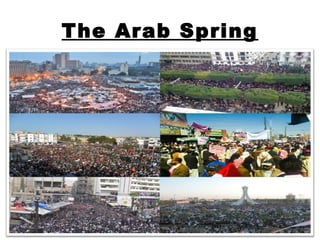
• The Arab Spring is a revolutionary wave of 
demonstrations and protests (both non-violent and 
violent), riots, and civil wars in the Arab world that began on 
18 December 2010 and spread throughout the countries of the 
Arab League and surroundings. 
• While the wave of initial revolutions and protests had expired 
by mid-2012, some refer to the ongoing large-scale conflicts in 
Middle East and North Africa as a continuation of the Arab 
Spring, while others refer to aftermath of revolutions and civil 
wars post mid-2012 as the Arab Winter.
Overview of the Arab Spring
• By December 2013, rulers had been forced from power 
in Tunisia, 
 Egypt  Libya, 
 and Yemen; civil uprisings had 
erupted in Bahrain 
 and Syria; 
 major protests had broken out 
in Algeria, Iraq, 
Jordan, 
 Kuwait, 
 Morocco, 
 Israel 
and Sudan; 
 and minor protests had occurred in Mauritania, 
 Oman, 
 Saudi Arabia, 
 Djibouti, 
 Weste  Sahara, 
and Palestine. 
• Weapons and Target fighters returning from the Libyan Civil 
War stoked a simmering conflict in Mali which has been 
described as "fallout" from the Arab Spring in North Africa.
Overview of the Arab Spring
• The protests have shared some techniques of civil resistance in 
sustained campaigns involving strikes, demonstrations, 
marches, and rallies, as well as the effective use of social 
media 
 to organize, communicate, and raise awareness in the 
face of state attempts at repression and Internet censorship
• Many Arab Spring demonstrations have been met with violent 
responses from authorities, 
 as well as from pro-government 
militias and counter-demonstrators. These attacks have been 
answered with violence from protestors in some cases
Overview of the Arab Spring
• A major slogan of the demonstrators in the Arab 
world has been Ash-sha`b yurid isqat an-nizam ("the 
people want to bring down the regime")
• Some observers have drawn comparisons between the Arab 
Spring movements and the Revolutions of 1989 (also known 
as the "Autumn of Nations") that swept through Eastern 
Europe and the Second World, in terms of their scale and 
significance. 
• Others, however, have pointed out that there are several key 
differences between the movements, such as the desired 
outcomes and the organizational role of Internet-based 
technologies in the Arab revolutions.
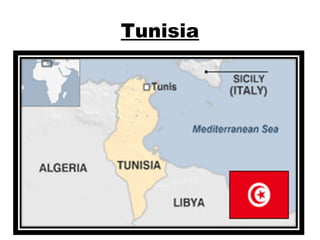
Tunisia
Tunisia
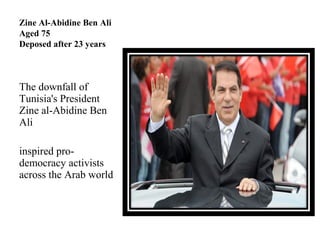
Zine Al-Abidine Ben Ali
Aged 75
Deposed after 23 years
The downfall of 
Tunisia's President 
Zine al-Abidine Ben 
Ali 
inspired pro-
democracy activists 
across the Arab world
Tunisia
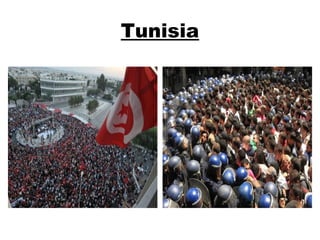
• Widespread discontent at economic hardship, decades of 
autocratic rule and corruption erupted into mass 
demonstrations in December 2010 
• After a young, unemployed man, Mohamed Bouazizi set fire 
to himself after officials stopped him selling vegetables in Sidi 
Bouzid 
• Around 300 people were killed during the subsequent unrest, 
which forced Ben Ali to resign in January 2011, after 23 years 
in power, and go into exile in Saudi Arabia. He was later 
sentenced to life in prison in absentia.
Tunisia
• In October 2011, Tunisia held its first democratic 
parliamentary elections. 
• The moderate Islamist Ennahda party won more than 41% of 
the vote in the constituent assembly tasked with drafting a new 
constitution. 
• Veteran dissident Moncef  Marzouki was then elected 
president.
Tunisia
• Since July 2013 a stand-off between Ennahda and its secular
rivals, triggered by the assassination of two leftist politicians
and other violence blamed on Salafists, has thwarted efforts to
complete the draft constitution.
• Opposition supporters took to the streets to demand a non-
partisan caretaker government until the constitution was
finished and new elections were held,
• December 2013 the main political parties agreed on appointing
Mehdi Jomaa as prime minister.
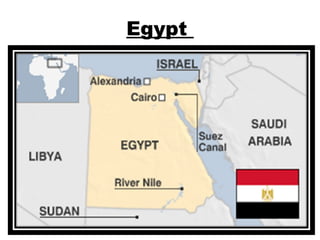
Egypt
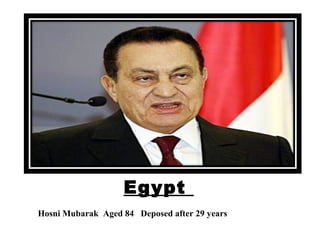
Hosni Mubarak Aged 84 Deposed after 29 years
Egypt
Egypt
• Egypt has witnessed the overthrow of two presidents since
the start of the Arab Spring
• Eighteen days of mass protests forced Hosni Mubarak to
resign in February 2011, after three decades in power.
• He was convicted of complicity in the deaths of 846 people
killed during the uprising, but the verdict was overturned on
appeal
Egypt
• Following Mr Mubarak's resignation, the Supreme Council of
the Armed Forces (Scaf) assumed presidential powers.
• Parliamentary elections in 2011-12 saw overwhelming
victories for the Islamist Muslim Brotherhood's Freedom
and Justice Party and Salafist al-Nour party
• In June 2012, the Brotherhood's Mohammed Morsi was
elected president.
Egypt
• He swiftly revoked a controversial Scaf decree that limited his
powers, dissolved the House of Representatives and changed
the military's leadership, naming Gen Abdul Fattah al-Sisi as
chief of staff and defense minister
• Public opposition to Mr Morsi began to build in November
2012, when he issued a decree granting himself far-reaching
powers, and were fuelled by the passage of what many
considered an Islamist-leaning draft constitution
Egypt
• Mr Morsi was deposed by the military in June 2013 after
millions of protesters took to the streets and replaced by an
interim government
• Security forces then launched a crackdown on the Muslim
Brotherhood, killing almost 1,000 people at two pro-Morsi sit-
ins in Cairo.
• In December 2013, a constituent assembly finished drafting a
new constitution to replace the 2012 charter
Egypt
• Egypt is polarized between supporters of the interim
government and the military on the one-hand, and supporters
of the Muslim Brotherhood and those who fear the authorities
have become too repressive on the other.
• Some analysts say Egypt has returned to the kind of police
state which the revolution aimed to remove
• A referendum were been held on the redrafted constitution,
followed by parliamentary and presidential elections in 2014.
It was clear what the hugely popular armed forces chief Gen
Sisi will be the next President of Mursi
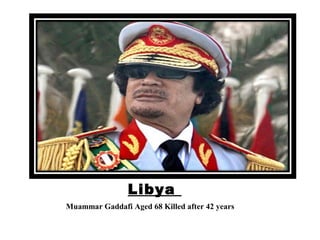
Libya
Libya
Muammar Gaddafi Aged 68 Killed after 42 years
Libya
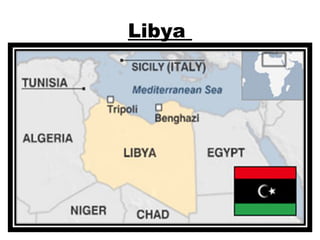
• Libya's uprising began in February 2011 after security
forces in the eastern city of Benghazi opened fire on a
protest.
• Anti-government demonstrations then erupted in other towns
before eventually reaching Tripoli.
• They swiftly evolved into an armed revolt seeking to topple to
Muammar Gaddafi.
Libya
• In March 2011, after the UN Security Council authorized "all
necessary measures" to protect civilians, Nato powers
launched air strikes on government targets, ostensibly aimed at
imposing a no-fly zone.
• With military assistance from the West and several Arab
states, rebel forces took Tripoli after six months of fighting in
which several thousand people were killed.
• After four decades in power, Gaddafi went on the run and was
captured and killed outside Sirte in August 2011
Libya
• The National Transitional Council (NTC), which led the
revolt, declared Libya officially "liberated" and promised a
pluralist, democratic state.
• In July 2012, it organized elections for an interim parliament,
the General National Congress (GNC), in which liberal,
secular and independent candidates beat the Muslim
Brotherhood-aligned Justice and Construction Party
Libya
• Since Gaddafi's overthrow Libya has been plagued by
instability, with some 300 revolutionary militias clashing
repeatedly, defying requests to disarm and besieging
government buildings.
• Many Libyans also complain of uneven regional development,
unemployment and a lack of government transparency.
• Plans for the election of a constituent assembly to draft a new
constitution were announced in September 2013
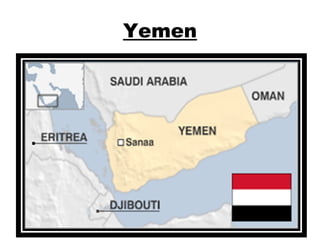
Yemen
Yemen
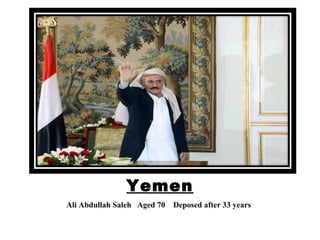
Ali Abdullah Saleh Aged 70 Deposed after 33 years
Yemen
• Yemen's President Ali Abdullah Saleh was the fourth Arab
leader to be forced from power.
• Demonstrations calling for the end of his 33-year rule began in
January 2011.
• Mr Saleh promised not to seek re-election, but the protests
spread. Security forces and Saleh supporters launched a
crackdown that eventually left between 200 and 2,000 people
dead.
Yemen
• In April 2011, Mr Saleh's General People's Congress (GPC)
agreed to a Gulf Co-operation Council-brokered deal to hand
over power, but the president refused to sign.
• This prompted the Hashid tribal federation and several army
commanders to back the opposition, after which clashes
erupted in Sanaa.
• In June 2011, Mr Saleh was seriously injured in a bombing
and travelled abroad for medical treatment
Yemen
• He returned to the presidential palace in September 2011 amid
renewed clashes.
• It was not until November 2011 that he signed the deal that
saw his deputy, Abdrabbuh Mansour Hadi, assume power
and form a unity government.
• Mr Hadi was sworn in for a two-year term as president in
February 2012 after an election in which he stood unopposed.
Yemen
• Since taking power, President Hadi has struggled to tackle
widespread poverty and malnutrition, an Islamist
insurgency led by al-Qaeda, a secessionist movement in the
south, and Zaidi Shia rebels in the north.
• A National Dialogue Conference involving rival political,
tribal, religious and social groups, is being held as part of the
process to draft a new constitution and hold democratic
elections in February 2014.
Bahrain
Bahrain
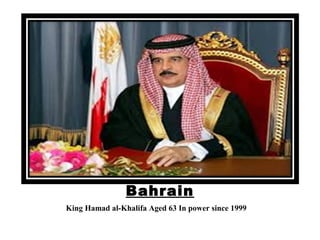
King Hamad al-Khalifa Aged 63 In power since 1999
Bahrain
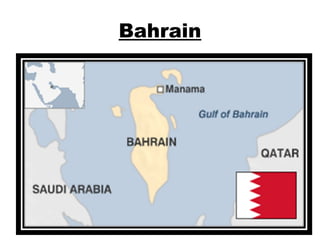
• Bahrain has been wracked by unrest since in February 2011,
when demonstrators occupied Manama's Pearl Roundabout,
demanding more democracy and an end to discrimination
against the majority Shia Muslim community by the Sunni
royal family.
• The protesters were driven out by security forces in March
2011, after King Hamad declared a state of emergency and
brought in troops from neighbouring Sunni-led Gulf states to
restore order and crush dissent.
Bahrain
• The unrest left at least 30 civilians and five policemen dead.
Almost 3,000 people were also arrested, and scores were
handed long prison terms by military courts.
• International condemnation prompted King Hamad to set up
the Bahrain Independent Commission of Inquiry (BICI)
• which issued recommendations that included the prosecution
of security forces personnel responsible for the torture and
deaths of detainees, the release prisoners of conscience, and
the reinstatement of dismissed Shia workers.
Bahrain
• The king accepted the recommendations and the government
says they have all been implemented.
• However, critics have complained that not only is that not
happening, but that the crackdown is continuing and abuses
are on the increase.
• A national dialogue process has reached an impasse, with the
opposition claiming the ruling Khalifa family have no
intention of making good on its promises.
Bahrain
• With no breakthrough expected, angry Shia youth are
increasingly turning to violence.
• Opposition and human rights activists say more than 45 people
have been killed during clashes between security forces and
protesters since the end of the March 2011 crackdown, though
the government says the death toll is lower.
Syria
Syria
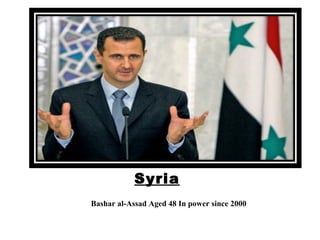
Bashar al-Assad Aged 48 In power since 2000
Syria
• The wave of popular unrest that swept the Arab world came
late to Syria, but its once peaceful uprising has evolved into a
brutal and increasingly sectarian armed conflict.
• Protests demanding greater freedom and an end to corruption
began in the southern city of Deraa in March 2011. After
security forces opened fire on demonstrators, more took to the
streets.
• By July 2011, hundreds of thousands of people across the
country were attending protests demanding President Bashar
al-Assad's resignation.
Syria
• Despite the security forces' concerted and ruthless efforts to
crush the "terrorists" and "armed criminal gangs", the uprising
continued unabated. Opposition supporters began to take up
arms, first to defend themselves and then to oust loyalist
forces from their areas.
• In February 2012, President Assad pressed ahead with a
referendum that approved a new constitution that dropped an
article giving the ruling Baath Party unique status as the
"leader of the state and society". The opposition denounced it
as sham.
Syria
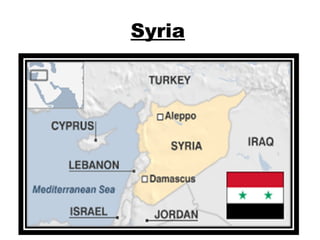
• Pressure steadily built on Mr Assad as rebels seized control of
large parts of the north and east of the country and launched
offensives on Damascus and Aleppo, while the opposition
National Coalition was recognised around the world as the
Syrian people's "legitimate representative".
• In 2013, the momentum in the conflict gradually began
shifting in Mr Assad's favour, as government forces launched
major offensives to recover territory and consolidate their grip
on population centres in the south and west. The rebels'
appeals for heavy weapons were meanwhile rejected by
Western and Gulf allies concerned by the prominence of
jihadists affiliated to al-Qaeda.
Syria
• However, Mr Assad was forced onto the defensive in August
2013 after a chemical weapons attack on the outskirts of
Damascus that left hundreds dead.
• Although the US pulled back from launching punitive military
strikes, the president was forced to agree to destroy Syria's
chemical weapons.
Syria
• Neither side has managed to achieve a breakthrough on the
battlefield and the government and National Coalition have
reluctantly agreed to a peace conference in Geneva in January
2014.
• President Assad is refusing to step aside - a step the National
Coalition is insisting on. Meanwhile, the war has produced a
humanitarian disaster, leaving more than 100,000 people dead
and forcing millions from their homes.

The Arab Spring

  • 1.
  • 2.
  • 3.
    Overview of theArab Spring • The Arab Spring is a revolutionary wave of  demonstrations and protests (both non-violent and  violent), riots, and civil wars in the Arab world that began on  18 December 2010 and spread throughout the countries of the  Arab League and surroundings.  • While the wave of initial revolutions and protests had expired  by mid-2012, some refer to the ongoing large-scale conflicts in  Middle East and North Africa as a continuation of the Arab  Spring, while others refer to aftermath of revolutions and civil  wars post mid-2012 as the Arab Winter.
  • 4.
    Overview of theArab Spring • By December 2013, rulers had been forced from power  in Tunisia,   Egypt  Libya,   and Yemen; civil uprisings had  erupted in Bahrain   and Syria;   major protests had broken out  in Algeria, Iraq,  Jordan,   Kuwait,   Morocco,   Israel  and Sudan;   and minor protests had occurred in Mauritania,   Oman,   Saudi Arabia,   Djibouti,   Weste  Sahara,  and Palestine.  • Weapons and Target fighters returning from the Libyan Civil  War stoked a simmering conflict in Mali which has been  described as "fallout" from the Arab Spring in North Africa.
  • 5.
    Overview of theArab Spring • The protests have shared some techniques of civil resistance in  sustained campaigns involving strikes, demonstrations,  marches, and rallies, as well as the effective use of social  media   to organize, communicate, and raise awareness in the  face of state attempts at repression and Internet censorship • Many Arab Spring demonstrations have been met with violent  responses from authorities,   as well as from pro-government  militias and counter-demonstrators. These attacks have been  answered with violence from protestors in some cases
  • 6.
    Overview of theArab Spring • A major slogan of the demonstrators in the Arab  world has been Ash-sha`b yurid isqat an-nizam ("the  people want to bring down the regime") • Some observers have drawn comparisons between the Arab  Spring movements and the Revolutions of 1989 (also known  as the "Autumn of Nations") that swept through Eastern  Europe and the Second World, in terms of their scale and  significance.  • Others, however, have pointed out that there are several key  differences between the movements, such as the desired  outcomes and the organizational role of Internet-based  technologies in the Arab revolutions.
  • 7.
  • 8.
  • 9.
  • 10.
    Tunisia • Widespread discontent at economic hardship, decades of  autocratic rule and corruption erupted into mass  demonstrations in December 2010  • After a young, unemployed man, Mohamed Bouazizi set fire  to himself after officials stopped him selling vegetables in Sidi  Bouzid  •Around 300 people were killed during the subsequent unrest,  which forced Ben Ali to resign in January 2011, after 23 years  in power, and go into exile in Saudi Arabia. He was later  sentenced to life in prison in absentia.
  • 11.
  • 12.
    Tunisia • Since July2013 a stand-off between Ennahda and its secular rivals, triggered by the assassination of two leftist politicians and other violence blamed on Salafists, has thwarted efforts to complete the draft constitution. • Opposition supporters took to the streets to demand a non- partisan caretaker government until the constitution was finished and new elections were held, • December 2013 the main political parties agreed on appointing Mehdi Jomaa as prime minister.
  • 13.
    Egypt Hosni Mubarak Aged84 Deposed after 29 years
  • 14.
  • 15.
    Egypt • Egypt haswitnessed the overthrow of two presidents since the start of the Arab Spring • Eighteen days of mass protests forced Hosni Mubarak to resign in February 2011, after three decades in power. • He was convicted of complicity in the deaths of 846 people killed during the uprising, but the verdict was overturned on appeal
  • 16.
    Egypt • Following MrMubarak's resignation, the Supreme Council of the Armed Forces (Scaf) assumed presidential powers. • Parliamentary elections in 2011-12 saw overwhelming victories for the Islamist Muslim Brotherhood's Freedom and Justice Party and Salafist al-Nour party • In June 2012, the Brotherhood's Mohammed Morsi was elected president.
  • 17.
    Egypt • He swiftlyrevoked a controversial Scaf decree that limited his powers, dissolved the House of Representatives and changed the military's leadership, naming Gen Abdul Fattah al-Sisi as chief of staff and defense minister • Public opposition to Mr Morsi began to build in November 2012, when he issued a decree granting himself far-reaching powers, and were fuelled by the passage of what many considered an Islamist-leaning draft constitution
  • 18.
    Egypt • Mr Morsiwas deposed by the military in June 2013 after millions of protesters took to the streets and replaced by an interim government • Security forces then launched a crackdown on the Muslim Brotherhood, killing almost 1,000 people at two pro-Morsi sit- ins in Cairo. • In December 2013, a constituent assembly finished drafting a new constitution to replace the 2012 charter
  • 19.
    Egypt • Egypt ispolarized between supporters of the interim government and the military on the one-hand, and supporters of the Muslim Brotherhood and those who fear the authorities have become too repressive on the other. • Some analysts say Egypt has returned to the kind of police state which the revolution aimed to remove • A referendum were been held on the redrafted constitution, followed by parliamentary and presidential elections in 2014. It was clear what the hugely popular armed forces chief Gen Sisi will be the next President of Mursi
  • 20.
  • 21.
    Libya Muammar Gaddafi Aged68 Killed after 42 years
  • 22.
    Libya • Libya's uprisingbegan in February 2011 after security forces in the eastern city of Benghazi opened fire on a protest. • Anti-government demonstrations then erupted in other towns before eventually reaching Tripoli. • They swiftly evolved into an armed revolt seeking to topple to Muammar Gaddafi.
  • 23.
    Libya • In March2011, after the UN Security Council authorized "all necessary measures" to protect civilians, Nato powers launched air strikes on government targets, ostensibly aimed at imposing a no-fly zone. • With military assistance from the West and several Arab states, rebel forces took Tripoli after six months of fighting in which several thousand people were killed. • After four decades in power, Gaddafi went on the run and was captured and killed outside Sirte in August 2011
  • 24.
    Libya • The NationalTransitional Council (NTC), which led the revolt, declared Libya officially "liberated" and promised a pluralist, democratic state. • In July 2012, it organized elections for an interim parliament, the General National Congress (GNC), in which liberal, secular and independent candidates beat the Muslim Brotherhood-aligned Justice and Construction Party
  • 25.
    Libya • Since Gaddafi'soverthrow Libya has been plagued by instability, with some 300 revolutionary militias clashing repeatedly, defying requests to disarm and besieging government buildings. • Many Libyans also complain of uneven regional development, unemployment and a lack of government transparency. • Plans for the election of a constituent assembly to draft a new constitution were announced in September 2013
  • 26.
  • 27.
    Yemen Ali Abdullah SalehAged 70 Deposed after 33 years
  • 28.
    Yemen • Yemen's PresidentAli Abdullah Saleh was the fourth Arab leader to be forced from power. • Demonstrations calling for the end of his 33-year rule began in January 2011. • Mr Saleh promised not to seek re-election, but the protests spread. Security forces and Saleh supporters launched a crackdown that eventually left between 200 and 2,000 people dead.
  • 29.
    Yemen • In April2011, Mr Saleh's General People's Congress (GPC) agreed to a Gulf Co-operation Council-brokered deal to hand over power, but the president refused to sign. • This prompted the Hashid tribal federation and several army commanders to back the opposition, after which clashes erupted in Sanaa. • In June 2011, Mr Saleh was seriously injured in a bombing and travelled abroad for medical treatment
  • 30.
    Yemen • He returnedto the presidential palace in September 2011 amid renewed clashes. • It was not until November 2011 that he signed the deal that saw his deputy, Abdrabbuh Mansour Hadi, assume power and form a unity government. • Mr Hadi was sworn in for a two-year term as president in February 2012 after an election in which he stood unopposed.
  • 31.
    Yemen • Since takingpower, President Hadi has struggled to tackle widespread poverty and malnutrition, an Islamist insurgency led by al-Qaeda, a secessionist movement in the south, and Zaidi Shia rebels in the north. • A National Dialogue Conference involving rival political, tribal, religious and social groups, is being held as part of the process to draft a new constitution and hold democratic elections in February 2014.
  • 32.
  • 33.
    Bahrain King Hamad al-KhalifaAged 63 In power since 1999
  • 34.
    Bahrain • Bahrain hasbeen wracked by unrest since in February 2011, when demonstrators occupied Manama's Pearl Roundabout, demanding more democracy and an end to discrimination against the majority Shia Muslim community by the Sunni royal family. • The protesters were driven out by security forces in March 2011, after King Hamad declared a state of emergency and brought in troops from neighbouring Sunni-led Gulf states to restore order and crush dissent.
  • 35.
    Bahrain • The unrestleft at least 30 civilians and five policemen dead. Almost 3,000 people were also arrested, and scores were handed long prison terms by military courts. • International condemnation prompted King Hamad to set up the Bahrain Independent Commission of Inquiry (BICI) • which issued recommendations that included the prosecution of security forces personnel responsible for the torture and deaths of detainees, the release prisoners of conscience, and the reinstatement of dismissed Shia workers.
  • 36.
    Bahrain • The kingaccepted the recommendations and the government says they have all been implemented. • However, critics have complained that not only is that not happening, but that the crackdown is continuing and abuses are on the increase. • A national dialogue process has reached an impasse, with the opposition claiming the ruling Khalifa family have no intention of making good on its promises.
  • 37.
    Bahrain • With nobreakthrough expected, angry Shia youth are increasingly turning to violence. • Opposition and human rights activists say more than 45 people have been killed during clashes between security forces and protesters since the end of the March 2011 crackdown, though the government says the death toll is lower.
  • 38.
  • 39.
    Syria Bashar al-Assad Aged48 In power since 2000
  • 40.
    Syria • The waveof popular unrest that swept the Arab world came late to Syria, but its once peaceful uprising has evolved into a brutal and increasingly sectarian armed conflict. • Protests demanding greater freedom and an end to corruption began in the southern city of Deraa in March 2011. After security forces opened fire on demonstrators, more took to the streets. • By July 2011, hundreds of thousands of people across the country were attending protests demanding President Bashar al-Assad's resignation.
  • 41.
    Syria • Despite thesecurity forces' concerted and ruthless efforts to crush the "terrorists" and "armed criminal gangs", the uprising continued unabated. Opposition supporters began to take up arms, first to defend themselves and then to oust loyalist forces from their areas. • In February 2012, President Assad pressed ahead with a referendum that approved a new constitution that dropped an article giving the ruling Baath Party unique status as the "leader of the state and society". The opposition denounced it as sham.
  • 42.
    Syria • Pressure steadilybuilt on Mr Assad as rebels seized control of large parts of the north and east of the country and launched offensives on Damascus and Aleppo, while the opposition National Coalition was recognised around the world as the Syrian people's "legitimate representative". • In 2013, the momentum in the conflict gradually began shifting in Mr Assad's favour, as government forces launched major offensives to recover territory and consolidate their grip on population centres in the south and west. The rebels' appeals for heavy weapons were meanwhile rejected by Western and Gulf allies concerned by the prominence of jihadists affiliated to al-Qaeda.
  • 43.
    Syria • However, MrAssad was forced onto the defensive in August 2013 after a chemical weapons attack on the outskirts of Damascus that left hundreds dead. • Although the US pulled back from launching punitive military strikes, the president was forced to agree to destroy Syria's chemical weapons.
  • 44.
    Syria • Neither sidehas managed to achieve a breakthrough on the battlefield and the government and National Coalition have reluctantly agreed to a peace conference in Geneva in January 2014. • President Assad is refusing to step aside - a step the National Coalition is insisting on. Meanwhile, the war has produced a humanitarian disaster, leaving more than 100,000 people dead and forcing millions from their homes.