




1
Animal Identification using Machine Learning
Techniques
By
Aya Salama Abdelhady
Under the Supervision of:
Professor Aly Fahmy & Professor Abou Elella Hassanein
Ph.D Presentation
Department of Computer Science
Agenda
 Introduction
 Motivation
 Problem Statement
 Research Objectives
 Literature Review and Current Approaches
 Proposed Approach (Deep Neural Networks)
 Data Sets
 Work plan
2
3
Introduction
 Animal identification refers to the
recognition process of animals.
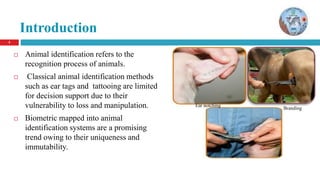
 Classical animal identification methods
such as ear tags and tattooing are limited
for decision support due to their
vulnerability to loss and manipulation.
 Biometric mapped into animal
identification systems are a promising
trend owing to their uniqueness and
immutability.
Ear notching
Branding
 Animal identification is vital in in large group of animals
 Individual identification allow management of
 Stockbreeding programs
 Disease and treatment
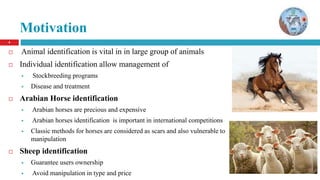
 Arabian Horse identification
 Arabian horses are precious and expensive
 Arabian horses identification is important in international competitions
 Classic methods for horses are considered as scars and also vulnerable to
manipulation
 Sheep identification
 Guarantee users ownership
 Avoid manipulation in type and price
4
Motivation
 Investigation of bio and physical metrics that lead to
best identification results
(Example of these features are eyes, iris, face, weight)
 Data Sets Collection
 Arabian horses identification has no available data
sets of horses
 Sheep identification has no available data sets of
sheep
5
Problem Statement
6
Thesis Objectives
The aim of the thesis are:
 To develop real time mobile application for:
• Arabian horse Identification
• Sheep Identification
 To build animal weight estimation module
that would help in animal identification
Literature Review
General methods
7
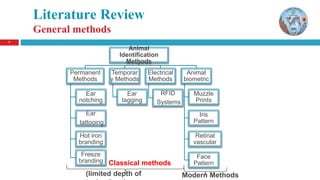
Animal
Identification
Methods
Permanent
Methods
Ear
notching
Ear
tattooing
Hot iron
branding
Freeze
branding
Temporar
y Methods
Ear
tagging
Electrical
Methods
RFID
Systems
Animal
biometric
Muzzle
Prints
Iris
Pattern
Retinal
vascular
Face
PatternClassical methods
Modern Methods(limited depth of
8
Literature Review
Disadvantages of Classical Methods
 Vulnerability to losses, duplications and manipulation
 Hot branding and freeze branding cause a lot of pain
 Difficult to read
 Most of these methods are painful and can lead to
infection, and they can also be considered as scars.
9
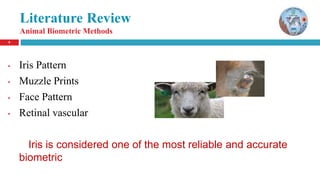
• Iris Pattern
• Muzzle Prints
• Face Pattern
• Retinal vascular
Iris is considered one of the most reliable and accurate
biometric
Literature Review
Animal Biometric Methods
10
10
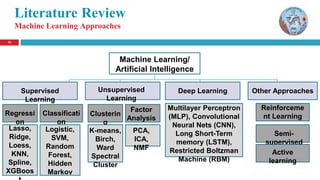
Literature Review
Machine Learning Approaches
Machine Learning/
Artificial Intelligence
Supervised
Learning
Unsupervised
Learning
Deep Learning Other Approaches
Regressi
on
Classificati
on
Clusterin
g
Factor
Analysis
Reinforceme
nt Learning
Semi-
supervised
Active
learning
Lasso,
Ridge,
Loess,
KNN,
Spline,
XGBoos
Logistic,
SVM,
Random
Forest,
Hidden
Markov
K-means,
Birch,
Ward
Spectral
Cluster
PCA,
ICA,
NMF
Multilayer Perceptron
(MLP), Convolutional
Neural Nets (CNN),
Long Short-Term
memory (LSTM),
Restricted Boltzman
Machine (RBM)
11
Literature Review
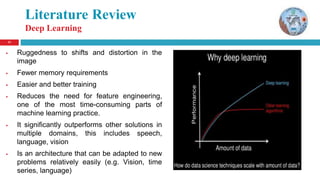
Deep Learning
 Ruggedness to shifts and distortion in the
image
 Fewer memory requirements
 Easier and better training
 Reduces the need for feature engineering,
one of the most time-consuming parts of
machine learning practice.
 It significantly outperforms other solutions in
multiple domains, this includes speech,
language, vision
 Is an architecture that can be adapted to new
problems relatively easily (e.g. Vision, time
series, language)
12
Literature Review
Animal identification systems
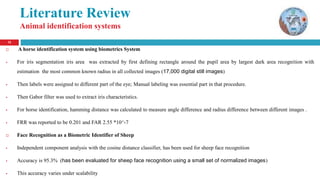
 A horse identification system using biometrics System
 For iris segmentation iris area was extracted by first defining rectangle around the pupil area by largest dark area recognition with
estimation the most common known radius in all collected images (17,000 digital still images)
 Then labels were assigned to different part of the eye; Manual labeling was essential part in that procedure.
 Then Gabor filter was used to extract iris characteristics.
 For horse identification, hamming distance was calculated to measure angle difference and radius difference between different images .
 FRR was reported to be 0.201 and FAR 2.55 *10^-7
 Face Recognition as a Biometric Identifier of Sheep
 Independent component analysis with the cosine distance classifier, has been used for sheep face recognition
 Accuracy is 95.3% (has been evaluated for sheep face recognition using a small set of normalized images)
 This accuracy varies under scalability
13
The Suggested System
 Data Preparation
 Data Augmentation
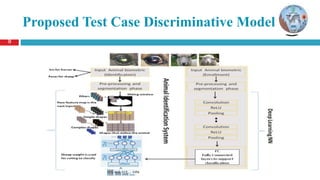
 Investigate deep learning architecture in generative
models
 Investigate deep learning architecture in
discriminative models
14
Data Sets Collections
14
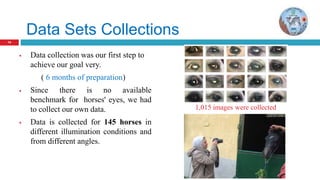
 Data collection was our first step to
achieve our goal very.
( 6 months of preparation)
 Since there is no available
benchmark for horses' eyes, we had
to collect our own data.
 Data is collected for 145 horses in
different illumination conditions and
from different angles.
1,015 images were collected
15
15
Proposed Test Case Discriminative Model
Seminar, FCI, Cairo University (July-2017)
161616
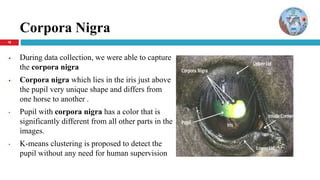
Corpora Nigra
 During data collection, we were able to capture
the corpora nigra
 Corpora nigra which lies in the iris just above
the pupil very unique shape and differs from
one horse to another .
• Pupil with corpora nigra has a color that is
significantly different from all other parts in the
images.
• K-means clustering is proposed to detect the
pupil without any need for human supervision
1717
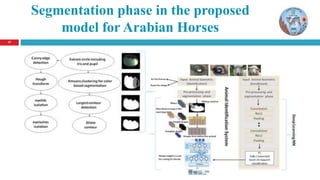
Segmentation phase in the proposed
model for Arabian Horses
1818
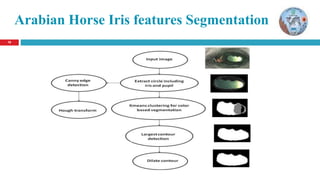
Arabian Horse Iris features Segmentation
1919
Preliminary Results and Evaluation
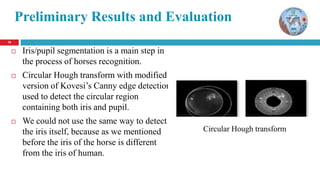
 Iris/pupil segmentation is a main step in
the process of horses recognition.
 Circular Hough transform with modified
version of Kovesi’s Canny edge detection
used to detect the circular region
containing both iris and pupil.
 We could not use the same way to detect
the iris itself, because as we mentioned
before the iris of the horse is different
from the iris of human.
Circular Hough transform
2020
Preliminary Results and Evaluation (2)
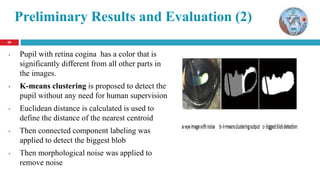
• Pupil with retina cogina has a color that is
significantly different from all other parts in
the images.
• K-means clustering is proposed to detect the
pupil without any need for human supervision
• Euclidean distance is calculated is used to
define the distance of the nearest centroid
• Then connected component labeling was
applied to detect the biggest blob
• Then morphological noise was applied to
remove noise
2121
Preliminary Results and Evaluation (3)
• Jaccard similarity is the most common used matrix to
evaluate the performance of segmentation
• After removing all unwanted images we had total of
320 images to work on.
• Ground truth images were built for 320 images.
• For 256 images, Jaccard coefficient ranged between
80% and 95%, while for the rest 64 images ranged
between 40% and 70%
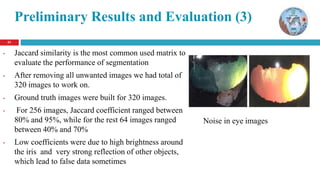
• Low coefficients were due to high brightness around
the iris and very strong reflection of other objects,
which lead to false data sometimes
Noise in eye images
2222
ACM paper accepted
Seminar, FCI, Cairo University (July-2017)
2323
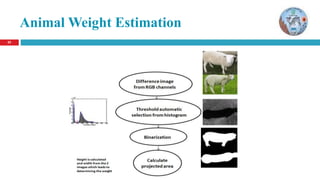
Animal Weight Estimation
2424
Work Plan
1. Continue survey and identify How to best
recognize animals using deep learning.
2. Investigate generative and descriptive models
3. Continue working on data collection
4. Design and develop a model for animal
identification
5. Conduct a performance analysis of the developed
model with the existing ones. Partners in this work (Suez Canal University (agriculture faculty)
and Cairo University (Faculty Vet. medicine ))
25
Any Questions!?

Animal identification using machine learning techniques

  • 1.
    1 Animal Identification usingMachine Learning Techniques By Aya Salama Abdelhady Under the Supervision of: Professor Aly Fahmy & Professor Abou Elella Hassanein Ph.D Presentation Department of Computer Science
  • 2.
    Agenda  Introduction  Motivation Problem Statement  Research Objectives  Literature Review and Current Approaches  Proposed Approach (Deep Neural Networks)  Data Sets  Work plan 2
  • 3.
    3 Introduction  Animal identificationrefers to the recognition process of animals.  Classical animal identification methods such as ear tags and tattooing are limited for decision support due to their vulnerability to loss and manipulation.  Biometric mapped into animal identification systems are a promising trend owing to their uniqueness and immutability. Ear notching Branding
  • 4.
     Animal identificationis vital in in large group of animals  Individual identification allow management of  Stockbreeding programs  Disease and treatment  Arabian Horse identification  Arabian horses are precious and expensive  Arabian horses identification is important in international competitions  Classic methods for horses are considered as scars and also vulnerable to manipulation  Sheep identification  Guarantee users ownership  Avoid manipulation in type and price 4 Motivation
  • 5.
     Investigation ofbio and physical metrics that lead to best identification results (Example of these features are eyes, iris, face, weight)  Data Sets Collection  Arabian horses identification has no available data sets of horses  Sheep identification has no available data sets of sheep 5 Problem Statement
  • 6.
    6 Thesis Objectives The aimof the thesis are:  To develop real time mobile application for: • Arabian horse Identification • Sheep Identification  To build animal weight estimation module that would help in animal identification
  • 7.
    Literature Review General methods 7 Animal Identification Methods Permanent Methods Ear notching Ear tattooing Hotiron branding Freeze branding Temporar y Methods Ear tagging Electrical Methods RFID Systems Animal biometric Muzzle Prints Iris Pattern Retinal vascular Face PatternClassical methods Modern Methods(limited depth of
  • 8.
    8 Literature Review Disadvantages ofClassical Methods  Vulnerability to losses, duplications and manipulation  Hot branding and freeze branding cause a lot of pain  Difficult to read  Most of these methods are painful and can lead to infection, and they can also be considered as scars.
  • 9.
    9 • Iris Pattern •Muzzle Prints • Face Pattern • Retinal vascular Iris is considered one of the most reliable and accurate biometric Literature Review Animal Biometric Methods
  • 10.
    10 10 Literature Review Machine LearningApproaches Machine Learning/ Artificial Intelligence Supervised Learning Unsupervised Learning Deep Learning Other Approaches Regressi on Classificati on Clusterin g Factor Analysis Reinforceme nt Learning Semi- supervised Active learning Lasso, Ridge, Loess, KNN, Spline, XGBoos Logistic, SVM, Random Forest, Hidden Markov K-means, Birch, Ward Spectral Cluster PCA, ICA, NMF Multilayer Perceptron (MLP), Convolutional Neural Nets (CNN), Long Short-Term memory (LSTM), Restricted Boltzman Machine (RBM)
  • 11.
    11 Literature Review Deep Learning Ruggedness to shifts and distortion in the image  Fewer memory requirements  Easier and better training  Reduces the need for feature engineering, one of the most time-consuming parts of machine learning practice.  It significantly outperforms other solutions in multiple domains, this includes speech, language, vision  Is an architecture that can be adapted to new problems relatively easily (e.g. Vision, time series, language)
  • 12.
    12 Literature Review Animal identificationsystems  A horse identification system using biometrics System  For iris segmentation iris area was extracted by first defining rectangle around the pupil area by largest dark area recognition with estimation the most common known radius in all collected images (17,000 digital still images)  Then labels were assigned to different part of the eye; Manual labeling was essential part in that procedure.  Then Gabor filter was used to extract iris characteristics.  For horse identification, hamming distance was calculated to measure angle difference and radius difference between different images .  FRR was reported to be 0.201 and FAR 2.55 *10^-7  Face Recognition as a Biometric Identifier of Sheep  Independent component analysis with the cosine distance classifier, has been used for sheep face recognition  Accuracy is 95.3% (has been evaluated for sheep face recognition using a small set of normalized images)  This accuracy varies under scalability
  • 13.
    13 The Suggested System Data Preparation  Data Augmentation  Investigate deep learning architecture in generative models  Investigate deep learning architecture in discriminative models
  • 14.
    14 Data Sets Collections 14 Data collection was our first step to achieve our goal very. ( 6 months of preparation)  Since there is no available benchmark for horses' eyes, we had to collect our own data.  Data is collected for 145 horses in different illumination conditions and from different angles. 1,015 images were collected
  • 15.
    15 15 Proposed Test CaseDiscriminative Model Seminar, FCI, Cairo University (July-2017)
  • 16.
    161616 Corpora Nigra  Duringdata collection, we were able to capture the corpora nigra  Corpora nigra which lies in the iris just above the pupil very unique shape and differs from one horse to another . • Pupil with corpora nigra has a color that is significantly different from all other parts in the images. • K-means clustering is proposed to detect the pupil without any need for human supervision
  • 17.
    1717 Segmentation phase inthe proposed model for Arabian Horses
  • 18.
    1818 Arabian Horse Irisfeatures Segmentation
  • 19.
    1919 Preliminary Results andEvaluation  Iris/pupil segmentation is a main step in the process of horses recognition.  Circular Hough transform with modified version of Kovesi’s Canny edge detection used to detect the circular region containing both iris and pupil.  We could not use the same way to detect the iris itself, because as we mentioned before the iris of the horse is different from the iris of human. Circular Hough transform
  • 20.
    2020 Preliminary Results andEvaluation (2) • Pupil with retina cogina has a color that is significantly different from all other parts in the images. • K-means clustering is proposed to detect the pupil without any need for human supervision • Euclidean distance is calculated is used to define the distance of the nearest centroid • Then connected component labeling was applied to detect the biggest blob • Then morphological noise was applied to remove noise
  • 21.
    2121 Preliminary Results andEvaluation (3) • Jaccard similarity is the most common used matrix to evaluate the performance of segmentation • After removing all unwanted images we had total of 320 images to work on. • Ground truth images were built for 320 images. • For 256 images, Jaccard coefficient ranged between 80% and 95%, while for the rest 64 images ranged between 40% and 70% • Low coefficients were due to high brightness around the iris and very strong reflection of other objects, which lead to false data sometimes Noise in eye images
  • 22.
    2222 ACM paper accepted Seminar,FCI, Cairo University (July-2017)
  • 23.
  • 24.
    2424 Work Plan 1. Continuesurvey and identify How to best recognize animals using deep learning. 2. Investigate generative and descriptive models 3. Continue working on data collection 4. Design and develop a model for animal identification 5. Conduct a performance analysis of the developed model with the existing ones. Partners in this work (Suez Canal University (agriculture faculty) and Cairo University (Faculty Vet. medicine ))
  • 25.

Editor's Notes

  • #23 All accepted papers (regular, short, and poster) will be published by ACM – International Conference Proceedings Series (ICPS) and will be available in ACM Digital Library . ISBN: 978-1-4503-5243-7