School of Computer Engineering and Technology
Guide:
Dr. Minakshi Vharkate
FARM-AGRI– Web-Based Plant Disease
Prediction and Cure
TY Final Presentation
 Agriculture is the backbone of our country around 70% of actual population
depends on agriculture. The Indian economy relies heavily on agriculture
productivity.
 A lot is at stake when a plant is struck with a disease that causes a significant loss
in production, economic losses, and a reduction in the quality and quantity of
agricultural products.
 It is crucial to identify plant diseases in order to prevent the loss of agricultural
yield and quantity.
 Many plants get damaged due to disease, infections which lead to wastage of the
resources where there is large production area
 Plant disease Prediction based on Deep learning will surely help to prevent the
same.
INTRODUCTION
Literature Summary
1. This research paper introduces a novel application for predicting plant diseases in cotton and potato plants
using Convolutional Neural Networks (CNNs).
2. Separate CNN models were trained on labeled datasets of cotton and potato leaves, each associated with
their respective diseases. The primary goal is to employ a fusion of two standard CNN systems to detect
various diseases in cotton and potato plants.
3. Given India's heavy reliance on agriculture, this innovation is crucial to address challenges faced by the
sector, including technological limitations, limited access to credit and markets, and the impact of climate
change.
4. Cotton and potatoes are significant crops; this research paper are susceptible to various diseases that can
impede their growth and result in substantial yield losses.
5. The conventional disease detection methods involve manual inspection and disease prognosis, which are
time consuming and less accurate. The research showcases the effectiveness of the automated plant disease
detection system, with two best models achieving impressive accuracies of 97.10% and 96.94% for cotton
and potato plants, respectively.
6. These results offer promising insights for potential applications in crop management, benefiting the
agricultural sector and contributing to increased productivity and profitability.
 Plant [Cotton] disease prediction system based
on leaf image and cure
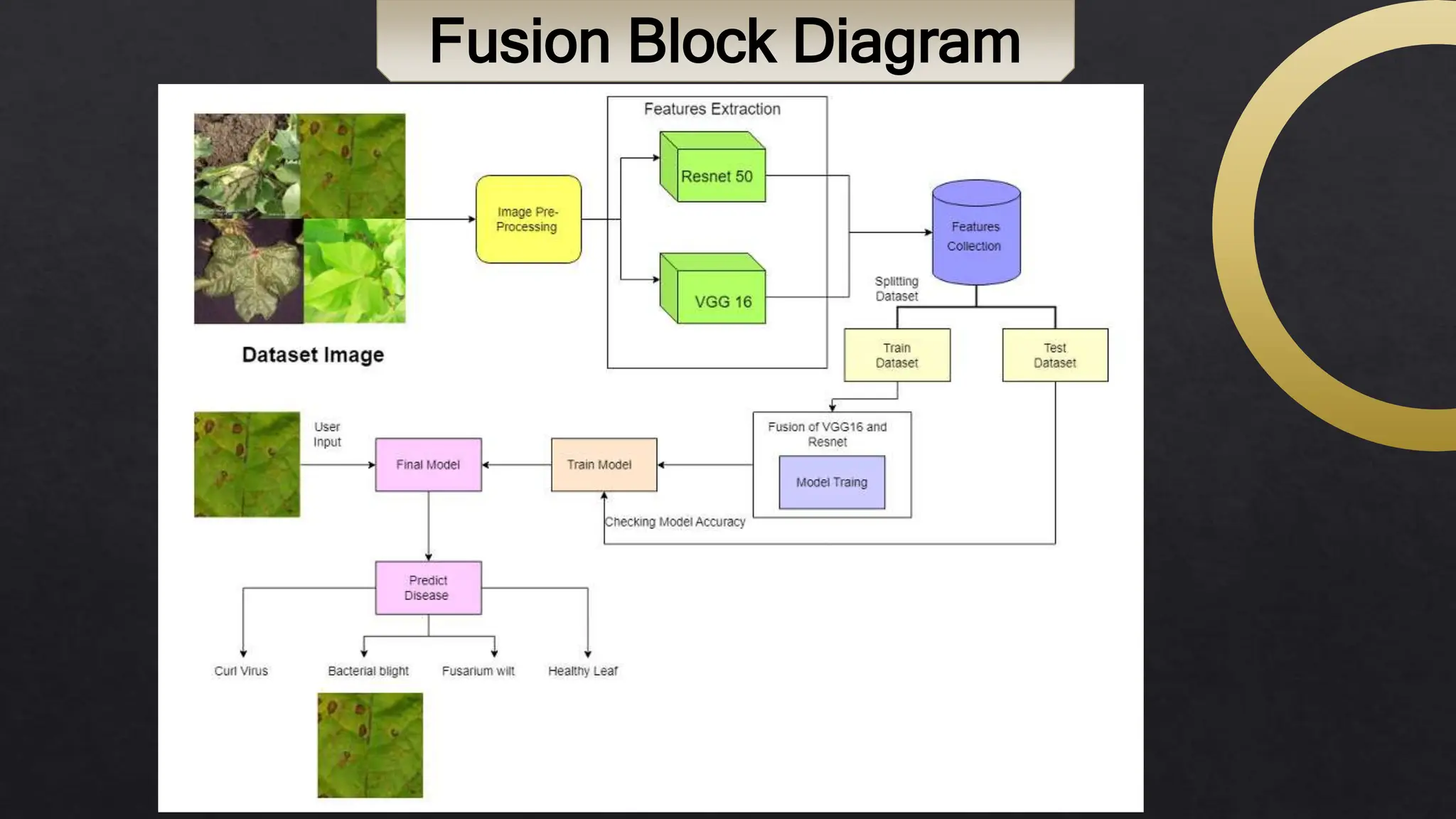
System Architecture
Fusion Block Diagram
Methodology
The approach for developing the web platform for plant disease prediction using a CNN and algorithm can
be divided into several steps:
1. Data Collection: The first step is to collect a large dataset of plant images, including both healthy and
diseased plants. This dataset will be used to train and validate the deep learning models.
2. Data Preprocessing: The collected dataset will be preprocessed to remove noise and unwanted data. The
images will be resized and normalized to a standard size and format suitable for feeding into the deep
learning models.
3. Model Training: The next step is to train the deep learning models using the preprocessed dataset. Two
deep learning models, namely CNN and ResNet50, will be used. The models will be trained on the
preprocessed dataset using a supervised learning approach.
4. WebPlatform Development: Once the fused model is developed, a web platform will be developed to
make it accessible to farmers. The platform will allow farmers to upload plant images, and the fused model
will predict the type of disease the plant is suffering from.
6. Back-end Development: The back-end of the web platform will be developed using Python and
Flask. The fused model will be integrated into the back-end, allowing the platform to predict the
type of disease the plant is suffering from.
7. Database Integration: The platform will have a database to store the uploaded images and
their corresponding disease predictions. The database will also store information about the
fertilizers that are suggested for each disease.
8. Testing and Evaluation: The web platform will be tested and evaluated using a separate dataset
of plant images that were not used in the training or validation of the model. The accuracy of the
model will be evaluated using metrics such as precision, recall, and F1-score.
9. Deployment: The final step is to deploy the web platform to make it available to farmers. The
platform will be hosted on a cloud server to ensure scalability and availability.
Methodology
Comperative study
Start
Resnet
CNN
Softmax
Relu
Adam
Ada
delta
Choose
best
Final
model
Epochs constant : 100
Implementation Screenshot
Model Accuracy
The VGG16-ResNet fused model, which had the maximum accuracy
of 97.1% according to the comparison study's findings, was the most
effective and accurate model for classifying images.
With an accuracy of 96.94%, the suggested scratch CNN model came
in second place, demonstrating its potential to be a formidable
opponent in the area of CNN models.
The ResNet50 model's accuracy of 96.59% demonstrated its
prowess in properly classifying pictures. While Srikanth Tammina
CNN [17] and Sarah Jones CNN [4] both had accuracy rates of 95.49
and 95.40, respectively.
Applications
o Easy Detection:-With our highest accurate model , system would detect the plant’s
leaf infection . Once the disease is been recognized it can also explain the cause of the
disease.
o Pest suggestion:- After detecting the disease of infected leaf , our system would suggest
a pest respectively that can be used as remedial.
Conclusion
 Thisstudydemonstrates thepotentialof CNNs forplant disease prediction.The
proposed CNN-based applicationisable toaccuratelypredictthepresence of
diseases withhighprecisionandrecall,showing itspotential asapowerful tool
forplantdiseasedetection.
[1] Shujuan Zhang, And Bin Wang "Plant Disease Detection and Classification by Deep Learning" IEEE, 2021.
[2] LILI LI , Jun Liu and Xuewei Wang"Plant diseases and pests detection based on deep learning: a review “,
Biomedcentral Plant Methods,IOSR Journal of Computer Engineering 2021.
[3] Mr.V Suresh, D Gopinath, M Hemavarthini, K Jayanthan, Mohana Krishnan ( Assistant Professor, CSE
Department, Dr.NGP Institute of Technology) "Plant Disease Detection using Image Processing",IJRET,2020.
[4] Koushik Nagasubramanian, Sarah Jones, Asheesh K. Singh “Plant disease identifcation using explainable
deep learning on images Biomedcentral Plant Methods”.
[5] Md. Zahid Hasan CSE, Daffodil International University Dhaka, Bangladesh ,Md. Sazzadur Ahamed
.Aniruddha Rakshit ,K. M. Zubair Hasan "Recognition of Jute Diseases by Leaf Image Classification using
Convolutional Neural Network ".
[6] Y. Chen, D. He , P. Jiang, B. Liu, and C.Liang " Prediction of Potato Disease from Leaves using Deep
Convolution Neural Network towards a Digital Agricultural System" IEEE, 2019.
[7] Huu Quan Cap Erika Fujita ,Satoshi Kagiwada ,Hiroyuki Uga ,Hitoshi Iyatomi ,"A Deep Learning Approach
for on site Plant Leaf Detection ",IEEE,2018.
REFERENCES
[8] Amrita S.Tulshan ,Nataasha Raul "Plant Leaf Disease Detection using Machine Learning",IEEE , 2019.
[9] M. Nazmul Hoq, T. A. Bushra, M. Al-amin" Prediction of Potato Disease from Leaves using Deep Convolution
Neural Network towards a Digital Agricultural System" IEEE, 1st International Conference on Advances in
Science, Engineering and Robotics Technology (ICASERT) 2019.
[10] Poojan Panchal ,Vignesh Charan Raman ,Shamla Mantri ,"Plant Diseases Detection and Classification using
Machine Learning Models ",IEEE,2019.
REFERENCES
Plant Disease Prediction using CNN

Plant Disease Prediction using CNN

  • 1.
    School of ComputerEngineering and Technology Guide: Dr. Minakshi Vharkate FARM-AGRI– Web-Based Plant Disease Prediction and Cure TY Final Presentation
  • 3.
     Agriculture isthe backbone of our country around 70% of actual population depends on agriculture. The Indian economy relies heavily on agriculture productivity.  A lot is at stake when a plant is struck with a disease that causes a significant loss in production, economic losses, and a reduction in the quality and quantity of agricultural products.  It is crucial to identify plant diseases in order to prevent the loss of agricultural yield and quantity.  Many plants get damaged due to disease, infections which lead to wastage of the resources where there is large production area  Plant disease Prediction based on Deep learning will surely help to prevent the same. INTRODUCTION
  • 4.
    Literature Summary 1. Thisresearch paper introduces a novel application for predicting plant diseases in cotton and potato plants using Convolutional Neural Networks (CNNs). 2. Separate CNN models were trained on labeled datasets of cotton and potato leaves, each associated with their respective diseases. The primary goal is to employ a fusion of two standard CNN systems to detect various diseases in cotton and potato plants. 3. Given India's heavy reliance on agriculture, this innovation is crucial to address challenges faced by the sector, including technological limitations, limited access to credit and markets, and the impact of climate change. 4. Cotton and potatoes are significant crops; this research paper are susceptible to various diseases that can impede their growth and result in substantial yield losses. 5. The conventional disease detection methods involve manual inspection and disease prognosis, which are time consuming and less accurate. The research showcases the effectiveness of the automated plant disease detection system, with two best models achieving impressive accuracies of 97.10% and 96.94% for cotton and potato plants, respectively. 6. These results offer promising insights for potential applications in crop management, benefiting the agricultural sector and contributing to increased productivity and profitability.
  • 5.
     Plant [Cotton]disease prediction system based on leaf image and cure
  • 6.
  • 7.
  • 8.
    Methodology The approach fordeveloping the web platform for plant disease prediction using a CNN and algorithm can be divided into several steps: 1. Data Collection: The first step is to collect a large dataset of plant images, including both healthy and diseased plants. This dataset will be used to train and validate the deep learning models. 2. Data Preprocessing: The collected dataset will be preprocessed to remove noise and unwanted data. The images will be resized and normalized to a standard size and format suitable for feeding into the deep learning models. 3. Model Training: The next step is to train the deep learning models using the preprocessed dataset. Two deep learning models, namely CNN and ResNet50, will be used. The models will be trained on the preprocessed dataset using a supervised learning approach. 4. WebPlatform Development: Once the fused model is developed, a web platform will be developed to make it accessible to farmers. The platform will allow farmers to upload plant images, and the fused model will predict the type of disease the plant is suffering from.
  • 9.
    6. Back-end Development:The back-end of the web platform will be developed using Python and Flask. The fused model will be integrated into the back-end, allowing the platform to predict the type of disease the plant is suffering from. 7. Database Integration: The platform will have a database to store the uploaded images and their corresponding disease predictions. The database will also store information about the fertilizers that are suggested for each disease. 8. Testing and Evaluation: The web platform will be tested and evaluated using a separate dataset of plant images that were not used in the training or validation of the model. The accuracy of the model will be evaluated using metrics such as precision, recall, and F1-score. 9. Deployment: The final step is to deploy the web platform to make it available to farmers. The platform will be hosted on a cloud server to ensure scalability and availability. Methodology
  • 10.
  • 11.
  • 12.
  • 13.
    Model Accuracy The VGG16-ResNetfused model, which had the maximum accuracy of 97.1% according to the comparison study's findings, was the most effective and accurate model for classifying images. With an accuracy of 96.94%, the suggested scratch CNN model came in second place, demonstrating its potential to be a formidable opponent in the area of CNN models. The ResNet50 model's accuracy of 96.59% demonstrated its prowess in properly classifying pictures. While Srikanth Tammina CNN [17] and Sarah Jones CNN [4] both had accuracy rates of 95.49 and 95.40, respectively.
  • 14.
    Applications o Easy Detection:-Withour highest accurate model , system would detect the plant’s leaf infection . Once the disease is been recognized it can also explain the cause of the disease. o Pest suggestion:- After detecting the disease of infected leaf , our system would suggest a pest respectively that can be used as remedial.
  • 15.
    Conclusion  Thisstudydemonstrates thepotentialofCNNs forplant disease prediction.The proposed CNN-based applicationisable toaccuratelypredictthepresence of diseases withhighprecisionandrecall,showing itspotential asapowerful tool forplantdiseasedetection.
  • 16.
    [1] Shujuan Zhang,And Bin Wang "Plant Disease Detection and Classification by Deep Learning" IEEE, 2021. [2] LILI LI , Jun Liu and Xuewei Wang"Plant diseases and pests detection based on deep learning: a review “, Biomedcentral Plant Methods,IOSR Journal of Computer Engineering 2021. [3] Mr.V Suresh, D Gopinath, M Hemavarthini, K Jayanthan, Mohana Krishnan ( Assistant Professor, CSE Department, Dr.NGP Institute of Technology) "Plant Disease Detection using Image Processing",IJRET,2020. [4] Koushik Nagasubramanian, Sarah Jones, Asheesh K. Singh “Plant disease identifcation using explainable deep learning on images Biomedcentral Plant Methods”. [5] Md. Zahid Hasan CSE, Daffodil International University Dhaka, Bangladesh ,Md. Sazzadur Ahamed .Aniruddha Rakshit ,K. M. Zubair Hasan "Recognition of Jute Diseases by Leaf Image Classification using Convolutional Neural Network ". [6] Y. Chen, D. He , P. Jiang, B. Liu, and C.Liang " Prediction of Potato Disease from Leaves using Deep Convolution Neural Network towards a Digital Agricultural System" IEEE, 2019. [7] Huu Quan Cap Erika Fujita ,Satoshi Kagiwada ,Hiroyuki Uga ,Hitoshi Iyatomi ,"A Deep Learning Approach for on site Plant Leaf Detection ",IEEE,2018. REFERENCES
  • 17.
    [8] Amrita S.Tulshan,Nataasha Raul "Plant Leaf Disease Detection using Machine Learning",IEEE , 2019. [9] M. Nazmul Hoq, T. A. Bushra, M. Al-amin" Prediction of Potato Disease from Leaves using Deep Convolution Neural Network towards a Digital Agricultural System" IEEE, 1st International Conference on Advances in Science, Engineering and Robotics Technology (ICASERT) 2019. [10] Poojan Panchal ,Vignesh Charan Raman ,Shamla Mantri ,"Plant Diseases Detection and Classification using Machine Learning Models ",IEEE,2019. REFERENCES