ACTION SPECTRUM
abhishek.m
Accessory pigments extend the
range of light absorption
In addition to chlorophyll ,
thylakoid membrane contain
secondary light absorbing pigments
or accessory pigments, called as
CAROTENOIDS
These pigments may be
YELLOW,RED OR PURPLE
Beta-carotene is a
red-orange while Lutein is a
yellow carotenoid.
These carotenoids absorbs light
at wavelengths not absorbed by
chlorophylls, and thus are
supplementary light receptors
ABSORPTION v/s ACTION Spectra
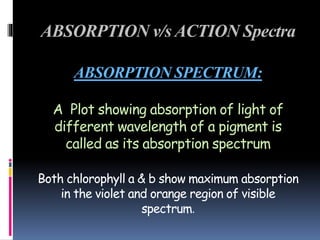
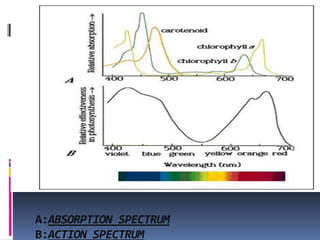
ABSORPTION SPECTRUM:
A Plot showing absorption of light of
different wavelength of a pigment is
called as its absorption spectrum
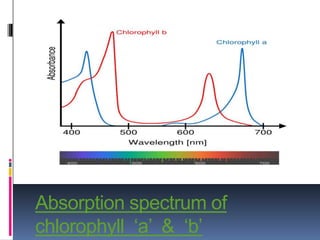
Both chlorophyll a & b show maximum absorption
in the violet and orange region of visible
spectrum.
V
Absorption spectrum of
chlorophyll ‘a’ & ‘b’
V
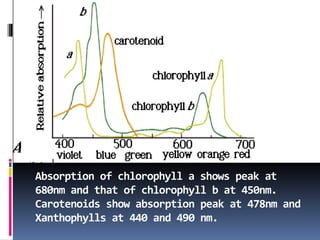
Absorption of chlorophyll a shows peak at
680nm and that of chlorophyll b at 450nm.
Carotenoids show absorption peak at 478nm and
Xanthophylls at 440 and 490 nm.
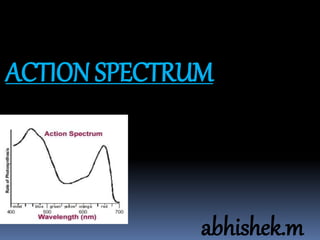
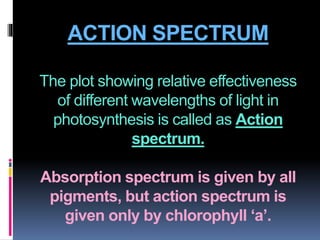
ACTION SPECTRUM
The plot showing relative effectiveness
of different wavelengths of light in
photosynthesis is called as Action
spectrum.
Absorption spectrum is given by all
pigments, but action spectrum is
given only by chlorophyll ‘a’.
G
A:ABSORPTION SPECTRUM
B:ACTION SPECTRUM
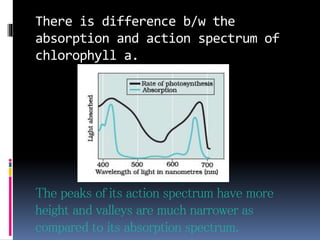
There is difference b/w the
absorption and action spectrum of
chlorophyll a.
The peaks of its action spectrum have more
height and valleys are much narrower as
compared to its absorption spectrum.
From the former diagram it is
rather clear that the action
spectrum of chlorophyll a is much
more efficient than its absorption
spectrum.
This is an indication of the fact
that chlorophyll a performs more
photosynthesis than it actually
absorbs light.
An action spectrum is the rate
of physiological activity plotted
against the wavelength of light.
It shows which wavelength is
more effectively used in a
specific chemical reaction
{in this case photosynthesis.}
EXPERIMENTALMETHODSTODETERMINE
THEACTIONSPECTRUM
ENGELMANN’S EXPERIMENT:
T .W . Engelmann , in 1882 conducted
a classic experiment that determined
the wavelength of light that is most
effective in photosynthesis.
He performed the experiment on
filamentous alga.
He illuminated the alga with light from
a prism.
His aim was to determine which algal
cells carried out photosynthesis most
actively.
To achieve his objective he
introduced on the microscopic
slide bacteria known to migrate
towards regions of high O2.
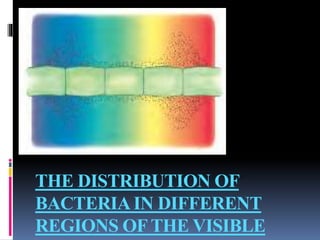
after a period of illumination, the
distribution of bacteria showed
highest O2 levels in regions
illuminated by violet and red
light.
THE DISTRIBUTION OF
BACTERIAIN DIFFERENT
REGIONS OFTHE VISIBLE
MODERN EXPERIMENTS
Similar experiments were conducted by
scientists in the twentieth century.
But here modern technologies were used .
Like the use of an O2 electrode for
measurement of oxygen production.
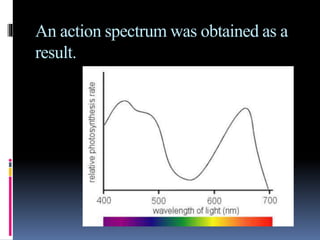
An action spectrum was obtained as a
result.
An action spectrum describes the
relative rate of photosynthesis for
illumination with a constant number
of photons of different wavelength.
It is useful because, by comparison
with an absorption spectrum, it
suggests which pigments can channel
energy into photosynthesis.
Action spectrum

Action spectrum

  • 1.
  • 2.
    Accessory pigments extendthe range of light absorption In addition to chlorophyll , thylakoid membrane contain secondary light absorbing pigments or accessory pigments, called as CAROTENOIDS
  • 3.
    These pigments maybe YELLOW,RED OR PURPLE Beta-carotene is a red-orange while Lutein is a yellow carotenoid.
  • 4.
    These carotenoids absorbslight at wavelengths not absorbed by chlorophylls, and thus are supplementary light receptors
  • 5.
    ABSORPTION v/s ACTIONSpectra ABSORPTION SPECTRUM: A Plot showing absorption of light of different wavelength of a pigment is called as its absorption spectrum Both chlorophyll a & b show maximum absorption in the violet and orange region of visible spectrum.
  • 6.
  • 7.
    V Absorption of chlorophylla shows peak at 680nm and that of chlorophyll b at 450nm. Carotenoids show absorption peak at 478nm and Xanthophylls at 440 and 490 nm.
  • 8.
    ACTION SPECTRUM The plotshowing relative effectiveness of different wavelengths of light in photosynthesis is called as Action spectrum. Absorption spectrum is given by all pigments, but action spectrum is given only by chlorophyll ‘a’.
  • 9.
  • 10.
    There is differenceb/w the absorption and action spectrum of chlorophyll a. The peaks of its action spectrum have more height and valleys are much narrower as compared to its absorption spectrum.
  • 11.
    From the formerdiagram it is rather clear that the action spectrum of chlorophyll a is much more efficient than its absorption spectrum. This is an indication of the fact that chlorophyll a performs more photosynthesis than it actually absorbs light.
  • 12.
    An action spectrumis the rate of physiological activity plotted against the wavelength of light. It shows which wavelength is more effectively used in a specific chemical reaction {in this case photosynthesis.}
  • 13.
    EXPERIMENTALMETHODSTODETERMINE THEACTIONSPECTRUM ENGELMANN’S EXPERIMENT: T .W. Engelmann , in 1882 conducted a classic experiment that determined the wavelength of light that is most effective in photosynthesis.
  • 14.
    He performed theexperiment on filamentous alga. He illuminated the alga with light from a prism. His aim was to determine which algal cells carried out photosynthesis most actively.
  • 15.
    To achieve hisobjective he introduced on the microscopic slide bacteria known to migrate towards regions of high O2. after a period of illumination, the distribution of bacteria showed highest O2 levels in regions illuminated by violet and red light.
  • 16.
    THE DISTRIBUTION OF BACTERIAINDIFFERENT REGIONS OFTHE VISIBLE
  • 17.
    MODERN EXPERIMENTS Similar experimentswere conducted by scientists in the twentieth century. But here modern technologies were used . Like the use of an O2 electrode for measurement of oxygen production.
  • 18.
    An action spectrumwas obtained as a result.
  • 19.
    An action spectrumdescribes the relative rate of photosynthesis for illumination with a constant number of photons of different wavelength. It is useful because, by comparison with an absorption spectrum, it suggests which pigments can channel energy into photosynthesis.