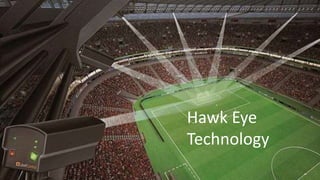
Hawk Eye
Technology
Once there was a Hockey coach who used to tell his team
to start every match by imagining they were 0-3 down, “A
goal for your weaknesses, another for your opponent’s
strengths and a third for umpiring errors.”
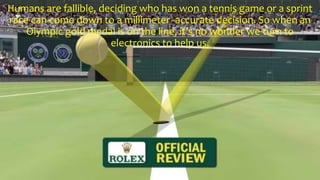
Humans are fallible, deciding who has won a tennis game or a sprint
race can come down to a millimeter -accurate decision. So when an
Olympic gold medal is on the line, it’s no wonder we turn to
electronics to help us.
It was developed by
the engineers of Roke
Manor Research
Limited in 2001.
This technology was created by Dr.
Paul Hawkins
Hawk Eye basically consist of two
significant parts:
Tracking System
Video Replay System
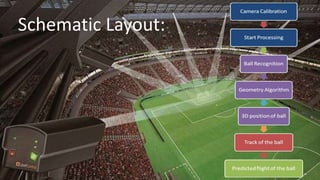
Schematic Layout:
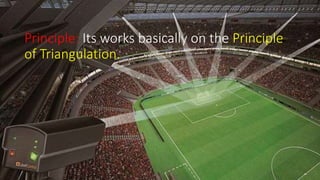
Principle: Its works basically on the Principle
of Triangulation.
𝑙 =
𝑑
tan 𝛼
+
𝑑
tan 𝛽
𝑑 = 𝑙
𝑑
tan 𝛼
+
𝑑
tan 𝛽
Principle of Triangulation:
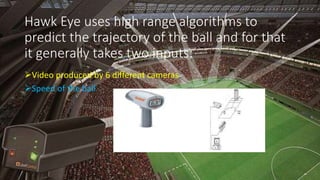
Hawk Eye uses high range algorithms to
predict the trajectory of the ball and for that
it generally takes two inputs:
Video produced by 6 different cameras
Speed of the ball
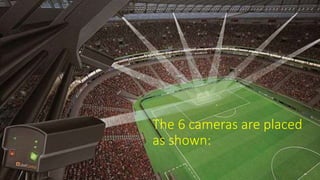
The 6 cameras are placed
as shown:
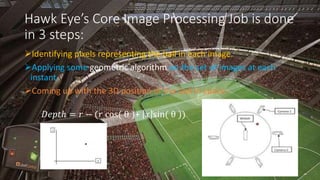
Hawk Eye’s Core Image Processing Job is done
in 3 steps:
Identifying pixels representing the ball in each image.
Applying some geometric algorithm on the set of images at each
instant.
Coming up with the 3D position of the ball in space.
𝐷𝑒𝑝𝑡ℎ = 𝑟 − (𝑟 cos( θ )+ 𝑥 sin( θ ))
Hawk Eye is used in the following:-
Tennis
Cricket
Badminton
Snooker
Baseball
Rugby
Volley ball
Military and Defense Services
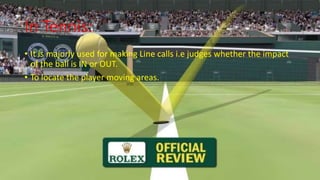
In Tennis:
• It is majorly used for making Line calls i.e judges whether the impact
of the ball is IN or OUT.
• To locate the player moving areas.
In Cricket:
Apart like Tennis, here in Cricket the Hawk Eye is used for many other
purposes like:
LBW Decisions
Wagon Wheels
Pitch Maps
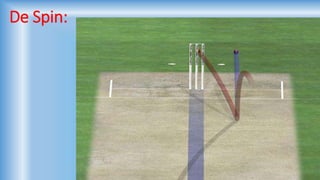
De Spin
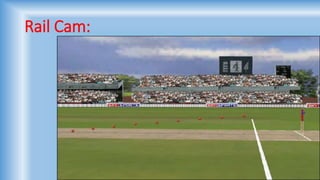
Rail Cam
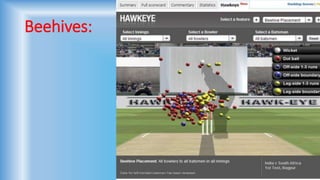
Beehives
LBW Decision:
For an umpire to give an LBW decision, he checks for
the following :
Whether the ball did not pitch outside leg stump.
If the batsman offered a shot, the ball hit him in line with the stumps.
Whether the ball did not hit the bat first.
The ball would have gone on to hit the stumps.
Wagon Wheels:
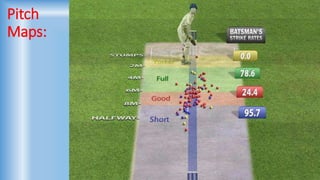
Pitch
Maps:
De Spin:
Rail Cam:
Beehives:
In Snooker:
In Automobile and Military Power:
BEYOND THE LINE CALL:
How Hawk-Eye can improve performance
Hawk Eye is not just used to make line calls, there is much more than line calls for
Hawk Eye. It is used as a data source to analyze the game.
Tennis Australia (TA) is amassing richer data sources than ever. At this year’s
Australian Open, Hawk-Eye based insights as a tool for pre-match opposition
analysis will be greater utilized than ever before by Tennis Australia’s High-
Performance unit.
Hawk-Eye has been deployed on multiple courts at the Australian Open and AO
series events (Brisbane and Sydney for example) since 2007, and as such we have
tracking data for some 250 tennis players. Thanks partially to funding from an
Australian Institute of Sport (AIS) grant, an app (like the ones on your favorite
smart-phone) has been constructed using open source technologies with Hawk-
eye data at its core. Coaches can log-in from anywhere in the world, and
interactivity sort and visualize data, tapping into their unique expertise without
the need to consult the performance analysis team every time they want to delve
deeper into the data.
Limitations in Cricket:
LBW Decision:
For an umpire to give an LBW decision, he checks for
the following :
Whether the ball did not pitch outside leg stump.
If the batsman offered a shot, the ball hit him in line with the stumps.
Whether the ball did not hit the bat first.
The ball would have gone on to hit the stumps.
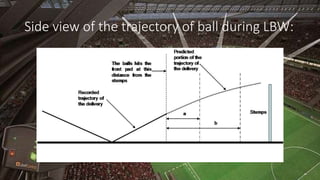
Side view of the trajectory of ball during LBW:
Another Limitation with Impact:
• Law 5 states that a cricket ball must have a circumference not less
than 22.4 cms and not greater than 22.9 cms. I will now draw out
what the margin of error should look like if Hawkeye were to create a
graphic that actually demonstrated what their technology can do,
according to their own specifications. For the purpose of this
argument, let's assume that the diameter of our chosen cricket ball is
22.5cms. Assuming Pi to be the ratio 22/7, the diameter of our cricket
ball is 7.16 cms. Let's consider the margins of error reported by
Hawkeye in various conditions in sequence. In each image the light
gray band is the margin of error.
1. Pitching Point, Interception Point
accuracy between 2.6 - 5mm. Let's
say that the pitching point accuracy is
3mm. It appears as in figure(a)
2. Predicted impact in the plane of
the stumps - between 0 and 15mm,
average 5mm, for normal LBWs. Let's
assume 5mm. It appears as in
figure(b)
3. Predicted impact in the plane of
the stumps, less than 25mm for
"extreme" LBW's. "Extreme" LBW's
are typically ones where the batsman
is well forward and is playing a fairly
full ball but get's hit on the pad. Let's
be generous as assume that the error
in such instances is 15mm. It appears
as in figure(c).
Conclusion
We have looked at various aspects of the HAWKEYE technology. Initially, we outlined the main
problems which one could encounter while trying to implement such a system for a sport like
cricket. Then, we looked into the details of each step of the process which finally gives us the
wonderful looking graphics that we see on TV during cricket analysis shows.
We have thus seen that the HAWKEYE is a great innovation, which puts technology to good use in
the field of sports. The technology is used widely these days, in sports such as Tennis and Cricket.
The accuracy which can be achieved with the use of the system is making the authorities think
seriously about reducing the human error component involved in important decisions. As the
system runs in real time, there is no extra time required to see the visualizations and graphics. The
system is also a great tool which can be used by players, statisticians, tacticians, coaches to analyze
previous games and come up with strategies for subsequent ones.
References
• Conway, Richard “Goal –line technology edges closer,” BBC Sport. Retrieved 18
May 2012.
• Video Processor Systems for Ball Tracking in Ball Games. International Patent
• IEEE Spectrum:Hawk Eye in the Crosshairs at Wimbledon Again.
Spectrum.ieeegbv.org. Retrieved on 15-08-2010
• www.hawkeyeinnovations.co.uk
• http://www.therulesofcricket.co.uk
• http://cricketingview.blogspot.in/2010/06/problems-with-hawkeye.html
• www.images.google.com
• http://www.espncricinfo.com/ci/content/story/250365.html
Hawk Eye Technology - An Understanding

Hawk Eye Technology - An Understanding

  • 1.
  • 2.
    Once there wasa Hockey coach who used to tell his team to start every match by imagining they were 0-3 down, “A goal for your weaknesses, another for your opponent’s strengths and a third for umpiring errors.”
  • 3.
    Humans are fallible,deciding who has won a tennis game or a sprint race can come down to a millimeter -accurate decision. So when an Olympic gold medal is on the line, it’s no wonder we turn to electronics to help us.
  • 4.
    It was developedby the engineers of Roke Manor Research Limited in 2001. This technology was created by Dr. Paul Hawkins
  • 5.
    Hawk Eye basicallyconsist of two significant parts: Tracking System Video Replay System
  • 6.
  • 7.
    Principle: Its worksbasically on the Principle of Triangulation.
  • 8.
    𝑙 = 𝑑 tan 𝛼 + 𝑑 tan𝛽 𝑑 = 𝑙 𝑑 tan 𝛼 + 𝑑 tan 𝛽 Principle of Triangulation:
  • 9.
    Hawk Eye useshigh range algorithms to predict the trajectory of the ball and for that it generally takes two inputs: Video produced by 6 different cameras Speed of the ball
  • 10.
    The 6 camerasare placed as shown:
  • 11.
    Hawk Eye’s CoreImage Processing Job is done in 3 steps: Identifying pixels representing the ball in each image. Applying some geometric algorithm on the set of images at each instant. Coming up with the 3D position of the ball in space. 𝐷𝑒𝑝𝑡ℎ = 𝑟 − (𝑟 cos( θ )+ 𝑥 sin( θ ))
  • 12.
    Hawk Eye isused in the following:- Tennis Cricket Badminton Snooker Baseball Rugby Volley ball Military and Defense Services
  • 13.
    In Tennis: • Itis majorly used for making Line calls i.e judges whether the impact of the ball is IN or OUT. • To locate the player moving areas.
  • 15.
    In Cricket: Apart likeTennis, here in Cricket the Hawk Eye is used for many other purposes like: LBW Decisions Wagon Wheels Pitch Maps De Spin Rail Cam Beehives
  • 16.
    LBW Decision: For anumpire to give an LBW decision, he checks for the following : Whether the ball did not pitch outside leg stump. If the batsman offered a shot, the ball hit him in line with the stumps. Whether the ball did not hit the bat first. The ball would have gone on to hit the stumps.
  • 17.
  • 18.
  • 19.
  • 20.
  • 21.
  • 22.
  • 23.
    In Automobile andMilitary Power:
  • 24.
    BEYOND THE LINECALL: How Hawk-Eye can improve performance Hawk Eye is not just used to make line calls, there is much more than line calls for Hawk Eye. It is used as a data source to analyze the game. Tennis Australia (TA) is amassing richer data sources than ever. At this year’s Australian Open, Hawk-Eye based insights as a tool for pre-match opposition analysis will be greater utilized than ever before by Tennis Australia’s High- Performance unit. Hawk-Eye has been deployed on multiple courts at the Australian Open and AO series events (Brisbane and Sydney for example) since 2007, and as such we have tracking data for some 250 tennis players. Thanks partially to funding from an Australian Institute of Sport (AIS) grant, an app (like the ones on your favorite smart-phone) has been constructed using open source technologies with Hawk- eye data at its core. Coaches can log-in from anywhere in the world, and interactivity sort and visualize data, tapping into their unique expertise without the need to consult the performance analysis team every time they want to delve deeper into the data.
  • 25.
  • 26.
    LBW Decision: For anumpire to give an LBW decision, he checks for the following : Whether the ball did not pitch outside leg stump. If the batsman offered a shot, the ball hit him in line with the stumps. Whether the ball did not hit the bat first. The ball would have gone on to hit the stumps.
  • 27.
    Side view ofthe trajectory of ball during LBW:
  • 29.
    Another Limitation withImpact: • Law 5 states that a cricket ball must have a circumference not less than 22.4 cms and not greater than 22.9 cms. I will now draw out what the margin of error should look like if Hawkeye were to create a graphic that actually demonstrated what their technology can do, according to their own specifications. For the purpose of this argument, let's assume that the diameter of our chosen cricket ball is 22.5cms. Assuming Pi to be the ratio 22/7, the diameter of our cricket ball is 7.16 cms. Let's consider the margins of error reported by Hawkeye in various conditions in sequence. In each image the light gray band is the margin of error.
  • 30.
    1. Pitching Point,Interception Point accuracy between 2.6 - 5mm. Let's say that the pitching point accuracy is 3mm. It appears as in figure(a) 2. Predicted impact in the plane of the stumps - between 0 and 15mm, average 5mm, for normal LBWs. Let's assume 5mm. It appears as in figure(b) 3. Predicted impact in the plane of the stumps, less than 25mm for "extreme" LBW's. "Extreme" LBW's are typically ones where the batsman is well forward and is playing a fairly full ball but get's hit on the pad. Let's be generous as assume that the error in such instances is 15mm. It appears as in figure(c).
  • 31.
    Conclusion We have lookedat various aspects of the HAWKEYE technology. Initially, we outlined the main problems which one could encounter while trying to implement such a system for a sport like cricket. Then, we looked into the details of each step of the process which finally gives us the wonderful looking graphics that we see on TV during cricket analysis shows. We have thus seen that the HAWKEYE is a great innovation, which puts technology to good use in the field of sports. The technology is used widely these days, in sports such as Tennis and Cricket. The accuracy which can be achieved with the use of the system is making the authorities think seriously about reducing the human error component involved in important decisions. As the system runs in real time, there is no extra time required to see the visualizations and graphics. The system is also a great tool which can be used by players, statisticians, tacticians, coaches to analyze previous games and come up with strategies for subsequent ones.
  • 32.
    References • Conway, Richard“Goal –line technology edges closer,” BBC Sport. Retrieved 18 May 2012. • Video Processor Systems for Ball Tracking in Ball Games. International Patent • IEEE Spectrum:Hawk Eye in the Crosshairs at Wimbledon Again. Spectrum.ieeegbv.org. Retrieved on 15-08-2010 • www.hawkeyeinnovations.co.uk • http://www.therulesofcricket.co.uk • http://cricketingview.blogspot.in/2010/06/problems-with-hawkeye.html • www.images.google.com • http://www.espncricinfo.com/ci/content/story/250365.html