Hawk Eye
   It is a system that tracks the ball as it
    moves around the court (or football
    pitch) and determines whether a ball
    is in or out, and where it might've
    gone if not it wasn't caught or hit
    (especially important in leg-before-
    wicket decisions in cricket.
   Or to put it in simpler terms it is a….


      Ball Tracking System
i


 Hawk-Eye was invented by Paul Hawkns
and David Sherry at Roke Manor Research
  in the UK, with the initial main aim of
          being used in cricket.
How it Works?
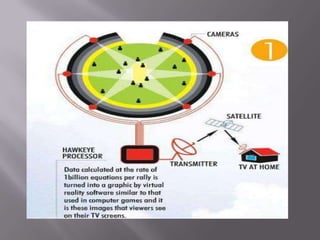
   Hawk-Eye requires a minimum of 4 cameras
    around the playing field (cricket uses 6, see
    illustration in the previous slide). The cameras
    are normal video cameras and thus take a
    series of shots of what they see, called frames.
   Each frame is sent to a data processing unit (a
    computer) where the computer has to firstly
    identify the ball and calculate its position in the
    frame. Once the computer has done this for all
    4 cameras, it calculates a 3D position of the ball
    in space using all the data gathered from all the
    cameras.
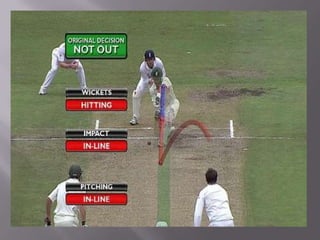
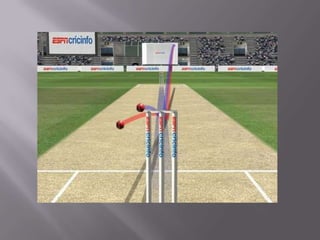
   After this, the computer can draw the path that
    the ball has taken, as well as predict a path that
    the ball might take, based on the change of
    position of the ball in successive frames. The
    computer can then map this path and compare
    it to the rules of the game to determine whether
    a ball was in or out, or a player was LBW
   The computer can also work as a statistics
    generator, recording and storing information
    about ball track, size, and velocity.
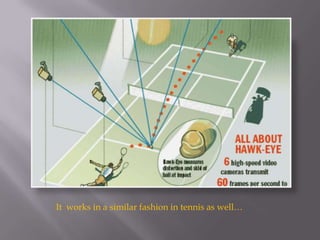
It works in a similar fashion in tennis as well…
   Presently the Hawkeye is being used in the
    UDRS in cricket and to verify line calls in
    tennis.
   Thus the Hawkeye is a useful technology to
    make sports like cricket and tennis free from
    human errors , ensuring fair play in the playing
    field.
Hawkeye

Hawkeye

  • 3.
  • 4.
    It is a system that tracks the ball as it moves around the court (or football pitch) and determines whether a ball is in or out, and where it might've gone if not it wasn't caught or hit (especially important in leg-before- wicket decisions in cricket.
  • 5.
    Or to put it in simpler terms it is a…. Ball Tracking System
  • 6.
    i Hawk-Eye wasinvented by Paul Hawkns and David Sherry at Roke Manor Research in the UK, with the initial main aim of being used in cricket.
  • 7.
  • 9.
    Hawk-Eye requires a minimum of 4 cameras around the playing field (cricket uses 6, see illustration in the previous slide). The cameras are normal video cameras and thus take a series of shots of what they see, called frames.
  • 10.
    Each frame is sent to a data processing unit (a computer) where the computer has to firstly identify the ball and calculate its position in the frame. Once the computer has done this for all 4 cameras, it calculates a 3D position of the ball in space using all the data gathered from all the cameras.
  • 12.
    After this, the computer can draw the path that the ball has taken, as well as predict a path that the ball might take, based on the change of position of the ball in successive frames. The computer can then map this path and compare it to the rules of the game to determine whether a ball was in or out, or a player was LBW
  • 17.
    The computer can also work as a statistics generator, recording and storing information about ball track, size, and velocity.
  • 18.
    It works ina similar fashion in tennis as well…
  • 19.
    Presently the Hawkeye is being used in the UDRS in cricket and to verify line calls in tennis.  Thus the Hawkeye is a useful technology to make sports like cricket and tennis free from human errors , ensuring fair play in the playing field.