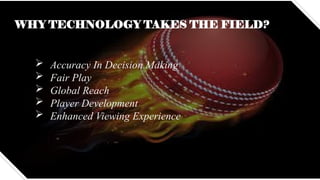
Modern cricket has adopted various advanced technologies to improve accuracy, fairness, and entertainment. These technologies assist players, umpires, coaches, and viewers by providing real-time data, performance analysis, and decision-making support.
Here’s a clear and concise description for “Advanced Technology Used in Cricket” — suitable for reports, presentations, or practical notebooks 👇
---
Advanced Technology Used in Cricket
Modern cricket has adopted various advanced technologies to improve accuracy, fairness, and entertainment. These technologies assist players, umpires, coaches, and viewers by providing real-time data, performance analysis, and decision-making support.
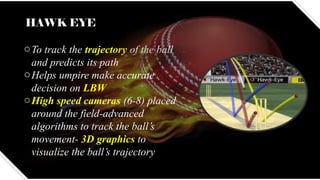
1. Hawk-Eye Technology
Purpose: Tracks the trajectory of the ball.
Use: Helps in LBW (Leg Before Wicket) decisions and analyzing ball movement.
Working: Uses multiple high-speed cameras around the field to triangulate and predict the ball’s path.
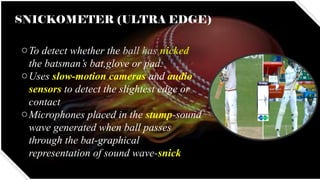
2. UltraEdge / Snickometer
Purpose: Detects faint edges when the ball passes the bat.
Use: Used in DRS (Decision Review System) to confirm caught-behind or LBW appeals.
Working: Converts sound vibrations into visual waveforms to detect contact between bat and ball.
3. Hot Spot
Purpose: Identifies contact between bat, ball, or pad.
Use: Helps in close edge and LBW decisions.
Working: Infrared cameras capture heat generated by impact, showing bright spots on contact areas.
4. Ball Tracking and Speed Guns
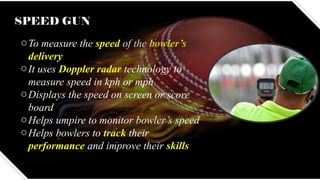
Purpose: Measures ball speed and movement.
Use: Used by commentators and analysts to show bowling speed and swing.
Working: Uses radar technology to measure the velocity of the ball.
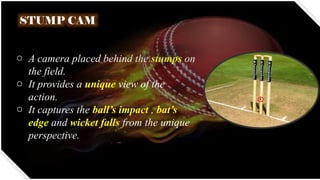
5. Stump Cameras and Microphones
Purpose: Provides close-up visuals and sounds near the wicket.
Use: Enhances broadcast quality and assists umpires in decision-making.
Working: Mini cameras and mics embedded in stumps capture fine details.
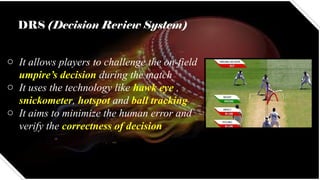
6. DRS (Decision Review System)
Purpose: Ensures fair umpiring decisions.
Use: Players can challenge the on-field umpire’s call.
Working: Combines technologies like Hawk-Eye, UltraEdge, and Hot Spot for review decisions.
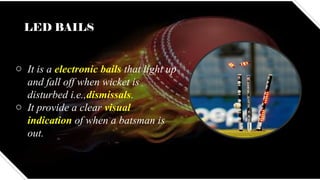
7. Smart Bails and LED Stumps
Purpose: Detects when the bails are dislodged.
Use: Used in run-out, stumping, and close wicket decisions.
Working: Embedded sensors and LEDs light up instantly when contact is broken.
8. Data Analytics and AI
Purpose: Analyzes player performance and match strategies.
Use: Coaches and analysts use it for team selection, training, and predictive modeling.
Working: Uses AI algorithms and statistical software to interpret large datasets.
---
Conclusion
Advanced technology in cricket has revolutionized the game, making it more transparent, accurate, and engaging. It bridges the gap between human judgment and machine precision, ensuring fair play and improving viewer experience.
---
Would you like me to shorten this for a school record/practical note format (around 100–150 words) or expand it for a presentation/report (300