HAWK EYE
INTRODUCTION
 Hawk-Eye is a complex computer system used
in cricket, tennis and other sports to visually
track the path of the ball and display a record
of its most statistically likely path as a moving
image.
 Hawk-Eye is most innovative technology in
sports broadcasting and is a development that
will reinforce the group's presence and
influence.
HISTORY
 It was developed by engineers at Roke Manor Research
Limited in 2001.
 The patent being held by Paul Hawkins and David
Sherry. The system was first used
during a Test match between
Pakistan and England at Lord's
Cricket Ground, on 21 April
2001.
 And in tennis, it was used in
2006 US open.
Abilities
 Hawk-eye can track any type of bounce , spin , swing and seam
movement of the ball.
 Give a prediction as accurate as 99.99 percent .
 Hawk-Eye was used for referring decisions to the third umpire in
LBW.
 The cameras are used in two sets, and a multi-channel frame
grabber handles each set of cameras.
 The images captured are then processed by software to produce a
3-D image.
 This is updated 100 times every second.
 The system is able to locate the ball in 3-D and can predict the
motion with a claimed accuracy of 5 mm
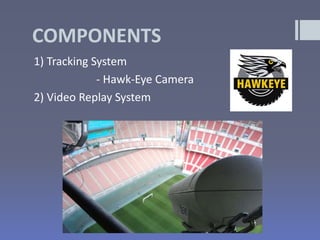
COMPONENTS
1) Tracking System
- Hawk-Eye Camera
2) Video Replay System
TRACKING SYSTEM
The system calculates the following information:
• The swing of the ball from the bowler's hand to where
the ball pitched .
• How much the ball bounced.
• How much the ball deviated sideways off the wicket.
• A prediction of where the ball would have passed the
stumps.
• Video provided by 6 different cameras placed at 6
different places.
• The system rapidly processes the video feeds by a
high speed video processor.
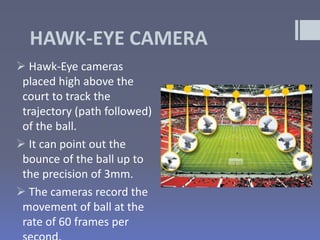
HAWK-EYE CAMERA
 Hawk-Eye cameras
placed high above the
court to track the
trajectory (path followed)
of the ball.
 It can point out the
bounce of the ball up to
the precision of 3mm.
 The cameras record the
movement of ball at the
rate of 60 frames per
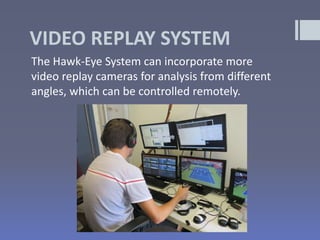
VIDEO REPLAY SYSTEM
The Hawk-Eye System can incorporate more
video replay cameras for analysis from different
angles, which can be controlled remotely.
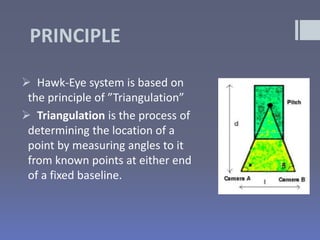
PRINCIPLE
 Hawk-Eye system is based on
the principle of ”Triangulation”
 Triangulation is the process of
determining the location of a
point by measuring angles to it
from known points at either end
of a fixed baseline.
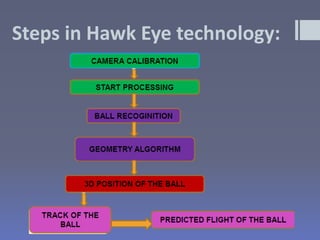
Steps in Hawk Eye technology:
Applications
Cricket
• Predict a ball flight-path from the said 3D ball position
• Map the predicted path on the modeled area
• Helps to track the trajectory of balls in flight
Tennis
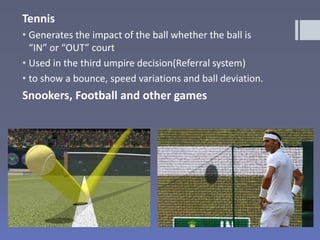
• Generates the impact of the ball whether the ball is
“IN” or “OUT” court
• Used in the third umpire decision(Referral system)
• to show a bounce, speed variations and ball deviation.
Snookers, Football and other games
Advantages
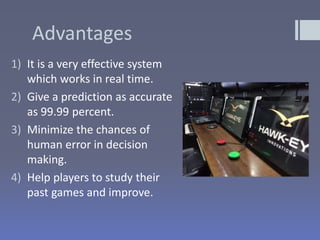
1) It is a very effective system
which works in real time.
2) Give a prediction as accurate
as 99.99 percent.
3) Minimize the chances of
human error in decision
making.
4) Help players to study their
past games and improve.
Disadvantages
1) The system is too costly.
2) The system needs complex arrangements.
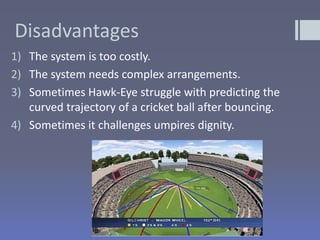
3) Sometimes Hawk-Eye struggle with predicting the
curved trajectory of a cricket ball after bouncing.
4) Sometimes it challenges umpires dignity.
Conclusion
 After all the test that have been conducted on this technology, it
has always come out successful and it promises to be a boon for
the world of sports and now it is up to the different councils to
decide whether to use this technology or not.
 This technology has met the high
reality and accuracy features.
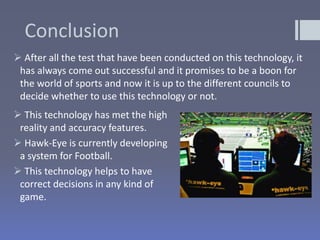
 Hawk-Eye is currently developing
a system for Football.
 This technology helps to have
correct decisions in any kind of
game.

Hawk eye

  • 1.
  • 2.
    INTRODUCTION  Hawk-Eye isa complex computer system used in cricket, tennis and other sports to visually track the path of the ball and display a record of its most statistically likely path as a moving image.  Hawk-Eye is most innovative technology in sports broadcasting and is a development that will reinforce the group's presence and influence.
  • 3.
    HISTORY  It wasdeveloped by engineers at Roke Manor Research Limited in 2001.  The patent being held by Paul Hawkins and David Sherry. The system was first used during a Test match between Pakistan and England at Lord's Cricket Ground, on 21 April 2001.  And in tennis, it was used in 2006 US open.
  • 4.
    Abilities  Hawk-eye cantrack any type of bounce , spin , swing and seam movement of the ball.  Give a prediction as accurate as 99.99 percent .  Hawk-Eye was used for referring decisions to the third umpire in LBW.  The cameras are used in two sets, and a multi-channel frame grabber handles each set of cameras.  The images captured are then processed by software to produce a 3-D image.  This is updated 100 times every second.  The system is able to locate the ball in 3-D and can predict the motion with a claimed accuracy of 5 mm
  • 5.
    COMPONENTS 1) Tracking System -Hawk-Eye Camera 2) Video Replay System
  • 6.
    TRACKING SYSTEM The systemcalculates the following information: • The swing of the ball from the bowler's hand to where the ball pitched . • How much the ball bounced. • How much the ball deviated sideways off the wicket. • A prediction of where the ball would have passed the stumps. • Video provided by 6 different cameras placed at 6 different places. • The system rapidly processes the video feeds by a high speed video processor.
  • 7.
    HAWK-EYE CAMERA  Hawk-Eyecameras placed high above the court to track the trajectory (path followed) of the ball.  It can point out the bounce of the ball up to the precision of 3mm.  The cameras record the movement of ball at the rate of 60 frames per
  • 8.
    VIDEO REPLAY SYSTEM TheHawk-Eye System can incorporate more video replay cameras for analysis from different angles, which can be controlled remotely.
  • 9.
    PRINCIPLE  Hawk-Eye systemis based on the principle of ”Triangulation”  Triangulation is the process of determining the location of a point by measuring angles to it from known points at either end of a fixed baseline.
  • 10.
    Steps in HawkEye technology:
  • 11.
    Applications Cricket • Predict aball flight-path from the said 3D ball position • Map the predicted path on the modeled area • Helps to track the trajectory of balls in flight
  • 12.
    Tennis • Generates theimpact of the ball whether the ball is “IN” or “OUT” court • Used in the third umpire decision(Referral system) • to show a bounce, speed variations and ball deviation. Snookers, Football and other games
  • 13.
    Advantages 1) It isa very effective system which works in real time. 2) Give a prediction as accurate as 99.99 percent. 3) Minimize the chances of human error in decision making. 4) Help players to study their past games and improve.
  • 14.
    Disadvantages 1) The systemis too costly. 2) The system needs complex arrangements. 3) Sometimes Hawk-Eye struggle with predicting the curved trajectory of a cricket ball after bouncing. 4) Sometimes it challenges umpires dignity.
  • 15.
    Conclusion  After allthe test that have been conducted on this technology, it has always come out successful and it promises to be a boon for the world of sports and now it is up to the different councils to decide whether to use this technology or not.  This technology has met the high reality and accuracy features.  Hawk-Eye is currently developing a system for Football.  This technology helps to have correct decisions in any kind of game.