Listening 101
1
by Aaron Filipi
Founder, Cairn Communication
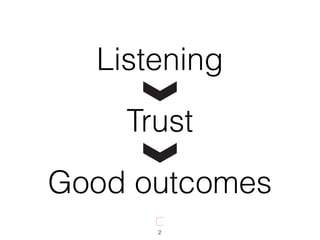
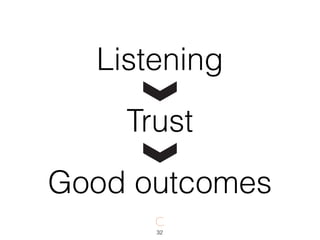
Listening
Trust
Good outcomes
2
Listening 

receiving, interpreting,
recalling, evaluating,
and responding
3
4
Survival.
“…the listener always wins.”
~
“The best leaders are the best
listeners.” Sir Richard Branson~
5
It comes down to one thing…
6
Respect
7
So…what’s your emotional IQ?
8
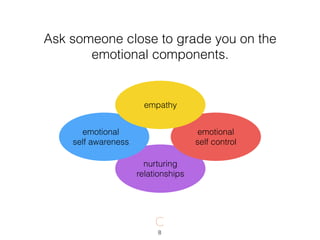
empathy
emotional
self control
emotional
self awareness
nurturing
relationships
Ask someone close to grade you on the
emotional components.
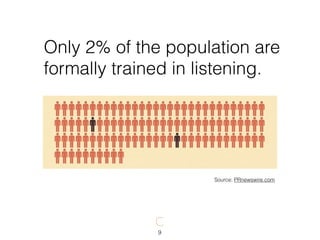
Source: PRnewswire.com
Only 2% of the population are
formally trained in listening.
9
10
Lessons learned
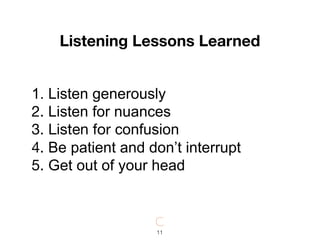
1. Listen generously

2. Listen for nuances

3. Listen for confusion

4. Be patient and don’t interrupt

5. Get out of your head
Listening Lessons Learned
11
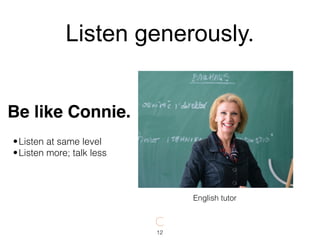
•Listen at same level
•Listen more; talk less
English tutor
Be like Connie.
12
Listen generously.
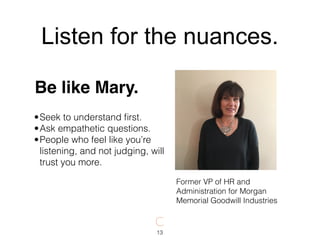
•Seek to understand first.
•Ask empathetic questions.
•People who feel like you’re
listening, and not judging, will
trust you more.
Former VP of HR and
Administration for Morgan
Memorial Goodwill Industries
Be like Mary.
13
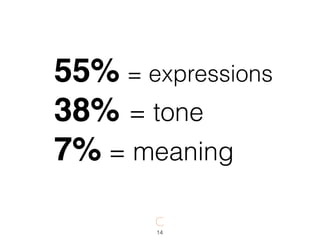
Listen for the nuances.
55% = expressions
38% = tone
7% = meaning
14
Data show:
•More action-oriented listener, focusing on
information pertinent to the task at hand.
•Less patience for rambling off topic and
unnecessary details.
Guys
15
Data show:
•Connect with emotions and conversation
undertones.
•More concerned with the occurrence of
conversations than with the pertinent
information discussed.
Gals
16
17
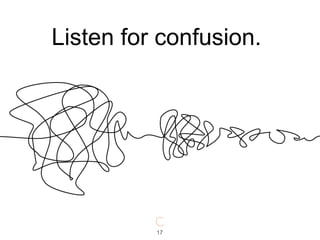
Listen for confusion.
18
Why is the man who invests all
your money called a broker?
Why are wise men and wise guys opposites?
Why do we park in driveways,
and drive on parkways?
Why is it called a TV "set" when
you only get one of them?
Why are boxing rings square?
19
3 Common Causes of Miscommunication
1. Misaligned vocabularies - speaker not using
words listener will understand.

2. Messy thinking - speaking before thinking.

3. Faulty definitions - overuse of homophones.
Flounder…or founder?
Alternate…or alternative?
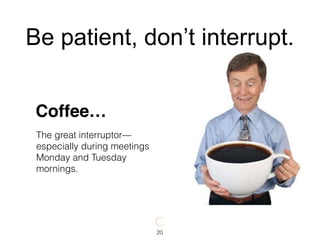
The great interruptor—
especially during meetings
Monday and Tuesday
mornings.
Coffee…
20
Be patient, don’t interrupt.
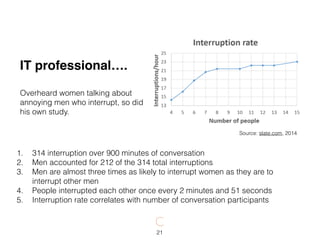
1. 314 interruption over 900 minutes of conversation
2. Men accounted for 212 of the 314 total interruptions
3. Men are almost three times as likely to interrupt women as they are to
interrupt other men
4. People interrupted each other once every 2 minutes and 51 seconds
5. Interruption rate correlates with number of conversation participants
Source: slate.com, 2014
IT professional….
Overheard women talking about
annoying men who interrupt, so did
his own study.
21
Less productivity
Less trust
22
Shut up.
23
24
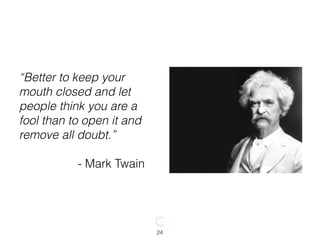
“Better to keep your
mouth closed and let
people think you are a
fool than to open it and
remove all doubt.”
- Mark Twain
Focus on the other person as
much as you’re focusing on
this cash. Don’t “plan” your
response…listen, think, and
then respond.
25
Get out of your head.
26
Helpful tips
27
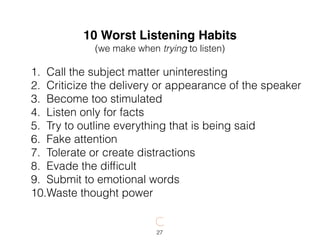
10 Worst Listening Habits
(we make when trying to listen)

1. Call the subject matter uninteresting
2. Criticize the delivery or appearance of the speaker
3. Become too stimulated
4. Listen only for facts
5. Try to outline everything that is being said
6. Fake attention
7. Tolerate or create distractions
8. Evade the difficult
9. Submit to emotional words
10.Waste thought power
Start here. Set
your dang
phone to DND.
28
29
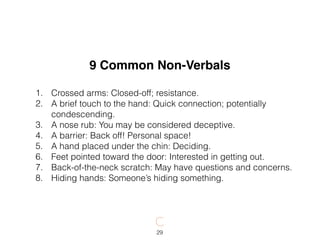
9 Common Non-Verbals
1. Crossed arms: Closed-off; resistance.
2. A brief touch to the hand: Quick connection; potentially
condescending.
3. A nose rub: You may be considered deceptive.
4. A barrier: Back off! Personal space!
5. A hand placed under the chin: Deciding.
6. Feet pointed toward the door: Interested in getting out.
7. Back-of-the-neck scratch: May have questions and concerns.
8. Hiding hands: Someone’s hiding something.
30
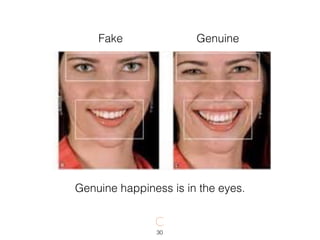
Fake Genuine
Genuine happiness is in the eyes.
“Employees who use ‘upspeak’
put their promotions at risk by
coming across as less
confident.”
- Bernard Marr (performance expert)
31
32
Listening
Trust
Good outcomes
33
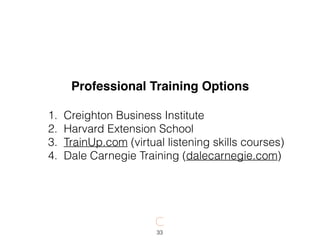
Professional Training Options
1. Creighton Business Institute
2. Harvard Extension School
3. TrainUp.com (virtual listening skills courses)
4. Dale Carnegie Training (dalecarnegie.com)

Listening 101