BATCH 2016-17 , BSC ID (HONOURS) , FCRM ,MSU
STUDENT : 1. AAHUTI PRAJAPATI
2. DISHA PATEL
SUBJECT : SUSTAINABLE ENVIRONMENT AND INTERIOR DESIGN
1.
CASE STUDY :CII SOHRABJI GODREJ GREEN BUISNESS CENTER ,HYDERABAD
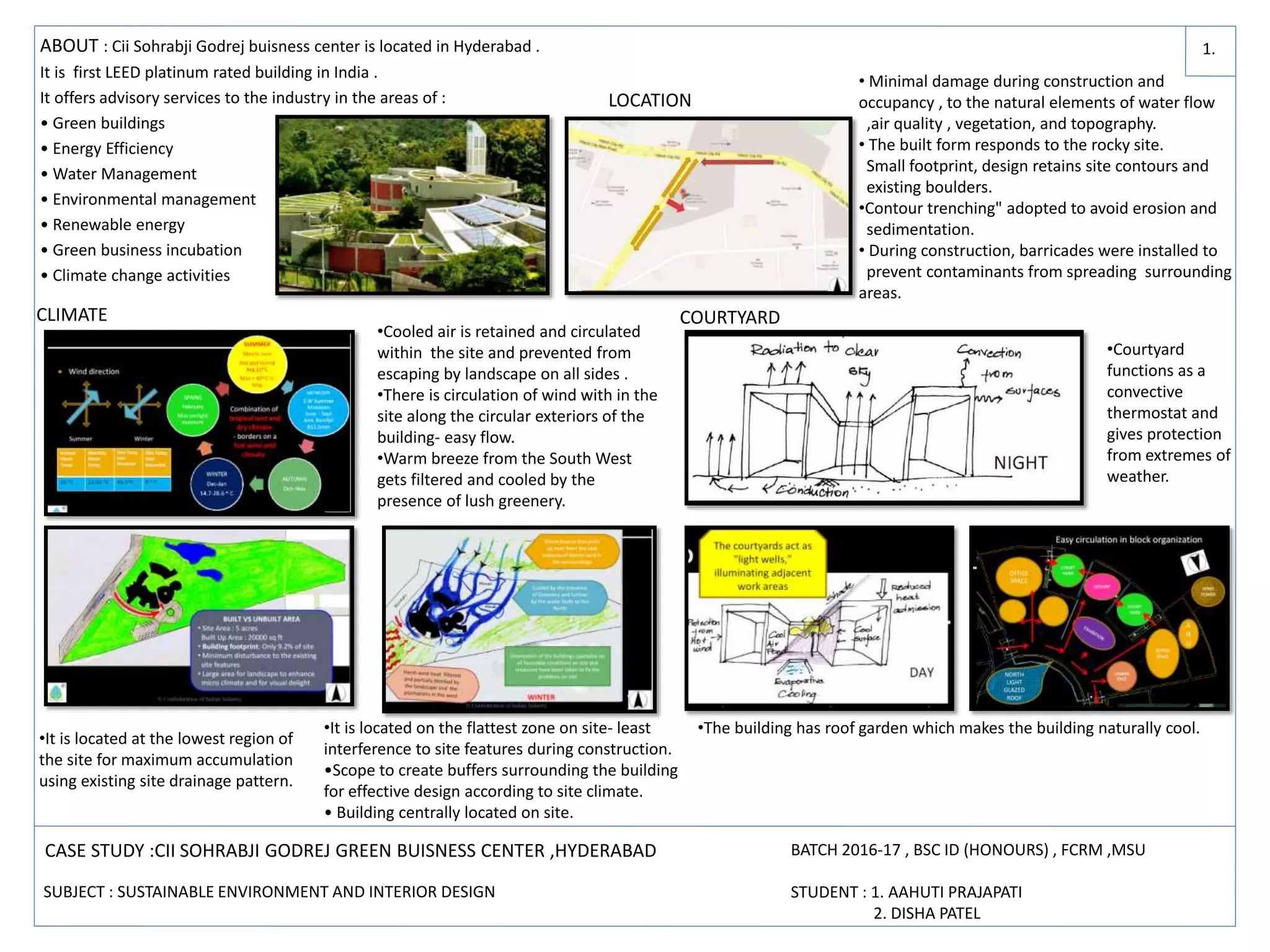
ABOUT : Cii Sohrabji Godrej buisness center is located in Hyderabad .
It is first LEED platinum rated building in India .
It offers advisory services to the industry in the areas of :
• Green buildings
• Energy Efficiency
• Water Management
• Environmental management
• Renewable energy
• Green business incubation
• Climate change activities
CLIMATE
• Minimal damage during construction and
occupancy , to the natural elements of water flow
,air quality , vegetation, and topography.
• The built form responds to the rocky site.
Small footprint, design retains site contours and
existing boulders.
•Contour trenching" adopted to avoid erosion and
sedimentation.
• During construction, barricades were installed to
prevent contaminants from spreading surrounding
areas.
LOCATION
COURTYARD
•Courtyard
functions as a
convective
thermostat and
gives protection
from extremes of
weather.
•Cooled air is retained and circulated
within the site and prevented from
escaping by landscape on all sides .
•There is circulation of wind with in the
site along the circular exteriors of the
building- easy flow.
•Warm breeze from the South West
gets filtered and cooled by the
presence of lush greenery.
•It is located at the lowest region of
the site for maximum accumulation
using existing site drainage pattern.
•It is located on the flattest zone on site- least
interference to site features during construction.
•Scope to create buffers surrounding the building
for effective design according to site climate.
• Building centrally located on site.
•The building has roof garden which makes the building naturally cool.
BATCH 2016-17 , BSC ID (HONOURS) , FCRM ,MSU
STUDENT : 1. AAHUTI PRAJAPATI
2. DISHA PATEL
SUBJECT : SUSTAINABLE ENVIRONMENT AND INTERIOR DESIGN
2.
CASE STUDY :CII SOHRABJI GODREJ GREEN BUISNESS CENTER ,HYDERABAD
WIND CIRCULATION LIGHT
•Building layout ensures that 90 % of spaces
have daylight.
•access and views to the outside.
• North facades are glazed for efficient diffused
light.
• Low heat transmitting glass used.
• Double glass to further reduce heat gain.
• Natural lighting - no lights are used until late
in the evening.
• Minimum lux levels for all work stations have
been ensured.
• Light captured from as many sides possible -
the use of courtyards.
•Fully glazed windows help tolight the entire
technology centre.
•Allow controlled passage of air and light into
the Interior space.
• throw patterns of light and shadow on the
floor enhancing aesthetics .
• Ensure constant flow of breeze into the
interior – occupant comfort cools the interiors.
• An alternative to costly window construction
diffuse the glare of direct sunlight .
PLAN AND SECTION
•Some rainwater goes into the soil by the use of permeable
grid pavers.
• The remaining rainwater follows existing flow patterns and
is collected in a water pond another traditional method of
rain water harvesting, constructed at a lower end of the site.
• In addition, the building achieves a 35 % reduction of
municipally supplied potable water.
•In part through the use of low-flush toilets and waterless
urinals.
•Artificially
prepared wetlands
comprising of clay
or plastic lined
excavation and
emergent
vegetation growing
on sand mixtures.
WATER MANAGMENT
BATCH 2016-17 , BSC ID (HONOURS) , FCRM ,MSU
STUDENT : 1. AAHUTI PRAJAPATI
2. DISHA PATEL
SUBJECT : SUSTAINABLE ENVIRONMENT AND INTERIOR DESIGN
3.
CASE STUDY :CII SOHRABJI GODREJ GREEN BUISNESS CENTER ,HYDERABAD
LANDSCAPE
•Canopy trees modify
the natural light
quality .
Penetrating sunlight
adds to the dynamism
of the space
•Understorey trees are
effective in screening
mid or low angle sun.
For ex bamboo , champo
tree .
•Bio degradable
plastic grass
crates
used to hold
grass– easy
removal and
Maintenance .
SUSTAINABLE MATERIALS
Bagasse Boarda – by product of
sugarcane industry-a good
substitute for plywood or
Particle Board
It has wide usage for making
partitions, furniture etc.
•An impressive 77 % of the building materials
use
recycled content in the form of fly ash, broken
glass, broken tiles, recycled paper, recycled
aluminum, cinder from industrial furnaces,
bagasse, mineral fibers , cellulose fibers , and
quarry dust.
• Low VOC paints have also been applied.
Of this, 95 % of the raw material was extracted or
harvested locally.
Furniture in the
canteen
with local Tandur
stone
flooring
Reuse of
construction
waste stone in
paving
the gardens
FLY ASH BRICK
•Low embodied energy, High
recycled content, low CO2
emission
•Lower water penetration,
considerably reducing
seepage of water through
•Bricks manufacturing
method saves energy,
reduces mercury pollution .
•Use of Solar panels on the
rooftop grid provides
about 16 % of the
building's electricity needs.
Placed on the roof facing
South and West to capture
maximum heat gain. •A Windcatcher, Windscoop or Badgir is
a traditional Persian architectural
element to create natural ventilation in
buildings Energy savings are achieved
by the GBCs two wind towers.
•Air, cooled by upto 8 ^C, is supplied to
the AHUs,substantially reducing the
load on the air conditioning system.
WINDCATCHER

sustainable building case study

  • 1.
    BATCH 2016-17 ,BSC ID (HONOURS) , FCRM ,MSU STUDENT : 1. AAHUTI PRAJAPATI 2. DISHA PATEL SUBJECT : SUSTAINABLE ENVIRONMENT AND INTERIOR DESIGN 1. CASE STUDY :CII SOHRABJI GODREJ GREEN BUISNESS CENTER ,HYDERABAD ABOUT : Cii Sohrabji Godrej buisness center is located in Hyderabad . It is first LEED platinum rated building in India . It offers advisory services to the industry in the areas of : • Green buildings • Energy Efficiency • Water Management • Environmental management • Renewable energy • Green business incubation • Climate change activities CLIMATE • Minimal damage during construction and occupancy , to the natural elements of water flow ,air quality , vegetation, and topography. • The built form responds to the rocky site. Small footprint, design retains site contours and existing boulders. •Contour trenching" adopted to avoid erosion and sedimentation. • During construction, barricades were installed to prevent contaminants from spreading surrounding areas. LOCATION COURTYARD •Courtyard functions as a convective thermostat and gives protection from extremes of weather. •Cooled air is retained and circulated within the site and prevented from escaping by landscape on all sides . •There is circulation of wind with in the site along the circular exteriors of the building- easy flow. •Warm breeze from the South West gets filtered and cooled by the presence of lush greenery. •It is located at the lowest region of the site for maximum accumulation using existing site drainage pattern. •It is located on the flattest zone on site- least interference to site features during construction. •Scope to create buffers surrounding the building for effective design according to site climate. • Building centrally located on site. •The building has roof garden which makes the building naturally cool.
  • 2.
    BATCH 2016-17 ,BSC ID (HONOURS) , FCRM ,MSU STUDENT : 1. AAHUTI PRAJAPATI 2. DISHA PATEL SUBJECT : SUSTAINABLE ENVIRONMENT AND INTERIOR DESIGN 2. CASE STUDY :CII SOHRABJI GODREJ GREEN BUISNESS CENTER ,HYDERABAD WIND CIRCULATION LIGHT •Building layout ensures that 90 % of spaces have daylight. •access and views to the outside. • North facades are glazed for efficient diffused light. • Low heat transmitting glass used. • Double glass to further reduce heat gain. • Natural lighting - no lights are used until late in the evening. • Minimum lux levels for all work stations have been ensured. • Light captured from as many sides possible - the use of courtyards. •Fully glazed windows help tolight the entire technology centre. •Allow controlled passage of air and light into the Interior space. • throw patterns of light and shadow on the floor enhancing aesthetics . • Ensure constant flow of breeze into the interior – occupant comfort cools the interiors. • An alternative to costly window construction diffuse the glare of direct sunlight . PLAN AND SECTION •Some rainwater goes into the soil by the use of permeable grid pavers. • The remaining rainwater follows existing flow patterns and is collected in a water pond another traditional method of rain water harvesting, constructed at a lower end of the site. • In addition, the building achieves a 35 % reduction of municipally supplied potable water. •In part through the use of low-flush toilets and waterless urinals. •Artificially prepared wetlands comprising of clay or plastic lined excavation and emergent vegetation growing on sand mixtures. WATER MANAGMENT
  • 3.
    BATCH 2016-17 ,BSC ID (HONOURS) , FCRM ,MSU STUDENT : 1. AAHUTI PRAJAPATI 2. DISHA PATEL SUBJECT : SUSTAINABLE ENVIRONMENT AND INTERIOR DESIGN 3. CASE STUDY :CII SOHRABJI GODREJ GREEN BUISNESS CENTER ,HYDERABAD LANDSCAPE •Canopy trees modify the natural light quality . Penetrating sunlight adds to the dynamism of the space •Understorey trees are effective in screening mid or low angle sun. For ex bamboo , champo tree . •Bio degradable plastic grass crates used to hold grass– easy removal and Maintenance . SUSTAINABLE MATERIALS Bagasse Boarda – by product of sugarcane industry-a good substitute for plywood or Particle Board It has wide usage for making partitions, furniture etc. •An impressive 77 % of the building materials use recycled content in the form of fly ash, broken glass, broken tiles, recycled paper, recycled aluminum, cinder from industrial furnaces, bagasse, mineral fibers , cellulose fibers , and quarry dust. • Low VOC paints have also been applied. Of this, 95 % of the raw material was extracted or harvested locally. Furniture in the canteen with local Tandur stone flooring Reuse of construction waste stone in paving the gardens FLY ASH BRICK •Low embodied energy, High recycled content, low CO2 emission •Lower water penetration, considerably reducing seepage of water through •Bricks manufacturing method saves energy, reduces mercury pollution . •Use of Solar panels on the rooftop grid provides about 16 % of the building's electricity needs. Placed on the roof facing South and West to capture maximum heat gain. •A Windcatcher, Windscoop or Badgir is a traditional Persian architectural element to create natural ventilation in buildings Energy savings are achieved by the GBCs two wind towers. •Air, cooled by upto 8 ^C, is supplied to the AHUs,substantially reducing the load on the air conditioning system. WINDCATCHER