Shared Governance
Prepared by:-
1- Ahmed Mohammed Zinhom
2- Rady Mubarak
Under supervision of:
prof. Magda El Mola
Outlines
 1-Introduction
 2-Definition of
 -Share
 -Governance
 -Shared governance
 3-Aims of shared governance
 4-Governance styles
 5-World without shared governance
 6-World with shared governance
 7-Benefit from shared governance
 8-How can I help make shared
governance work on my unit?
 9-Shared governance models
 10-Shared governance at the unit level
 11-Barriers to implementation of shared
governance.
Introduction
First introduced by Christman in1976
•Asserted the idea that nurses should have decision
making power within their scope of practice equal to that
of physicians within theirs.
• that was developed as an alternative to the traditional
bureaucratic organizational structure.
• In shared governance, the organization's governance is
shared among board members, nurses, physicians, and
management. (Kovner, Hendrckson, &Finkler, 1993).

cont.
 Decision making and communication
channels are altered.
 Group structures, in the form of joint
practice committees, are developed to
assume the power and accountability for
decision making and professional
communication takes an equalitarian
structure.
(Gessner,1990; Boeglin,1993)
Shared Governance
Share: participate, partake, implies having or
taking part in an undertaking or activity
Governance:
Exertion of a determining or guiding influence
over; government; direct control; having the
authority to determine basic policy
The action or manner of governing.
 Definitions of Shared Governance
It is a partnership between staff and
management working together to
promote shared decision making and
accountability to provide an improved
work environment
Shared governance is an organizational
framework grounded in a philosophy of
decentralized leadership that fosters
autonomous decision making and
professional nursing practice.
cont.
 In shared governance, a nursing
organization's management assume
the responsibility for organizational
structure and resources.
 In turn, staff nurses accept the
responsibility and accountability for their
professional practice
cont.
 Shared governance is collaboration,
whether in scheduling staff, educating
new staff, or implementing evidence-
based practice.
 It involves teamwork, problem-solving,
and accountability, with the goals of
improved staff satisfaction, productivity,
and patient outcomes.
 It is working together to make decisions
that affect nursing practice and patient
care.
 It is working with other disciplines for the
good of the patient. It is collaborating to
Aims of Shared governance
 Empowerment of individuals within the
decision making system, this
empowerment is directed at increasing
nurse's authority & control over their
nursing practice.
 Shared governance improves staff
nurses' perception of their job & practice
environment.
(Jones, & Lucas,1993; Ludemann, &
Brown,1989).
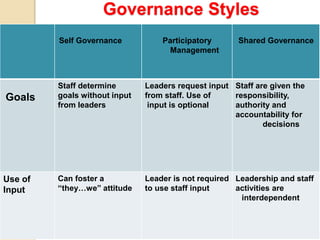
Governance Styles
Shared GovernanceParticipatory
Management
Self Governance
Staff are given the
responsibility,
authority and
accountability for
decisions
Leaders request input
from staff. Use of
input is optional
Staff determine
goals without input
from leaders
Goals
Leadership and staff
activities are
interdependent
Leader is not required
to use staff input
Can foster a
“they…we” attitude
Use of
Input
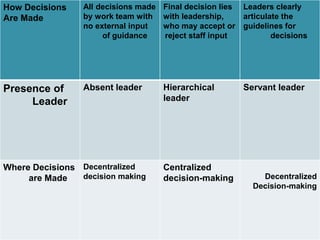
Leaders clearly
articulate the
guidelines for
decisions
Final decision lies
with leadership,
who may accept or
reject staff input
All decisions made
by work team with
no external input
of guidance
How Decisions
Are Made
Servant leaderHierarchical
leader
Absent leaderPresence of
Leader
Decentralized
Decision-making
Centralized
decision-making
Decentralized
decision making
Where Decisions
are Made
A World without Shared
Governance
 Managers make the decisions
 Nurses are powerless, self-focused &
see a narrow scope
 Few people do the work, while others
don’t follow the new rules because they
don’t know why or how they were
established
A World with Shared Governance
 Nurses are empowered
 They have a voice
 Autonomy is valued
 Nurses have control over their
practice
 Happier work environment
Impact
 Nurse satisfaction improves
 Nurses turnover decreases
 Quality of care improves
benefit from Shared Governance
 Possibility to make changes
 Decisions made by bedside clinicians
 Promotes healthy work environment
 Improves employee satisfaction, patient
outcomes and employee turnover
How can I help make Shared
Governance work on my unit?
 Engage
 Commit
 Collaborate
 Deliver
 Encourage
18
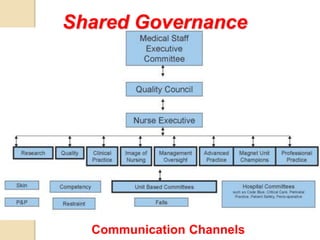
Shared Governance
Communication Channels
Shared governance model:
 Organizational Shared governance
structures are usually council models
that have evolved from preexisting
nursing or institutional committees.
 In a council structure, clearly defined
accountabilities for specific elements of
professional practice have been
delegated to five main areas of
accountability:
cont.
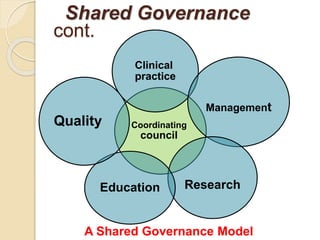
1. Clinical practice
2. Quality
3. Education
4. Research
5. Management
 A typical model of shared governance is
a committee structure (congressional
model) where representative staff
nurses belong to nursing committees
that are assigned specific management
or clinical functions.
cont.
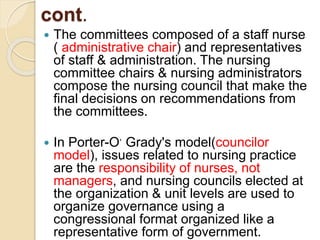
 The committees composed of a staff nurse
( administrative chair) and representatives
of staff & administration. The nursing
committee chairs & nursing administrators
compose the nursing council that make the
final decisions on recommendations from
the committees.
 In Porter-O
,
Grady's model(councilor
model), issues related to nursing practice
are the responsibility of nurses, not
managers, and nursing councils elected at
the organization & unit levels are used to
organize governance using a
congressional format organized like a
representative form of government.
cont.
Coordinating
council
Clinical
practice
Management
ResearchEducation
Quality
A Shared Governance Model
Shared Governance
Each Shared governance
model :
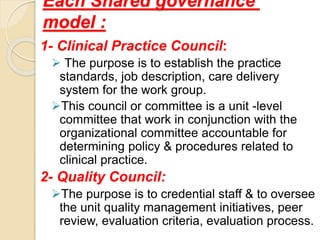
1- Clinical Practice Council:
 The purpose is to establish the practice
standards, job description, care delivery
system for the work group.
This council or committee is a unit -level
committee that work in conjunction with the
organizational committee accountable for
determining policy & procedures related to
clinical practice.
2- Quality Council:
The purpose is to credential staff & to oversee
the unit quality management initiatives, peer
review, evaluation criteria, evaluation process.
Quality Council
 cont.
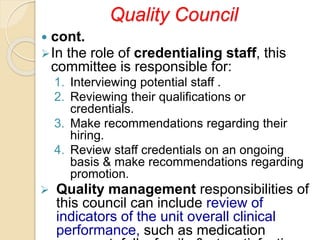
In the role of credentialing staff, this
committee is responsible for:
1. Interviewing potential staff .
2. Reviewing their qualifications or
credentials.
3. Make recommendations regarding their
hiring.
4. Review staff credentials on an ongoing
basis & make recommendations regarding
promotion.
 Quality management responsibilities of
this council can include review of
indicators of the unit overall clinical
performance, such as medication
3- Education Council:
The purpose is to assess the learning
needs of the unit staff and develop and
implement programs to meet these needs.
This council usually works closely with
organizational education & training
departments.
4- Research Council:
At the unit level, this council advances
research utilization with the intent of
incorporating research-based findings into
the clinical standards of unit practice.
cont.
5- Management Council:
This council ensures that the standards
of practice and governance agreed upon
by unit staff are upheld and that there are
adequate resources to deliver patient
care.
Members of this council are the first-line
pt. care manager (a standing member),
the assistant nurse managers, & the
charge or resource nurses from each
shift.
cont.
6- Coordinating Council:
The purpose of this council is to facilitate
and integrate the activities of the other
councils.
This council usually facilitates the annual
review of the unit mission & vision, and
develops the annual operational plan.
(Sellers,1996).
This council is usually composed of the
first-line pt. care manager and the chair-
people of the other councils.
Shared Governance at the unit
level
 Unit-based shared governance structures
may be less diverse:
Some of the councils are combined into one
council e.g. education & research.
A council may contain subcommittees whose
purposes are to perform very specific tasks
e.g. credential & promote staff or recruit &
retain staff.
 Unit-based structures are varied, with the
primary purpose being to empower staff
by fostering professional practice while
29
Shared Governance
Unit shared governance
Barriers to implementation of
Shared Governance
1- The resistance of nurse managers to
change their roles from autocratic decision
makers to consultants, teachers,
collaborators, & facilitators of shared
decision making.
This new role is foreign to many managers &
difficult to accept, In addition, consensus
decision making takes time more than
autocratic decision making ,
not all nurses want to share decisions and
accountability.
cont.
3- Shared governance requires a
considerable & long term commitment on
the part of the workers and the
organization.
Shared governance
Shared governance

Shared governance

  • 1.
    Shared Governance Prepared by:- 1-Ahmed Mohammed Zinhom 2- Rady Mubarak Under supervision of: prof. Magda El Mola
  • 2.
    Outlines  1-Introduction  2-Definitionof  -Share  -Governance  -Shared governance  3-Aims of shared governance  4-Governance styles  5-World without shared governance
  • 3.
     6-World withshared governance  7-Benefit from shared governance  8-How can I help make shared governance work on my unit?  9-Shared governance models  10-Shared governance at the unit level  11-Barriers to implementation of shared governance.
  • 4.
    Introduction First introduced byChristman in1976 •Asserted the idea that nurses should have decision making power within their scope of practice equal to that of physicians within theirs. • that was developed as an alternative to the traditional bureaucratic organizational structure. • In shared governance, the organization's governance is shared among board members, nurses, physicians, and management. (Kovner, Hendrckson, &Finkler, 1993). 
  • 5.
    cont.  Decision makingand communication channels are altered.  Group structures, in the form of joint practice committees, are developed to assume the power and accountability for decision making and professional communication takes an equalitarian structure. (Gessner,1990; Boeglin,1993)
  • 6.
    Shared Governance Share: participate,partake, implies having or taking part in an undertaking or activity Governance: Exertion of a determining or guiding influence over; government; direct control; having the authority to determine basic policy The action or manner of governing.
  • 7.
     Definitions ofShared Governance It is a partnership between staff and management working together to promote shared decision making and accountability to provide an improved work environment Shared governance is an organizational framework grounded in a philosophy of decentralized leadership that fosters autonomous decision making and professional nursing practice.
  • 8.
    cont.  In sharedgovernance, a nursing organization's management assume the responsibility for organizational structure and resources.  In turn, staff nurses accept the responsibility and accountability for their professional practice
  • 9.
    cont.  Shared governanceis collaboration, whether in scheduling staff, educating new staff, or implementing evidence- based practice.  It involves teamwork, problem-solving, and accountability, with the goals of improved staff satisfaction, productivity, and patient outcomes.  It is working together to make decisions that affect nursing practice and patient care.  It is working with other disciplines for the good of the patient. It is collaborating to
  • 10.
    Aims of Sharedgovernance  Empowerment of individuals within the decision making system, this empowerment is directed at increasing nurse's authority & control over their nursing practice.  Shared governance improves staff nurses' perception of their job & practice environment. (Jones, & Lucas,1993; Ludemann, & Brown,1989).
  • 11.
    Governance Styles Shared GovernanceParticipatory Management SelfGovernance Staff are given the responsibility, authority and accountability for decisions Leaders request input from staff. Use of input is optional Staff determine goals without input from leaders Goals Leadership and staff activities are interdependent Leader is not required to use staff input Can foster a “they…we” attitude Use of Input
  • 12.
    Leaders clearly articulate the guidelinesfor decisions Final decision lies with leadership, who may accept or reject staff input All decisions made by work team with no external input of guidance How Decisions Are Made Servant leaderHierarchical leader Absent leaderPresence of Leader Decentralized Decision-making Centralized decision-making Decentralized decision making Where Decisions are Made
  • 13.
    A World withoutShared Governance  Managers make the decisions  Nurses are powerless, self-focused & see a narrow scope  Few people do the work, while others don’t follow the new rules because they don’t know why or how they were established
  • 14.
    A World withShared Governance  Nurses are empowered  They have a voice  Autonomy is valued  Nurses have control over their practice  Happier work environment
  • 15.
    Impact  Nurse satisfactionimproves  Nurses turnover decreases  Quality of care improves
  • 16.
    benefit from SharedGovernance  Possibility to make changes  Decisions made by bedside clinicians  Promotes healthy work environment  Improves employee satisfaction, patient outcomes and employee turnover
  • 17.
    How can Ihelp make Shared Governance work on my unit?  Engage  Commit  Collaborate  Deliver  Encourage
  • 18.
  • 19.
    Shared governance model: Organizational Shared governance structures are usually council models that have evolved from preexisting nursing or institutional committees.  In a council structure, clearly defined accountabilities for specific elements of professional practice have been delegated to five main areas of accountability:
  • 20.
    cont. 1. Clinical practice 2.Quality 3. Education 4. Research 5. Management  A typical model of shared governance is a committee structure (congressional model) where representative staff nurses belong to nursing committees that are assigned specific management or clinical functions.
  • 21.
    cont.  The committeescomposed of a staff nurse ( administrative chair) and representatives of staff & administration. The nursing committee chairs & nursing administrators compose the nursing council that make the final decisions on recommendations from the committees.  In Porter-O , Grady's model(councilor model), issues related to nursing practice are the responsibility of nurses, not managers, and nursing councils elected at the organization & unit levels are used to organize governance using a congressional format organized like a representative form of government.
  • 22.
  • 23.
    Each Shared governance model: 1- Clinical Practice Council:  The purpose is to establish the practice standards, job description, care delivery system for the work group. This council or committee is a unit -level committee that work in conjunction with the organizational committee accountable for determining policy & procedures related to clinical practice. 2- Quality Council: The purpose is to credential staff & to oversee the unit quality management initiatives, peer review, evaluation criteria, evaluation process.
  • 24.
    Quality Council  cont. Inthe role of credentialing staff, this committee is responsible for: 1. Interviewing potential staff . 2. Reviewing their qualifications or credentials. 3. Make recommendations regarding their hiring. 4. Review staff credentials on an ongoing basis & make recommendations regarding promotion.  Quality management responsibilities of this council can include review of indicators of the unit overall clinical performance, such as medication
  • 25.
    3- Education Council: Thepurpose is to assess the learning needs of the unit staff and develop and implement programs to meet these needs. This council usually works closely with organizational education & training departments. 4- Research Council: At the unit level, this council advances research utilization with the intent of incorporating research-based findings into the clinical standards of unit practice.
  • 26.
    cont. 5- Management Council: Thiscouncil ensures that the standards of practice and governance agreed upon by unit staff are upheld and that there are adequate resources to deliver patient care. Members of this council are the first-line pt. care manager (a standing member), the assistant nurse managers, & the charge or resource nurses from each shift.
  • 27.
    cont. 6- Coordinating Council: Thepurpose of this council is to facilitate and integrate the activities of the other councils. This council usually facilitates the annual review of the unit mission & vision, and develops the annual operational plan. (Sellers,1996). This council is usually composed of the first-line pt. care manager and the chair- people of the other councils.
  • 28.
    Shared Governance atthe unit level  Unit-based shared governance structures may be less diverse: Some of the councils are combined into one council e.g. education & research. A council may contain subcommittees whose purposes are to perform very specific tasks e.g. credential & promote staff or recruit & retain staff.  Unit-based structures are varied, with the primary purpose being to empower staff by fostering professional practice while
  • 29.
  • 30.
    Barriers to implementationof Shared Governance 1- The resistance of nurse managers to change their roles from autocratic decision makers to consultants, teachers, collaborators, & facilitators of shared decision making. This new role is foreign to many managers & difficult to accept, In addition, consensus decision making takes time more than autocratic decision making , not all nurses want to share decisions and accountability.
  • 31.
    cont. 3- Shared governancerequires a considerable & long term commitment on the part of the workers and the organization.