SHARED GOVERNANCE
THE CENTERPIECE OF DEVELOPING THE
COLLABORATIVE ENVIRONMENT FOR PATIENT
CARE
By: ARDEE LUNA DOMINGO, MAN,
RN
WHAT IS SHARED GOVERNANCE?
• A strategy that can facilitate point-of-service nursing staff
buy-in because it allows nurses greater control and autonomy
over their practice, rather than having their practice controlled
by senior nurse executives.
WHAT IS SHARED GOVERNANCE?
• This management process model empowers all members of the
healthcare workforce to have a voice in decision-making, thus
encouraging diverse and creative input that will help advance
the business and healthcare missions of the organization.
WHAT IS SHARED GOVERNANCE?
It is a system wherein it involves a dynamic structure that
incorporates shared- leadership and participative decision
making. It empowers and organizes nurses to make decisions
about clinical practice standards, quality improvement, staff and
professional development, and research. It assumes full
accountability for nurses over their nursing practice while
participating in collegial interdisciplinary relationships.
THE EVOLUTION OF SHARED GOVERNANCE
• Socrates (470-399 BC), an ancient Greek philosopher,
integrated shared governance concepts into his philosophies of
education. The Socratic Method (answering a question with a
question) calls for the teacher to facilitate the student's
autonomous learning as the teacher guides him or her through
a series of questions.
THE EVOLUTION OF SHARED GOVERNANCE
• The government model for the United States was established on
the concepts of shared governance-"of the people, by the
people, for the people" (from Lincoln's Gettysburg Address,
1863)-wherein the very citizenry is directly responsible for the
government on both state and federal levels.
THE EVOLUTION OF SHARED GOVERNANCE
• Shared governance found its way into the business and
management literature. Positive outcomes emphasized
movement from point of service outward. This differed from
the more traditional, hierarchical method of moving from the
organization downward approach previously used.
THE EVOLUTION OF SHARED GOVERNANCE
• In the late 1970s and early 1980s, shared governance found its
way into the healthcare and nursing arenas as a form of
participative management. It engaged self-managed work
teams and grew out of the dissatisfaction nurses were
experiencing with the institutions in which they practiced.
PRINCIPLES OF SHARED GOVERNANCE
• In whole-system shared governance, the system is said to "live"
where it provides service. It upholds that all members of the
organization have a stake in the system, and each part of the
system supports the whole.
PRINCIPLES OF SHARED GOVERNANCE
• In an accountability-based governance structure, there is no
place for non-participation or non-ownership among the
members of the organization. While it is neither feasible nor
required that everyone partake in all decision-making bodies,
the voice of all staff can be heard through good relations and
productive communication between managers and staff, as well
as through rotation of leadership/membership of
councils/teams.
PRINCIPLES OF SHARED GOVERNANCE
• Shared governance is often misunderstood as `giving power to
employees', which oversimplifies the reality of outcomes
claimed to be obtained by effective shared governance
organizations, such as the release of expert knowledge,
motivation and action at the point of service.
WHY SHARED GOVERNANCE?
• Research indicates healthcare organizations that promote employee
engagement outperform other facilities in several areas, such as:
• Job satisfaction
• Nurse retention
• Performance, including better patient care experiences
• Profitability
• In fact, participation in shared decision-making has shown to be so
important that hospitals seeking Magnet status must demonstrate
effective structures of shared governance.
NURSES AND SHARED GOVERNANCE
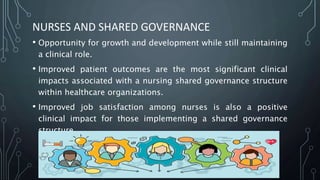
• Opportunity for growth and development while still maintaining
a clinical role.
• Improved patient outcomes are the most significant clinical
impacts associated with a nursing shared governance structure
within healthcare organizations.
• Improved job satisfaction among nurses is also a positive
clinical impact for those implementing a shared governance
structure.
NURSES AND SHARED GOVERNANCE
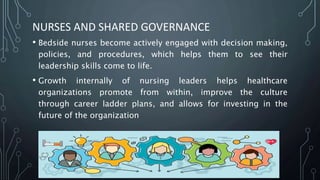
• Bedside nurses become actively engaged with decision making,
policies, and procedures, which helps them to see their
leadership skills come to life.
• Growth internally of nursing leaders helps healthcare
organizations promote from within, improve the culture
through career ladder plans, and allows for investing in the
future of the organization
NURSES AND SHARED GOVERNANCE
• Communication among bedside nurses and nursing leadership
is a critical area for the successful implementation of a healthy,
shared governance structure.
• Nurses are more engaged in policy development and revision,
which helps to give them a better overall picture of the hospital
environment
BARRIERS IN IMPLEMENTING SHARED GOVERNANCE
A. Management Perspective
• Change can be a perceived or real ``loss of power'' whereby managers
no longer take the lead role.
• Some administrators, this change can be seen as threatening
• Integrating shared governance into their management structure is
difficult and time consuming, considering the numerous teams that
tackle topics such as nursing documentation, quality improvement,
nursing standards, equipment purchasing and education.
BARRIERS IN IMPLEMENTING SHARED GOVERNANCE
A. Management Perspective (cont.)
• Freeing staff nurses from patient care areas to participate in shared
governance meetings can be costly when salaries for participants and
staff nurse replacements are considered.
BARRIERS IN IMPLEMENTING SHARED GOVERNANCE
B. Staff Perspectives
• There may be initial reluctance to accept increased responsibility
(resulting from increased autonomy), until such time as knowledge and
skills in decision making are expanded.
• Problems may arise in determining how decision-making occurs, and
there is a need to ensure that ideas and concerns are directed to the
appropriate council.
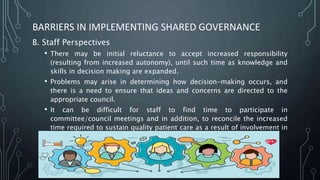
• It can be difficult for staff to find time to participate in
committee/council meetings and in addition, to reconcile the increased
time required to sustain quality patient care as a result of involvement in
new management tasks
ROAD TO SUCCESSFUL SHARED GOVERNANCE
• Acquire and use the insights of those who have already been
through the process.
• Implementing shared governance means giving a language to
the activities of changing an organization’s behaviors and
patterns of role and relationship.
• To make the initial efforts successful, there must be an
organization-wide acknowledgement that something
significant is underway that affects all stakeholders in the
system.
ROAD TO SUCCESSFUL SHARED GOVERNANCE
• Critical efforts to change the patterns of leadership and the
behavior of managers are a major part of the first steps in
initiating sustainable change.
• Undertaking structural changes supporting new behaviors is
important because new and different formats for interaction,
work, and decision making are generated in a way that requires
different performance and also challenges not yet extinguished
behaviors valued in past models of structure and expectation
ROAD TO SUCCESSFUL SHARED GOVERNANCE
• Both leadership and staff act in concert to inculcate new
processes and interactions that represent the framework they
have created.
• Reinforcing the underlying format and patterns of interaction
assures that the infrastructure (information, policy, locus of
control, team-based work processes) is advanced to every
aspect of the system’s way of doing business.
KEY POINTS
• Shared governance is not the same as clinical governance
• Empowering frontline staff to make patient-focused change has
visible benefits to outcomes and feedback
• Frontline routine data is a vital resource and should be used by
frontline staff to make improvements
KEY POINTS
• Top-heavy leadership results in nurses and midwives feeling
less autonomous
• Flattening the hierarchy and creating bedside leaders improves
staff satisfaction
• Shared decision-making is not only relevant, it is essential.
REFERENCES
Bravo, M., and Crow, G. (2015). Shared Governance: The Role of
Buy-in in Bringing About Change. The Online Journal of Issues in
Nursing, Vol. 20, Issue 2. DOI: 10.3912/OJIN.Vol20No02PPT02
Caramica, L. (2004). Shared Governance: Hartford Hospital's
Experience. The Online Journal of Issues in Nursing, Vol. 9, Issue
1.
May, F., and Buchan, J. (1999). Shared Governance: A Literature
Review. International Journal of Nursing Studies, Vol. 36, 281-
300. DOI: 10.1016/S0020-7489(99)00023-1
REFERENCES
McKnight, H., and Moore, S. (2019). Nursing Shared Governance.
StatPearls Publishing, LLC.
Swihart, D., and Hess, R. (2018). Shared Governance: A Practical
Approach to Transfroming Interprofessional Healthcare. Second
Edition.
Taylor, K. (2016). Using Shared Governance to Empower Nurses.
Nursing Times, Vol. 112, Issue 1-2, 20-23.
These slides are uploaded for
information purposes and as
partial requirement of Philippine
Women's University in PhD class;
Subject: Governance in Health Care
Practice.
Shared governance (Ardee L. Domingo)

Shared governance (Ardee L. Domingo)

  • 1.
    SHARED GOVERNANCE THE CENTERPIECEOF DEVELOPING THE COLLABORATIVE ENVIRONMENT FOR PATIENT CARE By: ARDEE LUNA DOMINGO, MAN, RN
  • 2.
    WHAT IS SHAREDGOVERNANCE? • A strategy that can facilitate point-of-service nursing staff buy-in because it allows nurses greater control and autonomy over their practice, rather than having their practice controlled by senior nurse executives.
  • 3.
    WHAT IS SHAREDGOVERNANCE? • This management process model empowers all members of the healthcare workforce to have a voice in decision-making, thus encouraging diverse and creative input that will help advance the business and healthcare missions of the organization.
  • 4.
    WHAT IS SHAREDGOVERNANCE? It is a system wherein it involves a dynamic structure that incorporates shared- leadership and participative decision making. It empowers and organizes nurses to make decisions about clinical practice standards, quality improvement, staff and professional development, and research. It assumes full accountability for nurses over their nursing practice while participating in collegial interdisciplinary relationships.
  • 5.
    THE EVOLUTION OFSHARED GOVERNANCE • Socrates (470-399 BC), an ancient Greek philosopher, integrated shared governance concepts into his philosophies of education. The Socratic Method (answering a question with a question) calls for the teacher to facilitate the student's autonomous learning as the teacher guides him or her through a series of questions.
  • 6.
    THE EVOLUTION OFSHARED GOVERNANCE • The government model for the United States was established on the concepts of shared governance-"of the people, by the people, for the people" (from Lincoln's Gettysburg Address, 1863)-wherein the very citizenry is directly responsible for the government on both state and federal levels.
  • 7.
    THE EVOLUTION OFSHARED GOVERNANCE • Shared governance found its way into the business and management literature. Positive outcomes emphasized movement from point of service outward. This differed from the more traditional, hierarchical method of moving from the organization downward approach previously used.
  • 8.
    THE EVOLUTION OFSHARED GOVERNANCE • In the late 1970s and early 1980s, shared governance found its way into the healthcare and nursing arenas as a form of participative management. It engaged self-managed work teams and grew out of the dissatisfaction nurses were experiencing with the institutions in which they practiced.
  • 9.
    PRINCIPLES OF SHAREDGOVERNANCE • In whole-system shared governance, the system is said to "live" where it provides service. It upholds that all members of the organization have a stake in the system, and each part of the system supports the whole.
  • 10.
    PRINCIPLES OF SHAREDGOVERNANCE • In an accountability-based governance structure, there is no place for non-participation or non-ownership among the members of the organization. While it is neither feasible nor required that everyone partake in all decision-making bodies, the voice of all staff can be heard through good relations and productive communication between managers and staff, as well as through rotation of leadership/membership of councils/teams.
  • 11.
    PRINCIPLES OF SHAREDGOVERNANCE • Shared governance is often misunderstood as `giving power to employees', which oversimplifies the reality of outcomes claimed to be obtained by effective shared governance organizations, such as the release of expert knowledge, motivation and action at the point of service.
  • 12.
    WHY SHARED GOVERNANCE? •Research indicates healthcare organizations that promote employee engagement outperform other facilities in several areas, such as: • Job satisfaction • Nurse retention • Performance, including better patient care experiences • Profitability • In fact, participation in shared decision-making has shown to be so important that hospitals seeking Magnet status must demonstrate effective structures of shared governance.
  • 13.
    NURSES AND SHAREDGOVERNANCE • Opportunity for growth and development while still maintaining a clinical role. • Improved patient outcomes are the most significant clinical impacts associated with a nursing shared governance structure within healthcare organizations. • Improved job satisfaction among nurses is also a positive clinical impact for those implementing a shared governance structure.
  • 14.
    NURSES AND SHAREDGOVERNANCE • Bedside nurses become actively engaged with decision making, policies, and procedures, which helps them to see their leadership skills come to life. • Growth internally of nursing leaders helps healthcare organizations promote from within, improve the culture through career ladder plans, and allows for investing in the future of the organization
  • 15.
    NURSES AND SHAREDGOVERNANCE • Communication among bedside nurses and nursing leadership is a critical area for the successful implementation of a healthy, shared governance structure. • Nurses are more engaged in policy development and revision, which helps to give them a better overall picture of the hospital environment
  • 16.
    BARRIERS IN IMPLEMENTINGSHARED GOVERNANCE A. Management Perspective • Change can be a perceived or real ``loss of power'' whereby managers no longer take the lead role. • Some administrators, this change can be seen as threatening • Integrating shared governance into their management structure is difficult and time consuming, considering the numerous teams that tackle topics such as nursing documentation, quality improvement, nursing standards, equipment purchasing and education.
  • 17.
    BARRIERS IN IMPLEMENTINGSHARED GOVERNANCE A. Management Perspective (cont.) • Freeing staff nurses from patient care areas to participate in shared governance meetings can be costly when salaries for participants and staff nurse replacements are considered.
  • 18.
    BARRIERS IN IMPLEMENTINGSHARED GOVERNANCE B. Staff Perspectives • There may be initial reluctance to accept increased responsibility (resulting from increased autonomy), until such time as knowledge and skills in decision making are expanded. • Problems may arise in determining how decision-making occurs, and there is a need to ensure that ideas and concerns are directed to the appropriate council. • It can be difficult for staff to find time to participate in committee/council meetings and in addition, to reconcile the increased time required to sustain quality patient care as a result of involvement in new management tasks
  • 19.
    ROAD TO SUCCESSFULSHARED GOVERNANCE • Acquire and use the insights of those who have already been through the process. • Implementing shared governance means giving a language to the activities of changing an organization’s behaviors and patterns of role and relationship. • To make the initial efforts successful, there must be an organization-wide acknowledgement that something significant is underway that affects all stakeholders in the system.
  • 20.
    ROAD TO SUCCESSFULSHARED GOVERNANCE • Critical efforts to change the patterns of leadership and the behavior of managers are a major part of the first steps in initiating sustainable change. • Undertaking structural changes supporting new behaviors is important because new and different formats for interaction, work, and decision making are generated in a way that requires different performance and also challenges not yet extinguished behaviors valued in past models of structure and expectation
  • 21.
    ROAD TO SUCCESSFULSHARED GOVERNANCE • Both leadership and staff act in concert to inculcate new processes and interactions that represent the framework they have created. • Reinforcing the underlying format and patterns of interaction assures that the infrastructure (information, policy, locus of control, team-based work processes) is advanced to every aspect of the system’s way of doing business.
  • 22.
    KEY POINTS • Sharedgovernance is not the same as clinical governance • Empowering frontline staff to make patient-focused change has visible benefits to outcomes and feedback • Frontline routine data is a vital resource and should be used by frontline staff to make improvements
  • 23.
    KEY POINTS • Top-heavyleadership results in nurses and midwives feeling less autonomous • Flattening the hierarchy and creating bedside leaders improves staff satisfaction • Shared decision-making is not only relevant, it is essential.
  • 24.
    REFERENCES Bravo, M., andCrow, G. (2015). Shared Governance: The Role of Buy-in in Bringing About Change. The Online Journal of Issues in Nursing, Vol. 20, Issue 2. DOI: 10.3912/OJIN.Vol20No02PPT02 Caramica, L. (2004). Shared Governance: Hartford Hospital's Experience. The Online Journal of Issues in Nursing, Vol. 9, Issue 1. May, F., and Buchan, J. (1999). Shared Governance: A Literature Review. International Journal of Nursing Studies, Vol. 36, 281- 300. DOI: 10.1016/S0020-7489(99)00023-1
  • 25.
    REFERENCES McKnight, H., andMoore, S. (2019). Nursing Shared Governance. StatPearls Publishing, LLC. Swihart, D., and Hess, R. (2018). Shared Governance: A Practical Approach to Transfroming Interprofessional Healthcare. Second Edition. Taylor, K. (2016). Using Shared Governance to Empower Nurses. Nursing Times, Vol. 112, Issue 1-2, 20-23.
  • 26.
    These slides areuploaded for information purposes and as partial requirement of Philippine Women's University in PhD class; Subject: Governance in Health Care Practice.