Introduction to SharedGovernance
• Definition: Shared governance is a
professional practice model that promotes
nursing empowerment through participation
in decision-making processes.
• Purpose: Enhance accountability, improve
outcomes, and strengthen team collaboration.
• Relevance: Supports Magnet® recognition and
professional nursing standards.
3.
Is There aBest Way to Implement
Shared Governance?
• No 'one-size-fits-all' model
• Implementation must align with:
• - Organizational size and structure
• - Leadership style
• - Staff readiness and culture
• Tailored approaches yield the best results
4.
Core Models ofShared
Governance
• Councilor Model: Centralized, policy-focused –
best for large institutions
• Unit-Based Model: Local decision-making –
suitable for small/medium units
• Hybrid Model: Combines both – versatile
application
5.
Critical Success Factors
•• Executive support and sponsorship
• • Clear communication channels
• • Defined roles and accountability
• • Ongoing education and training
• • Measurement and feedback mechanisms
6.
Role of SharedGovernance in
Healthcare
• • Promotes nursing autonomy and
accountability
• • Enhances interprofessional collaboration
• • Supports evidence-based practice
• • Enables continuous quality improvement
7.
Impact on Patientand
Organizational Outcomes
• • Improved patient satisfaction (e.g., HCAHPS
scores)
• • Higher nurse retention and engagement
• • Lower adverse events and errors
• • Increased innovation in care delivery
8.
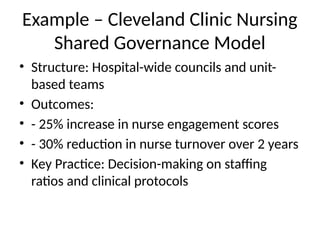
Example – ClevelandClinic Nursing
Shared Governance Model
• Structure: Hospital-wide councils and unit-
based teams
• Outcomes:
• - 25% increase in nurse engagement scores
• - 30% reduction in nurse turnover over 2 years
• Key Practice: Decision-making on staffing
ratios and clinical protocols
9.
Challenges in ImplementingShared
Governance
• • Resistance to cultural change
• • Lack of leadership buy-in
• • Poorly defined roles or processes
• • Limited training and mentorship
• • Resource constraints (time, personnel)
10.
Transitional Leadership Tools
Overview
•Tools help bridge the gap during change
• Focus:
• - Flexi-time: Custom work hours
• - Self-scheduling: Staff-controlled shift
planning
• Aim: Increase autonomy and reduce burnout
11.
Flexi-Time – Definition&
Applications
• Allows nurses to choose start/end times
within limits
• Example: 7 AM–3 PM, 9 AM–5 PM
• Facilitates balance with family, education,
health
Flexi-Time – Implementation
Challenges
•• Potential scheduling overlaps
• • Uneven patient coverage
• • Perception of unfairness if not standardized
• • Requires strong timekeeping systems
14.
Self-Scheduling – Definition&
Implementation
• Nurses collaborate to create monthly/weekly
shifts
• Usually managed via software or council
oversight
• Requires guidelines for fairness
15.
Self-Scheduling – Benefits
•• Increases ownership and satisfaction
• • Empowers nurses to plan around personal
life
• • Encourages collaborative team culture
• • Reduces manager workload
16.
Self-Scheduling – Implementation
Challenges
•• Requires mature team dynamics
• • Risk of uneven skill mix on shifts
• • Staff may prioritize preferences over patient
needs
• • Conflict resolution mechanisms necessary
17.
Integrating Tools intoShared
Governance
• • Create pilot units to test flexi-time/self-
scheduling
• • Use Shared Governance councils to:
• - Develop scheduling policies
• - Evaluate equity and effectiveness
• • Gather feedback and adjust
18.
Evaluation Metrics
• •Nurse satisfaction (survey tools like NDNQI,
PES-NWI)
• • Staff turnover and retention
• • Patient care indicators
• • Council participation rates
• • Audit compliance with self-scheduling
standards
19.
Conclusion
• • Sharedgovernance empowers nurses and
improves outcomes
• • No singular model; best practices are
adaptive and evidence-based
• • Transitional tools like flexi-time and self-
scheduling align well with governance goals
• • Leadership support and education are vital
20.
References
• 1. Anthony& Vidal (2022). Shared governance
in nursing.
• 2. Goudreau (2023). Leadership and shared
governance.
• 3. Kramer & Schmalenberg (2022). Essentials
of Magnetism.
• 4. Hess (2022). Professional governance in
nursing.
• 5. Olender & Allen (2022). Flex-time in acute
care.