Shared Governance
Reporter: Qin Liu
2022t0853
outline
Models of Shared governance
Why Is Shared Governance Important?
Obstacles to shared governance
How to implement shared governance in nursing?
Specific efforts from nurse leaders
Nurses’ skills in Shared Governance
Definition
History of Shared Governance
Aims of shared governance
Four principles of Shared Governance
Benefits of Shared governance
Disadvantages of Shared governance
Shared governance framework
Definition
• Shared governance is a working model of participatory decision-making in
which nurses and the interdisciplinary team follow an organized decision-
making process about practice standards, quality improvement,
professional development, and research leading to improved outcomes
and shared success.
• It includes shared accountability, shared vision, collaborative partnerships,
and focuses on outcomes leading to shared success.
History of Shared Governance
• Began in business and management
• Organizations began to design formal structures and relationships around
their leaders and employees.
• Positive outcomes emphasized movement from point of service outward.
• This differed from the more traditional, hierarchical method of moving
from the organization downward approach previously used.
• History in the health care system
• In the late 1970s and early 1980s, shared governance found its way into
the healthcare and nursing arenas as a form of participative management.
• lt engaged self-managed work teams and grew out of the dissatisfaction
nurses were experiencing with the institutions in which they practiced.
Aims of shared governance
 Empowerment of individuals within the decision making system, this
empowerment is directed at increasing nurse's authority & control
over their nursing practice.
 Shared governance gives nurses more control over their nursing
practice by being an accountability-based governance system for
professional workers.
 Shared governance improves staff nurses' perception of their job &
practice environment.
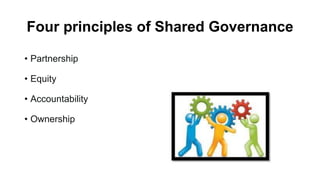
Four principles of Shared Governance
• Partnership
• Equity
• Accountability
• Ownership
• Partnership
 Creates professional empowerment through the collaborative relationships
of all the stakeholders
 Essential to building relationships
 Involves all staff members in decisions and processes
 Equality between members in decisions and processes
 Links healthcare providers & patients
• Equity
 Maintains a focus on services, patients and staff
 Integrates roles and relationships into the structures and processes
needed to achieve positive patient outcomes
 No role is more important than another
 Each team member is essential in providing safe and effective care
• Accountability
• Accountability is the core of shared governance
• Willingness to invest in decision-making
• Accepting ownership of decisions
• Defines roles, not jobs; cannot be delegated
• Used interchangeably with responsibility and allows for evaluation of role
performance
• Facilitates partnerships for sharing decisions and is secured in the roles by
staff producing positive outcomes
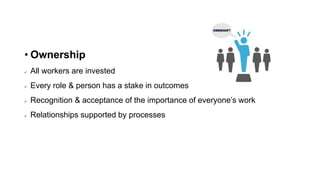
• Ownership
 All workers are invested
 Every role & person has a stake in outcomes
 Recognition & acceptance of the importance of everyone’s work
 Relationships supported by processes
Shared Governance:What lt Is
• Shared Governance is:
• A model that ensures that decisions are made by people working at the point
of care
• A leadership development strategy
• A way to identify future positional leaders
• A tenet of professional practice
• A key expression of organizational culture
Shared Governance:What lt Is Not
Shared governance is not:
The replacement or elimination of positional leadership
A strategy to support downsizing of leadership
Self-governance
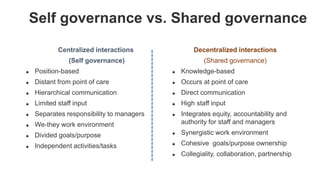
Self governance vs. Shared governance
Centralized interactions
(Self governance)
 Position-based
 Distant from point of care
 Hierarchical communication
 Limited staff input
 Separates responsibility to managers
 We-they work environment
 Divided goals/purpose
 Independent activities/tasks
Decentralized interactions
(Shared governance)
 Knowledge-based
 Occurs at point of care
 Direct communication
 High staff input
 Integrates equity, accountability and
authority for staff and managers
 Synergistic work environment
 Cohesive goals/purpose ownership
 Collegiality, collaboration, partnership
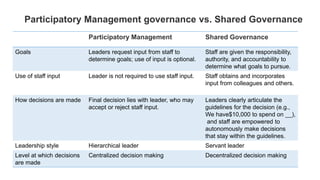
Participatory Management governance vs. Shared Governance
Participatory Management Shared Governance
Goals Leaders request input from staff to
determine goals; use of input is optional.
Staff are given the responsibility,
authority, and accountability to
determine what goals to pursue.
Use of staff input Leader is not required to use staff input. Staff obtains and incorporates
input from colleagues and others.
How decisions are made Final decision lies with leader, who may
accept or reject staff input.
Leaders clearly articulate the
guidelines for the decision (e.g.,
We have$10,000 to spend on __),
and staff are empowered to
autonomously make decisions
that stay within the guidelines.
Leadership style Hierarchical leader Servant leader
Level at which decisions
are made
Centralized decision making Decentralized decision making
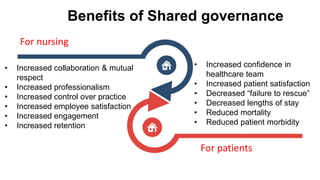
For nursing
• Increased collaboration & mutual
respect
• Increased professionalism
• Increased control over practice
• Increased employee satisfaction
• Increased engagement
• Increased retention
For patients
• Increased confidence in
healthcare team
• Increased patient satisfaction
• Decreased “failure to rescue”
• Decreased lengths of stay
• Reduced mortality
• Reduced patient morbidity
Benefits of Shared governance
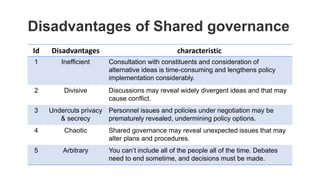
Disadvantages of Shared governance
Id Disadvantages characteristic
1 Inefficient Consultation with constituents and consideration of
alternative ideas is time-consuming and lengthens policy
implementation considerably.
2 Divisive Discussions may reveal widely divergent ideas and that may
cause conflict.
3 Undercuts privacy
& secrecy
Personnel issues and policies under negotiation may be
prematurely revealed, undermining policy options.
4 Chaotic Shared governance may reveal unexpected issues that may
alter plans and procedures.
5 Arbitrary You can’t include all of the people all of the time. Debates
need to end sometime, and decisions must be made.
Shared governance framework
Nursing is responsible, accountable and has authority over decisions
related to practice, quality and competence
Management provides the support, encouragement, resources,
training and boundaries for success
Composed of a coordinating group of staff and management.
Is bylaws and rules driven
Staff nominated, elect, and/or chosen to participate
Models of Shared governance
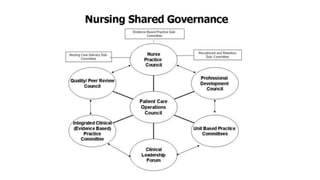
• 1.Councilor models
• lt is the most commonly used model
by magnet organizations.
• Councilor models are designed using
any number of department level
councils as a method to coordinate
clinical and administrative activities.
• The Councilor Model is made up of a
coordinating council, central councils,
and unit based councils.
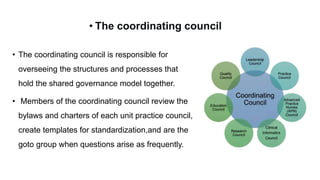
• The coordinating council is responsible for
overseeing the structures and processes that
hold the shared governance model together.
• Members of the coordinating council review the
bylaws and charters of each unit practice council,
create templates for standardization,and are the
goto group when questions arise as frequently.
• The coordinating council
Among these issues is leaders’concern about loss of power and control or
feeling that shared governance asks them to abdicate their leadership
role.
Staff member issues include the concern that shared governance
positions them to do their leaders’work with no pay increase or promotion,
as well as confusion about their scope of responsibility and authority.
 In addition to leadership and staff issues, organizational issues most
likely to adversely affect the shared governance culture are lack of a
sustainment plan and a culture of blame.
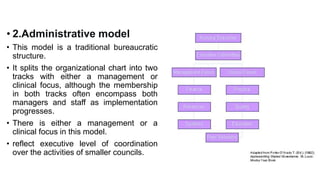
• 2.Administrative model
• This model is a traditional bureaucratic
structure.
• It splits the organizational chart into two
tracks with either a management or
clinical focus, although the membership
in both tracks often encompass both
managers and staff as implementation
progresses.
• There is either a management or a
clinical focus in this model.
• reflect executive level of coordination
over the activities of smaller councils.
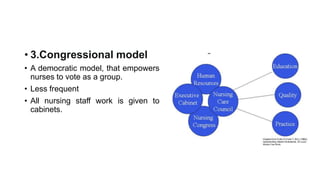
• 3.Congressional model
• A democratic model, that empowers
nurses to vote as a group.
• Less frequent
• All nursing staff work is given to
cabinets.
• 4.Unit-Based Systems Model
• This type of nursing shared governance model is tailored to a specific
nursing unit. The purpose of Unit-Based shared governance is for nurses
and nurse leaders to work together to make clinical and business decisions
relevant to the delivery of nursing care in their respective unit(s).
Why Is Shared Governance Important?
• 1.Deliver high-quality nursing care
• 2.Implement nursing in a professional and competent manner
• 3.Demonstrate a holistic approach to caring
• 4.Possess certain personal qualities that enhance practice and relate to
• patients,families, peers, hospital leadership and community members in a
competent, cooperative manner
• 5.Systems of shared governance, which may vary from one facility to the
next,according to institutional values and goals, help promote professional
practice environments while empowering nurses to help make decisions
affecting themselves, their colleagues, and their patients.
Obstacles to shared governance
Poor collaboration
Poor communication
Resistance to change and implementation of change
Lack of interest
Lack of concern to effect change
Lack of consensus
Lack of clarity related to roles and responsibilities
• How to Overcome the Poor Communication
• It is possible to overcome poor communication. Nurse leaders should set an example for
respectful, effective communication for nurses to follow. Nurses should encourage one
another to express their thoughts, feelings, and ideas without fear of judgment. It is also
necessary to become self-aware.
• For example, take note of your body language and tone of voice. If you speak in a sharp
tone, your body language is rigid, or you appear uninterested, your team members will
feel you are unapproachable. Speak in a calm tone, act interested in what your team
members say, ask questions, and encourage your team members.
Basic requirement for shared governance
 Committed nurse executive
 Strong nursing management team
 Employees must have a clear basic understanding of shared governance.
 Must chart progress with a plan and timeline for implementation
How to implement shared governance in nursing?
• 1. Establish a Steering Committee
• 2. Determine Criteria for Accepting Volunteer Memberships
• 3. Elect or Appoint Chair and Co-Chairs
• 4. Develop Councils
•
• 5. Create a Mission Statement
• 6. Establish Bylaws
• 7. Educate Nurses in All Clinical Areas About the
Shared Governance Model and Their Role
• 8. Establish Guidelines for Bringing Issues of
Concern Before the Council for Consideration
• 9. Establish a Preferred Method of Communication
for Staff of All Levels of the Organizations
• 10. Determine a Timeline for Implementation
Specific efforts from nurse leaders
• Clearly explain shared governance and its importance
• Create a structure of shared governance
• Make shared governance accessible
• Prioritize coaching
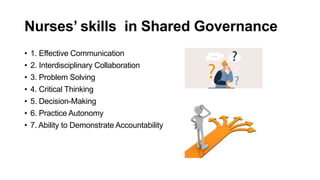
Nurses’ skills in Shared Governance
• 1. Effective Communication
• 2. Interdisciplinary Collaboration
• 3. Problem Solving
• 4. Critical Thinking
• 5. Decision-Making
• 6. Practice Autonomy
• 7. Ability to Demonstrate Accountability
THANK YOU
2023

Shared Governance

  • 1.
  • 2.
    outline Models of Sharedgovernance Why Is Shared Governance Important? Obstacles to shared governance How to implement shared governance in nursing? Specific efforts from nurse leaders Nurses’ skills in Shared Governance Definition History of Shared Governance Aims of shared governance Four principles of Shared Governance Benefits of Shared governance Disadvantages of Shared governance Shared governance framework
  • 3.
    Definition • Shared governanceis a working model of participatory decision-making in which nurses and the interdisciplinary team follow an organized decision- making process about practice standards, quality improvement, professional development, and research leading to improved outcomes and shared success. • It includes shared accountability, shared vision, collaborative partnerships, and focuses on outcomes leading to shared success.
  • 4.
    History of SharedGovernance • Began in business and management • Organizations began to design formal structures and relationships around their leaders and employees. • Positive outcomes emphasized movement from point of service outward. • This differed from the more traditional, hierarchical method of moving from the organization downward approach previously used.
  • 5.
    • History inthe health care system • In the late 1970s and early 1980s, shared governance found its way into the healthcare and nursing arenas as a form of participative management. • lt engaged self-managed work teams and grew out of the dissatisfaction nurses were experiencing with the institutions in which they practiced.
  • 6.
    Aims of sharedgovernance  Empowerment of individuals within the decision making system, this empowerment is directed at increasing nurse's authority & control over their nursing practice.  Shared governance gives nurses more control over their nursing practice by being an accountability-based governance system for professional workers.  Shared governance improves staff nurses' perception of their job & practice environment.
  • 7.
    Four principles ofShared Governance • Partnership • Equity • Accountability • Ownership
  • 8.
    • Partnership  Createsprofessional empowerment through the collaborative relationships of all the stakeholders  Essential to building relationships  Involves all staff members in decisions and processes  Equality between members in decisions and processes  Links healthcare providers & patients
  • 9.
    • Equity  Maintainsa focus on services, patients and staff  Integrates roles and relationships into the structures and processes needed to achieve positive patient outcomes  No role is more important than another  Each team member is essential in providing safe and effective care
  • 10.
    • Accountability • Accountabilityis the core of shared governance • Willingness to invest in decision-making • Accepting ownership of decisions • Defines roles, not jobs; cannot be delegated • Used interchangeably with responsibility and allows for evaluation of role performance • Facilitates partnerships for sharing decisions and is secured in the roles by staff producing positive outcomes
  • 11.
    • Ownership  Allworkers are invested  Every role & person has a stake in outcomes  Recognition & acceptance of the importance of everyone’s work  Relationships supported by processes
  • 12.
    Shared Governance:What ltIs • Shared Governance is: • A model that ensures that decisions are made by people working at the point of care • A leadership development strategy • A way to identify future positional leaders • A tenet of professional practice • A key expression of organizational culture
  • 13.
    Shared Governance:What ltIs Not Shared governance is not: The replacement or elimination of positional leadership A strategy to support downsizing of leadership Self-governance
  • 14.
    Self governance vs.Shared governance Centralized interactions (Self governance)  Position-based  Distant from point of care  Hierarchical communication  Limited staff input  Separates responsibility to managers  We-they work environment  Divided goals/purpose  Independent activities/tasks Decentralized interactions (Shared governance)  Knowledge-based  Occurs at point of care  Direct communication  High staff input  Integrates equity, accountability and authority for staff and managers  Synergistic work environment  Cohesive goals/purpose ownership  Collegiality, collaboration, partnership
  • 15.
    Participatory Management governancevs. Shared Governance Participatory Management Shared Governance Goals Leaders request input from staff to determine goals; use of input is optional. Staff are given the responsibility, authority, and accountability to determine what goals to pursue. Use of staff input Leader is not required to use staff input. Staff obtains and incorporates input from colleagues and others. How decisions are made Final decision lies with leader, who may accept or reject staff input. Leaders clearly articulate the guidelines for the decision (e.g., We have$10,000 to spend on __), and staff are empowered to autonomously make decisions that stay within the guidelines. Leadership style Hierarchical leader Servant leader Level at which decisions are made Centralized decision making Decentralized decision making
  • 17.
    For nursing • Increasedcollaboration & mutual respect • Increased professionalism • Increased control over practice • Increased employee satisfaction • Increased engagement • Increased retention For patients • Increased confidence in healthcare team • Increased patient satisfaction • Decreased “failure to rescue” • Decreased lengths of stay • Reduced mortality • Reduced patient morbidity Benefits of Shared governance
  • 18.
    Disadvantages of Sharedgovernance Id Disadvantages characteristic 1 Inefficient Consultation with constituents and consideration of alternative ideas is time-consuming and lengthens policy implementation considerably. 2 Divisive Discussions may reveal widely divergent ideas and that may cause conflict. 3 Undercuts privacy & secrecy Personnel issues and policies under negotiation may be prematurely revealed, undermining policy options. 4 Chaotic Shared governance may reveal unexpected issues that may alter plans and procedures. 5 Arbitrary You can’t include all of the people all of the time. Debates need to end sometime, and decisions must be made.
  • 19.
    Shared governance framework Nursingis responsible, accountable and has authority over decisions related to practice, quality and competence Management provides the support, encouragement, resources, training and boundaries for success Composed of a coordinating group of staff and management. Is bylaws and rules driven Staff nominated, elect, and/or chosen to participate
  • 20.
    Models of Sharedgovernance • 1.Councilor models • lt is the most commonly used model by magnet organizations. • Councilor models are designed using any number of department level councils as a method to coordinate clinical and administrative activities. • The Councilor Model is made up of a coordinating council, central councils, and unit based councils.
  • 21.
    • The coordinatingcouncil is responsible for overseeing the structures and processes that hold the shared governance model together. • Members of the coordinating council review the bylaws and charters of each unit practice council, create templates for standardization,and are the goto group when questions arise as frequently. • The coordinating council
  • 22.
    Among these issuesis leaders’concern about loss of power and control or feeling that shared governance asks them to abdicate their leadership role. Staff member issues include the concern that shared governance positions them to do their leaders’work with no pay increase or promotion, as well as confusion about their scope of responsibility and authority.  In addition to leadership and staff issues, organizational issues most likely to adversely affect the shared governance culture are lack of a sustainment plan and a culture of blame.
  • 23.
    • 2.Administrative model •This model is a traditional bureaucratic structure. • It splits the organizational chart into two tracks with either a management or clinical focus, although the membership in both tracks often encompass both managers and staff as implementation progresses. • There is either a management or a clinical focus in this model. • reflect executive level of coordination over the activities of smaller councils.
  • 24.
    • 3.Congressional model •A democratic model, that empowers nurses to vote as a group. • Less frequent • All nursing staff work is given to cabinets.
  • 25.
    • 4.Unit-Based SystemsModel • This type of nursing shared governance model is tailored to a specific nursing unit. The purpose of Unit-Based shared governance is for nurses and nurse leaders to work together to make clinical and business decisions relevant to the delivery of nursing care in their respective unit(s).
  • 26.
    Why Is SharedGovernance Important? • 1.Deliver high-quality nursing care • 2.Implement nursing in a professional and competent manner • 3.Demonstrate a holistic approach to caring • 4.Possess certain personal qualities that enhance practice and relate to • patients,families, peers, hospital leadership and community members in a competent, cooperative manner • 5.Systems of shared governance, which may vary from one facility to the next,according to institutional values and goals, help promote professional practice environments while empowering nurses to help make decisions affecting themselves, their colleagues, and their patients.
  • 27.
    Obstacles to sharedgovernance Poor collaboration Poor communication Resistance to change and implementation of change Lack of interest Lack of concern to effect change Lack of consensus Lack of clarity related to roles and responsibilities
  • 28.
    • How toOvercome the Poor Communication • It is possible to overcome poor communication. Nurse leaders should set an example for respectful, effective communication for nurses to follow. Nurses should encourage one another to express their thoughts, feelings, and ideas without fear of judgment. It is also necessary to become self-aware. • For example, take note of your body language and tone of voice. If you speak in a sharp tone, your body language is rigid, or you appear uninterested, your team members will feel you are unapproachable. Speak in a calm tone, act interested in what your team members say, ask questions, and encourage your team members.
  • 29.
    Basic requirement forshared governance  Committed nurse executive  Strong nursing management team  Employees must have a clear basic understanding of shared governance.  Must chart progress with a plan and timeline for implementation
  • 30.
    How to implementshared governance in nursing? • 1. Establish a Steering Committee • 2. Determine Criteria for Accepting Volunteer Memberships • 3. Elect or Appoint Chair and Co-Chairs • 4. Develop Councils •
  • 32.
    • 5. Createa Mission Statement • 6. Establish Bylaws • 7. Educate Nurses in All Clinical Areas About the Shared Governance Model and Their Role • 8. Establish Guidelines for Bringing Issues of Concern Before the Council for Consideration • 9. Establish a Preferred Method of Communication for Staff of All Levels of the Organizations • 10. Determine a Timeline for Implementation
  • 33.
    Specific efforts fromnurse leaders • Clearly explain shared governance and its importance • Create a structure of shared governance • Make shared governance accessible • Prioritize coaching
  • 34.
    Nurses’ skills inShared Governance • 1. Effective Communication • 2. Interdisciplinary Collaboration • 3. Problem Solving • 4. Critical Thinking • 5. Decision-Making • 6. Practice Autonomy • 7. Ability to Demonstrate Accountability
  • 35.