SHARING IS CARING
Rustan P. Geronimo
Reviewed by: Dr. David Hali De Jesus
Objectives
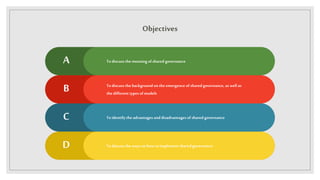
A
B
C
D
Todiscuss the meaning of shared governance
Todiscuss the background on the emergence of shared governance, as well as
the different typesof models
Toidentify theadvantages and disadvantages of shared governance
Todiscuss the ways on how toimplement shared governance
Shared Governance
Governance is about power, control,
authority, and influence.
An organizational strategy through
which nurses can express and mange
their practice with a higher level of
professional autonomy
Focus on the micro-level
Shared Governance
Shared decision making between the
bedside nurses and nurse leaders
Pillar of the ANCC Magnet culture
COLLABORATION
working together to make decisions that affect nursing
practice and patient care.
FourPrinciples
EQUITY OWNERSHIP
PARTNERSHIP ACCOUNTABILITY
Shared
Governance
PARTNERSHIP
- COLLABORATIVE
RELATIONSHIP AMONG ALL
STAKEHOLDERS.
- EACH MEMBER HAS A KEY
ROLE IN FULFILLING THE
MISSION AND PURPOSE OF
THE ORGANIZATION
EQUITY
- Maintains focus on services,
patients and staff
- Foundation and measure
value
- No one role is more
important than any other
- Each member is essential to
providing safe and effective
care
ACCOUNTABILITY
- Willingness to invest in
decision-making and express
ownership in those decision
- Core of shared governance
- Supports partnership
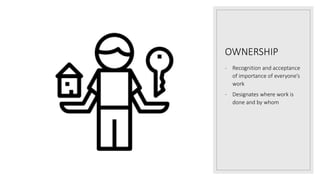
OWNERSHIP
- Recognition and acceptance
of importance of everyone’s
work
- Designates where work is
done and by whom
SHAREDGOVERNANCE
CONCEPTS
WHO SHARED?
Board members,
nurses, physician
and management WHO GOVERNS?
WHO BENEFITS?
Health care
team,
organization
and patients
Board members,
nurses, physician
and management
SHAREDGOVERNANCE
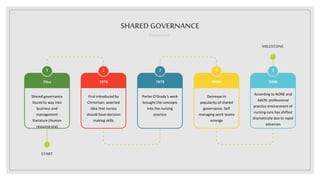
EMERGENCE
Shared governance
found its way into
business and
management
literature (Human
resource era)
19xx
First introduced by
Christman: asserted
idea that nurses
should have decision
making skills
1976
Porter O’Grady’s work
brought the concepts
into the nursing
practice
1978
Decrease in
popularity of shared
governance. Self
managing work teams
emerge
1990s
According to AONE and
AACN: professional
practice environment of
nursing care has shifted
dramatically due to rapid
advances
2000
1 2 3 4 5
START
MILESTONE
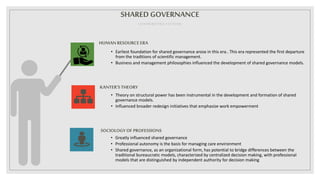
HUMAN RESOURCEERA
• Earliest foundation for shared governance arose in this era.. This era represented the first departure
from the traditions of scientific management.
• Business and management philosophies influenced the development of shared governance models.
KANTER’STHEORY
• Theory on structural power has been instrumental in the development and formation of shared
governance models.
• Influenced broader redesign initiatives that emphasize work empowerment
SOCIOLOGYOF PROFESSIONS
• Greatly influenced shared governance
• Professional autonomy is the basis for managing care environment
• Shared governance, as an organizational form, has potential to bridge differences between the
traditional bureaucratic models, characterized by centralized decision making, with professional
models that are distinguished by independent authority for decision making
SHAREDGOVERNANCE
CONTRIBUTING FACTORS
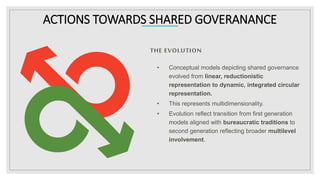
ACTIONS TOWARDS SHARED GOVERANANCE
THE EVOLUTION
• Conceptual models depicting shared governance
evolved from linear, reductionistic
representation to dynamic, integrated circular
representation.
• This represents multidimensionality.
• Evolution reflect transition from first generation
models aligned with bureaucratic traditions to
second generation reflecting broader multilevel
involvement.
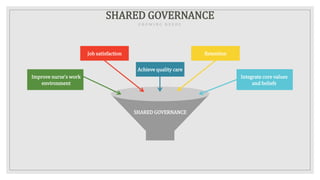
SHARED GOVERNANCE
G R O W I N G N E E D S
Achieve quality care
RetentionJob satisfaction
Improve nurse’s work
environment
Integrate core values
and beliefs
SHARED GOVERNANCE
GOVERNANCE MODELS
SHARED GOVERNANCE
MODELS
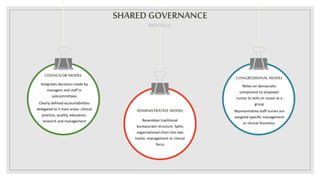
COUNCILOR MODEL
Integrates decisions made by
managers and staff in
subcommittees
Clearly defined accountabilities
delegated to 5 main areas: clinical
practice, quality, education,
research and management
CONGRESSIONAL MODEL
Relies on democratic
component to empower
nurses to vote on issues as a
group
Representative staff nurses are
assigned specific management
or clinical functions.
ADMINISTRATIVE MODEL
Resembles traditional
bureaucratic structure. Splits
organizational chart into two
tracks: management or clinical
focus
WHOLESYSTEMGOVERNANCE
01
Reflects accountability
at every level
02
Creates seamless
structure directed
towards providing health
service to its community
03
Recognizes multiple
stakeholders
04
Highlights coordination
and collaboration
05
Highlights the need to
build capacity
NURSE-SHAREDGOVERNANCE
01
Managerial innovation
that legitimizes nurses’
control over practice
02
Nurses extends their
influence into
administrative areas
previously controlled only
by managers
03
Focus on nurses
controlling their
professional practice
04
Ability to exercise control
over personnel in such
areas as hiring, transferring,
promoting, and firing
personnel;
05
Nurses feel that they
have access to the
information
necessary to make
effective governance
decisions
PROFESSIONAL-SHAREDGOVERNANCE
01
Modernized term for
shared governance.
02
Is not a management
strategy, model, tactic,
approach, or operational
component
03
Mechanism for professions
to not be controlled or
managed by organizations
or those outside the
profession.
04
Definition: The accountability, professional
obligation, collateral relationships, and decision-
making of a professional, fundamental to
autonomous practice and the achievement of
empirical outcomes
SHAREDGOVERNANCE
ADVANTAGES AND DISADVANTAGES
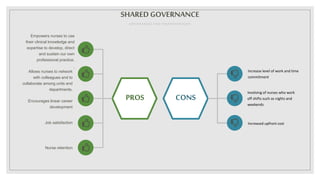
PROS CONS
Empowers nurses to use
their clinical knowledge and
expertise to develop, direct
and sustain our own
professional practice.
.
Allows nurses to network
with colleagues and to
collaborate among units and
departments.
Encourages linear career
development
Job satisfaction
Nurse retention
Involving of nurses who work
off shifts such as nights and
weekends
Increase level of work and time
commitment
Increased upfront cost
SHAREDGOVERNANCE
ADVANTAGES AND OBSTACLES
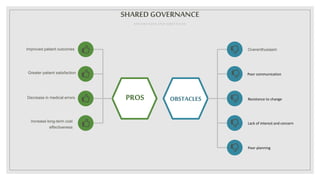
PROS OBSTACLES
Improved patient outcomes
Greater patient satisfaction
Decrease in medical errors
Increase long-term cost
effectiveness
Poor communication
Overenthusiasm
Resistance to change
Lack of interest and concern
Poor planning
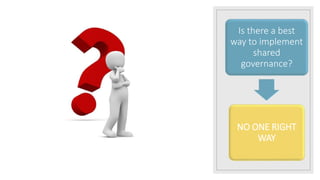
Is there a best
way to implement
shared
governance?
NO ONE RIGHT
WAY
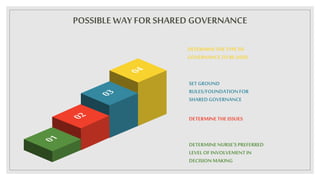
POSSIBLE WAY FOR SHARED GOVERNANCE
DETERMINETHE TYPEOF
GOVERNANCETO BEUSED
SETGROUND
RULES/FOUNDATIONFOR
SHAREDGOVERNANCE
DETERMINETHE ISSUES
DETERMINENURSE’SPREFERRED
LEVELOF INVOLVEMENTIN
DECISIONMAKING
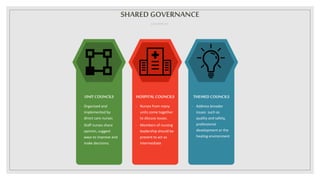
SHAREDGOVERNANCE
EXAMPLES
UNITCOUNCILS THEMED COUNCILSHOSPITAL COUNCILS
- Organized and
implemented by
direct care nurses
- Staff nurses share
opinion, suggest
ways to improve and
make decisions.
- Nurses from many
units come together
to discuss issues.
- Members of nursing
leadership should be
present to act as
intermediate
- Address broader
issues such as
quality and safety,
professional
development or the
healing environment
References
◦ HCPro. 2006. Shared governance: A practical approach to reshaping professional nursing practice. Retrieved from: http://www.strategiesfornursemanagers.com/supplemental/4428_book.pdf
◦ Taylor K (2016) Using shared governance to empower nurses. Nursing Times; 112: 1/2, 20-23. Retrieved from: https://www.nursingtimes.net/clinical-archive/leadership/using-shared-governance-to-empower-
nurses-11-01-2016/
◦ McKnight H, Moore SM. Nursing Shared Governance. [Updated 2019 Nov 7]. In: StatPearls [Internet]. Treasure Island (FL): StatPearls Publishing; 2020 Jan-. Available from:
https://www.ncbi.nlm.nih.gov/books/NBK549862/
◦ Lippincott solutions. 2019. How shared governance in nursing works. Retrieved from: http://lippincottsolutions.lww.com/blog.entry.html/2019/02/27/how_shared_governanc-oiGj.html
◦ Anthony, M. 2004. Shared governance models: Theory, practice and evidence. OIJN. Retrieved from:
https://ojin.nursingworld.org/MainMenuCategories/ANAMarketplace/ANAPeriodicals/OJIN/TableofContents/Volume92004/No1Jan04/SharedGovernanceModels.aspx
◦ Warren, S. Nursing shared governance. Retrieved from: https://www.slideserve.com/donkor/nursing-shared-governance
◦ Zinhom, A., Mubarak, R. Shared governance. Retrieved from: https://www.slideshare.net/AHMEDZINHOM/shared-governance-52677290
◦ Vail, K, Collins, A., Coyle G. et.al. Shared governance in nursing. Retrieved from: https://prezi.com/ajwlomftwz9v/shared-governance-in-nursing/
◦ Hess, R., 2004. From Bedside to Boardroom – Nursing Shared Governance. Online Journal of Issues in Nursing. Vol. 9 No.1, Manuscript 1. Retrieved from:
www.nursingworld.org/MainMenuCategories/ANAMarketplace/ANAPeriodicals/OJIN/TableofContents/Volume92004/No1Jan04/FromBedsidetoBoardroom.aspx
◦ Porter-O’Grady, T. 2017. A response to the questions of professional governance versus shared governance. JONA. 27 (2). Retrieved from:
https://www.nursingcenter.com/journalarticle?Article_ID=3959486&Journal_ID=54024&Issue_ID=3959485
◦ Porter-O'Grady, T. 2019. Pinciples for sustaining shared/professional governance in nursing, Nursing Management (Springhouse). 50 (1): 36-41 doi: 10.1097/01.NUMA.0000550448.17375.28. Retrieved from:
https://journals.lww.com/nursingmanagement/Fulltext/2019/01000/Principles_for_sustaining_shared_professional.8.aspx
◦ Fawcett, G. 2018. Professionalization leads to better governance and public financial management. Retrieved from: https://slideplayer.com/slide/14542935/
Slides is uploaded for information purposes and as partial requirement of Philippine Women's University in
PhD class; Subject: Governance in Health Care Practice.

Sharing is caring ppt

  • 1.
    SHARING IS CARING RustanP. Geronimo Reviewed by: Dr. David Hali De Jesus
  • 2.
    Objectives A B C D Todiscuss the meaningof shared governance Todiscuss the background on the emergence of shared governance, as well as the different typesof models Toidentify theadvantages and disadvantages of shared governance Todiscuss the ways on how toimplement shared governance
  • 3.
    Shared Governance Governance isabout power, control, authority, and influence. An organizational strategy through which nurses can express and mange their practice with a higher level of professional autonomy Focus on the micro-level
  • 4.
    Shared Governance Shared decisionmaking between the bedside nurses and nurse leaders Pillar of the ANCC Magnet culture COLLABORATION working together to make decisions that affect nursing practice and patient care.
  • 5.
  • 6.
    PARTNERSHIP - COLLABORATIVE RELATIONSHIP AMONGALL STAKEHOLDERS. - EACH MEMBER HAS A KEY ROLE IN FULFILLING THE MISSION AND PURPOSE OF THE ORGANIZATION
  • 7.
    EQUITY - Maintains focuson services, patients and staff - Foundation and measure value - No one role is more important than any other - Each member is essential to providing safe and effective care
  • 8.
    ACCOUNTABILITY - Willingness toinvest in decision-making and express ownership in those decision - Core of shared governance - Supports partnership
  • 9.
    OWNERSHIP - Recognition andacceptance of importance of everyone’s work - Designates where work is done and by whom
  • 10.
    SHAREDGOVERNANCE CONCEPTS WHO SHARED? Board members, nurses,physician and management WHO GOVERNS? WHO BENEFITS? Health care team, organization and patients Board members, nurses, physician and management
  • 11.
    SHAREDGOVERNANCE EMERGENCE Shared governance found itsway into business and management literature (Human resource era) 19xx First introduced by Christman: asserted idea that nurses should have decision making skills 1976 Porter O’Grady’s work brought the concepts into the nursing practice 1978 Decrease in popularity of shared governance. Self managing work teams emerge 1990s According to AONE and AACN: professional practice environment of nursing care has shifted dramatically due to rapid advances 2000 1 2 3 4 5 START MILESTONE
  • 12.
    HUMAN RESOURCEERA • Earliestfoundation for shared governance arose in this era.. This era represented the first departure from the traditions of scientific management. • Business and management philosophies influenced the development of shared governance models. KANTER’STHEORY • Theory on structural power has been instrumental in the development and formation of shared governance models. • Influenced broader redesign initiatives that emphasize work empowerment SOCIOLOGYOF PROFESSIONS • Greatly influenced shared governance • Professional autonomy is the basis for managing care environment • Shared governance, as an organizational form, has potential to bridge differences between the traditional bureaucratic models, characterized by centralized decision making, with professional models that are distinguished by independent authority for decision making SHAREDGOVERNANCE CONTRIBUTING FACTORS
  • 13.
    ACTIONS TOWARDS SHAREDGOVERANANCE THE EVOLUTION • Conceptual models depicting shared governance evolved from linear, reductionistic representation to dynamic, integrated circular representation. • This represents multidimensionality. • Evolution reflect transition from first generation models aligned with bureaucratic traditions to second generation reflecting broader multilevel involvement.
  • 14.
    SHARED GOVERNANCE G RO W I N G N E E D S Achieve quality care RetentionJob satisfaction Improve nurse’s work environment Integrate core values and beliefs SHARED GOVERNANCE
  • 15.
  • 16.
    SHARED GOVERNANCE MODELS COUNCILOR MODEL Integratesdecisions made by managers and staff in subcommittees Clearly defined accountabilities delegated to 5 main areas: clinical practice, quality, education, research and management CONGRESSIONAL MODEL Relies on democratic component to empower nurses to vote on issues as a group Representative staff nurses are assigned specific management or clinical functions. ADMINISTRATIVE MODEL Resembles traditional bureaucratic structure. Splits organizational chart into two tracks: management or clinical focus
  • 17.
    WHOLESYSTEMGOVERNANCE 01 Reflects accountability at everylevel 02 Creates seamless structure directed towards providing health service to its community 03 Recognizes multiple stakeholders 04 Highlights coordination and collaboration 05 Highlights the need to build capacity
  • 18.
    NURSE-SHAREDGOVERNANCE 01 Managerial innovation that legitimizesnurses’ control over practice 02 Nurses extends their influence into administrative areas previously controlled only by managers 03 Focus on nurses controlling their professional practice 04 Ability to exercise control over personnel in such areas as hiring, transferring, promoting, and firing personnel; 05 Nurses feel that they have access to the information necessary to make effective governance decisions
  • 19.
    PROFESSIONAL-SHAREDGOVERNANCE 01 Modernized term for sharedgovernance. 02 Is not a management strategy, model, tactic, approach, or operational component 03 Mechanism for professions to not be controlled or managed by organizations or those outside the profession. 04 Definition: The accountability, professional obligation, collateral relationships, and decision- making of a professional, fundamental to autonomous practice and the achievement of empirical outcomes
  • 20.
    SHAREDGOVERNANCE ADVANTAGES AND DISADVANTAGES PROSCONS Empowers nurses to use their clinical knowledge and expertise to develop, direct and sustain our own professional practice. . Allows nurses to network with colleagues and to collaborate among units and departments. Encourages linear career development Job satisfaction Nurse retention Involving of nurses who work off shifts such as nights and weekends Increase level of work and time commitment Increased upfront cost
  • 21.
    SHAREDGOVERNANCE ADVANTAGES AND OBSTACLES PROSOBSTACLES Improved patient outcomes Greater patient satisfaction Decrease in medical errors Increase long-term cost effectiveness Poor communication Overenthusiasm Resistance to change Lack of interest and concern Poor planning
  • 22.
    Is there abest way to implement shared governance? NO ONE RIGHT WAY
  • 23.
    POSSIBLE WAY FORSHARED GOVERNANCE DETERMINETHE TYPEOF GOVERNANCETO BEUSED SETGROUND RULES/FOUNDATIONFOR SHAREDGOVERNANCE DETERMINETHE ISSUES DETERMINENURSE’SPREFERRED LEVELOF INVOLVEMENTIN DECISIONMAKING
  • 24.
    SHAREDGOVERNANCE EXAMPLES UNITCOUNCILS THEMED COUNCILSHOSPITALCOUNCILS - Organized and implemented by direct care nurses - Staff nurses share opinion, suggest ways to improve and make decisions. - Nurses from many units come together to discuss issues. - Members of nursing leadership should be present to act as intermediate - Address broader issues such as quality and safety, professional development or the healing environment
  • 25.
    References ◦ HCPro. 2006.Shared governance: A practical approach to reshaping professional nursing practice. Retrieved from: http://www.strategiesfornursemanagers.com/supplemental/4428_book.pdf ◦ Taylor K (2016) Using shared governance to empower nurses. Nursing Times; 112: 1/2, 20-23. Retrieved from: https://www.nursingtimes.net/clinical-archive/leadership/using-shared-governance-to-empower- nurses-11-01-2016/ ◦ McKnight H, Moore SM. Nursing Shared Governance. [Updated 2019 Nov 7]. In: StatPearls [Internet]. Treasure Island (FL): StatPearls Publishing; 2020 Jan-. Available from: https://www.ncbi.nlm.nih.gov/books/NBK549862/ ◦ Lippincott solutions. 2019. How shared governance in nursing works. Retrieved from: http://lippincottsolutions.lww.com/blog.entry.html/2019/02/27/how_shared_governanc-oiGj.html ◦ Anthony, M. 2004. Shared governance models: Theory, practice and evidence. OIJN. Retrieved from: https://ojin.nursingworld.org/MainMenuCategories/ANAMarketplace/ANAPeriodicals/OJIN/TableofContents/Volume92004/No1Jan04/SharedGovernanceModels.aspx ◦ Warren, S. Nursing shared governance. Retrieved from: https://www.slideserve.com/donkor/nursing-shared-governance ◦ Zinhom, A., Mubarak, R. Shared governance. Retrieved from: https://www.slideshare.net/AHMEDZINHOM/shared-governance-52677290 ◦ Vail, K, Collins, A., Coyle G. et.al. Shared governance in nursing. Retrieved from: https://prezi.com/ajwlomftwz9v/shared-governance-in-nursing/ ◦ Hess, R., 2004. From Bedside to Boardroom – Nursing Shared Governance. Online Journal of Issues in Nursing. Vol. 9 No.1, Manuscript 1. Retrieved from: www.nursingworld.org/MainMenuCategories/ANAMarketplace/ANAPeriodicals/OJIN/TableofContents/Volume92004/No1Jan04/FromBedsidetoBoardroom.aspx ◦ Porter-O’Grady, T. 2017. A response to the questions of professional governance versus shared governance. JONA. 27 (2). Retrieved from: https://www.nursingcenter.com/journalarticle?Article_ID=3959486&Journal_ID=54024&Issue_ID=3959485 ◦ Porter-O'Grady, T. 2019. Pinciples for sustaining shared/professional governance in nursing, Nursing Management (Springhouse). 50 (1): 36-41 doi: 10.1097/01.NUMA.0000550448.17375.28. Retrieved from: https://journals.lww.com/nursingmanagement/Fulltext/2019/01000/Principles_for_sustaining_shared_professional.8.aspx ◦ Fawcett, G. 2018. Professionalization leads to better governance and public financial management. Retrieved from: https://slideplayer.com/slide/14542935/ Slides is uploaded for information purposes and as partial requirement of Philippine Women's University in PhD class; Subject: Governance in Health Care Practice.