
Electronic devices and circuits
UNIT – I
PN- DIODE
SEMICONDUCTOR DIODE
• Theory of p-n junction
• p-n junction as diode
• p-n diode currents
• Volt-amp characteristics
• Diode resistance
• Temperature effect of p-n junction
• Transition and diffusion capacitance of p-n
diode
• Diode switching times
Theory of p-n junction
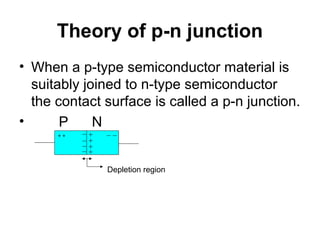
• When a p-type semiconductor material is
suitably joined to n-type semiconductor
the contact surface is called a p-n junction.
• P N
+ +
Depletion region
p-n junction as diode
• The p-n junction is also called as
semiconductor diode .
• The left side material is a p-type
semiconductor having –ve acceptor ions
and +vely charged holes. The right side
material is n-type semiconductor having
+ve donor ions and free electrons
p-n junction as diode
• Suppose the two pieces are suitably treated to
form pn junction, then there is a tendency for the
free electrons from n-type to diffuse over to the
p-side and holes from p-type to the n-side . This
process is called diffusion
• The left side material is a p-type semiconductor
having –ve acceptor ions and +vely charged
holes. The right side material is n-type
semiconductor having +ve donor ions and free
electrons.
p-n junction as diode
• As the free electrons move across the
junction from n-type to p-type, +ve donor
ions are uncovered. Hence a +ve charge
is built on the n-side of the junction. At the
same time, the free electrons cross the
junction and uncover the –ve acceptor
ions by filling in the holes. Therefore a net
–ve charge is established on p-side of the
junction.
p-n junction as diode
• When a sufficient number of donor and acceptor
ions is uncovered further diffusion is prevented.
• Thus a barrier is set up against further
movement of charge carriers. This is called
potential barrier or junction barrier Vo. The
potential barrier is of the order of 0.1 to 0.3V.
• Note: outside this barrier on each side of the
junction, the material is still neutral. Only inside
the barrier, there is a +ve charge on n-side and
–ve charge on p-side. This region is called
depletion layer.
p-n diode currents
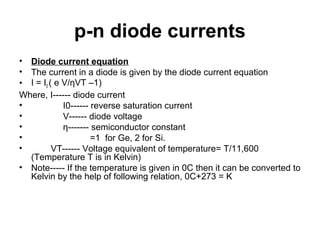
• Diode current equation
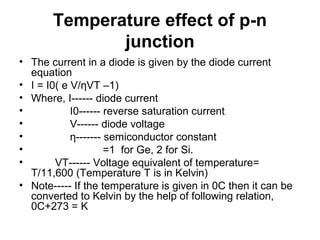
• The current in a diode is given by the diode current equation
• I = I0 ( e V/ηVT –1)
Where, I------ diode current
• I0------ reverse saturation current
• V------ diode voltage
• η------- semiconductor constant
• =1 for Ge, 2 for Si.
• VT------ Voltage equivalent of temperature= T/11,600
(Temperature T is in Kelvin)
• Note----- If the temperature is given in 0C then it can be converted to
Kelvin by the help of following relation, 0C+273 = K
Volt-amp characteristics
R
A
V diode
VF
Knee voltage
VR
IR(μA )
IF(mA)
Break over
Voltage
V
Volt-amp characteristics
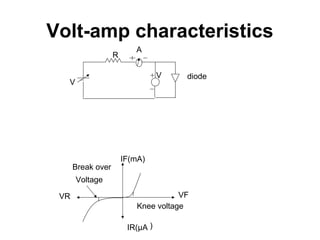
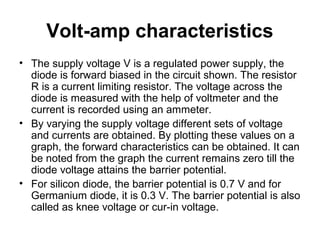
• The supply voltage V is a regulated power supply, the
diode is forward biased in the circuit shown. The resistor
R is a current limiting resistor. The voltage across the
diode is measured with the help of voltmeter and the
current is recorded using an ammeter.
• By varying the supply voltage different sets of voltage
and currents are obtained. By plotting these values on a
graph, the forward characteristics can be obtained. It can
be noted from the graph the current remains zero till the
diode voltage attains the barrier potential.
• For silicon diode, the barrier potential is 0.7 V and for
Germanium diode, it is 0.3 V. The barrier potential is also
called as knee voltage or cur-in voltage.
Diode equivalent circuit
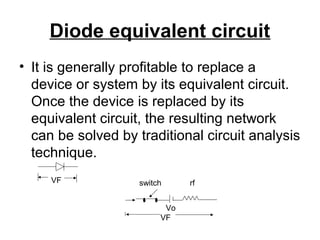
• It is generally profitable to replace a
device or system by its equivalent circuit.
Once the device is replaced by its
equivalent circuit, the resulting network
can be solved by traditional circuit analysis
technique.
VF rf
Vo
switch
VF
Diode resistance
• Static Resistance
– Forward Resistance Rf
– Reverse Resistance Rr
• Dynamic Resistance
– Forward Resistance rf
– Reverse Resistance rr
Temperature effect of p-n
junction
• The current in a diode is given by the diode current
equation
• I = I0( e V/ηVT –1)
• Where, I------ diode current
• I0------ reverse saturation current
• V------ diode voltage
• η------- semiconductor constant
• =1 for Ge, 2 for Si.
• VT------ Voltage equivalent of temperature=
T/11,600 (Temperature T is in Kelvin)
• Note----- If the temperature is given in 0C then it can be
converted to Kelvin by the help of following relation,
0C+273 = K
HALFWAVE RECTIFIER
HALFWAVE RECTIFIER
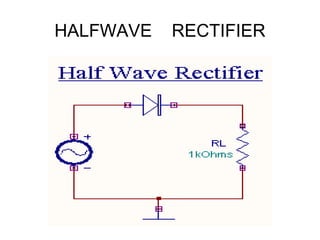
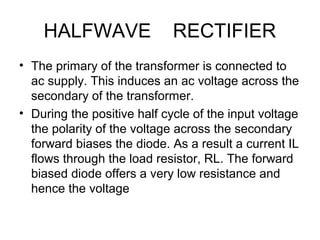
• The primary of the transformer is connected to
ac supply. This induces an ac voltage across the
secondary of the transformer.
• During the positive half cycle of the input voltage
the polarity of the voltage across the secondary
forward biases the diode. As a result a current IL
flows through the load resistor, RL. The forward
biased diode offers a very low resistance and
hence the voltage
HALFWAVE RECTIFIER
• Drop across it is very small. Thus the voltage
appearing across the load is practically the same
as the input voltage at every instant.
• During the negative half cycle of the input
voltage the polarity of the secondary voltage
gets reversed. As a result, the diode is reverse
biased.
• Practically no current flows through the circuit
and almost no voltage is developed across the
resistor. All input voltage appears across the
diode itself.
HALFWAVE RECTIFIER
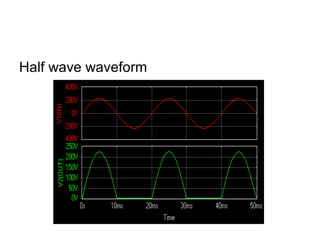
• Hence we conclude that when the input voltage
is going through its positive half cycle, output
voltage is almost the same as the input voltage
and during the negative half cycle no voltage is
available across the load.
• This explains the unidirectional pulsating dc
waveform obtained as output. The process of
removing one half the input signal to establish a
dc level is aptly called half wave rectification.
HALFWAVE RECTIFIER
Peak Inverse Voltage
• When the input voltage reaches its maximum
value Vm during the negative half cycle the
voltage across the diode is also maximum. This
maximum voltage is known as the peak inverse
voltage.
Thus for a half wave rectifier
Let Vi be the voltage to the primary of the
transformer. Vi is given by
where Vr is the cut-in voltage of the diode.
Half wave waveform
HALFWAVE RECTIFIER
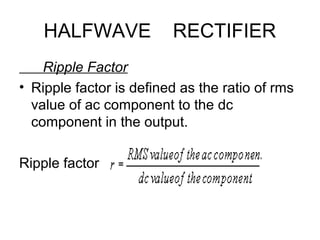
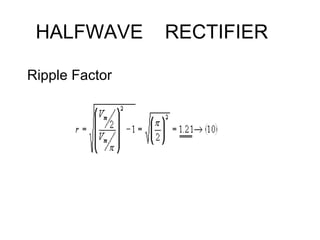
Ripple Factor
• Ripple factor is defined as the ratio of rms
value of ac component to the dc
component in the output.
Ripple factor
HALFWAVE RECTIFIER
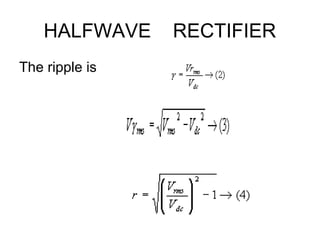
The ripple is
HALFWAVE RECTIFIER
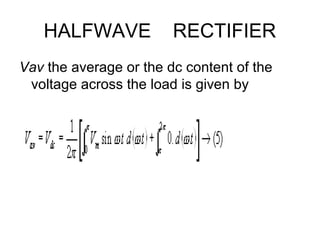
Vav the average or the dc content of the
voltage across the load is given by
HALFWAVE RECTIFIER
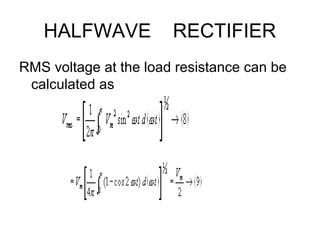
RMS voltage at the load resistance can be
calculated as
HALFWAVE RECTIFIER
Ripple Factor
HALFWAVE RECTIFIER
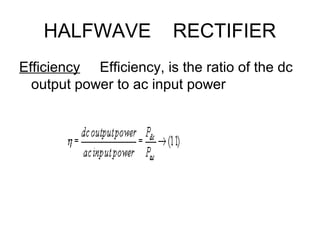
Efficiency Efficiency, is the ratio of the dc
output power to ac input power
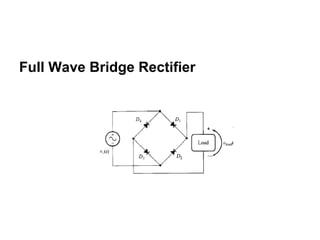
Full Wave Bridge Rectifier
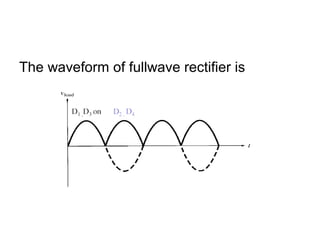
The waveform of fullwave rectifier is
Zener Diode
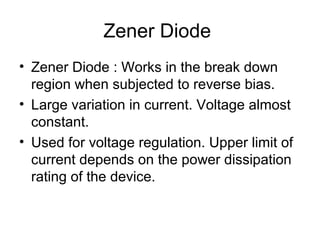
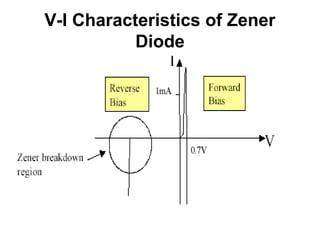
• Zener Diode : Works in the break down
region when subjected to reverse bias.
• Large variation in current. Voltage almost
constant.
• Used for voltage regulation. Upper limit of
current depends on the power dissipation
rating of the device.
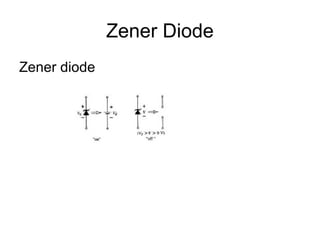
Zener Diode
Zener diode
Light Emitting Diode
Light emitting diodes (LEDs)
• The Light Emitting Diode (LED) is a
common light source used in electronic
circuits.
• LED is a semiconductor diode that emits
light when current passes through it.
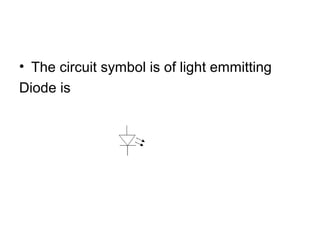
• The circuit symbol is of light emmitting
Diode is
• The characteristics of the LED are similar
to other semiconductor diodes except the
operating
• voltage is higher.
• A typical LED has an operating voltage of
2.0V and a maximum current of 30mA.
• When the LED is to be operated from a
circuit voltage supply, a resistor will be
required in
• series with the LED to ensure the correct
current and voltage for the LED.
• Consider an LED operating from a +5V
power supply and has 20mA flowing
through it …..
• the value for the resistor (R) will be 150W.
LIQUID CRYSTAL DISPLAY
LIQUID CRYSTAL DISPLAY - They are
used for display of numeric and
alphanumeric character in dot matrix and
segmental display.
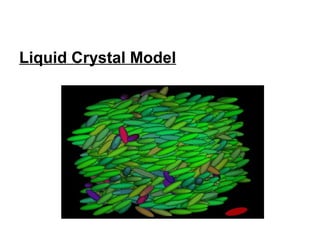
• What is a Liquid Crystal?
Liquid Crystal – a stable phase of matter
characterized by anisotropic properties
without the existence of a 3-dimensional
crystal lattice – generally lying between
the solid and isotropic (“liquid”) phase.
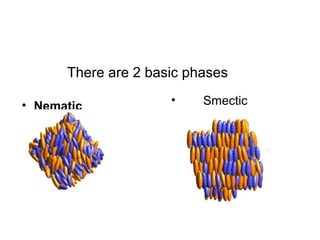
• Nematic • Smectic
There are 2 basic phases
Liquid Crystal Model
Series voltage regulator
In a voltage regulator circuit , if the control
elements are connected in series with load
it is called series voltage regulator .
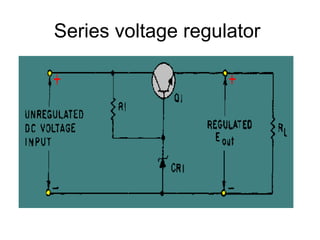
Series voltage regulator
• Zener diode is a diode that block current until a
specified voltage is applied. Remember also that
the applied voltage is called the breakdown, or
Zener voltage. Zener diodes are available with
different Zener voltages. When the Zener
voltage is reached, the Zener diode conducts
from its anode to its cathode (with the direction
of the arrow).
• In this voltage regulator, Q1 has a constant
voltage applied to its base.
This voltage is often called the reference
voltage. As changes in the circuit output
voltage occur, they are sensed at the
emitter of Q1 producing a corresponding
change in the forward bias of the
transistor.
In other words, Q1 compensates by
increasing or decreasing its resistance in
order to change the circuit voltage
division.
V-I Characteristics of Zener
Diode
V-I Characteristics of Zener
Diode
• Zener diodes are manufactured to have a
very low reverse bias breakdown voltage
• Since the breakdown at the zener voltage
is so sharp, these devices are often used
in voltage regulators to provide precise
voltage references. The actual zener
voltage is device dependent. For example,
you can buy a 6V zener diode.
THANK U

Electronic devices circuits

  • 1.
    Electronic devices andcircuits UNIT – I PN- DIODE
  • 2.
    SEMICONDUCTOR DIODE • Theoryof p-n junction • p-n junction as diode • p-n diode currents • Volt-amp characteristics • Diode resistance • Temperature effect of p-n junction • Transition and diffusion capacitance of p-n diode • Diode switching times
  • 3.
    Theory of p-njunction • When a p-type semiconductor material is suitably joined to n-type semiconductor the contact surface is called a p-n junction. • P N + + Depletion region
  • 4.
    p-n junction asdiode • The p-n junction is also called as semiconductor diode . • The left side material is a p-type semiconductor having –ve acceptor ions and +vely charged holes. The right side material is n-type semiconductor having +ve donor ions and free electrons
  • 5.
    p-n junction asdiode • Suppose the two pieces are suitably treated to form pn junction, then there is a tendency for the free electrons from n-type to diffuse over to the p-side and holes from p-type to the n-side . This process is called diffusion • The left side material is a p-type semiconductor having –ve acceptor ions and +vely charged holes. The right side material is n-type semiconductor having +ve donor ions and free electrons.
  • 6.
    p-n junction asdiode • As the free electrons move across the junction from n-type to p-type, +ve donor ions are uncovered. Hence a +ve charge is built on the n-side of the junction. At the same time, the free electrons cross the junction and uncover the –ve acceptor ions by filling in the holes. Therefore a net –ve charge is established on p-side of the junction.
  • 7.
    p-n junction asdiode • When a sufficient number of donor and acceptor ions is uncovered further diffusion is prevented. • Thus a barrier is set up against further movement of charge carriers. This is called potential barrier or junction barrier Vo. The potential barrier is of the order of 0.1 to 0.3V. • Note: outside this barrier on each side of the junction, the material is still neutral. Only inside the barrier, there is a +ve charge on n-side and –ve charge on p-side. This region is called depletion layer.
  • 8.
    p-n diode currents •Diode current equation • The current in a diode is given by the diode current equation • I = I0 ( e V/ηVT –1) Where, I------ diode current • I0------ reverse saturation current • V------ diode voltage • η------- semiconductor constant • =1 for Ge, 2 for Si. • VT------ Voltage equivalent of temperature= T/11,600 (Temperature T is in Kelvin) • Note----- If the temperature is given in 0C then it can be converted to Kelvin by the help of following relation, 0C+273 = K
  • 9.
    Volt-amp characteristics R A V diode VF Kneevoltage VR IR(μA ) IF(mA) Break over Voltage V
  • 10.
    Volt-amp characteristics • Thesupply voltage V is a regulated power supply, the diode is forward biased in the circuit shown. The resistor R is a current limiting resistor. The voltage across the diode is measured with the help of voltmeter and the current is recorded using an ammeter. • By varying the supply voltage different sets of voltage and currents are obtained. By plotting these values on a graph, the forward characteristics can be obtained. It can be noted from the graph the current remains zero till the diode voltage attains the barrier potential. • For silicon diode, the barrier potential is 0.7 V and for Germanium diode, it is 0.3 V. The barrier potential is also called as knee voltage or cur-in voltage.
  • 11.
    Diode equivalent circuit •It is generally profitable to replace a device or system by its equivalent circuit. Once the device is replaced by its equivalent circuit, the resulting network can be solved by traditional circuit analysis technique. VF rf Vo switch VF
  • 12.
    Diode resistance • StaticResistance – Forward Resistance Rf – Reverse Resistance Rr • Dynamic Resistance – Forward Resistance rf – Reverse Resistance rr
  • 13.
    Temperature effect ofp-n junction • The current in a diode is given by the diode current equation • I = I0( e V/ηVT –1) • Where, I------ diode current • I0------ reverse saturation current • V------ diode voltage • η------- semiconductor constant • =1 for Ge, 2 for Si. • VT------ Voltage equivalent of temperature= T/11,600 (Temperature T is in Kelvin) • Note----- If the temperature is given in 0C then it can be converted to Kelvin by the help of following relation, 0C+273 = K
  • 14.
  • 15.
    HALFWAVE RECTIFIER • Theprimary of the transformer is connected to ac supply. This induces an ac voltage across the secondary of the transformer. • During the positive half cycle of the input voltage the polarity of the voltage across the secondary forward biases the diode. As a result a current IL flows through the load resistor, RL. The forward biased diode offers a very low resistance and hence the voltage
  • 16.
    HALFWAVE RECTIFIER • Dropacross it is very small. Thus the voltage appearing across the load is practically the same as the input voltage at every instant. • During the negative half cycle of the input voltage the polarity of the secondary voltage gets reversed. As a result, the diode is reverse biased. • Practically no current flows through the circuit and almost no voltage is developed across the resistor. All input voltage appears across the diode itself.
  • 17.
    HALFWAVE RECTIFIER • Hencewe conclude that when the input voltage is going through its positive half cycle, output voltage is almost the same as the input voltage and during the negative half cycle no voltage is available across the load. • This explains the unidirectional pulsating dc waveform obtained as output. The process of removing one half the input signal to establish a dc level is aptly called half wave rectification.
  • 18.
    HALFWAVE RECTIFIER Peak InverseVoltage • When the input voltage reaches its maximum value Vm during the negative half cycle the voltage across the diode is also maximum. This maximum voltage is known as the peak inverse voltage. Thus for a half wave rectifier Let Vi be the voltage to the primary of the transformer. Vi is given by where Vr is the cut-in voltage of the diode.
  • 19.
  • 20.
    HALFWAVE RECTIFIER Ripple Factor •Ripple factor is defined as the ratio of rms value of ac component to the dc component in the output. Ripple factor
  • 21.
  • 22.
    HALFWAVE RECTIFIER Vav theaverage or the dc content of the voltage across the load is given by
  • 23.
    HALFWAVE RECTIFIER RMS voltageat the load resistance can be calculated as
  • 24.
  • 25.
    HALFWAVE RECTIFIER Efficiency Efficiency,is the ratio of the dc output power to ac input power
  • 26.
  • 27.
    The waveform offullwave rectifier is
  • 28.
    Zener Diode • ZenerDiode : Works in the break down region when subjected to reverse bias. • Large variation in current. Voltage almost constant. • Used for voltage regulation. Upper limit of current depends on the power dissipation rating of the device.
  • 29.
  • 30.
    Light Emitting Diode Lightemitting diodes (LEDs) • The Light Emitting Diode (LED) is a common light source used in electronic circuits. • LED is a semiconductor diode that emits light when current passes through it.
  • 31.
    • The circuitsymbol is of light emmitting Diode is
  • 32.
    • The characteristicsof the LED are similar to other semiconductor diodes except the operating • voltage is higher. • A typical LED has an operating voltage of 2.0V and a maximum current of 30mA.
  • 33.
    • When theLED is to be operated from a circuit voltage supply, a resistor will be required in • series with the LED to ensure the correct current and voltage for the LED. • Consider an LED operating from a +5V power supply and has 20mA flowing through it ….. • the value for the resistor (R) will be 150W.
  • 34.
    LIQUID CRYSTAL DISPLAY LIQUIDCRYSTAL DISPLAY - They are used for display of numeric and alphanumeric character in dot matrix and segmental display.
  • 35.
    • What isa Liquid Crystal? Liquid Crystal – a stable phase of matter characterized by anisotropic properties without the existence of a 3-dimensional crystal lattice – generally lying between the solid and isotropic (“liquid”) phase.
  • 36.
    • Nematic •Smectic There are 2 basic phases
  • 37.
  • 38.
    Series voltage regulator Ina voltage regulator circuit , if the control elements are connected in series with load it is called series voltage regulator .
  • 39.
  • 40.
    • Zener diodeis a diode that block current until a specified voltage is applied. Remember also that the applied voltage is called the breakdown, or Zener voltage. Zener diodes are available with different Zener voltages. When the Zener voltage is reached, the Zener diode conducts from its anode to its cathode (with the direction of the arrow). • In this voltage regulator, Q1 has a constant voltage applied to its base.
  • 41.
    This voltage isoften called the reference voltage. As changes in the circuit output voltage occur, they are sensed at the emitter of Q1 producing a corresponding change in the forward bias of the transistor. In other words, Q1 compensates by increasing or decreasing its resistance in order to change the circuit voltage division.
  • 42.
  • 43.
    V-I Characteristics ofZener Diode • Zener diodes are manufactured to have a very low reverse bias breakdown voltage • Since the breakdown at the zener voltage is so sharp, these devices are often used in voltage regulators to provide precise voltage references. The actual zener voltage is device dependent. For example, you can buy a 6V zener diode.
  • 44.