CULTURE
MEDIA
WHAT IS CULTURE MEDIA?
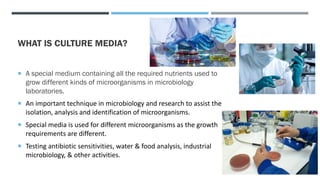
 A special medium containing all the required nutrients used to
grow different kinds of microorganisms in microbiology
laboratories.
 An important technique in microbiology and research to assist the
isolation, analysis and identification of microorganisms.
 Special media is used for different microorganisms as the growth
requirements are different.
 Testing antibiotic sensitivities, water & food analysis, industrial
microbiology, & other activities.
MAJOR CONTRIBUTION TO CULTURE MEDIA
 LOUIS PASTEUR (1822-95) – Used
simple broths made up of urine or
meat extracts.
 ROBERT KOCH (1843-1910) – Used
cooked potato pieces as solid
medium to grow bacteria.
-- used gelatine
TYPES OF CULTURE MEDIA
 Physical Nature
 Chemical Composition
 Functional type
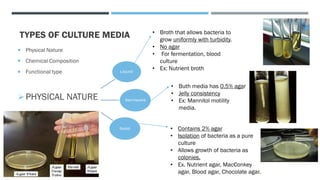
➢PHYSICAL NATURE
• Broth that allows bacteria to
grow uniformly with turbidity.
• No agar
• For fermentation, blood
culture
• Ex: Nutrient broth
• Buth media has 0.5% agar
• Jelly consistency
• Ex: Mannitol motility
media.
• Contains 2% agar
• Isolation of bacteria as a pure
culture
• Allows growth of bacteria as
colonies.
• Ex. Nutrient agar, MacConkey
agar, Blood agar, Chocolate agar.
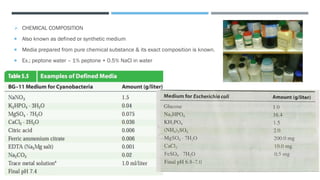
➢ CHEMICAL COMPOSITION
 Also known as defined or synthetic medium
 Media prepared from pure chemical substance & its exact composition is known.
 Ex.; peptone water – 1% peptone + 0.5% NaCl in water
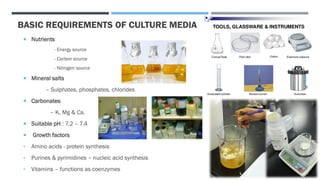
BASIC REQUIREMENTS OF CULTURE MEDIA
 Nutrients
- Energy source
- Carbon source
- Nitrogen source
 Mineral salts
– Sulphates, phosphates, chlorides
 Carbonates
– K, Mg & Ca.
 Suitable pH : 7.2 – 7.4
 Growth factors
• Amino acids - protein synthesis
• Purines & pyrimidines – nucleic acid synthesis
• Vitamins – functions as coenzymes
Functional types of
media
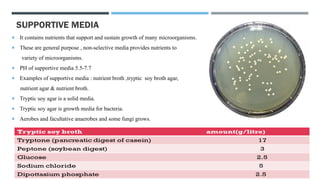
SUPPORTIVE MEDIA
 It contains nutrients that support and sustain growth of many microorganisms.
 These are general purpose , non-selective media provides nutrients to
variety of microorganisms.
 PH of supportive media 5.5-7.7
 Examples of supportive media : nutrient broth ,tryptic soy broth agar,
nutrient agar & nutrient broth.
 Tryptic soy agar is a solid media.
 Tryptic soy agar is growth media for bacteria.
 Aerobes and facultative anaerobes and some fungi grows.
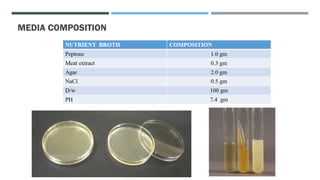
MEDIA COMPOSITION
ENRICHED MEDIA
➢ Solid media
 When basal medium is added with some nutrients such as blood serum or egg it is called enriched media.
 Enriched with blood, serum , extra peptones ,egg & vitamins
 Used for cultivation of all fastidious micro-organisms, (Haemophiles influenza & streptococcus spp.)
 Examples : Blood agar media and chocolate agar media
➢ Blood agar
 Composition: sterile nutrient agar + 5-10% sheep blood
 Appearance : red color
 Most bacteria can grow on blood agar media
➢ Chocolate agar
 Chocolate agar → RBC breakdown → intracellular nutrients released
 Chocolate agar is different medium for gram positive cocci
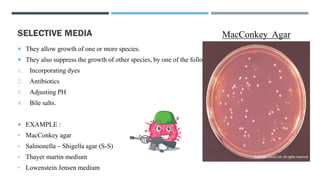
SELECTIVE MEDIA
 They allow growth of one or more species.
 They also suppress the growth of other species, by one of the following.
1. Incorporating dyes
2. Antibiotics
3. Adjusting PH
4. Bile salts.
 EXAMPLE :
• MacConkey agar
• Salmonella – Shigella agar (S-S)
• Thayer martin medium
• Lowenstein Jensen medium
MacConkey Agar
MACCONKEY AGAR COMPOSITION
DIFFERENTIAL MEDIA
 When a medium contains substance which help to distinguish differing characteristics of bacteria is
called differential media.
 Lactose fermenters and non lactose fermenters
 Example : MacConkey agar
 It contains: peptone, agar, lactose, Neutral red (PH indicator), bile salts, Crystal violet.
 MacConkey agar is a differential media and selective media
 Gram negative enteric bacteria that grow on MacConkey agar are differentiated
by their ability to ferment lactose.
 If the lactose is fermented by the bacteria, the production of the acid drops the PH of the media.
 The drop in PH is indicated by the change of neutral red indicator to pink.
 If gram negative bacteria that grow on MacConkey agar but do not ferment lactose appear colorless on
the medium
SELECTIVE & INDICATOR/DIFFERENTIA MEDIA

Culture Media.pdf

  • 1.
  • 2.
    WHAT IS CULTUREMEDIA?  A special medium containing all the required nutrients used to grow different kinds of microorganisms in microbiology laboratories.  An important technique in microbiology and research to assist the isolation, analysis and identification of microorganisms.  Special media is used for different microorganisms as the growth requirements are different.  Testing antibiotic sensitivities, water & food analysis, industrial microbiology, & other activities.
  • 3.
    MAJOR CONTRIBUTION TOCULTURE MEDIA  LOUIS PASTEUR (1822-95) – Used simple broths made up of urine or meat extracts.  ROBERT KOCH (1843-1910) – Used cooked potato pieces as solid medium to grow bacteria. -- used gelatine
  • 4.
    TYPES OF CULTUREMEDIA  Physical Nature  Chemical Composition  Functional type ➢PHYSICAL NATURE • Broth that allows bacteria to grow uniformly with turbidity. • No agar • For fermentation, blood culture • Ex: Nutrient broth • Buth media has 0.5% agar • Jelly consistency • Ex: Mannitol motility media. • Contains 2% agar • Isolation of bacteria as a pure culture • Allows growth of bacteria as colonies. • Ex. Nutrient agar, MacConkey agar, Blood agar, Chocolate agar.
  • 5.
    ➢ CHEMICAL COMPOSITION Also known as defined or synthetic medium  Media prepared from pure chemical substance & its exact composition is known.  Ex.; peptone water – 1% peptone + 0.5% NaCl in water
  • 6.
    BASIC REQUIREMENTS OFCULTURE MEDIA  Nutrients - Energy source - Carbon source - Nitrogen source  Mineral salts – Sulphates, phosphates, chlorides  Carbonates – K, Mg & Ca.  Suitable pH : 7.2 – 7.4  Growth factors • Amino acids - protein synthesis • Purines & pyrimidines – nucleic acid synthesis • Vitamins – functions as coenzymes
  • 7.
  • 9.
    SUPPORTIVE MEDIA  Itcontains nutrients that support and sustain growth of many microorganisms.  These are general purpose , non-selective media provides nutrients to variety of microorganisms.  PH of supportive media 5.5-7.7  Examples of supportive media : nutrient broth ,tryptic soy broth agar, nutrient agar & nutrient broth.  Tryptic soy agar is a solid media.  Tryptic soy agar is growth media for bacteria.  Aerobes and facultative anaerobes and some fungi grows.
  • 10.
  • 11.
    ENRICHED MEDIA ➢ Solidmedia  When basal medium is added with some nutrients such as blood serum or egg it is called enriched media.  Enriched with blood, serum , extra peptones ,egg & vitamins  Used for cultivation of all fastidious micro-organisms, (Haemophiles influenza & streptococcus spp.)  Examples : Blood agar media and chocolate agar media ➢ Blood agar  Composition: sterile nutrient agar + 5-10% sheep blood  Appearance : red color  Most bacteria can grow on blood agar media ➢ Chocolate agar  Chocolate agar → RBC breakdown → intracellular nutrients released  Chocolate agar is different medium for gram positive cocci
  • 12.
    SELECTIVE MEDIA  Theyallow growth of one or more species.  They also suppress the growth of other species, by one of the following. 1. Incorporating dyes 2. Antibiotics 3. Adjusting PH 4. Bile salts.  EXAMPLE : • MacConkey agar • Salmonella – Shigella agar (S-S) • Thayer martin medium • Lowenstein Jensen medium MacConkey Agar
  • 13.
  • 14.
    DIFFERENTIAL MEDIA  Whena medium contains substance which help to distinguish differing characteristics of bacteria is called differential media.  Lactose fermenters and non lactose fermenters  Example : MacConkey agar  It contains: peptone, agar, lactose, Neutral red (PH indicator), bile salts, Crystal violet.  MacConkey agar is a differential media and selective media  Gram negative enteric bacteria that grow on MacConkey agar are differentiated by their ability to ferment lactose.  If the lactose is fermented by the bacteria, the production of the acid drops the PH of the media.  The drop in PH is indicated by the change of neutral red indicator to pink.  If gram negative bacteria that grow on MacConkey agar but do not ferment lactose appear colorless on the medium
  • 15.