LASERS AND ITS
APPLICATIONS
SUBMITTED
BY
G.HEMANTH{14BF1A0460}
&
G.GURU PRASAD{14BF1A0455}
Contents
1) Introduction of laser
2) Principle of laser
3) Kinds of lasers
4) Construction and working of Ruby laser
5) Construction and working of He-Ne laser
6) Applications of lasers
a)Communication
b)Industry
c)Medicine
d)Military operation
7) Advantages of lasers
8) Disadvantages of lasers
9) Conclusion
Introduction
 The word laser is an acronym that stands
for “light amplification by the stimulated
emission of radiation”.
 Lasers are essentially highly directional,
highly intense, highly monochromatic and
highly coherent optical sources.
 Stimulated emission was postulated by
einstein as early as in 1917.
In 1960 , a solid state ruby laser is
developed by maiman on this principle.
In 1961, a gas state He-Ne laser is
developed by Ali javan and others in Bell
telephone laboratory.
Principle of laser
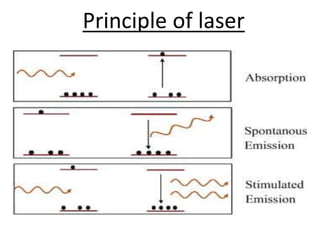
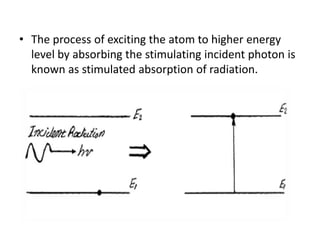
• The process of exciting the atom to higher energy
level by absorbing the stimulating incident photon is
known as stimulated absorption of radiation.
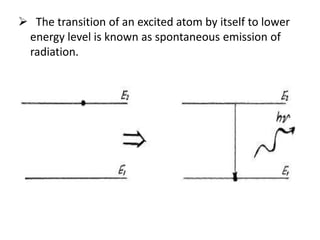
 The transition of an excited atom by itself to lower
energy level is known as spontaneous emission of
radiation.
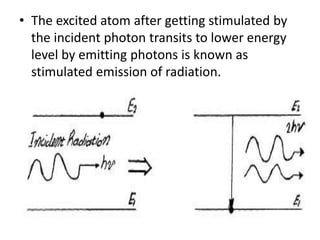
• The excited atom after getting stimulated by
the incident photon transits to lower energy
level by emitting photons is known as
stimulated emission of radiation.
Kinds of lasers
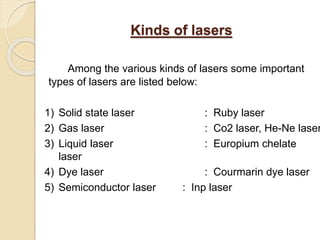
Among the various kinds of lasers some important
types of lasers are listed below:
1) Solid state laser : Ruby laser
2) Gas laser : Co2 laser, He-Ne laser
3) Liquid laser : Europium chelate
laser
4) Dye laser : Courmarin dye laser
5) Semiconductor laser : Inp laser
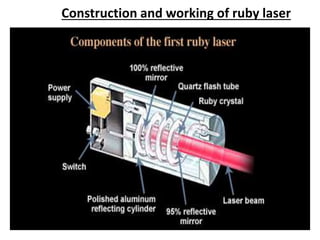
Construction and working of ruby laser
Construction :
In ruby laser a cylindrical ruby rod
made up of aluminum oxide which is
doped with 0.05% weight of chromium
oxide.
One end of rod is fully silvered and the
other one partially silvered so it act as
optical resonator.
The rod is surrounded by a glass tube
which in turn is surrounded by the
helical flash lamp filled with xenon
gas.
Working:
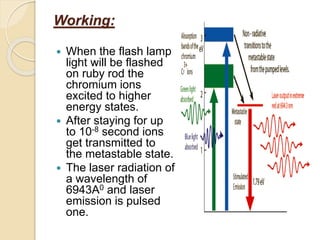
 When the flash lamp
light will be flashed
on ruby rod the
chromium ions
excited to higher
energy states.
 After staying for up
to 10-8 second ions
get transmitted to
the metastable state.
 The laser radiation of
a wavelength of
6943A0 and laser
emission is pulsed
one.
Construction and working of He-Ne
laser
Construction:
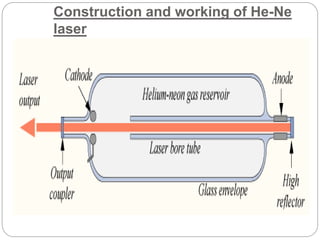
 A He-Ne laser consists of large and narrow
discharge tube filled with helium a and neon
gases in the ratio 10:1.
 The tube is enclosed between fully and
partially reflective mirrors which serve as
optical cavity.
 The two end windows are set at Brewster's
angle, so reflected radiations enter into the
tube become polarized.
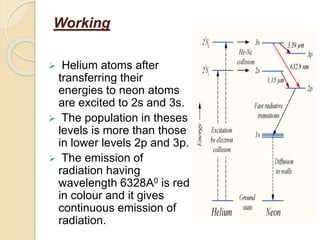
Working
 Helium atoms after
transferring their
energies to neon atoms
are excited to 2s and 3s.
 The population in theses
levels is more than those
in lower levels 2p and 3p.
 The emission of
radiation having
wavelength 6328A0 is red
in colour and it gives
continuous emission of
radiation.
Applications of lasers
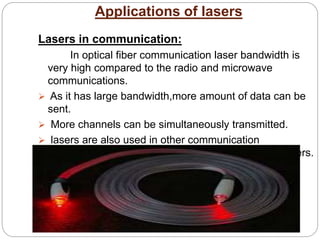
Lasers in communication:
In optical fiber communication laser bandwidth is
very high compared to the radio and microwave
communications.
 As it has large bandwidth,more amount of data can be
sent.
 More channels can be simultaneously transmitted.
 lasers are also used in other communication
devices,including high speed photo copiers and printers.
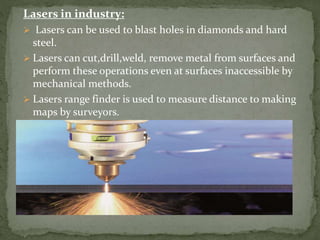
Lasers in industry:
 Lasers can be used to blast holes in diamonds and hard
steel.
 Lasers can cut,drill,weld, remove metal from surfaces and
perform these operations even at surfaces inaccessible by
mechanical methods.
 Lasers range finder is used to measure distance to making
maps by surveyors.
 Argon and Co2 lasers are used in treatment of liver
and lungs .
 New kind of laser surgery that uses molecules to
stitch together wounds .
 Co2 laser is particularly used in spinal and brain
tumour excision and kidney stone extrusion.
 Lasers are used in the treatment of Glaucoma.
Laser used in eye
treatment
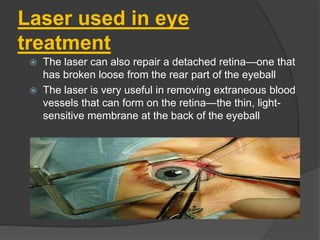
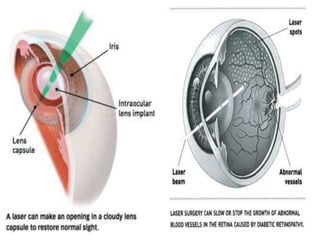
 The laser can also repair a detached retina—one that
has broken loose from the rear part of the eyeball
 The laser is very useful in removing extraneous blood
vessels that can form on the retina—the thin, light-
sensitive membrane at the back of the eyeball
Lasers in military:
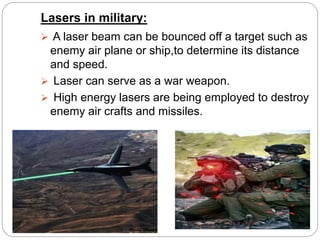
 A laser beam can be bounced off a target such as
enemy air plane or ship,to determine its distance
and speed.
 Laser can serve as a war weapon.
 High energy lasers are being employed to destroy
enemy air crafts and missiles.
Advantages of lasers
 Lasers are used to cut glass and drill holes in
ceramics.
 Lasers are used for bloodless surgery and in
destroying kidney stones and gallstones.
 Lasers are used to study the internal
structure of microorganisms and cells.
 Lasers are used in air pollution, to estimate
the size of dust particles.
Disadvantages of lasers
 Lasers are known to be dangerous to the
atmosphere and health.
 Laser printers are very costly when compared to
other printers.
 When running the laser machine small amount of
ozone are generated, which can damage the
ozone layer.
 Some laser particles are also known to emit
particles that may cause respiratory disease.
CONCLUSION
Finally I conclude that laser
plays a crucial role in the
modern world.
Therefore laser play an pivotal
role in the present technical
world.
lasers ppt
lasers ppt

lasers ppt

  • 1.
  • 2.
    Contents 1) Introduction oflaser 2) Principle of laser 3) Kinds of lasers 4) Construction and working of Ruby laser 5) Construction and working of He-Ne laser 6) Applications of lasers a)Communication b)Industry c)Medicine d)Military operation
  • 3.
    7) Advantages oflasers 8) Disadvantages of lasers 9) Conclusion
  • 4.
    Introduction  The wordlaser is an acronym that stands for “light amplification by the stimulated emission of radiation”.  Lasers are essentially highly directional, highly intense, highly monochromatic and highly coherent optical sources.  Stimulated emission was postulated by einstein as early as in 1917.
  • 5.
    In 1960 ,a solid state ruby laser is developed by maiman on this principle. In 1961, a gas state He-Ne laser is developed by Ali javan and others in Bell telephone laboratory.
  • 6.
  • 7.
    • The processof exciting the atom to higher energy level by absorbing the stimulating incident photon is known as stimulated absorption of radiation.
  • 8.
     The transitionof an excited atom by itself to lower energy level is known as spontaneous emission of radiation.
  • 9.
    • The excitedatom after getting stimulated by the incident photon transits to lower energy level by emitting photons is known as stimulated emission of radiation.
  • 10.
    Kinds of lasers Amongthe various kinds of lasers some important types of lasers are listed below: 1) Solid state laser : Ruby laser 2) Gas laser : Co2 laser, He-Ne laser 3) Liquid laser : Europium chelate laser 4) Dye laser : Courmarin dye laser 5) Semiconductor laser : Inp laser
  • 11.
  • 12.
    Construction : In rubylaser a cylindrical ruby rod made up of aluminum oxide which is doped with 0.05% weight of chromium oxide. One end of rod is fully silvered and the other one partially silvered so it act as optical resonator. The rod is surrounded by a glass tube which in turn is surrounded by the helical flash lamp filled with xenon gas.
  • 13.
    Working:  When theflash lamp light will be flashed on ruby rod the chromium ions excited to higher energy states.  After staying for up to 10-8 second ions get transmitted to the metastable state.  The laser radiation of a wavelength of 6943A0 and laser emission is pulsed one.
  • 14.
  • 15.
    Construction:  A He-Nelaser consists of large and narrow discharge tube filled with helium a and neon gases in the ratio 10:1.  The tube is enclosed between fully and partially reflective mirrors which serve as optical cavity.  The two end windows are set at Brewster's angle, so reflected radiations enter into the tube become polarized.
  • 16.
    Working  Helium atomsafter transferring their energies to neon atoms are excited to 2s and 3s.  The population in theses levels is more than those in lower levels 2p and 3p.  The emission of radiation having wavelength 6328A0 is red in colour and it gives continuous emission of radiation.
  • 17.
    Applications of lasers Lasersin communication: In optical fiber communication laser bandwidth is very high compared to the radio and microwave communications.  As it has large bandwidth,more amount of data can be sent.  More channels can be simultaneously transmitted.  lasers are also used in other communication devices,including high speed photo copiers and printers.
  • 18.
    Lasers in industry: Lasers can be used to blast holes in diamonds and hard steel.  Lasers can cut,drill,weld, remove metal from surfaces and perform these operations even at surfaces inaccessible by mechanical methods.  Lasers range finder is used to measure distance to making maps by surveyors.
  • 19.
     Argon andCo2 lasers are used in treatment of liver and lungs .  New kind of laser surgery that uses molecules to stitch together wounds .  Co2 laser is particularly used in spinal and brain tumour excision and kidney stone extrusion.  Lasers are used in the treatment of Glaucoma.
  • 20.
    Laser used ineye treatment  The laser can also repair a detached retina—one that has broken loose from the rear part of the eyeball  The laser is very useful in removing extraneous blood vessels that can form on the retina—the thin, light- sensitive membrane at the back of the eyeball
  • 22.
    Lasers in military: A laser beam can be bounced off a target such as enemy air plane or ship,to determine its distance and speed.  Laser can serve as a war weapon.  High energy lasers are being employed to destroy enemy air crafts and missiles.
  • 23.
    Advantages of lasers Lasers are used to cut glass and drill holes in ceramics.  Lasers are used for bloodless surgery and in destroying kidney stones and gallstones.  Lasers are used to study the internal structure of microorganisms and cells.  Lasers are used in air pollution, to estimate the size of dust particles.
  • 24.
    Disadvantages of lasers Lasers are known to be dangerous to the atmosphere and health.  Laser printers are very costly when compared to other printers.  When running the laser machine small amount of ozone are generated, which can damage the ozone layer.  Some laser particles are also known to emit particles that may cause respiratory disease.
  • 25.
    CONCLUSION Finally I concludethat laser plays a crucial role in the modern world. Therefore laser play an pivotal role in the present technical world.