SUBMITTED BY :
GARVIT GOYAL
B.TECH 4TH YEAR
CIVIL BRANCH
CONTENT
INTRODUCTION
TYPES OF PAVEMENTS
(a) Flexible pavements
(b) Rigid pavements
© Semi rigid pavements
 Design factors
 Reqirement of good pavement
California bearing ratio (CBR)
Introduction
 Pavement design is the major component in the road
construction.
 Nearly one-third or one-half of the total cost of
construction , so careful consideration should be taken in
design of pavement.
 For the better road condition ,good pavement is used
can eaisly bear the load as well eaisly transmit the load.
 Flexible pavement has shorter life span as compared
to rigid pavements.
Type of pavements
FLEXIBLE PAVEMENT
RIGID PAVEMENT
SEMI-RIGID PAVEMENT
Flexible Pavements
Flexible pavemants are those pavements which are
flexible under the action of load.
Bituminous is one of the best flexible pavement
material.
Flexible pavement transmit the vertical stress to the
lower layers.
Flexible pavement is form in layers , so first layer is
form strong as compared to other.
It consist of 4 parts soil subgrade, subbase ,base course
,surface course.
Flexible Pavement
 Structure
 Surface course
 Base course
 Subbase course
 Subgrade
Design parameters for Flexible Pavements
1.VDF(Visual display factor)
It is a multiplier which converts the number of
commericial vechiles of different axle loads and axle
configuration to the number of standard load
repetitions.
2. SUB GRADE:
 IT Should be well compacted in cutting as well as filling .
 Strength is assesed in terms of CBR value.
3. Traffic
 As per the IRC:37 design traffic should be 0.1 msa to
2 msa (million standard axles).
 Weight of commercial vehicle (laden) is
considered as 3 tonnes or more.
 For design traffic we consider the existing traffic and
rate of growth.
4. Design life
 The no. of years to be taken until the major
reconstruction.
 Design life depend upon the environmental conditions,
materials used ,maintenance etc.
 For rural roads design life of 10 years is considered.
 In low volume roads for the thin bituminous surfacing
design life of 5 years is considered.
Flexible Pavement – Construction
Rigid Pavements
Rigid pavements are those pavements whose surface is
hard
This pavement is not transferd the load from ground
surface to lower suface.
Rigid Pavement has the capacity to transfer the wheel
load from wider area of roads.
Rigid pavement is formed either of opc slabs or cement
conrete .
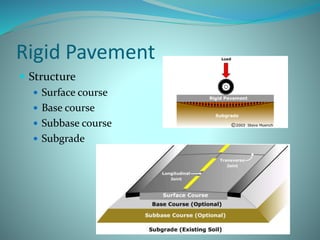
Rigid Pavement
 Structure
 Surface course
 Base course
 Subbase course
 Subgrade
Design Parameters for rigid pavement
1. Wheel load stresses :
Westergaard developed relationships for the stress at interior, edge and
corner regions, denoted as i; e; c in kg/cm2.
2. Temperature Stress :
Temperature stresses are developed in cement concrete
pavement due to variation in slab temperature.
This is caused by
(A) daily variation resulting in a temperature
gradient across the thickness of the slab and
(B) seasonal variation resulting in overall change in
the slab temperature.
The former results in warping stresses and the later in
Frictional stresses.
Design of joints
1. EXPANSION JOINTS :
The purpose of the expansion joint is to allow the
expansion of the pavement due to rise in temperature
with respect to construction temperature.
 The design consideration are:
 Provided along the longitudinal direction,
 design involves nding the joint spacing for a given
expansion joint thickness (say 2.5 cm specied by IRC)
subjected to some maximum spacing.
2. Contraction joints
 The purpose of the contaction joint is to allow the
contraction of the slab due to fall in slab temperature below
the construction temperature.
 The design considerations are:
 The movement is restricted by the sub-grade friction
 Design involves the length of the slab given by:
Lc =2* 10^4 Sc/W:f
Where,
 where, Sc is the allowable stress in tension in cement
concrete and is taken as 0.8 kg/cm2, W is the unit weight of
the concrete which can be taken as 2400 kg/cm3 and
 f is the coecient of sub-grade friction which can be taken as
1.5.
Computation of design traffic
a=p(1+r)^(n+x)
Where,
a= no. of commercial vechiles per day for design
p= no. of commercial vechiles per day last count
r=annual growth rate of commercial traffic
n=no. of years between last count and year of
completion of construction
Selection Factors Of Pavements
 Initial cost
 Availability of good materials
 Cost of maintenance
 Environmental conditions
 Availability of industrial wastes
 Traffic intensity
 Ease of labour
 Favourable working conditions
Requirement Of Good Pavement
It should be Economical.
It should be cheap and durable.
Ease to construct.
Good surface finish.
Eaisly visible marks on the pavements.
It should have low maintenance cost.
It should provide good visibility in night.
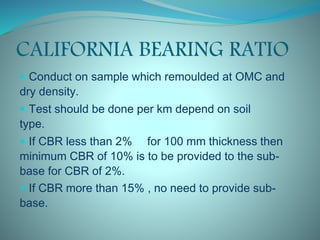
CALIFORNIA BEARING RATIO
 Conduct on sample which remoulded at OMC and
dry density.
 Test should be done per km depend on soil
type.
 If CBR less than 2% for 100 mm thickness then
minimum CBR of 10% is to be provided to the sub-
base for CBR of 2%.
 If CBR more than 15% , no need to provide sub-
base.
Pavement design

Pavement design

  • 1.
    SUBMITTED BY : GARVITGOYAL B.TECH 4TH YEAR CIVIL BRANCH
  • 3.
    CONTENT INTRODUCTION TYPES OF PAVEMENTS (a)Flexible pavements (b) Rigid pavements © Semi rigid pavements  Design factors  Reqirement of good pavement California bearing ratio (CBR)
  • 4.
    Introduction  Pavement designis the major component in the road construction.  Nearly one-third or one-half of the total cost of construction , so careful consideration should be taken in design of pavement.  For the better road condition ,good pavement is used can eaisly bear the load as well eaisly transmit the load.  Flexible pavement has shorter life span as compared to rigid pavements.
  • 5.
    Type of pavements FLEXIBLEPAVEMENT RIGID PAVEMENT SEMI-RIGID PAVEMENT
  • 6.
    Flexible Pavements Flexible pavemantsare those pavements which are flexible under the action of load. Bituminous is one of the best flexible pavement material. Flexible pavement transmit the vertical stress to the lower layers. Flexible pavement is form in layers , so first layer is form strong as compared to other. It consist of 4 parts soil subgrade, subbase ,base course ,surface course.
  • 7.
    Flexible Pavement  Structure Surface course  Base course  Subbase course  Subgrade
  • 8.
    Design parameters forFlexible Pavements 1.VDF(Visual display factor) It is a multiplier which converts the number of commericial vechiles of different axle loads and axle configuration to the number of standard load repetitions. 2. SUB GRADE:  IT Should be well compacted in cutting as well as filling .  Strength is assesed in terms of CBR value.
  • 9.
    3. Traffic  Asper the IRC:37 design traffic should be 0.1 msa to 2 msa (million standard axles).  Weight of commercial vehicle (laden) is considered as 3 tonnes or more.  For design traffic we consider the existing traffic and rate of growth.
  • 10.
    4. Design life The no. of years to be taken until the major reconstruction.  Design life depend upon the environmental conditions, materials used ,maintenance etc.  For rural roads design life of 10 years is considered.  In low volume roads for the thin bituminous surfacing design life of 5 years is considered.
  • 11.
  • 12.
    Rigid Pavements Rigid pavementsare those pavements whose surface is hard This pavement is not transferd the load from ground surface to lower suface. Rigid Pavement has the capacity to transfer the wheel load from wider area of roads. Rigid pavement is formed either of opc slabs or cement conrete .
  • 13.
    Rigid Pavement  Structure Surface course  Base course  Subbase course  Subgrade
  • 15.
    Design Parameters forrigid pavement 1. Wheel load stresses : Westergaard developed relationships for the stress at interior, edge and corner regions, denoted as i; e; c in kg/cm2.
  • 16.
    2. Temperature Stress: Temperature stresses are developed in cement concrete pavement due to variation in slab temperature. This is caused by (A) daily variation resulting in a temperature gradient across the thickness of the slab and (B) seasonal variation resulting in overall change in the slab temperature. The former results in warping stresses and the later in Frictional stresses.
  • 17.
    Design of joints 1.EXPANSION JOINTS : The purpose of the expansion joint is to allow the expansion of the pavement due to rise in temperature with respect to construction temperature.  The design consideration are:  Provided along the longitudinal direction,  design involves nding the joint spacing for a given expansion joint thickness (say 2.5 cm specied by IRC) subjected to some maximum spacing.
  • 18.
    2. Contraction joints The purpose of the contaction joint is to allow the contraction of the slab due to fall in slab temperature below the construction temperature.  The design considerations are:  The movement is restricted by the sub-grade friction  Design involves the length of the slab given by: Lc =2* 10^4 Sc/W:f Where,  where, Sc is the allowable stress in tension in cement concrete and is taken as 0.8 kg/cm2, W is the unit weight of the concrete which can be taken as 2400 kg/cm3 and  f is the coecient of sub-grade friction which can be taken as 1.5.
  • 19.
    Computation of designtraffic a=p(1+r)^(n+x) Where, a= no. of commercial vechiles per day for design p= no. of commercial vechiles per day last count r=annual growth rate of commercial traffic n=no. of years between last count and year of completion of construction
  • 20.
    Selection Factors OfPavements  Initial cost  Availability of good materials  Cost of maintenance  Environmental conditions  Availability of industrial wastes  Traffic intensity  Ease of labour  Favourable working conditions
  • 21.
    Requirement Of GoodPavement It should be Economical. It should be cheap and durable. Ease to construct. Good surface finish. Eaisly visible marks on the pavements. It should have low maintenance cost. It should provide good visibility in night.
  • 22.
    CALIFORNIA BEARING RATIO Conduct on sample which remoulded at OMC and dry density.  Test should be done per km depend on soil type.  If CBR less than 2% for 100 mm thickness then minimum CBR of 10% is to be provided to the sub- base for CBR of 2%.  If CBR more than 15% , no need to provide sub- base.