This document summarizes several cognitive learning theories:
- Allan Paivio's Dual Coding Theory which posits that people process information visually and verbally.
- Robert Gagne identified 5 categories of learning like verbal information, intellectual skills, and motor skills.
- Howard Gardner's Theory of Multiple Intelligences which identified 8 types of intelligence like linguistic and interpersonal.
- Benjamin Bloom concluded that every child has the ability to learn based on his research into the cognitive domain.
The cognitive theory views thinking and remembering as behaviors that can be analyzed to measure their effect on learning. It is interested in how people understand material.
In this document
Powered by AI
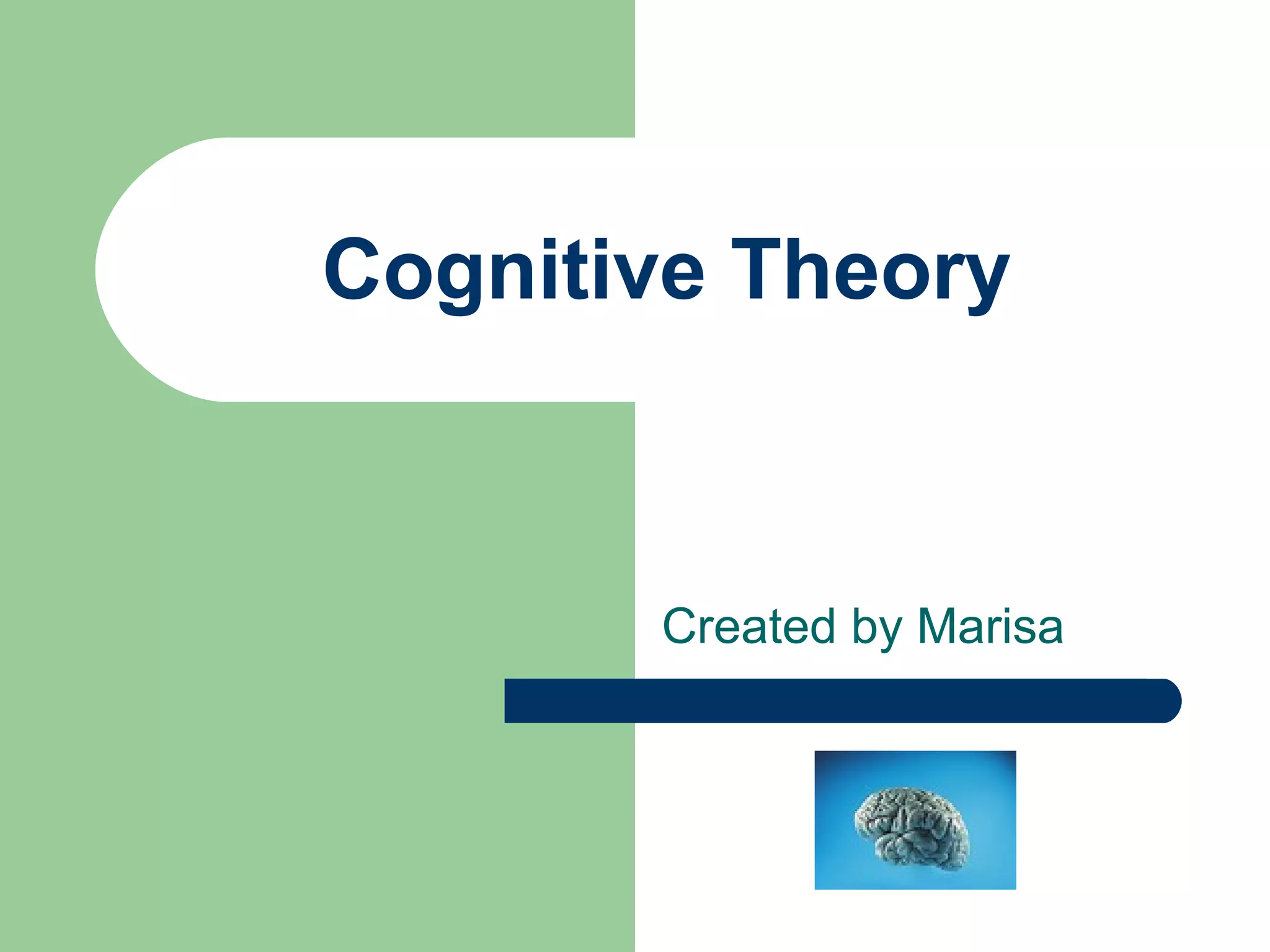
Presentation of cognitive theory and its creator, Marisa.
Allan Paivio's Dual Coding Theory enhances memory through visual and verbal information processing.
Robert Gagne's 5 learning categories: Verbal Information, Intellectual Skills, Cognitive Strategies, Motor Skills, and Attitudes.
Howard Gardner's theory identifies 8 intelligences and emphasizes individual dominance levels in intelligences.
Benjamin Bloom defines cognitive domain relating to what students know and how they organize their thoughts.
Overview of cognitive theory’s focus on thinking, remembering, and the importance of learning capacity.
Encouragement of active participation in learning, considering different learning styles, and enhancing intelligences.
Personal commitment to implementing cognitive learning in lesson plans emphasizing active participation.
References used in the presentation for cognitive theories of learning.
List of photo resources with attributions for visual support in the presentation.
Allan Paivio
Proposed that presenting information in both
visual and verbal form enhances recall and
recognition (Shelly, Gunter, & Gunter, 2012).
Dual Coding Theory: assumes that people
process information in two different ways;
processing of images and processing of
languages. (Shelly, et al., 2012).
3.
Robert Gagne
Came up with 5 categories of learning (Shelly, et
al., 2012).
1. Verbal Information: can state what has been heard
2. Intellectual Skills: can discriminate between facts
and follow directions
3. Cognitive Strategies: reads books
4. Motor Skills: can use a mouse
5. Attitudes: learners enjoy reading
4.
Howard Gardner
Theory of multiple Intelligences
Gardner has identified 8 intelligences:
linguistic, logical, spatial, kinesthetic,
musical, interpersonal, intrapersonal, and
naturalist
He believes that an individual is capable of
having all 8 intelligences, but some
intelligences will be more dominant than
others (Shelly, et al., 2012).
5.
Benjamin Bloom
Shelly (2012) says that Bloom defined the
cognitive domain as a students’ intellectual
level, in other words, what students know
and how they organize ideas and thoughts.
From Bloom’s research, he concluded that
every child has the ability to learn.
6.
Key Points ofthe Theory
Shelly (2012) stated that, “According to the
cognitive theory, activities like thinking and
remembering seem like a behavior, thus
providing an avenue to use behavior analysis
to measure their effect on learning”(p.261).
Atherton (2011) says cognitive theory is
interested in how people understand
material.
Aptitude and capacity to learn
7.
Classroom Implications
Students need to stray away from lecturing
and get the students to actively participate.
Teachers should understand and incorporate
different learning styles.
Each student has a different type of
intelligence. They should use their dominant
intelligence, while also working to improve
their non dominant intelligences.
8.
What I thinkabout the Theory
As a teacher I will incorporate cognitive
learning into my lesson plans. I believe that
students gain from classroom participation. I
will find ways to incorporate different learning
styles to benefit every child. I strongly stress
this theory over behaviorism. Students are
NOT just “programmed animals” that merely
respond to environmental stimuli.
9.
References
– Atherton J S (2011) Learning and
Teaching; Cognitive theories of learning [On-
line: UK] retrieved 12 November 2012 from
http://www.learningandteaching.info/learning/cog
nitive.htm
– Teachers Discovering Computers: Integrating
Technology in a Connected World (7th Ed.), Shelly,
Cashman, Gunter, and Gunter (2012).
10.
Photo Resources
http://www.flickr.com/creativecommons
1. Taken by Aban Nesta taken on December
21, 2006
2. Taken by Kerry Ball on August 15, 2008
3. Taken by Nikki Jane on July 17, 2008
![References
– Atherton J S (2011) Learning and
Teaching; Cognitive theories of learning [On-
line: UK] retrieved 12 November 2012 from
http://www.learningandteaching.info/learning/cog
nitive.htm
– Teachers Discovering Computers: Integrating
Technology in a Connected World (7th Ed.), Shelly,
Cashman, Gunter, and Gunter (2012).](https://image.slidesharecdn.com/cognitivetheoryppt-121112230627-phpapp02/75/Cognitive-theory-ppt-9-2048.jpg)