Somayeh Kheirandish, Mahsa liaghat, Tengku Mohd Azahar & Adel Gohari
Geoinformatica - An International Journal (GIIJ), Volume (2) : Issue (1) : 2012 12
Comparison of Interpolation Methods in Prediction the Pattern of
Basal Stem Rot Diesease in Palm Oil Plantation
Somayeh Kheirandish somayehkheirandish@gmail.com
Faculty of Geoinformation and Real Estate
UniversityTechnology malaysia
Johour Bahru Malaysia,
Mahsa liaghat Mahsalia@yahoo.com
Faculty of Geoinformation and Real Estate
UniversityTechnology malaysia
Johour Bahru Malaysia,
Tengku Mohd Azahar azhar@inomaps.com.my
Universiti Kuala Lumpur MFI, Malaysia,
Adel Gohari Adel.Gohari@gmail.com
Faculty of Geoinformation and Real Estate
UniversityTechnology malaysia
Johour Bahru Malaysia,
Abstract
Basal Stem Rot is a diseases that caused by Ganoderma Boinense that is the most serious
disease for oil palm trees in Malaysia. The analysis of plant disease has been carried extensively
with the advancement in computer technology. Particularly, in terms of spatial and temporal, it is
very complicated to be processed. Furthermore, the application of GIS in plant disease analysis is
becoming more popular, precise and advance. In previous studies, Kriging has been used to
predict the pattern of BSR disease. In this study, two commonly used interpolation methods for
GIS, Kriging and Inverse Distance Weighting (IDW), are used to interpolate and predict the
pattern of Basal Stem Rot disease. Since the IDW method is an exact method and is more
accurate one, it was expected to see more accurate results. However, the accuracy results of
both methods are the same. Based on the characteristic of both methods and according to
advantages and disadvantages, the Inverse Distance Weighted is recommended in this study but,
for more informative data, Ordinary Kriging is suggested to be the preferable method to be used
as an alternative method.
Keywords: Inverse Distance Weighted, Kriging, Palm Oil
1. INTRODUCTION
About half of the world’s palm oil is produced in Malaysia. The oil palm is an important socio-
economic crop in Malaysia, with the value of oil palm products estimated at 10.8 million tons in
2000. Concerns about the impact of diseases on future competitiveness and sustainability of the
industry have surfaced. Fungal pathogens cause many diseases that strike oil palms. One of
these deadly diseases of oil palm in Malaysia is the Basal Stem Rot.There is not enough
information on the dynamics of the Basal Stem Rot disease in the system of production of palm
oil. The analysis of plant disease has been facilitated to a considerable area (Markom et al.,
2008). Although the advancement in computer technology has been substantial, the analysis,
particularly in spatial and temporal terms is a very complicated process. Furthermore, using GIS
in plant disease analysis is becoming more popular, precise and advanced. GIS can be used in
plant disease analysis in many ways. Interpolation is the process of creating estimated values of
a phenomenon (such as air temperature) from verified values of the same phenomenon. This
Somayeh Kheirandish, Mahsa liaghat, Tengku Mohd Azahar & Adel Gohari
Geoinformatica - An International Journal (GIIJ), Volume (2) : Issue (1) : 2012 13
method is commonly used in GIS to create maps depicting phenomena. Two widely used
interpolation methods for GIS are Kriging and Inverse Distance Weighting (IDW) which are used
to interpolate and predict the pattern of Basal Stem Rot disease in this study.Experiments were
conducted on an area of 10.88 ha (108800 m) at the MPOB (Malaysian Palm Oil Board) Teluk
Intan Research Station (3.49o N, 101.06o S) in Perak, Malaysia. (Tengku Mohd Azhar Bin Tuan
Dir, 2010).
Kriging provides a means of interpolating values for points not physically sampled using
knowledge about the underlying spatial relationships in a data set to do so. . Kriging is based on
regionalized variable theory, which provides an optimal interpolation estimate for a given
coordinate location, as well as a variance estimate for the interpolation value. Inverse distance
weighted interpolation is an exact method, using IDW to enforce the condition to influence
estimated value more by nearby points rather than farther away. It means that Inverse Distance
Weighting (IDW) points in nearest distance to the sample point give more weight when calculating
the mean. . Those measured values closest to the prediction location will have more influence on
the predicted value than those farther away. Thus, IDW assumes that each measured point has a
local influence that diminishes with distance. (Chang, 2010).
2. STUDY AREA
Experiments were conducted on an area of 10.88 ha (108800 m) at the MPOB (Malaysian Palm
Oil Board) Teluk Intan Research Station (3.49o N, 101.06o S) in Perak, Malaysia. The study area
is mostly flat and lies mostly between 5 to 8 meters above sea level. The site receives a
moderately high and uniformly distributed rainfall and has a high soil water table. Between 1990
and 2001, the annual rainfall at the site varied from 1696 to 2404 mm with the driest month being
July and the wettest, November. The soil is characterized with very deep (above 3 meters) peat,
comprised of a heterogeneous mixture of decomposed plant (humus) material that has
accumulated in a water-saturated environment and in the absence of oxygen (Markom et.al,
2009).
2. METHODOLOGY
Kriging involves an interactive investigation of the spatial behavior of the phenomenon before
generating the output surface. It is based on the regionalized variable theory, which assumes that
the spatial variation in the phenomenon is statistically homogeneous throughout the surface; that
is, the same pattern of variation can be observed at all locations on the surface. This hypothesis
of spatial homogeneity is fundamental to the regionalized variable theory. Indeed, Inverse
Distance Weighting (IDW) is an interpolation technique in which interpolated estimates are made
based on values at nearby locations weighted only by distance from the interpolation location.
This technique determines cell values using a linearly weighted combination of a set of sample
points. The weight is a function of inverse distance. IDW allows the user to control the
significance of known points upon the interpolated values, based upon their distance from the
output point (Chang, 2010).
The data is divided to training data which include 70% of all data and testing data which is 30% of
all data. (Norman, 1975).The output of training (70%) data of using Inverse Distance weighted
and Ordinary Kriging is in continuous raster format, while, the selected testing (30% ) data is
still in two classes (0 and 1) and vector format.
Somayeh Kheirandish, Mahsa liaghat, Tengku Mohd Azahar & Adel Gohari
Geoinformatica - An International Journal (GIIJ), Volume (2) : Issue (1) : 2012 14
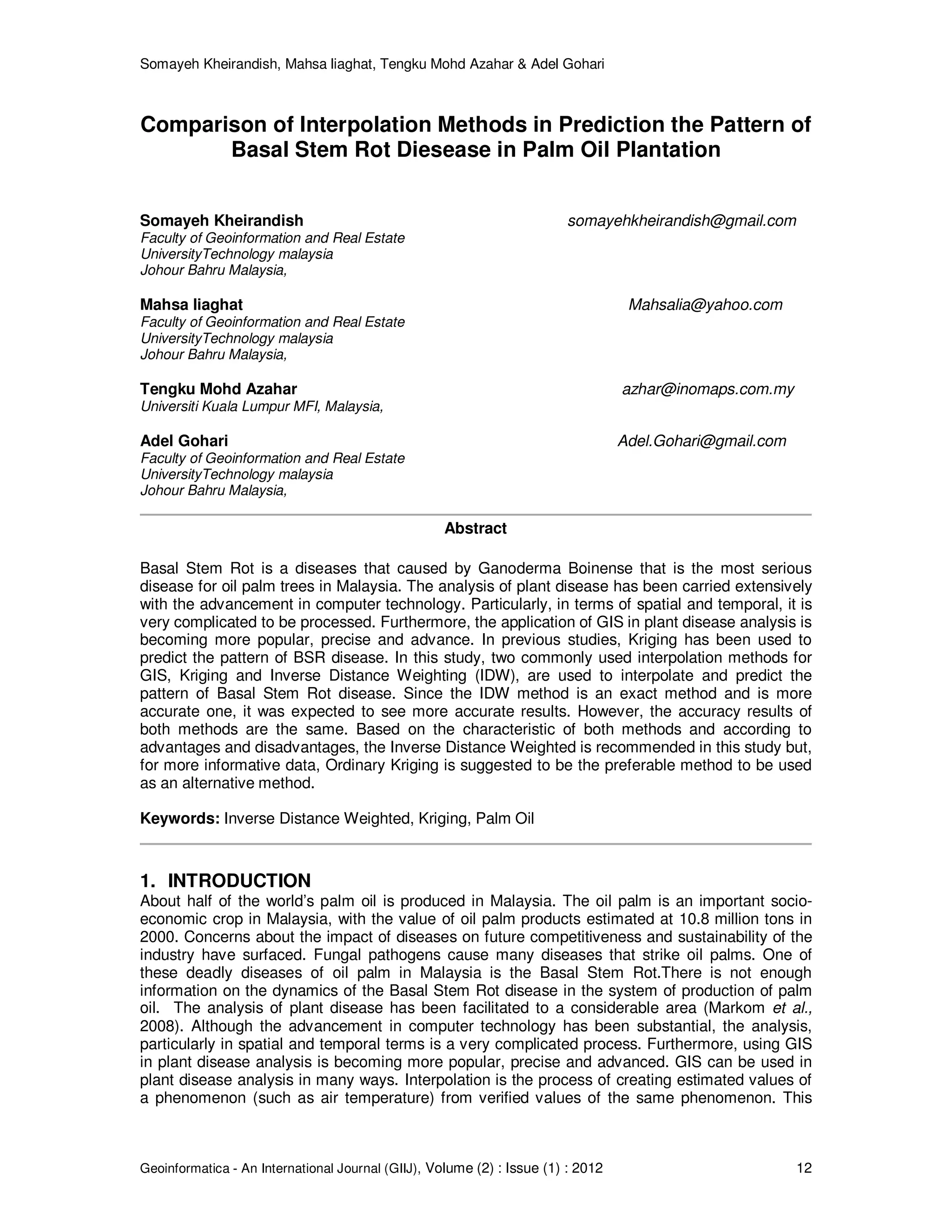
FIGURE 1: Sample testing and training data
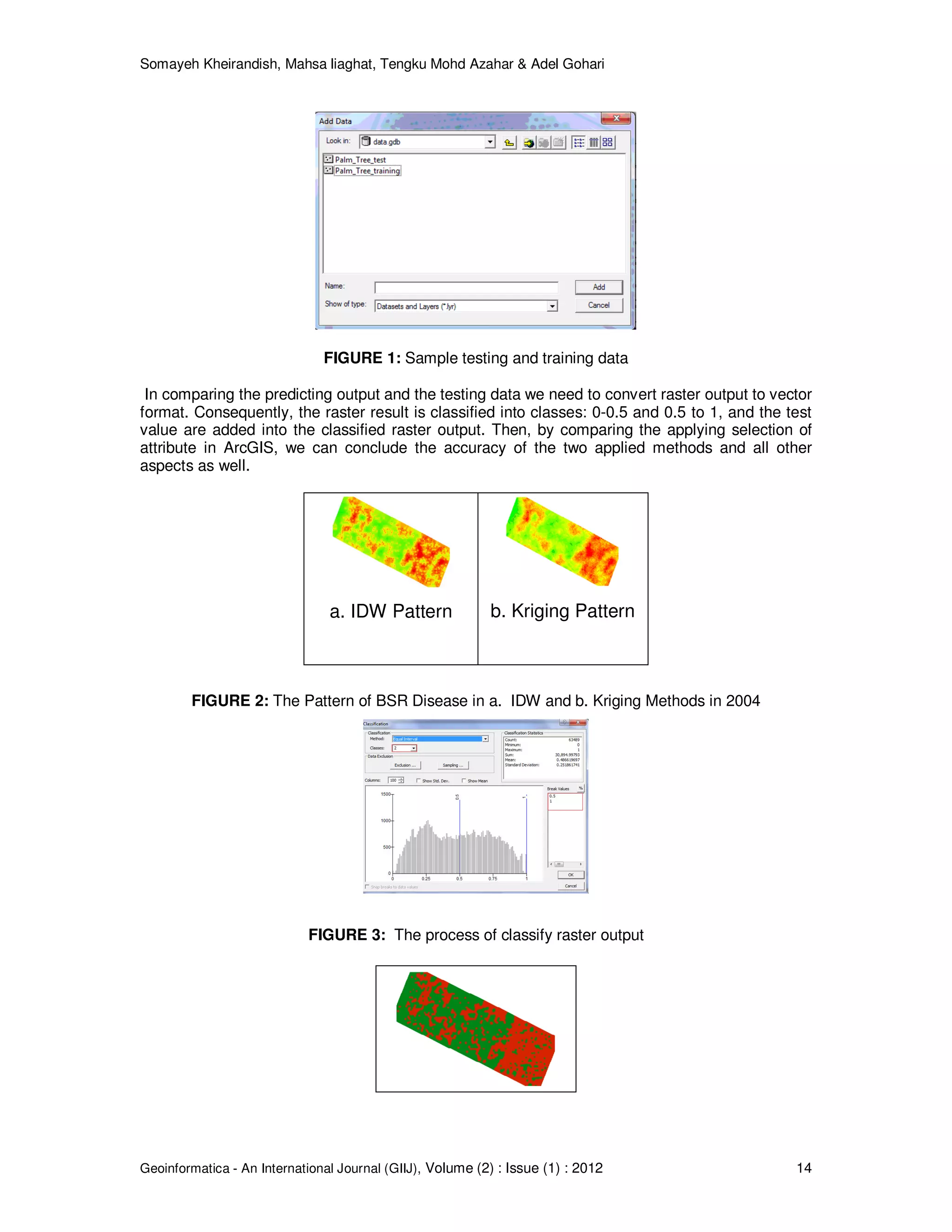
In comparing the predicting output and the testing data we need to convert raster output to vector
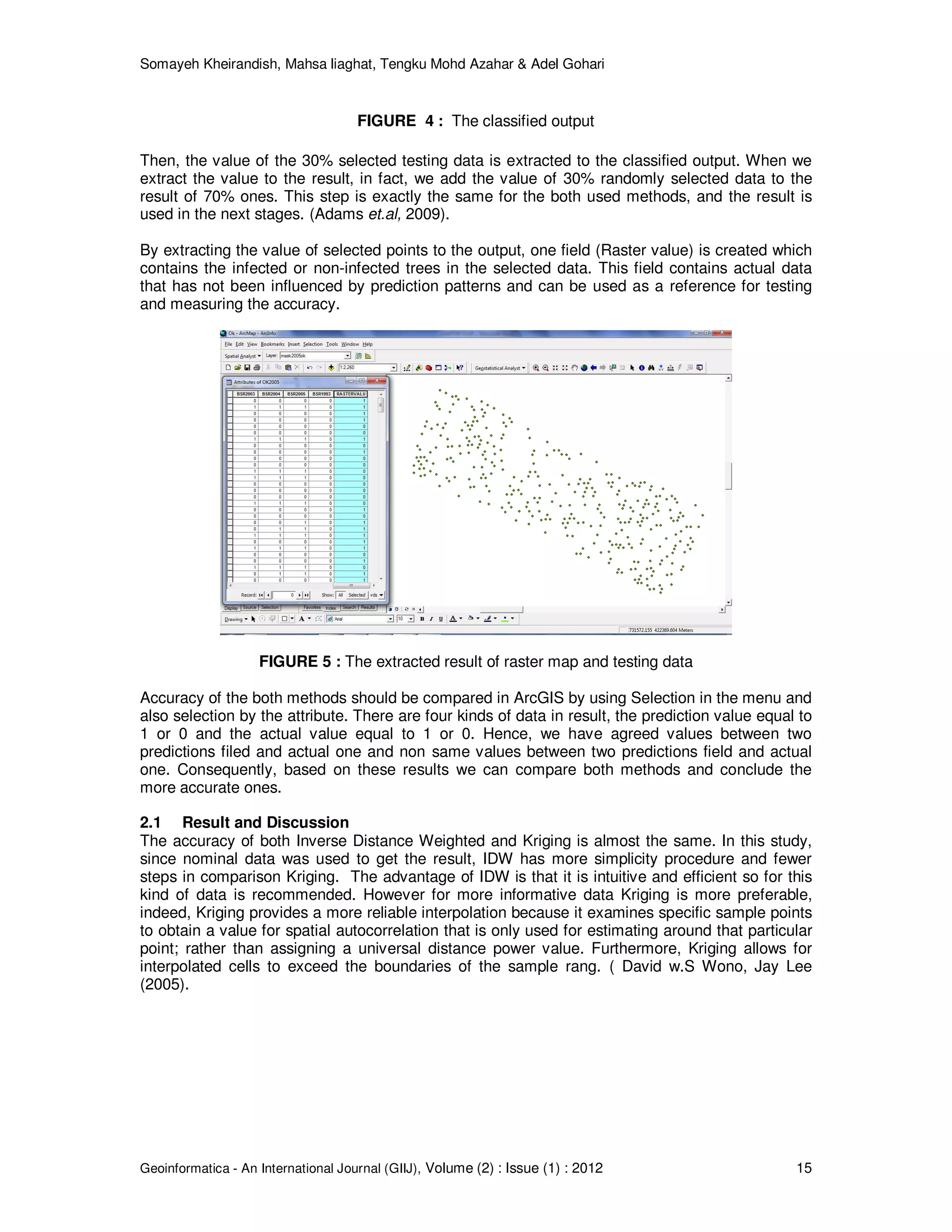
format. Consequently, the raster result is classified into classes: 0-0.5 and 0.5 to 1, and the test
value are added into the classified raster output. Then, by comparing the applying selection of
attribute in ArcGIS, we can conclude the accuracy of the two applied methods and all other
aspects as well.
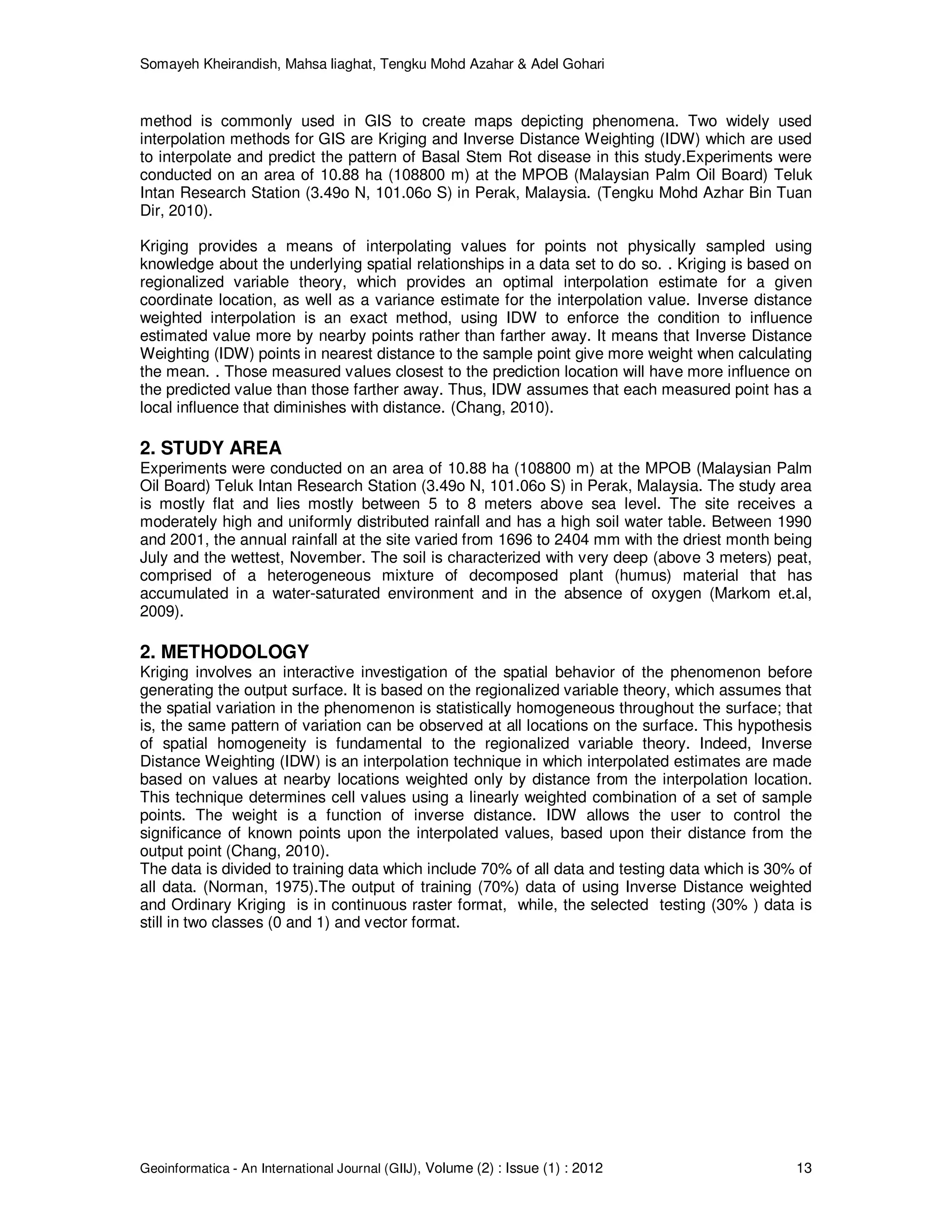
a. IDW Pattern b. Kriging Pattern
FIGURE 2: The Pattern of BSR Disease in a. IDW and b. Kriging Methods in 2004
FIGURE 3: The process of classify raster output
Somayeh Kheirandish, Mahsa liaghat, Tengku Mohd Azahar & Adel Gohari
Geoinformatica - An International Journal (GIIJ), Volume (2) : Issue (1) : 2012 15
FIGURE 4 : The classified output
Then, the value of the 30% selected testing data is extracted to the classified output. When we
extract the value to the result, in fact, we add the value of 30% randomly selected data to the
result of 70% ones. This step is exactly the same for the both used methods, and the result is
used in the next stages. (Adams et.al, 2009).
By extracting the value of selected points to the output, one field (Raster value) is created which
contains the infected or non-infected trees in the selected data. This field contains actual data
that has not been influenced by prediction patterns and can be used as a reference for testing
and measuring the accuracy.
FIGURE 5 : The extracted result of raster map and testing data
Accuracy of the both methods should be compared in ArcGIS by using Selection in the menu and
also selection by the attribute. There are four kinds of data in result, the prediction value equal to
1 or 0 and the actual value equal to 1 or 0. Hence, we have agreed values between two
predictions filed and actual one and non same values between two predictions field and actual
one. Consequently, based on these results we can compare both methods and conclude the
more accurate ones.
2.1 Result and Discussion
The accuracy of both Inverse Distance Weighted and Kriging is almost the same. In this study,
since nominal data was used to get the result, IDW has more simplicity procedure and fewer
steps in comparison Kriging. The advantage of IDW is that it is intuitive and efficient so for this
kind of data is recommended. However for more informative data Kriging is more preferable,
indeed, Kriging provides a more reliable interpolation because it examines specific sample points
to obtain a value for spatial autocorrelation that is only used for estimating around that particular
point; rather than assigning a universal distance power value. Furthermore, Kriging allows for
interpolated cells to exceed the boundaries of the sample rang. ( David w.S Wono, Jay Lee
(2005).
Somayeh Kheirandish, Mahsa liaghat, Tengku Mohd Azahar & Adel Gohari
Geoinformatica - An International Journal (GIIJ), Volume (2) : Issue (1) : 2012 16
0%
20%
40%
60%
80%
100%
1993 1995 1997 1999 2001 2003 2005
Years
Percentageofaccuracy
Kriging
IDW
FIGURE 6: Agree values in Kriging and IDW methods (Accuracy of Methods)
REFERENCES
[1] Adams Niall, Robardet Celin, sibes Arno 2009, Advances in Intelligent Data Analysis VII,
Advanced in intelligent data analysis, Springer ISBN 3642039146, 9783642039140,( pp. 90-
101).
[2] Chang, Kang-tsung Introduction to geographic Information Systems (5th ed.) New York,
Thomas D.Timp. (2010), pp. 327-340
[3] David w.S Wono,Jay Lee (2005), Statistical Analysis of Geographic Information with Arcview
GIS and ArcGIS, Canada, John wiley&Sons,Inc., Hobken, New Jersey.
[4] Markom, M. A,Md Shakaff . A. Y,Adom . A. Y, M.N. Ahmad,. Abdullah, A.H The Feasibility
Study of Utilizing Electronic Nose and ANN for Plant Malaise Detection, Malaysian
Universities Conferences on Engineering and Technolog , 2008,
[5] J.E. Bourne. “Synthetic structure of industrial plastics,” in Plastics, 2nd ed., vol. 3. J. Peters,
Ed. New York: McGraw-Hill, 1964, pp.15-67.
[6] Tengku Mohd Azhar Bin Tuan DirSpatial and Hotspots Analysis of Basal Stem Rot Disease in
Oil Palm Plantations: An analysis on peat soil , PN-191 International Journal of Engineering &
Technology IJET-IJENS , (2009),

Comparison of Interpolation Methods in Prediction the Pattern of Basal Stem Rot Diesease in Palm Oil Plantation

  • 1.
    Somayeh Kheirandish, Mahsaliaghat, Tengku Mohd Azahar & Adel Gohari Geoinformatica - An International Journal (GIIJ), Volume (2) : Issue (1) : 2012 12 Comparison of Interpolation Methods in Prediction the Pattern of Basal Stem Rot Diesease in Palm Oil Plantation Somayeh Kheirandish somayehkheirandish@gmail.com Faculty of Geoinformation and Real Estate UniversityTechnology malaysia Johour Bahru Malaysia, Mahsa liaghat Mahsalia@yahoo.com Faculty of Geoinformation and Real Estate UniversityTechnology malaysia Johour Bahru Malaysia, Tengku Mohd Azahar azhar@inomaps.com.my Universiti Kuala Lumpur MFI, Malaysia, Adel Gohari Adel.Gohari@gmail.com Faculty of Geoinformation and Real Estate UniversityTechnology malaysia Johour Bahru Malaysia, Abstract Basal Stem Rot is a diseases that caused by Ganoderma Boinense that is the most serious disease for oil palm trees in Malaysia. The analysis of plant disease has been carried extensively with the advancement in computer technology. Particularly, in terms of spatial and temporal, it is very complicated to be processed. Furthermore, the application of GIS in plant disease analysis is becoming more popular, precise and advance. In previous studies, Kriging has been used to predict the pattern of BSR disease. In this study, two commonly used interpolation methods for GIS, Kriging and Inverse Distance Weighting (IDW), are used to interpolate and predict the pattern of Basal Stem Rot disease. Since the IDW method is an exact method and is more accurate one, it was expected to see more accurate results. However, the accuracy results of both methods are the same. Based on the characteristic of both methods and according to advantages and disadvantages, the Inverse Distance Weighted is recommended in this study but, for more informative data, Ordinary Kriging is suggested to be the preferable method to be used as an alternative method. Keywords: Inverse Distance Weighted, Kriging, Palm Oil 1. INTRODUCTION About half of the world’s palm oil is produced in Malaysia. The oil palm is an important socio- economic crop in Malaysia, with the value of oil palm products estimated at 10.8 million tons in 2000. Concerns about the impact of diseases on future competitiveness and sustainability of the industry have surfaced. Fungal pathogens cause many diseases that strike oil palms. One of these deadly diseases of oil palm in Malaysia is the Basal Stem Rot.There is not enough information on the dynamics of the Basal Stem Rot disease in the system of production of palm oil. The analysis of plant disease has been facilitated to a considerable area (Markom et al., 2008). Although the advancement in computer technology has been substantial, the analysis, particularly in spatial and temporal terms is a very complicated process. Furthermore, using GIS in plant disease analysis is becoming more popular, precise and advanced. GIS can be used in plant disease analysis in many ways. Interpolation is the process of creating estimated values of a phenomenon (such as air temperature) from verified values of the same phenomenon. This
  • 2.
    Somayeh Kheirandish, Mahsaliaghat, Tengku Mohd Azahar & Adel Gohari Geoinformatica - An International Journal (GIIJ), Volume (2) : Issue (1) : 2012 13 method is commonly used in GIS to create maps depicting phenomena. Two widely used interpolation methods for GIS are Kriging and Inverse Distance Weighting (IDW) which are used to interpolate and predict the pattern of Basal Stem Rot disease in this study.Experiments were conducted on an area of 10.88 ha (108800 m) at the MPOB (Malaysian Palm Oil Board) Teluk Intan Research Station (3.49o N, 101.06o S) in Perak, Malaysia. (Tengku Mohd Azhar Bin Tuan Dir, 2010). Kriging provides a means of interpolating values for points not physically sampled using knowledge about the underlying spatial relationships in a data set to do so. . Kriging is based on regionalized variable theory, which provides an optimal interpolation estimate for a given coordinate location, as well as a variance estimate for the interpolation value. Inverse distance weighted interpolation is an exact method, using IDW to enforce the condition to influence estimated value more by nearby points rather than farther away. It means that Inverse Distance Weighting (IDW) points in nearest distance to the sample point give more weight when calculating the mean. . Those measured values closest to the prediction location will have more influence on the predicted value than those farther away. Thus, IDW assumes that each measured point has a local influence that diminishes with distance. (Chang, 2010). 2. STUDY AREA Experiments were conducted on an area of 10.88 ha (108800 m) at the MPOB (Malaysian Palm Oil Board) Teluk Intan Research Station (3.49o N, 101.06o S) in Perak, Malaysia. The study area is mostly flat and lies mostly between 5 to 8 meters above sea level. The site receives a moderately high and uniformly distributed rainfall and has a high soil water table. Between 1990 and 2001, the annual rainfall at the site varied from 1696 to 2404 mm with the driest month being July and the wettest, November. The soil is characterized with very deep (above 3 meters) peat, comprised of a heterogeneous mixture of decomposed plant (humus) material that has accumulated in a water-saturated environment and in the absence of oxygen (Markom et.al, 2009). 2. METHODOLOGY Kriging involves an interactive investigation of the spatial behavior of the phenomenon before generating the output surface. It is based on the regionalized variable theory, which assumes that the spatial variation in the phenomenon is statistically homogeneous throughout the surface; that is, the same pattern of variation can be observed at all locations on the surface. This hypothesis of spatial homogeneity is fundamental to the regionalized variable theory. Indeed, Inverse Distance Weighting (IDW) is an interpolation technique in which interpolated estimates are made based on values at nearby locations weighted only by distance from the interpolation location. This technique determines cell values using a linearly weighted combination of a set of sample points. The weight is a function of inverse distance. IDW allows the user to control the significance of known points upon the interpolated values, based upon their distance from the output point (Chang, 2010). The data is divided to training data which include 70% of all data and testing data which is 30% of all data. (Norman, 1975).The output of training (70%) data of using Inverse Distance weighted and Ordinary Kriging is in continuous raster format, while, the selected testing (30% ) data is still in two classes (0 and 1) and vector format.
  • 3.
    Somayeh Kheirandish, Mahsaliaghat, Tengku Mohd Azahar & Adel Gohari Geoinformatica - An International Journal (GIIJ), Volume (2) : Issue (1) : 2012 14 FIGURE 1: Sample testing and training data In comparing the predicting output and the testing data we need to convert raster output to vector format. Consequently, the raster result is classified into classes: 0-0.5 and 0.5 to 1, and the test value are added into the classified raster output. Then, by comparing the applying selection of attribute in ArcGIS, we can conclude the accuracy of the two applied methods and all other aspects as well. a. IDW Pattern b. Kriging Pattern FIGURE 2: The Pattern of BSR Disease in a. IDW and b. Kriging Methods in 2004 FIGURE 3: The process of classify raster output
  • 4.
    Somayeh Kheirandish, Mahsaliaghat, Tengku Mohd Azahar & Adel Gohari Geoinformatica - An International Journal (GIIJ), Volume (2) : Issue (1) : 2012 15 FIGURE 4 : The classified output Then, the value of the 30% selected testing data is extracted to the classified output. When we extract the value to the result, in fact, we add the value of 30% randomly selected data to the result of 70% ones. This step is exactly the same for the both used methods, and the result is used in the next stages. (Adams et.al, 2009). By extracting the value of selected points to the output, one field (Raster value) is created which contains the infected or non-infected trees in the selected data. This field contains actual data that has not been influenced by prediction patterns and can be used as a reference for testing and measuring the accuracy. FIGURE 5 : The extracted result of raster map and testing data Accuracy of the both methods should be compared in ArcGIS by using Selection in the menu and also selection by the attribute. There are four kinds of data in result, the prediction value equal to 1 or 0 and the actual value equal to 1 or 0. Hence, we have agreed values between two predictions filed and actual one and non same values between two predictions field and actual one. Consequently, based on these results we can compare both methods and conclude the more accurate ones. 2.1 Result and Discussion The accuracy of both Inverse Distance Weighted and Kriging is almost the same. In this study, since nominal data was used to get the result, IDW has more simplicity procedure and fewer steps in comparison Kriging. The advantage of IDW is that it is intuitive and efficient so for this kind of data is recommended. However for more informative data Kriging is more preferable, indeed, Kriging provides a more reliable interpolation because it examines specific sample points to obtain a value for spatial autocorrelation that is only used for estimating around that particular point; rather than assigning a universal distance power value. Furthermore, Kriging allows for interpolated cells to exceed the boundaries of the sample rang. ( David w.S Wono, Jay Lee (2005).
  • 5.
    Somayeh Kheirandish, Mahsaliaghat, Tengku Mohd Azahar & Adel Gohari Geoinformatica - An International Journal (GIIJ), Volume (2) : Issue (1) : 2012 16 0% 20% 40% 60% 80% 100% 1993 1995 1997 1999 2001 2003 2005 Years Percentageofaccuracy Kriging IDW FIGURE 6: Agree values in Kriging and IDW methods (Accuracy of Methods) REFERENCES [1] Adams Niall, Robardet Celin, sibes Arno 2009, Advances in Intelligent Data Analysis VII, Advanced in intelligent data analysis, Springer ISBN 3642039146, 9783642039140,( pp. 90- 101). [2] Chang, Kang-tsung Introduction to geographic Information Systems (5th ed.) New York, Thomas D.Timp. (2010), pp. 327-340 [3] David w.S Wono,Jay Lee (2005), Statistical Analysis of Geographic Information with Arcview GIS and ArcGIS, Canada, John wiley&Sons,Inc., Hobken, New Jersey. [4] Markom, M. A,Md Shakaff . A. Y,Adom . A. Y, M.N. Ahmad,. Abdullah, A.H The Feasibility Study of Utilizing Electronic Nose and ANN for Plant Malaise Detection, Malaysian Universities Conferences on Engineering and Technolog , 2008, [5] J.E. Bourne. “Synthetic structure of industrial plastics,” in Plastics, 2nd ed., vol. 3. J. Peters, Ed. New York: McGraw-Hill, 1964, pp.15-67. [6] Tengku Mohd Azhar Bin Tuan DirSpatial and Hotspots Analysis of Basal Stem Rot Disease in Oil Palm Plantations: An analysis on peat soil , PN-191 International Journal of Engineering & Technology IJET-IJENS , (2009),