CLINICAL EXAMINATION
OF ELBOW JOINT


      Dr K. Anjaneyulu
      Prof & HOD of Orthopaedics
Gandhi Medical College / gandhi hospital
             Secunderabad
                                           1
The approach for clinical examination of
trauma cases differs from non traumatic
conditions

It also differs - acute injuries examination from
old neglected cases


                                                    2
• Hinge joint (Humero ulnar, Radiohumeral
                             Sup.Radioulnar)

• Common - childhood injuries

• Easily prone for stiffness

• Often neglected & inappropiately Rx

• Functional position - different - R – L
                                            3
COMMON COMPLAINTS
• Pain
• Swelling
• Stiffness
• Deformity
• Instability
• Paraesthaesias / neuro. manife
                                   4
HISTORY
•   Duration
•   Dominant Limb - Profession
•   H/O injury / consti. sympt.
•   H/o polyarthralgia / UTI
•   Rx History
•   H/o massage
•   Limitation of ADL
•   Referred pain from neck / shoulder
                                         5
PHYSICAL EXAMINATION
•   Inspection
•   Palpation
•   Movements
•   Measurements
•   Distal Neurovascular Status
•   Regional Lymphnodes
•   Thickening of Ulnar nerve
•   Special Tests
                                  6
ELBOW FRACTURES IN CHILDREN

• Neuro-motor exam may be limited by the
  child’s ability to cooperate because of age,
  pain, or fear.

• Thumb extension - EPL (radial – PIN branch)

• Thumb flexion - FPL (median – AIN branch)

• Cross fingers - Interossei (ulnar)

                                                 7
INSPECTION
• Attitude & deformity
• Carrying angle
• Swelling
  para olecranon area
  anconeus soft spot
  radiocapitellar joint
  general diffuse swelling - effusion (semiflexed elbow)
• Skin
  Sinuses, scars, oedema, engorged veins
• Muscle wasting

                                                        8
CARRYING ANGLE
MALE
  7 - 10 deg.
FEMALE
  10 - 15 deg.

Disappears on
pronation &
flexion of elbow

Compare with
opposite side
                            9
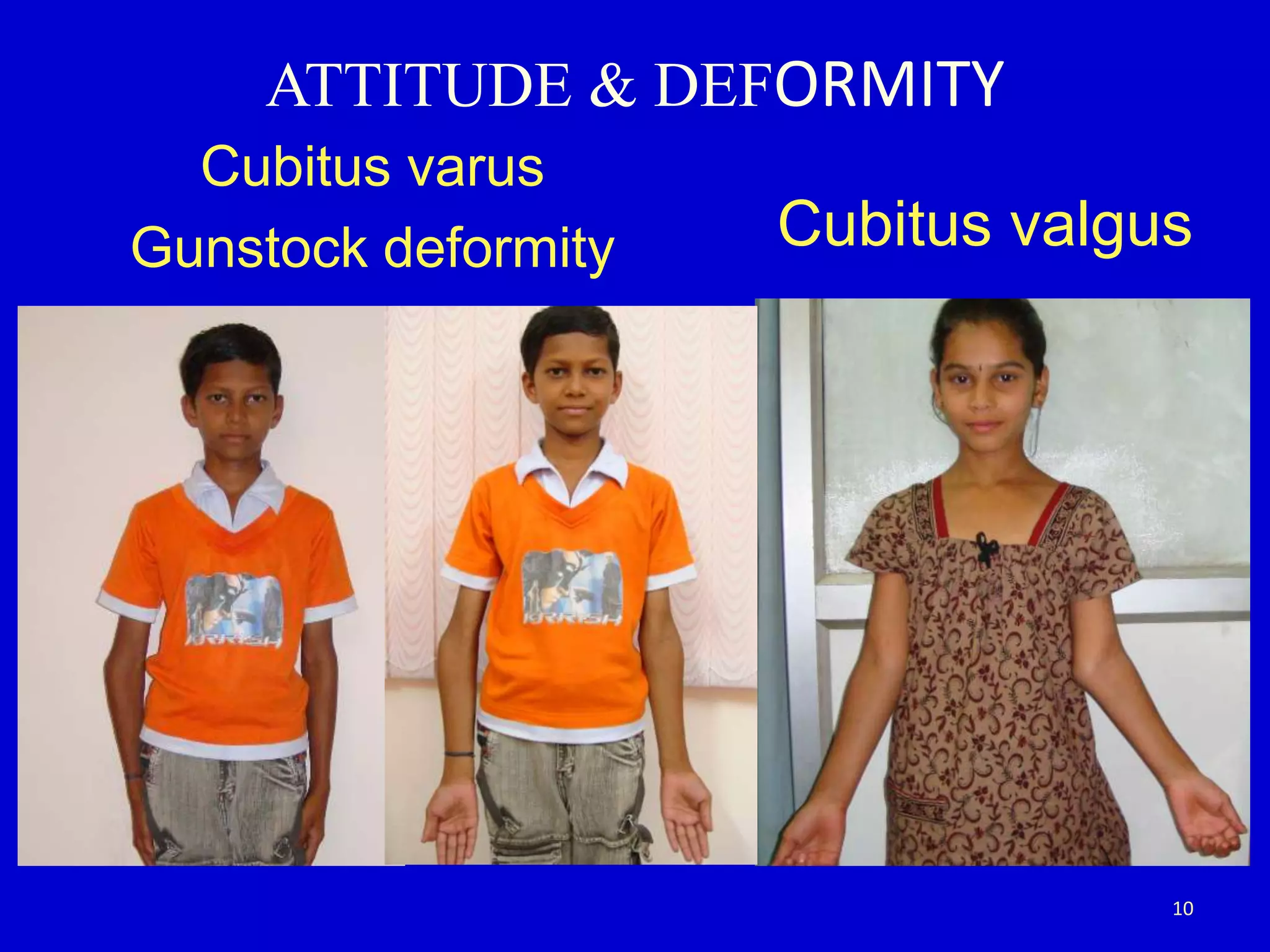
ATTITUDE & DEFORMITY
  Cubitus varus
Gunstock deformity   Cubitus valgus


                                  10
INSPECTION


             11
OLECRANON BURSITIS


                     12
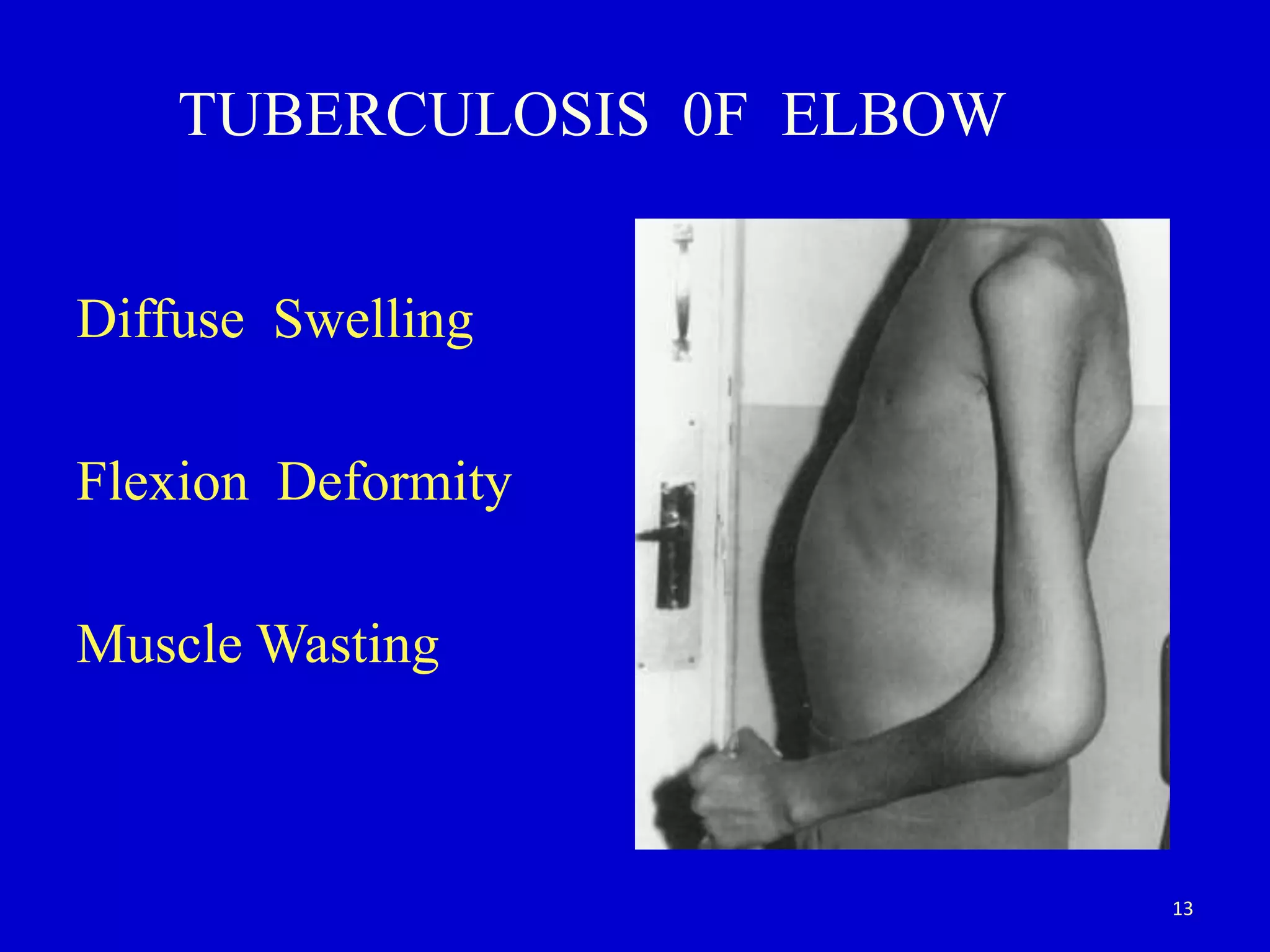
TUBERCULOSIS 0F ELBOW


Diffuse Swelling

Flexion Deformity

Muscle Wasting


                            13
PALPATION

•   Local rise of temperature
•   Tenderness
•   Bony components
•   Soft Tissue components
•   Ulnar nerve thickening
•   Supratrochlear lymph node

                                14
LOCAL RISE OF TEMPERATURE


    Infective - Pyogenic
               Tubercular
    Inflammatory - Polyarthritis
                    Acute Myositis
    Traumatic - Fresh injury - haematoma
                               oedema


                                           15
TENDERNESS
Maximum point of tenderness
    Lat. Epicondyle - Tennis elbow
    Med. Epicondyle - Golfer’s elbow
    Lower end of Humerus - S/C # Humerus
    Radial head - # Radial head
    Upper end of Ulna - Olecranon #


                                           16
PALPATION
BONY COMPONENTS
     irregularity, bowing, thickening
and steps
  Medial epicondyle
  Lateral epicondyle
  Olecranon
  Supracondylar ridges
  Radial head and capitellum (springing of forearm)
Soft Tissue
  Medial aspect
  Lateral aspect
  Posterior aspect
  Anterior aspect                                     17
THREE BONY POINT RELATIONSHIP
     COMPARE WITH OPPOSITE NORMAL ELBOW
    • Medial epicondyle     Extension
    • Lateral epicondyle
    • Olecranon


F
L
E
X
I
O
N
                                          18
PALPATION OF SUPRATROCHLEAR NODE

• Flex the Elbow to right angle to relax
                         surrounding structures
• Palpated on anterior surface of medial
          intermuscular septum 1 cm above the
                               medial epicondyle
• Not Palpable: Normal elbow, Traumatic causes
• Palpable : Unilateral or Bil (systemic)


                                               19
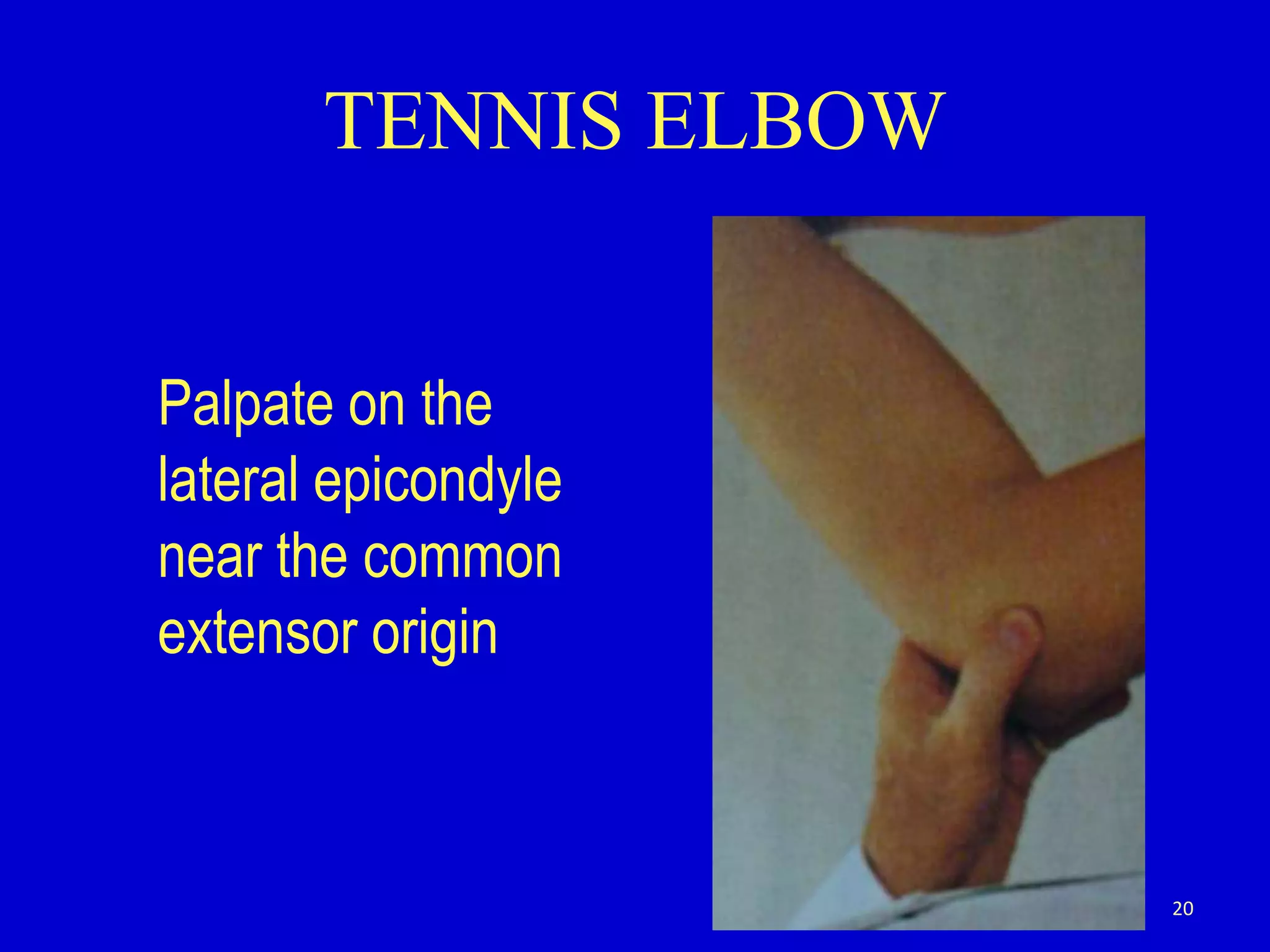
TENNIS ELBOW


Palpate on the
lateral epicondyle
near the common
extensor origin


                      20
PALPATION OF ULNAR NERVE


Palpate in the groove
behind the
Medial epicondyle


                             21
MOVEMENTS
ROM
Flexion      - 135
Extension    - 0

Supination   - 90
Pronation    - 90

                         22
FLEXION & EXTENSION


                      23
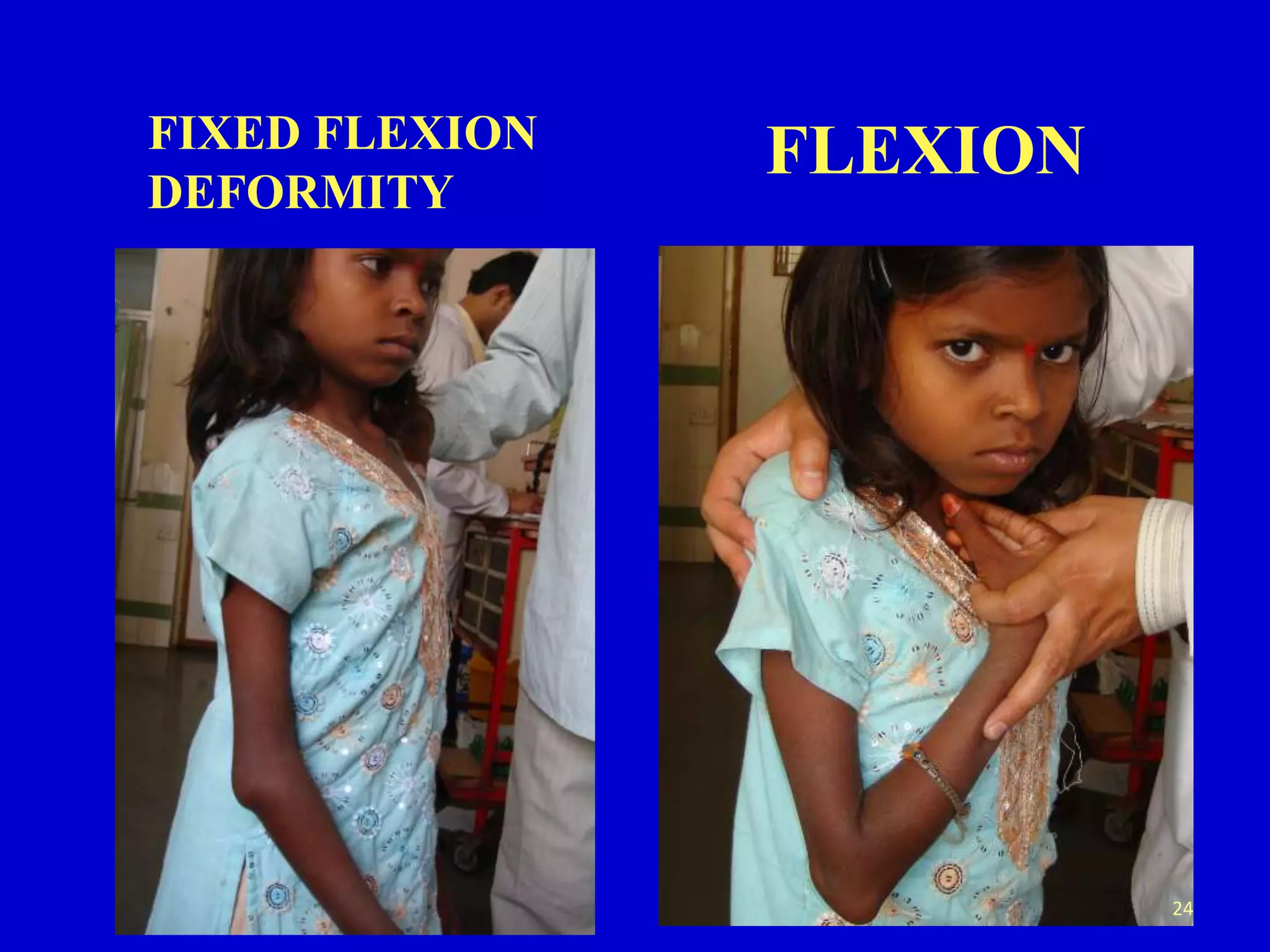
FIXED FLEXION   FLEXION
DEFORMITY


                          24
CRITICAL ANGLE OF FLEXION

The arc of flexion        30 – 110 deg

Inspite of some degree of morbidity with
partial limitation of motion a person will be
able to perform the day to day activities with
out much difficulty

                                                 25
HYPEREXTENSION


                 26
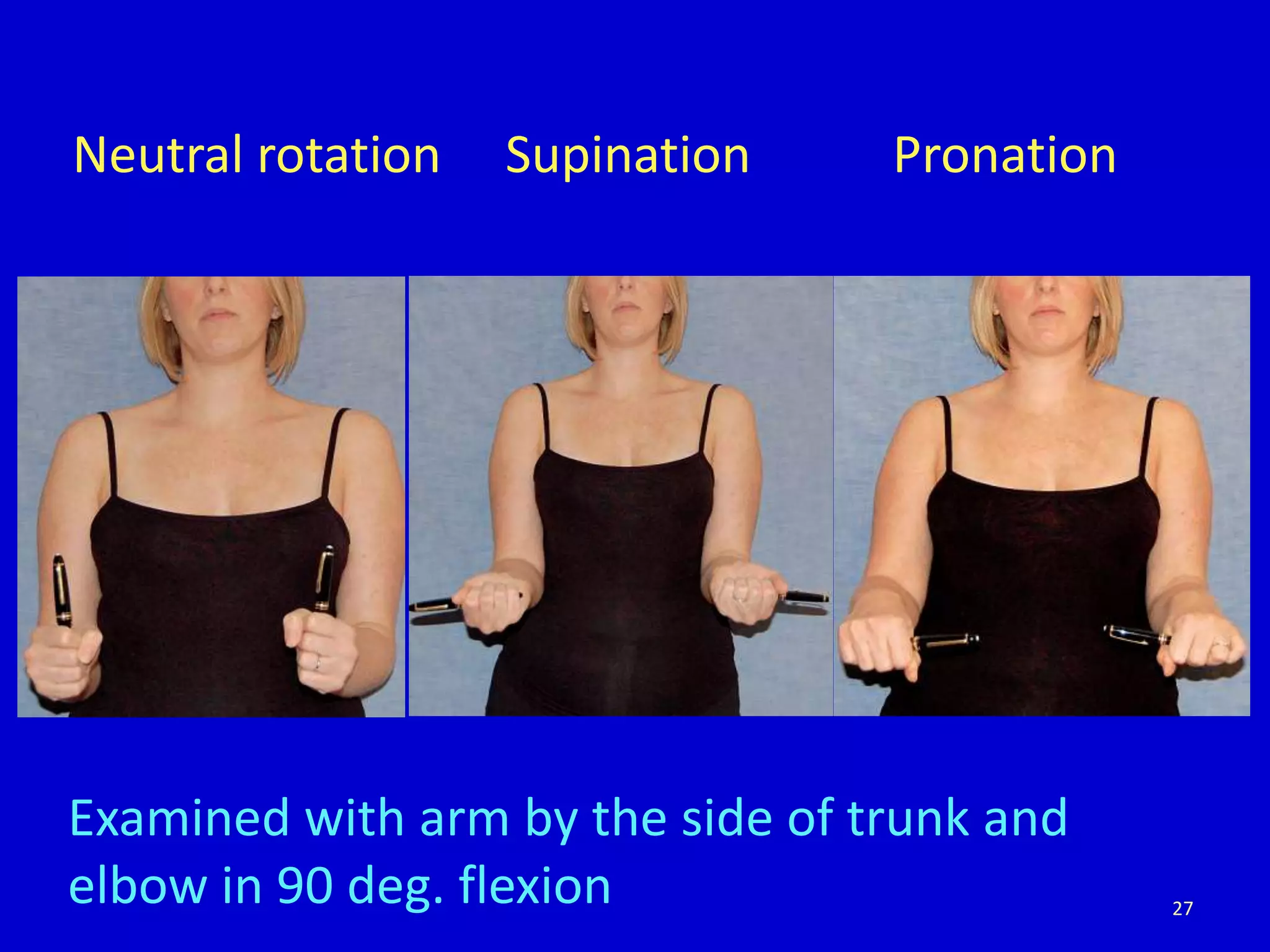
Neutral rotation   Supination     Pronation


Examined with arm by the side of trunk and
elbow in 90 deg. flexion                      27
SUPINATION   PRONATION


                         28
MEASUREMENTS
•   3 bony point relationship
•   Arm length & girth
•   Forearm length & girth
•   carrying angle – cannot be assessed in FFD


                                                 29
SPECIAL TESTS
Tests for Tennis Elbow
  • Mill’s Manouvre
  • Cozen’s Test
Bicipital Tendinitis
    Yergason’s sign
Tests for Ligamentous Laxity
  • Varus stress
  • Valgus stress
                               30
MILL’S MANOUVRE


Elbow flexed, Forearm slightly pronated & Wrist slightly
dorsiflexed
Patient tries to supinate the forearm against resistance
Produces pain at the elbow                              31
COZEN’S TEST

Dorsiflexion of the
wrist against
resistance with
elbow in flexion
causes pain at the
elbow

In TENNIS ELBOW


                              32
YERGASON’S TEST
FOR BICIPITAL TENDINITIS

Supination of the forearm against
 resistance with elbow at 90 deg.
 produces pain at the elbow


                                    33
VARUS STRESS TEST


                    34
VALGUS STRESS TEST


                     35
CONCLUDE BY FOLLOWING
• NEUROLOGICAL EXAMINATION
     Motor
     Sensory
     Thickening of ulnar nerve
• EXAMINATION of DISTAL PULSES
      Brachial
      Radial
• EXAMINATION OF CERVICAL SPINE

• EXAMINATION OF SHOULDER , WRIST,
                       OPPOSITE ELBOW

                                    36
PULLED ELBOW
• Children - 2 to 5 Yrs
• H/o lifting the child with extended elbows
• Continuous screaming – does not allow the
  elbow to be examined
• Due to subluxation of radial head from the
  annular ligament
• No obvious swelling or deformity
• X- ray – normal
• Reduction – instantaneous relief
                                               37
COMMON EXAM CASES

• Cubitus varus - malunited Supracondylar #

• Cubitus Valgus - Non Union of Lateral condyle
                      +/- Tardy Ulnar nerve Palsy

• Neglected Posterior Dislocation Elbow

• Ankylosed / Stiff Elbow
                      Trauma/Infection
                      Myositis Ossificans
                                                    38
CUBITUS VARUS
•   Gunstock deformity
•   Medial deviation of forearm
•   Thickening / irregularity of L/E of humerus
•   Sometimes difficult to identify lat.epicondyle
•   Relation of three bony points maintained
•   Downward Tilting of the triangle medially
•   Shortening of arm – forearm length equal
•   Hyperextension / limitation of flexion

                                                     39
CUBITUS VARUS


                40
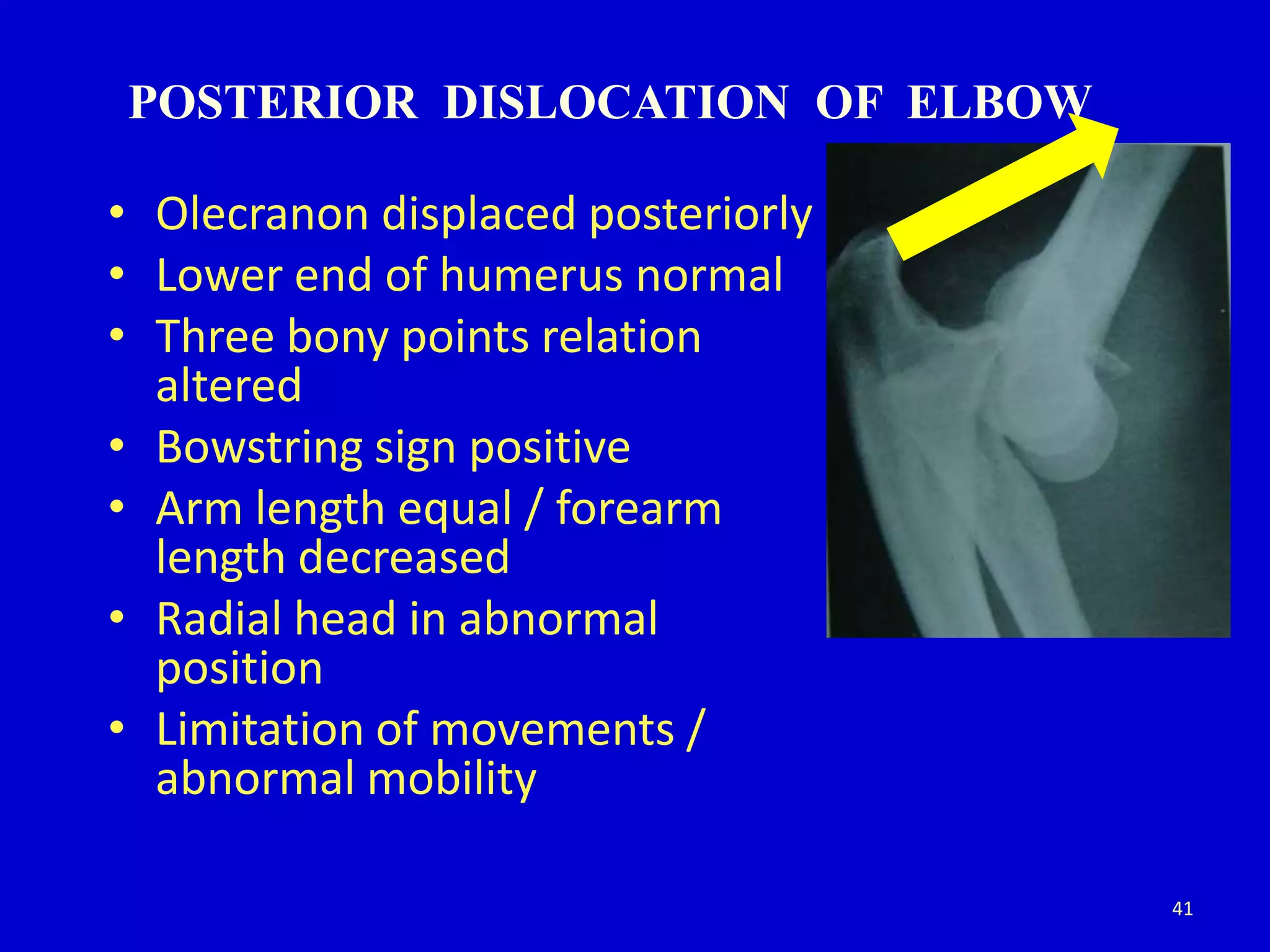
POSTERIOR DISLOCATION OF ELBOW

• Olecranon displaced posteriorly
• Lower end of humerus normal
• Three bony points relation
  altered
• Bowstring sign positive
• Arm length equal / forearm
  length decreased
• Radial head in abnormal
  position
• Limitation of movements /
  abnormal mobility

                                    41
# LATERAL CONDYLE HUMERUS

• Cubitus valgus deformity – increased carrying
• Lateral supracondylar ridge irregular/ stepping
• Medial supracondylar ridge normal
• Widening of interepicondylar distance
• Distance bet.lat.epicondyle and tip of
  olecranon increased
• Abnormal mobility of lat.cond - nonunion

                                                42
Cubitus valgus   Non Union Lat. Condyle #


                                        43
Fracture Lateral Condyle
Widening of interepicond. line


RIGHT


            LEFT          RIGHT


                                  44
MYOSITIS OSSIFICANS

• H/o injury (can form with or without fracture)

• H/o massage

• Irregular bony mass infront & behind of elbow

• Limitation of movts of elbow / ankylosis

                                                   45
Thank You for your kind attention
                                    46

Clinical examination of elbow joint

  • 1.
    CLINICAL EXAMINATION OF ELBOWJOINT Dr K. Anjaneyulu Prof & HOD of Orthopaedics Gandhi Medical College / gandhi hospital Secunderabad 1
  • 2.
    The approach forclinical examination of trauma cases differs from non traumatic conditions It also differs - acute injuries examination from old neglected cases 2
  • 3.
    • Hinge joint(Humero ulnar, Radiohumeral Sup.Radioulnar) • Common - childhood injuries • Easily prone for stiffness • Often neglected & inappropiately Rx • Functional position - different - R – L 3
  • 4.
    COMMON COMPLAINTS • Pain •Swelling • Stiffness • Deformity • Instability • Paraesthaesias / neuro. manife 4
  • 5.
    HISTORY • Duration • Dominant Limb - Profession • H/O injury / consti. sympt. • H/o polyarthralgia / UTI • Rx History • H/o massage • Limitation of ADL • Referred pain from neck / shoulder 5
  • 6.
    PHYSICAL EXAMINATION • Inspection • Palpation • Movements • Measurements • Distal Neurovascular Status • Regional Lymphnodes • Thickening of Ulnar nerve • Special Tests 6
  • 7.
    ELBOW FRACTURES INCHILDREN • Neuro-motor exam may be limited by the child’s ability to cooperate because of age, pain, or fear. • Thumb extension - EPL (radial – PIN branch) • Thumb flexion - FPL (median – AIN branch) • Cross fingers - Interossei (ulnar) 7
  • 8.
    INSPECTION • Attitude &deformity • Carrying angle • Swelling para olecranon area anconeus soft spot radiocapitellar joint general diffuse swelling - effusion (semiflexed elbow) • Skin Sinuses, scars, oedema, engorged veins • Muscle wasting 8
  • 9.
    CARRYING ANGLE MALE 7 - 10 deg. FEMALE 10 - 15 deg. Disappears on pronation & flexion of elbow Compare with opposite side 9
  • 10.
    ATTITUDE & DEFORMITY Cubitus varus Gunstock deformity Cubitus valgus 10
  • 11.
  • 12.
  • 13.
    TUBERCULOSIS 0F ELBOW DiffuseSwelling Flexion Deformity Muscle Wasting 13
  • 14.
    PALPATION • Local rise of temperature • Tenderness • Bony components • Soft Tissue components • Ulnar nerve thickening • Supratrochlear lymph node 14
  • 15.
    LOCAL RISE OFTEMPERATURE Infective - Pyogenic Tubercular Inflammatory - Polyarthritis Acute Myositis Traumatic - Fresh injury - haematoma oedema 15
  • 16.
    TENDERNESS Maximum point oftenderness Lat. Epicondyle - Tennis elbow Med. Epicondyle - Golfer’s elbow Lower end of Humerus - S/C # Humerus Radial head - # Radial head Upper end of Ulna - Olecranon # 16
  • 17.
    PALPATION BONY COMPONENTS irregularity, bowing, thickening and steps Medial epicondyle Lateral epicondyle Olecranon Supracondylar ridges Radial head and capitellum (springing of forearm) Soft Tissue Medial aspect Lateral aspect Posterior aspect Anterior aspect 17
  • 18.
    THREE BONY POINTRELATIONSHIP COMPARE WITH OPPOSITE NORMAL ELBOW • Medial epicondyle Extension • Lateral epicondyle • Olecranon F L E X I O N 18
  • 19.
    PALPATION OF SUPRATROCHLEARNODE • Flex the Elbow to right angle to relax surrounding structures • Palpated on anterior surface of medial intermuscular septum 1 cm above the medial epicondyle • Not Palpable: Normal elbow, Traumatic causes • Palpable : Unilateral or Bil (systemic) 19
  • 20.
    TENNIS ELBOW Palpate onthe lateral epicondyle near the common extensor origin 20
  • 21.
    PALPATION OF ULNARNERVE Palpate in the groove behind the Medial epicondyle 21
  • 22.
    MOVEMENTS ROM Flexion - 135 Extension - 0 Supination - 90 Pronation - 90 22
  • 23.
  • 24.
    FIXED FLEXION FLEXION DEFORMITY 24
  • 25.
    CRITICAL ANGLE OFFLEXION The arc of flexion 30 – 110 deg Inspite of some degree of morbidity with partial limitation of motion a person will be able to perform the day to day activities with out much difficulty 25
  • 26.
  • 27.
    Neutral rotation Supination Pronation Examined with arm by the side of trunk and elbow in 90 deg. flexion 27
  • 28.
    SUPINATION PRONATION 28
  • 29.
    MEASUREMENTS • 3 bony point relationship • Arm length & girth • Forearm length & girth • carrying angle – cannot be assessed in FFD 29
  • 30.
    SPECIAL TESTS Tests forTennis Elbow • Mill’s Manouvre • Cozen’s Test Bicipital Tendinitis Yergason’s sign Tests for Ligamentous Laxity • Varus stress • Valgus stress 30
  • 31.
    MILL’S MANOUVRE Elbow flexed,Forearm slightly pronated & Wrist slightly dorsiflexed Patient tries to supinate the forearm against resistance Produces pain at the elbow 31
  • 32.
    COZEN’S TEST Dorsiflexion ofthe wrist against resistance with elbow in flexion causes pain at the elbow In TENNIS ELBOW 32
  • 33.
    YERGASON’S TEST FOR BICIPITALTENDINITIS Supination of the forearm against resistance with elbow at 90 deg. produces pain at the elbow 33
  • 34.
  • 35.
  • 36.
    CONCLUDE BY FOLLOWING •NEUROLOGICAL EXAMINATION Motor Sensory Thickening of ulnar nerve • EXAMINATION of DISTAL PULSES Brachial Radial • EXAMINATION OF CERVICAL SPINE • EXAMINATION OF SHOULDER , WRIST, OPPOSITE ELBOW 36
  • 37.
    PULLED ELBOW • Children- 2 to 5 Yrs • H/o lifting the child with extended elbows • Continuous screaming – does not allow the elbow to be examined • Due to subluxation of radial head from the annular ligament • No obvious swelling or deformity • X- ray – normal • Reduction – instantaneous relief 37
  • 38.
    COMMON EXAM CASES •Cubitus varus - malunited Supracondylar # • Cubitus Valgus - Non Union of Lateral condyle +/- Tardy Ulnar nerve Palsy • Neglected Posterior Dislocation Elbow • Ankylosed / Stiff Elbow Trauma/Infection Myositis Ossificans 38
  • 39.
    CUBITUS VARUS • Gunstock deformity • Medial deviation of forearm • Thickening / irregularity of L/E of humerus • Sometimes difficult to identify lat.epicondyle • Relation of three bony points maintained • Downward Tilting of the triangle medially • Shortening of arm – forearm length equal • Hyperextension / limitation of flexion 39
  • 40.
  • 41.
    POSTERIOR DISLOCATION OFELBOW • Olecranon displaced posteriorly • Lower end of humerus normal • Three bony points relation altered • Bowstring sign positive • Arm length equal / forearm length decreased • Radial head in abnormal position • Limitation of movements / abnormal mobility 41
  • 42.
    # LATERAL CONDYLEHUMERUS • Cubitus valgus deformity – increased carrying • Lateral supracondylar ridge irregular/ stepping • Medial supracondylar ridge normal • Widening of interepicondylar distance • Distance bet.lat.epicondyle and tip of olecranon increased • Abnormal mobility of lat.cond - nonunion 42
  • 43.
    Cubitus valgus Non Union Lat. Condyle # 43
  • 44.
    Fracture Lateral Condyle Wideningof interepicond. line RIGHT LEFT RIGHT 44
  • 45.
    MYOSITIS OSSIFICANS • H/oinjury (can form with or without fracture) • H/o massage • Irregular bony mass infront & behind of elbow • Limitation of movts of elbow / ankylosis 45
  • 46.
    Thank You foryour kind attention 46