

SCIENCE EDUCATION
MASTER DEGREE PROGRAM
THE STATE UNIVERSITY OF SURABAYA
ULIVINA PRATINI
(127795086)
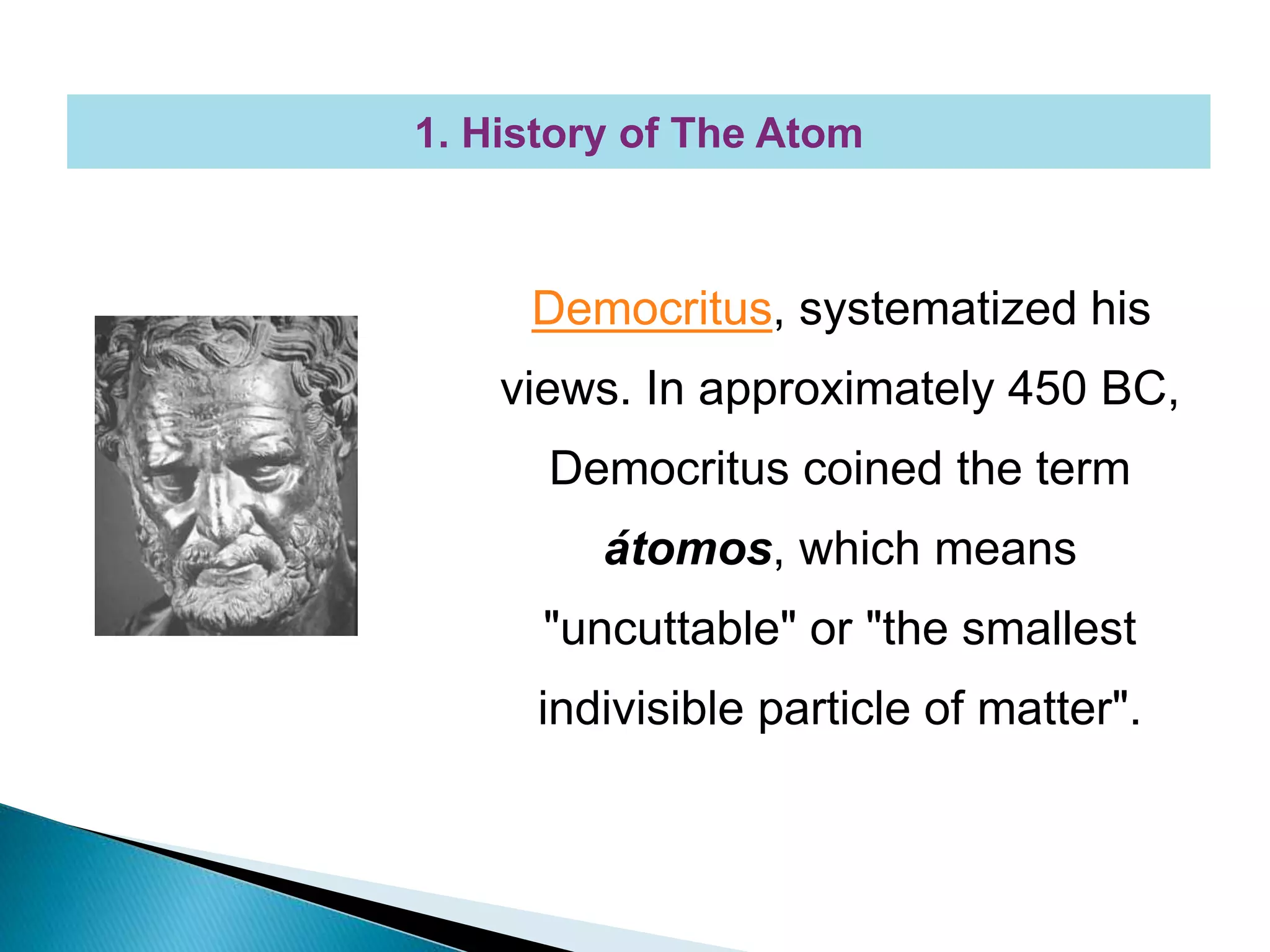
Democritus, systematized his
views. In approximately 450 BC,
Democritus coined the term
átomos, which means
"uncuttable" or "the smallest
indivisible particle of matter".
1. History of The Atom
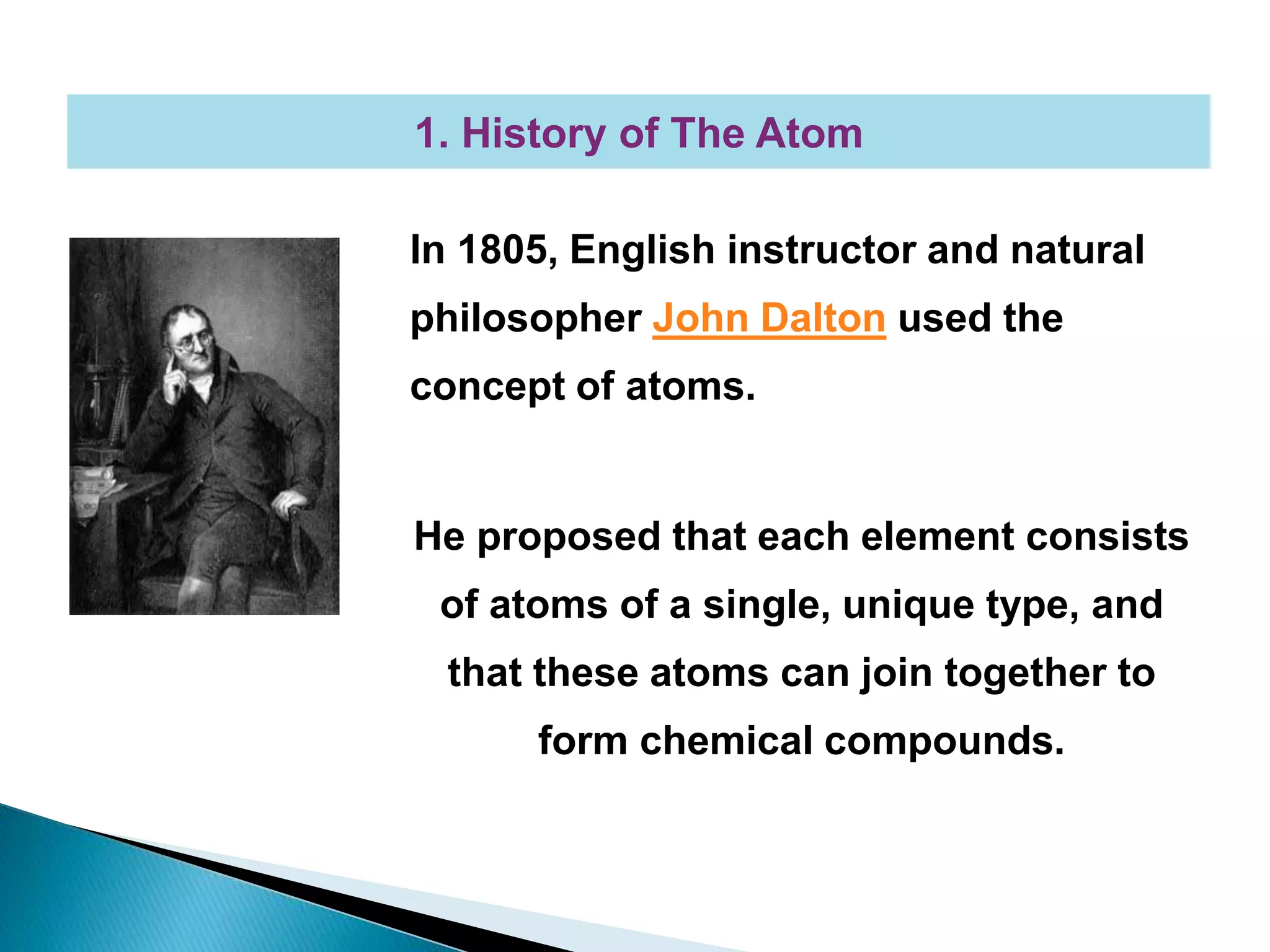
In 1805, English instructor and natural
philosopher John Dalton used the
concept of atoms.
He proposed that each element consists
of atoms of a single, unique type, and
that these atoms can join together to
form chemical compounds.
1. History of The Atom
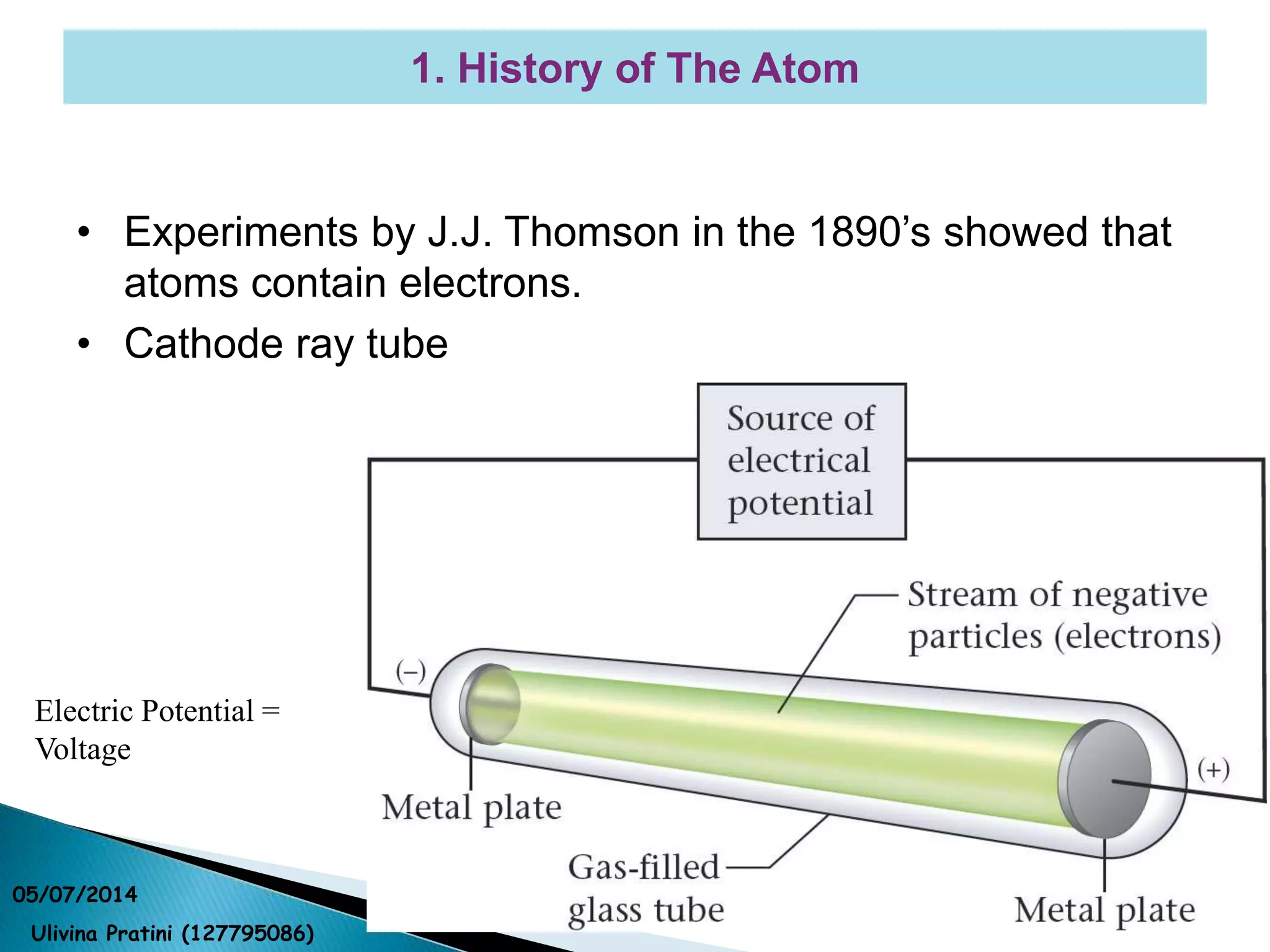
• Experiments by J.J. Thomson in the 1890’s showed that
atoms contain electrons.
• Cathode ray tube
1. History of The Atom
Electric Potential =
Voltage
Ulivina Pratini (127795086)
05/07/2014
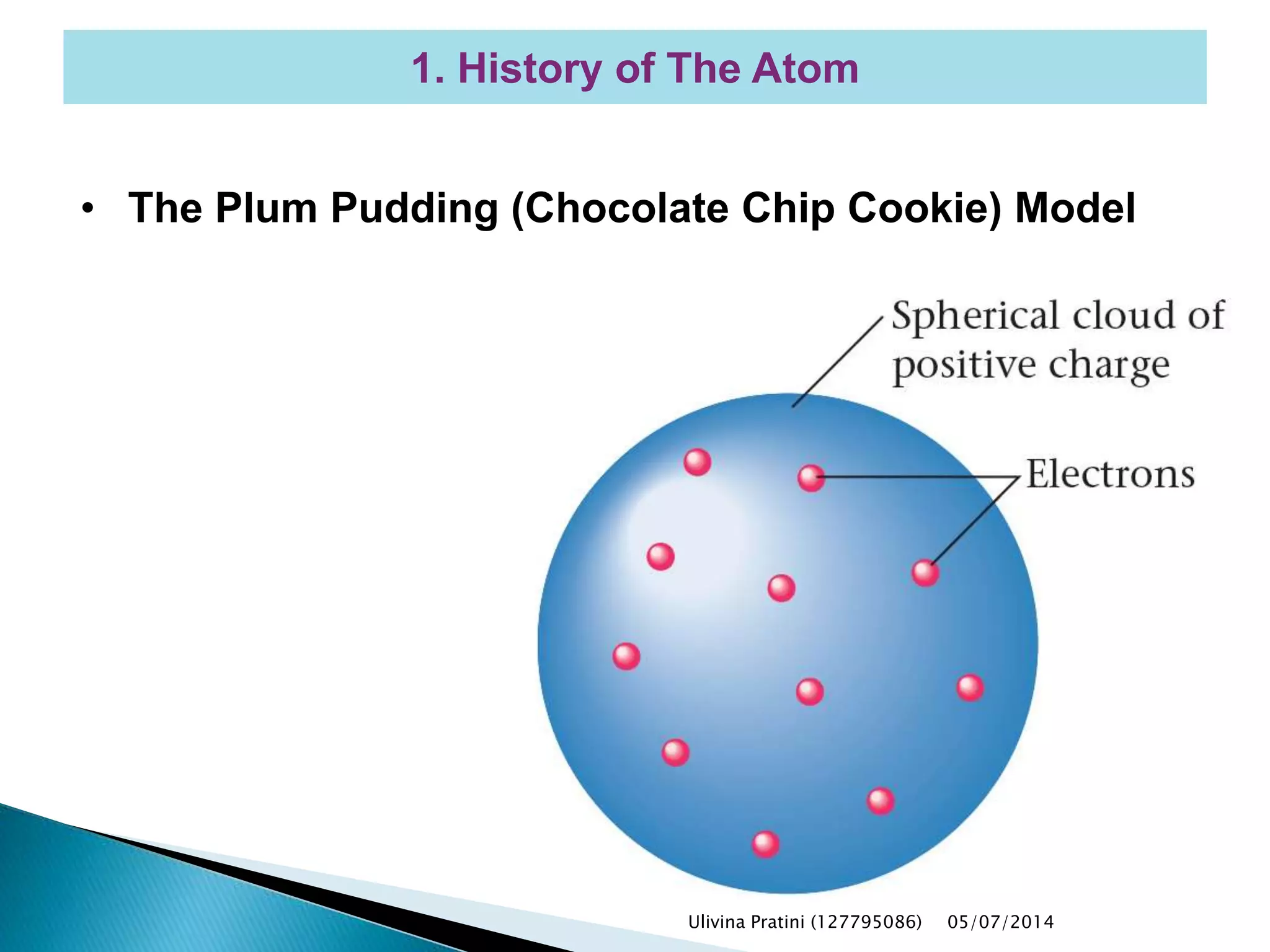
• The Plum Pudding (Chocolate Chip Cookie) Model
1. History of The Atom
Ulivina Pratini (127795086) 05/07/2014
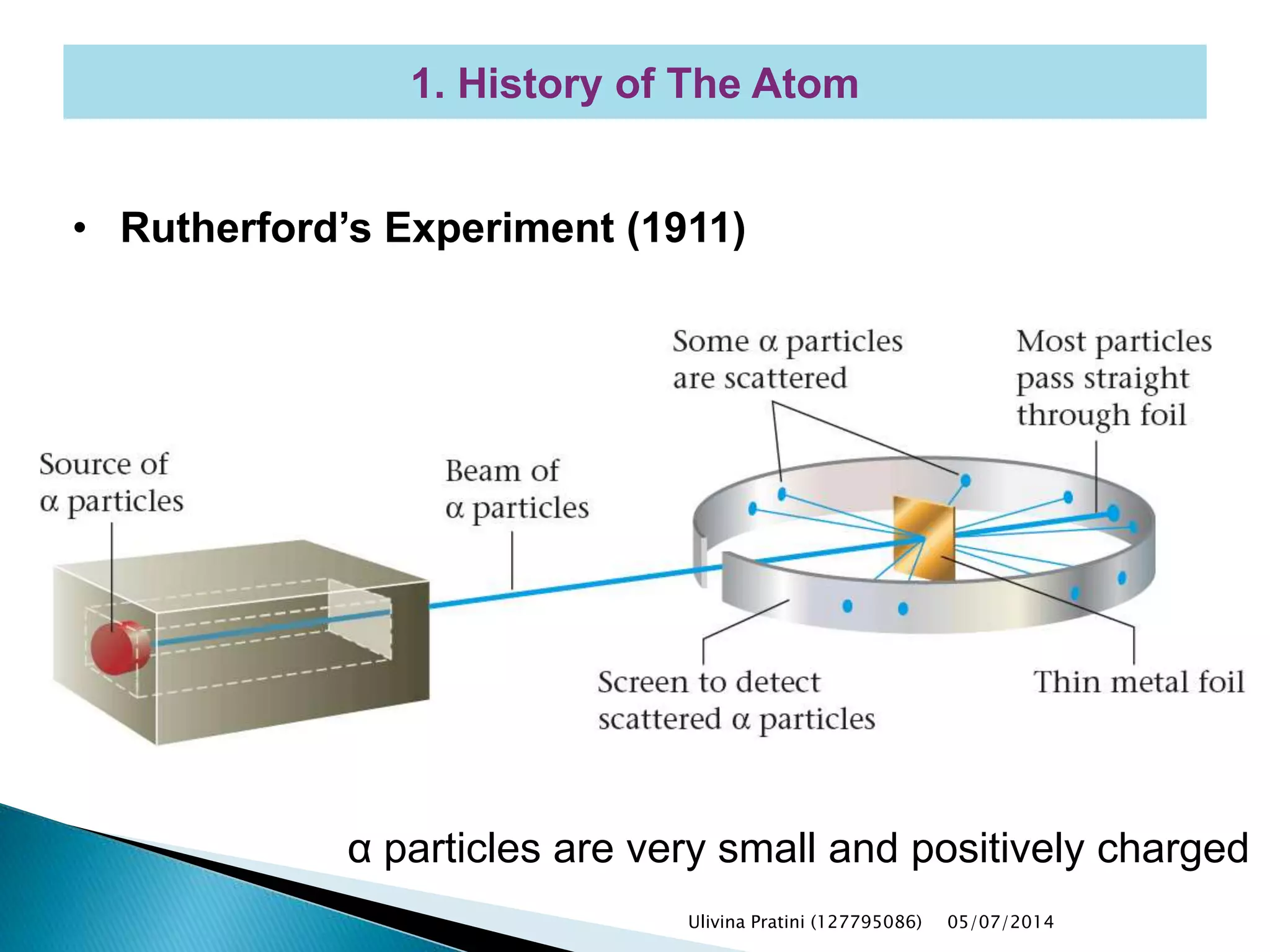
• Rutherford’s Experiment (1911)
α particles are very small and positively charged
1. History of The Atom
Ulivina Pratini (127795086) 05/07/2014
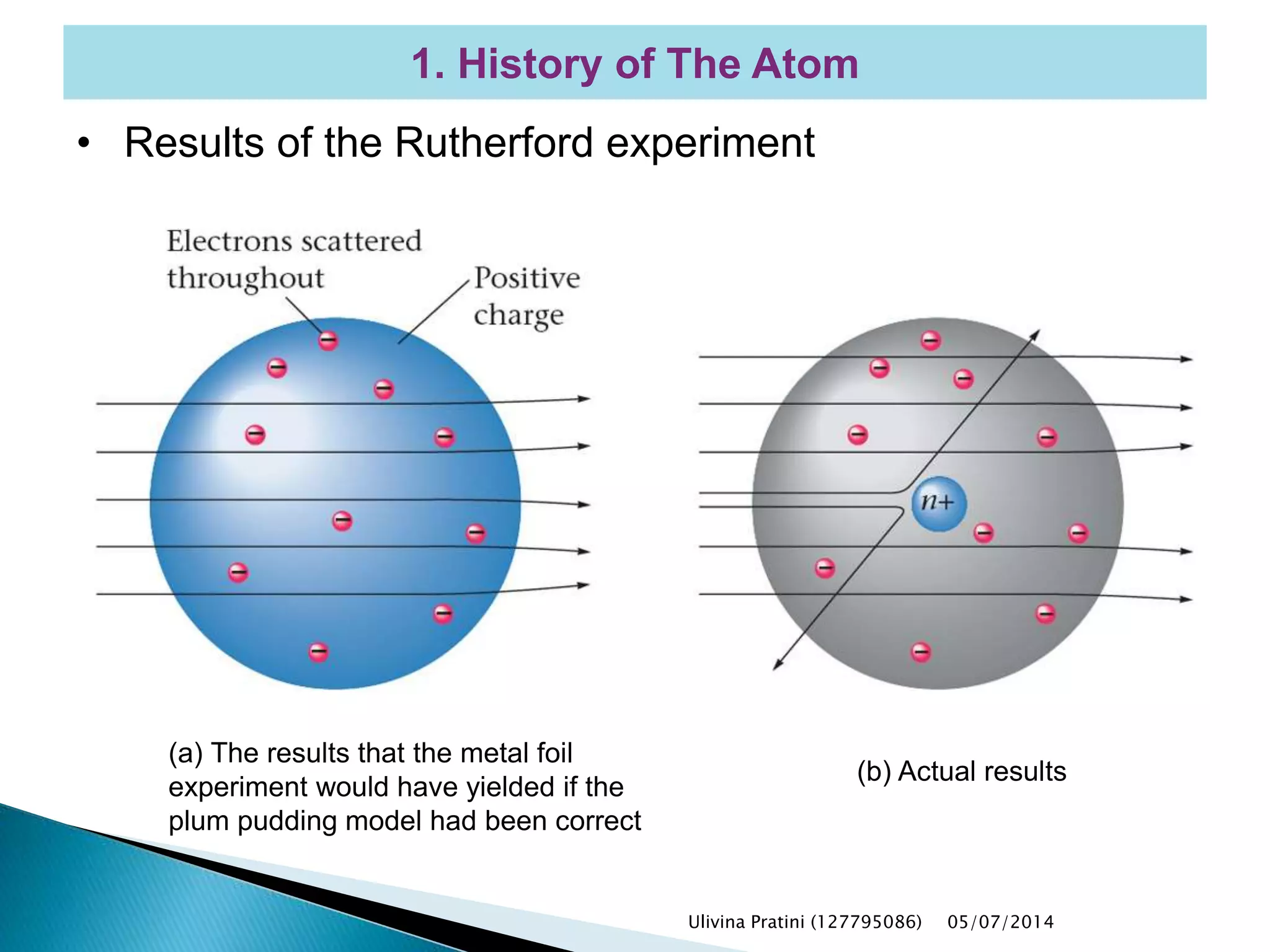
• Results of the Rutherford experiment
(a) The results that the metal foil
experiment would have yielded if the
plum pudding model had been correct
(b) Actual results
1. History of The Atom
Ulivina Pratini (127795086) 05/07/2014
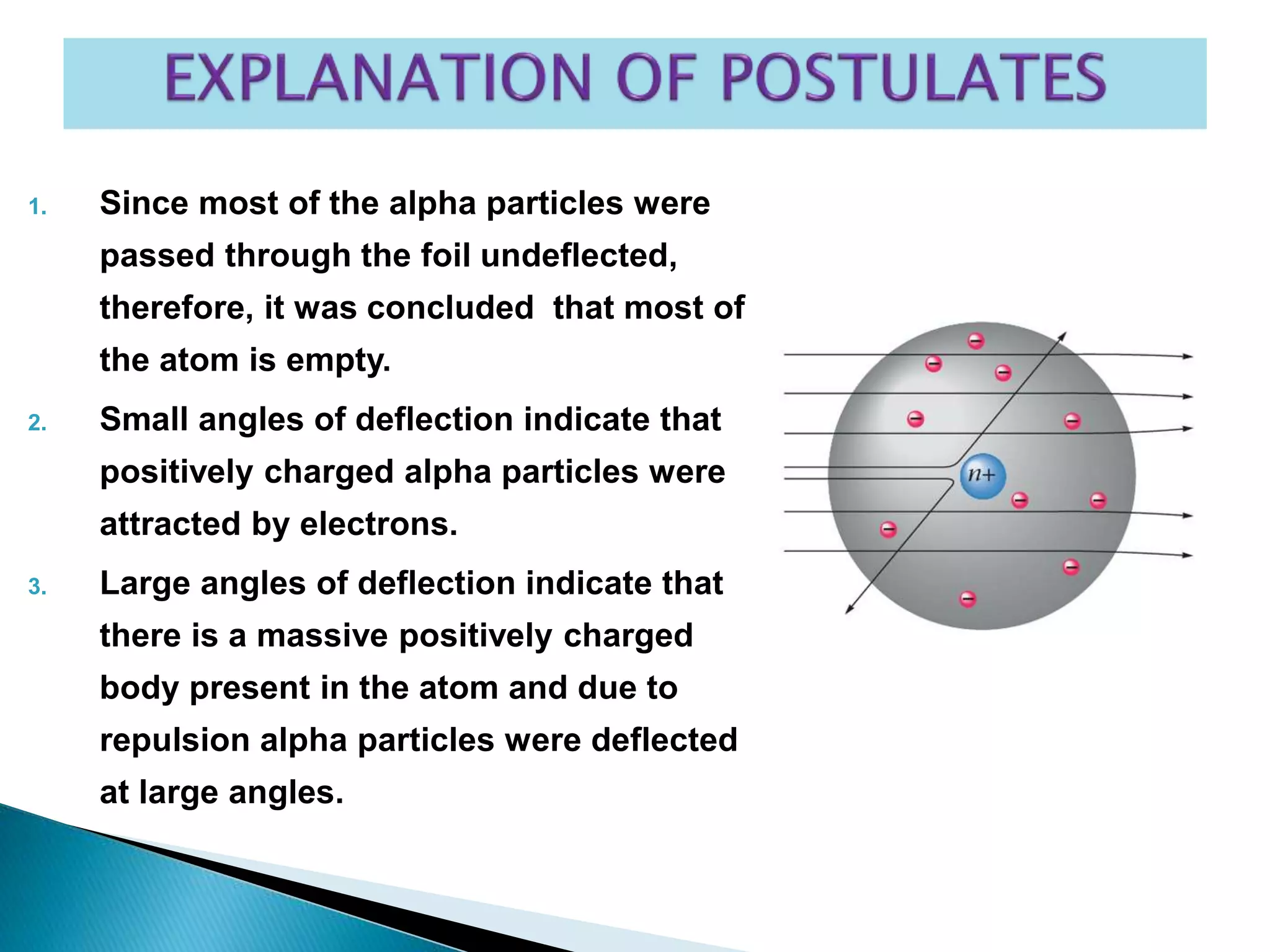
1. Since most of the alpha particles were
passed through the foil undeflected,
therefore, it was concluded that most of
the atom is empty.
2. Small angles of deflection indicate that
positively charged alpha particles were
attracted by electrons.
3. Large angles of deflection indicate that
there is a massive positively charged
body present in the atom and due to
repulsion alpha particles were deflected
at large angles.
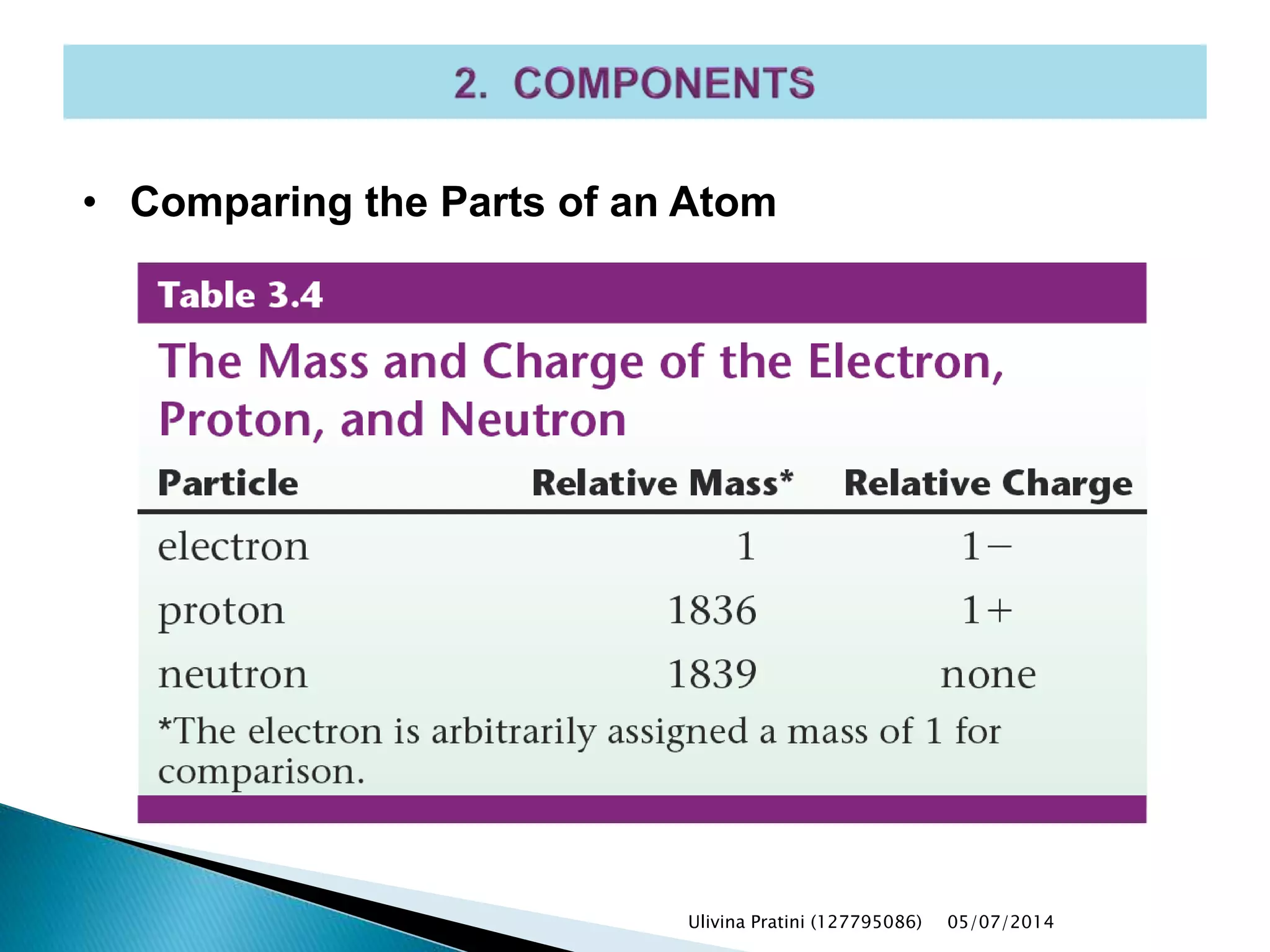
• Comparing the Parts of an Atom
Ulivina Pratini (127795086) 05/07/2014
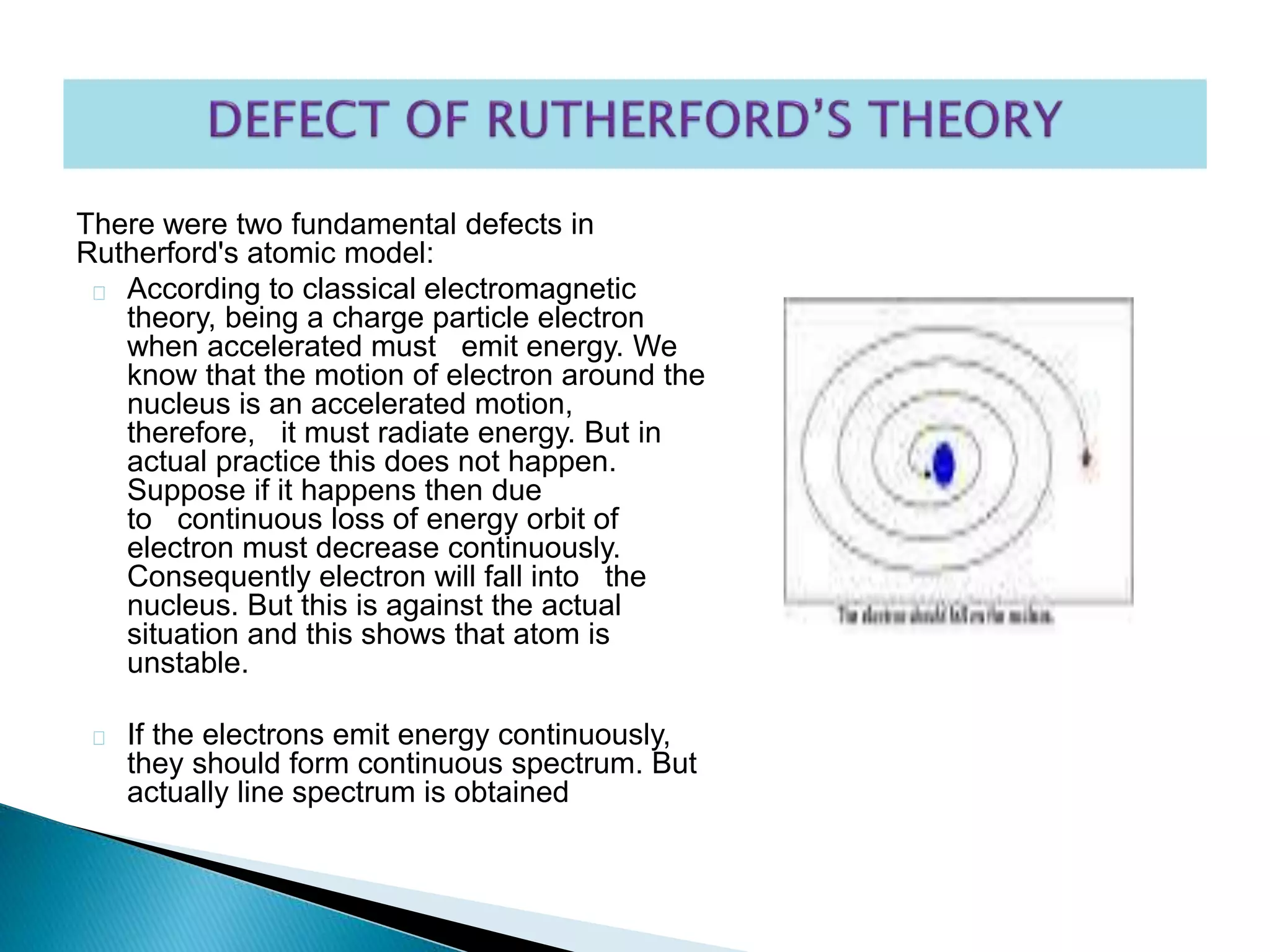
There were two fundamental defects in
Rutherford's atomic model:
According to classical electromagnetic
theory, being a charge particle electron
when accelerated must emit energy. We
know that the motion of electron around the
nucleus is an accelerated motion,
therefore, it must radiate energy. But in
actual practice this does not happen.
Suppose if it happens then due
to continuous loss of energy orbit of
electron must decrease continuously.
Consequently electron will fall into the
nucleus. But this is against the actual
situation and this shows that atom is
unstable.
If the electrons emit energy continuously,
they should form continuous spectrum. But
actually line spectrum is obtained
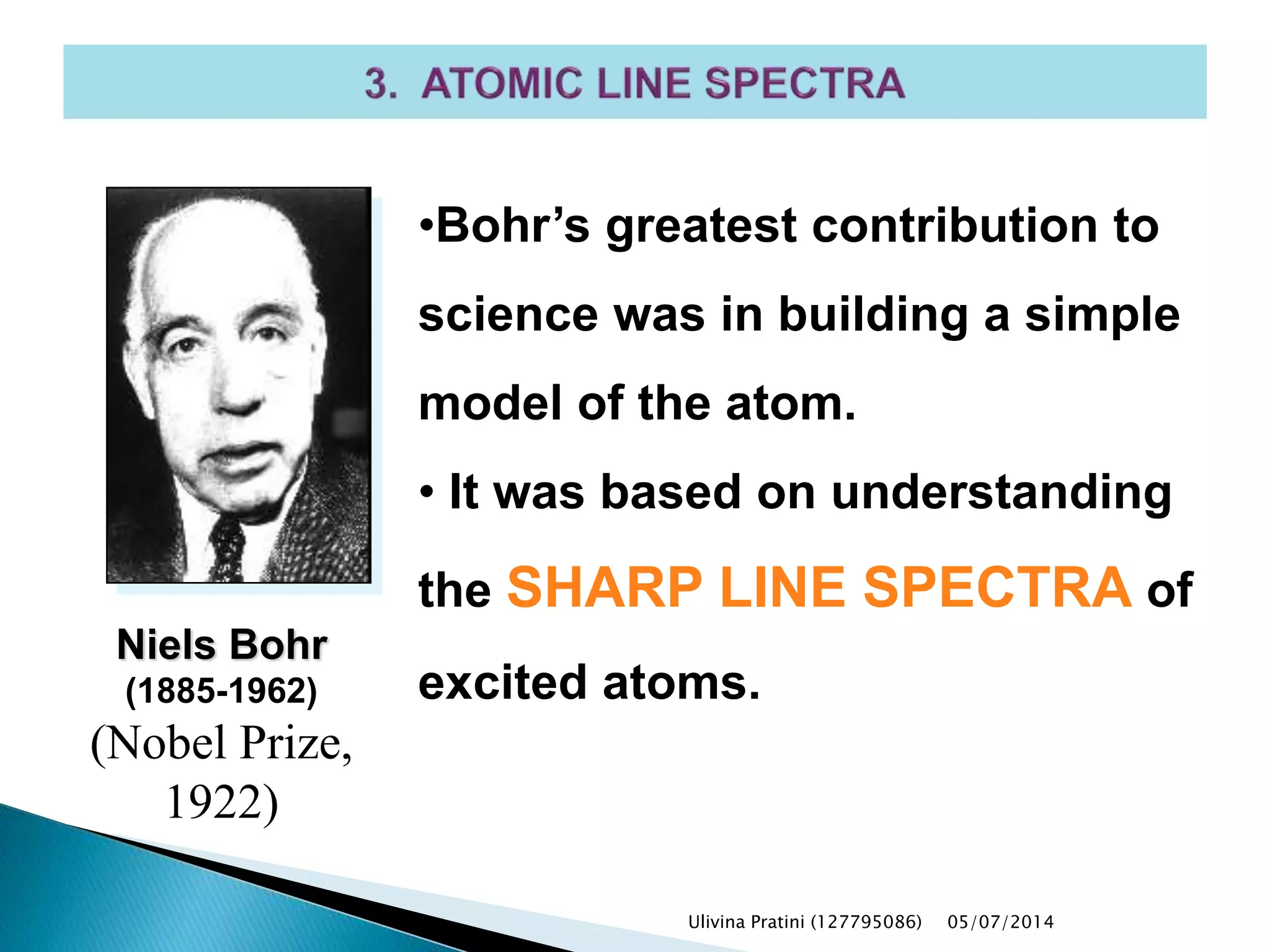
•Bohr’s greatest contribution to
science was in building a simple
model of the atom.
• It was based on understanding
the SHARP LINE SPECTRA of
excited atoms.
Niels Bohr
(1885-1962)
(Nobel Prize,
1922)
Ulivina Pratini (127795086) 05/07/2014
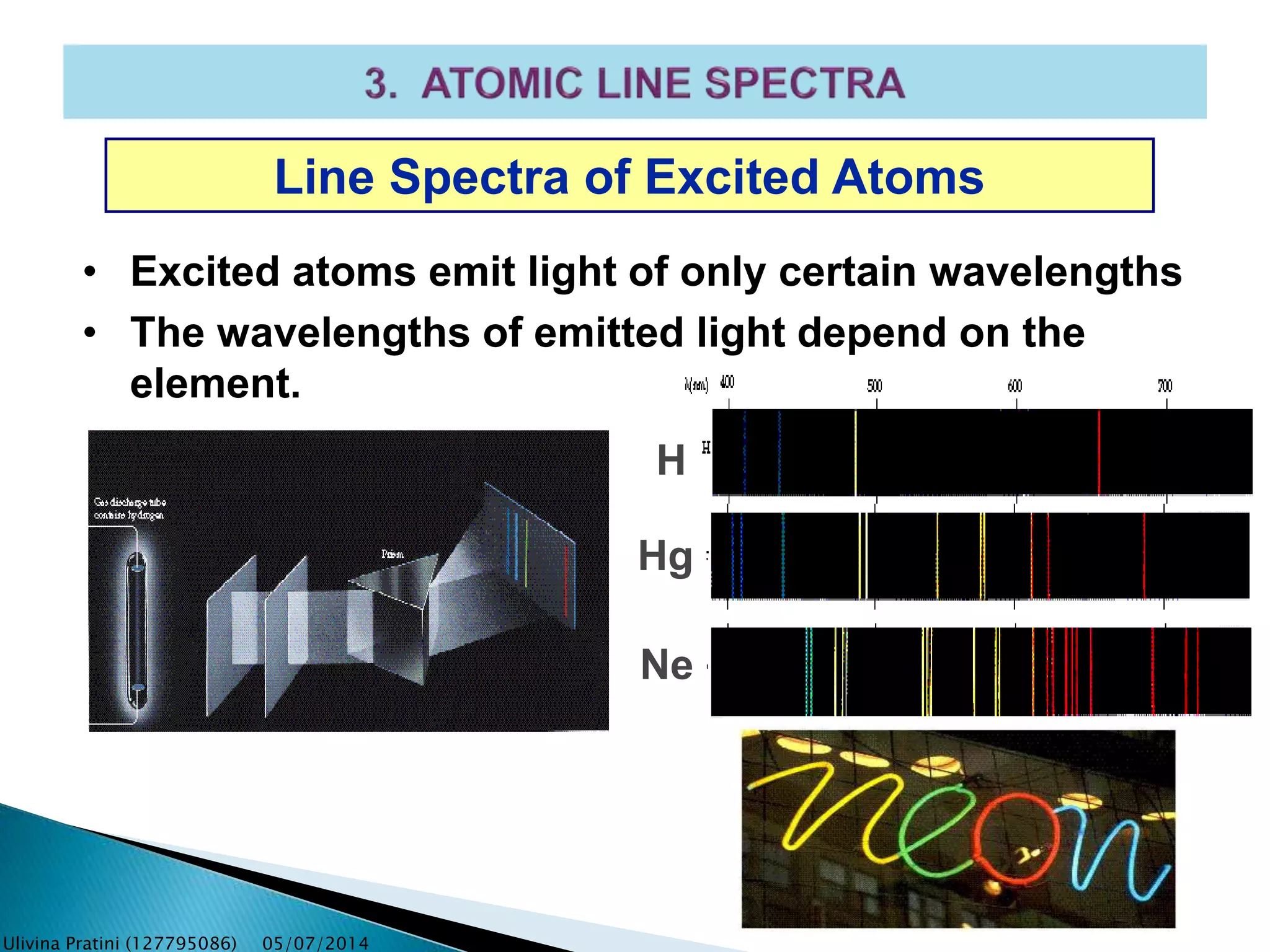
Line Spectra of Excited Atoms
• Excited atoms emit light of only certain wavelengths
• The wavelengths of emitted light depend on the
element.
H
Hg
Ne
Ulivina Pratini (127795086) 05/07/2014
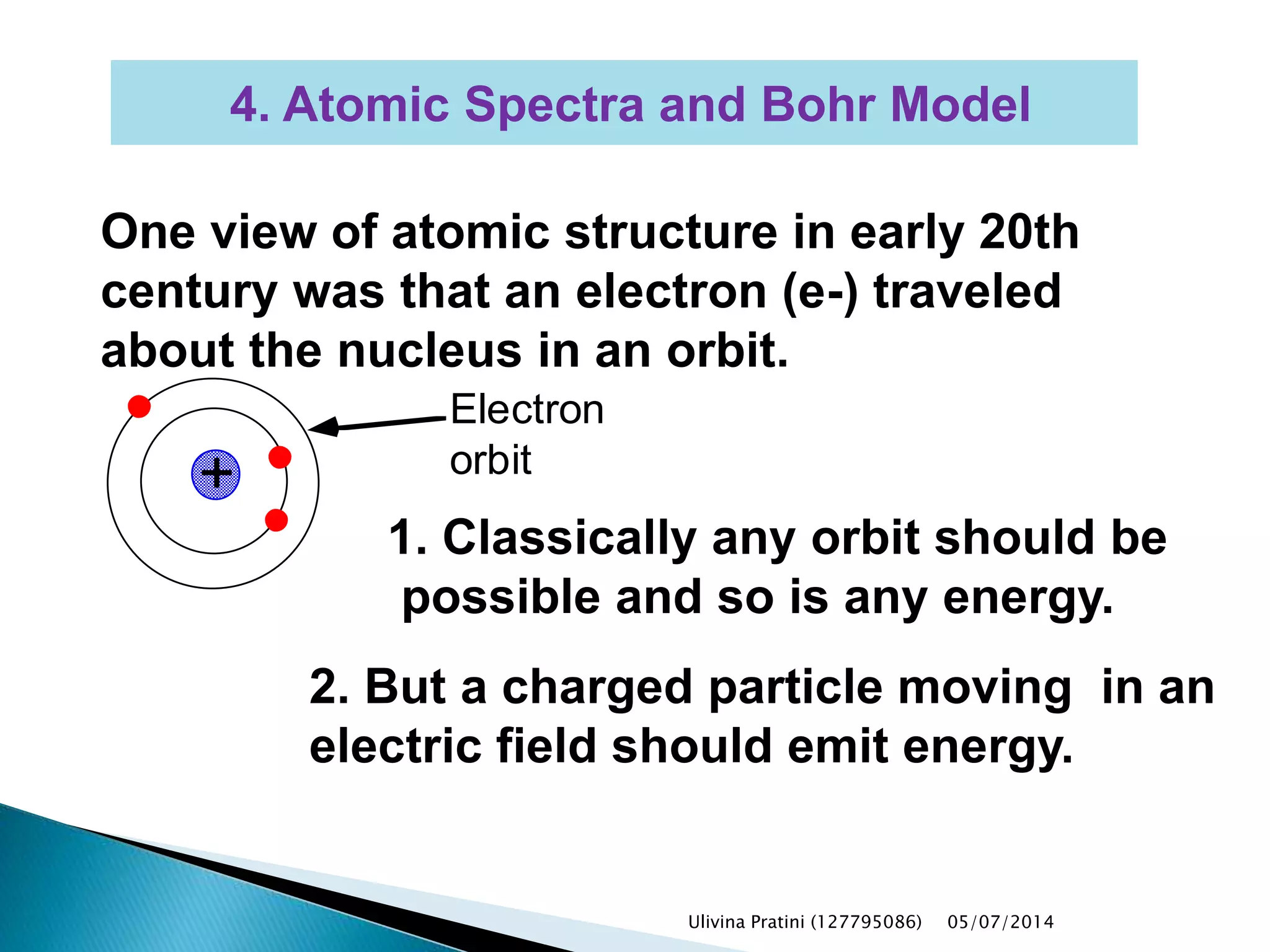
+
Electron
orbit
2. But a charged particle moving in an
electric field should emit energy.
1. Classically any orbit should be
possible and so is any energy.
4. Atomic Spectra and Bohr Model
One view of atomic structure in early 20th
century was that an electron (e-) traveled
about the nucleus in an orbit.
Ulivina Pratini (127795086) 05/07/2014
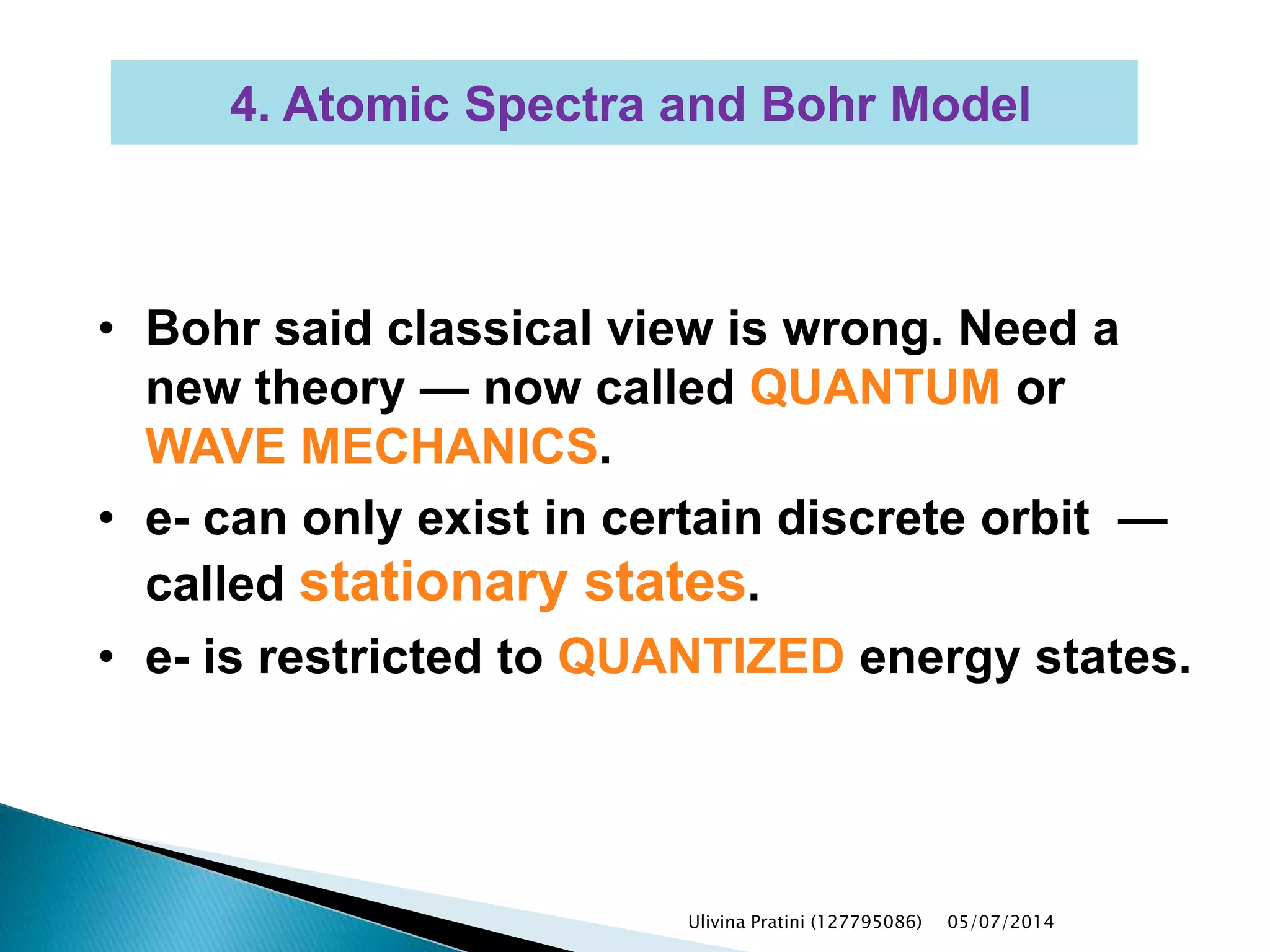
• Bohr said classical view is wrong. Need a
new theory — now called QUANTUM or
WAVE MECHANICS.
• e- can only exist in certain discrete orbit —
called stationary states.
• e- is restricted to QUANTIZED energy states.
4. Atomic Spectra and Bohr Model
Ulivina Pratini (127795086) 05/07/2014
4-H_SPECTRA.MOV
H atom
07m07an1.mov
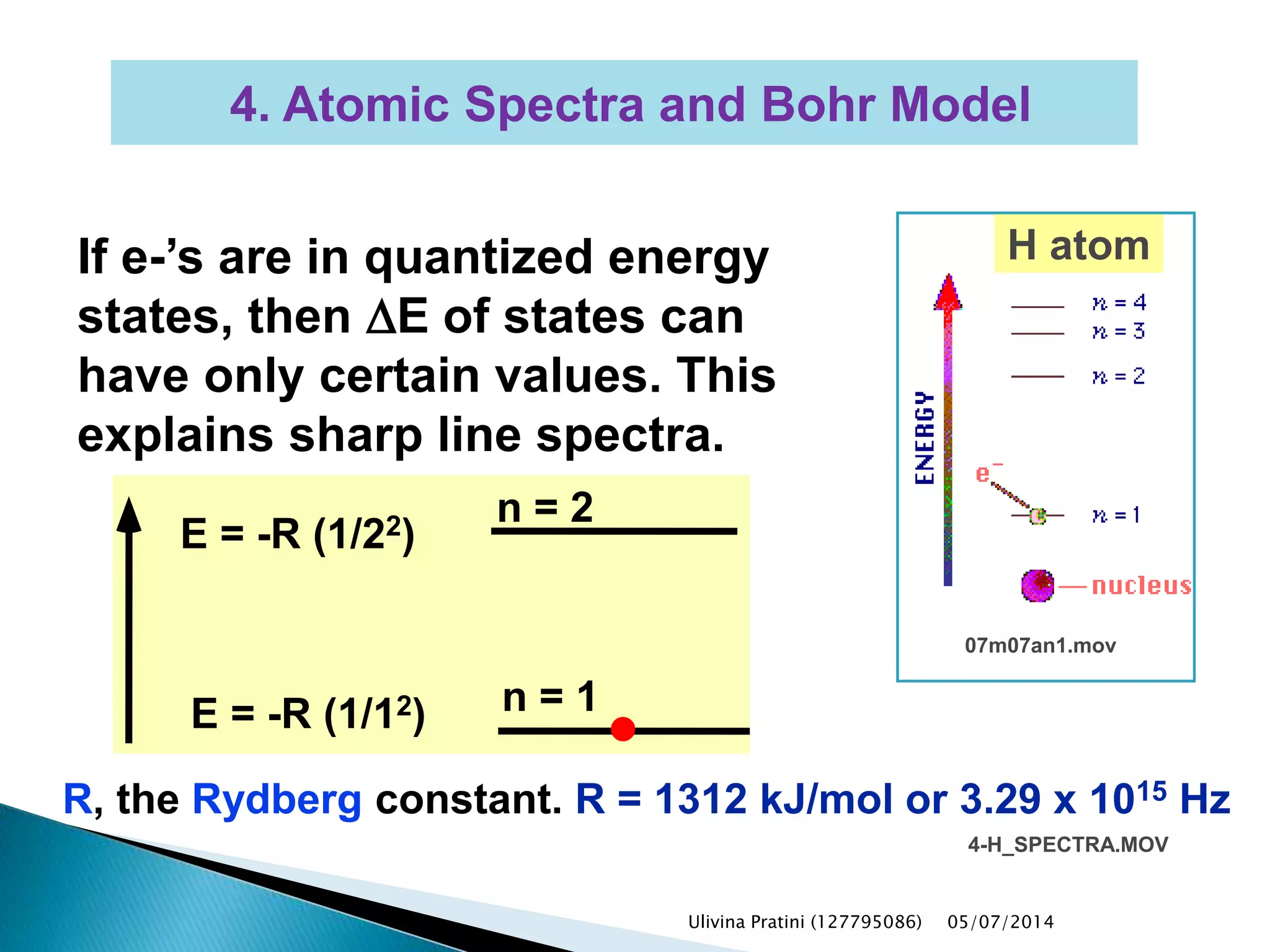
If e-’s are in quantized energy
states, then DE of states can
have only certain values. This
explains sharp line spectra.
4. Atomic Spectra and Bohr Model
Ulivina Pratini (127795086) 05/07/2014
n = 1
n = 2
E = -R (1/22)
E = -R (1/12)
R, the Rydberg constant. R = 1312 kJ/mol or 3.29 x 10¹⁵ Hz
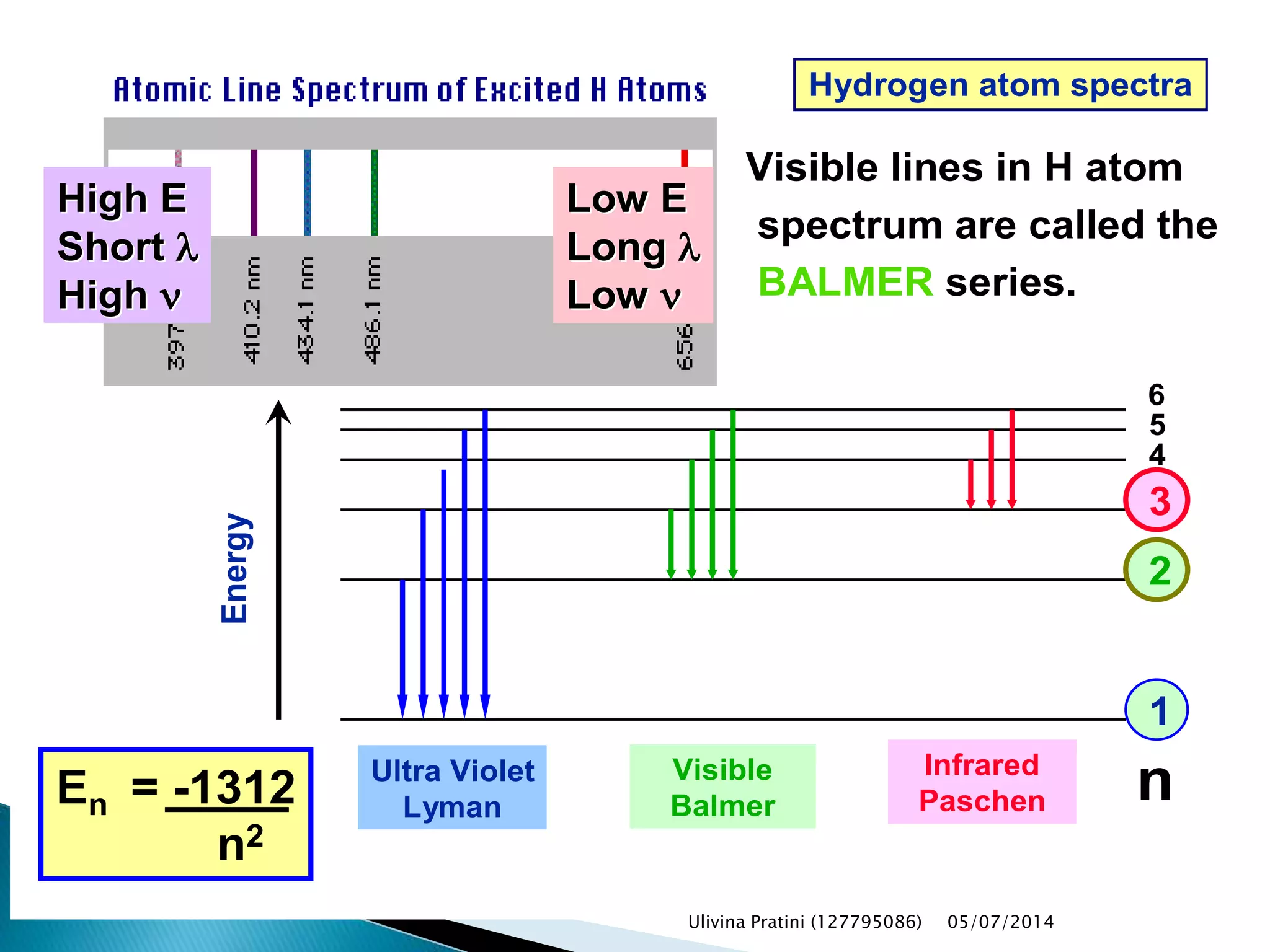
Hydrogen atom spectra
Visible lines in H atom
spectrum are called the
BALMER series.
High EHigh E
ShortShort 
HighHigh 
Low ELow E
LongLong 
LowLow 
Energy
Ultra Violet
Lyman
Infrared
Paschen
Visible
BalmerEn = -1312
n2
6
5
3
2
1
4
n
Ulivina Pratini (127795086) 05/07/2014
05/07/2014Ulivina Pratini (127795086)
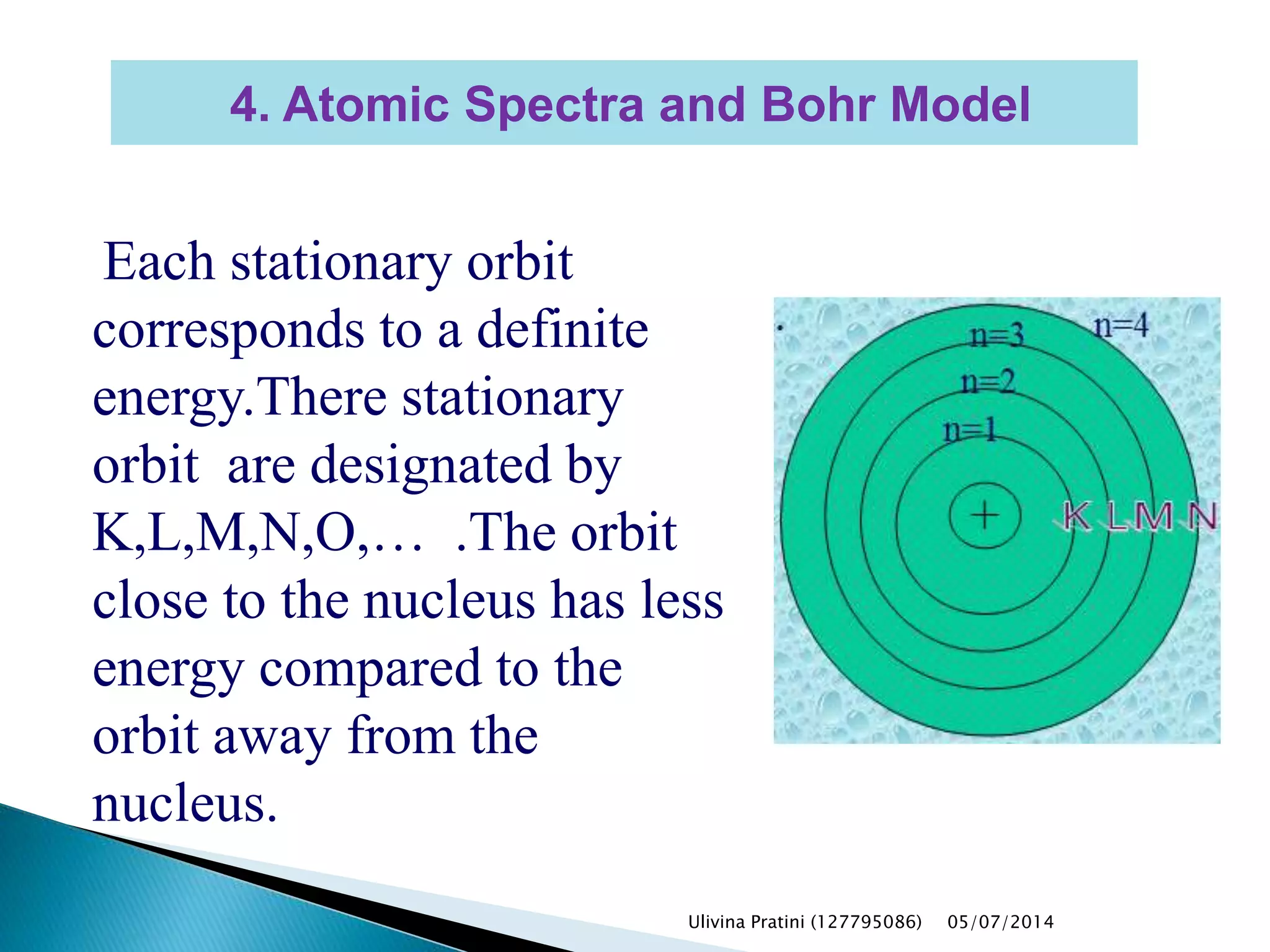
Each stationary orbit
corresponds to a definite
energy.There stationary
orbit are designated by
K,L,M,N,O,… .The orbit
close to the nucleus has less
energy compared to the
orbit away from the
nucleus.
4. Atomic Spectra and Bohr Model
05/07/2014Ulivina Pratini (127795086)
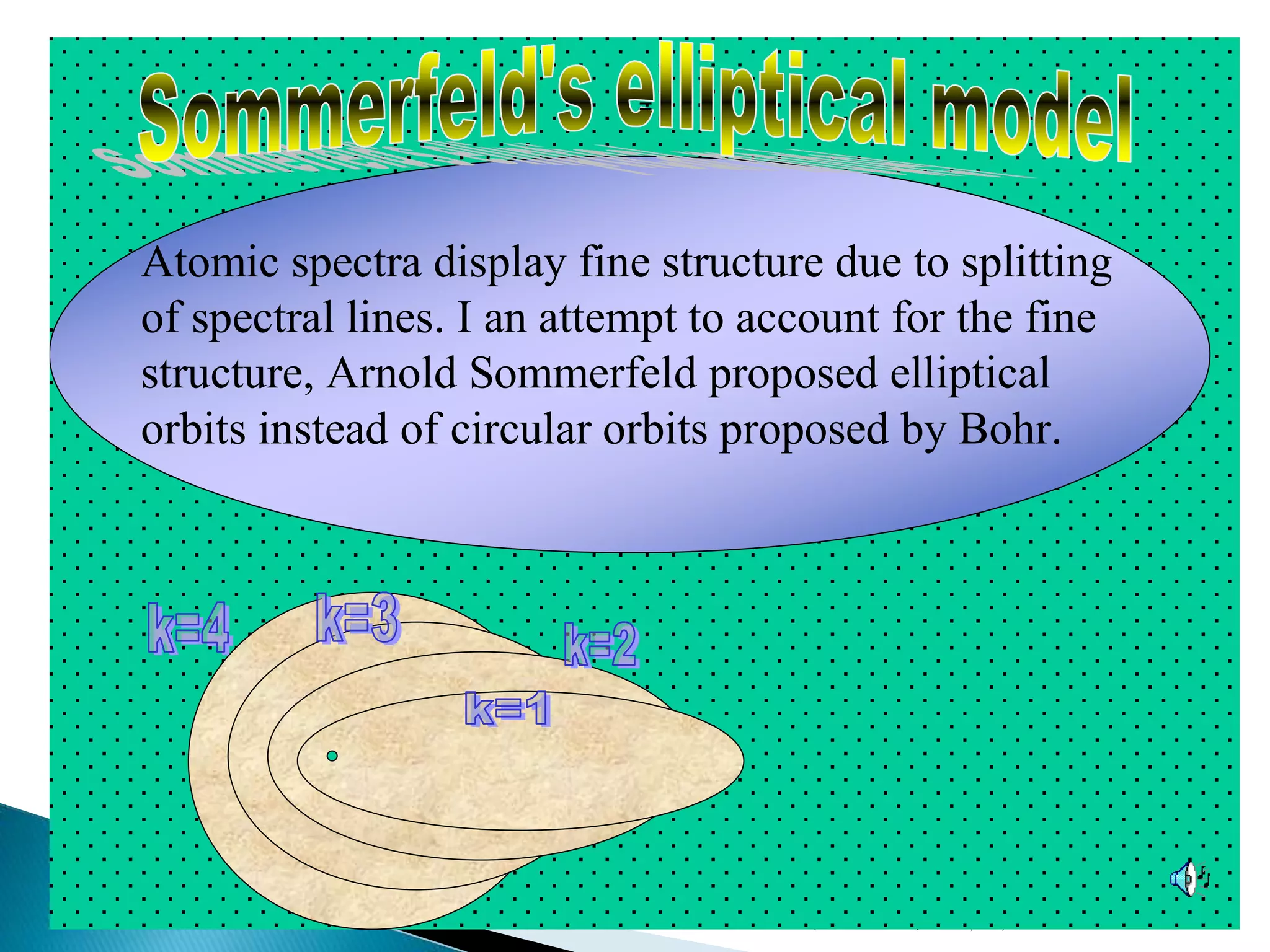
Atomic spectra display fine structure due to splitting
of spectral lines. I an attempt to account for the fine
structure, Arnold Sommerfeld proposed elliptical
orbits instead of circular orbits proposed by Bohr.
=
• Bohr’s theory was a great accomplishment
and radically changed our view of matter.
• But problems existed with Bohr theory —
– theory only successful for the H atom.
– introduced quantum idea artificially.
• So, we go on to QUANTUM or WAVE
MECHANICS
Ulivina Pratini (127795086) 05/07/2014
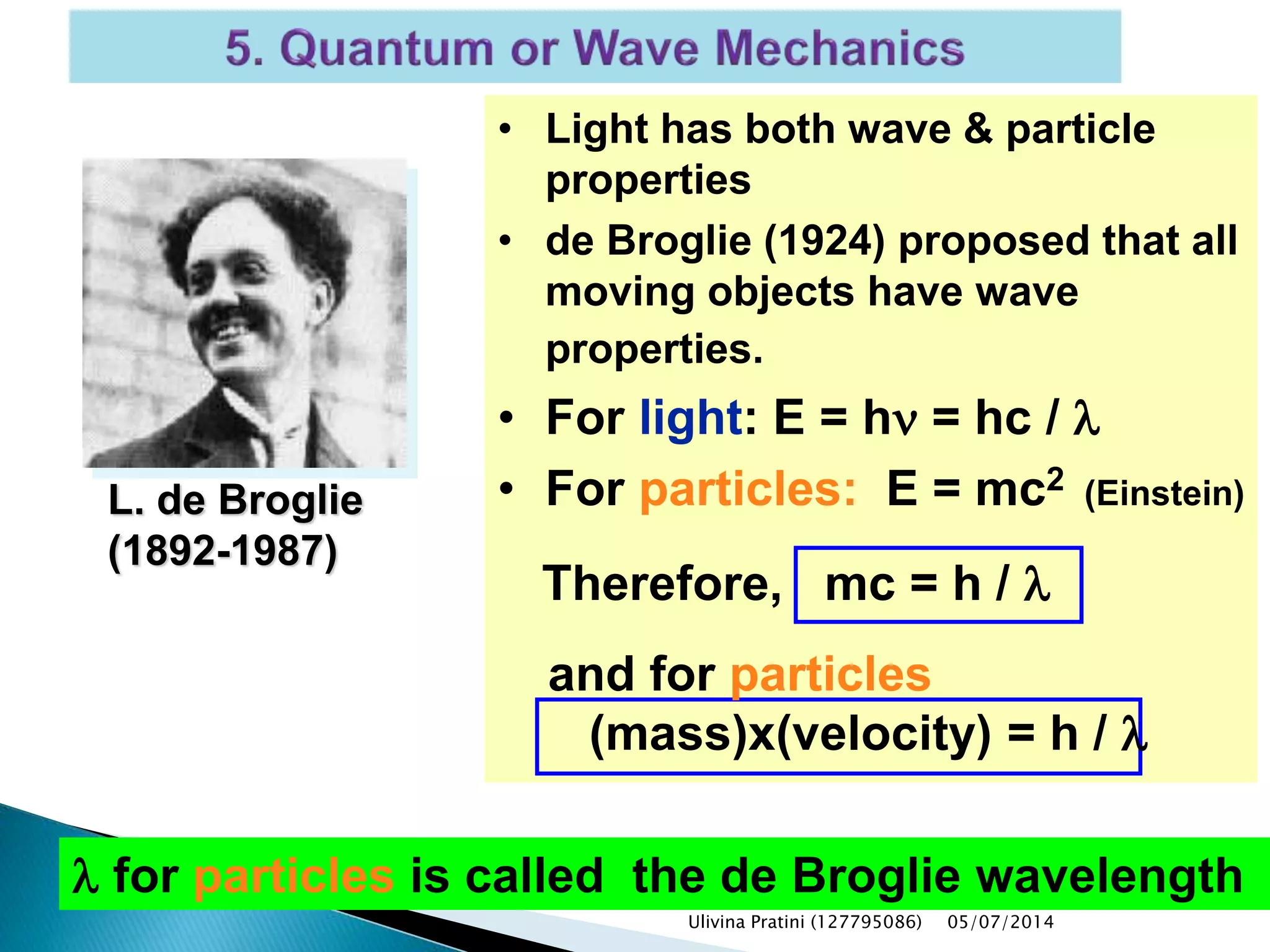
• Light has both wave & particle
properties
• de Broglie (1924) proposed that all
moving objects have wave
properties.
• For light: E = h = hc / 
• For particles: E = mc2 (Einstein)L. de Broglie
(1892-1987)
 for particles is called the de Broglie wavelength
and for particles
(mass)x(velocity) = h / 
Therefore, mc = h / 
Ulivina Pratini (127795086) 05/07/2014
05/07/2014Ulivina Pratini (127795086)
Uncertainty Principle
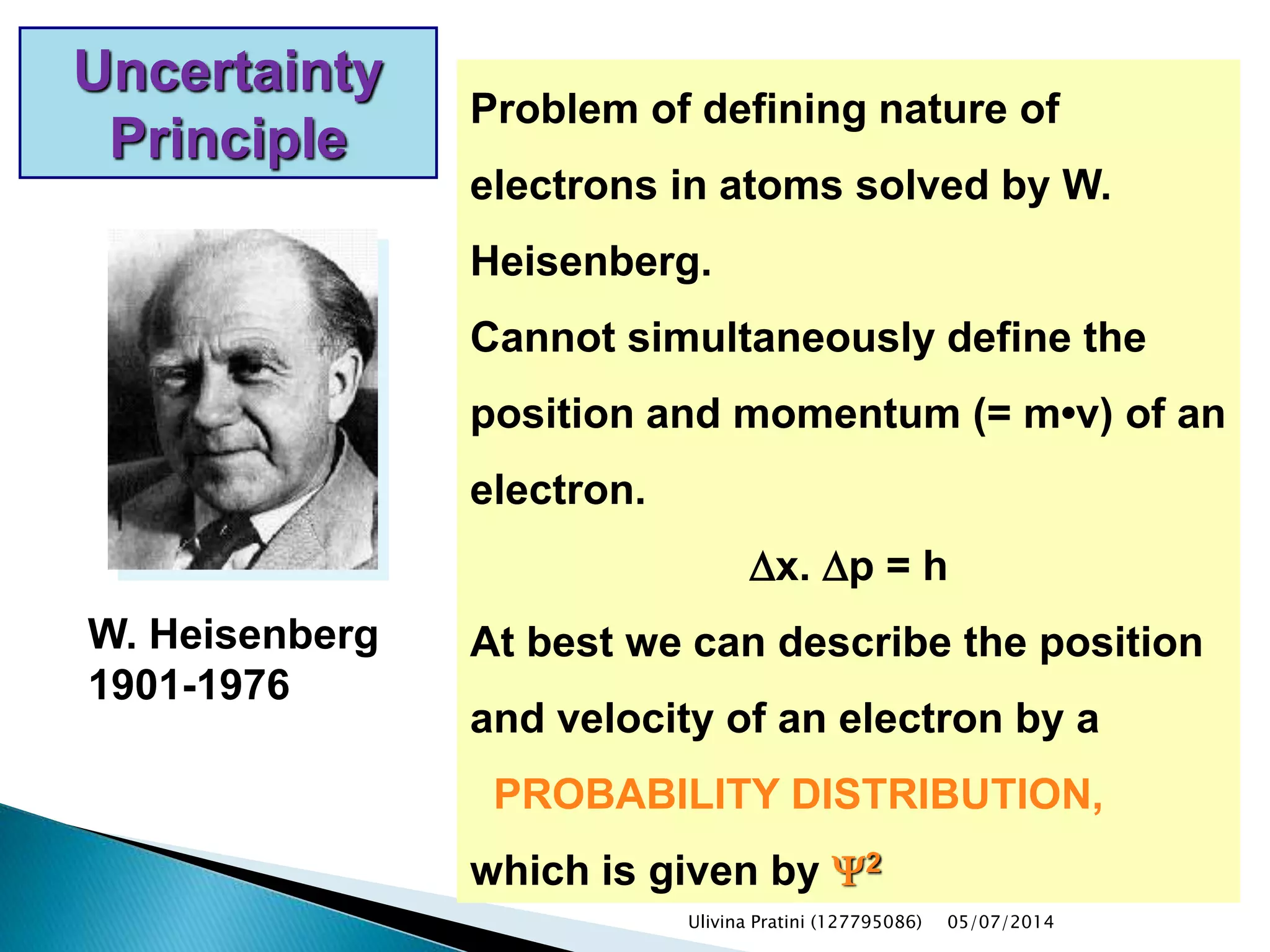
W. Heisenberg
1901-1976
Uncertainty
Principle
Problem of defining nature of
electrons in atoms solved by W.
Heisenberg.
Cannot simultaneously define the
position and momentum (= m•v) of an
electron.
Dx. Dp = h
At best we can describe the position
and velocity of an electron by a
PROBABILITY DISTRIBUTION,
which is given by Y2
Ulivina Pratini (127795086) 05/07/2014
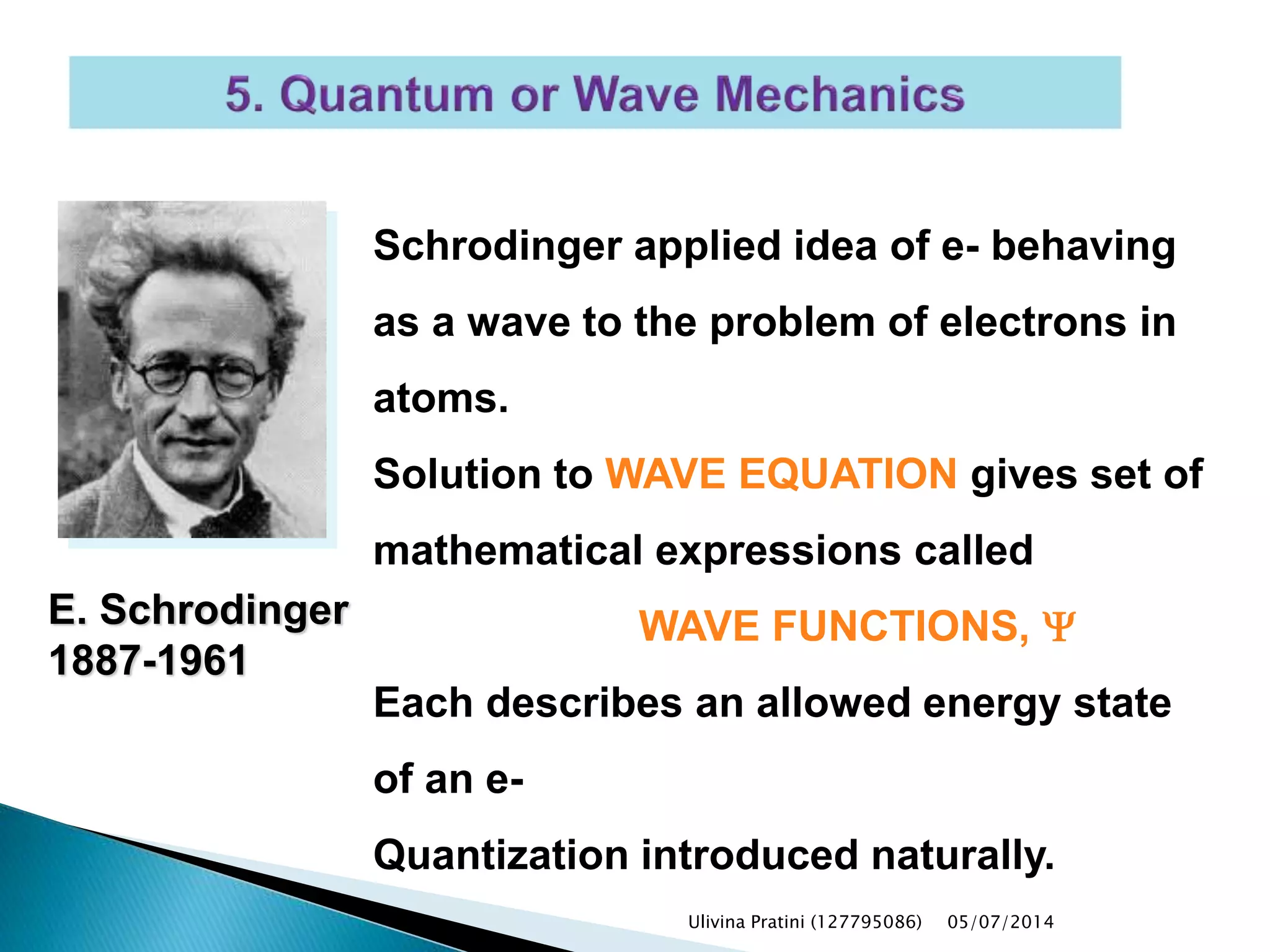
E. Schrodinger
1887-1961
Schrodinger applied idea of e- behaving
as a wave to the problem of electrons in
atoms.
Solution to WAVE EQUATION gives set of
mathematical expressions called
WAVE FUNCTIONS, Y
Each describes an allowed energy state
of an e-
Quantization introduced naturally.
Ulivina Pratini (127795086) 05/07/2014
WAVE FUNCTIONS, Y
• Y is a function of distance and two
angles.
• For 1 electron, Y corresponds to an
ORBITAL — the region of space within
which an electron is found.
• Y does NOT describe the exact
location of the electron.
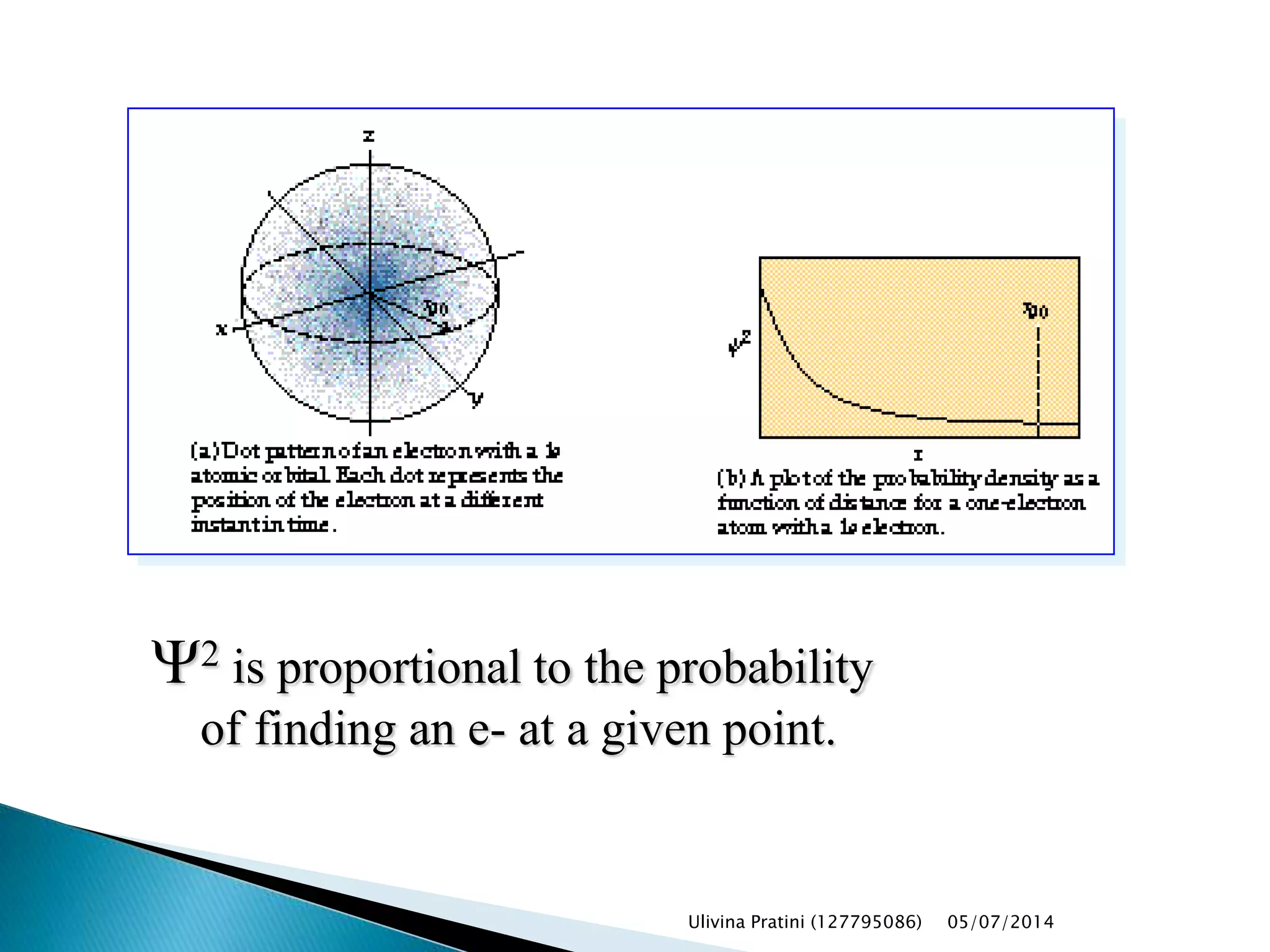
• Y2 is proportional to the probability of
finding an e- at a given point.
Ulivina Pratini (127795086) 05/07/2014
Y2 is proportional to the probability
of finding an e- at a given point.
Ulivina Pratini (127795086) 05/07/2014
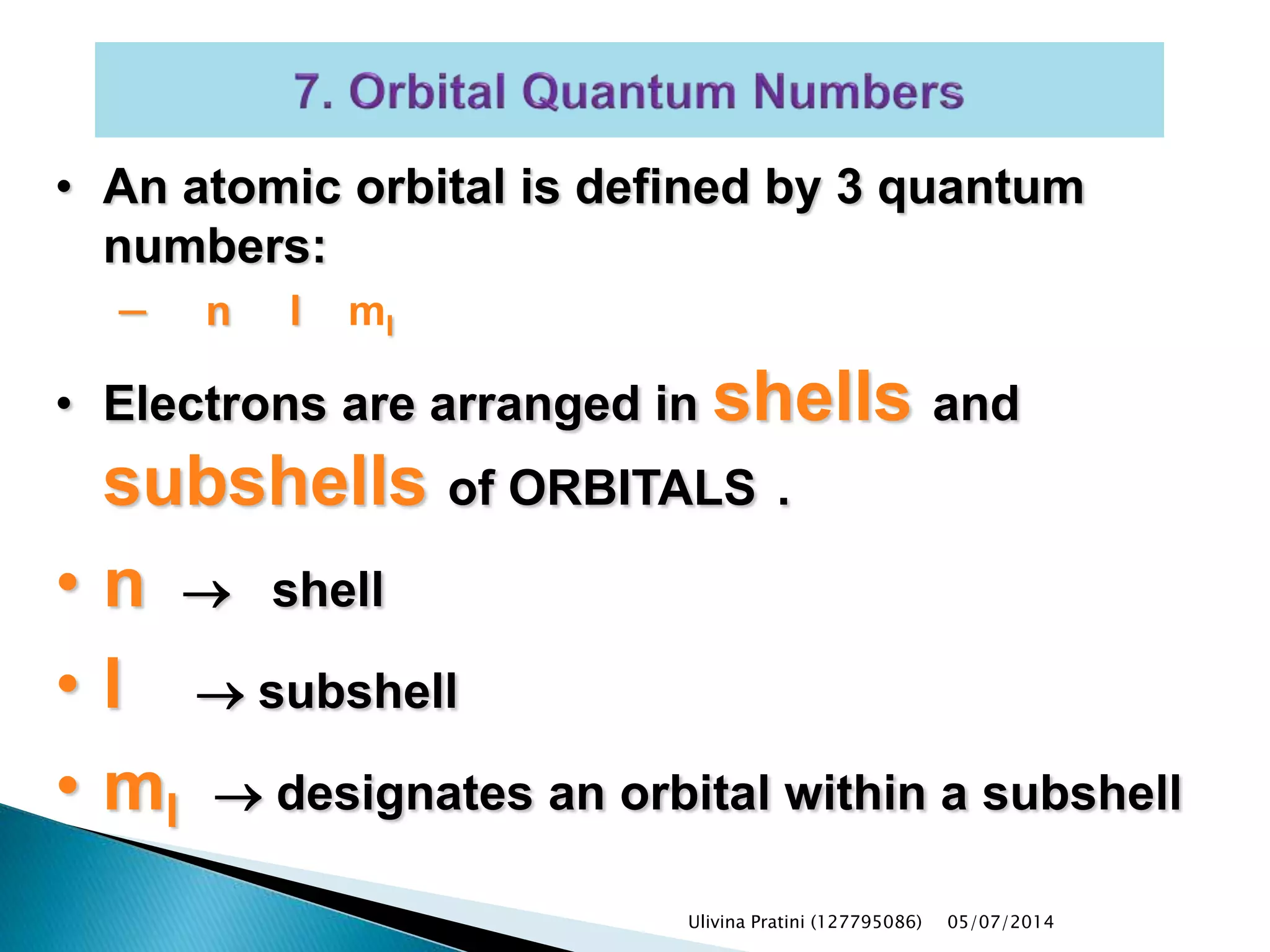
• An atomic orbital is defined by 3 quantum
numbers:
– n l ml
• Electrons are arranged in shells and
subshells of ORBITALS .
• n  shell
• l  subshell
• ml  designates an orbital within a subshell
Ulivina Pratini (127795086) 05/07/2014
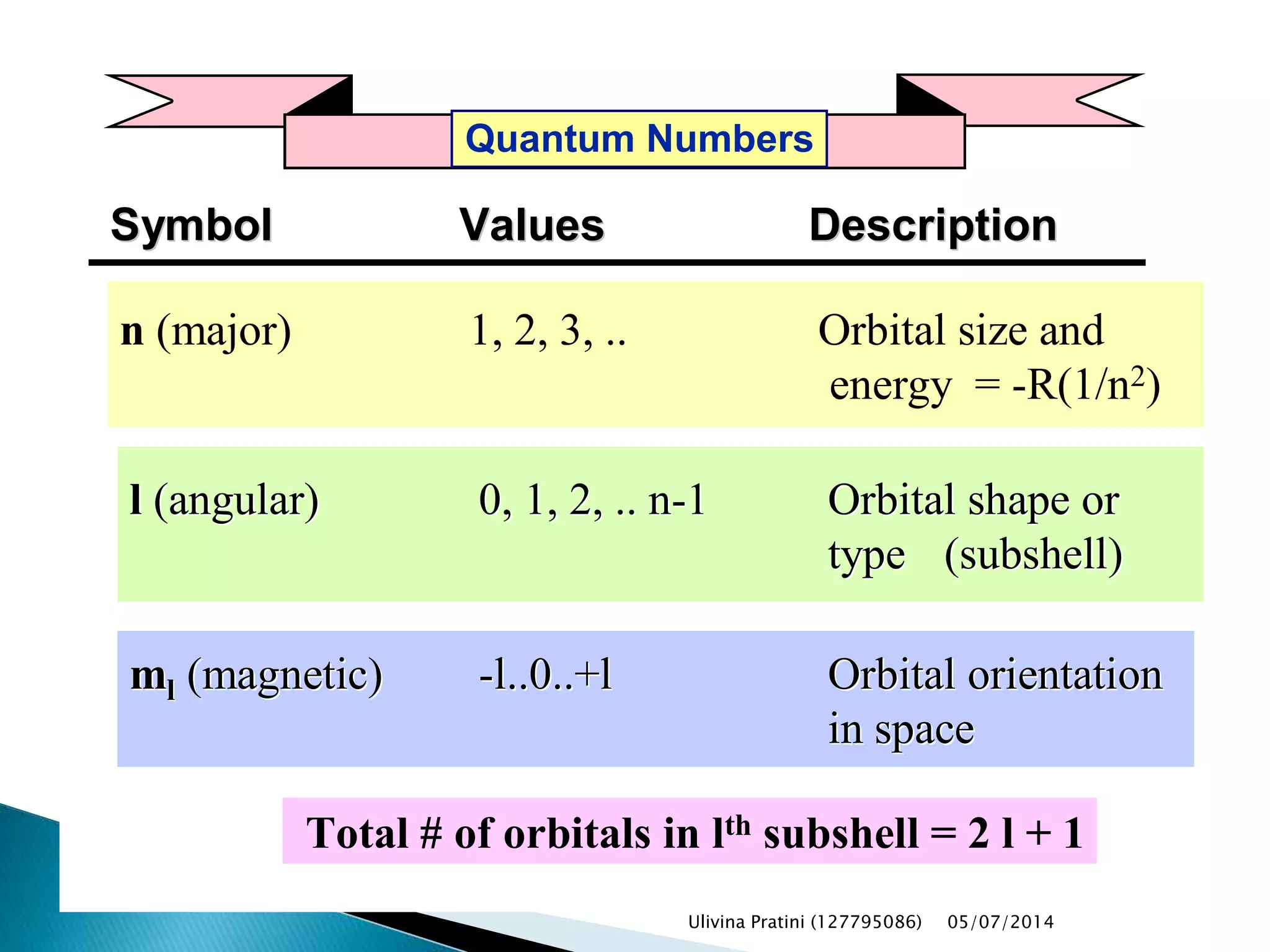
Quantum Numbers
mmll (magnetic)(magnetic) --l..0..+ll..0..+l Orbital orientationOrbital orientation
in spacein space
ll (angular)(angular) 0, 1, 2, .. n0, 1, 2, .. n--11 Orbital shape orOrbital shape or
typetype ((subshellsubshell))
n (major) 1, 2, 3, .. Orbital size and
energy = -R(1/n2)
Total # of orbitals in lth subshell = 2 l + 1
SymbolSymbol ValuesValues DescriptionDescription
Ulivina Pratini (127795086) 05/07/2014
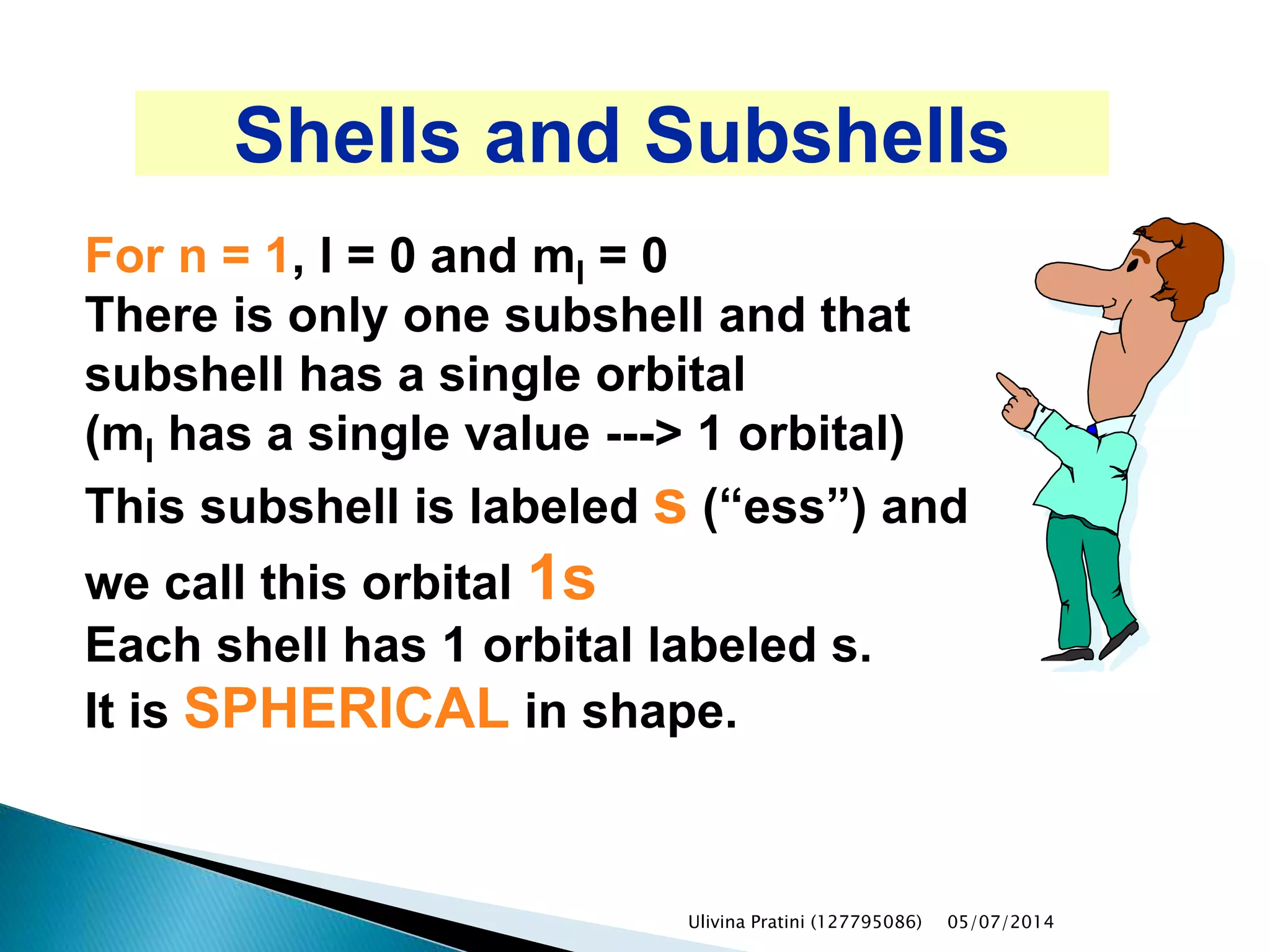
Shells and Subshells
For n = 1, l = 0 and ml = 0
There is only one subshell and that
subshell has a single orbital
(ml has a single value ---> 1 orbital)
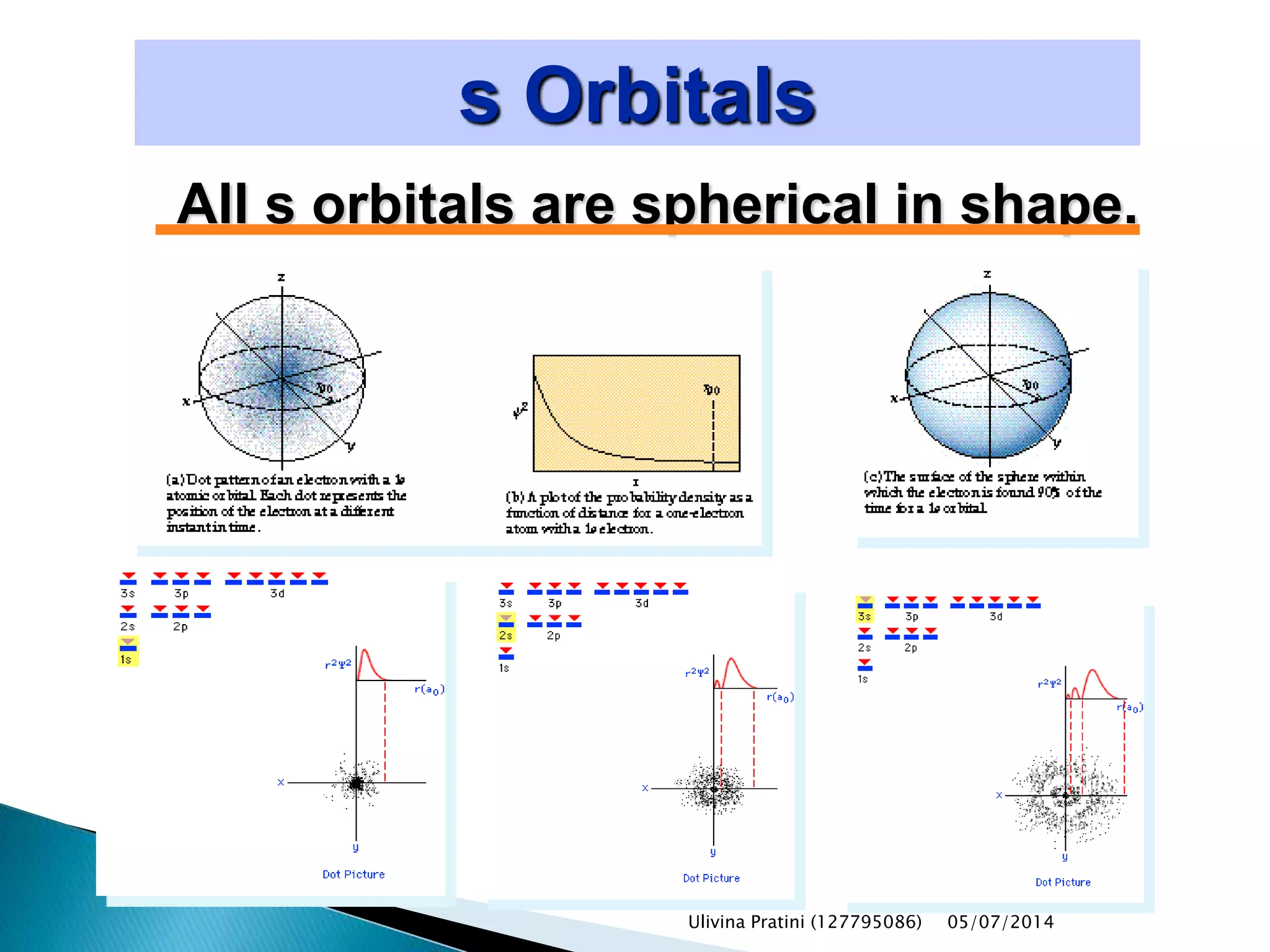
This subshell is labeled s (“ess”) and
we call this orbital 1s
Each shell has 1 orbital labeled s.
It is SPHERICAL in shape.
Ulivina Pratini (127795086) 05/07/2014
s Orbitals
All s orbitals are spherical in shape.
Ulivina Pratini (127795086) 05/07/2014
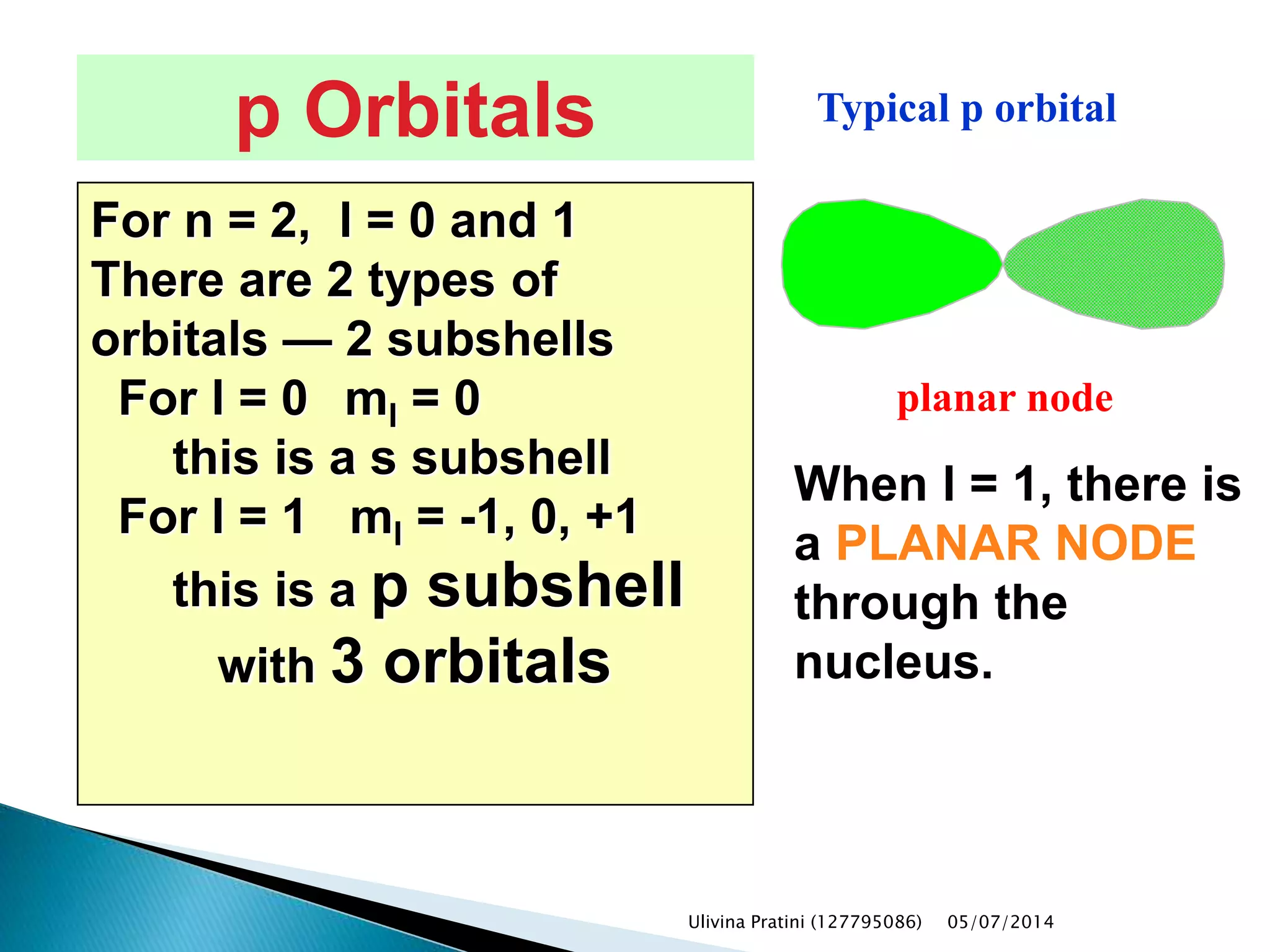
When l = 1, there is
a PLANAR NODE
through the
nucleus.
planar node
Typical p orbitalp Orbitals
For n = 2, l = 0 and 1
There are 2 types of
orbitals — 2 subshells
For l = 0 ml = 0
this is a s subshell
For l = 1 ml = -1, 0, +1
this is a p subshell
with 3 orbitals
Ulivina Pratini (127795086) 05/07/2014
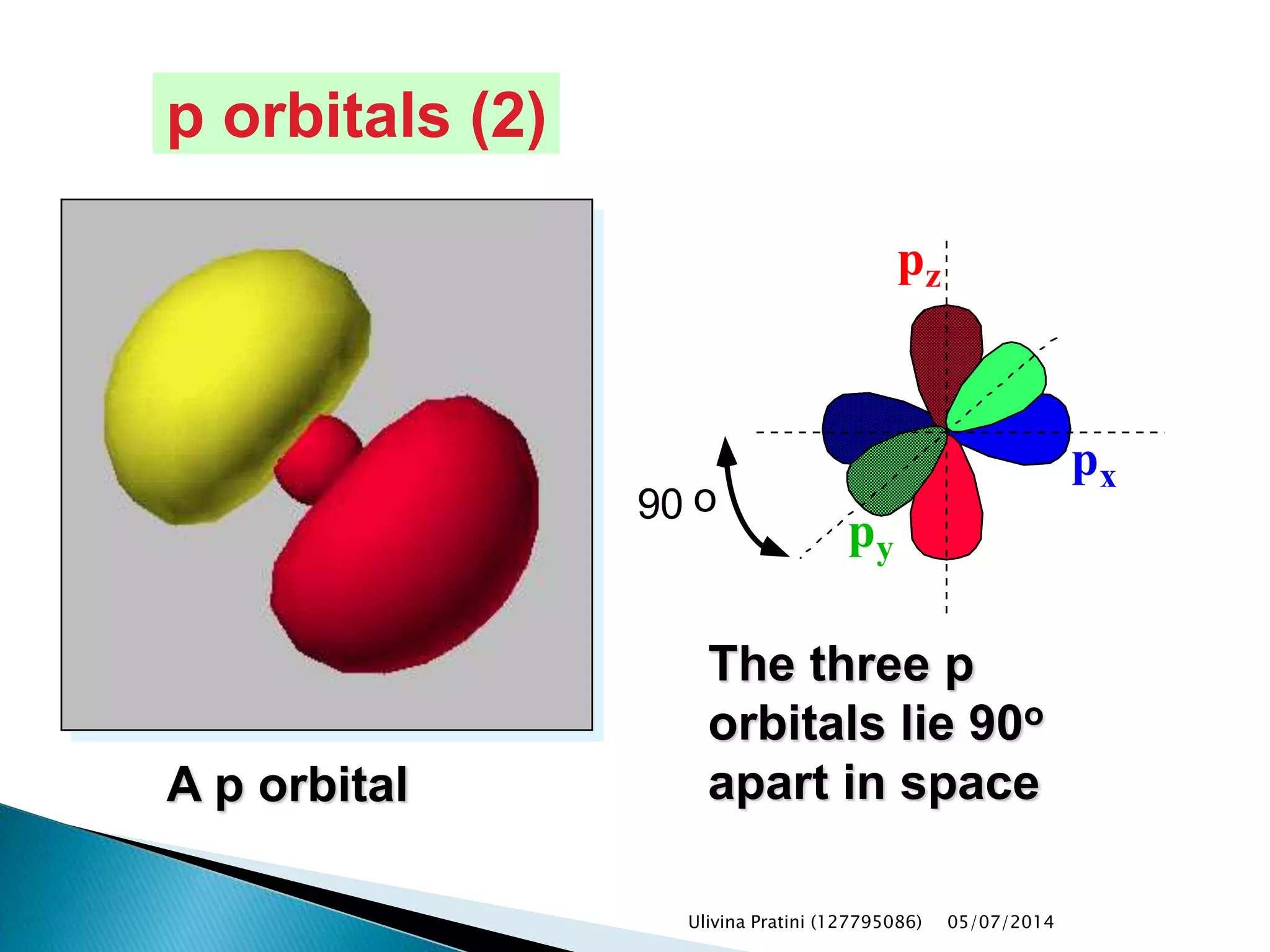
The three p
orbitals lie 90o
apart in space
pz
py
px
90 o
A p orbital
p orbitals (2)
Ulivina Pratini (127795086) 05/07/2014
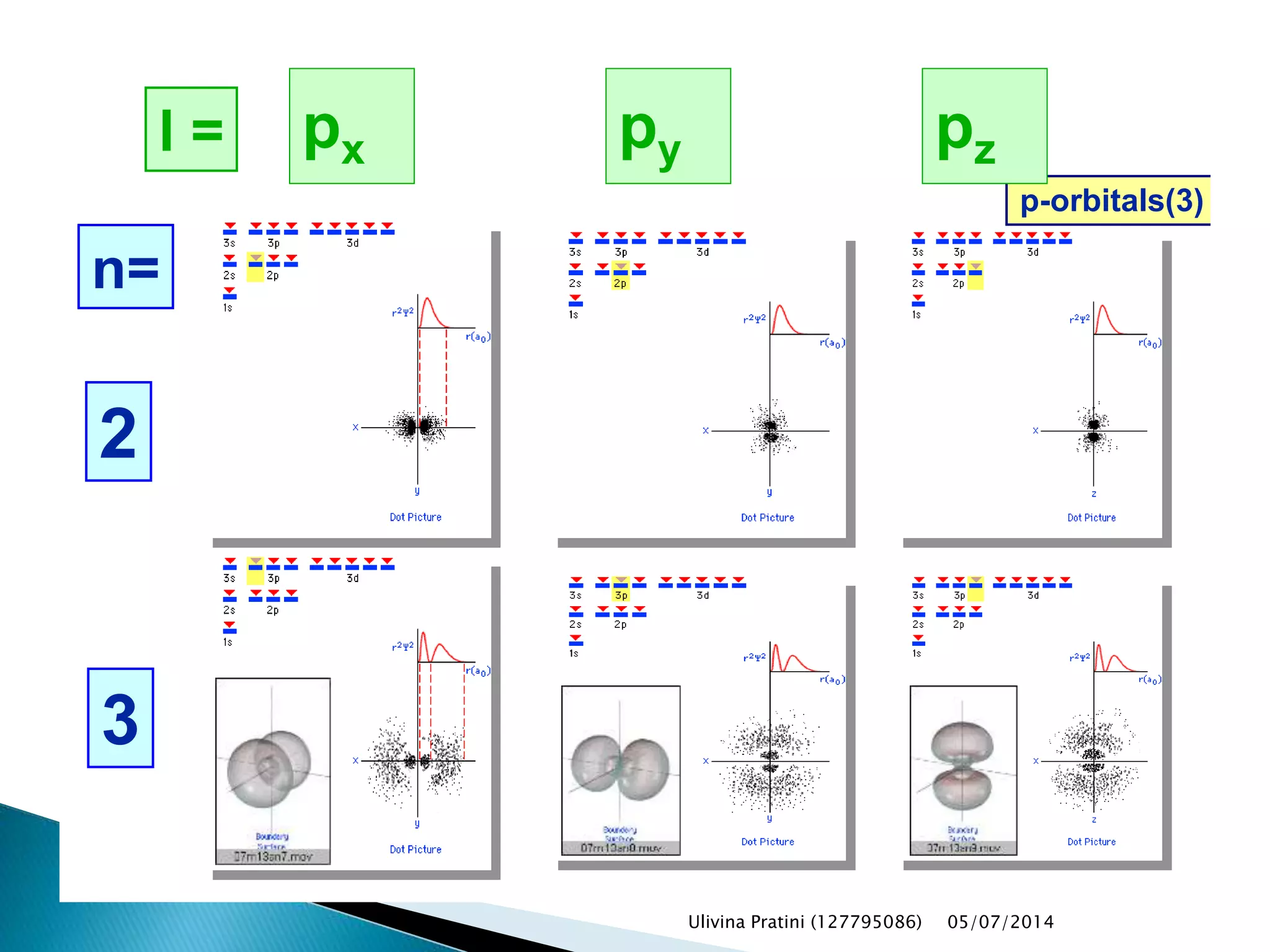
p-orbitals(3)
px py pz
2
3
n=
l =
Ulivina Pratini (127795086) 05/07/2014
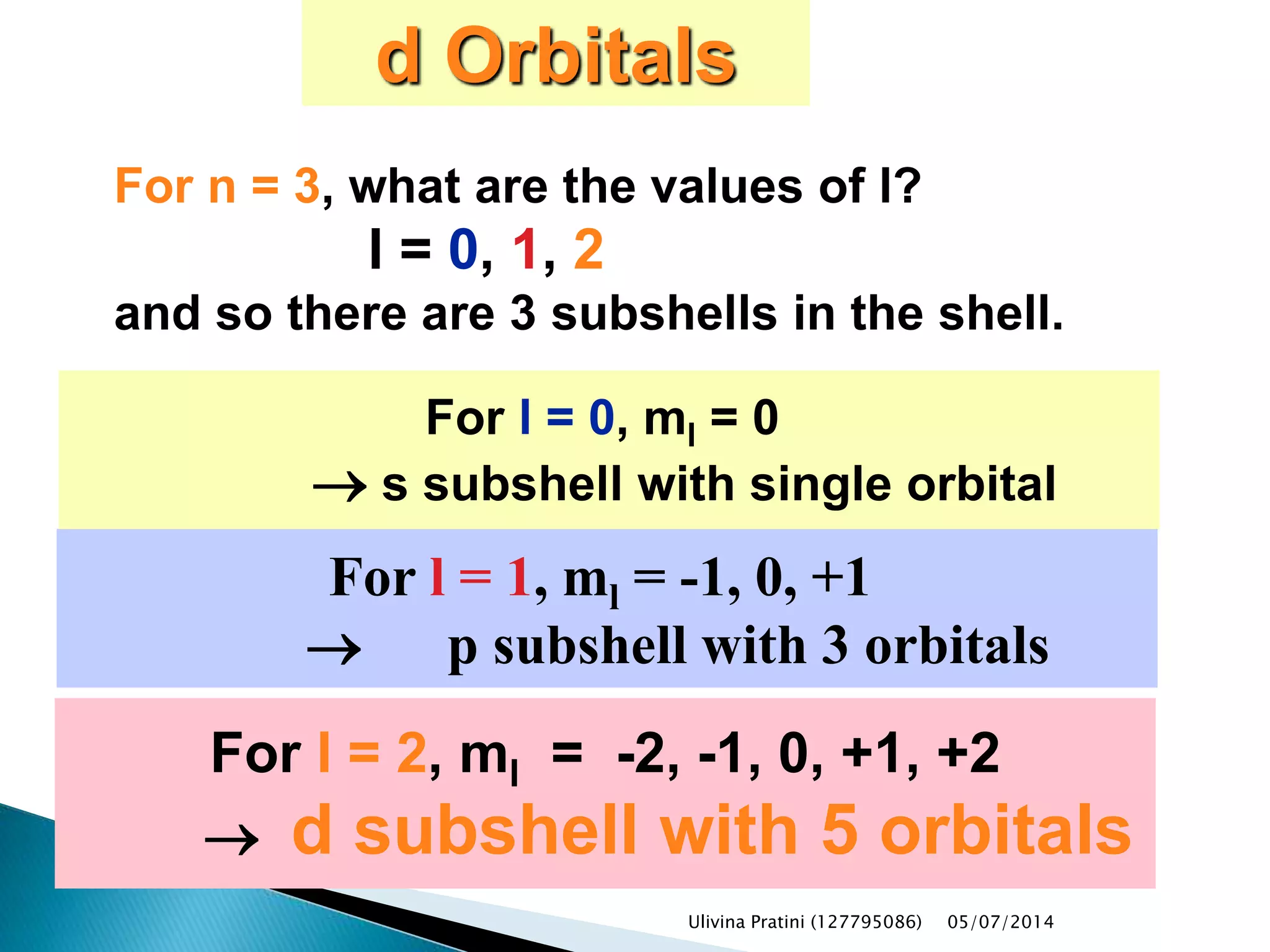
For l = 2, ml = -2, -1, 0, +1, +2
 d subshell with 5 orbitals
For l = 1, ml = -1, 0, +1
 p subshell with 3 orbitals
For l = 0, ml = 0
 s subshell with single orbital
For n = 3, what are the values of l?
l = 0, 1, 2
and so there are 3 subshells in the shell.
d Orbitals
Ulivina Pratini (127795086) 05/07/2014
d Orbitals
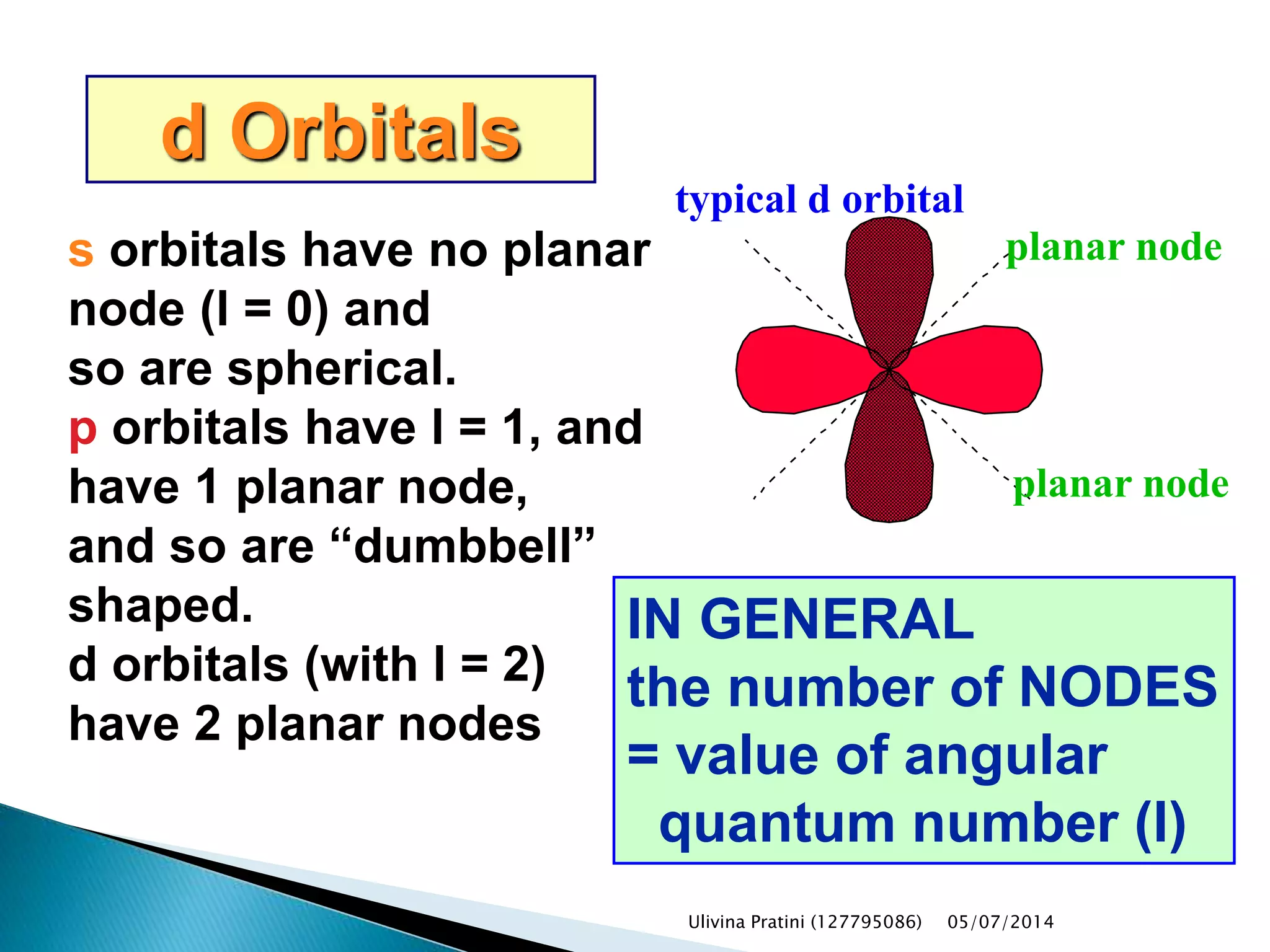
IN GENERAL
the number of NODES
= value of angular
quantum number (l)
s orbitals have no planar
node (l = 0) and
so are spherical.
p orbitals have l = 1, and
have 1 planar node,
and so are “dumbbell”
shaped.
d orbitals (with l = 2)
have 2 planar nodes
typical d orbital
planar node
planar node
Ulivina Pratini (127795086) 05/07/2014
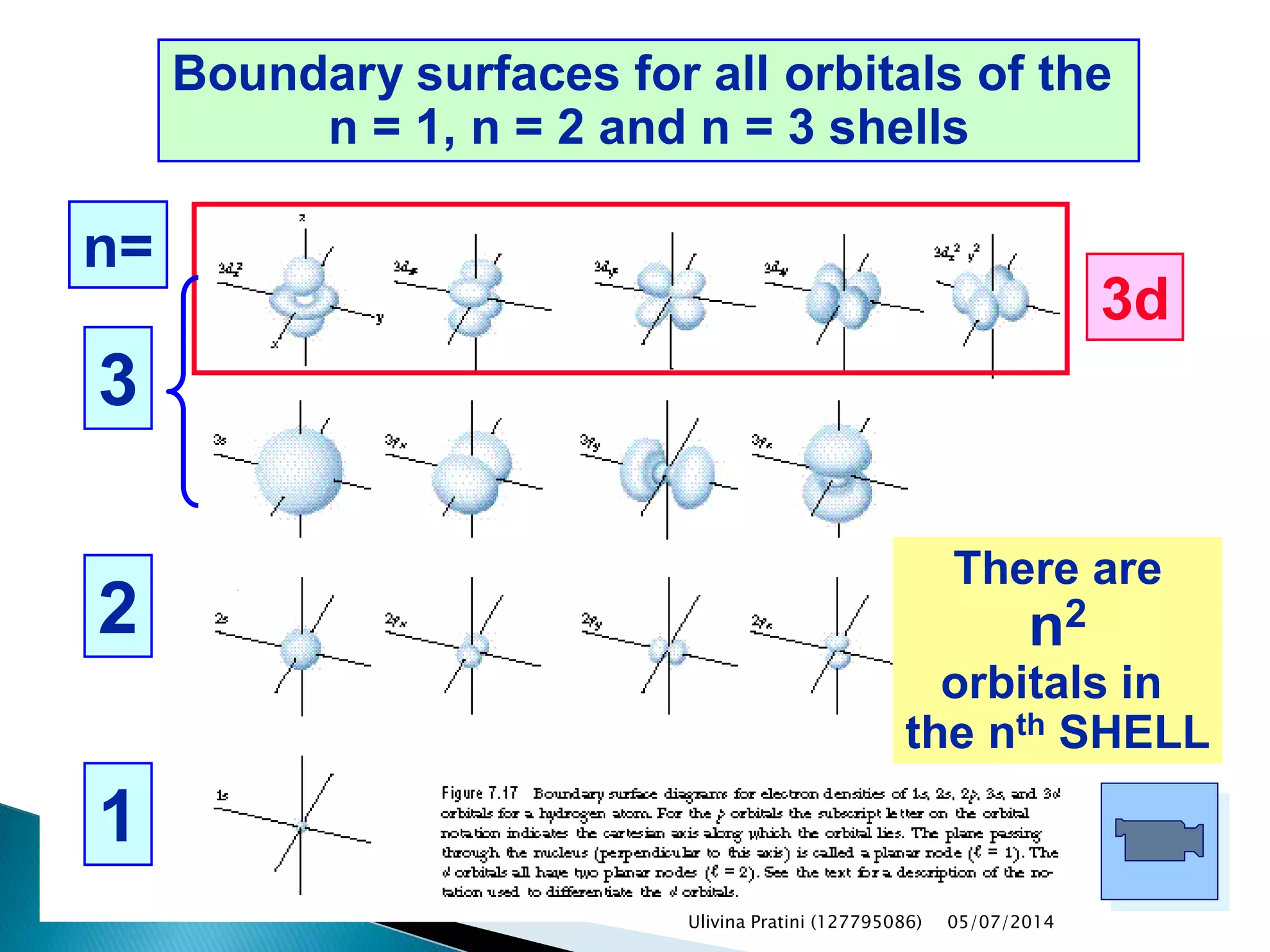
Boundary surfaces for all orbitals of the
n = 1, n = 2 and n = 3 shells
2
1
3d
n=
3
There are
n2
orbitals in
the nth SHELL
Ulivina Pratini (127795086) 05/07/2014
05/07/2014Ulivina Pratini (127795086)

Basic of Atomic Structure

  • 1.
    SCIENCE EDUCATION MASTER DEGREEPROGRAM THE STATE UNIVERSITY OF SURABAYA ULIVINA PRATINI (127795086)
  • 2.
    Democritus, systematized his views.In approximately 450 BC, Democritus coined the term átomos, which means "uncuttable" or "the smallest indivisible particle of matter". 1. History of The Atom
  • 3.
    In 1805, Englishinstructor and natural philosopher John Dalton used the concept of atoms. He proposed that each element consists of atoms of a single, unique type, and that these atoms can join together to form chemical compounds. 1. History of The Atom
  • 4.
    • Experiments byJ.J. Thomson in the 1890’s showed that atoms contain electrons. • Cathode ray tube 1. History of The Atom Electric Potential = Voltage Ulivina Pratini (127795086) 05/07/2014
  • 5.
    • The PlumPudding (Chocolate Chip Cookie) Model 1. History of The Atom Ulivina Pratini (127795086) 05/07/2014
  • 6.
    • Rutherford’s Experiment(1911) α particles are very small and positively charged 1. History of The Atom Ulivina Pratini (127795086) 05/07/2014
  • 7.
    • Results ofthe Rutherford experiment (a) The results that the metal foil experiment would have yielded if the plum pudding model had been correct (b) Actual results 1. History of The Atom Ulivina Pratini (127795086) 05/07/2014
  • 8.
    1. Since mostof the alpha particles were passed through the foil undeflected, therefore, it was concluded that most of the atom is empty. 2. Small angles of deflection indicate that positively charged alpha particles were attracted by electrons. 3. Large angles of deflection indicate that there is a massive positively charged body present in the atom and due to repulsion alpha particles were deflected at large angles.
  • 10.
    • Comparing theParts of an Atom Ulivina Pratini (127795086) 05/07/2014
  • 11.
    There were twofundamental defects in Rutherford's atomic model: According to classical electromagnetic theory, being a charge particle electron when accelerated must emit energy. We know that the motion of electron around the nucleus is an accelerated motion, therefore, it must radiate energy. But in actual practice this does not happen. Suppose if it happens then due to continuous loss of energy orbit of electron must decrease continuously. Consequently electron will fall into the nucleus. But this is against the actual situation and this shows that atom is unstable. If the electrons emit energy continuously, they should form continuous spectrum. But actually line spectrum is obtained
  • 12.
    •Bohr’s greatest contributionto science was in building a simple model of the atom. • It was based on understanding the SHARP LINE SPECTRA of excited atoms. Niels Bohr (1885-1962) (Nobel Prize, 1922) Ulivina Pratini (127795086) 05/07/2014
  • 13.
    Line Spectra ofExcited Atoms • Excited atoms emit light of only certain wavelengths • The wavelengths of emitted light depend on the element. H Hg Ne Ulivina Pratini (127795086) 05/07/2014
  • 14.
    + Electron orbit 2. But acharged particle moving in an electric field should emit energy. 1. Classically any orbit should be possible and so is any energy. 4. Atomic Spectra and Bohr Model One view of atomic structure in early 20th century was that an electron (e-) traveled about the nucleus in an orbit. Ulivina Pratini (127795086) 05/07/2014
  • 15.
    • Bohr saidclassical view is wrong. Need a new theory — now called QUANTUM or WAVE MECHANICS. • e- can only exist in certain discrete orbit — called stationary states. • e- is restricted to QUANTIZED energy states. 4. Atomic Spectra and Bohr Model Ulivina Pratini (127795086) 05/07/2014
  • 16.
    4-H_SPECTRA.MOV H atom 07m07an1.mov If e-’sare in quantized energy states, then DE of states can have only certain values. This explains sharp line spectra. 4. Atomic Spectra and Bohr Model Ulivina Pratini (127795086) 05/07/2014 n = 1 n = 2 E = -R (1/22) E = -R (1/12) R, the Rydberg constant. R = 1312 kJ/mol or 3.29 x 10¹⁵ Hz
  • 17.
    Hydrogen atom spectra Visiblelines in H atom spectrum are called the BALMER series. High EHigh E ShortShort  HighHigh  Low ELow E LongLong  LowLow  Energy Ultra Violet Lyman Infrared Paschen Visible BalmerEn = -1312 n2 6 5 3 2 1 4 n Ulivina Pratini (127795086) 05/07/2014
  • 18.
    05/07/2014Ulivina Pratini (127795086) Eachstationary orbit corresponds to a definite energy.There stationary orbit are designated by K,L,M,N,O,… .The orbit close to the nucleus has less energy compared to the orbit away from the nucleus. 4. Atomic Spectra and Bohr Model
  • 19.
    05/07/2014Ulivina Pratini (127795086) Atomicspectra display fine structure due to splitting of spectral lines. I an attempt to account for the fine structure, Arnold Sommerfeld proposed elliptical orbits instead of circular orbits proposed by Bohr. =
  • 20.
    • Bohr’s theorywas a great accomplishment and radically changed our view of matter. • But problems existed with Bohr theory — – theory only successful for the H atom. – introduced quantum idea artificially. • So, we go on to QUANTUM or WAVE MECHANICS Ulivina Pratini (127795086) 05/07/2014
  • 21.
    • Light hasboth wave & particle properties • de Broglie (1924) proposed that all moving objects have wave properties. • For light: E = h = hc /  • For particles: E = mc2 (Einstein)L. de Broglie (1892-1987)  for particles is called the de Broglie wavelength and for particles (mass)x(velocity) = h /  Therefore, mc = h /  Ulivina Pratini (127795086) 05/07/2014
  • 22.
  • 23.
    W. Heisenberg 1901-1976 Uncertainty Principle Problem ofdefining nature of electrons in atoms solved by W. Heisenberg. Cannot simultaneously define the position and momentum (= m•v) of an electron. Dx. Dp = h At best we can describe the position and velocity of an electron by a PROBABILITY DISTRIBUTION, which is given by Y2 Ulivina Pratini (127795086) 05/07/2014
  • 24.
    E. Schrodinger 1887-1961 Schrodinger appliedidea of e- behaving as a wave to the problem of electrons in atoms. Solution to WAVE EQUATION gives set of mathematical expressions called WAVE FUNCTIONS, Y Each describes an allowed energy state of an e- Quantization introduced naturally. Ulivina Pratini (127795086) 05/07/2014
  • 25.
    WAVE FUNCTIONS, Y •Y is a function of distance and two angles. • For 1 electron, Y corresponds to an ORBITAL — the region of space within which an electron is found. • Y does NOT describe the exact location of the electron. • Y2 is proportional to the probability of finding an e- at a given point. Ulivina Pratini (127795086) 05/07/2014
  • 26.
    Y2 is proportionalto the probability of finding an e- at a given point. Ulivina Pratini (127795086) 05/07/2014
  • 27.
    • An atomicorbital is defined by 3 quantum numbers: – n l ml • Electrons are arranged in shells and subshells of ORBITALS . • n  shell • l  subshell • ml  designates an orbital within a subshell Ulivina Pratini (127795086) 05/07/2014
  • 28.
    Quantum Numbers mmll (magnetic)(magnetic)--l..0..+ll..0..+l Orbital orientationOrbital orientation in spacein space ll (angular)(angular) 0, 1, 2, .. n0, 1, 2, .. n--11 Orbital shape orOrbital shape or typetype ((subshellsubshell)) n (major) 1, 2, 3, .. Orbital size and energy = -R(1/n2) Total # of orbitals in lth subshell = 2 l + 1 SymbolSymbol ValuesValues DescriptionDescription Ulivina Pratini (127795086) 05/07/2014
  • 29.
    Shells and Subshells Forn = 1, l = 0 and ml = 0 There is only one subshell and that subshell has a single orbital (ml has a single value ---> 1 orbital) This subshell is labeled s (“ess”) and we call this orbital 1s Each shell has 1 orbital labeled s. It is SPHERICAL in shape. Ulivina Pratini (127795086) 05/07/2014
  • 30.
    s Orbitals All sorbitals are spherical in shape. Ulivina Pratini (127795086) 05/07/2014
  • 31.
    When l =1, there is a PLANAR NODE through the nucleus. planar node Typical p orbitalp Orbitals For n = 2, l = 0 and 1 There are 2 types of orbitals — 2 subshells For l = 0 ml = 0 this is a s subshell For l = 1 ml = -1, 0, +1 this is a p subshell with 3 orbitals Ulivina Pratini (127795086) 05/07/2014
  • 32.
    The three p orbitalslie 90o apart in space pz py px 90 o A p orbital p orbitals (2) Ulivina Pratini (127795086) 05/07/2014
  • 33.
    p-orbitals(3) px py pz 2 3 n= l= Ulivina Pratini (127795086) 05/07/2014
  • 34.
    For l =2, ml = -2, -1, 0, +1, +2  d subshell with 5 orbitals For l = 1, ml = -1, 0, +1  p subshell with 3 orbitals For l = 0, ml = 0  s subshell with single orbital For n = 3, what are the values of l? l = 0, 1, 2 and so there are 3 subshells in the shell. d Orbitals Ulivina Pratini (127795086) 05/07/2014
  • 35.
    d Orbitals IN GENERAL thenumber of NODES = value of angular quantum number (l) s orbitals have no planar node (l = 0) and so are spherical. p orbitals have l = 1, and have 1 planar node, and so are “dumbbell” shaped. d orbitals (with l = 2) have 2 planar nodes typical d orbital planar node planar node Ulivina Pratini (127795086) 05/07/2014
  • 36.
    Boundary surfaces forall orbitals of the n = 1, n = 2 and n = 3 shells 2 1 3d n= 3 There are n2 orbitals in the nth SHELL Ulivina Pratini (127795086) 05/07/2014
  • 37.