1. Define defibrillation.
2. Describe Need and history of defibrillation.
3. Describe the principle and mechanism of
defibrillation.
4. Types and classes of defibrillator
5. Describe the Automated external defibrillator
6. Identify the precautions and risk
7. Troubleshooting of defibrillator
Definition:
Defibrillation is a process in which an electronic device
sends an electric shock to the heart to stop an extremely
rapid, irregular heartbeat, and restore the normal heart
rhythm.
Defibrillation is a common treatment for life
threatening cardiac dysrhythmias, ventricular
fibrillation, and pulse less ventricular tachycardia.
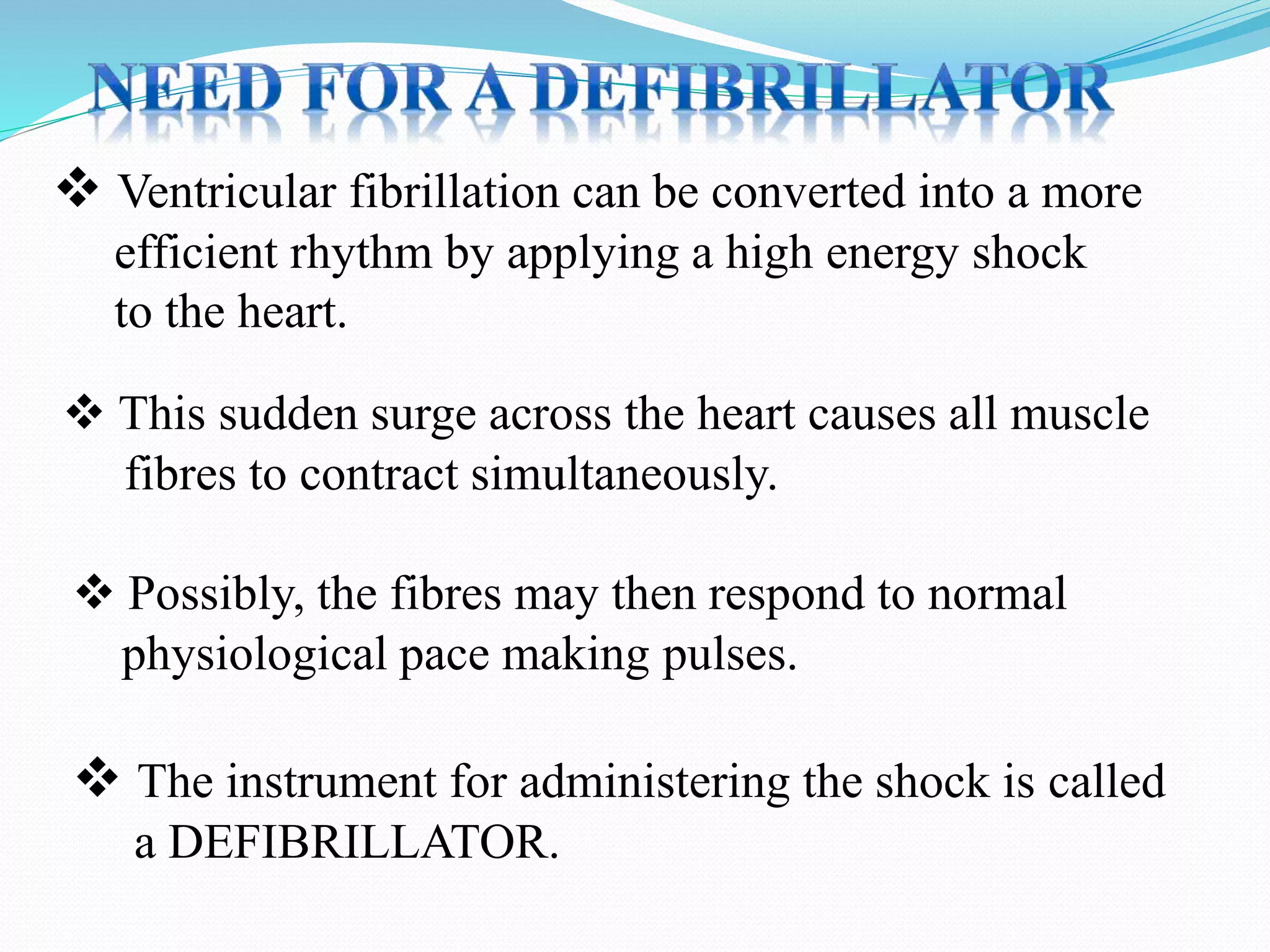
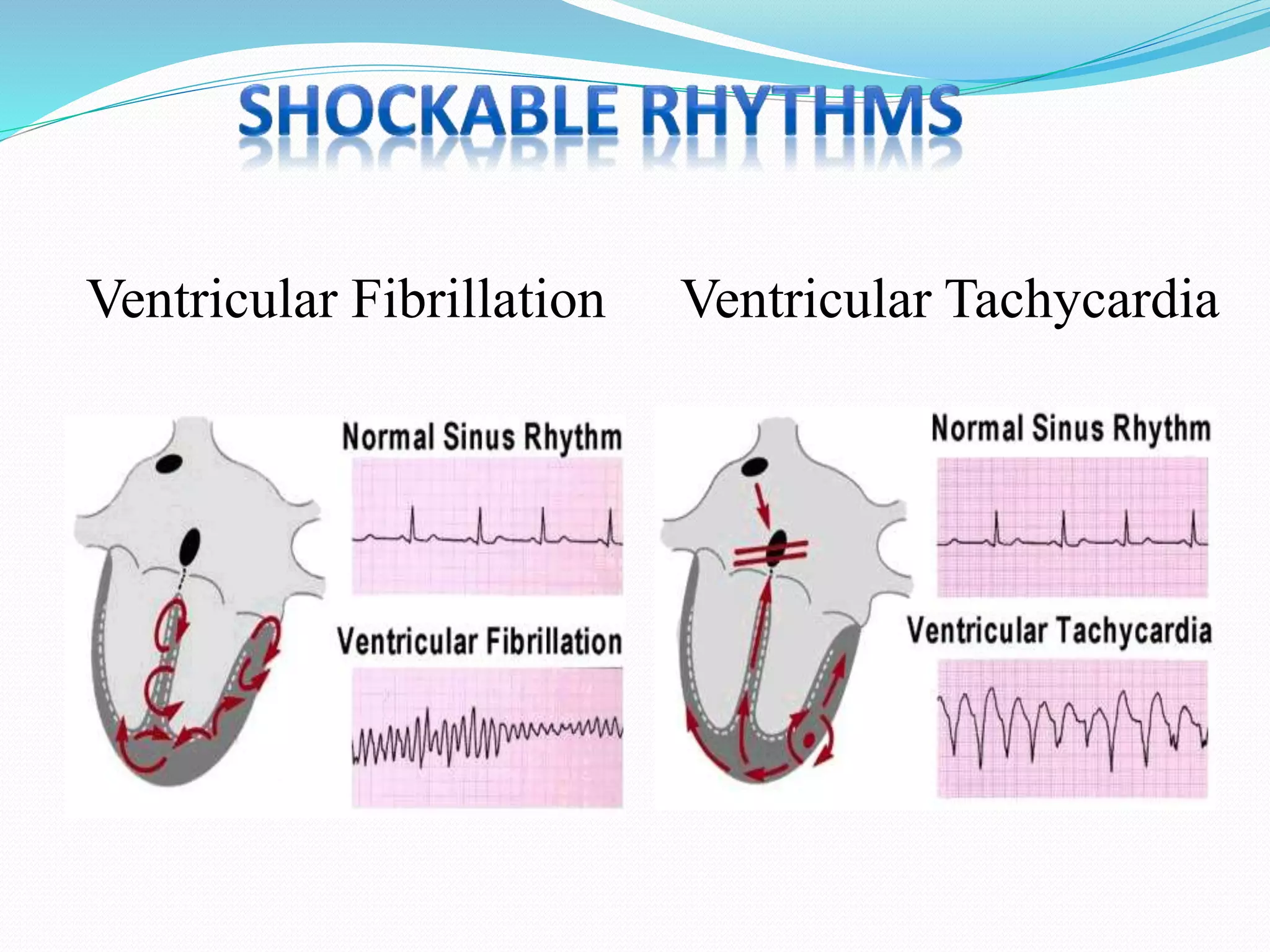
Ventricular fibrillation is a serious cardiac emergency
resulting from asynchronous contraction of the heart
muscles.
 Due to ventricular fibrillation, there is an irregular
rapid heart rhythm.
Fig. Ventricular fibrillation Fig. Normal heart beat
 Ventricular fibrillation can be converted into a more
efficient rhythm by applying a high energy shock
to the heart.
 This sudden surge across the heart causes all muscle
fibres to contract simultaneously.
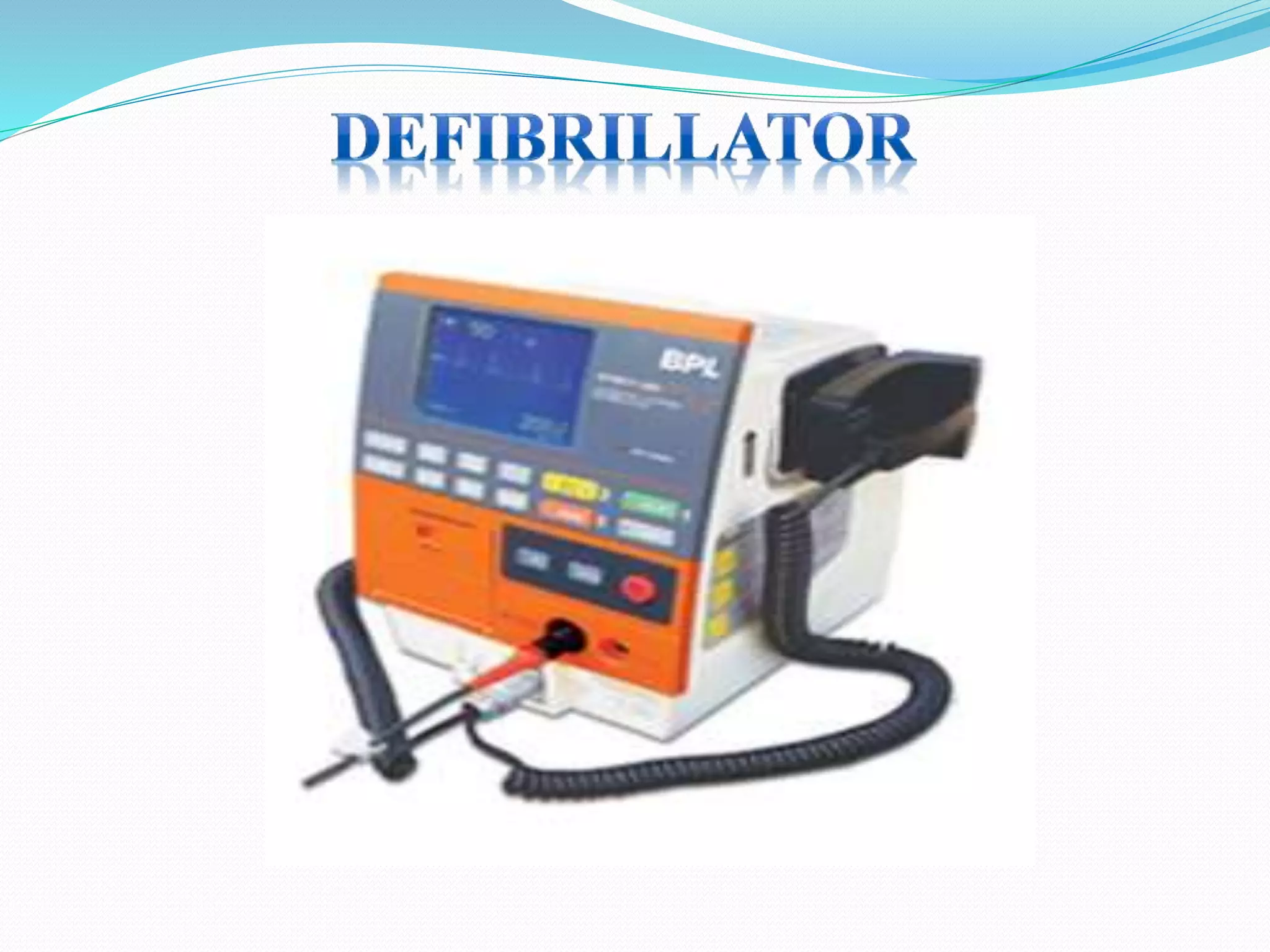
 The instrument for administering the shock is called
a DEFIBRILLATOR.
 Possibly, the fibres may then respond to normal
physiological pace making pulses.
Defibrillation is performed to correct life-
threatening fibrillations of the heart, which could
result in cardiac arrest. It should be performed
immediately after identifying that the patient is
experiencing a cardiac emergency, has no pulse,
and is unresponsive.
Defibrillation was invented in 1899 by Prevost and
Batelli, two Italian physiologists. They discovered
that electric shocks could convert ventricular
fibrillation to sinus rhythm in dogs.The first case of a
human life saved by defibrillation was reported by
Beck in 1947 .
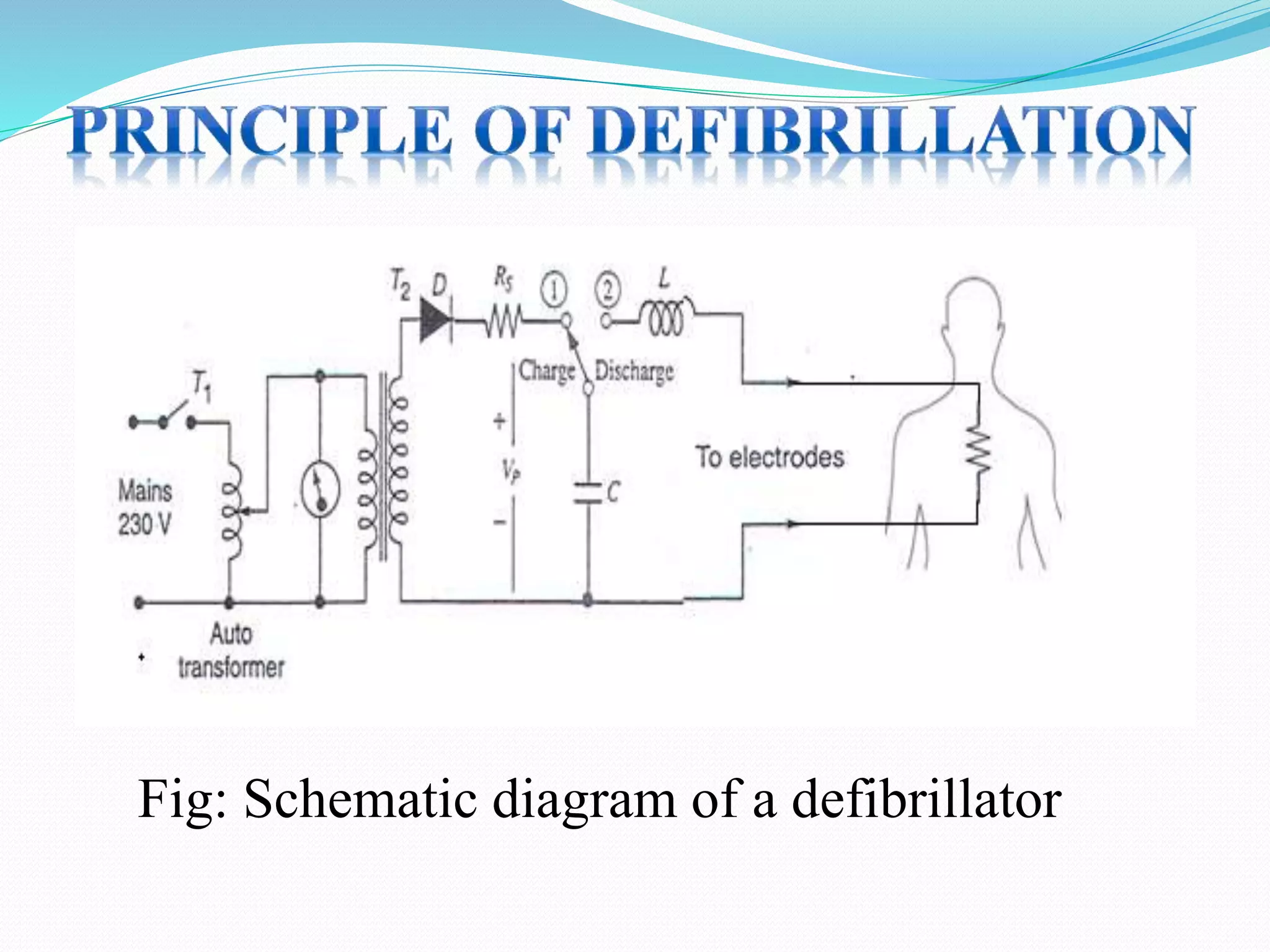
 Energy storage capacitor is charged at relatively
slow rate from AC line.
 Energy stored in capacitor is then delivered at a
relatively rapid rate to chest of the patient.
 Simple arrangement involve the discharge of
capacitor energy through the patient’s own
resistance.
Fig: Schematic diagram of a defibrillator
 The discharge resistance which the patient
represents as purely ohmic resistance of 50 to 100Ω
approximately for a typical electrode size of 80cm2.
 This particular waveform Fig is called ‘ Lown’
waveform.
 The pulse width of this waveform is generally 10 ms.
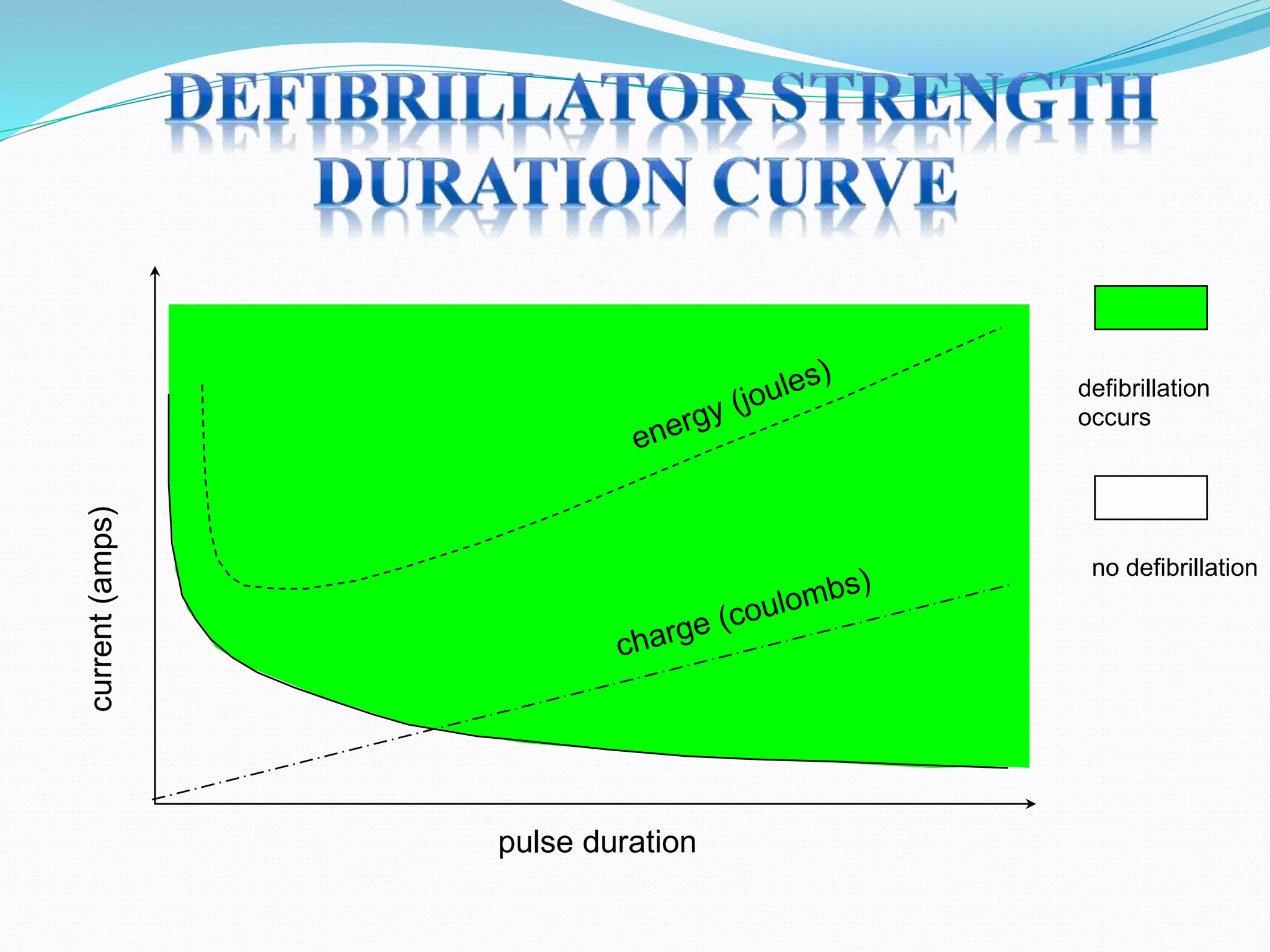
current(amps)
pulse duration
defibrillation
occurs
no defibrillation
• minimum defibrillation energy occurs for pulse
durations of 3 - 10 ms (for most pulse shapes).
• pulse amplitude in tens of amperes (few
thousand volts).
– intrinsic characteristics of patient
– patient’s disease
– duration of arrhythmia
– patient’s age
– type of arrhythmia (more energy required for v.
fib.)
• operator selects energy delivered: 50-360
joules, depends on:
 Fibrillations cause the heart to stop pumping
blood, leading to brain damage.
 Defibrillators deliver a brief electric shock to the
heart, which enables the heart's natural pacemaker
to regain control and establish a normal heart
rhythm.
 Higher voltages are required for external defibrillation
than for internal defibrillation.
 A corrective shock of 750-800 volts is applied within a
tenth of a second.
 That is the same voltage as 500-533 no of AA batteries!
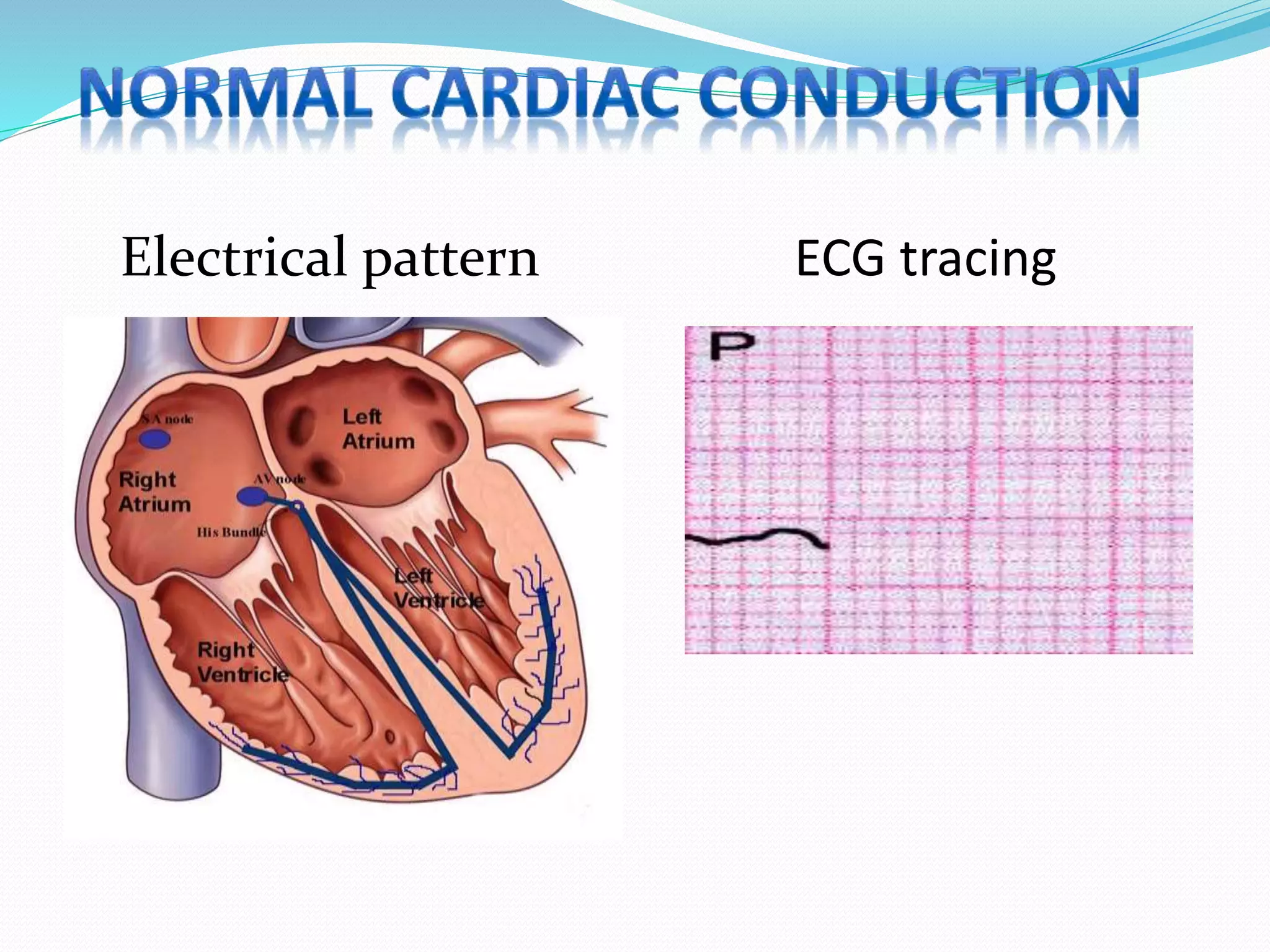
ECG tracingElectrical pattern
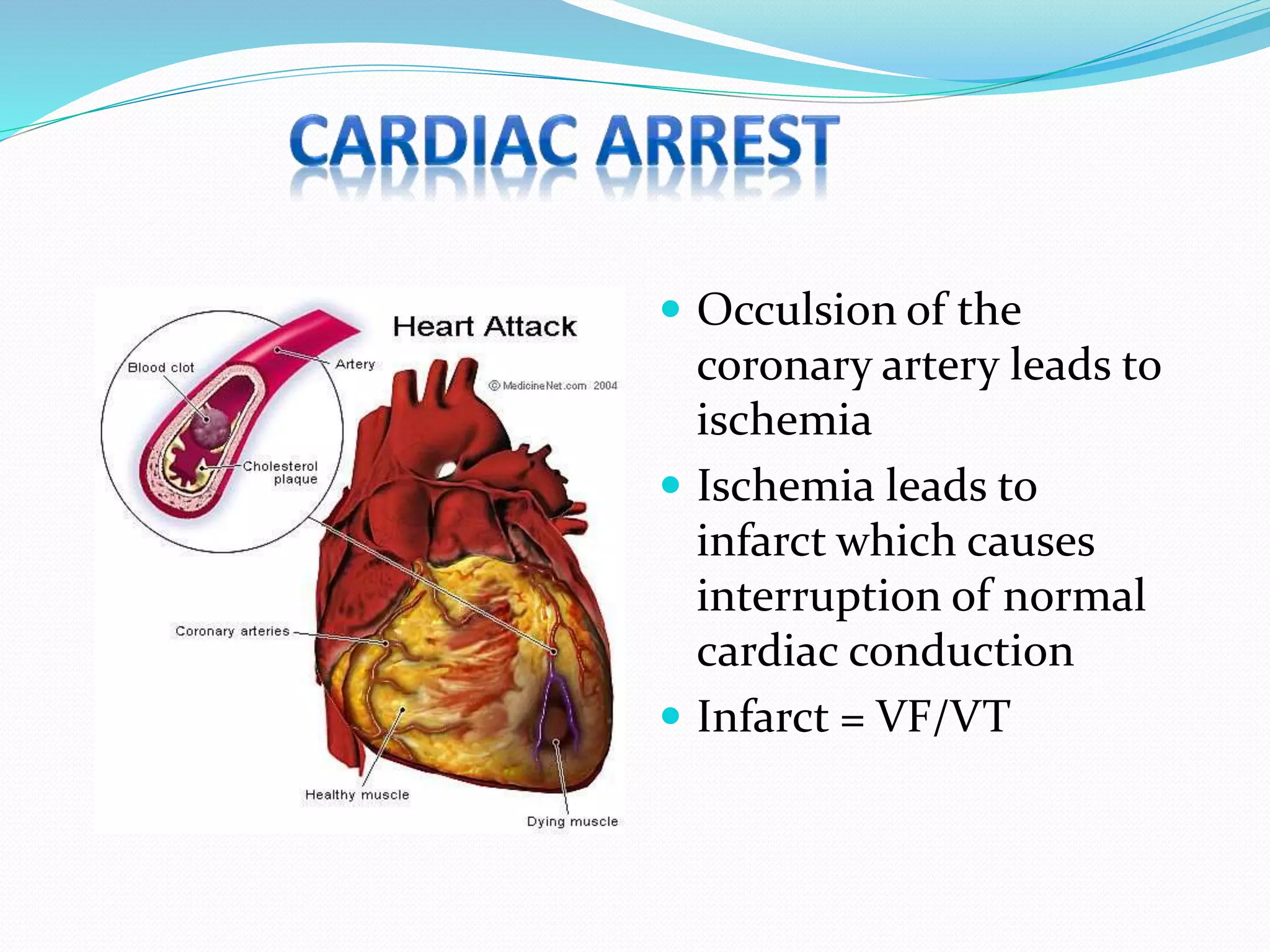
 Occulsion of the
coronary artery leads to
ischemia
 Ischemia leads to
infarct which causes
interruption of normal
cardiac conduction
 Infarct = VF/VT
Ventricular Fibrillation Ventricular Tachycardia
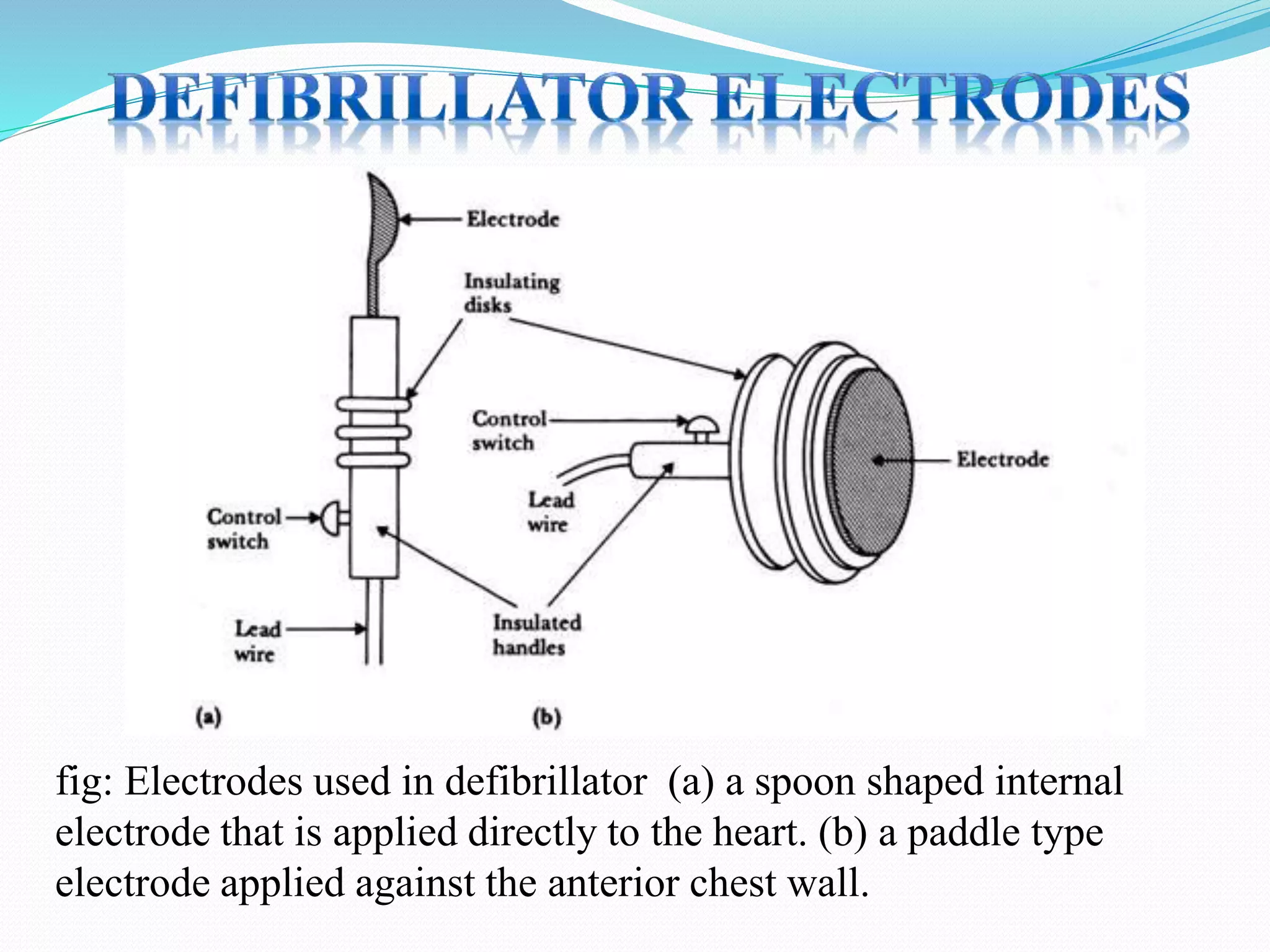
 Types of Defibrillator electrodes:-
a) Spoon shaped electrode
• Applied directly to the heart.
b) Paddle type electrode
• Applied against the chest wall
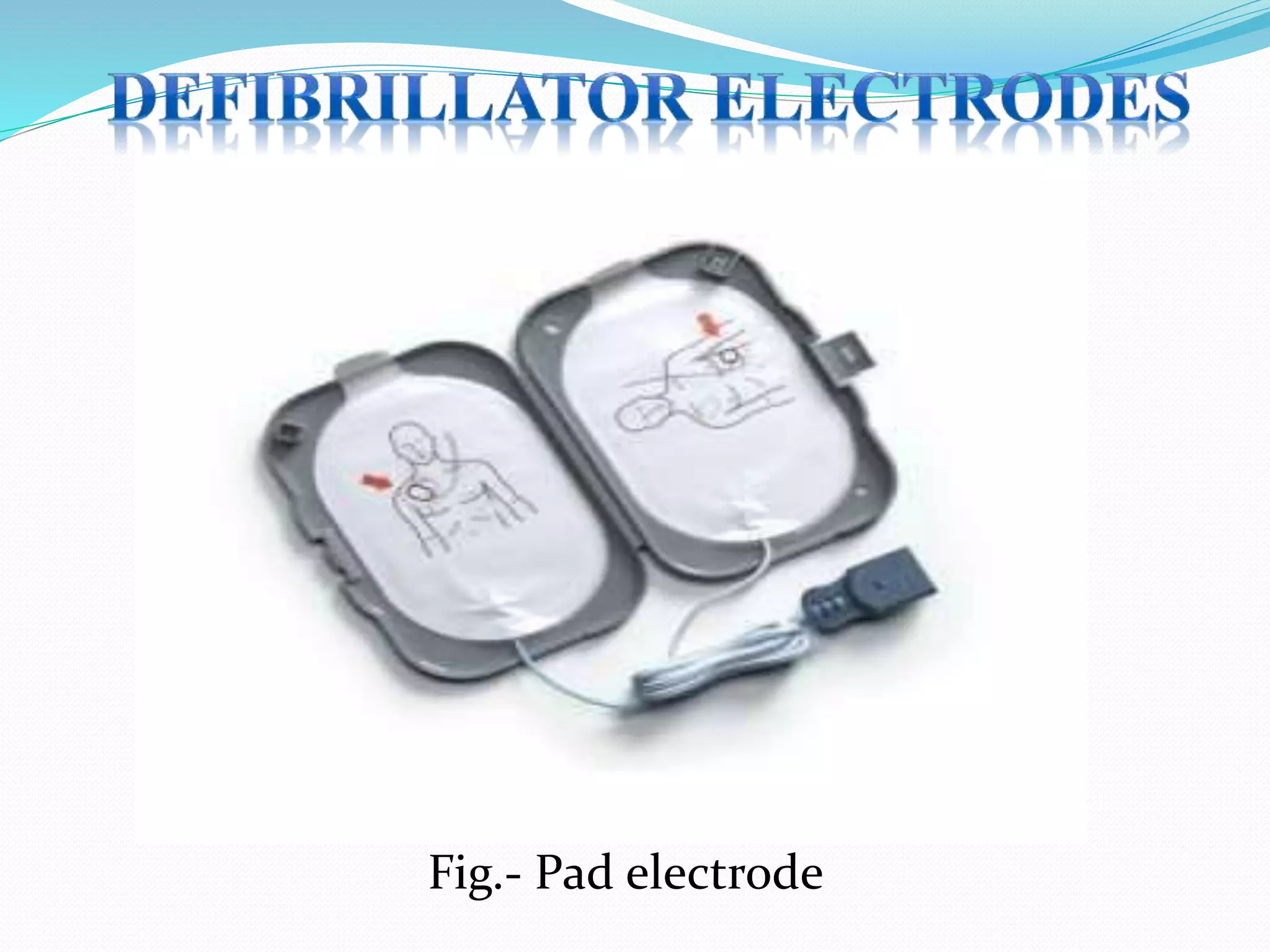
c) Pad type electrode
• Applied directly on chest wall
fig: Electrodes used in defibrillator (a) a spoon shaped internal
electrode that is applied directly to the heart. (b) a paddle type
electrode applied against the anterior chest wall.
Fig.- Pad electrode
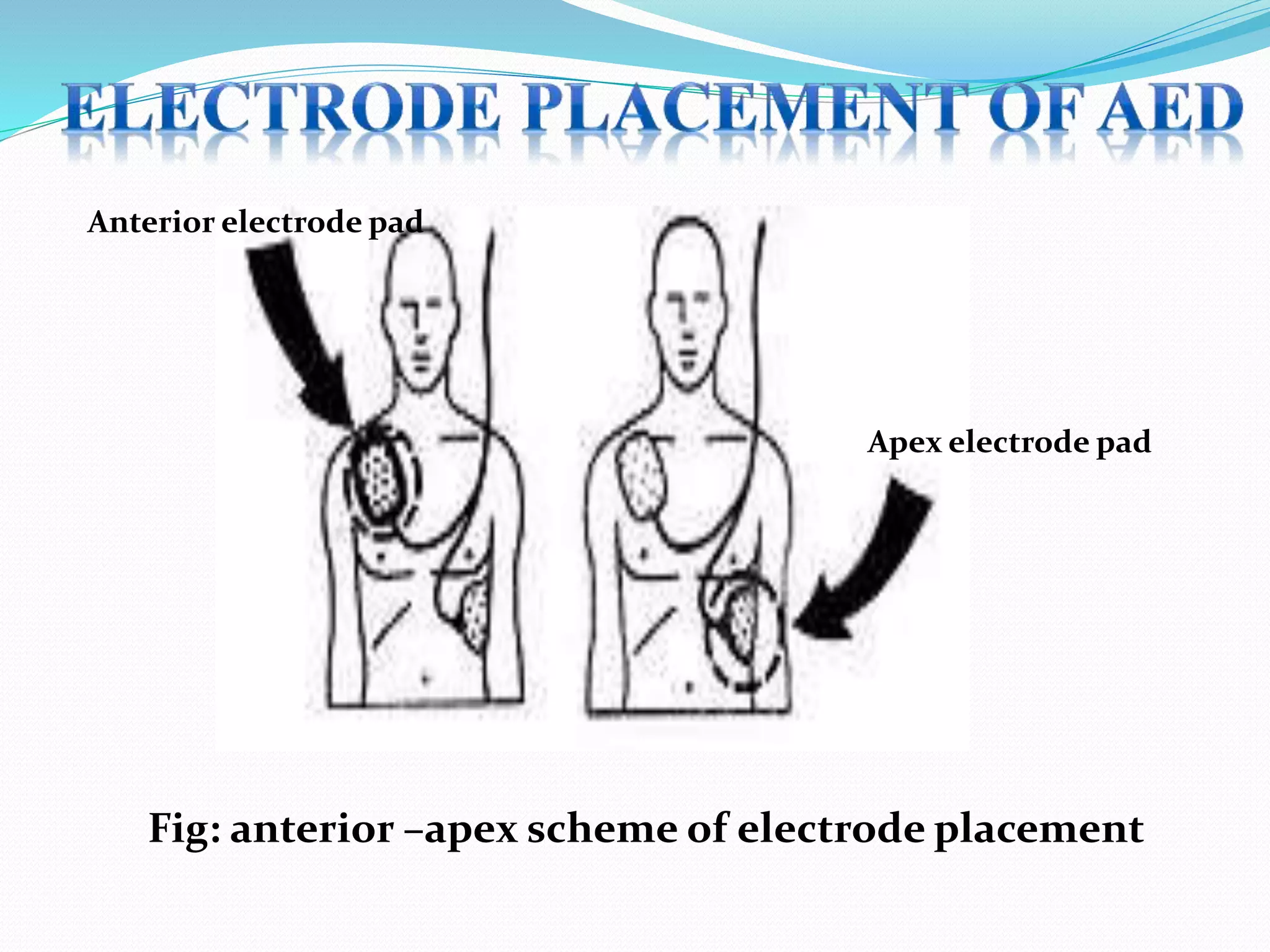
Anterior electrode pad
Apex electrode pad
Fig: anterior –apex scheme of electrode placement
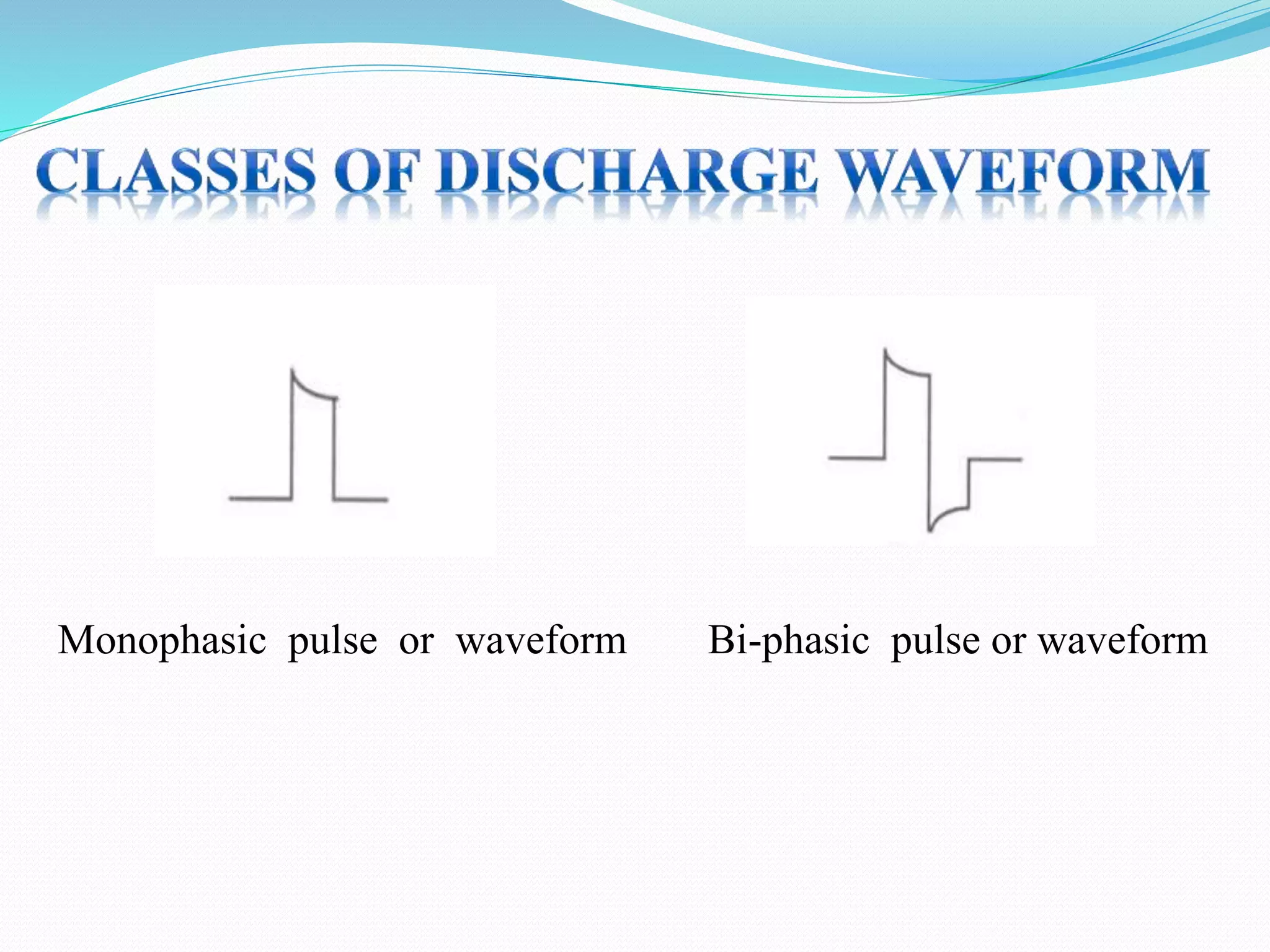
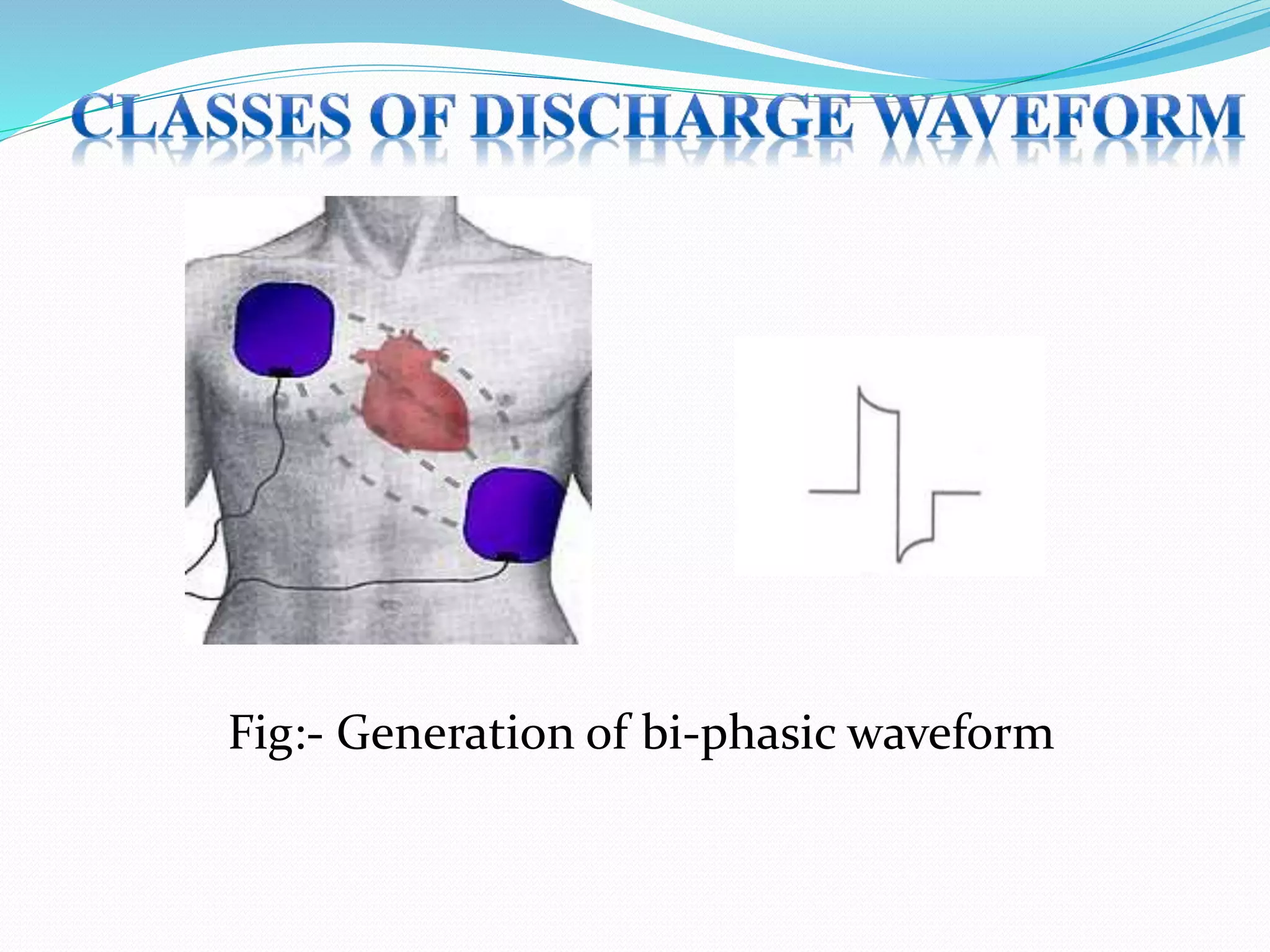
Monophasic pulse or waveform Bi-phasic pulse or waveform
 There are two general classes of waveforms:
a) mono-phasic waveform
• Energy delivered in one direction through the
patient’s heart
a) Biphasic waveform
• Energy delivered in both direction through the
patient’s heart
Fig:- Generation of bi-phasic waveform
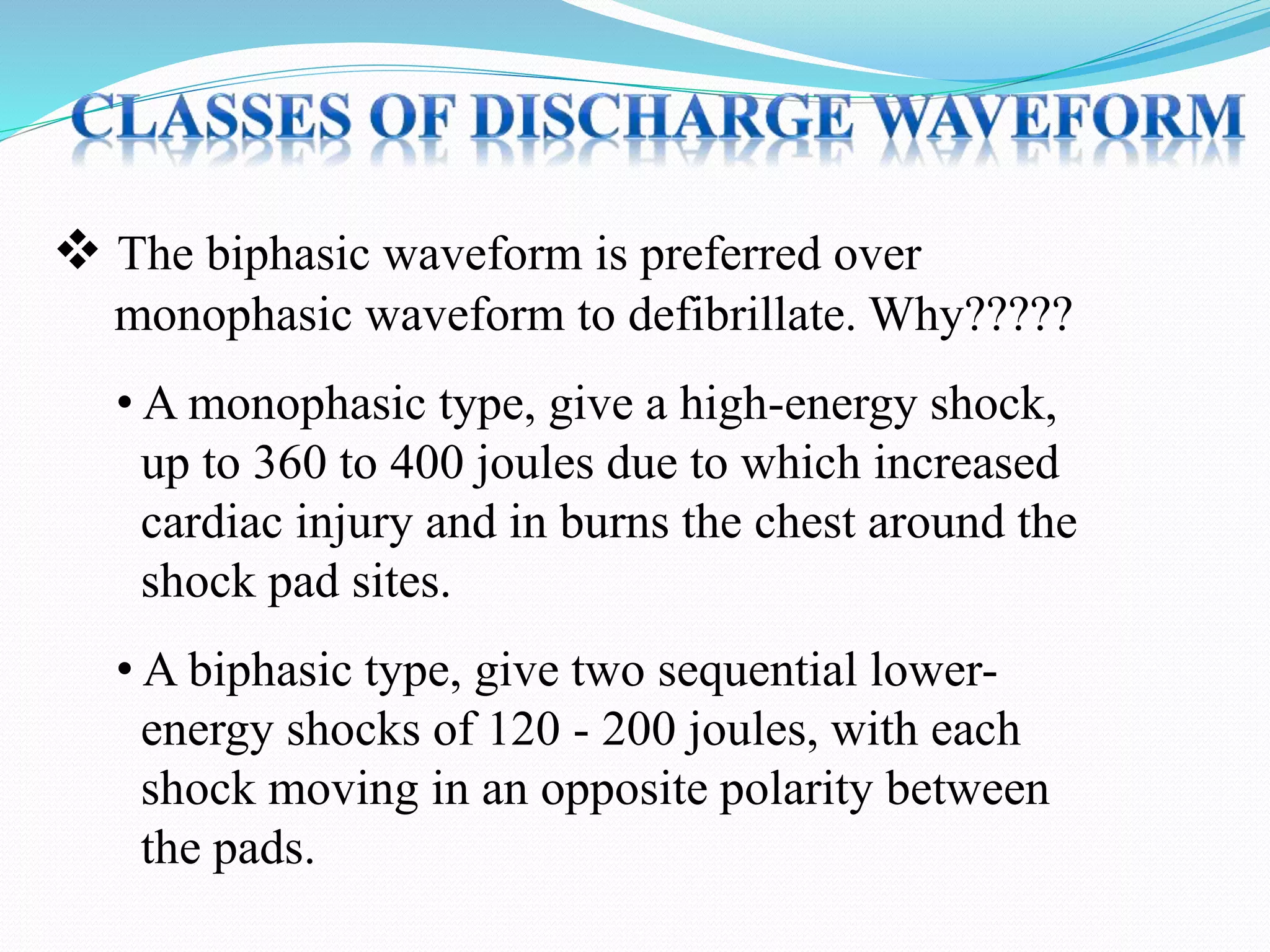
 The biphasic waveform is preferred over
monophasic waveform to defibrillate. Why?????
• A monophasic type, give a high-energy shock,
up to 360 to 400 joules due to which increased
cardiac injury and in burns the chest around the
shock pad sites.
• A biphasic type, give two sequential lower-
energy shocks of 120 - 200 joules, with each
shock moving in an opposite polarity between
the pads.
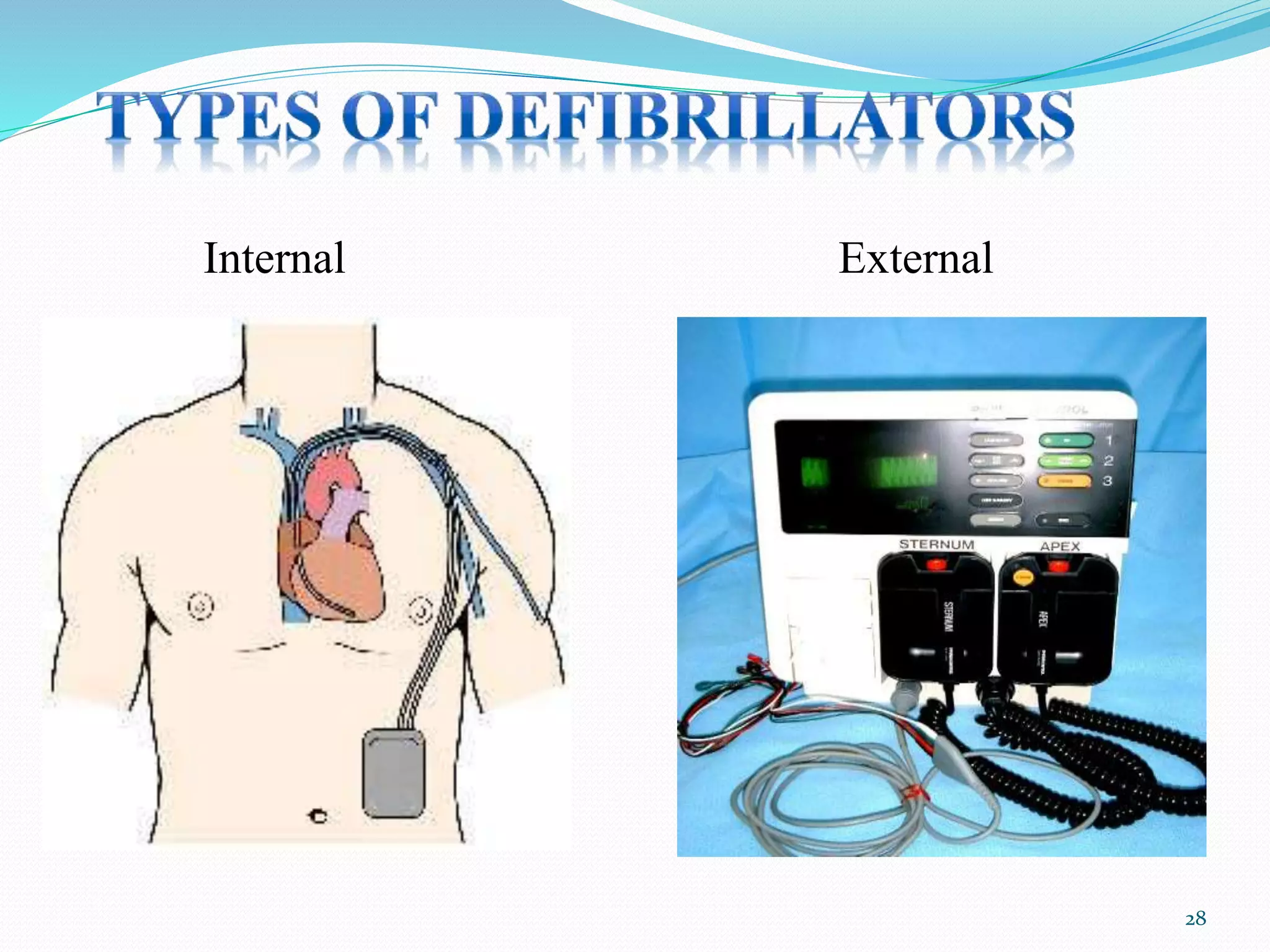
Internal External
28
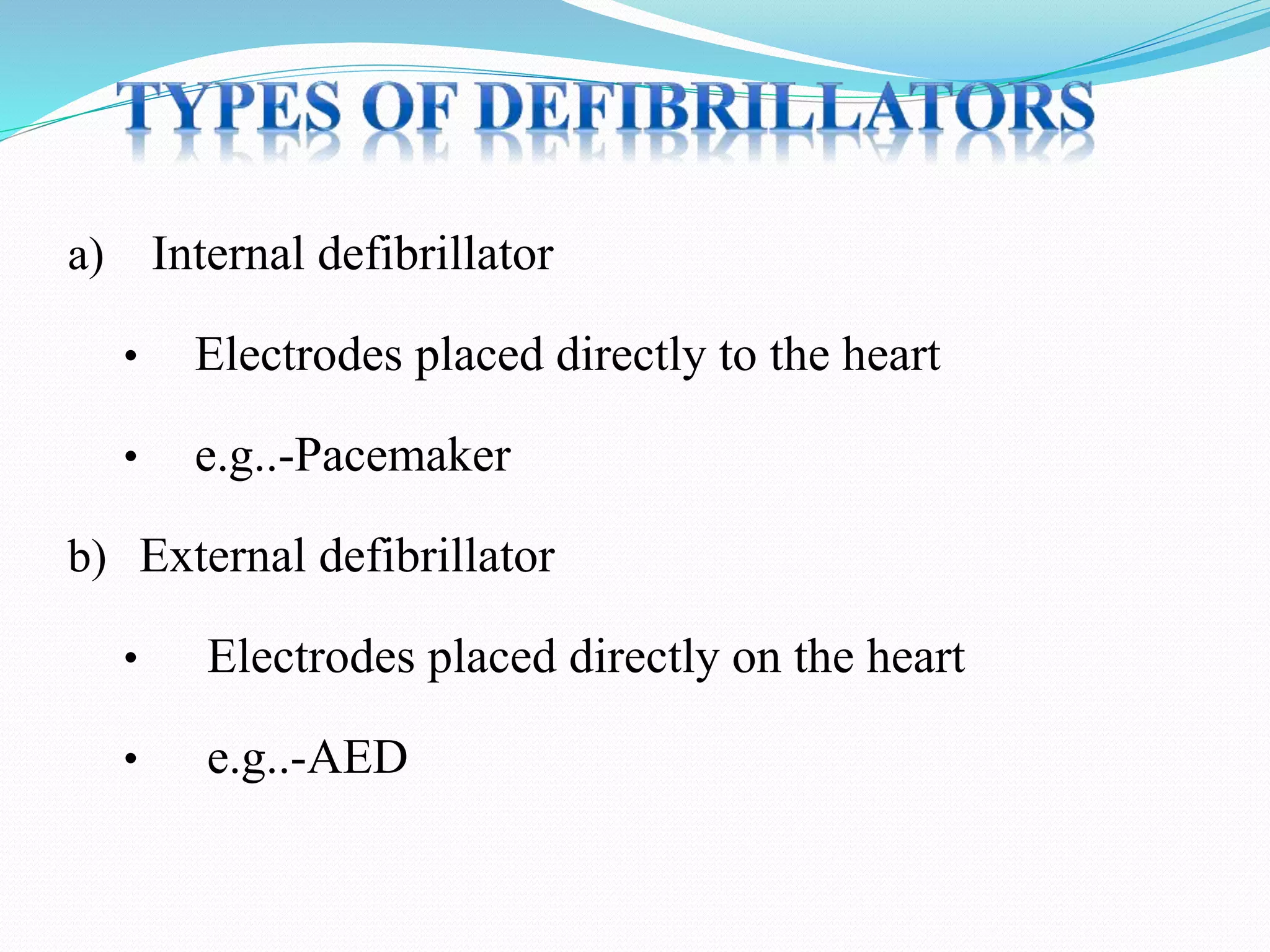
a) Internal defibrillator
• Electrodes placed directly to the heart
• e.g..-Pacemaker
b) External defibrillator
• Electrodes placed directly on the heart
• e.g..-AED
• For each minute elapsing between onset of
ventricular fibrillation and first defibrillation,
survival decreases by 10%.
• defibrillators should be portable, battery operated,
small size.
• energy in defibrillators usually stored in large
capacitors.
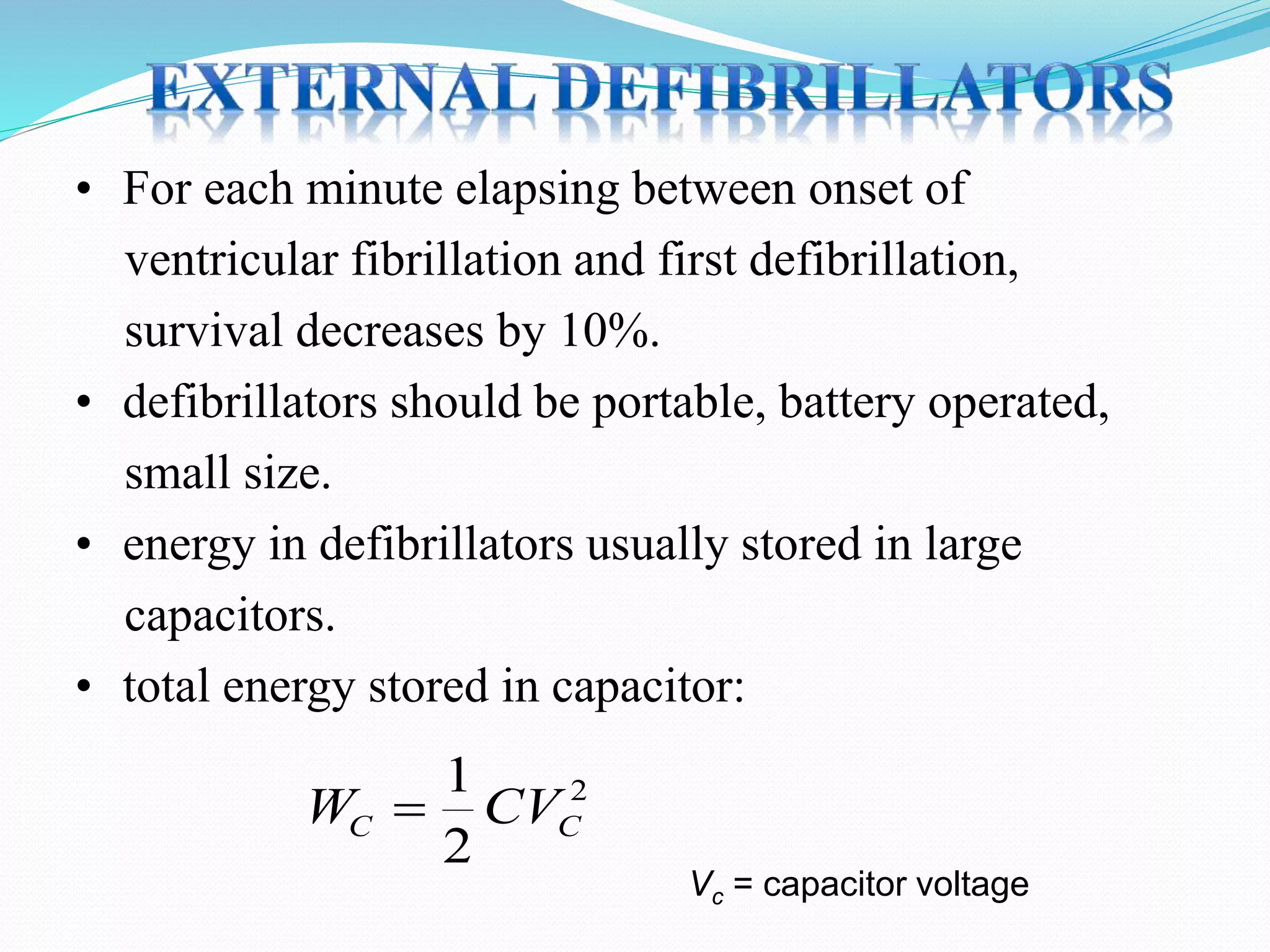
• total energy stored in capacitor:
W CVC C
1
2
2
Vc = capacitor voltage
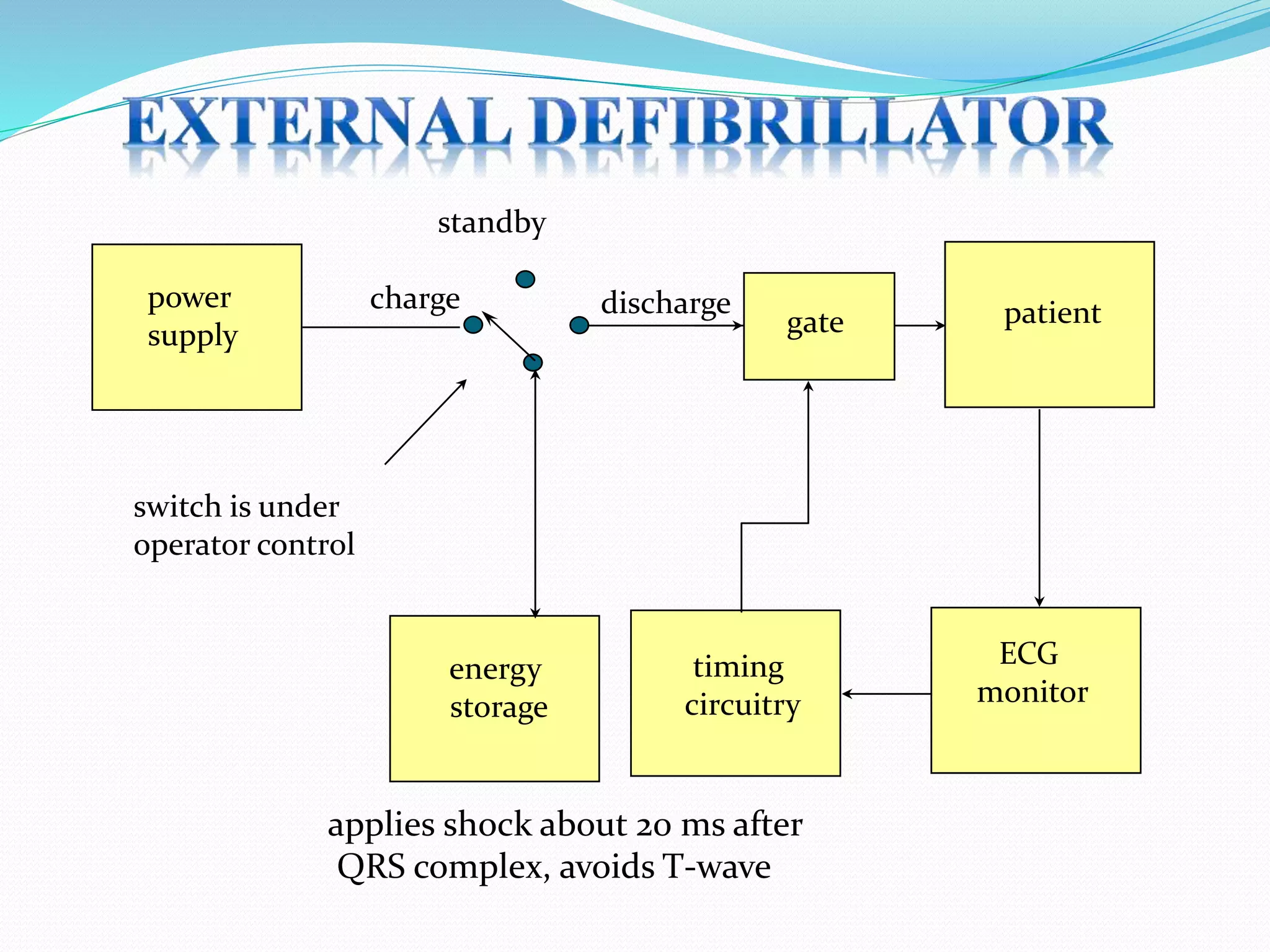
power
supply
energy
storage
patient
ECG
monitor
timing
circuitry
gate
charge discharge
standby
switch is under
operator control
applies shock about 20 ms after
QRS complex, avoids T-wave
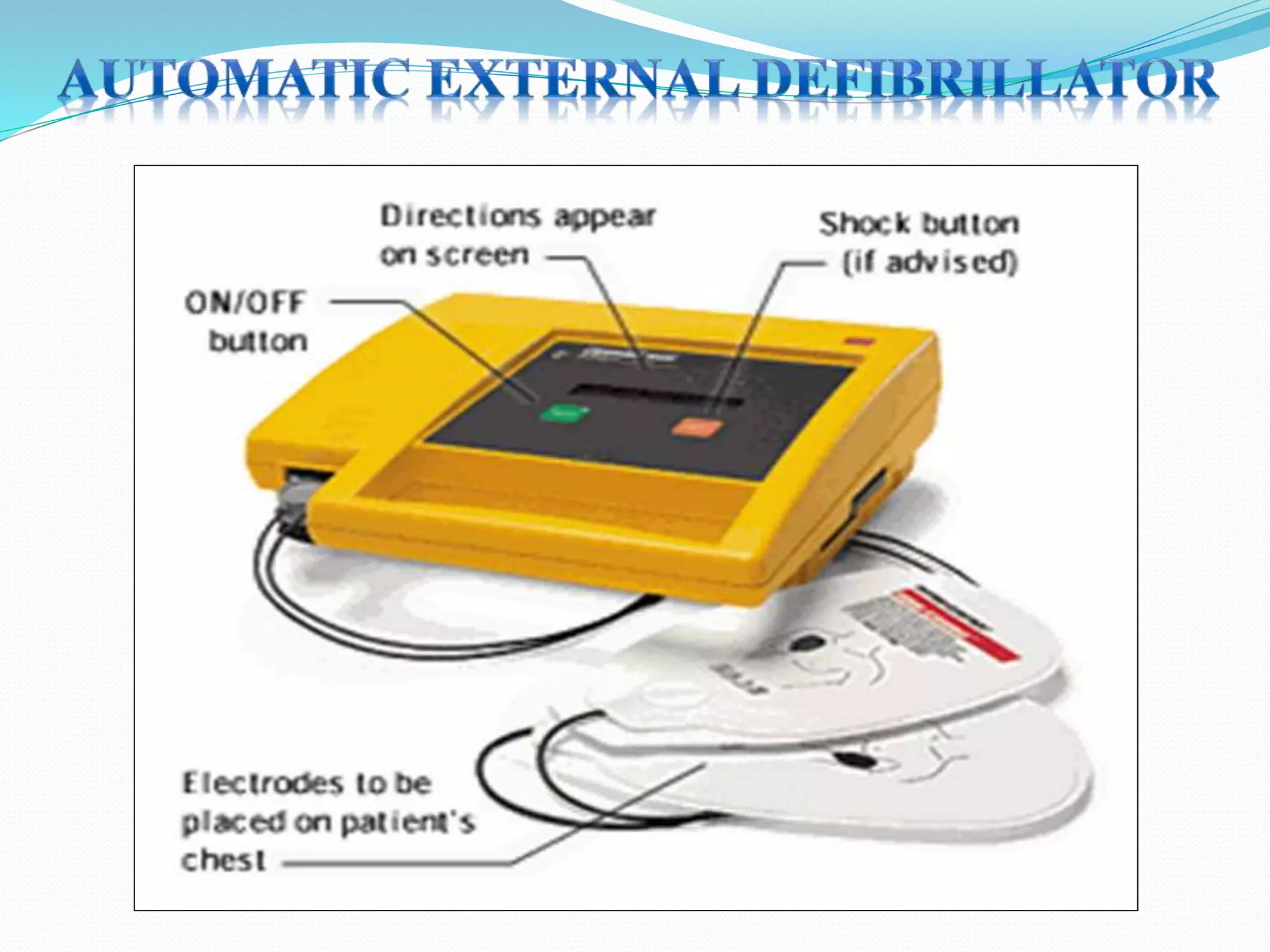
 AED is a type of external defibrillation process.
 AED is a portable electronic device that auto-
matically diagnoses the ventricular fibrillation
in a patient.
Automatic refers to the ability to autonomously
analyse the patient's condition.
 AEDs require self-adhesive electrodes instead of hand
held paddles.
 The AED uses voice prompts, lights and text messages to
tell the rescuer what steps have to take next.
 Turned on or opened AED.
 AED will instruct the user to:-
• Connect the electrodes (pads) to the patient.
• Avoid touching the patient to avoid false
readings by the unit.
• The AED examine the electrical output from
the heart and determine the patient is in a
shock able rhythm or not
When device determined that shock is warranted, it
will charge its internal capacitor in preparation to
deliver the shock.
 When charged, the device instructs the user to ensure
no one is touching the victim and then to press a red
button to deliver the shock.
 Many AED units have an 'event memory' which
store the ECG of the patient along with details of the
time the unit was activated and the number and
strength of any shocks delivered.
The paddles used in the procedure should not be
placed:-
• on a woman's breasts
• over an internal pacemaker patients.
 Before the paddle is used, a gel must be applied to
the patient's skin
• Skin burns from the defibrillator paddles are the
most common complication of defibrillation.
• Other risks include injury to the heart muscle,
abnormal heart rhythms, and blood clots.
• Attach the external and internal paddles if the monitor
reads, "No paddles."
• Check to ensure that the leads are securely attached if
the monitor reads, "No leads.“
• Connect the unit to AC power if the message reads,
"Low battery."
• Verify that the Energy Select control settings are correct
if the defibrillator does not charge.
• Change the electrodes and make sure that the electrodes
adapter cable is properly connected if you receive a
message of "PACER FAILURE." Restart the pacer.
• Close the recorder door and the paper roll if the monitor
message reads, "Check recorder”.
 Willis A Tacker, “External Defibrillators,” in The
Biomedical Engineering Handbook, J. Bronzino (ed)
CRC Press, 1995.
 www.google.com
 en.wikipedia.org/wiki/Defibrillation
 http://www.slideworld.org/viewslides.aspx/defibrillator

Defibrillatorppt 131028115457-phpapp01

  • 2.
    1. Define defibrillation. 2.Describe Need and history of defibrillation. 3. Describe the principle and mechanism of defibrillation. 4. Types and classes of defibrillator 5. Describe the Automated external defibrillator 6. Identify the precautions and risk 7. Troubleshooting of defibrillator
  • 4.
    Definition: Defibrillation is aprocess in which an electronic device sends an electric shock to the heart to stop an extremely rapid, irregular heartbeat, and restore the normal heart rhythm. Defibrillation is a common treatment for life threatening cardiac dysrhythmias, ventricular fibrillation, and pulse less ventricular tachycardia.
  • 5.
    Ventricular fibrillation isa serious cardiac emergency resulting from asynchronous contraction of the heart muscles.  Due to ventricular fibrillation, there is an irregular rapid heart rhythm. Fig. Ventricular fibrillation Fig. Normal heart beat
  • 6.
     Ventricular fibrillationcan be converted into a more efficient rhythm by applying a high energy shock to the heart.  This sudden surge across the heart causes all muscle fibres to contract simultaneously.  The instrument for administering the shock is called a DEFIBRILLATOR.  Possibly, the fibres may then respond to normal physiological pace making pulses.
  • 7.
    Defibrillation is performedto correct life- threatening fibrillations of the heart, which could result in cardiac arrest. It should be performed immediately after identifying that the patient is experiencing a cardiac emergency, has no pulse, and is unresponsive.
  • 8.
    Defibrillation was inventedin 1899 by Prevost and Batelli, two Italian physiologists. They discovered that electric shocks could convert ventricular fibrillation to sinus rhythm in dogs.The first case of a human life saved by defibrillation was reported by Beck in 1947 .
  • 9.
     Energy storagecapacitor is charged at relatively slow rate from AC line.  Energy stored in capacitor is then delivered at a relatively rapid rate to chest of the patient.  Simple arrangement involve the discharge of capacitor energy through the patient’s own resistance.
  • 10.
    Fig: Schematic diagramof a defibrillator
  • 11.
     The dischargeresistance which the patient represents as purely ohmic resistance of 50 to 100Ω approximately for a typical electrode size of 80cm2.  This particular waveform Fig is called ‘ Lown’ waveform.  The pulse width of this waveform is generally 10 ms.
  • 12.
  • 13.
    • minimum defibrillationenergy occurs for pulse durations of 3 - 10 ms (for most pulse shapes). • pulse amplitude in tens of amperes (few thousand volts).
  • 14.
    – intrinsic characteristicsof patient – patient’s disease – duration of arrhythmia – patient’s age – type of arrhythmia (more energy required for v. fib.) • operator selects energy delivered: 50-360 joules, depends on:
  • 15.
     Fibrillations causethe heart to stop pumping blood, leading to brain damage.  Defibrillators deliver a brief electric shock to the heart, which enables the heart's natural pacemaker to regain control and establish a normal heart rhythm.
  • 16.
     Higher voltagesare required for external defibrillation than for internal defibrillation.  A corrective shock of 750-800 volts is applied within a tenth of a second.  That is the same voltage as 500-533 no of AA batteries!
  • 17.
  • 18.
     Occulsion ofthe coronary artery leads to ischemia  Ischemia leads to infarct which causes interruption of normal cardiac conduction  Infarct = VF/VT
  • 19.
  • 20.
     Types ofDefibrillator electrodes:- a) Spoon shaped electrode • Applied directly to the heart. b) Paddle type electrode • Applied against the chest wall c) Pad type electrode • Applied directly on chest wall
  • 21.
    fig: Electrodes usedin defibrillator (a) a spoon shaped internal electrode that is applied directly to the heart. (b) a paddle type electrode applied against the anterior chest wall.
  • 22.
  • 23.
    Anterior electrode pad Apexelectrode pad Fig: anterior –apex scheme of electrode placement
  • 24.
    Monophasic pulse orwaveform Bi-phasic pulse or waveform
  • 25.
     There aretwo general classes of waveforms: a) mono-phasic waveform • Energy delivered in one direction through the patient’s heart a) Biphasic waveform • Energy delivered in both direction through the patient’s heart
  • 26.
    Fig:- Generation ofbi-phasic waveform
  • 27.
     The biphasicwaveform is preferred over monophasic waveform to defibrillate. Why????? • A monophasic type, give a high-energy shock, up to 360 to 400 joules due to which increased cardiac injury and in burns the chest around the shock pad sites. • A biphasic type, give two sequential lower- energy shocks of 120 - 200 joules, with each shock moving in an opposite polarity between the pads.
  • 28.
  • 29.
    a) Internal defibrillator •Electrodes placed directly to the heart • e.g..-Pacemaker b) External defibrillator • Electrodes placed directly on the heart • e.g..-AED
  • 30.
    • For eachminute elapsing between onset of ventricular fibrillation and first defibrillation, survival decreases by 10%. • defibrillators should be portable, battery operated, small size. • energy in defibrillators usually stored in large capacitors. • total energy stored in capacitor: W CVC C 1 2 2 Vc = capacitor voltage
  • 31.
    power supply energy storage patient ECG monitor timing circuitry gate charge discharge standby switch isunder operator control applies shock about 20 ms after QRS complex, avoids T-wave
  • 33.
     AED isa type of external defibrillation process.  AED is a portable electronic device that auto- matically diagnoses the ventricular fibrillation in a patient. Automatic refers to the ability to autonomously analyse the patient's condition.
  • 34.
     AEDs requireself-adhesive electrodes instead of hand held paddles.  The AED uses voice prompts, lights and text messages to tell the rescuer what steps have to take next.
  • 35.
     Turned onor opened AED.  AED will instruct the user to:- • Connect the electrodes (pads) to the patient. • Avoid touching the patient to avoid false readings by the unit. • The AED examine the electrical output from the heart and determine the patient is in a shock able rhythm or not
  • 36.
    When device determinedthat shock is warranted, it will charge its internal capacitor in preparation to deliver the shock.  When charged, the device instructs the user to ensure no one is touching the victim and then to press a red button to deliver the shock.  Many AED units have an 'event memory' which store the ECG of the patient along with details of the time the unit was activated and the number and strength of any shocks delivered.
  • 37.
    The paddles usedin the procedure should not be placed:- • on a woman's breasts • over an internal pacemaker patients.  Before the paddle is used, a gel must be applied to the patient's skin
  • 38.
    • Skin burnsfrom the defibrillator paddles are the most common complication of defibrillation. • Other risks include injury to the heart muscle, abnormal heart rhythms, and blood clots.
  • 39.
    • Attach theexternal and internal paddles if the monitor reads, "No paddles." • Check to ensure that the leads are securely attached if the monitor reads, "No leads.“ • Connect the unit to AC power if the message reads, "Low battery." • Verify that the Energy Select control settings are correct if the defibrillator does not charge.
  • 40.
    • Change theelectrodes and make sure that the electrodes adapter cable is properly connected if you receive a message of "PACER FAILURE." Restart the pacer. • Close the recorder door and the paper roll if the monitor message reads, "Check recorder”.
  • 41.
     Willis ATacker, “External Defibrillators,” in The Biomedical Engineering Handbook, J. Bronzino (ed) CRC Press, 1995.  www.google.com  en.wikipedia.org/wiki/Defibrillation  http://www.slideworld.org/viewslides.aspx/defibrillator