Sandia is a multiprogram laboratory operated by Sandia Corporation, a Lockheed Martin Company, for the United
States Department of Energy’s National Nuclear Security Administration under contract DE-AC04-94AL85000.
Dennis Roach, Tom Rice, Josh Paquette
Wind Blade Reliability Center
Sandia National Labs
Optimizing Quality Assurance Inspections to
Improve the Probability of
Damage Detection in Wind Turbine Blades
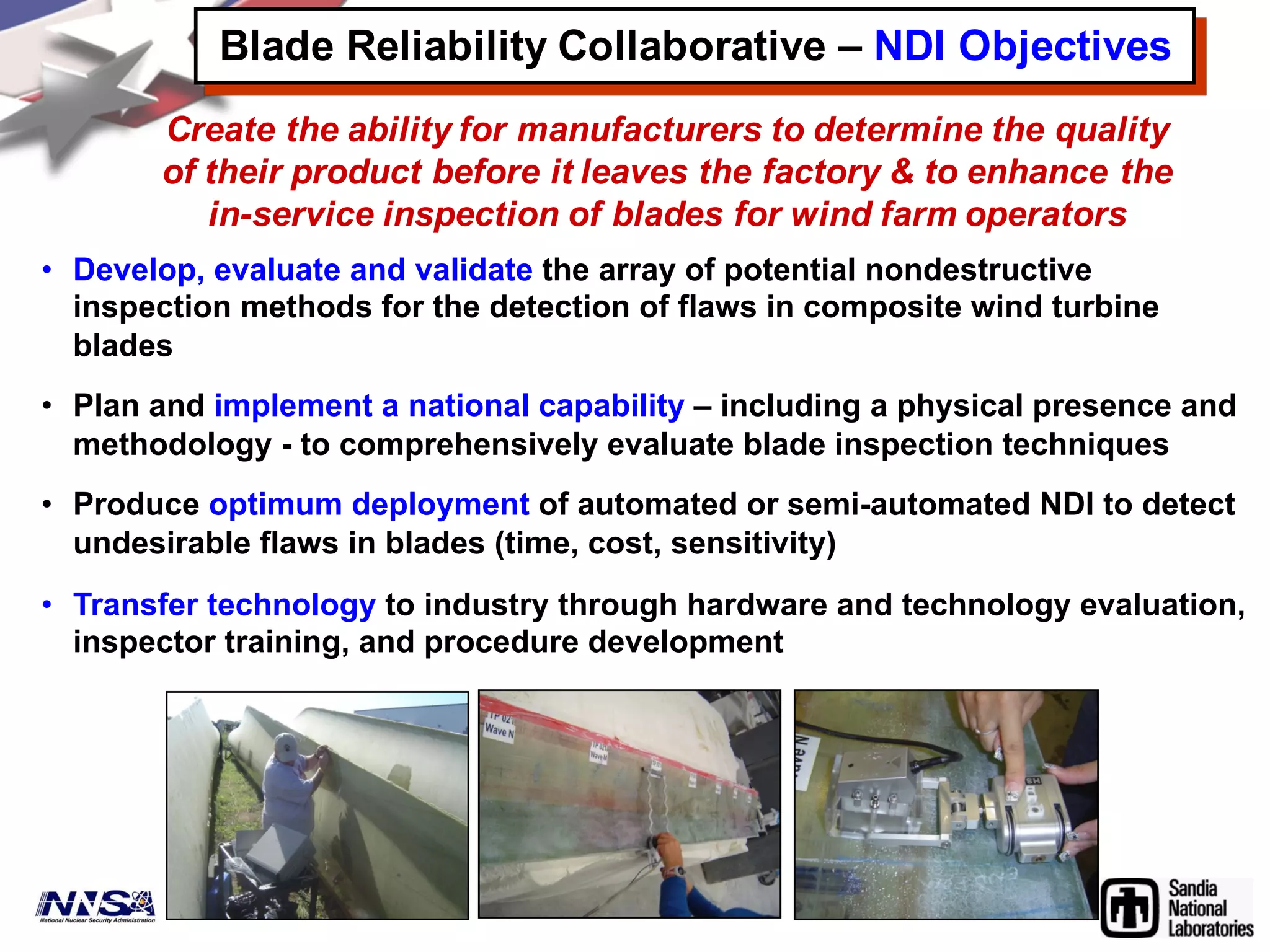
Blade Reliability Collaborative – NDI Objectives
• Develop, evaluate and validate the array of potential nondestructive
inspection methods for the detection of flaws in composite wind turbine
blades
• Plan and implement a national capability – including a physical presence and
methodology - to comprehensively evaluate blade inspection techniques
• Produce optimum deployment of automated or semi-automated NDI to detect
undesirable flaws in blades (time, cost, sensitivity)
• Transfer technology to industry through hardware and technology evaluation,
inspector training, and procedure development
Create the ability for manufacturers to determine the quality
of their product before it leaves the factory & to enhance the
in-service inspection of blades for wind farm operators
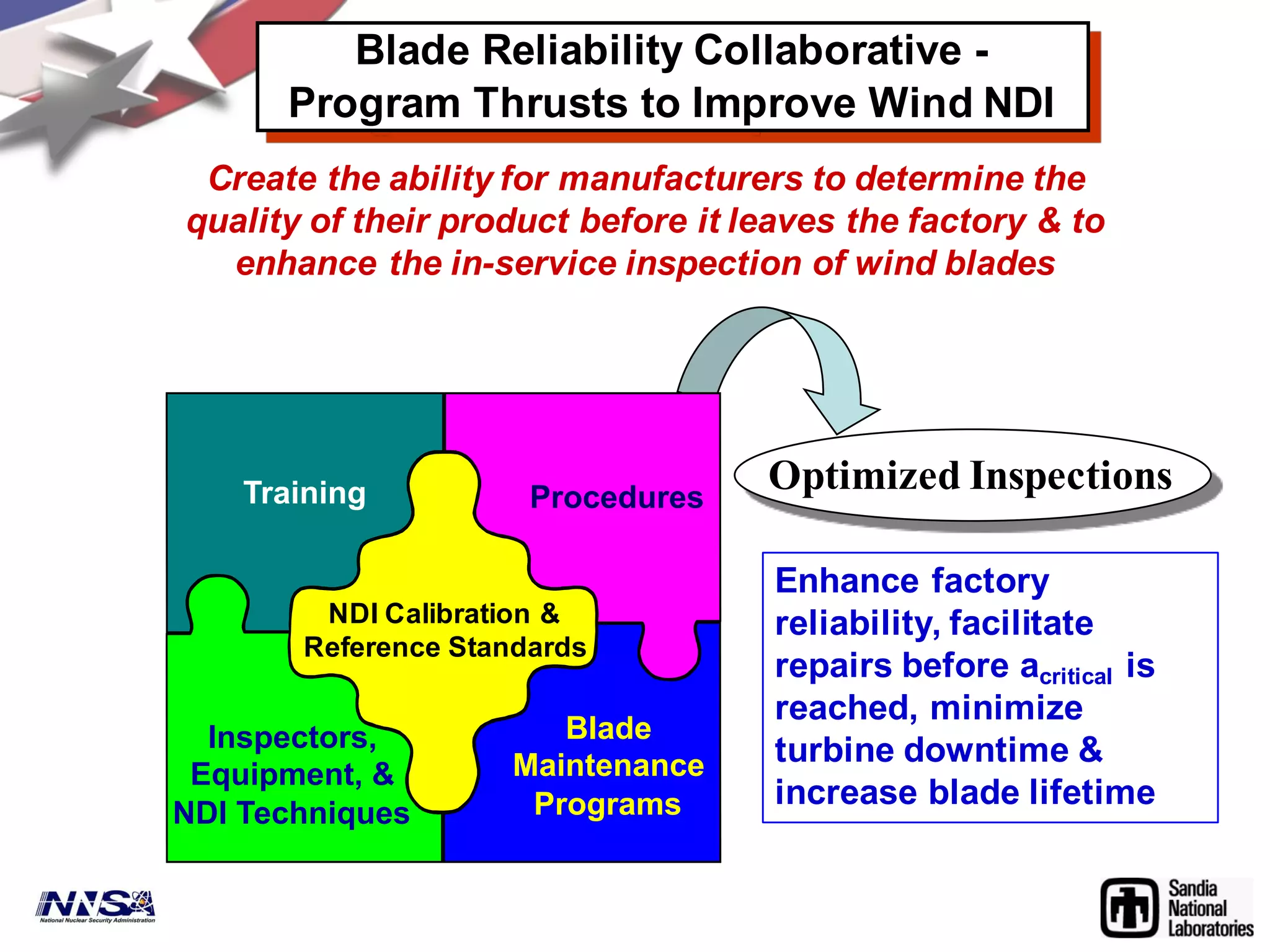
Optimized InspectionsTraining
Inspectors,
Equipment, &
NDI Techniques
Procedures
NDI Calibration &
Reference Standards
Blade
Maintenance
Programs
Blade Reliability Collaborative -
Program Thrusts to Improve Wind NDI
Enhance factory
reliability, facilitate
repairs before acritical is
reached, minimize
turbine downtime &
increase blade lifetime
Create the ability for manufacturers to determine the
quality of their product before it leaves the factory & to
enhance the in-service inspection of wind blades
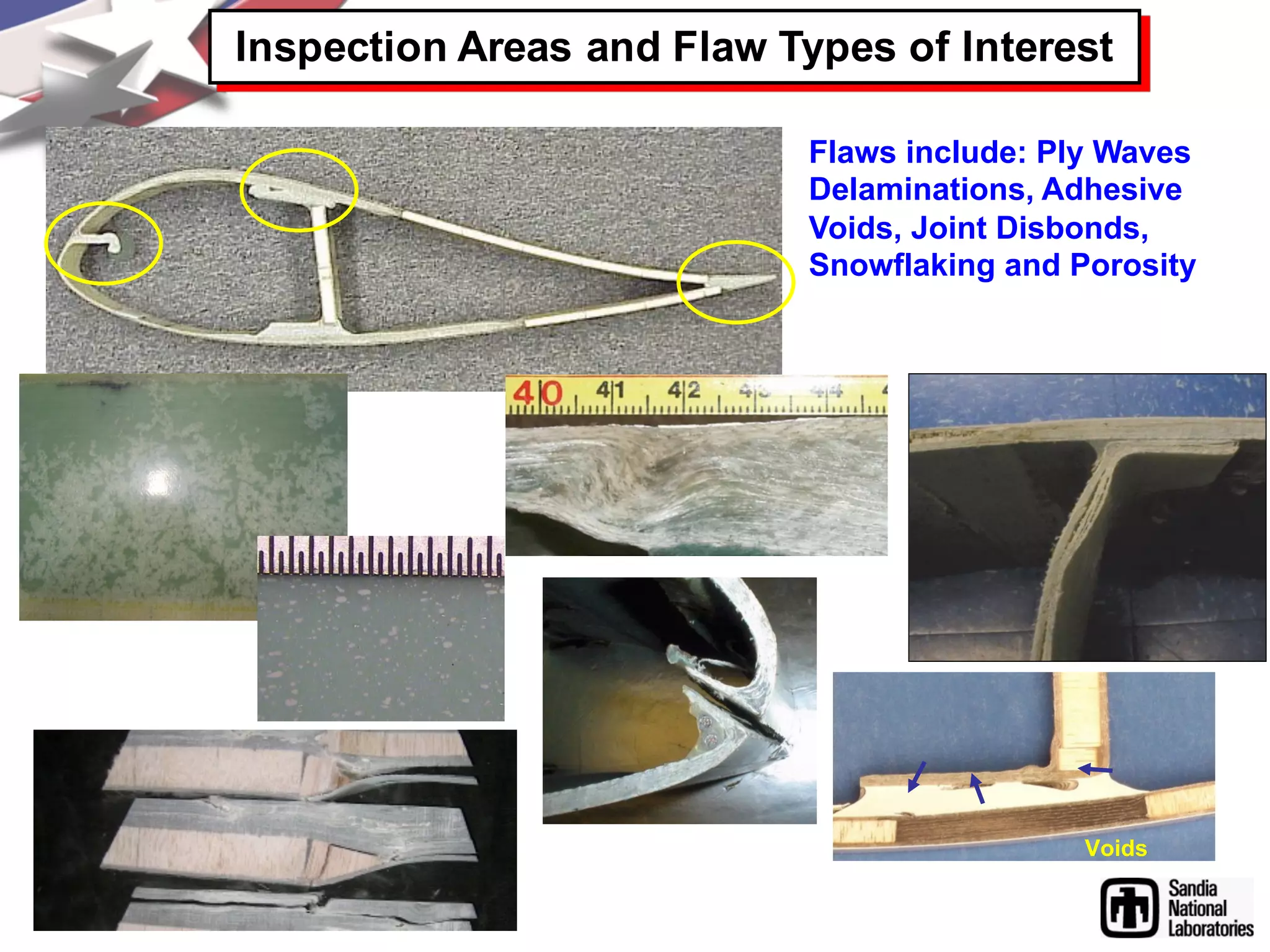
VoidsVoids
Inspection Areas and Flaw Types of Interest
Flaws include: Ply Waves
Delaminations, Adhesive
Voids, Joint Disbonds,
Snowflaking and Porosity
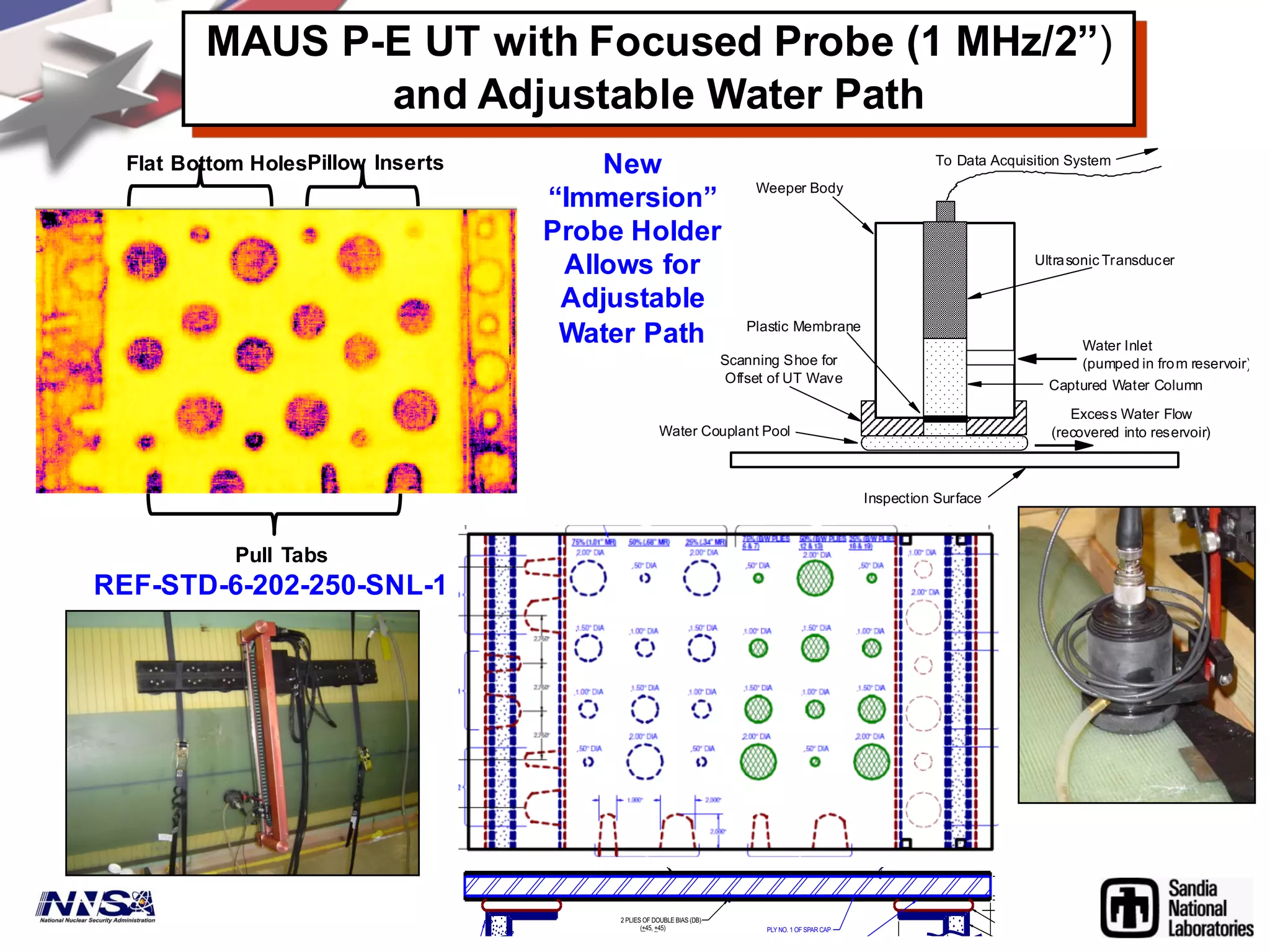
Ultrasonic Transducer
Captured Water Column
Scanning Shoe for
Offset of UT Wave
Plastic Membrane
Weeper Body
Water Inlet
(pumped in from reservoir)
Water Couplant Pool
Inspection Surface
Excess Water Flow
(recovered into reservoir)
To Data Acquisition System
MAUS P-E UT with Focused Probe (1 MHz/2”)
and Adjustable Water Path
New
“Immersion”
Probe Holder
Allows for
Adjustable
Water Path
Flat Bottom HolesPillow Inserts
Pull Tabs
REF-STD-6-202-250-SNL-1
1.01"
0.34"
1.35"
0.68"
0.67"
1.35"
0.34"
1.01"
1.35"
USED VECTORPLY ELT 5500
24 PLIES OF MATERIAL (UNIAXIAL FIBER)
2.000"1.000"
2.000"
.40" (10mm) BONDLINE
INSPECTION SIDE
PERCENTAGE OF FULL
THICKNESSAT BONDLINE
(.100" SKINAND .400" BOND
THICKNESS)
25%(OF FULLTHICKNESS)
50%(OF FULLTHICKNESS)
75%(OF FULLTHICKNESS)
FLAT BOTTOM HOLE (FBH)
PILLOW INSERT
EXAMPLES OF VARIOUS FLAW
DEPTHS IN SPAR CAPSECTION
INSPECTION SURFACE
NDI REFERENCE STANDARD 2 FABRICATION DRAWING
SPAR CAPAND SHEAR WEB BLADE SCHEMATIC
(DISBONDS INADHESIVE)
PULLTABS
(DELAMS) (DELAMS) (BASED ON 24 PLIES OF UNIAXIAL MAT'L)
(DISBONDS INADHESIVE)
25%
(.125" MR)
50%
(.25" MR)
1.00" DIA
2.00" DIA
SHEAR WEB
ADHESIVE
FLAT BOTTOMHOLES
1.00" (25mm) FOAM CORE
INTERFACE 2
INTERFACE 1
INTERFACE 1
25%
(B/WPLIES 18 & 19)
75%
(B/WPLIES 6 & 7)
75%
(.375" MR)
4 PLYPILLOWINSERTSFLAT BOTTOMHOLES
25%(B/WPLIES
18 & 19)
50%(B/WPLIES
12 & 13)
75%(B/WPLIES
6 & 7)
25%(.34" MR)50%(.68" MR)75%(1.01" MR)
2.00" DIA
.50" DIA
1.00" DIA
1.50" DIA
1.50" DIA
1.00" DIA
.50" DIA
2.00" DIA
2.00" DIA
.50" DIA
1.00" DIA
1.50" DIA
1.50" DIA
1.00" DIA
.50" DIA
2.00" DIA
2.00" DIA
1.50" DIA
1.00" DIA
.50" DIA
.50" DIA
1.00" DIA
1.50" DIA
2.00" DIA
18.00"
~1.35" (34mm) UNIAXIAL (SPANWISE)
30.00"
__(+45, +45)
2 PLIES OF DOUBLE BIAS (DB)
11-30-10
MR = MATERIAL REMAINING
PLY NO. 1 OF SPAR CAP__(+45, +45)
(NOTE: IF USING TEFLON BASED RELEASE FABRIC
(BASED ON 24 PLIES OF UNIAXIALMAT'L)
NOTE: PULLTABS (.007" THK) WILL EXTEND OUT FROM SPECIMEN
EDGE DURING CURE PROCESS, BE SURE TO USE SPECIAL
CARE NOTTO PUNCTURE VACUUM BAG (COVER SHARP
EDGES WITH BREATHER FABRIC) . PULLTABS REMOVED
AFTER CURE PROCESS.
1 of 2NOTES:
1. SPECIMEN CURED USING 14 IN. HG. VACUUM PRESSURE
AND VACUUM LEFT ON OVER NIGHT.
2. POST CURE SPECIMENAT 70 C FOR 10 HOURS.
3. FINAL FLAT BOTTOM HOLE DEPTH MAY CHANGE DEPENDING
ON FINAL PART THICKNESS.
1.875"
2.750"
2.750"
2.750"
2.750"
2.750"
(41)
(42)
(43)
(44)
(45)
(46)
(52)
(51)
(50)
(49)
(48)
(47)
(53)
(54)
(55) (56)
(57)
(58)
(64)
(63)
(62)
(61)
(60)
(59)
(65) (66) (67) (68)
(69)
(70)
(71)
(72)
(73)
(74)
(75)
(76)
(77)
(78)
(79)
(80)
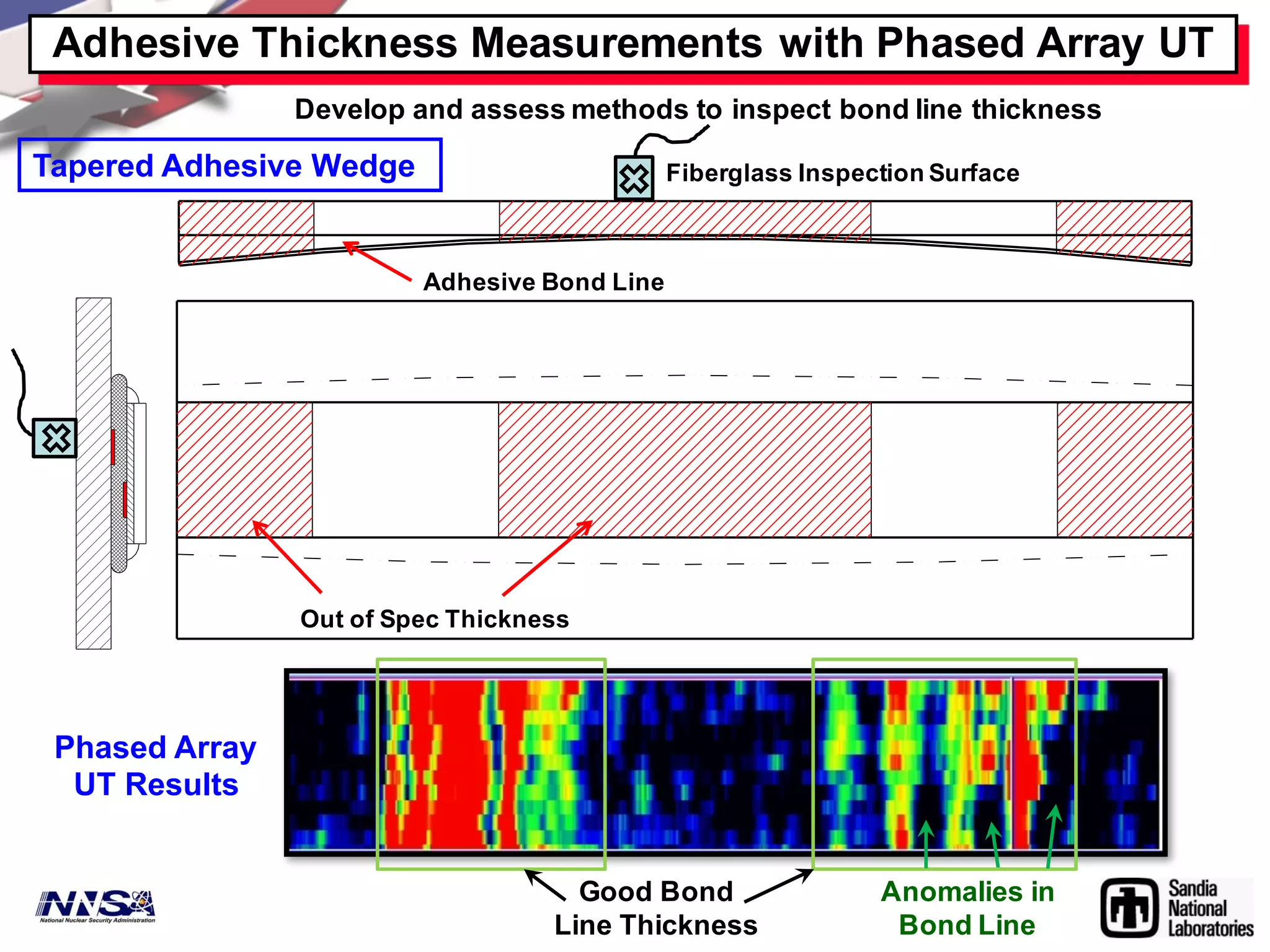
Tapered Adhesive Wedge Fiberglass Inspection Surface
Adhesive Bond Line
Out of Spec Thickness
Develop and assess methods to inspect bond line thickness
Phased Array
UT Results
Good Bond
Line Thickness
Anomalies in
Bond Line
Adhesive Thickness Measurements with Phased Array UT
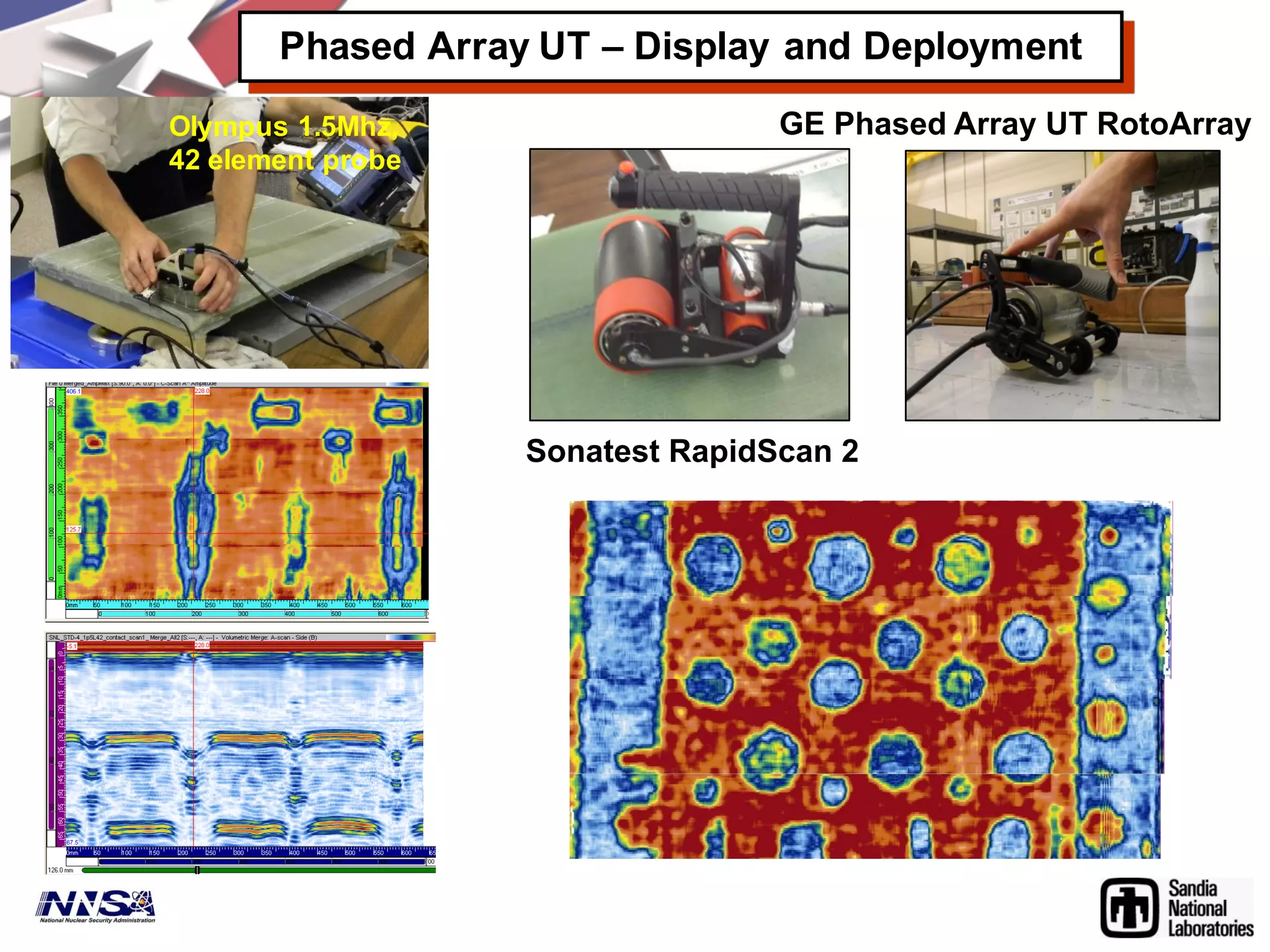
Phased Array UT – Display and Deployment
Olympus 1.5Mhz,
42 element probe
Sonatest RapidScan 2
GE Phased Array UT RotoArray
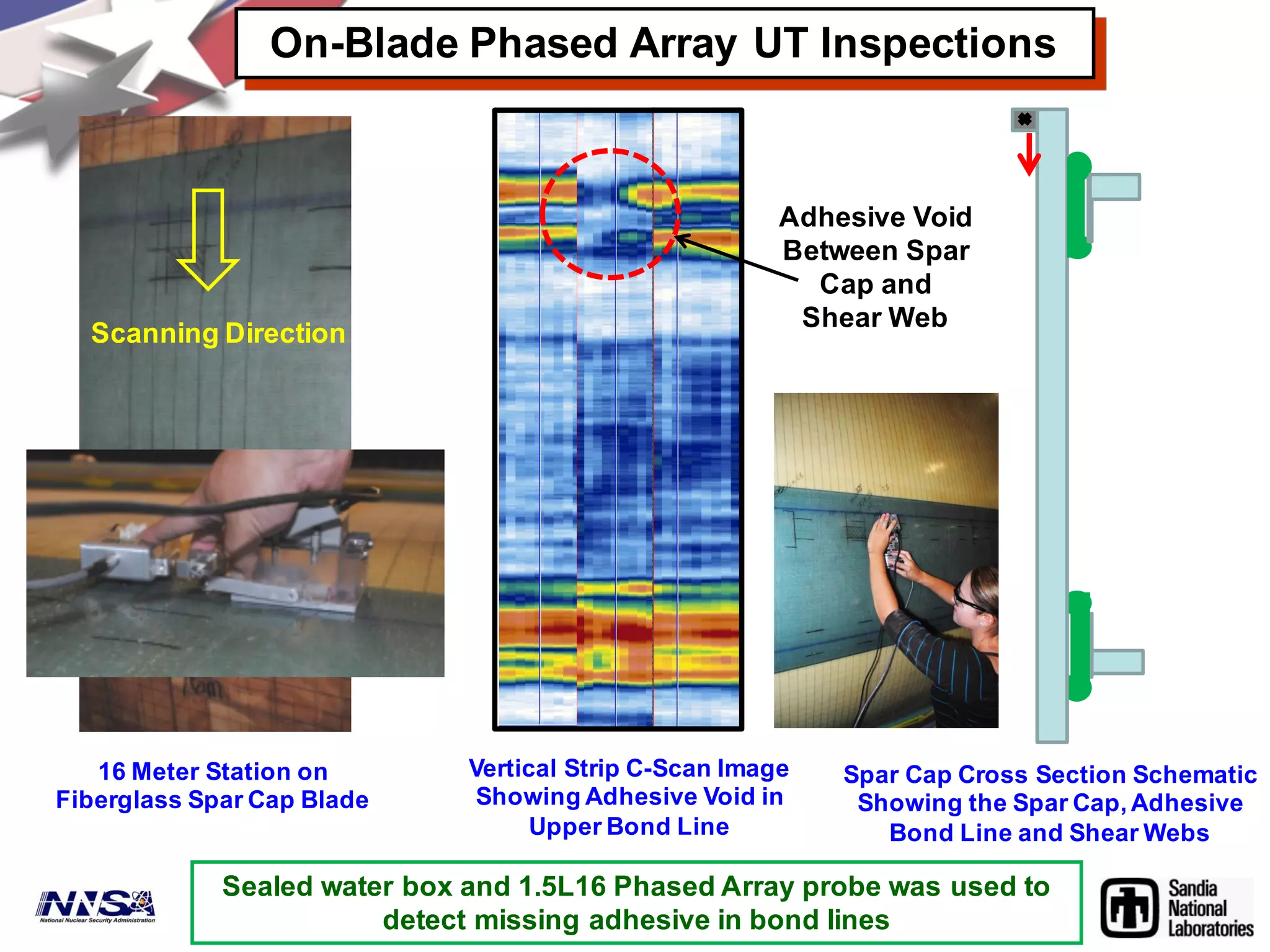
On-Blade Phased Array UT Inspections
16 Meter Station on
Fiberglass Spar Cap Blade
Spar Cap Cross Section Schematic
Showing the Spar Cap, Adhesive
Bond Line and Shear Webs
Scanning Direction
Sealed water box and 1.5L16 Phased Array probe was used to
detect missing adhesive in bond lines
Vertical Strip C-Scan Image
Showing Adhesive Void in
Upper Bond Line
Adhesive Void
Between Spar
Cap and
Shear Web
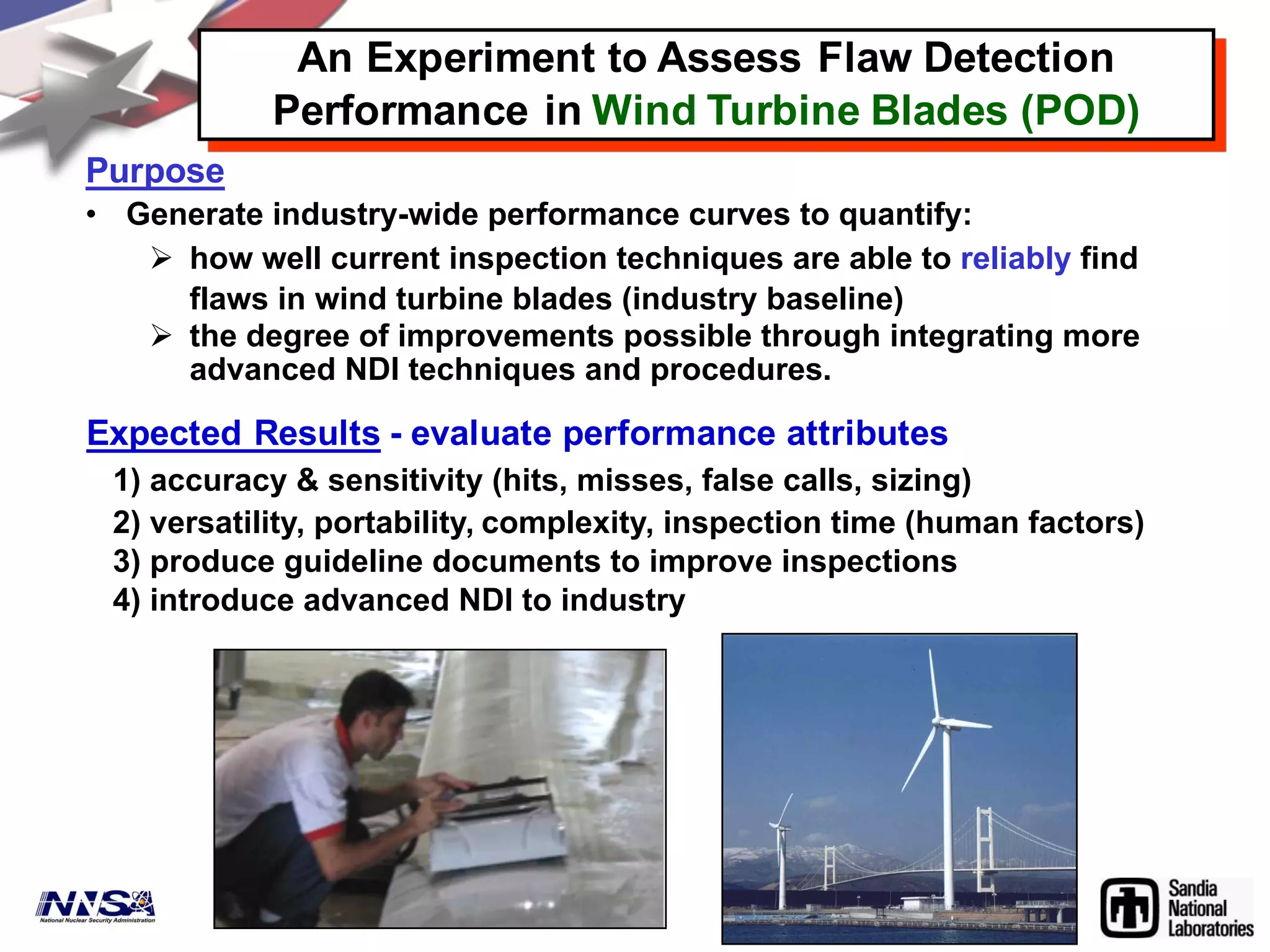
Purpose
• Generate industry-wide performance curves to quantify:
Ø how well current inspection techniques are able to reliably find
flaws in wind turbine blades (industry baseline)
Ø the degree of improvements possible through integrating more
advanced NDI techniques and procedures.
An Experiment to Assess Flaw Detection
Performance in Wind Turbine Blades (POD)
Expected Results - evaluate performance attributes
1) accuracy & sensitivity (hits, misses, false calls, sizing)
2) versatility, portability, complexity, inspection time (human factors)
3) produce guideline documents to improve inspections
4) introduce advanced NDI to industry
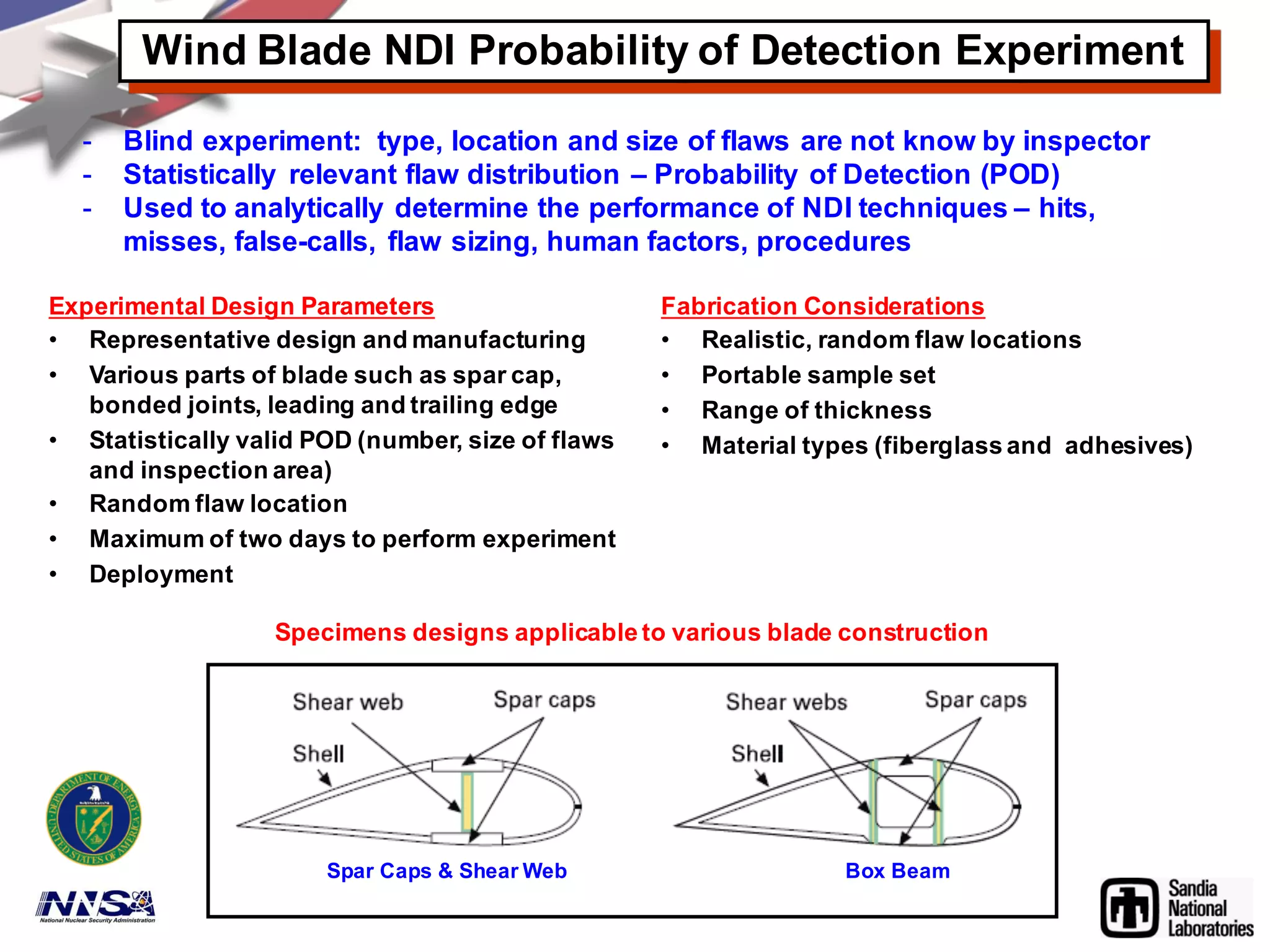
Wind Blade NDI Probability of Detection Experiment
- Blind experiment: type, location and size of flaws are not know by inspector
- Statistically relevant flaw distribution – Probability of Detection (POD)
- Used to analytically determine the performance of NDI techniques – hits,
misses, false-calls, flaw sizing, human factors, procedures
Experimental Design Parameters
• Representative design and manufacturing
• Various parts of blade such as spar cap,
bonded joints, leading and trailing edge
• Statistically valid POD (number, size of flaws
and inspection area)
• Random flaw location
• Maximum of two days to perform experiment
• Deployment
Fabrication Considerations
• Realistic, random flaw locations
• Portable sample set
• Range of thickness
• Material types (fiberglass and adhesives)
Spar Caps & Shear Web Box Beam
Specimens designs applicable to various blade construction
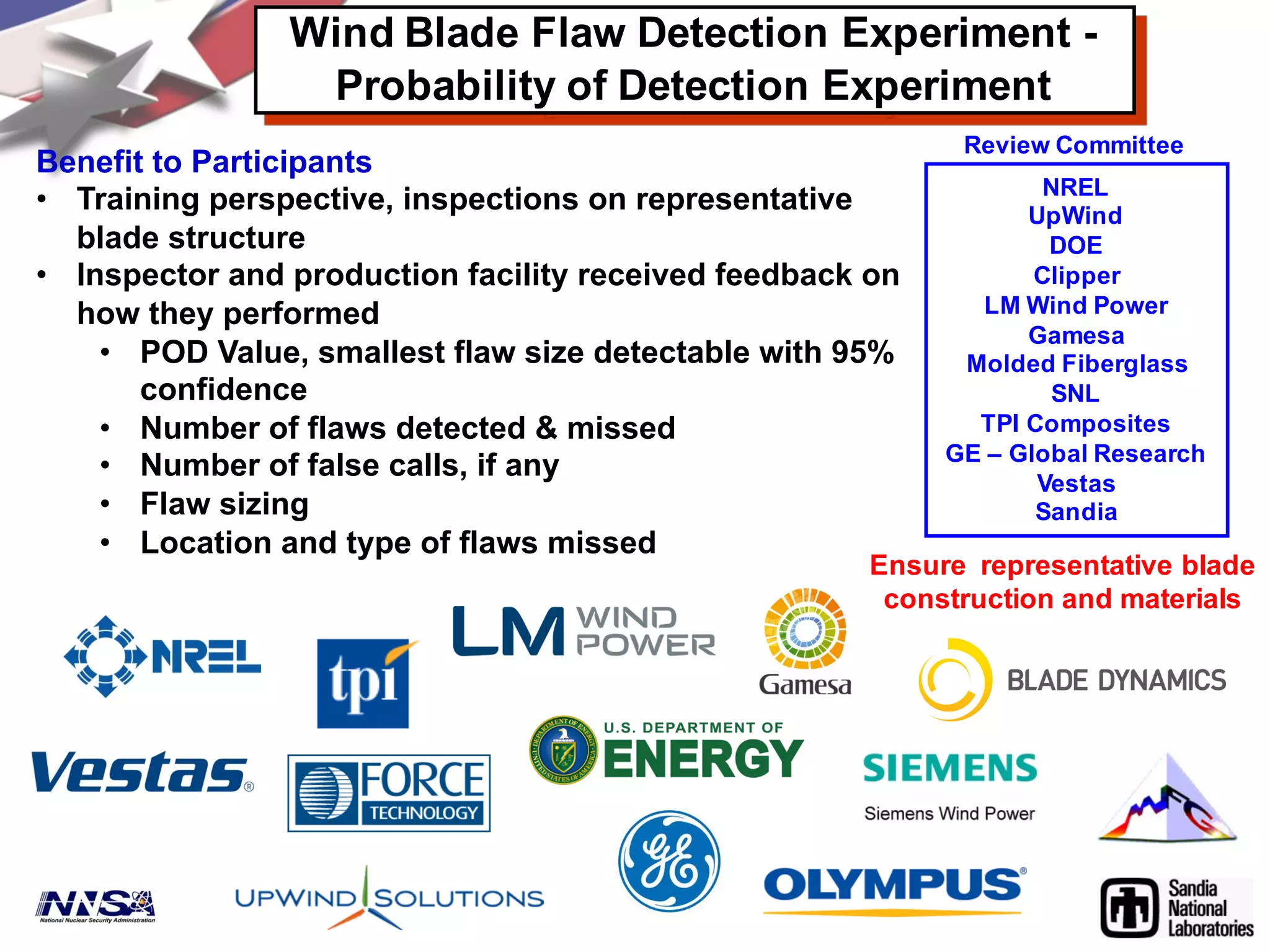
Wind Blade Flaw Detection Experiment -
Probability of Detection Experiment
Benefit to Participants
• Training perspective, inspections on representative
blade structure
• Inspector and production facility received feedback on
how they performed
• POD Value, smallest flaw size detectable with 95%
confidence
• Number of flaws detected & missed
• Number of false calls, if any
• Flaw sizing
• Location and type of flaws missed
NREL
UpWind
DOE
Clipper
LM Wind Power
Gamesa
Molded Fiberglass
SNL
TPI Composites
GE – Global Research
Vestas
Sandia
Review Committee
Ensure representative blade
construction and materials
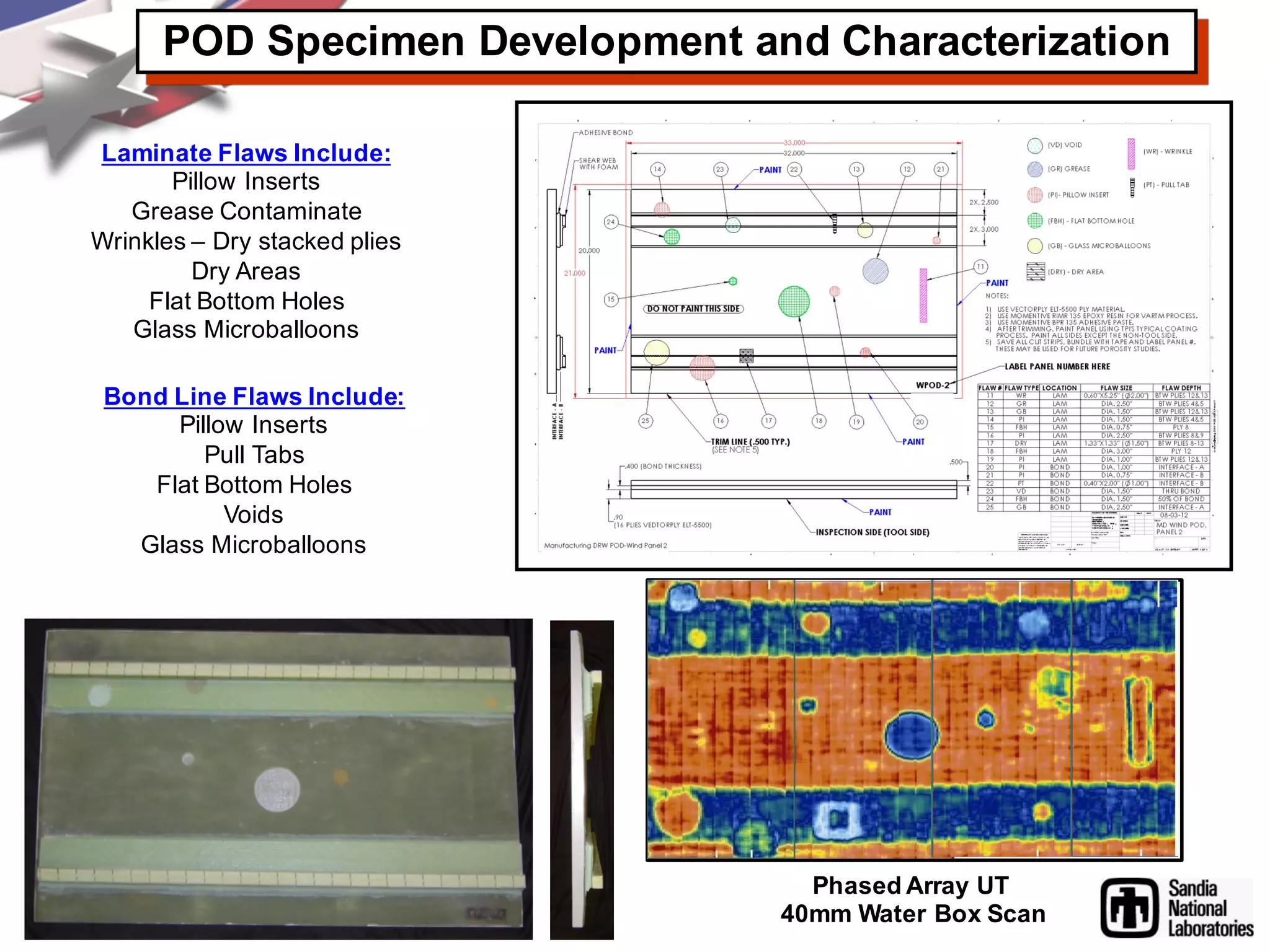
POD Specimen Development and Characterization
Laminate Flaws Include:
Pillow Inserts
Grease Contaminate
Wrinkles – Dry stacked plies
Dry Areas
Flat Bottom Holes
Glass Microballoons
Bond Line Flaws Include:
Pillow Inserts
Pull Tabs
Flat Bottom Holes
Voids
Glass Microballoons
Phased Array UT
40mm Water Box Scan
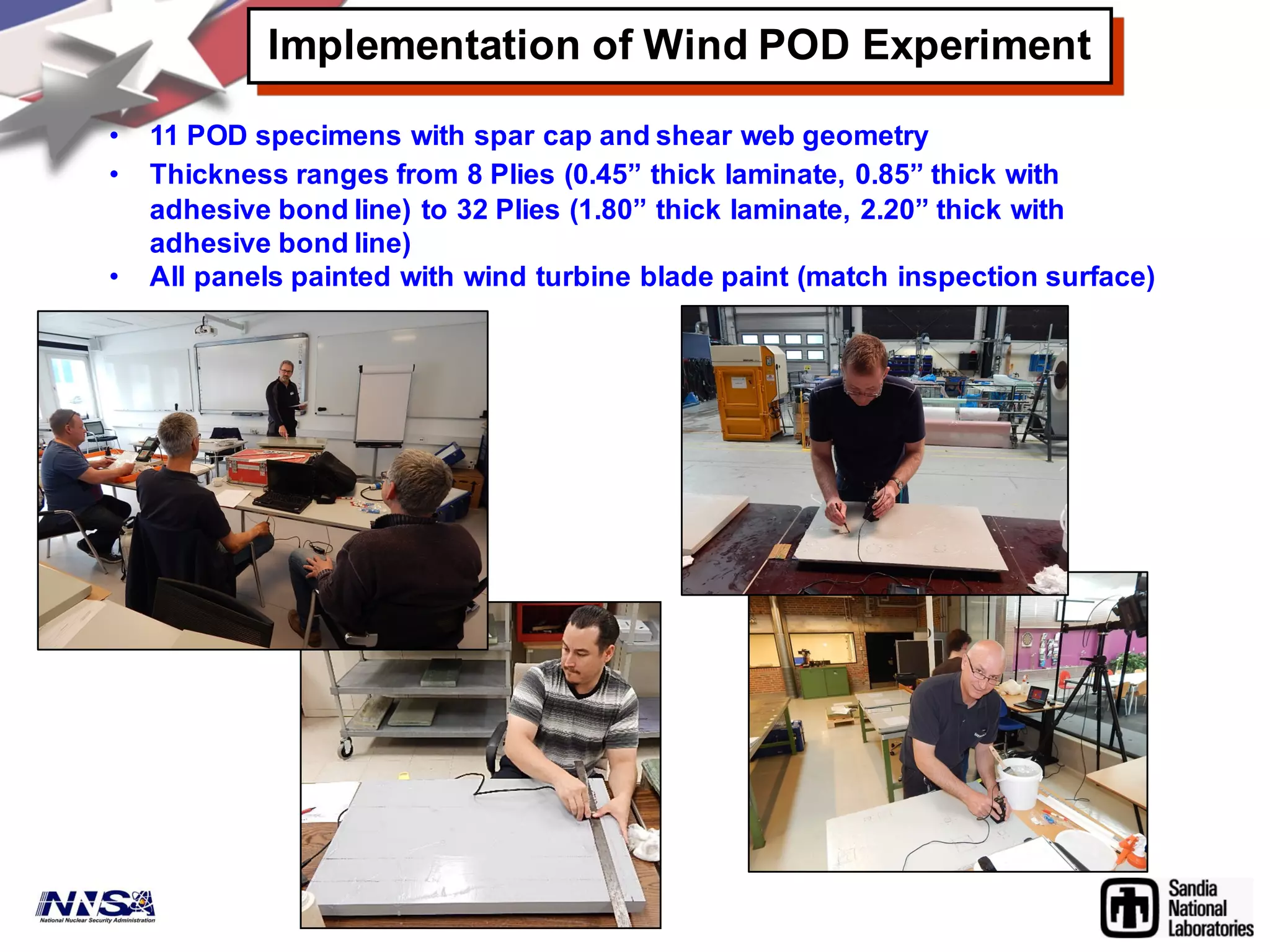
Implementation of Wind POD Experiment
• 11 POD specimens with spar cap and shear web geometry
• Thickness ranges from 8 Plies (0.45” thick laminate, 0.85” thick with
adhesive bond line) to 32 Plies (1.80” thick laminate, 2.20” thick with
adhesive bond line)
• All panels painted with wind turbine blade paint (match inspection surface)
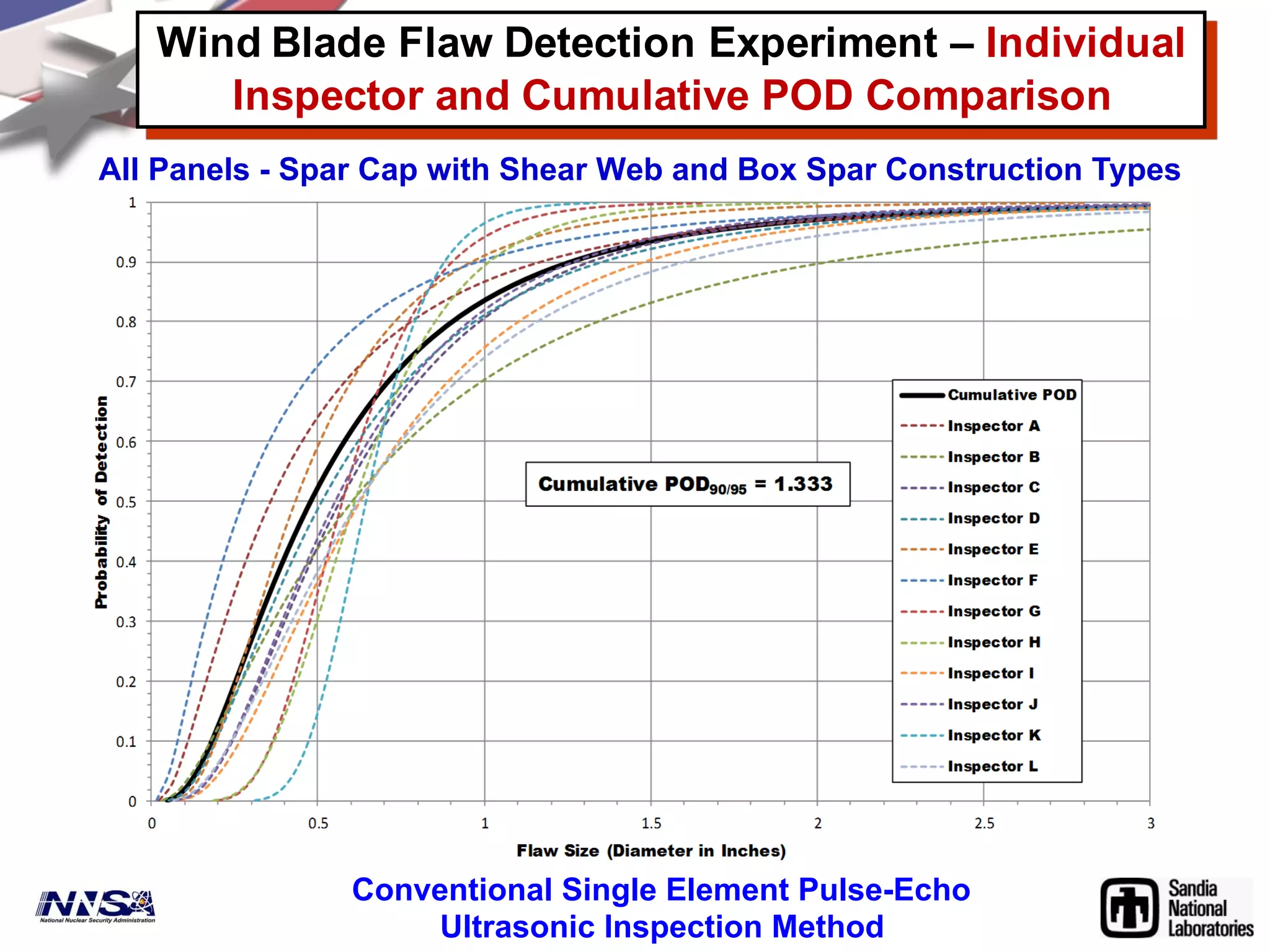
Wind Blade Flaw Detection Experiment – Individual
Inspector and Cumulative POD Comparison
All Panels - Spar Cap with Shear Web and Box Spar Construction Types
Conventional Single Element Pulse-Echo
Ultrasonic Inspection Method
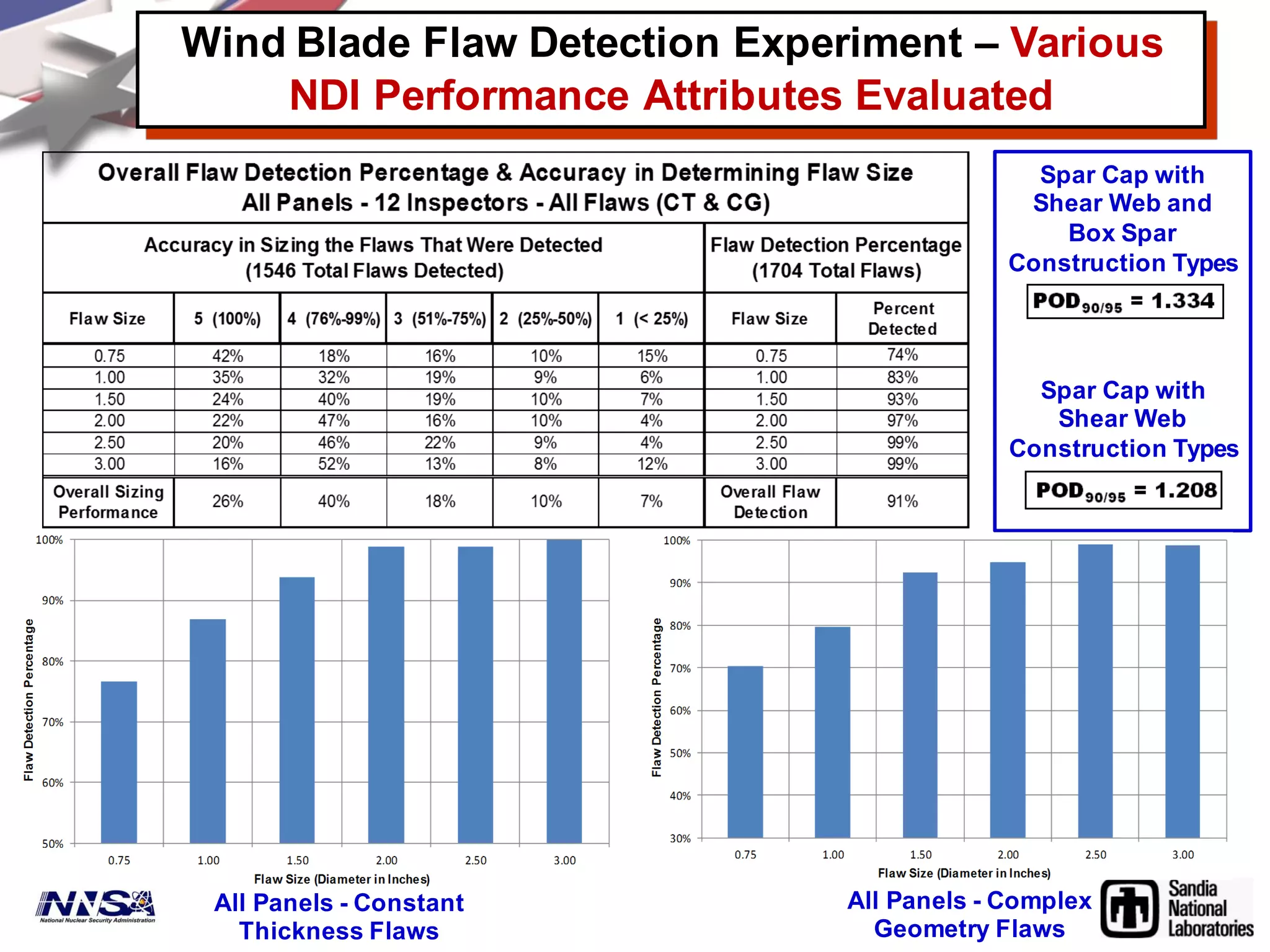
Wind Blade Flaw Detection Experiment – Various
NDI Performance Attributes Evaluated
Spar Cap with
Shear Web and
Box Spar
Construction Types
Spar Cap with
Shear Web
Construction Types
All Panels - Constant
Thickness Flaws
All Panels - Complex
Geometry Flaws
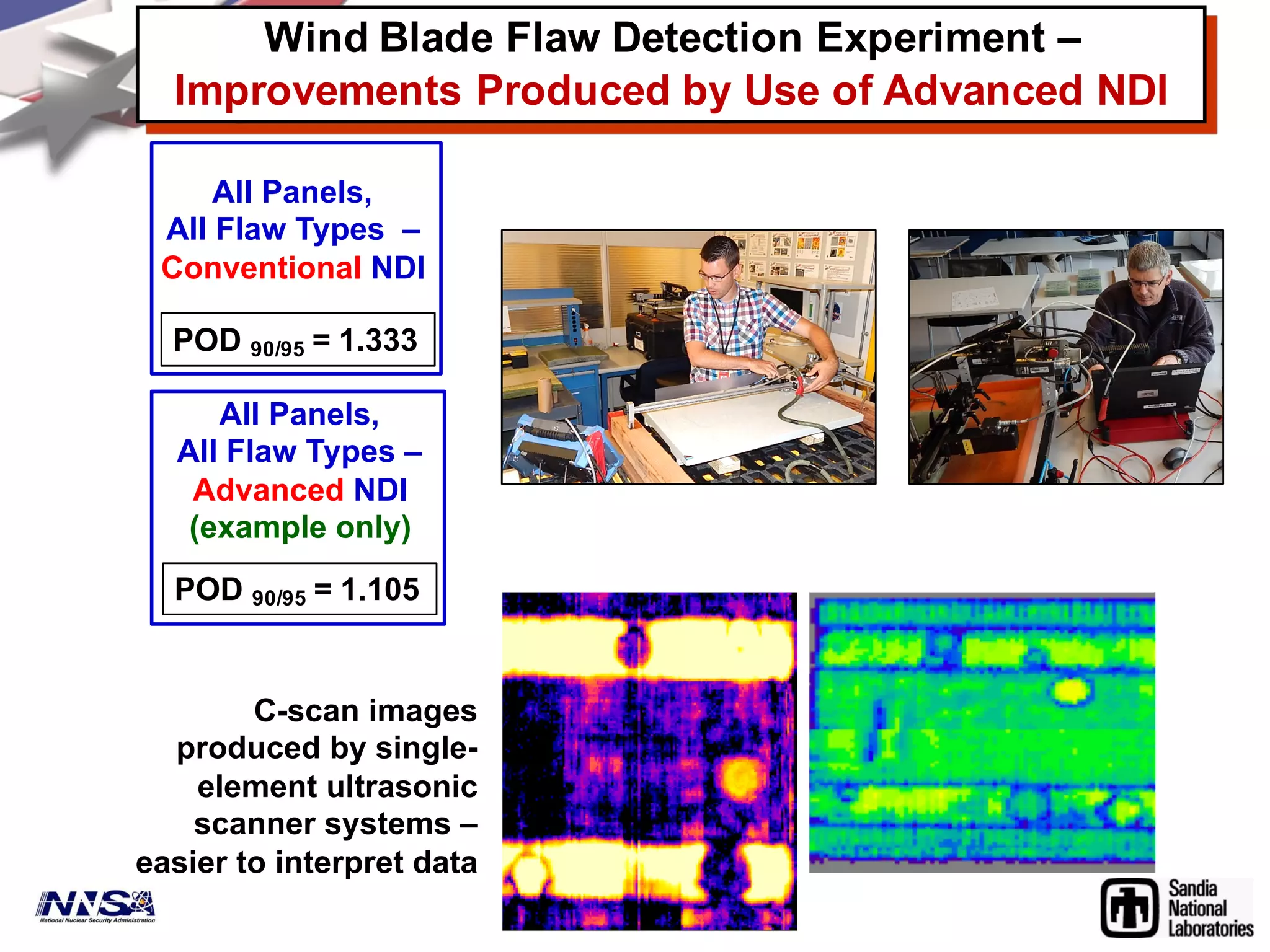
Wind Blade Flaw Detection Experiment –
Improvements Produced by Use of Advanced NDI
C-scan images
produced by single-
element ultrasonic
scanner systems –
easier to interpret data
All Panels,
All Flaw Types –
Conventional NDI
POD 90/95 = 1.333
All Panels,
All Flaw Types –
Advanced NDI
(example only)
POD 90/95 = 1.105
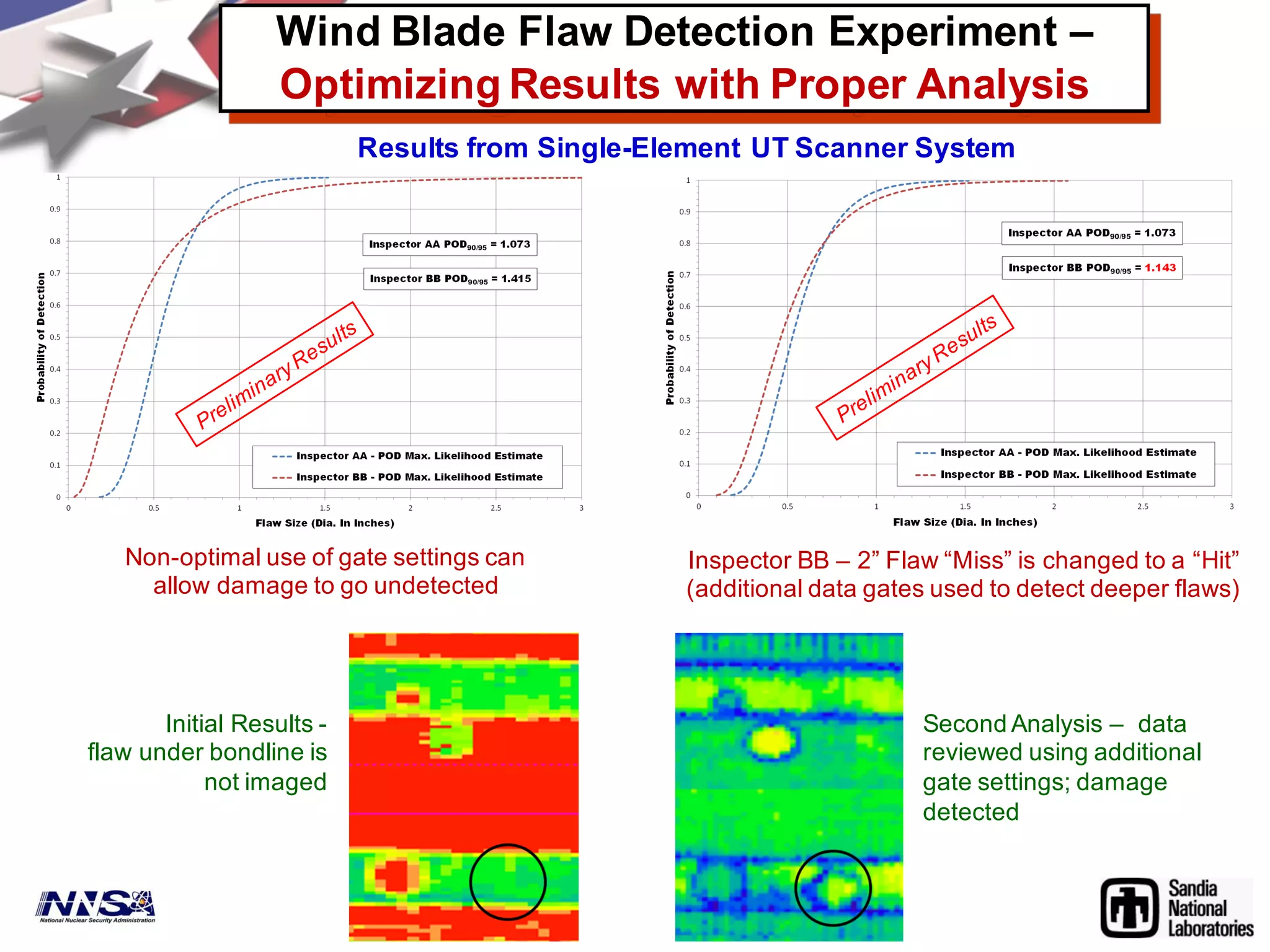
Results from Single-Element UT Scanner System
Wind Blade Flaw Detection Experiment –
Optimizing Results with Proper Analysis
Non-optimal use of gate settings can
allow damage to go undetected
Initial Results -
flaw under bondline is
not imaged
Inspector BB – 2” Flaw “Miss” is changed to a “Hit”
(additional data gates used to detect deeper flaws)
Second Analysis – data
reviewed using additional
gate settings; damage
detected
• Need to develop array of inspection tools to comprehensively assess
blade integrity
• Consider time, cost, & sensitivity issues (minimize production,
maintenance and operation costs)
• Develop NDI solutions in concert with related studies: effects of defects,
field surveys, analysis, certification, standards
• NDI investigation has produced promising results thus far & may lead to
hybrid approach with multiple NDI tools (e.g. near surface and deep flaws)
• There are sensitive & rapid NDI options available for inspecting wind
blades, both for manufacturing QA and in-service NDI
• Evolution in phased array UT methods & use of C-scan technology
provides the greatest & easiest-to-achieve benefits
• Training, experience (apprenticeships) and optimized procedures are key
factors in determining the overall performance of NDI for detecting
flaws/damage in wind blades
• NDI can help ensure that wind blades meet their design life and possibly
beyond
Wind Blade Flaw Detection Experiment –
Steps to Improve Probability of Flaw Detection
If you are interested in participating in the
Sandia Labs wind blade inspection activities:
Tom Rice
Phone: (505) 844-7738
Email: tmrice@sandia.gov
Dennis Roach
Phone: (505) 844-6078
Email: dproach@sandia.gov
Ray Ely
Phone: (505) 284-9050
Email: grely@sandia.gov
Optimizing Quality Assurance Inspections to
Improve the Probability of
Damage Detection in Wind Turbine Blades

Optimizing Quality Assurance Inspections to Improve the Probability of Damage Detection in Wind Turbine Blades

  • 1.
    Sandia is amultiprogram laboratory operated by Sandia Corporation, a Lockheed Martin Company, for the United States Department of Energy’s National Nuclear Security Administration under contract DE-AC04-94AL85000. Dennis Roach, Tom Rice, Josh Paquette Wind Blade Reliability Center Sandia National Labs Optimizing Quality Assurance Inspections to Improve the Probability of Damage Detection in Wind Turbine Blades
  • 2.
    Blade Reliability Collaborative– NDI Objectives • Develop, evaluate and validate the array of potential nondestructive inspection methods for the detection of flaws in composite wind turbine blades • Plan and implement a national capability – including a physical presence and methodology - to comprehensively evaluate blade inspection techniques • Produce optimum deployment of automated or semi-automated NDI to detect undesirable flaws in blades (time, cost, sensitivity) • Transfer technology to industry through hardware and technology evaluation, inspector training, and procedure development Create the ability for manufacturers to determine the quality of their product before it leaves the factory & to enhance the in-service inspection of blades for wind farm operators
  • 3.
    Optimized InspectionsTraining Inspectors, Equipment, & NDITechniques Procedures NDI Calibration & Reference Standards Blade Maintenance Programs Blade Reliability Collaborative - Program Thrusts to Improve Wind NDI Enhance factory reliability, facilitate repairs before acritical is reached, minimize turbine downtime & increase blade lifetime Create the ability for manufacturers to determine the quality of their product before it leaves the factory & to enhance the in-service inspection of wind blades
  • 4.
    VoidsVoids Inspection Areas andFlaw Types of Interest Flaws include: Ply Waves Delaminations, Adhesive Voids, Joint Disbonds, Snowflaking and Porosity
  • 5.
    Ultrasonic Transducer Captured WaterColumn Scanning Shoe for Offset of UT Wave Plastic Membrane Weeper Body Water Inlet (pumped in from reservoir) Water Couplant Pool Inspection Surface Excess Water Flow (recovered into reservoir) To Data Acquisition System MAUS P-E UT with Focused Probe (1 MHz/2”) and Adjustable Water Path New “Immersion” Probe Holder Allows for Adjustable Water Path Flat Bottom HolesPillow Inserts Pull Tabs REF-STD-6-202-250-SNL-1 1.01" 0.34" 1.35" 0.68" 0.67" 1.35" 0.34" 1.01" 1.35" USED VECTORPLY ELT 5500 24 PLIES OF MATERIAL (UNIAXIAL FIBER) 2.000"1.000" 2.000" .40" (10mm) BONDLINE INSPECTION SIDE PERCENTAGE OF FULL THICKNESSAT BONDLINE (.100" SKINAND .400" BOND THICKNESS) 25%(OF FULLTHICKNESS) 50%(OF FULLTHICKNESS) 75%(OF FULLTHICKNESS) FLAT BOTTOM HOLE (FBH) PILLOW INSERT EXAMPLES OF VARIOUS FLAW DEPTHS IN SPAR CAPSECTION INSPECTION SURFACE NDI REFERENCE STANDARD 2 FABRICATION DRAWING SPAR CAPAND SHEAR WEB BLADE SCHEMATIC (DISBONDS INADHESIVE) PULLTABS (DELAMS) (DELAMS) (BASED ON 24 PLIES OF UNIAXIAL MAT'L) (DISBONDS INADHESIVE) 25% (.125" MR) 50% (.25" MR) 1.00" DIA 2.00" DIA SHEAR WEB ADHESIVE FLAT BOTTOMHOLES 1.00" (25mm) FOAM CORE INTERFACE 2 INTERFACE 1 INTERFACE 1 25% (B/WPLIES 18 & 19) 75% (B/WPLIES 6 & 7) 75% (.375" MR) 4 PLYPILLOWINSERTSFLAT BOTTOMHOLES 25%(B/WPLIES 18 & 19) 50%(B/WPLIES 12 & 13) 75%(B/WPLIES 6 & 7) 25%(.34" MR)50%(.68" MR)75%(1.01" MR) 2.00" DIA .50" DIA 1.00" DIA 1.50" DIA 1.50" DIA 1.00" DIA .50" DIA 2.00" DIA 2.00" DIA .50" DIA 1.00" DIA 1.50" DIA 1.50" DIA 1.00" DIA .50" DIA 2.00" DIA 2.00" DIA 1.50" DIA 1.00" DIA .50" DIA .50" DIA 1.00" DIA 1.50" DIA 2.00" DIA 18.00" ~1.35" (34mm) UNIAXIAL (SPANWISE) 30.00" __(+45, +45) 2 PLIES OF DOUBLE BIAS (DB) 2 PLIES OF DOUBLE BIAS (DB) 11-30-10 MR = MATERIAL REMAINING PLY NO. 1 OF SPAR CAP__(+45, +45) (NOTE: IF USING TEFLON BASED RELEASE FABRIC (BASED ON 24 PLIES OF UNIAXIALMAT'L) NOTE: PULLTABS (.007" THK) WILL EXTEND OUT FROM SPECIMEN EDGE DURING CURE PROCESS, BE SURE TO USE SPECIAL CARE NOTTO PUNCTURE VACUUM BAG (COVER SHARP EDGES WITH BREATHER FABRIC) . PULLTABS REMOVED AFTER CURE PROCESS. 1 of 2NOTES: 1. SPECIMEN CURED USING 14 IN. HG. VACUUM PRESSURE AND VACUUM LEFT ON OVER NIGHT. 2. POST CURE SPECIMENAT 70 C FOR 10 HOURS. 3. FINAL FLAT BOTTOM HOLE DEPTH MAY CHANGE DEPENDING ON FINAL PART THICKNESS. 1.875" 2.750" 2.750" 2.750" 2.750" 2.750" (41) (42) (43) (44) (45) (46) (52) (51) (50) (49) (48) (47) (53) (54) (55) (56) (57) (58) (64) (63) (62) (61) (60) (59) (65) (66) (67) (68) (69) (70) (71) (72) (73) (74) (75) (76) (77) (78) (79) (80)
  • 6.
    Tapered Adhesive WedgeFiberglass Inspection Surface Adhesive Bond Line Out of Spec Thickness Develop and assess methods to inspect bond line thickness Phased Array UT Results Good Bond Line Thickness Anomalies in Bond Line Adhesive Thickness Measurements with Phased Array UT
  • 7.
    Phased Array UT– Display and Deployment Olympus 1.5Mhz, 42 element probe Sonatest RapidScan 2 GE Phased Array UT RotoArray
  • 8.
    On-Blade Phased ArrayUT Inspections 16 Meter Station on Fiberglass Spar Cap Blade Spar Cap Cross Section Schematic Showing the Spar Cap, Adhesive Bond Line and Shear Webs Scanning Direction Sealed water box and 1.5L16 Phased Array probe was used to detect missing adhesive in bond lines Vertical Strip C-Scan Image Showing Adhesive Void in Upper Bond Line Adhesive Void Between Spar Cap and Shear Web
  • 9.
    Purpose • Generate industry-wideperformance curves to quantify: Ø how well current inspection techniques are able to reliably find flaws in wind turbine blades (industry baseline) Ø the degree of improvements possible through integrating more advanced NDI techniques and procedures. An Experiment to Assess Flaw Detection Performance in Wind Turbine Blades (POD) Expected Results - evaluate performance attributes 1) accuracy & sensitivity (hits, misses, false calls, sizing) 2) versatility, portability, complexity, inspection time (human factors) 3) produce guideline documents to improve inspections 4) introduce advanced NDI to industry
  • 10.
    Wind Blade NDIProbability of Detection Experiment - Blind experiment: type, location and size of flaws are not know by inspector - Statistically relevant flaw distribution – Probability of Detection (POD) - Used to analytically determine the performance of NDI techniques – hits, misses, false-calls, flaw sizing, human factors, procedures Experimental Design Parameters • Representative design and manufacturing • Various parts of blade such as spar cap, bonded joints, leading and trailing edge • Statistically valid POD (number, size of flaws and inspection area) • Random flaw location • Maximum of two days to perform experiment • Deployment Fabrication Considerations • Realistic, random flaw locations • Portable sample set • Range of thickness • Material types (fiberglass and adhesives) Spar Caps & Shear Web Box Beam Specimens designs applicable to various blade construction
  • 11.
    Wind Blade FlawDetection Experiment - Probability of Detection Experiment Benefit to Participants • Training perspective, inspections on representative blade structure • Inspector and production facility received feedback on how they performed • POD Value, smallest flaw size detectable with 95% confidence • Number of flaws detected & missed • Number of false calls, if any • Flaw sizing • Location and type of flaws missed NREL UpWind DOE Clipper LM Wind Power Gamesa Molded Fiberglass SNL TPI Composites GE – Global Research Vestas Sandia Review Committee Ensure representative blade construction and materials
  • 12.
    POD Specimen Developmentand Characterization Laminate Flaws Include: Pillow Inserts Grease Contaminate Wrinkles – Dry stacked plies Dry Areas Flat Bottom Holes Glass Microballoons Bond Line Flaws Include: Pillow Inserts Pull Tabs Flat Bottom Holes Voids Glass Microballoons Phased Array UT 40mm Water Box Scan
  • 13.
    Implementation of WindPOD Experiment • 11 POD specimens with spar cap and shear web geometry • Thickness ranges from 8 Plies (0.45” thick laminate, 0.85” thick with adhesive bond line) to 32 Plies (1.80” thick laminate, 2.20” thick with adhesive bond line) • All panels painted with wind turbine blade paint (match inspection surface)
  • 14.
    Wind Blade FlawDetection Experiment – Individual Inspector and Cumulative POD Comparison All Panels - Spar Cap with Shear Web and Box Spar Construction Types Conventional Single Element Pulse-Echo Ultrasonic Inspection Method
  • 15.
    Wind Blade FlawDetection Experiment – Various NDI Performance Attributes Evaluated Spar Cap with Shear Web and Box Spar Construction Types Spar Cap with Shear Web Construction Types All Panels - Constant Thickness Flaws All Panels - Complex Geometry Flaws
  • 16.
    Wind Blade FlawDetection Experiment – Improvements Produced by Use of Advanced NDI C-scan images produced by single- element ultrasonic scanner systems – easier to interpret data All Panels, All Flaw Types – Conventional NDI POD 90/95 = 1.333 All Panels, All Flaw Types – Advanced NDI (example only) POD 90/95 = 1.105
  • 17.
    Results from Single-ElementUT Scanner System Wind Blade Flaw Detection Experiment – Optimizing Results with Proper Analysis Non-optimal use of gate settings can allow damage to go undetected Initial Results - flaw under bondline is not imaged Inspector BB – 2” Flaw “Miss” is changed to a “Hit” (additional data gates used to detect deeper flaws) Second Analysis – data reviewed using additional gate settings; damage detected
  • 18.
    • Need todevelop array of inspection tools to comprehensively assess blade integrity • Consider time, cost, & sensitivity issues (minimize production, maintenance and operation costs) • Develop NDI solutions in concert with related studies: effects of defects, field surveys, analysis, certification, standards • NDI investigation has produced promising results thus far & may lead to hybrid approach with multiple NDI tools (e.g. near surface and deep flaws) • There are sensitive & rapid NDI options available for inspecting wind blades, both for manufacturing QA and in-service NDI • Evolution in phased array UT methods & use of C-scan technology provides the greatest & easiest-to-achieve benefits • Training, experience (apprenticeships) and optimized procedures are key factors in determining the overall performance of NDI for detecting flaws/damage in wind blades • NDI can help ensure that wind blades meet their design life and possibly beyond Wind Blade Flaw Detection Experiment – Steps to Improve Probability of Flaw Detection
  • 19.
    If you areinterested in participating in the Sandia Labs wind blade inspection activities: Tom Rice Phone: (505) 844-7738 Email: tmrice@sandia.gov Dennis Roach Phone: (505) 844-6078 Email: dproach@sandia.gov Ray Ely Phone: (505) 284-9050 Email: grely@sandia.gov Optimizing Quality Assurance Inspections to Improve the Probability of Damage Detection in Wind Turbine Blades