DESIGN AND FABRICATION OF
PIPE INSPECTION ROVER
USING WIRELESS CAMERA
B.HARI 620816114072
N.JAYAKUMAR 620816114076
T.KARTHICK 620816114080
V.MAHENDRAN 620816114095
Guided by,
Dr.SACHIN S RAJ,AP/Mech.
ABSTRACT
Inspection rovers are used in many fields of industry. One
application is monitoring the inside of the pipes and channels,
recognizing and solving problems through the interior of pipes or
channels. Automated inspection of the inner surface of a pipe can be
achieved by a mobile rover. Although it’s less common, corrosion also
can occur on the inside surface of the pipe and reduces the strength of
the pipe. If crack goes undetected and becomes severe, the pipe can
leak and, in rare cases, fail catastrophically. In this work, Pipe
Inspection Robot (PIR) with ability to move inside horizontal pipes has
been designed and fabricated. The rover consists of a motor for driving
and camera for monitoring.
Keywords: Monitoring, PIR, Camera, Detection, Automated inspection.
LITERATURE REVIEW
Kazuhiro TSURUTA et al., (2000), we have developed a
compact control circuit which controls all the devices installed in the
robot by an outside command and transmits the image data of the CCD
camera. As for the control circuit, the power consumption and the size
are greatly restricted in order to be installed in the robot. In order to
reduce the size of the circuit, we have newly developed an image data
communication LSI based on a new architecture. Through the
fabricated prototype, we have successfully confirmed the wireless
image data communication of 2.27 frames per second and control of the
robot by using microwaves. By the end of 2000, we will complete the
in-pipe wireless micro robot. It will show the possibility of wireless
micro machine with multi-functions.
Ankit Nayak , S. K. Pradhan (Oct 2015), Based on the
literature reviewed it is concluded that screw type In-pipe inspection
robotic mechanism has many advantages as compared to other
mechanisms. In view of this a Screw type In-pipe inspection robot has
been designed in this work to perform inspection related activities
inside a pipe of diameters ranging from 127mm to 152mm. Kinematic
and dynamic analyses are performed to understand the behavior of
proposed model in vertical, inclined and horizontal pipe line with Y or
L bends. After getting the basic dimensions from these kinematic and
dynamic equations, solid model is developed in UGNX and after some
trials the basic design is finalized and presented in this work. To
validate the behavior and desired outcomes an initial prototype is also
developed.
METHODOLOGY
 This project use to find any crack and damage in pipe.
 Sensor attached in control units, first sensor enter the required
investigation pipe here sensor inspected the pipe line.
 In case any damage identifies the sensor, it give the signal to electro
control units.
 Electro control units activate the alarm, so this case easy to identify
the damage area easily.
 This project very use and important one in boiler pipe line and gas
pipe line areas.
 A wireless camera has attached in front of rover that it used to
monitor the inside the pipe.
 Sensor attached in control units, first sensor enter the required
investigation pipe here sensor inspected the pipe line.
 Electro control units activate the alarm, so this case easy to identify
the damage area easily.
 This project very use and important one in boiler pipe line and gas
pipe line areas.
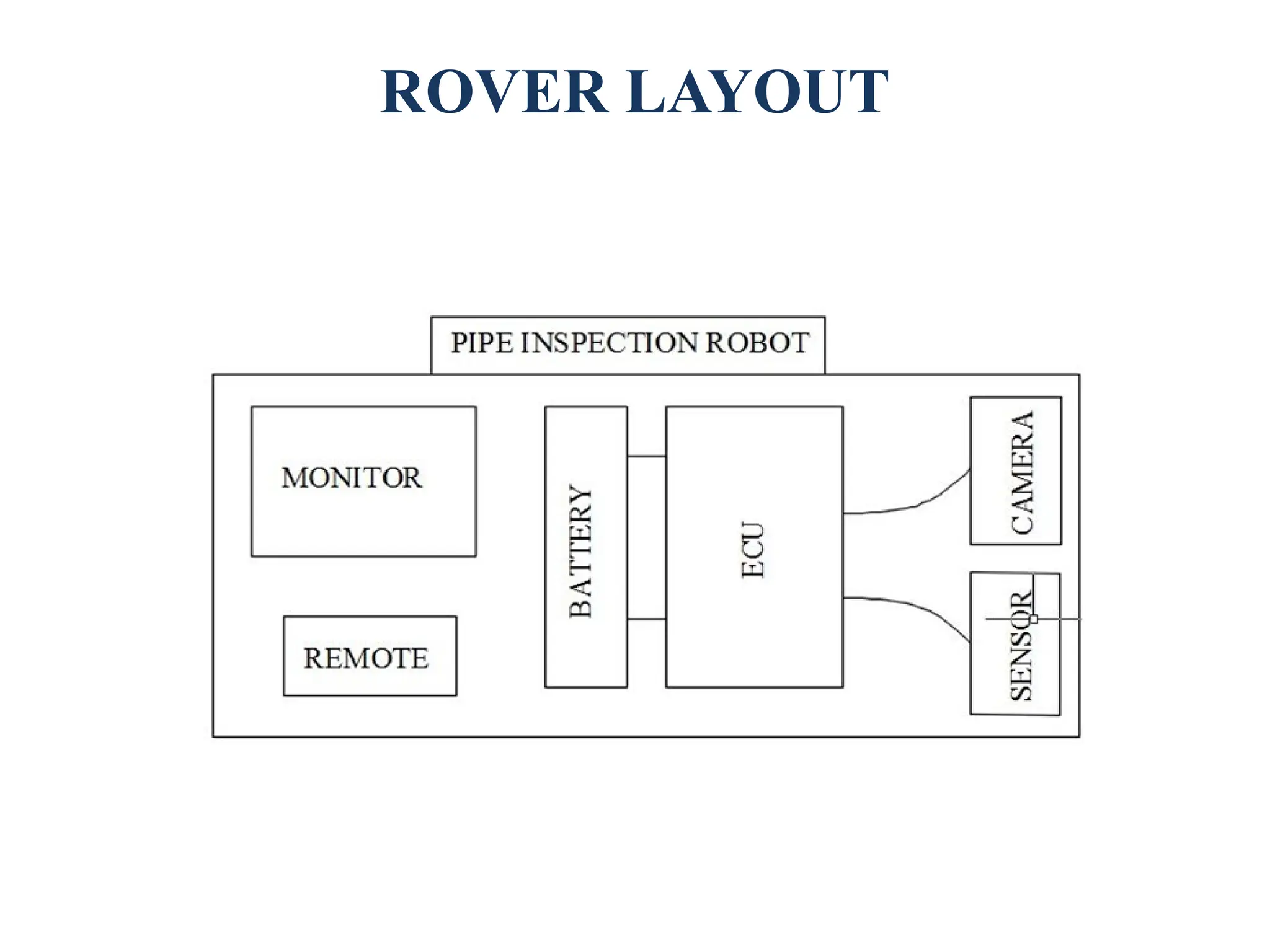
ROVER LAYOUT
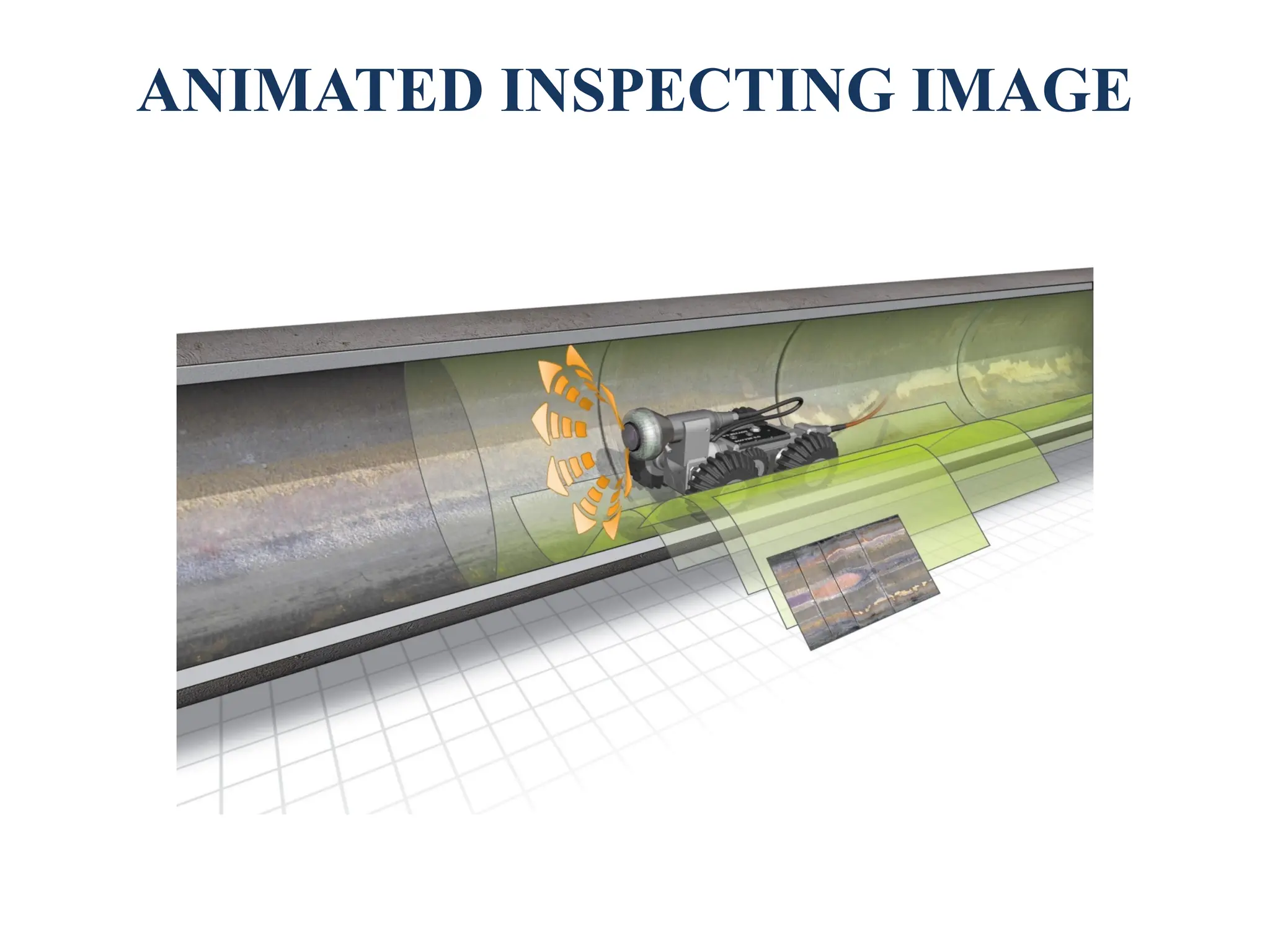
ANIMATED INSPECTING IMAGE
DEFECTS IN PIPE
 Corrosion inside the pipe.
 Internal defects such as holes, cracks, dent marks, material
loss.
 Defects in weld joints.
 Internal blockage.
DEFECT INSIDE THE PIPE
ADVANTAGES
 It can be able to find defects such as leakage,corrosion wear,matertial
losses easily.
 It can be able to find defects in weld joints.
 Rovers are able to give fast response.
 Inspection camera gives a high quality detection of defects.
 It produces alarm to identify the particular defected area easily.
 This rover is more compactable compared to the wired inspection rovers.
LIMITATIONS
 This pipe inspection rover can inspect a defects only for a straight
pipe line.
 The battery backup time consideration is much needed.
 It can not be used for a pipe line which is not straight such as bend
pipe, elbow and T shaped pipe etc..,
 This rover cannot use to inspect the more inclined and vertical pipes.
 Rover does not work inside water.
APPLICATION
 Suited for all industries which are using an pipelines.
 It will be applicable for duct, Pipes, boilers, etc.,
 It also compactable for pipe manufacturing industry.
CONCLUSION
A very important design goal of the robotic systems is the
adaptability to the inner diameters of the pipes. So, we had proposed
a new design in inspecting pipelines. The major advantage is that it
could be used in case of pipe diameter variation with the simple
mechanism. We developed a pipe inspection rover that can be
applied. The types of inspection tasks are very different. Presence of
obstacles within the pipelines is a difficult issue. The rover is
designed to be able to traverse pipes. We had experimented our
project and we got the test results. Several types of modules for pipe
inspection mini rover have been presented. Many of the design goals
of the Pipe inspection rover have been completely fulfilled.
REFERENCE
1. Ankit Nayak , S. K. Pradhan, “Design of a New In-Pipe Inspection
Robot,” in 12th Global congress on manufacturing and
management, GCMM 2014.
2. Lee Vuen Nee, I. Elamvazuthi, Timothy Ganesan, M.K.A. Ahamed
Khan and S. Parasuraman, “Development of a Laboratory-scale
Pipeline Inspection Robot,” in 2015 IEEE International
Symposium on Robotics and Intelligent Sensors (IRIS 2015).
3. Kentarou Nishijima, Yixiang Sun, Rupesh Kumar Srivastava
Harutoshi Ogai, Bishakh Bhattacharya, “Advanced pipe inspection
robot using rotating probe,” in The Fifteenth International
Symposium on Artificial Life and Robotics 2010 (AROB 15th ’10),
B-Con Plaza, Beppu,Oita, Japan, February 4-6, 2010.
4. Nur Shahida Roslin, Adzly Anuar, Muhammad Fairuz Abdul
Jalal, Khairul Salleh Mohamed Sahari, “A Review: Hybrid
Locomotion of In-pipe Inspection Robot,” in 2012 International
Symposium on Robotics and Intelligent Sensors.
5. Xin Li, Wuyi Yu, Xiao Lin, and S. S. Iyengar, “On Optimizing
Autonomous Pipeline Inspection,” in IEEE Transactions On
Robotics, Vol. 28, No. 1, February 2012.
6. Hanaa Said Salim Al-Hajry and G.R. Rameshkumar,
“Designand Testing of Pipeline Inspection Robot,” in
International Journal of Engineering Innovation & Research
Volume 2, Issue 4, ISSN: 2277 – 5668.
7. Ankit Nayak, S. K. Pradhan, “Investigations of Design Issues
Related To In-Pipe Inspection Robots,” in International Journal
of Emerging Technology and Advanced Engineering Website:
www.ijetae.com (ISSN 2250-2459, ISO 9001:2008 Certified
Journal, Volume 4, Issue 3, March 2014).
THANK YOU

DESIGN AND FABRICATION SGSGDHSadehsdDEAEHDG

  • 1.
    DESIGN AND FABRICATIONOF PIPE INSPECTION ROVER USING WIRELESS CAMERA B.HARI 620816114072 N.JAYAKUMAR 620816114076 T.KARTHICK 620816114080 V.MAHENDRAN 620816114095 Guided by, Dr.SACHIN S RAJ,AP/Mech.
  • 2.
    ABSTRACT Inspection rovers areused in many fields of industry. One application is monitoring the inside of the pipes and channels, recognizing and solving problems through the interior of pipes or channels. Automated inspection of the inner surface of a pipe can be achieved by a mobile rover. Although it’s less common, corrosion also can occur on the inside surface of the pipe and reduces the strength of the pipe. If crack goes undetected and becomes severe, the pipe can leak and, in rare cases, fail catastrophically. In this work, Pipe Inspection Robot (PIR) with ability to move inside horizontal pipes has been designed and fabricated. The rover consists of a motor for driving and camera for monitoring. Keywords: Monitoring, PIR, Camera, Detection, Automated inspection.
  • 3.
    LITERATURE REVIEW Kazuhiro TSURUTAet al., (2000), we have developed a compact control circuit which controls all the devices installed in the robot by an outside command and transmits the image data of the CCD camera. As for the control circuit, the power consumption and the size are greatly restricted in order to be installed in the robot. In order to reduce the size of the circuit, we have newly developed an image data communication LSI based on a new architecture. Through the fabricated prototype, we have successfully confirmed the wireless image data communication of 2.27 frames per second and control of the robot by using microwaves. By the end of 2000, we will complete the in-pipe wireless micro robot. It will show the possibility of wireless micro machine with multi-functions.
  • 4.
    Ankit Nayak ,S. K. Pradhan (Oct 2015), Based on the literature reviewed it is concluded that screw type In-pipe inspection robotic mechanism has many advantages as compared to other mechanisms. In view of this a Screw type In-pipe inspection robot has been designed in this work to perform inspection related activities inside a pipe of diameters ranging from 127mm to 152mm. Kinematic and dynamic analyses are performed to understand the behavior of proposed model in vertical, inclined and horizontal pipe line with Y or L bends. After getting the basic dimensions from these kinematic and dynamic equations, solid model is developed in UGNX and after some trials the basic design is finalized and presented in this work. To validate the behavior and desired outcomes an initial prototype is also developed.
  • 5.
    METHODOLOGY  This projectuse to find any crack and damage in pipe.  Sensor attached in control units, first sensor enter the required investigation pipe here sensor inspected the pipe line.  In case any damage identifies the sensor, it give the signal to electro control units.  Electro control units activate the alarm, so this case easy to identify the damage area easily.  This project very use and important one in boiler pipe line and gas pipe line areas.  A wireless camera has attached in front of rover that it used to monitor the inside the pipe.
  • 6.
     Sensor attachedin control units, first sensor enter the required investigation pipe here sensor inspected the pipe line.  Electro control units activate the alarm, so this case easy to identify the damage area easily.  This project very use and important one in boiler pipe line and gas pipe line areas.
  • 7.
  • 8.
  • 9.
    DEFECTS IN PIPE Corrosion inside the pipe.  Internal defects such as holes, cracks, dent marks, material loss.  Defects in weld joints.  Internal blockage.
  • 10.
  • 11.
    ADVANTAGES  It canbe able to find defects such as leakage,corrosion wear,matertial losses easily.  It can be able to find defects in weld joints.  Rovers are able to give fast response.  Inspection camera gives a high quality detection of defects.  It produces alarm to identify the particular defected area easily.  This rover is more compactable compared to the wired inspection rovers.
  • 12.
    LIMITATIONS  This pipeinspection rover can inspect a defects only for a straight pipe line.  The battery backup time consideration is much needed.  It can not be used for a pipe line which is not straight such as bend pipe, elbow and T shaped pipe etc..,  This rover cannot use to inspect the more inclined and vertical pipes.  Rover does not work inside water.
  • 13.
    APPLICATION  Suited forall industries which are using an pipelines.  It will be applicable for duct, Pipes, boilers, etc.,  It also compactable for pipe manufacturing industry.
  • 14.
    CONCLUSION A very importantdesign goal of the robotic systems is the adaptability to the inner diameters of the pipes. So, we had proposed a new design in inspecting pipelines. The major advantage is that it could be used in case of pipe diameter variation with the simple mechanism. We developed a pipe inspection rover that can be applied. The types of inspection tasks are very different. Presence of obstacles within the pipelines is a difficult issue. The rover is designed to be able to traverse pipes. We had experimented our project and we got the test results. Several types of modules for pipe inspection mini rover have been presented. Many of the design goals of the Pipe inspection rover have been completely fulfilled.
  • 15.
    REFERENCE 1. Ankit Nayak, S. K. Pradhan, “Design of a New In-Pipe Inspection Robot,” in 12th Global congress on manufacturing and management, GCMM 2014. 2. Lee Vuen Nee, I. Elamvazuthi, Timothy Ganesan, M.K.A. Ahamed Khan and S. Parasuraman, “Development of a Laboratory-scale Pipeline Inspection Robot,” in 2015 IEEE International Symposium on Robotics and Intelligent Sensors (IRIS 2015). 3. Kentarou Nishijima, Yixiang Sun, Rupesh Kumar Srivastava Harutoshi Ogai, Bishakh Bhattacharya, “Advanced pipe inspection robot using rotating probe,” in The Fifteenth International Symposium on Artificial Life and Robotics 2010 (AROB 15th ’10), B-Con Plaza, Beppu,Oita, Japan, February 4-6, 2010.
  • 16.
    4. Nur ShahidaRoslin, Adzly Anuar, Muhammad Fairuz Abdul Jalal, Khairul Salleh Mohamed Sahari, “A Review: Hybrid Locomotion of In-pipe Inspection Robot,” in 2012 International Symposium on Robotics and Intelligent Sensors. 5. Xin Li, Wuyi Yu, Xiao Lin, and S. S. Iyengar, “On Optimizing Autonomous Pipeline Inspection,” in IEEE Transactions On Robotics, Vol. 28, No. 1, February 2012. 6. Hanaa Said Salim Al-Hajry and G.R. Rameshkumar, “Designand Testing of Pipeline Inspection Robot,” in International Journal of Engineering Innovation & Research Volume 2, Issue 4, ISSN: 2277 – 5668. 7. Ankit Nayak, S. K. Pradhan, “Investigations of Design Issues Related To In-Pipe Inspection Robots,” in International Journal of Emerging Technology and Advanced Engineering Website: www.ijetae.com (ISSN 2250-2459, ISO 9001:2008 Certified Journal, Volume 4, Issue 3, March 2014).
  • 17.