The Angle Addition Postulate You will learn to  find the measure  of an angle  and the bisector of an angle.  What You'll Learn NOTHING NEW! Vocabulary
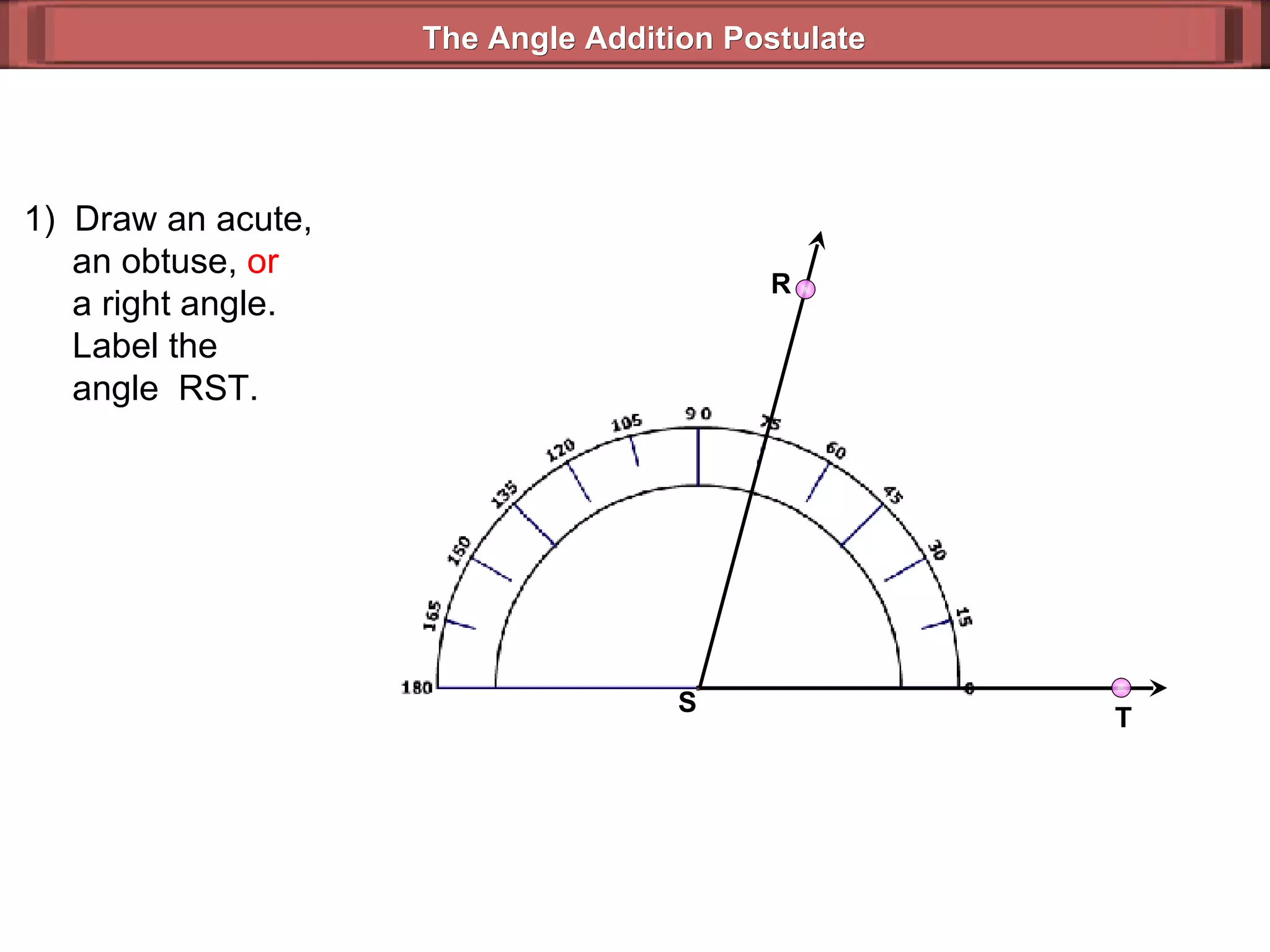
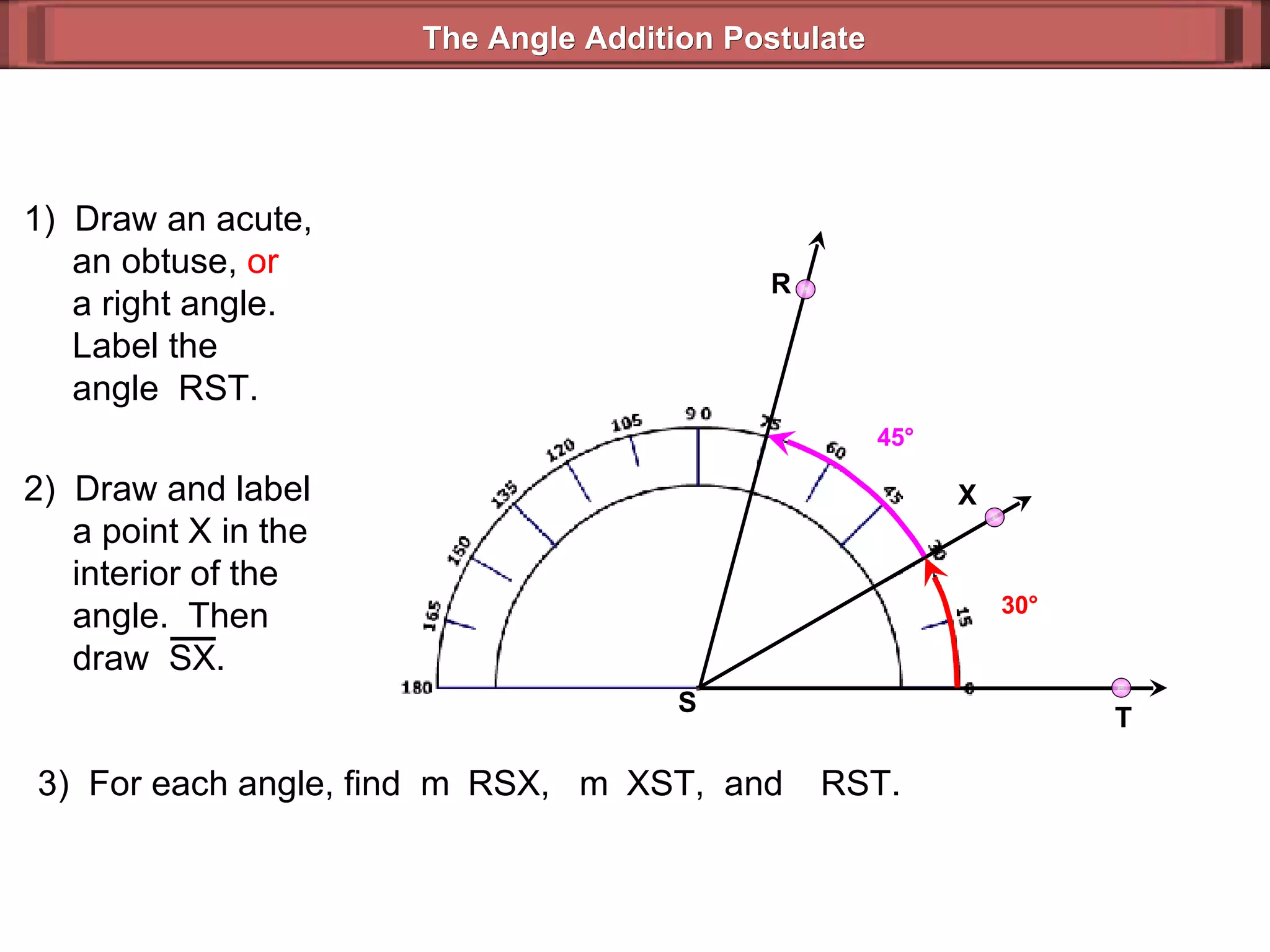
1)  Draw an acute,   an obtuse,  or   a right angle.   Label the   angle  RST. The Angle Addition Postulate R T S
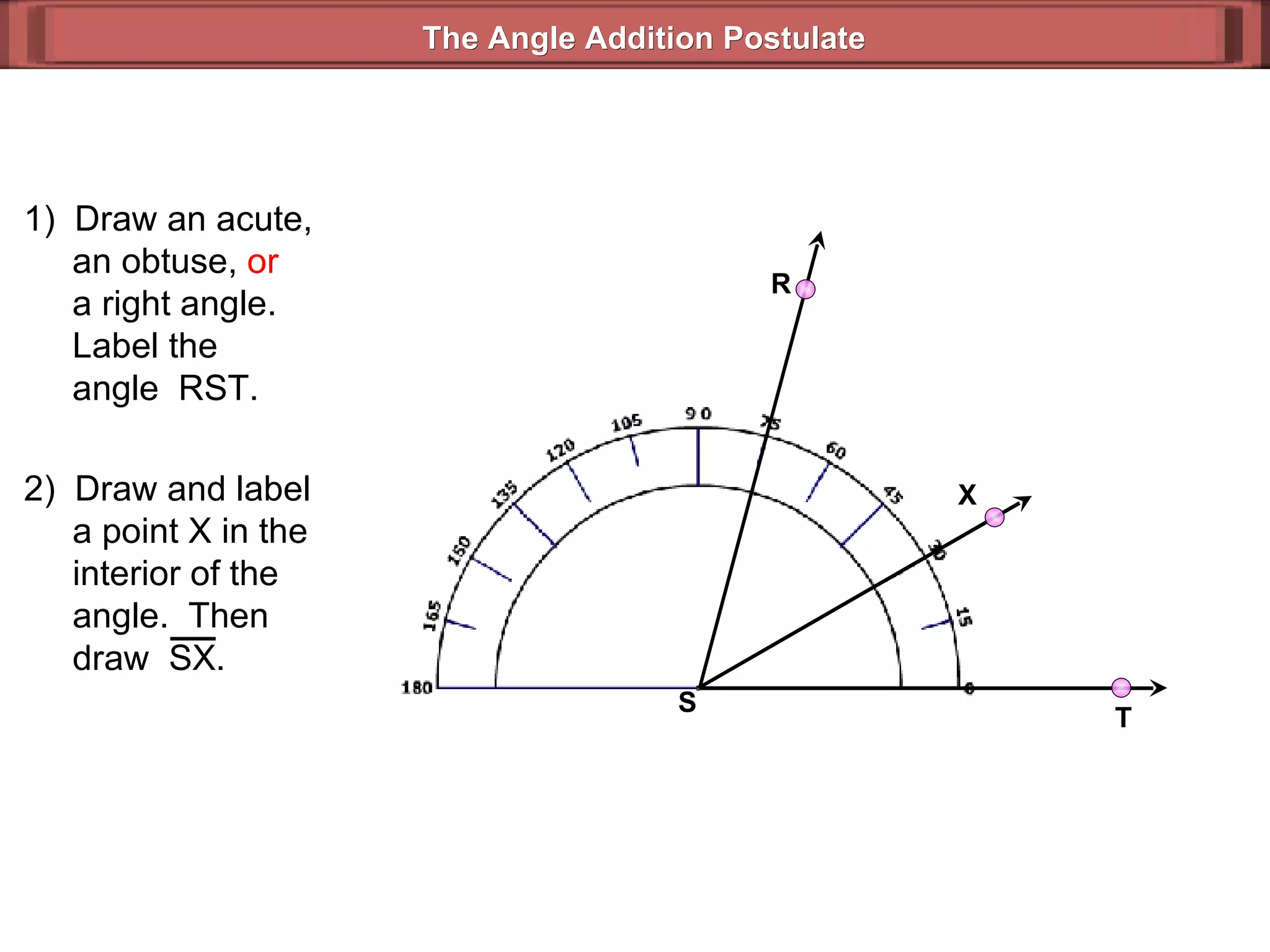
1)  Draw an acute,   an obtuse,  or   a right angle.   Label the   angle  RST. The Angle Addition Postulate R T S 2)  Draw and label   a point X in the   interior of the    angle.  Then    draw  SX. X
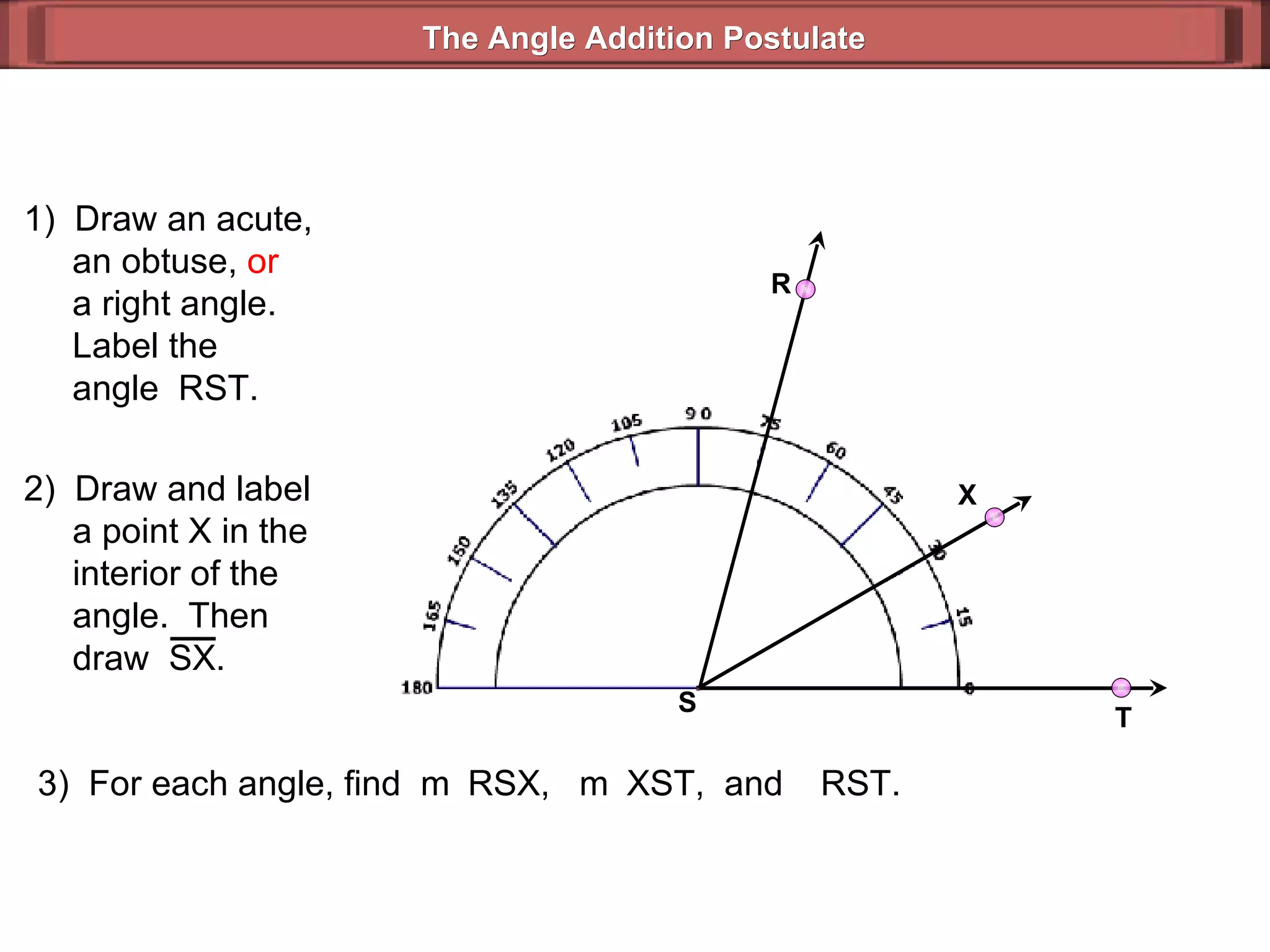
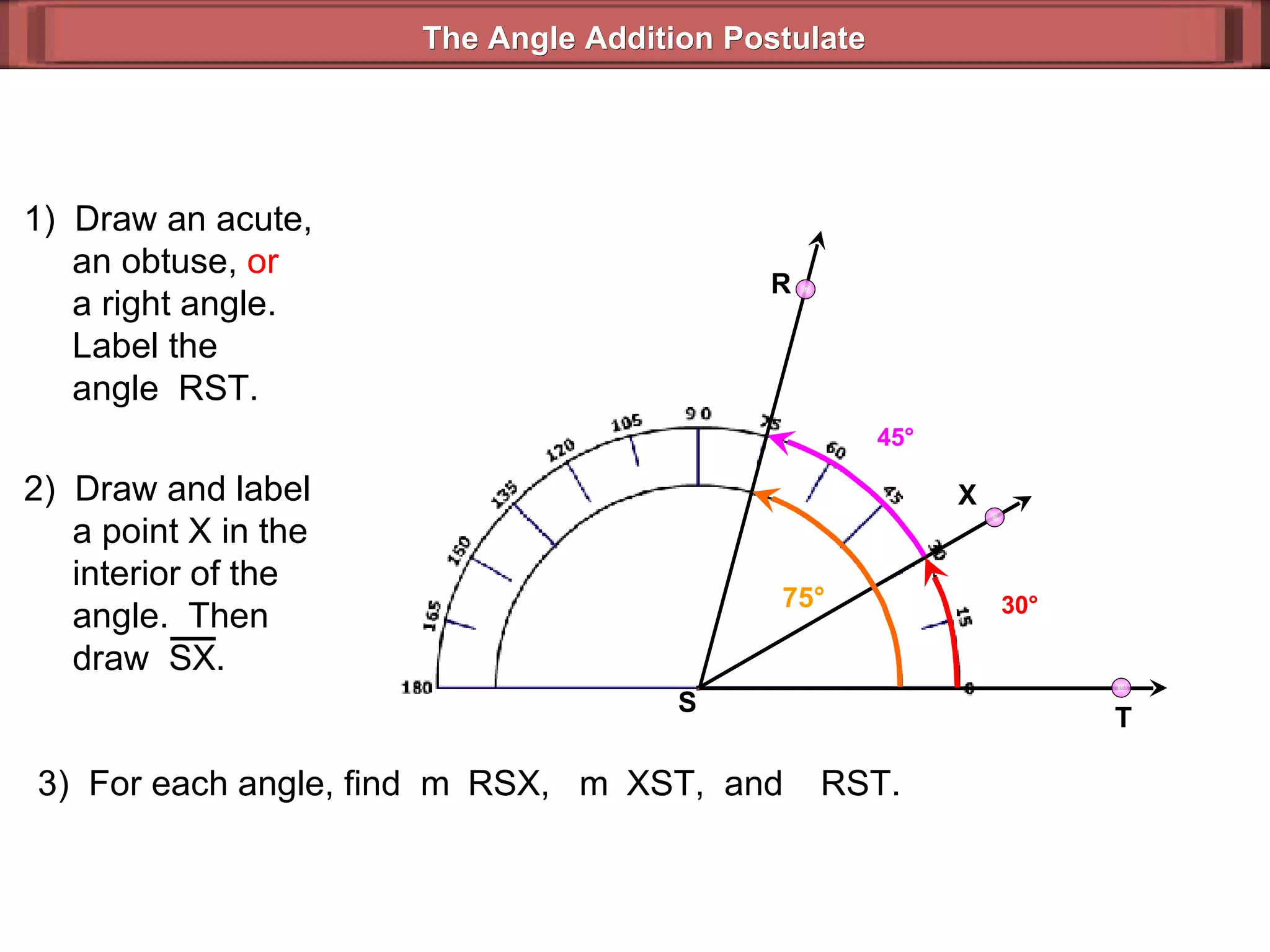
1)  Draw an acute,   an obtuse,  or   a right angle.   Label the   angle  RST. 3)  For each angle, find  m  RSX,  m  XST,  and   RST. The Angle Addition Postulate R T S 2)  Draw and label   a point X in the   interior of the    angle.  Then    draw  SX. X
1)  Draw an acute,   an obtuse,  or   a right angle.   Label the   angle  RST. 3)  For each angle, find  m  RSX,  m  XST,  and   RST. 30 ° 45 ° The Angle Addition Postulate R T S 2)  Draw and label   a point X in the   interior of the    angle.  Then    draw  SX. X
1)  Draw an acute,   an obtuse,  or   a right angle.   Label the   angle  RST. 3)  For each angle, find  m  RSX,  m  XST,  and   RST. 30 ° 45 ° 75 ° The Angle Addition Postulate R T S 2)  Draw and label   a point X in the   interior of the    angle.  Then    draw  SX. X
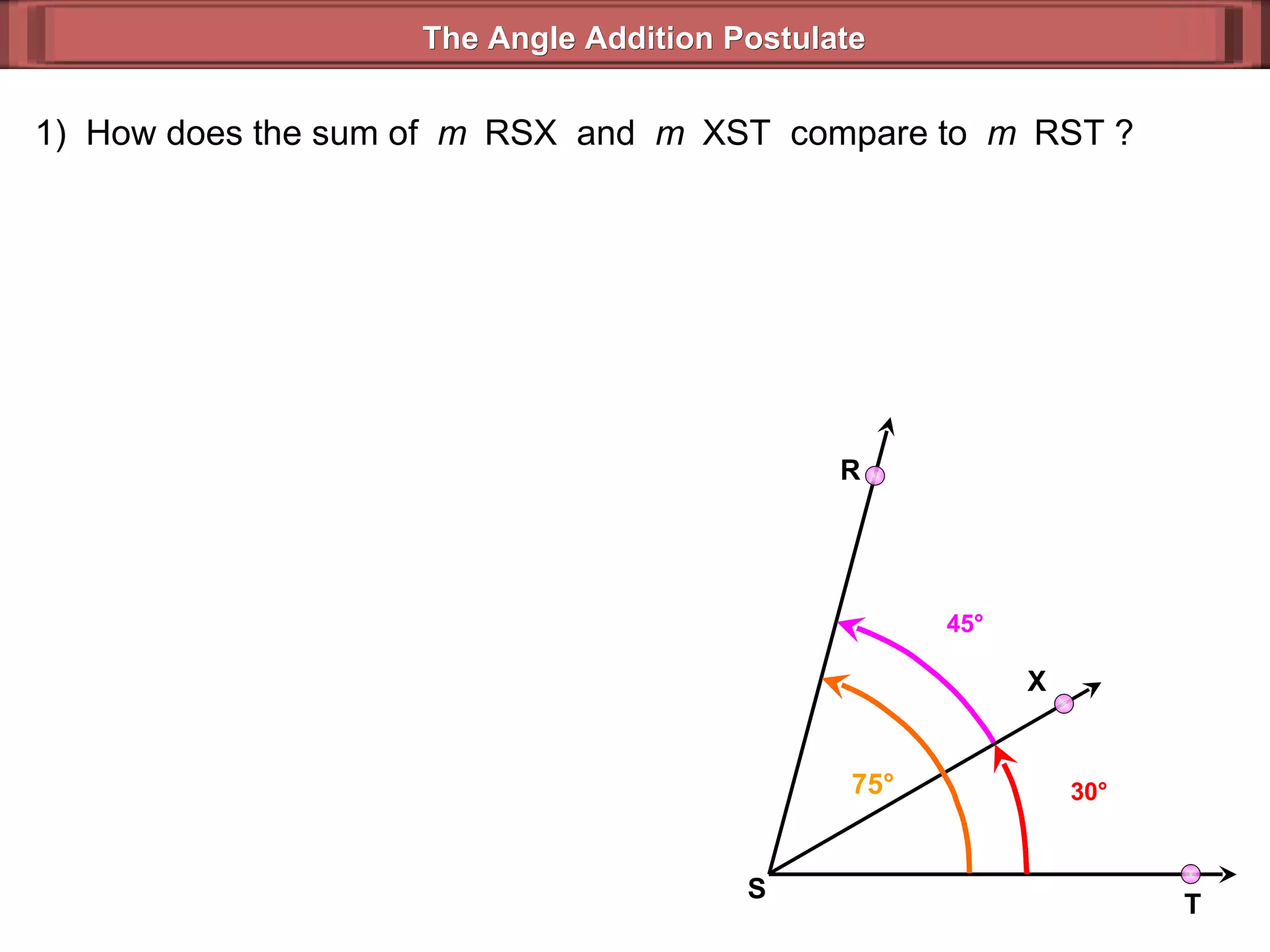
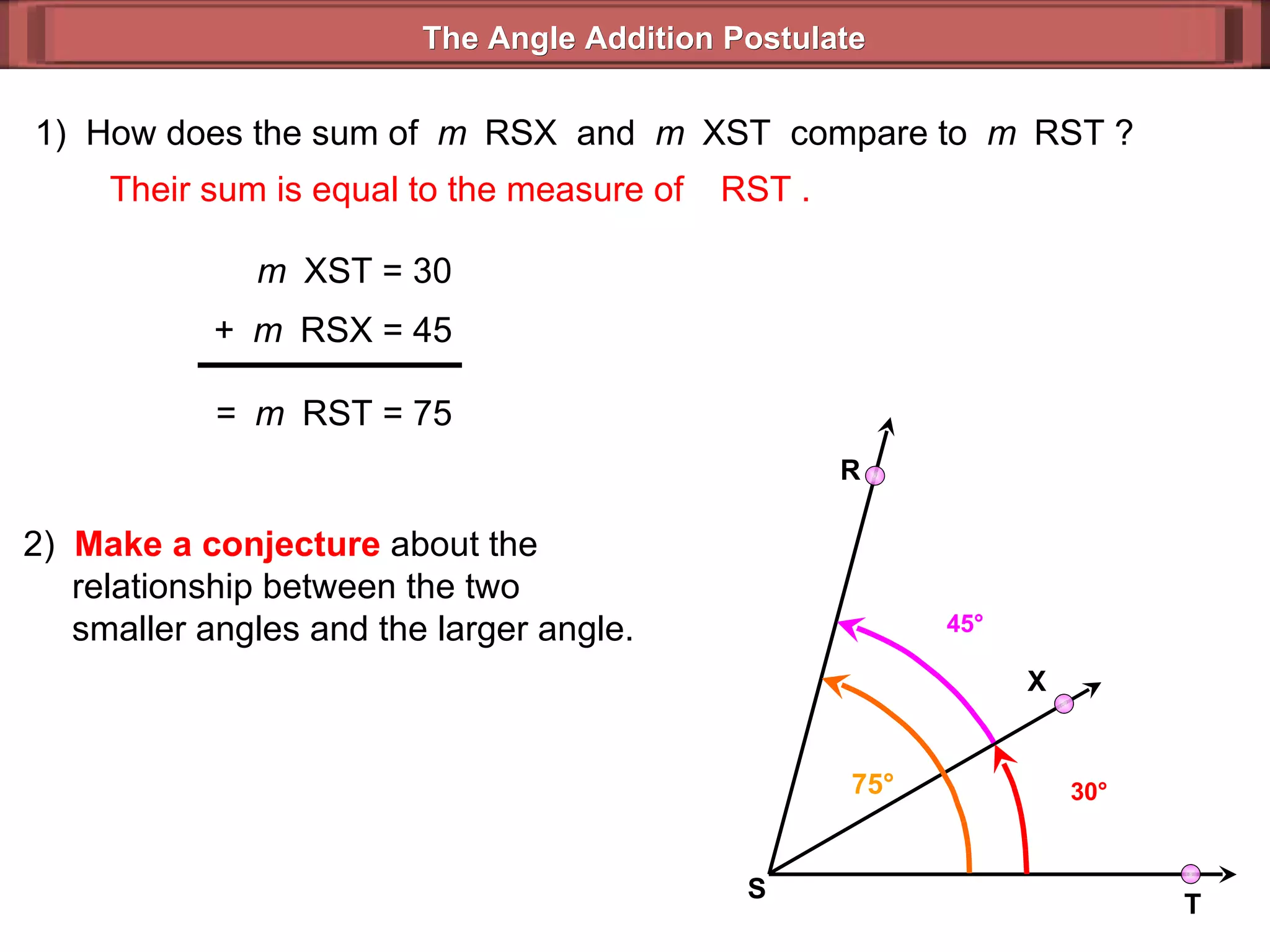
30 ° 45 ° 75 ° 1)  How does the sum of  m  RSX  and  m  XST  compare to  m  RST ? The Angle Addition Postulate R T S X
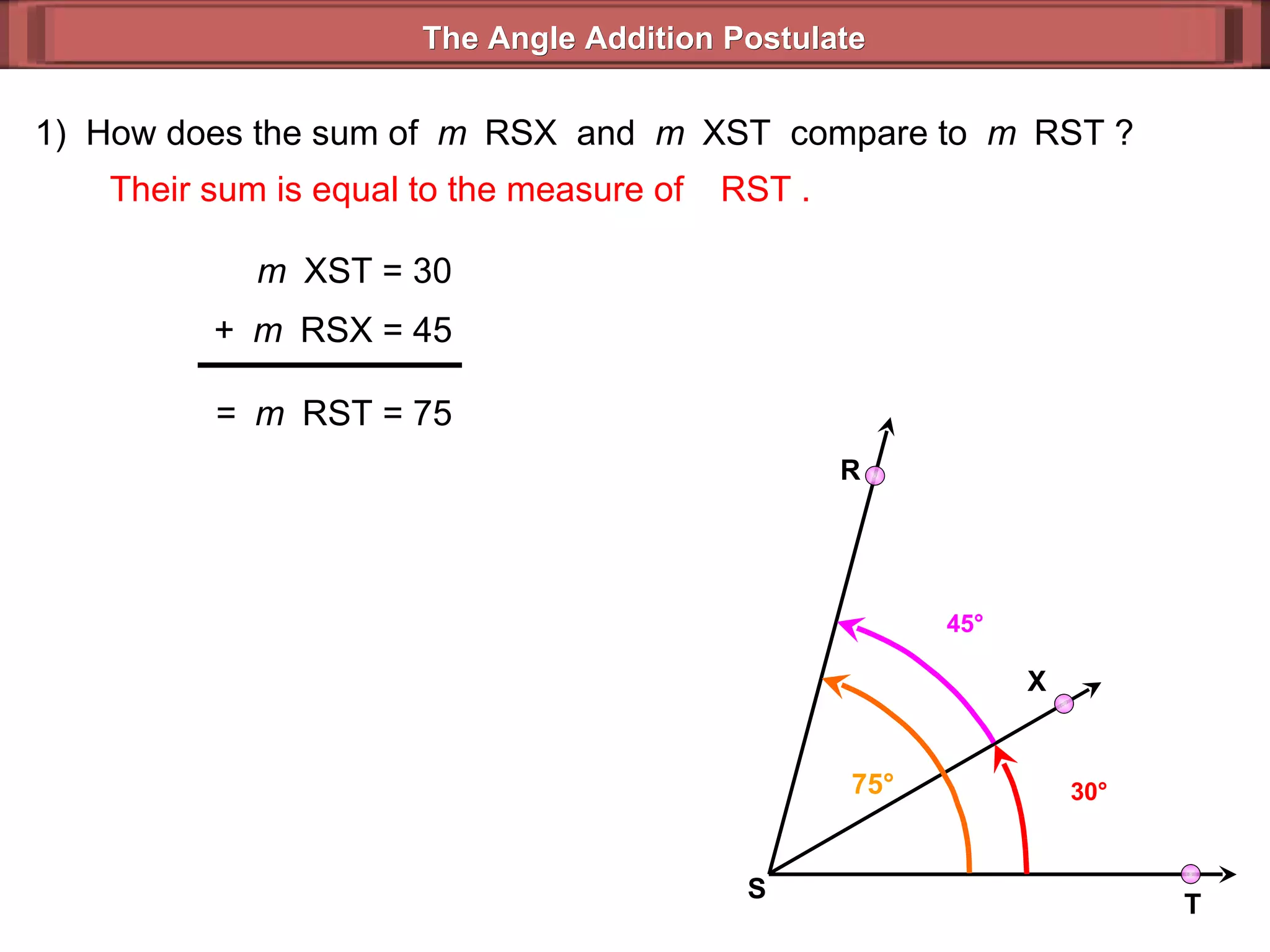
30 ° 45 ° 75 ° =  m  RST = 75 m  XST = 30 +  m  RSX = 45 1)  How does the sum of  m  RSX  and  m  XST  compare to  m  RST ? Their sum is equal to the measure of   RST . The Angle Addition Postulate R T S X
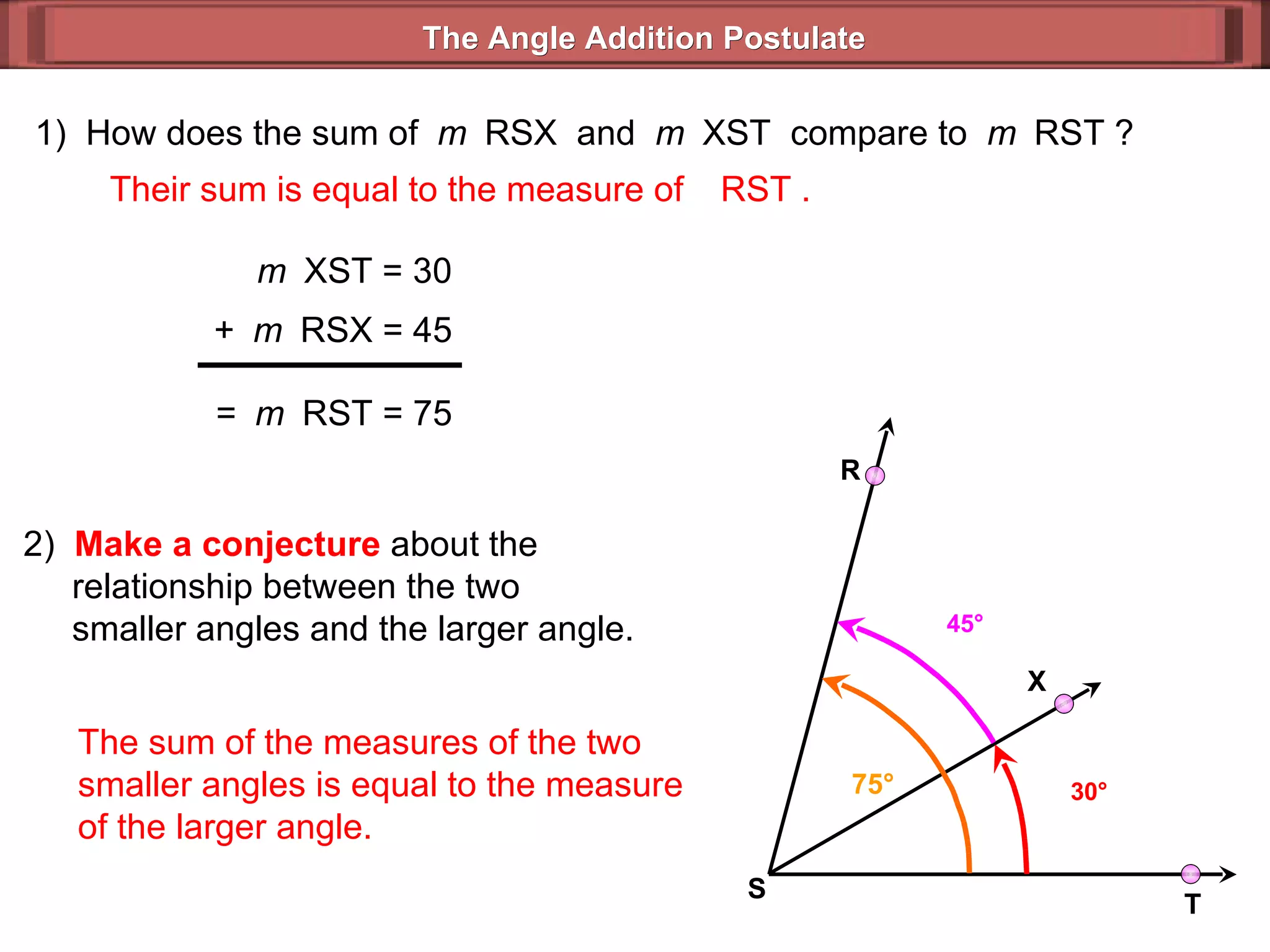
30 ° 45 ° 75 ° =  m  RST = 75 m  XST = 30 +  m  RSX = 45 1)  How does the sum of  m  RSX  and  m  XST  compare to  m  RST ? 2)  Make a conjecture  about the    relationship between the two    smaller angles and the larger angle. Their sum is equal to the measure of   RST . The Angle Addition Postulate R T S X
30 ° 45 ° 75 ° =  m  RST = 75 m  XST = 30 +  m  RSX = 45 1)  How does the sum of  m  RSX  and  m  XST  compare to  m  RST ? 2)  Make a conjecture  about the    relationship between the two    smaller angles and the larger angle. Their sum is equal to the measure of   RST . The sum of the measures of the two smaller angles is equal to the measure of the larger angle. The Angle Addition Postulate R T S X
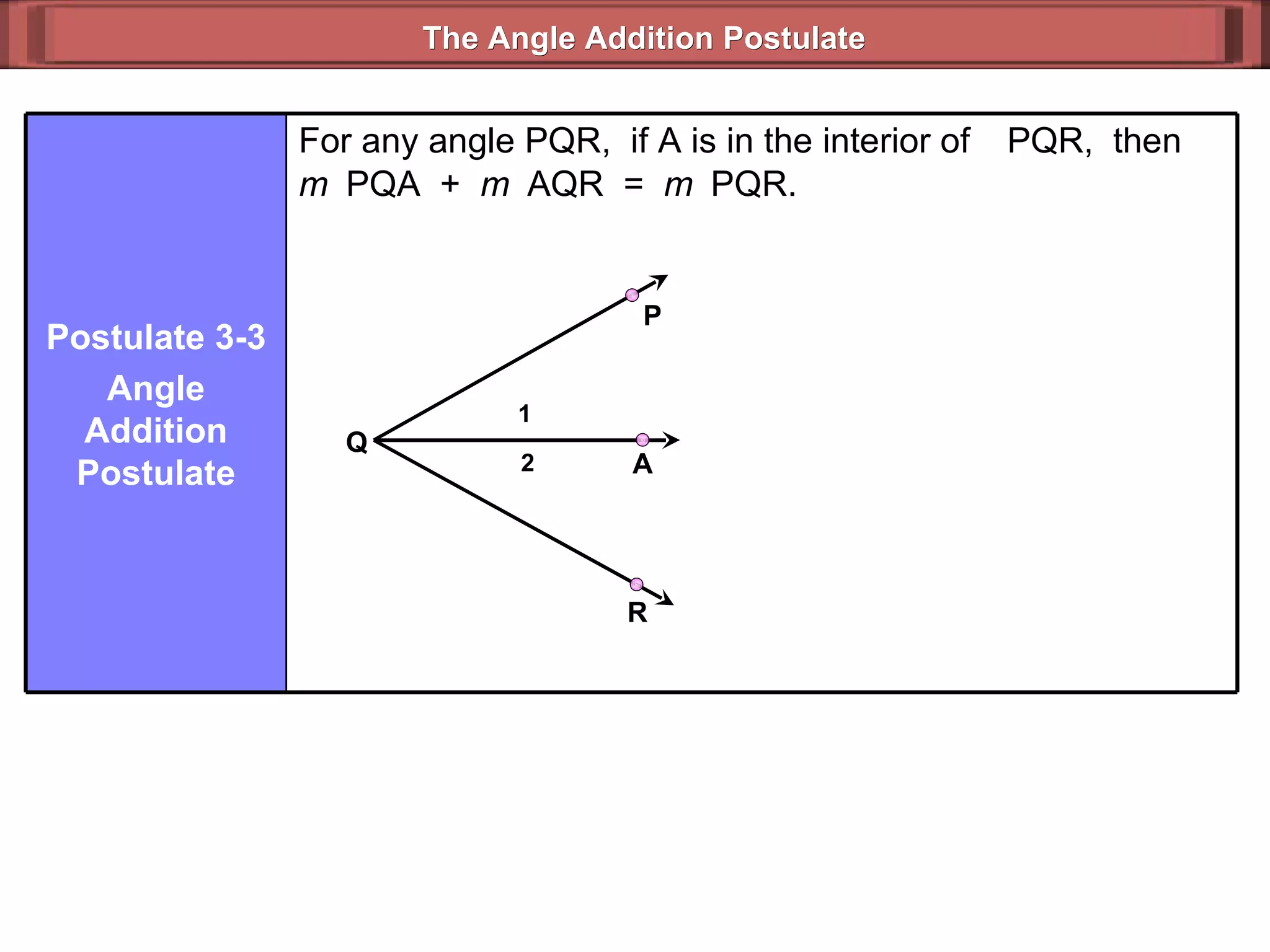
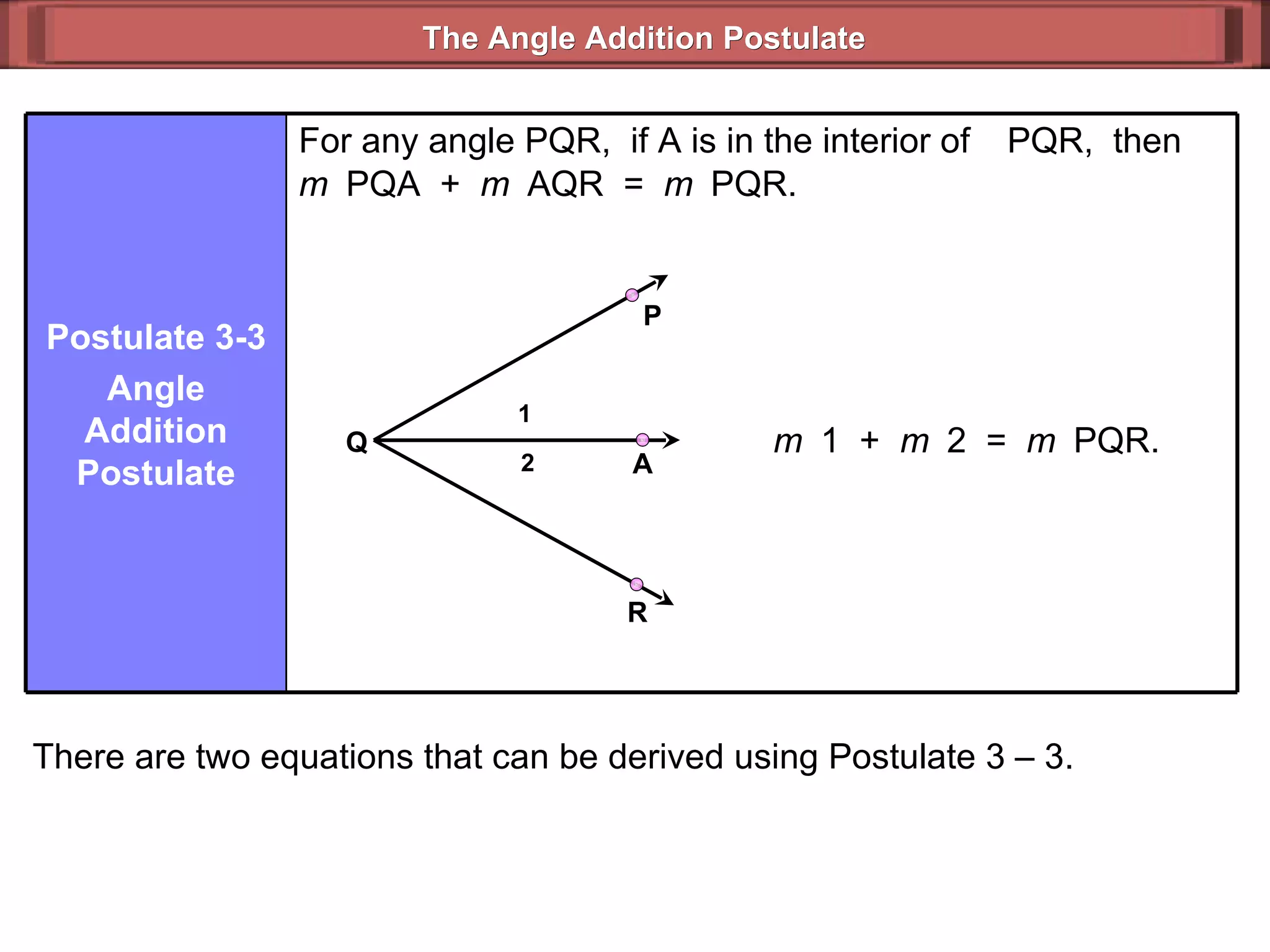
The Angle Addition Postulate For any angle PQR,  if A is in the interior of   PQR,  then m  PQA  +  m  AQR  =  m  PQR. Postulate 3-3 Angle Addition Postulate 2 1 A R P Q
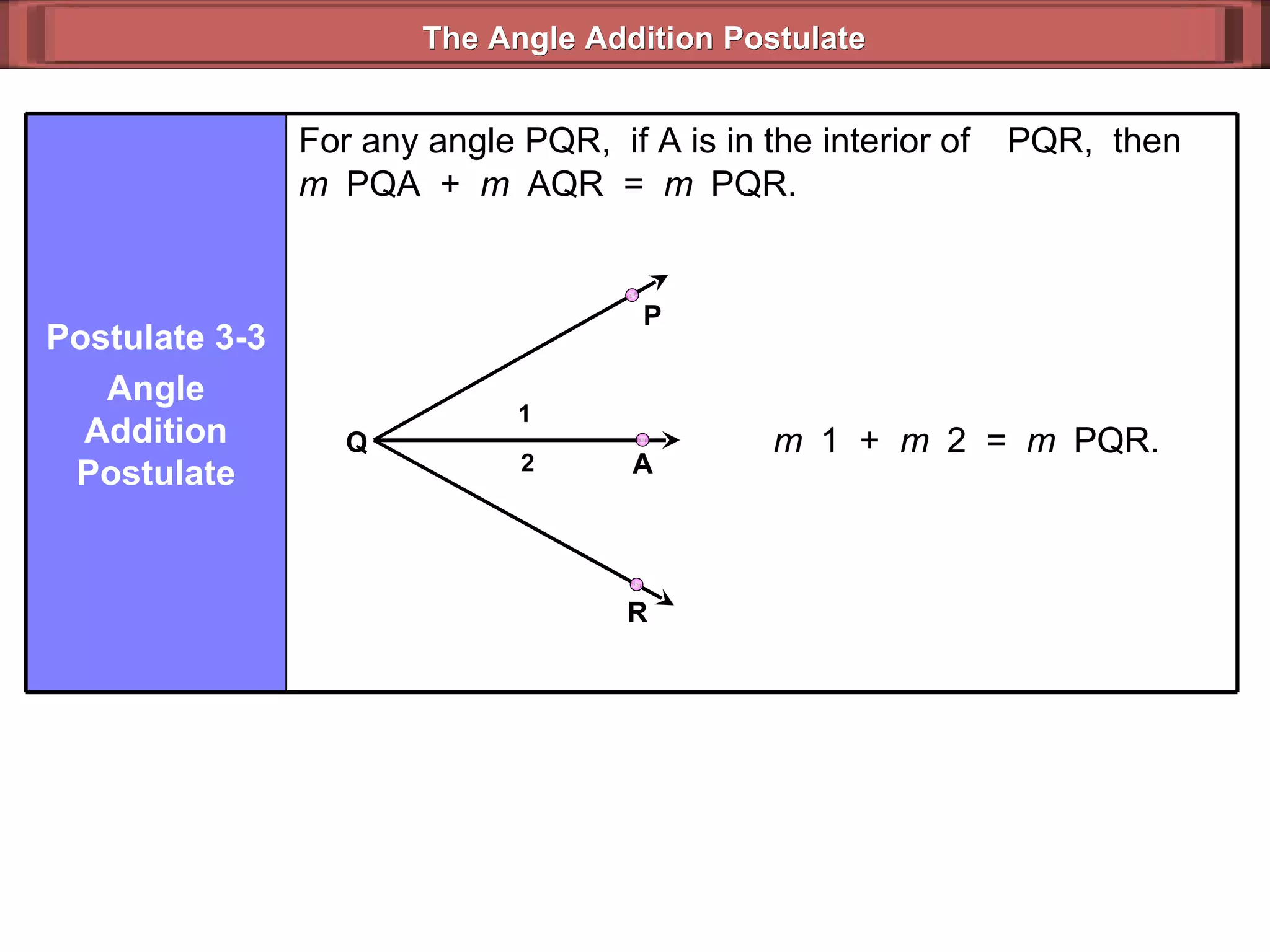
m  1  +  m  2  =  m  PQR. The Angle Addition Postulate For any angle PQR,  if A is in the interior of   PQR,  then m  PQA  +  m  AQR  =  m  PQR. Postulate 3-3 Angle Addition Postulate 2 1 A R P Q
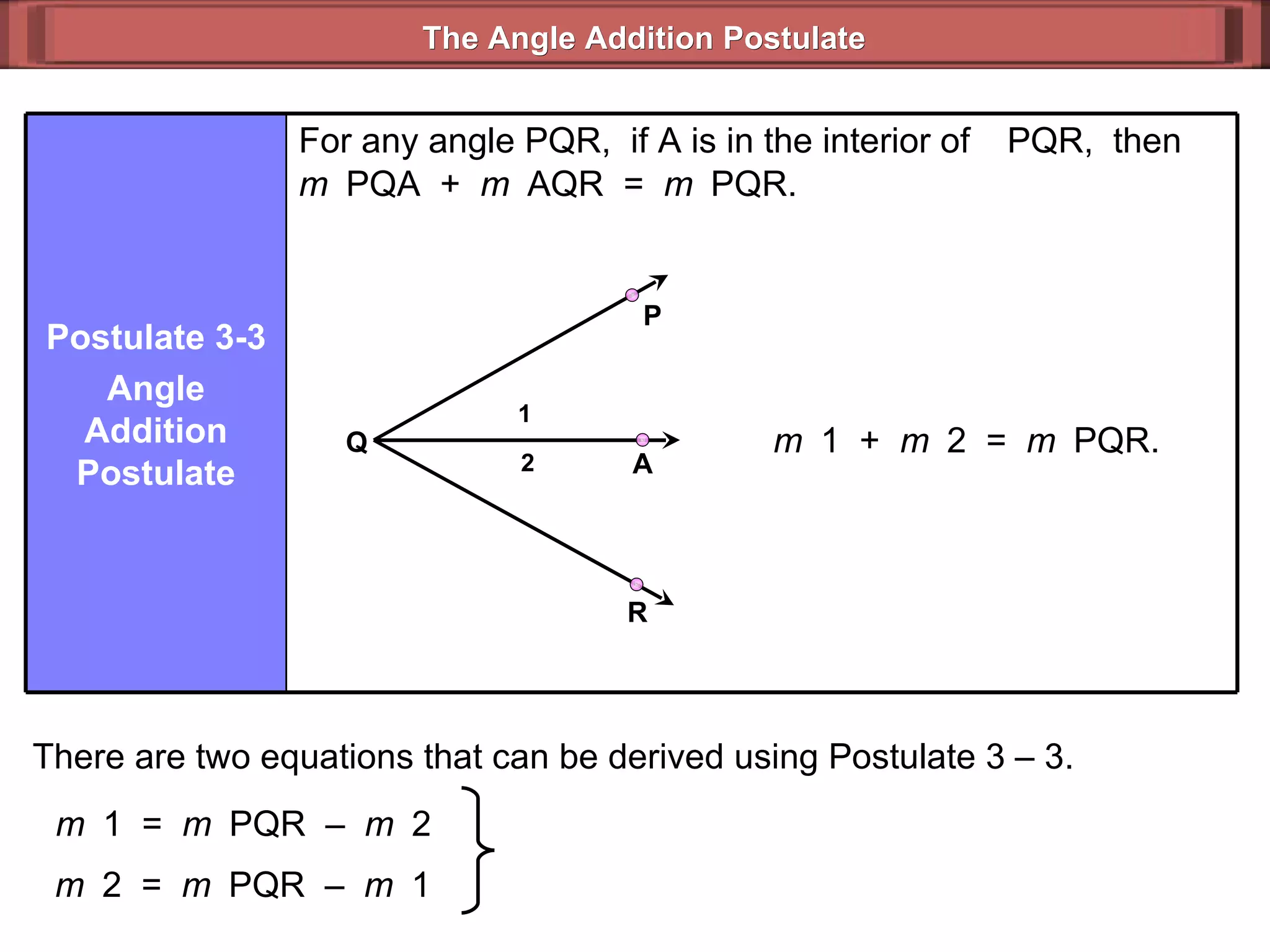
m  1  +  m  2  =  m  PQR. There are two equations that can be derived using Postulate 3 – 3. The Angle Addition Postulate For any angle PQR,  if A is in the interior of   PQR,  then m  PQA  +  m  AQR  =  m  PQR. Postulate 3-3 Angle Addition Postulate 2 1 A R P Q
m  1  +  m  2  =  m  PQR. There are two equations that can be derived using Postulate 3 – 3. m  1  =  m  PQR  –  m  2  m  2  =  m  PQR  –  m  1  The Angle Addition Postulate For any angle PQR,  if A is in the interior of   PQR,  then m  PQA  +  m  AQR  =  m  PQR. Postulate 3-3 Angle Addition Postulate 2 1 A R P Q
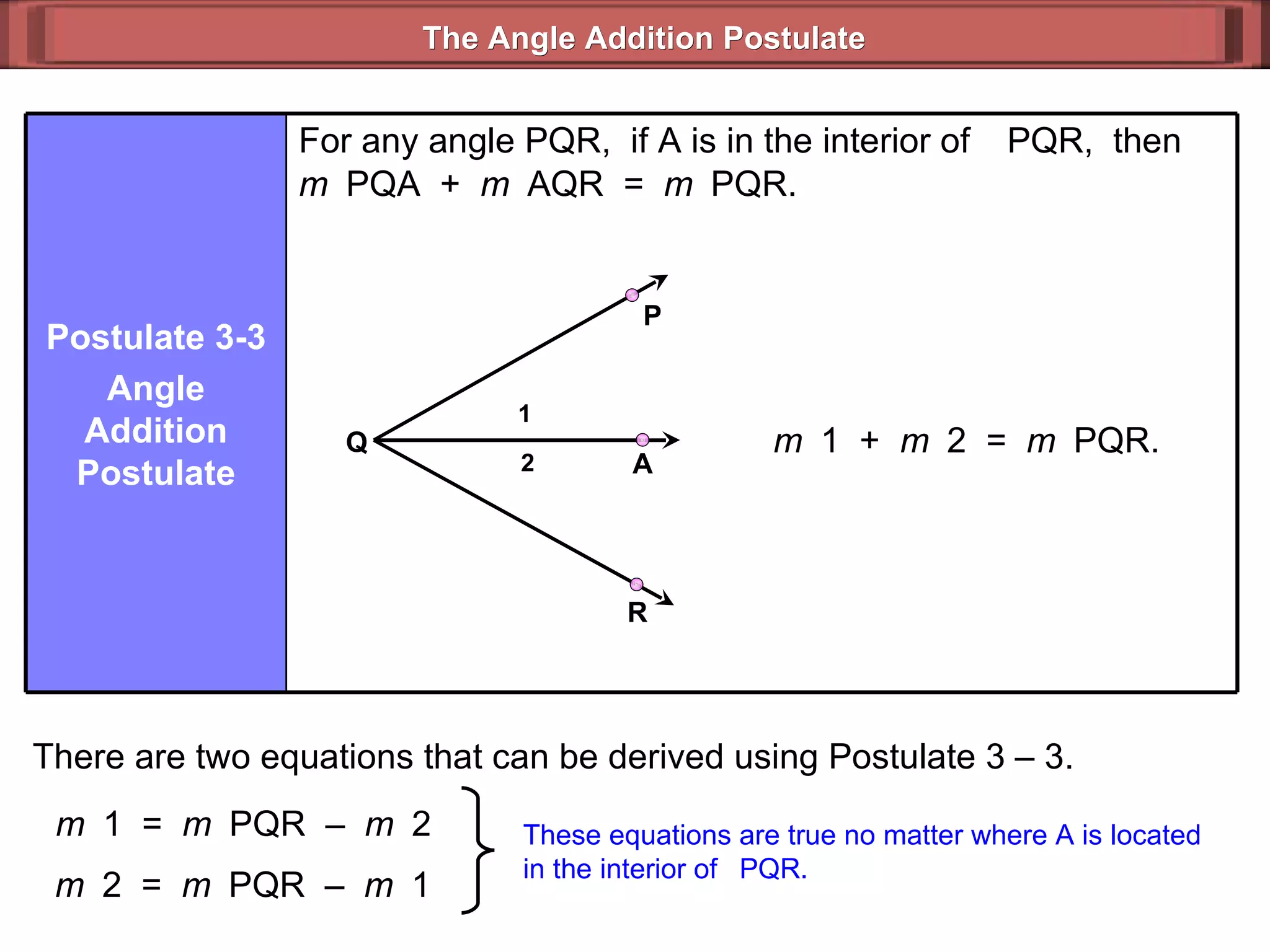
m  1  +  m  2  =  m  PQR. There are two equations that can be derived using Postulate 3 – 3. m  1  =  m  PQR  –  m  2  m  2  =  m  PQR  –  m  1  These equations are true no matter where A is located in the interior of   PQR.  The Angle Addition Postulate For any angle PQR,  if A is in the interior of   PQR,  then m  PQA  +  m  AQR  =  m  PQR. Postulate 3-3 Angle Addition Postulate 2 1 A R P Q
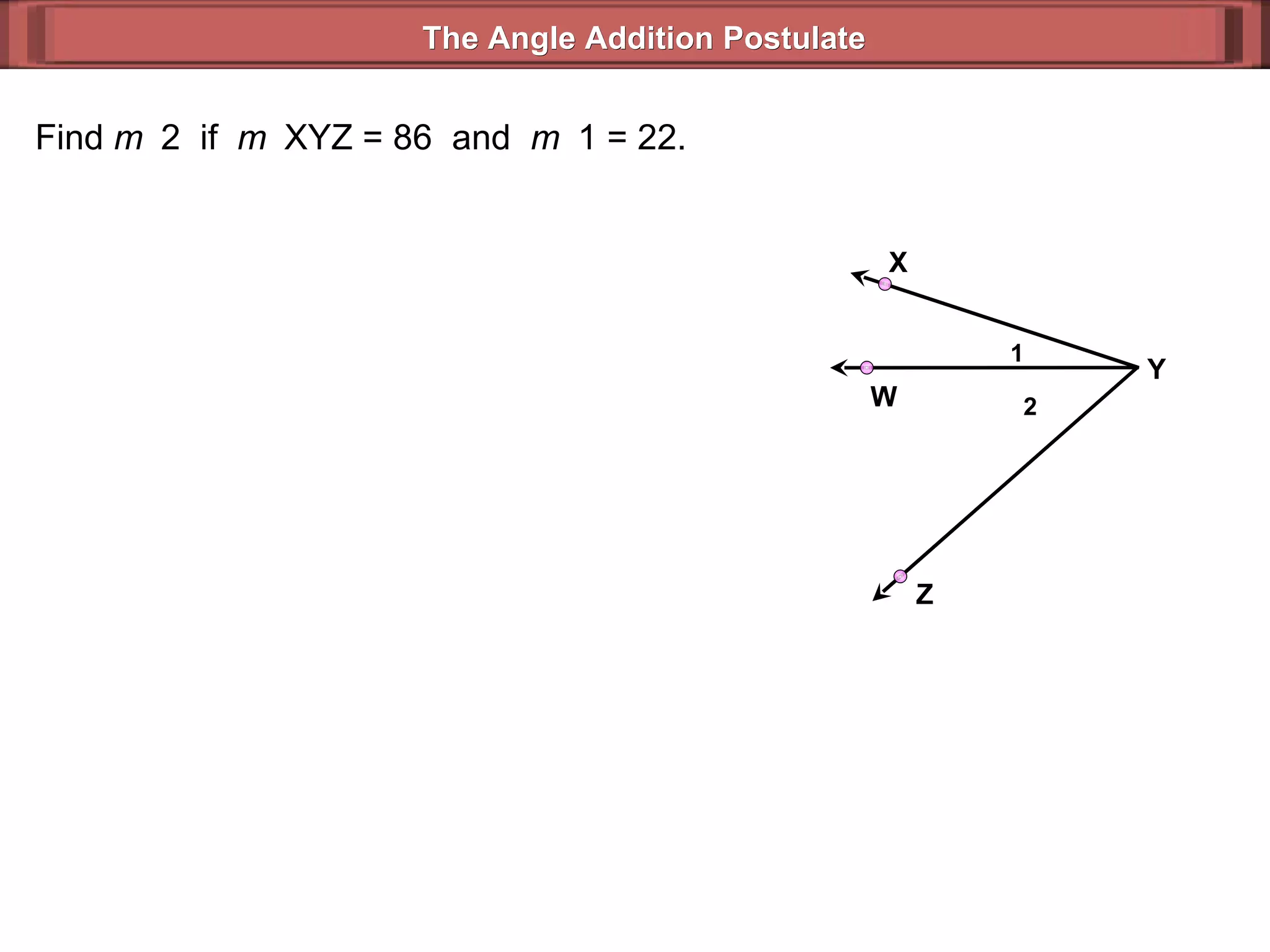
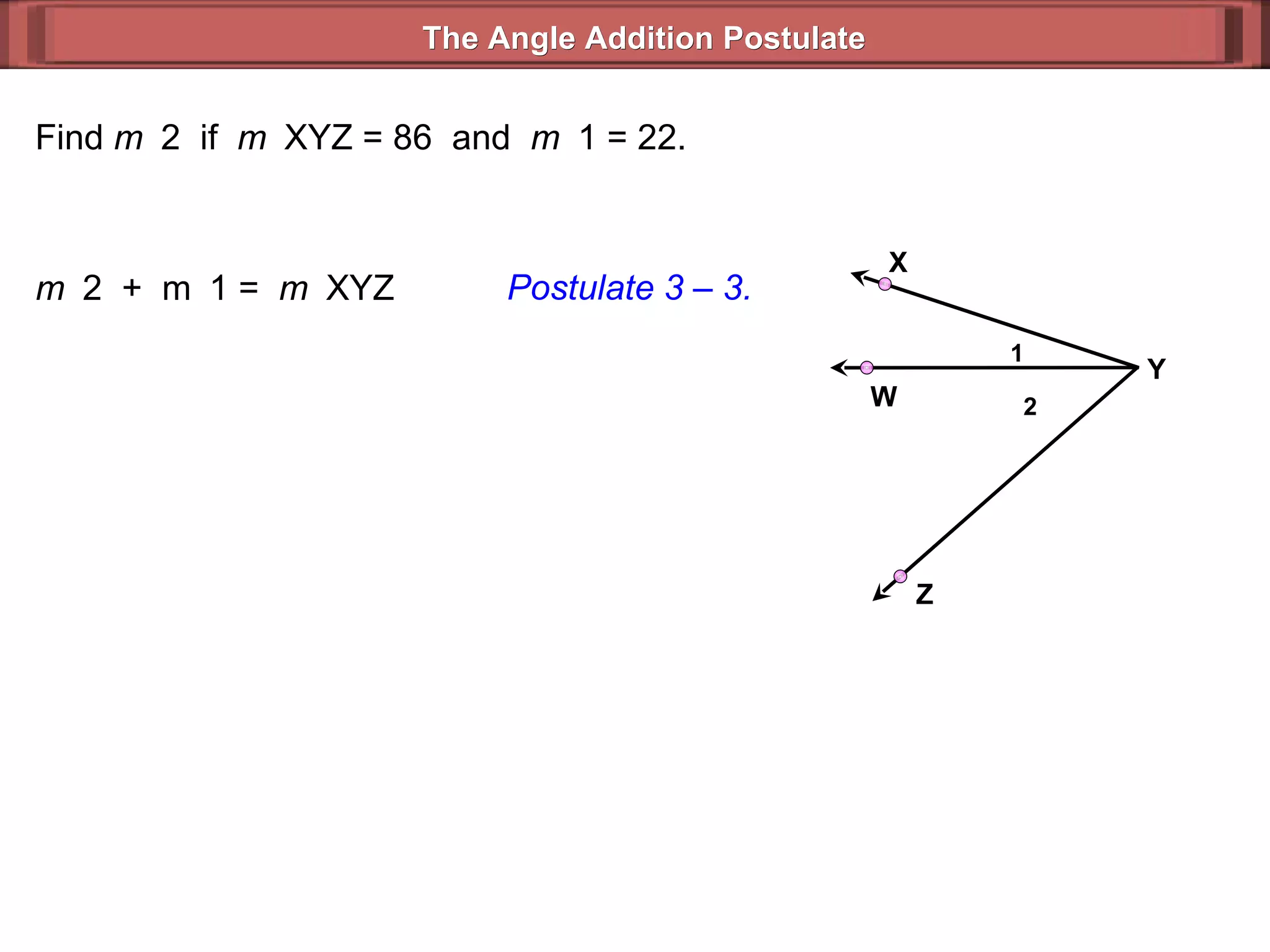
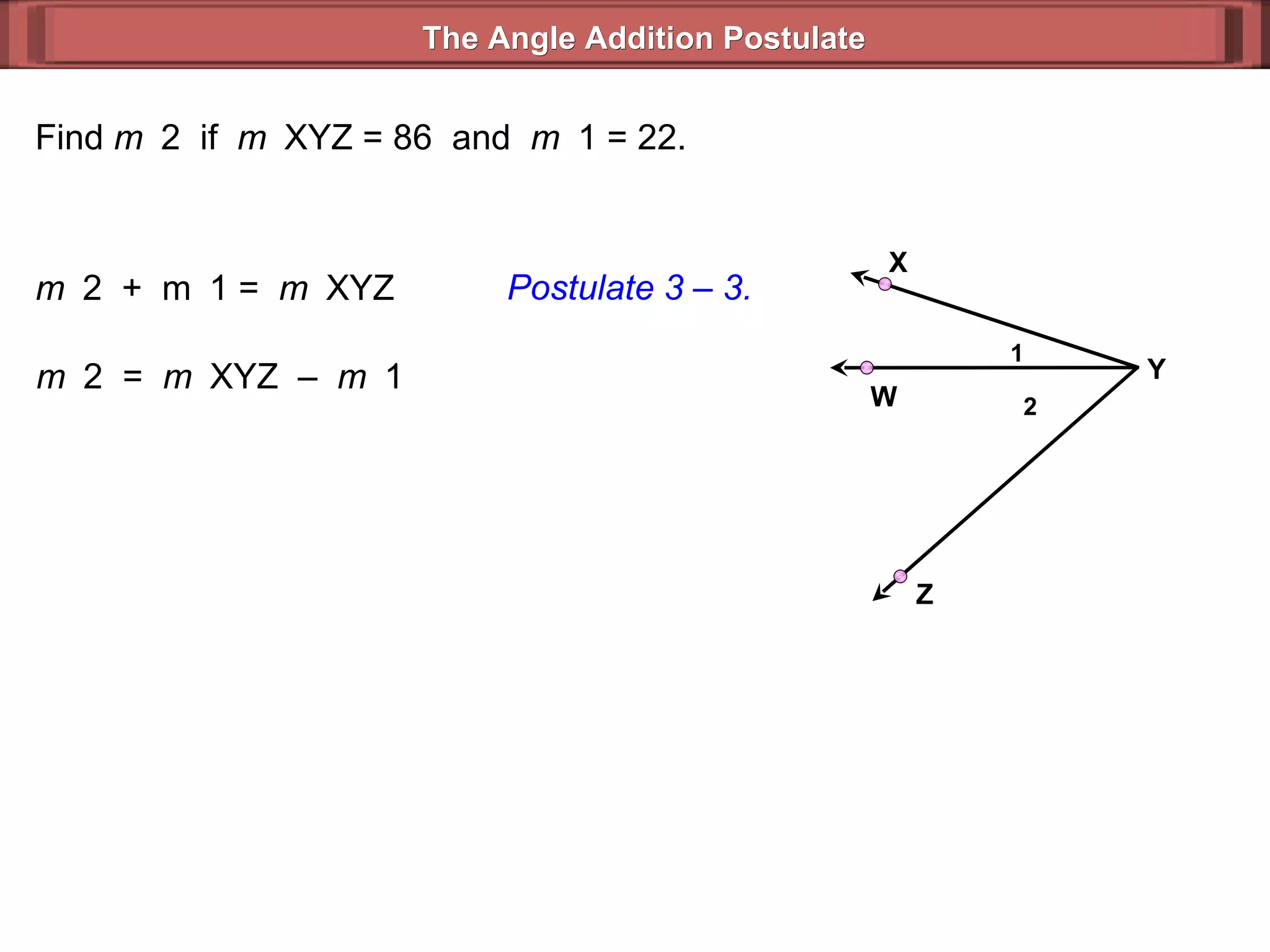
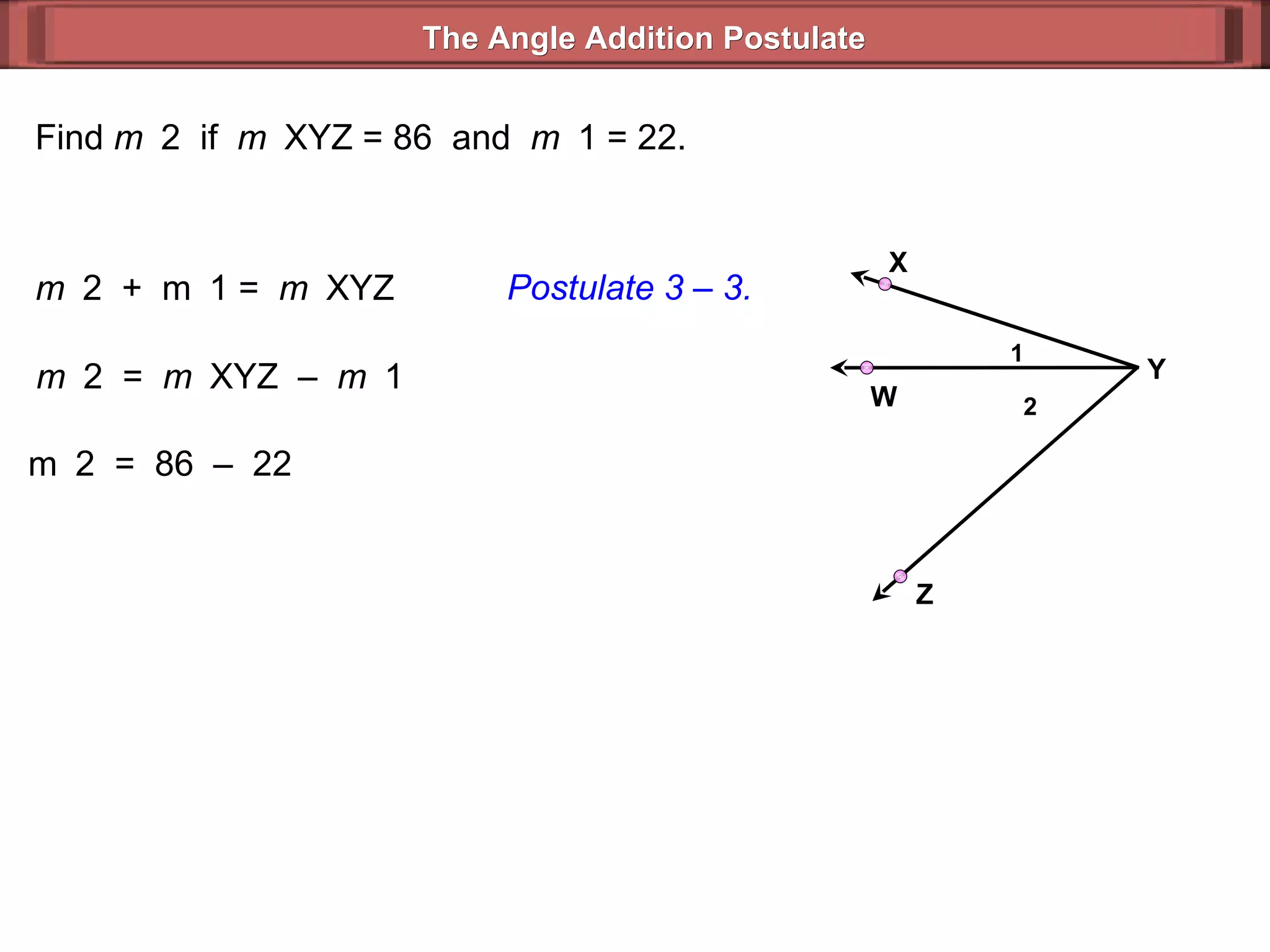
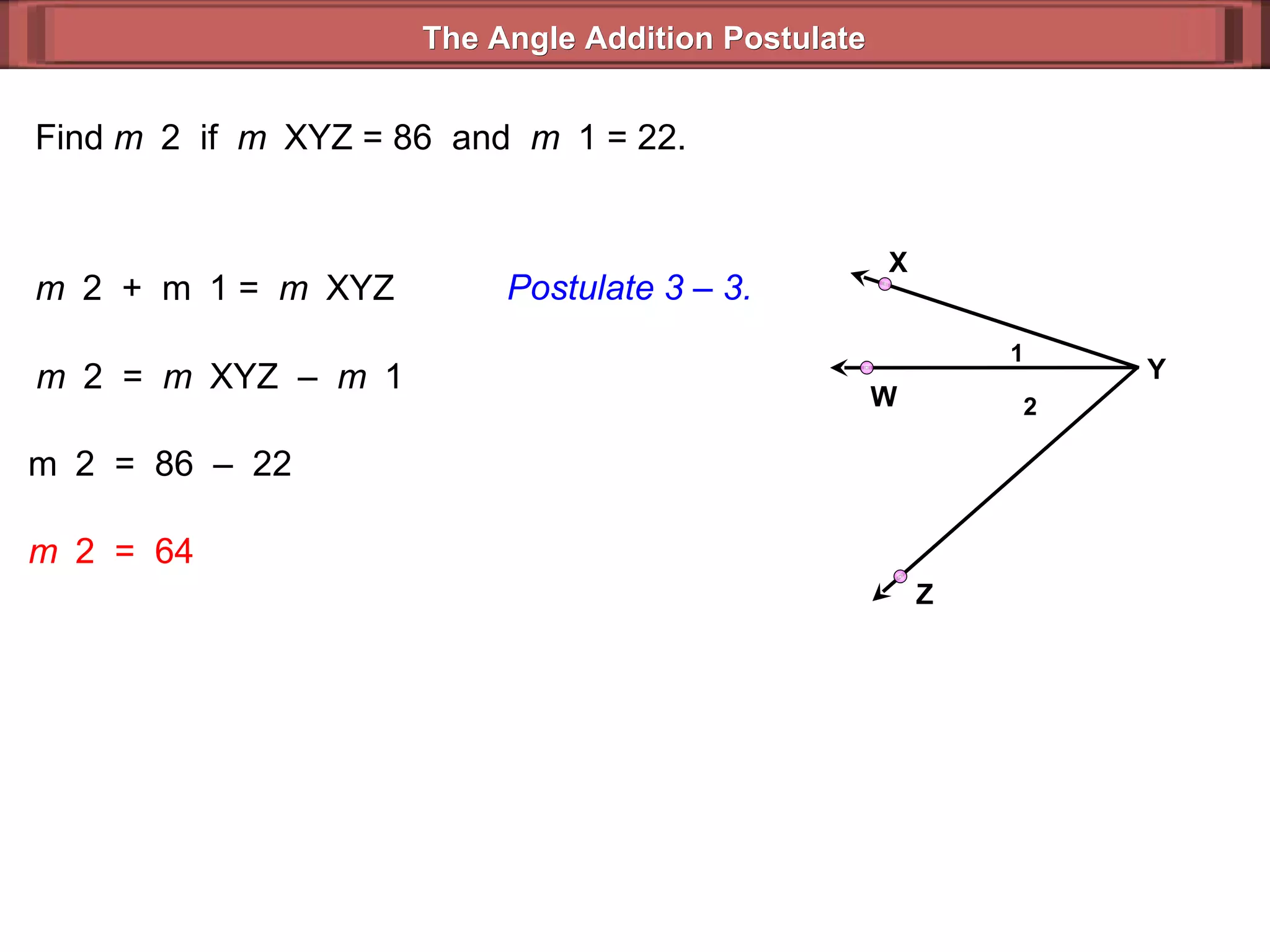
Find  m  2  if  m  XYZ = 86  and  m  1 = 22. The Angle Addition Postulate 2 1 Y Z X W
Find  m  2  if  m  XYZ = 86  and  m  1 = 22. m  2  +  m  1 =  m  XYZ  Postulate 3 – 3. The Angle Addition Postulate 2 1 Y Z X W
Find  m  2  if  m  XYZ = 86  and  m  1 = 22. m  2  =  m  XYZ  –  m  1  m  2  +  m  1 =  m  XYZ  Postulate 3 – 3. The Angle Addition Postulate 2 1 Y Z X W
Find  m  2  if  m  XYZ = 86  and  m  1 = 22. m  2  =  m  XYZ  –  m  1  m  2  =  86  –  22  m  2  +  m  1 =  m  XYZ  Postulate 3 – 3. The Angle Addition Postulate 2 1 Y Z X W
Find  m  2  if  m  XYZ = 86  and  m  1 = 22. m  2  =  m  XYZ  –  m  1  m  2  =  86  –  22  m  2  =  64 m  2  +  m  1 =  m  XYZ  Postulate 3 – 3. The Angle Addition Postulate 2 1 Y Z X W
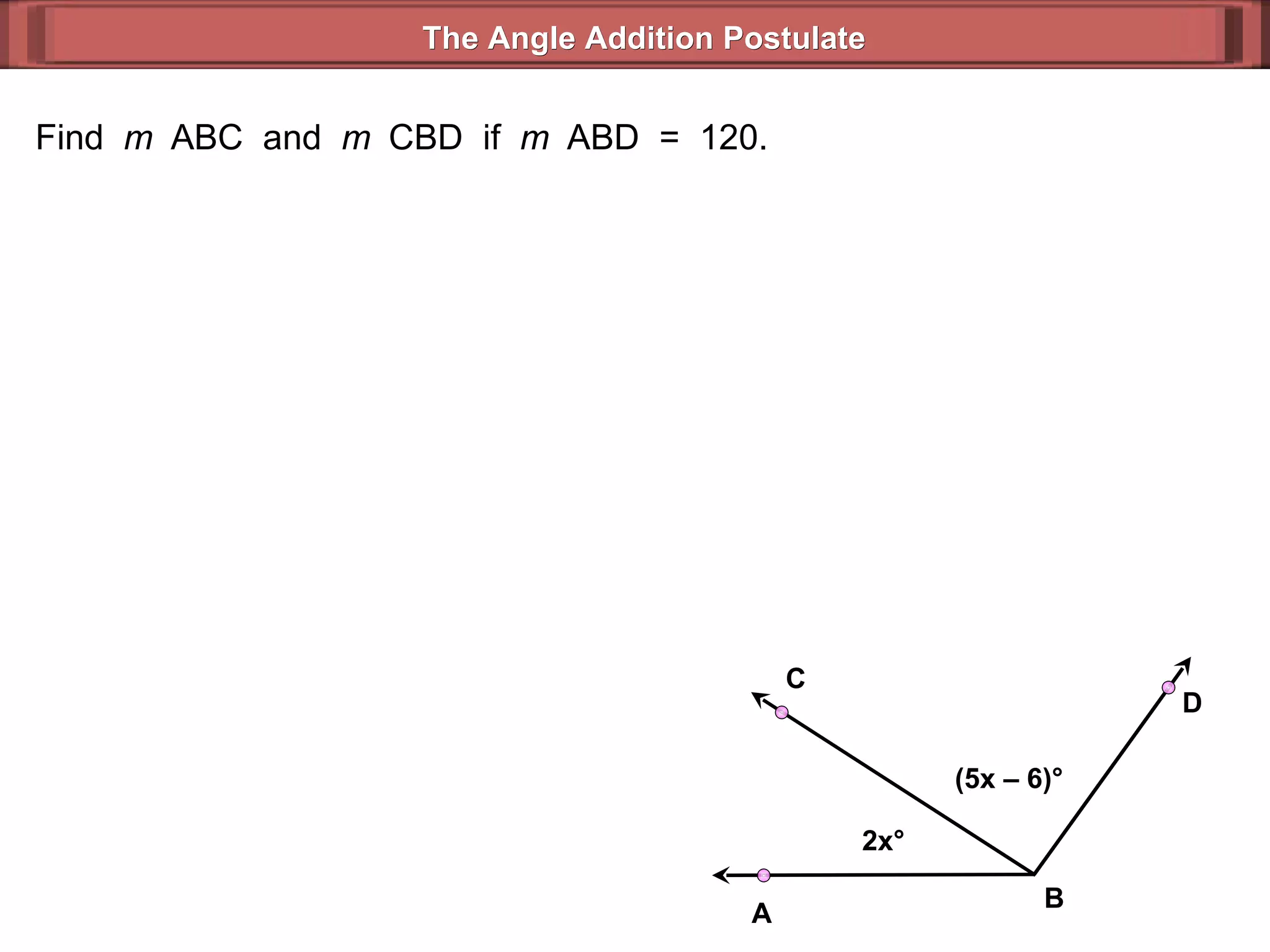
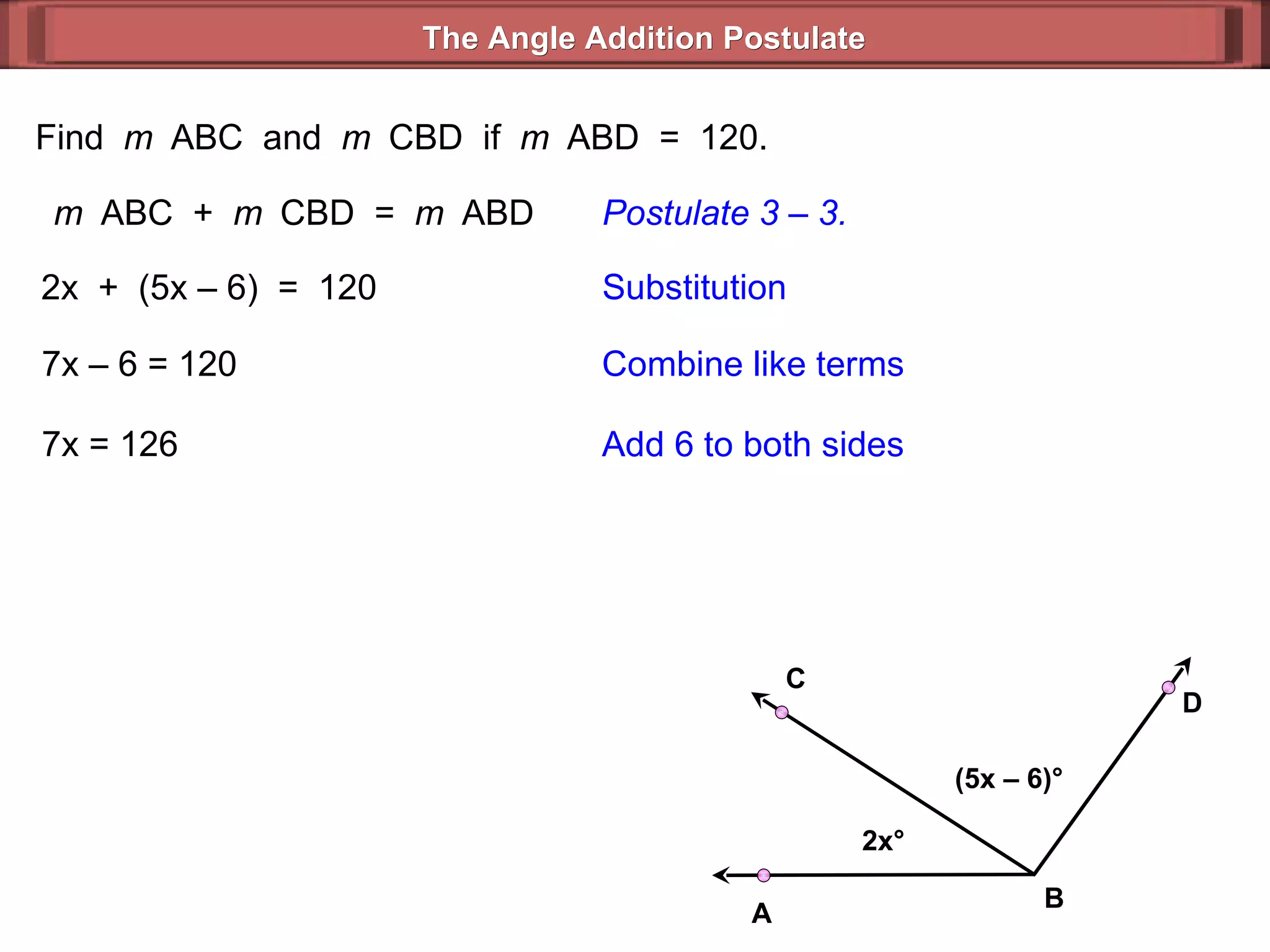
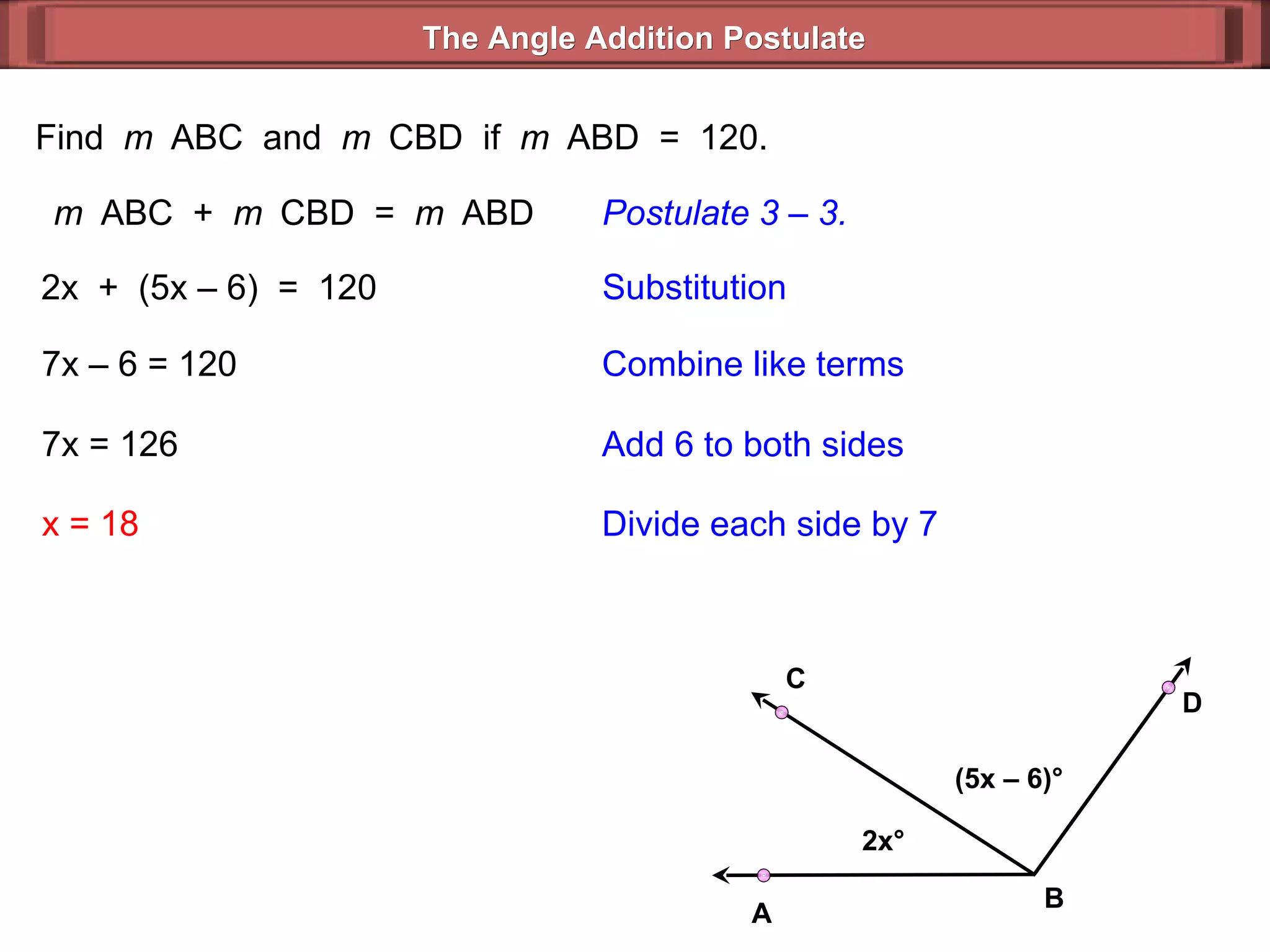
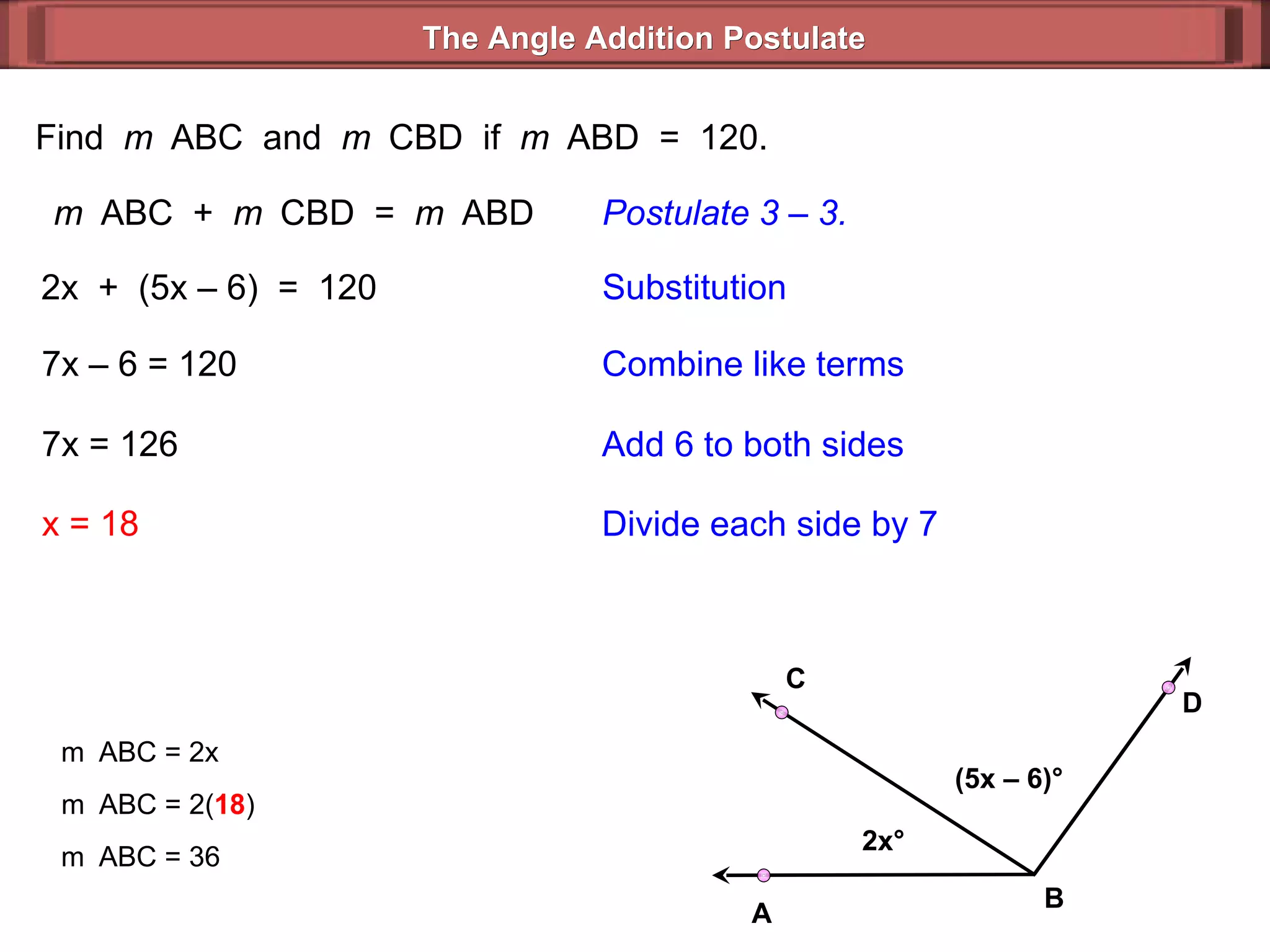
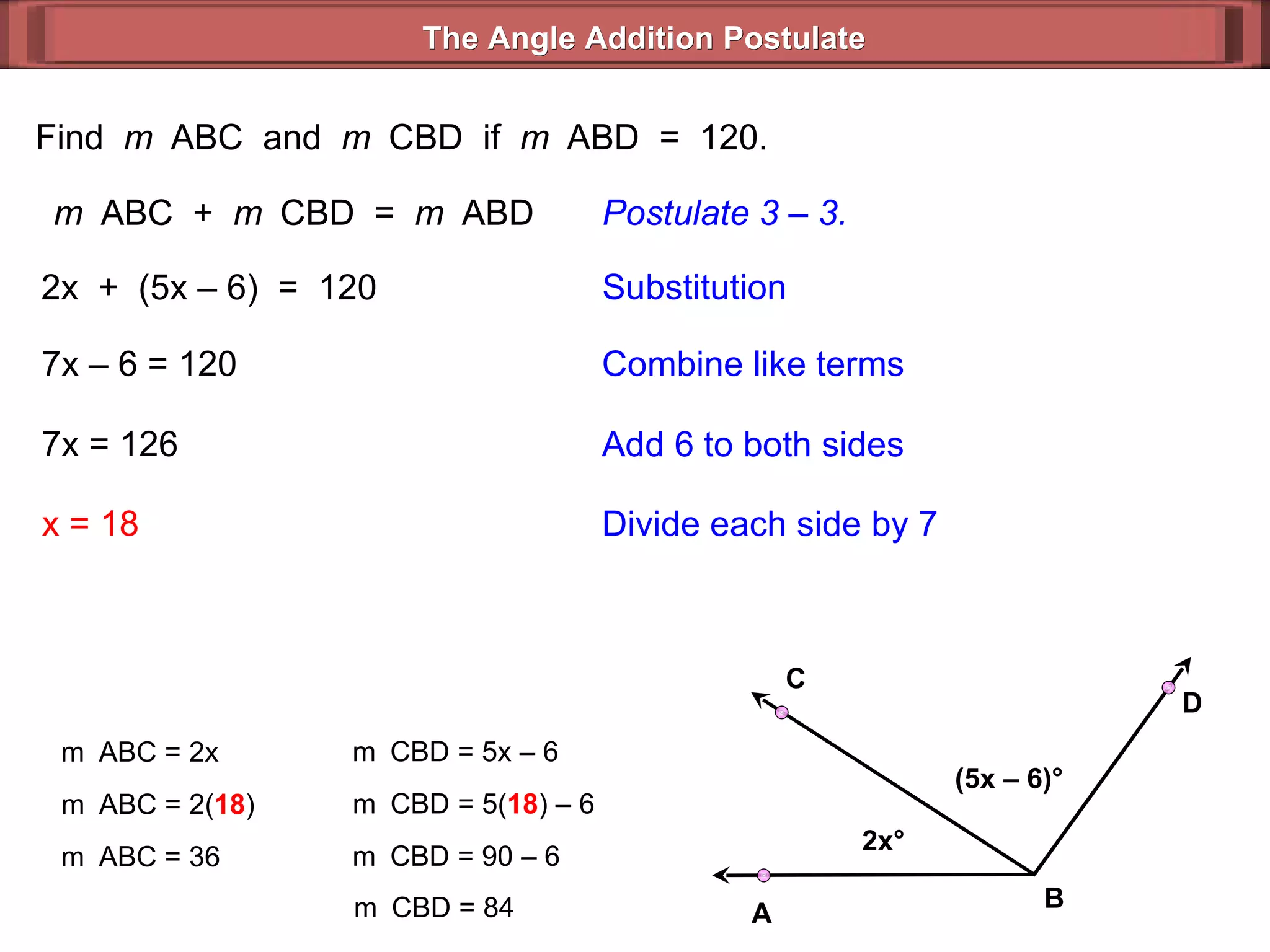
Find  m  ABC  and  m  CBD  if  m  ABD  =  120. The Angle Addition Postulate 2x ° (5x – 6) ° B D C A
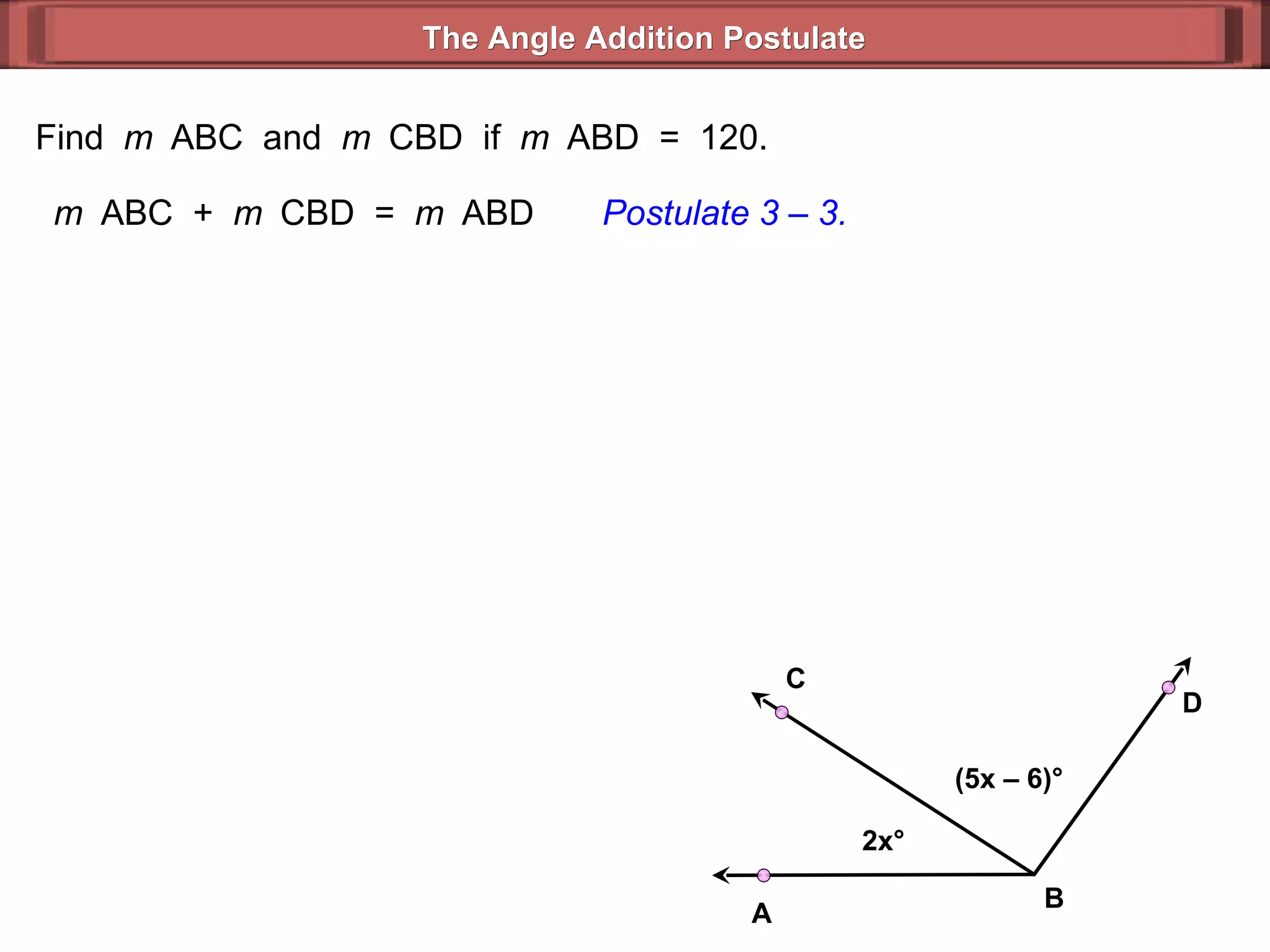
Find  m  ABC  and  m  CBD  if  m  ABD  =  120. m  ABC  +  m  CBD  =  m  ABD Postulate 3 – 3. The Angle Addition Postulate 2x ° (5x – 6) ° B D C A
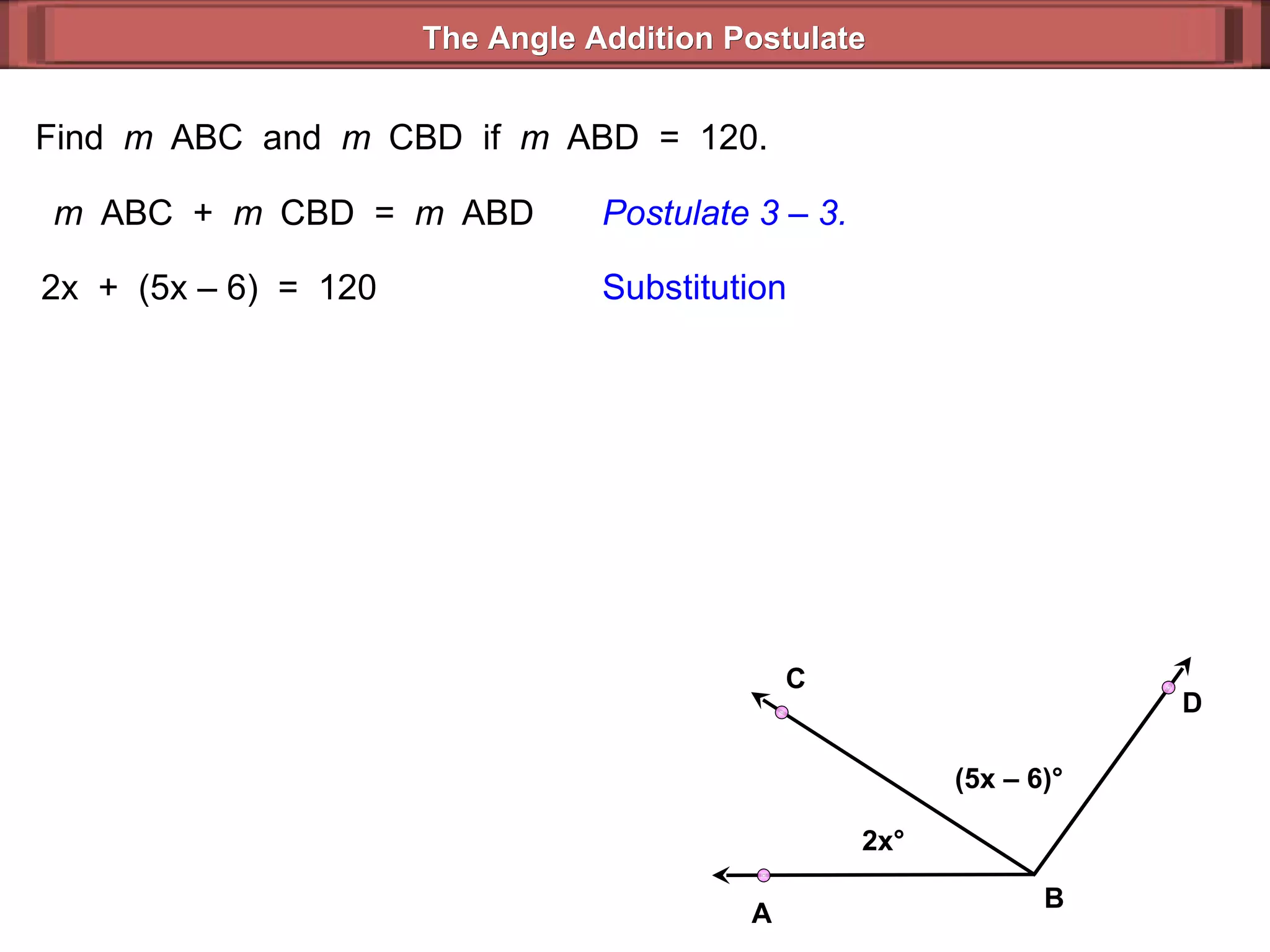
Find  m  ABC  and  m  CBD  if  m  ABD  =  120. m  ABC  +  m  CBD  =  m  ABD Postulate 3 – 3. 2x  +  (5x – 6)  =  120 Substitution The Angle Addition Postulate 2x ° (5x – 6) ° B D C A
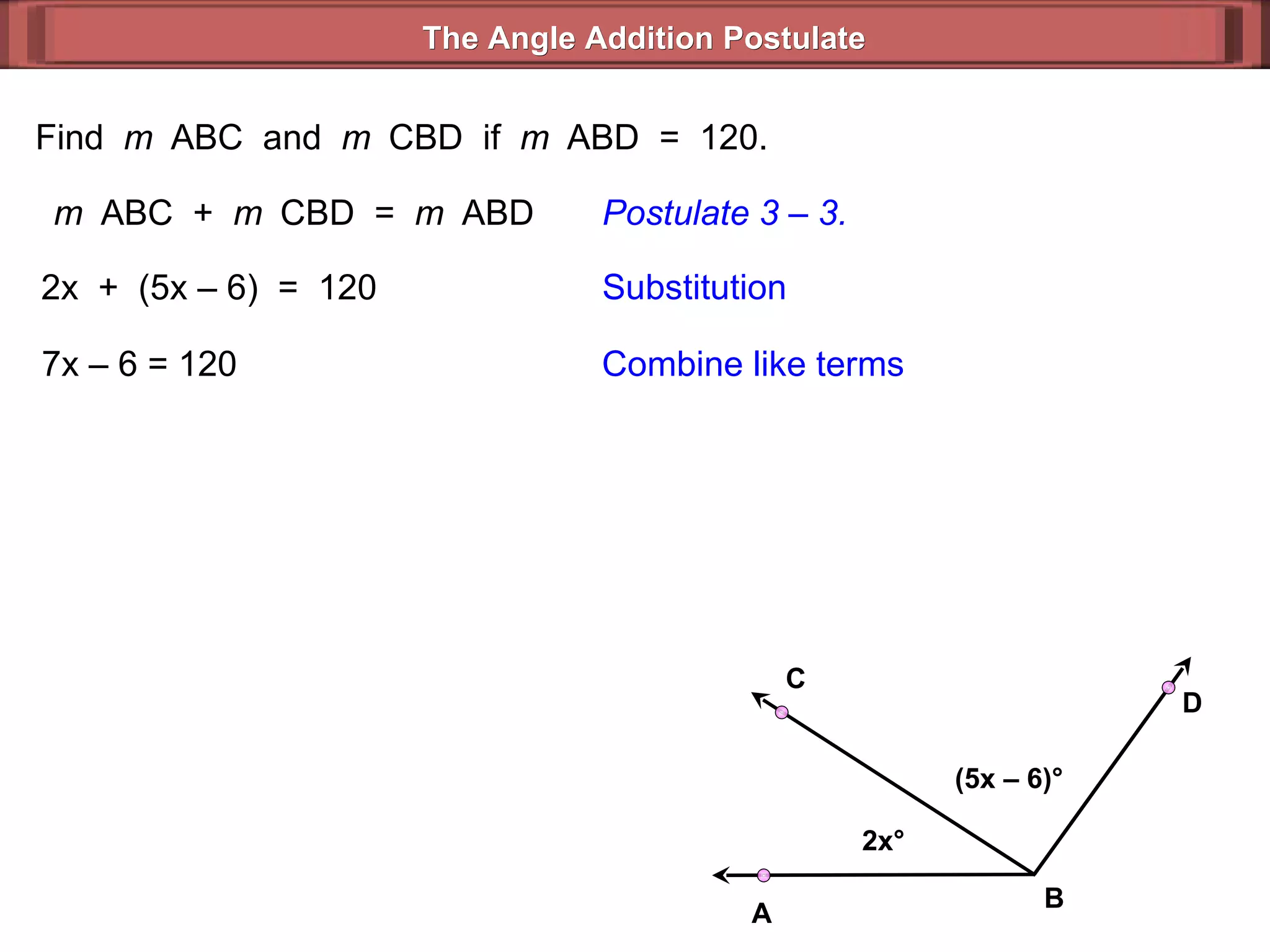
Find  m  ABC  and  m  CBD  if  m  ABD  =  120. m  ABC  +  m  CBD  =  m  ABD Postulate 3 – 3. 2x  +  (5x – 6)  =  120 Substitution 7x – 6 = 120 Combine like terms The Angle Addition Postulate 2x ° (5x – 6) ° B D C A
Find  m  ABC  and  m  CBD  if  m  ABD  =  120. m  ABC  +  m  CBD  =  m  ABD Postulate 3 – 3. 2x  +  (5x – 6)  =  120 Substitution 7x – 6 = 120 Combine like terms 7x = 126 Add 6 to both sides The Angle Addition Postulate 2x ° (5x – 6) ° B D C A
Find  m  ABC  and  m  CBD  if  m  ABD  =  120. m  ABC  +  m  CBD  =  m  ABD Postulate 3 – 3. 2x  +  (5x – 6)  =  120 Substitution 7x – 6 = 120 Combine like terms 7x = 126 x = 18 Add 6 to both sides Divide each side by 7 The Angle Addition Postulate 2x ° (5x – 6) ° B D C A
Find  m  ABC  and  m  CBD  if  m  ABD  =  120. m  ABC  +  m  CBD  =  m  ABD Postulate 3 – 3. 2x  +  (5x – 6)  =  120 Substitution 7x – 6 = 120 Combine like terms 7x = 126 x = 18 Add 6 to both sides Divide each side by 7 m  ABC = 2x m  ABC = 2( 18 ) m  ABC = 36 The Angle Addition Postulate 2x ° (5x – 6) ° B D C A
Find  m  ABC  and  m  CBD  if  m  ABD  =  120. m  ABC  +  m  CBD  =  m  ABD Postulate 3 – 3. 2x  +  (5x – 6)  =  120 Substitution 7x – 6 = 120 Combine like terms 7x = 126 x = 18 Add 6 to both sides Divide each side by 7 m  ABC = 2x m  ABC = 2( 18 ) m  ABC = 36 m  CBD = 5x – 6  m  CBD = 5( 18 ) – 6  m  CBD = 90 – 6  m  CBD = 84  The Angle Addition Postulate 2x ° (5x – 6) ° B D C A
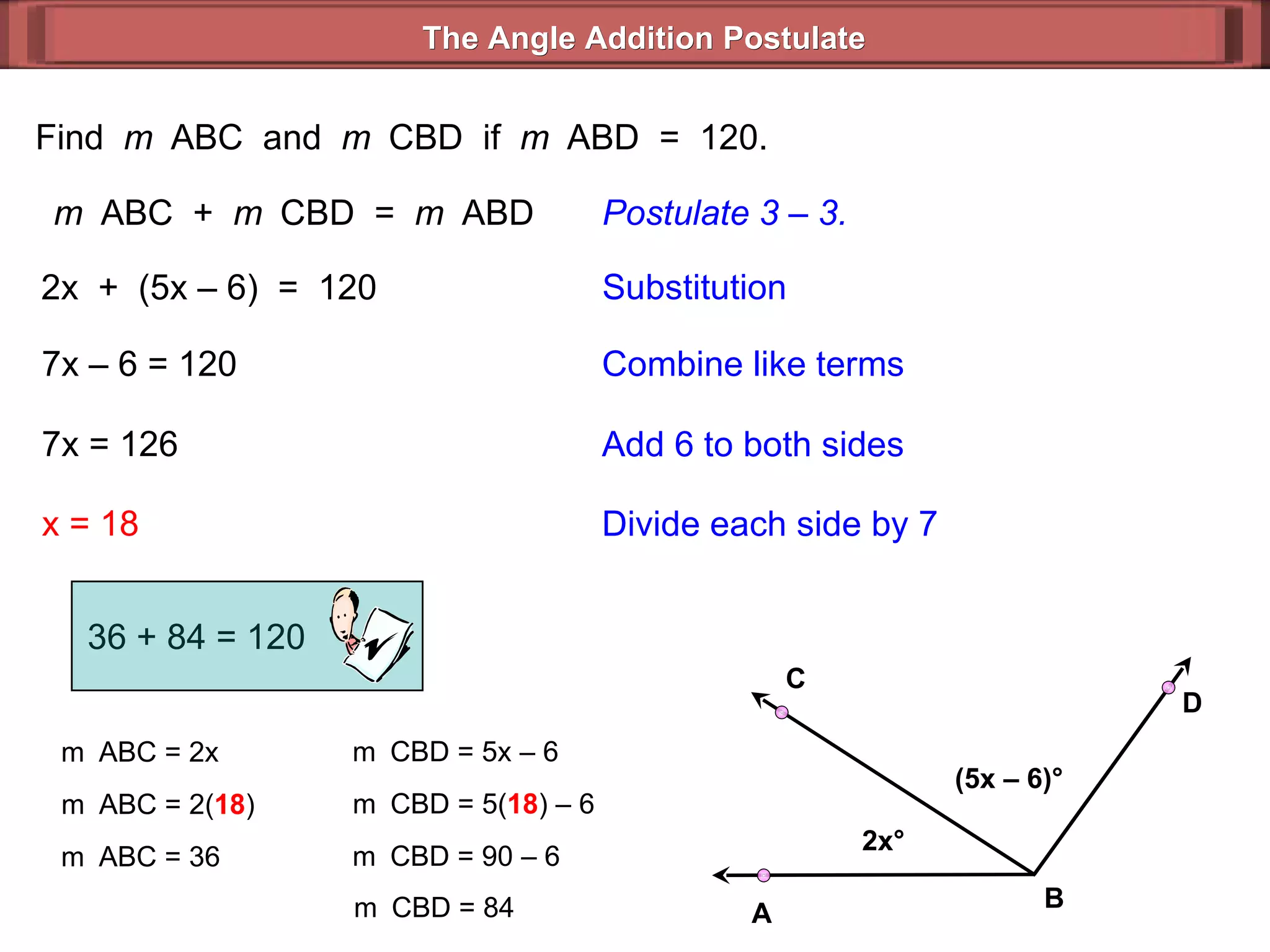
Find  m  ABC  and  m  CBD  if  m  ABD  =  120. m  ABC  +  m  CBD  =  m  ABD Postulate 3 – 3. 2x  +  (5x – 6)  =  120 Substitution 7x – 6 = 120 Combine like terms 7x = 126 x = 18 Add 6 to both sides Divide each side by 7 m  ABC = 2x m  ABC = 2( 18 ) m  ABC = 36 m  CBD = 5x – 6  m  CBD = 5( 18 ) – 6  m  CBD = 90 – 6  m  CBD = 84  36 + 84 = 120 The Angle Addition Postulate 2x ° (5x – 6) ° B D C A
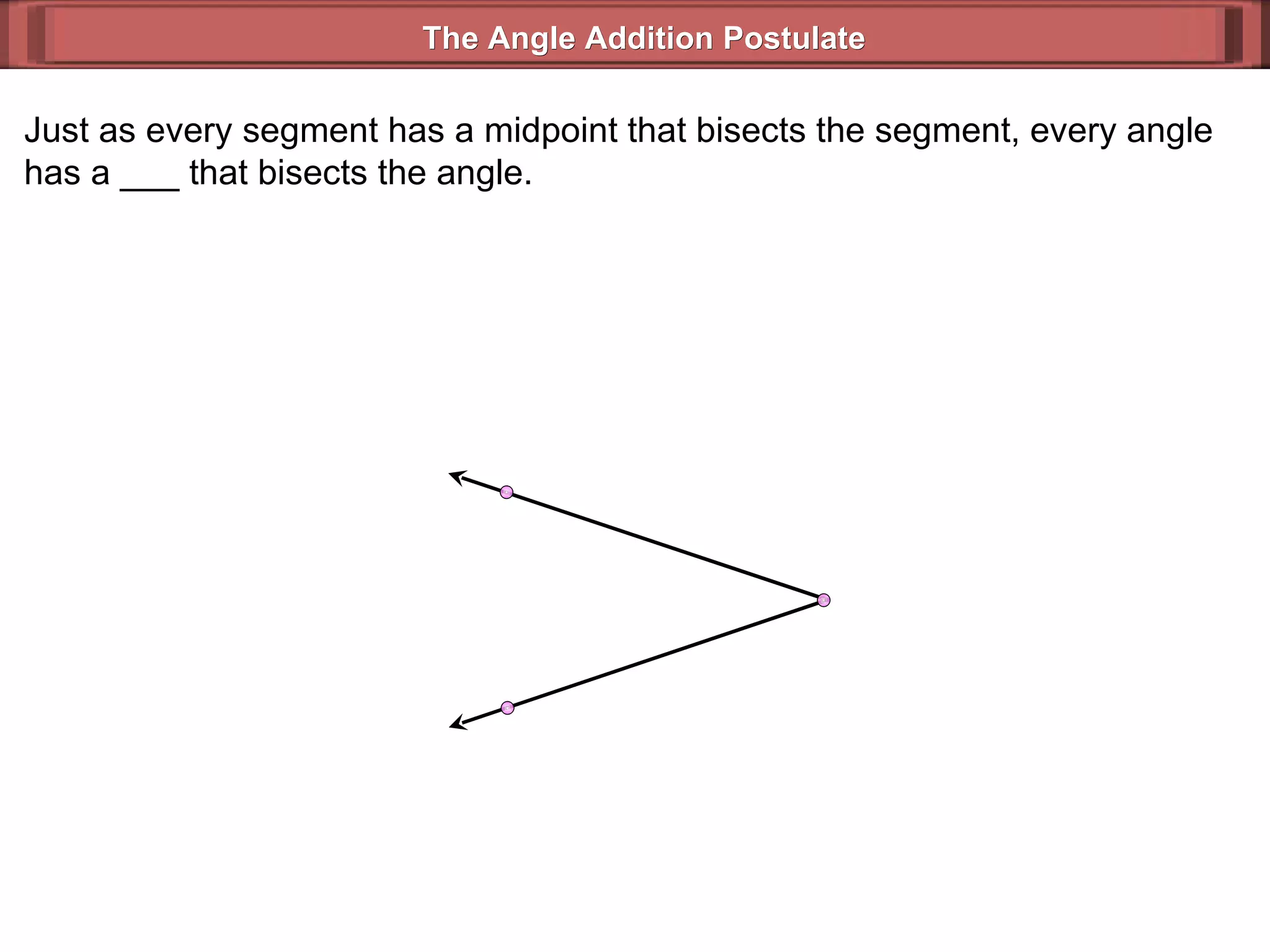
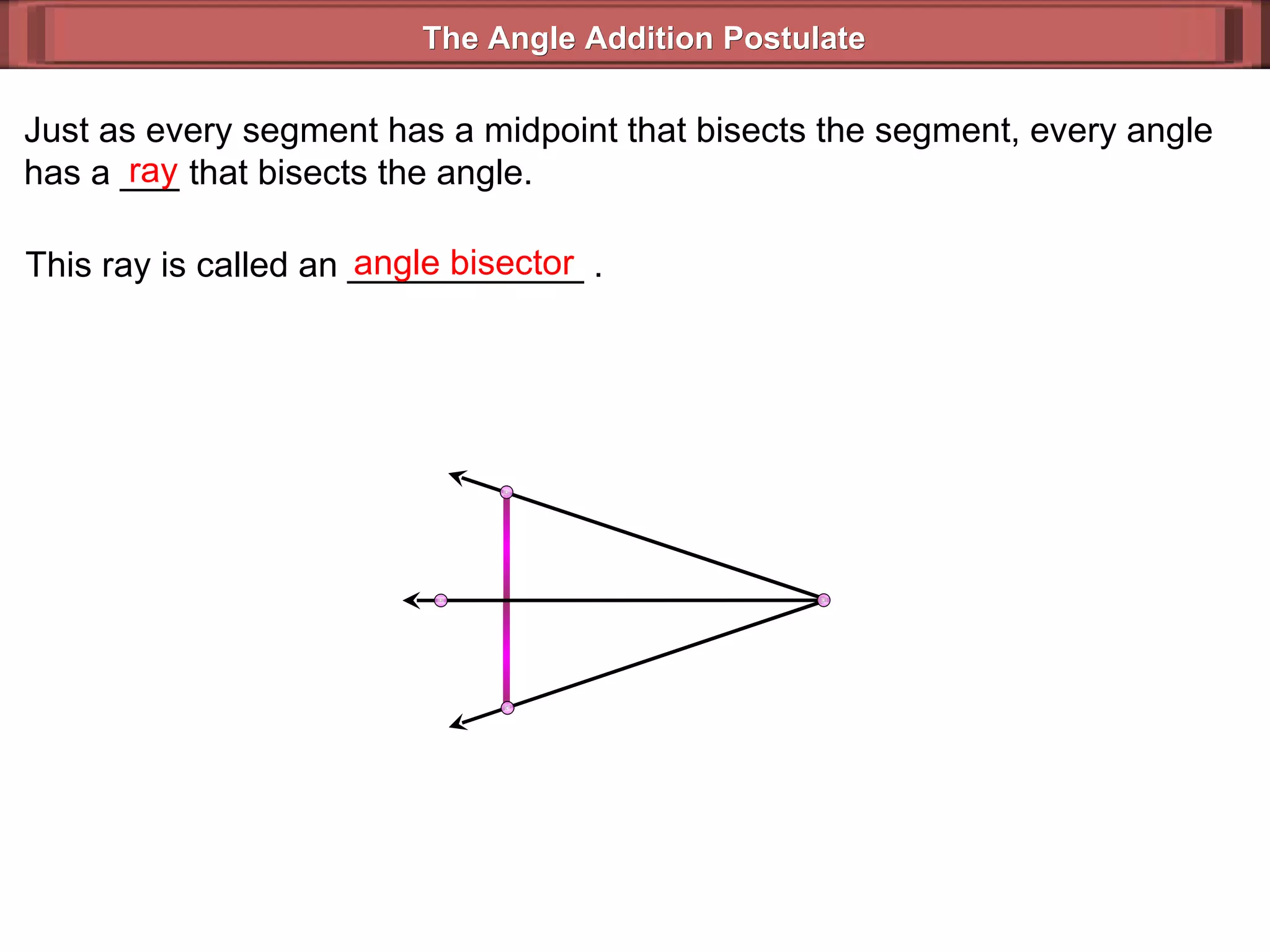
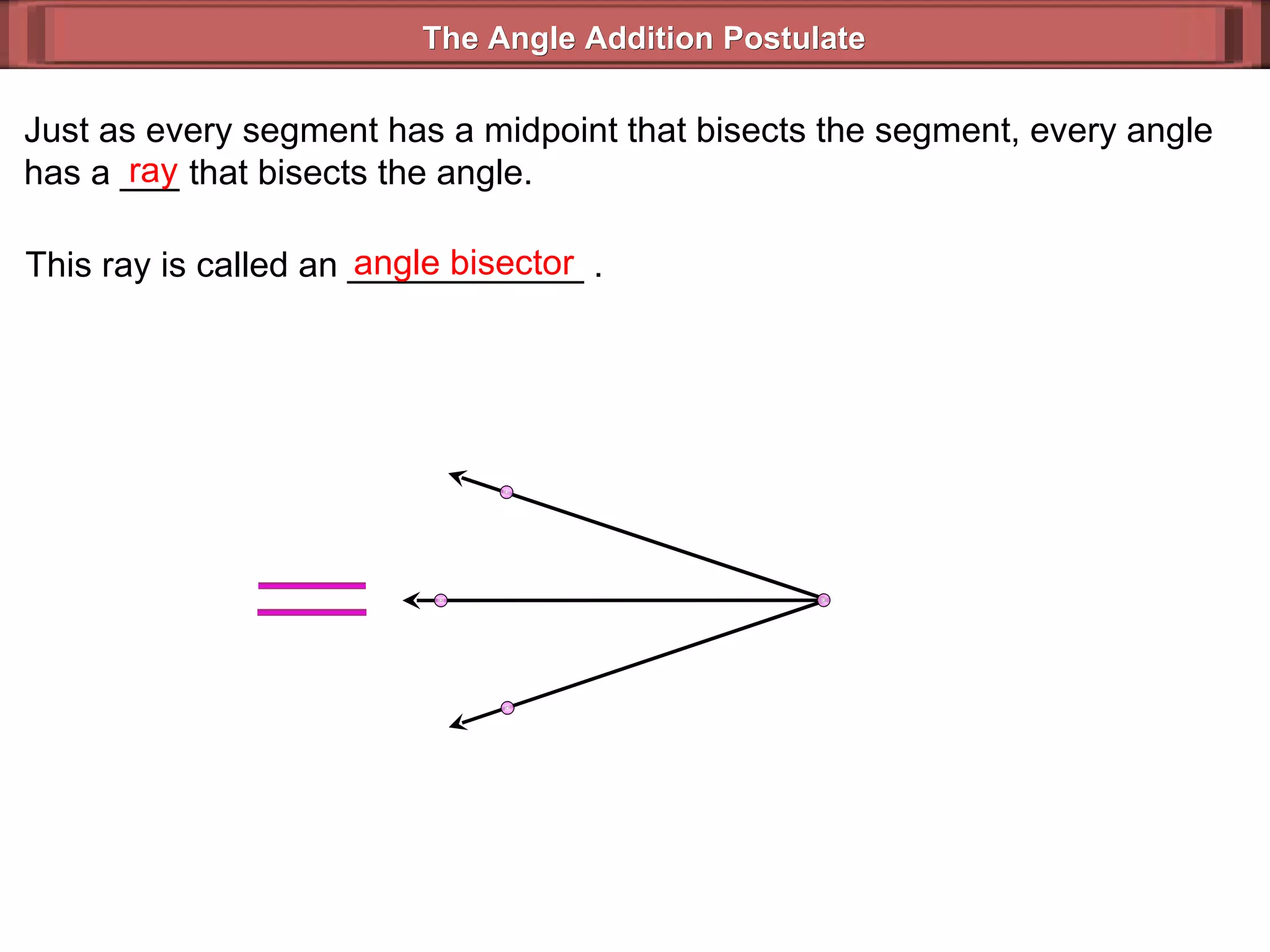
Just as every segment has a midpoint that bisects the segment, every angle has a ___ that bisects the angle. The Angle Addition Postulate
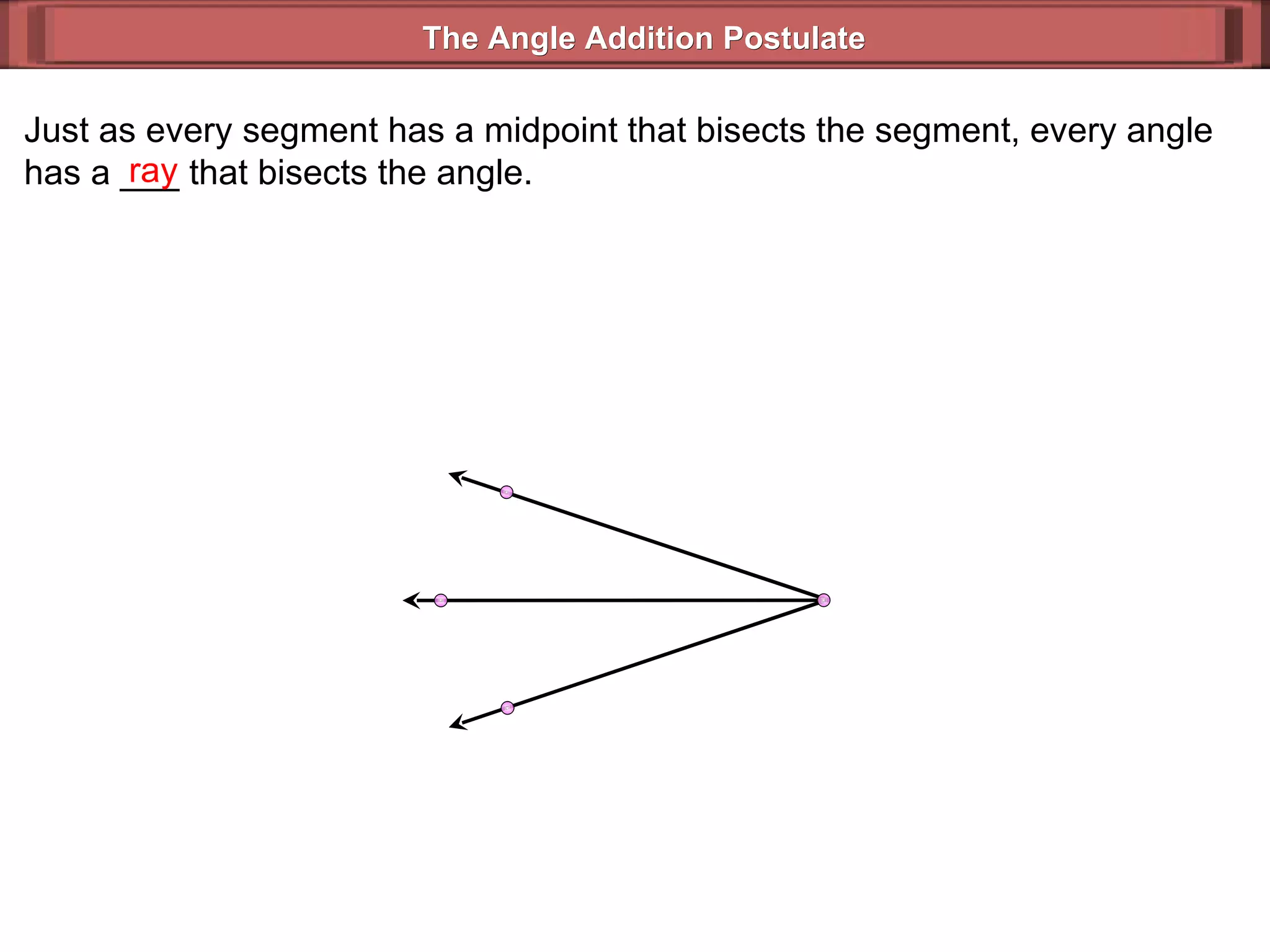
Just as every segment has a midpoint that bisects the segment, every angle has a ___ that bisects the angle. ray The Angle Addition Postulate
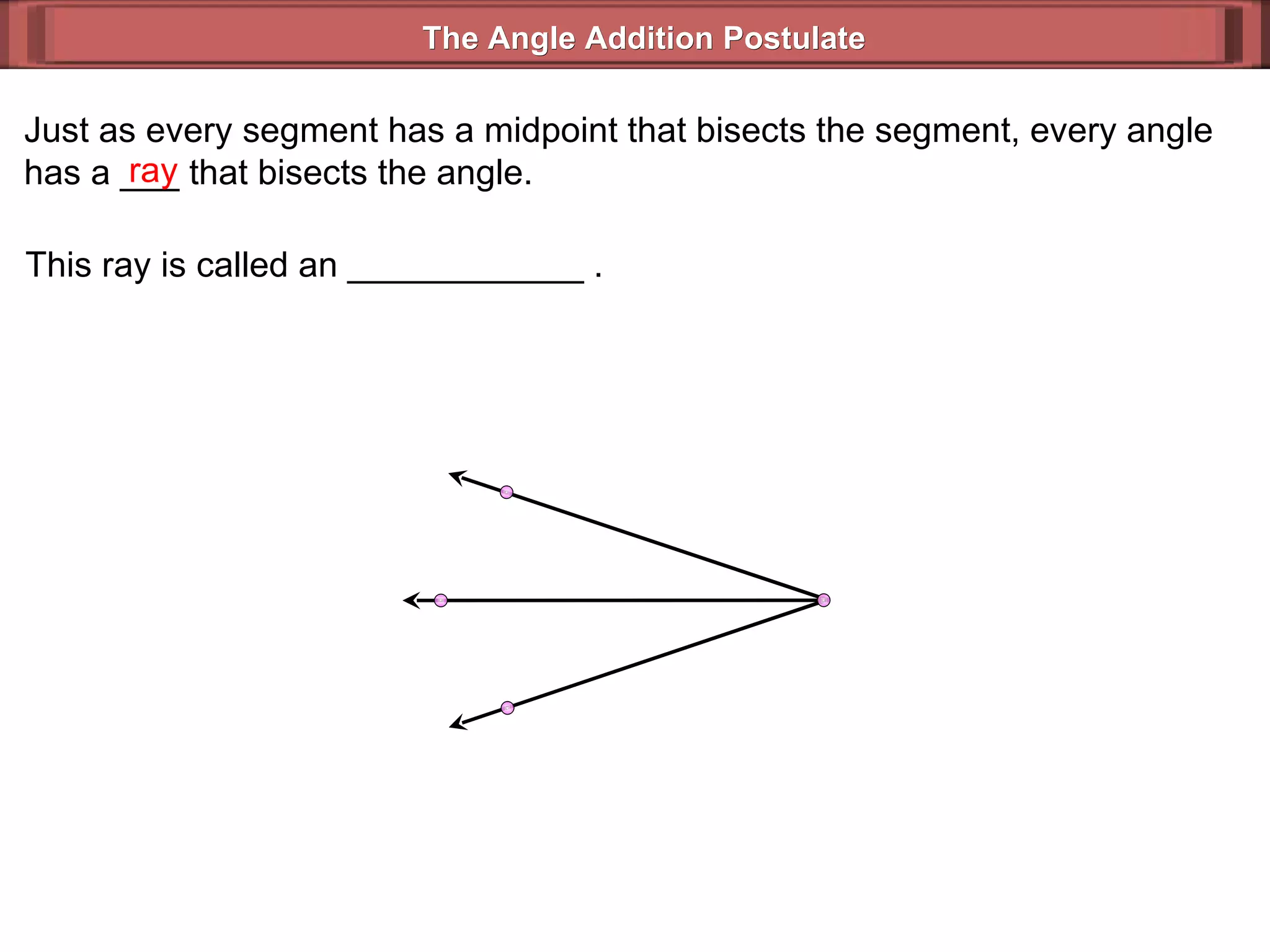
Just as every segment has a midpoint that bisects the segment, every angle has a ___ that bisects the angle. ray This ray is called an ____________ . The Angle Addition Postulate
Just as every segment has a midpoint that bisects the segment, every angle has a ___ that bisects the angle. ray This ray is called an ____________ . angle bisector The Angle Addition Postulate
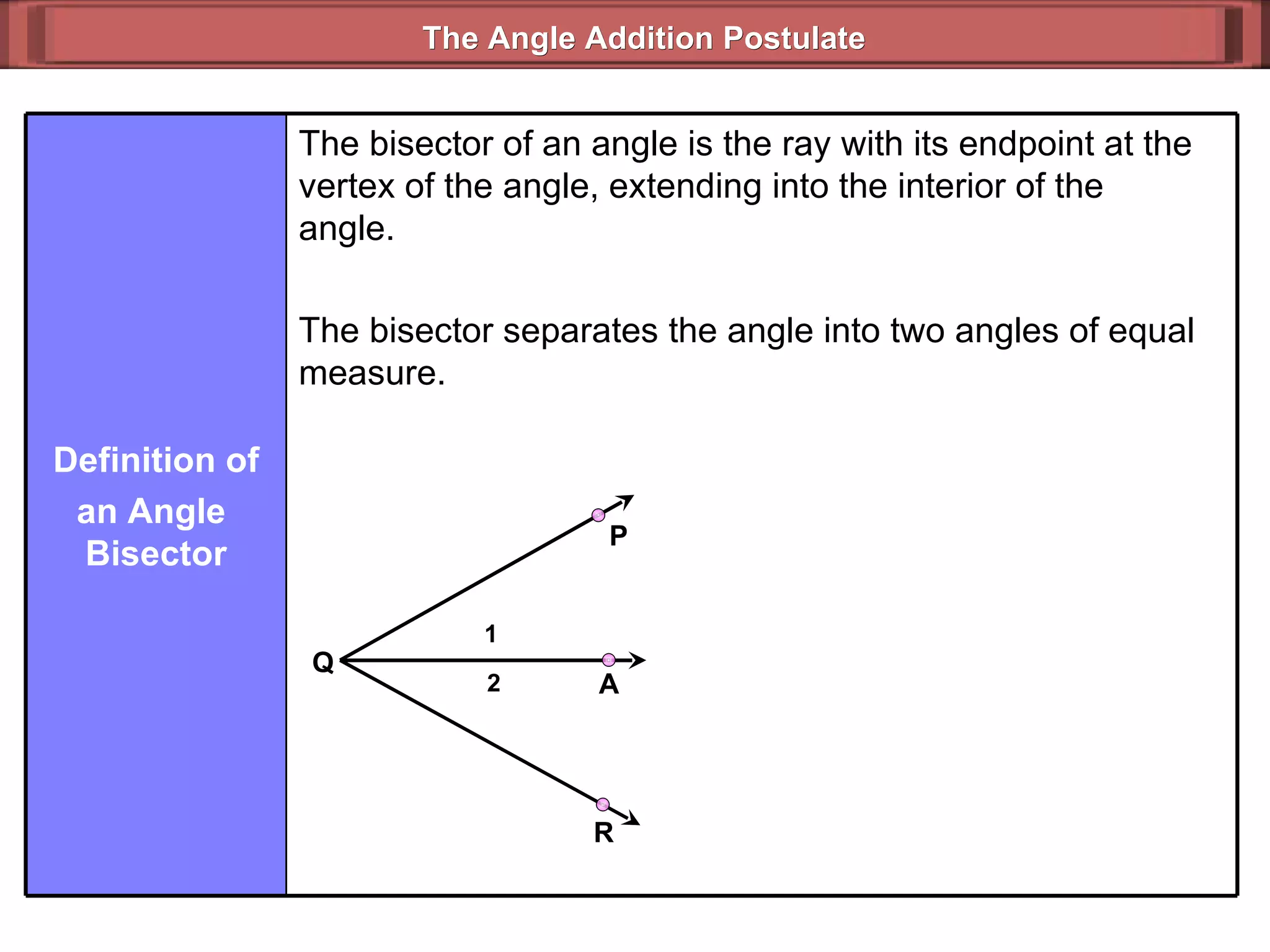
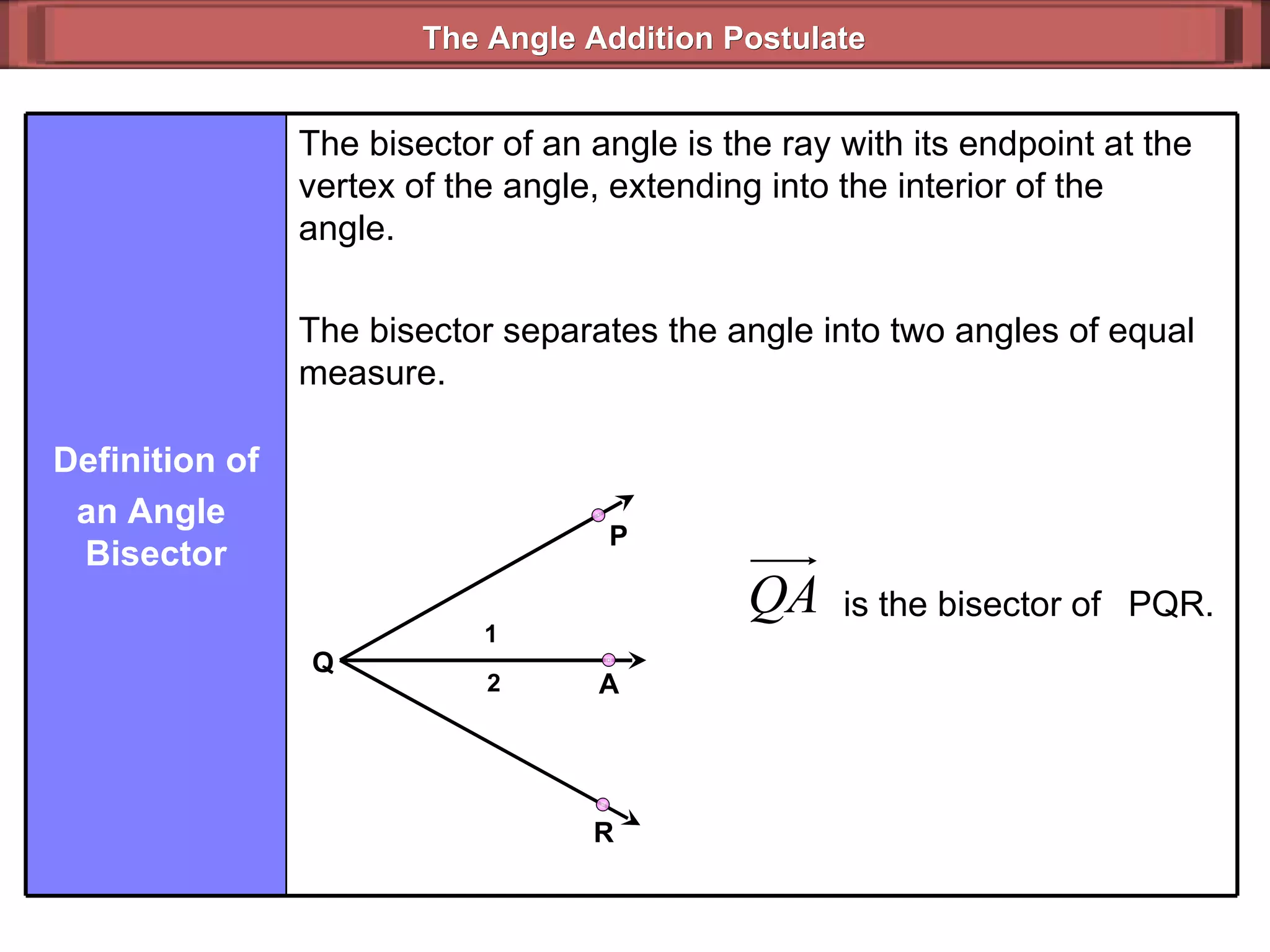
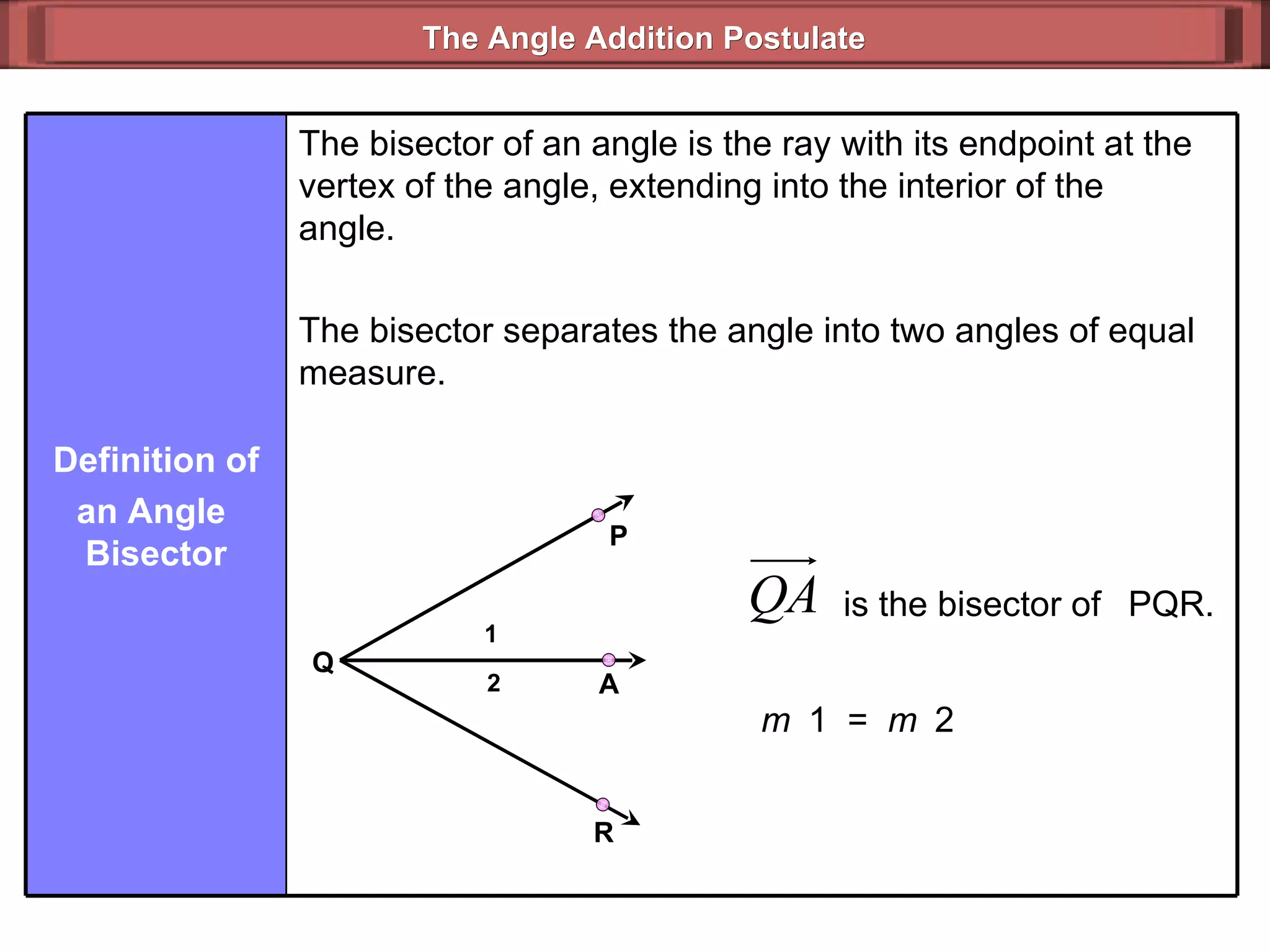
The Angle Addition Postulate The bisector of an angle is the ray with its endpoint at the vertex of the angle, extending into the interior of the  angle.  The bisector separates the angle into two angles of equal measure. Definition of an Angle  Bisector 2 1 A R P Q
The Angle Addition Postulate The bisector of an angle is the ray with its endpoint at the vertex of the angle, extending into the interior of the  angle.  The bisector separates the angle into two angles of equal measure. Definition of an Angle  Bisector 2 1 A R P Q is the bisector of   PQR.
m  1  =  m  2 The Angle Addition Postulate The bisector of an angle is the ray with its endpoint at the vertex of the angle, extending into the interior of the  angle.  The bisector separates the angle into two angles of equal measure. Definition of an Angle  Bisector 2 1 A R P Q is the bisector of   PQR.
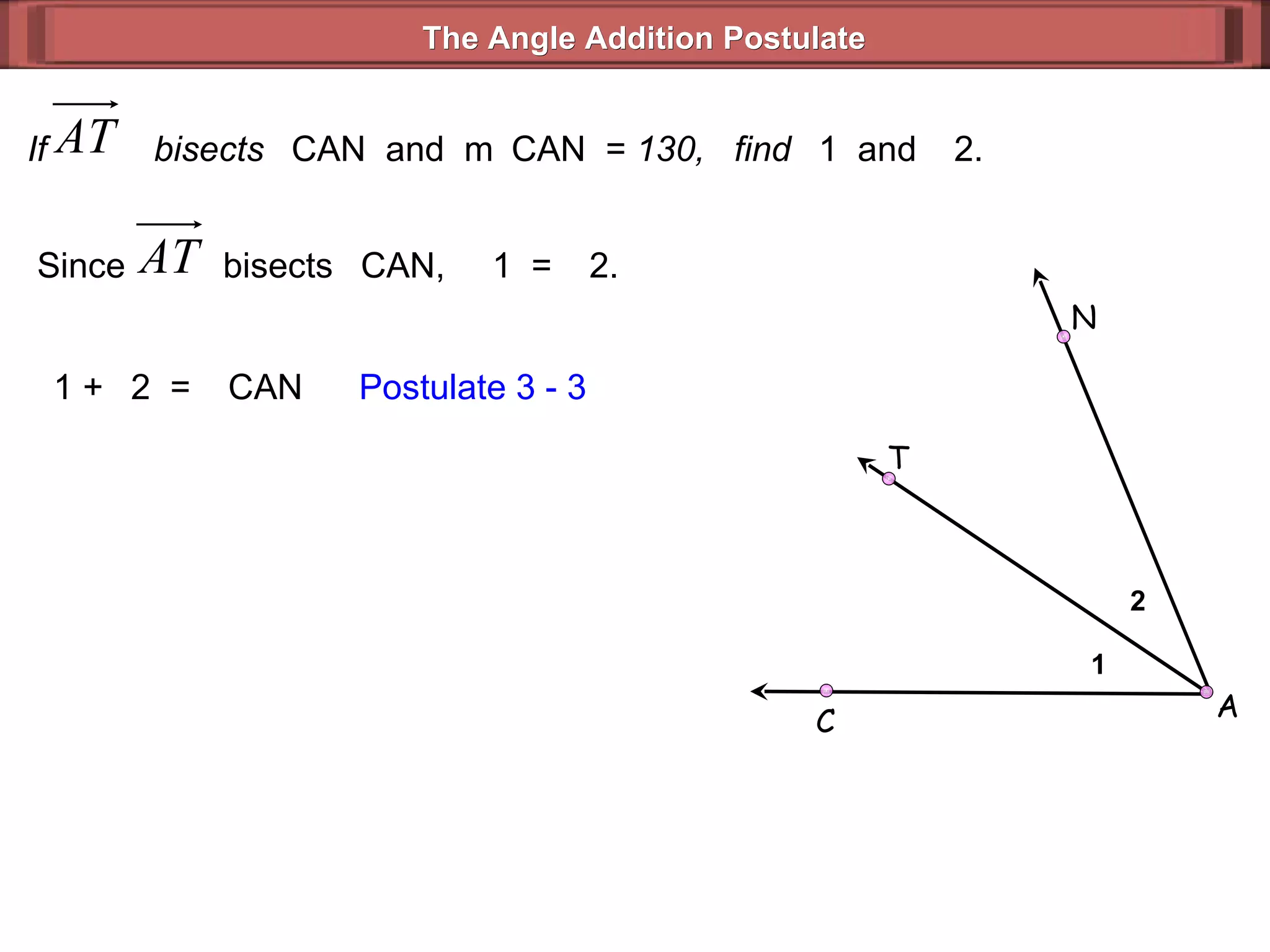
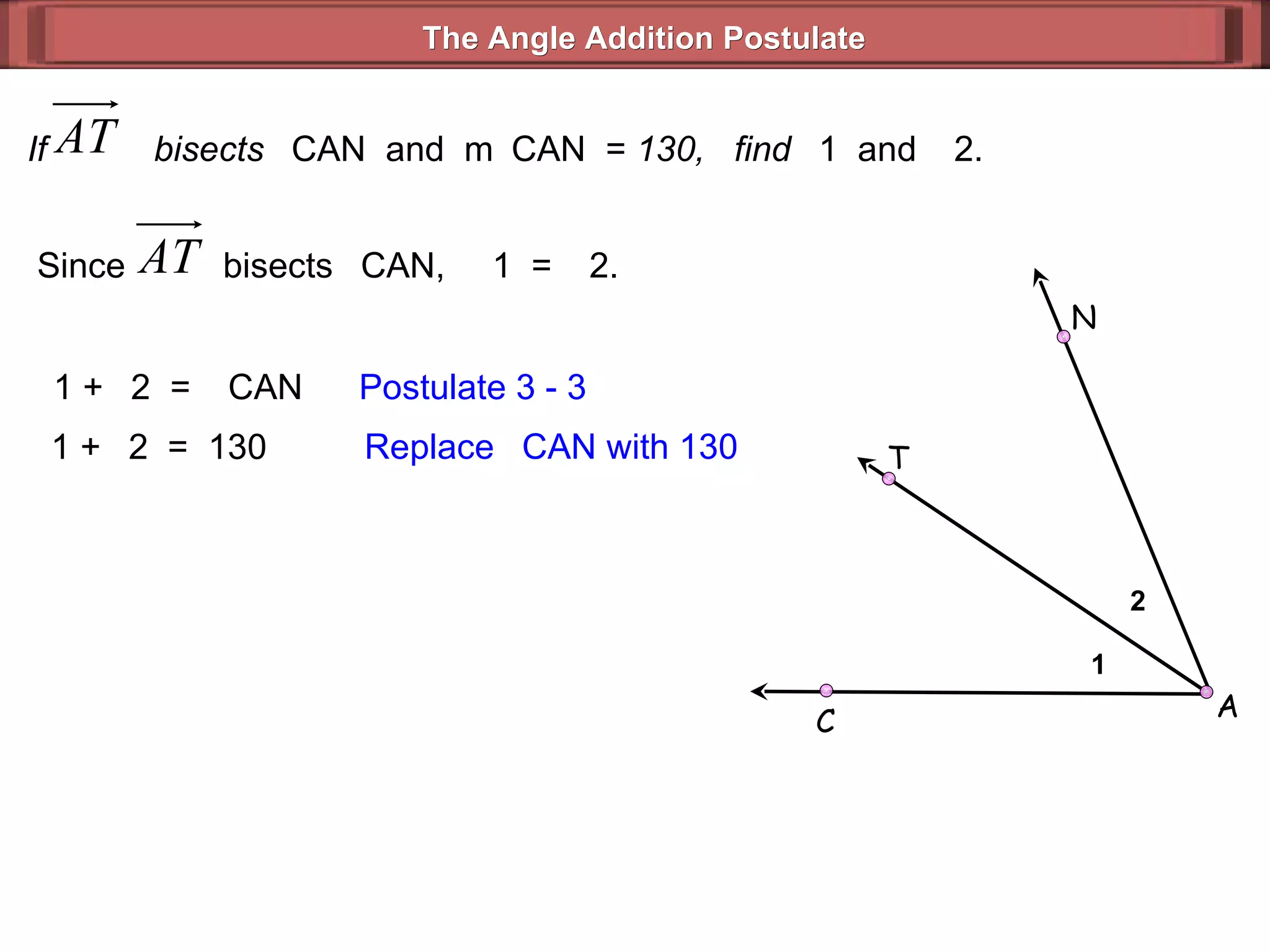
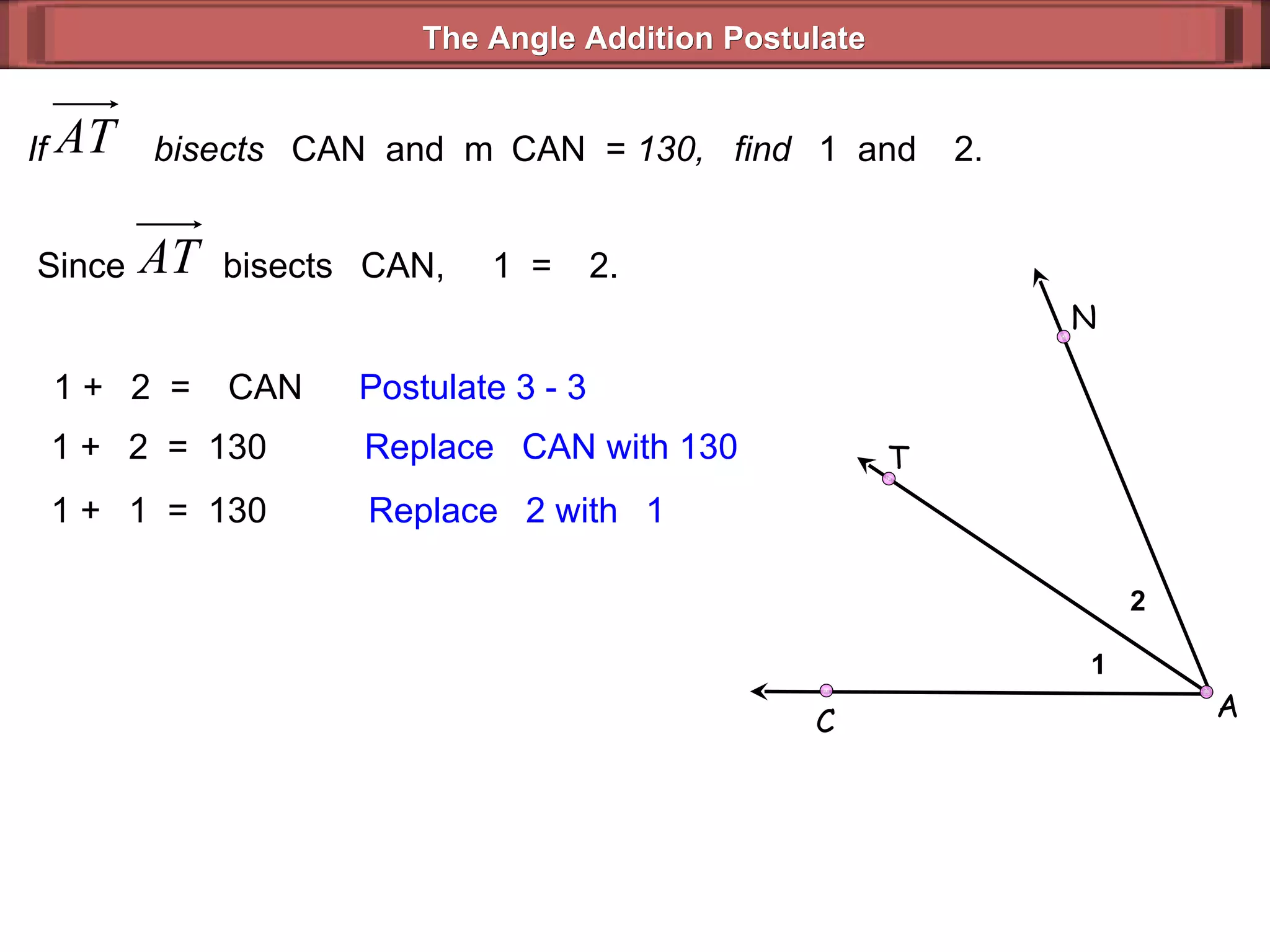
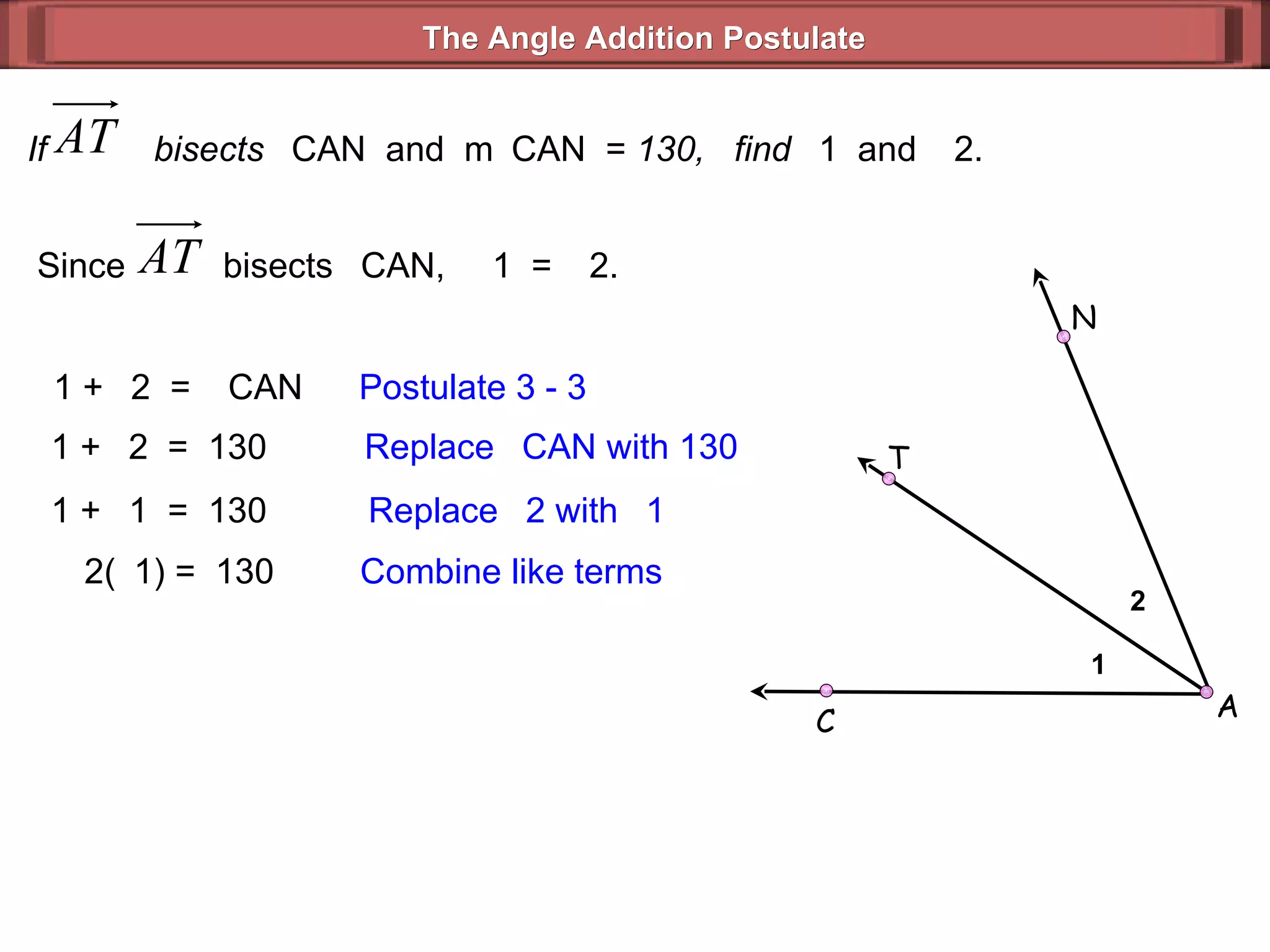
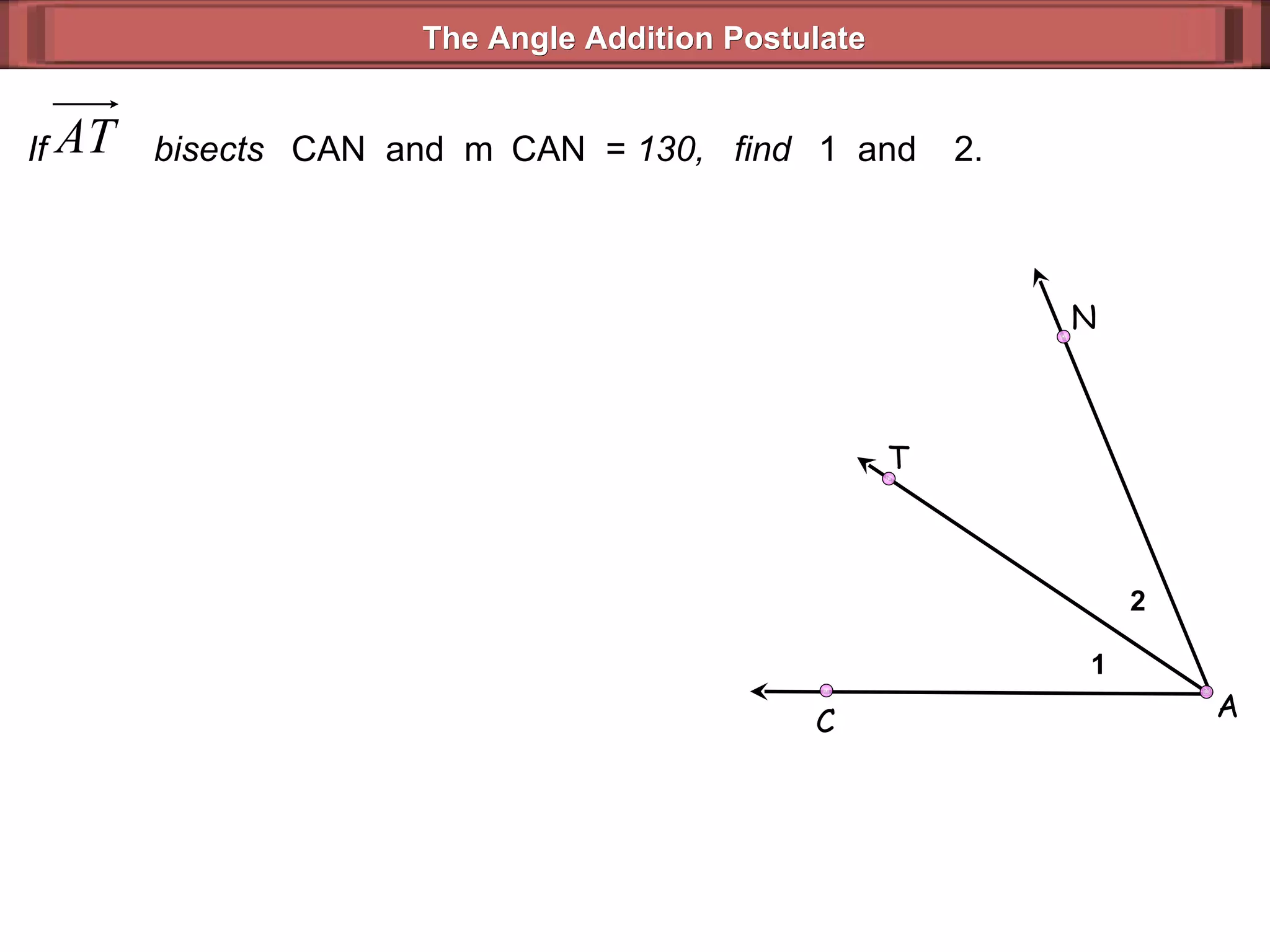
If  bisects   CAN  and  m  CAN  =  130,  find   1  and   2. The Angle Addition Postulate 1 2 A C N T
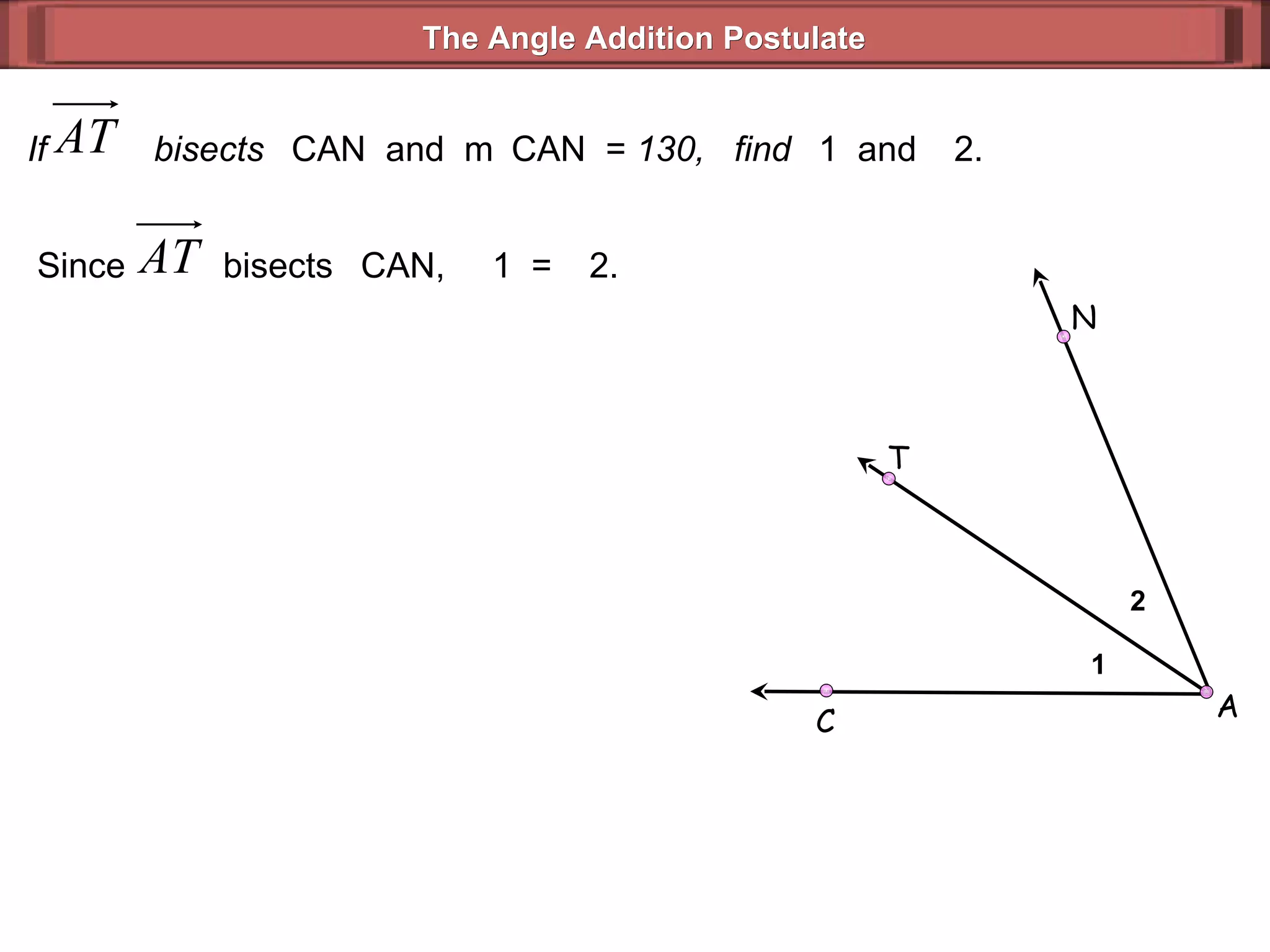
If  bisects   CAN  and  m  CAN  =  130,  find   1  and   2. The Angle Addition Postulate Since  bisects   CAN,   1  =   2. 1 2 A C N T
If  bisects   CAN  and  m  CAN  =  130,  find   1  and   2.  1 +   2  =   CAN Postulate 3 - 3 The Angle Addition Postulate Since  bisects   CAN,   1  =   2. 1 2 A C N T
If  bisects   CAN  and  m  CAN  =  130,  find   1  and   2.  1 +   2  =   CAN Postulate 3 - 3  1 +   2  =  130 Replace   CAN with 130 The Angle Addition Postulate Since  bisects   CAN,   1  =   2. 1 2 A C N T
If  bisects   CAN  and  m  CAN  =  130,  find   1  and   2.  1 +   2  =   CAN Postulate 3 - 3  1 +   2  =  130 Replace   CAN with 130  1 +   1  =  130 Replace   2 with   1 The Angle Addition Postulate Since  bisects   CAN,   1  =   2. 1 2 A C N T
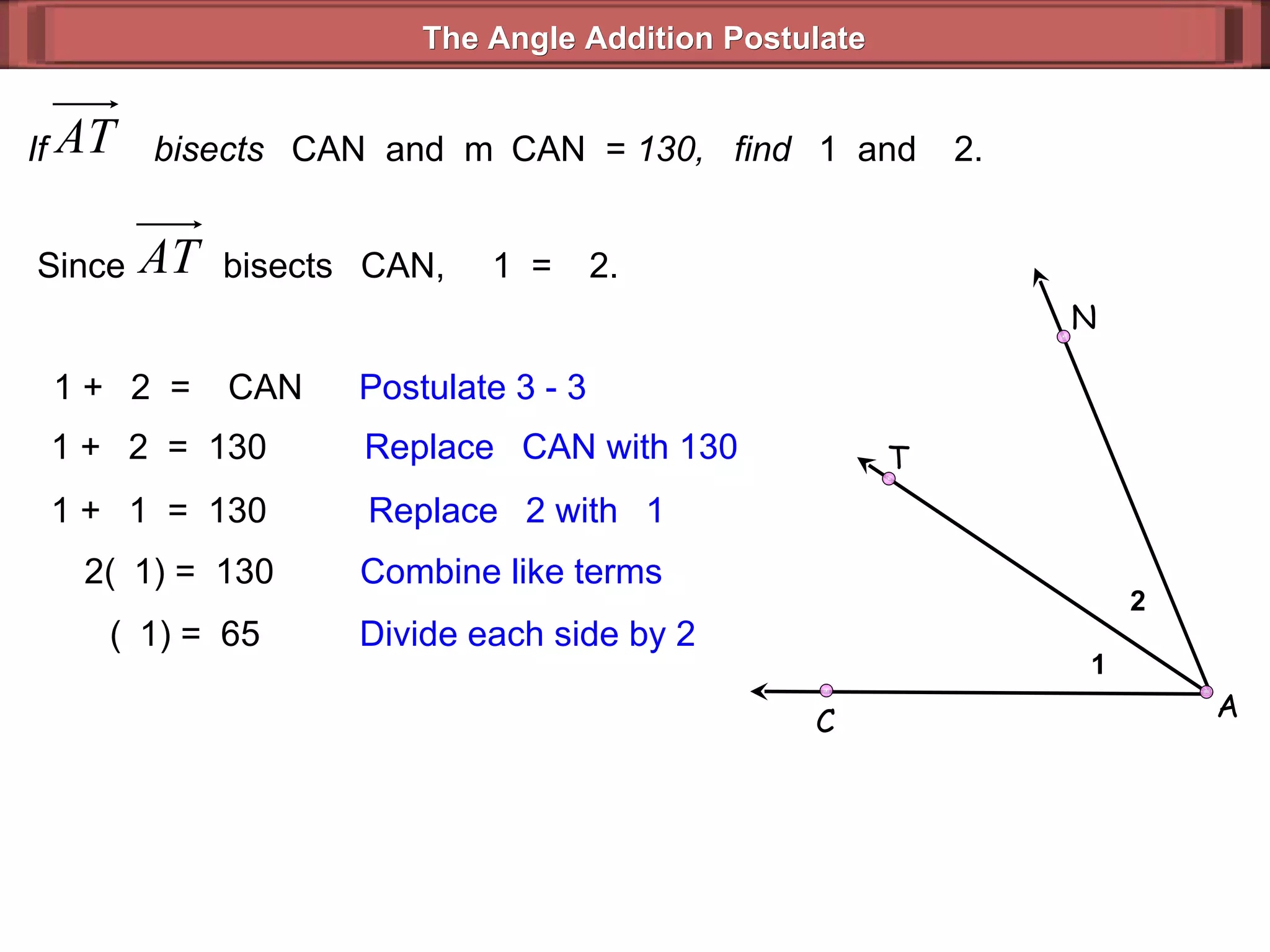
If  bisects   CAN  and  m  CAN  =  130,  find   1  and   2.  1 +   2  =   CAN Postulate 3 - 3  1 +   2  =  130 Replace   CAN with 130  1 +   1  =  130 Replace   2 with   1 2(  1) =  130 Combine like terms The Angle Addition Postulate Since  bisects   CAN,   1  =   2. 1 2 A C N T
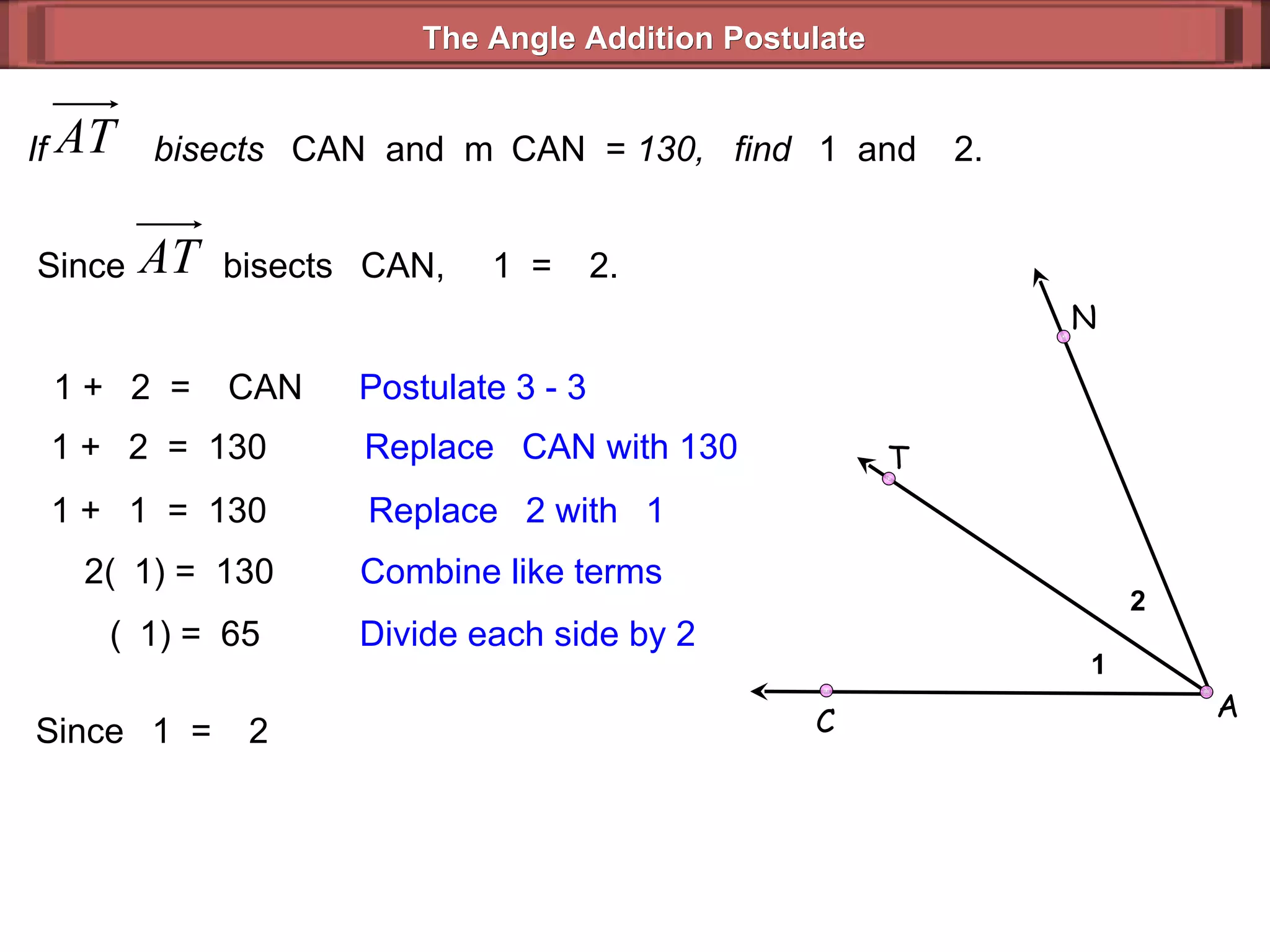
If  bisects   CAN  and  m  CAN  =  130,  find   1  and   2.  1 +   2  =   CAN Postulate 3 - 3  1 +   2  =  130 Replace   CAN with 130  1 +   1  =  130 Replace   2 with   1 2(  1) =  130 Combine like terms (  1) =  65 Divide each side by 2 The Angle Addition Postulate Since  bisects   CAN,   1  =   2. 1 2 A C N T
If  bisects   CAN  and  m  CAN  =  130,  find   1  and   2.  1 +   2  =   CAN Postulate 3 - 3  1 +   2  =  130 Replace   CAN with 130  1 +   1  =  130 Replace   2 with   1 2(  1) =  130 Combine like terms (  1) =  65 Divide each side by 2 Since   1  =   2 The Angle Addition Postulate Since  bisects   CAN,   1  =   2. 1 2 A C N T
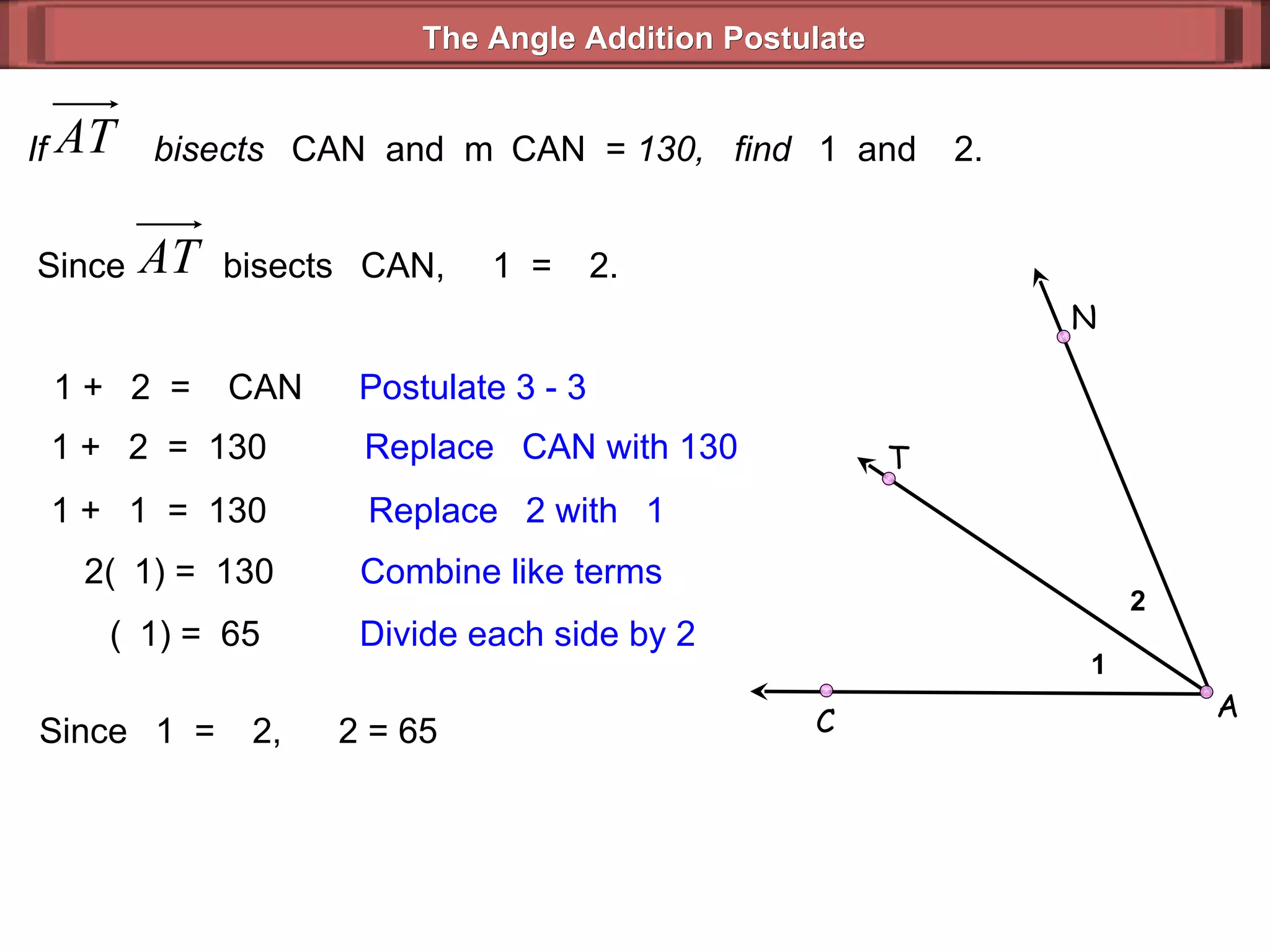
If  bisects   CAN  and  m  CAN  =  130,  find   1  and   2.  1 +   2  =   CAN Postulate 3 - 3  1 +   2  =  130 Replace   CAN with 130  1 +   1  =  130 Replace   2 with   1 2(  1) =  130 Combine like terms (  1) =  65 Divide each side by 2 Since   1  =   2,   2 = 65 The Angle Addition Postulate Since  bisects   CAN,   1  =   2. 1 2 A C N T
End of Lesson The Angle Addition Postulate

Angle Addition Postulate (Geometry 3_3)

  • 1.
    The Angle AdditionPostulate You will learn to find the measure of an angle and the bisector of an angle. What You'll Learn NOTHING NEW! Vocabulary
  • 2.
    1) Drawan acute, an obtuse, or a right angle. Label the angle RST. The Angle Addition Postulate R T S
  • 3.
    1) Drawan acute, an obtuse, or a right angle. Label the angle RST. The Angle Addition Postulate R T S 2) Draw and label a point X in the interior of the angle. Then draw SX. X
  • 4.
    1) Drawan acute, an obtuse, or a right angle. Label the angle RST. 3) For each angle, find m  RSX, m  XST, and  RST. The Angle Addition Postulate R T S 2) Draw and label a point X in the interior of the angle. Then draw SX. X
  • 5.
    1) Drawan acute, an obtuse, or a right angle. Label the angle RST. 3) For each angle, find m  RSX, m  XST, and  RST. 30 ° 45 ° The Angle Addition Postulate R T S 2) Draw and label a point X in the interior of the angle. Then draw SX. X
  • 6.
    1) Drawan acute, an obtuse, or a right angle. Label the angle RST. 3) For each angle, find m  RSX, m  XST, and  RST. 30 ° 45 ° 75 ° The Angle Addition Postulate R T S 2) Draw and label a point X in the interior of the angle. Then draw SX. X
  • 7.
    30 ° 45° 75 ° 1) How does the sum of m  RSX and m  XST compare to m  RST ? The Angle Addition Postulate R T S X
  • 8.
    30 ° 45° 75 ° = m  RST = 75 m  XST = 30 + m  RSX = 45 1) How does the sum of m  RSX and m  XST compare to m  RST ? Their sum is equal to the measure of  RST . The Angle Addition Postulate R T S X
  • 9.
    30 ° 45° 75 ° = m  RST = 75 m  XST = 30 + m  RSX = 45 1) How does the sum of m  RSX and m  XST compare to m  RST ? 2) Make a conjecture about the relationship between the two smaller angles and the larger angle. Their sum is equal to the measure of  RST . The Angle Addition Postulate R T S X
  • 10.
    30 ° 45° 75 ° = m  RST = 75 m  XST = 30 + m  RSX = 45 1) How does the sum of m  RSX and m  XST compare to m  RST ? 2) Make a conjecture about the relationship between the two smaller angles and the larger angle. Their sum is equal to the measure of  RST . The sum of the measures of the two smaller angles is equal to the measure of the larger angle. The Angle Addition Postulate R T S X
  • 11.
    The Angle AdditionPostulate For any angle PQR, if A is in the interior of  PQR, then m  PQA + m  AQR = m  PQR. Postulate 3-3 Angle Addition Postulate 2 1 A R P Q
  • 12.
    m  1 + m  2 = m  PQR. The Angle Addition Postulate For any angle PQR, if A is in the interior of  PQR, then m  PQA + m  AQR = m  PQR. Postulate 3-3 Angle Addition Postulate 2 1 A R P Q
  • 13.
    m  1 + m  2 = m  PQR. There are two equations that can be derived using Postulate 3 – 3. The Angle Addition Postulate For any angle PQR, if A is in the interior of  PQR, then m  PQA + m  AQR = m  PQR. Postulate 3-3 Angle Addition Postulate 2 1 A R P Q
  • 14.
    m  1 + m  2 = m  PQR. There are two equations that can be derived using Postulate 3 – 3. m  1 = m  PQR – m  2 m  2 = m  PQR – m  1 The Angle Addition Postulate For any angle PQR, if A is in the interior of  PQR, then m  PQA + m  AQR = m  PQR. Postulate 3-3 Angle Addition Postulate 2 1 A R P Q
  • 15.
    m  1 + m  2 = m  PQR. There are two equations that can be derived using Postulate 3 – 3. m  1 = m  PQR – m  2 m  2 = m  PQR – m  1 These equations are true no matter where A is located in the interior of  PQR. The Angle Addition Postulate For any angle PQR, if A is in the interior of  PQR, then m  PQA + m  AQR = m  PQR. Postulate 3-3 Angle Addition Postulate 2 1 A R P Q
  • 16.
    Find m 2 if m  XYZ = 86 and m  1 = 22. The Angle Addition Postulate 2 1 Y Z X W
  • 17.
    Find m 2 if m  XYZ = 86 and m  1 = 22. m  2 + m  1 = m  XYZ Postulate 3 – 3. The Angle Addition Postulate 2 1 Y Z X W
  • 18.
    Find m 2 if m  XYZ = 86 and m  1 = 22. m  2 = m  XYZ – m  1 m  2 + m  1 = m  XYZ Postulate 3 – 3. The Angle Addition Postulate 2 1 Y Z X W
  • 19.
    Find m 2 if m  XYZ = 86 and m  1 = 22. m  2 = m  XYZ – m  1 m  2 = 86 – 22 m  2 + m  1 = m  XYZ Postulate 3 – 3. The Angle Addition Postulate 2 1 Y Z X W
  • 20.
    Find m 2 if m  XYZ = 86 and m  1 = 22. m  2 = m  XYZ – m  1 m  2 = 86 – 22 m  2 = 64 m  2 + m  1 = m  XYZ Postulate 3 – 3. The Angle Addition Postulate 2 1 Y Z X W
  • 21.
    Find m ABC and m  CBD if m  ABD = 120. The Angle Addition Postulate 2x ° (5x – 6) ° B D C A
  • 22.
    Find m ABC and m  CBD if m  ABD = 120. m  ABC + m  CBD = m  ABD Postulate 3 – 3. The Angle Addition Postulate 2x ° (5x – 6) ° B D C A
  • 23.
    Find m ABC and m  CBD if m  ABD = 120. m  ABC + m  CBD = m  ABD Postulate 3 – 3. 2x + (5x – 6) = 120 Substitution The Angle Addition Postulate 2x ° (5x – 6) ° B D C A
  • 24.
    Find m ABC and m  CBD if m  ABD = 120. m  ABC + m  CBD = m  ABD Postulate 3 – 3. 2x + (5x – 6) = 120 Substitution 7x – 6 = 120 Combine like terms The Angle Addition Postulate 2x ° (5x – 6) ° B D C A
  • 25.
    Find m ABC and m  CBD if m  ABD = 120. m  ABC + m  CBD = m  ABD Postulate 3 – 3. 2x + (5x – 6) = 120 Substitution 7x – 6 = 120 Combine like terms 7x = 126 Add 6 to both sides The Angle Addition Postulate 2x ° (5x – 6) ° B D C A
  • 26.
    Find m ABC and m  CBD if m  ABD = 120. m  ABC + m  CBD = m  ABD Postulate 3 – 3. 2x + (5x – 6) = 120 Substitution 7x – 6 = 120 Combine like terms 7x = 126 x = 18 Add 6 to both sides Divide each side by 7 The Angle Addition Postulate 2x ° (5x – 6) ° B D C A
  • 27.
    Find m ABC and m  CBD if m  ABD = 120. m  ABC + m  CBD = m  ABD Postulate 3 – 3. 2x + (5x – 6) = 120 Substitution 7x – 6 = 120 Combine like terms 7x = 126 x = 18 Add 6 to both sides Divide each side by 7 m  ABC = 2x m  ABC = 2( 18 ) m  ABC = 36 The Angle Addition Postulate 2x ° (5x – 6) ° B D C A
  • 28.
    Find m ABC and m  CBD if m  ABD = 120. m  ABC + m  CBD = m  ABD Postulate 3 – 3. 2x + (5x – 6) = 120 Substitution 7x – 6 = 120 Combine like terms 7x = 126 x = 18 Add 6 to both sides Divide each side by 7 m  ABC = 2x m  ABC = 2( 18 ) m  ABC = 36 m  CBD = 5x – 6 m  CBD = 5( 18 ) – 6 m  CBD = 90 – 6 m  CBD = 84 The Angle Addition Postulate 2x ° (5x – 6) ° B D C A
  • 29.
    Find m ABC and m  CBD if m  ABD = 120. m  ABC + m  CBD = m  ABD Postulate 3 – 3. 2x + (5x – 6) = 120 Substitution 7x – 6 = 120 Combine like terms 7x = 126 x = 18 Add 6 to both sides Divide each side by 7 m  ABC = 2x m  ABC = 2( 18 ) m  ABC = 36 m  CBD = 5x – 6 m  CBD = 5( 18 ) – 6 m  CBD = 90 – 6 m  CBD = 84 36 + 84 = 120 The Angle Addition Postulate 2x ° (5x – 6) ° B D C A
  • 30.
    Just as everysegment has a midpoint that bisects the segment, every angle has a ___ that bisects the angle. The Angle Addition Postulate
  • 31.
    Just as everysegment has a midpoint that bisects the segment, every angle has a ___ that bisects the angle. ray The Angle Addition Postulate
  • 32.
    Just as everysegment has a midpoint that bisects the segment, every angle has a ___ that bisects the angle. ray This ray is called an ____________ . The Angle Addition Postulate
  • 33.
    Just as everysegment has a midpoint that bisects the segment, every angle has a ___ that bisects the angle. ray This ray is called an ____________ . angle bisector The Angle Addition Postulate
  • 34.
    Just as everysegment has a midpoint that bisects the segment, every angle has a ___ that bisects the angle. ray This ray is called an ____________ . angle bisector The Angle Addition Postulate
  • 35.
    The Angle AdditionPostulate The bisector of an angle is the ray with its endpoint at the vertex of the angle, extending into the interior of the angle. The bisector separates the angle into two angles of equal measure. Definition of an Angle Bisector 2 1 A R P Q
  • 36.
    The Angle AdditionPostulate The bisector of an angle is the ray with its endpoint at the vertex of the angle, extending into the interior of the angle. The bisector separates the angle into two angles of equal measure. Definition of an Angle Bisector 2 1 A R P Q is the bisector of  PQR.
  • 37.
    m  1 = m  2 The Angle Addition Postulate The bisector of an angle is the ray with its endpoint at the vertex of the angle, extending into the interior of the angle. The bisector separates the angle into two angles of equal measure. Definition of an Angle Bisector 2 1 A R P Q is the bisector of  PQR.
  • 38.
    If bisects  CAN and m  CAN = 130, find  1 and  2. The Angle Addition Postulate 1 2 A C N T
  • 39.
    If bisects  CAN and m  CAN = 130, find  1 and  2. The Angle Addition Postulate Since bisects  CAN,  1 =  2. 1 2 A C N T
  • 40.
    If bisects  CAN and m  CAN = 130, find  1 and  2.  1 +  2 =  CAN Postulate 3 - 3 The Angle Addition Postulate Since bisects  CAN,  1 =  2. 1 2 A C N T
  • 41.
    If bisects  CAN and m  CAN = 130, find  1 and  2.  1 +  2 =  CAN Postulate 3 - 3  1 +  2 = 130 Replace  CAN with 130 The Angle Addition Postulate Since bisects  CAN,  1 =  2. 1 2 A C N T
  • 42.
    If bisects  CAN and m  CAN = 130, find  1 and  2.  1 +  2 =  CAN Postulate 3 - 3  1 +  2 = 130 Replace  CAN with 130  1 +  1 = 130 Replace  2 with  1 The Angle Addition Postulate Since bisects  CAN,  1 =  2. 1 2 A C N T
  • 43.
    If bisects  CAN and m  CAN = 130, find  1 and  2.  1 +  2 =  CAN Postulate 3 - 3  1 +  2 = 130 Replace  CAN with 130  1 +  1 = 130 Replace  2 with  1 2(  1) = 130 Combine like terms The Angle Addition Postulate Since bisects  CAN,  1 =  2. 1 2 A C N T
  • 44.
    If bisects  CAN and m  CAN = 130, find  1 and  2.  1 +  2 =  CAN Postulate 3 - 3  1 +  2 = 130 Replace  CAN with 130  1 +  1 = 130 Replace  2 with  1 2(  1) = 130 Combine like terms (  1) = 65 Divide each side by 2 The Angle Addition Postulate Since bisects  CAN,  1 =  2. 1 2 A C N T
  • 45.
    If bisects  CAN and m  CAN = 130, find  1 and  2.  1 +  2 =  CAN Postulate 3 - 3  1 +  2 = 130 Replace  CAN with 130  1 +  1 = 130 Replace  2 with  1 2(  1) = 130 Combine like terms (  1) = 65 Divide each side by 2 Since  1 =  2 The Angle Addition Postulate Since bisects  CAN,  1 =  2. 1 2 A C N T
  • 46.
    If bisects  CAN and m  CAN = 130, find  1 and  2.  1 +  2 =  CAN Postulate 3 - 3  1 +  2 = 130 Replace  CAN with 130  1 +  1 = 130 Replace  2 with  1 2(  1) = 130 Combine like terms (  1) = 65 Divide each side by 2 Since  1 =  2,  2 = 65 The Angle Addition Postulate Since bisects  CAN,  1 =  2. 1 2 A C N T
  • 47.
    End of LessonThe Angle Addition Postulate