BUSINESS & REVENUE
MODELS
BUSINESS MODELS

business model involves the following choices:
1. Value proposition – how to deliver value to the

   customer
2. Market offering – what will sell, where, …

3. Resource system – what facilities, …

4. Financial model – how will you charge for
                your product or service
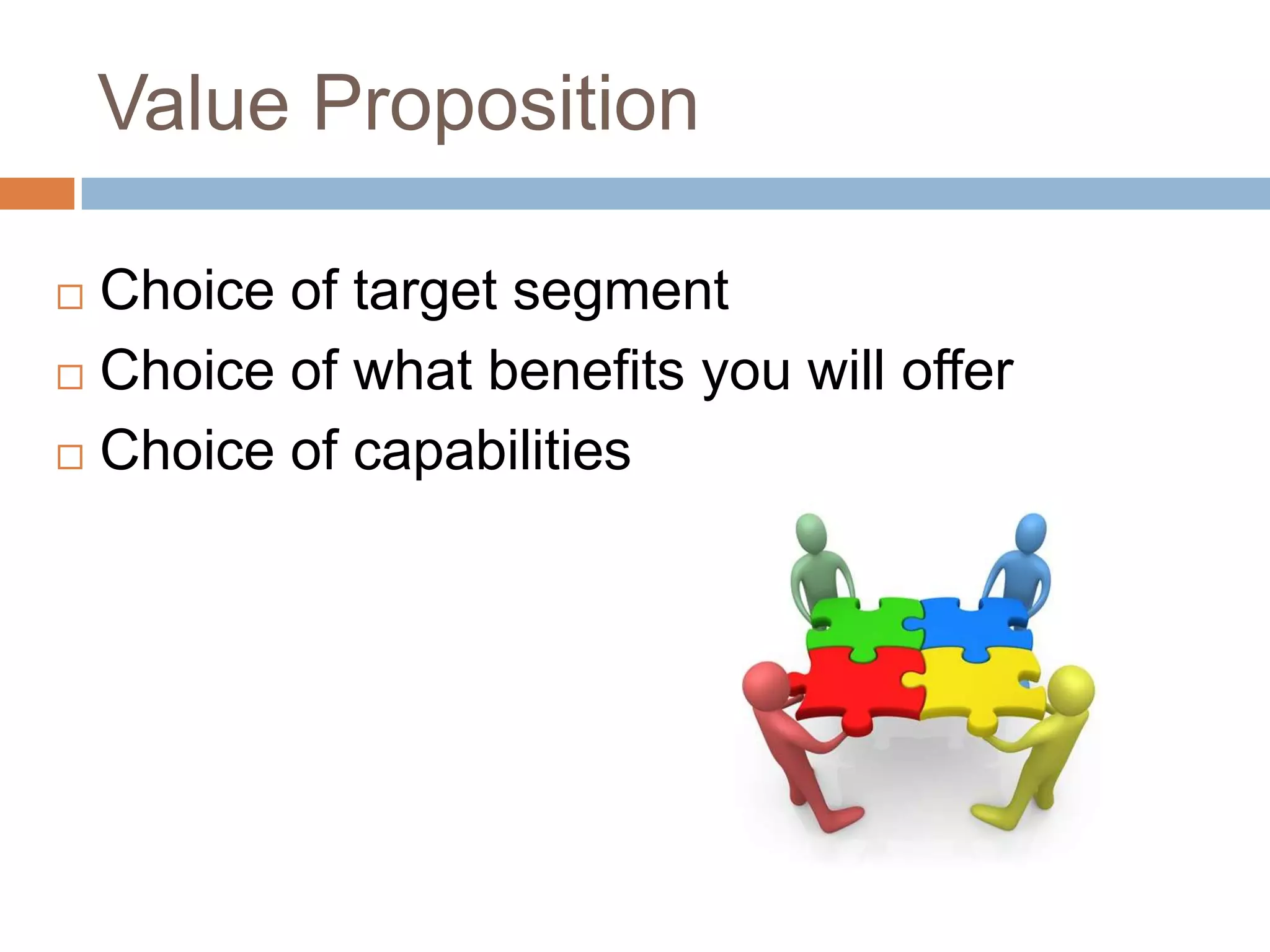
Value Proposition

 Choice of target segment
 Choice of what benefits you will offer

 Choice of capabilities
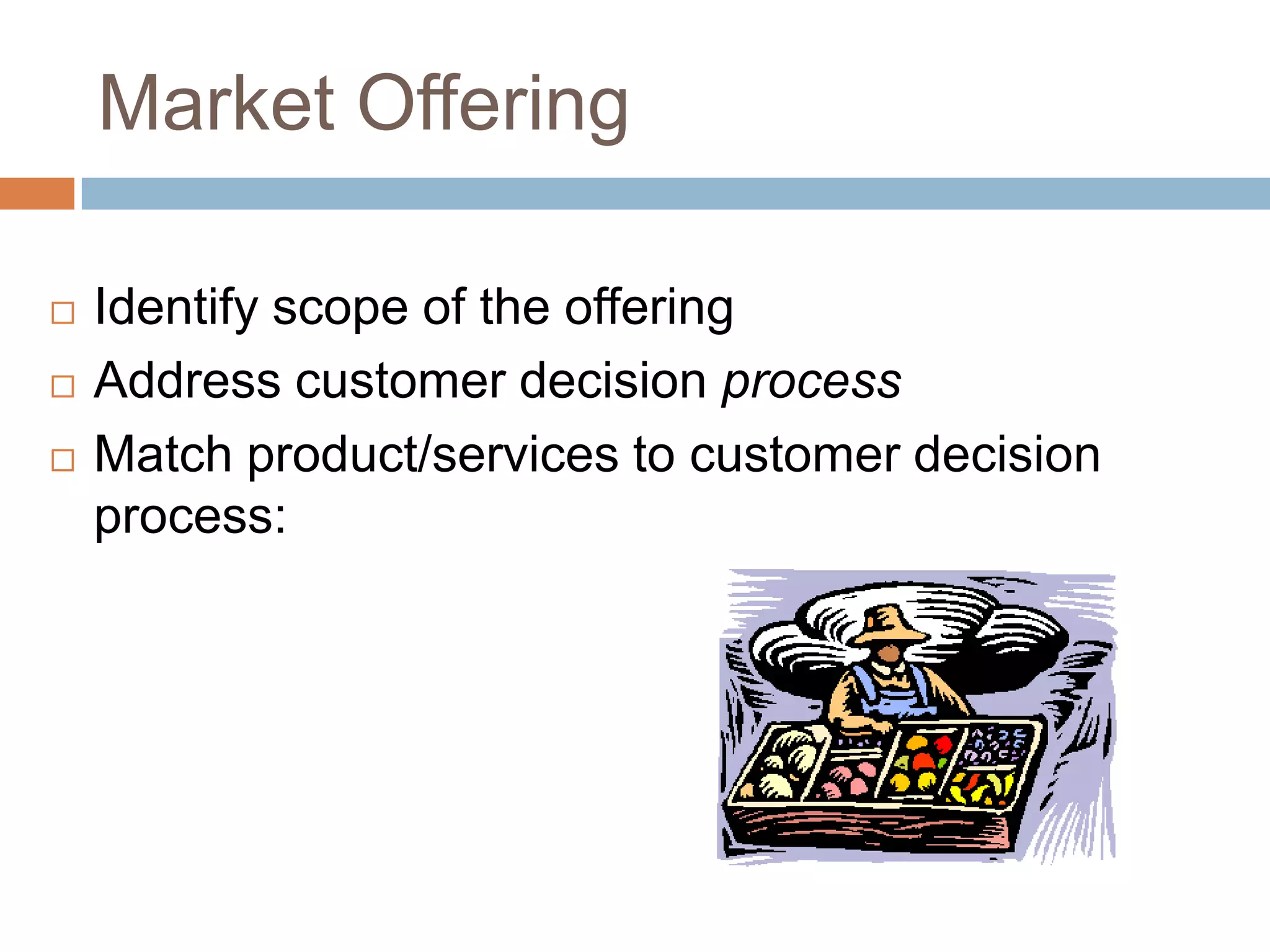
Market Offering

   Identify scope of the offering
   Address customer decision process
   Match product/services to customer decision
    process:
What resources to deploy ?

   Resource system shows how a co must
    align its internal “systems” and partners to
    deliver the benefits of the value proposition
Financial Models


   Revenue Model
   Shareholder value models
   Growth models
Revenue Models

   P roduct/service information (infomediary)
   A dvertising (Google Adwords, Adsense)
   S ale/transaction (eCommerce – buy/sell)
   S ubscription (to a service – Bloomberg, Dunn &
                        Bradstreet, Prowess DB, …)
Shareholder Value Models

User Derived:
 Metamarket- hub for many buyers/sellers, multiple
  categories; e.g., BabyCenter.com
 Auctions- competitive bid hub: eBay, Freemarket

 Category switchboard- aggreg brands: PlanetRX

Company Derived:
   Best Information- Zagat, NYTimes
   Wildest assortment- Secondspin.com
   Lowest Price- Buy.com, Lowestfares.com
   Most Personalized- Reflect.com
Revenue Growth Models
   Deeper penetration into current market
    (existing product)
   New product development (existing market)
   New market development (existing product)
   New products and new markets

    On-line and off-line space
Types of e-business models

generally they are classified on the following
  basis :-
 1.                           2.


      Parties connected       transaction types
      e.g B2B, B2C etc
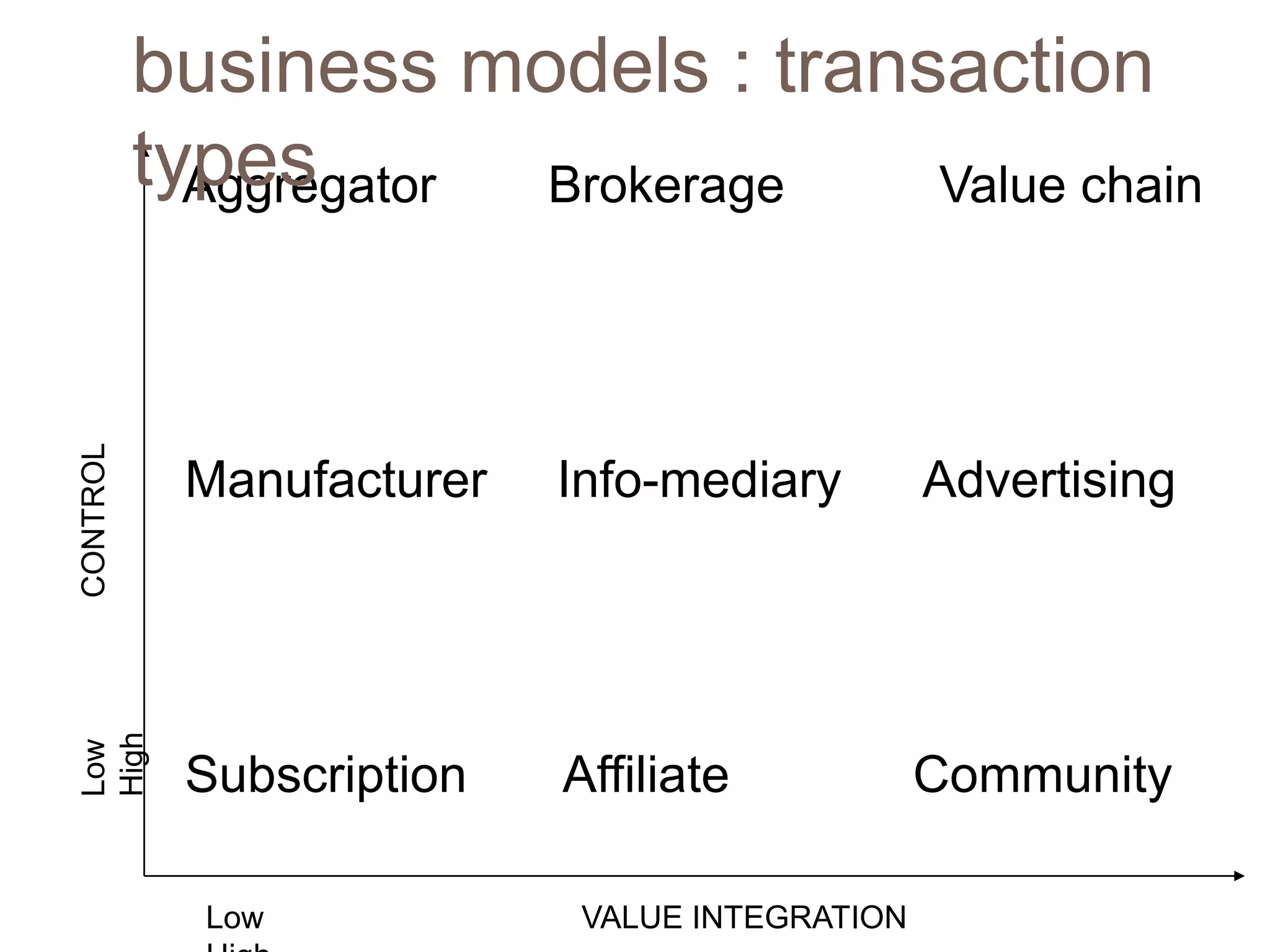
business models : transaction
          types
            Aggregator Brokerage Value chain
CONTROL


           Manufacturer   Info-mediary         Advertising
High
Low


           Subscription   Affiliate            Community

            Low            VALUE INTEGRATION
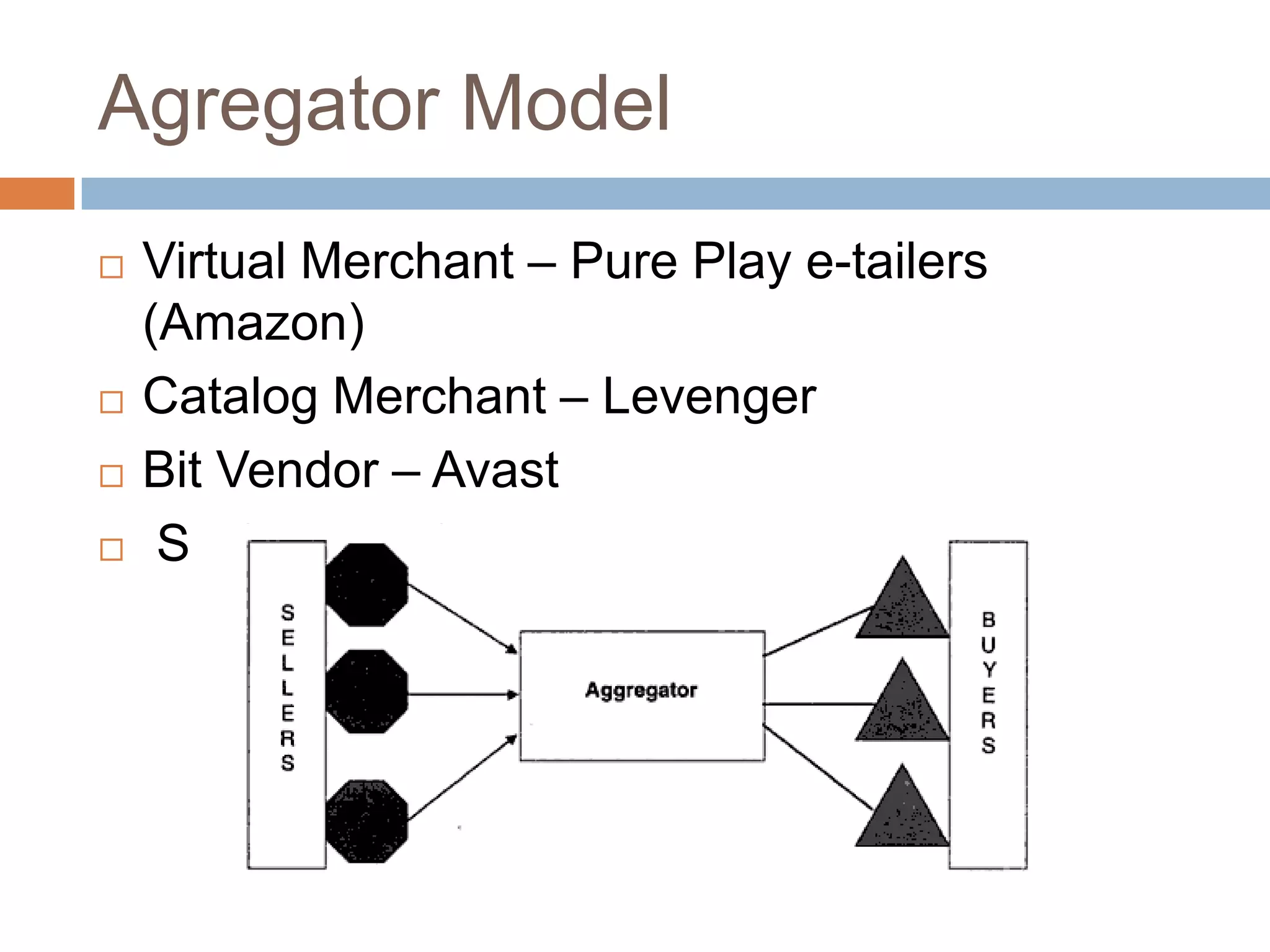
Agregator Model
   Virtual Merchant – Pure Play e-tailers
    (Amazon)
   Catalog Merchant – Levenger
   Bit Vendor – Avast
    Surf-and-turf
Brokerage Model
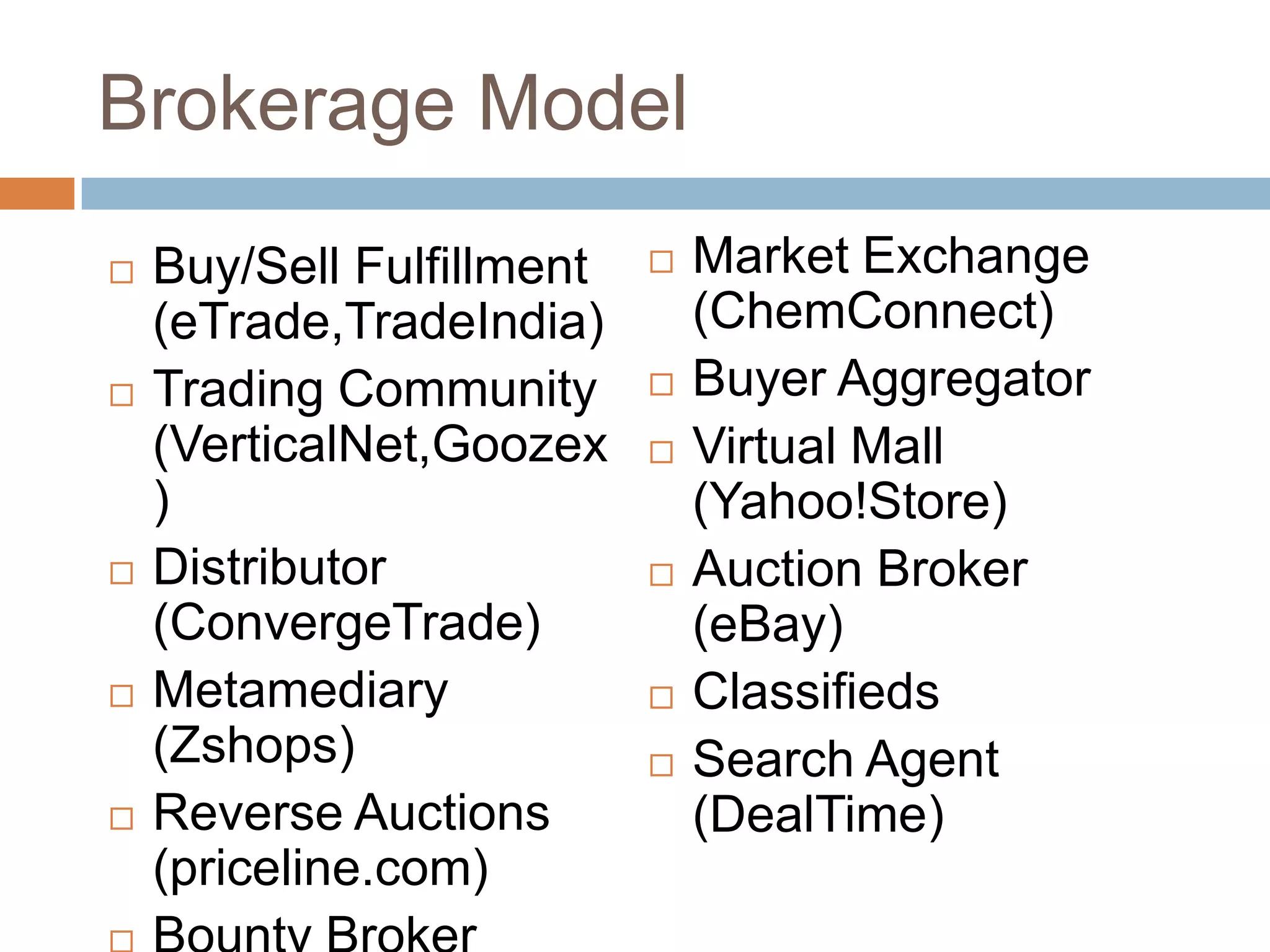
   Buy/Sell Fulfillment      Market Exchange
    (eTrade,TradeIndia)        (ChemConnect)
   Trading Community         Buyer Aggregator
    (VerticalNet,Goozex       Virtual Mall
    )                          (Yahoo!Store)
   Distributor               Auction Broker
    (ConvergeTrade)            (eBay)
   Metamediary               Classifieds
    (Zshops)                  Search Agent
   Reverse Auctions           (DealTime)
    (priceline.com)
Value Chain Model
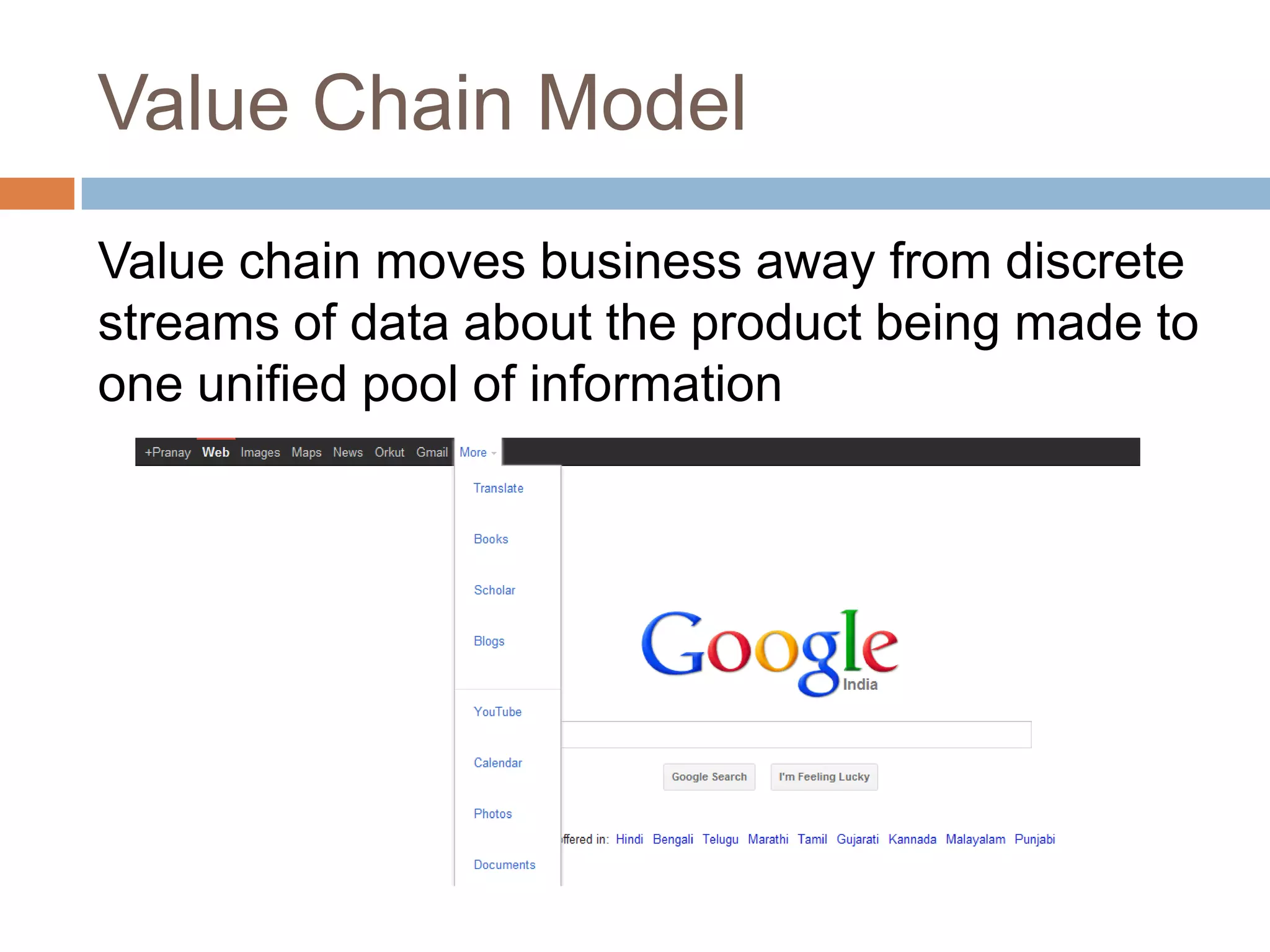
Value chain moves business away from discrete
streams of data about the product being made to
one unified pool of information
Infomediary Model

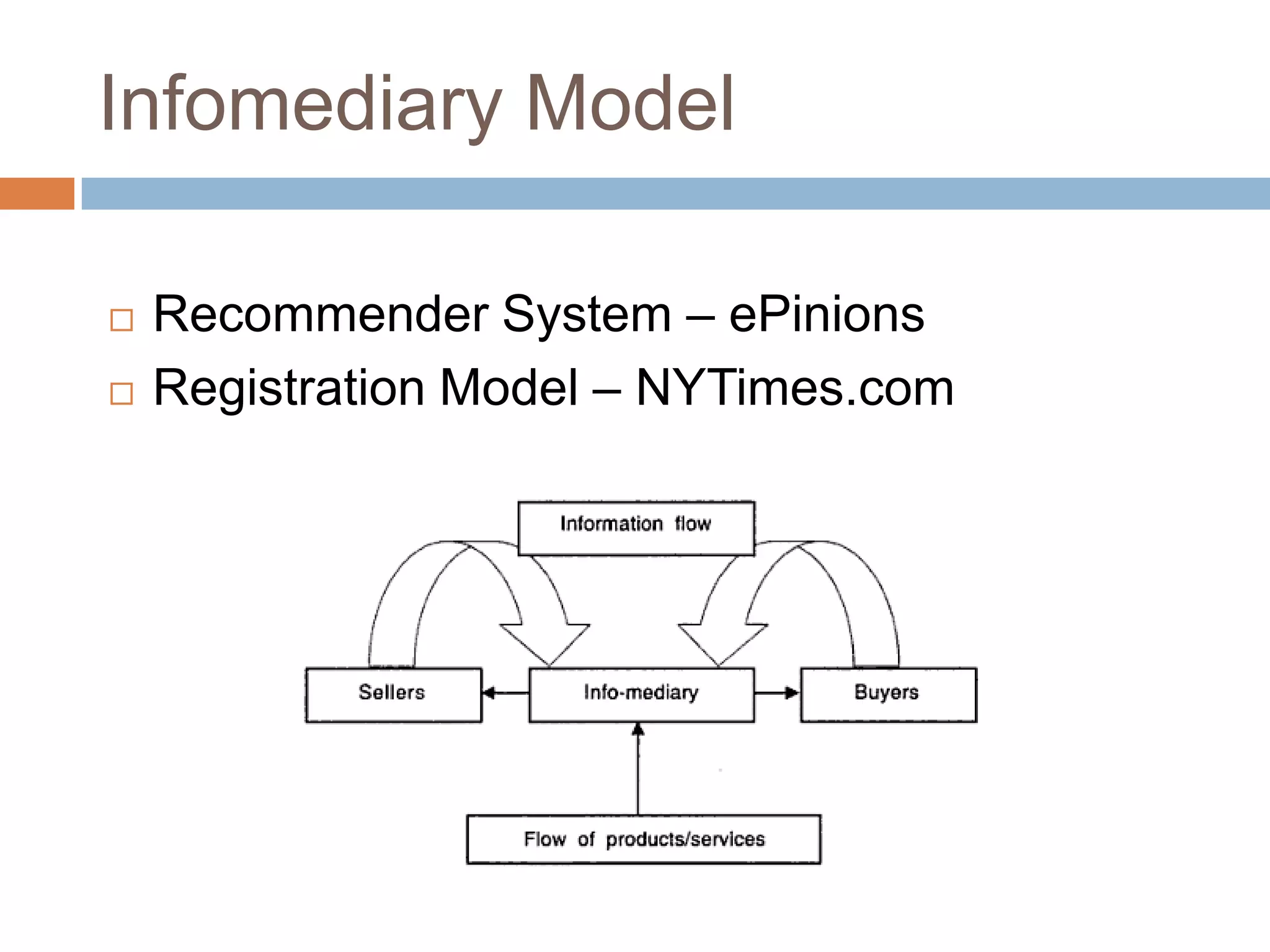
   Recommender System – ePinions
   Registration Model – NYTimes.com
Advertising Model

   Generalized Portal – AOL
   Personalized Portal – MyMSN
   Specialized Portal / Vortal
   Attention/Incentive Marketing – CyberGold
   Free Model – Blue Mountain
   Bargain Discounter – Buy.com
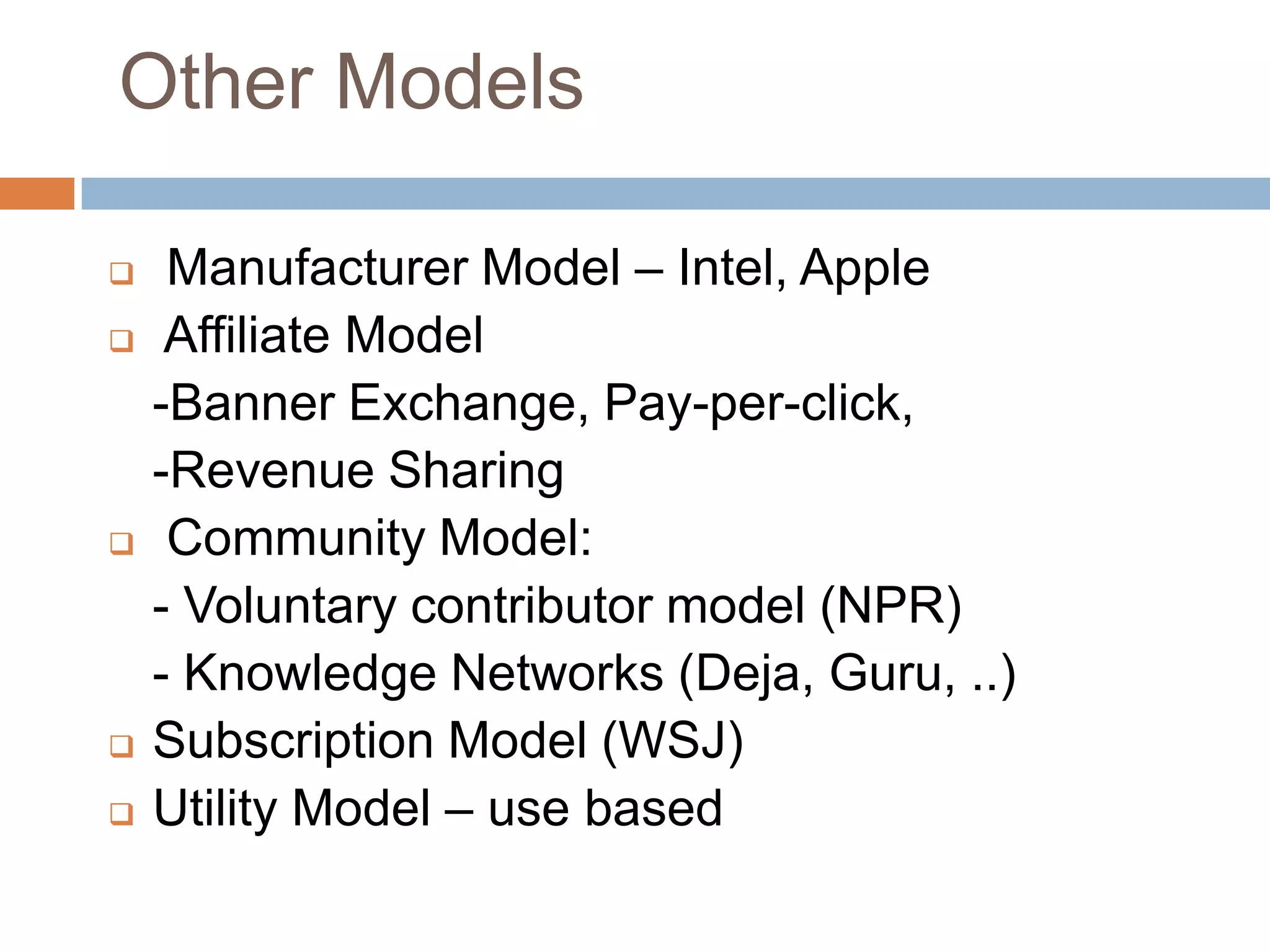
Other Models

    Manufacturer Model – Intel, Apple
    Affiliate Model
    -Banner Exchange, Pay-per-click,
    -Revenue Sharing
    Community Model:
    - Voluntary contributor model (NPR)
    - Knowledge Networks (Deja, Guru, ..)
   Subscription Model (WSJ)
   Utility Model – use based
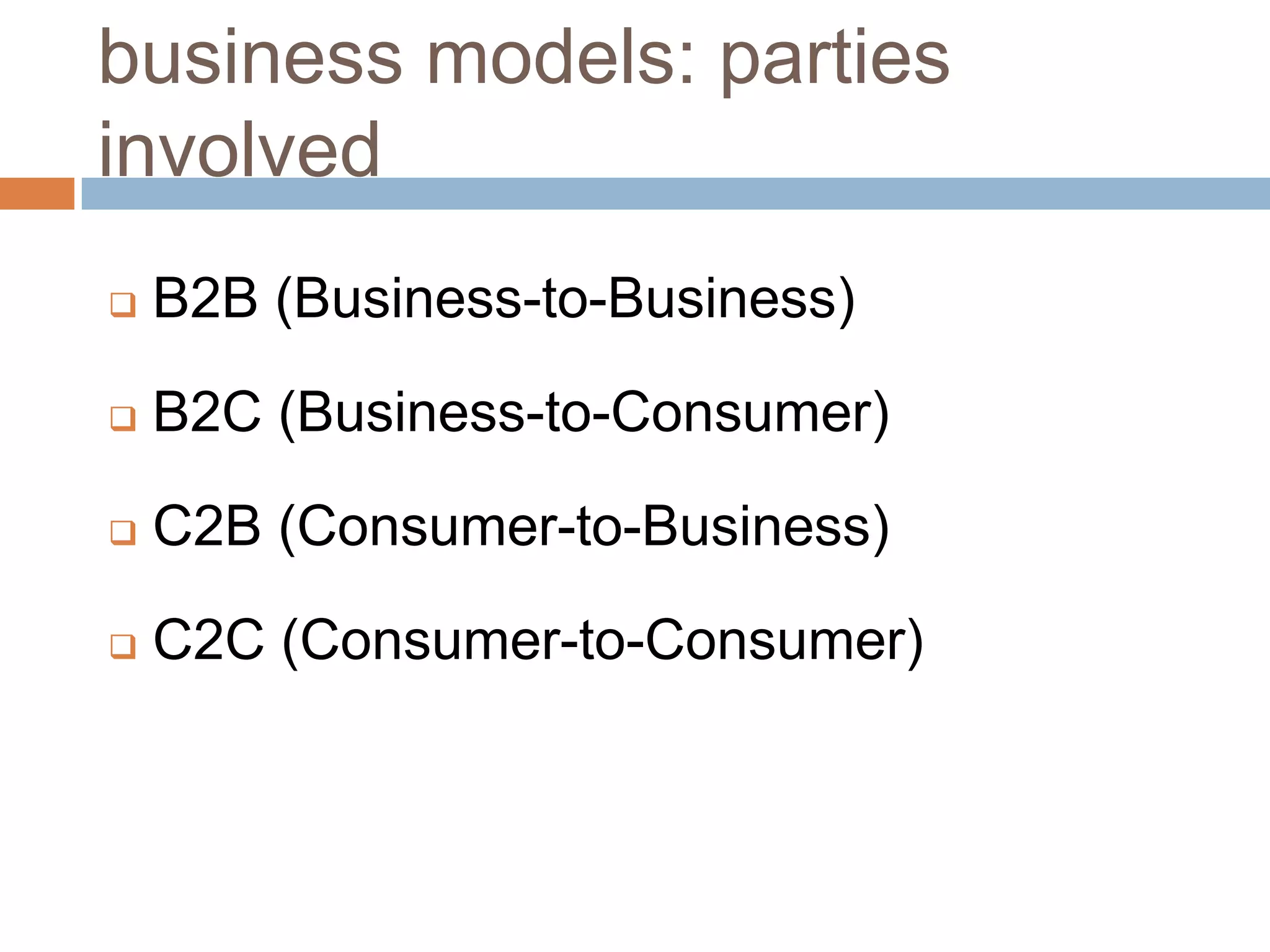
business models: parties
involved
   B2B (Business-to-Business)

   B2C (Business-to-Consumer)

   C2B (Consumer-to-Business)

   C2C (Consumer-to-Consumer)
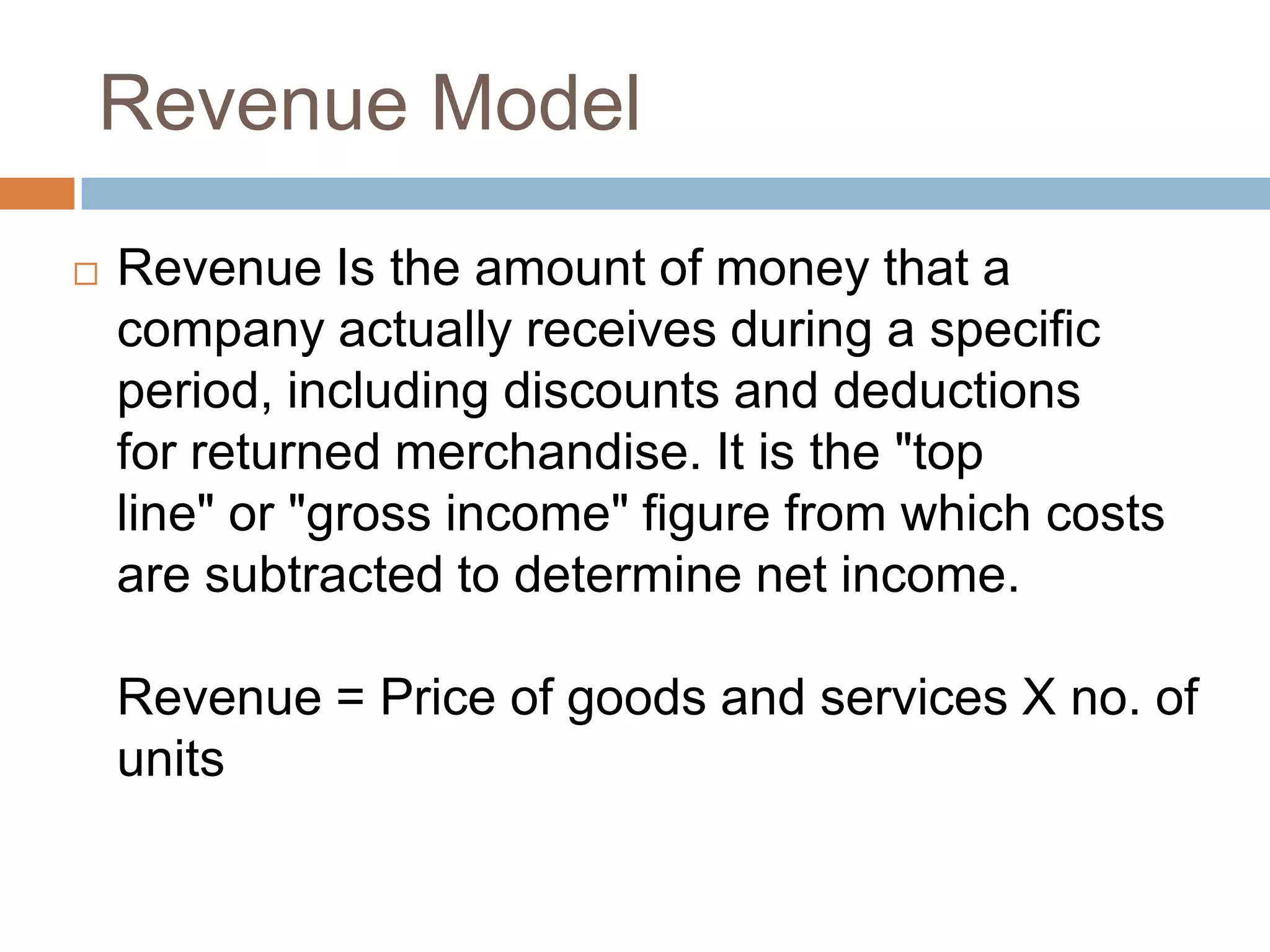
Revenue Model

   Revenue Is the amount of money that a
    company actually receives during a specific
    period, including discounts and deductions
    for returned merchandise. It is the "top
    line" or "gross income" figure from which costs
    are subtracted to determine net income.

    Revenue = Price of goods and services X no. of
    units
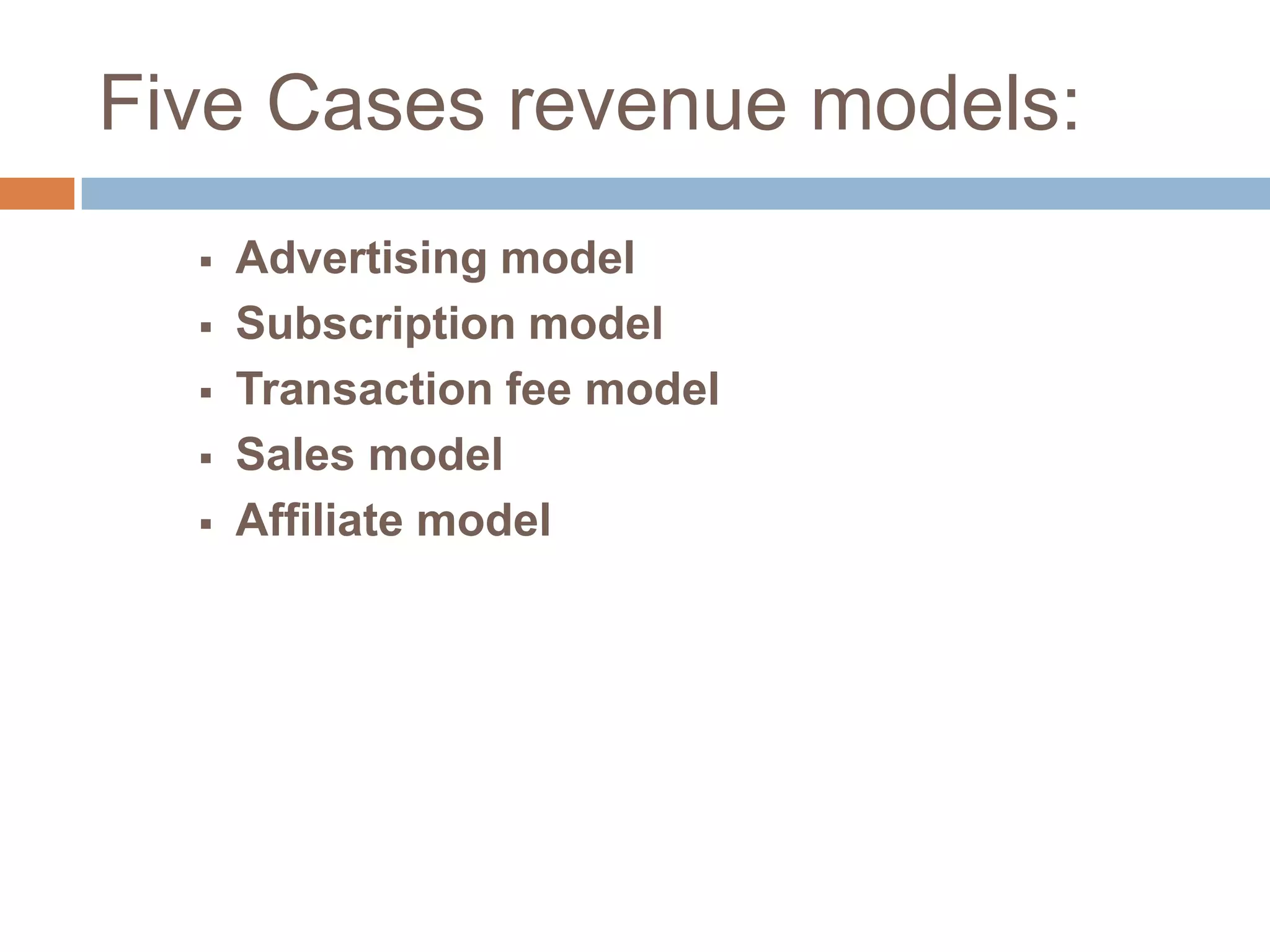
Five Cases revenue models:
     Advertising model
     Subscription model
     Transaction fee model
     Sales model
     Affiliate model
Advertising model

   Simply you have website and provides a
    contents and forum for advertisements and get
    fees from advertisers.
   The advertising model is an addition of the
    traditional media model. The web site,
    provides content which always free and
    services like email, IM, blogs and users
    accepts advertising messages in the form of
    banner ads.
   To attract users to its site, leading Web portal
    Yahoo! offers things like free e-mail, extensive
    content, and travel services. The firm got its
    start in early 1995 when founders Jerry Yang
    and David Filo put together a simple list of
    favorite Web sites.
Subscription model

   A company offers it users content or services
    and charges a subscription fee for access to
    some or all of it offerings.
   where a customer must pay a subscription
    price to have access to the product/service.
    The model was pioneered by magazines and
    newspapers, but is now used by many
    businesses and website.
   Industries that use this model include mail
    order book sales clubs and music sales clubs,
    cable television, satellite television providers
    with pay-TV channels, satellite radio,
    telephone companies, cell phone companies,
    internet providers, software providers,
    business solutions providers, financial services
    firms, fitness clubs, and pharmaceuticals, as
    well as the traditional newspapers, magazines
    and academic journals.
Transaction fee model

   There are businesses offering services for
    which they charge a fee based on the number
    or size of transactions they process. The
    business provides information to the
    customers which is required to complete a
    transaction and revenue is purely earned on
    that basis.
   For example, online travel agents receive a
    fee for facilitating a transaction that includes
    the making of travel arrangement for their
    clients, as well as, advising them about
    lodging, transportation etc. Stock brokerage
    firms also use this model as they charge their
    customers a commission for each transaction
    of stocks/shares executed through them.
Sales model

   A company derives revenue by selling
    goods, information, or services.
   Here the merchants provide goods and
    services online but based on list prices or via
    auction.
   Examples: wwww.1800flowers.com
   This site sells the flowers online, and deliver
    your order almost everywhere in US.
Affiliate model

   A company steers business to an affiliate
    and receives a referral fee or percentage of
    the revenue from any resulting sales.
   Example: www.movies.com
   This site uses Amazon Associates Web
    Services to deliver a complete marketplace of
    DVDs.

Business and Revenue Models in E-Commerce

  • 1.
  • 2.
    BUSINESS MODELS business modelinvolves the following choices: 1. Value proposition – how to deliver value to the customer 2. Market offering – what will sell, where, … 3. Resource system – what facilities, … 4. Financial model – how will you charge for your product or service
  • 3.
    Value Proposition  Choiceof target segment  Choice of what benefits you will offer  Choice of capabilities
  • 4.
    Market Offering  Identify scope of the offering  Address customer decision process  Match product/services to customer decision process:
  • 5.
    What resources todeploy ?  Resource system shows how a co must align its internal “systems” and partners to deliver the benefits of the value proposition
  • 6.
    Financial Models  Revenue Model  Shareholder value models  Growth models
  • 7.
    Revenue Models  P roduct/service information (infomediary)  A dvertising (Google Adwords, Adsense)  S ale/transaction (eCommerce – buy/sell)  S ubscription (to a service – Bloomberg, Dunn & Bradstreet, Prowess DB, …)
  • 8.
    Shareholder Value Models UserDerived:  Metamarket- hub for many buyers/sellers, multiple categories; e.g., BabyCenter.com  Auctions- competitive bid hub: eBay, Freemarket  Category switchboard- aggreg brands: PlanetRX Company Derived:  Best Information- Zagat, NYTimes  Wildest assortment- Secondspin.com  Lowest Price- Buy.com, Lowestfares.com  Most Personalized- Reflect.com
  • 9.
    Revenue Growth Models  Deeper penetration into current market (existing product)  New product development (existing market)  New market development (existing product)  New products and new markets On-line and off-line space
  • 10.
    Types of e-businessmodels generally they are classified on the following basis :- 1. 2. Parties connected transaction types e.g B2B, B2C etc
  • 11.
    business models :transaction types Aggregator Brokerage Value chain CONTROL Manufacturer Info-mediary Advertising High Low Subscription Affiliate Community Low VALUE INTEGRATION
  • 12.
    Agregator Model  Virtual Merchant – Pure Play e-tailers (Amazon)  Catalog Merchant – Levenger  Bit Vendor – Avast  Surf-and-turf
  • 13.
    Brokerage Model  Buy/Sell Fulfillment  Market Exchange (eTrade,TradeIndia) (ChemConnect)  Trading Community  Buyer Aggregator (VerticalNet,Goozex  Virtual Mall ) (Yahoo!Store)  Distributor  Auction Broker (ConvergeTrade) (eBay)  Metamediary  Classifieds (Zshops)  Search Agent  Reverse Auctions (DealTime) (priceline.com)
  • 14.
    Value Chain Model Valuechain moves business away from discrete streams of data about the product being made to one unified pool of information
  • 15.
    Infomediary Model  Recommender System – ePinions  Registration Model – NYTimes.com
  • 16.
    Advertising Model  Generalized Portal – AOL  Personalized Portal – MyMSN  Specialized Portal / Vortal  Attention/Incentive Marketing – CyberGold  Free Model – Blue Mountain  Bargain Discounter – Buy.com
  • 17.
    Other Models  Manufacturer Model – Intel, Apple  Affiliate Model -Banner Exchange, Pay-per-click, -Revenue Sharing  Community Model: - Voluntary contributor model (NPR) - Knowledge Networks (Deja, Guru, ..)  Subscription Model (WSJ)  Utility Model – use based
  • 18.
    business models: parties involved  B2B (Business-to-Business)  B2C (Business-to-Consumer)  C2B (Consumer-to-Business)  C2C (Consumer-to-Consumer)
  • 19.
    Revenue Model  Revenue Is the amount of money that a company actually receives during a specific period, including discounts and deductions for returned merchandise. It is the "top line" or "gross income" figure from which costs are subtracted to determine net income. Revenue = Price of goods and services X no. of units
  • 20.
    Five Cases revenuemodels:  Advertising model  Subscription model  Transaction fee model  Sales model  Affiliate model
  • 21.
    Advertising model  Simply you have website and provides a contents and forum for advertisements and get fees from advertisers.  The advertising model is an addition of the traditional media model. The web site, provides content which always free and services like email, IM, blogs and users accepts advertising messages in the form of banner ads.
  • 22.
    To attract users to its site, leading Web portal Yahoo! offers things like free e-mail, extensive content, and travel services. The firm got its start in early 1995 when founders Jerry Yang and David Filo put together a simple list of favorite Web sites.
  • 23.
    Subscription model  A company offers it users content or services and charges a subscription fee for access to some or all of it offerings.  where a customer must pay a subscription price to have access to the product/service. The model was pioneered by magazines and newspapers, but is now used by many businesses and website.
  • 24.
    Industries that use this model include mail order book sales clubs and music sales clubs, cable television, satellite television providers with pay-TV channels, satellite radio, telephone companies, cell phone companies, internet providers, software providers, business solutions providers, financial services firms, fitness clubs, and pharmaceuticals, as well as the traditional newspapers, magazines and academic journals.
  • 25.
    Transaction fee model  There are businesses offering services for which they charge a fee based on the number or size of transactions they process. The business provides information to the customers which is required to complete a transaction and revenue is purely earned on that basis.
  • 26.
    For example, online travel agents receive a fee for facilitating a transaction that includes the making of travel arrangement for their clients, as well as, advising them about lodging, transportation etc. Stock brokerage firms also use this model as they charge their customers a commission for each transaction of stocks/shares executed through them.
  • 27.
    Sales model  A company derives revenue by selling goods, information, or services.  Here the merchants provide goods and services online but based on list prices or via auction.  Examples: wwww.1800flowers.com  This site sells the flowers online, and deliver your order almost everywhere in US.
  • 28.
    Affiliate model  A company steers business to an affiliate and receives a referral fee or percentage of the revenue from any resulting sales.  Example: www.movies.com  This site uses Amazon Associates Web Services to deliver a complete marketplace of DVDs.

Editor's Notes

  • #4 Choice of target segmentMarket Opportunity analysis (area, demographics, ..)Market attractiveness (can you make money?)Ability to compete (what is your usp?)Degree of fit with existing channels (Choice of what benefits you will offer:Single benefit vs. multiple benefitsConflicting benefits lead to average performanceWhat are the customer preferences (service, ease of access, … price only 10th preferred attribute)Choice of capabilitiesWhat unique and differentiating capabilities do you need to possess? (Capabilities need to be linked to the benefits which form the value propositionChoice of tangible assets (plant, machinery, …Choice of intangible assets (brand), Core competencies (C K Prahlad) vs. external partners
  • #5 Identify scope of the offeringWhat categories – single/multiple (books, CD’s)Cross-category – metamarkets; cluster of goods and services; (e.g., Travel: airline, hotel, car rental, …)Address customer decision processPre-purchase: Identify the need for the product, search, evaluate alternativesPurchase: Purchase decisionPost-purchase: Satisfaction, loyalty, disposalMatch product/services to customer decision process:Web site should “walk the customer through”Encourage the customer to revisit the decision cycleRepeat the cycle for every categoryRecognize the need: reminders for birthdaysSearch: store locator, price listsEvaluate alternatives: comparisonsPurchase decision: shopping cart, credit cardSatisfaction/loyalty: cust. support, incentives
  • #6 Value proposition and offering dictate resource systemResource system shows how a co must align its internal “systems” and partners to deliver the benefits of the value propositionIt is the choice of actions/assets used to deliver the value proposition
  • #11 Basics: Method of doing business by which a company can sustain itselfE-commerce gives rise to new models or re-invent tried-and-true models (e.g., Auctions)No comprehensive and cogent taxonomy of web business models exists – combination of modelsIntellectual Property protection perspectiveTypes of models based on parties connected: B2B, B2C, …Types of models based on transaction types are classified by two parameters: Value Addition and Control on business