Web 3.0 & IoT
  The future of Internet
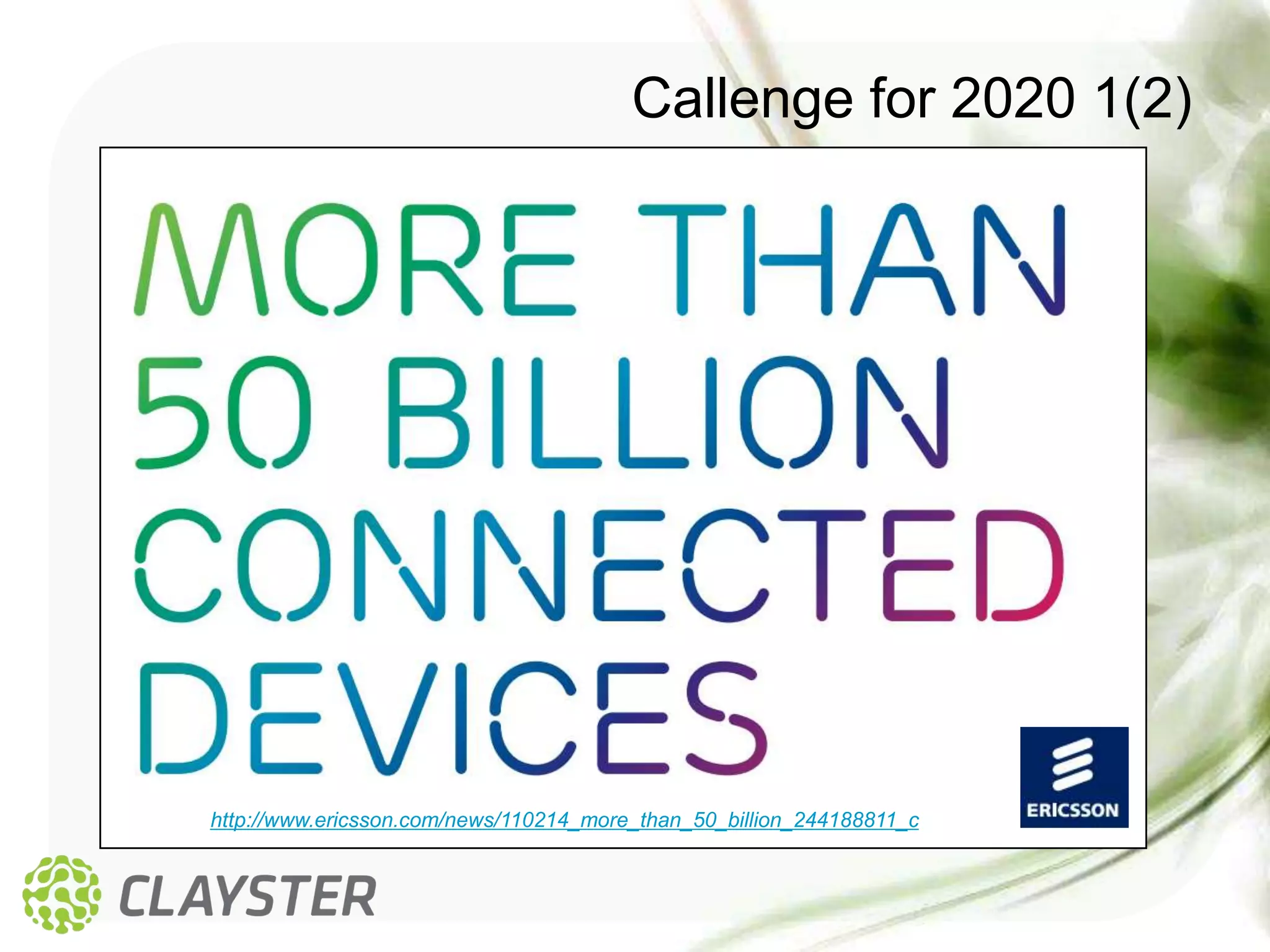
Callenge for 2020 1(2)


http://www.ericsson.com/news/110214_more_than_50_billion_244188811_c
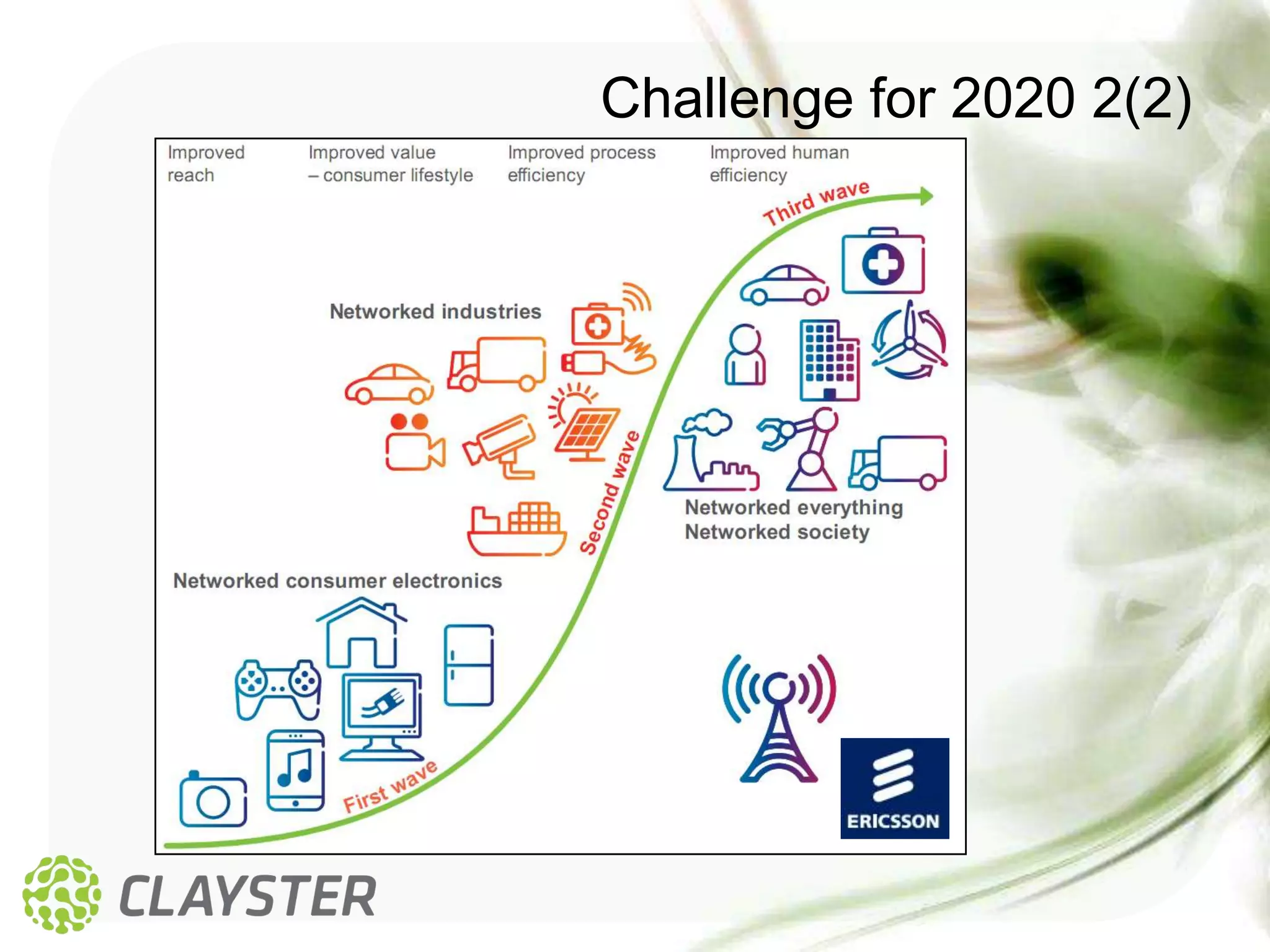
Challenge for 2020 2(2)
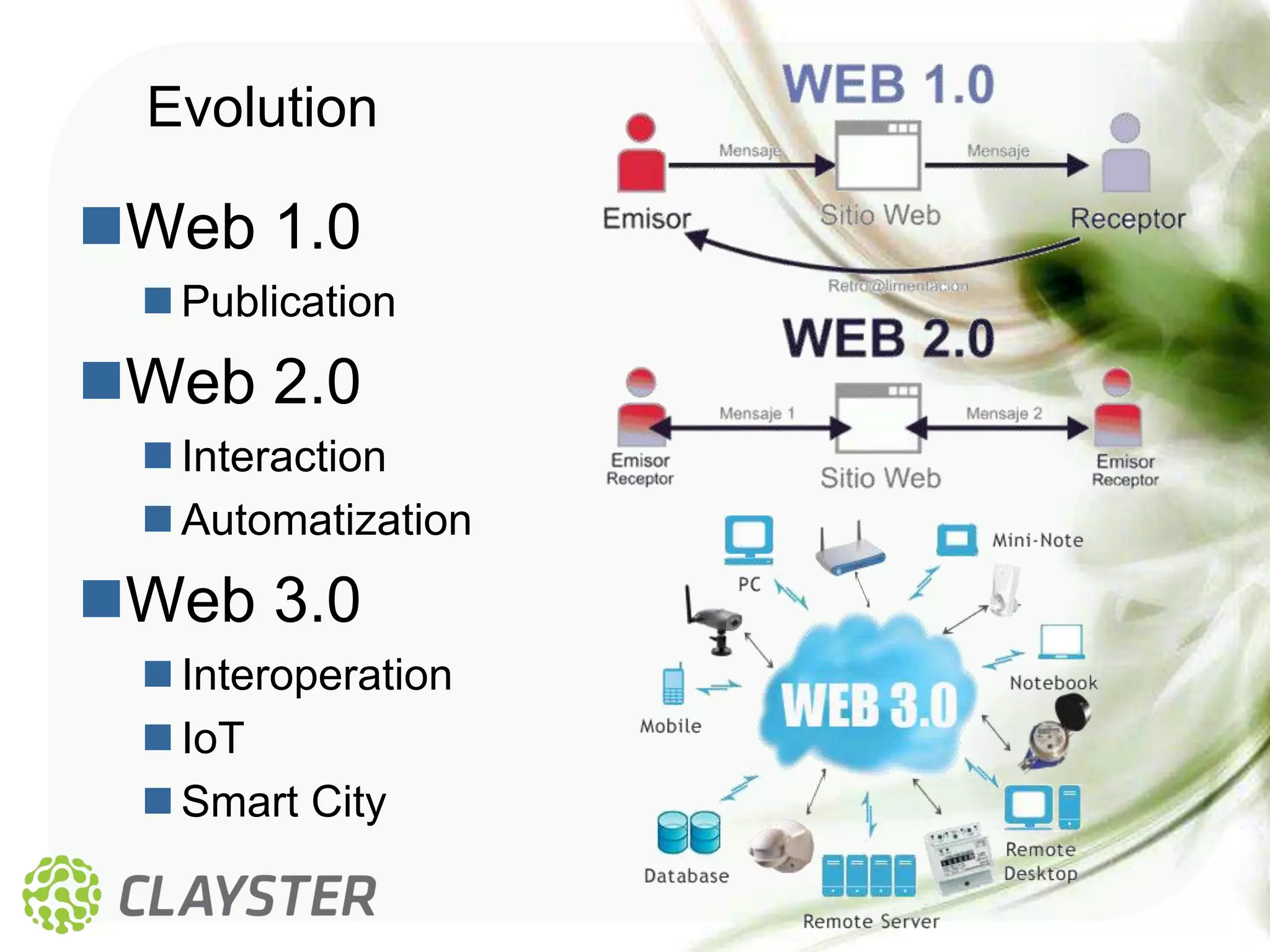
Evolution

Web 1.0
  Publication
Web 2.0
  Interaction
  Automatization
Web 3.0
  Interoperation
  IoT
  Smart City
Web 1.0
Publication of papers.
   HTML / HTTP / TCP / IP
Links between publications.
   URI
Consumption by humans.
   Browsers
Static information.
   The publisher provides the information.
   Centralized.
Examples of web 1.0
Newspapers
Portals
Home Pages
Britannica Online
Web 2.0
Dynamic information.
   Users provide the information.
   XML, XML Schema, XSLT, XHR (Ajax).
New interfaces for humans
   Apps (10’ interfaces)
Web Services.
   SOAP, WSDL
   REST, WADL
   Syndication (RSS, ATOM, Podcasts, etc.)
Examples of web 2.0
Social networks
   FB, Twitter, LinkedIn, Flickr, YT, etc.
   Comments, tagging, voting, liking, blogging.

On-line databases
   Wikipedia, Google Earth, OSM, etc.
Stores
   eBay, Amazon, etc.
Content Management Systems
   Drupal, Mediawiki, etc.
Examples of web 2.0
Apps
   IPhone, Android, IP-TV, etc.
“Web as a platform”
   Cloud
   Google: Docs, Gmail, Calendar, etc.
   Hotmail, MS Web Apps
Programmable web
   Mashups (6809 en www.programmableweb.com)
   APIs (7677 en www.programmableweb.com)
Web 3.0
Publication of data.
   RDF / HTTP, XMPP / TCPv6 / IPv6
Links between data.
   URI
Consumption by machines.
   M2M, WSN
Federated information.
   Created for multitude of entities.
   Decentralized.
Web 3.0 Technologies
Semantic Web
   Universal abstraction of information.
   Meaning of información.
   Standardized question languages
   Standardized rule languages
   Artificial intelligence.
Internet of Things (IoT)
   Wireless sensor networks WSN (IPv6 / WiFi)
   Grid Computing (federation)
   Security, peer-to-peer (XMPP)
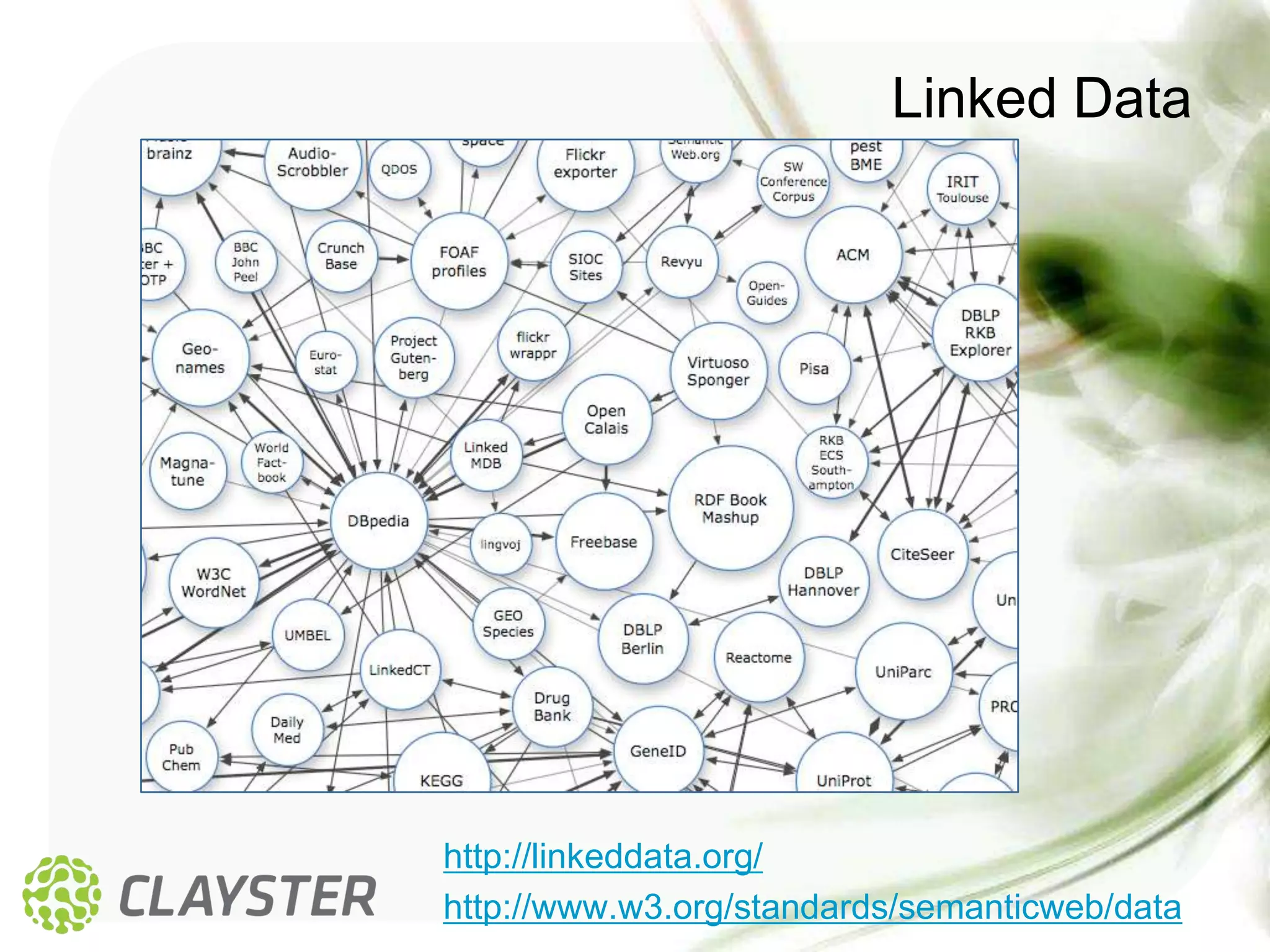
Linked Data


http://linkeddata.org/
http://www.w3.org/standards/semanticweb/data
Abstraction of information


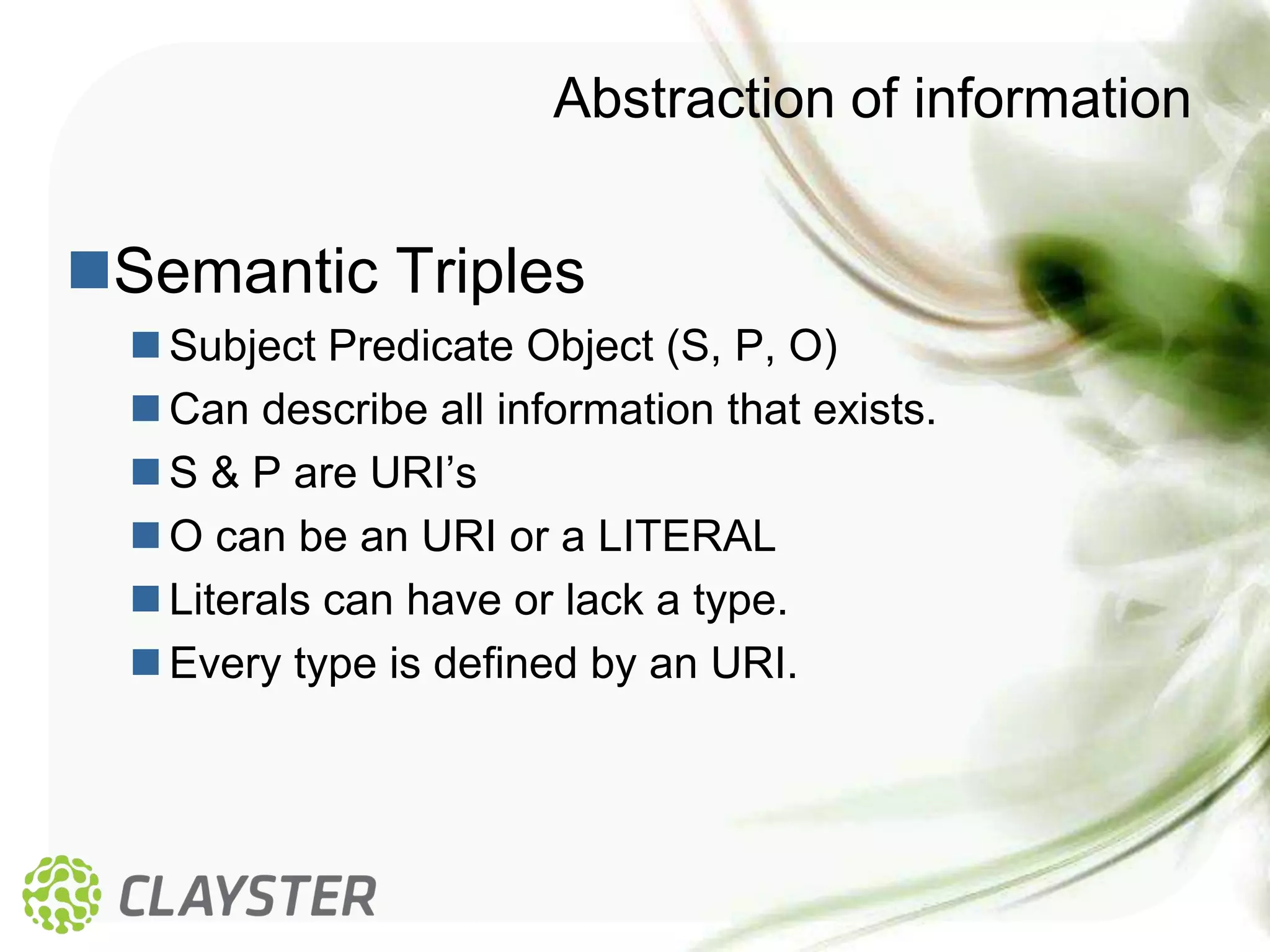
Semantic Triples
   Subject Predicate Object (S, P, O)
   Can describe all information that exists.
   S & P are URI’s
   O can be an URI or a LITERAL
   Literals can have or lack a type.
   Every type is defined by an URI.
Examples of Semantic Triples
   Clayster “is a” Company
   Clayster “is domiciled in” Valparaíso
   Valparaíso “is a” City
   Valparaíso “lies in” Chile
   Chile “is a” Country
   Peter Waher “is a” Man
   Peter Waher “has” 40 years
   Peter Waher “is employed by” Clayster.
   Peter Waher “is married to” Katya Waher.
   etc.
URIs

URI Format
 Scheme://Host/Path
 Simple to extend
 Simple to maintain unique
 Simple to distribute
Graphs
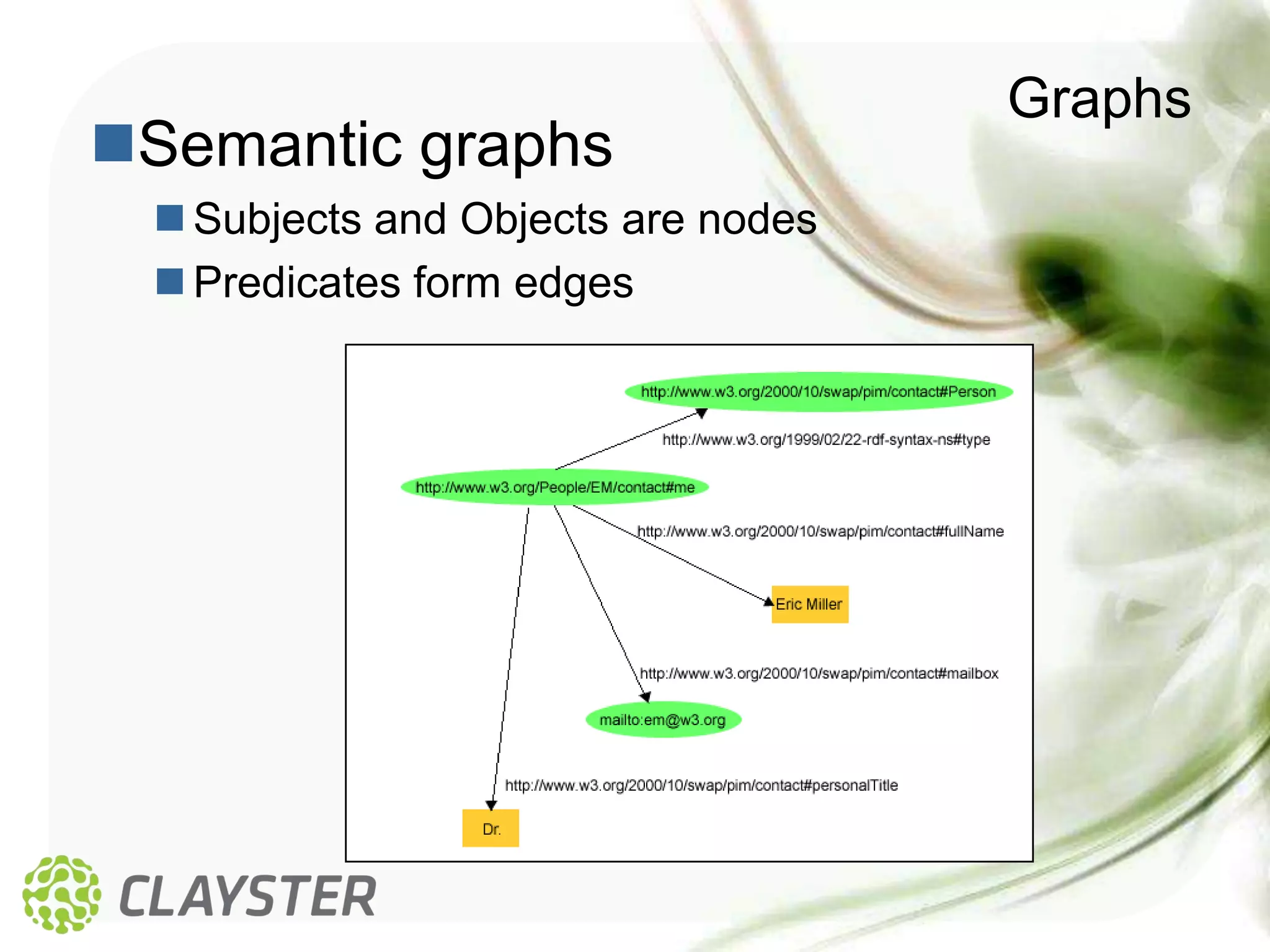
Semantic graphs
  Subjects and Objects are nodes
  Predicates form edges
Links

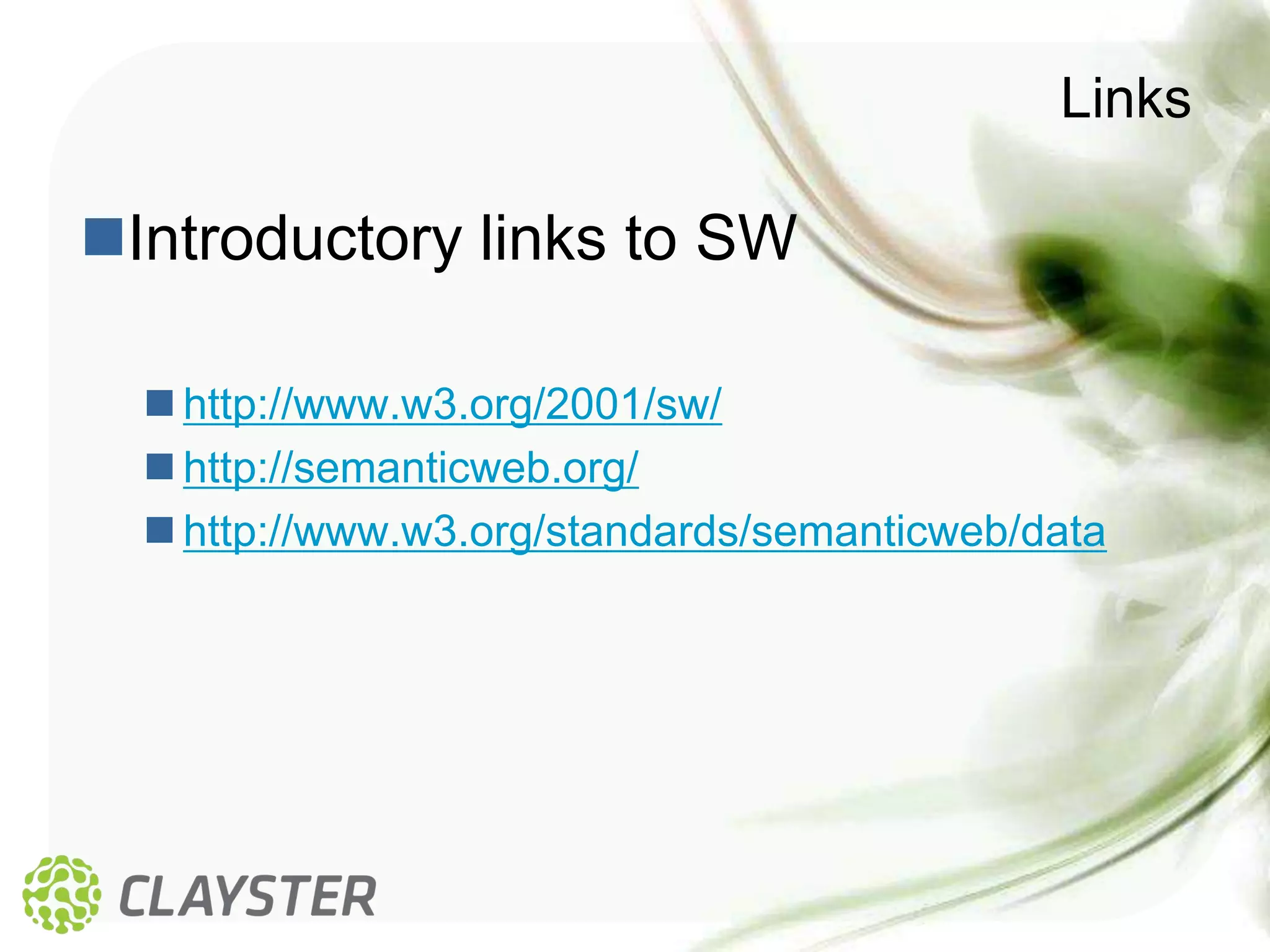
Introductory links to SW

   http://www.w3.org/2001/sw/
   http://semanticweb.org/
   http://www.w3.org/standards/semanticweb/data
RDF

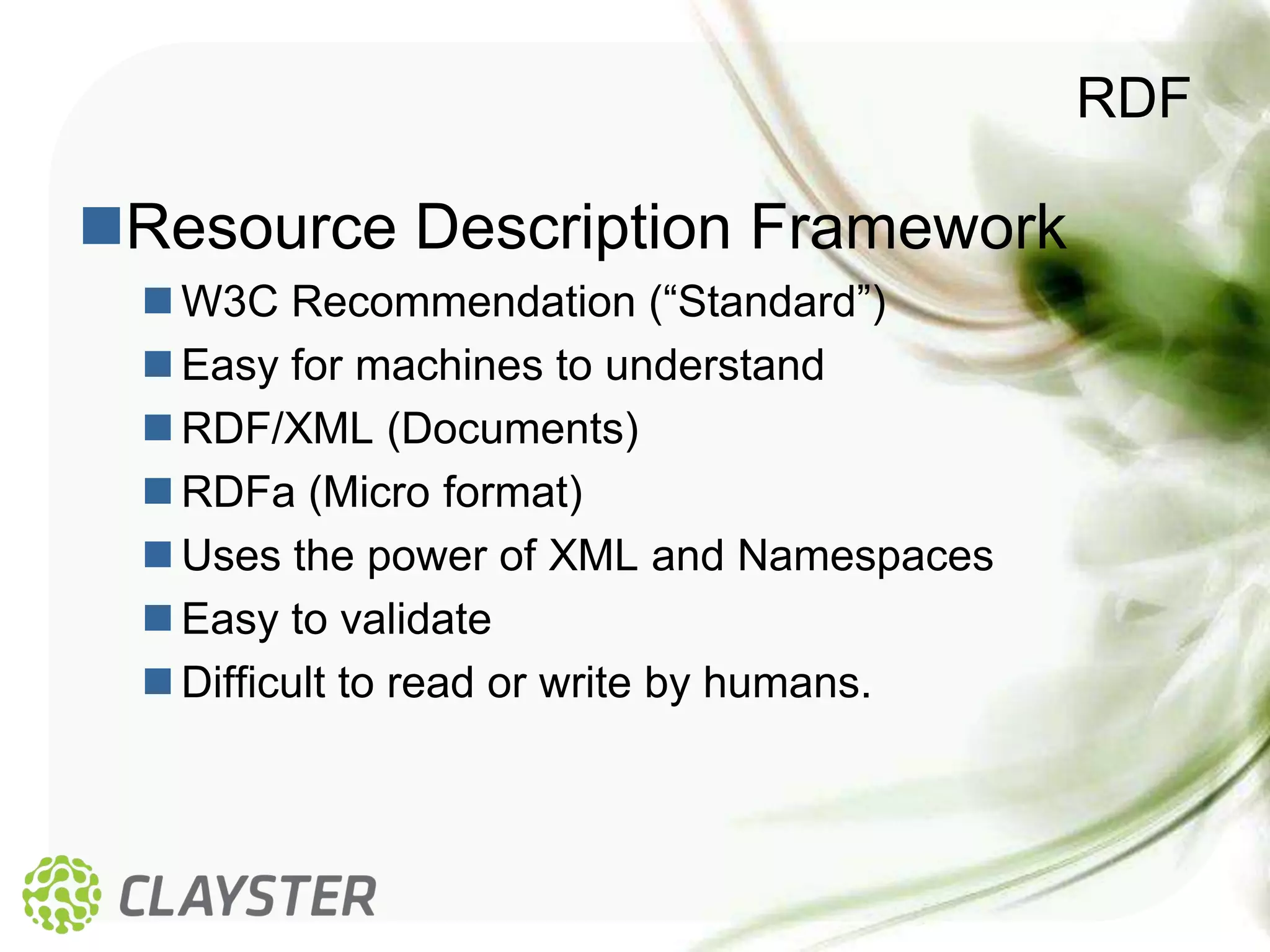
Resource Description Framework
  W3C Recommendation (“Standard”)
  Easy for machines to understand
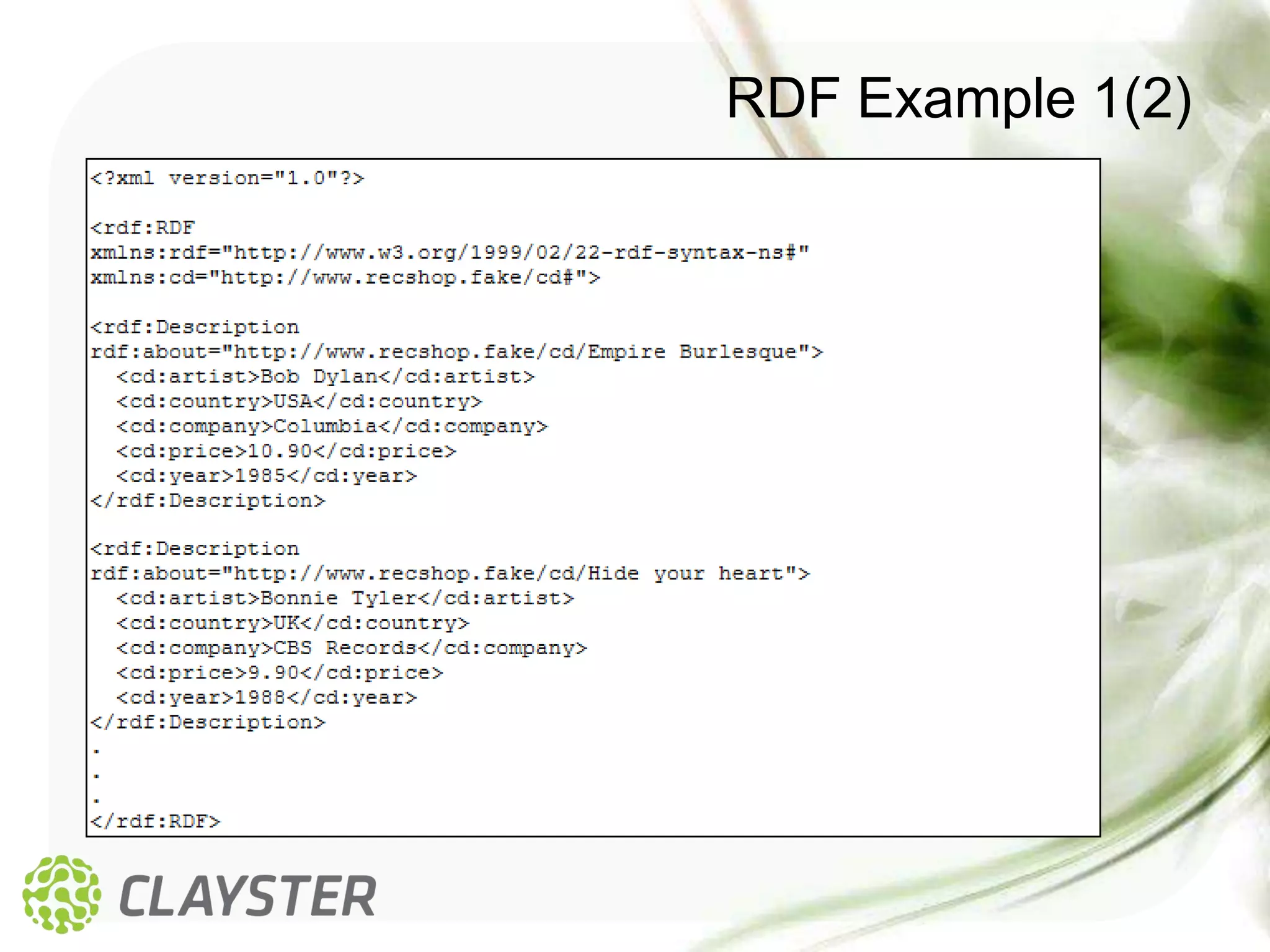
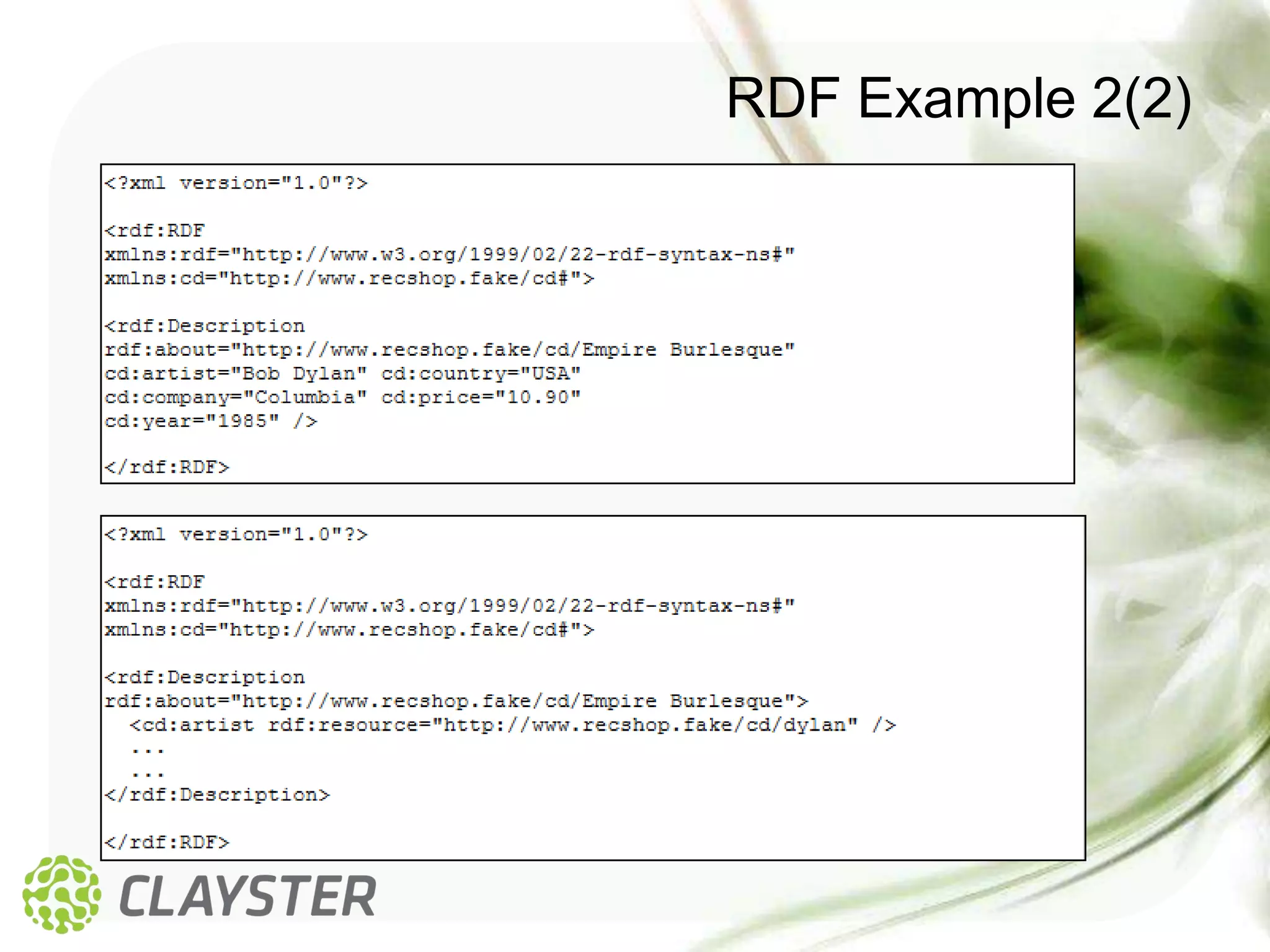
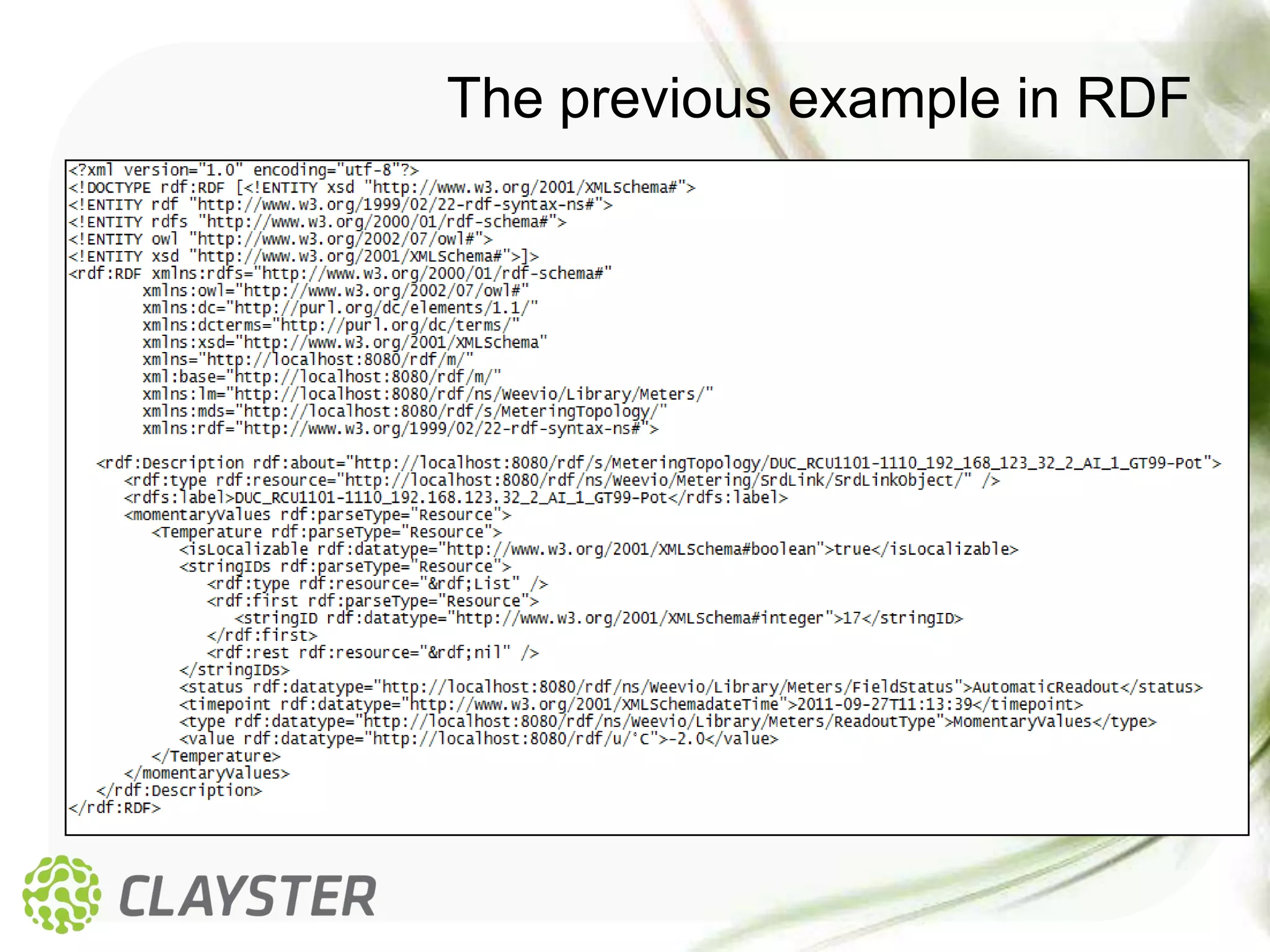
  RDF/XML (Documents)
  RDFa (Micro format)
  Uses the power of XML and Namespaces
  Easy to validate
  Difficult to read or write by humans.
RDF Example 1(2)
RDF Example 2(2)
Ontologies

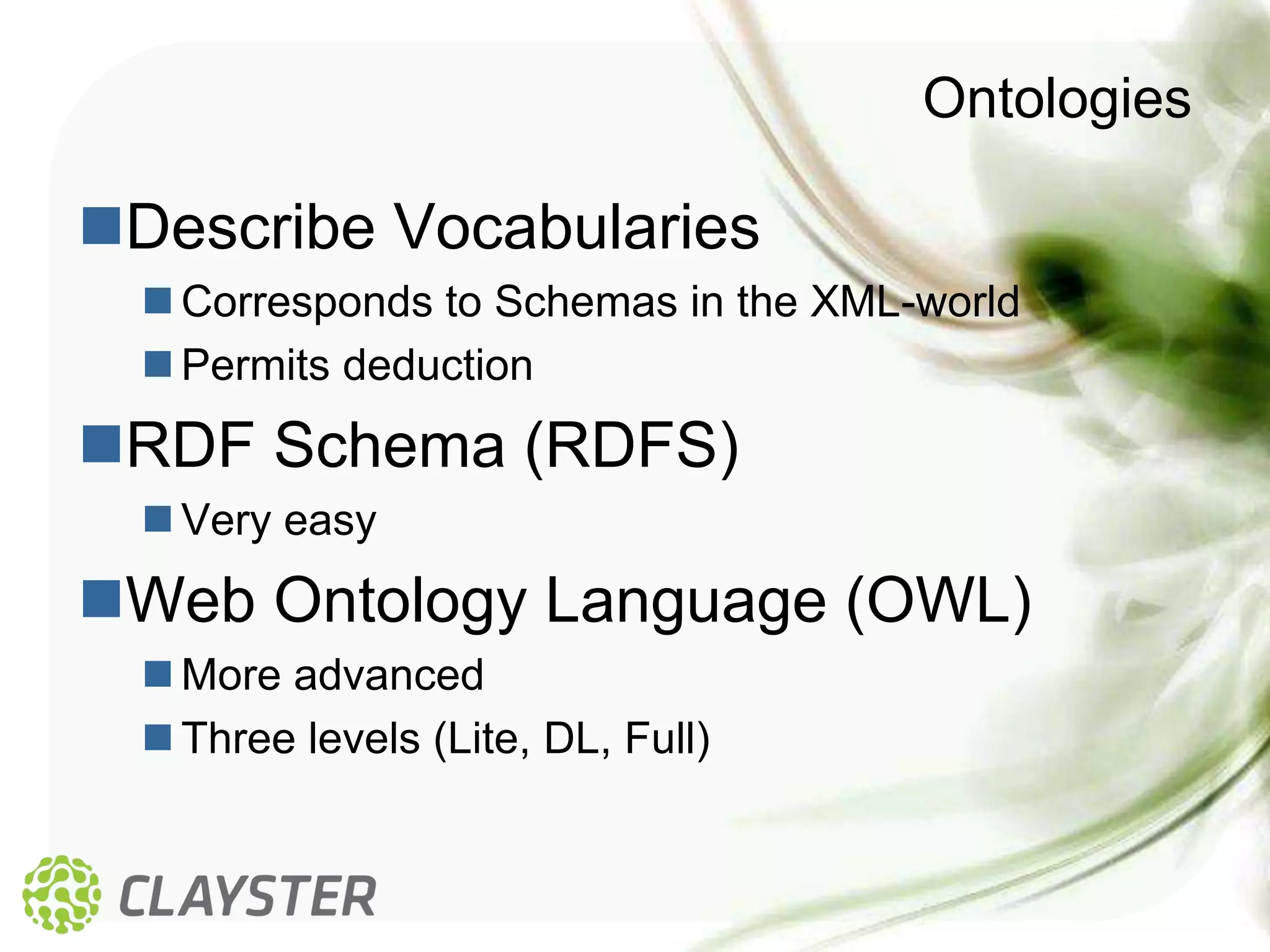
Describe Vocabularies
   Corresponds to Schemas in the XML-world
   Permits deduction
RDF Schema (RDFS)
   Very easy
Web Ontology Language (OWL)
   More advanced
   Three levels (Lite, DL, Full)
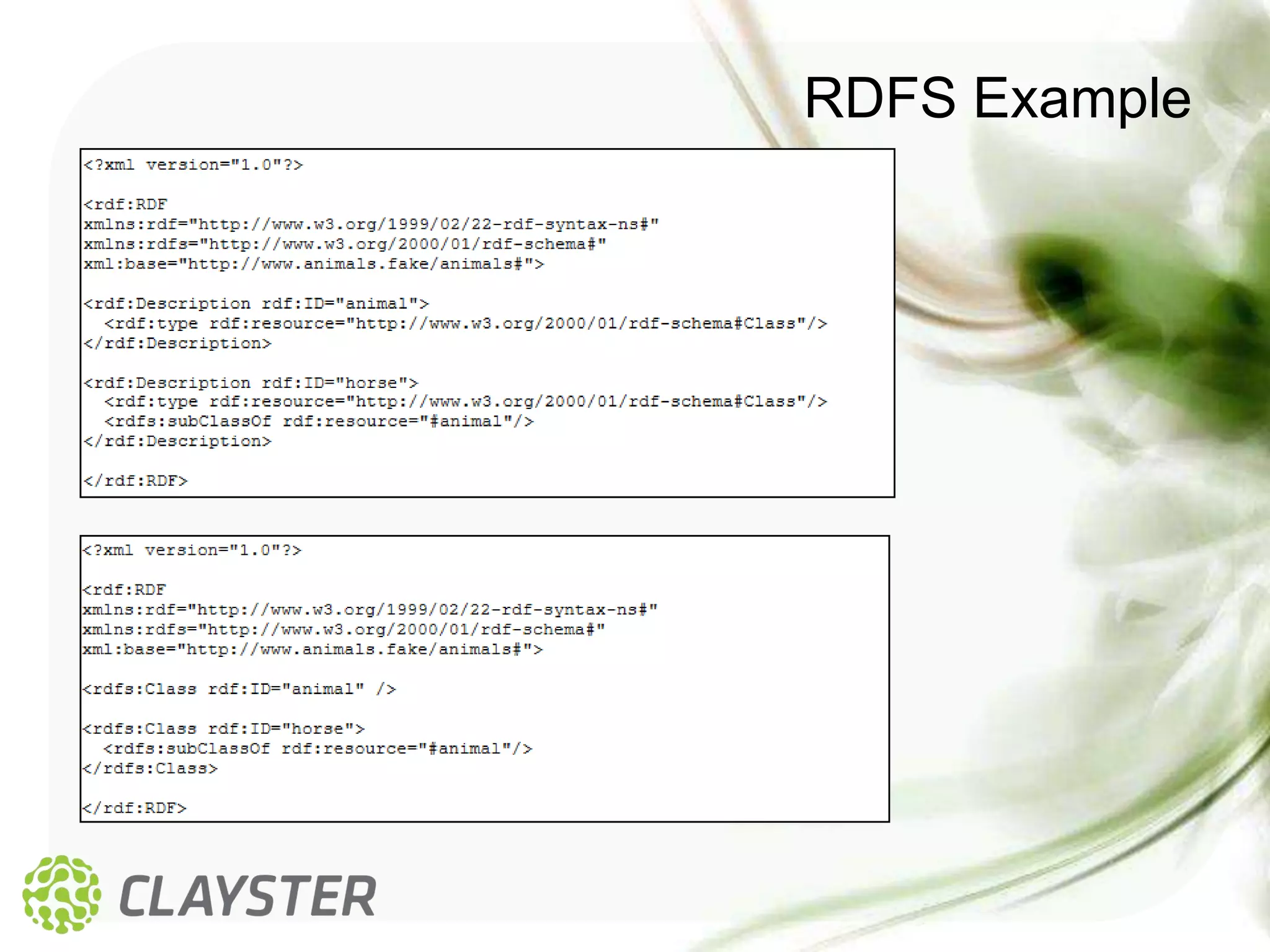
RDFS Example
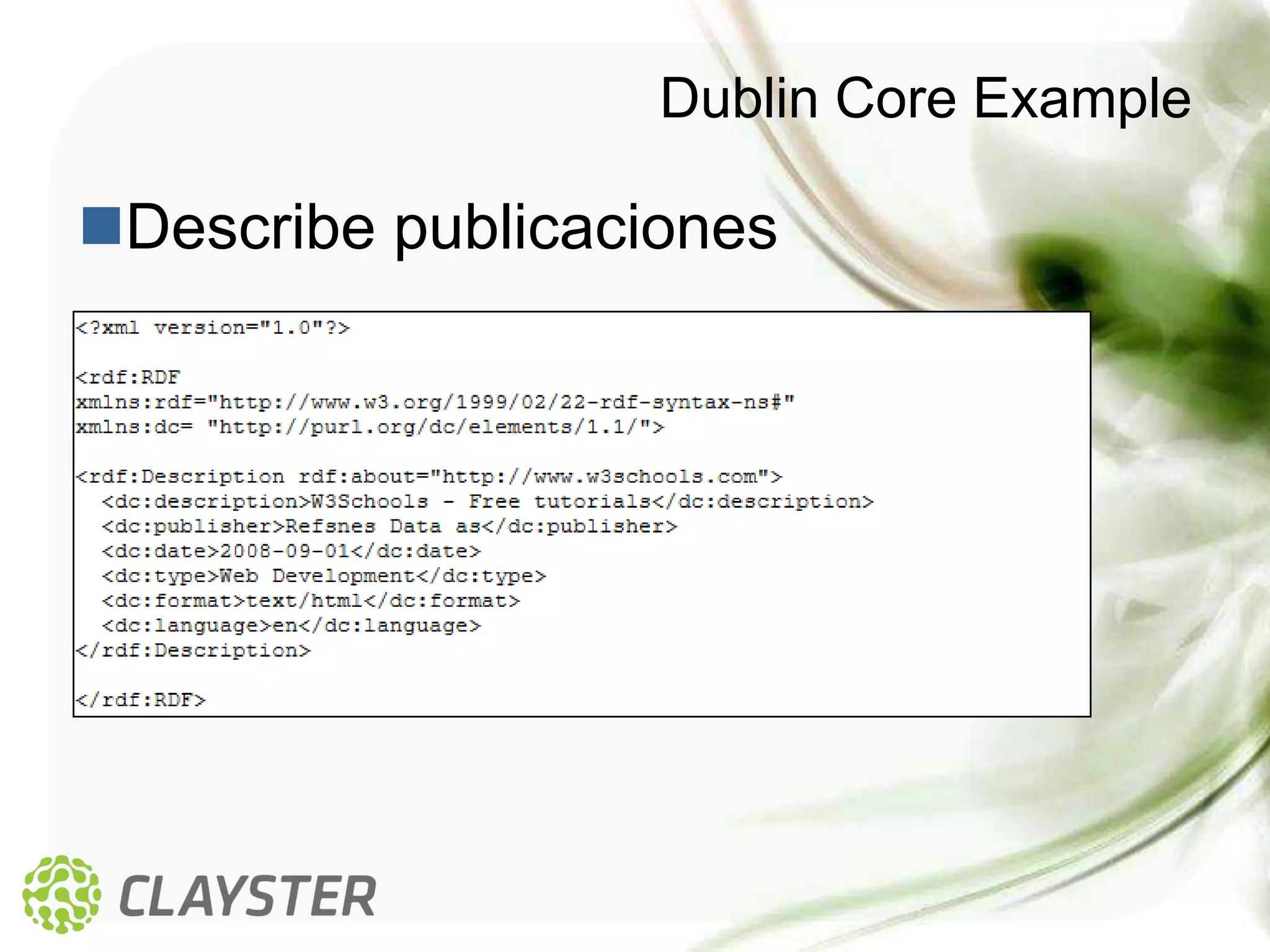
Dublin Core Example

Describe publicaciones
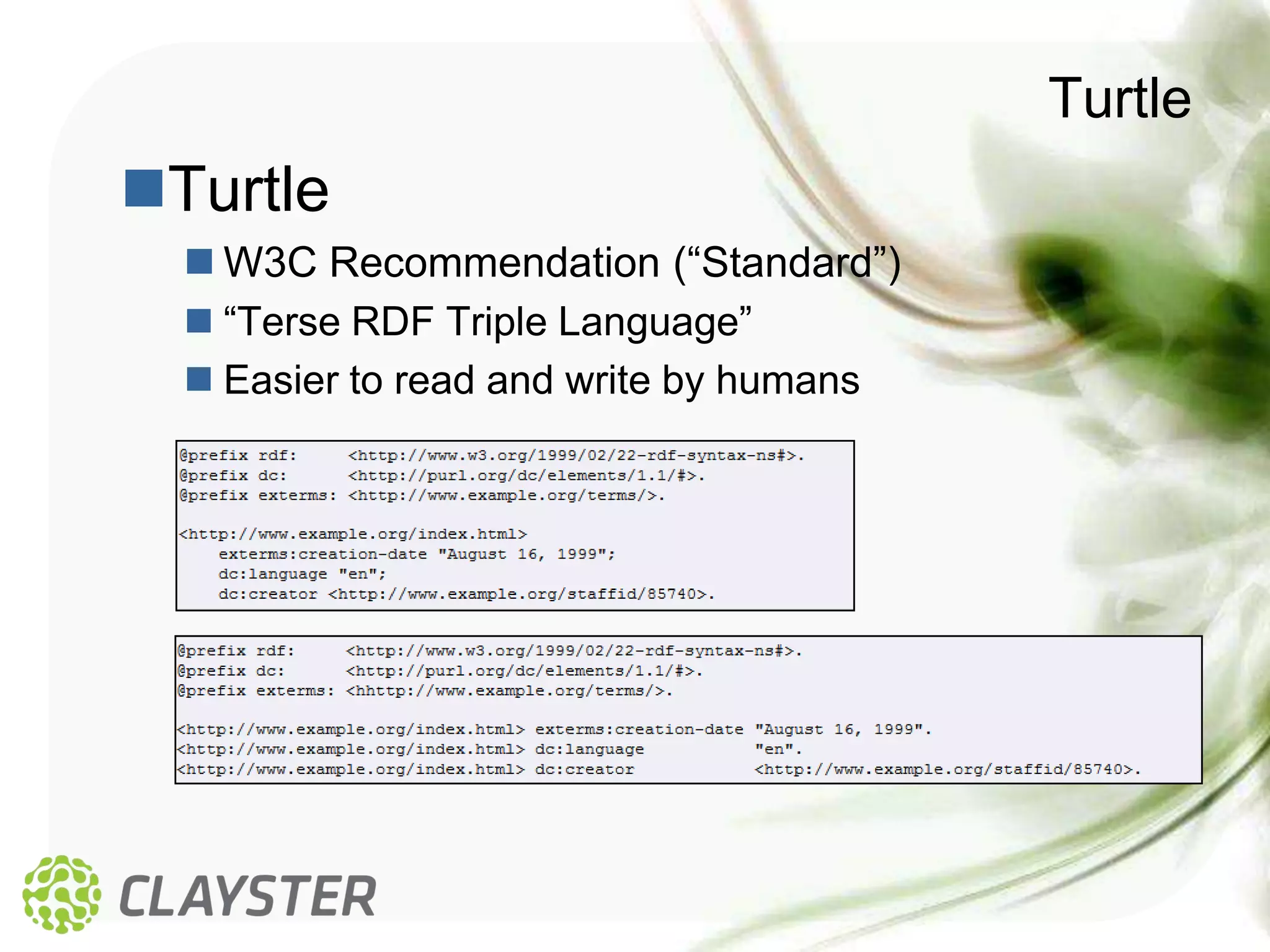
Turtle
Turtle
   W3C Recommendation (“Standard”)
   “Terse RDF Triple Language”
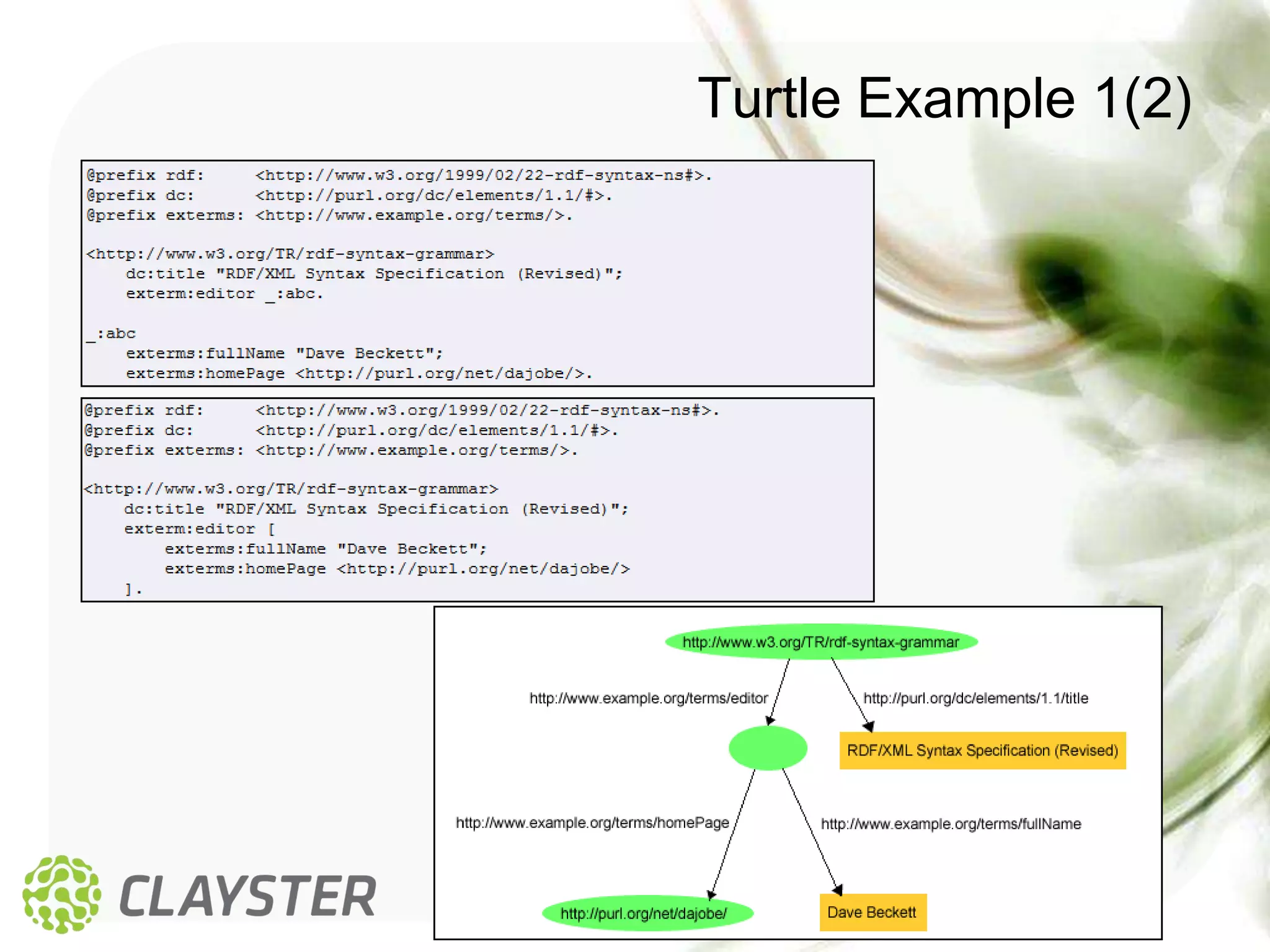
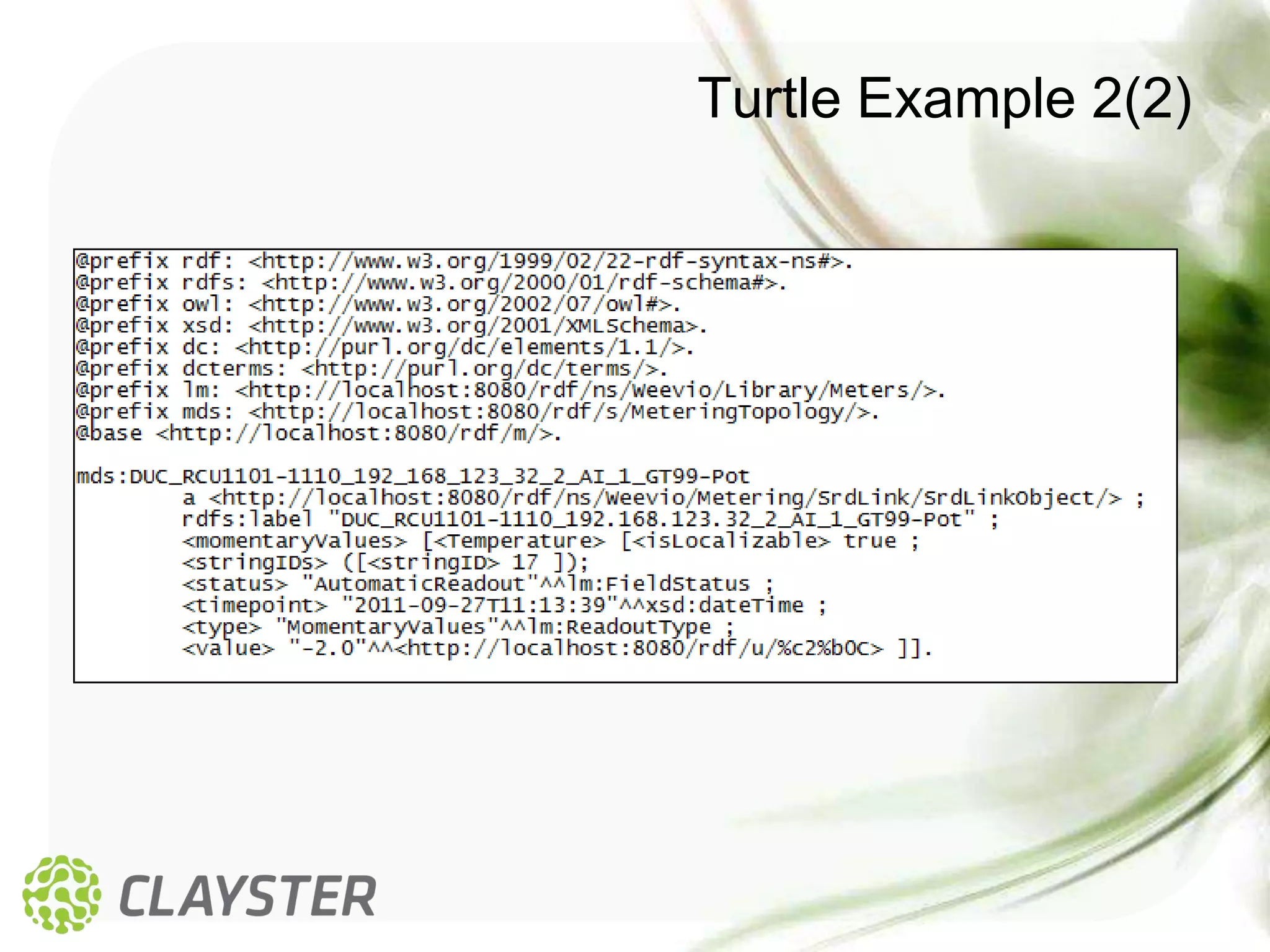
   Easier to read and write by humans
Turtle Example 1(2)
Turtle Example 2(2)
The previous example in RDF
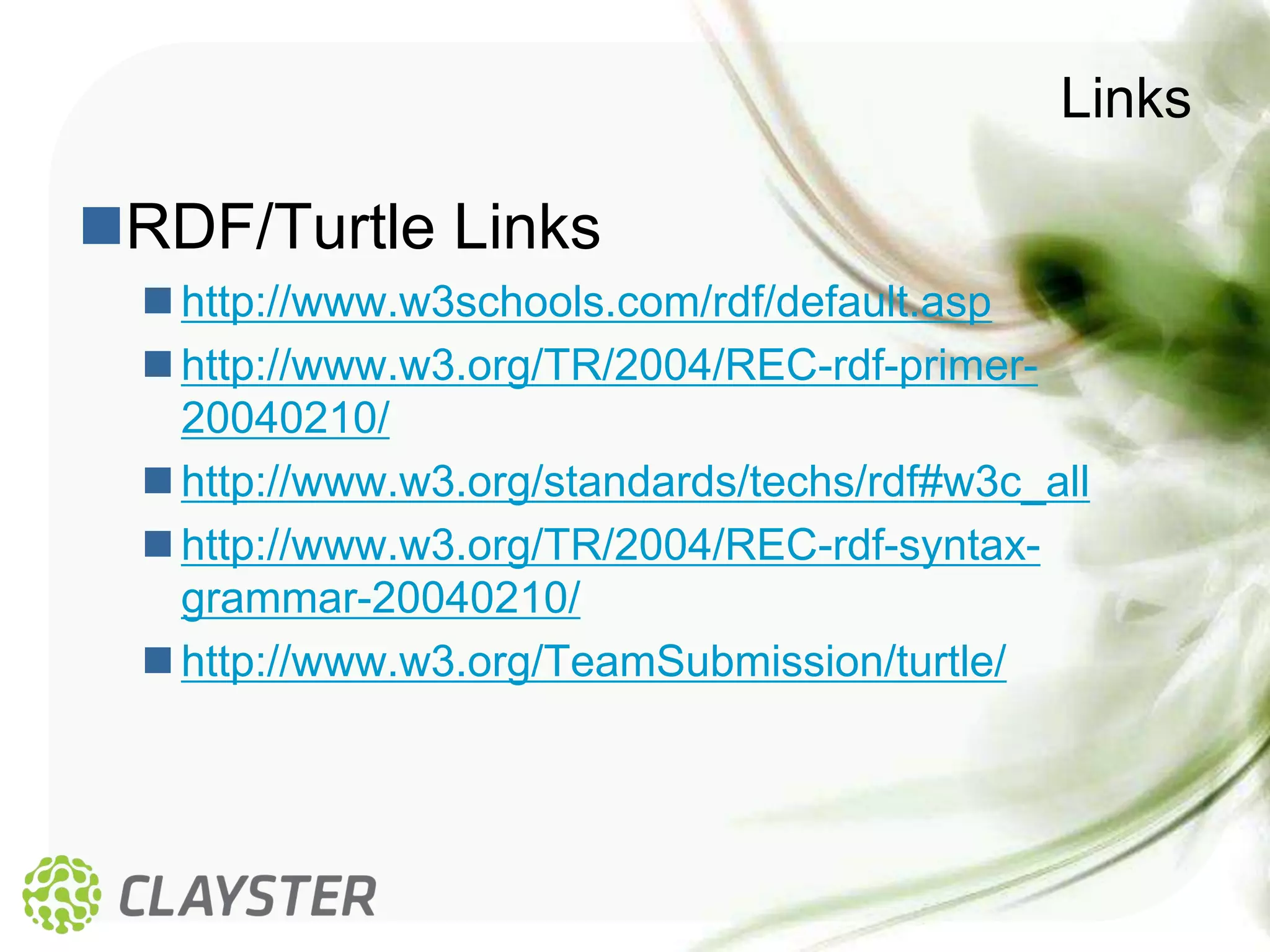
Links

RDF/Turtle Links
   http://www.w3schools.com/rdf/default.asp
   http://www.w3.org/TR/2004/REC-rdf-primer-
    20040210/
   http://www.w3.org/standards/techs/rdf#w3c_all
   http://www.w3.org/TR/2004/REC-rdf-syntax-
    grammar-20040210/
   http://www.w3.org/TeamSubmission/turtle/
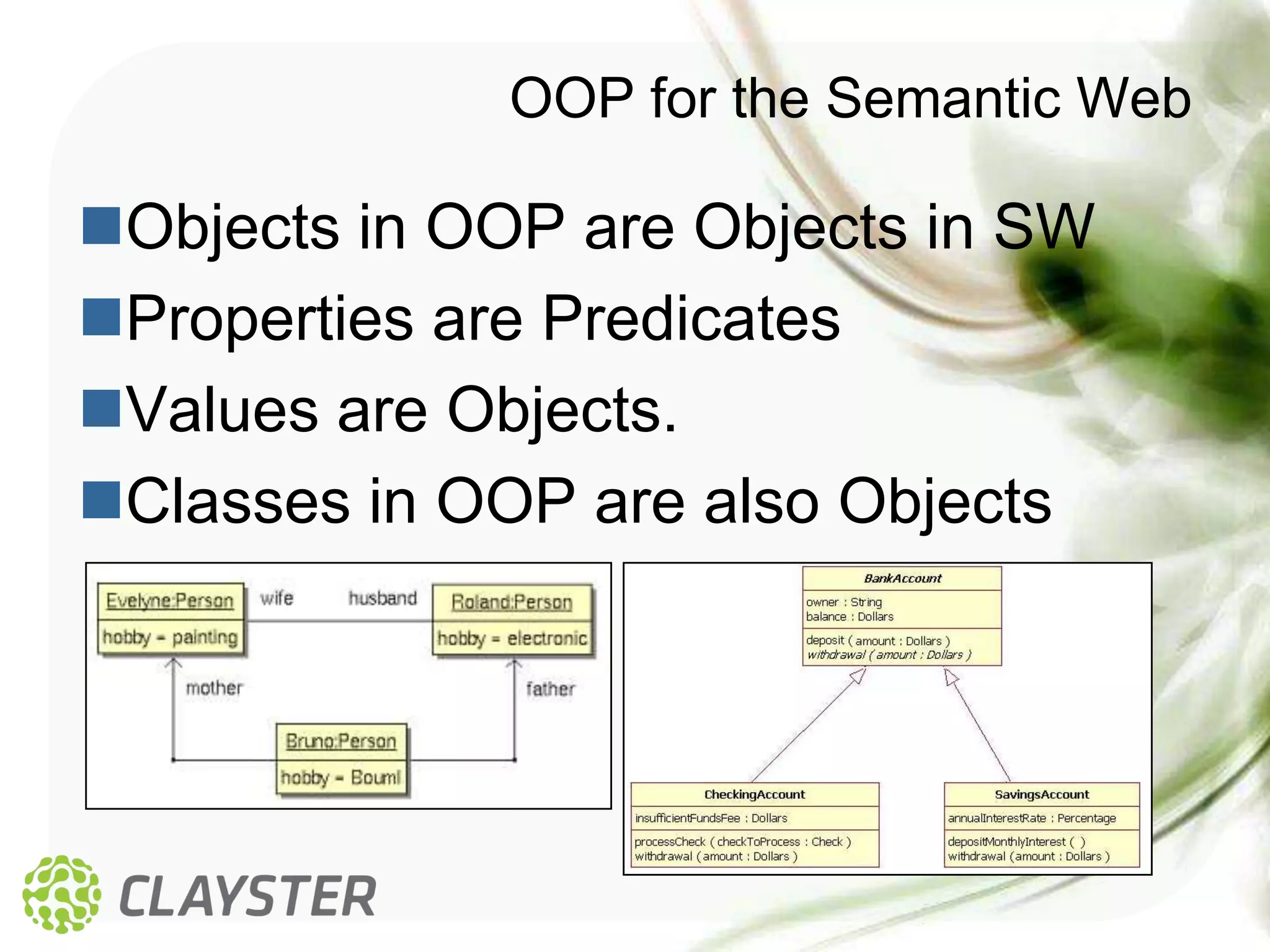
OOP for the Semantic Web

Objects in OOP are Objects in SW
Properties are Predicates
Values are Objects.
Classes in OOP are also Objects
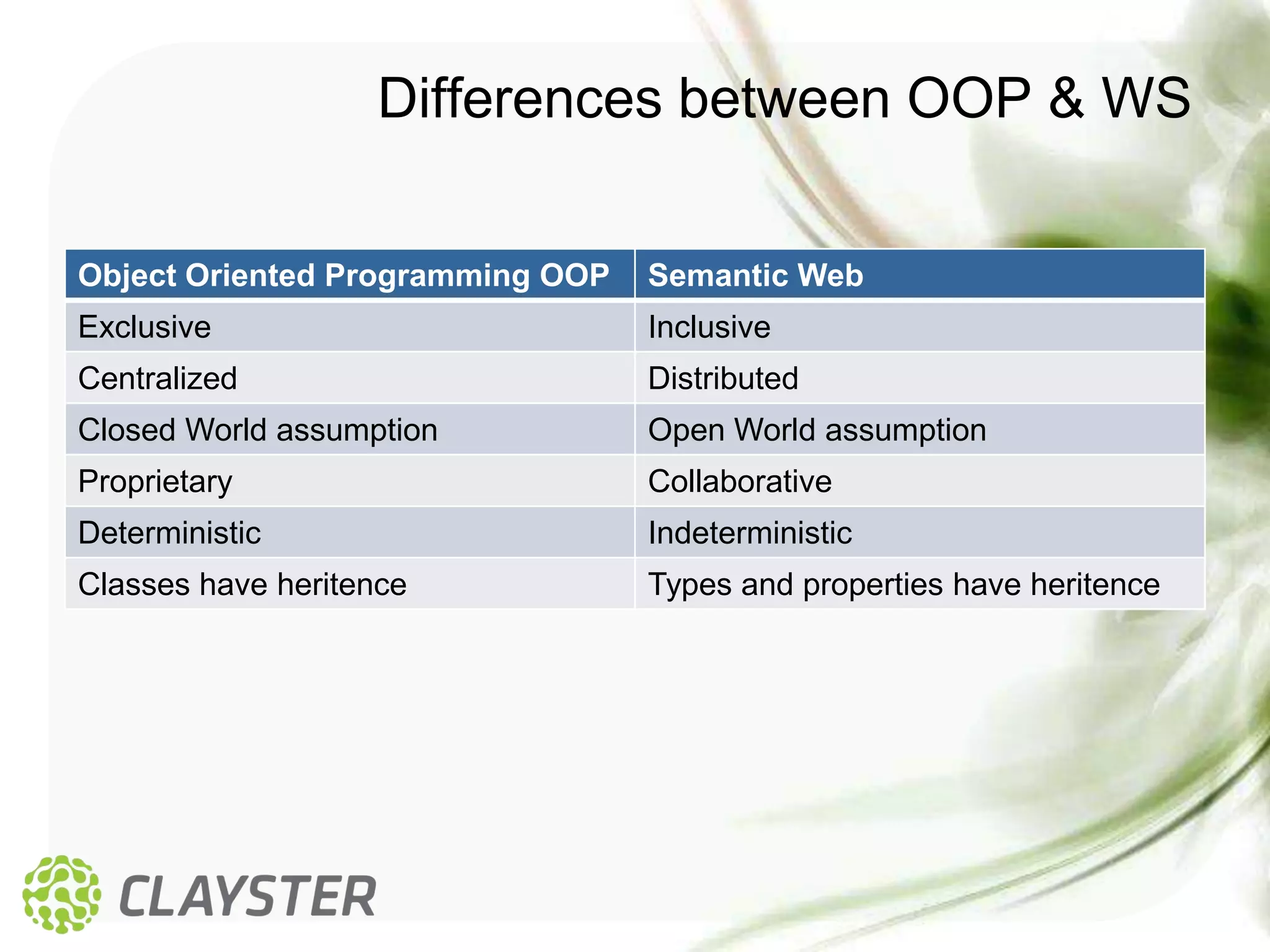
Differences between OOP & WS

Object Oriented Programming OOP   Semantic Web
Exclusive                         Inclusive
Centralized                       Distributed
Closed World assumption           Open World assumption
Proprietary                       Collaborative
Deterministic                     Indeterministic
Classes have heritence            Types and properties have heritence
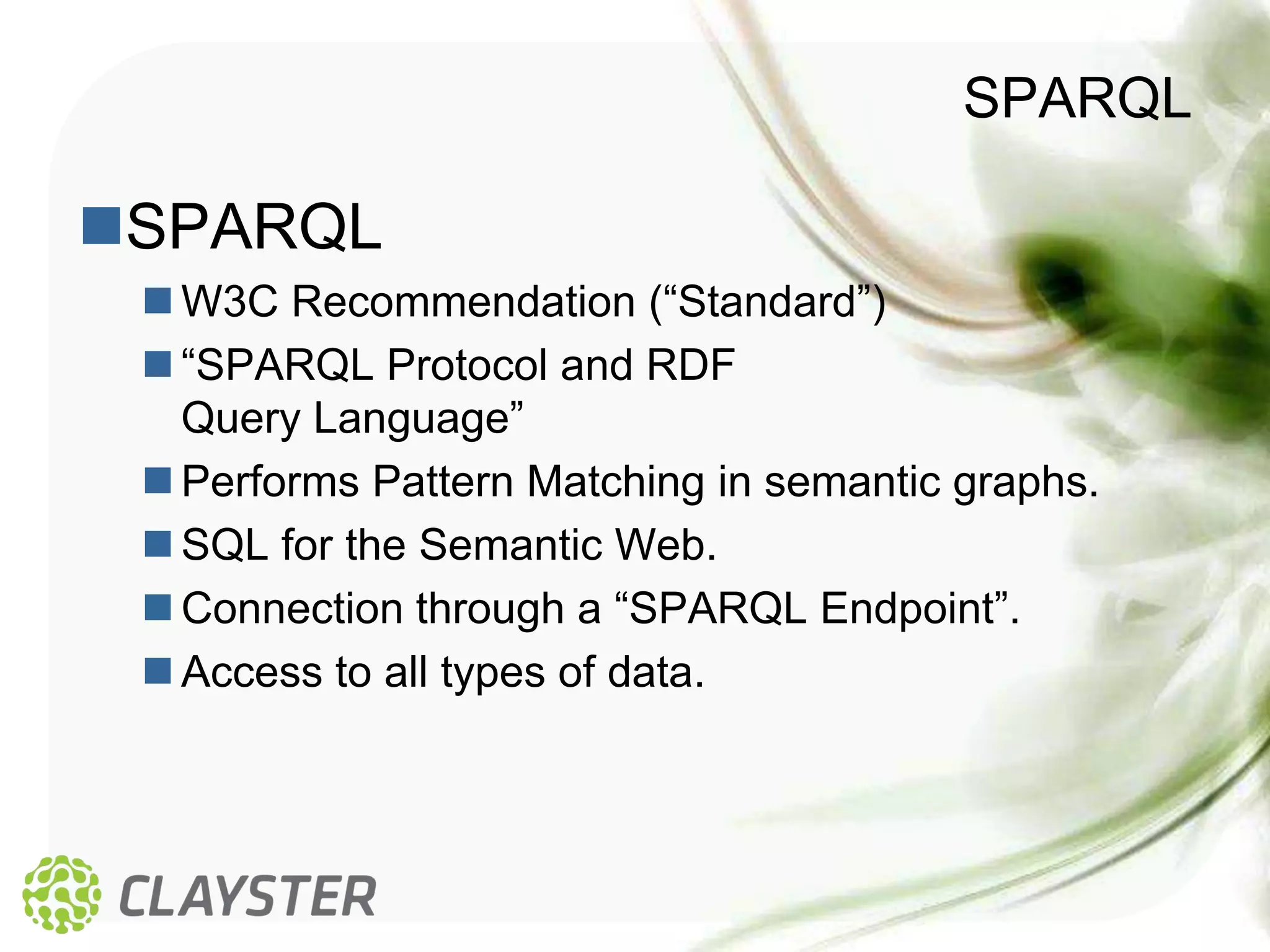
SPARQL

SPARQL
  W3C Recommendation (“Standard”)
  “SPARQL Protocol and RDF
   Query Language”
  Performs Pattern Matching in semantic graphs.
  SQL for the Semantic Web.
  Connection through a “SPARQL Endpoint”.
  Access to all types of data.
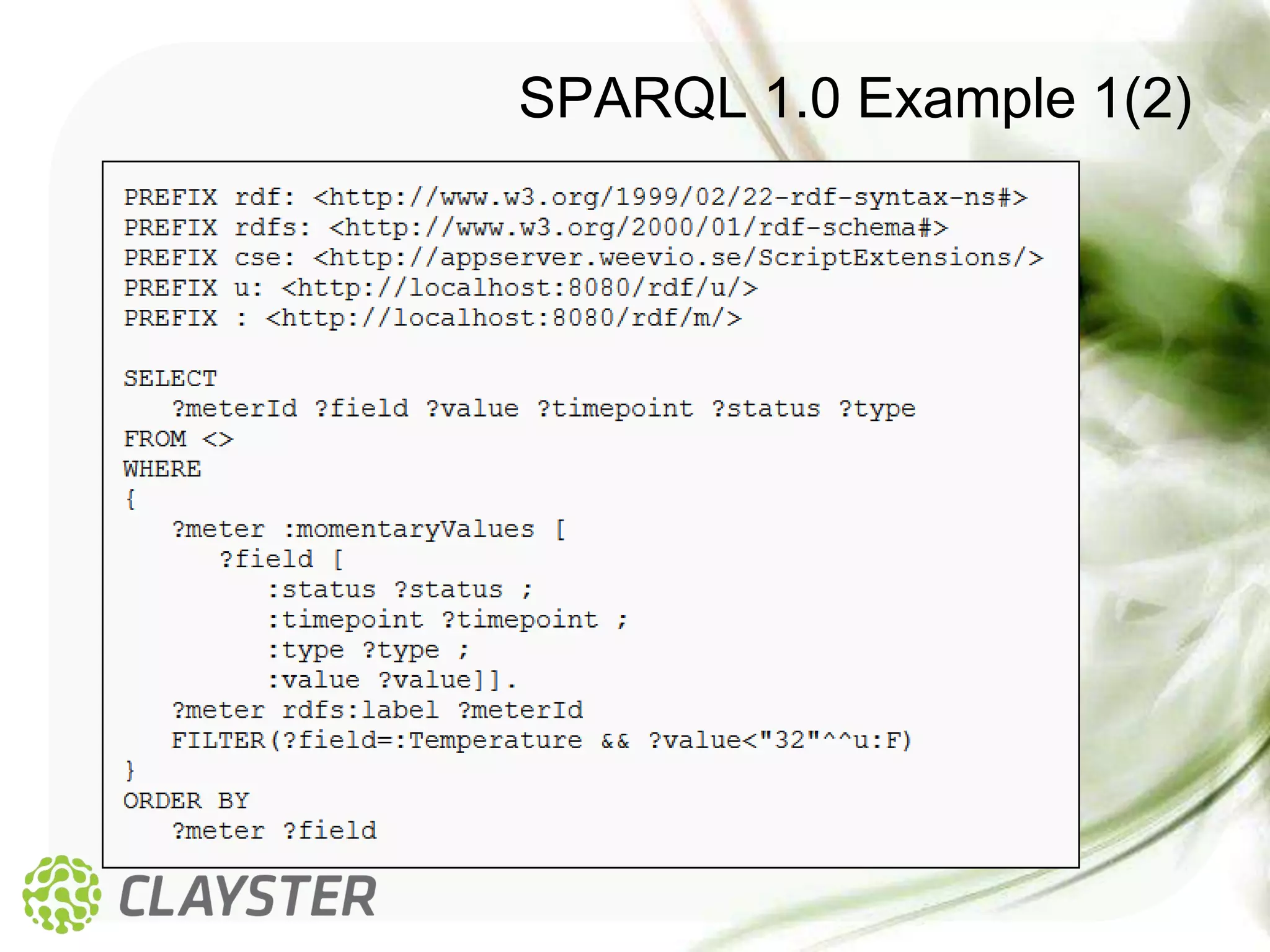
SPARQL 1.0 Example 1(2)
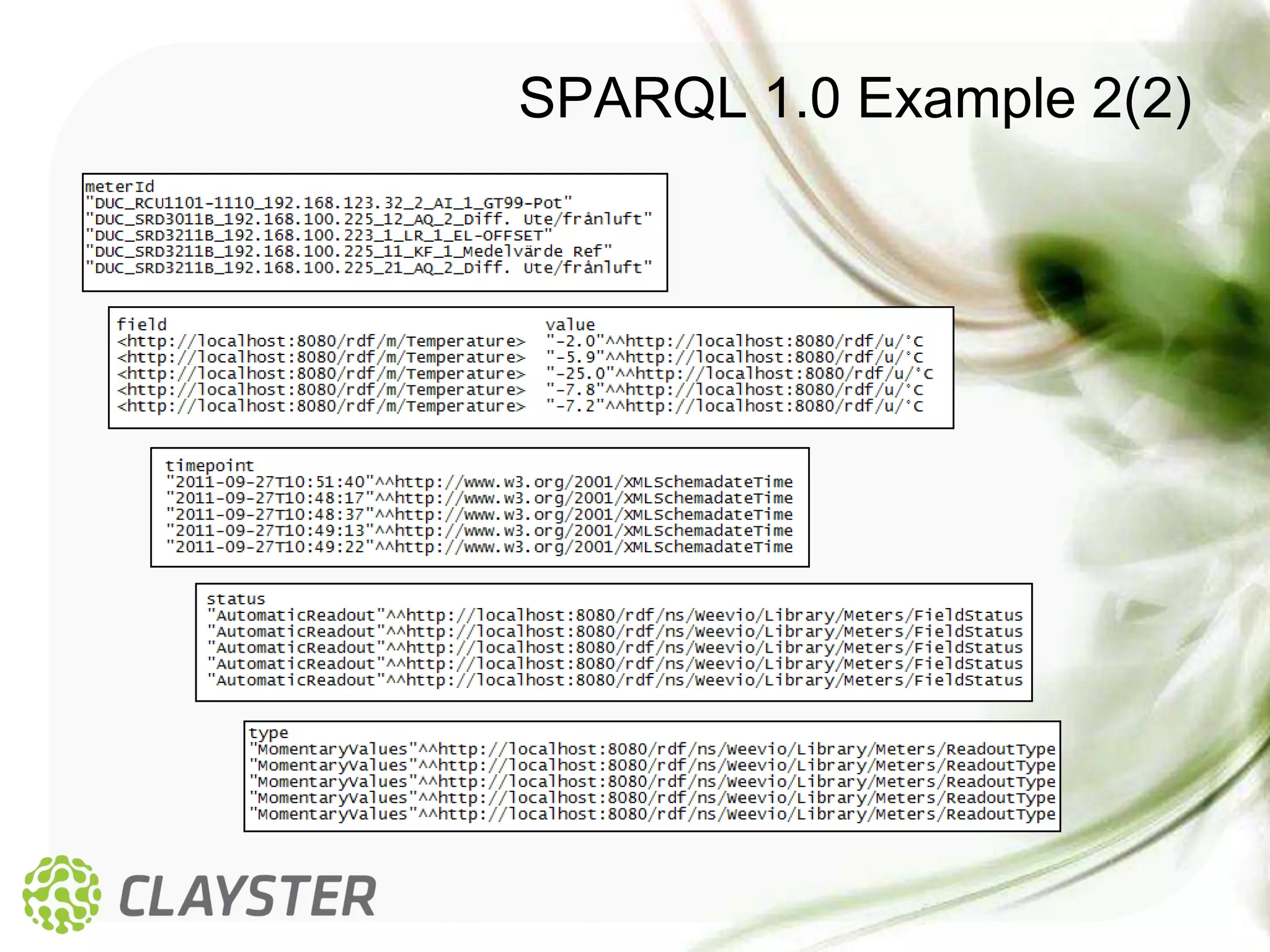
SPARQL 1.0 Example 2(2)
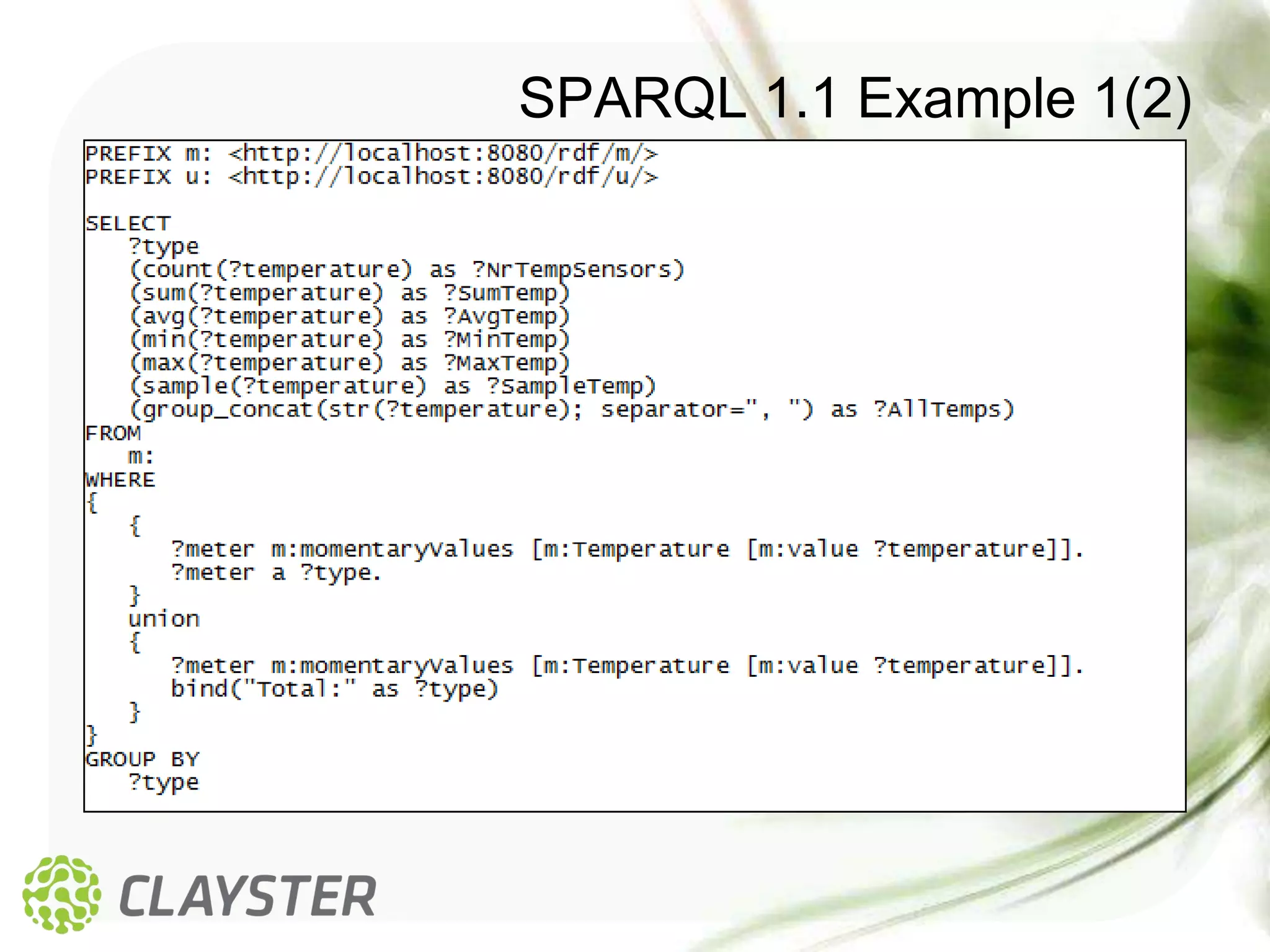
SPARQL 1.1 Example 1(2)
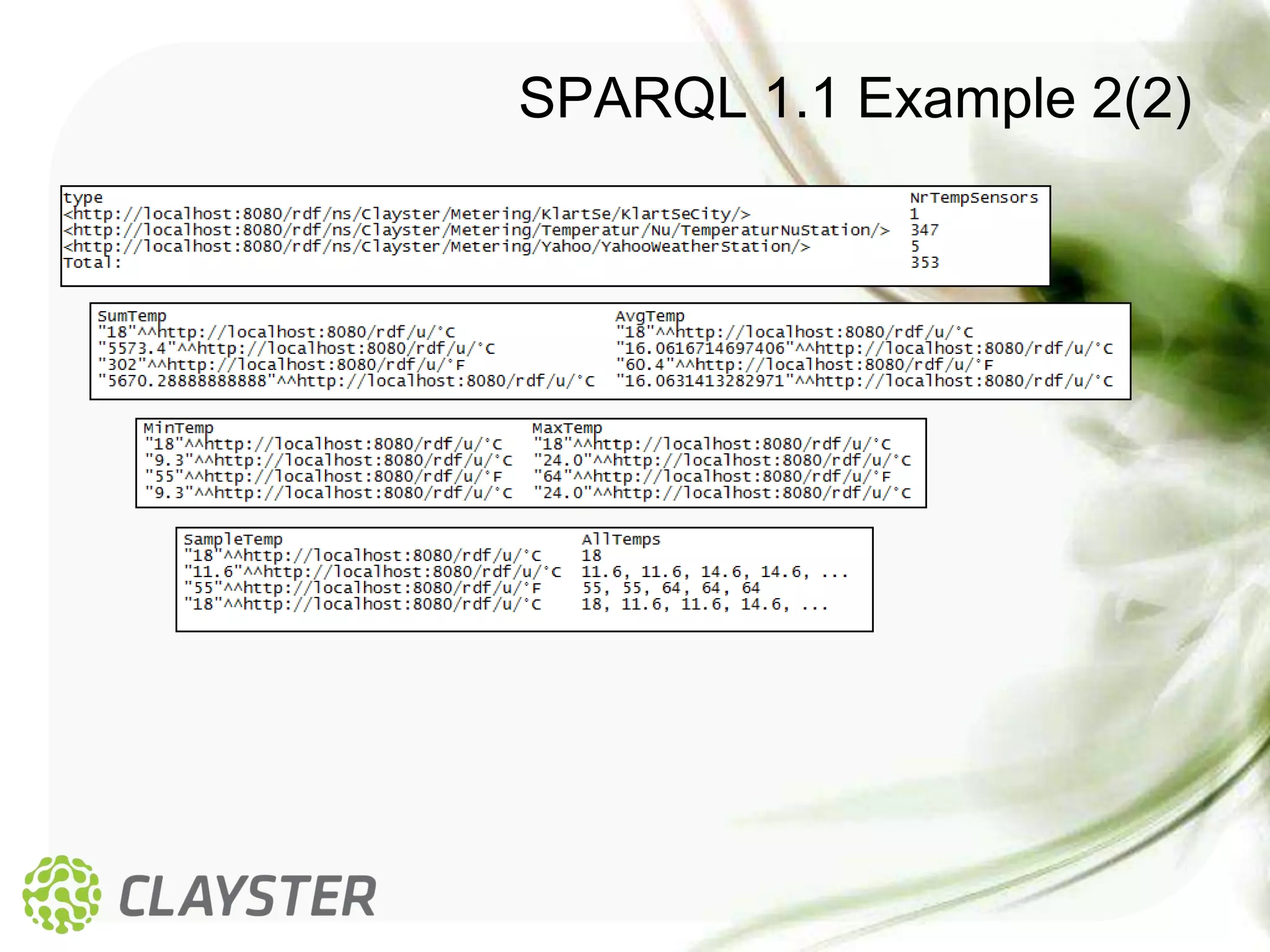
SPARQL 1.1 Example 2(2)
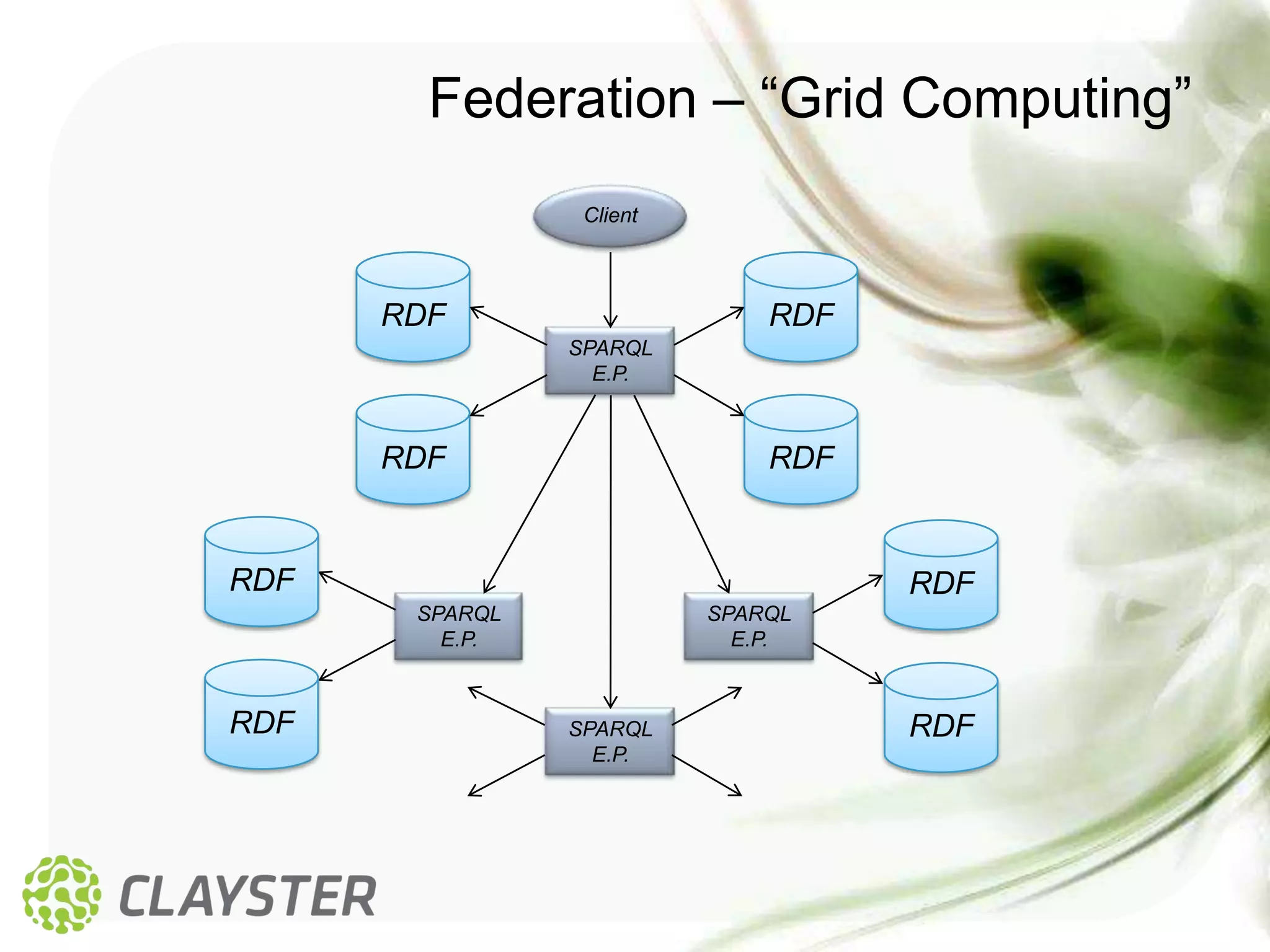
Federation – “Grid Computing”
                 Client


      RDF                     RDF
                SPARQL
                  E.P.


      RDF                     RDF


RDF                                 RDF
       SPARQL             SPARQL
         E.P.               E.P.


RDF             SPARQL              RDF
                  E.P.
Links

SPARQL Links
  http://www.w3.org/TR/sparql11-query/
  http://www.w3.org/TR/2008/REC-rdf-sparql-query-
   20080115/
  http://www.w3.org/TR/2008/REC-rdf-sparql-
   protocol-20080115/
  http://www.w3.org/TR/2008/REC-rdf-sparql-
   XMLres-20080115/
  http://www.w3.org/standards/techs/sparql#w3c_all
  http://www.w3.org/wiki/SparqlEndpoints
  http://dbpedia.org/sparql
RIF

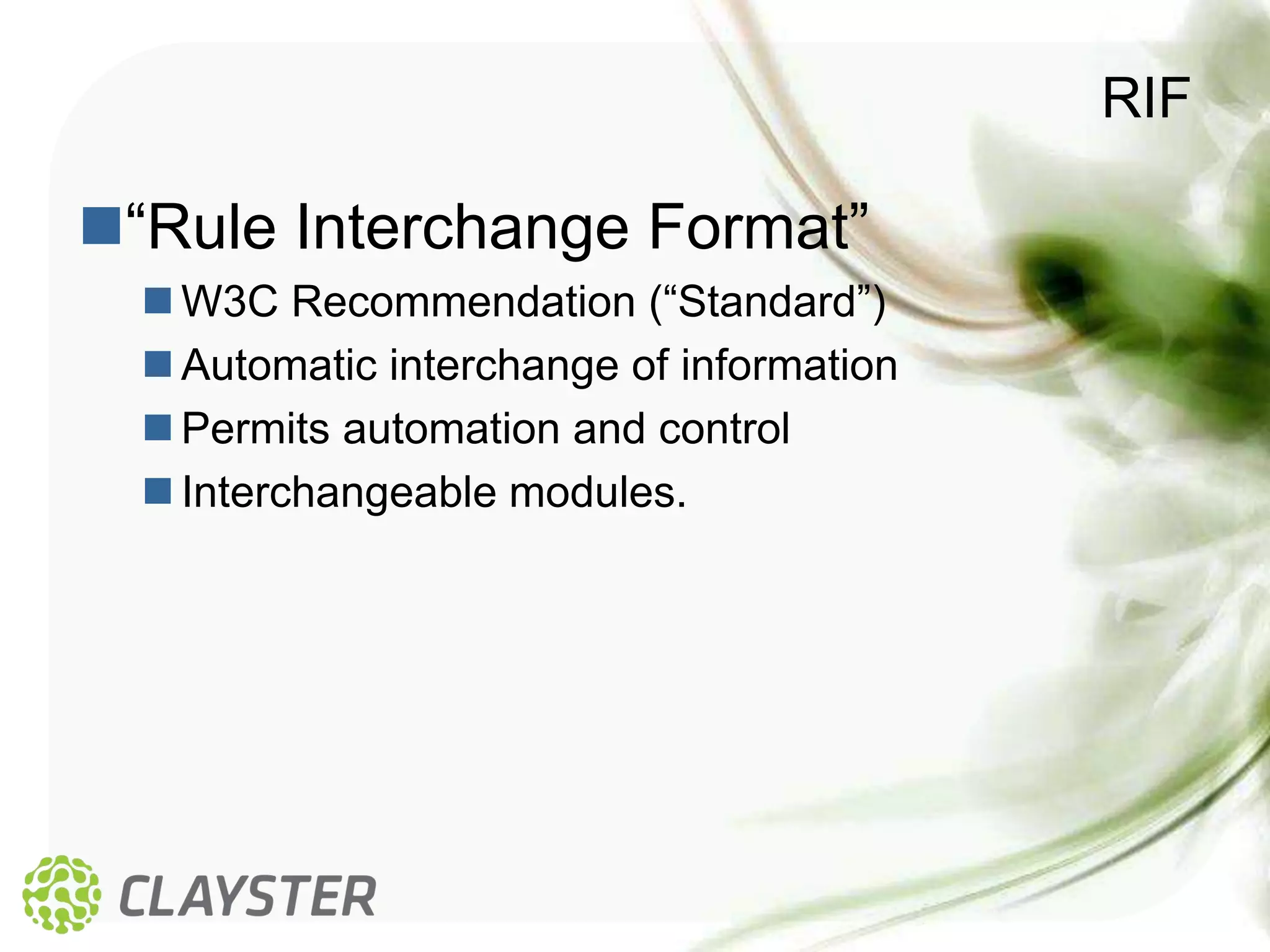
“Rule Interchange Format”
   W3C Recommendation (“Standard”)
   Automatic interchange of information
   Permits automation and control
   Interchangeable modules.
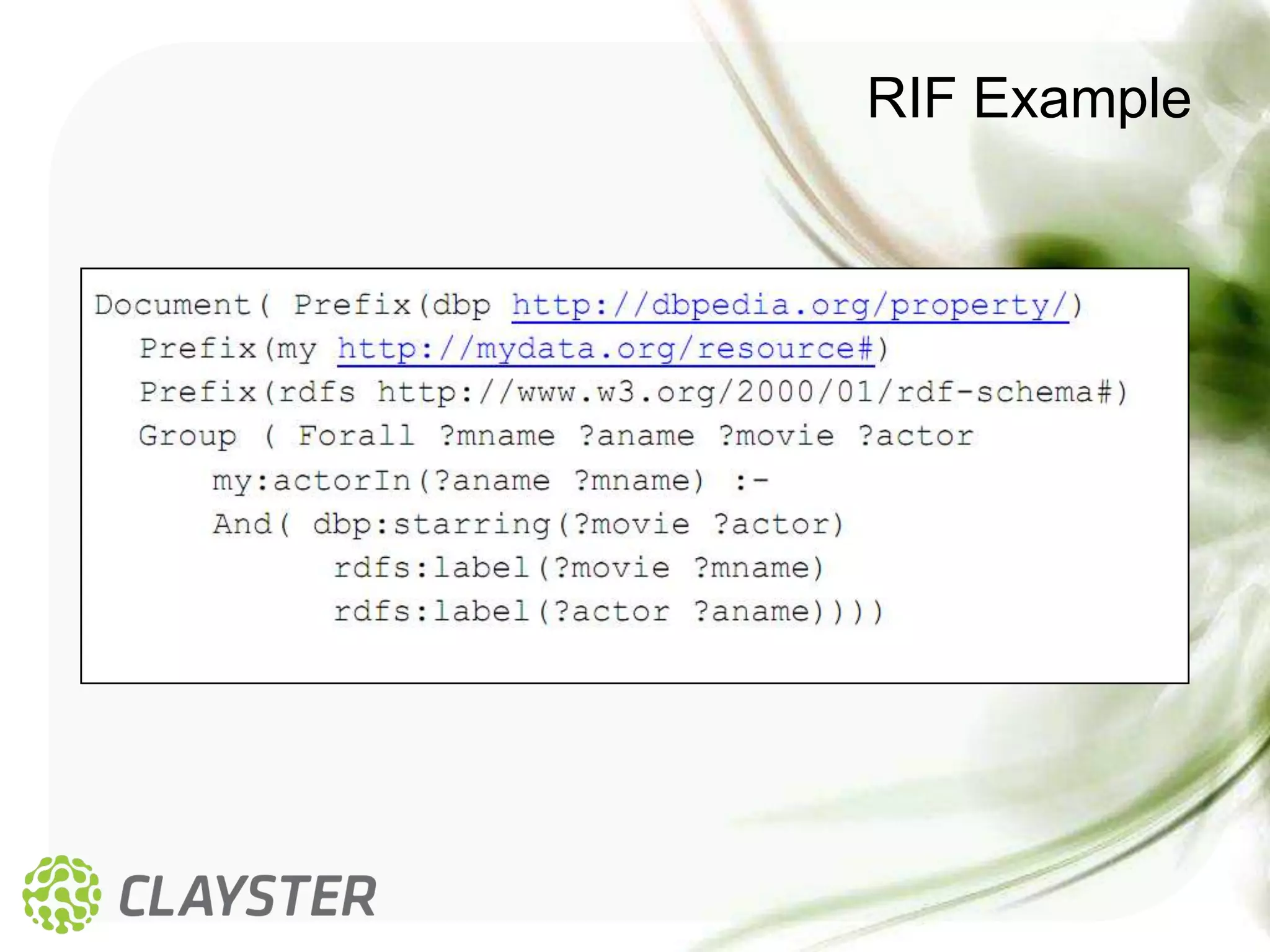
RIF Example
Links

RIF Links
   http://www.w3.org/TR/2010/NOTE-rif-overview-
    20100622/
   http://www.w3.org/TR/2010/REC-rif-core-
    20100622/
   http://www.w3.org/2005/rules/wiki/images/b/b0/W3
    C_RIF-CW-9-09.pdf
   http://www.w3.org/2005/rules/wiki/RIF_Working_Gr
    oup
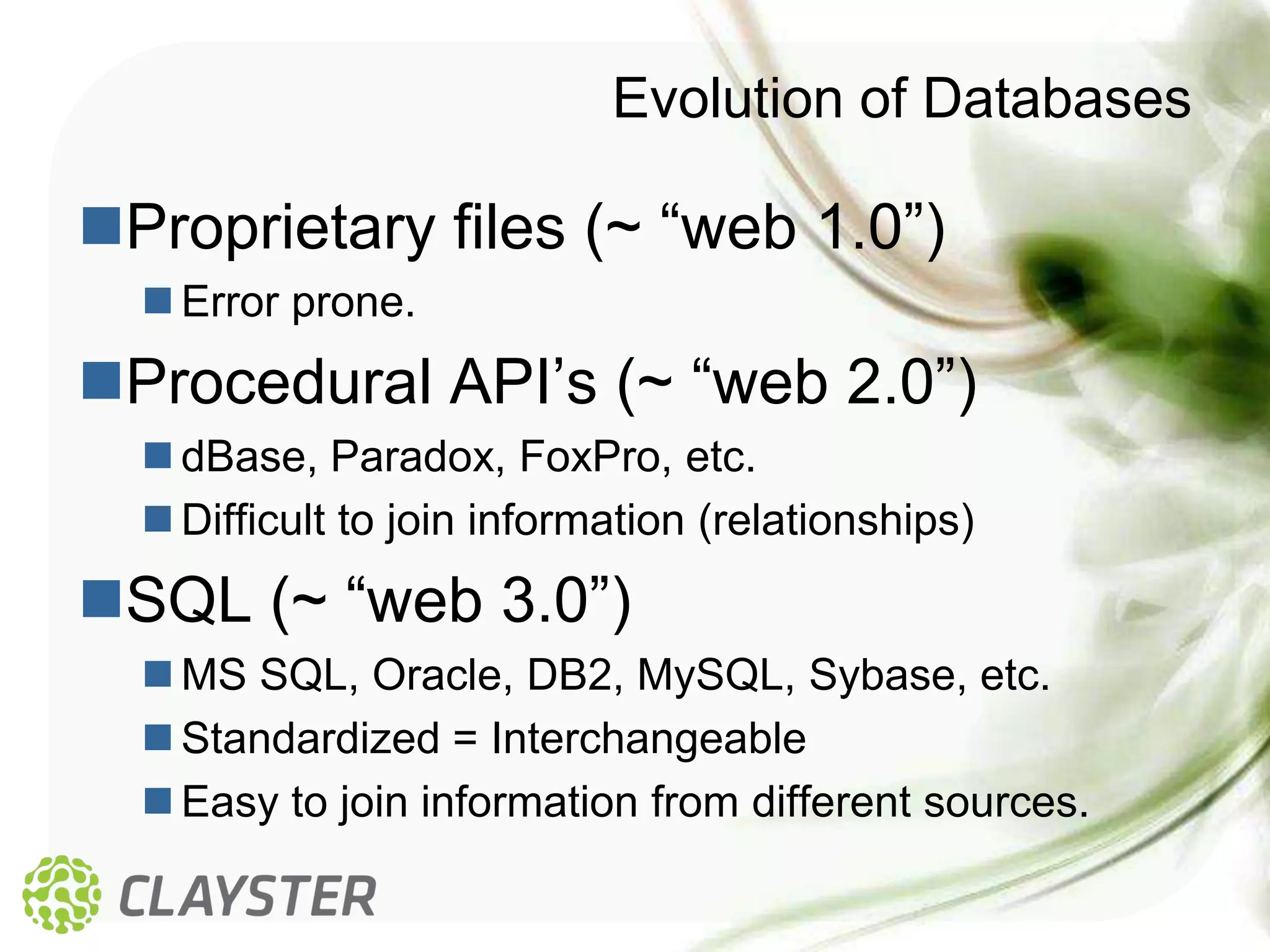
Evolution of Databases

Proprietary files (~ “web 1.0”)
   Error prone.
Procedural API’s (~ “web 2.0”)
   dBase, Paradox, FoxPro, etc.
   Difficult to join information (relationships)
SQL (~ “web 3.0”)
   MS SQL, Oracle, DB2, MySQL, Sybase, etc.
   Standardized = Interchangeable
   Easy to join information from different sources.
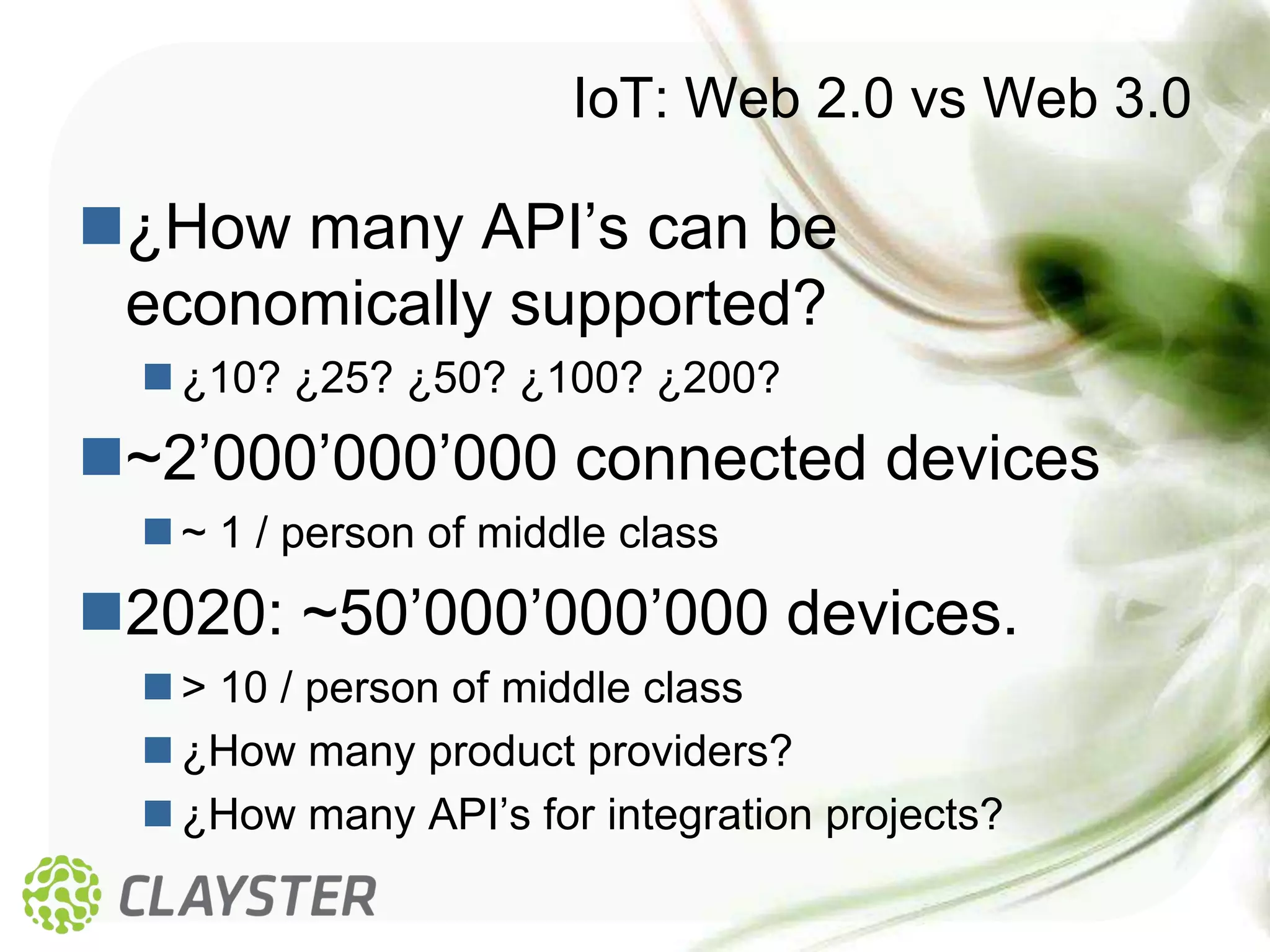
IoT: Web 2.0 vs Web 3.0

¿How many API’s can be
 economically supported?
   ¿10? ¿25? ¿50? ¿100? ¿200?
~2’000’000’000 connected devices
   ~ 1 / person of middle class
2020: ~50’000’000’000 devices.
   > 10 / person of middle class
   ¿How many product providers?
   ¿How many API’s for integration projects?
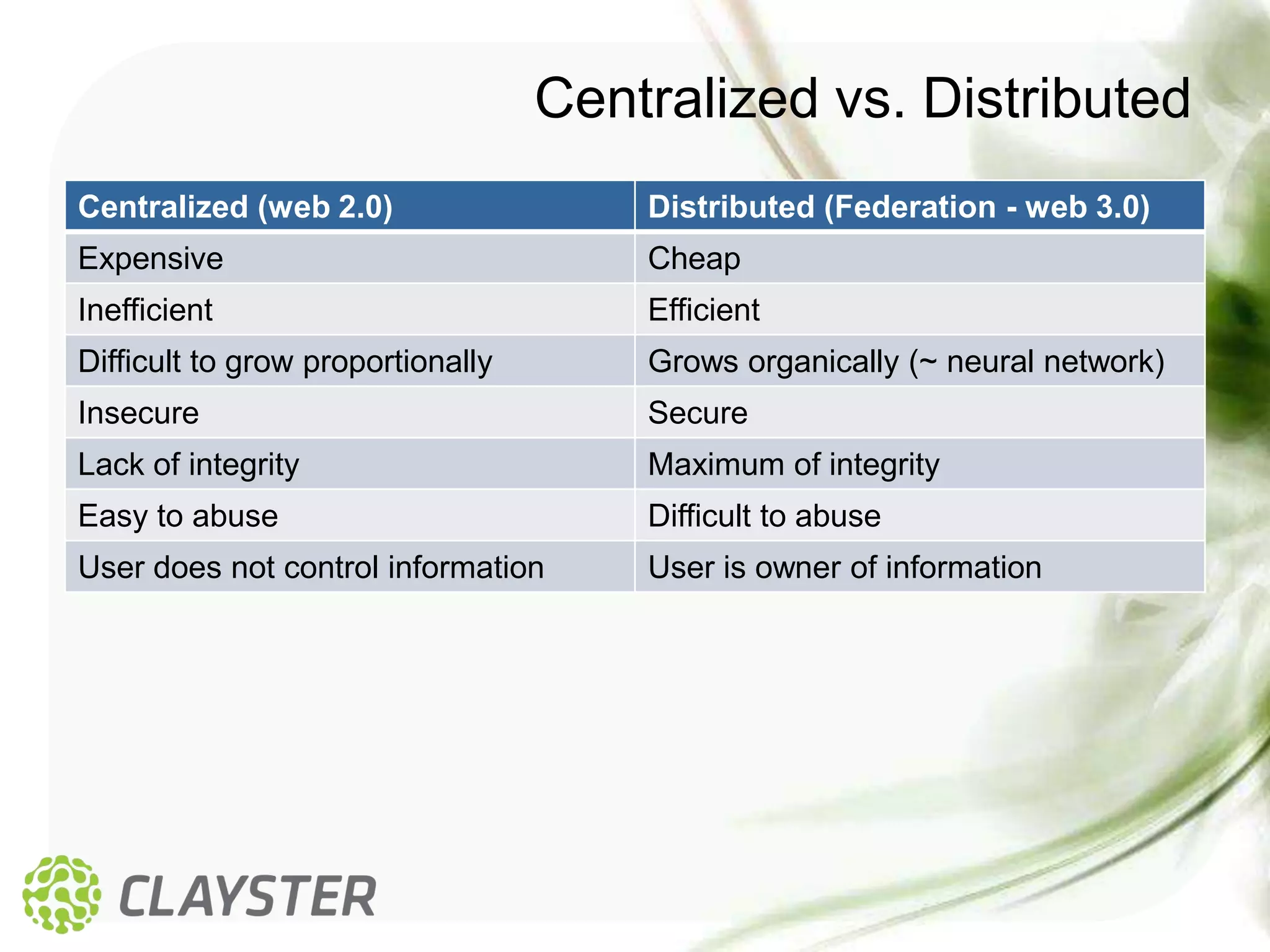
Centralized vs. Distributed
Centralized (web 2.0)                  Distributed (Federation - web 3.0)
Expensive                              Cheap
Inefficient                            Efficient
Difficult to grow proportionally       Grows organically (~ neural network)
Insecure                               Secure
Lack of integrity                      Maximum of integrity
Easy to abuse                          Difficult to abuse
User does not control information      User is owner of information
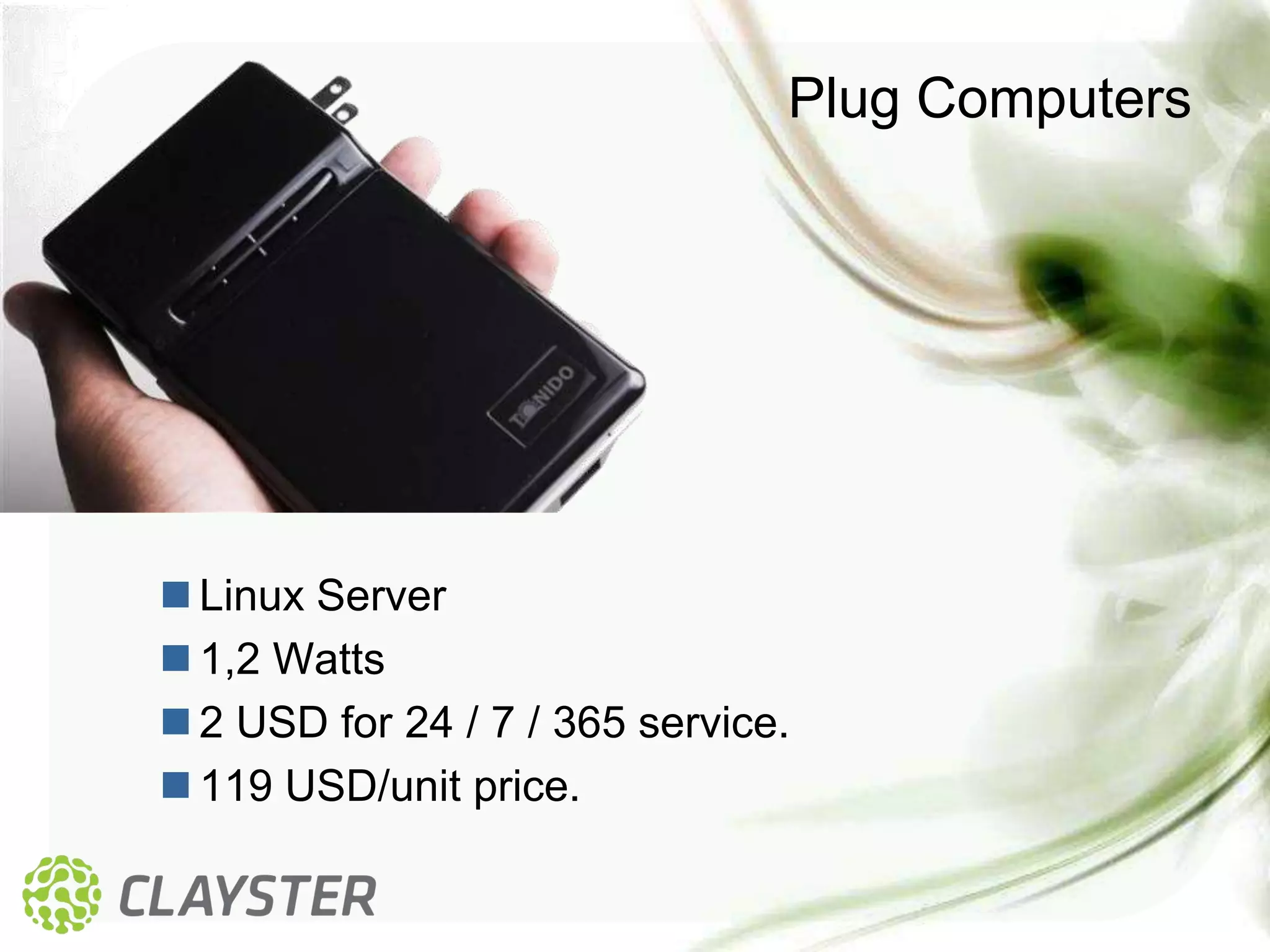
Plug Computers


 Linux Server
 1,2 Watts
 2 USD for 24 / 7 / 365 service.
 119 USD/unit price.
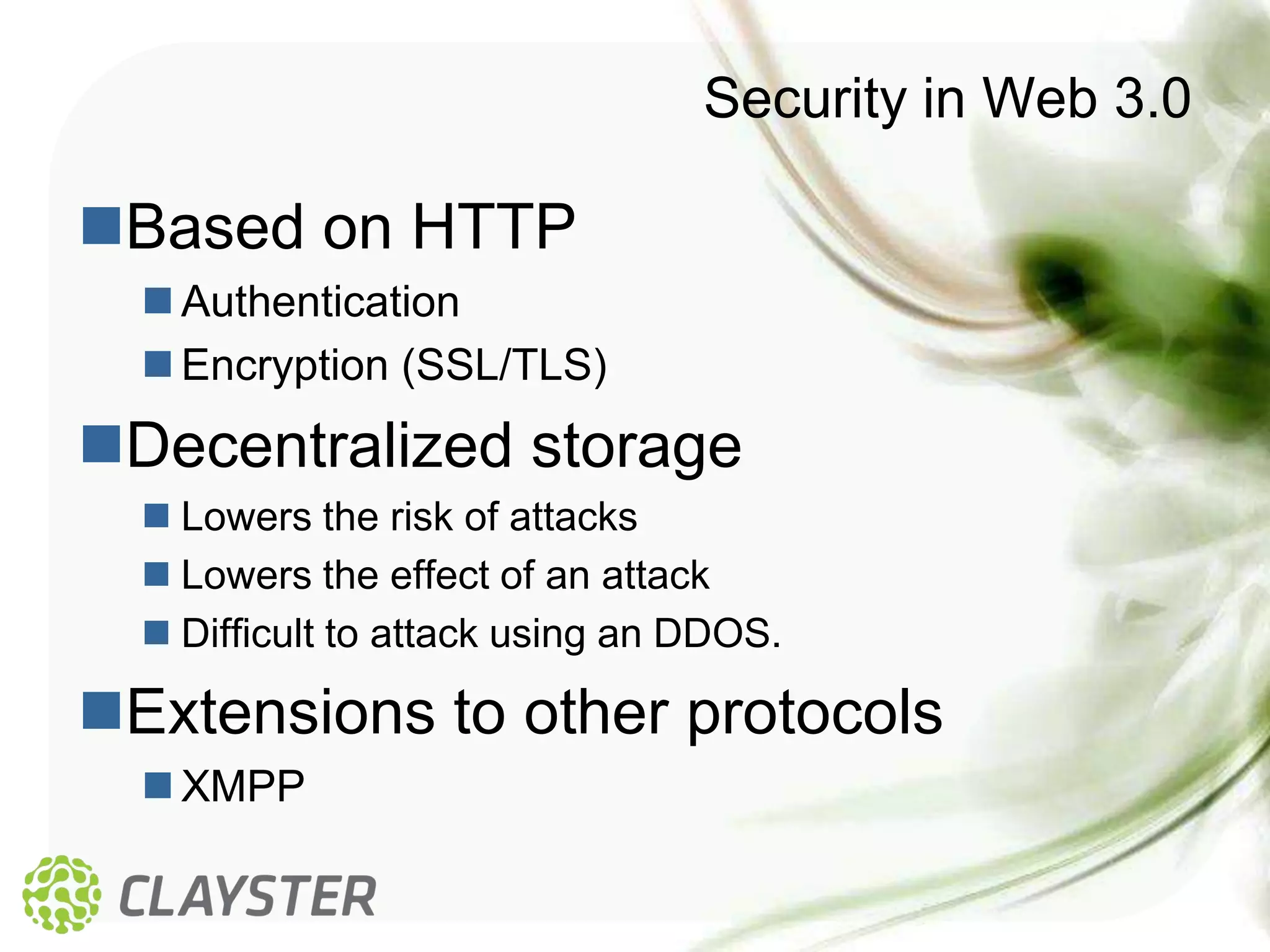
Security in Web 3.0

Based on HTTP
   Authentication
   Encryption (SSL/TLS)
Decentralized storage
   Lowers the risk of attacks
   Lowers the effect of an attack
   Difficult to attack using an DDOS.

Extensions to other protocols
   XMPP
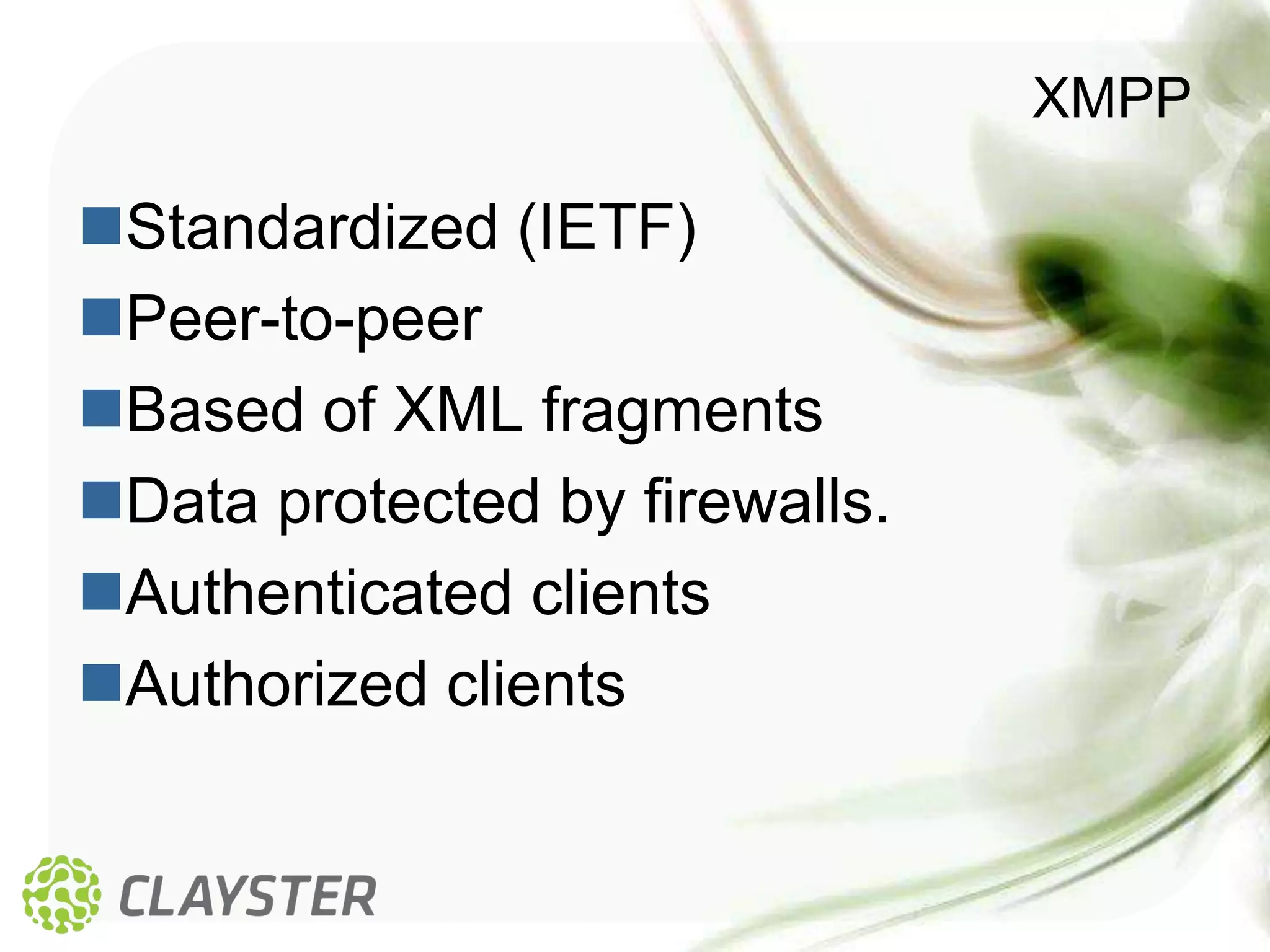
XMPP

Standardized (IETF)
Peer-to-peer
Based of XML fragments
Data protected by firewalls.
Authenticated clients
Authorized clients
Advantages with IETF, W3C, XSF

Replaceable components
Lowers the cost
Permits interchange of information
Permits a mixture of providers
Power shifts to client
Creates a new infrastructure
Permits new business models
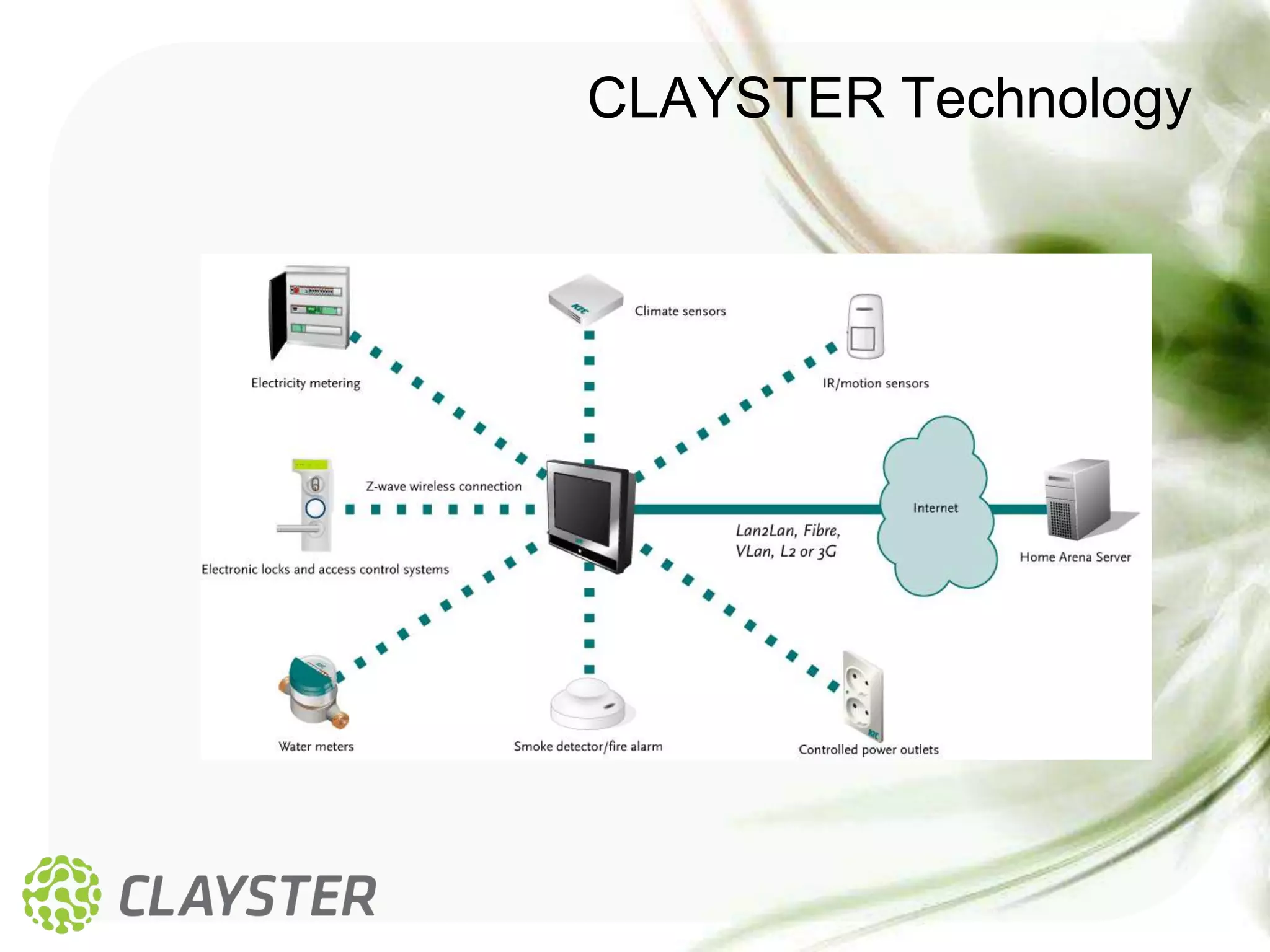
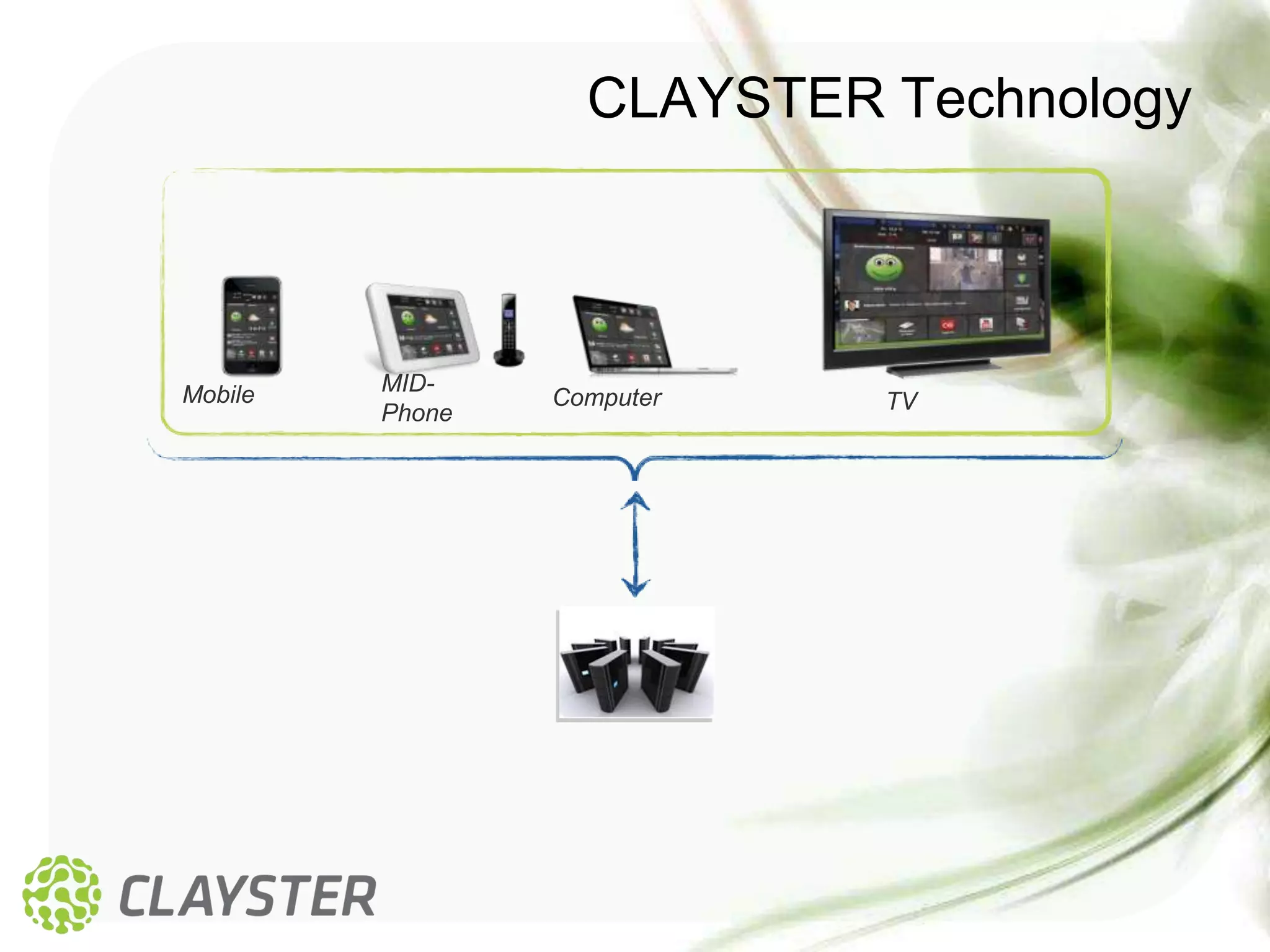
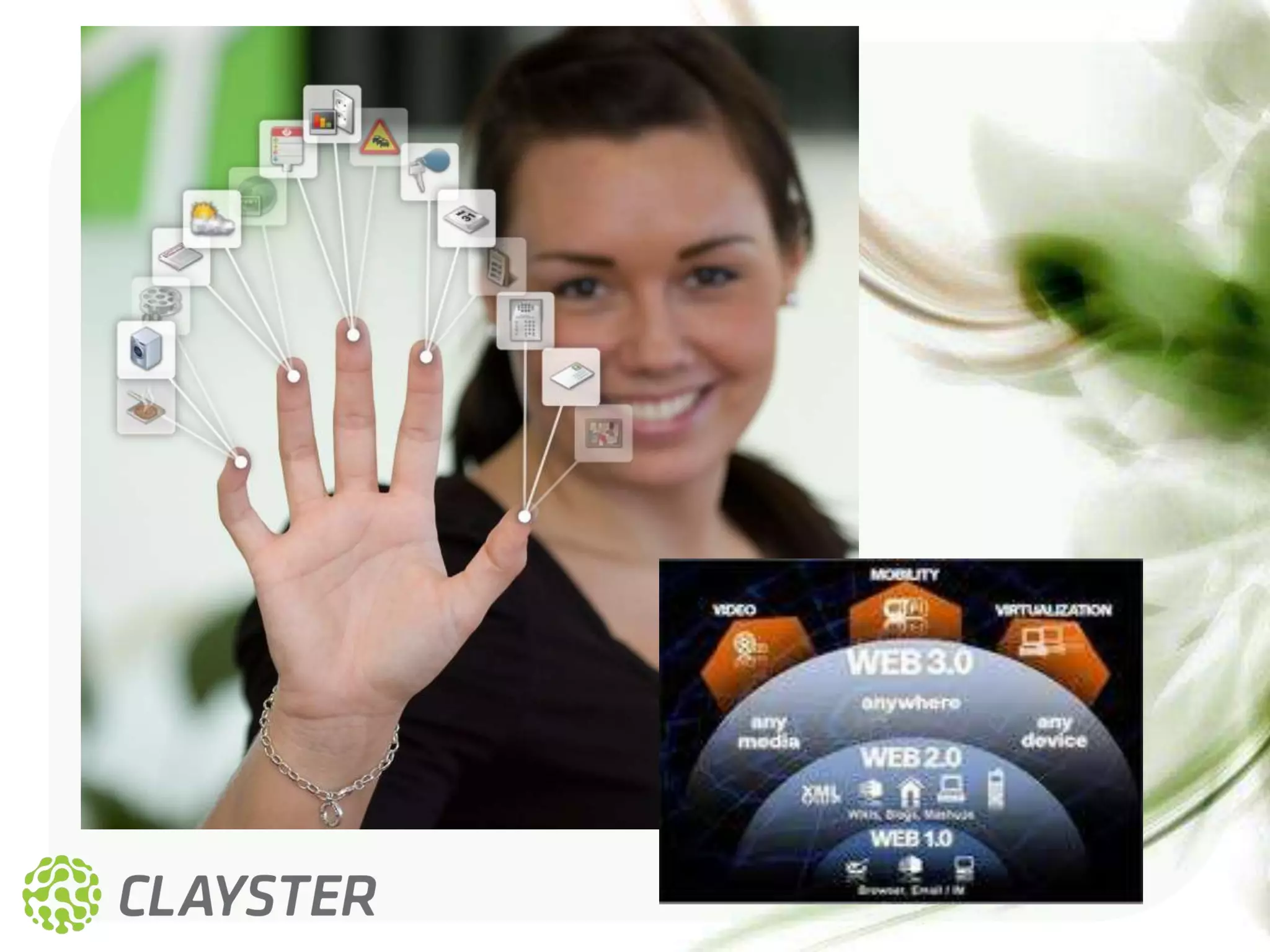
CLAYSTER Technology
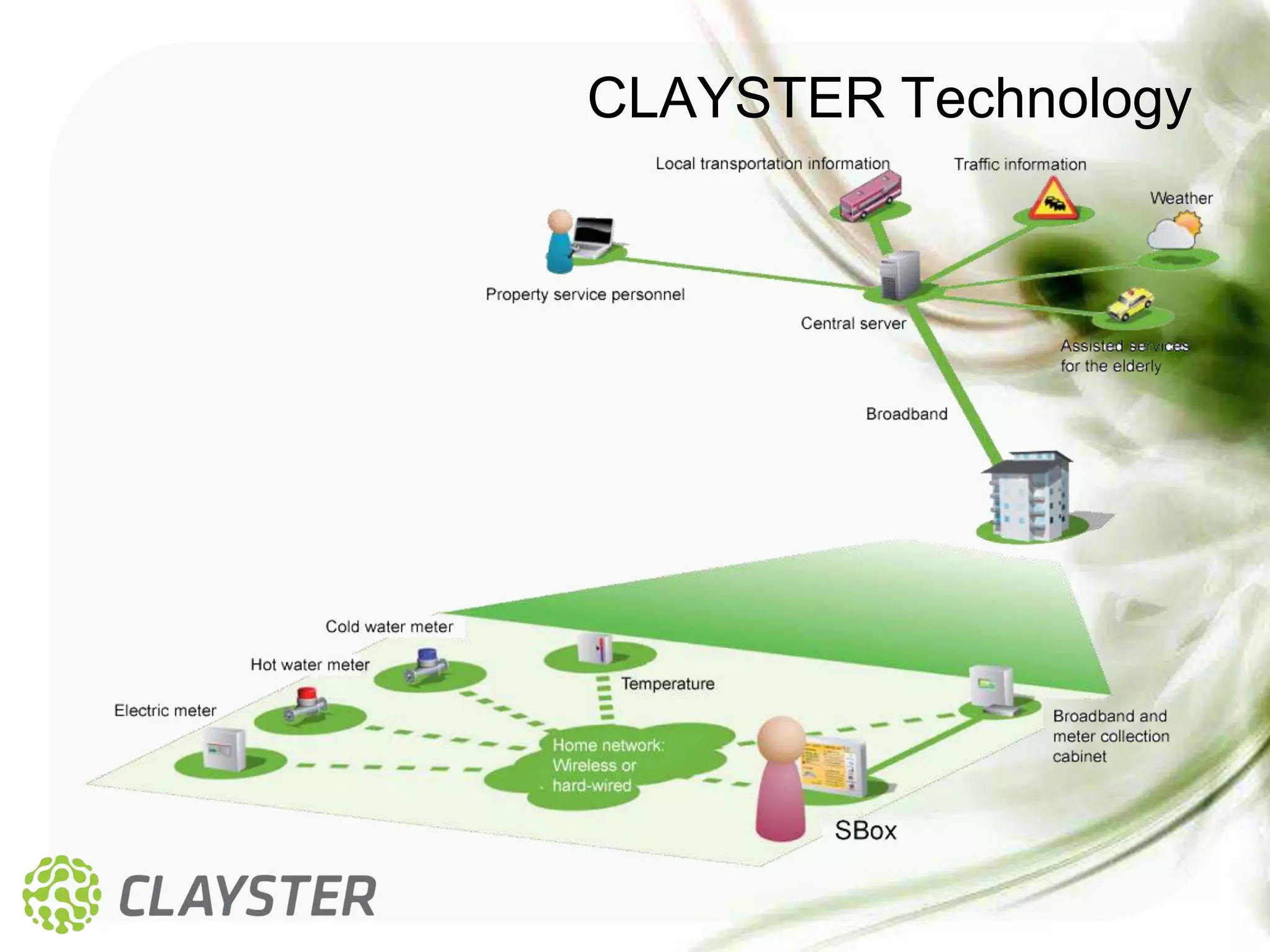
CLAYSTER Technology
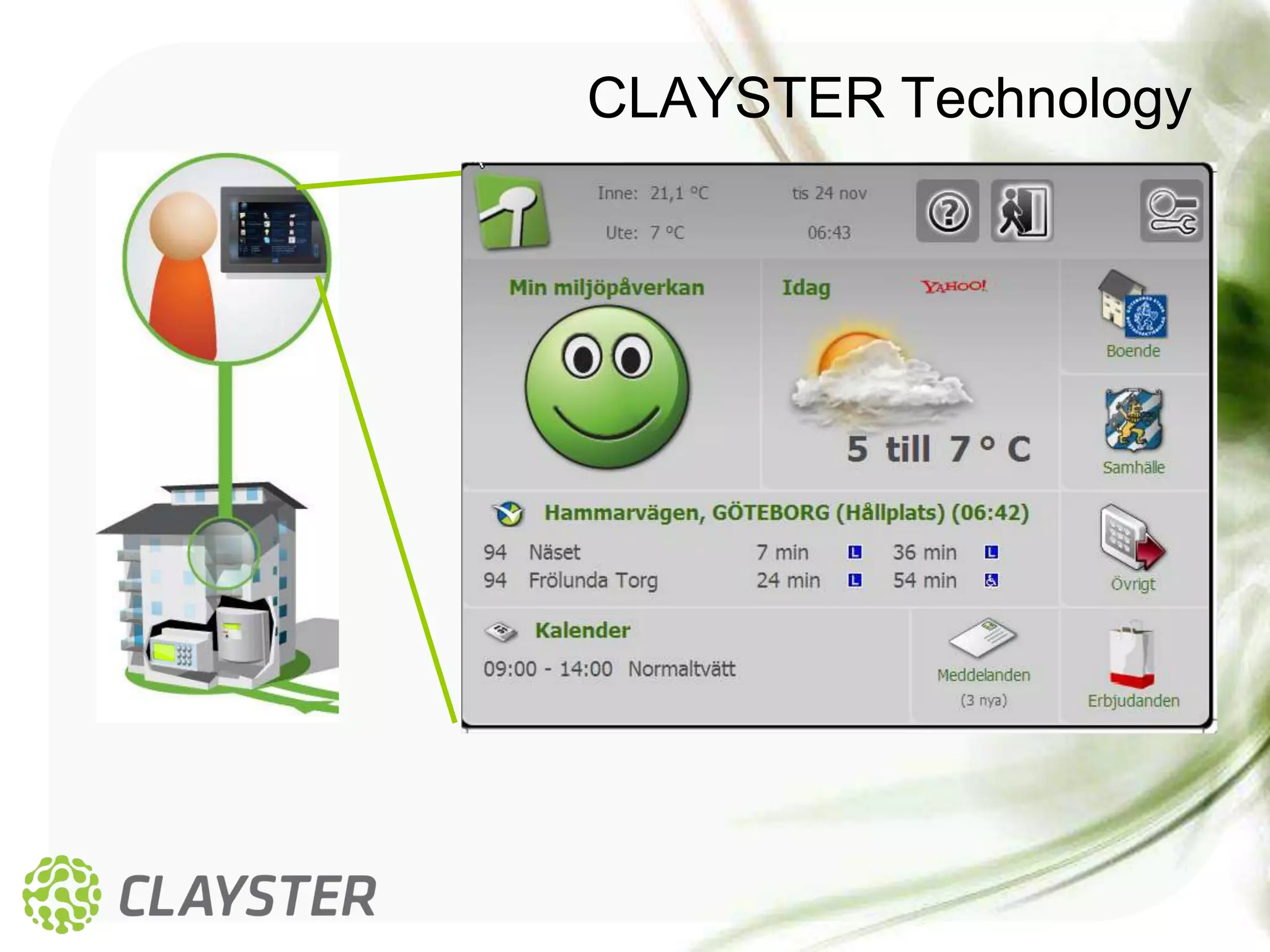
CLAYSTER Technology
CLAYSTER Technology


Mobile   MID-
                 Computer   TV
         Phone
Developing the technology for the future

 ¿Do you find this interesting?
 ¿Do you want to work with this with us?
 We seek development engineers within:
   .NET (server, platform)
   WPF (client, UI)
   Android (mobile, UI)
   Integrated systems (PLC, electronic circuits)
Peter Waher
Clayster Laboratorios Chile Ltda.
Calle Blanco 1623, of 1402.
Valparaíso
peter.waher@clayster.com
Tel: 032-212 25 33
Skype: peterwaher
Twitter: PeterWaher
Twitter: ClaysterLabs

Web 3.0 & IoT (English)

  • 1.
    Web 3.0 &IoT The future of Internet
  • 2.
    Callenge for 20201(2) http://www.ericsson.com/news/110214_more_than_50_billion_244188811_c
  • 3.
  • 4.
    Evolution Web 1.0 Publication Web 2.0  Interaction  Automatization Web 3.0  Interoperation  IoT  Smart City
  • 5.
    Web 1.0 Publication ofpapers.  HTML / HTTP / TCP / IP Links between publications.  URI Consumption by humans.  Browsers Static information.  The publisher provides the information.  Centralized.
  • 6.
    Examples of web1.0 Newspapers Portals Home Pages Britannica Online
  • 7.
    Web 2.0 Dynamic information.  Users provide the information.  XML, XML Schema, XSLT, XHR (Ajax). New interfaces for humans  Apps (10’ interfaces) Web Services.  SOAP, WSDL  REST, WADL  Syndication (RSS, ATOM, Podcasts, etc.)
  • 8.
    Examples of web2.0 Social networks  FB, Twitter, LinkedIn, Flickr, YT, etc.  Comments, tagging, voting, liking, blogging. On-line databases  Wikipedia, Google Earth, OSM, etc. Stores  eBay, Amazon, etc. Content Management Systems  Drupal, Mediawiki, etc.
  • 9.
    Examples of web2.0 Apps  IPhone, Android, IP-TV, etc. “Web as a platform”  Cloud  Google: Docs, Gmail, Calendar, etc.  Hotmail, MS Web Apps Programmable web  Mashups (6809 en www.programmableweb.com)  APIs (7677 en www.programmableweb.com)
  • 10.
    Web 3.0 Publication ofdata.  RDF / HTTP, XMPP / TCPv6 / IPv6 Links between data.  URI Consumption by machines.  M2M, WSN Federated information.  Created for multitude of entities.  Decentralized.
  • 11.
    Web 3.0 Technologies SemanticWeb  Universal abstraction of information.  Meaning of información.  Standardized question languages  Standardized rule languages  Artificial intelligence. Internet of Things (IoT)  Wireless sensor networks WSN (IPv6 / WiFi)  Grid Computing (federation)  Security, peer-to-peer (XMPP)
  • 12.
  • 13.
    Abstraction of information SemanticTriples  Subject Predicate Object (S, P, O)  Can describe all information that exists.  S & P are URI’s  O can be an URI or a LITERAL  Literals can have or lack a type.  Every type is defined by an URI.
  • 14.
    Examples of SemanticTriples  Clayster “is a” Company  Clayster “is domiciled in” Valparaíso  Valparaíso “is a” City  Valparaíso “lies in” Chile  Chile “is a” Country  Peter Waher “is a” Man  Peter Waher “has” 40 years  Peter Waher “is employed by” Clayster.  Peter Waher “is married to” Katya Waher.  etc.
  • 15.
    URIs URI Format Scheme://Host/Path Simple to extend Simple to maintain unique Simple to distribute
  • 16.
    Graphs Semantic graphs Subjects and Objects are nodes  Predicates form edges
  • 17.
    Links Introductory links toSW  http://www.w3.org/2001/sw/  http://semanticweb.org/  http://www.w3.org/standards/semanticweb/data
  • 18.
    RDF Resource Description Framework  W3C Recommendation (“Standard”)  Easy for machines to understand  RDF/XML (Documents)  RDFa (Micro format)  Uses the power of XML and Namespaces  Easy to validate  Difficult to read or write by humans.
  • 19.
  • 20.
  • 21.
    Ontologies Describe Vocabularies  Corresponds to Schemas in the XML-world  Permits deduction RDF Schema (RDFS)  Very easy Web Ontology Language (OWL)  More advanced  Three levels (Lite, DL, Full)
  • 22.
  • 23.
  • 24.
    Turtle Turtle W3C Recommendation (“Standard”)  “Terse RDF Triple Language”  Easier to read and write by humans
  • 25.
  • 26.
  • 27.
  • 28.
    Links RDF/Turtle Links  http://www.w3schools.com/rdf/default.asp  http://www.w3.org/TR/2004/REC-rdf-primer- 20040210/  http://www.w3.org/standards/techs/rdf#w3c_all  http://www.w3.org/TR/2004/REC-rdf-syntax- grammar-20040210/  http://www.w3.org/TeamSubmission/turtle/
  • 29.
    OOP for theSemantic Web Objects in OOP are Objects in SW Properties are Predicates Values are Objects. Classes in OOP are also Objects
  • 30.
    Differences between OOP& WS Object Oriented Programming OOP Semantic Web Exclusive Inclusive Centralized Distributed Closed World assumption Open World assumption Proprietary Collaborative Deterministic Indeterministic Classes have heritence Types and properties have heritence
  • 31.
    SPARQL SPARQL  W3CRecommendation (“Standard”)  “SPARQL Protocol and RDF Query Language”  Performs Pattern Matching in semantic graphs.  SQL for the Semantic Web.  Connection through a “SPARQL Endpoint”.  Access to all types of data.
  • 32.
  • 33.
  • 34.
  • 35.
  • 36.
    Federation – “GridComputing” Client RDF RDF SPARQL E.P. RDF RDF RDF RDF SPARQL SPARQL E.P. E.P. RDF SPARQL RDF E.P.
  • 37.
    Links SPARQL Links http://www.w3.org/TR/sparql11-query/  http://www.w3.org/TR/2008/REC-rdf-sparql-query- 20080115/  http://www.w3.org/TR/2008/REC-rdf-sparql- protocol-20080115/  http://www.w3.org/TR/2008/REC-rdf-sparql- XMLres-20080115/  http://www.w3.org/standards/techs/sparql#w3c_all  http://www.w3.org/wiki/SparqlEndpoints  http://dbpedia.org/sparql
  • 38.
    RIF “Rule Interchange Format”  W3C Recommendation (“Standard”)  Automatic interchange of information  Permits automation and control  Interchangeable modules.
  • 39.
  • 40.
    Links RIF Links  http://www.w3.org/TR/2010/NOTE-rif-overview- 20100622/  http://www.w3.org/TR/2010/REC-rif-core- 20100622/  http://www.w3.org/2005/rules/wiki/images/b/b0/W3 C_RIF-CW-9-09.pdf  http://www.w3.org/2005/rules/wiki/RIF_Working_Gr oup
  • 41.
    Evolution of Databases Proprietaryfiles (~ “web 1.0”)  Error prone. Procedural API’s (~ “web 2.0”)  dBase, Paradox, FoxPro, etc.  Difficult to join information (relationships) SQL (~ “web 3.0”)  MS SQL, Oracle, DB2, MySQL, Sybase, etc.  Standardized = Interchangeable  Easy to join information from different sources.
  • 42.
    IoT: Web 2.0vs Web 3.0 ¿How many API’s can be economically supported?  ¿10? ¿25? ¿50? ¿100? ¿200? ~2’000’000’000 connected devices  ~ 1 / person of middle class 2020: ~50’000’000’000 devices.  > 10 / person of middle class  ¿How many product providers?  ¿How many API’s for integration projects?
  • 43.
    Centralized vs. Distributed Centralized(web 2.0) Distributed (Federation - web 3.0) Expensive Cheap Inefficient Efficient Difficult to grow proportionally Grows organically (~ neural network) Insecure Secure Lack of integrity Maximum of integrity Easy to abuse Difficult to abuse User does not control information User is owner of information
  • 44.
    Plug Computers  LinuxServer  1,2 Watts  2 USD for 24 / 7 / 365 service.  119 USD/unit price.
  • 45.
    Security in Web3.0 Based on HTTP  Authentication  Encryption (SSL/TLS) Decentralized storage  Lowers the risk of attacks  Lowers the effect of an attack  Difficult to attack using an DDOS. Extensions to other protocols  XMPP
  • 46.
    XMPP Standardized (IETF) Peer-to-peer Based ofXML fragments Data protected by firewalls. Authenticated clients Authorized clients
  • 47.
    Advantages with IETF,W3C, XSF Replaceable components Lowers the cost Permits interchange of information Permits a mixture of providers Power shifts to client Creates a new infrastructure Permits new business models
  • 48.
  • 49.
  • 50.
  • 51.
    CLAYSTER Technology Mobile MID- Computer TV Phone
  • 53.
    Developing the technologyfor the future  ¿Do you find this interesting?  ¿Do you want to work with this with us?  We seek development engineers within:  .NET (server, platform)  WPF (client, UI)  Android (mobile, UI)  Integrated systems (PLC, electronic circuits)
  • 54.
    Peter Waher Clayster LaboratoriosChile Ltda. Calle Blanco 1623, of 1402. Valparaíso peter.waher@clayster.com Tel: 032-212 25 33 Skype: peterwaher Twitter: PeterWaher Twitter: ClaysterLabs