AWS BASICS
Marko Baric
@markobaric
WHY CLOUD?
#1
AGILE INVESTING
No upfront investment
No capacity planning
Spend as you grow
Reduced running costs
#2
INNOVATION
Experiment
Innovate and refactor rapidly
Fail often without risk
#3
FOCUS ON BUSINESS PROBLEM
No need to build fundamental services
(computing, storage, database, messaging,
analysis, etc.)
Instead build your app
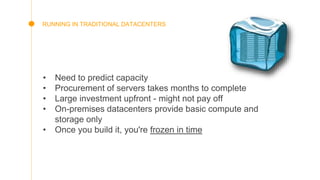
RUNNING IN TRADITIONAL DATACENTERS
• Need to predict capacity
• Procurement of servers takes months to complete
• Large investment upfront - might not pay off
• On-premises datacenters provide basic compute and
storage only
• Once you build it, you're frozen in time
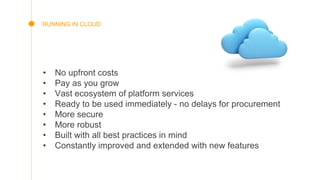
RUNNING IN CLOUD
• No upfront costs
• Pay as you grow
• Vast ecosystem of platform services
• Ready to be used immediately - no delays for procurement
• More secure
• More robust
• Built with all best practices in mind
• Constantly improved and extended with new features
You can't be competitive today
if you're not running in cloud !
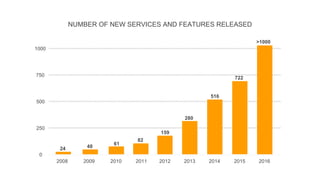
INCREDIBLE
PACE OF INNOVATION
2008 2009 2010 2011 2012 2013 2014 2015 2016
0
250
500
750
1000
>1000
24 48
61
82
159
280
516
722
NUMBER OF NEW SERVICES AND FEATURES RELEASED
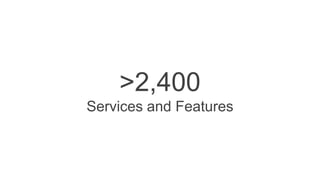
>2,400
Services and Features
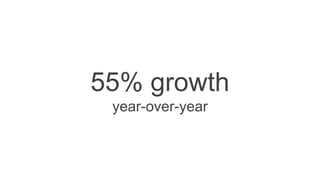
55% growth
year-over-year
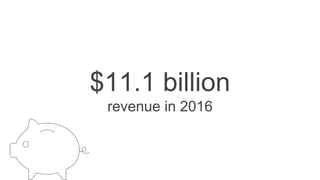
$11.1 billion
revenue in 2016
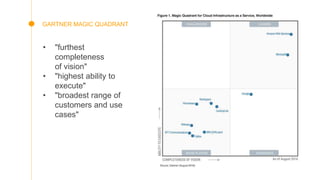
GARTNER MAGIC QUADRANT
• "furthest
completeness
of vision"
• "highest ability to
execute"
• "broadest range of
customers and use
cases"
AWS runs
10x more compute power
than all other cloud providers
combined!
>1 million
active customers (companies)
STARTUP CUSTOMERS
ENTERPRISE CUSTOMERS
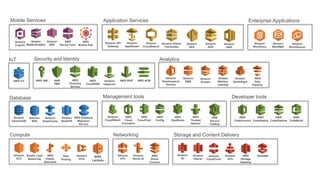
How broad is AWS platform?
Amazon
S3
Compute
Amazon
EC2
Elastic Load
Balancing
Auto
Scaling
Amazon
VPC
Amazon
Route 53
Networking Storage and Content Delivery
Amazon
CloudFront
Amazon
Glacier
Amazon
EFS
AWS
Storage
Gateway
AWS
Elastic
Beanstalk
Amazon
ECS
Amazon
DynamoDB
Amazon
RDS
Amazon
ElastiCache
Amazon
Redshift
AWS Database
Migration
Service
Database
AWS
Direct
Connect
Amazon
CloudWatch
AWS
Cloud
Formation
AWS
CloudTrail
AWS
Config
AWS
OpsWorks
AWS
Trusted
Advisor
Management tools
AWS
CodeCommit
AWS
CodeDeploy
AWS
CodePipeline
Developer tools
Security and Identity
AWS IAM AWS
KMS
AWS
Directory
Service
AWS
CloudHSM
Amazon
Inspector
AWS WAF
Analytics
Amazon
Elasticsearch
Service
Amazon
EMR
Amazon
Kinesis
Amazon
Machine
Learning
Amazon
QuickSight
AWS
Data
Pipeline
IoT
AWS IoT
Amazon
Cognito
Amazon
MobileAnalytics
Amazon
SNS
AWS
Device Farm
AWS
Mobile Hub
Mobile Services Application Services
Amazon API
Gateway
Amazon
AppStream
Amazon
CloudSearch
Amazon Elastic
Transcoder
Amazon
SES
Amazon
SQS
Amazon
SWF
AWS
Lambda
Snowball
AWS
CodeBuild
AWS
Service
Catalog
AWS ACM
Enterprise Applications
Amazon
WorkDocs
Amazon
WorkMail
Amazon
WorkSpaces
Now let's go technical
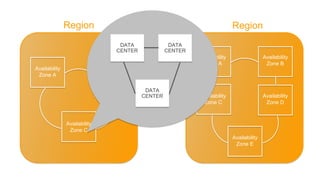
AWS GLOBAL
INFRASTRUCTURE
Region
Availability
Zone A
Availability
Zone C
Availability
Zone B
Availability
Zone A
Availability
Zone C
Availability
Zone B
Availability
Zone D
Availability
Zone E
Region
DATA
CENTER
DATA
CENTER
DATA
CENTER
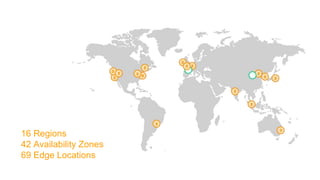
16 Regions
42 Availability Zones
69 Edge Locations
OVERVIEW OF SERVICES
...get ready for abbreviation hell
COMPUTE SERVICES
• Virtual servers in the cloud
• Multiple operating systems supported:
‣ Amazon Linux, Red Hat Enterprise, SUSE, Ubuntu, Windows Server
• Range of different machine flavours:
‣ General purpose, memory optimised, I/O optimised, GPU optimised, FPGA
• Range of different instance types:
‣ T2, M3, M4, C3, C4, R3, R4, X1, P2, G2, F1, I3, D2
• Range of different compute power:
‣ nano, micro, small, medium, large, xlarge, 2xlarge, 3xlarge, etc....
‣ From 0.5 GB RAM / 1 vCPU
‣ To 1952 GB RAM / 128 vCPU
• Range of pricing models:
‣ On-demand instances, reserved instances, spot instances, dedicated
hosts, placement groups, etc.
Amazon EC2
Amazon EC2
• Scale in and out based on your own scaling policies
• Manual, dynamic scaling or scheduled scaling
• Instance health checks
• Monitoring
• Logging of scaling events
• Cooldown periods
• Lifecycle hooks
Auto Scaling
Auto Scaling
• Distributes traffic across fleet of EC2 instances
• Highly scalable - can handle any load
• Instance health checks
• SSL offloading
• Supports IPv6, HTTP/2 and WebSockets
• Two flavours:
‣ Classic balancing (on network level - layer 3)
‣ Application balancing (on application level - layer 7)
Elastic
Load Balancing
Elastic Load Balancing
• Function-as-a-service
• Event-driven serverless compute service
• Pay only for execution time, never pay for idle time
• Automatically scales to handle ANY load
• Supports functions in JavaScript, C#, Java, Python
• Execution monitoring
AWS
Lambda
AWS Lambda
NETWORKING SERVICES
• Logically isolated section of AWS cloud
• Think of it as your own "private virtual data centre in the
cloud"
• Define your own virtual networking, subnets, route tables,
internet gateways, NATs, access lists, etc.
• Manage group of your resources as one unit
Amazon
VPC
Amazon VPC
• Managed DNS service
• Public and private hosted zones
• Endpoint health checks
• Routing options:
‣ latency based
‣ geolocation based
‣ weighted routing
Amazon
Route 53
Amazon Route 53
STORAGE SERVICES
• Low latency, high throughput "object" storage
• Unlimited size
• Max object size for a singe object is 5TB
• 99.999999999% durability
• Cross-AZ / Cross-region replication
• Ideal for backup storage, bulk file storage, data lakes,
analytics, etc.
• Encryption in-transit and at-rest
• Object versioning
• Object lifecycle management
• 3 storage classes: standard, infrequent access and reduced
redundancy
Amazon S3
Amazon S3
• Petabyte-scale storage
• Ideal for infrequently accessed files (e.g. archives)
• Extremely low-cost
‣ $0.004 per gigabyte per month
• Two price classes:
‣ Standard - data retrieval time 3-5 hours
‣ Expedited - data retrieval time 1-5 minutes
Amazon Glacier
Amazon Glacier
CONTENT DELIVERY
SERVICES
• Global content delivery network (CDN)
• Advanced security features (access policies, request signing,
cookie signing)
• Supports IPv6, HTTP/2 and WebSockets
• Edge location available in any relevant place in the world
• You can even run application logic on the edge location
Amazon
CloudFront
Amazon CloudFront
• Blocks traffic at the edge
• Protects from common web exploits
• Customisable filters based on:
‣ request headers
‣ request content
‣ source IP
‣ request size
• Automatic SQL injection protection, automatic XSS protection
• Can be set up on ELB or CloudFront
• AWS Shield - advanced DDoS detection and protection
AWS WAF
AWS WAF
DATABASE SERVICES
• Fully managed NoSql data store
• Seamless scaling to support any load
• Supports any number of indexes with projected columns
• Automatic data partitioning
• Can stream data changes to other sources
Amazon
DynamoDB
Amazon DynamoDB
• Fully managed relational database service
• Supports MySQL, MariaDB, SQL Server, PostgreSQL, Oracle
and Amazon Aurora
• Automatic backups with "point in time" restore
• Multi-AZ deployments with synchronous read replicas
• Automatic failover
• Advanced DB instance monitoring
• Amazon Aurora
‣ five times the throughput of standard MySQL
‣ data replicated to 6 replicas by default (up to 15)
‣ supports databases up to 64 GB in size
‣ continuous backup to S3
Amazon
RDS
Amazon RDS
MANAGEMENT SERVICES
• Central point of monitoring of logs, events and metrics
• Integrated with all other services
• Set alarms to automatically react to changes
Amazon
CloudWatch
Amazon CloudWatch
• Records every API call
• Essential for compliance auditing
• Streams logs to CloudWatch
Amazon
CloudTrail
Amazon CoudTrail
• Infrastructure-as-a-code service
• Spin up entire stacks od resources with a single click
• Plays key role in deployment automation
• Stacks can be defined in JSON or YAML syntax
AWS
CloudFormation
Amazon CloudFormation
APPLICATION SERVICES
• Fast, scalable message queuing
• Supports any volume of messages - scales automatically
• Cost-effective way to decouple cloud applications
• Two types of queues:
‣ Standard
‣ FIFO
Amazon
SQS
Amazon SQS
• Fast reliable push notification service
• Simple pub-sub model
• Can deliver to following subscribers:
‣ Mobile notifications
‣ SMS messages
‣ SQS queues
‣ HTTP/HTTPS endpoints
‣ Lambda functions
Amazon
SNS
Amazon SNS
ANALYTICS SERVICES
• Reliable data streaming
• Supports TBs of data per hour from thousands of sources
• Emit stream data between AWS services
• Apply SQL queries directly on the stream data for analytics
• Deliver stream data directly to S3 or Redshift (warehouse)
Amazon
Kinesis
Amazon Kinesis
DEVELOPER SERVICES
• Services for continuous integration and deployment
• Integrated with the AWS ecosystem (e.g. OpsWorks)
• Works with external services (GitHub, Jenkins, Docker, etc.)
AWS
CodePipeline
Developer Services
AWS
CodeDeploy
AWS
CodeCommit
AWS
CodeBuild
And about...
50
more services
No one will be running their datacenter
in few years, it's your last chance
to adapt.
THANK YOU!
Q & A

AWS basics

  • 1.
  • 2.
  • 3.
    #1 AGILE INVESTING No upfrontinvestment No capacity planning Spend as you grow Reduced running costs
  • 4.
    #2 INNOVATION Experiment Innovate and refactorrapidly Fail often without risk
  • 5.
    #3 FOCUS ON BUSINESSPROBLEM No need to build fundamental services (computing, storage, database, messaging, analysis, etc.) Instead build your app
  • 6.
    RUNNING IN TRADITIONALDATACENTERS • Need to predict capacity • Procurement of servers takes months to complete • Large investment upfront - might not pay off • On-premises datacenters provide basic compute and storage only • Once you build it, you're frozen in time
  • 7.
    RUNNING IN CLOUD •No upfront costs • Pay as you grow • Vast ecosystem of platform services • Ready to be used immediately - no delays for procurement • More secure • More robust • Built with all best practices in mind • Constantly improved and extended with new features
  • 8.
    You can't becompetitive today if you're not running in cloud !
  • 9.
  • 10.
    2008 2009 20102011 2012 2013 2014 2015 2016 0 250 500 750 1000 >1000 24 48 61 82 159 280 516 722 NUMBER OF NEW SERVICES AND FEATURES RELEASED
  • 11.
  • 12.
  • 13.
  • 14.
    GARTNER MAGIC QUADRANT •"furthest completeness of vision" • "highest ability to execute" • "broadest range of customers and use cases"
  • 15.
    AWS runs 10x morecompute power than all other cloud providers combined!
  • 16.
  • 17.
  • 18.
  • 19.
    How broad isAWS platform?
  • 20.
    Amazon S3 Compute Amazon EC2 Elastic Load Balancing Auto Scaling Amazon VPC Amazon Route 53 NetworkingStorage and Content Delivery Amazon CloudFront Amazon Glacier Amazon EFS AWS Storage Gateway AWS Elastic Beanstalk Amazon ECS Amazon DynamoDB Amazon RDS Amazon ElastiCache Amazon Redshift AWS Database Migration Service Database AWS Direct Connect Amazon CloudWatch AWS Cloud Formation AWS CloudTrail AWS Config AWS OpsWorks AWS Trusted Advisor Management tools AWS CodeCommit AWS CodeDeploy AWS CodePipeline Developer tools Security and Identity AWS IAM AWS KMS AWS Directory Service AWS CloudHSM Amazon Inspector AWS WAF Analytics Amazon Elasticsearch Service Amazon EMR Amazon Kinesis Amazon Machine Learning Amazon QuickSight AWS Data Pipeline IoT AWS IoT Amazon Cognito Amazon MobileAnalytics Amazon SNS AWS Device Farm AWS Mobile Hub Mobile Services Application Services Amazon API Gateway Amazon AppStream Amazon CloudSearch Amazon Elastic Transcoder Amazon SES Amazon SQS Amazon SWF AWS Lambda Snowball AWS CodeBuild AWS Service Catalog AWS ACM Enterprise Applications Amazon WorkDocs Amazon WorkMail Amazon WorkSpaces
  • 21.
    Now let's gotechnical
  • 22.
  • 23.
    Region Availability Zone A Availability Zone C Availability ZoneB Availability Zone A Availability Zone C Availability Zone B Availability Zone D Availability Zone E Region DATA CENTER DATA CENTER DATA CENTER
  • 24.
    16 Regions 42 AvailabilityZones 69 Edge Locations
  • 25.
    OVERVIEW OF SERVICES ...getready for abbreviation hell
  • 26.
  • 27.
    • Virtual serversin the cloud • Multiple operating systems supported: ‣ Amazon Linux, Red Hat Enterprise, SUSE, Ubuntu, Windows Server • Range of different machine flavours: ‣ General purpose, memory optimised, I/O optimised, GPU optimised, FPGA • Range of different instance types: ‣ T2, M3, M4, C3, C4, R3, R4, X1, P2, G2, F1, I3, D2 • Range of different compute power: ‣ nano, micro, small, medium, large, xlarge, 2xlarge, 3xlarge, etc.... ‣ From 0.5 GB RAM / 1 vCPU ‣ To 1952 GB RAM / 128 vCPU • Range of pricing models: ‣ On-demand instances, reserved instances, spot instances, dedicated hosts, placement groups, etc. Amazon EC2 Amazon EC2
  • 28.
    • Scale inand out based on your own scaling policies • Manual, dynamic scaling or scheduled scaling • Instance health checks • Monitoring • Logging of scaling events • Cooldown periods • Lifecycle hooks Auto Scaling Auto Scaling
  • 29.
    • Distributes trafficacross fleet of EC2 instances • Highly scalable - can handle any load • Instance health checks • SSL offloading • Supports IPv6, HTTP/2 and WebSockets • Two flavours: ‣ Classic balancing (on network level - layer 3) ‣ Application balancing (on application level - layer 7) Elastic Load Balancing Elastic Load Balancing
  • 30.
    • Function-as-a-service • Event-drivenserverless compute service • Pay only for execution time, never pay for idle time • Automatically scales to handle ANY load • Supports functions in JavaScript, C#, Java, Python • Execution monitoring AWS Lambda AWS Lambda
  • 31.
  • 32.
    • Logically isolatedsection of AWS cloud • Think of it as your own "private virtual data centre in the cloud" • Define your own virtual networking, subnets, route tables, internet gateways, NATs, access lists, etc. • Manage group of your resources as one unit Amazon VPC Amazon VPC
  • 33.
    • Managed DNSservice • Public and private hosted zones • Endpoint health checks • Routing options: ‣ latency based ‣ geolocation based ‣ weighted routing Amazon Route 53 Amazon Route 53
  • 34.
  • 35.
    • Low latency,high throughput "object" storage • Unlimited size • Max object size for a singe object is 5TB • 99.999999999% durability • Cross-AZ / Cross-region replication • Ideal for backup storage, bulk file storage, data lakes, analytics, etc. • Encryption in-transit and at-rest • Object versioning • Object lifecycle management • 3 storage classes: standard, infrequent access and reduced redundancy Amazon S3 Amazon S3
  • 36.
    • Petabyte-scale storage •Ideal for infrequently accessed files (e.g. archives) • Extremely low-cost ‣ $0.004 per gigabyte per month • Two price classes: ‣ Standard - data retrieval time 3-5 hours ‣ Expedited - data retrieval time 1-5 minutes Amazon Glacier Amazon Glacier
  • 37.
  • 38.
    • Global contentdelivery network (CDN) • Advanced security features (access policies, request signing, cookie signing) • Supports IPv6, HTTP/2 and WebSockets • Edge location available in any relevant place in the world • You can even run application logic on the edge location Amazon CloudFront Amazon CloudFront
  • 39.
    • Blocks trafficat the edge • Protects from common web exploits • Customisable filters based on: ‣ request headers ‣ request content ‣ source IP ‣ request size • Automatic SQL injection protection, automatic XSS protection • Can be set up on ELB or CloudFront • AWS Shield - advanced DDoS detection and protection AWS WAF AWS WAF
  • 40.
  • 41.
    • Fully managedNoSql data store • Seamless scaling to support any load • Supports any number of indexes with projected columns • Automatic data partitioning • Can stream data changes to other sources Amazon DynamoDB Amazon DynamoDB
  • 42.
    • Fully managedrelational database service • Supports MySQL, MariaDB, SQL Server, PostgreSQL, Oracle and Amazon Aurora • Automatic backups with "point in time" restore • Multi-AZ deployments with synchronous read replicas • Automatic failover • Advanced DB instance monitoring • Amazon Aurora ‣ five times the throughput of standard MySQL ‣ data replicated to 6 replicas by default (up to 15) ‣ supports databases up to 64 GB in size ‣ continuous backup to S3 Amazon RDS Amazon RDS
  • 43.
  • 44.
    • Central pointof monitoring of logs, events and metrics • Integrated with all other services • Set alarms to automatically react to changes Amazon CloudWatch Amazon CloudWatch
  • 45.
    • Records everyAPI call • Essential for compliance auditing • Streams logs to CloudWatch Amazon CloudTrail Amazon CoudTrail
  • 46.
    • Infrastructure-as-a-code service •Spin up entire stacks od resources with a single click • Plays key role in deployment automation • Stacks can be defined in JSON or YAML syntax AWS CloudFormation Amazon CloudFormation
  • 47.
  • 48.
    • Fast, scalablemessage queuing • Supports any volume of messages - scales automatically • Cost-effective way to decouple cloud applications • Two types of queues: ‣ Standard ‣ FIFO Amazon SQS Amazon SQS
  • 49.
    • Fast reliablepush notification service • Simple pub-sub model • Can deliver to following subscribers: ‣ Mobile notifications ‣ SMS messages ‣ SQS queues ‣ HTTP/HTTPS endpoints ‣ Lambda functions Amazon SNS Amazon SNS
  • 50.
  • 51.
    • Reliable datastreaming • Supports TBs of data per hour from thousands of sources • Emit stream data between AWS services • Apply SQL queries directly on the stream data for analytics • Deliver stream data directly to S3 or Redshift (warehouse) Amazon Kinesis Amazon Kinesis
  • 52.
  • 53.
    • Services forcontinuous integration and deployment • Integrated with the AWS ecosystem (e.g. OpsWorks) • Works with external services (GitHub, Jenkins, Docker, etc.) AWS CodePipeline Developer Services AWS CodeDeploy AWS CodeCommit AWS CodeBuild
  • 54.
  • 55.
    No one willbe running their datacenter in few years, it's your last chance to adapt.
  • 56.
  • 57.