
Find it,
possibly also near you!
       Paul Borgermans
About me
●   Currently employed by eZ Systems http://ez.no
●   Active in open source community for a while
     –   Squid http proxy server (about 15 y ago)
     –   PHP based CMS solutions (mostly eZ Publish)
     –              executive committee

●   Currently fancying :
     –   PHP as the master glue language for almost everything
     –   Apache Lucene family of projects (mainly Solr)
     –   NoSQL (Not only SQL) and scalable architectures
     –   CMS systems & information management
Outline
●   Overview of Apache Solr
●   Concepts & internals
●   How to use it with PHP
●   Use cases & tips
●   Resources
Overview of Apache Solr
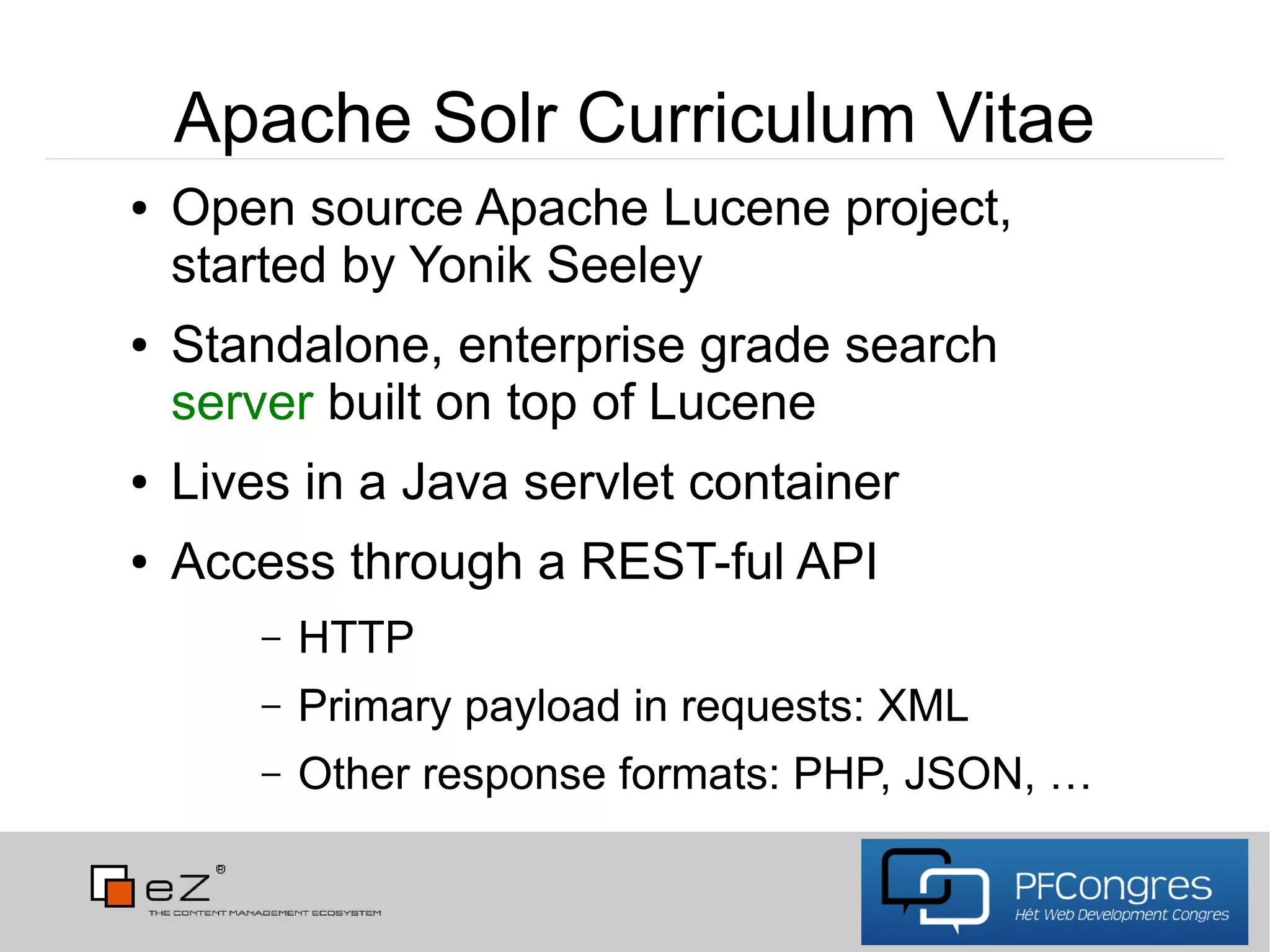
Apache Solr Curriculum Vitae
●   Open source Apache Lucene project,
    started by Yonik Seeley
●   Standalone, enterprise grade search
    server built on top of Lucene
●   Lives in a Java servlet container
●   Access through a REST-ful API
        –   HTTP
        –   Primary payload in requests: XML
        –   Other response formats: PHP, JSON, …
Used by ..


And many more ...
Solr in a nutshell
●   State of the art, advanced full text search and
    information retrieval
●   Fast, scalable with native replication features
●   Flexible configuration
●   Document oriented storage
●   Geospatial search
●   Native cloud features
Full text search main features
●   Tuneable relevancy ranking on top of internal
    similarity algorithms
●   Highlighting
●   Sorting
●   Filtering
●   “Drill-down” navigation (facets)
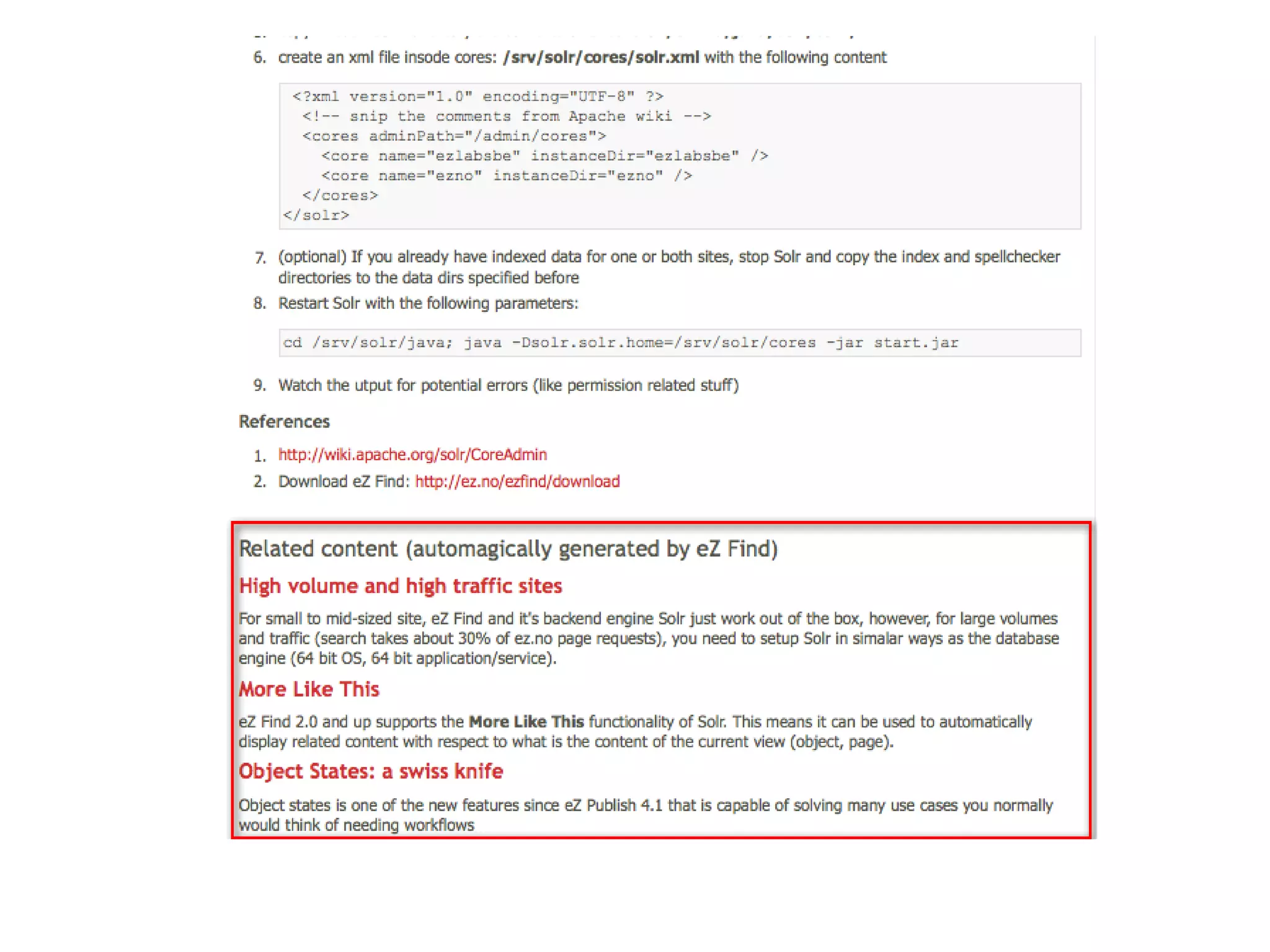
●   Automatic related content
●   Spell checking
●   Multilingual text analysis
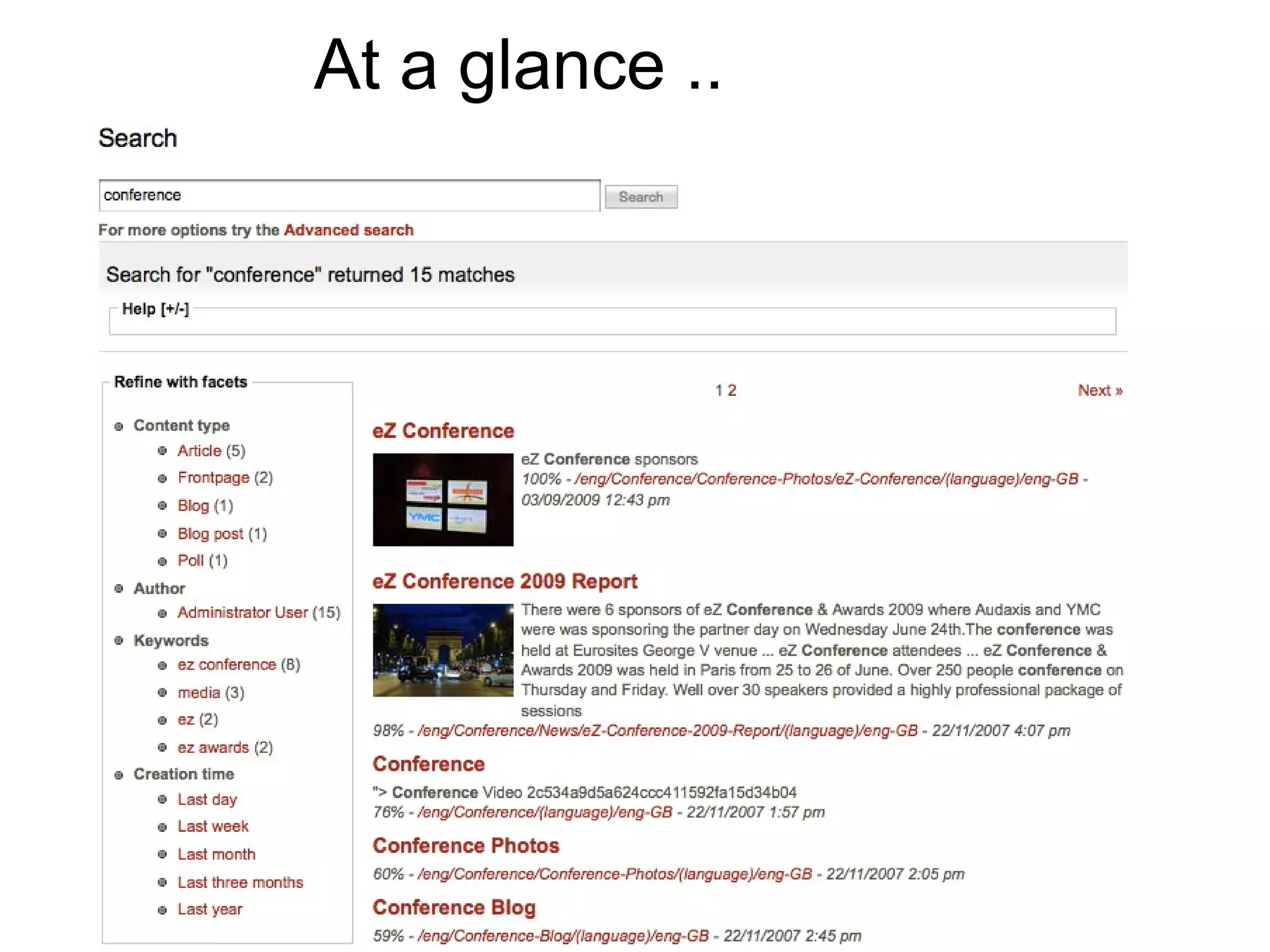
At a glance ..
Tunable relevancy ranking
●   “Boosting” at index and query time
        –   certain types of content
        –   certain parts of content (“fields”)
        –            page-rank like if the content has relations
●   Elevate request component
        –   predefined “pages/documents” to the top when certain
              keywords are entered
●   With customised functions
        –   more recent articles
        –   proximity (geolocations)
Filtering
●   Does not influence the relevancy
●   Narrows down the scope
●   Very powerful: full boolean, wildcards,
    fuzzy, and unlimited combinations
●   Ranges (dates, numbers,
    alphanumeric, ...)


     Also for implementing security!
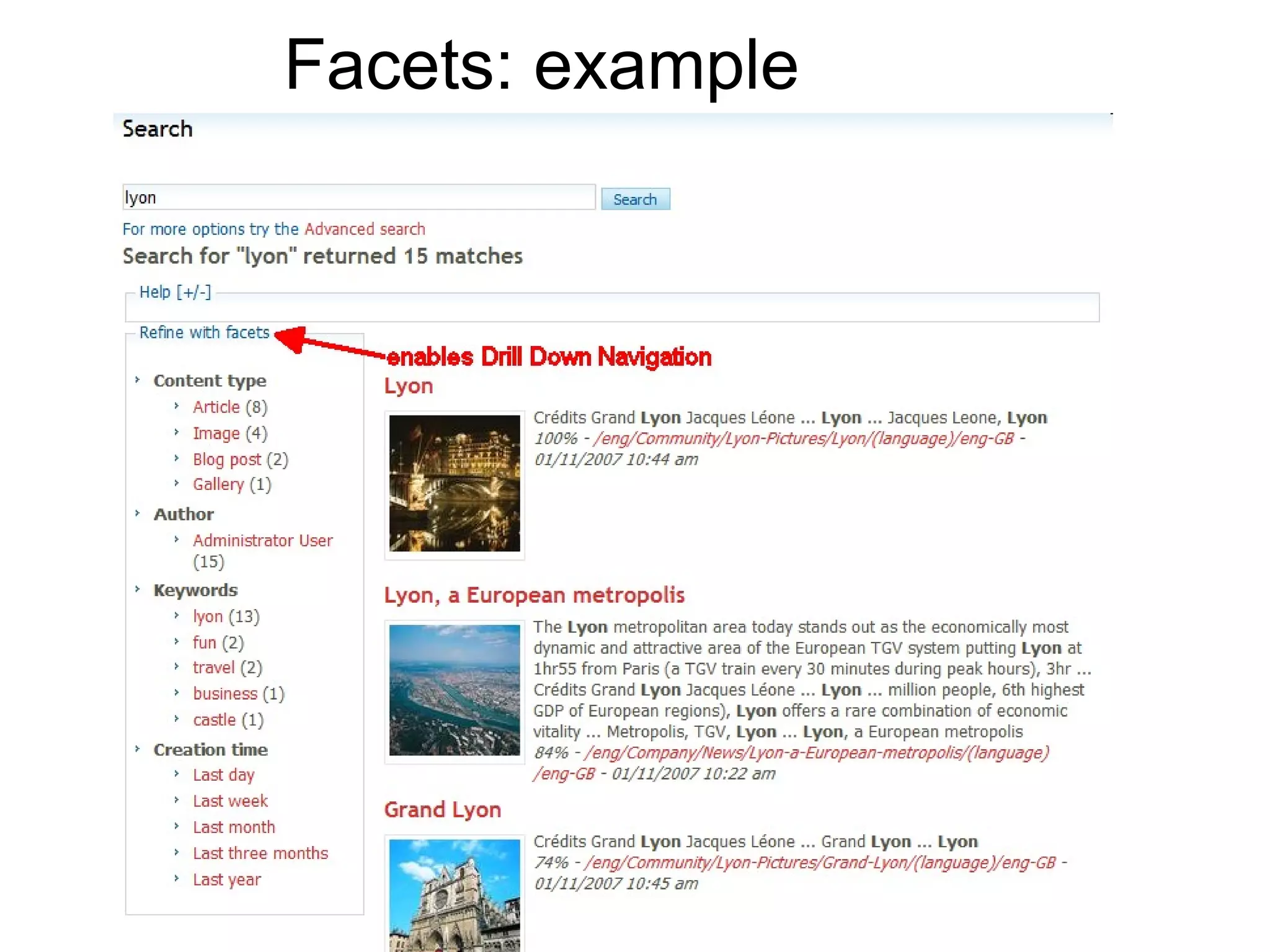
Facets
●   Along the main query, “facet fields” may be defined,
    usually operating on meta-data:
        –   Type of content
        –   Publication year
        –   Keywords
        –   Author ....
●   The result set is returned offering the number hits
    within each “facet”
●   You can use the selected facet as a subsequent filter
Facets: example
Automatic related content
               (“More Like This”)
●   Search engine determines itself which are the
    important terms of a page and performs a query
●   All other normal features can be used
       –   Filtering
       –   Sorting
       –   Facets
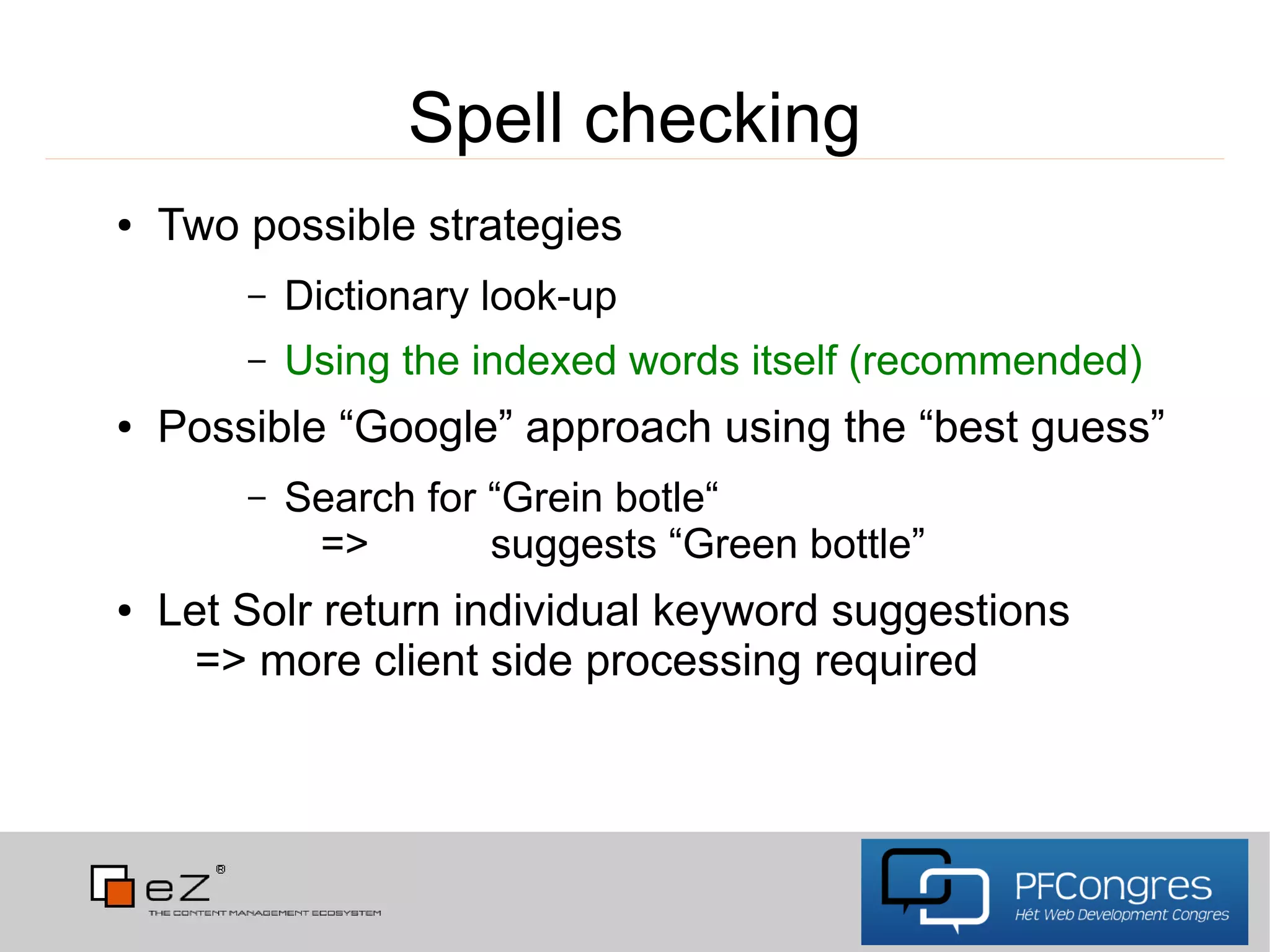
Spell checking
●   Two possible strategies
        –   Dictionary look-up
        –   Using the indexed words itself (recommended)
●   Possible “Google” approach using the “best guess”
        –   Search for “Grein botle“
             =>        suggests “Green bottle”
●   Let Solr return individual keyword suggestions
      => more client side processing required
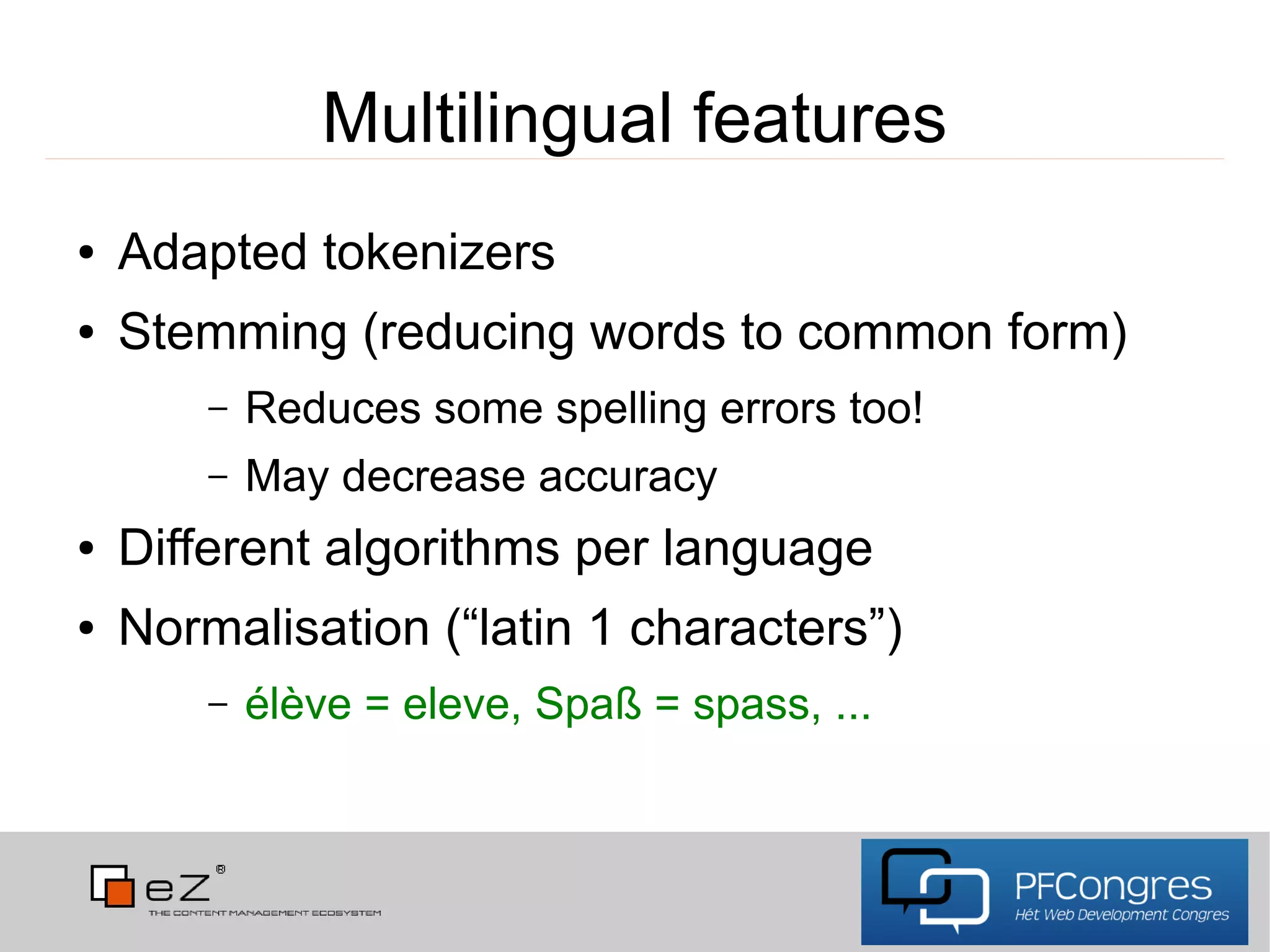
Multilingual features
●   Adapted tokenizers
●   Stemming (reducing words to common form)
        –   Reduces some spelling errors too!
        –   May decrease accuracy
●   Different algorithms per language
●   Normalisation (“latin 1 characters”)
        –   élève = eleve, Spaß = spass, ...
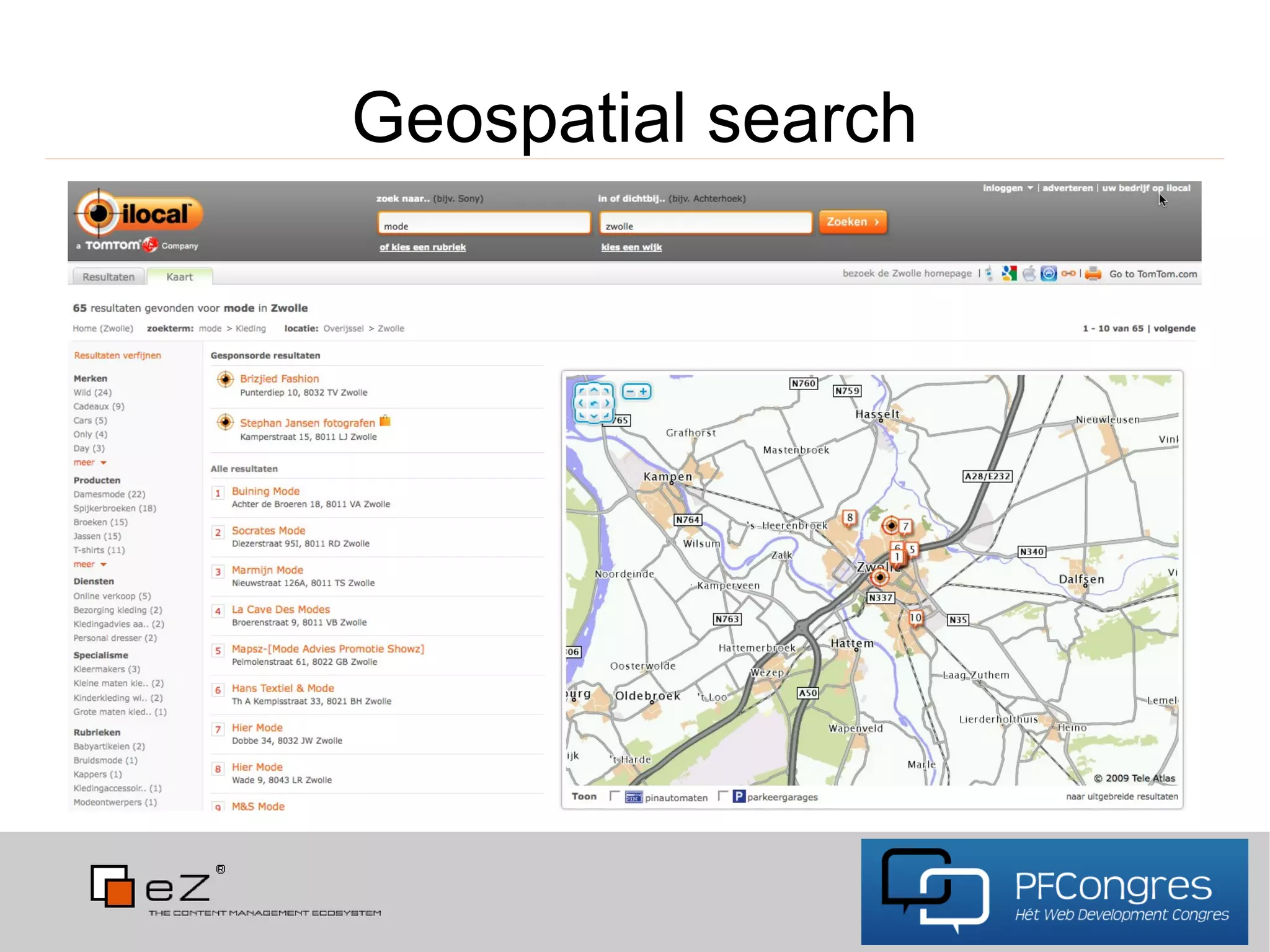
Geospatial search
Performance
●   Solr employs intelligent caches
        –   filters
        –   queries
        –   internal indexes
●   Optimized for search/retrieval
●   Possible autowarming on start up
●   When updates are done, caches are
    reconstructed on the fly in the background
Performance (2)
●   Replication
        –   master-slave for now
        –   works across platforms with same configuration
        –   no native OS features needed (or rsync)
        –   more cloud features under development
●   Sharding (client driven)
Concepts and internals
The Solr/Lucene index
●   Inverted index
●   Holds a collection of “documents” (hello NoSQL)
●   Document
        –   Collection of fields
        –   Flexible schema!
        –   Unique ID (user defined)
●   Solr uses a XML based config file:

    schema.xml
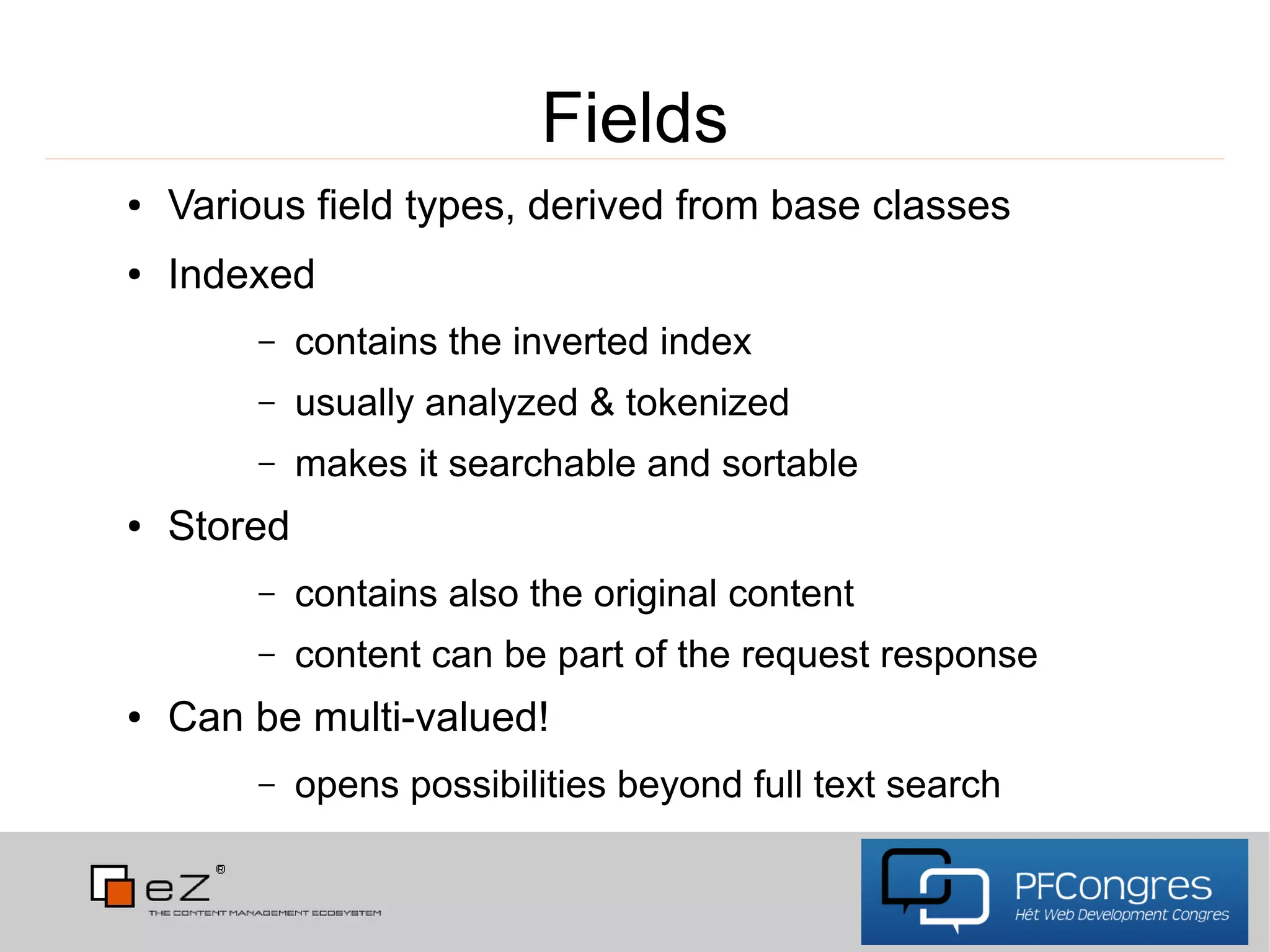
Fields
●   Various field types, derived from base classes
●   Indexed
        –    contains the inverted index
        –    usually analyzed & tokenized
        –    makes it searchable and sortable
●   Stored
        –    contains also the original content
        –    content can be part of the request response
●   Can be multi-valued!
        –    opens possibilities beyond full text search
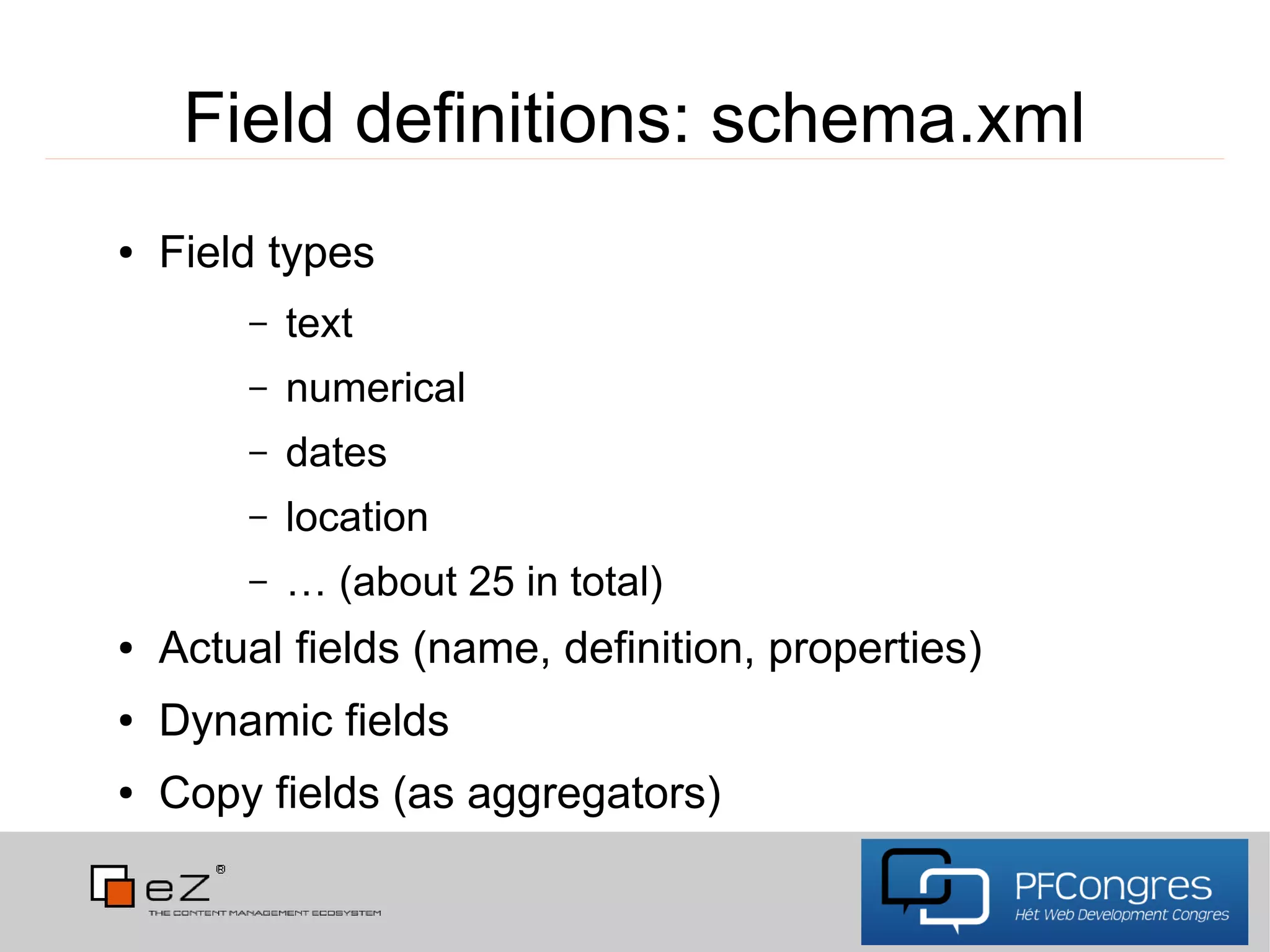
Field definitions: schema.xml
●   Field types
        –   text
        –   numerical
        –   dates
        –   location
        –   … (about 25 in total)
●   Actual fields (name, definition, properties)
●   Dynamic fields
●   Copy fields (as aggregators)
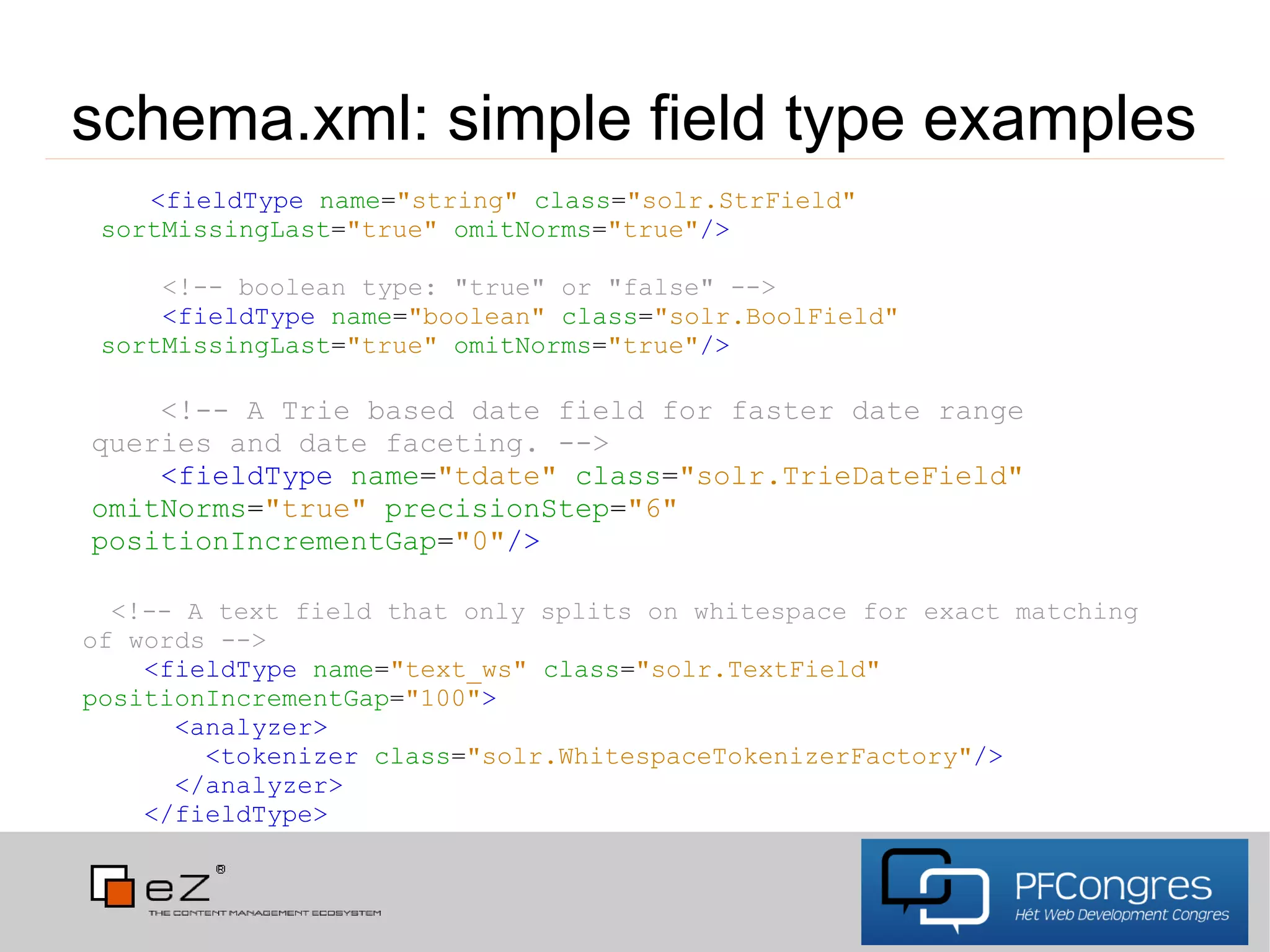
schema.xml: simple field type examples
    <fieldType name="string" class="solr.StrField"
 sortMissingLast="true" omitNorms="true"/>

     <!-- boolean type: "true" or "false" -->
     <fieldType name="boolean" class="solr.BoolField"
 sortMissingLast="true" omitNorms="true"/>

    <!-- A Trie based date field for faster date range
queries and date faceting. -->
    <fieldType name="tdate" class="solr.TrieDateField"
omitNorms="true" precisionStep="6"
positionIncrementGap="0"/>

  <!-- A text field that only splits on whitespace for exact matching
of words -->
    <fieldType name="text_ws" class="solr.TextField"
positionIncrementGap="100">
      <analyzer>
        <tokenizer class="solr.WhitespaceTokenizerFactory"/>
      </analyzer>
    </fieldType>
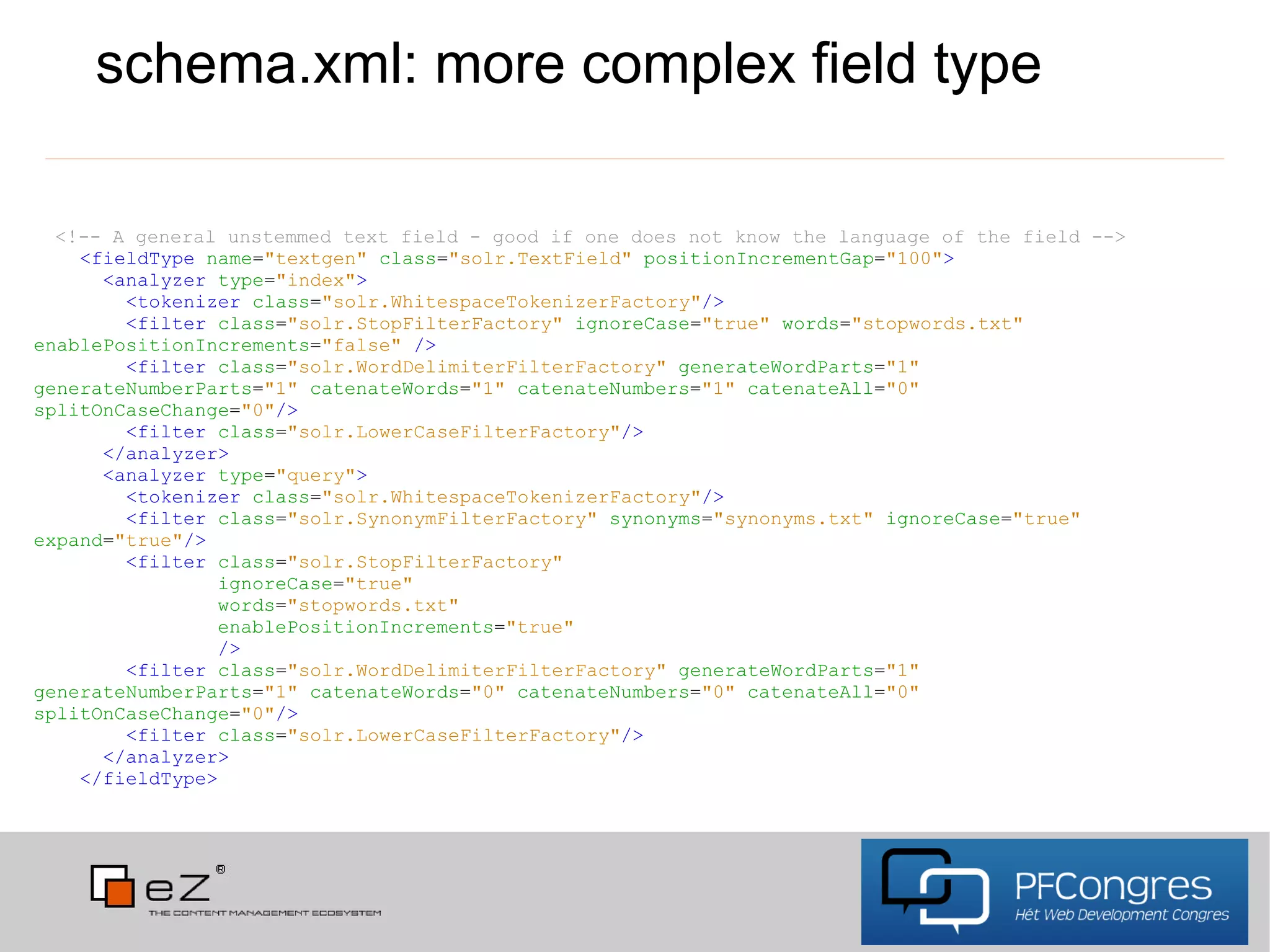
schema.xml: more complex field type

  <!-- A general unstemmed text field - good if one does not know the language of the field -->
    <fieldType name="textgen" class="solr.TextField" positionIncrementGap="100">
      <analyzer type="index">
        <tokenizer class="solr.WhitespaceTokenizerFactory"/>
        <filter class="solr.StopFilterFactory" ignoreCase="true" words="stopwords.txt"
enablePositionIncrements="false" />
        <filter class="solr.WordDelimiterFilterFactory" generateWordParts="1"
generateNumberParts="1" catenateWords="1" catenateNumbers="1" catenateAll="0"
splitOnCaseChange="0"/>
        <filter class="solr.LowerCaseFilterFactory"/>
      </analyzer>
      <analyzer type="query">
        <tokenizer class="solr.WhitespaceTokenizerFactory"/>
        <filter class="solr.SynonymFilterFactory" synonyms="synonyms.txt" ignoreCase="true"
expand="true"/>
        <filter class="solr.StopFilterFactory"
                ignoreCase="true"
                words="stopwords.txt"
                enablePositionIncrements="true"
                />
        <filter class="solr.WordDelimiterFilterFactory" generateWordParts="1"
generateNumberParts="1" catenateWords="0" catenateNumbers="0" catenateAll="0"
splitOnCaseChange="0"/>
        <filter class="solr.LowerCaseFilterFactory"/>
      </analyzer>
    </fieldType>
Huh?
Analysis
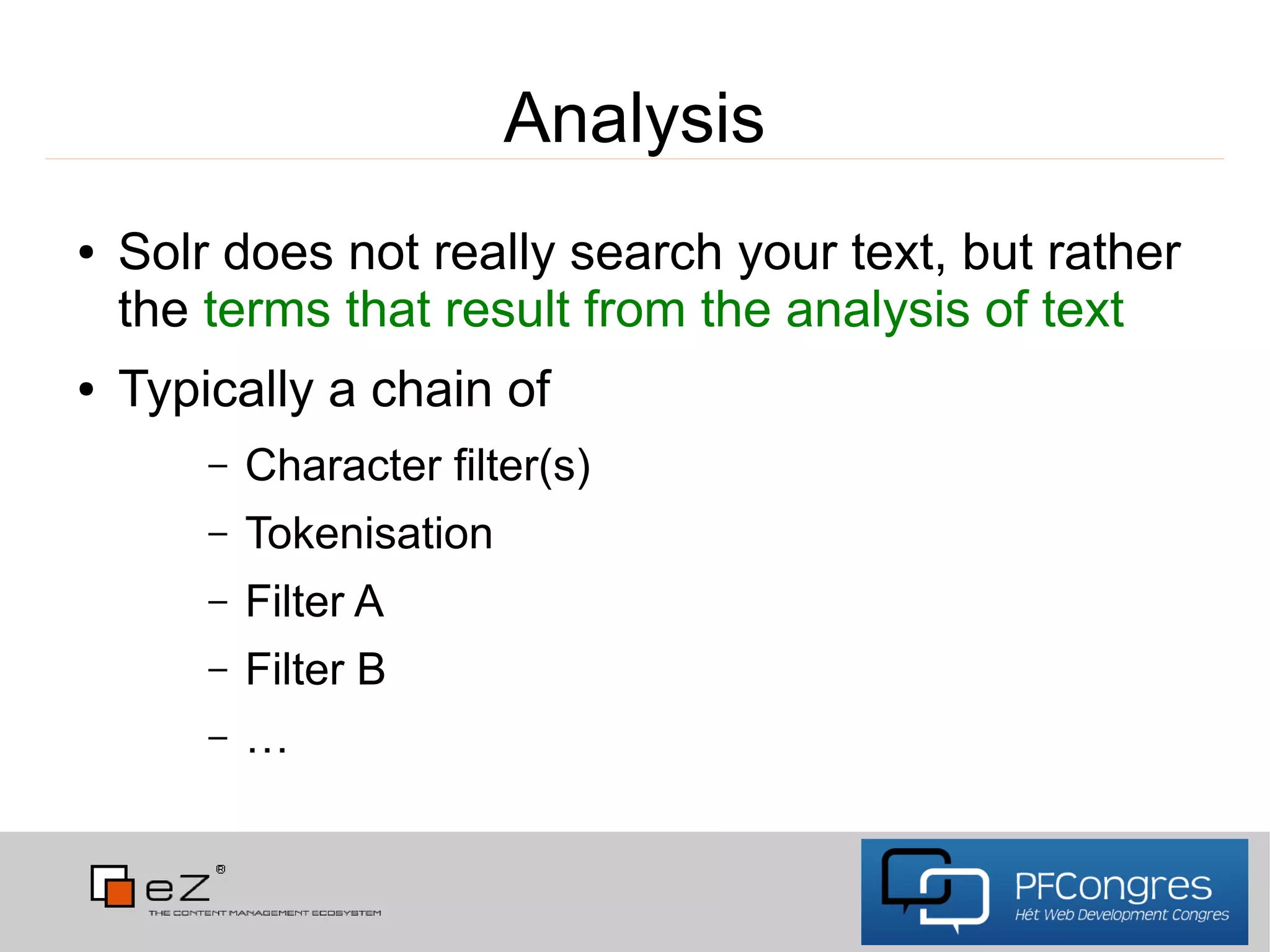
●   Solr does not really search your text, but rather
    the terms that result from the analysis of text
●   Typically a chain of
        –   Character filter(s)
        –   Tokenisation
        –   Filter A
        –   Filter B
        –   …
Solr comes with many tokenizers and
                   filters

●   Some are language specific
●   Others are very specialised
●   It is very important to get this right

    otherwise, you may not get what you expect!
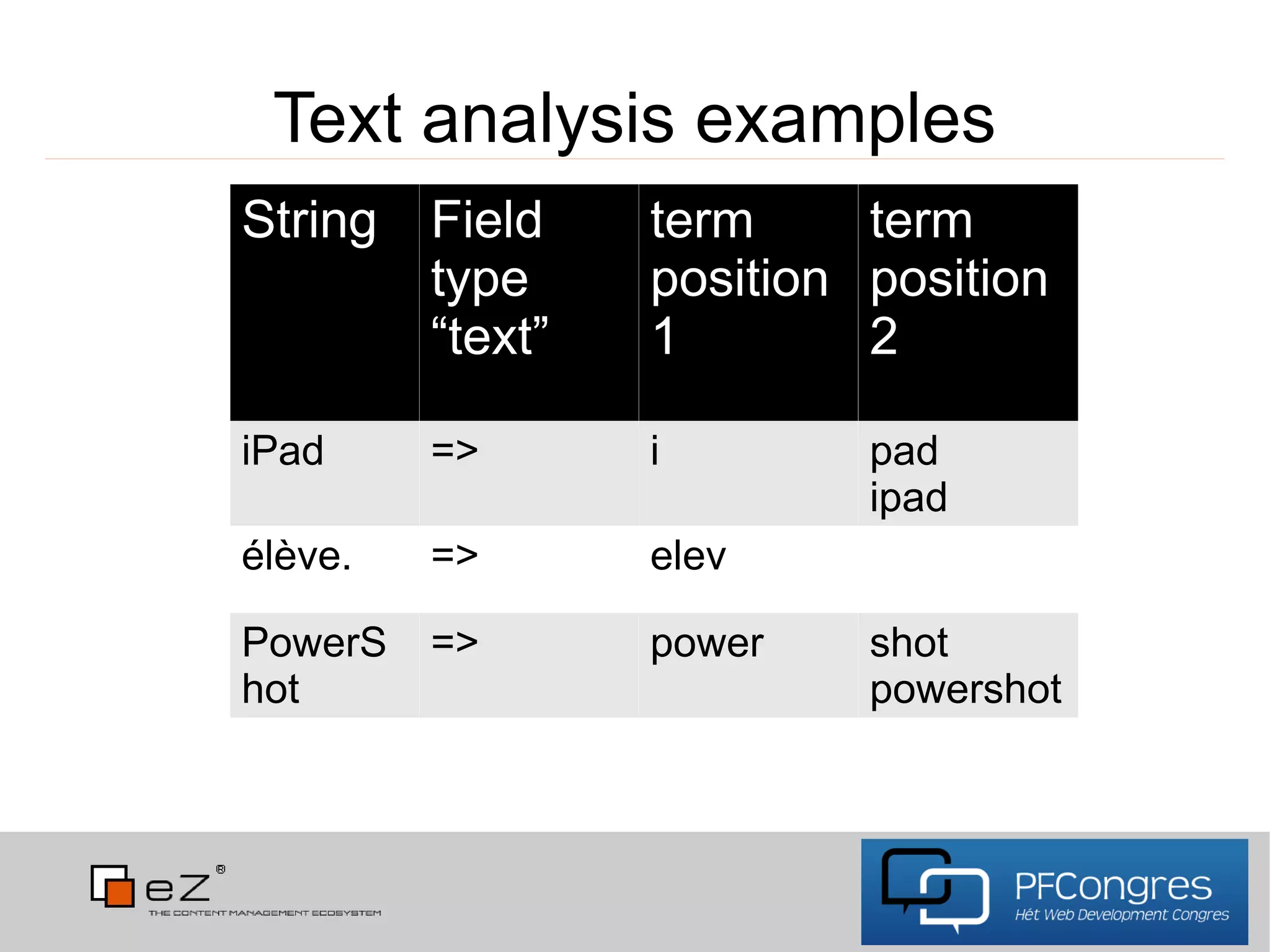
Text analysis examples
String   Field    term     term
         type     position position
         “text”   1        2

iPad     =>       i        pad
                           ipad
élève.   =>       elev

PowerS   =>       power    shot
hot                        powershot
Character filters
●   Used to cleanup text before tokenizing
       –   HTMLStripCharFilter (strips html, xml, js, css)
       –   MappingCharFilter (normalisation of characters,
            removing accents)
       –   Regular expression filter
Tokenizers
●   Convert text to tokens (terms)
●   You can define only one per field/analyzer
●   Examples
        –   WhitespaceTokenizer (splits on white space)
        –   StandardTokenizer
        –   CJK variants
Additional filters
●   Many possible per field/analyzer
●   Many delivered with Solr out of the box
●   If not enough, write a tiny bit of Java or look for
    contributions


●   Examples ...
Phonetic filters
●   PhoneticFilterFactory
●   “sounds like” transformations and matching
●   Algorithms:
       –   Metaphone
       –   Double Metaphone
       –   Soundex
       –   Refined Soundex
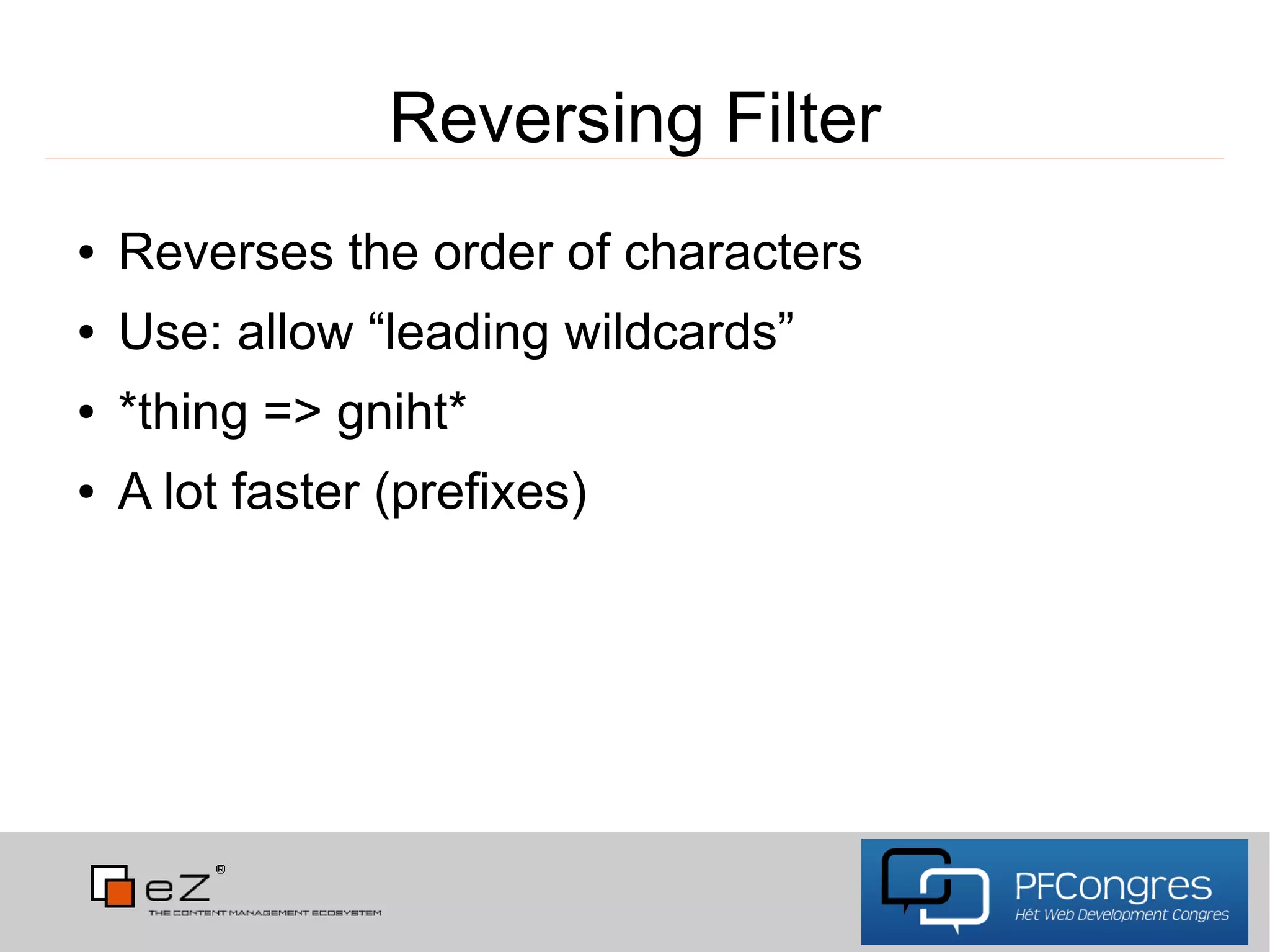
Reversing Filter
●   Reverses the order of characters
●   Use: allow “leading wildcards”
●   *thing => gniht*
●   A lot faster (prefixes)
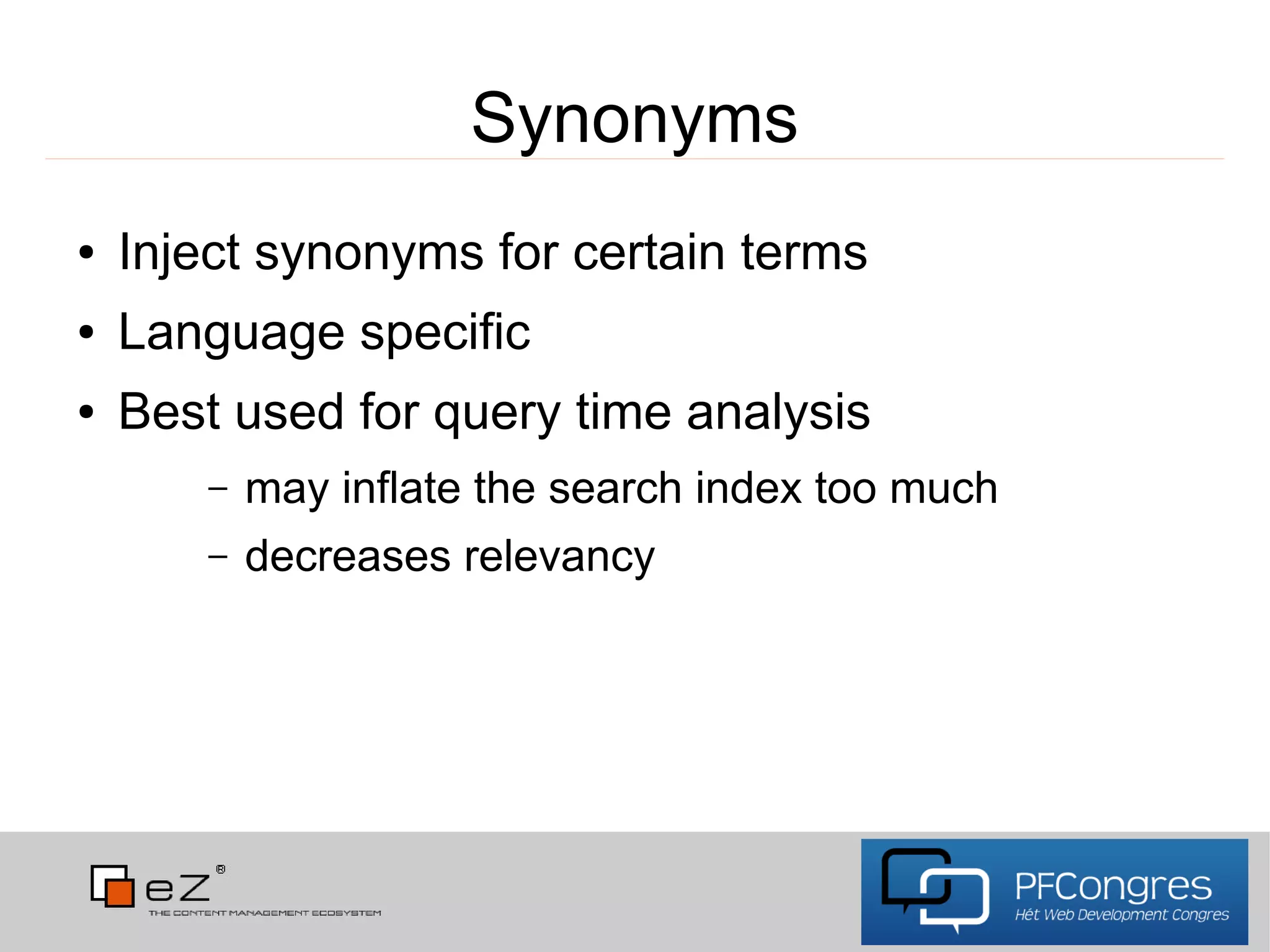
Synonyms
●   Inject synonyms for certain terms
●   Language specific
●   Best used for query time analysis
       –   may inflate the search index too much
       –   decreases relevancy
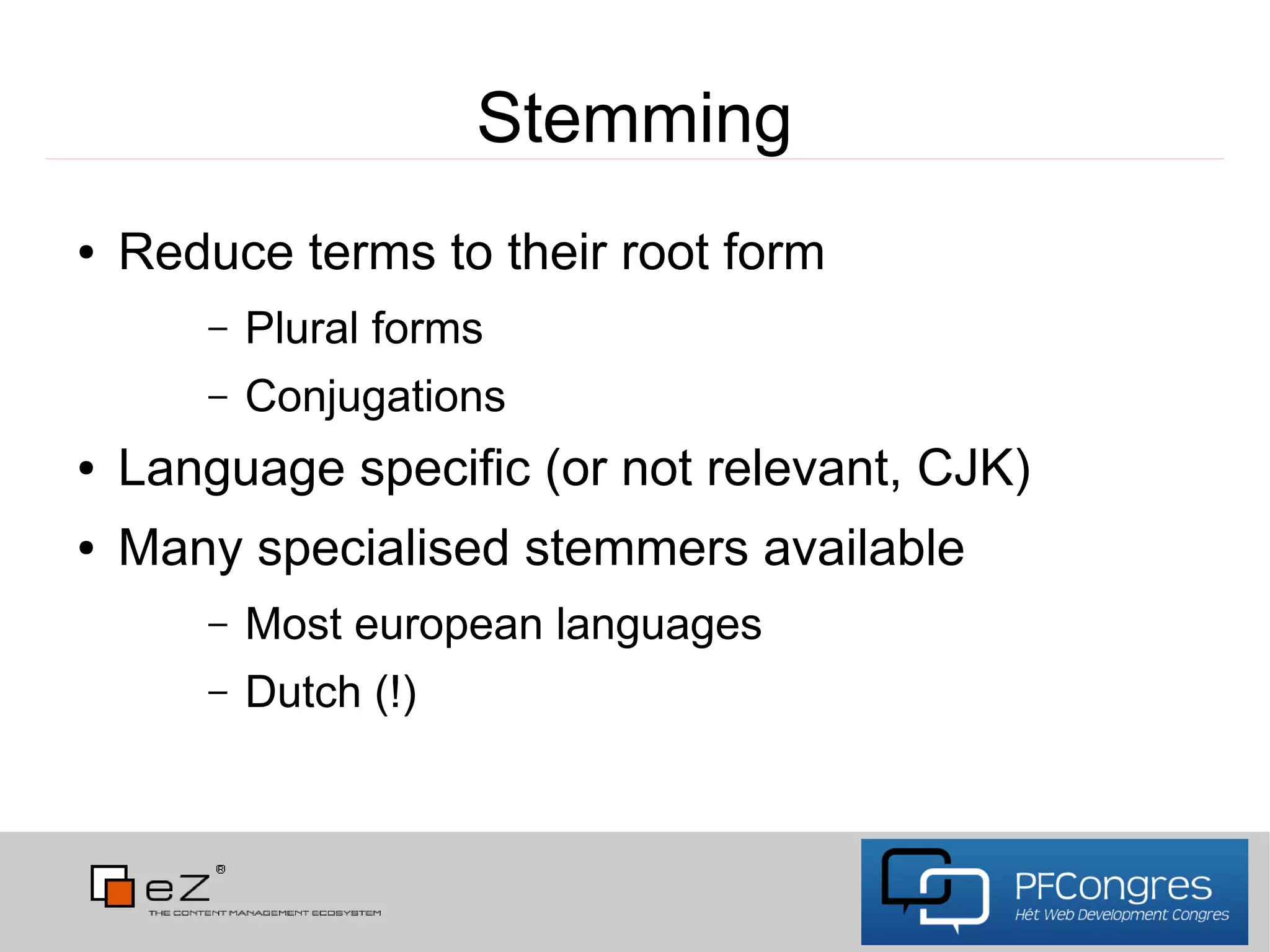
Stemming
●   Reduce terms to their root form
       –   Plural forms
       –   Conjugations
●   Language specific (or not relevant, CJK)
●   Many specialised stemmers available
       –   Most european languages
       –   Dutch (!)
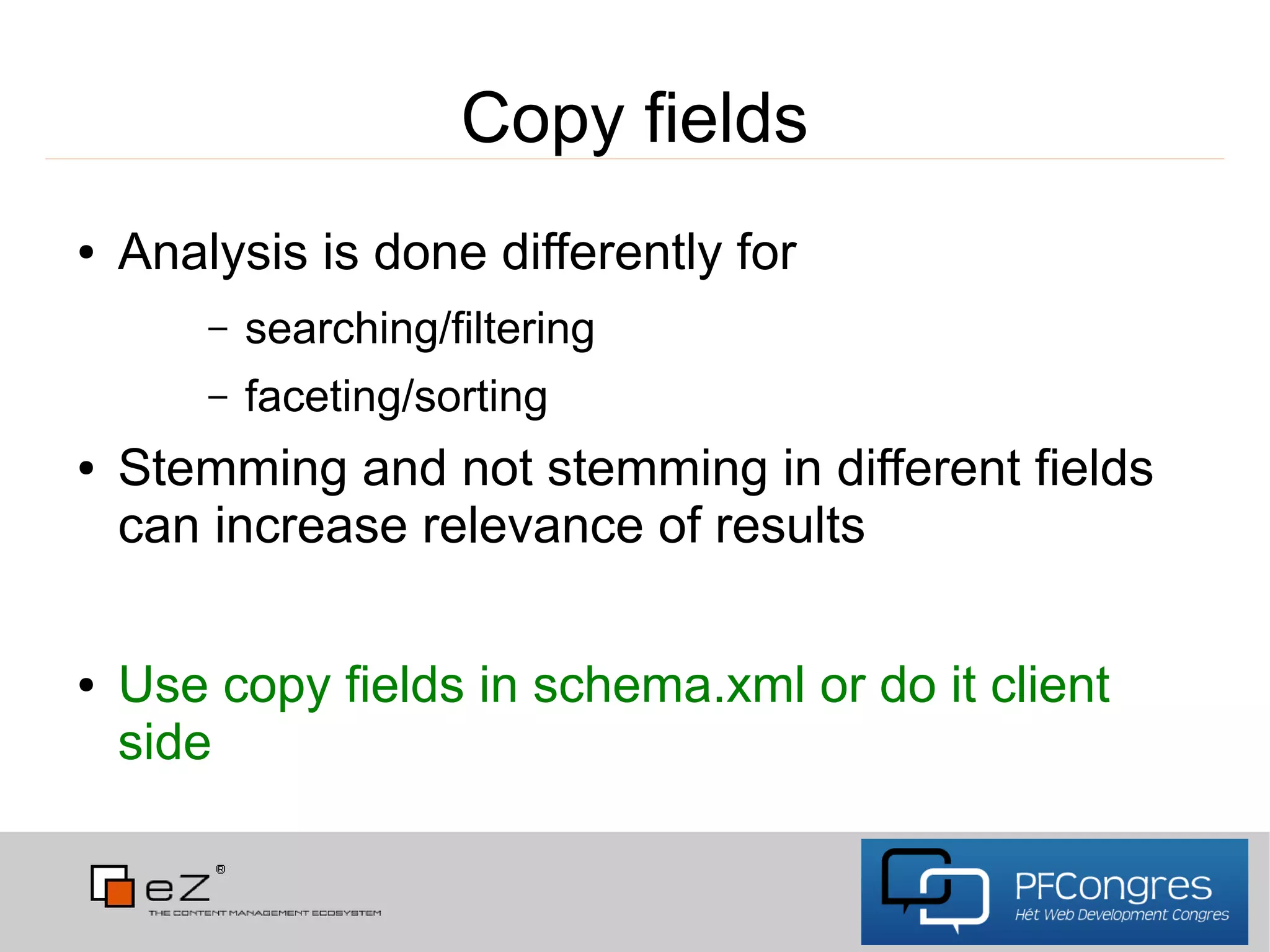
Copy fields
●   Analysis is done differently for
        –   searching/filtering
        –   faceting/sorting
●   Stemming and not stemming in different fields
    can increase relevance of results

●   Use copy fields in schema.xml or do it client
    side
Geospatial search
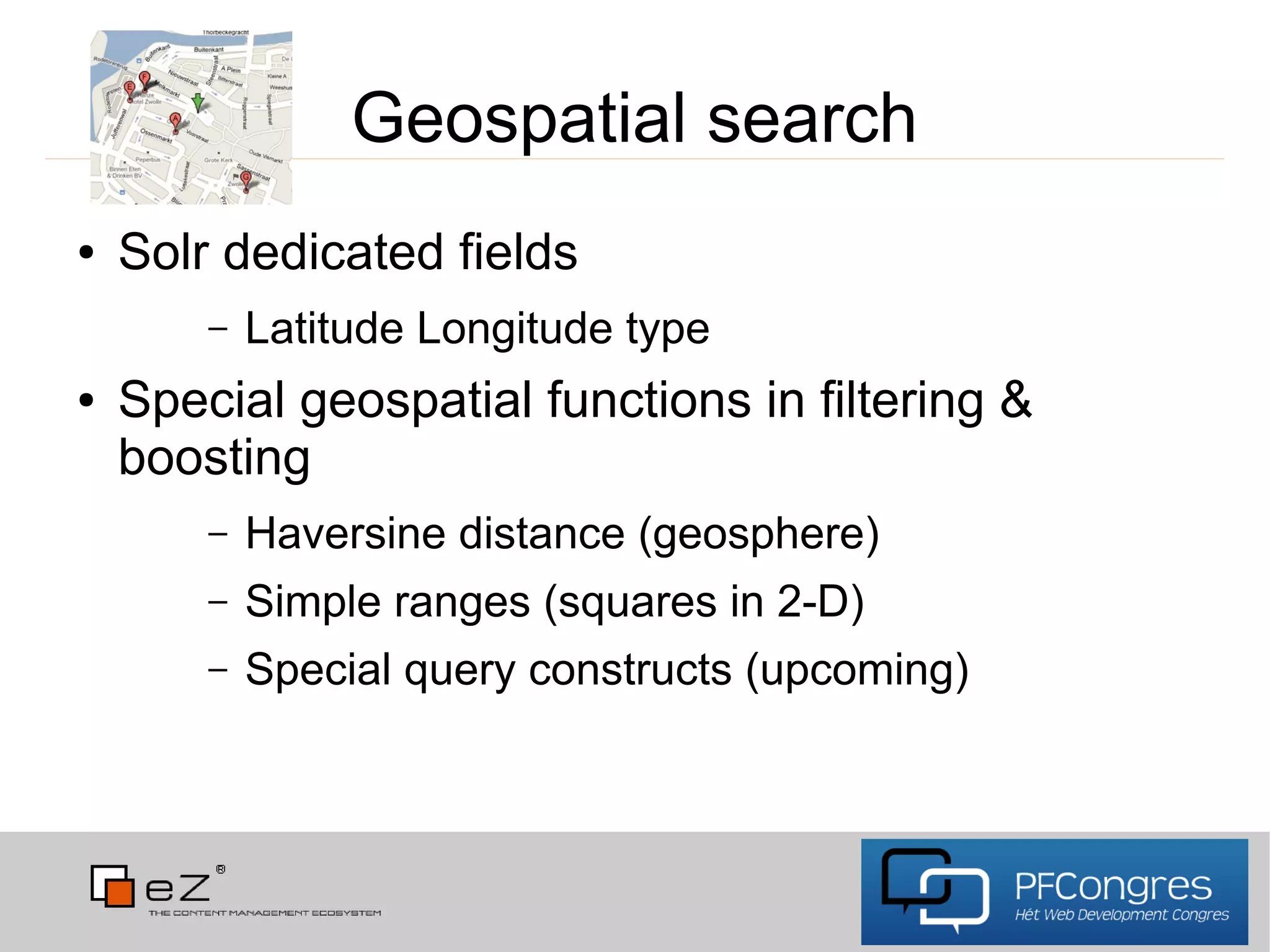
●   Solr dedicated fields
        –   Latitude Longitude type
●   Special geospatial functions in filtering &
    boosting
        –   Haversine distance (geosphere)
        –   Simple ranges (squares in 2-D)
        –   Special query constructs (upcoming)
How to use it with
Get the data and feed it
●   Most *AMP applications have databases
●   Map your data to a “document model”
       –   denormalization, flattening
       –   most DB fields can be fed unaltered, Solr takes
            care of the rest
●   Send it through HTTP as XML

●   One constraint: it must be UTF-8!
Searching
  ●   Construct a GET/POST query
  ●   Base parameters
            –   “q” for query text
            –   “start” for offset
            –   “rows” for max number of results to return
Example:
http://localhost:8983/solr/select/?q=content&version=2.2&start=0&rows=10&indent=on&wt=php
Searching (2)
●   Additional parameters
         –   response format (wt)
                   ●php = array(), json, ...
         –   type of search handler (qt)
         –   highlighting (hl.*)
         –   facets (f.<fieldName>.<FacetParam>=<value>)
         –   spellcheck (spellcheck)
         –   …
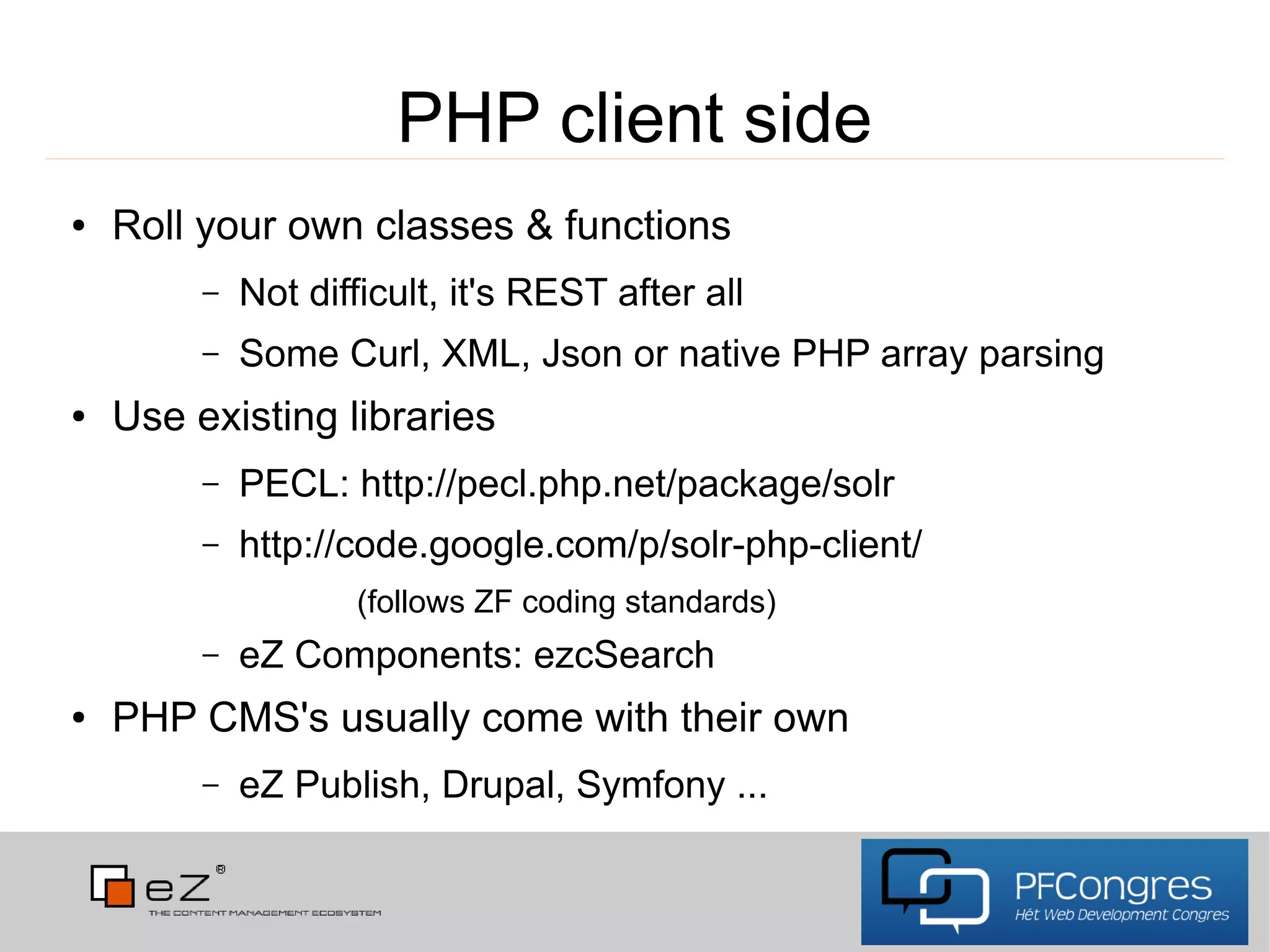
PHP client side
●   Roll your own classes & functions
         –   Not difficult, it's REST after all
         –   Some Curl, XML, Json or native PHP array parsing
●   Use existing libraries
         –   PECL: http://pecl.php.net/package/solr
         –   http://code.google.com/p/solr-php-client/
                    (follows ZF coding standards)
         –   eZ Components: ezcSearch
●   PHP CMS's usually come with their own
         –   eZ Publish, Drupal, Symfony ...
Use-cases & tips
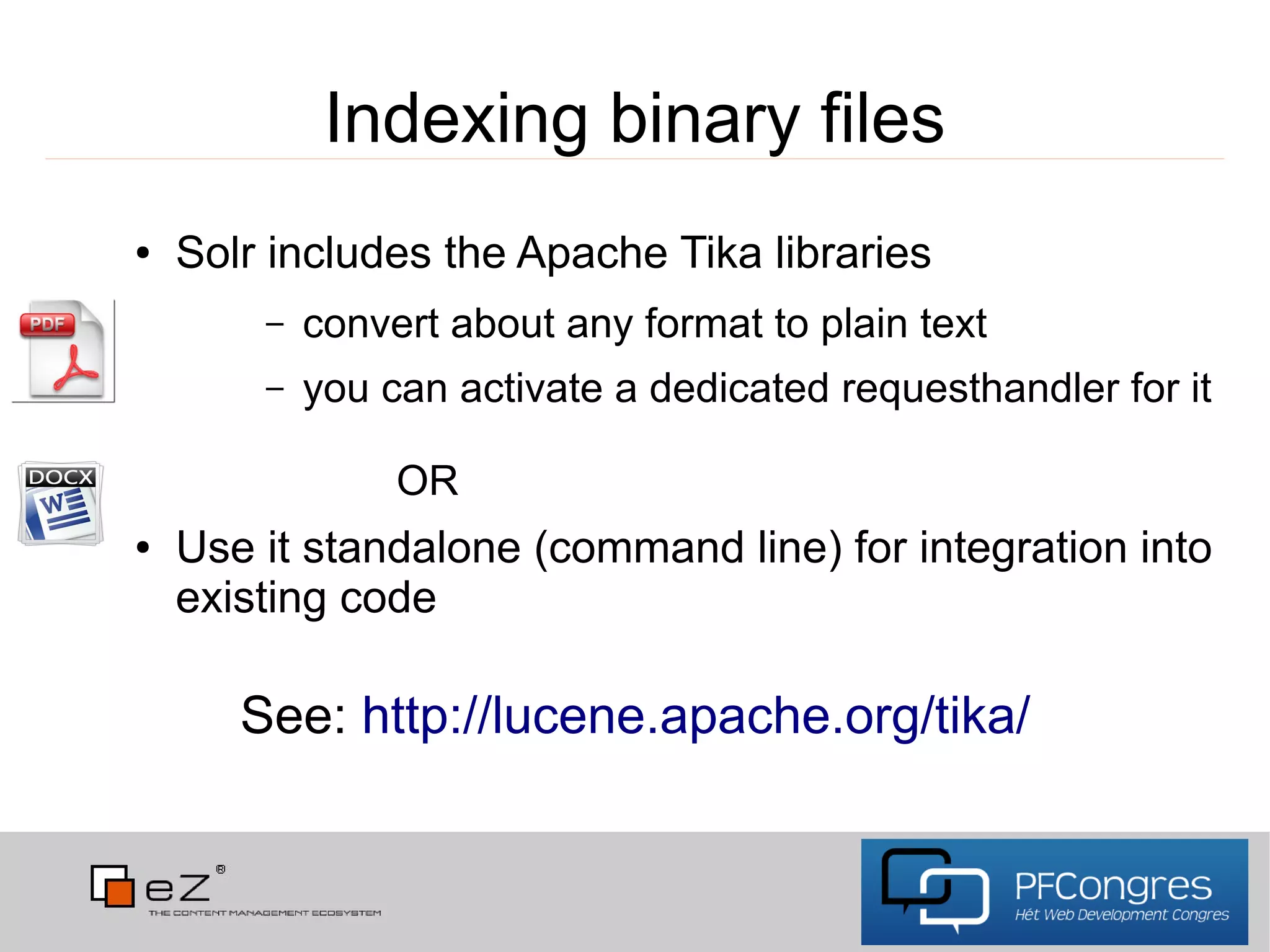
Indexing binary files
●   Solr includes the Apache Tika libraries
        –   convert about any format to plain text
        –   you can activate a dedicated requesthandler for it

                 OR
●   Use it standalone (command line) for integration into
    existing code

       See: http://lucene.apache.org/tika/
Integrate legacy data
●   Use the Solr Data Import Handler
●   Able to index DB's directly
        –   define the schema to use (including possible
             joins)
        –   fire simple requests to Solr to actually
               index/update
●   Also XML feeds, files (csv), ...
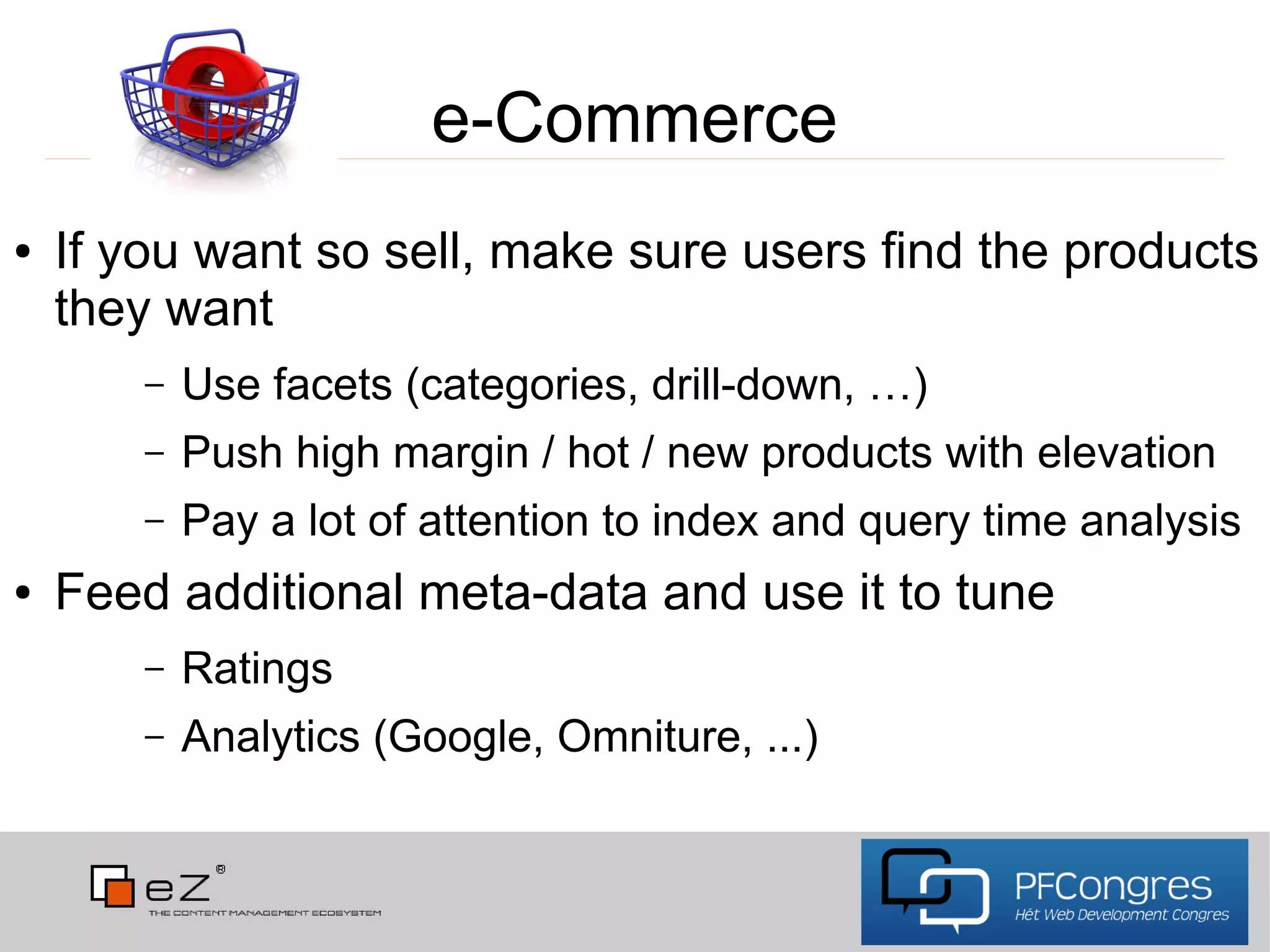
e-Commerce
●   If you want so sell, make sure users find the products
    they want
        –   Use facets (categories, drill-down, …)
        –   Push high margin / hot / new products with elevation
        –   Pay a lot of attention to index and query time analysis
●   Feed additional meta-data and use it to tune
        –   Ratings
        –   Analytics (Google, Omniture, ...)
Have multilingual content?
●   Multi-core configuration
        –   Setup a dedicated Solr core per language
        –   Each has its own schema definitions, while you
             can still use common field names
●   If using one index
        –   Use dynamic fields and create language specific
             analyzers for dedicate language
             suffixes/prefixes
Resources
●   Solr: wiki, mailing lists, downloads
    http://lucene.apache.org/solr/
●   Free book, articles (by core Solr devs)
    http://www.lucidimagination.com/
●   Bother me ;)
Thank you!

                Questions?

email: paul dot borgermans at gmail dot com
      http://twitter.com/paulborgermans

        Please rate this talk/slides:
        http://joind.in/talk/view/1504

Find it, possibly also near you!

  • 1.
    Find it, possibly alsonear you! Paul Borgermans
  • 2.
    About me ● Currently employed by eZ Systems http://ez.no ● Active in open source community for a while – Squid http proxy server (about 15 y ago) – PHP based CMS solutions (mostly eZ Publish) – executive committee ● Currently fancying : – PHP as the master glue language for almost everything – Apache Lucene family of projects (mainly Solr) – NoSQL (Not only SQL) and scalable architectures – CMS systems & information management
  • 3.
    Outline ● Overview of Apache Solr ● Concepts & internals ● How to use it with PHP ● Use cases & tips ● Resources
  • 4.
  • 5.
    Apache Solr CurriculumVitae ● Open source Apache Lucene project, started by Yonik Seeley ● Standalone, enterprise grade search server built on top of Lucene ● Lives in a Java servlet container ● Access through a REST-ful API – HTTP – Primary payload in requests: XML – Other response formats: PHP, JSON, …
  • 6.
    Used by .. Andmany more ...
  • 7.
    Solr in anutshell ● State of the art, advanced full text search and information retrieval ● Fast, scalable with native replication features ● Flexible configuration ● Document oriented storage ● Geospatial search ● Native cloud features
  • 8.
    Full text searchmain features ● Tuneable relevancy ranking on top of internal similarity algorithms ● Highlighting ● Sorting ● Filtering ● “Drill-down” navigation (facets) ● Automatic related content ● Spell checking ● Multilingual text analysis
  • 9.
  • 10.
    Tunable relevancy ranking ● “Boosting” at index and query time – certain types of content – certain parts of content (“fields”) – page-rank like if the content has relations ● Elevate request component – predefined “pages/documents” to the top when certain keywords are entered ● With customised functions – more recent articles – proximity (geolocations)
  • 11.
    Filtering ● Does not influence the relevancy ● Narrows down the scope ● Very powerful: full boolean, wildcards, fuzzy, and unlimited combinations ● Ranges (dates, numbers, alphanumeric, ...) Also for implementing security!
  • 12.
    Facets ● Along the main query, “facet fields” may be defined, usually operating on meta-data: – Type of content – Publication year – Keywords – Author .... ● The result set is returned offering the number hits within each “facet” ● You can use the selected facet as a subsequent filter
  • 13.
  • 14.
    Automatic related content (“More Like This”) ● Search engine determines itself which are the important terms of a page and performs a query ● All other normal features can be used – Filtering – Sorting – Facets
  • 16.
    Spell checking ● Two possible strategies – Dictionary look-up – Using the indexed words itself (recommended) ● Possible “Google” approach using the “best guess” – Search for “Grein botle“ => suggests “Green bottle” ● Let Solr return individual keyword suggestions => more client side processing required
  • 17.
    Multilingual features ● Adapted tokenizers ● Stemming (reducing words to common form) – Reduces some spelling errors too! – May decrease accuracy ● Different algorithms per language ● Normalisation (“latin 1 characters”) – élève = eleve, Spaß = spass, ...
  • 18.
  • 19.
    Performance ● Solr employs intelligent caches – filters – queries – internal indexes ● Optimized for search/retrieval ● Possible autowarming on start up ● When updates are done, caches are reconstructed on the fly in the background
  • 20.
    Performance (2) ● Replication – master-slave for now – works across platforms with same configuration – no native OS features needed (or rsync) – more cloud features under development ● Sharding (client driven)
  • 21.
  • 22.
    The Solr/Lucene index ● Inverted index ● Holds a collection of “documents” (hello NoSQL) ● Document – Collection of fields – Flexible schema! – Unique ID (user defined) ● Solr uses a XML based config file: schema.xml
  • 23.
    Fields ● Various field types, derived from base classes ● Indexed – contains the inverted index – usually analyzed & tokenized – makes it searchable and sortable ● Stored – contains also the original content – content can be part of the request response ● Can be multi-valued! – opens possibilities beyond full text search
  • 24.
    Field definitions: schema.xml ● Field types – text – numerical – dates – location – … (about 25 in total) ● Actual fields (name, definition, properties) ● Dynamic fields ● Copy fields (as aggregators)
  • 25.
    schema.xml: simple fieldtype examples <fieldType name="string" class="solr.StrField" sortMissingLast="true" omitNorms="true"/> <!-- boolean type: "true" or "false" --> <fieldType name="boolean" class="solr.BoolField" sortMissingLast="true" omitNorms="true"/> <!-- A Trie based date field for faster date range queries and date faceting. --> <fieldType name="tdate" class="solr.TrieDateField" omitNorms="true" precisionStep="6" positionIncrementGap="0"/> <!-- A text field that only splits on whitespace for exact matching of words --> <fieldType name="text_ws" class="solr.TextField" positionIncrementGap="100"> <analyzer> <tokenizer class="solr.WhitespaceTokenizerFactory"/> </analyzer> </fieldType>
  • 26.
    schema.xml: more complexfield type <!-- A general unstemmed text field - good if one does not know the language of the field --> <fieldType name="textgen" class="solr.TextField" positionIncrementGap="100"> <analyzer type="index"> <tokenizer class="solr.WhitespaceTokenizerFactory"/> <filter class="solr.StopFilterFactory" ignoreCase="true" words="stopwords.txt" enablePositionIncrements="false" /> <filter class="solr.WordDelimiterFilterFactory" generateWordParts="1" generateNumberParts="1" catenateWords="1" catenateNumbers="1" catenateAll="0" splitOnCaseChange="0"/> <filter class="solr.LowerCaseFilterFactory"/> </analyzer> <analyzer type="query"> <tokenizer class="solr.WhitespaceTokenizerFactory"/> <filter class="solr.SynonymFilterFactory" synonyms="synonyms.txt" ignoreCase="true" expand="true"/> <filter class="solr.StopFilterFactory" ignoreCase="true" words="stopwords.txt" enablePositionIncrements="true" /> <filter class="solr.WordDelimiterFilterFactory" generateWordParts="1" generateNumberParts="1" catenateWords="0" catenateNumbers="0" catenateAll="0" splitOnCaseChange="0"/> <filter class="solr.LowerCaseFilterFactory"/> </analyzer> </fieldType>
  • 27.
  • 28.
    Analysis ● Solr does not really search your text, but rather the terms that result from the analysis of text ● Typically a chain of – Character filter(s) – Tokenisation – Filter A – Filter B – …
  • 29.
    Solr comes withmany tokenizers and filters ● Some are language specific ● Others are very specialised ● It is very important to get this right otherwise, you may not get what you expect!
  • 30.
    Text analysis examples String Field term term type position position “text” 1 2 iPad => i pad ipad élève. => elev PowerS => power shot hot powershot
  • 31.
    Character filters ● Used to cleanup text before tokenizing – HTMLStripCharFilter (strips html, xml, js, css) – MappingCharFilter (normalisation of characters, removing accents) – Regular expression filter
  • 32.
    Tokenizers ● Convert text to tokens (terms) ● You can define only one per field/analyzer ● Examples – WhitespaceTokenizer (splits on white space) – StandardTokenizer – CJK variants
  • 33.
    Additional filters ● Many possible per field/analyzer ● Many delivered with Solr out of the box ● If not enough, write a tiny bit of Java or look for contributions ● Examples ...
  • 34.
    Phonetic filters ● PhoneticFilterFactory ● “sounds like” transformations and matching ● Algorithms: – Metaphone – Double Metaphone – Soundex – Refined Soundex
  • 35.
    Reversing Filter ● Reverses the order of characters ● Use: allow “leading wildcards” ● *thing => gniht* ● A lot faster (prefixes)
  • 36.
    Synonyms ● Inject synonyms for certain terms ● Language specific ● Best used for query time analysis – may inflate the search index too much – decreases relevancy
  • 37.
    Stemming ● Reduce terms to their root form – Plural forms – Conjugations ● Language specific (or not relevant, CJK) ● Many specialised stemmers available – Most european languages – Dutch (!)
  • 38.
    Copy fields ● Analysis is done differently for – searching/filtering – faceting/sorting ● Stemming and not stemming in different fields can increase relevance of results ● Use copy fields in schema.xml or do it client side
  • 39.
    Geospatial search ● Solr dedicated fields – Latitude Longitude type ● Special geospatial functions in filtering & boosting – Haversine distance (geosphere) – Simple ranges (squares in 2-D) – Special query constructs (upcoming)
  • 40.
    How to useit with
  • 41.
    Get the dataand feed it ● Most *AMP applications have databases ● Map your data to a “document model” – denormalization, flattening – most DB fields can be fed unaltered, Solr takes care of the rest ● Send it through HTTP as XML ● One constraint: it must be UTF-8!
  • 42.
    Searching ● Construct a GET/POST query ● Base parameters – “q” for query text – “start” for offset – “rows” for max number of results to return Example: http://localhost:8983/solr/select/?q=content&version=2.2&start=0&rows=10&indent=on&wt=php
  • 43.
    Searching (2) ● Additional parameters – response format (wt) ●php = array(), json, ... – type of search handler (qt) – highlighting (hl.*) – facets (f.<fieldName>.<FacetParam>=<value>) – spellcheck (spellcheck) – …
  • 44.
    PHP client side ● Roll your own classes & functions – Not difficult, it's REST after all – Some Curl, XML, Json or native PHP array parsing ● Use existing libraries – PECL: http://pecl.php.net/package/solr – http://code.google.com/p/solr-php-client/ (follows ZF coding standards) – eZ Components: ezcSearch ● PHP CMS's usually come with their own – eZ Publish, Drupal, Symfony ...
  • 45.
  • 46.
    Indexing binary files ● Solr includes the Apache Tika libraries – convert about any format to plain text – you can activate a dedicated requesthandler for it OR ● Use it standalone (command line) for integration into existing code See: http://lucene.apache.org/tika/
  • 47.
    Integrate legacy data ● Use the Solr Data Import Handler ● Able to index DB's directly – define the schema to use (including possible joins) – fire simple requests to Solr to actually index/update ● Also XML feeds, files (csv), ...
  • 48.
    e-Commerce ● If you want so sell, make sure users find the products they want – Use facets (categories, drill-down, …) – Push high margin / hot / new products with elevation – Pay a lot of attention to index and query time analysis ● Feed additional meta-data and use it to tune – Ratings – Analytics (Google, Omniture, ...)
  • 49.
    Have multilingual content? ● Multi-core configuration – Setup a dedicated Solr core per language – Each has its own schema definitions, while you can still use common field names ● If using one index – Use dynamic fields and create language specific analyzers for dedicate language suffixes/prefixes
  • 50.
    Resources ● Solr: wiki, mailing lists, downloads http://lucene.apache.org/solr/ ● Free book, articles (by core Solr devs) http://www.lucidimagination.com/ ● Bother me ;)
  • 51.
    Thank you! Questions? email: paul dot borgermans at gmail dot com http://twitter.com/paulborgermans Please rate this talk/slides: http://joind.in/talk/view/1504