Extending Solr: Building a Cloud-like
   Knowledge Discovery Platform


       Trey Grainger,,CareerBuilder
Overview
CareerBuilder’s Cloud-like Knowledge Discovery Platform
   • Scalable approaches to multi-lingual text
     analysis (with research study)
       Multiple fields vs Multiple Cores vs Single Field

   • Custom Scoring
       Payloads and on-the-fly bucket scoring
       Implementing a keyword spamming penalty

   • Solr as a Cloud Service
       Scalable, customizable search for everybody

   • Knowledge Discovery & Data Analytics
My background
 Trey Grainger
   • Search Technology Development Team Lead
     @ CareerBuilder.com


 Relevant Background:
   • Search & Recommendations
   • High-volume, N-tier Architectures
   • NLP, Relevancy Tuning, user group testing & machine
     learning


 Fun Side Project:
   • Founder and Site Architect @ Celiaccess.com
CareerBuilder’s Search Scale
 Over 1 million new jobs each month
 Over 40 million resumes
 ~150 globally distributed search servers
  (in the U.S., Europe, & Asia)
 Several thousand unique, dynamically generated
  indexes
 Over a million searches an hour
 >100 Million Search Documents
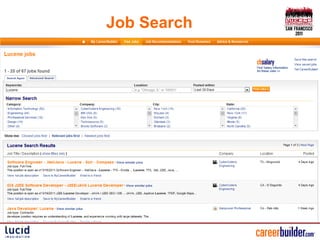
Job Search
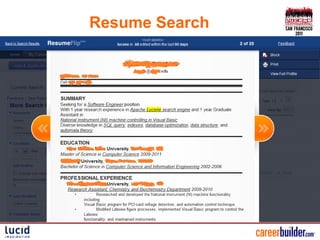
Resume Search
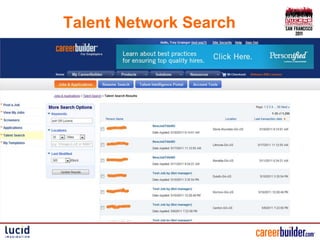
Talent Network Search
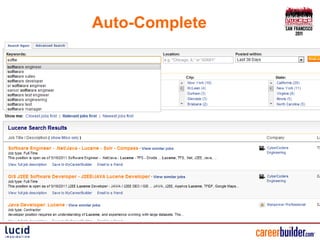
Auto-Complete
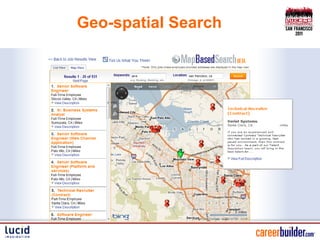
Geo-spatial Search
Recommendations
 We classify all content (Jobs, Resumes, etc.) and index
  the classified content into Solr

 We use a combination of collaborative filtering and
  classification techniques

 We utilize a custom scorer and payloads to apply
  higher bucket weights to more relevant content

 Recommendations are real-time and largely driven by
  search
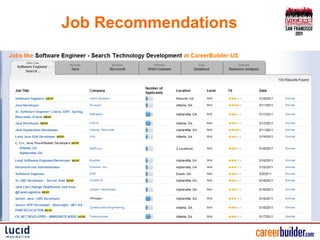
Job Recommendations
Resume Recommendations
Multi-lingual Analysis
 Approach 1: Different Field Per Language
   •   Advantages:
         Simple, easiest to implement
   •   Disadvantages:
         My require keeping duplicate copies of your text per language
         If searching across each field (dismax style), slows search down, especially if
          handling many languages


 Approach 2: Different Solr Core per language
   Each core has your field defined with a different Analyzer chain
   specific to that core’s language
   •   Advantages:
         Searching can be completely language-agnostic and additional overhead to search
          more languages simultaneously is negligible
   •   Disadvantages:
         Multi-lingual documents require indexing to multiple cores, potentially messing up
          relevancy and adding complexity
         Have to write your own language-dependent sharding
         If you don’t already have distributed search, this adds complexity and overhead
Multi-lingual Analysis
   Approach 3: All languages in one field
         •   Advantages:
               Only one field needed regardless of number of languages
               Avoids a field explosion or a Solr core explosion as you scale to handle more languages

         •   Disadvantages:
               Can end up with some “noise” in the index if you process most text in lots of languages
                (especially if stemming and not lemmatizing)
               Currently requires writing your own Tokenizer or Filter


   Strategy:
         •   1) Copy token stream and create a stemmer/lemmatizer for each language
             2) Pass the original into each stemmer/lemmatizer
             3) Stack the outputs of each stemmer/lemmatizer

Input:
Output:
Multi-lingual Analysis
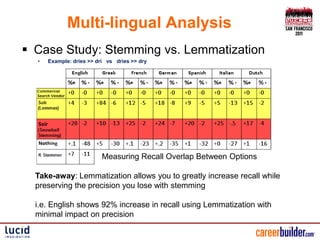
 Case Study: Stemming vs. Lemmatization
  •   Example: dries >> dri vs dries >> dry


                          Measuring Recall Overlap Between Options

  Take-away: Lemmatization allows you to greatly increase recall while
  preserving the precision you lose with stemming

  i.e. English shows 92% increase in recall using Lemmatization with
  minimal impact on precision
Custom Scoring
   Search Terms can be boosted differently:
     •   q=web^2 development^5 AND jobtitle:(software engineer)^10


   Some Fields can be weighted (scored) higher than others
     •   i.e. Field1^10, Field2^5, Field3^2, Field 4^.01

   Content within Fields can be boosted differently
     •   design [1] / engineer [1] / really [ ] / great [ ] / job [ ] / ten[3] / years[3] / experience[3] /
         careerbuilder [2] / design [2], …
         Field1: bucket=[1] boost=10; Field2: bucket=[2] boost=1.5; Field3: bucket=[] weight=1; Field4: bucket=3
         weight=1.5


     •   We can pass in a parameter to solr at query time specifying the boost to apply to each
         bucket i.e. …&bucketWeights=1:10;2:1.5;3:1.5

   You can also do index-time boosting, but this reduces your ability to do query-side
    relevancy experiments and requires norms to always be on

   By making all scoring parameters overridable at query time, we are able to do A / B
    testing to consistently improve our relevancy model
Stopping Keyword Spamming
 We already subclass PayloadTermQuery and tie in custom scoring
  for our buckets weights

 For each payload “bucket” (or across all buckets), we can count
  the number of hits and penalize the score if a particular keyword
  appears too many times

 Payload scoring then essentially becomes
    •   BucketBoost(payloadBucket) * HitMap(#hitsPerbucket)


 By adjusting our HitMap function, we can thus generate any kind of
  relevancy curve for how much each additional term adds to (or
  subtracts from) the relevancy score for that document
    •   ex: Bell curve, Linear, Bi-linear, Linear with drop-off, custom map, etc.
CareerBuilder’s Search Cloud
 Goals:
  • Make search easy to use and accessible to all engineers (not
    just the search team)

  • Allow schema changes without mucking with solr (on hundreds
    of servers)

  • Make solr installs generic and independent of any particular
    implementation
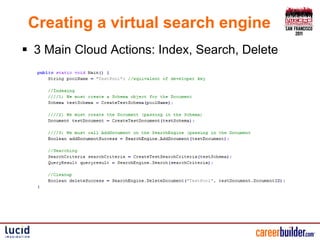
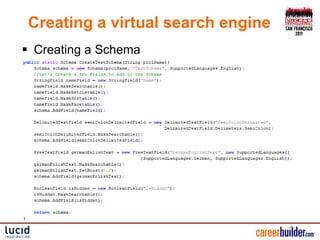
Creating a virtual search engine
 3 Main Cloud Actions: Index, Search, Delete
Creating a virtual search engine
 Creating a Schema
Creating a virtual search engine
 Creating a Document


 Processing Results
  •   A QueryResult object comes back from the SearchEngine.Search method with all of
      the main types (search records, facets, meta info, etc) parsed out into objects


 Behind the Scenes:
  •   We have a distributed architecture handling queuing all documents to
      appropriate datacenters, feeding the clusters, and load-balancing
      searches between all available clusters for the given search pool.
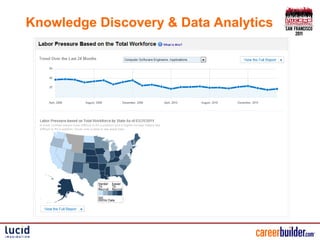
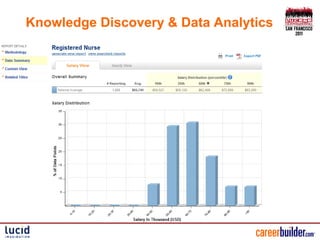
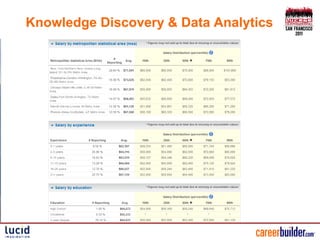
Knowledge Discovery & Data Analytics


                                       25
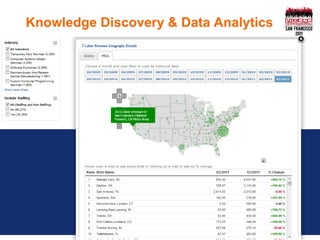
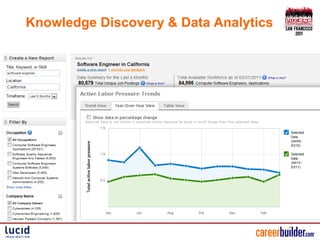
Knowledge Discovery & Data Analytics
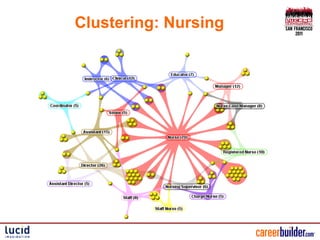
Clustering: Nursing
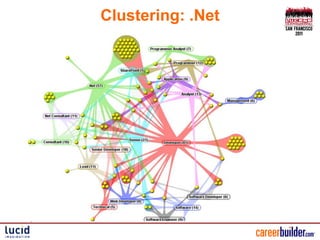
Clustering: .Net
Clustering: Hyperion Developer
Take Aways
 Know how your linguistics affect precision and recall
  and choose wisely; know how to tweak for your domain.

 A flexible software api that turn Solr into a SAAS type
  cloud app can greatly increase agility and adoption of
  search.

 Search isn’t just about finding and navigating content…
  it can be used to learn from and create it, as well.
Contact
 Trey Grainger
       • trey.grainger@careerbuilder.com
       • http://www.careerbuilder.com

Extending Solr: Behind CareerBuilder’s Cloud-like Knowledge Discovery Platform, By Trey Grainger

  • 1.
    Extending Solr: Buildinga Cloud-like Knowledge Discovery Platform Trey Grainger,,CareerBuilder
  • 2.
    Overview CareerBuilder’s Cloud-like KnowledgeDiscovery Platform • Scalable approaches to multi-lingual text analysis (with research study)  Multiple fields vs Multiple Cores vs Single Field • Custom Scoring  Payloads and on-the-fly bucket scoring  Implementing a keyword spamming penalty • Solr as a Cloud Service  Scalable, customizable search for everybody • Knowledge Discovery & Data Analytics
  • 3.
    My background  TreyGrainger • Search Technology Development Team Lead @ CareerBuilder.com  Relevant Background: • Search & Recommendations • High-volume, N-tier Architectures • NLP, Relevancy Tuning, user group testing & machine learning  Fun Side Project: • Founder and Site Architect @ Celiaccess.com
  • 4.
    CareerBuilder’s Search Scale Over 1 million new jobs each month  Over 40 million resumes  ~150 globally distributed search servers (in the U.S., Europe, & Asia)  Several thousand unique, dynamically generated indexes  Over a million searches an hour  >100 Million Search Documents
  • 5.
  • 6.
  • 7.
  • 8.
  • 9.
  • 10.
    Recommendations  We classifyall content (Jobs, Resumes, etc.) and index the classified content into Solr  We use a combination of collaborative filtering and classification techniques  We utilize a custom scorer and payloads to apply higher bucket weights to more relevant content  Recommendations are real-time and largely driven by search
  • 11.
  • 12.
  • 13.
    Multi-lingual Analysis  Approach1: Different Field Per Language • Advantages:  Simple, easiest to implement • Disadvantages:  My require keeping duplicate copies of your text per language  If searching across each field (dismax style), slows search down, especially if handling many languages  Approach 2: Different Solr Core per language Each core has your field defined with a different Analyzer chain specific to that core’s language • Advantages:  Searching can be completely language-agnostic and additional overhead to search more languages simultaneously is negligible • Disadvantages:  Multi-lingual documents require indexing to multiple cores, potentially messing up relevancy and adding complexity  Have to write your own language-dependent sharding  If you don’t already have distributed search, this adds complexity and overhead
  • 14.
    Multi-lingual Analysis  Approach 3: All languages in one field • Advantages:  Only one field needed regardless of number of languages  Avoids a field explosion or a Solr core explosion as you scale to handle more languages • Disadvantages:  Can end up with some “noise” in the index if you process most text in lots of languages (especially if stemming and not lemmatizing)  Currently requires writing your own Tokenizer or Filter  Strategy: • 1) Copy token stream and create a stemmer/lemmatizer for each language 2) Pass the original into each stemmer/lemmatizer 3) Stack the outputs of each stemmer/lemmatizer Input: Output:
  • 15.
    Multi-lingual Analysis  CaseStudy: Stemming vs. Lemmatization • Example: dries >> dri vs dries >> dry Measuring Recall Overlap Between Options Take-away: Lemmatization allows you to greatly increase recall while preserving the precision you lose with stemming i.e. English shows 92% increase in recall using Lemmatization with minimal impact on precision
  • 16.
    Custom Scoring  Search Terms can be boosted differently: • q=web^2 development^5 AND jobtitle:(software engineer)^10  Some Fields can be weighted (scored) higher than others • i.e. Field1^10, Field2^5, Field3^2, Field 4^.01  Content within Fields can be boosted differently • design [1] / engineer [1] / really [ ] / great [ ] / job [ ] / ten[3] / years[3] / experience[3] / careerbuilder [2] / design [2], … Field1: bucket=[1] boost=10; Field2: bucket=[2] boost=1.5; Field3: bucket=[] weight=1; Field4: bucket=3 weight=1.5 • We can pass in a parameter to solr at query time specifying the boost to apply to each bucket i.e. …&bucketWeights=1:10;2:1.5;3:1.5  You can also do index-time boosting, but this reduces your ability to do query-side relevancy experiments and requires norms to always be on  By making all scoring parameters overridable at query time, we are able to do A / B testing to consistently improve our relevancy model
  • 17.
    Stopping Keyword Spamming We already subclass PayloadTermQuery and tie in custom scoring for our buckets weights  For each payload “bucket” (or across all buckets), we can count the number of hits and penalize the score if a particular keyword appears too many times  Payload scoring then essentially becomes • BucketBoost(payloadBucket) * HitMap(#hitsPerbucket)  By adjusting our HitMap function, we can thus generate any kind of relevancy curve for how much each additional term adds to (or subtracts from) the relevancy score for that document • ex: Bell curve, Linear, Bi-linear, Linear with drop-off, custom map, etc.
  • 18.
    CareerBuilder’s Search Cloud Goals: • Make search easy to use and accessible to all engineers (not just the search team) • Allow schema changes without mucking with solr (on hundreds of servers) • Make solr installs generic and independent of any particular implementation
  • 19.
    Creating a virtualsearch engine  3 Main Cloud Actions: Index, Search, Delete
  • 20.
    Creating a virtualsearch engine  Creating a Schema
  • 21.
    Creating a virtualsearch engine  Creating a Document  Processing Results • A QueryResult object comes back from the SearchEngine.Search method with all of the main types (search records, facets, meta info, etc) parsed out into objects  Behind the Scenes: • We have a distributed architecture handling queuing all documents to appropriate datacenters, feeding the clusters, and load-balancing searches between all available clusters for the given search pool.
  • 22.
    Knowledge Discovery &Data Analytics
  • 23.
    Knowledge Discovery &Data Analytics
  • 24.
    Knowledge Discovery &Data Analytics 25
  • 25.
    Knowledge Discovery &Data Analytics
  • 26.
    Knowledge Discovery &Data Analytics
  • 27.
    Knowledge Discovery &Data Analytics
  • 28.
  • 29.
  • 30.
  • 31.
    Take Aways  Knowhow your linguistics affect precision and recall and choose wisely; know how to tweak for your domain.  A flexible software api that turn Solr into a SAAS type cloud app can greatly increase agility and adoption of search.  Search isn’t just about finding and navigating content… it can be used to learn from and create it, as well.
  • 32.
    Contact  Trey Grainger • trey.grainger@careerbuilder.com • http://www.careerbuilder.com