Java Persistence API (JPA)
       A Brief Overview

           By Scott Rabon
We have come a long way
• Java
  application
  persistence
  history
   – JDBC
   – EJB Entity
     Beans


                  1
Industry answered the call
• Proprietary
  persistence products
  were introduced

  – JBoss Hibernate

  – Oracle Top Link


                         2
Why Another Standard
• Standard goes
  deeper than a product

• Can be implemented
  by different vendors

• Developers code to
  interface, not
  implementation


                          3
A Standard Is Born
JSR 220 – EJB 3.0
Specification


Java Persistence
API part of EJB 3.0
Specification


                      4
JPA Fun Facts
• JSR 220 formed May
  2003

• Released May 2006

• Expert group
  consisted of industry
  ORM developers


                          5
JPA – Designed for Ease of Use
• Main goal of design
  team

• Elegant, powerful and
  flexible

• Easy to learn


                          6
Aspects: POJO Persistence
• Objects are POJO’s

• Mapping is metadata
  driven

• External XML or
  annotation based


                        7
Aspects: Non Intrusiveness
• API does not intrude
  on objects

• API exists as a
  separate layer from
  persistent objects

• Objects are
  “unaware” of the API


                         8
Aspects: Object Queries
• Query across entities
  and relationships

• Expressed in Java
  Persistence Query
  Language (JPQL)

• Uses a schema
  abstraction


                          9
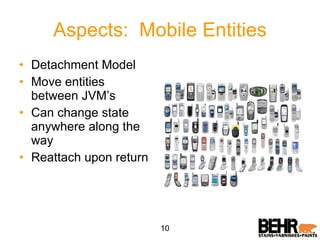
Aspects: Mobile Entities
• Detachment Model
• Move entities
  between JVM’s
• Can change state
  anywhere along the
  way
• Reattach upon return


                         10
Aspects: Simple Configuration
• Java SE 5
  Annotations

• XML

• Heavy use of defaults


                          11
Aspects: Integration and Testability
• Challenge: Testing on
  an app server

• API works outside
  application server
  – Two tier apps
  – Unit tests and
    automated testing
    frameworks


                          12
Entities


Not same as entity
beans


                     13
Entity Characteristics -
               Persistability
• Entities must be persistable

• State can be represented in
  a data store

• Entities can be manipulated
  without having persistent
  repercussions – app must
  use API


                             14
Entity Characteristics - Identity
• Key that uniquely
  identifies an instance

• Persistent identity

• Equivalent to primary
  key


                           15
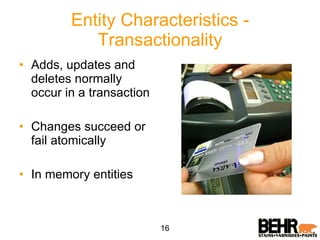
Entity Characteristics -
            Transactionality
• Adds, updates and
  deletes normally
  occur in a transaction

• Changes succeed or
  fail atomically

• In memory entities


                           16
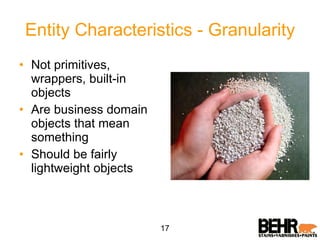
Entity Characteristics - Granularity
• Not primitives,
  wrappers, built-in
  objects
• Are business domain
  objects that mean
  something
• Should be fairly
  lightweight objects


                        17
Entity Manager
• Interface encapsulating
  most persistence
  functionality

• Set of managed
  instances is named
  persistence context


                            18
Queries
• Use JPQL syntax

• Can be defined
  statically (named) or
  dynamically

• Dynamic queries
  supply query criteria


                          19
JPA’s future - Independence
• Break free from the
  EJB specification


• Will get it’s own JSR
  for future evolution


                          20
The End

5 minutes of question time
       starts now!
Questions

4 minutes left!
Questions

3 minutes left!
Questions

2 minutes left!
Questions

1 minute left!
Questions

30 seconds left!
Questions

TIME IS UP!

Java Persistence API (JPA) - A Brief Overview