Planet Guardians
    Investigación de Calidad de Agua a la Quebrada Sabana Llana

http://www.delcarmenverde.blogspot.com/
• While for a housewife, water contamination can mean bad
taste, odor or water cause intestinal diseases, they do not
display an industrial or farm.

 • For industrial water pollution can mean the pipe is affected
boiler industry and for a farmer that water contains
extraordinary amounts of salt that does not allow its use for
irrigation or animal consumption.

 • The concept of pollution of water is on and is closely
related to the proposed use of water.
• Natural causes of water pollution
    Volume of water bodies
    Number of bacteria
    Organisms living in water
    Amounts of pollutants


•Unnatural causes of pollution
    Downloads home
    Industrial discharges
    Agricultural wastes
    Sedimentation and erosion
•Major water pollutants
    Existing number of coliform bacteria

    Amount of oxygen dissolved in water

    Fertilizers and pesticides

    Pollution by suspended solids metals
•The multidisciplinary project Water Cops CL, enable
students to explore their own watershed and understand
what happens to the flow of water over them, the way in
which human activities depend on the river and impact the
hydrology, and the way in which the change of land use can
affect plant and animal communities that live along it.

 •This project also seeks to develop technology skills in
applications such as Logger Pro and Vernier Software
LabQuest, MS Publisher 2007, ArcGIS Explorer, Adobe
Premier and Thinkquest.org or Blogger.
Students will have the opportunity to develop the following
skills XXI century:

 Communication

 Technology

 Creativity

 Critical Thinking
 Teamwork
Essential Question:
The percentage of contaminants in urban rivers in
the island is of concern. If you were appoint the
Secretary of Natural Resources for a certain period
of time, how could help improve water quality in
urban river basins in PR now and in the future?
During the development of the students will engage in tasks
and sub​​-tasks to complete highlights the following products:

 Science, Mathematics and Technology – Hydrology Data
Sheet- MS Word 2007.

  Science, Mathematics and Technology - Scientific Article -
Logger Pro and Vernier LabQuest.


  Science, Mathematics and Technology - Data Analysis and
Results Presentation – MS Power Point 2007
Geography and Technology - GeoMapping – ArcExplorer

English and Technology - Blog – Blogger.com and
Thinkquest.org

English and Technology - Video Documentary - Adobe
Premier
Data Analysis and Results
         Natacha Gonzalez
           Leslie Cabán
           Angelice Vale
         Marimar Bracero
          Gerardo Costa
          Jessmar Matos
         Mariedith Santos
            Paola Soto
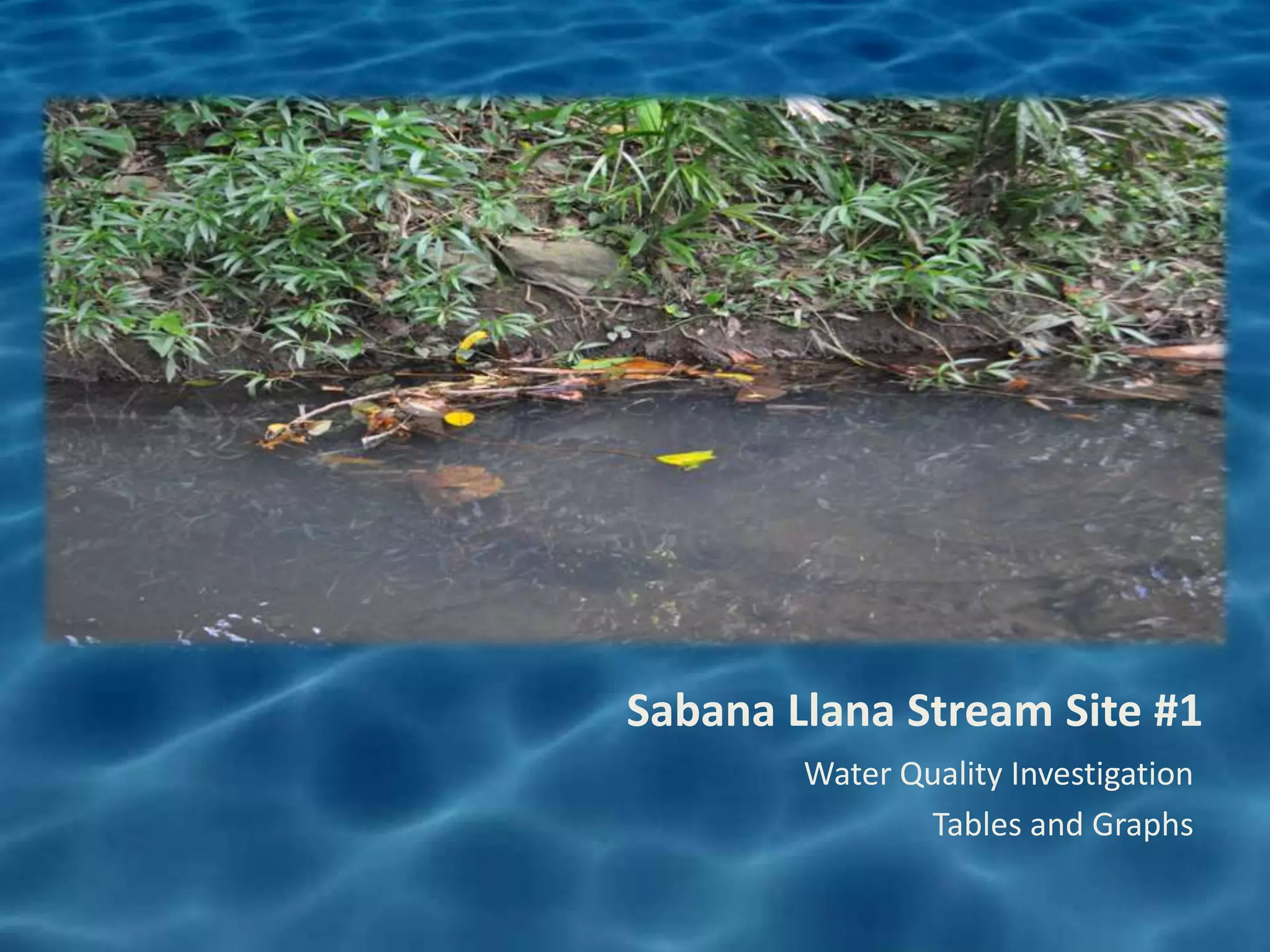
Sabana Llana Stream Site #1
        Water Quality Investigation
               Tables and Graphs
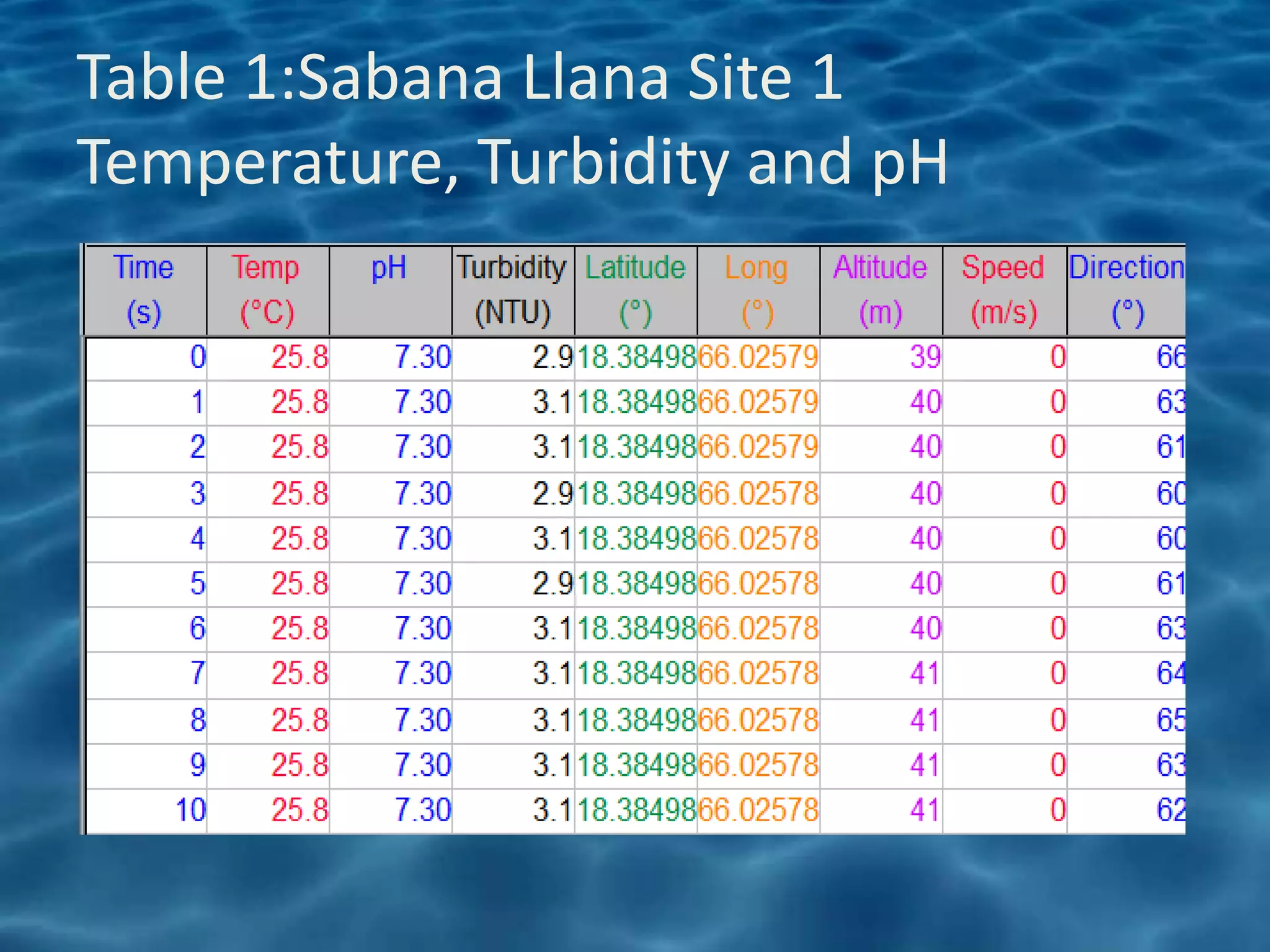
Table 1:Sabana Llana Site 1
Temperature, Turbidity and pH
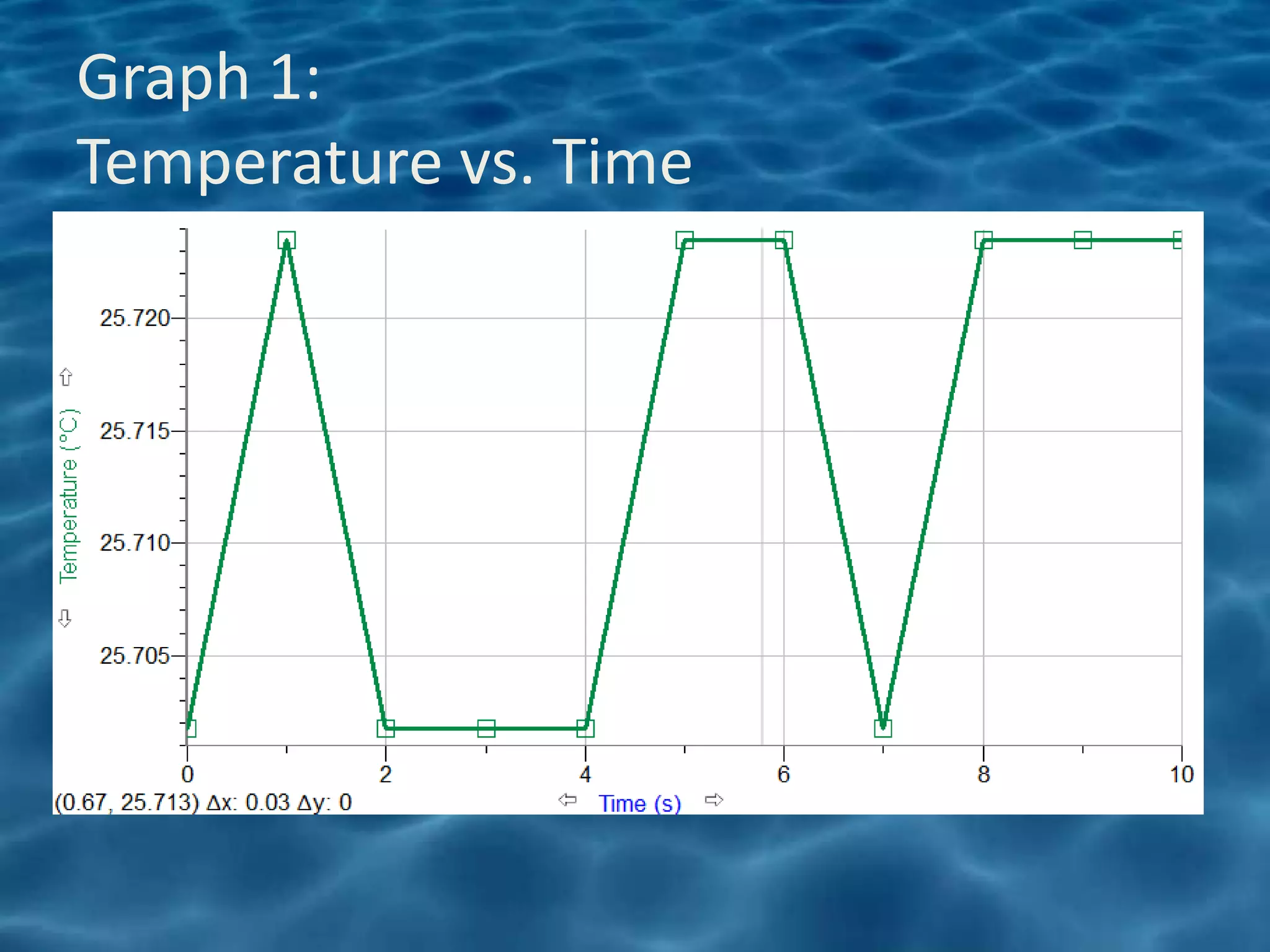
Graph 1:
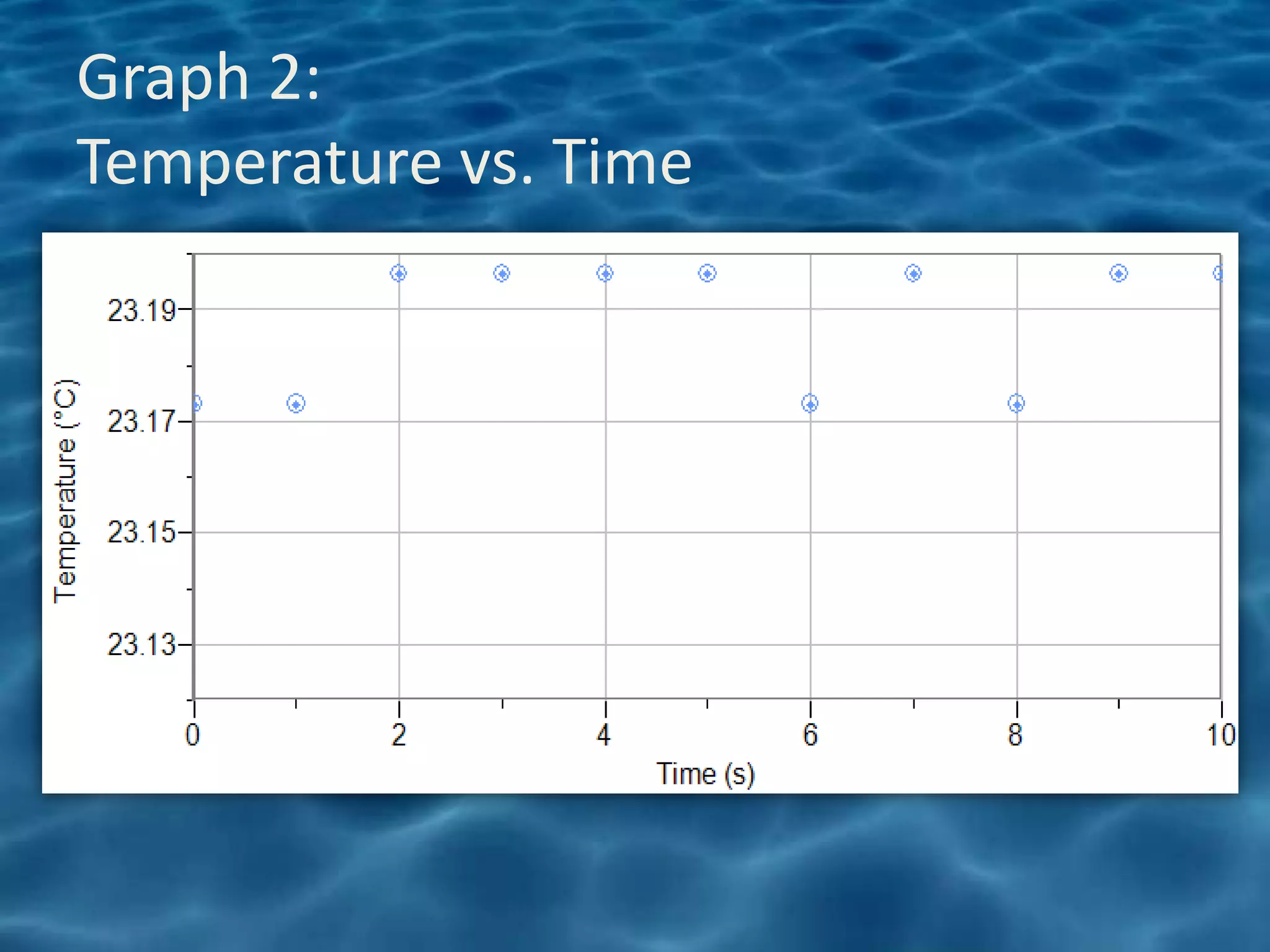
Temperature vs. Time
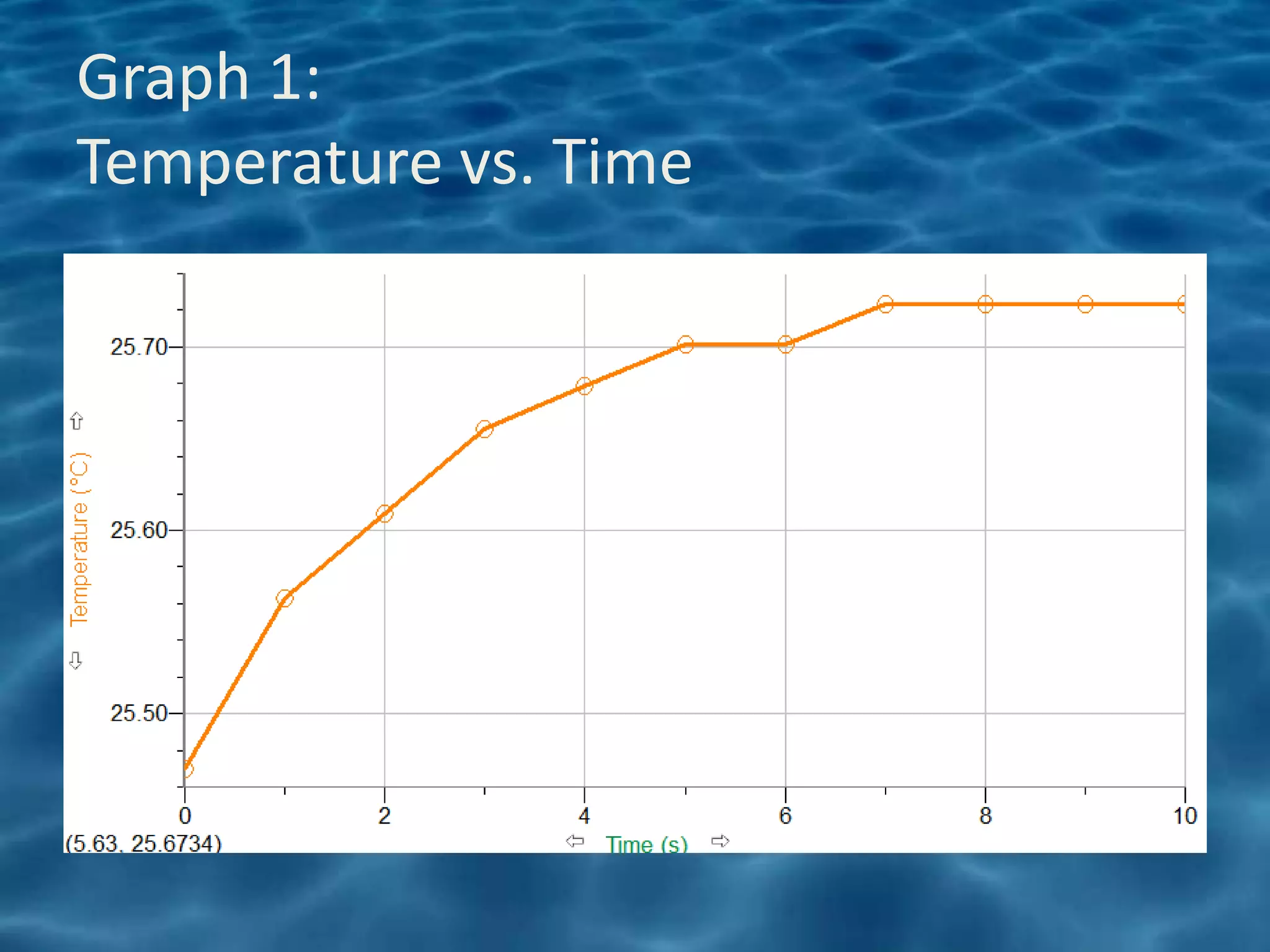
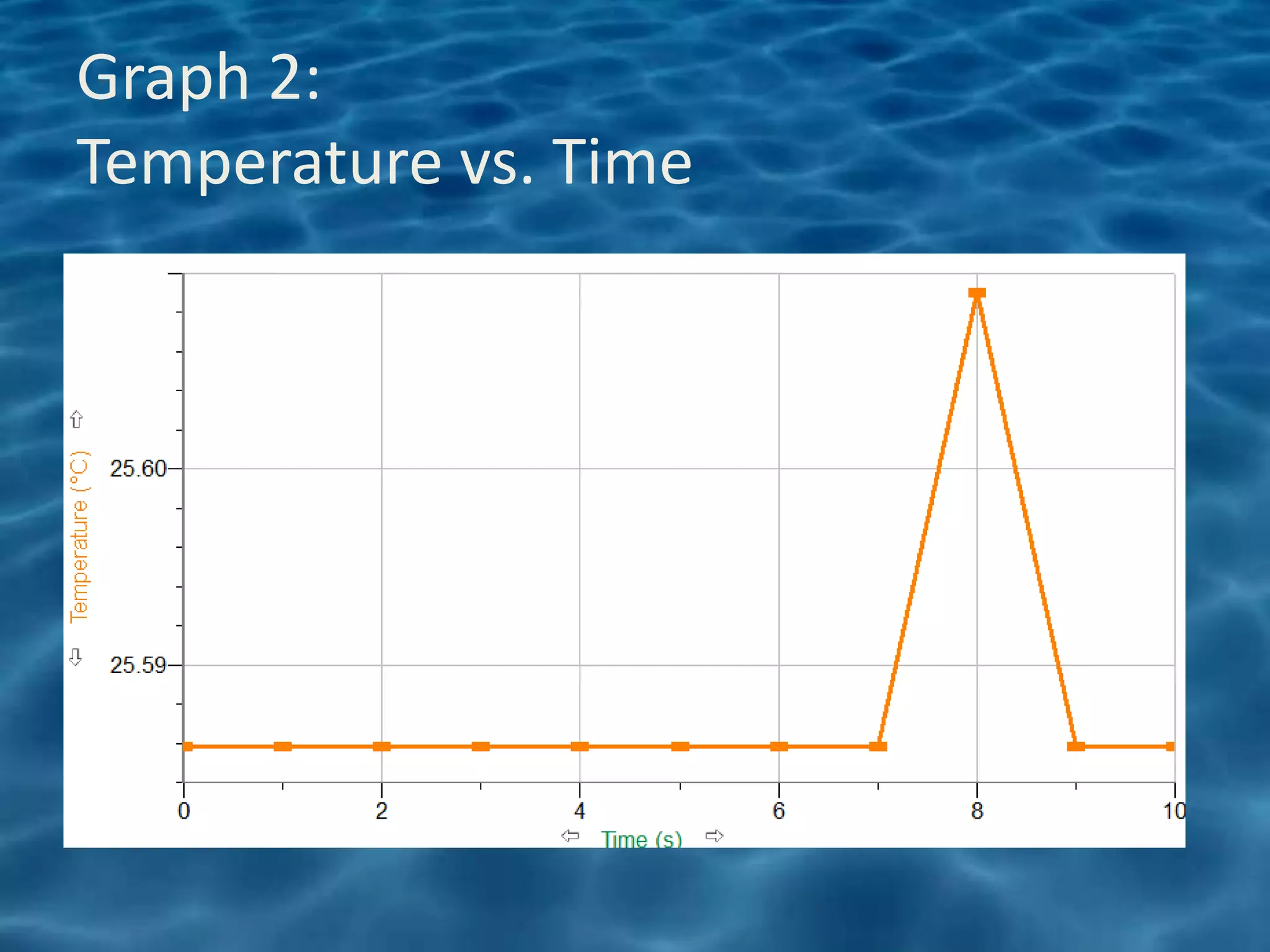
Water Temperature
• The temperature of a body of water influences its overall
  quality.
• A change in water temperature can affect the general health
  of the aquatic organisms, thus changing the quality of the
  stream.
• The temperature measured on Sabana Llana is suitable for
  small mouth bass and the rest of similar water organism.
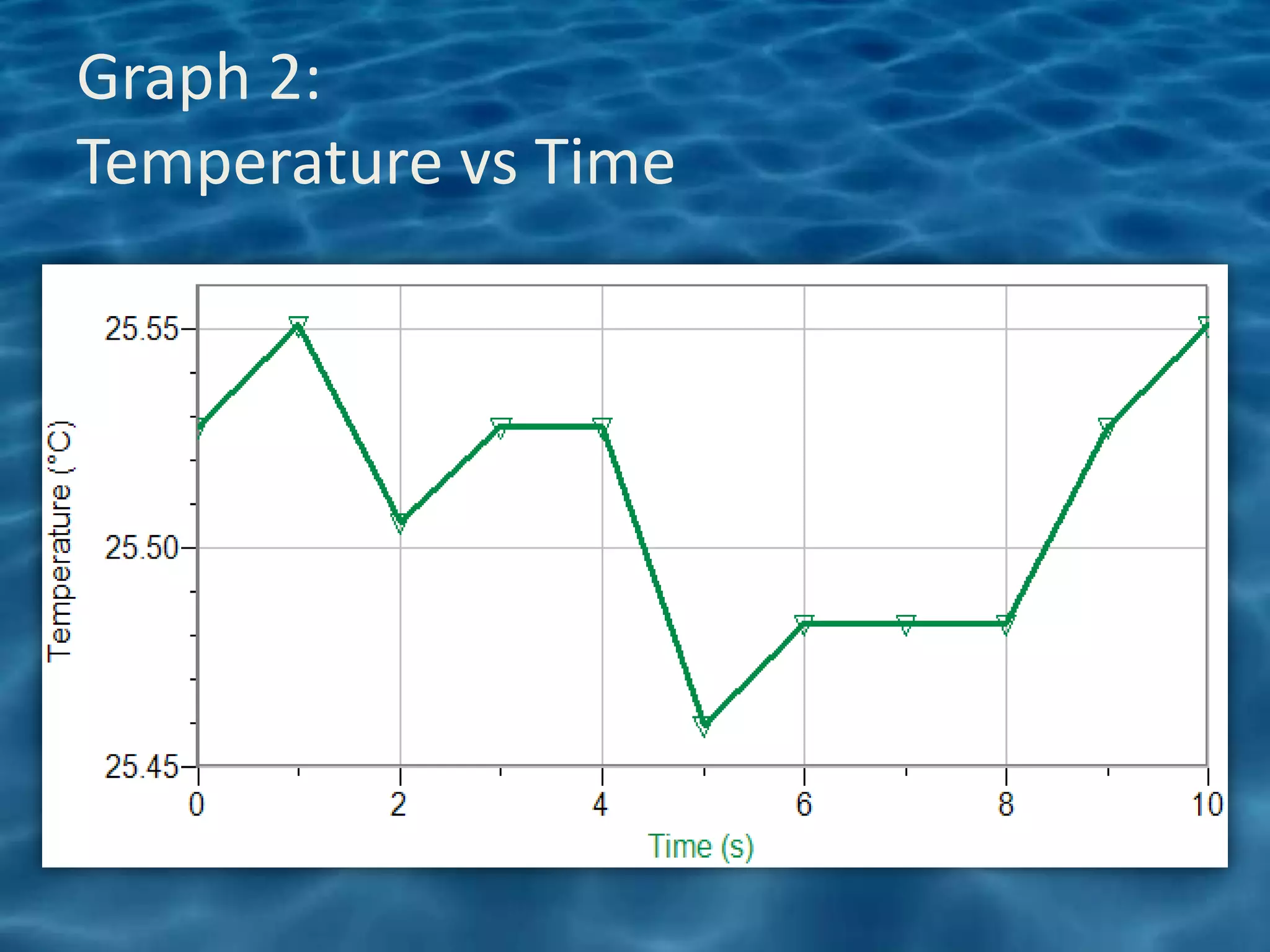
• The average temperature in this site was 26.5°C.
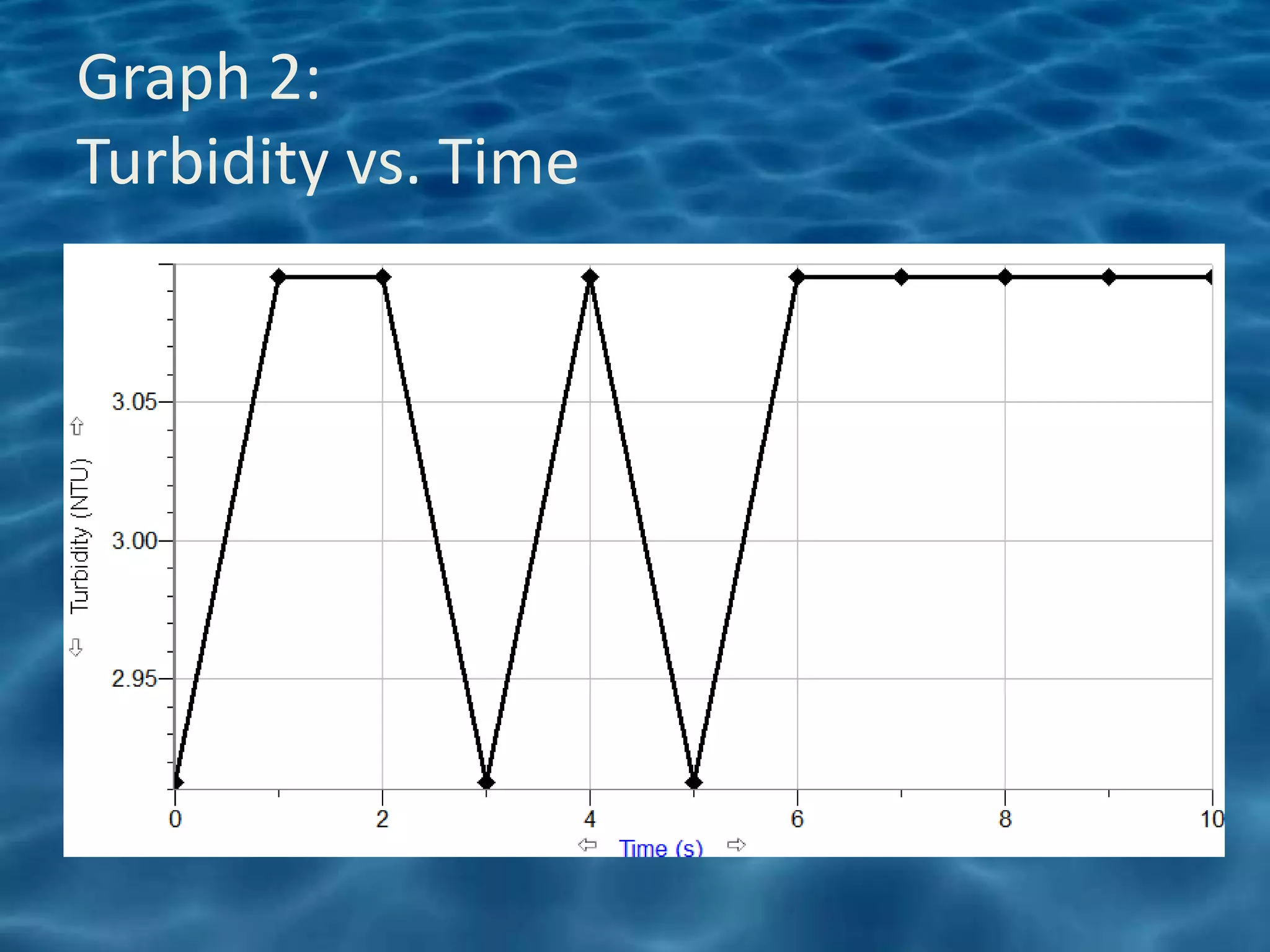
Graph 2:
Turbidity vs. Time
Turbidity
• Turbidity is a measure of water’s lack of clarity.
  Water with high turbidity is cloudy, while water
  with low turbidity is clear.
• Many factors can contribute to the turbidity of
  water.
• An increase in stream flow due to heavy rains or a
  decrease in stream-bank vegetation can speed up
  the process of soil erosion.
• This will add suspended particles, such as clay
  and silt, to the water.
Turbidity
• According to the USGS, the turbidity of surface
  water is usually between 1 NTU and 50 NTU .
• Water is visibly turbid at levels above 5 NTU.
• The standard for drinking water is 0.5 NTU to 1.0
  NTU.
• The average turbidity in this site of the Sabana
  Llana Stream is 45.8 NTU.
• The water is visibly turbid and in the standard
  range. It can’t be used for drinking water.
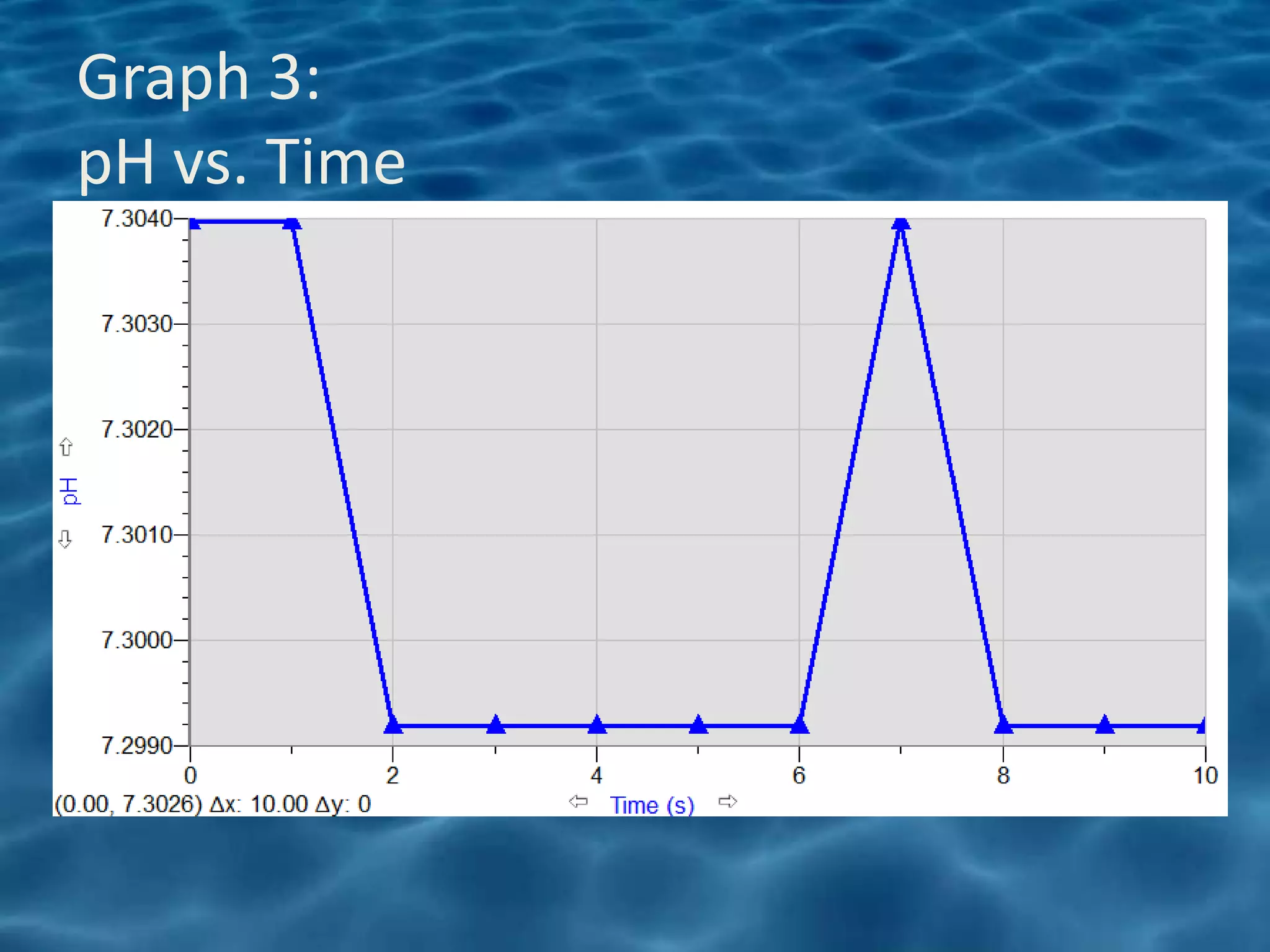
Graph 3:
pH vs. Time
Water pH
• Water contains both hydrogen ions, H+, and hydroxide ions, OH–.
  The relative concentrations of these two ions determine the pH
  value .
• Water with a pH of 7 has equal concentrations of these two ions
  and is considered to be a neutral solution.
• If a solution is acidic, the concentration of H+ ions exceeds that of
  the OH– ions. In a basic solution, the concentration of OH– ions
  exceeds that of the H+ ions.
• On a pH scale of 0 to 14, a value of 0 is the most acidic, and 14 the
  most basic. A change from pH 7 to pH 8 in a lake or stream
  represents a ten-fold increase in the OH– ion concentration.
• The average pH of the Sabana Llana stream is 8.2. The water is
  optimal for most organisms. The ph level is acceptable for most
  drinking water standards.
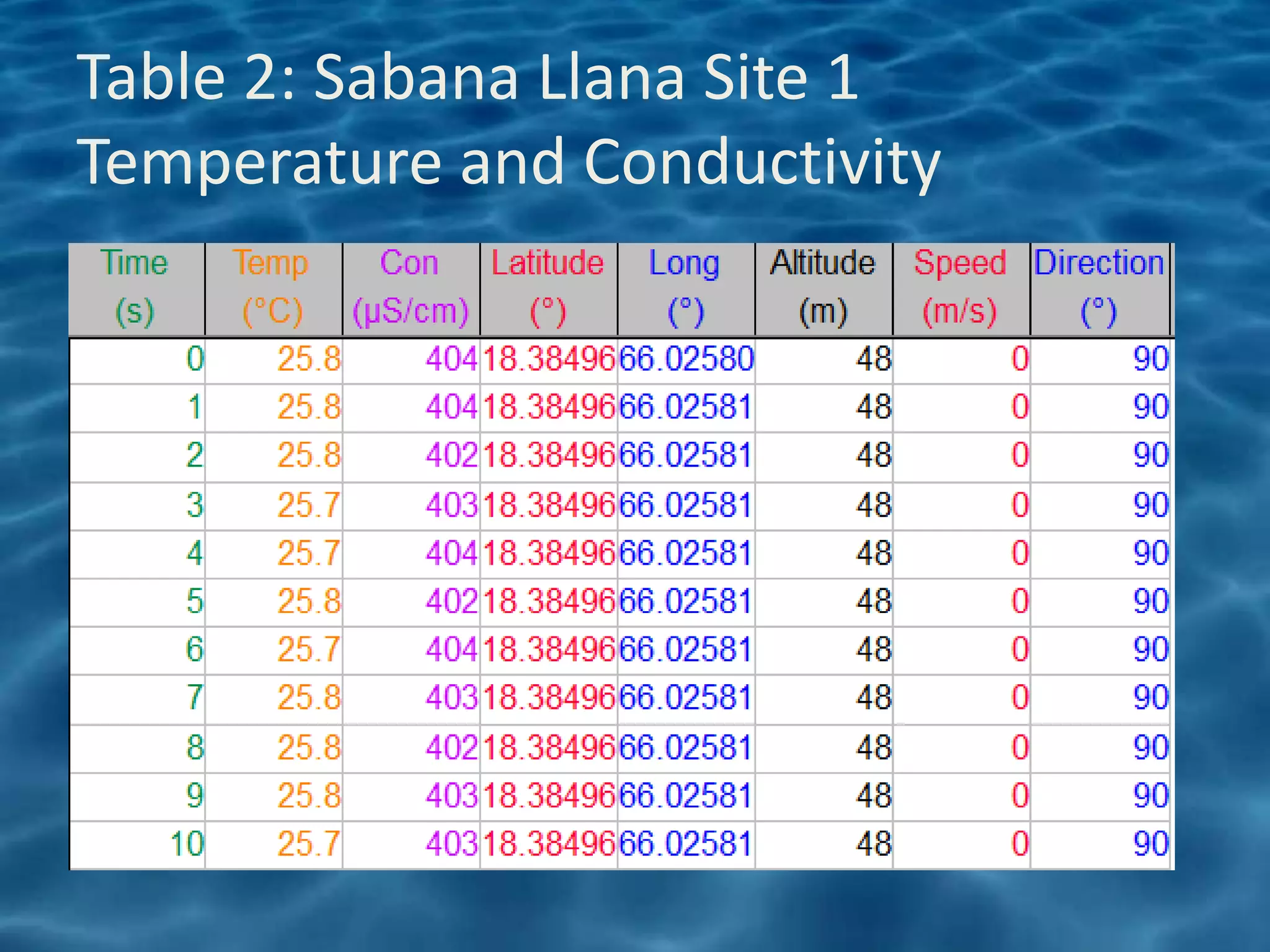
Table 2: Sabana Llana Site 1
Temperature and Conductivity
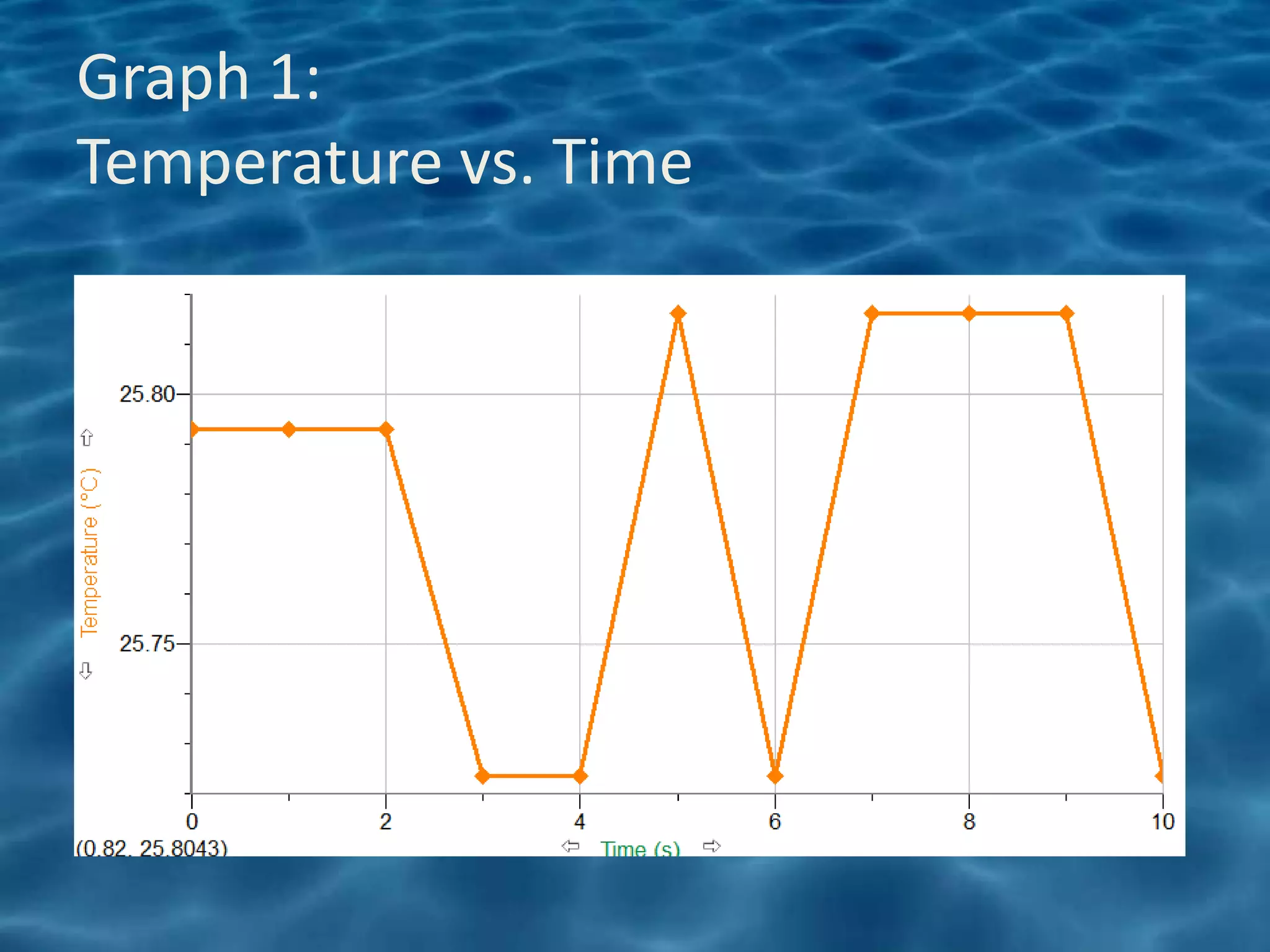
Graph 1:
Temperature vs. Time
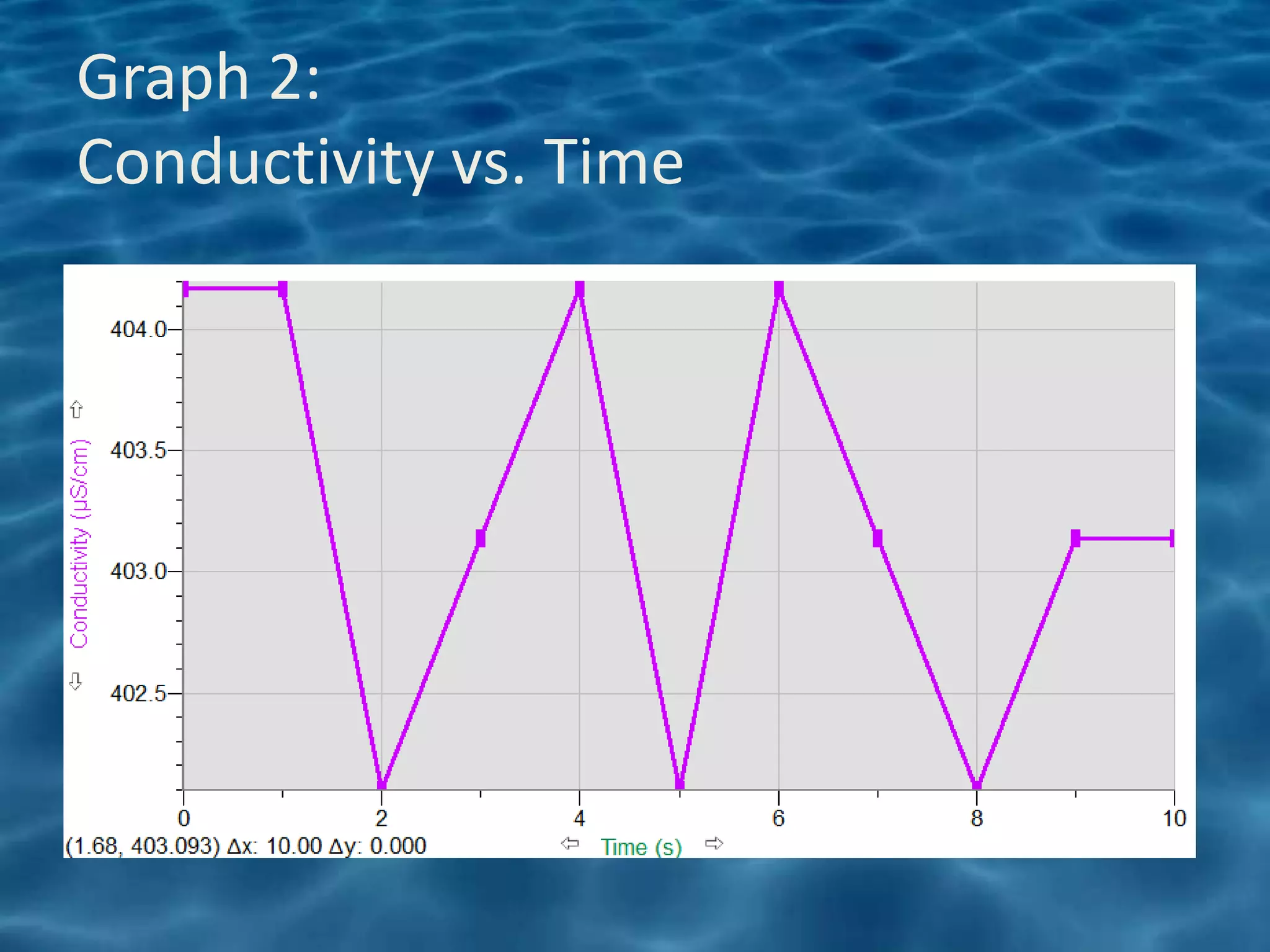
Graph 2:
Conductivity vs. Time
Conductivity
• Solids are found in streams in two forms, suspended and
  dissolved.
• Suspended solids include silt, stirred-up bottom sediment,
  decaying plant matter, or sewage-treatment effluent.
• Total dissolved solids, or TDS, can be determined usinig a
  Vernier Conductivity Probe to determine the ability of the
  dissolved salts and their resulting ions in an unfiltered
  sample to conduct an electrical current.
• The conductivity is then converted to TDS.
• Either of these methods yields a TDS value in units of mg/L.
• There are many possible manmade sources of ions that
  may contribute to elevated TDS readings.
Conductivity
• Fertilizers from fields and lawns can add a
 variety of ions to a stream.
• Increases in TDS can also result from runoff from
  roads that have been salted in the winter.
• Organic matter from wastewater treatment
  plants may contribute higher levels of nitrate or
  phosphate ions.
• Treated wastewater may also have higher TDS
 readings than surrounding streams if urban
  drinking water has been highly chlorinated.
Conductivity
• Irrigation water that is returned to a stream will often
  have higher concentrations of sodium or chloride ions.
• Acidic rainwater, with dissolved gases like CO2, NO2, or
  SO2, often yields elevated H+ ion
• concentrations.
• TDS values in lakes and streams are typically found to
  be in the range of 50 to 250 mg/L Drinking water will
  tend to be 25 to 500 mg/L TDS.
• The average conductivity of the Sabana Llana Stream is
  403 μS/cm.
• There is little amount of metals because the standard
  levels of conductivity are low.
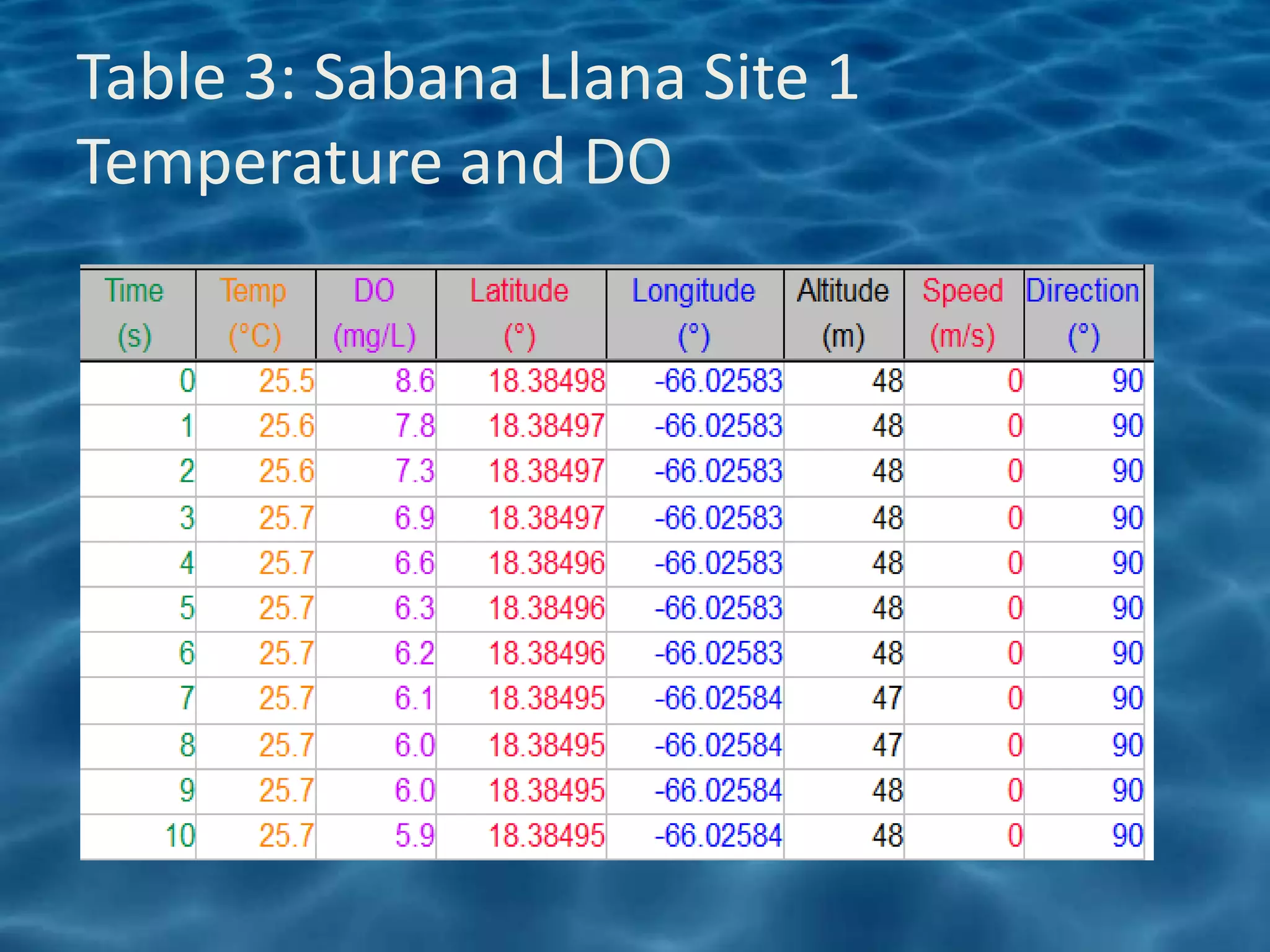
Table 3: Sabana Llana Site 1
Temperature and DO
Graph 1:
Temperature vs. Time
Graph 2:
DO vs. Time
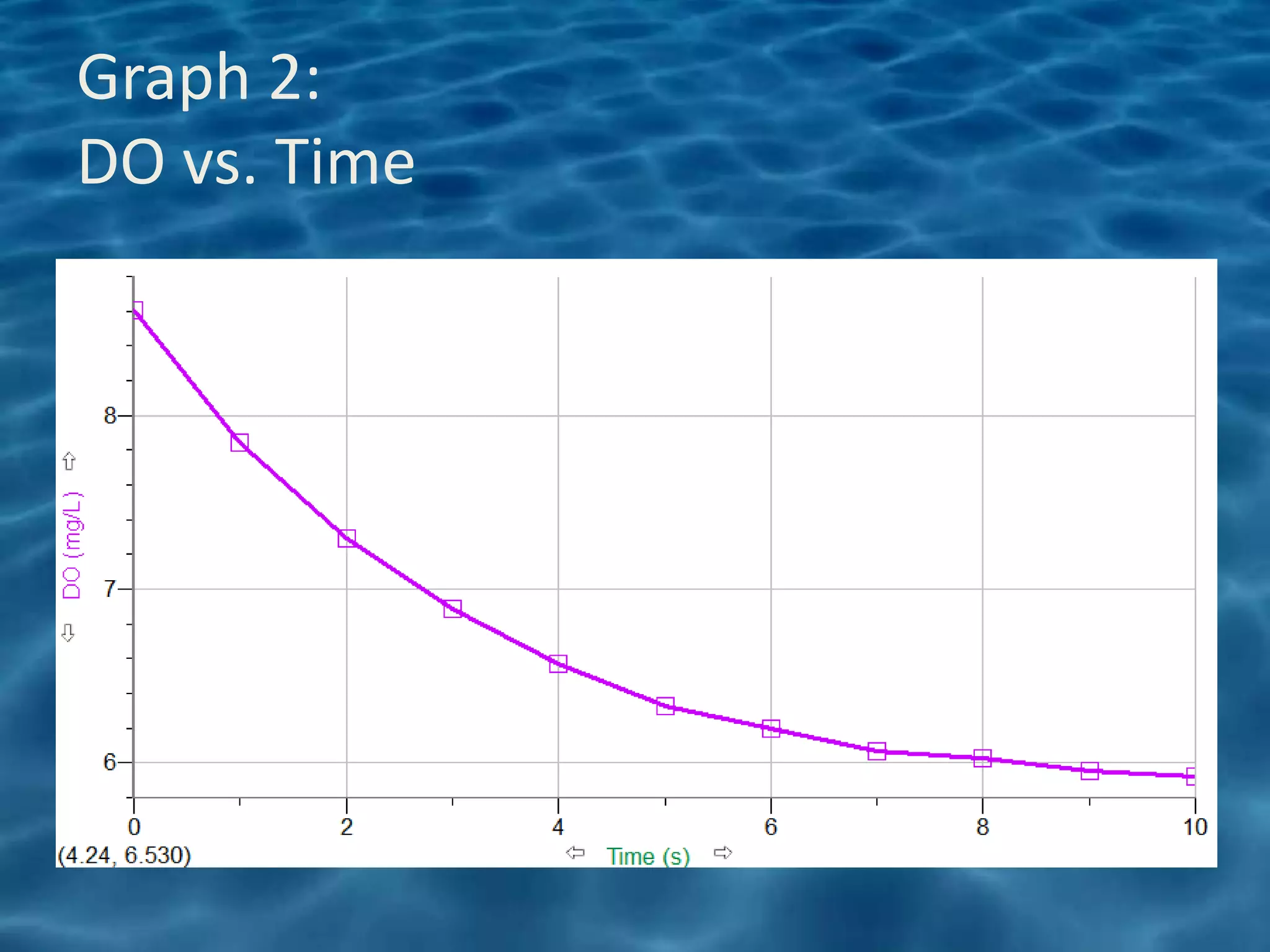
Dissolved Oxygen
• Description: Trout and small bass can’t live with this
  amount of dissolved oxygen found in this site of the Sabana
  Llana stream.
• Oxygen gas dissolved in water is vital to the existence of
  most aquatic organisms.
• Oxygen is a key component in cellular respiration for both
  aquatic and terrestrial life.
• Dissolved oxygen concentrations can range from 0 to 15
  mg/L. The average
• DO of this site of the Sabana Llana stream is 5.9 mg/L under
  the expected values.
• Some organisms like Mosquito larvae, Carp, Catfish, May fly
  larvae, Caddis fly larvae can live in this amount of DO.
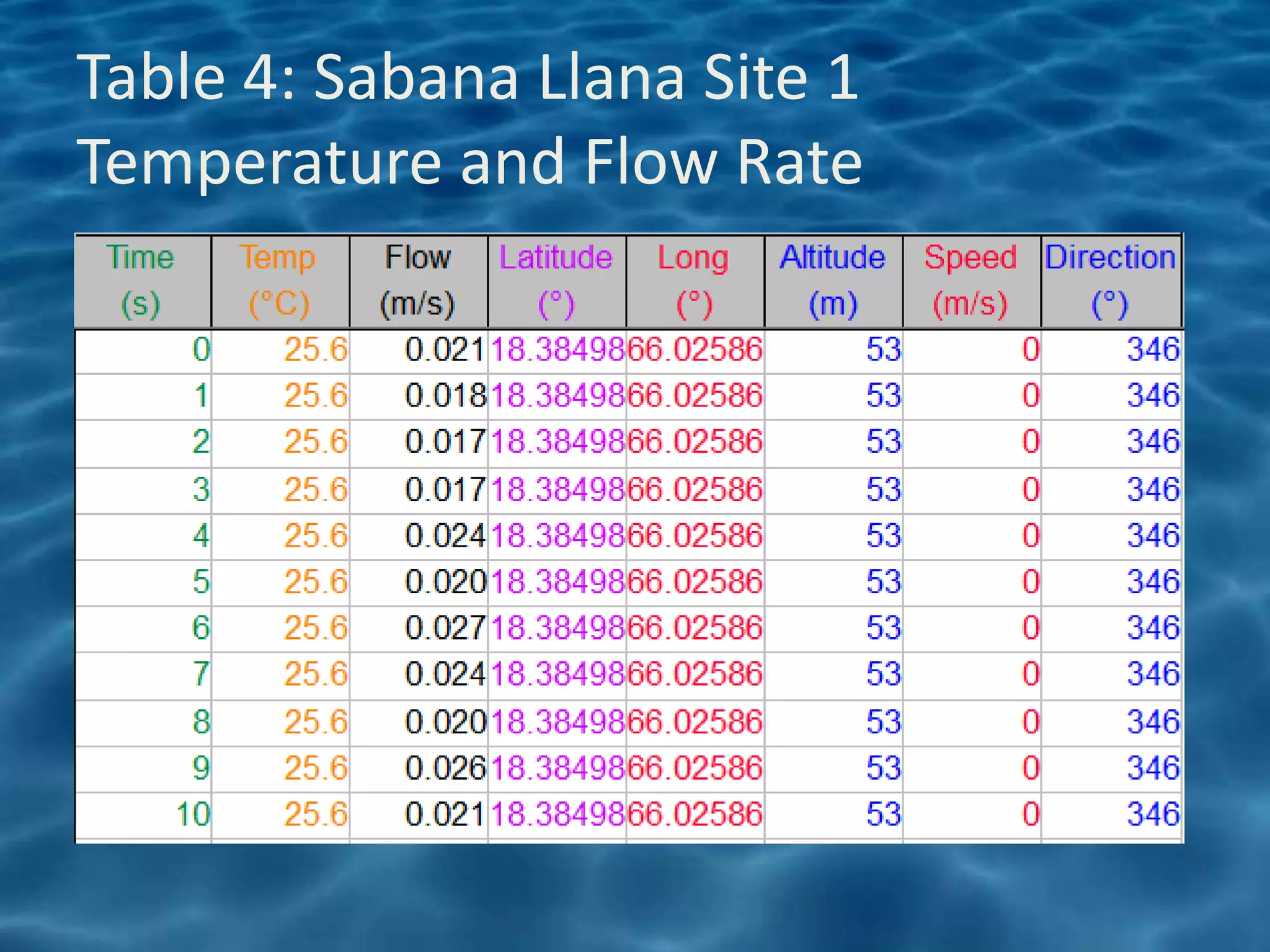
Table 4: Sabana Llana Site 1
Temperature and Flow Rate
Graph 1:
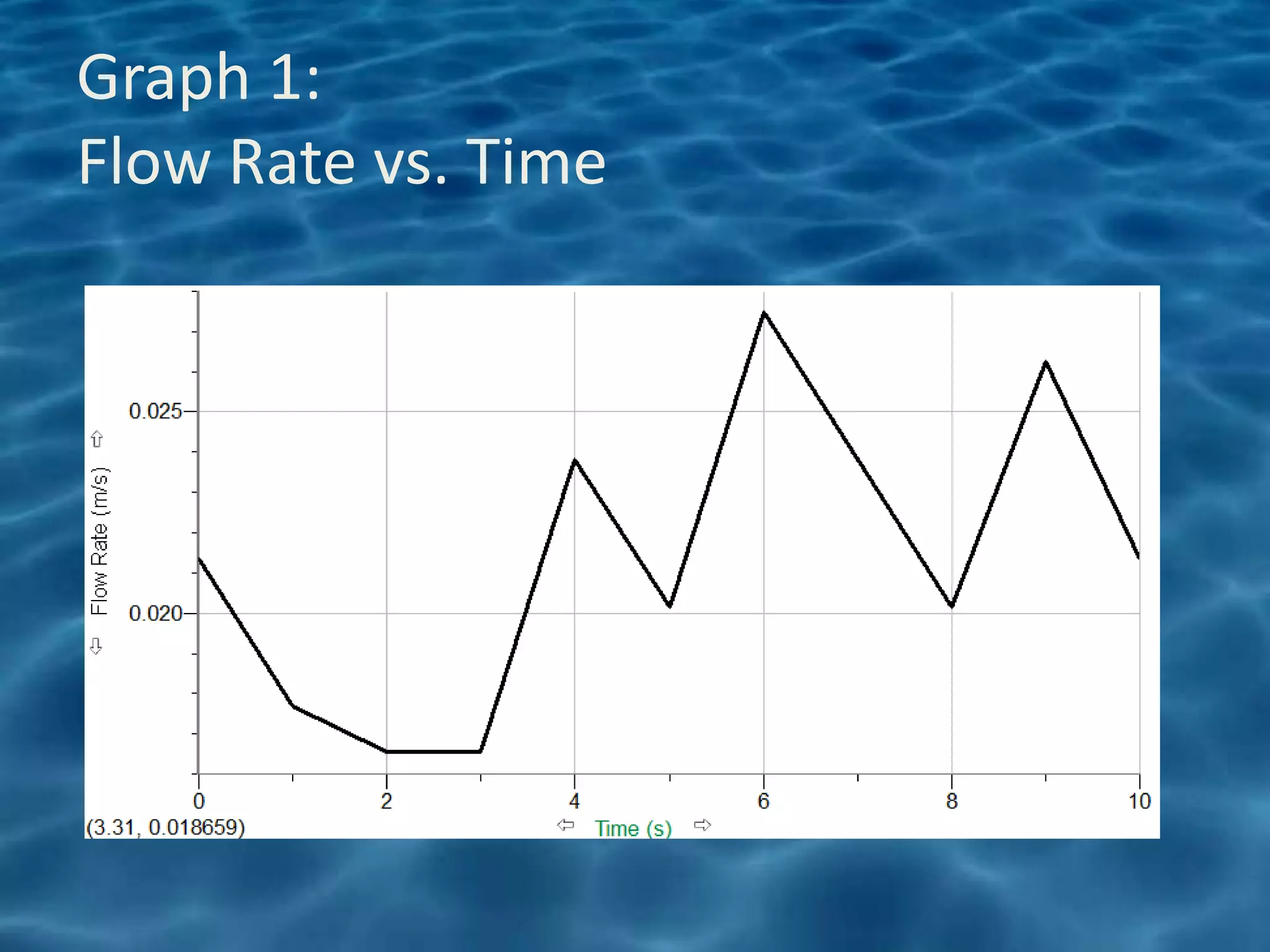
Flow Rate vs. Time
Stream Flow
• Description: Stream flow or discharge is the volume of
  water that moves through a specific point in a stream
  during a given period of time.
• Discharge is usually measured in units of cubic feet per
  second (cfs).
• Flow velocity is influenced by the slope of the surrounding
  terrain, the depth of the stream, the width of the stream,
  and the roughness of the substrate or stream bottom.
• The stream flow of this site of the Sabana Llana stream is
  low, 0.034cfs, because there is not much depth, the stream
  channel is not wide, there are many rocks, and there is no
  slope or inclination.
Graph 2:
Temperature vs. Time
Table 5: Sabana Llana Site 1
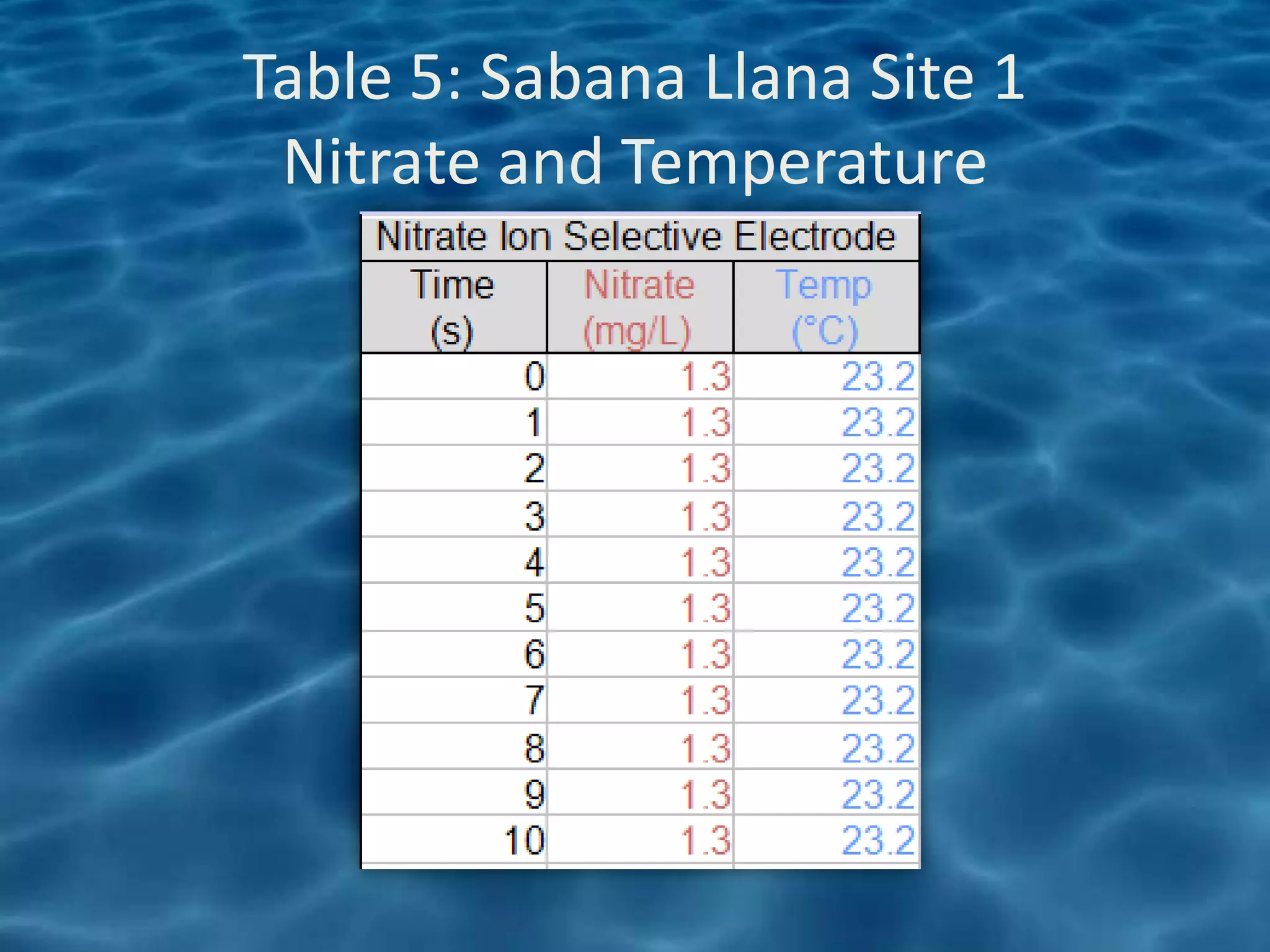
 Nitrate and Temperature
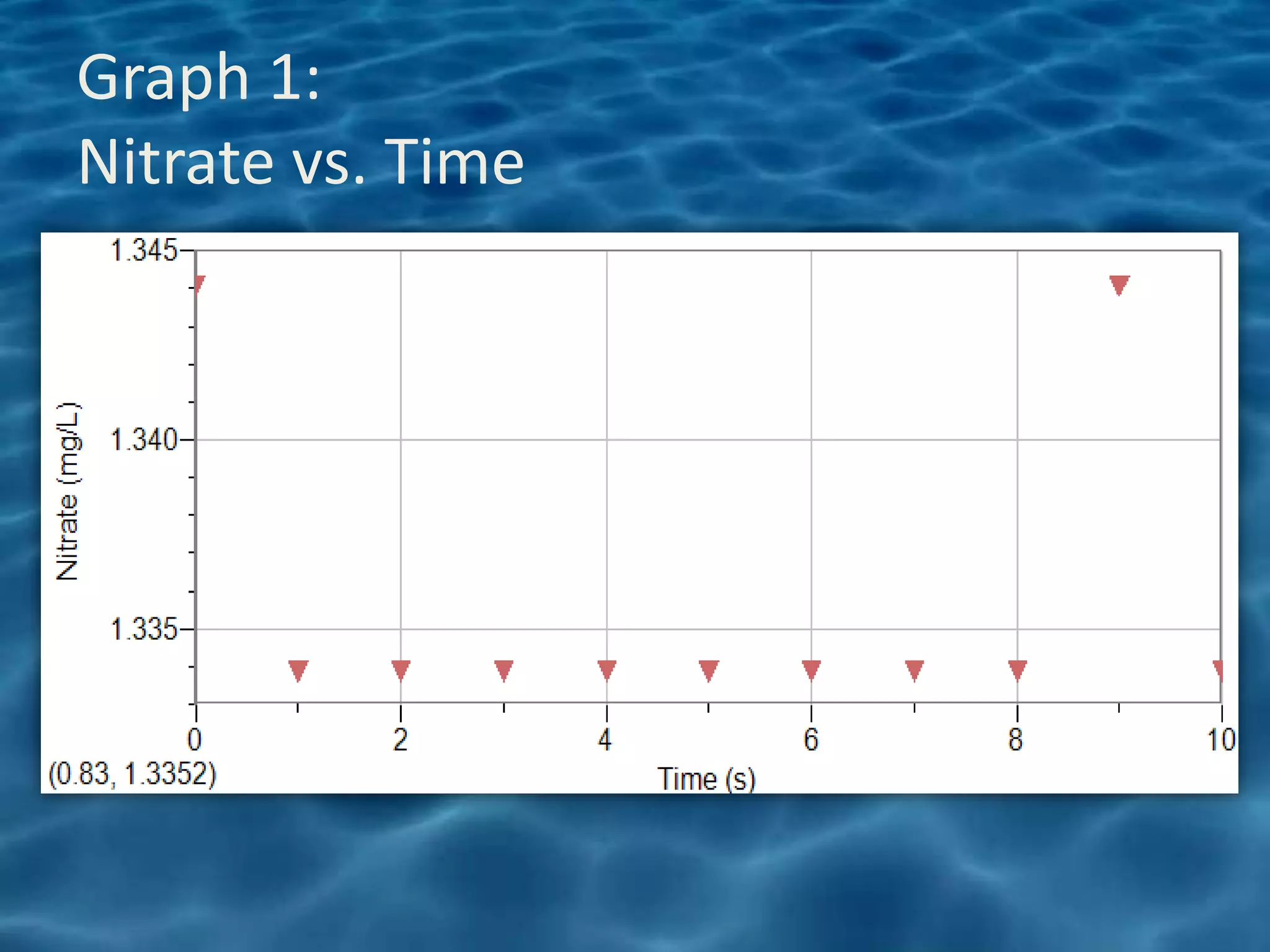
Graph 1:
Nitrate vs. Time
Nitrate Ion Selective Electrode
• Nitrate ions found in freshwater samples result from a
  variety of natural and manmade sources.
• Nitrates are an important source of nitrogen necessary for
  plants and animals to synthesize amino acids and proteins.
• Although nitrate levels in freshwater are usually
• less than 1 mg/L, manmade sources of nitrate may elevate
  levels above 3 mg/L.
• These sources include animal feedlots, runoff from
  fertilized fields, or treated municipal wastewater being
  returned to streams Levels above 10 mg/L in drinking water
  can cause a potentially fatal disease in infants called
  methemoglobinemia, or Blue-Baby Syndrome.
Nitrate Ion Selective Electrode
• In this disease, nitrate converts hemoglobin into a form
  that can no longer transport oxygen.
• High nitrate concentrations also contribute to a condition in
  lakes and ponds called eutrophication, the excessive growth
  of aquatic plants and algae.
• Unpleasant odor and taste of water, as well asreduced
  clarity.
• The nitrate level in freshwater is usually found in the range
  of 0.1 to 4 mg/L NO3–-N.
• Unpolluted waters generally have nitrate levels below 1
  mg/L .
• This body of water has a low amount of nitrate, 1.3 mg/L,
  which permits life.
Graph 2:
Temperature vs. Time
Table 6: Sabana Llana Site 1
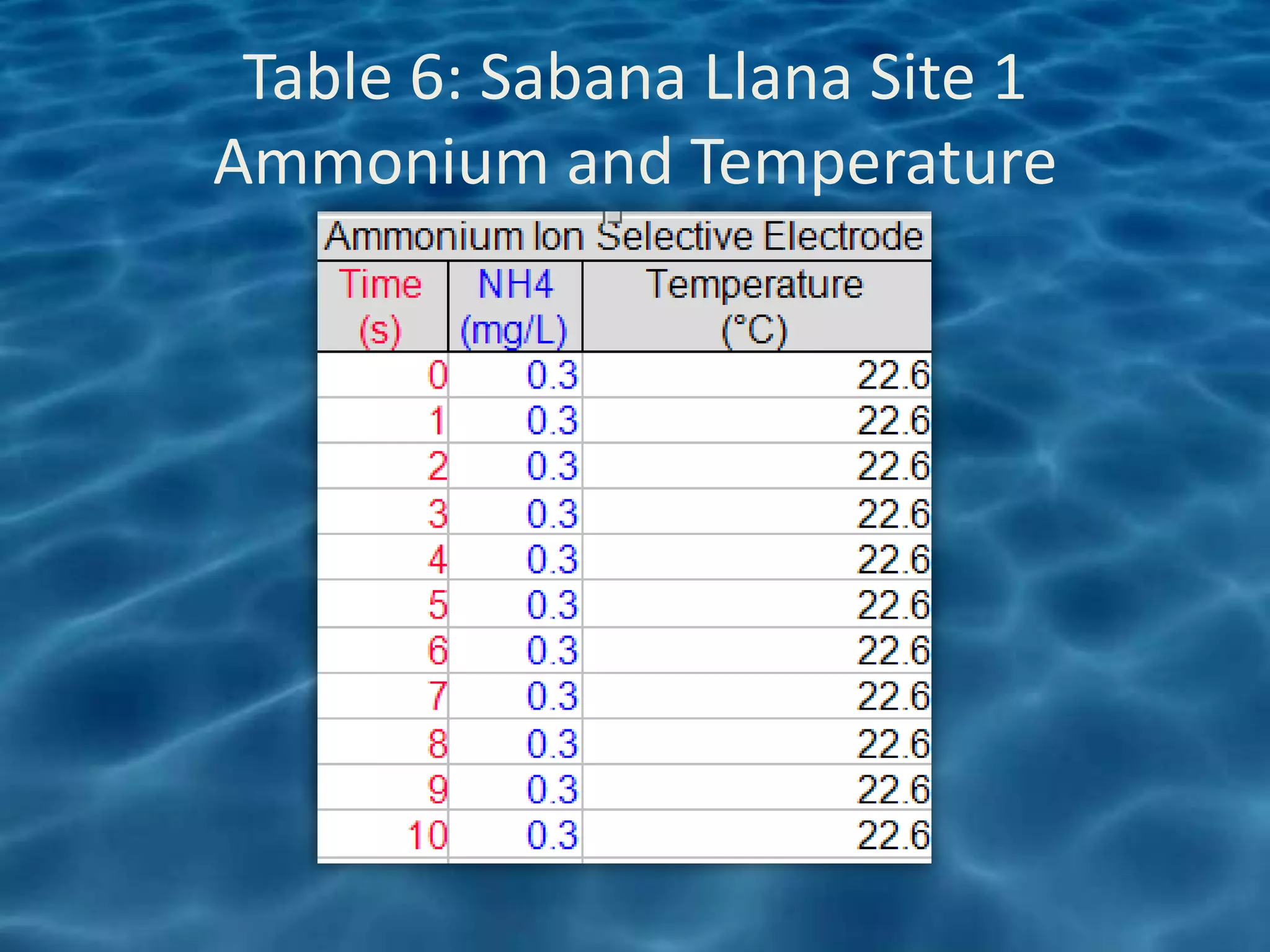
Ammonium and Temperature
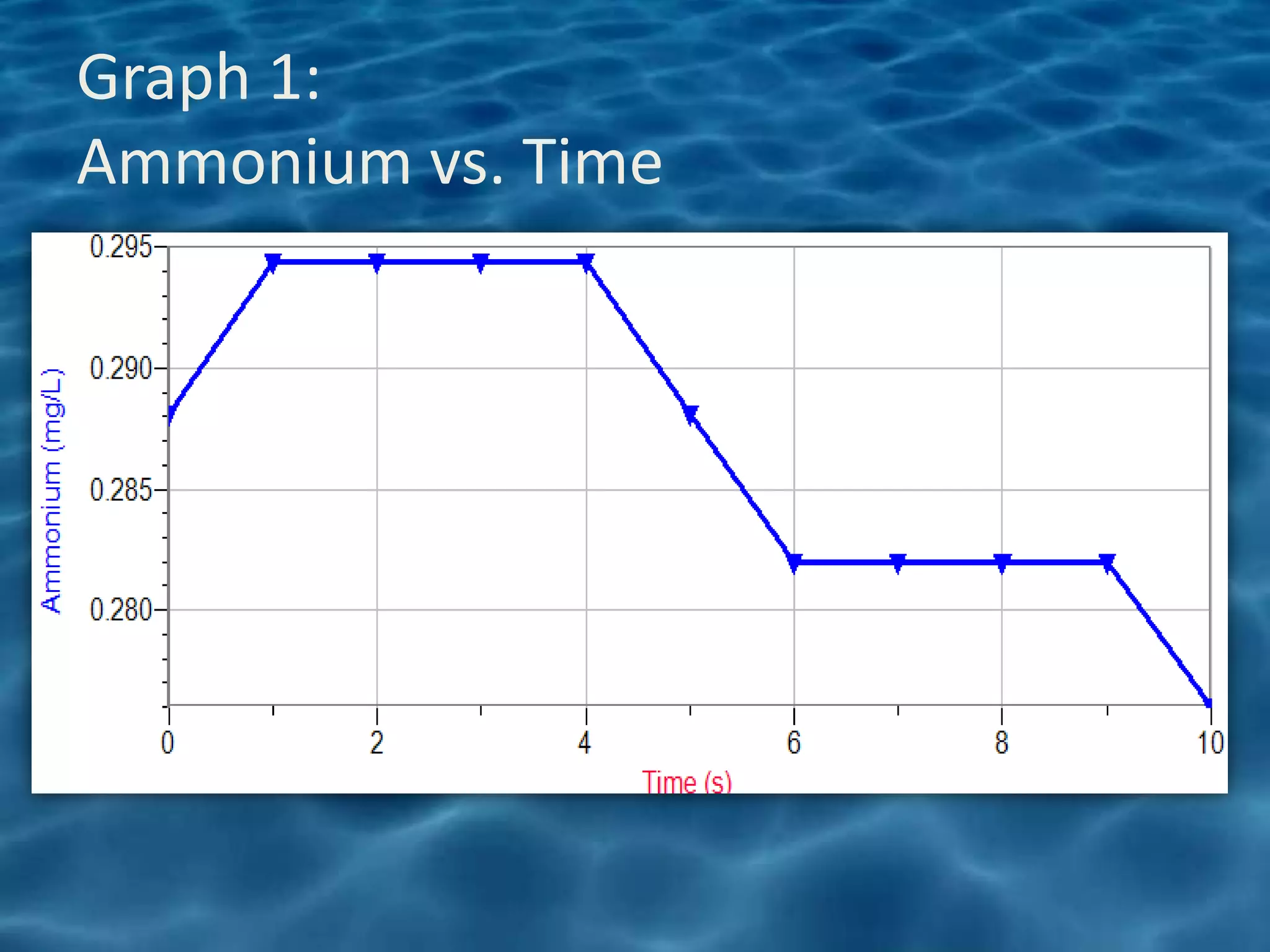
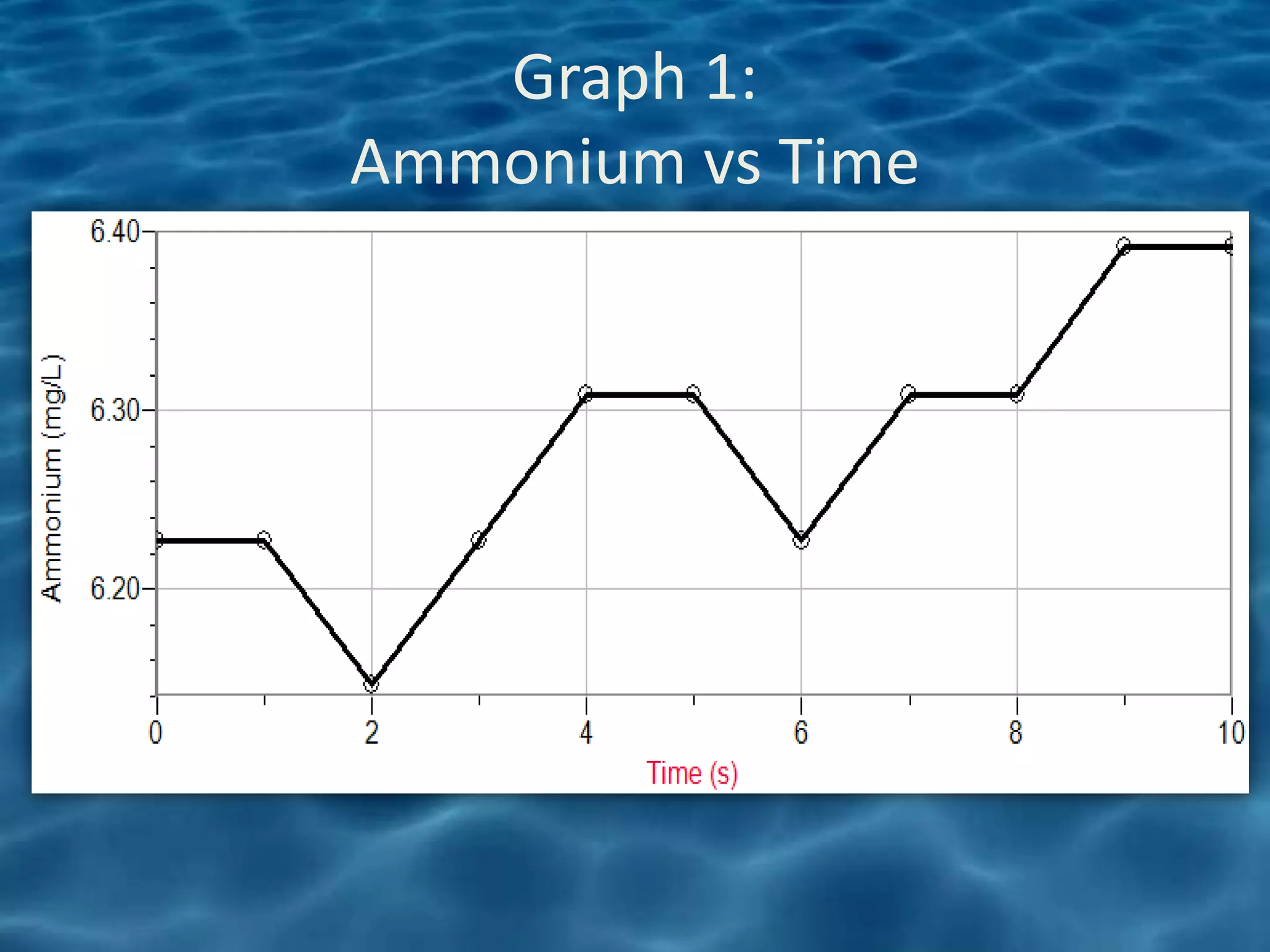
Graph 1:
Ammonium vs. Time
Ammonium Ion Selective Electrode
• Some trees and grasses are able to absorb
  ammonium ions directly, but most require
  their conversion to nitrate.
• This process, called nitrification, is usually
  accomplished by bacteria in the soil or water.
• If ammonium nitrogen levels in surface waters
  are too high, they can be toxic to some
  aquatic organisms.
Ammonium Ion Selective Electrode
• Dissolved oxygen levels can also be lowered when
  ammonium nitrogen is high due to the increased
  amount of nitrification occurring.
• Ammonium-nitrogen levels are usually quite low
  in moving surface waters.
• This is because there is little decaying organic
  matter collecting on the bottom.
• If there is a high level of ammonium nitrogen in a
  moving stream, it may be an indication of
  pollution of some kind entering the water.
Ammonium Ion Selective Electrode
• While levels of ammonium nitrogen in
  drinking water should not exceed 0.5 mg/L,
  streams or ponds near heavily fertilized fields
  may have higher concentrations of this ion.
• These amounts of ammonium are low, 0.3
  mg/L, because the water flows in this body of
  water .
• The amount of ammonium in this water is
  accepted for drinking water.
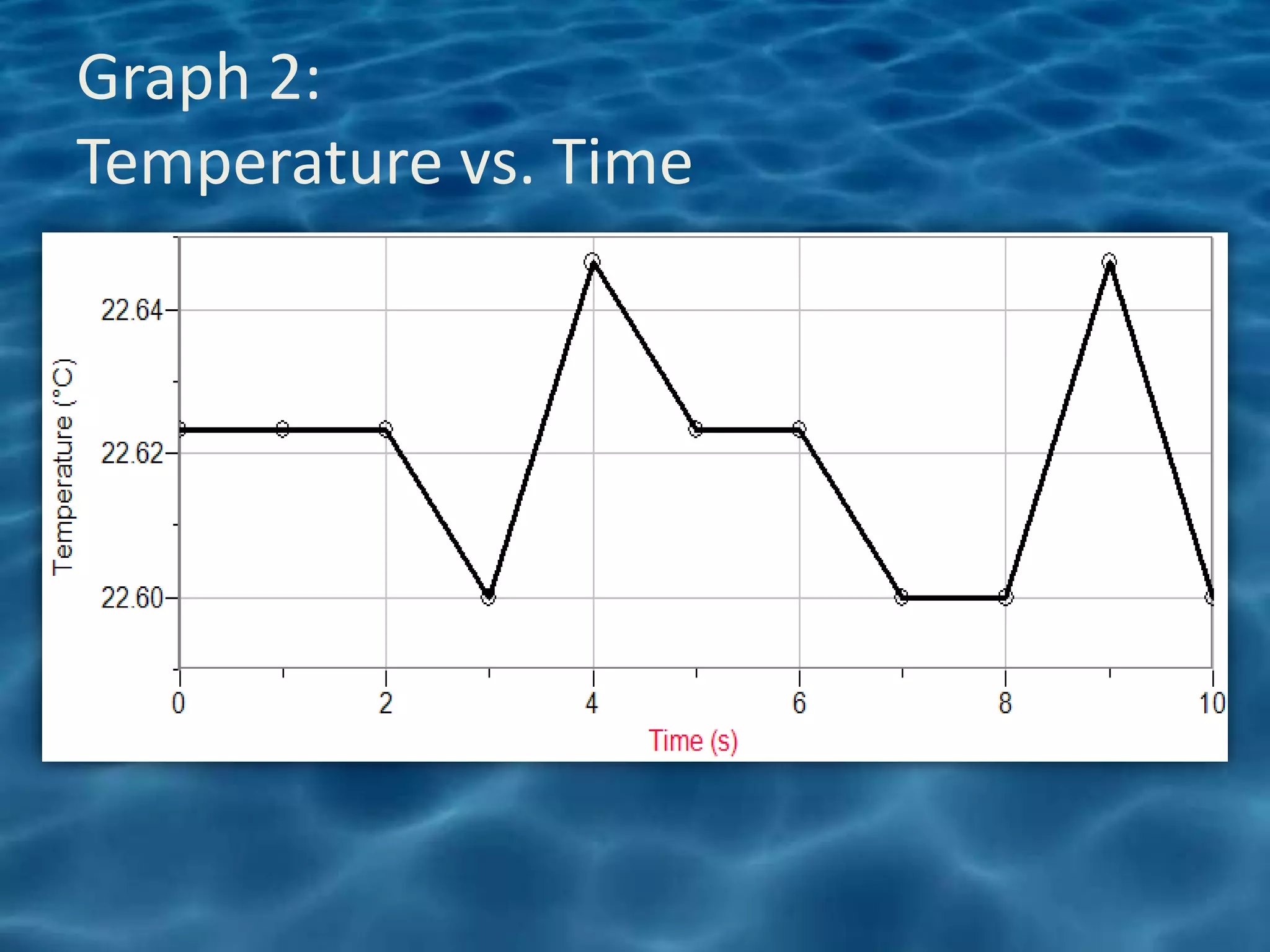
Graph 2:
Temperature vs. Time
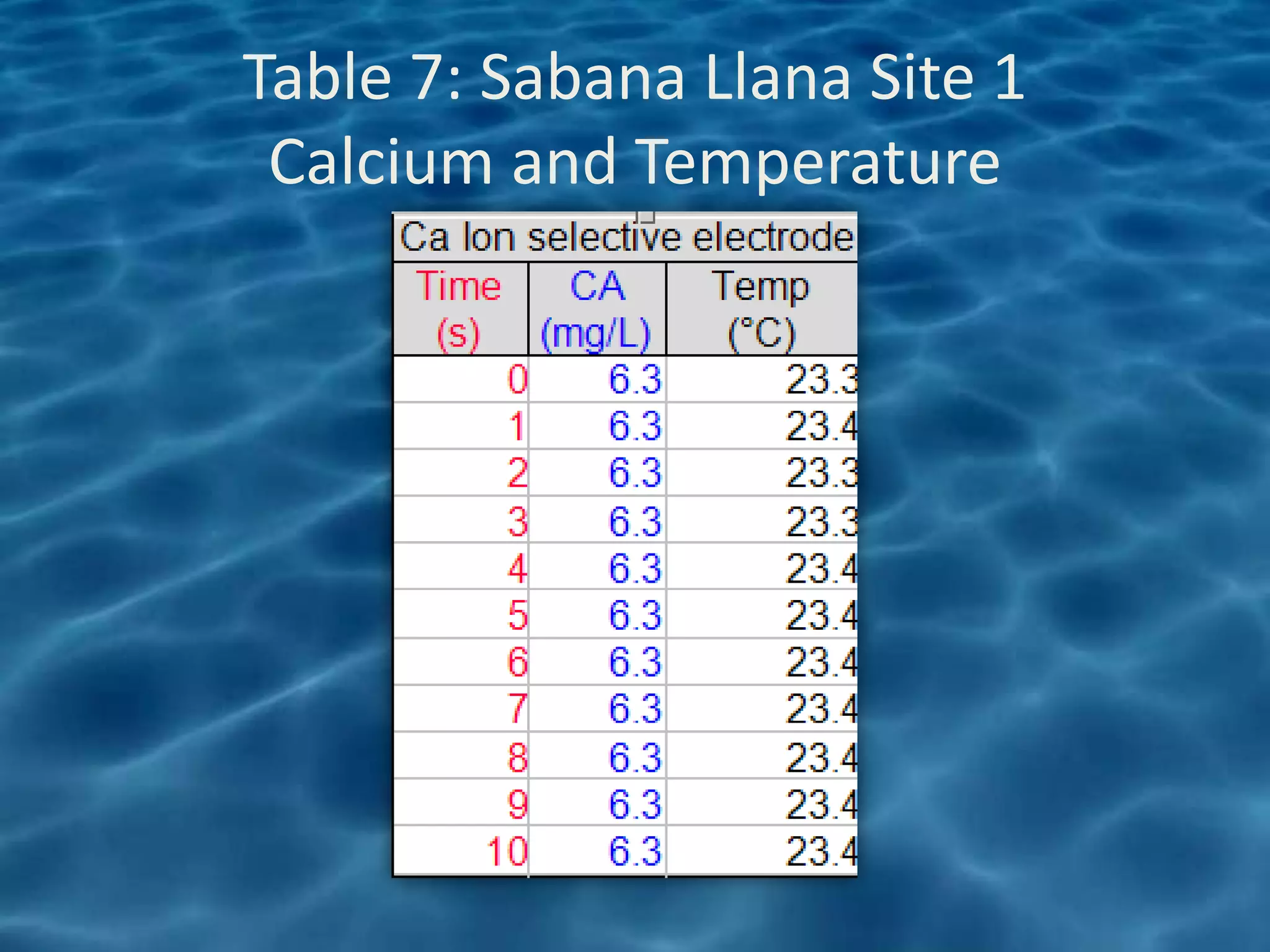
Table 7: Sabana Llana Site 1
 Calcium and Temperature
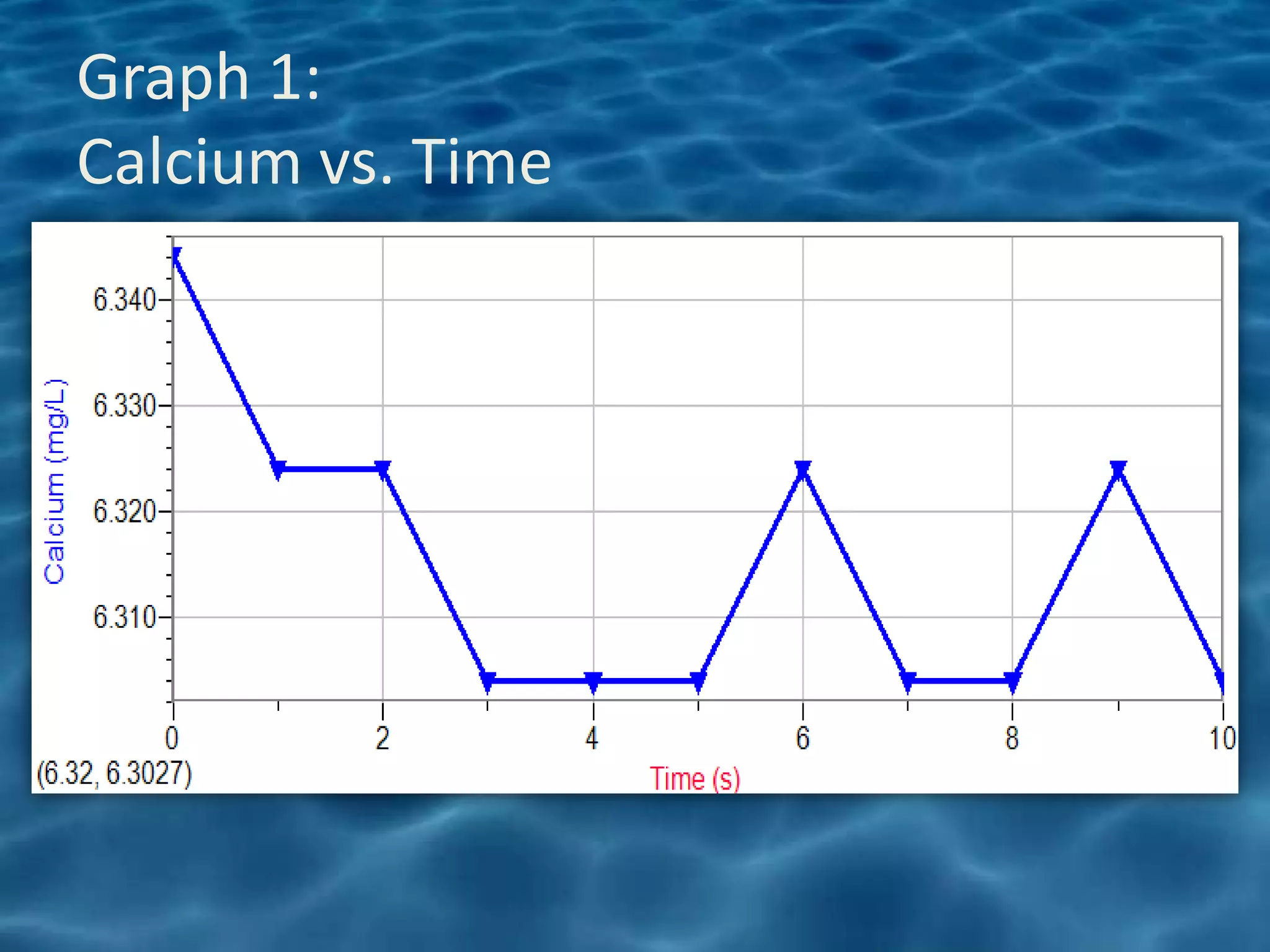
Graph 1:
Calcium vs. Time
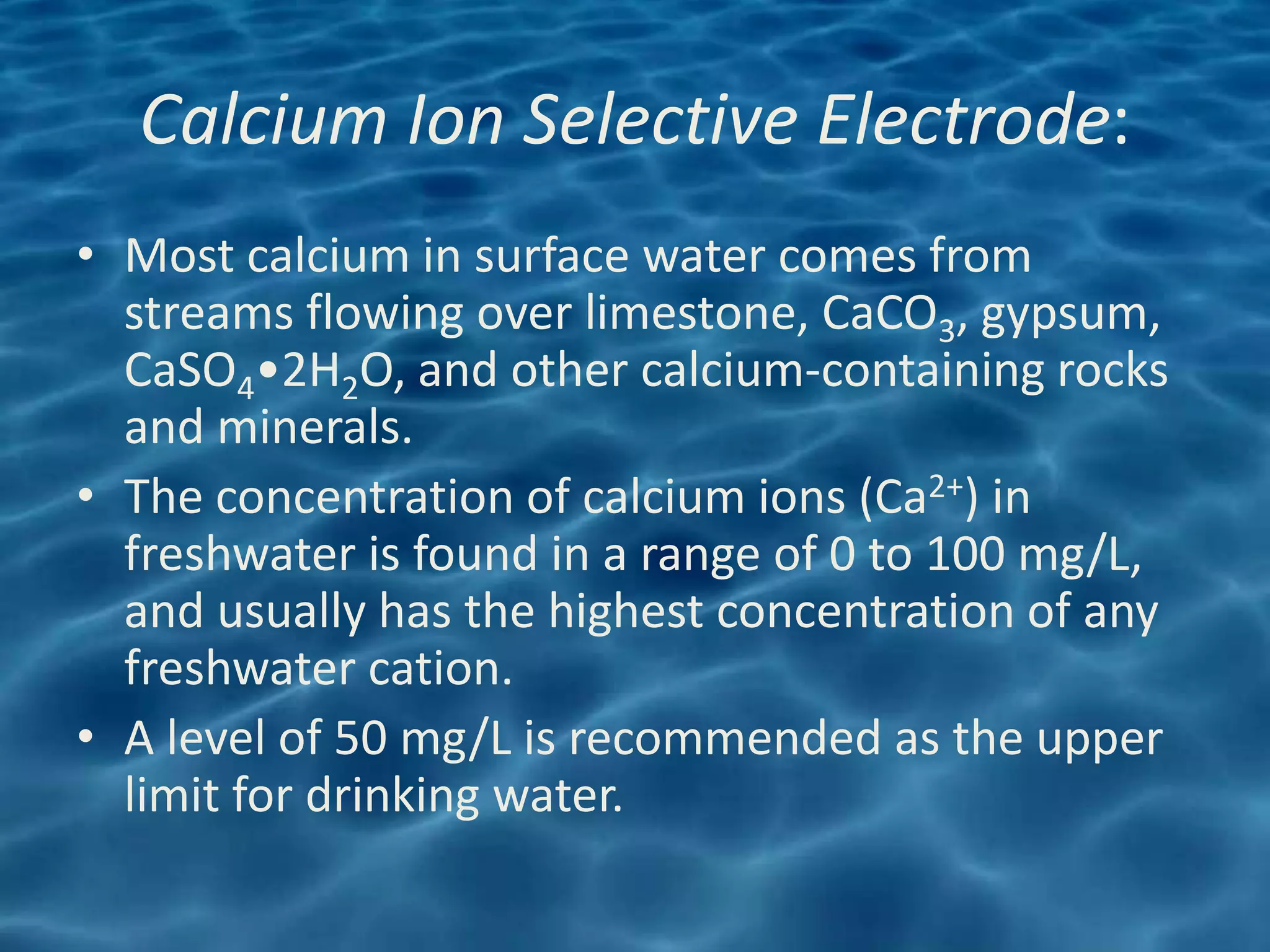
Calcium Ion Selective Electrode:
• Most calcium in surface water comes from
  streams flowing over limestone, CaCO3, gypsum,
  CaSO4•2H2O, and other calcium-containing rocks
  and minerals.
• The concentration of calcium ions (Ca2+) in
  freshwater is found in a range of 0 to 100 mg/L,
  and usually has the highest concentration of any
  freshwater cation.
• A level of 50 mg/L is recommended as the upper
  limit for drinking water.
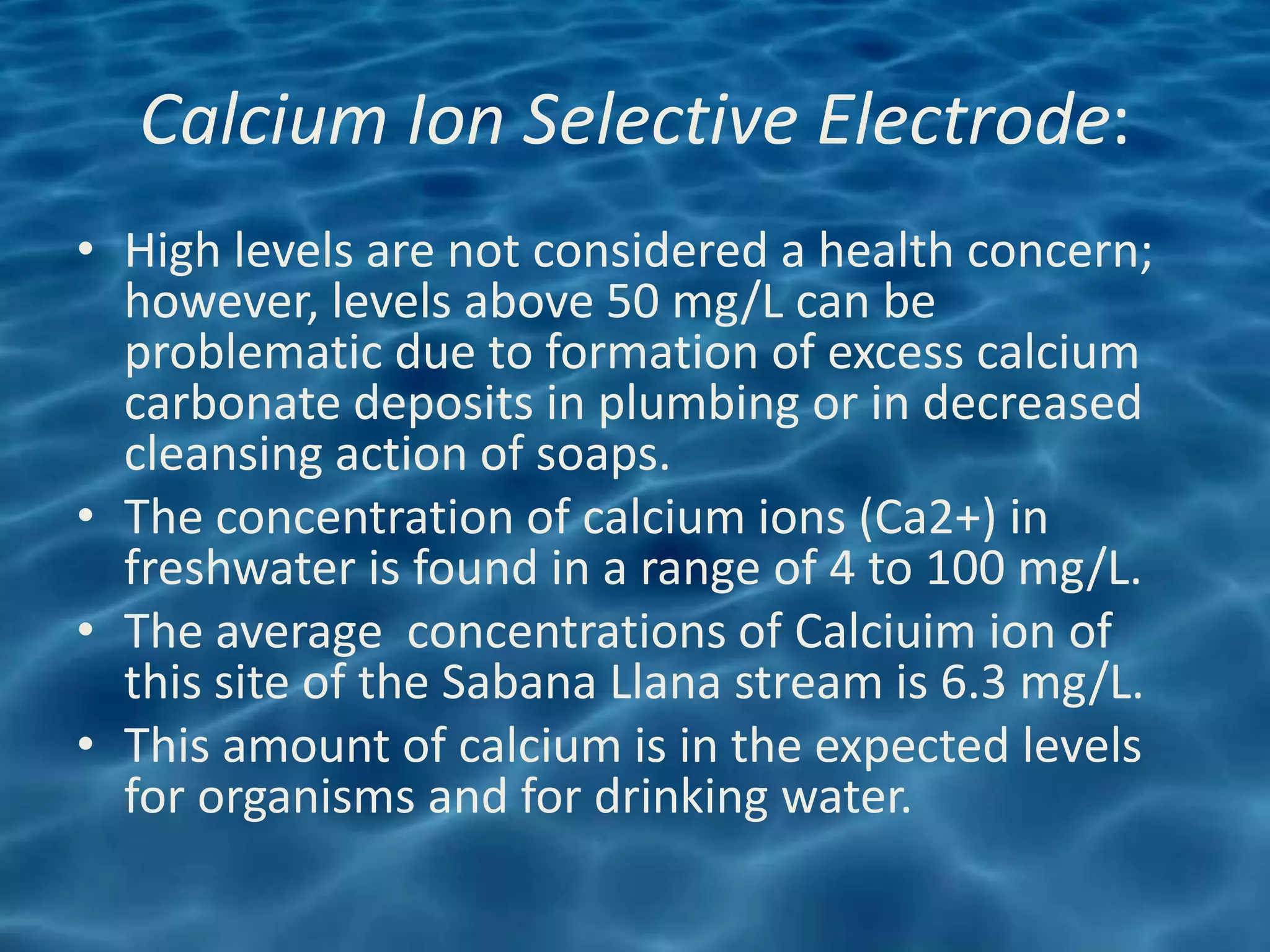
Calcium Ion Selective Electrode:
• High levels are not considered a health concern;
  however, levels above 50 mg/L can be
  problematic due to formation of excess calcium
  carbonate deposits in plumbing or in decreased
  cleansing action of soaps.
• The concentration of calcium ions (Ca2+) in
  freshwater is found in a range of 4 to 100 mg/L.
• The average concentrations of Calciuim ion of
  this site of the Sabana Llana stream is 6.3 mg/L.
• This amount of calcium is in the expected levels
  for organisms and for drinking water.
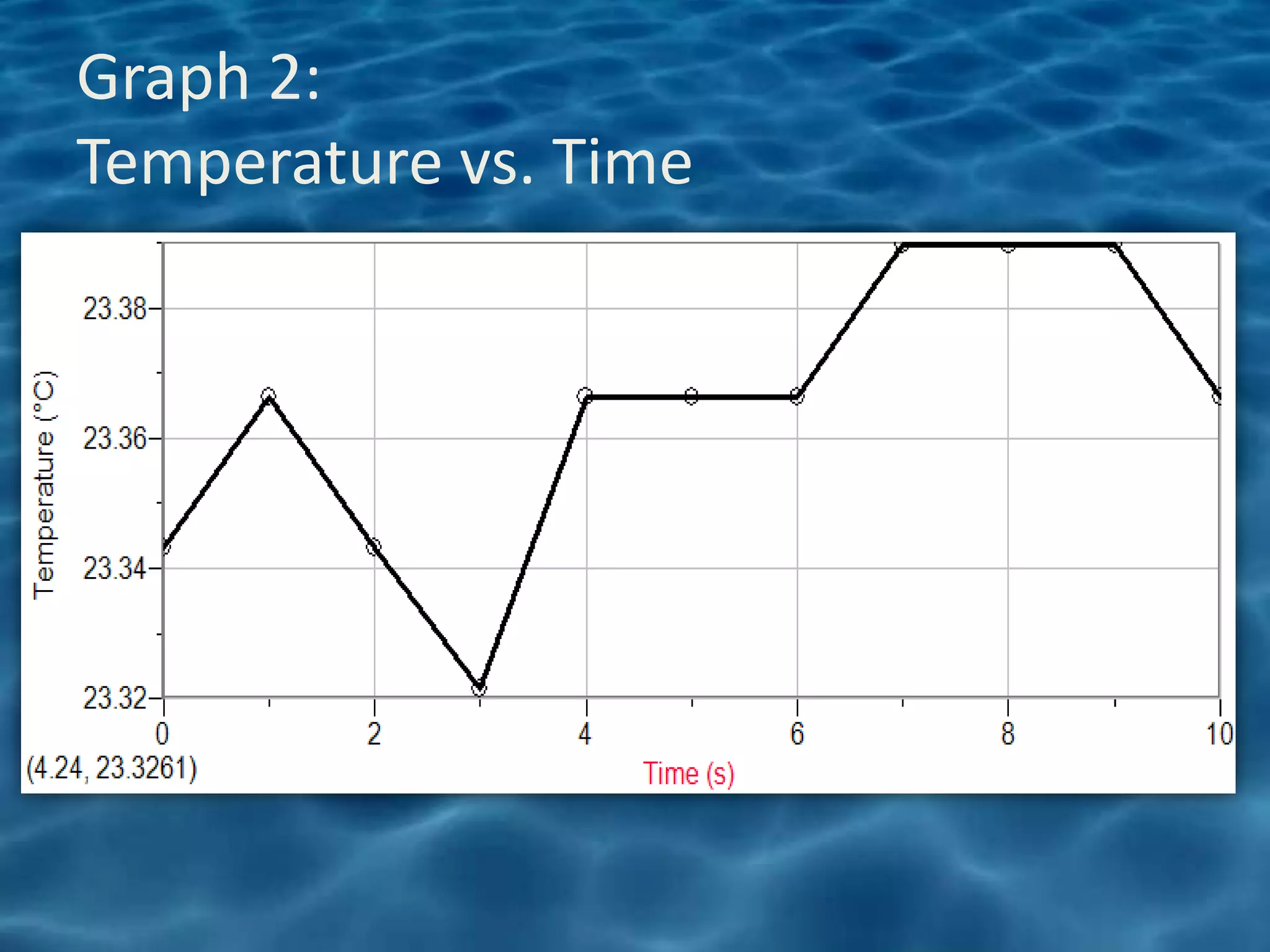
Graph 2:
Temperature vs. Time
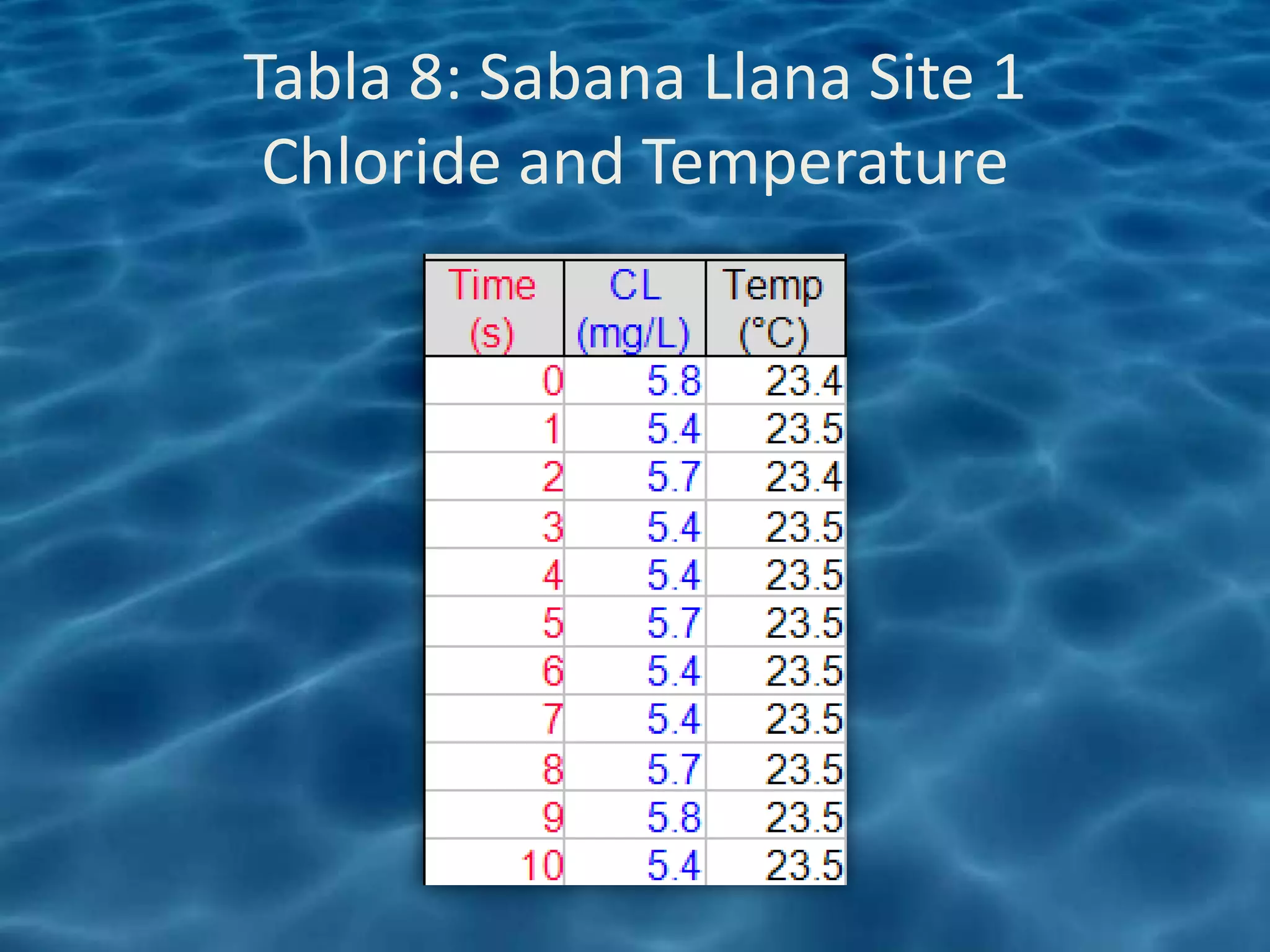
Tabla 8: Sabana Llana Site 1
 Chloride and Temperature
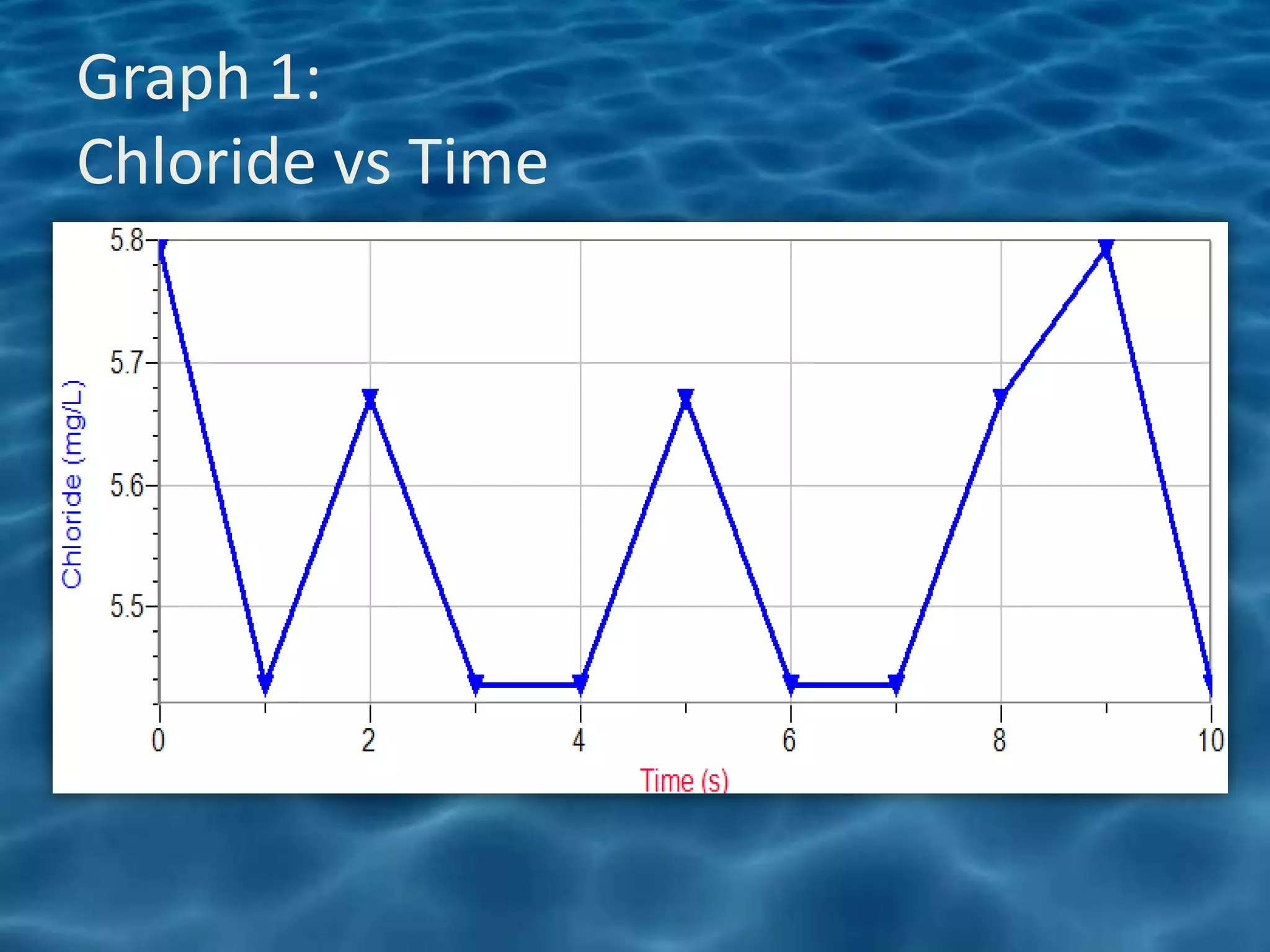
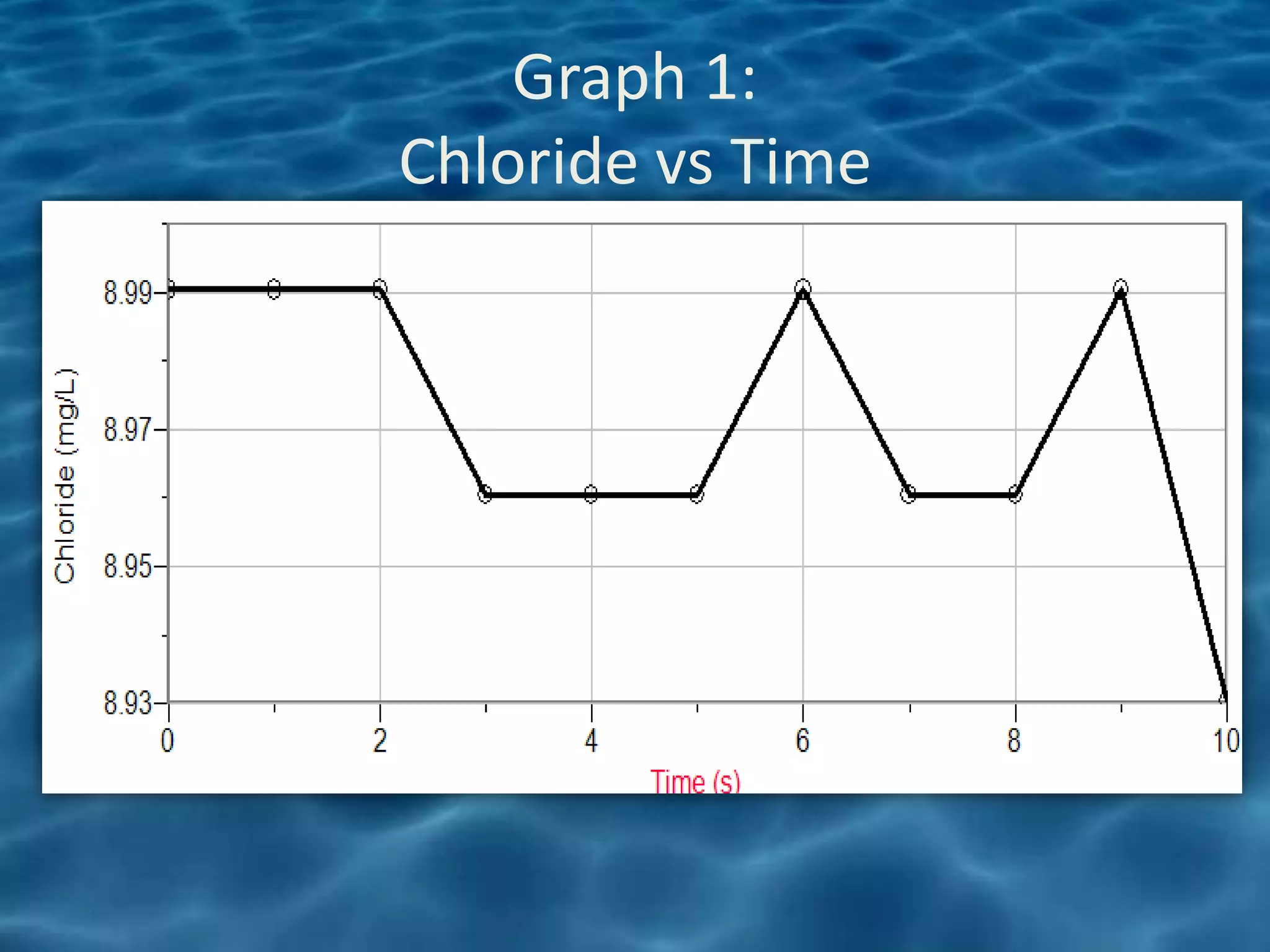
Graph 1:
Chloride vs Time
Chloride Ion Selective Electrode
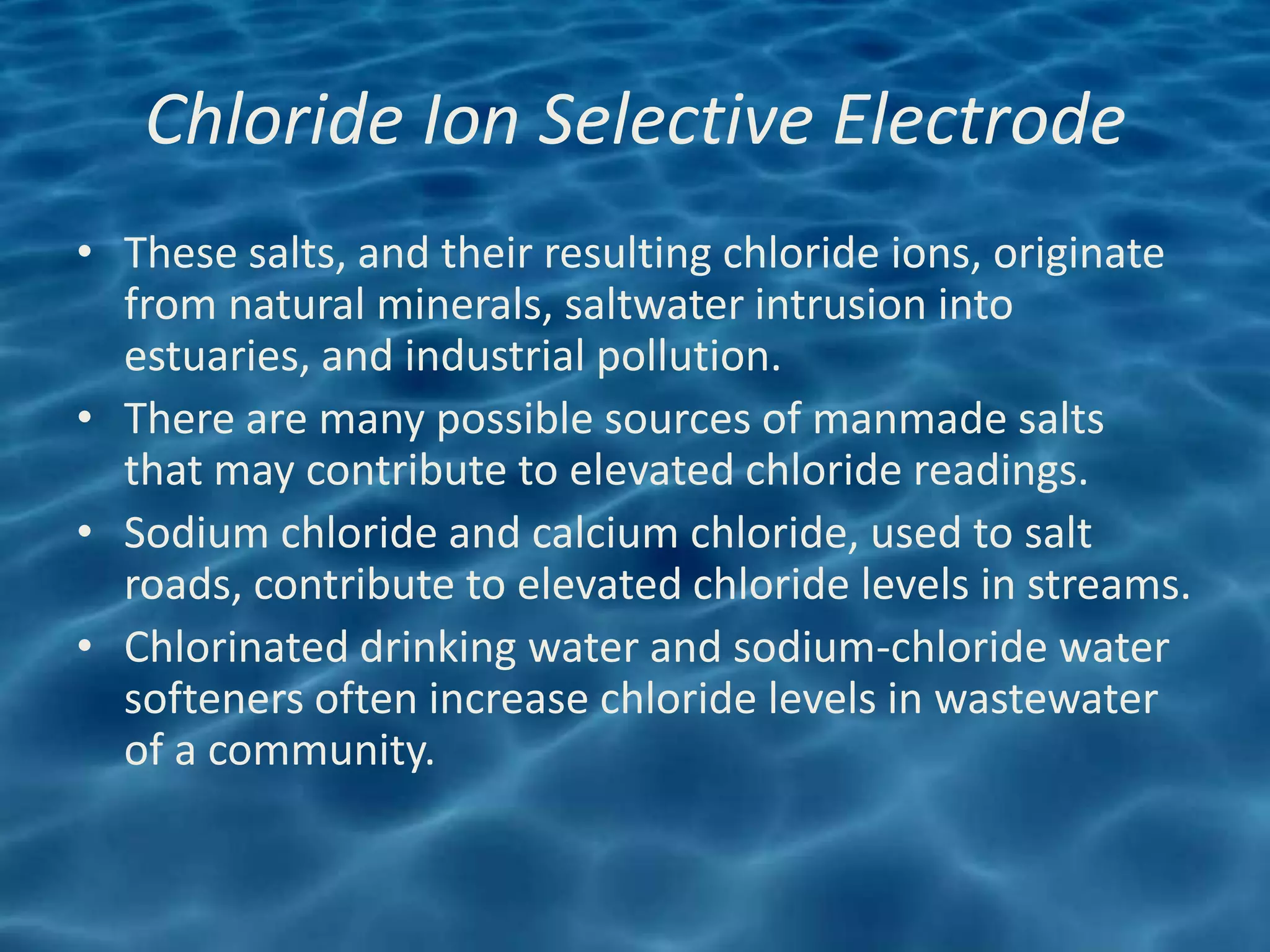
• These salts, and their resulting chloride ions,
  originate from natural minerals, saltwater
  intrusion into estuaries, and industrial pollution.
• There are many possible sources of
• manmade salts that may contribute to elevated
  chloride readings.
• Sodium chloride and calcium chloride, used to
  salt roads, contribute to elevated chloride levels
  in streams.
Chloride Ion Selective Electrode
• Chlorinated drinking water and sodium-chloride water
  softeners often increase chloride levels in wastewater
  of a community.
• The recommended maximum level of chloride in U.S.
  drinking water is 250 mg/L.
• Even freshwater streams and lakes have a significant
  chloride level that can range from 1 to 250 mg/L.
• The average concentration of Chloride ion in the
  Sabana Llana stream is 5.5mg/L.
• This amount of Calcium ion is in the expected levels for
  organisms and drinking water. The obtained amount is
  within the normal levels.
Graph 2:
Temperature vs Time
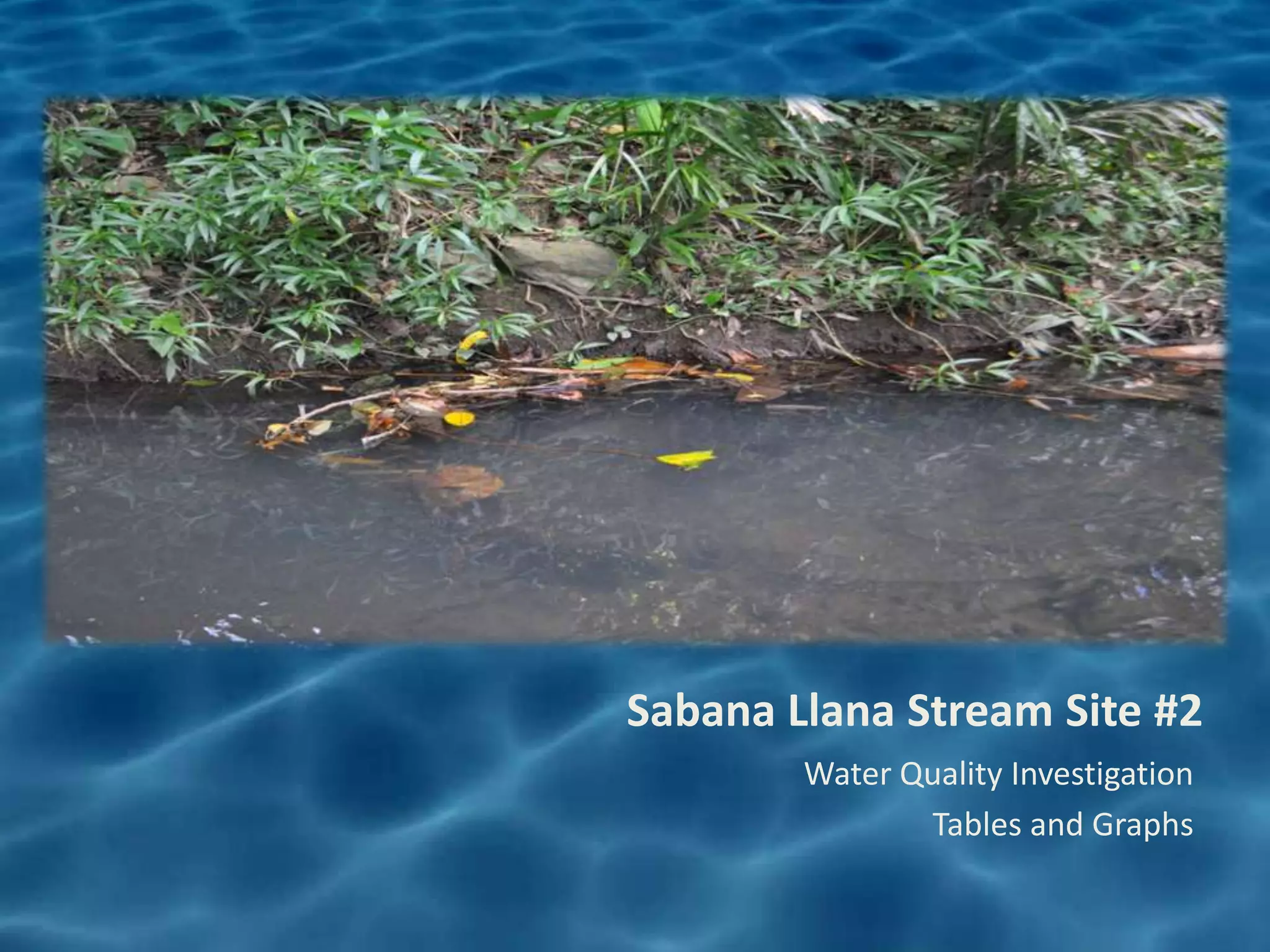
Sabana Llana Stream Site #2
        Water Quality Investigation
               Tables and Graphs
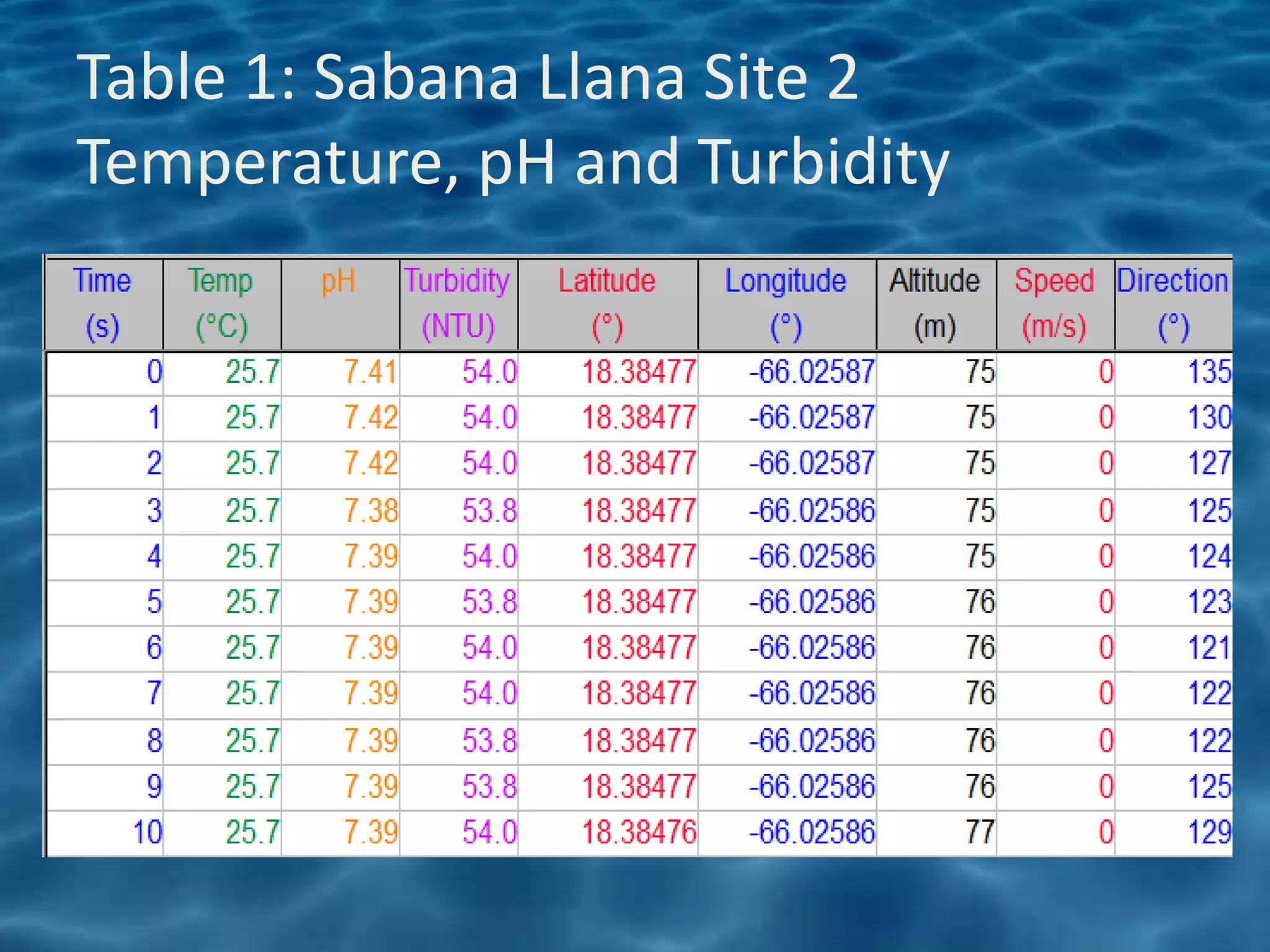
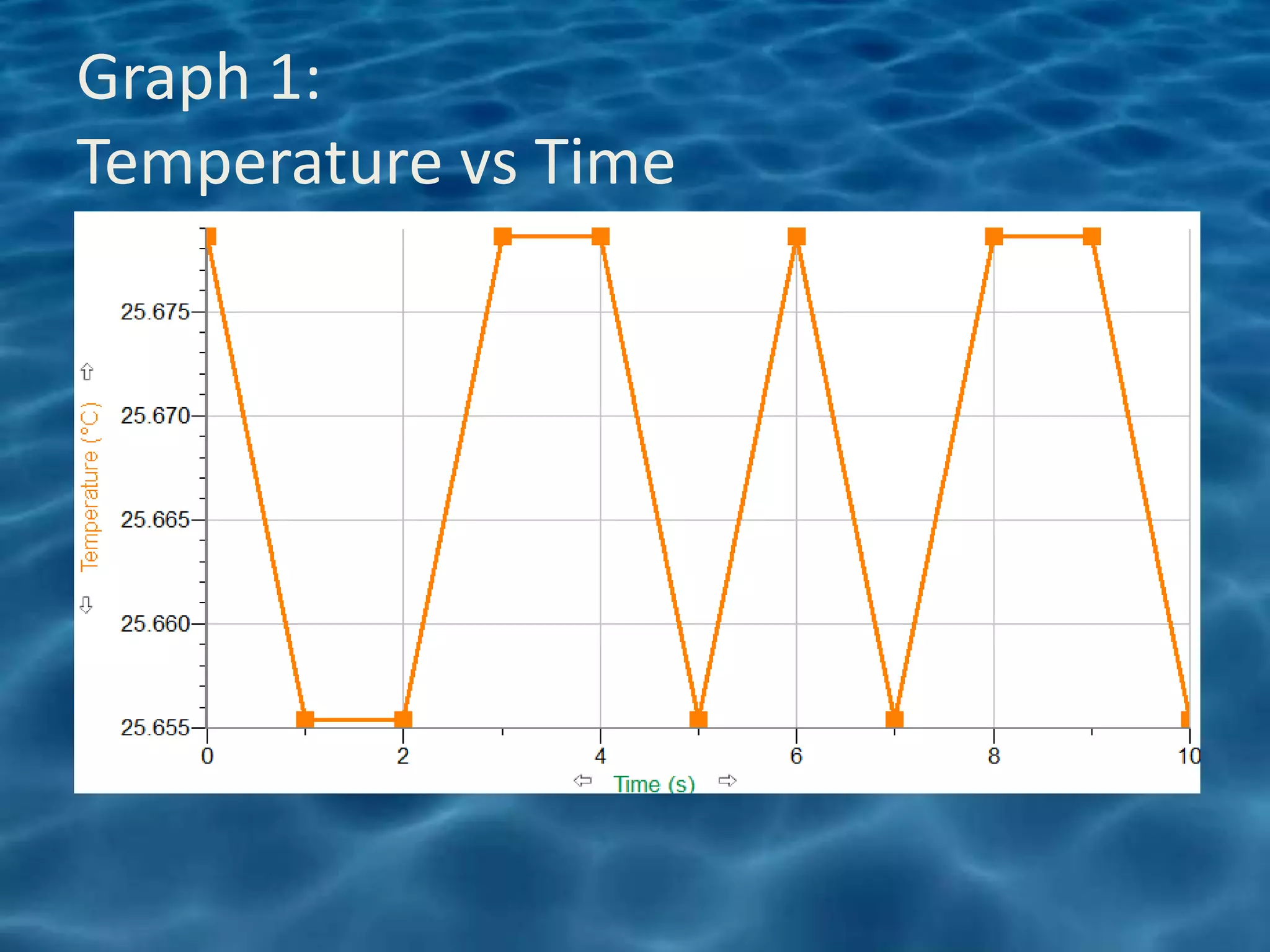
Table 1: Sabana Llana Site 2
Temperature, pH and Turbidity
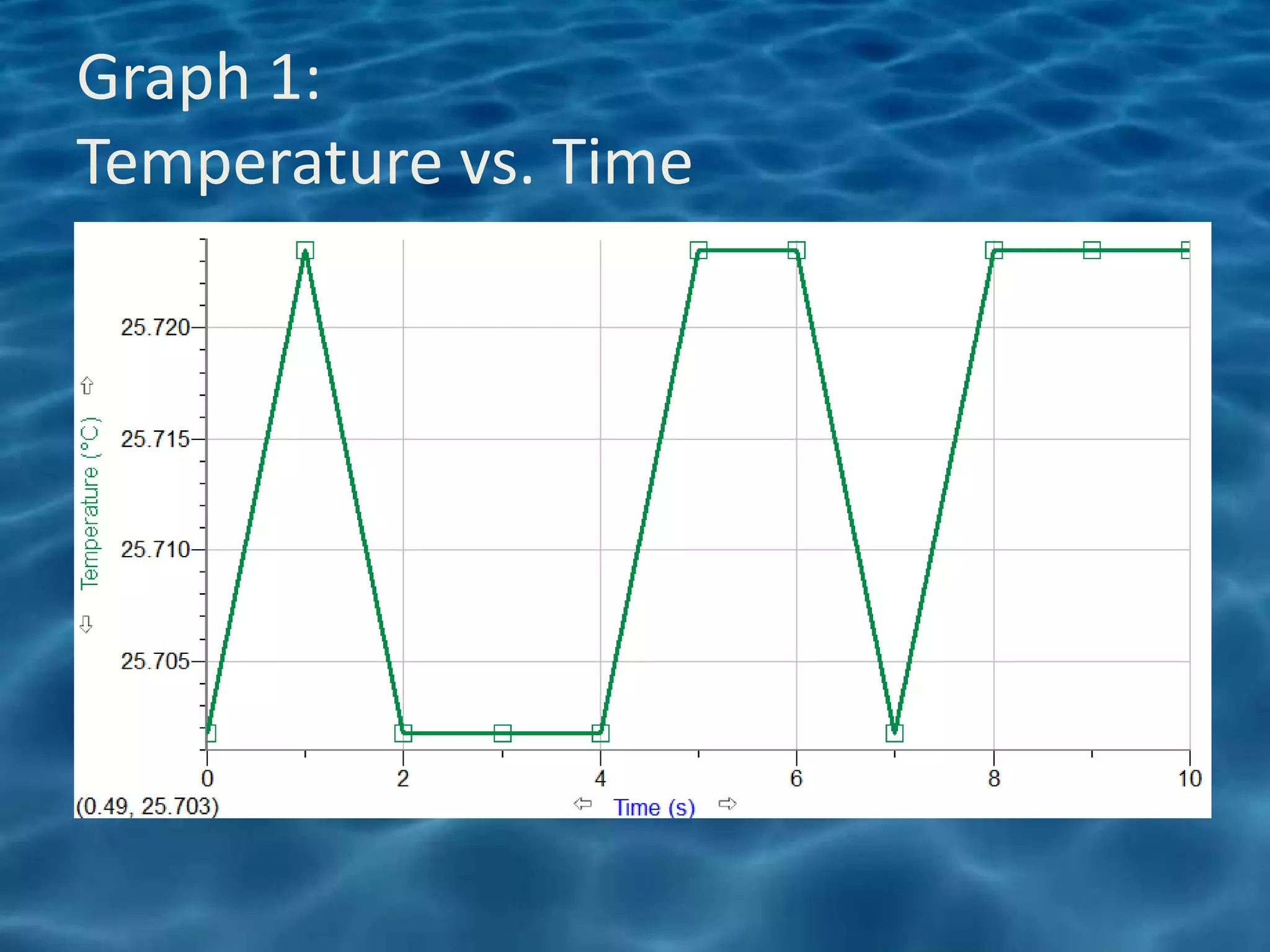
Graph 1:
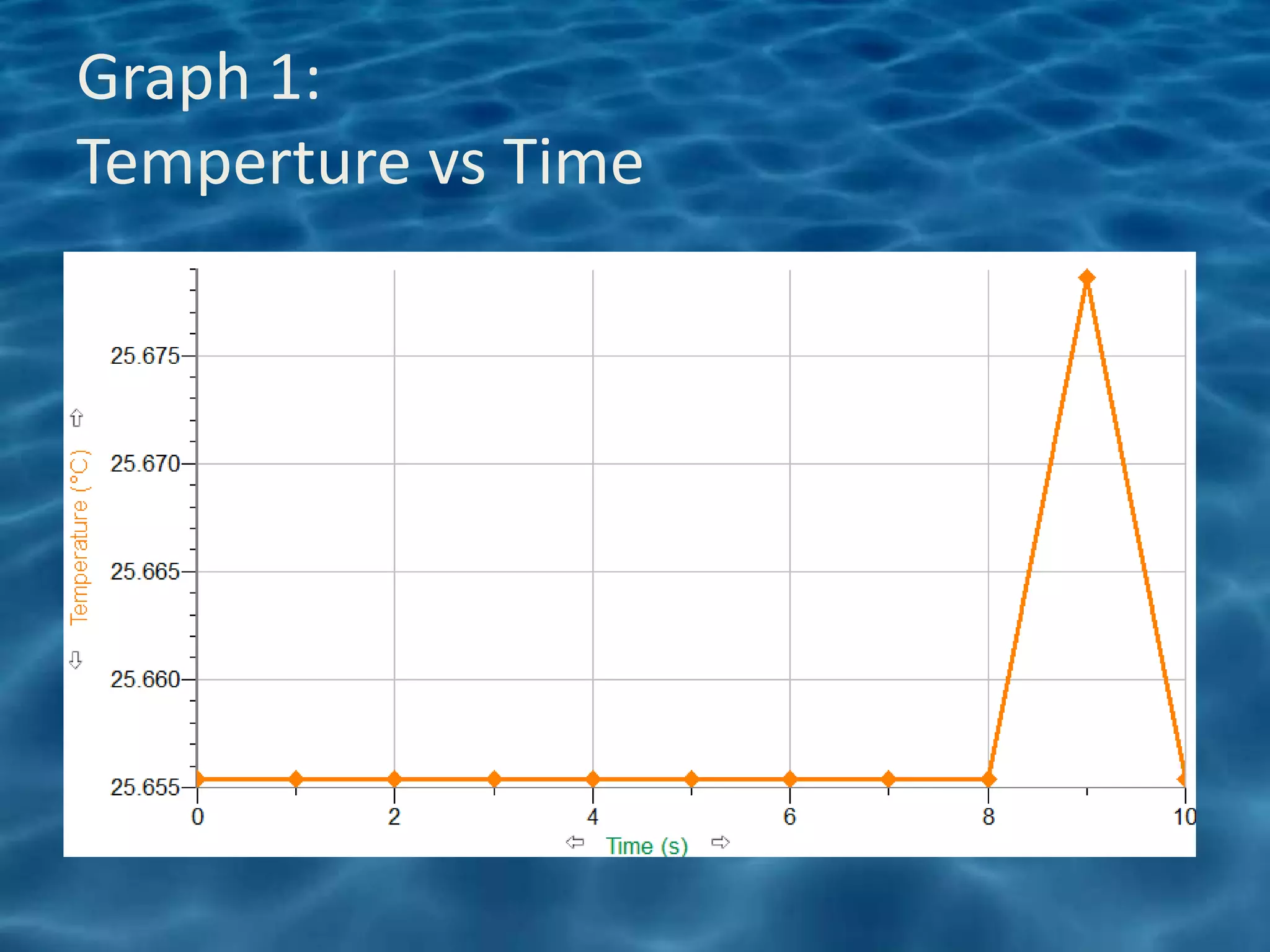
Temperature vs. Time
Water Temperature
• The temperature of a body of water influences its
  overall quality.
• A change in water temperature can affect the
  general health of the aquatic organisms, thus
  changing the quality of the stream.
• The temperature measured on Sabana Llana is
  suitable for small mouth bass and the rest of
  similar water organism.
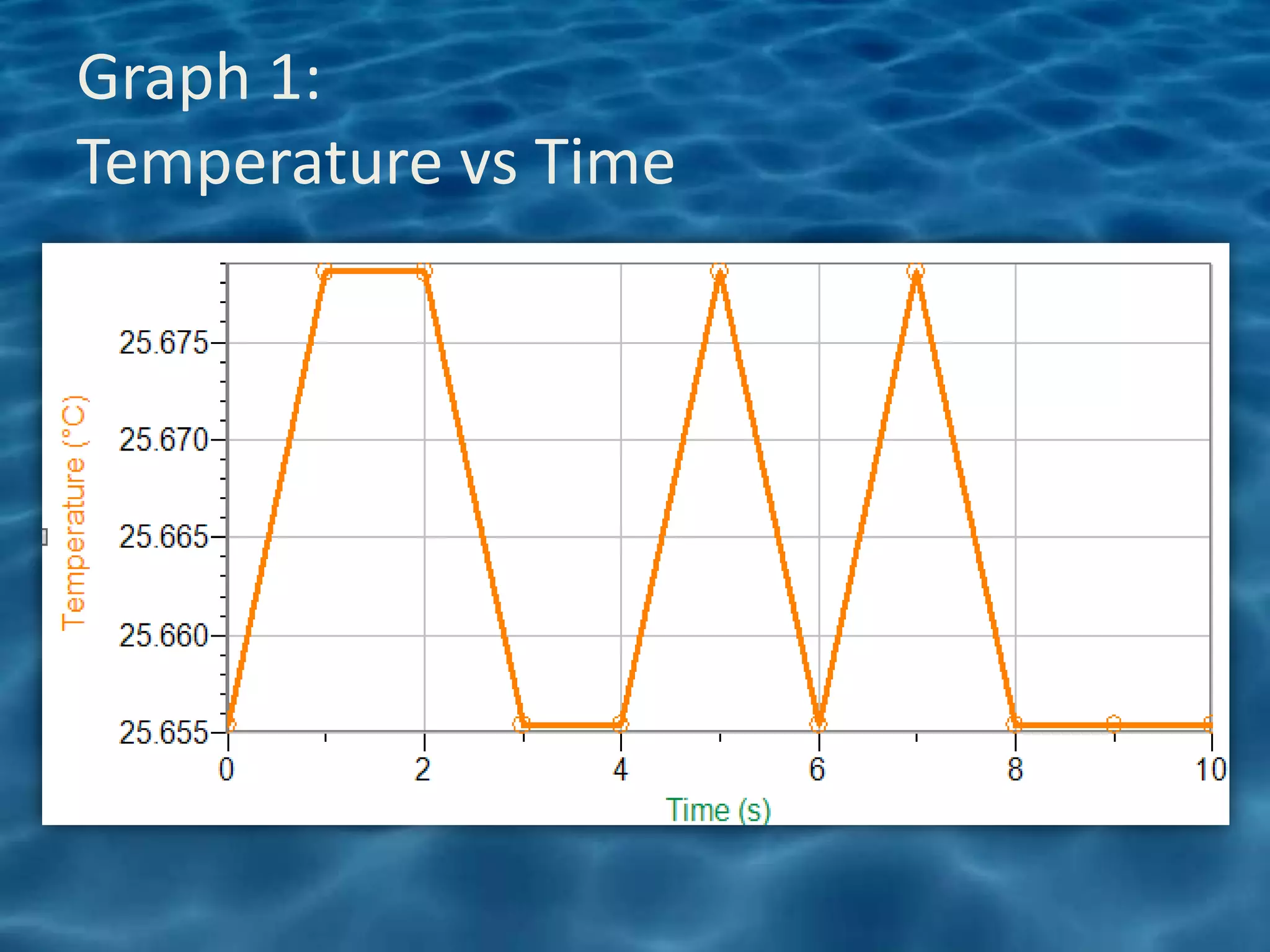
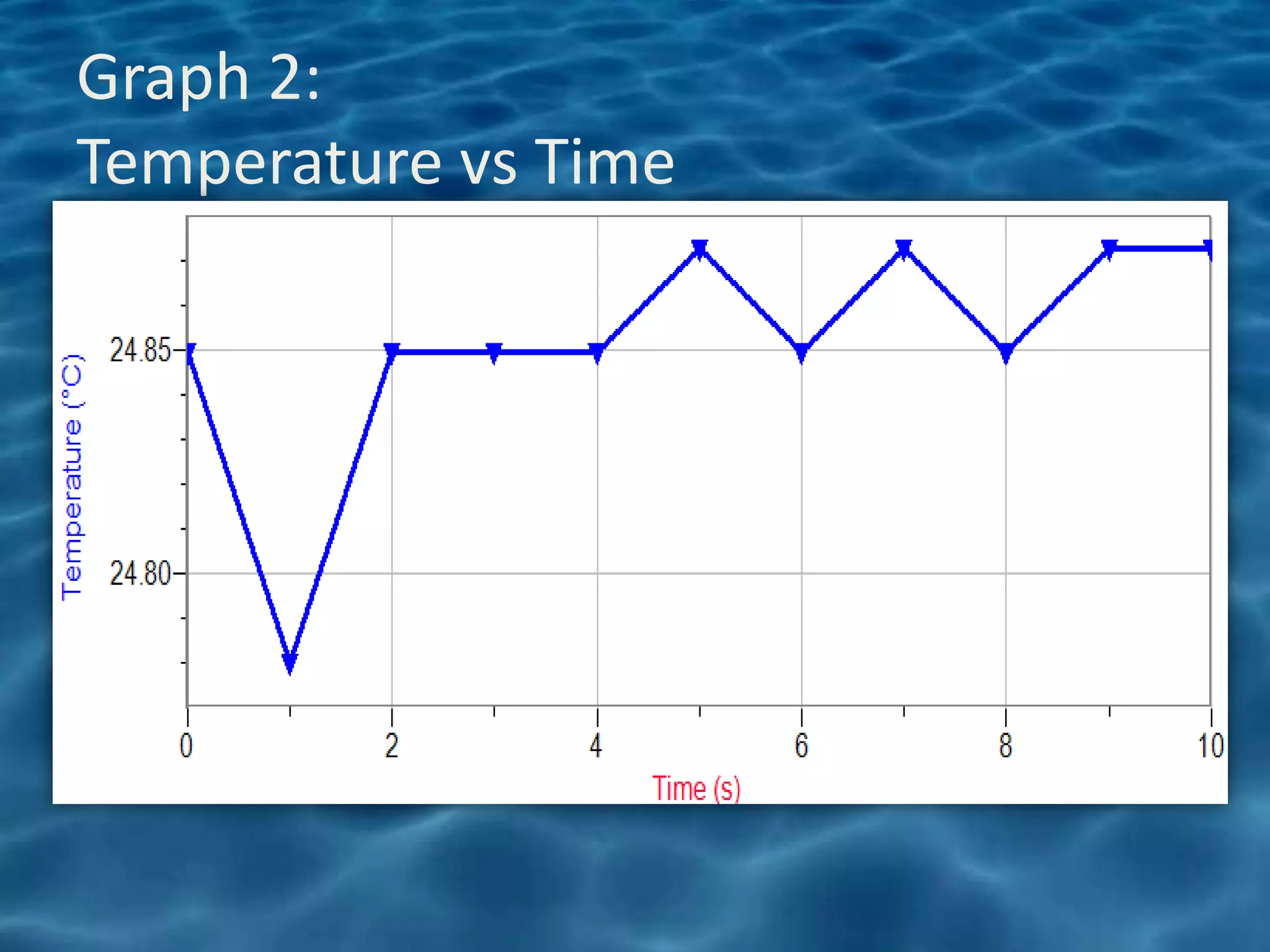
• The average temperature in this site was 25.7°C.
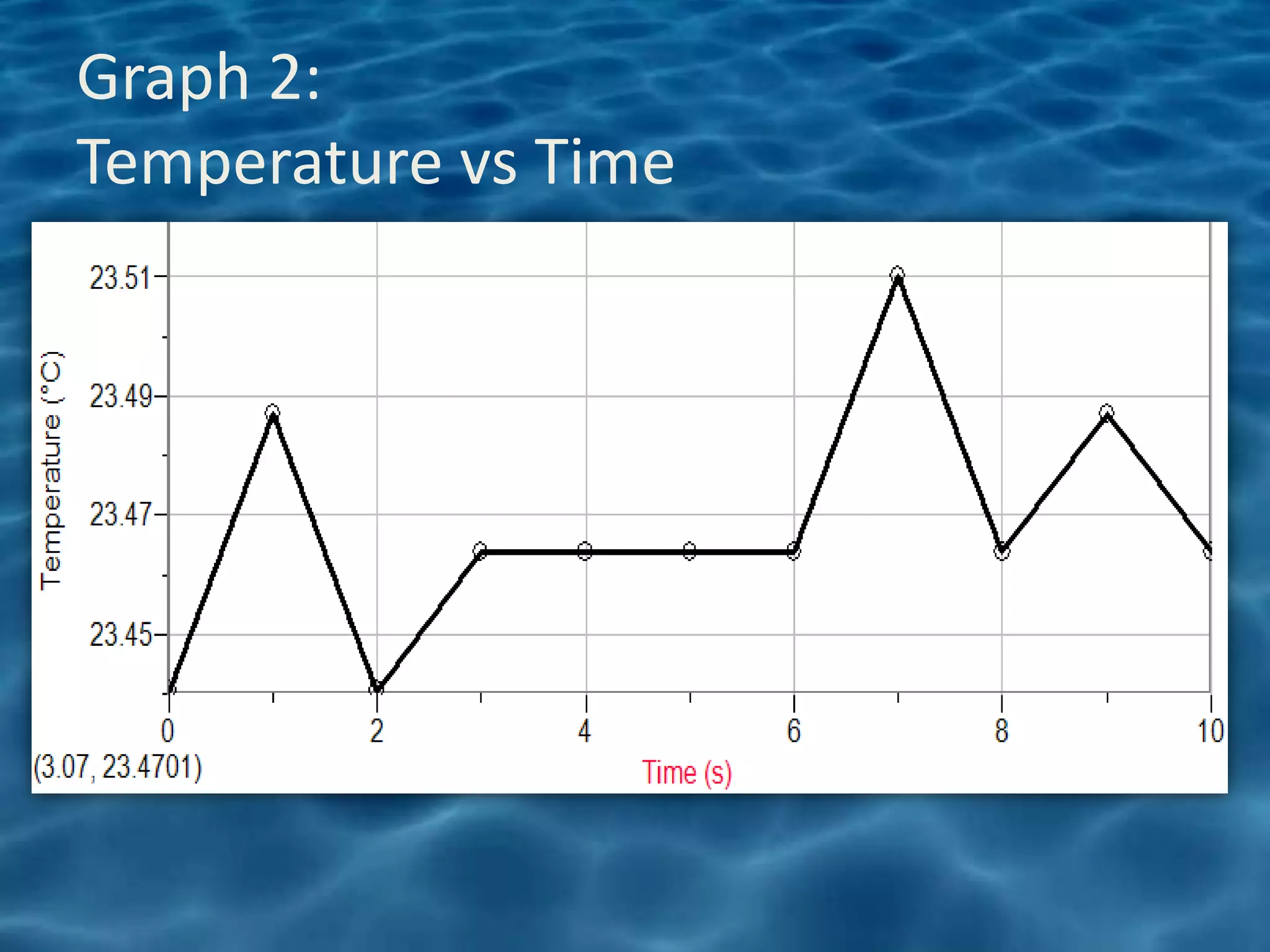
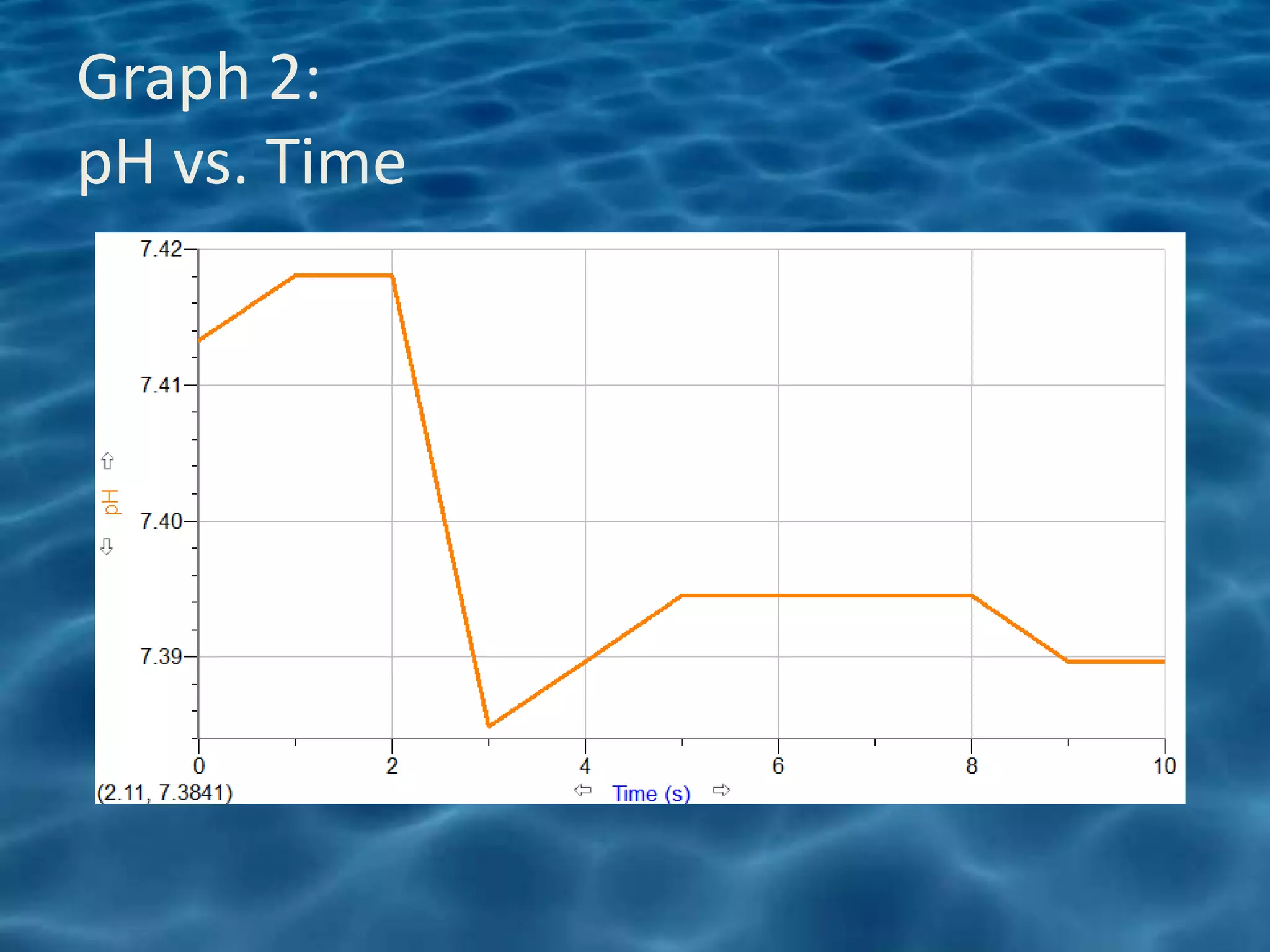
Graph 2:
pH vs. Time
Water pH
• Water contains both hydrogen ions, H+, and
  hydroxide ions, OH–.
• The relative concentrations of these two ions
  determine the pH value .
• Water with a pH of 7 has equal concentrations of
  these two ions and is considered to be a neutral
  solution.
• If a solution is acidic, the concentration of H+ ions
  exceeds that of the OH– ions.
• In a basic solution, the concentration of OH– ions
  exceeds that of the H+ ions.
Water pH
• On a pH scale of 0 to 14, a value of 0 is the most
  acidic, and 14 the most basic.
• A change from pH 7 to pH 8 in a lake or stream
  represents a ten-fold increase in the OH– ion
  concentration.
• The average pH of the Sabana Llana stream is 7.4.
• The water is optimal for most organisms.
• The ph level is acceptable for most drinking water
  standards.
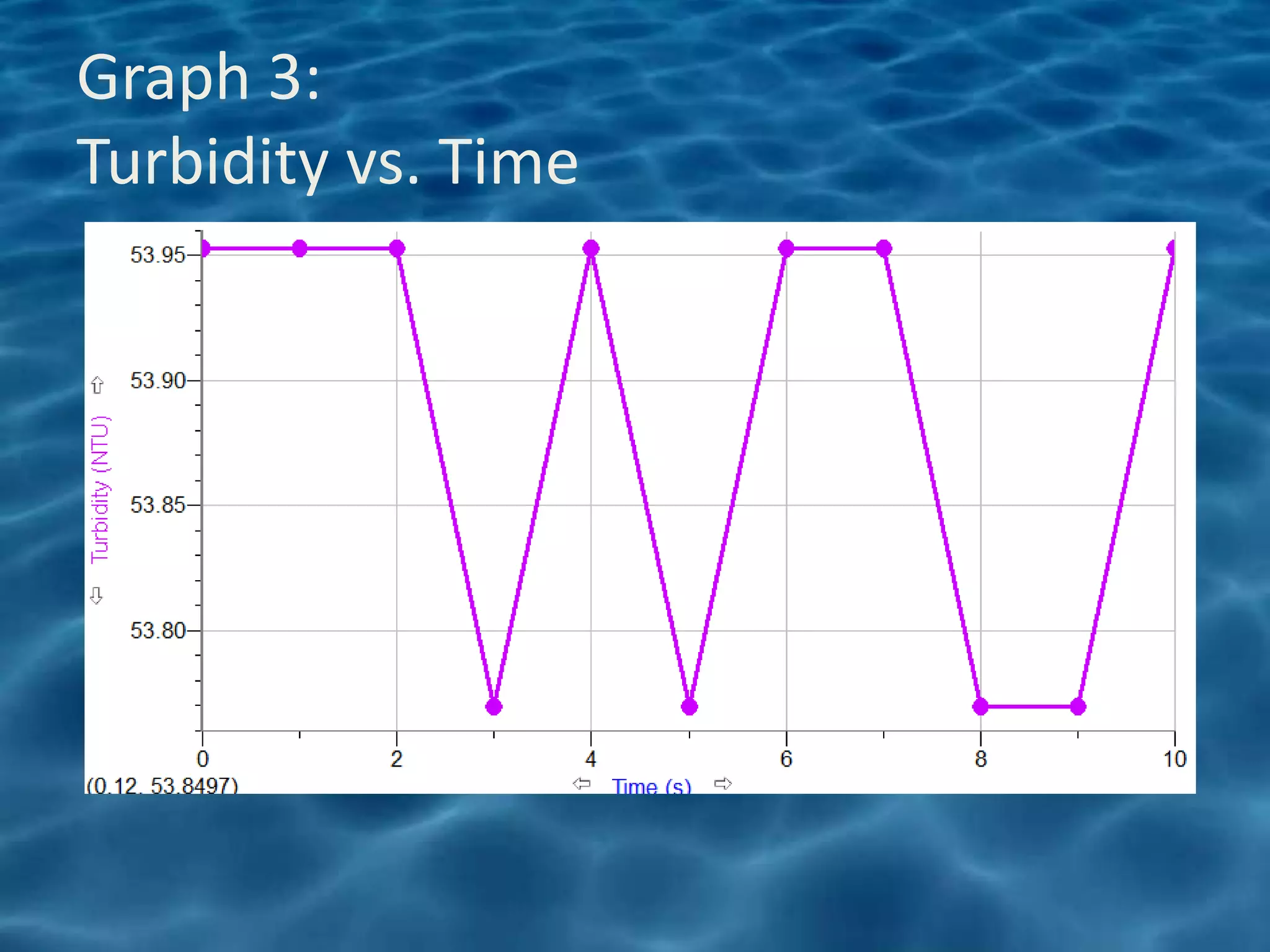
Graph 3:
Turbidity vs. Time
Turbidity
• Turbidity is a measure of water’s lack of clarity.
• Water with high turbidity is cloudy, while water
  with low turbidity is clear.
• The cloudiness is produced by light reflecting off
  of particles in the water; therefore, the more
  particles in the water, the higher the turbidity.
• Many factors can contribute to the turbidity of
  water.
• An increase in stream flow due to heavy rains or a
  decrease in stream-bank vegetation can speed up
  the process of soil erosion.
Turbidity
• This will add suspended particles, such as clay
  and silt, to the water.
• According to the USGS, the turbidity of surface
  water is usually between 1 NTU and 50 NTU .
• Water is visibly turbid at levels above 5 NTU.
• The standard for drinking water is 0.5 NTU to 1.0
  NTU.
• The average turbidity in this site of the Sabana
  Llana Stream is 55.4 NTU. The water is visibly
  turbid and in the standard range.
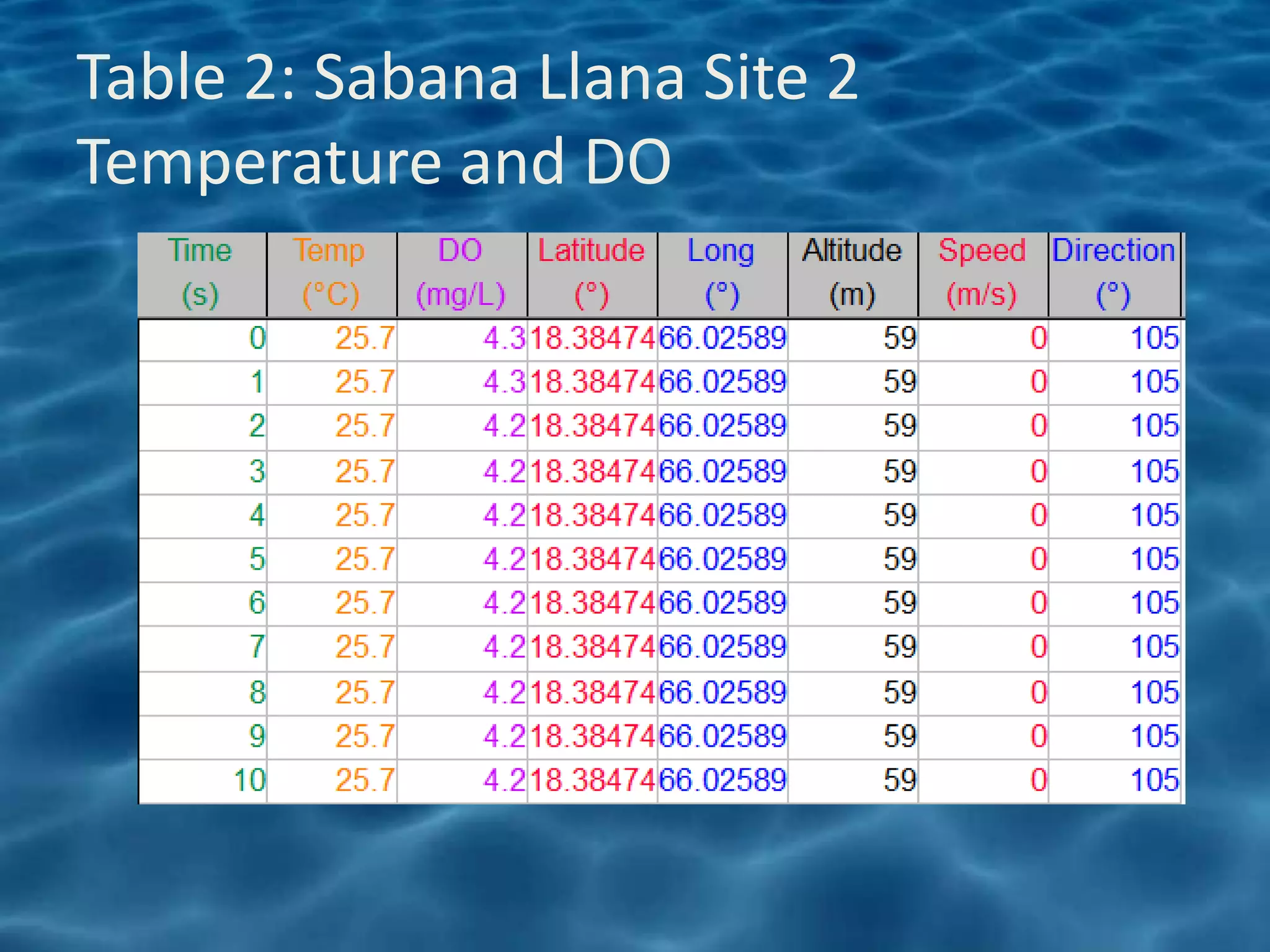
Table 2: Sabana Llana Site 2
Temperature and DO
Graph 1:
Temperture vs Time
Graph 2:
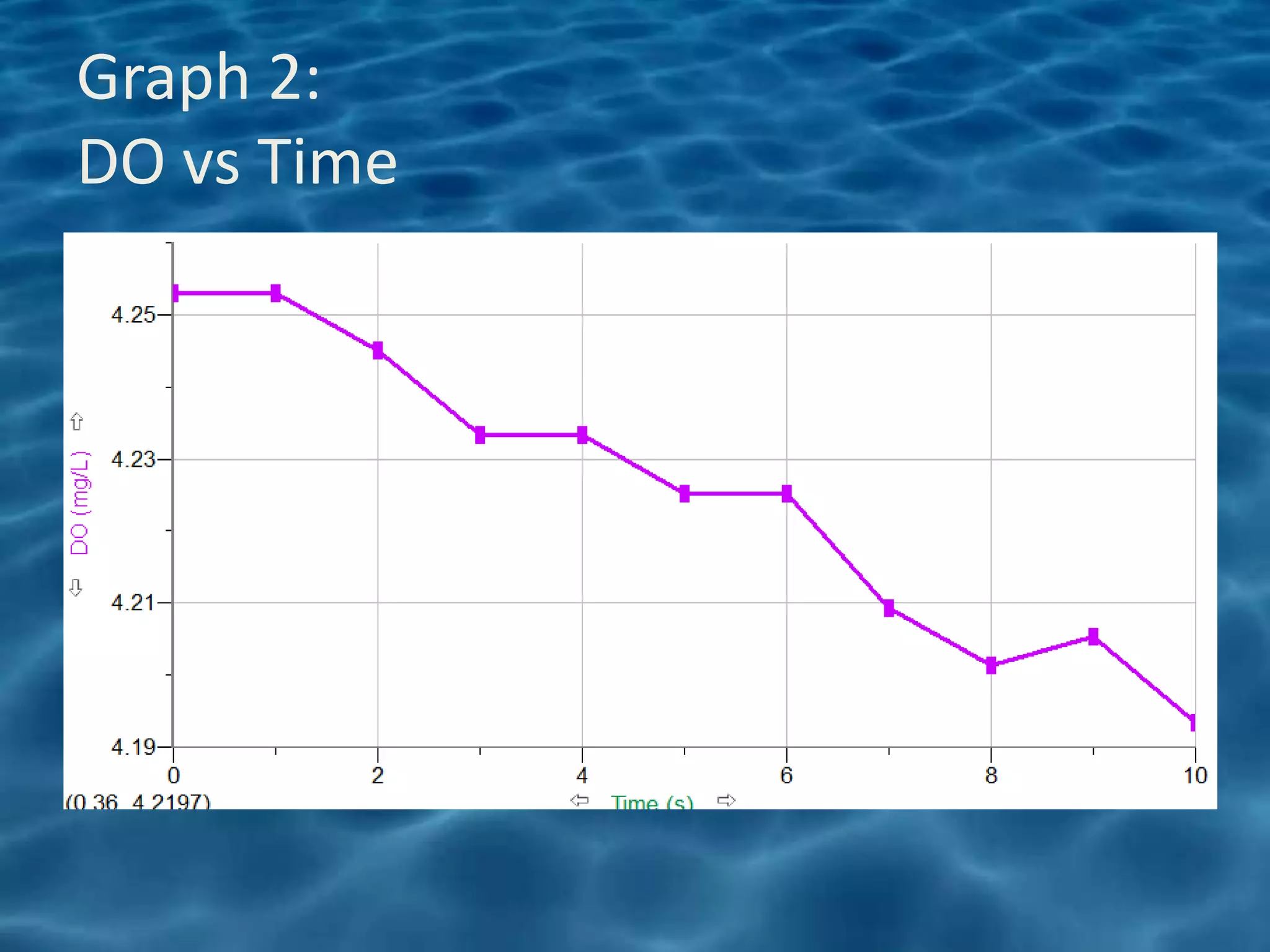
DO vs Time
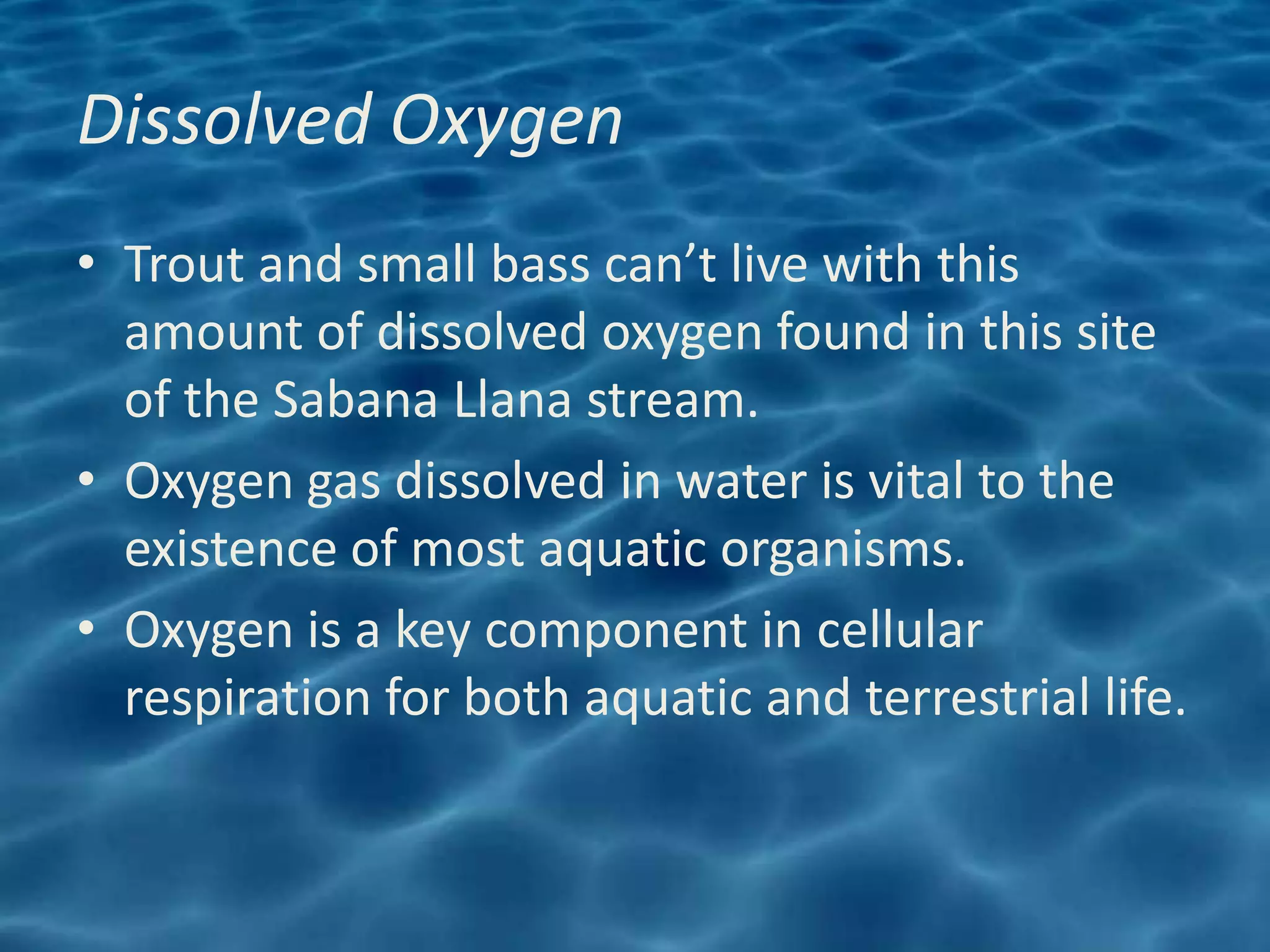
Dissolved Oxygen
• Trout and small bass can’t live with this
  amount of dissolved oxygen found in this site
  of the Sabana Llana stream.
• Oxygen gas dissolved in water is vital to the
  existence of most aquatic organisms.
• Oxygen is a key component in cellular
  respiration for both aquatic and terrestrial life.
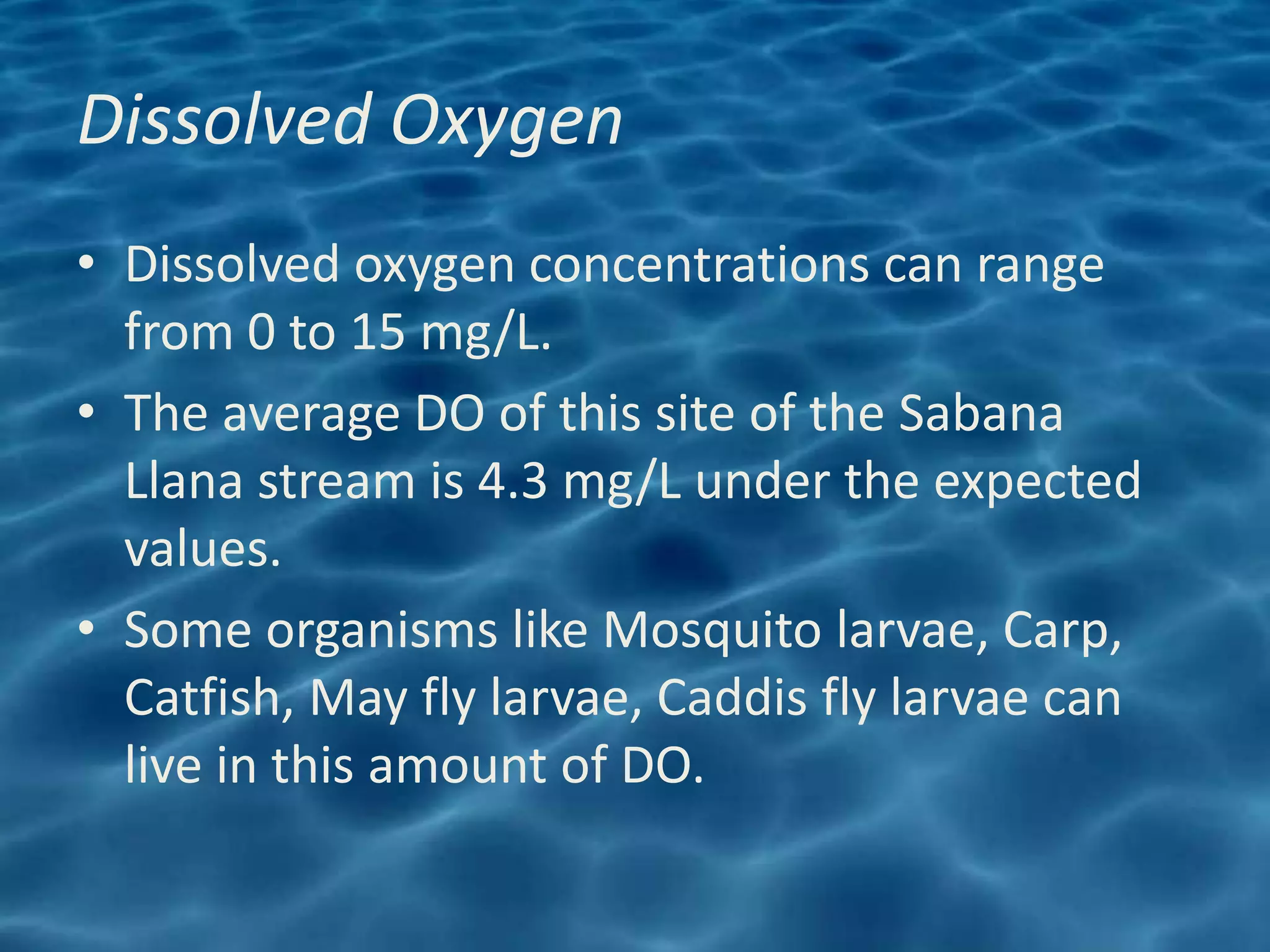
Dissolved Oxygen
• Dissolved oxygen concentrations can range
  from 0 to 15 mg/L.
• The average DO of this site of the Sabana
  Llana stream is 4.3 mg/L under the expected
  values.
• Some organisms like Mosquito larvae, Carp,
  Catfish, May fly larvae, Caddis fly larvae can
  live in this amount of DO.
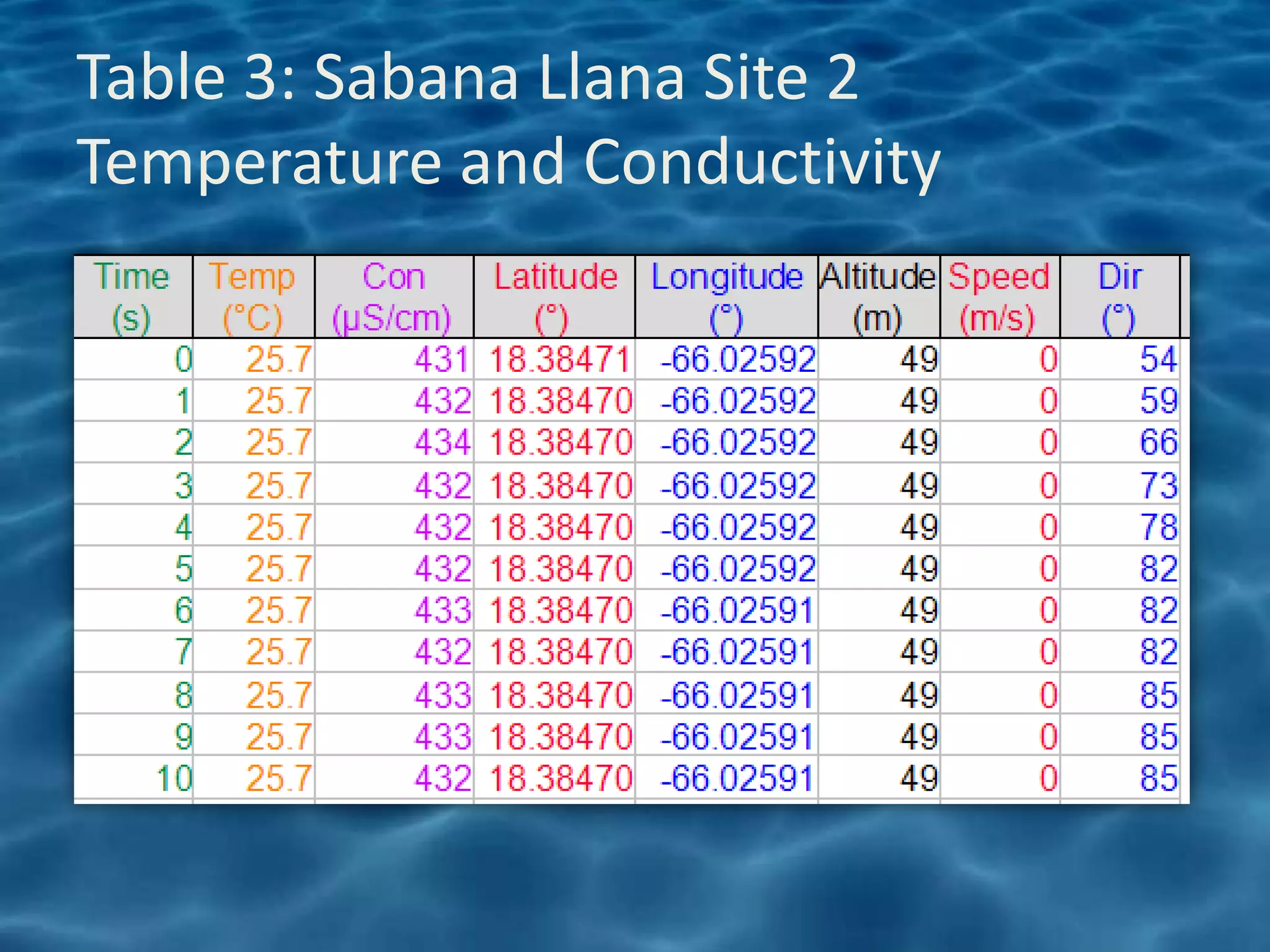
Table 3: Sabana Llana Site 2
Temperature and Conductivity
Graph 1:
Temperature vs Time
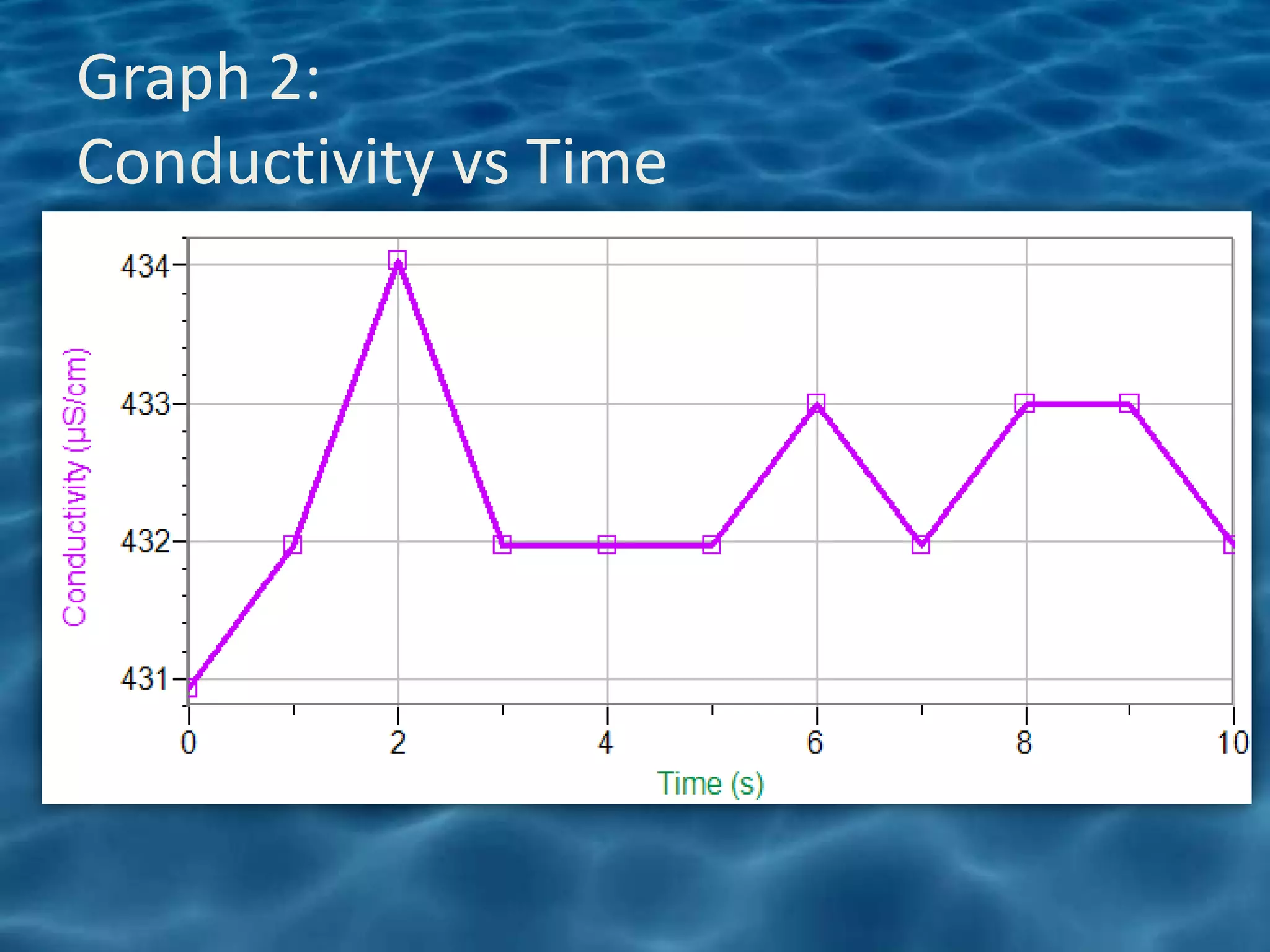
Graph 2:
Conductivity vs Time
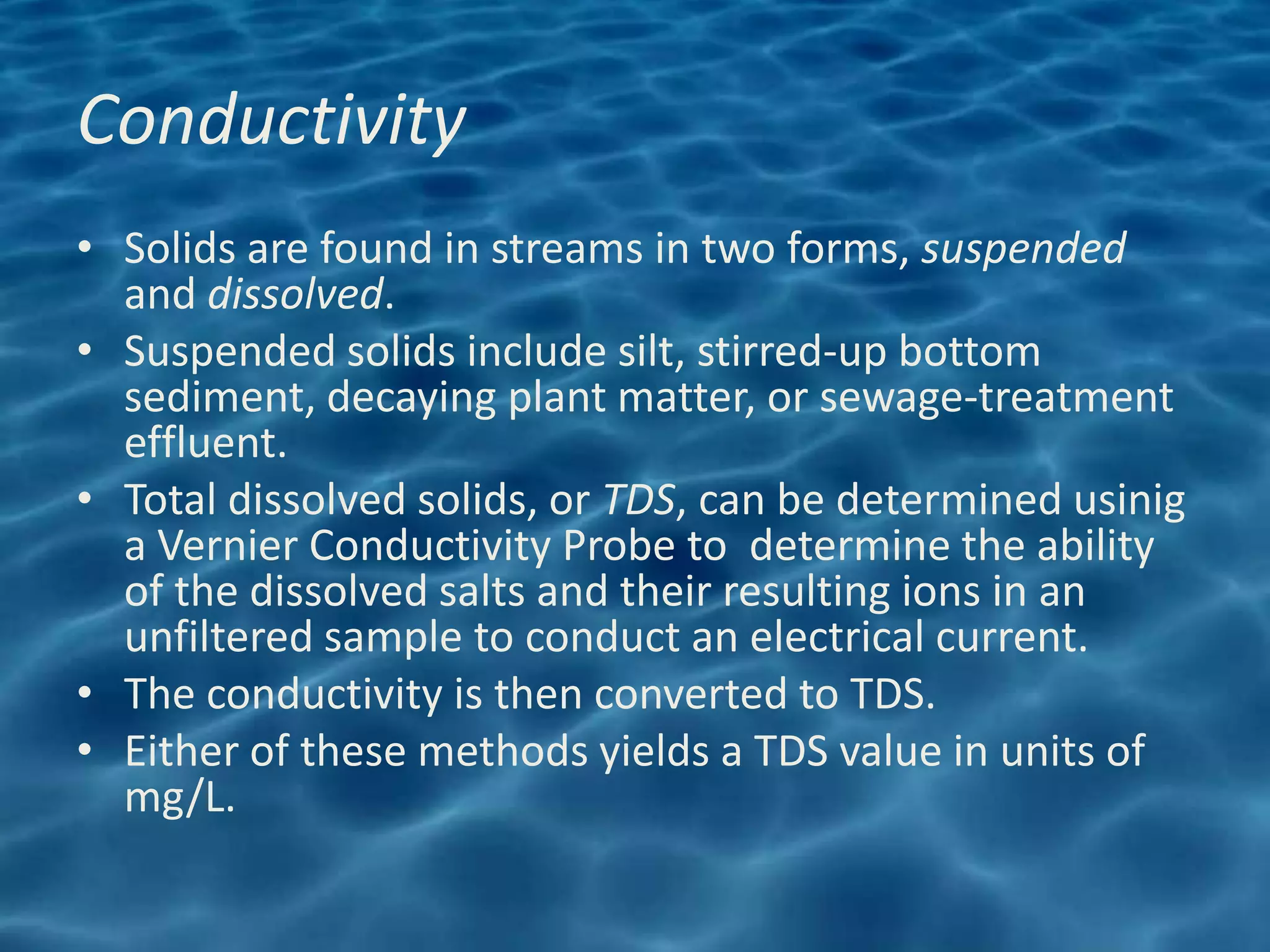
Conductivity
• Solids are found in streams in two forms, suspended
  and dissolved.
• Suspended solids include silt, stirred-up bottom
  sediment, decaying plant matter, or sewage-treatment
  effluent.
• Total dissolved solids, or TDS, can be determined usinig
  a Vernier Conductivity Probe to determine the ability
  of the dissolved salts and their resulting ions in an
  unfiltered sample to conduct an electrical current.
• The conductivity is then converted to TDS.
• Either of these methods yields a TDS value in units of
  mg/L.
Conductivity
• There are many possible manmade sources of
• ions that may contribute to elevated TDS readings.
  Fertilizers from fields and lawns can add a
• variety of ions to a stream. Increases in TDS can also
  result from runoff from roads that have
• been salted in the winter. Organic matter from
  wastewater treatment plants may contribute
• higher levels of nitrate or phosphate ions. Treated
  wastewater may also have higher TDS
• readings than surrounding streams if urban drinking
  water has been highly chlorinated.
Conductivity
• Irrigation water that is returned to a stream will often
  have higher concentrations of sodium or chloride ions.
• Acidic rainwater, with dissolved gases like CO2, NO2, or
  SO2, often yields elevated H+ ion concentrations.
• TDS values in lakes and streams are typically found to
  be in the range of 50 to 250 mg/L.
• Drinking water will tend to be 25 to 500 mg/L TDS.
• The average conductivity of the Sabana Llana Stream is
  432 μS/cm.
• There is a considerably amount of suspended solids
  because the levels of TDS are very near to the max
  level.
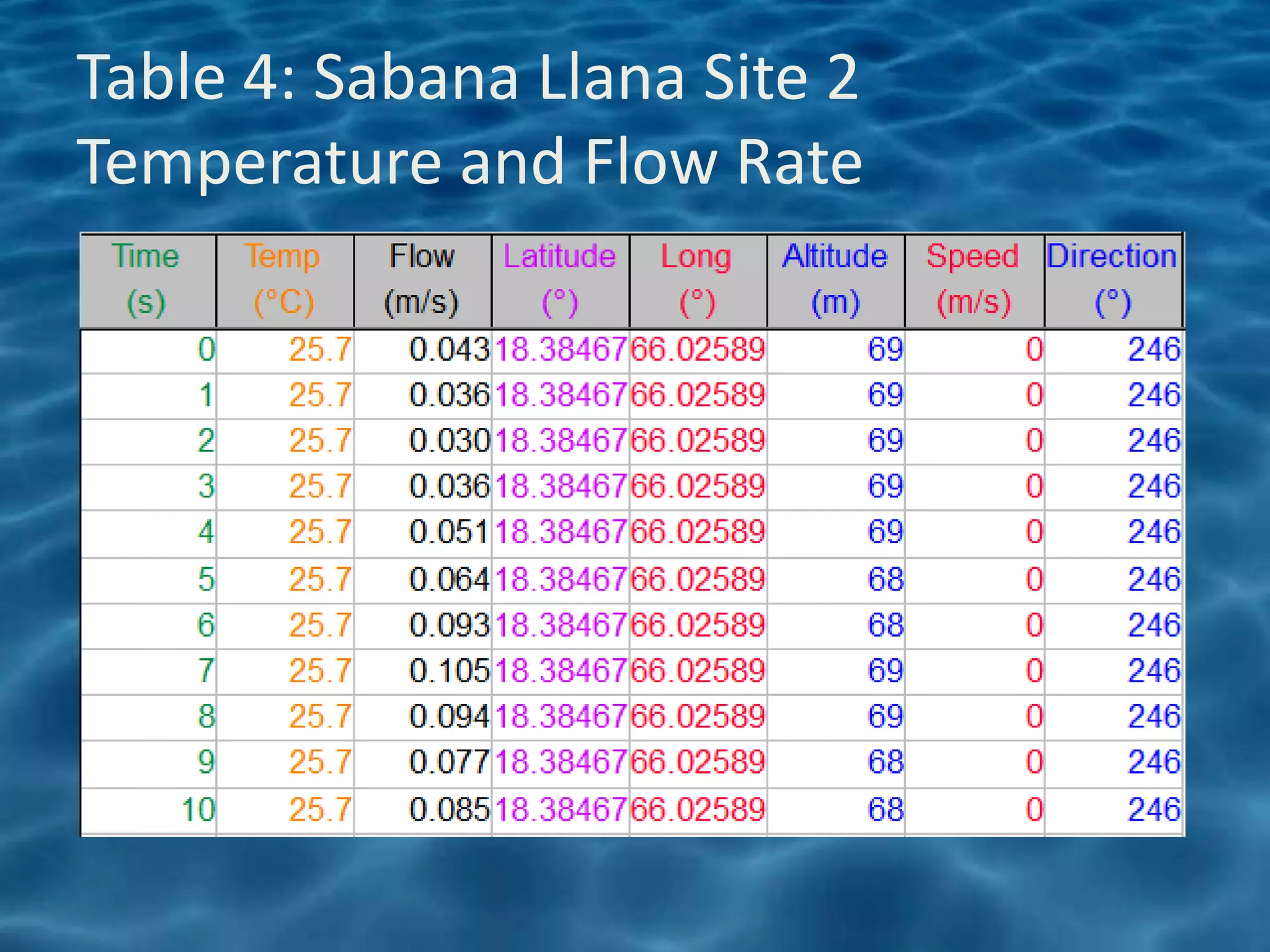
Table 4: Sabana Llana Site 2
Temperature and Flow Rate
Graph 1:
Temperature vs Time
Graph 2:
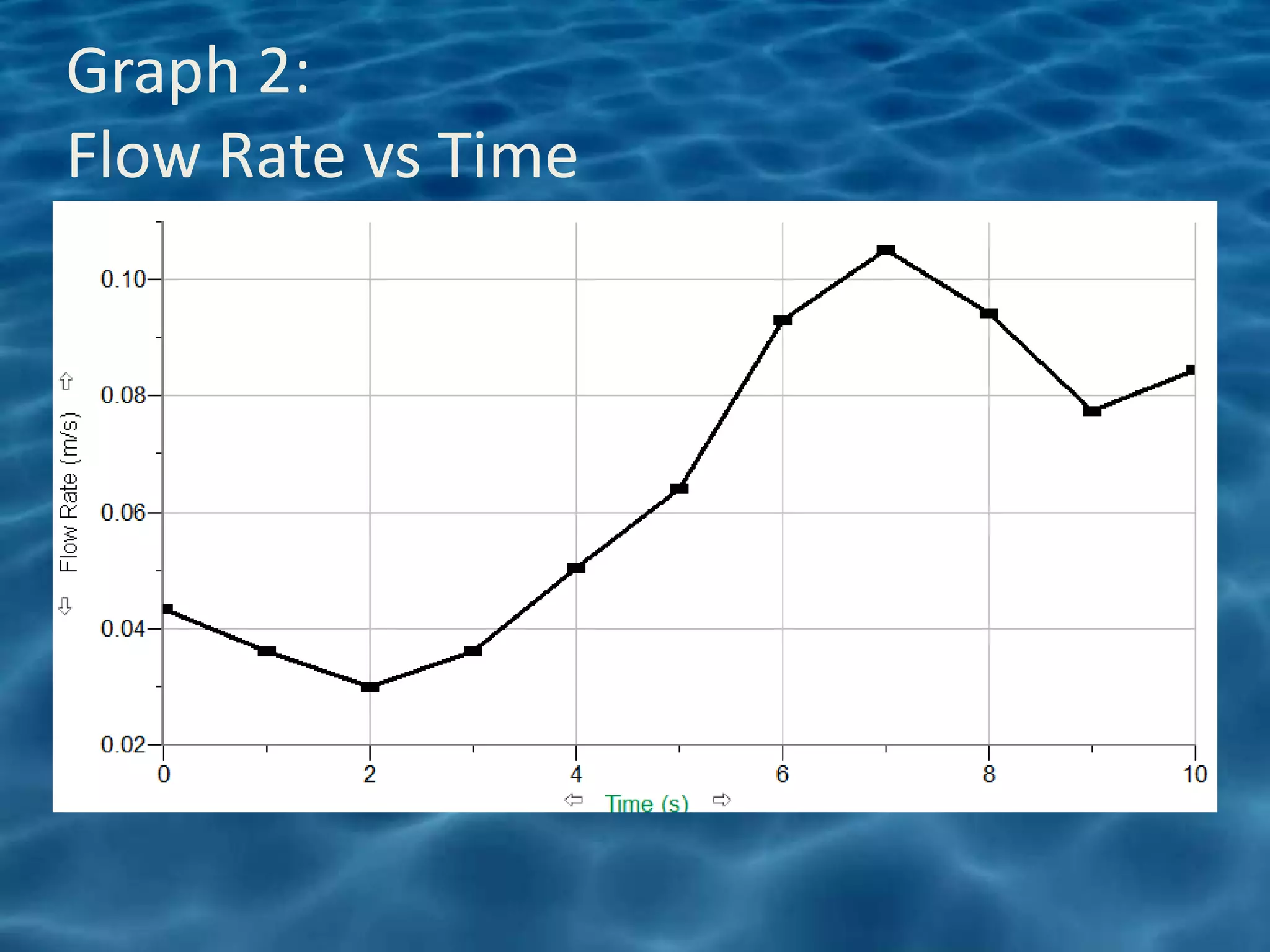
Flow Rate vs Time
Stream Flow
• Stream flow or discharge is the volume of water that moves
  through a specific point in a stream during a given period of
  time.
• Discharge is usually measured in units of cubic feet per
  second (cfs).
• Flow velocity is influenced by the slope of the surrounding
  terrain, the depth of the stream, the width of the stream,
  and the roughness of the substrate or stream bottom.
• The stream flow of this site of the Sabana Llana stream is
  low, 0.064 cfs, because there is not much depth, the stream
  channel is not wide, there are many rocks, and there is no
  slope or inclination.
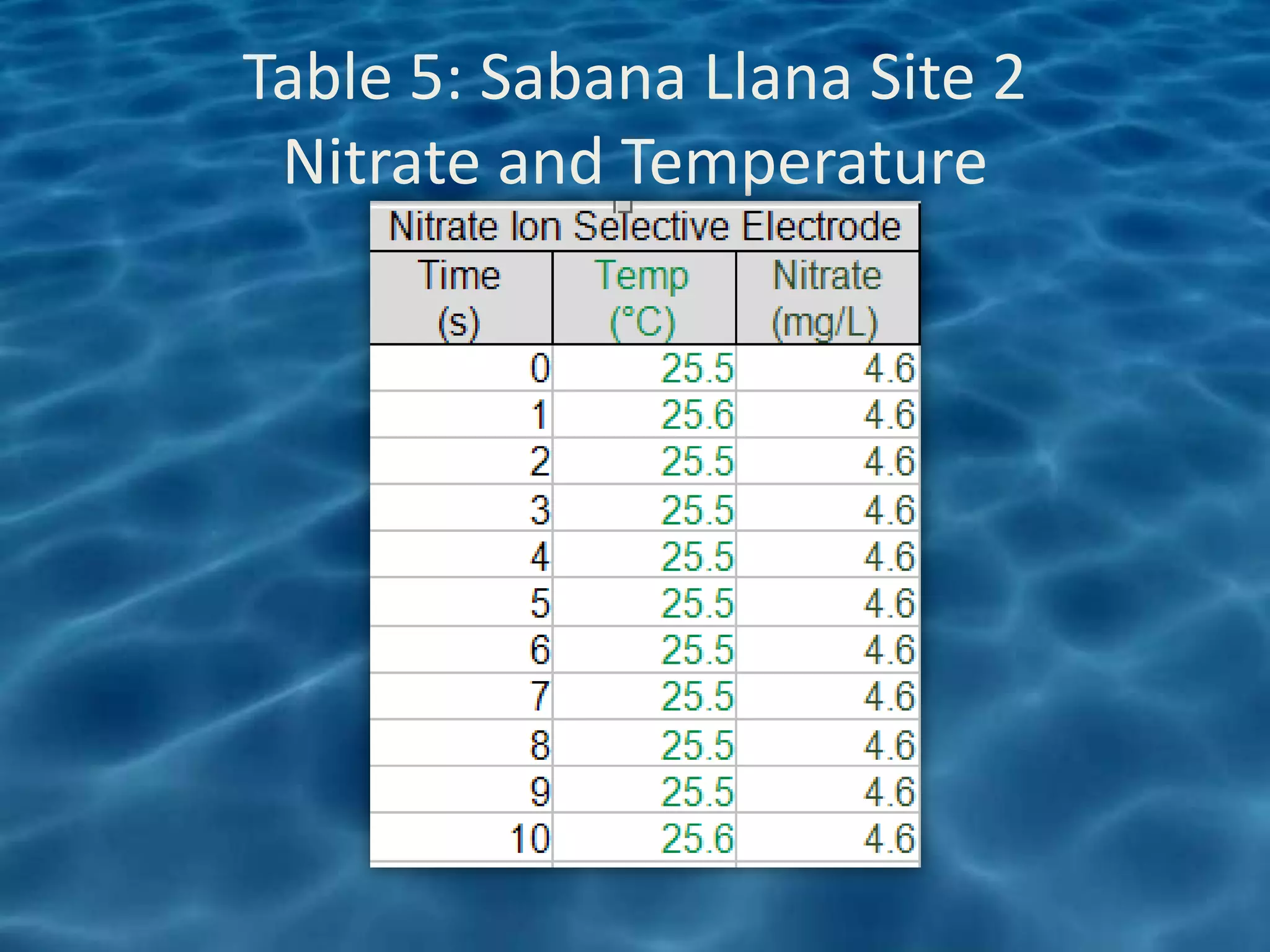
Table 5: Sabana Llana Site 2
 Nitrate and Temperature
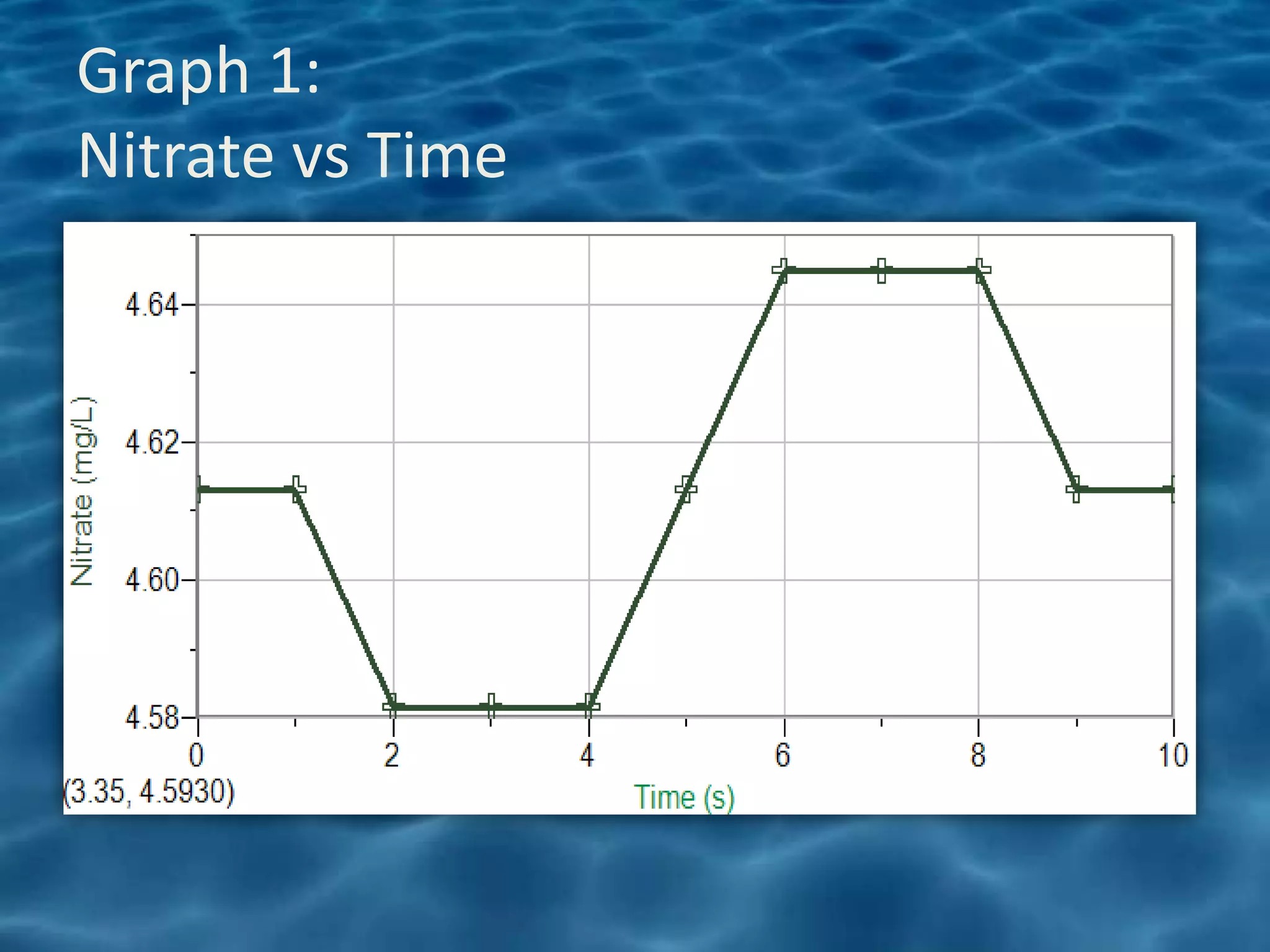
Graph 1:
Nitrate vs Time
Nitrate Ion Selective Electrode
• Nitrate ions found in freshwater samples result from a
  variety of natural and manmade sources.
• Nitrates are an important source of nitrogen necessary for
  plants and animals to synthesize amino acids and proteins.
• Although nitrate levels in freshwater are usually less than 1
  mg/L, manmade sources of nitrate may elevate levels
  above 3 mg/L.
• These sources include animal feedlots, runoff from
  fertilized fields, or treated municipal wastewater being
  returned to streams.
• Levels above 10 mg/L in drinking water can cause a
  potentially fatal disease in infants called
  methemoglobinemia, or Blue-Baby Syndrome.
Nitrate Ion Selective Electrode
• In this disease, nitrate converts hemoglobin into a form that can no
  longer transport oxygen.
• High nitrate concentrations also contribute to a condition in lakes
  and ponds called eutrophication, the excessive growth of aquatic
  plants and algae.
• Unpleasant odor and taste of water, as well as reduced clarity.
• The nitrate level in freshwater is usually found in the range of 0.1 to
  4 mg/L.
• Unpolluted waters generally have nitrate levels below 1 mg/L.
• The average concentration of nitrate ion in this site of the Sabana
  Llana stream is of 4.6 mg/L. This body of water has a high amount
  of nitrate which can’t permits life for many organism.
Graph 2:
Temperature vs Time
Table 6: Sabana Llana Site 2
Ammonium and Temperature
Graph 1:
Ammonium vs Time
Ammonium Ion Selective Electrode
• Some trees and grasses are able to absorb
  ammonium ions directly, but most require
  their conversion to nitrate.
• This process, called nitrification, is usually
  accomplished by bacteria in the soil or water.
• If ammonium nitrogen levels in surface waters
  are too high, they can be toxic to some
  aquatic organisms.
Ammonium Ion Selective Electrode
• Dissolved oxygen levels can also be lowered when
  ammonium nitrogen is high due to the increased
  amount of nitrification occurring.
• Ammonium-nitrogen levels are usually quite low
  in moving surface waters.
• This is because there is little decaying organic
  matter collecting on the bottom.
• If there is a high level of ammonium nitrogen in a
  moving stream, it may be an indication of
  pollution of some kind entering the water.
Ammonium Ion Selective Electrode
• While levels of ammonium nitrogen in drinking
  water should not exceed 0.5 mg/L, streams or
  ponds near heavily fertilized fields may have
  higher concentrations of this ion.
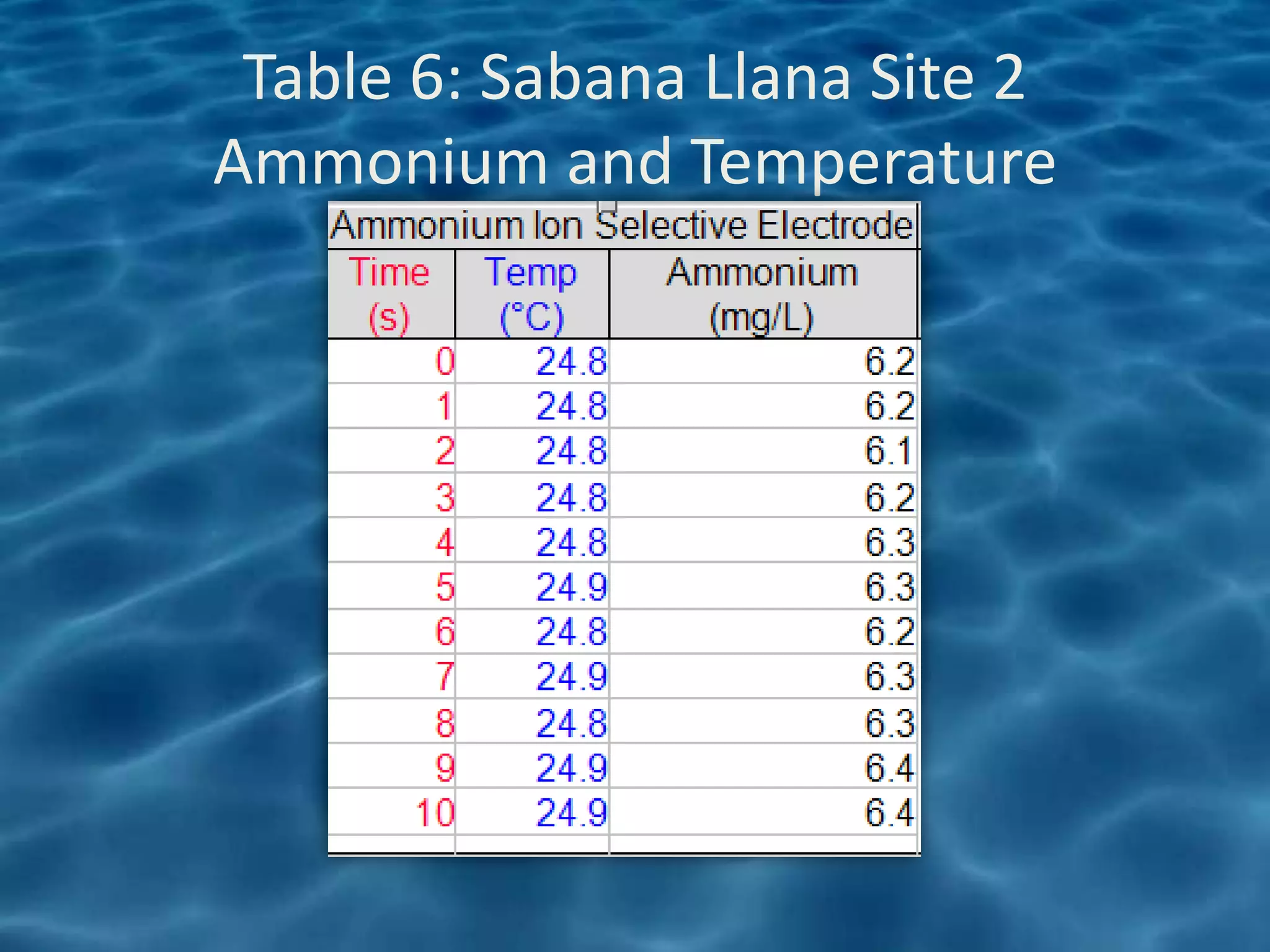
• The average of the concentration of ammonium
  ion in the Sabana Llana stream are 6.29mg/L.
• These amounts of ammonium are above the
  expected values.
• The amount of ammonium in this water isn’t
  accepted for drinking water.
Graph 2:
Temperature vs Time
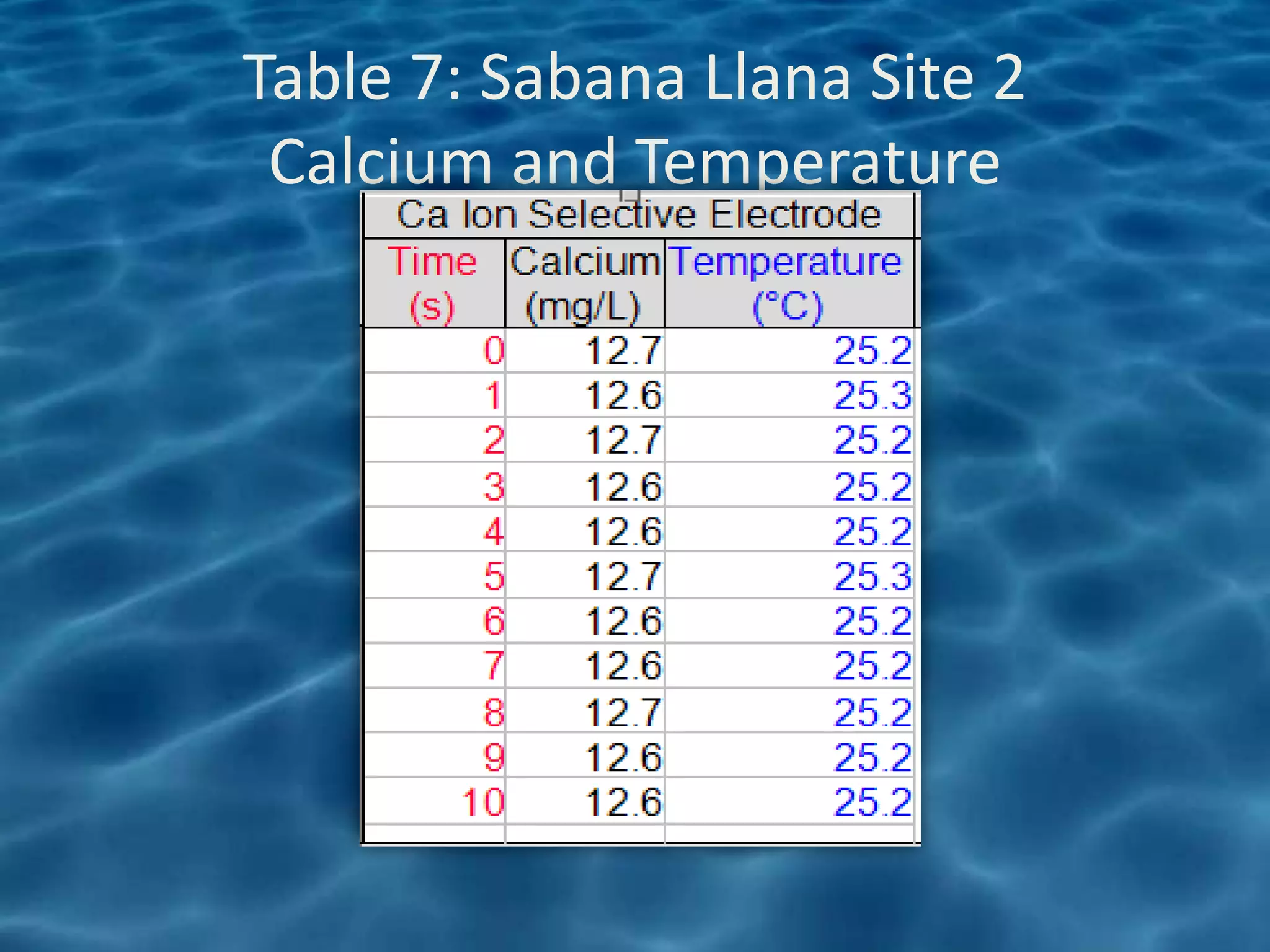
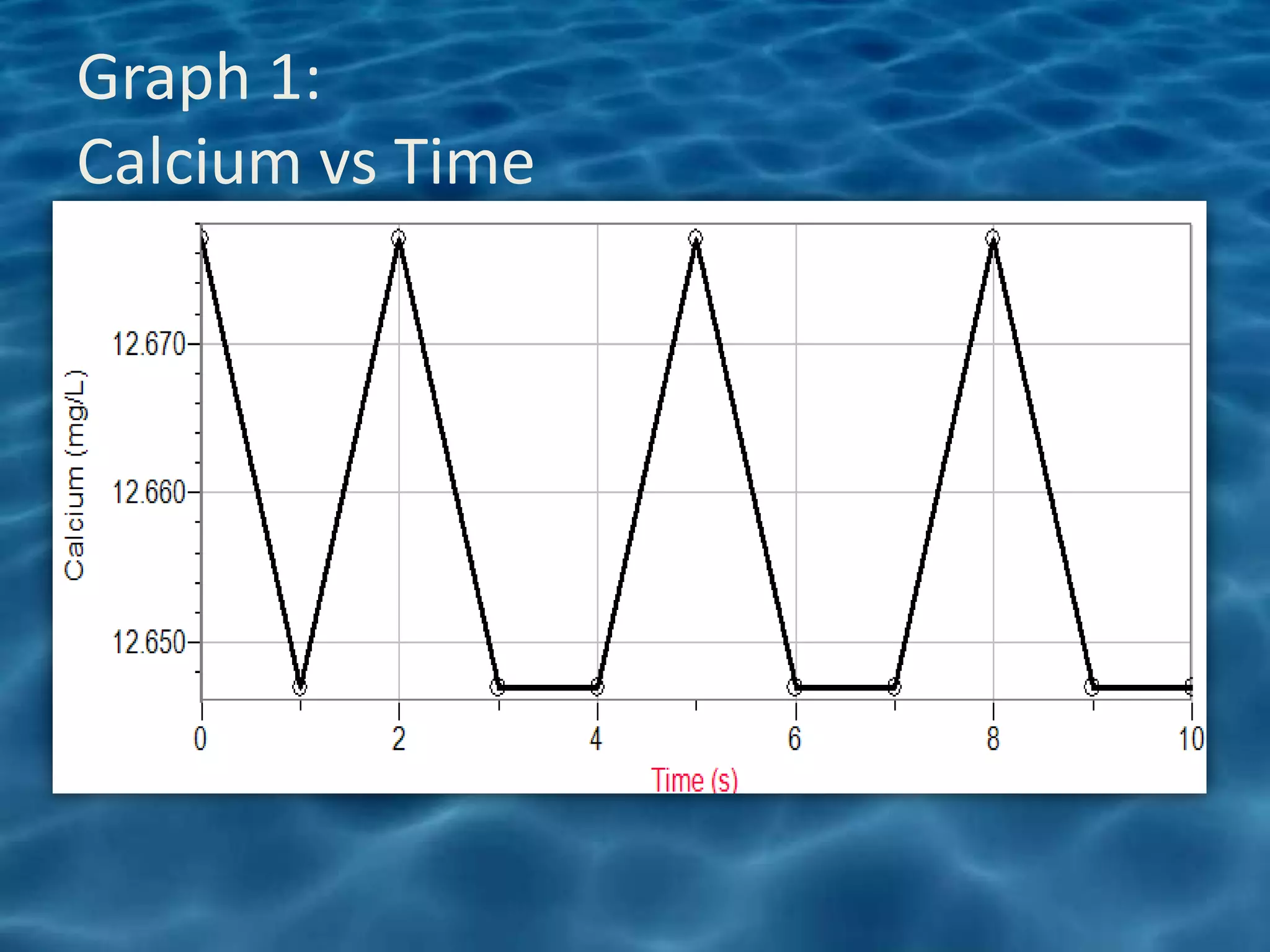
Table 7: Sabana Llana Site 2
 Calcium and Temperature
Graph 1:
Calcium vs Time
Calcium Ion Selective Electrode
• Most calcium in surface water comes from
  streams flowing over limestone, CaCO3, gypsum,
  CaSO4•2H2O, and other calcium-containing rocks
  and minerals.
• The concentration of calcium ions (Ca2+) in
  freshwater is found in a range of 0 to 100 mg/L,
  and usually has the highest concentration of any
  freshwater cation.
• A level of 50 mg/L is recommended as the upper
  limit for drinking water.
Calcium Ion Selective Electrode
• High levels are not considered a health concern;
  however, levels above 50 mg/L can be
  problematic due to formation of excess calcium
  carbonate deposits in plumbing or in decreased
  cleansing action of soaps.
• The concentration of calcium ions (Ca2+) in
• freshwater is found in a range of 4 to 100 mg/L.
• The average concentrations of Calciuim ion of
  this site of the Sabana Llana stream is 12.6 mg/L.
• This amount of calcium is in the expected levels
  for organisms and for drinking water.
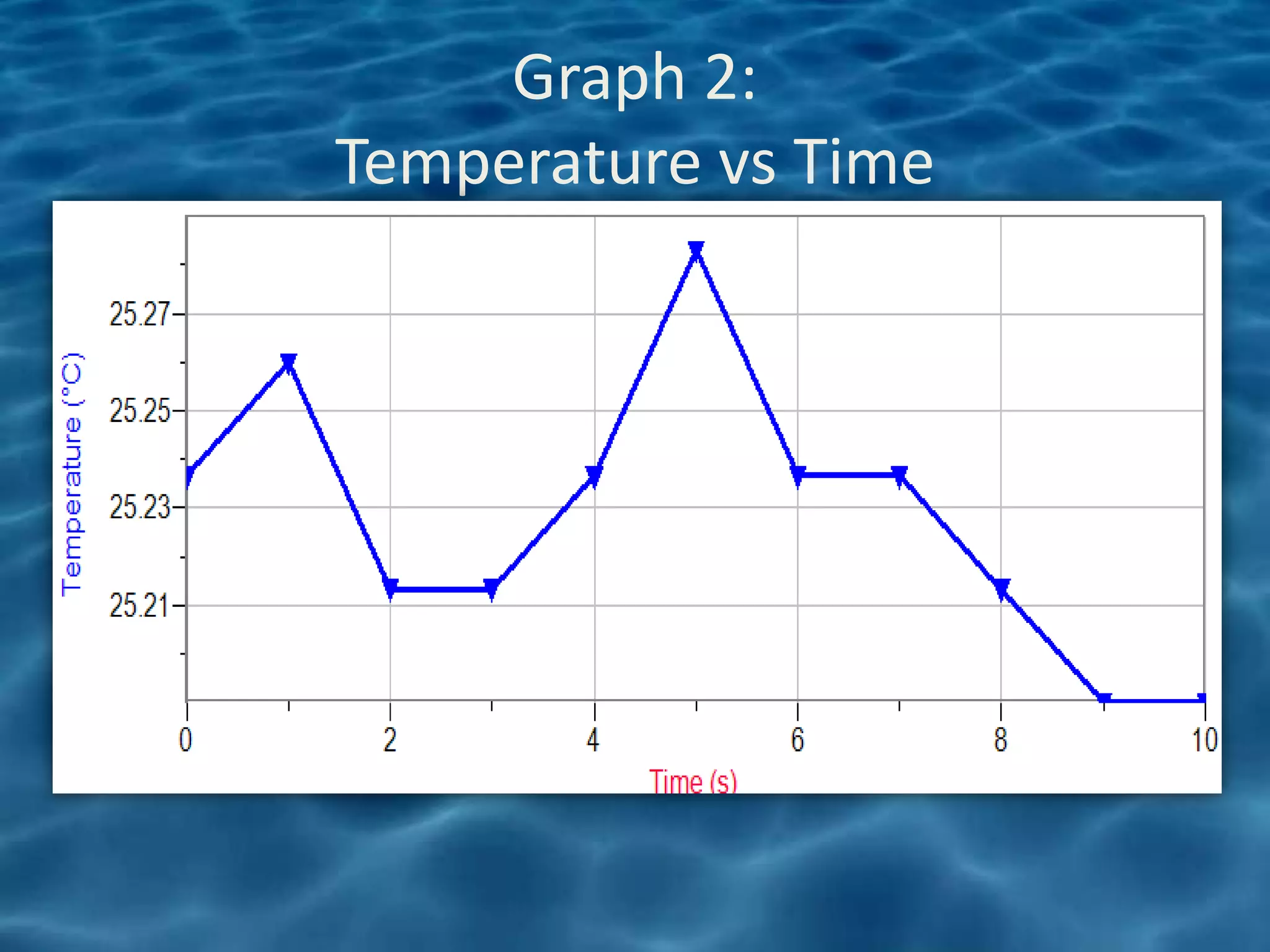
Graph 2:
Temperature vs Time
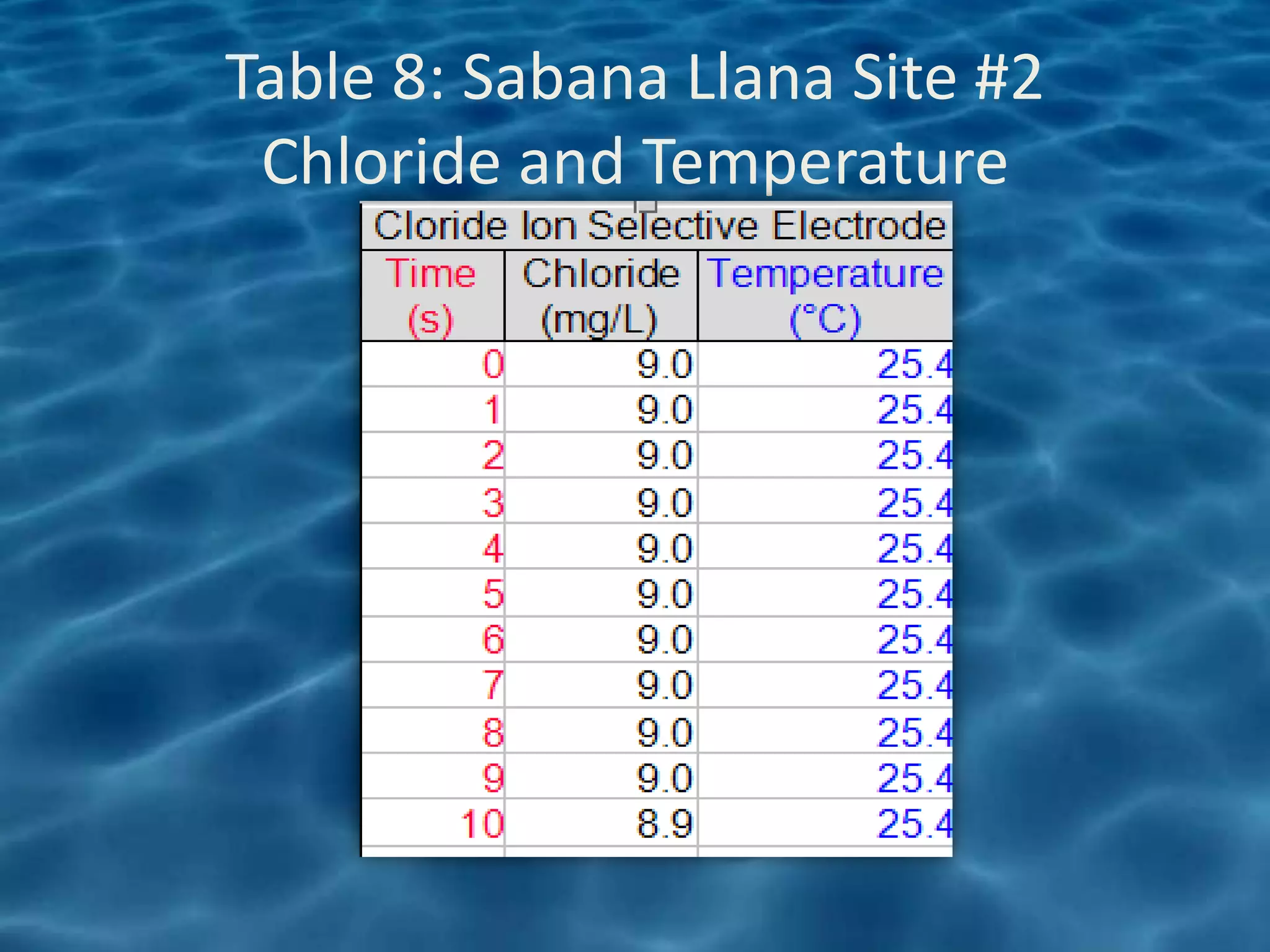
Table 8: Sabana Llana Site #2
 Chloride and Temperature
Graph 1:
Chloride vs Time
Chloride Ion Selective Electrode
• These salts, and their resulting chloride ions, originate
  from natural minerals, saltwater intrusion into
  estuaries, and industrial pollution.
• There are many possible sources of manmade salts
  that may contribute to elevated chloride readings.
• Sodium chloride and calcium chloride, used to salt
  roads, contribute to elevated chloride levels in streams.
• Chlorinated drinking water and sodium-chloride water
  softeners often increase chloride levels in wastewater
  of a community.
Chloride Ion Selective Electrode
• The recommended maximum level of chloride in
  U.S. drinking water is 250 mg/L.
• Even freshwater streams and lakes have a
  significant chloride level that can range from 1
• to 250 mg/L.
• The average concentration of Chloride ion in the
  Sabana Llana stream is 9.0 mg/L.
• This amount of Calcium ion is in the expected
  levels for organisms and drinking water.
• The obtained amount is within the normal levels.
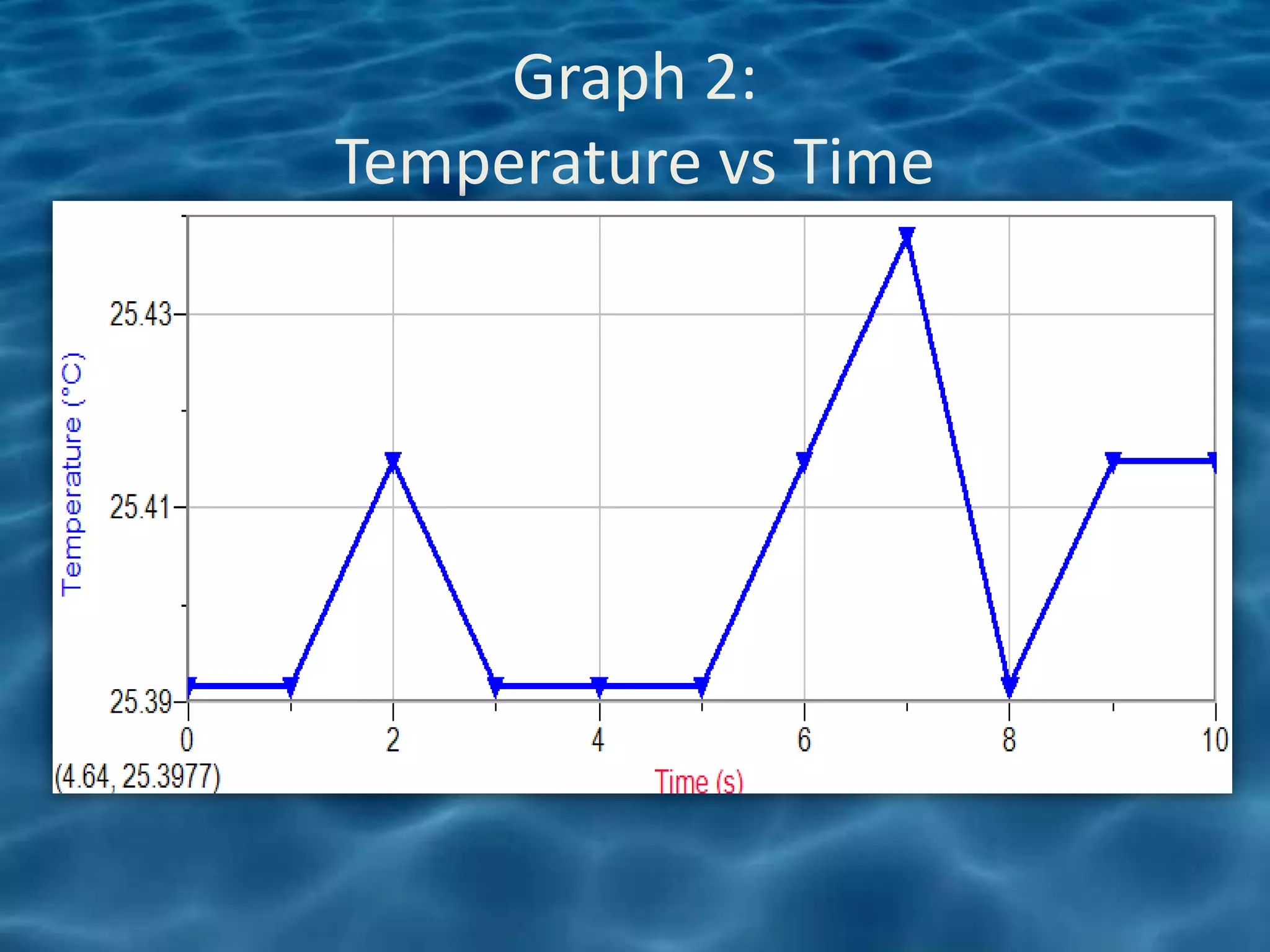
Graph 2:
Temperature vs Time
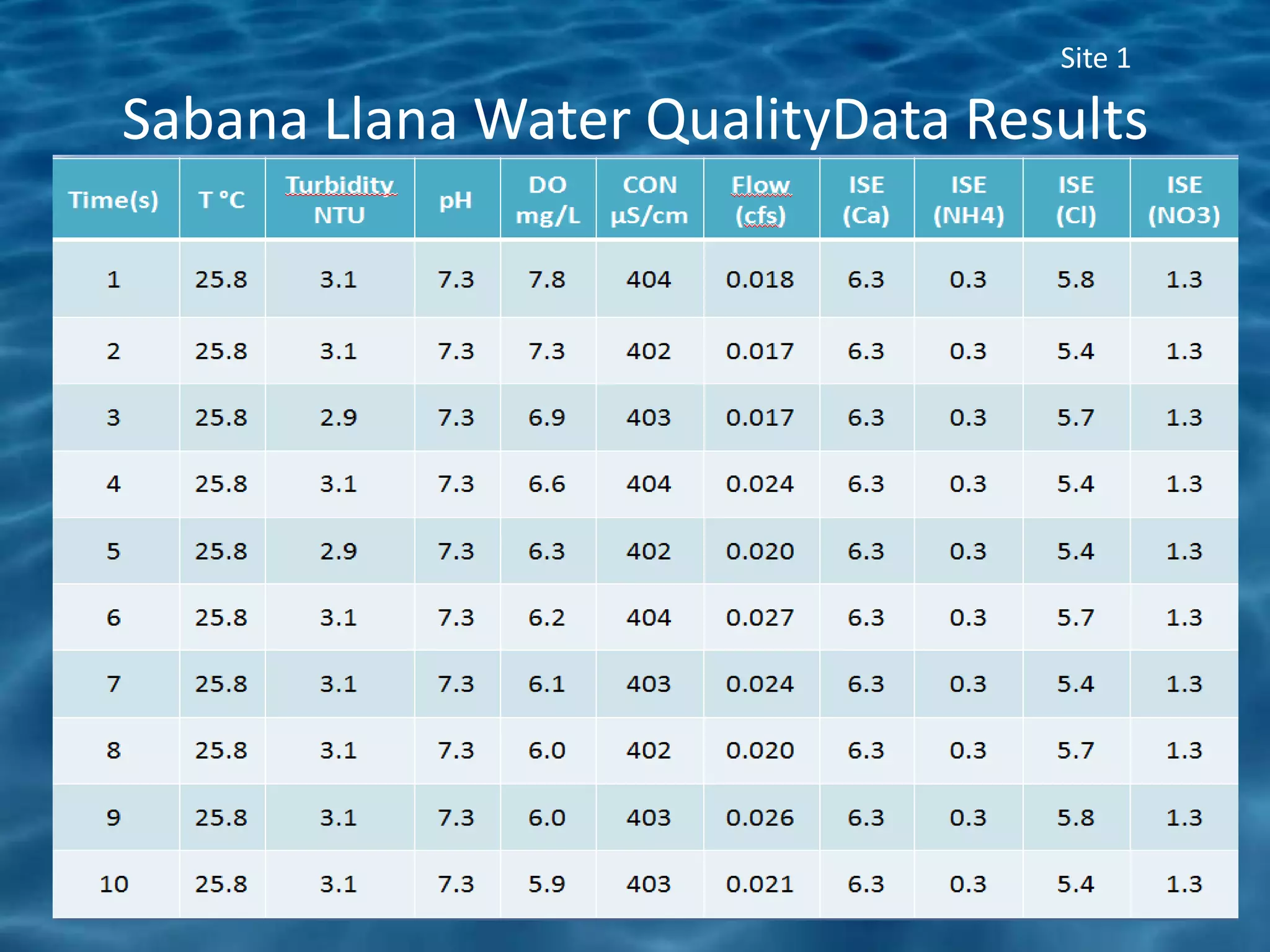
Site 1

Sabana Llana Water QualityData Results
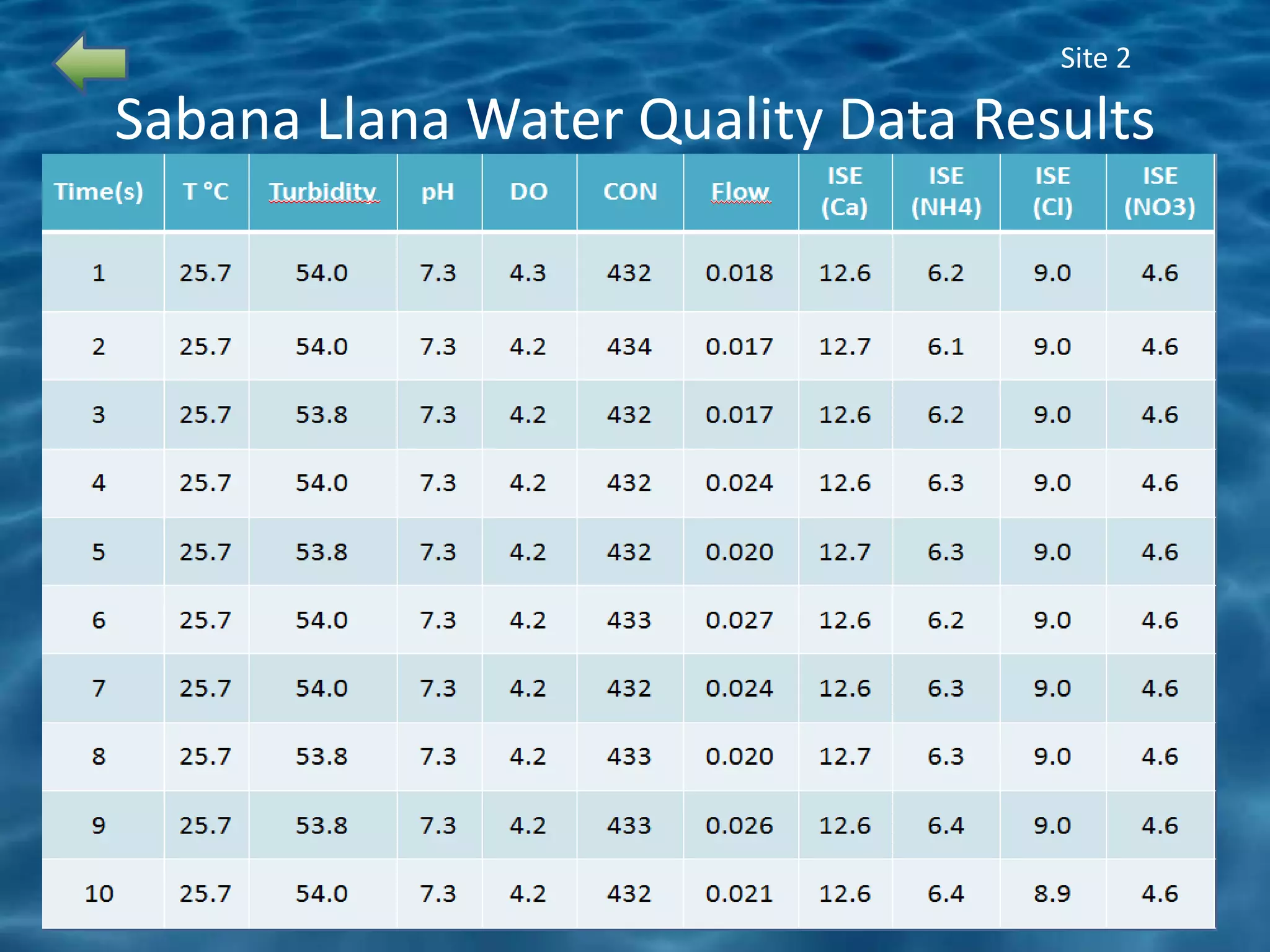
Site 2

Sabana Llana Water Quality Data Results
Planet Guardians
The Green Lanterns
•   Susan Cabello
•   Diva Mockford
•   Bethany Vázquez
•   Laurimar Rosado
•   Juan Corujo
•   Tomás Pérez
Guardians Dreamers
•   Jessmar Matos
•   Angelice Vale
•   Leslie Cabán
•   Marimar Bracero
•   Paola Santos
•   Mariedith Santos
•   Natacha González
Discovery Kids
•   Adriana Álvarez
•   Christian Maldonado
•   Rolando Rivera
•   Jean Paul Heffelfinger
•   Paolah González
•   Gerardo Costas
Green Brains
•   Andrea Sandoval
•   Carlos Colón
•   Edgardo Maldonado
•   Valentina Márquez
•   Valerie Castro
•   Germán Oyola
Natural Beauties
•   Laurimar González
•   Liana Basora
•   Veda Mockford
•   Krystal Flores
•   Beatriz Del Valle
•   Coral Flores
•   Emmanuel Medina

Planet Guardians Presentation

  • 1.
    Planet Guardians Investigación de Calidad de Agua a la Quebrada Sabana Llana http://www.delcarmenverde.blogspot.com/
  • 2.
    • While fora housewife, water contamination can mean bad taste, odor or water cause intestinal diseases, they do not display an industrial or farm. • For industrial water pollution can mean the pipe is affected boiler industry and for a farmer that water contains extraordinary amounts of salt that does not allow its use for irrigation or animal consumption. • The concept of pollution of water is on and is closely related to the proposed use of water.
  • 3.
    • Natural causesof water pollution Volume of water bodies Number of bacteria Organisms living in water Amounts of pollutants •Unnatural causes of pollution Downloads home Industrial discharges Agricultural wastes Sedimentation and erosion
  • 4.
    •Major water pollutants Existing number of coliform bacteria Amount of oxygen dissolved in water Fertilizers and pesticides Pollution by suspended solids metals
  • 5.
    •The multidisciplinary projectWater Cops CL, enable students to explore their own watershed and understand what happens to the flow of water over them, the way in which human activities depend on the river and impact the hydrology, and the way in which the change of land use can affect plant and animal communities that live along it. •This project also seeks to develop technology skills in applications such as Logger Pro and Vernier Software LabQuest, MS Publisher 2007, ArcGIS Explorer, Adobe Premier and Thinkquest.org or Blogger.
  • 6.
    Students will havethe opportunity to develop the following skills XXI century: Communication Technology Creativity Critical Thinking Teamwork
  • 7.
    Essential Question: The percentageof contaminants in urban rivers in the island is of concern. If you were appoint the Secretary of Natural Resources for a certain period of time, how could help improve water quality in urban river basins in PR now and in the future?
  • 8.
    During the developmentof the students will engage in tasks and sub​​-tasks to complete highlights the following products: Science, Mathematics and Technology – Hydrology Data Sheet- MS Word 2007. Science, Mathematics and Technology - Scientific Article - Logger Pro and Vernier LabQuest. Science, Mathematics and Technology - Data Analysis and Results Presentation – MS Power Point 2007
  • 9.
    Geography and Technology- GeoMapping – ArcExplorer English and Technology - Blog – Blogger.com and Thinkquest.org English and Technology - Video Documentary - Adobe Premier
  • 10.
    Data Analysis andResults Natacha Gonzalez Leslie Cabán Angelice Vale Marimar Bracero Gerardo Costa Jessmar Matos Mariedith Santos Paola Soto
  • 11.
    Sabana Llana StreamSite #1 Water Quality Investigation Tables and Graphs
  • 12.
    Table 1:Sabana LlanaSite 1 Temperature, Turbidity and pH
  • 13.
  • 14.
    Water Temperature • Thetemperature of a body of water influences its overall quality. • A change in water temperature can affect the general health of the aquatic organisms, thus changing the quality of the stream. • The temperature measured on Sabana Llana is suitable for small mouth bass and the rest of similar water organism. • The average temperature in this site was 26.5°C.
  • 15.
  • 16.
    Turbidity • Turbidity isa measure of water’s lack of clarity. Water with high turbidity is cloudy, while water with low turbidity is clear. • Many factors can contribute to the turbidity of water. • An increase in stream flow due to heavy rains or a decrease in stream-bank vegetation can speed up the process of soil erosion. • This will add suspended particles, such as clay and silt, to the water.
  • 17.
    Turbidity • According tothe USGS, the turbidity of surface water is usually between 1 NTU and 50 NTU . • Water is visibly turbid at levels above 5 NTU. • The standard for drinking water is 0.5 NTU to 1.0 NTU. • The average turbidity in this site of the Sabana Llana Stream is 45.8 NTU. • The water is visibly turbid and in the standard range. It can’t be used for drinking water.
  • 18.
  • 19.
    Water pH • Watercontains both hydrogen ions, H+, and hydroxide ions, OH–. The relative concentrations of these two ions determine the pH value . • Water with a pH of 7 has equal concentrations of these two ions and is considered to be a neutral solution. • If a solution is acidic, the concentration of H+ ions exceeds that of the OH– ions. In a basic solution, the concentration of OH– ions exceeds that of the H+ ions. • On a pH scale of 0 to 14, a value of 0 is the most acidic, and 14 the most basic. A change from pH 7 to pH 8 in a lake or stream represents a ten-fold increase in the OH– ion concentration. • The average pH of the Sabana Llana stream is 8.2. The water is optimal for most organisms. The ph level is acceptable for most drinking water standards.
  • 20.
    Table 2: SabanaLlana Site 1 Temperature and Conductivity
  • 21.
  • 22.
  • 23.
    Conductivity • Solids arefound in streams in two forms, suspended and dissolved. • Suspended solids include silt, stirred-up bottom sediment, decaying plant matter, or sewage-treatment effluent. • Total dissolved solids, or TDS, can be determined usinig a Vernier Conductivity Probe to determine the ability of the dissolved salts and their resulting ions in an unfiltered sample to conduct an electrical current. • The conductivity is then converted to TDS. • Either of these methods yields a TDS value in units of mg/L. • There are many possible manmade sources of ions that may contribute to elevated TDS readings.
  • 24.
    Conductivity • Fertilizers fromfields and lawns can add a variety of ions to a stream. • Increases in TDS can also result from runoff from roads that have been salted in the winter. • Organic matter from wastewater treatment plants may contribute higher levels of nitrate or phosphate ions. • Treated wastewater may also have higher TDS readings than surrounding streams if urban drinking water has been highly chlorinated.
  • 25.
    Conductivity • Irrigation waterthat is returned to a stream will often have higher concentrations of sodium or chloride ions. • Acidic rainwater, with dissolved gases like CO2, NO2, or SO2, often yields elevated H+ ion • concentrations. • TDS values in lakes and streams are typically found to be in the range of 50 to 250 mg/L Drinking water will tend to be 25 to 500 mg/L TDS. • The average conductivity of the Sabana Llana Stream is 403 μS/cm. • There is little amount of metals because the standard levels of conductivity are low.
  • 26.
    Table 3: SabanaLlana Site 1 Temperature and DO
  • 27.
  • 28.
  • 29.
    Dissolved Oxygen • Description:Trout and small bass can’t live with this amount of dissolved oxygen found in this site of the Sabana Llana stream. • Oxygen gas dissolved in water is vital to the existence of most aquatic organisms. • Oxygen is a key component in cellular respiration for both aquatic and terrestrial life. • Dissolved oxygen concentrations can range from 0 to 15 mg/L. The average • DO of this site of the Sabana Llana stream is 5.9 mg/L under the expected values. • Some organisms like Mosquito larvae, Carp, Catfish, May fly larvae, Caddis fly larvae can live in this amount of DO.
  • 30.
    Table 4: SabanaLlana Site 1 Temperature and Flow Rate
  • 31.
  • 32.
    Stream Flow • Description:Stream flow or discharge is the volume of water that moves through a specific point in a stream during a given period of time. • Discharge is usually measured in units of cubic feet per second (cfs). • Flow velocity is influenced by the slope of the surrounding terrain, the depth of the stream, the width of the stream, and the roughness of the substrate or stream bottom. • The stream flow of this site of the Sabana Llana stream is low, 0.034cfs, because there is not much depth, the stream channel is not wide, there are many rocks, and there is no slope or inclination.
  • 33.
  • 34.
    Table 5: SabanaLlana Site 1 Nitrate and Temperature
  • 35.
  • 36.
    Nitrate Ion SelectiveElectrode • Nitrate ions found in freshwater samples result from a variety of natural and manmade sources. • Nitrates are an important source of nitrogen necessary for plants and animals to synthesize amino acids and proteins. • Although nitrate levels in freshwater are usually • less than 1 mg/L, manmade sources of nitrate may elevate levels above 3 mg/L. • These sources include animal feedlots, runoff from fertilized fields, or treated municipal wastewater being returned to streams Levels above 10 mg/L in drinking water can cause a potentially fatal disease in infants called methemoglobinemia, or Blue-Baby Syndrome.
  • 37.
    Nitrate Ion SelectiveElectrode • In this disease, nitrate converts hemoglobin into a form that can no longer transport oxygen. • High nitrate concentrations also contribute to a condition in lakes and ponds called eutrophication, the excessive growth of aquatic plants and algae. • Unpleasant odor and taste of water, as well asreduced clarity. • The nitrate level in freshwater is usually found in the range of 0.1 to 4 mg/L NO3–-N. • Unpolluted waters generally have nitrate levels below 1 mg/L . • This body of water has a low amount of nitrate, 1.3 mg/L, which permits life.
  • 38.
  • 39.
    Table 6: SabanaLlana Site 1 Ammonium and Temperature
  • 40.
  • 41.
    Ammonium Ion SelectiveElectrode • Some trees and grasses are able to absorb ammonium ions directly, but most require their conversion to nitrate. • This process, called nitrification, is usually accomplished by bacteria in the soil or water. • If ammonium nitrogen levels in surface waters are too high, they can be toxic to some aquatic organisms.
  • 42.
    Ammonium Ion SelectiveElectrode • Dissolved oxygen levels can also be lowered when ammonium nitrogen is high due to the increased amount of nitrification occurring. • Ammonium-nitrogen levels are usually quite low in moving surface waters. • This is because there is little decaying organic matter collecting on the bottom. • If there is a high level of ammonium nitrogen in a moving stream, it may be an indication of pollution of some kind entering the water.
  • 43.
    Ammonium Ion SelectiveElectrode • While levels of ammonium nitrogen in drinking water should not exceed 0.5 mg/L, streams or ponds near heavily fertilized fields may have higher concentrations of this ion. • These amounts of ammonium are low, 0.3 mg/L, because the water flows in this body of water . • The amount of ammonium in this water is accepted for drinking water.
  • 44.
  • 45.
    Table 7: SabanaLlana Site 1 Calcium and Temperature
  • 46.
  • 47.
    Calcium Ion SelectiveElectrode: • Most calcium in surface water comes from streams flowing over limestone, CaCO3, gypsum, CaSO4•2H2O, and other calcium-containing rocks and minerals. • The concentration of calcium ions (Ca2+) in freshwater is found in a range of 0 to 100 mg/L, and usually has the highest concentration of any freshwater cation. • A level of 50 mg/L is recommended as the upper limit for drinking water.
  • 48.
    Calcium Ion SelectiveElectrode: • High levels are not considered a health concern; however, levels above 50 mg/L can be problematic due to formation of excess calcium carbonate deposits in plumbing or in decreased cleansing action of soaps. • The concentration of calcium ions (Ca2+) in freshwater is found in a range of 4 to 100 mg/L. • The average concentrations of Calciuim ion of this site of the Sabana Llana stream is 6.3 mg/L. • This amount of calcium is in the expected levels for organisms and for drinking water.
  • 49.
  • 50.
    Tabla 8: SabanaLlana Site 1 Chloride and Temperature
  • 51.
  • 52.
    Chloride Ion SelectiveElectrode • These salts, and their resulting chloride ions, originate from natural minerals, saltwater intrusion into estuaries, and industrial pollution. • There are many possible sources of • manmade salts that may contribute to elevated chloride readings. • Sodium chloride and calcium chloride, used to salt roads, contribute to elevated chloride levels in streams.
  • 53.
    Chloride Ion SelectiveElectrode • Chlorinated drinking water and sodium-chloride water softeners often increase chloride levels in wastewater of a community. • The recommended maximum level of chloride in U.S. drinking water is 250 mg/L. • Even freshwater streams and lakes have a significant chloride level that can range from 1 to 250 mg/L. • The average concentration of Chloride ion in the Sabana Llana stream is 5.5mg/L. • This amount of Calcium ion is in the expected levels for organisms and drinking water. The obtained amount is within the normal levels.
  • 54.
  • 55.
    Sabana Llana StreamSite #2 Water Quality Investigation Tables and Graphs
  • 56.
    Table 1: SabanaLlana Site 2 Temperature, pH and Turbidity
  • 57.
  • 58.
    Water Temperature • Thetemperature of a body of water influences its overall quality. • A change in water temperature can affect the general health of the aquatic organisms, thus changing the quality of the stream. • The temperature measured on Sabana Llana is suitable for small mouth bass and the rest of similar water organism. • The average temperature in this site was 25.7°C.
  • 59.
  • 60.
    Water pH • Watercontains both hydrogen ions, H+, and hydroxide ions, OH–. • The relative concentrations of these two ions determine the pH value . • Water with a pH of 7 has equal concentrations of these two ions and is considered to be a neutral solution. • If a solution is acidic, the concentration of H+ ions exceeds that of the OH– ions. • In a basic solution, the concentration of OH– ions exceeds that of the H+ ions.
  • 61.
    Water pH • Ona pH scale of 0 to 14, a value of 0 is the most acidic, and 14 the most basic. • A change from pH 7 to pH 8 in a lake or stream represents a ten-fold increase in the OH– ion concentration. • The average pH of the Sabana Llana stream is 7.4. • The water is optimal for most organisms. • The ph level is acceptable for most drinking water standards.
  • 62.
  • 63.
    Turbidity • Turbidity isa measure of water’s lack of clarity. • Water with high turbidity is cloudy, while water with low turbidity is clear. • The cloudiness is produced by light reflecting off of particles in the water; therefore, the more particles in the water, the higher the turbidity. • Many factors can contribute to the turbidity of water. • An increase in stream flow due to heavy rains or a decrease in stream-bank vegetation can speed up the process of soil erosion.
  • 64.
    Turbidity • This willadd suspended particles, such as clay and silt, to the water. • According to the USGS, the turbidity of surface water is usually between 1 NTU and 50 NTU . • Water is visibly turbid at levels above 5 NTU. • The standard for drinking water is 0.5 NTU to 1.0 NTU. • The average turbidity in this site of the Sabana Llana Stream is 55.4 NTU. The water is visibly turbid and in the standard range.
  • 65.
    Table 2: SabanaLlana Site 2 Temperature and DO
  • 66.
  • 67.
  • 68.
    Dissolved Oxygen • Troutand small bass can’t live with this amount of dissolved oxygen found in this site of the Sabana Llana stream. • Oxygen gas dissolved in water is vital to the existence of most aquatic organisms. • Oxygen is a key component in cellular respiration for both aquatic and terrestrial life.
  • 69.
    Dissolved Oxygen • Dissolvedoxygen concentrations can range from 0 to 15 mg/L. • The average DO of this site of the Sabana Llana stream is 4.3 mg/L under the expected values. • Some organisms like Mosquito larvae, Carp, Catfish, May fly larvae, Caddis fly larvae can live in this amount of DO.
  • 70.
    Table 3: SabanaLlana Site 2 Temperature and Conductivity
  • 71.
  • 72.
  • 73.
    Conductivity • Solids arefound in streams in two forms, suspended and dissolved. • Suspended solids include silt, stirred-up bottom sediment, decaying plant matter, or sewage-treatment effluent. • Total dissolved solids, or TDS, can be determined usinig a Vernier Conductivity Probe to determine the ability of the dissolved salts and their resulting ions in an unfiltered sample to conduct an electrical current. • The conductivity is then converted to TDS. • Either of these methods yields a TDS value in units of mg/L.
  • 74.
    Conductivity • There aremany possible manmade sources of • ions that may contribute to elevated TDS readings. Fertilizers from fields and lawns can add a • variety of ions to a stream. Increases in TDS can also result from runoff from roads that have • been salted in the winter. Organic matter from wastewater treatment plants may contribute • higher levels of nitrate or phosphate ions. Treated wastewater may also have higher TDS • readings than surrounding streams if urban drinking water has been highly chlorinated.
  • 75.
    Conductivity • Irrigation waterthat is returned to a stream will often have higher concentrations of sodium or chloride ions. • Acidic rainwater, with dissolved gases like CO2, NO2, or SO2, often yields elevated H+ ion concentrations. • TDS values in lakes and streams are typically found to be in the range of 50 to 250 mg/L. • Drinking water will tend to be 25 to 500 mg/L TDS. • The average conductivity of the Sabana Llana Stream is 432 μS/cm. • There is a considerably amount of suspended solids because the levels of TDS are very near to the max level.
  • 76.
    Table 4: SabanaLlana Site 2 Temperature and Flow Rate
  • 77.
  • 78.
  • 79.
    Stream Flow • Streamflow or discharge is the volume of water that moves through a specific point in a stream during a given period of time. • Discharge is usually measured in units of cubic feet per second (cfs). • Flow velocity is influenced by the slope of the surrounding terrain, the depth of the stream, the width of the stream, and the roughness of the substrate or stream bottom. • The stream flow of this site of the Sabana Llana stream is low, 0.064 cfs, because there is not much depth, the stream channel is not wide, there are many rocks, and there is no slope or inclination.
  • 80.
    Table 5: SabanaLlana Site 2 Nitrate and Temperature
  • 81.
  • 82.
    Nitrate Ion SelectiveElectrode • Nitrate ions found in freshwater samples result from a variety of natural and manmade sources. • Nitrates are an important source of nitrogen necessary for plants and animals to synthesize amino acids and proteins. • Although nitrate levels in freshwater are usually less than 1 mg/L, manmade sources of nitrate may elevate levels above 3 mg/L. • These sources include animal feedlots, runoff from fertilized fields, or treated municipal wastewater being returned to streams. • Levels above 10 mg/L in drinking water can cause a potentially fatal disease in infants called methemoglobinemia, or Blue-Baby Syndrome.
  • 83.
    Nitrate Ion SelectiveElectrode • In this disease, nitrate converts hemoglobin into a form that can no longer transport oxygen. • High nitrate concentrations also contribute to a condition in lakes and ponds called eutrophication, the excessive growth of aquatic plants and algae. • Unpleasant odor and taste of water, as well as reduced clarity. • The nitrate level in freshwater is usually found in the range of 0.1 to 4 mg/L. • Unpolluted waters generally have nitrate levels below 1 mg/L. • The average concentration of nitrate ion in this site of the Sabana Llana stream is of 4.6 mg/L. This body of water has a high amount of nitrate which can’t permits life for many organism.
  • 84.
  • 85.
    Table 6: SabanaLlana Site 2 Ammonium and Temperature
  • 86.
  • 87.
    Ammonium Ion SelectiveElectrode • Some trees and grasses are able to absorb ammonium ions directly, but most require their conversion to nitrate. • This process, called nitrification, is usually accomplished by bacteria in the soil or water. • If ammonium nitrogen levels in surface waters are too high, they can be toxic to some aquatic organisms.
  • 88.
    Ammonium Ion SelectiveElectrode • Dissolved oxygen levels can also be lowered when ammonium nitrogen is high due to the increased amount of nitrification occurring. • Ammonium-nitrogen levels are usually quite low in moving surface waters. • This is because there is little decaying organic matter collecting on the bottom. • If there is a high level of ammonium nitrogen in a moving stream, it may be an indication of pollution of some kind entering the water.
  • 89.
    Ammonium Ion SelectiveElectrode • While levels of ammonium nitrogen in drinking water should not exceed 0.5 mg/L, streams or ponds near heavily fertilized fields may have higher concentrations of this ion. • The average of the concentration of ammonium ion in the Sabana Llana stream are 6.29mg/L. • These amounts of ammonium are above the expected values. • The amount of ammonium in this water isn’t accepted for drinking water.
  • 90.
  • 91.
    Table 7: SabanaLlana Site 2 Calcium and Temperature
  • 92.
  • 93.
    Calcium Ion SelectiveElectrode • Most calcium in surface water comes from streams flowing over limestone, CaCO3, gypsum, CaSO4•2H2O, and other calcium-containing rocks and minerals. • The concentration of calcium ions (Ca2+) in freshwater is found in a range of 0 to 100 mg/L, and usually has the highest concentration of any freshwater cation. • A level of 50 mg/L is recommended as the upper limit for drinking water.
  • 94.
    Calcium Ion SelectiveElectrode • High levels are not considered a health concern; however, levels above 50 mg/L can be problematic due to formation of excess calcium carbonate deposits in plumbing or in decreased cleansing action of soaps. • The concentration of calcium ions (Ca2+) in • freshwater is found in a range of 4 to 100 mg/L. • The average concentrations of Calciuim ion of this site of the Sabana Llana stream is 12.6 mg/L. • This amount of calcium is in the expected levels for organisms and for drinking water.
  • 95.
  • 96.
    Table 8: SabanaLlana Site #2 Chloride and Temperature
  • 97.
  • 98.
    Chloride Ion SelectiveElectrode • These salts, and their resulting chloride ions, originate from natural minerals, saltwater intrusion into estuaries, and industrial pollution. • There are many possible sources of manmade salts that may contribute to elevated chloride readings. • Sodium chloride and calcium chloride, used to salt roads, contribute to elevated chloride levels in streams. • Chlorinated drinking water and sodium-chloride water softeners often increase chloride levels in wastewater of a community.
  • 99.
    Chloride Ion SelectiveElectrode • The recommended maximum level of chloride in U.S. drinking water is 250 mg/L. • Even freshwater streams and lakes have a significant chloride level that can range from 1 • to 250 mg/L. • The average concentration of Chloride ion in the Sabana Llana stream is 9.0 mg/L. • This amount of Calcium ion is in the expected levels for organisms and drinking water. • The obtained amount is within the normal levels.
  • 100.
  • 101.
    Site 1 Sabana LlanaWater QualityData Results
  • 102.
    Site 2 Sabana LlanaWater Quality Data Results
  • 103.
  • 104.
    The Green Lanterns • Susan Cabello • Diva Mockford • Bethany Vázquez • Laurimar Rosado • Juan Corujo • Tomás Pérez
  • 105.
    Guardians Dreamers • Jessmar Matos • Angelice Vale • Leslie Cabán • Marimar Bracero • Paola Santos • Mariedith Santos • Natacha González
  • 106.
    Discovery Kids • Adriana Álvarez • Christian Maldonado • Rolando Rivera • Jean Paul Heffelfinger • Paolah González • Gerardo Costas
  • 107.
    Green Brains • Andrea Sandoval • Carlos Colón • Edgardo Maldonado • Valentina Márquez • Valerie Castro • Germán Oyola
  • 108.
    Natural Beauties • Laurimar González • Liana Basora • Veda Mockford • Krystal Flores • Beatriz Del Valle • Coral Flores • Emmanuel Medina