Modal Verbs

     AITOR SÁNCHEZ ABELLÁN
    DAVID SÁNCHEZ GONZÁLEZ


Revised, Corrected, and completed by Nur Garriga
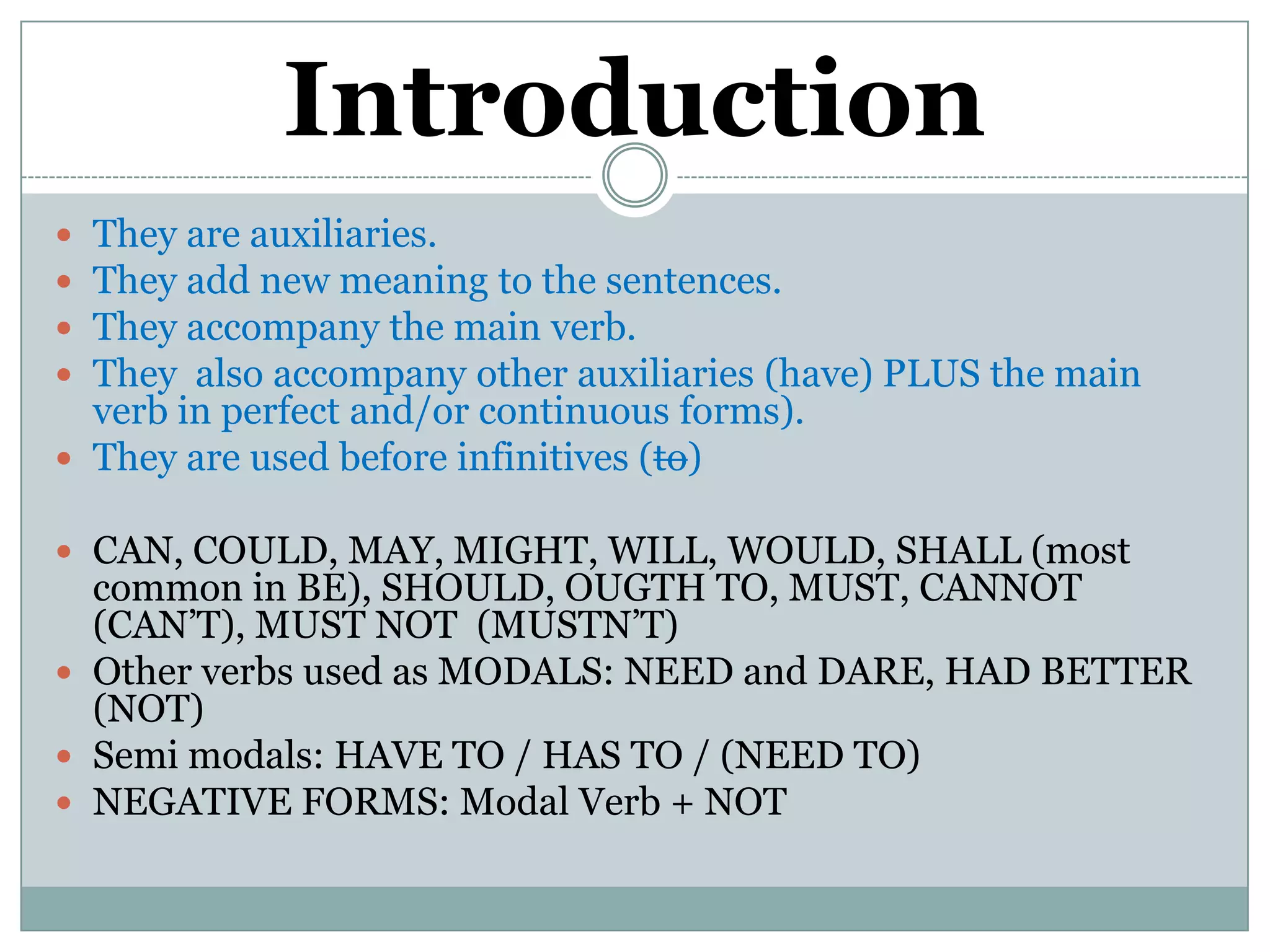
Introduction
 They are auxiliaries.
 They add new meaning to the sentences.
 They accompany the main verb.
 They also accompany other auxiliaries (have) PLUS the main
  verb in perfect and/or continuous forms).
 They are used before infinitives (to)

 CAN, COULD, MAY, MIGHT, WILL, WOULD, SHALL (most
  common in BE), SHOULD, OUGTH TO, MUST, CANNOT
  (CAN’T), MUST NOT (MUSTN’T)
 Other verbs used as MODALS: NEED and DARE, HAD BETTER
  (NOT)
 Semi modals: HAVE TO / HAS TO / (NEED TO)
 NEGATIVE FORMS: Modal Verb + NOT
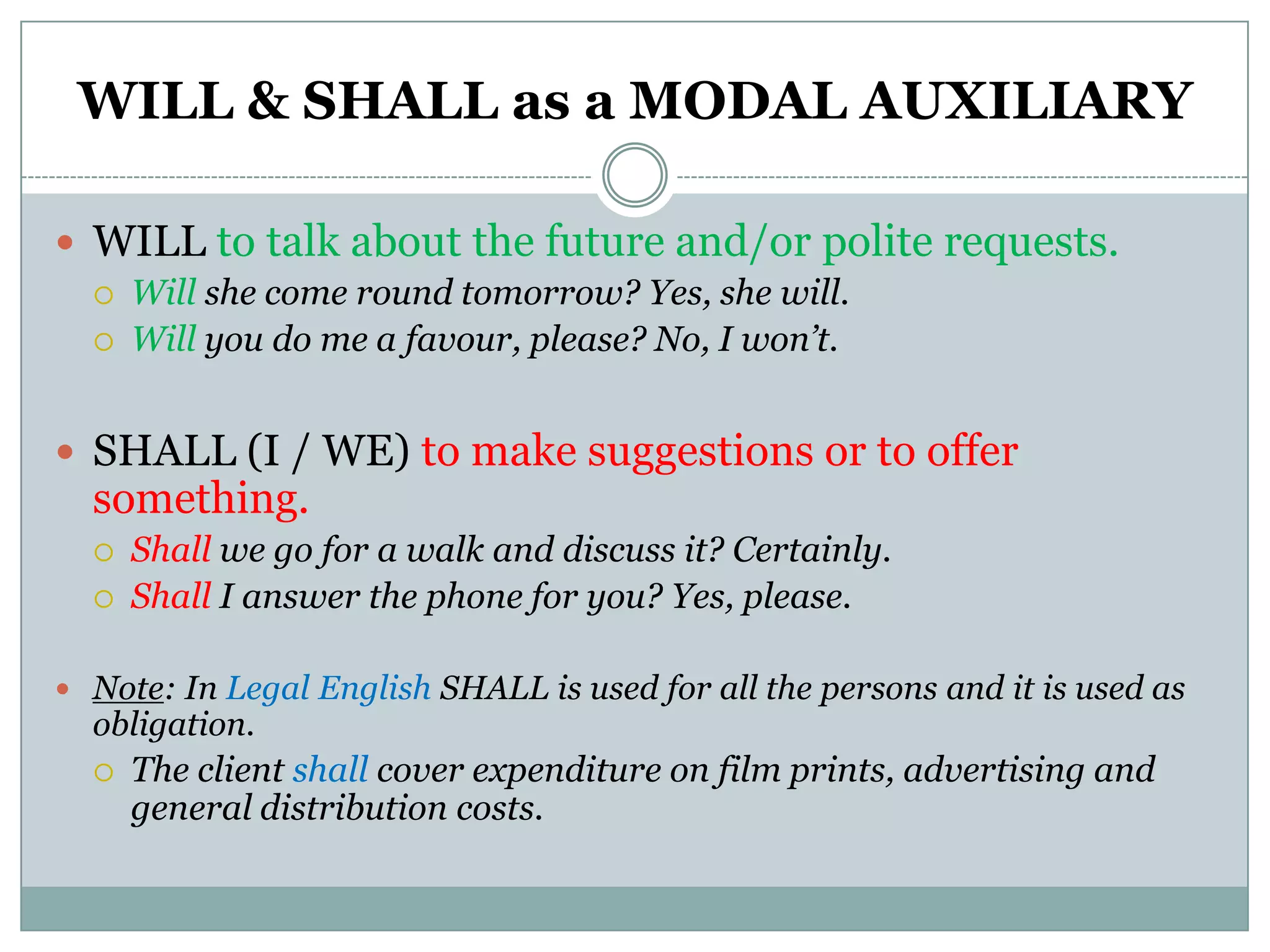
WILL & SHALL as a MODAL AUXILIARY

 WILL to talk about the future and/or polite requests.
     Will she come round tomorrow? Yes, she will.
     Will you do me a favour, please? No, I won’t.


 SHALL (I / WE) to make suggestions or to offer
  something.
     Shall we go for a walk and discuss it? Certainly.
     Shall I answer the phone for you? Yes, please.

 Note: In Legal English SHALL is used for all the persons and it is used as
  obligation.
     The client shall cover expenditure on film prints, advertising and
      general distribution costs.
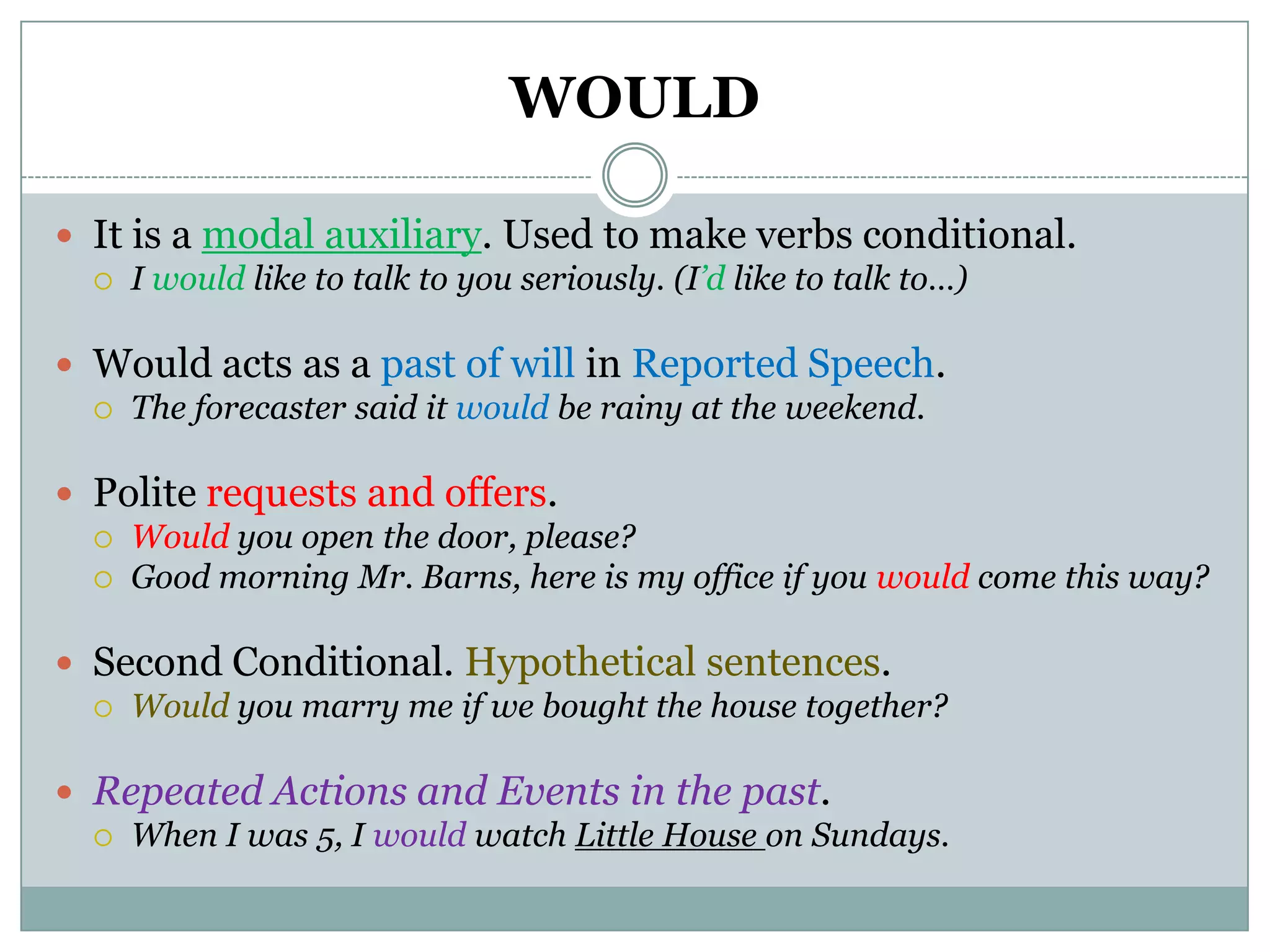
WOULD

 It is a modal auxiliary. Used to make verbs conditional.
   I would like to talk to you seriously. (I’d like to talk to…)


 Would acts as a past of will in Reported Speech.
   The forecaster said it would be rainy at the weekend.


 Polite requests and offers.
   Would you open the door, please?
   Good morning Mr. Barns, here is my office if you would come this way?


 Second Conditional. Hypothetical sentences.
   Would you marry me if we bought the house together?


 Repeated Actions and Events in the past.
   When I was 5, I would watch Little House on Sundays.
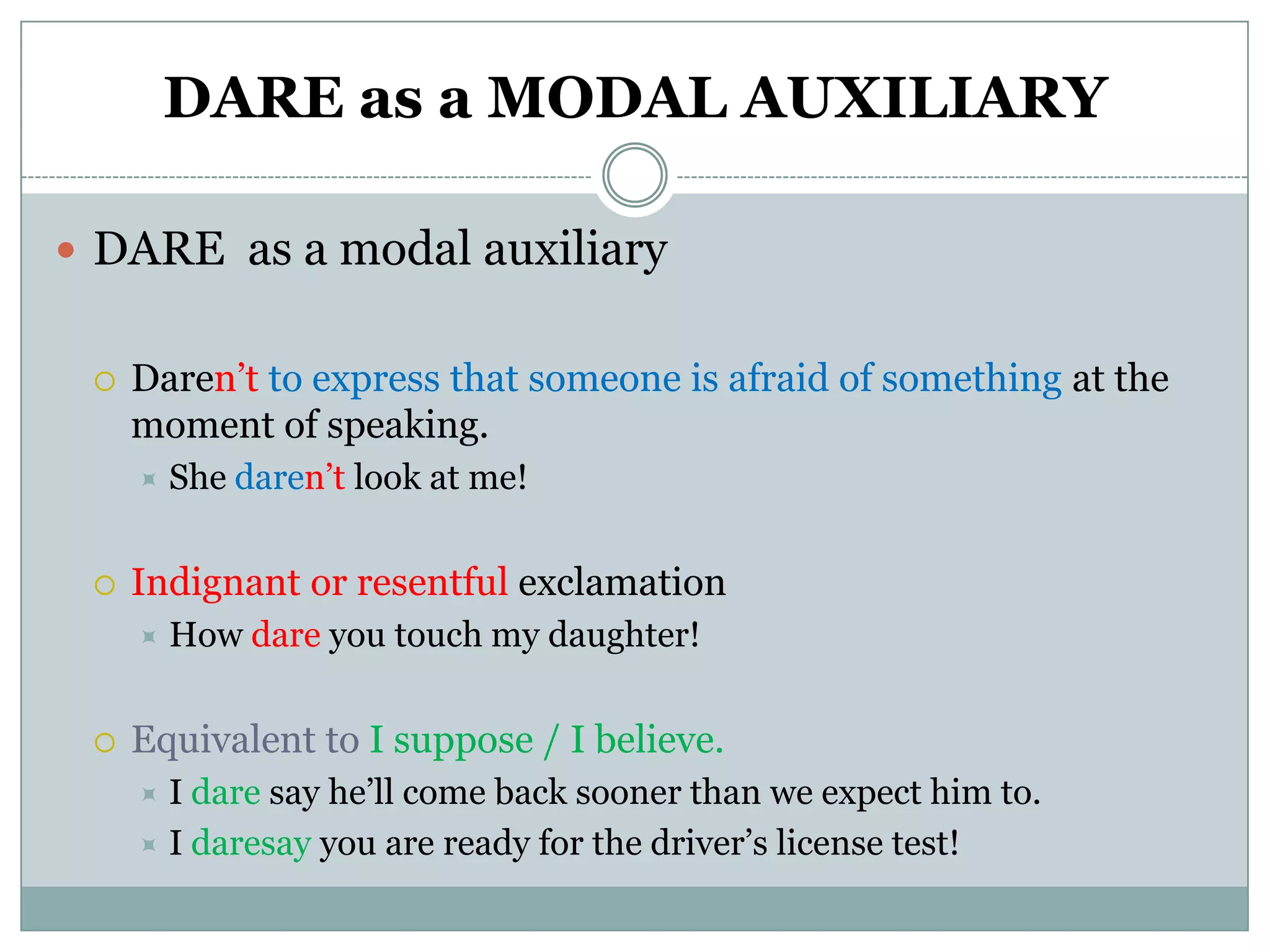
DARE as a MODAL AUXILIARY

 DARE as a modal auxiliary


    Daren’t to express that someone is afraid of something at the
     moment of speaking.
        She daren’t look at me!


    Indignant or resentful exclamation
        How dare you touch my daughter!


    Equivalent to I suppose / I believe.
      I dare say he’ll come back sooner than we expect him to.
      I daresay you are ready for the driver’s license test!
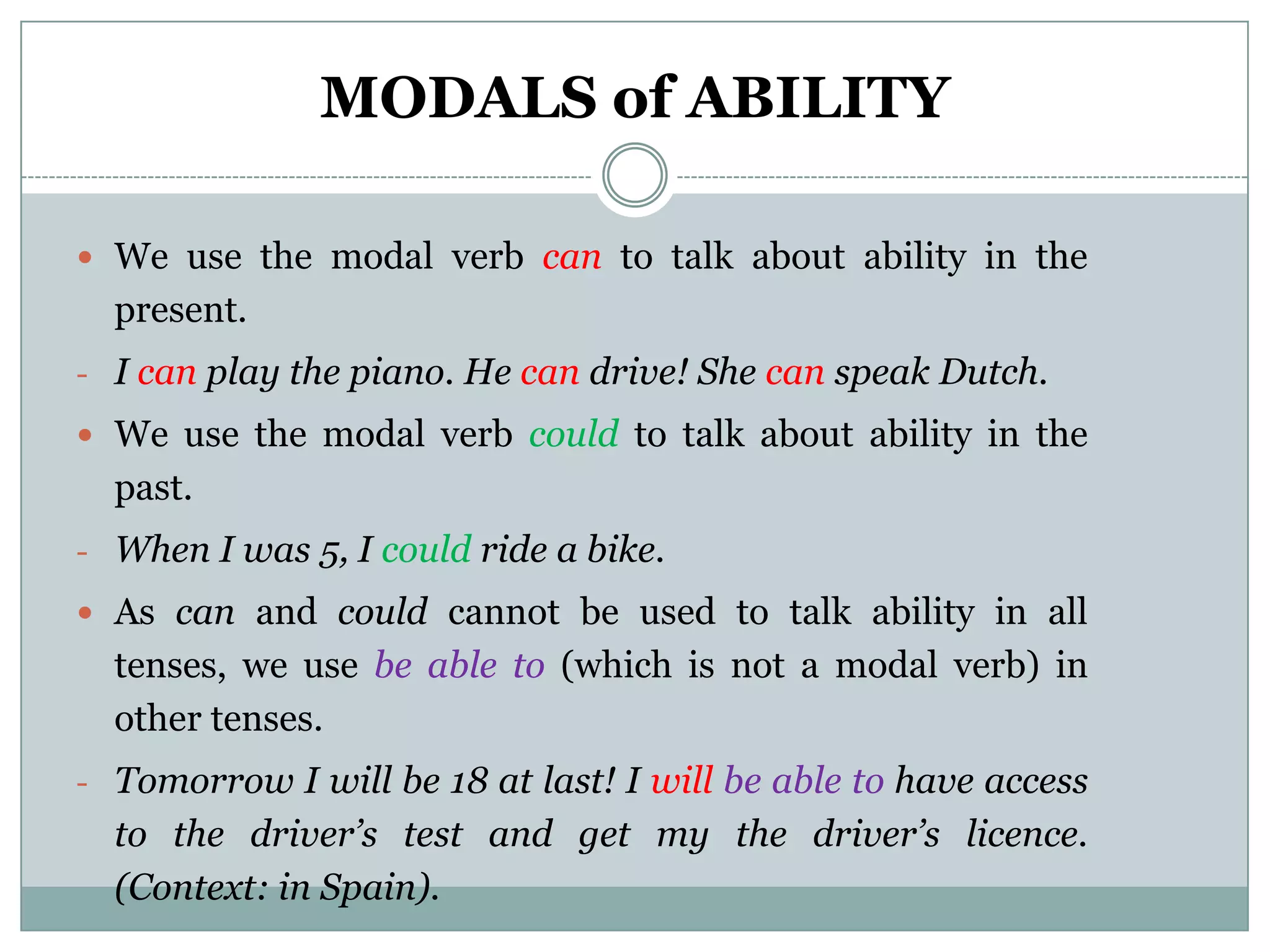
MODALS of ABILITY

 We use the modal verb can to talk about ability in the
  present.
- I can play the piano. He can drive! She can speak Dutch.
 We use the modal verb could to talk about ability in the
  past.
- When I was 5, I could ride a bike.
 As can and could cannot be used to talk ability in all
  tenses, we use be able to (which is not a modal verb) in
  other tenses.
- Tomorrow I will be 18 at last! I will be able to have access
  to the driver’s test and get my the driver’s licence.
  (Context: in Spain).
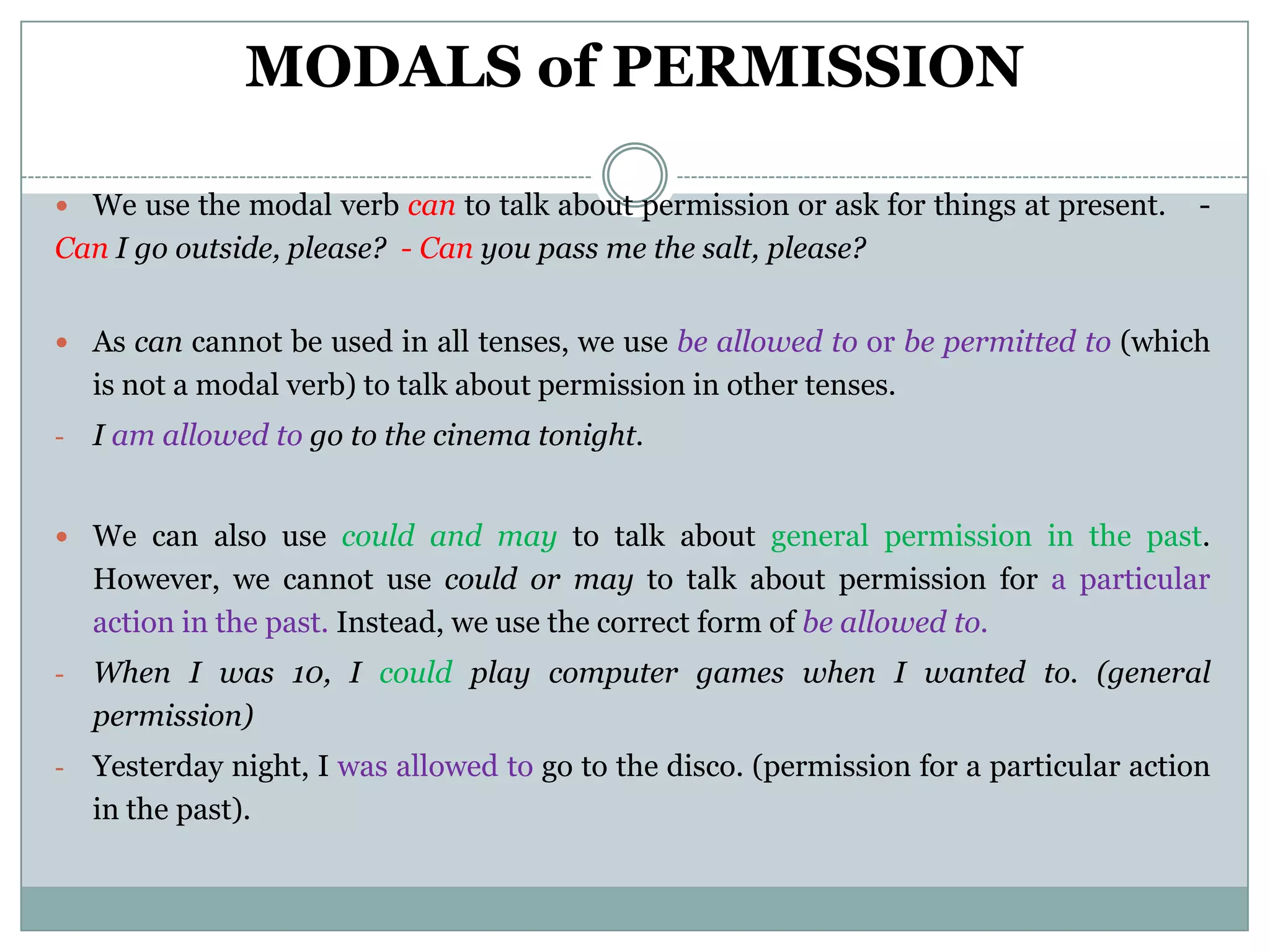
MODALS of PERMISSION

 We use the modal verb can to talk about permission or ask for things at present.       -
Can I go outside, please? - Can you pass me the salt, please?


 As can cannot be used in all tenses, we use be allowed to or be permitted to (which
    is not a modal verb) to talk about permission in other tenses.
-   I am allowed to go to the cinema tonight.


 We can also use could and may to talk about general permission in the past.
    However, we cannot use could or may to talk about permission for a particular
    action in the past. Instead, we use the correct form of be allowed to.
-   When I was 10, I could play computer games when I wanted to. (general
    permission)
-   Yesterday night, I was allowed to go to the disco. (permission for a particular action
    in the past).
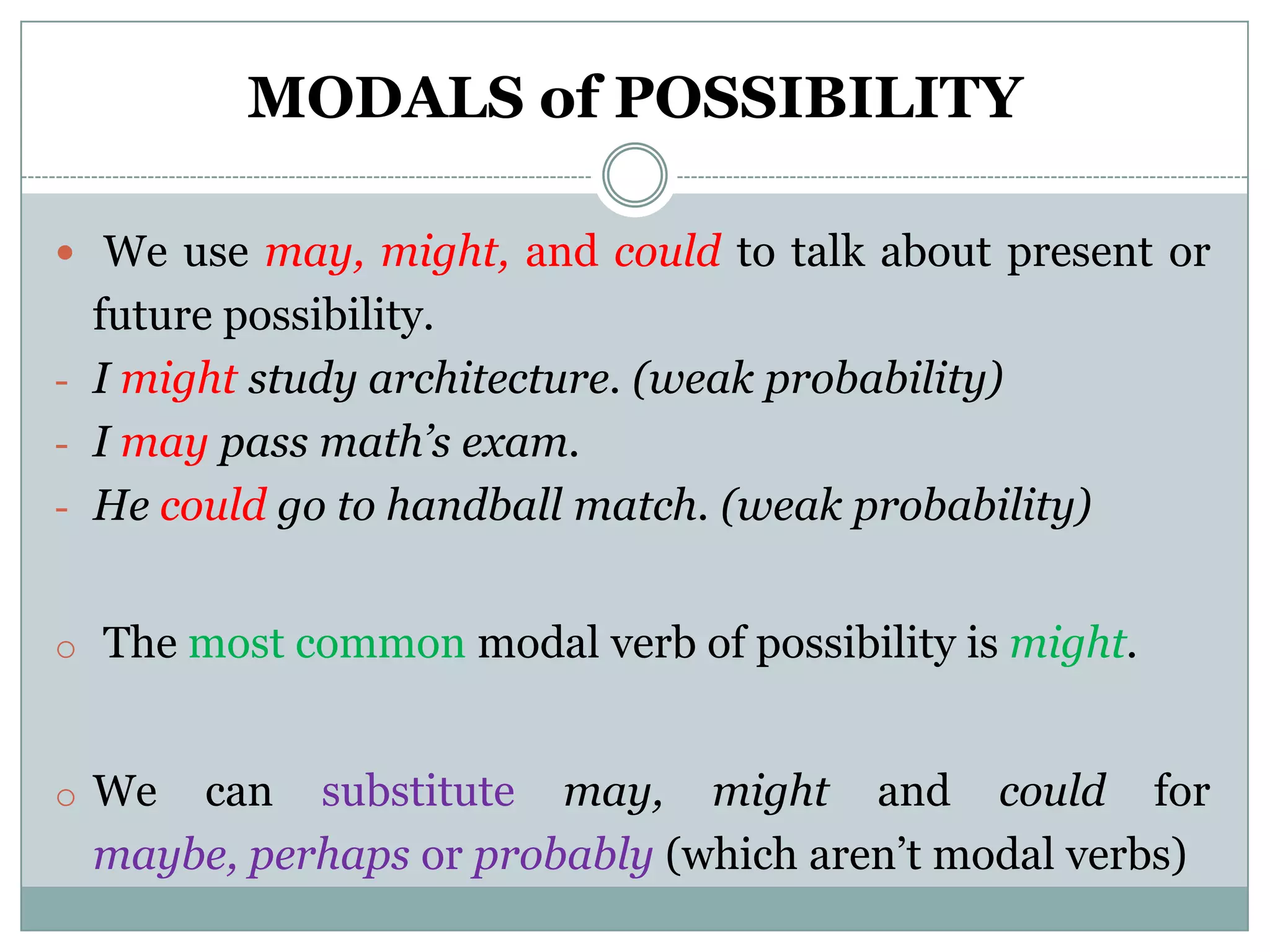
MODALS of POSSIBILITY

 We use may, might, and could to talk about present or
  future possibility.
- I might study architecture. (weak probability)
- I may pass math’s exam.
- He could go to handball match. (weak probability)


o The most common modal verb of possibility is might.


o We can substitute may, might and could for
 maybe, perhaps or probably (which aren’t modal verbs)
MODALS of ADVICE

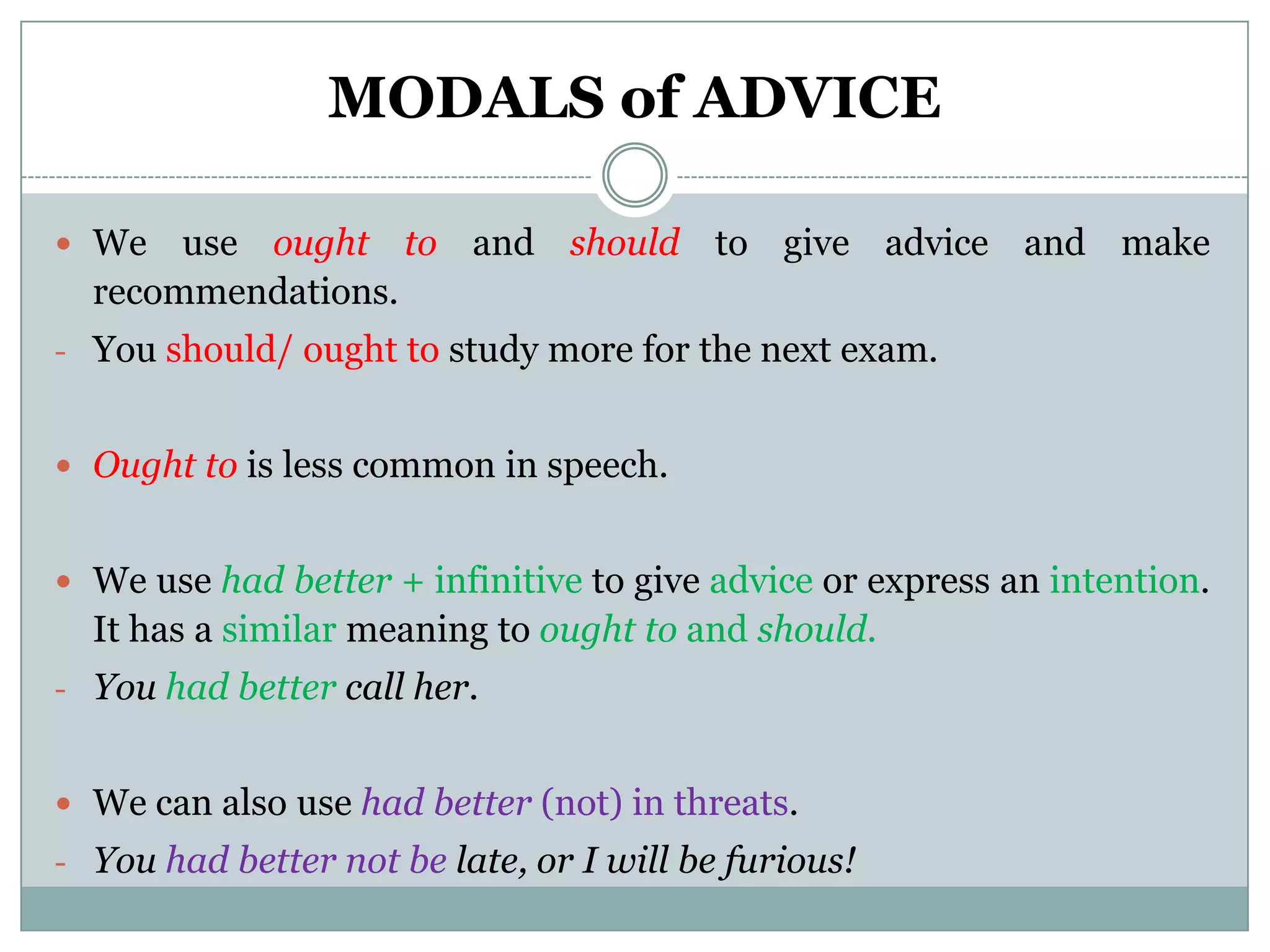
 We   use ought to and should to give advice and make
  recommendations.
- You should/ ought to study more for the next exam.


 Ought to is less common in speech.


 We use had better + infinitive to give advice or express an intention.
  It has a similar meaning to ought to and should.
- You had better call her.


 We can also use had better (not) in threats.
- You had better not be late, or I will be furious!
MODALS of NECESSITY

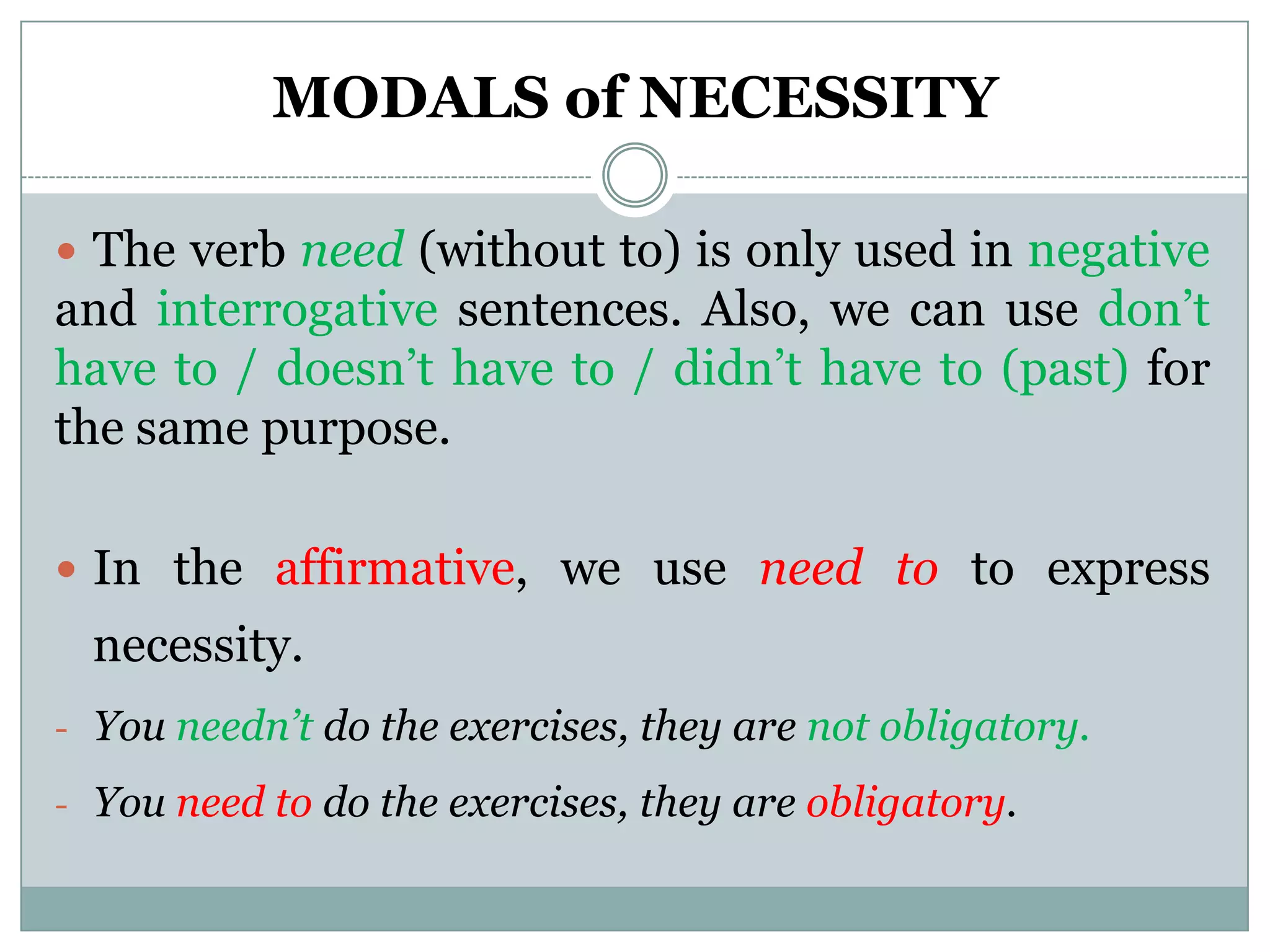
 The verb need (without to) is only used in negative
and interrogative sentences. Also, we can use don’t
have to / doesn’t have to / didn’t have to (past) for
the same purpose.

 In the affirmative, we use need to to express
  necessity.
- You needn’t do the exercises, they are not obligatory.

- You need to do the exercises, they are obligatory.
MODALS of OBLIGATION

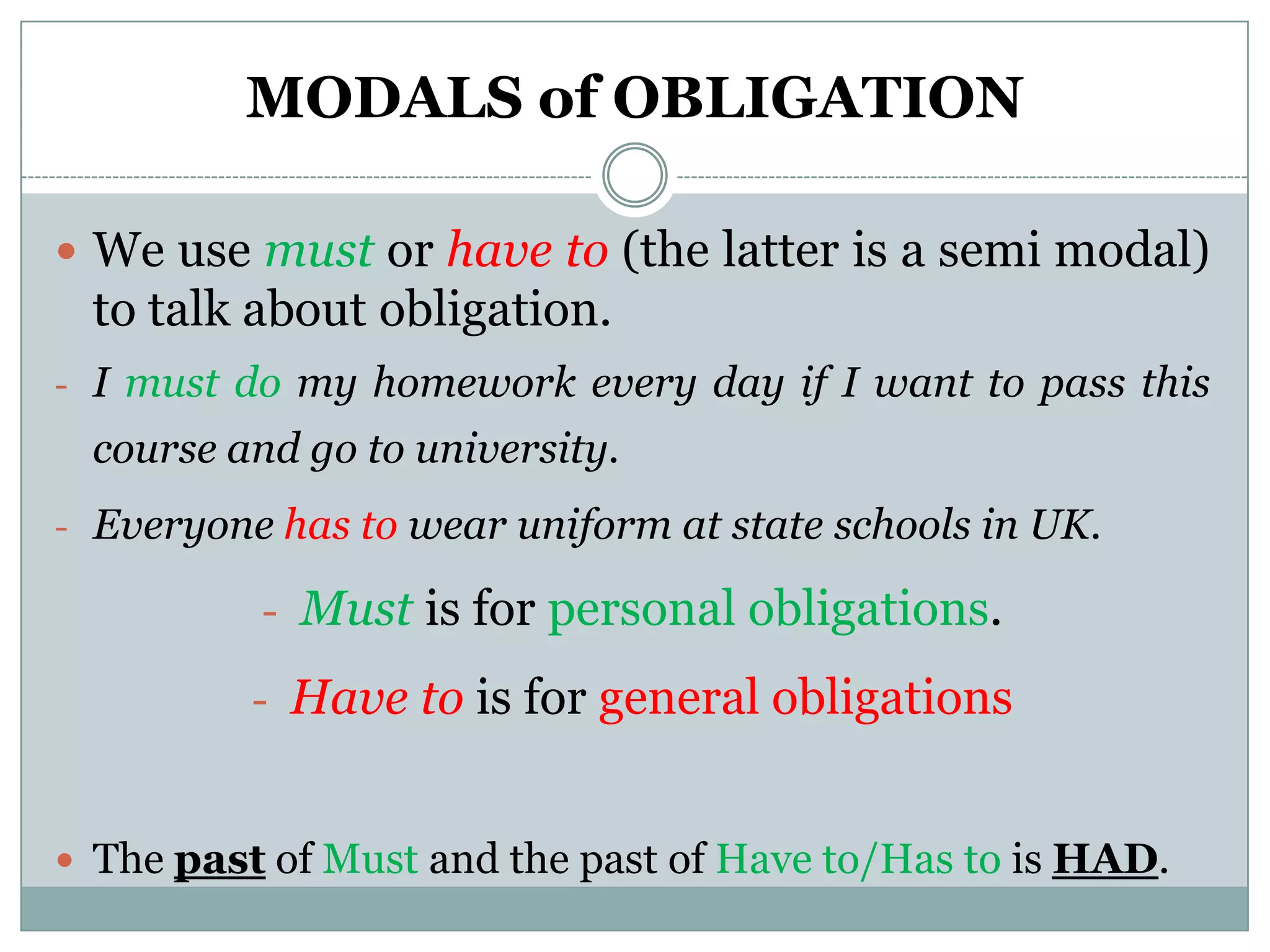
 We use must or have to (the latter is a semi modal)
 to talk about obligation.
- I must do my homework every day if I want to pass this
 course and go to university.
- Everyone has to wear uniform at state schools in UK.

          - Must is for personal obligations.

          - Have to is for general obligations


 The past of Must and the past of Have to/Has to is HAD.
MODAL of PROHIBITION

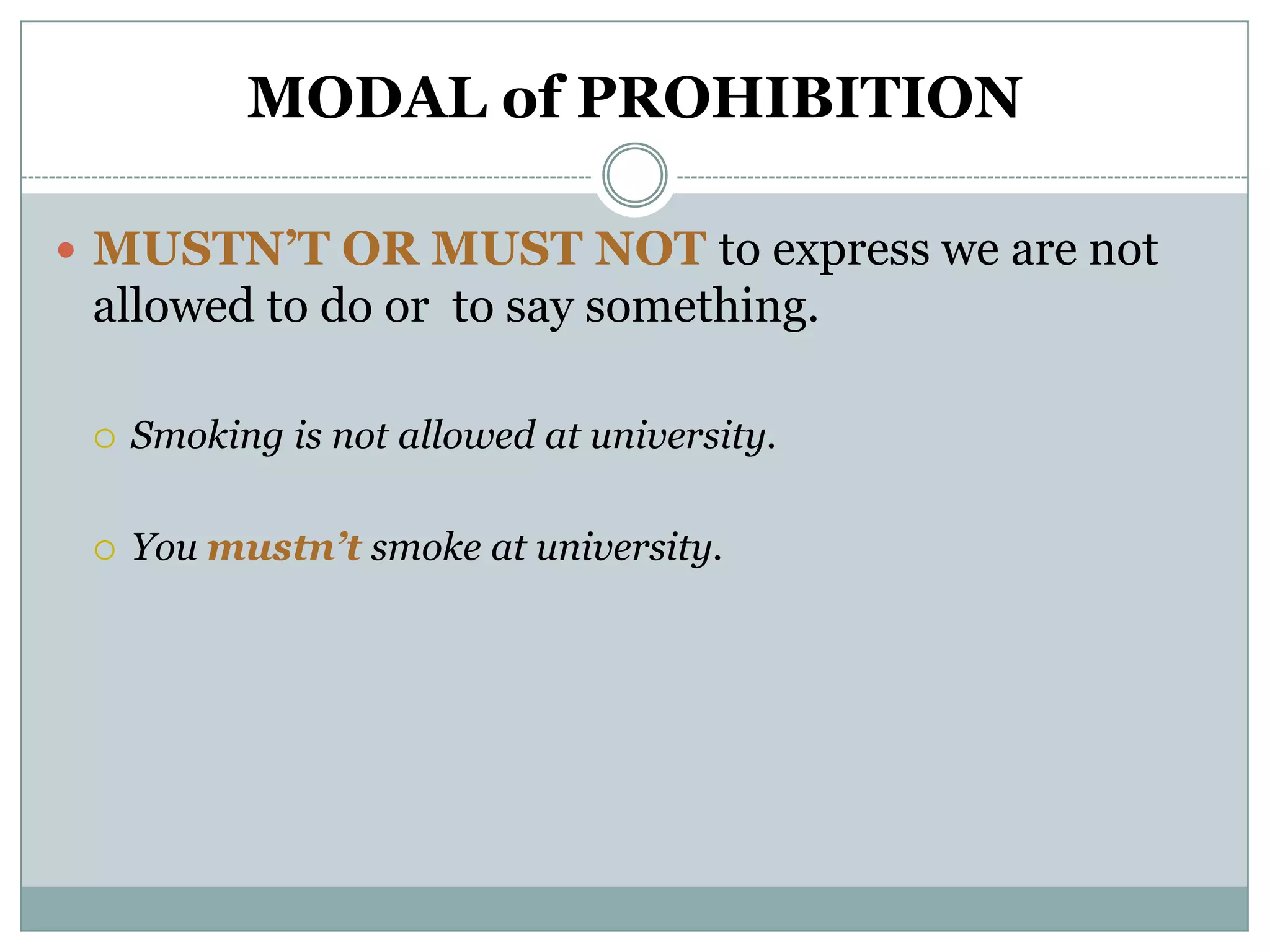
 MUSTN’T OR MUST NOT to express we are not
 allowed to do or to say something.

    Smoking is not allowed at university.

    You mustn’t smoke at university.
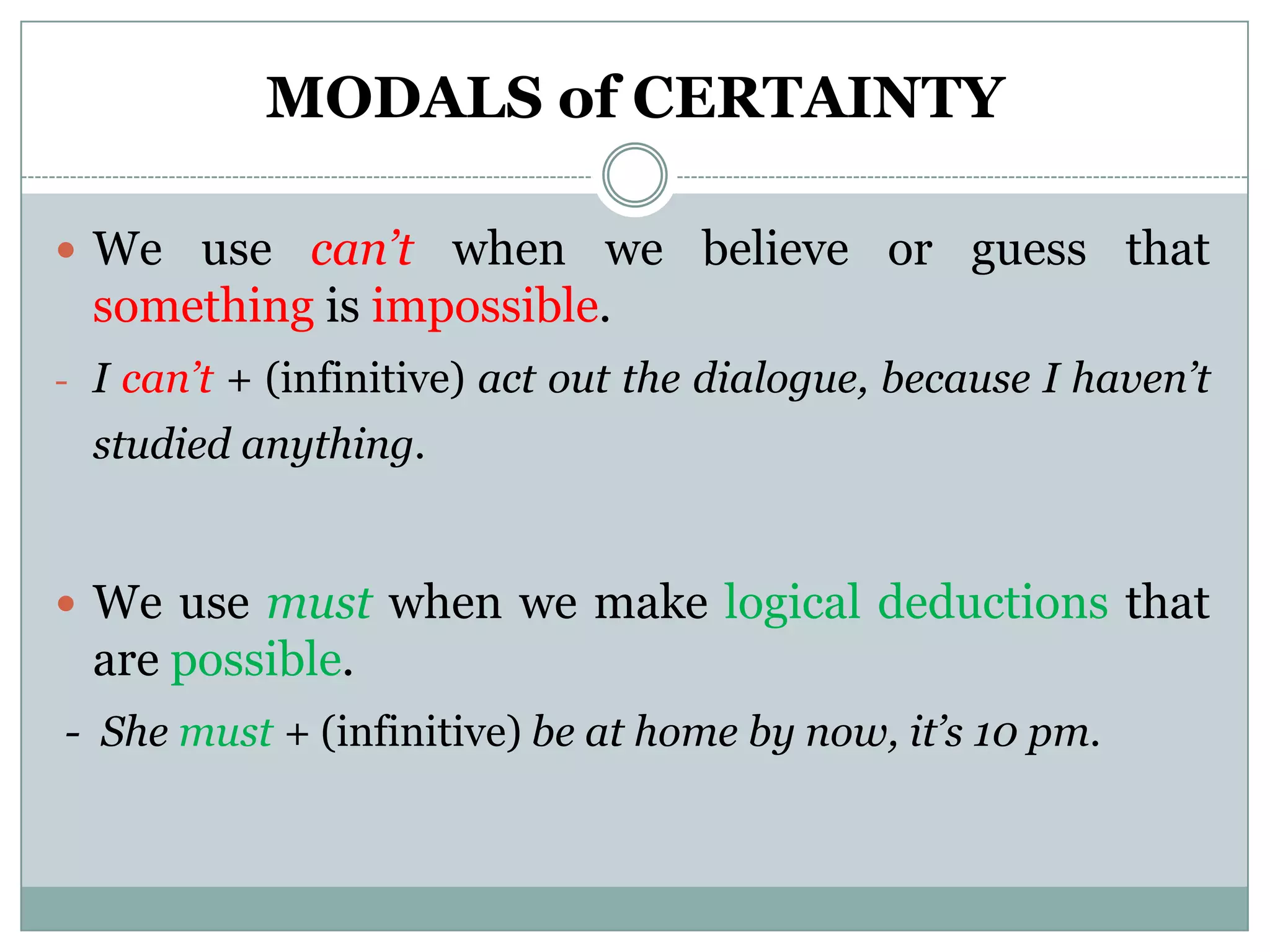
MODALS of CERTAINTY

 We use can’t when we believe or guess that
  something is impossible.
- I can’t + (infinitive) act out the dialogue, because I haven’t
  studied anything.


 We use must when we make logical deductions that
  are possible.
- She must + (infinitive) be at home by now, it’s 10 pm.
MODALS + PERFECT INFINITIVES
          PAST SITUATIONS
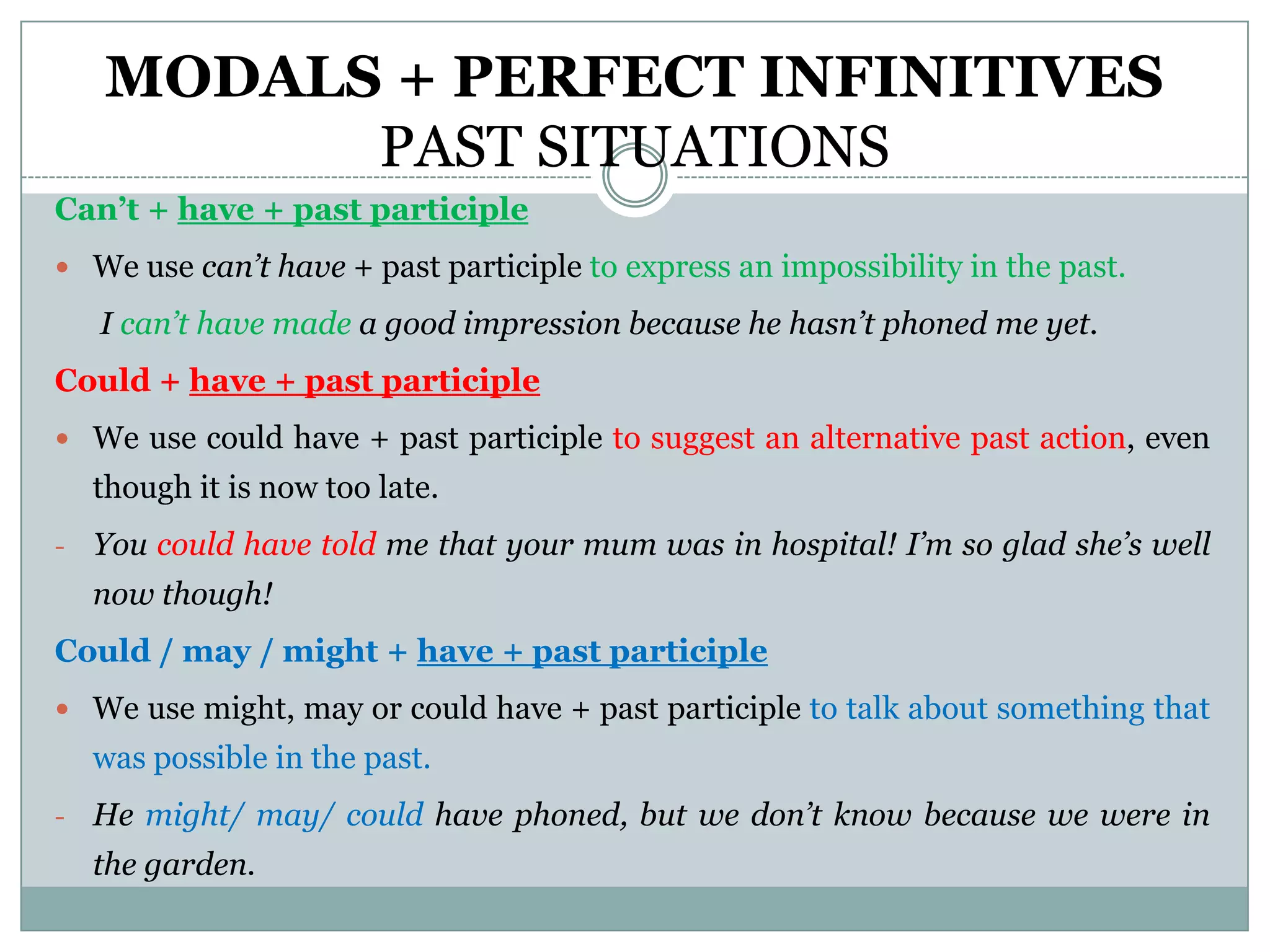
Can’t + have + past participle
 We use can’t have + past participle to express an impossibility in the past.

    I can’t have made a good impression because he hasn’t phoned me yet.
Could + have + past participle
 We use could have + past participle to suggest an alternative past action, even
    though it is now too late.
-   You could have told me that your mum was in hospital! I’m so glad she’s well
    now though!
Could / may / might + have + past participle
 We use might, may or could have + past participle to talk about something that
    was possible in the past.
-   He might/ may/ could have phoned, but we don’t know because we were in
    the garden.
MODALS + PERFECT INFINITIVES
          PAST SITUATIONS
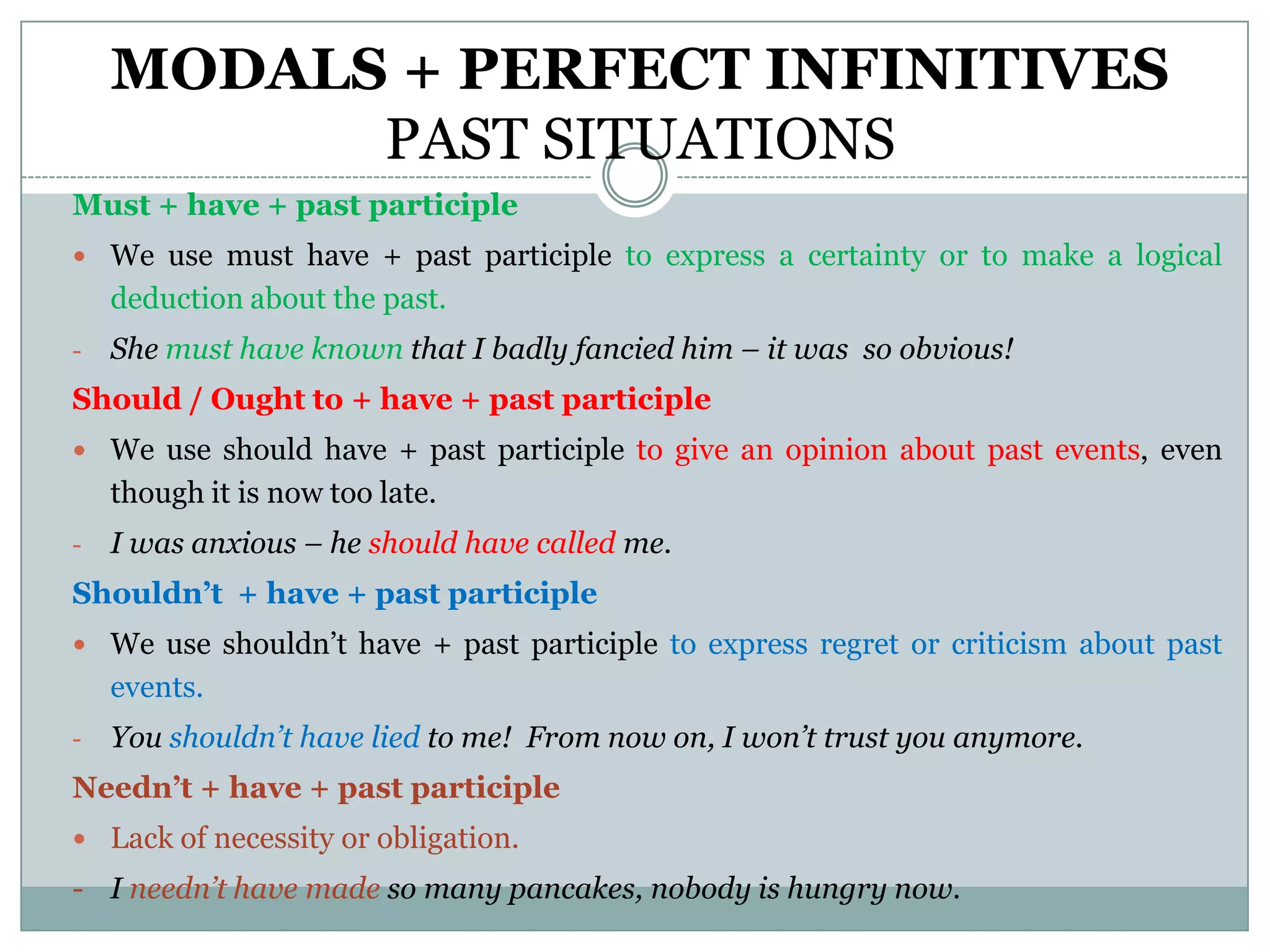
Must + have + past participle
 We use must have + past participle to express a certainty or to make a logical
    deduction about the past.
-   She must have known that I badly fancied him – it was so obvious!
Should / Ought to + have + past participle
 We use should have + past participle to give an opinion about past events, even
    though it is now too late.
-   I was anxious – he should have called me.
Shouldn’t + have + past participle
 We use shouldn’t have + past participle to express regret or criticism about past
    events.
-   You shouldn’t have lied to me! From now on, I won’t trust you anymore.
Needn’t + have + past participle
 Lack of necessity or obligation.
- I needn’t have made so many pancakes, nobody is hungry now.
THE END

Modal verbs

  • 1.
    Modal Verbs AITOR SÁNCHEZ ABELLÁN DAVID SÁNCHEZ GONZÁLEZ Revised, Corrected, and completed by Nur Garriga
  • 2.
    Introduction  They areauxiliaries.  They add new meaning to the sentences.  They accompany the main verb.  They also accompany other auxiliaries (have) PLUS the main verb in perfect and/or continuous forms).  They are used before infinitives (to)  CAN, COULD, MAY, MIGHT, WILL, WOULD, SHALL (most common in BE), SHOULD, OUGTH TO, MUST, CANNOT (CAN’T), MUST NOT (MUSTN’T)  Other verbs used as MODALS: NEED and DARE, HAD BETTER (NOT)  Semi modals: HAVE TO / HAS TO / (NEED TO)  NEGATIVE FORMS: Modal Verb + NOT
  • 3.
    WILL & SHALLas a MODAL AUXILIARY  WILL to talk about the future and/or polite requests.  Will she come round tomorrow? Yes, she will.  Will you do me a favour, please? No, I won’t.  SHALL (I / WE) to make suggestions or to offer something.  Shall we go for a walk and discuss it? Certainly.  Shall I answer the phone for you? Yes, please.  Note: In Legal English SHALL is used for all the persons and it is used as obligation.  The client shall cover expenditure on film prints, advertising and general distribution costs.
  • 4.
    WOULD  It isa modal auxiliary. Used to make verbs conditional.  I would like to talk to you seriously. (I’d like to talk to…)  Would acts as a past of will in Reported Speech.  The forecaster said it would be rainy at the weekend.  Polite requests and offers.  Would you open the door, please?  Good morning Mr. Barns, here is my office if you would come this way?  Second Conditional. Hypothetical sentences.  Would you marry me if we bought the house together?  Repeated Actions and Events in the past.  When I was 5, I would watch Little House on Sundays.
  • 5.
    DARE as aMODAL AUXILIARY  DARE as a modal auxiliary  Daren’t to express that someone is afraid of something at the moment of speaking.  She daren’t look at me!  Indignant or resentful exclamation  How dare you touch my daughter!  Equivalent to I suppose / I believe.  I dare say he’ll come back sooner than we expect him to.  I daresay you are ready for the driver’s license test!
  • 6.
    MODALS of ABILITY We use the modal verb can to talk about ability in the present. - I can play the piano. He can drive! She can speak Dutch.  We use the modal verb could to talk about ability in the past. - When I was 5, I could ride a bike.  As can and could cannot be used to talk ability in all tenses, we use be able to (which is not a modal verb) in other tenses. - Tomorrow I will be 18 at last! I will be able to have access to the driver’s test and get my the driver’s licence. (Context: in Spain).
  • 7.
    MODALS of PERMISSION We use the modal verb can to talk about permission or ask for things at present. - Can I go outside, please? - Can you pass me the salt, please?  As can cannot be used in all tenses, we use be allowed to or be permitted to (which is not a modal verb) to talk about permission in other tenses. - I am allowed to go to the cinema tonight.  We can also use could and may to talk about general permission in the past. However, we cannot use could or may to talk about permission for a particular action in the past. Instead, we use the correct form of be allowed to. - When I was 10, I could play computer games when I wanted to. (general permission) - Yesterday night, I was allowed to go to the disco. (permission for a particular action in the past).
  • 8.
    MODALS of POSSIBILITY We use may, might, and could to talk about present or future possibility. - I might study architecture. (weak probability) - I may pass math’s exam. - He could go to handball match. (weak probability) o The most common modal verb of possibility is might. o We can substitute may, might and could for maybe, perhaps or probably (which aren’t modal verbs)
  • 9.
    MODALS of ADVICE We use ought to and should to give advice and make recommendations. - You should/ ought to study more for the next exam.  Ought to is less common in speech.  We use had better + infinitive to give advice or express an intention. It has a similar meaning to ought to and should. - You had better call her.  We can also use had better (not) in threats. - You had better not be late, or I will be furious!
  • 10.
    MODALS of NECESSITY The verb need (without to) is only used in negative and interrogative sentences. Also, we can use don’t have to / doesn’t have to / didn’t have to (past) for the same purpose.  In the affirmative, we use need to to express necessity. - You needn’t do the exercises, they are not obligatory. - You need to do the exercises, they are obligatory.
  • 11.
    MODALS of OBLIGATION We use must or have to (the latter is a semi modal) to talk about obligation. - I must do my homework every day if I want to pass this course and go to university. - Everyone has to wear uniform at state schools in UK. - Must is for personal obligations. - Have to is for general obligations  The past of Must and the past of Have to/Has to is HAD.
  • 12.
    MODAL of PROHIBITION MUSTN’T OR MUST NOT to express we are not allowed to do or to say something.  Smoking is not allowed at university.  You mustn’t smoke at university.
  • 13.
    MODALS of CERTAINTY We use can’t when we believe or guess that something is impossible. - I can’t + (infinitive) act out the dialogue, because I haven’t studied anything.  We use must when we make logical deductions that are possible. - She must + (infinitive) be at home by now, it’s 10 pm.
  • 14.
    MODALS + PERFECTINFINITIVES PAST SITUATIONS Can’t + have + past participle  We use can’t have + past participle to express an impossibility in the past. I can’t have made a good impression because he hasn’t phoned me yet. Could + have + past participle  We use could have + past participle to suggest an alternative past action, even though it is now too late. - You could have told me that your mum was in hospital! I’m so glad she’s well now though! Could / may / might + have + past participle  We use might, may or could have + past participle to talk about something that was possible in the past. - He might/ may/ could have phoned, but we don’t know because we were in the garden.
  • 15.
    MODALS + PERFECTINFINITIVES PAST SITUATIONS Must + have + past participle  We use must have + past participle to express a certainty or to make a logical deduction about the past. - She must have known that I badly fancied him – it was so obvious! Should / Ought to + have + past participle  We use should have + past participle to give an opinion about past events, even though it is now too late. - I was anxious – he should have called me. Shouldn’t + have + past participle  We use shouldn’t have + past participle to express regret or criticism about past events. - You shouldn’t have lied to me! From now on, I won’t trust you anymore. Needn’t + have + past participle  Lack of necessity or obligation. - I needn’t have made so many pancakes, nobody is hungry now.
  • 16.