The Magic ForMulaS:
Aux + Subject + rest of the question ?
AND
Aux + Subject + Verb + rest of the question?
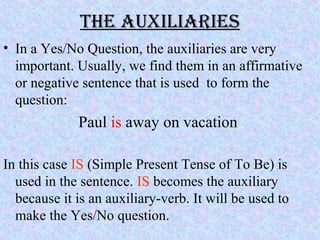
The auxiliarieS
• In a Yes/No Question, the auxiliaries are very
important. Usually, we find them in an affirmative
or negative sentence that is used to form the
question:
Paul is away on vacation.
In this case IS (Simple Present Tense of To Be) is
used in the sentence. IS becomes the auxiliary
because it is an auxiliary-verb. It will be used to
make the Yes/No question.
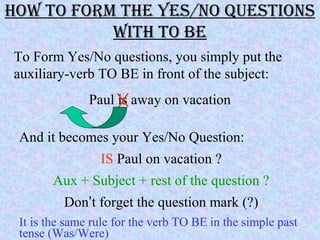
how To ForM The YeS/No QueSTioNS
wiTh To Be
To Form Yes/No questions, you simply put the
auxiliary-verb TO BE in front of the subject:
Paul is away on vacation
And it becomes your Yes/No Question:
IS Paul on vacation ?
Aux + Subject + rest of the question ?
Don’t forget the question mark (?)
It is the same rule for the verb TO BE in the simple past
tense (Was/Were)
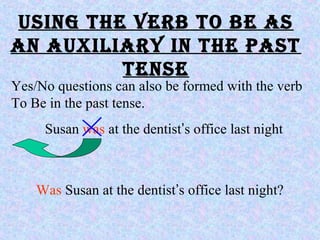
uSiNg The verB To Be aS
aN auxiliarY iN The paST
TeNSe
Yes/No questions can also be formed with the verb
To Be in the past tense.
Susan was at the dentist’s office last night
Was Susan at the dentist’s office last night?
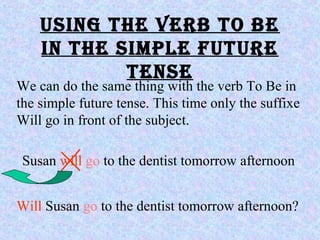
Using the verb to be
in the simple fUtUre
tense
We can do the same thing with the verb To Be in
the simple future tense. This time only the suffixe
Will go in front of the subject.
Susan will go to the dentist tomorrow afternoon
Will Susan go to the dentist tomorrow afternoon?
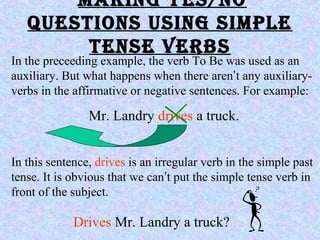
making Yes/no
qUestions Using simple
tense verbs
In the preceeding example, the verb To Be was used as an
auxiliary. But what happens when there aren’t any auxiliary-
verbs in the affirmative or negative sentences. For example:
Mr. Landry drives a truck.
In this sentence, drives is an irregular verb in the simple past
tense. It is obvious that we can’t put the simple tense verb in
front of the subject.
Drives Mr. Landry a truck?
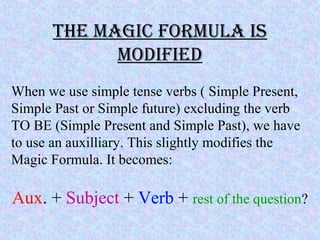
the magic formUla is
modified
When we use simple tense verbs ( Simple Present,
Simple Past or Simple future) excluding the verb
TO BE (Simple Present and Simple Past), we have
to use an auxilliary. This slightly modifies the
Magic Formula. It becomes:
Aux. + Subject + Verb + rest of the question?
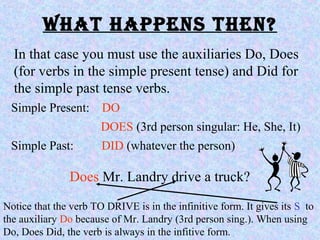
What happens then?
In that case you must use the auxiliaries Do, Does
(for verbs in the simple present tense) and Did for
the simple past tense verbs.
Simple Present: DO
DOES (3rd person singular: He, She, It)
Simple Past: DID (whatever the person)
Does Mr. Landry drive a truck?
Notice that the verb TO DRIVE is in the infinitive form. It gives its S to
the auxiliary Do because of Mr. Landry (3rd person sing.). When using
Do, Does Did, the verb is always in the infitive form.
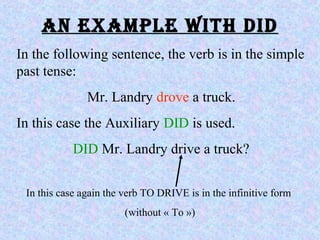
An exAmple with DiD
In the following sentence, the verb is in the simple
past tense:
Mr. Landry drove a truck.
In this case the Auxiliary DID is used.
DID Mr. Landry drive a truck?
In this case again the verb TO DRIVE is in the infinitive form
(without « To »)
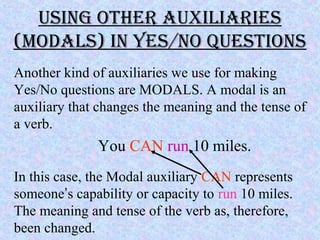
Using other AUxiliAries
(moDAls) in Yes/no QUestions
Another kind of auxiliaries we use for making
Yes/No questions are MODALS. A modal is an
auxiliary that changes the meaning and the tense of
a verb.
You CAN run 10 miles.
In this case, the Modal auxiliary CAN represents
someone’s capability or capacity to run 10 miles.
The meaning and tense of the verb as, therefore,
been changed.
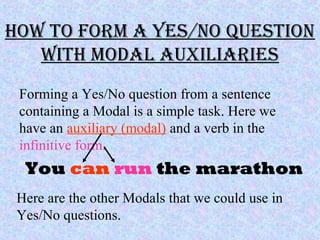
how to form A Yes/no QUestion
with moDAl AUxiliAries
Forming a Yes/No question from a sentence
containing a Modal is a simple task. Here we
have an auxiliary (modal) and a verb in the
infinitive form.
You can run the marathon
Here are the other Modals that we could use in
Yes/No questions.
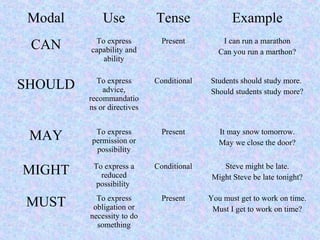
Modal Use Tense Example
CAN To express
capability and
ability
Present I can run a marathon
Can you run a marthon?
SHOULD To express
advice,
recommandatio
ns or directives
Conditional Students should study more.
Should students study more?
MAY To express
permission or
possibility
Present It may snow tomorrow.
May we close the door?
MIGHT To express a
reduced
possibility
Conditional Steve might be late.
Might Steve be late tonight?
MUST To express
obligation or
necessity to do
something
Present You must get to work on time.
Must I get to work on time?
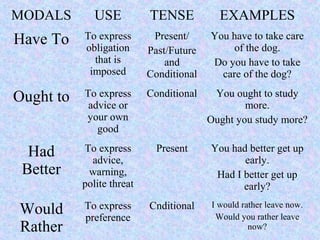
MODALS USE TENSE EXAMPLES
Have To To express
obligation
that is
imposed
Present/
Past/Future
and
Conditional
You have to take care
of the dog.
Do you have to take
care of the dog?
Ought to To express
advice or
your own
good
Conditional You ought to study
more.
Ought you study more?
Had
Better
To express
advice,
warning,
polite threat
Present You had better get up
early.
Had I better get up
early?
Would
Rather
To express
preference
Cnditional I would rather leave now.
Would you rather leave
now?
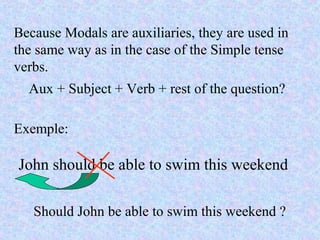
Because Modals are auxiliaries, they are used in
the same way as in the case of the Simple tense
verbs.
Aux + Subject + Verb + rest of the question?
Exemple:
John should be able to swim this weekend
Should John be able to swim this weekend ?
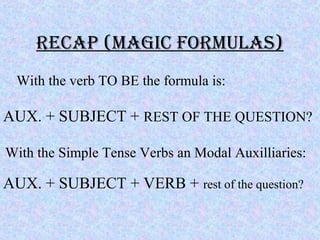
Recap (Magic FoRMulas)
With the verb TO BE the formula is:
AUX. + SUBJECT + REST OF THE QUESTION?
With the Simple Tense Verbs an Modal Auxilliaries:
AUX. + SUBJECT + VERB + rest of the question?

Yes no questions

  • 1.
    The Magic ForMulaS: Aux+ Subject + rest of the question ? AND Aux + Subject + Verb + rest of the question?
  • 2.
    The auxiliarieS • Ina Yes/No Question, the auxiliaries are very important. Usually, we find them in an affirmative or negative sentence that is used to form the question: Paul is away on vacation. In this case IS (Simple Present Tense of To Be) is used in the sentence. IS becomes the auxiliary because it is an auxiliary-verb. It will be used to make the Yes/No question.
  • 3.
    how To ForMThe YeS/No QueSTioNS wiTh To Be To Form Yes/No questions, you simply put the auxiliary-verb TO BE in front of the subject: Paul is away on vacation And it becomes your Yes/No Question: IS Paul on vacation ? Aux + Subject + rest of the question ? Don’t forget the question mark (?) It is the same rule for the verb TO BE in the simple past tense (Was/Were)
  • 4.
    uSiNg The verBTo Be aS aN auxiliarY iN The paST TeNSe Yes/No questions can also be formed with the verb To Be in the past tense. Susan was at the dentist’s office last night Was Susan at the dentist’s office last night?
  • 5.
    Using the verbto be in the simple fUtUre tense We can do the same thing with the verb To Be in the simple future tense. This time only the suffixe Will go in front of the subject. Susan will go to the dentist tomorrow afternoon Will Susan go to the dentist tomorrow afternoon?
  • 6.
    making Yes/no qUestions Usingsimple tense verbs In the preceeding example, the verb To Be was used as an auxiliary. But what happens when there aren’t any auxiliary- verbs in the affirmative or negative sentences. For example: Mr. Landry drives a truck. In this sentence, drives is an irregular verb in the simple past tense. It is obvious that we can’t put the simple tense verb in front of the subject. Drives Mr. Landry a truck?
  • 7.
    the magic formUlais modified When we use simple tense verbs ( Simple Present, Simple Past or Simple future) excluding the verb TO BE (Simple Present and Simple Past), we have to use an auxilliary. This slightly modifies the Magic Formula. It becomes: Aux. + Subject + Verb + rest of the question?
  • 8.
    What happens then? Inthat case you must use the auxiliaries Do, Does (for verbs in the simple present tense) and Did for the simple past tense verbs. Simple Present: DO DOES (3rd person singular: He, She, It) Simple Past: DID (whatever the person) Does Mr. Landry drive a truck? Notice that the verb TO DRIVE is in the infinitive form. It gives its S to the auxiliary Do because of Mr. Landry (3rd person sing.). When using Do, Does Did, the verb is always in the infitive form.
  • 9.
    An exAmple withDiD In the following sentence, the verb is in the simple past tense: Mr. Landry drove a truck. In this case the Auxiliary DID is used. DID Mr. Landry drive a truck? In this case again the verb TO DRIVE is in the infinitive form (without « To »)
  • 10.
    Using other AUxiliAries (moDAls)in Yes/no QUestions Another kind of auxiliaries we use for making Yes/No questions are MODALS. A modal is an auxiliary that changes the meaning and the tense of a verb. You CAN run 10 miles. In this case, the Modal auxiliary CAN represents someone’s capability or capacity to run 10 miles. The meaning and tense of the verb as, therefore, been changed.
  • 11.
    how to formA Yes/no QUestion with moDAl AUxiliAries Forming a Yes/No question from a sentence containing a Modal is a simple task. Here we have an auxiliary (modal) and a verb in the infinitive form. You can run the marathon Here are the other Modals that we could use in Yes/No questions.
  • 12.
    Modal Use TenseExample CAN To express capability and ability Present I can run a marathon Can you run a marthon? SHOULD To express advice, recommandatio ns or directives Conditional Students should study more. Should students study more? MAY To express permission or possibility Present It may snow tomorrow. May we close the door? MIGHT To express a reduced possibility Conditional Steve might be late. Might Steve be late tonight? MUST To express obligation or necessity to do something Present You must get to work on time. Must I get to work on time?
  • 13.
    MODALS USE TENSEEXAMPLES Have To To express obligation that is imposed Present/ Past/Future and Conditional You have to take care of the dog. Do you have to take care of the dog? Ought to To express advice or your own good Conditional You ought to study more. Ought you study more? Had Better To express advice, warning, polite threat Present You had better get up early. Had I better get up early? Would Rather To express preference Cnditional I would rather leave now. Would you rather leave now?
  • 14.
    Because Modals areauxiliaries, they are used in the same way as in the case of the Simple tense verbs. Aux + Subject + Verb + rest of the question? Exemple: John should be able to swim this weekend Should John be able to swim this weekend ?
  • 15.
    Recap (Magic FoRMulas) Withthe verb TO BE the formula is: AUX. + SUBJECT + REST OF THE QUESTION? With the Simple Tense Verbs an Modal Auxilliaries: AUX. + SUBJECT + VERB + rest of the question?