Suction
MURUGANANDAM
ASSISTANT PROFESSOR
LPU - PUNJAP
Introduction
• Airway suction frequently used to removal of secretion in lung
• Is to be given whenever
• secretions can be heard in an intubated patient
• who is unable to cough and expectorate efficiently
• Before and during the release of the cuff on a tracheostomy tube
• presence of a large plug of mucus in one of the larger bronch
• If the minute volume (MV) drops
Suction equipment
1. Suction pumps
2. Tubing
3. Connections
4. Catheter
5. Suction trolley
Suction pumps
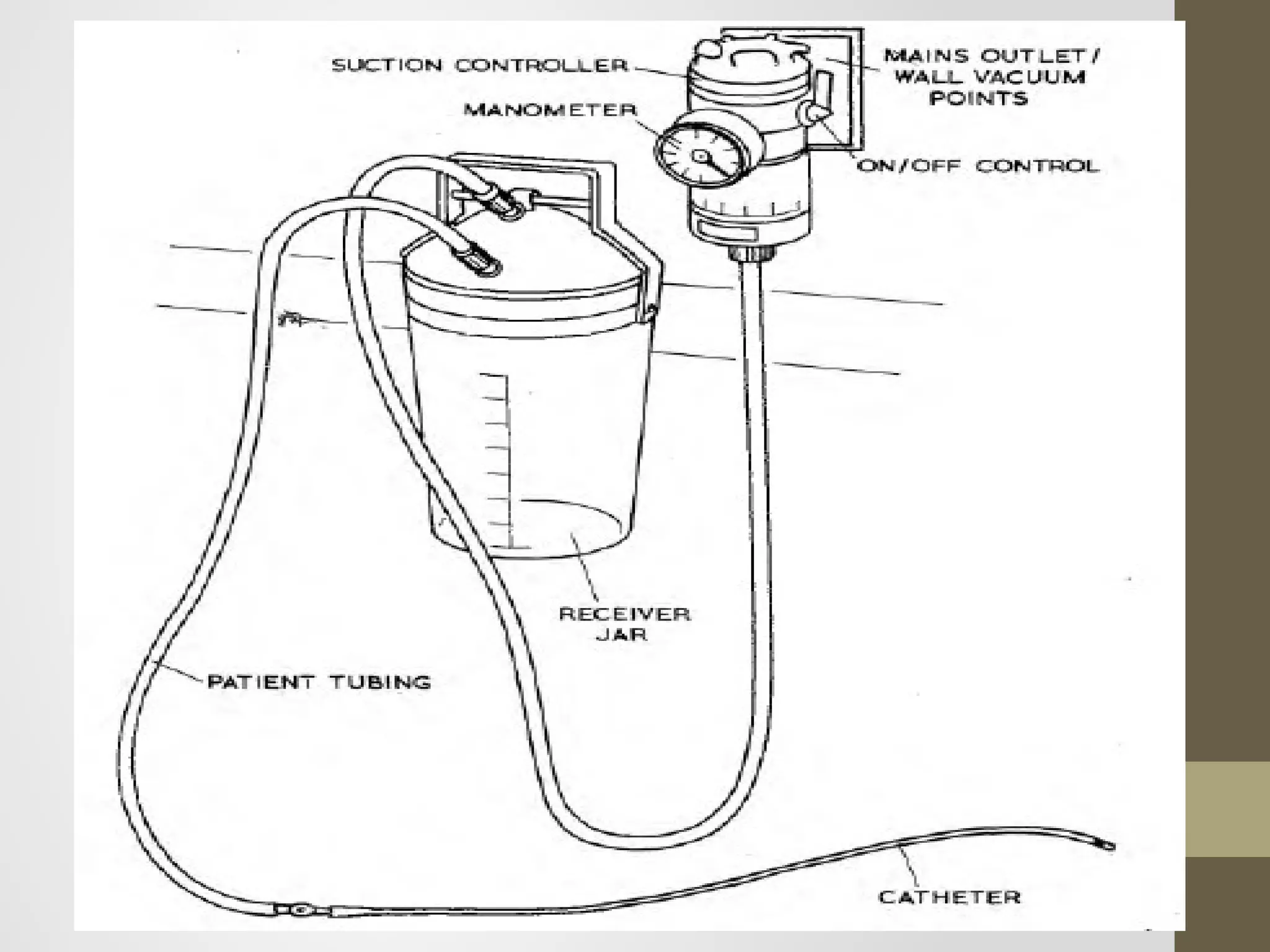
1. Common vacuum pumps
• A vacuum point close to the patient’s bed
• The power is provided by a large motor situated at some
convenient site within the hospital grounds
• Commonly found in ITUs and on wards in modern hospitals
• An on/off switch
• Control dial for set negative pressure to be increased or
decreased
• A manometer displays the pressure used
• They have approximately — 5ommHg,— ioommHg and —
300mmHg.
Suction pumps
Suction pumps
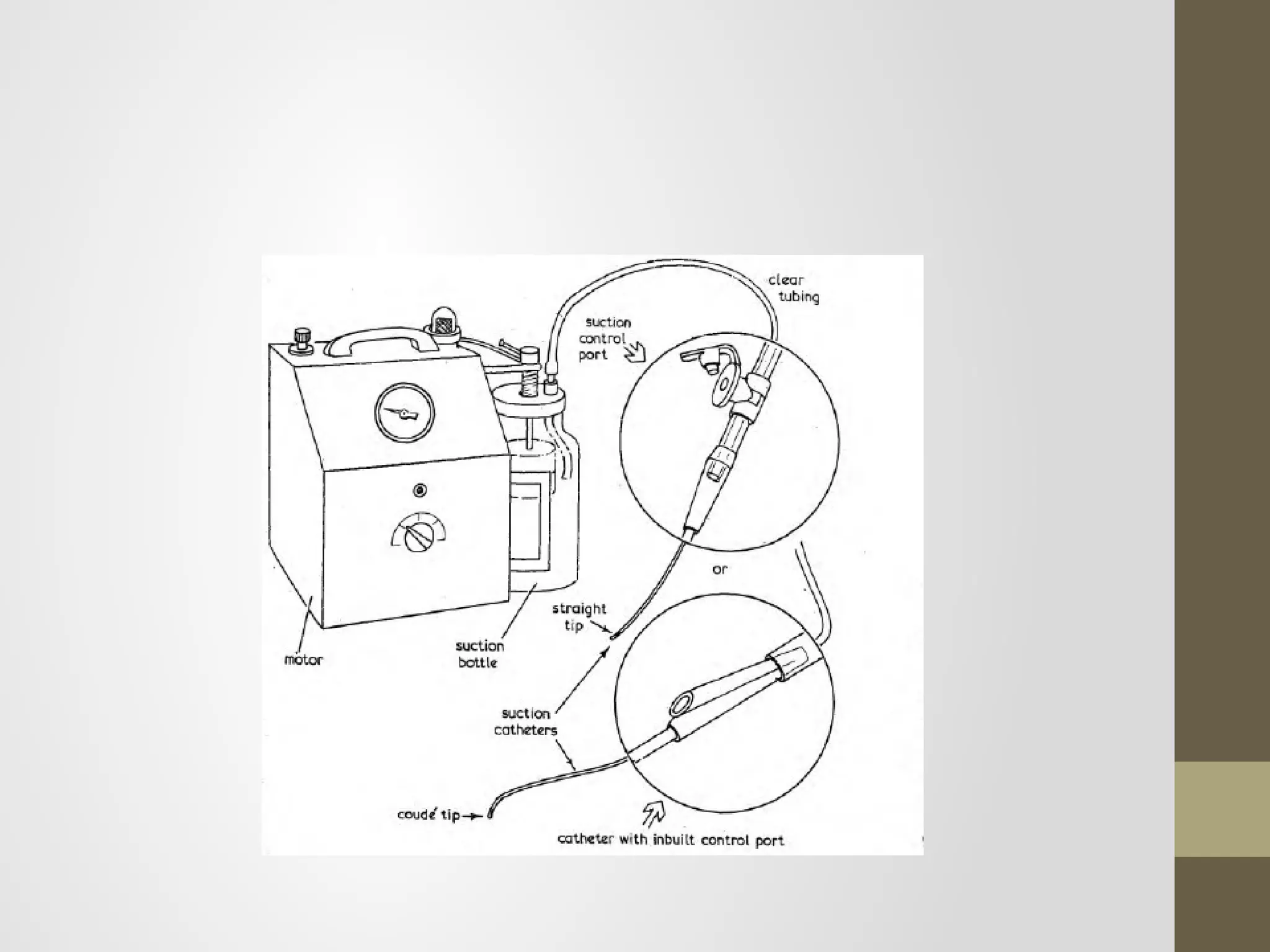
2. Electrical suction apparatus
• Powered from the mains
• This type has its own small motor, with an on/off switch and a
control dial
• This is the equipment most commonly used on wards where a
vacuum point is not available
Suction pumps
3. Portable suction apparatus
• available powered by rechargeable batteries
• Has a small motor and on/off switch
• The machine should be tested at frequent intervals to check the batteries
5. Foot pump
• The power is provided by the operator
• This pump was the only type available in the period when intensive care
was developing
• Modern versions are available and, like the battery operated pumps, these
are suitable for use in the community or for an emergency resuscitation
team
Suction tubing
• This leads from the suction bottle to the connection for the
suction catheter
• Usually the tubing is made from clear plastic for easy viewing
of secretions
• Disposable
• Sometimes rubber tubing is used
Connections
• Usually plastic and either clear or semitransparent
• Most connections have three holes
• Y-connector three arms; one at either end and a third at the side used
as the control port
• This opening offers less resistance to the suction force
• To apply the suction force to the catheter the operator places a finger
or thumb over the opening
Catheters
• Mostly soft, clear plastic and disposable
• Vital that the correct size of catheter is used for each patient
• Should not exceed half the diameter of the endotracheal or
tracheostomy tube
• Too large a catheter may cause alveolar collapse when suction is
applied
• Soft rubber catheters are still used in some hospitals
• They are softer and more flexible than the plastic catheters
• They may be too short for some endotracheal tubes
Catheters
• Coude catheters
• sometimes known as bronchoscopy or Pinkerton’s catheters,
• These are extra long catheters with a curved tip used for
selective suctioning of the left main bronchus
• A straight catheter passed beyond the carina
• Using a coude catheter with the head side flexed to the right
gives a greater chance of the catheter entering the left main
bronchus
Catheter
• Argyle Aero-Flo catheters
• which have a specially designed tip to minimize mucosal trauma
• These catheters have a bead surrounding the distal hole at the
end of the catheter, and there are four small holes
Suction trolley
• Sterile plastic gloves - disposable
• Suction catheters - appropriate sizes for the patient
• Lubricating jelly water-based only, not oil-based, for use in
nasopharyngeal suction.
• Sterile gauze swabs - to transfer jelly to tip of catheter
• Bowl of sodium bicarbonate or sterile water - to flush the
secretions through the catheter and tubing
• Plastic bag for the collection of disposables
• Bowl of antiseptic solution for the collection of items to be
sterilised
Suction techniques
• Sterile technique
• Mode of entry
• Nose
• Mouth
• Tube
• First practice with unconscious patient
Suction technique
• Nasopharyngeal
• Neck extended
• Introduce on Inspiration phase only
• Not for head injury patient due to leakage of CSF
• Oropharyngeal
• Less use
• Plastic airway to avoid catheter bit by patient
• Suction via tube
• catheter is introduced into an endotracheal, tracheostomy or mini-
tracheotomy tube
• Breath hold technique by physiotherapist
• Tracheostomy mini tube
Procedure
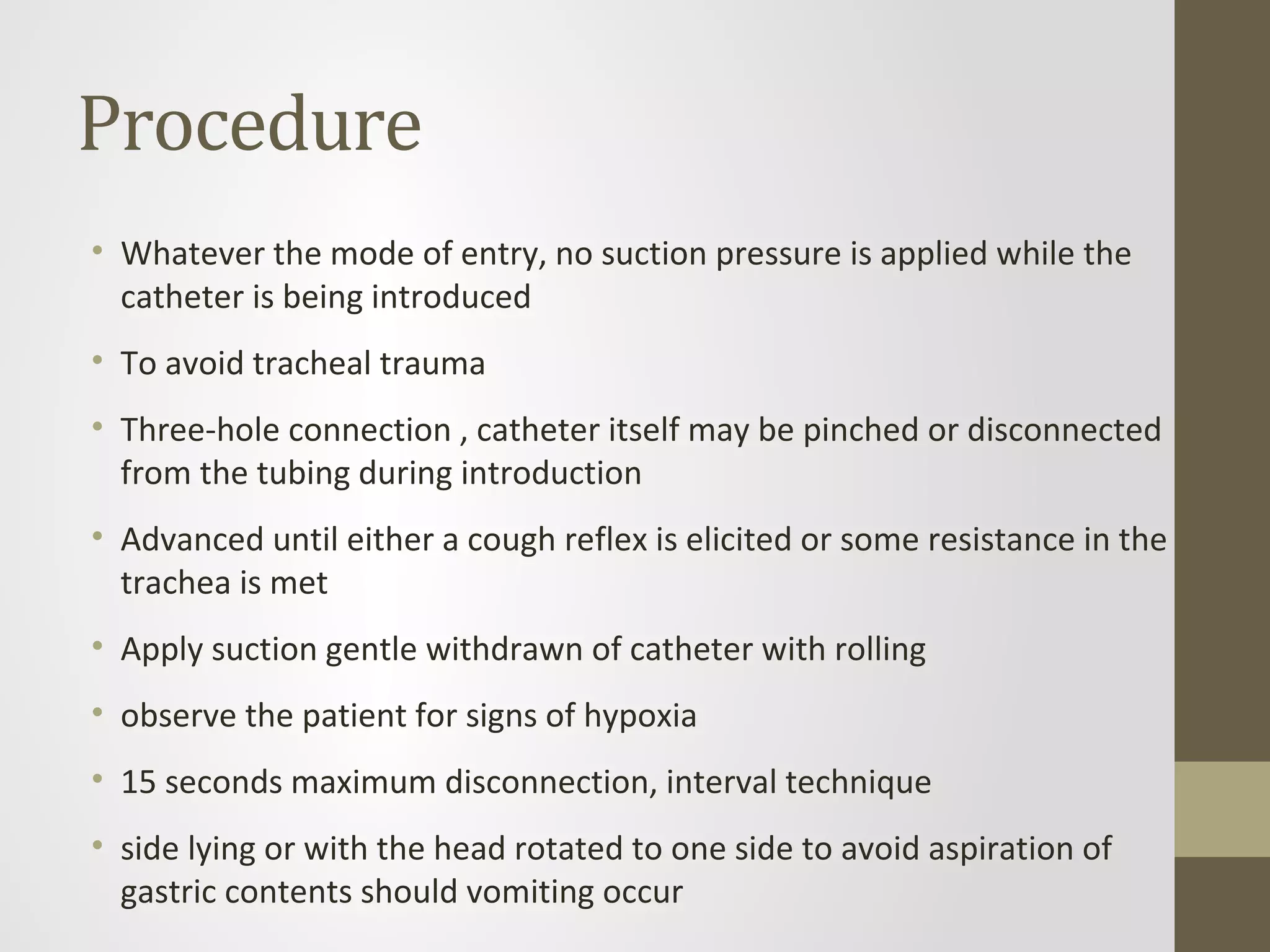
• Whatever the mode of entry, no suction pressure is applied while the
catheter is being introduced
• To avoid tracheal trauma
• Three-hole connection , catheter itself may be pinched or disconnected
from the tubing during introduction
• Advanced until either a cough reflex is elicited or some resistance in the
trachea is met
• Apply suction gentle withdrawn of catheter with rolling
• observe the patient for signs of hypoxia
• 15 seconds maximum disconnection, interval technique
• side lying or with the head rotated to one side to avoid aspiration of
gastric contents should vomiting occur
HAZARDS OF AIRWAY SUCTION
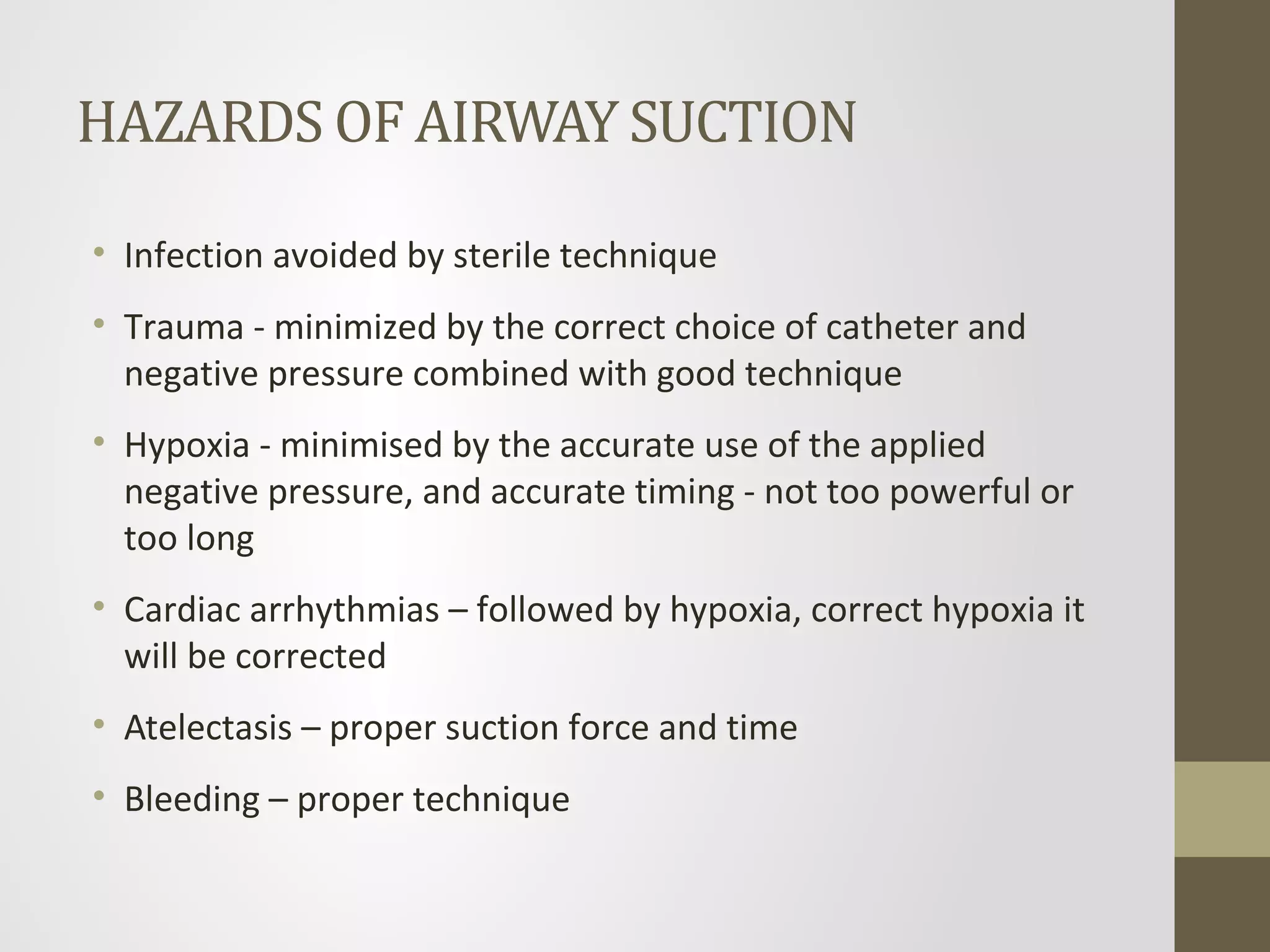
• Infection avoided by sterile technique
• Trauma - minimized by the correct choice of catheter and
negative pressure combined with good technique
• Hypoxia - minimised by the accurate use of the applied
negative pressure, and accurate timing - not too powerful or
too long
• Cardiac arrhythmias – followed by hypoxia, correct hypoxia it
will be corrected
• Atelectasis – proper suction force and time
• Bleeding – proper technique

Suction

  • 1.
  • 2.
    Introduction • Airway suctionfrequently used to removal of secretion in lung • Is to be given whenever • secretions can be heard in an intubated patient • who is unable to cough and expectorate efficiently • Before and during the release of the cuff on a tracheostomy tube • presence of a large plug of mucus in one of the larger bronch • If the minute volume (MV) drops
  • 3.
    Suction equipment 1. Suctionpumps 2. Tubing 3. Connections 4. Catheter 5. Suction trolley
  • 4.
    Suction pumps 1. Commonvacuum pumps • A vacuum point close to the patient’s bed • The power is provided by a large motor situated at some convenient site within the hospital grounds • Commonly found in ITUs and on wards in modern hospitals • An on/off switch • Control dial for set negative pressure to be increased or decreased • A manometer displays the pressure used • They have approximately — 5ommHg,— ioommHg and — 300mmHg.
  • 5.
  • 6.
    Suction pumps 2. Electricalsuction apparatus • Powered from the mains • This type has its own small motor, with an on/off switch and a control dial • This is the equipment most commonly used on wards where a vacuum point is not available
  • 8.
    Suction pumps 3. Portablesuction apparatus • available powered by rechargeable batteries • Has a small motor and on/off switch • The machine should be tested at frequent intervals to check the batteries 5. Foot pump • The power is provided by the operator • This pump was the only type available in the period when intensive care was developing • Modern versions are available and, like the battery operated pumps, these are suitable for use in the community or for an emergency resuscitation team
  • 9.
    Suction tubing • Thisleads from the suction bottle to the connection for the suction catheter • Usually the tubing is made from clear plastic for easy viewing of secretions • Disposable • Sometimes rubber tubing is used
  • 10.
    Connections • Usually plasticand either clear or semitransparent • Most connections have three holes • Y-connector three arms; one at either end and a third at the side used as the control port • This opening offers less resistance to the suction force • To apply the suction force to the catheter the operator places a finger or thumb over the opening
  • 11.
    Catheters • Mostly soft,clear plastic and disposable • Vital that the correct size of catheter is used for each patient • Should not exceed half the diameter of the endotracheal or tracheostomy tube • Too large a catheter may cause alveolar collapse when suction is applied • Soft rubber catheters are still used in some hospitals • They are softer and more flexible than the plastic catheters • They may be too short for some endotracheal tubes
  • 12.
    Catheters • Coude catheters •sometimes known as bronchoscopy or Pinkerton’s catheters, • These are extra long catheters with a curved tip used for selective suctioning of the left main bronchus • A straight catheter passed beyond the carina • Using a coude catheter with the head side flexed to the right gives a greater chance of the catheter entering the left main bronchus
  • 13.
    Catheter • Argyle Aero-Flocatheters • which have a specially designed tip to minimize mucosal trauma • These catheters have a bead surrounding the distal hole at the end of the catheter, and there are four small holes
  • 16.
    Suction trolley • Sterileplastic gloves - disposable • Suction catheters - appropriate sizes for the patient • Lubricating jelly water-based only, not oil-based, for use in nasopharyngeal suction. • Sterile gauze swabs - to transfer jelly to tip of catheter • Bowl of sodium bicarbonate or sterile water - to flush the secretions through the catheter and tubing • Plastic bag for the collection of disposables • Bowl of antiseptic solution for the collection of items to be sterilised
  • 17.
    Suction techniques • Steriletechnique • Mode of entry • Nose • Mouth • Tube • First practice with unconscious patient
  • 18.
    Suction technique • Nasopharyngeal •Neck extended • Introduce on Inspiration phase only • Not for head injury patient due to leakage of CSF • Oropharyngeal • Less use • Plastic airway to avoid catheter bit by patient • Suction via tube • catheter is introduced into an endotracheal, tracheostomy or mini- tracheotomy tube • Breath hold technique by physiotherapist • Tracheostomy mini tube
  • 19.
    Procedure • Whatever themode of entry, no suction pressure is applied while the catheter is being introduced • To avoid tracheal trauma • Three-hole connection , catheter itself may be pinched or disconnected from the tubing during introduction • Advanced until either a cough reflex is elicited or some resistance in the trachea is met • Apply suction gentle withdrawn of catheter with rolling • observe the patient for signs of hypoxia • 15 seconds maximum disconnection, interval technique • side lying or with the head rotated to one side to avoid aspiration of gastric contents should vomiting occur
  • 20.
    HAZARDS OF AIRWAYSUCTION • Infection avoided by sterile technique • Trauma - minimized by the correct choice of catheter and negative pressure combined with good technique • Hypoxia - minimised by the accurate use of the applied negative pressure, and accurate timing - not too powerful or too long • Cardiac arrhythmias – followed by hypoxia, correct hypoxia it will be corrected • Atelectasis – proper suction force and time • Bleeding – proper technique