POPULATION GEOGRAPHY
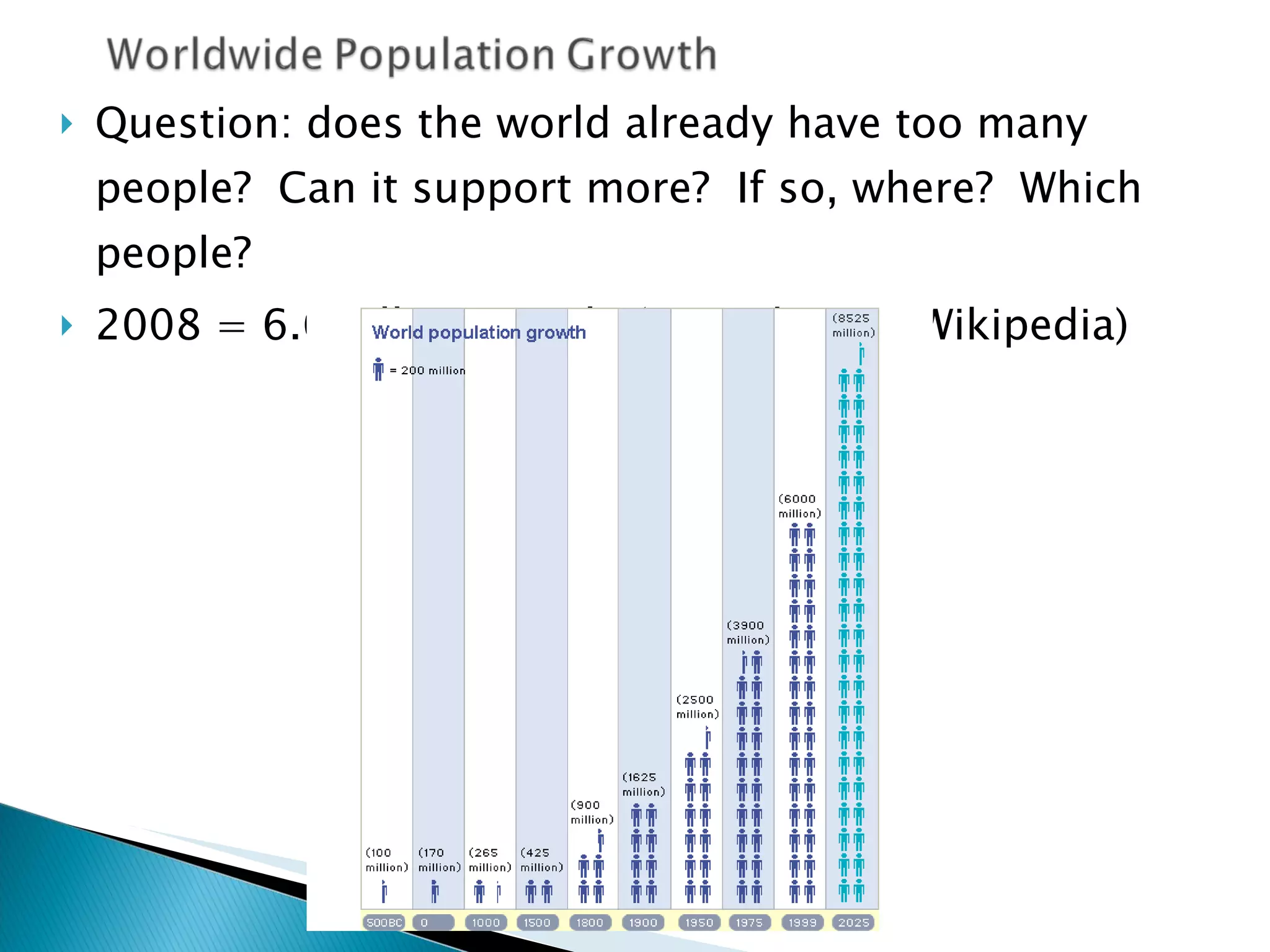
Question: does the world already have too many people?  Can it support more?  If so, where?  Which people?  2008 = 6.6 Billion people (according to Wikipedia)
Population Geographer - studies aspects affecting population Birthrate:  number of live births per thousand population according to Wikipedia: Congo is highest with 49.6 per 1000 and Japan is lowest with 8.2 per 1000 Fertility Rate:  average number of children per woman during childbearing years throughout lifetime according to CIA worldbook factbook: Niger is highest with 7.19 and Belarus is lowest with 1.20 --replacement rate: number of children each mother must have to maintain current population --estimated is 2.1  WHY might this figure be misleading?  Is it more appropriate to analyze country levels rather than world?
Mortality Rate:  number of deaths per thousand (also called the death rate) QUESTION--What would be an ideal or healthy mortality rate?  Infant Mortality Rate:  number of deaths among infants under age one per thousand live births QUESTION--What nations might you assume have a high infant mortality rate?  Why?  Low rate?  Why?  What factors affect this?  according to the CIA Worldfact book the US has 6.3 per one thousand, ranking number 46--behind Cuba, most of Europe, South Korea, Japan, and Singapore…is this surprising?  Why or why not?  Other rates studied: perinatal mortality, maternal mortality, child mortality, standardized mortality rate
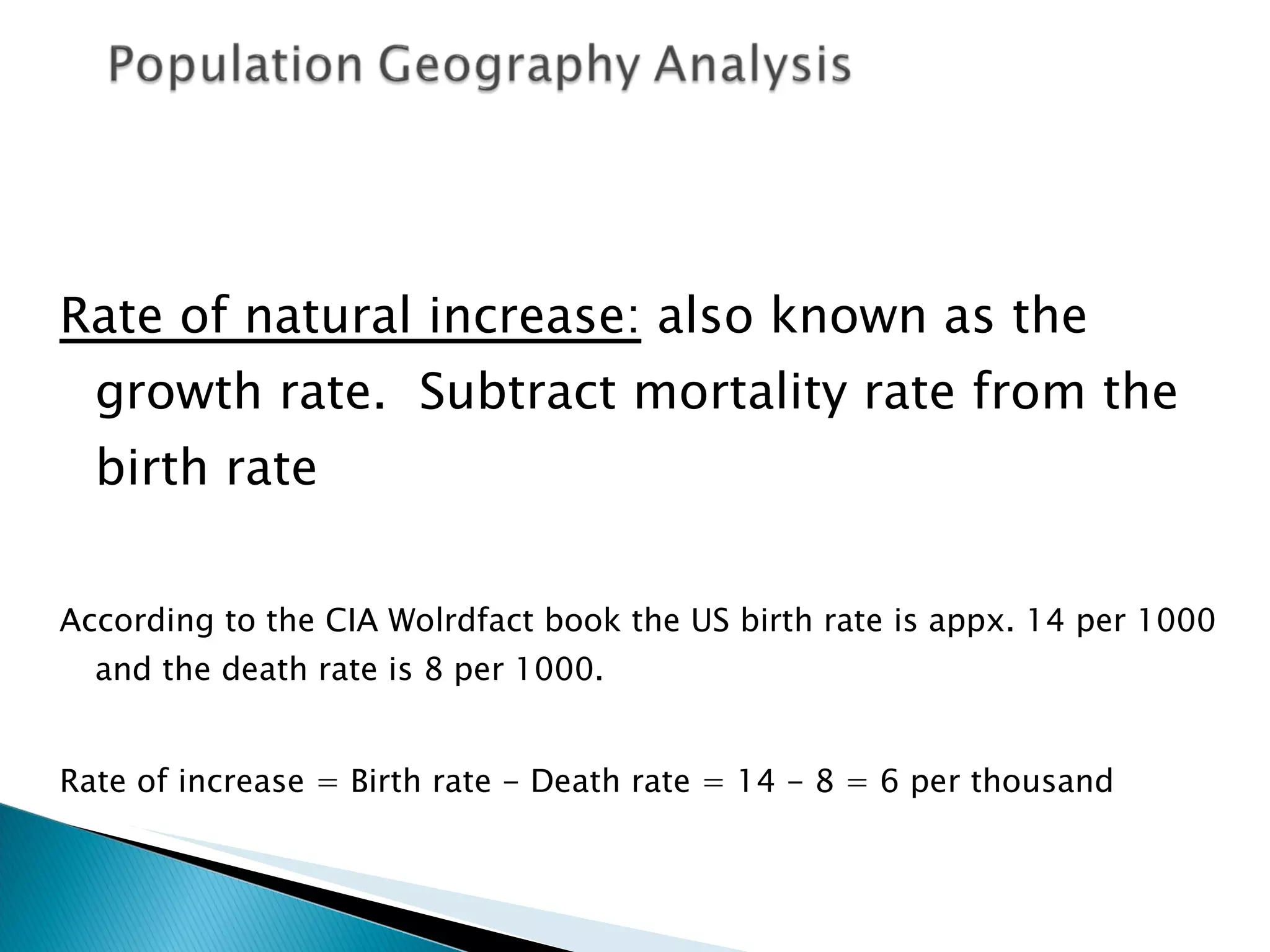
Rate of natural increase:  also known as the growth rate.  Subtract mortality rate from the birth rate According to the CIA Wolrdfact book the US birth rate is appx. 14 per 1000 and the death rate is 8 per 1000.  Rate of increase = Birth rate - Death rate = 14 - 8 = 6 per thousand
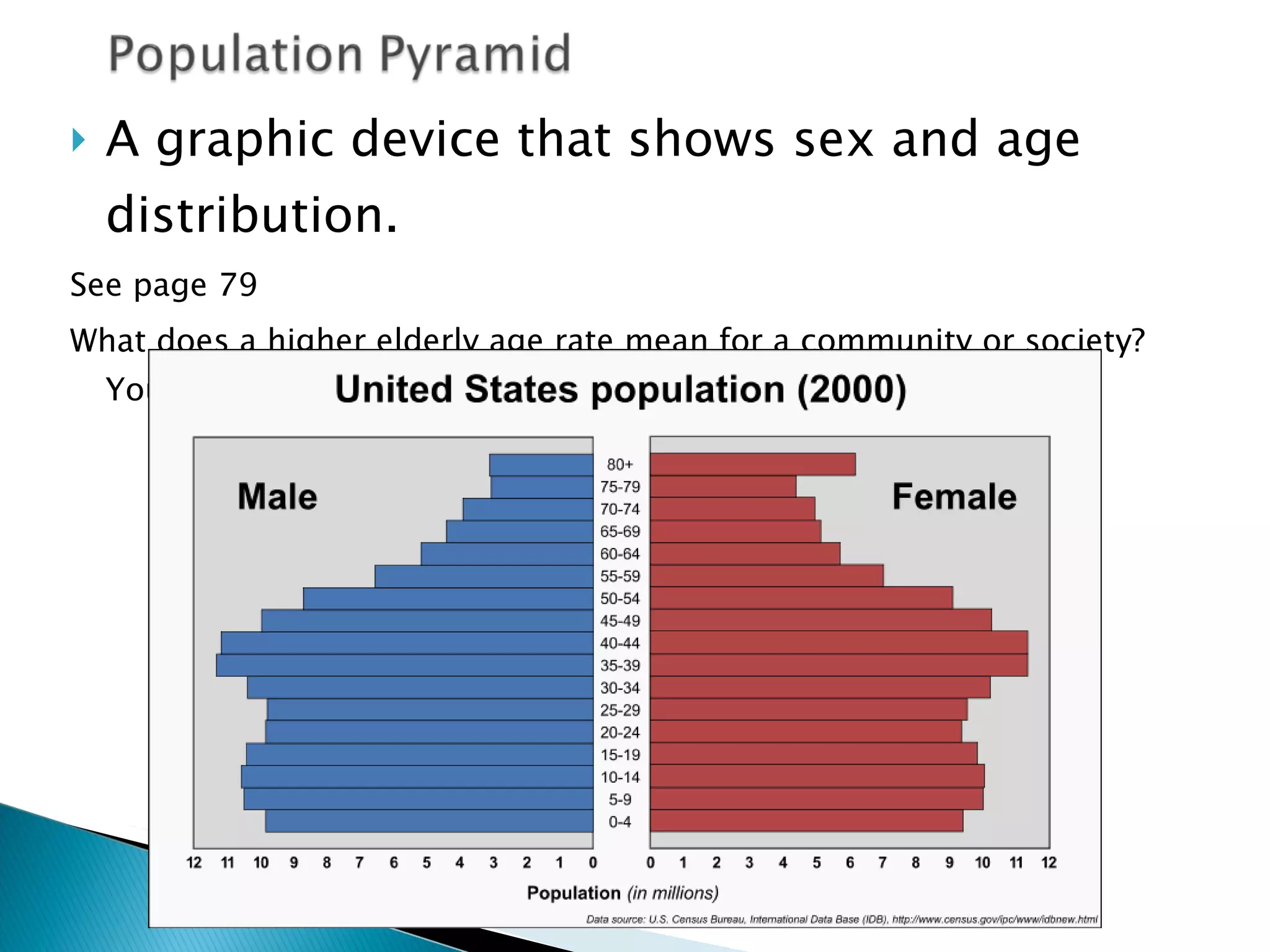
A graphic device that shows sex and age distribution. See page 79 What does a higher elderly age rate mean for a community or society?  Young age?  What is most ideal?
Habitable Lands 90% of people live in Northern Hemisphere Lands between 20 degrees and 60 degrees N latitude have very suitable climate and vegetation conditions = more dense human population High population density in coastal regions and river valleys Lower population density in polar regions, heavily mountainous regions, desert regions More than 1/2 of world’s population lives in rural areas, but dramatically changing Largest city in world = city (proper) = Mumbai, India at 13 million Let’s look at map on page 80 QUESTION: What affect does a higher urban population have on society, nations, the world?
Migration 1.Push factors - factors causing people to leave homeland and migrate to another region Environmental conditions War Natural disasters Persecution 2.Pull factors - factors that draw or attract people to another location Good economy High salary Climate
Pop. Den. Is the average number of people who live in a measurable area (such as square mile or kilometer) How to calculate? Total number of inhabitants/total amount of land New Jersey has density of app. 1000 people per square mile and Australia has density of app. 6 people per square mile…what is misleading about these figures?  Carrying Capacity: the number of organisms a piece of land can support QUESTION--What factors can increase carrying capacity?
Explain the factors involved in the world’s population growth Describe the distribution of the world’s population Describe some factors that influence population density and carrying capacity

Geo: Chapter 4, Section 2

  • 1.
  • 2.
    Question: does theworld already have too many people? Can it support more? If so, where? Which people? 2008 = 6.6 Billion people (according to Wikipedia)
  • 3.
    Population Geographer -studies aspects affecting population Birthrate: number of live births per thousand population according to Wikipedia: Congo is highest with 49.6 per 1000 and Japan is lowest with 8.2 per 1000 Fertility Rate: average number of children per woman during childbearing years throughout lifetime according to CIA worldbook factbook: Niger is highest with 7.19 and Belarus is lowest with 1.20 --replacement rate: number of children each mother must have to maintain current population --estimated is 2.1 WHY might this figure be misleading? Is it more appropriate to analyze country levels rather than world?
  • 4.
    Mortality Rate: number of deaths per thousand (also called the death rate) QUESTION--What would be an ideal or healthy mortality rate? Infant Mortality Rate: number of deaths among infants under age one per thousand live births QUESTION--What nations might you assume have a high infant mortality rate? Why? Low rate? Why? What factors affect this? according to the CIA Worldfact book the US has 6.3 per one thousand, ranking number 46--behind Cuba, most of Europe, South Korea, Japan, and Singapore…is this surprising? Why or why not? Other rates studied: perinatal mortality, maternal mortality, child mortality, standardized mortality rate
  • 5.
    Rate of naturalincrease: also known as the growth rate. Subtract mortality rate from the birth rate According to the CIA Wolrdfact book the US birth rate is appx. 14 per 1000 and the death rate is 8 per 1000. Rate of increase = Birth rate - Death rate = 14 - 8 = 6 per thousand
  • 6.
    A graphic devicethat shows sex and age distribution. See page 79 What does a higher elderly age rate mean for a community or society? Young age? What is most ideal?
  • 7.
    Habitable Lands 90%of people live in Northern Hemisphere Lands between 20 degrees and 60 degrees N latitude have very suitable climate and vegetation conditions = more dense human population High population density in coastal regions and river valleys Lower population density in polar regions, heavily mountainous regions, desert regions More than 1/2 of world’s population lives in rural areas, but dramatically changing Largest city in world = city (proper) = Mumbai, India at 13 million Let’s look at map on page 80 QUESTION: What affect does a higher urban population have on society, nations, the world?
  • 8.
    Migration 1.Push factors- factors causing people to leave homeland and migrate to another region Environmental conditions War Natural disasters Persecution 2.Pull factors - factors that draw or attract people to another location Good economy High salary Climate
  • 9.
    Pop. Den. Isthe average number of people who live in a measurable area (such as square mile or kilometer) How to calculate? Total number of inhabitants/total amount of land New Jersey has density of app. 1000 people per square mile and Australia has density of app. 6 people per square mile…what is misleading about these figures? Carrying Capacity: the number of organisms a piece of land can support QUESTION--What factors can increase carrying capacity?
  • 10.
    Explain the factorsinvolved in the world’s population growth Describe the distribution of the world’s population Describe some factors that influence population density and carrying capacity