Key Stage 3
Mathematics
 Key Facts
  Level 6
Level 6


Number and Algebra
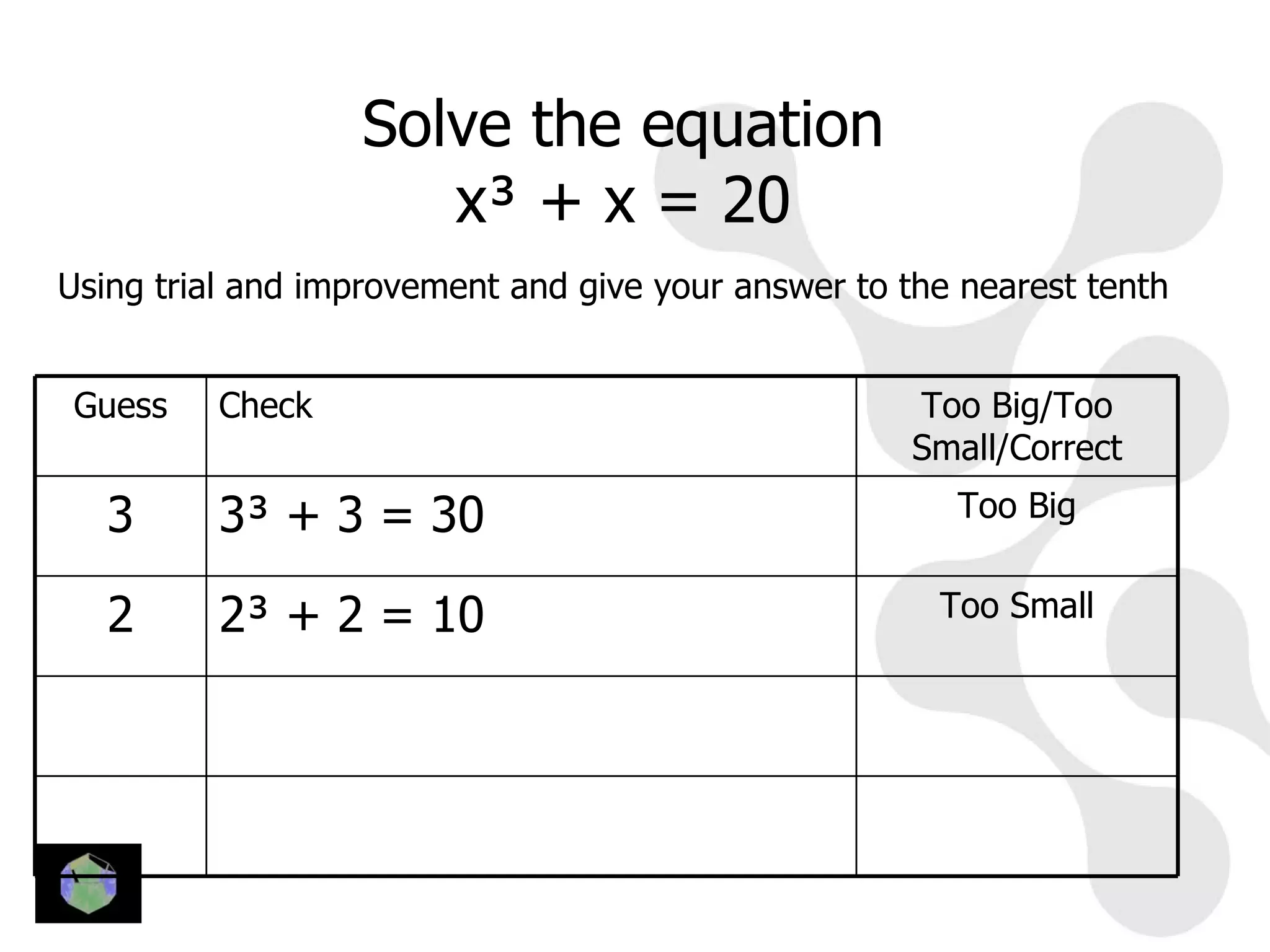
Solve the equation
                     x³ + x = 20
Using trial and improvement and give your answer to the nearest tenth


Guess     Check                                      Too Big/Too
                                                     Small/Correct
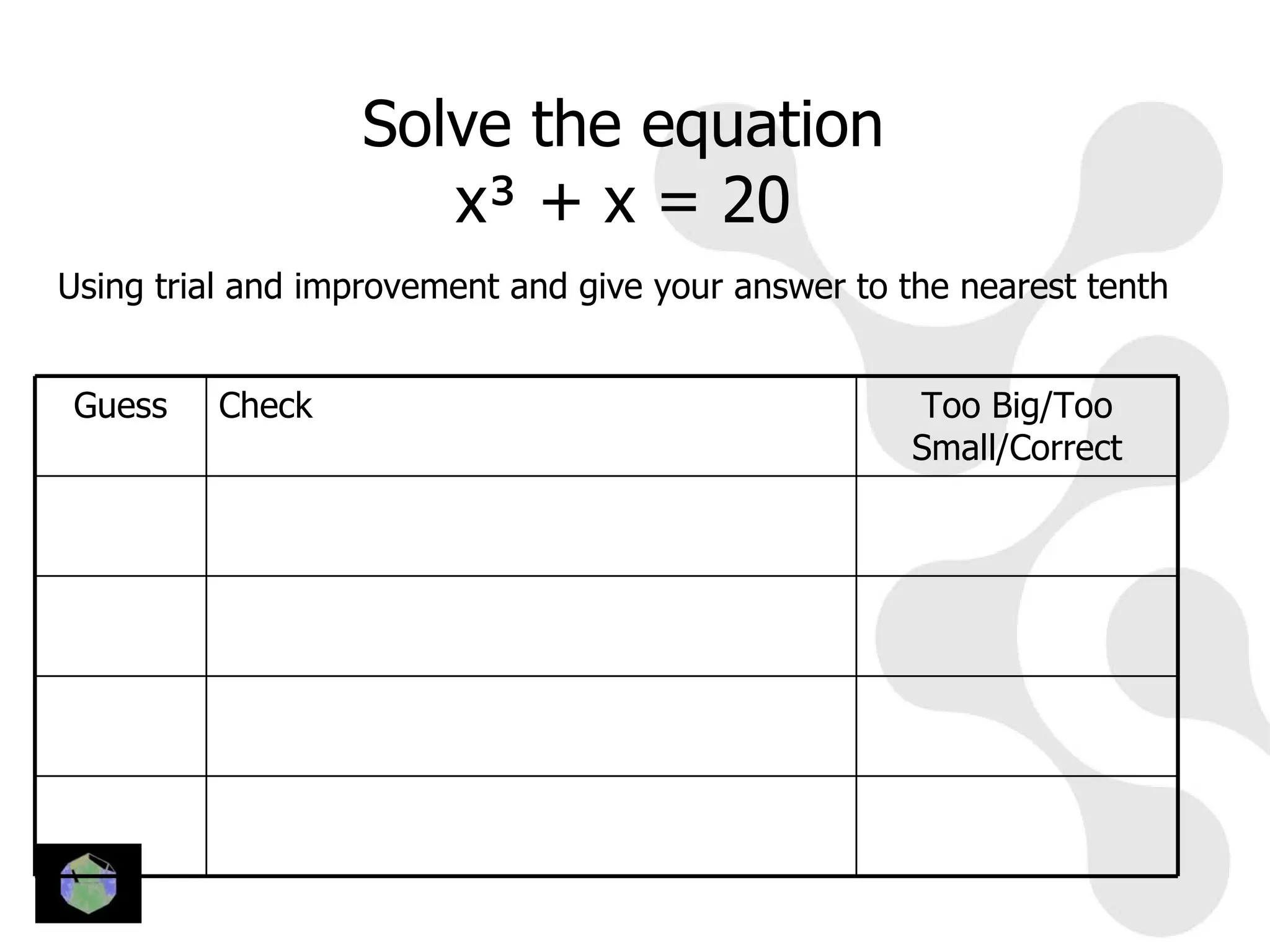
Solve the equation
                     x³ + x = 20
Using trial and improvement and give your answer to the nearest tenth


Guess     Check                                      Too Big/Too
                                                     Small/Correct

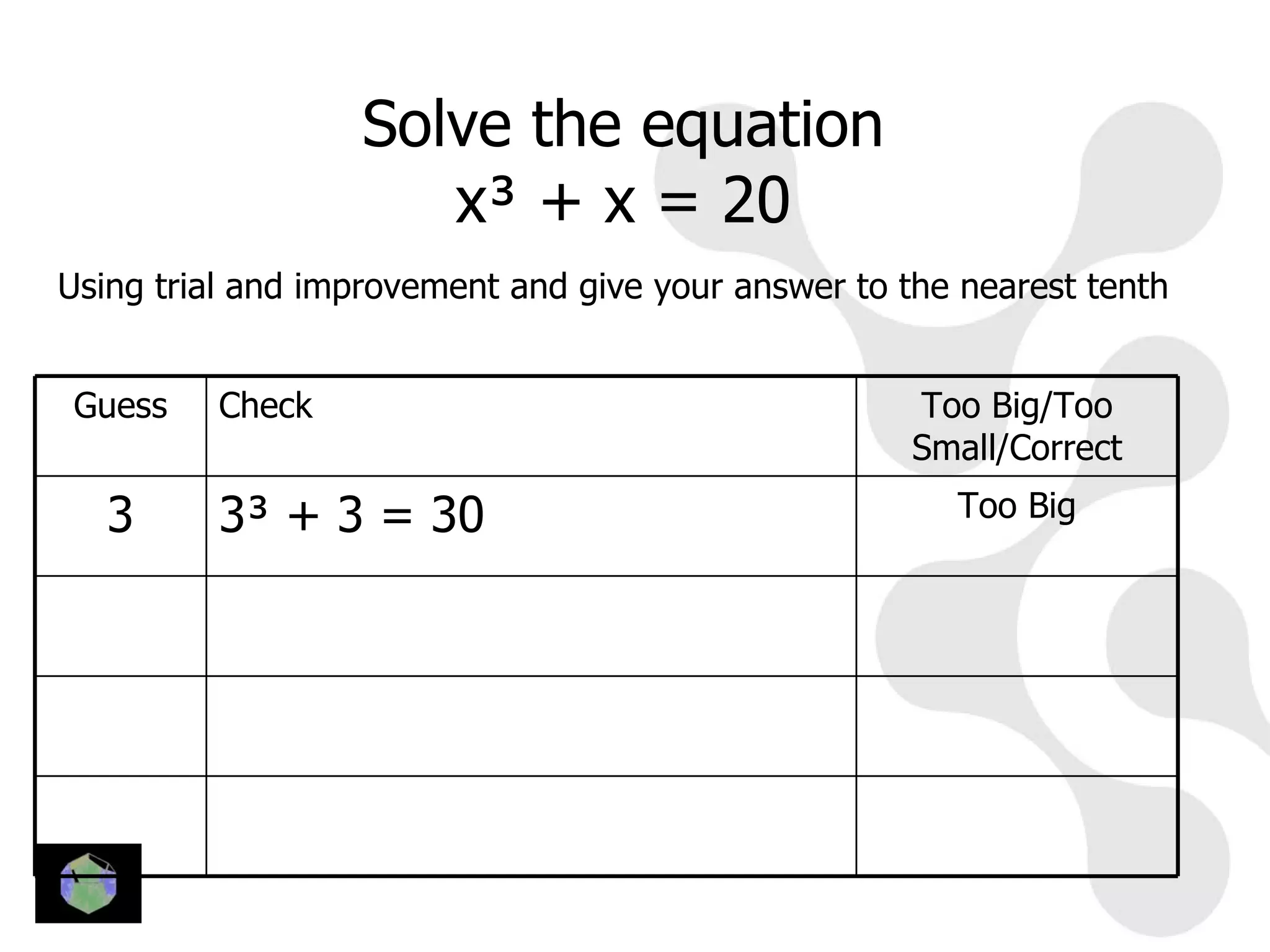
   3      3³ + 3 = 30                                  Too Big
Solve the equation
                     x³ + x = 20
Using trial and improvement and give your answer to the nearest tenth


Guess     Check                                      Too Big/Too
                                                     Small/Correct

   3      3³ + 3 = 30                                  Too Big


   2      2³ + 2 = 10                                 Too Small
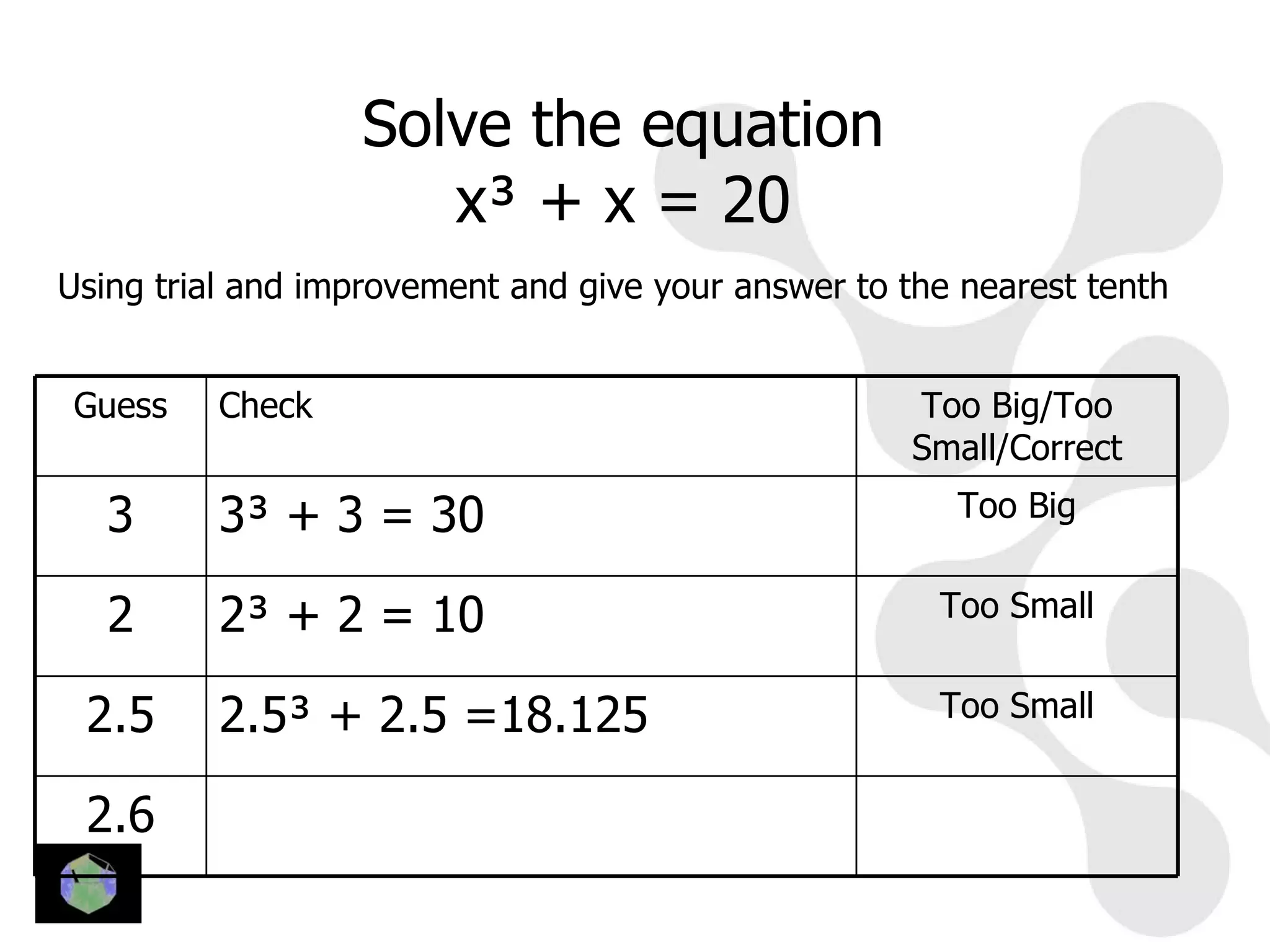
Solve the equation
                     x³ + x = 20
Using trial and improvement and give your answer to the nearest tenth


Guess     Check                                      Too Big/Too
                                                     Small/Correct

   3      3³ + 3 = 30                                  Too Big


   2      2³ + 2 = 10                                 Too Small


 2.5      2.5³ + 2.5 =18.125                          Too Small


 2.6
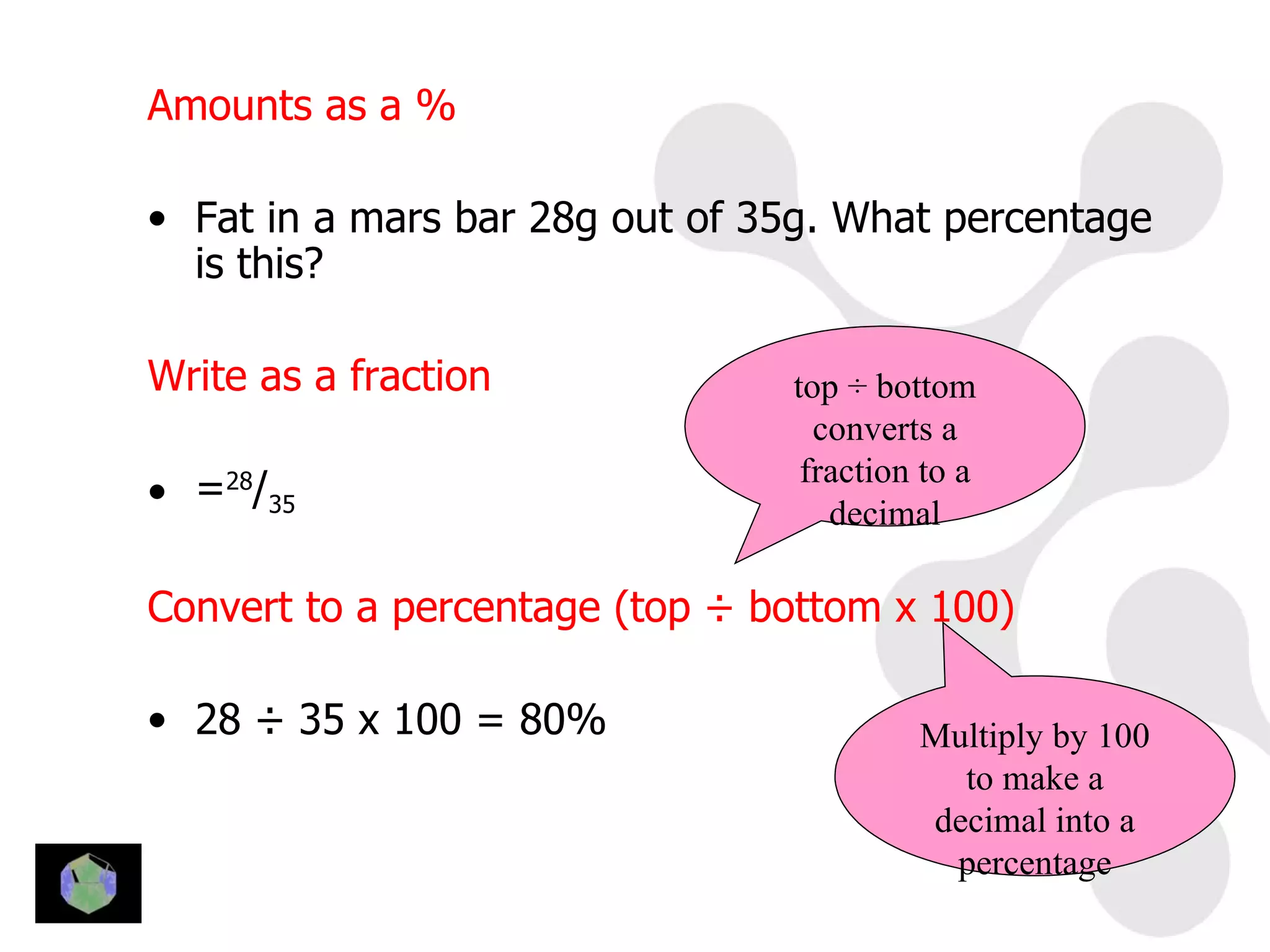
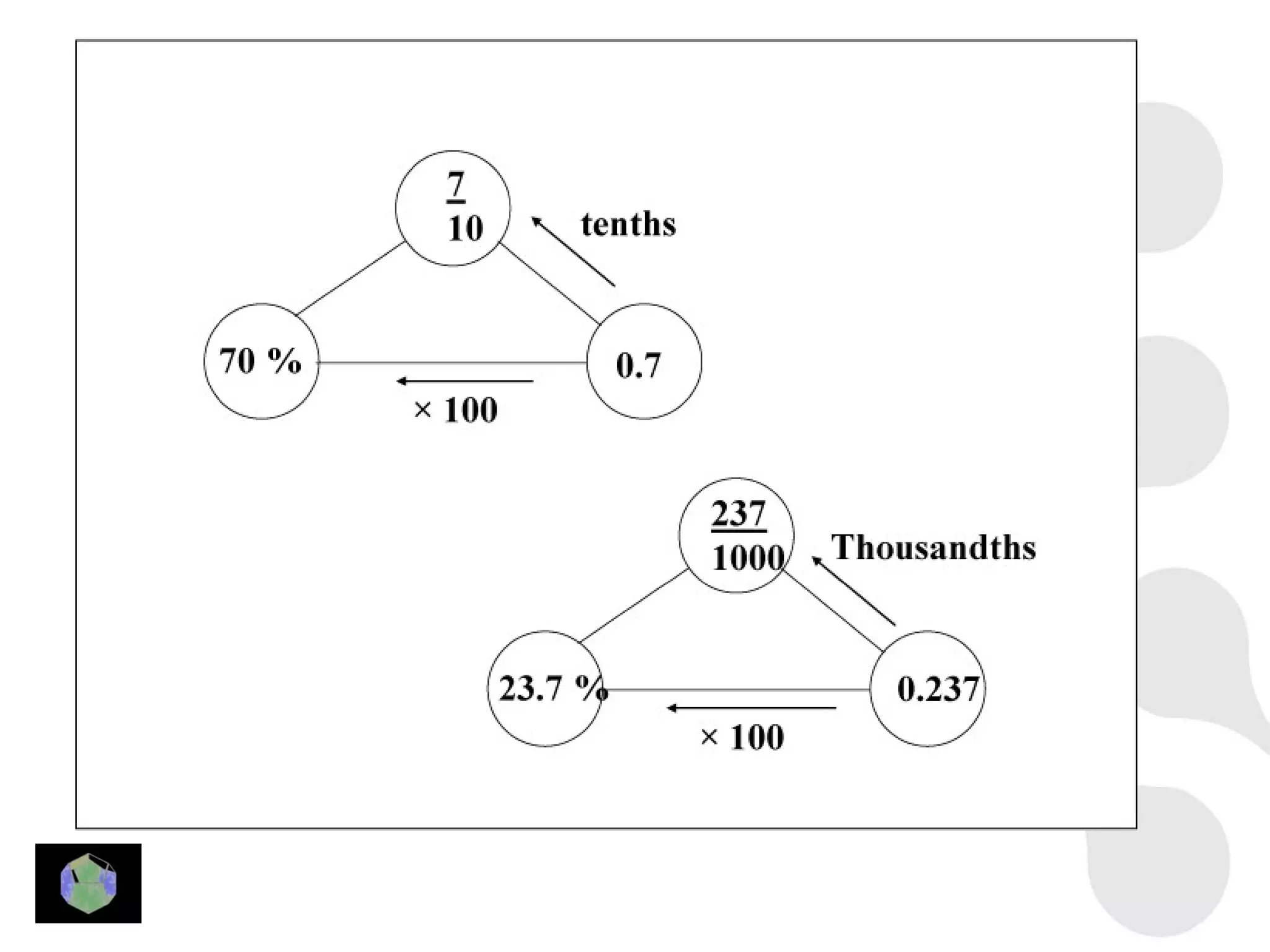
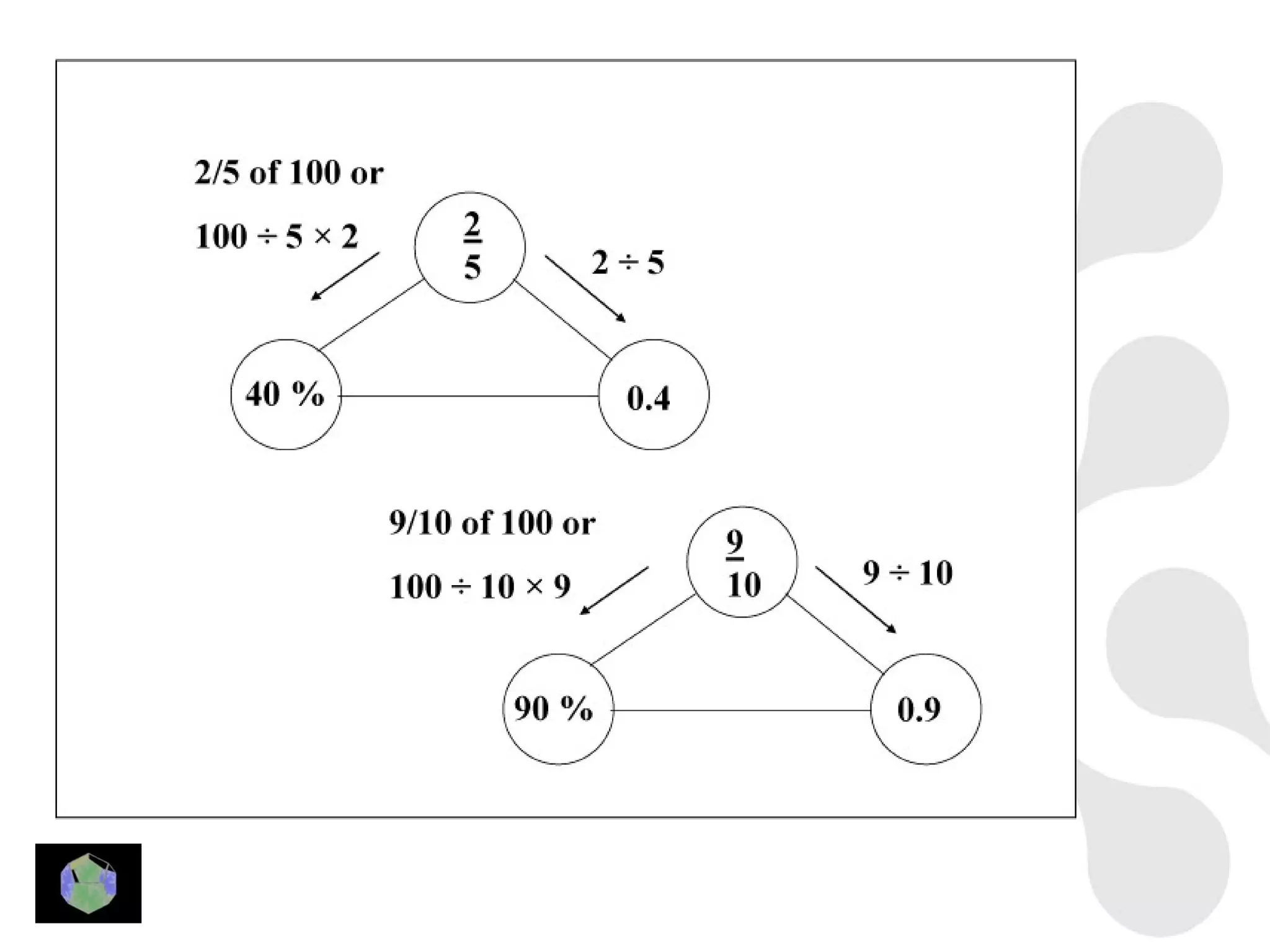
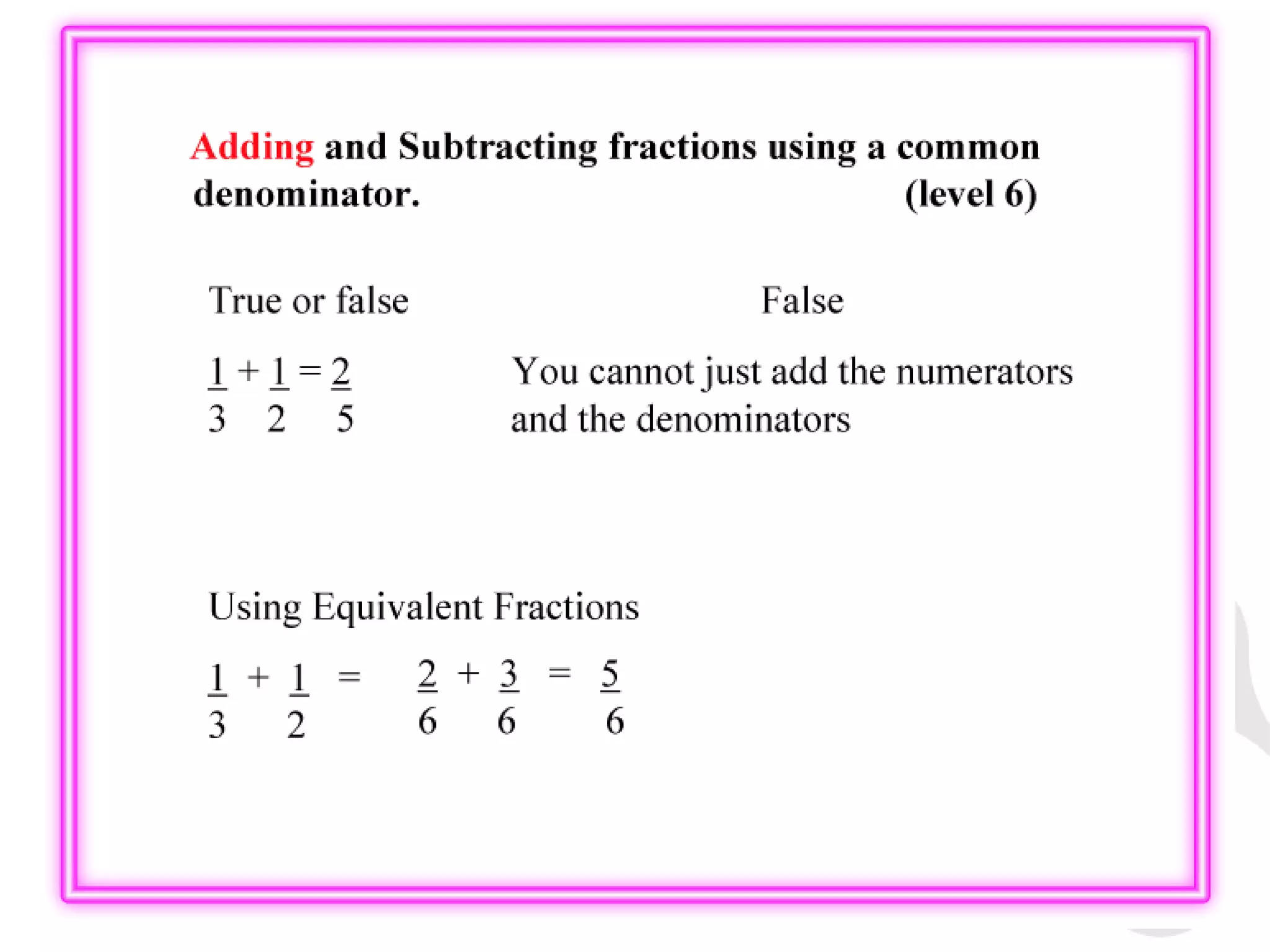
Amounts as a %

• Fat in a mars bar 28g out of 35g. What percentage
  is this?

Write as a fraction             top ÷ bottom
                                  converts a
                                 fraction to a
• =28/35                           decimal

Convert to a percentage (top ÷ bottom x 100)

• 28 ÷ 35 x 100 = 80%                    Multiply by 100
                                           to make a
                                         decimal into a
                                          percentage
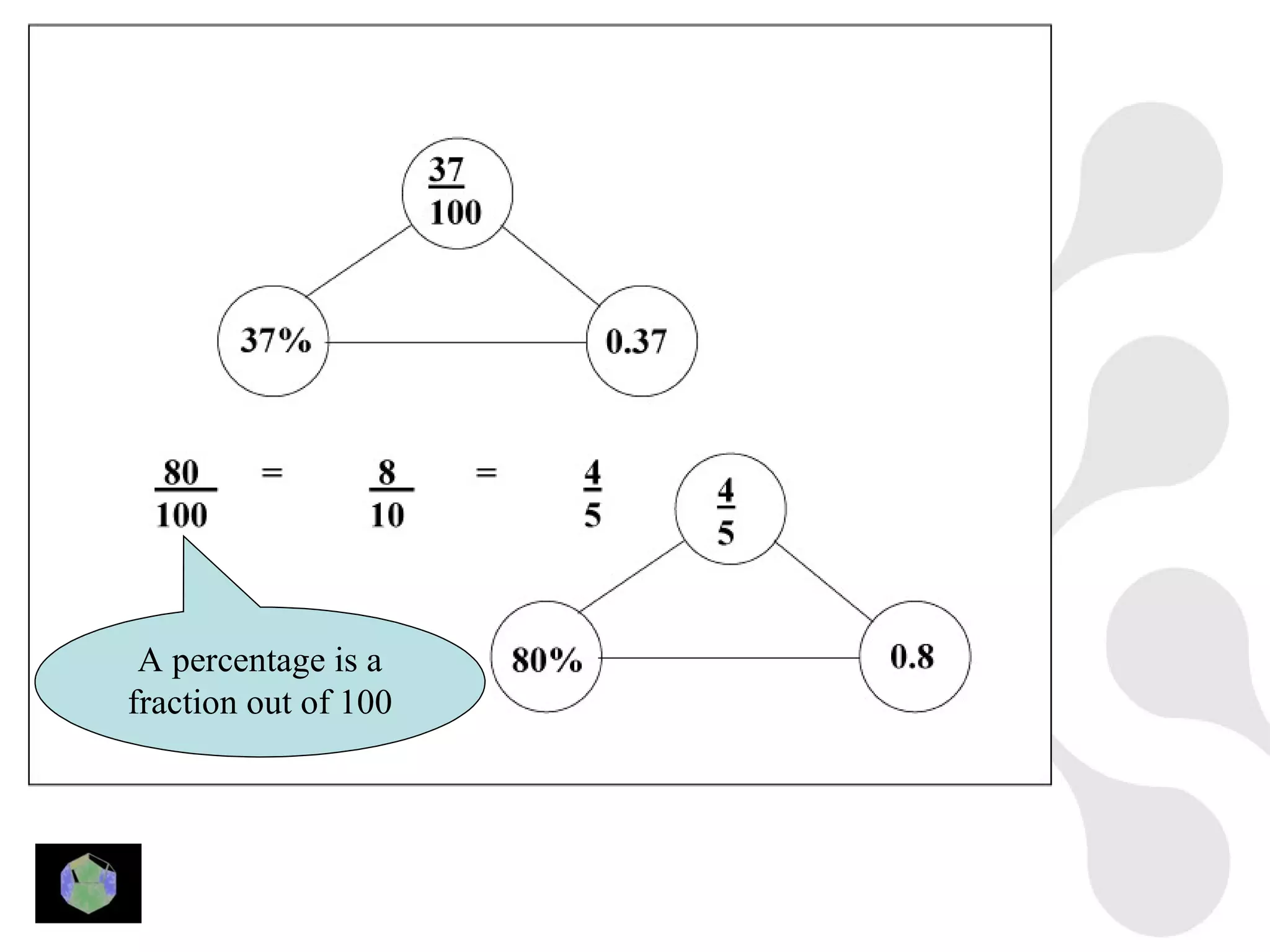
A percentage is a
fraction out of 100
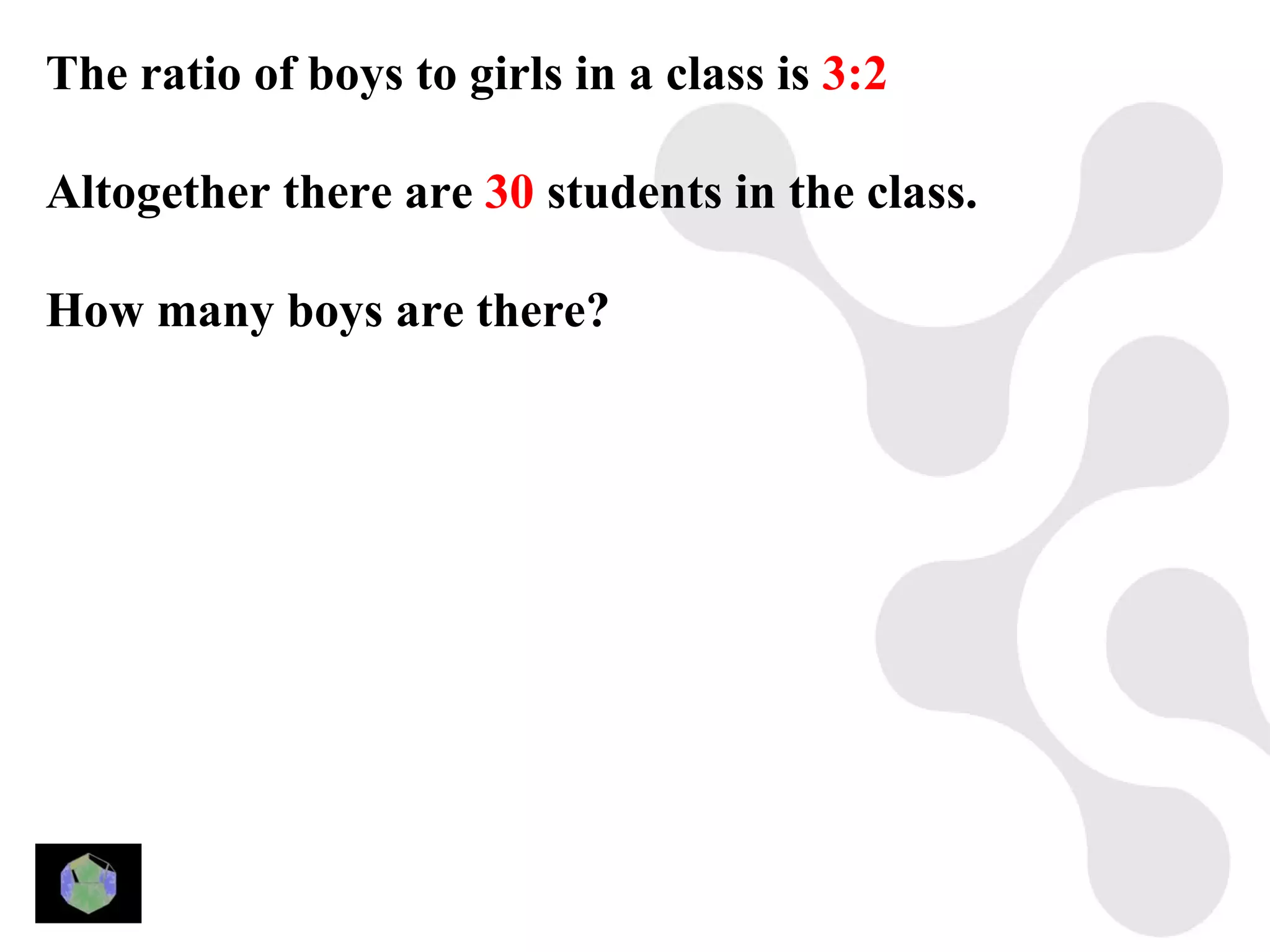
The ratio of boys to girls in a class is 3:2

Altogether there are 30 students in the class.

How many boys are there?
The ratio of boys to girls in a class is 3:2

Altogether there are 30 students in the class.

How many boys are there?

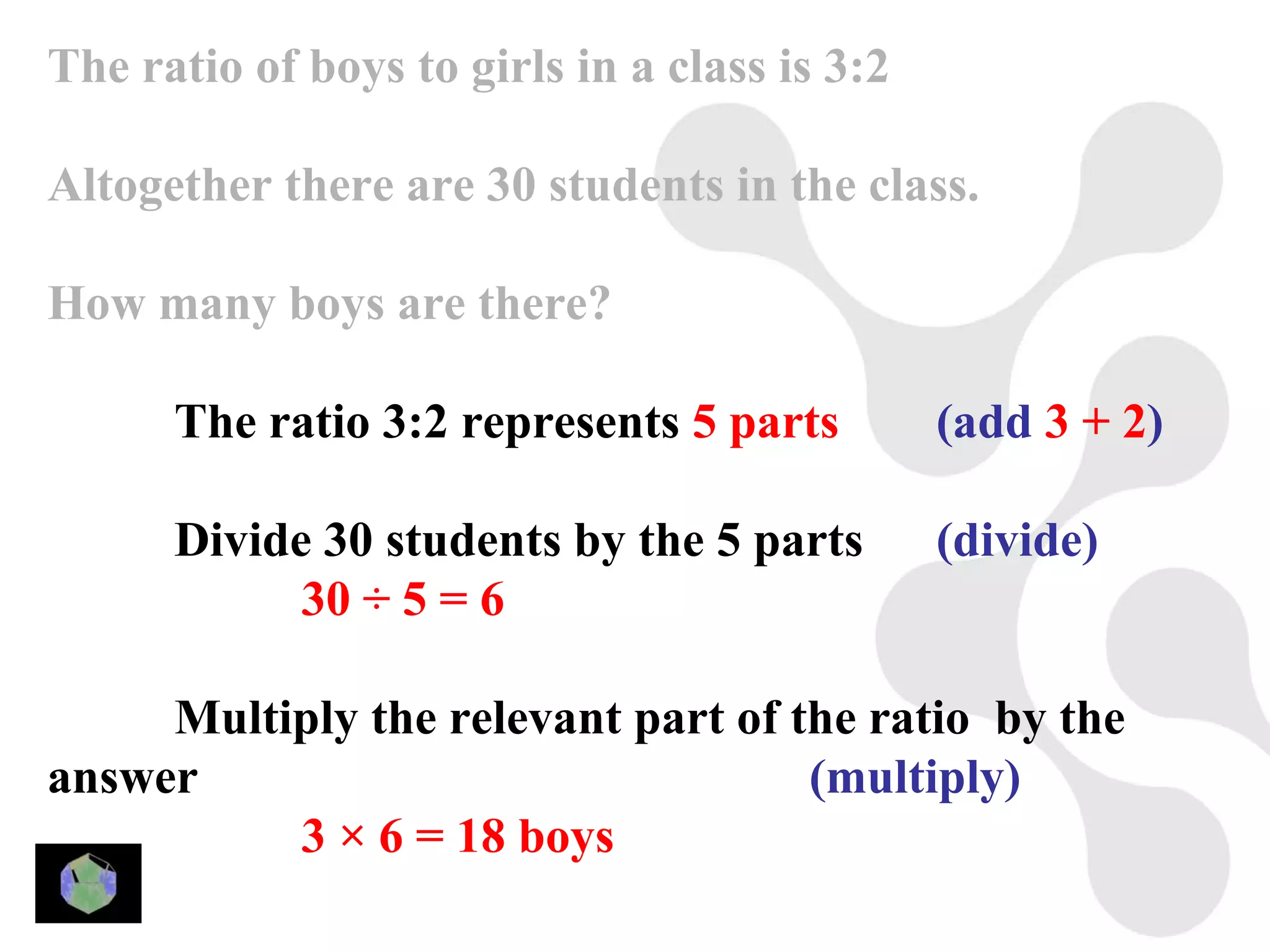
      The ratio 3:2 represents 5 parts         (add 3 + 2)

      Divide 30 students by the 5 parts        (divide)
            30 ÷ 5 = 6

     Multiply the relevant part of the ratio by the
answer                              (multiply)
          3 × 6 = 18 boys
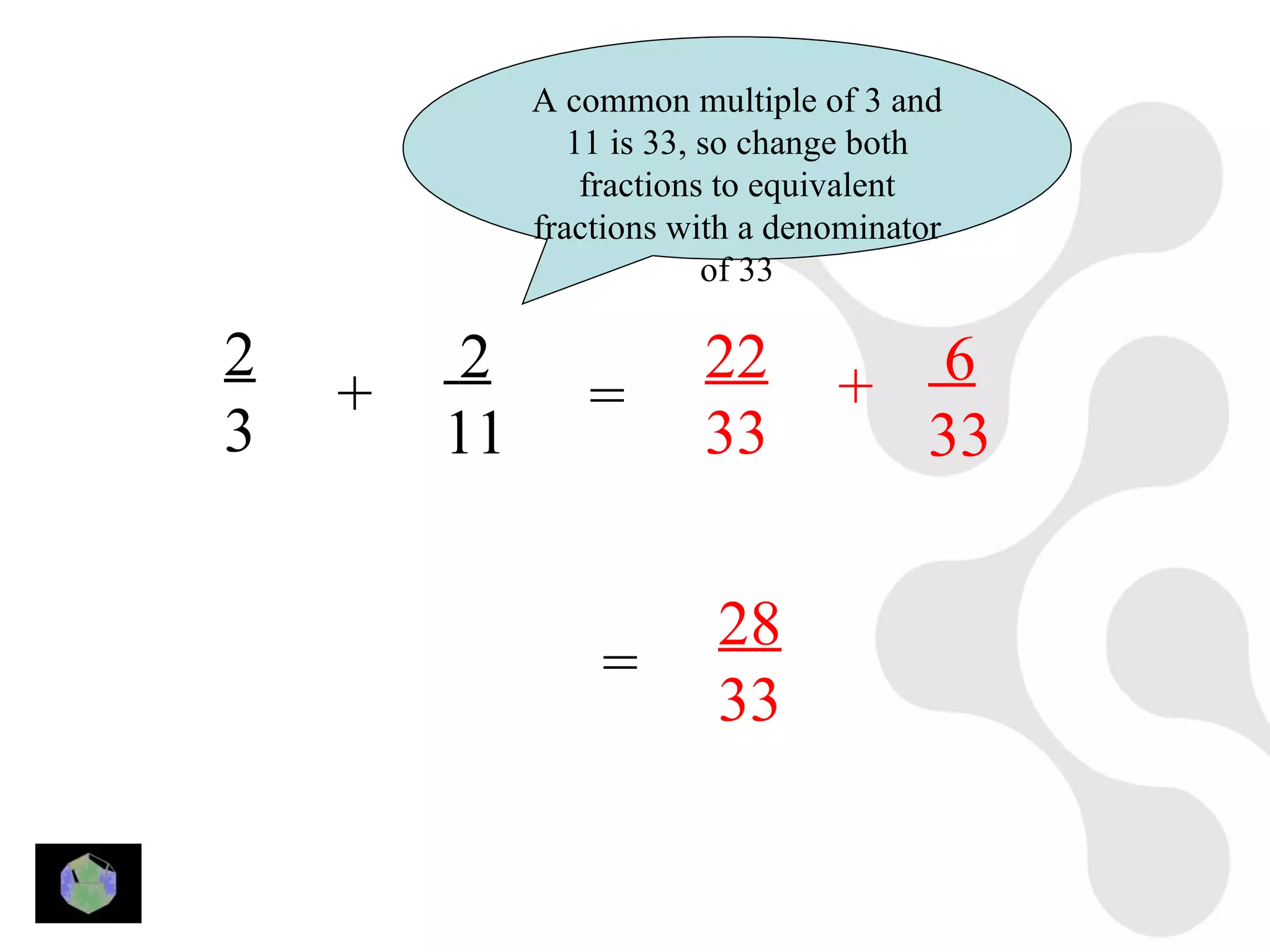
A common multiple of 3 and
                11 is 33, so change both
                 fractions to equivalent
             fractions with a denominator
                          of 33

2        2              22          6
    +           =                +
3       11              33         33

                         28
                 =
                         33
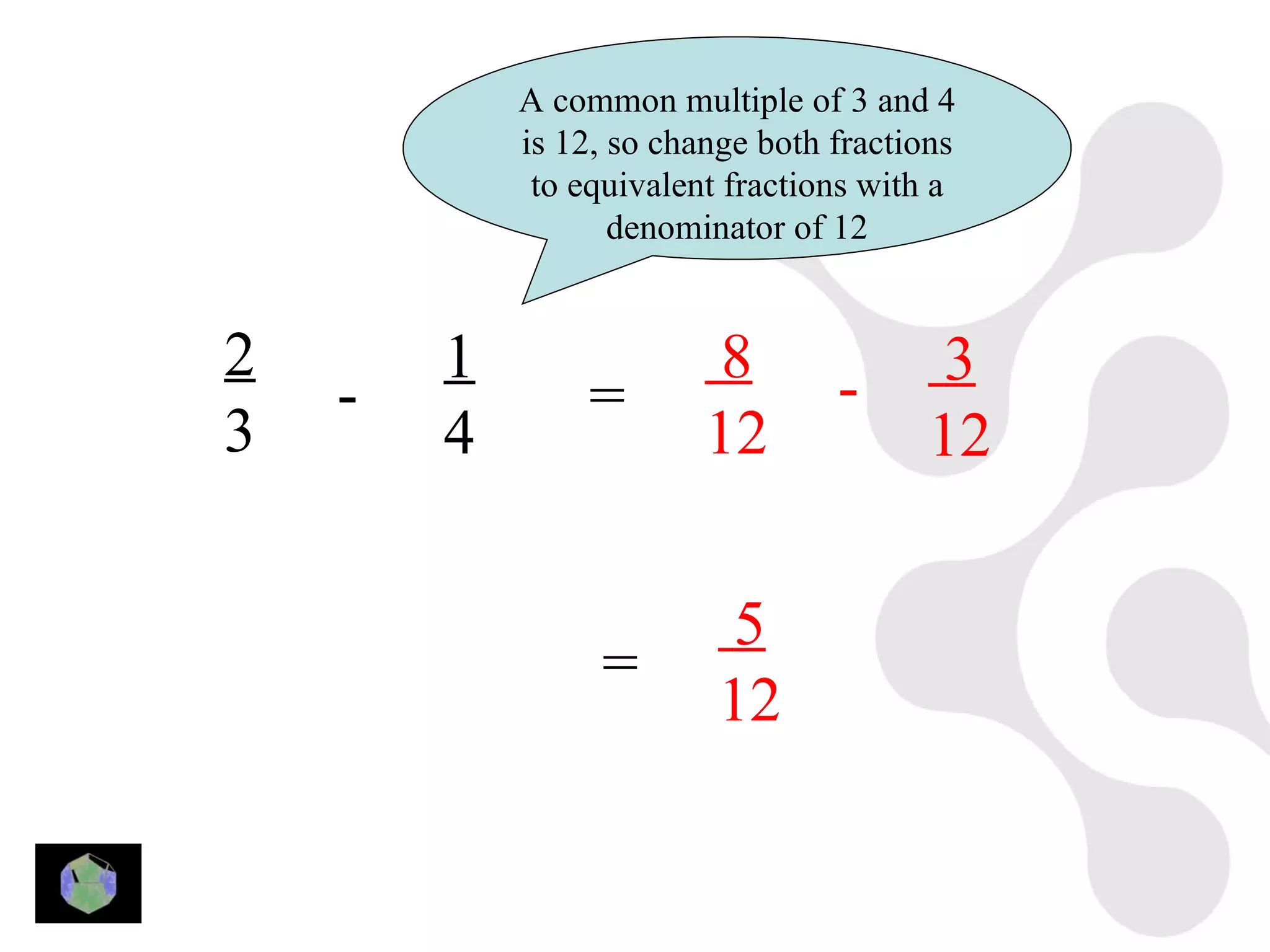
A common multiple of 3 and 4
            is 12, so change both fractions
             to equivalent fractions with a
                   denominator of 12


2       1                 8               3
    -            =                -
3       4                12              12

                           5
                 =
                          12
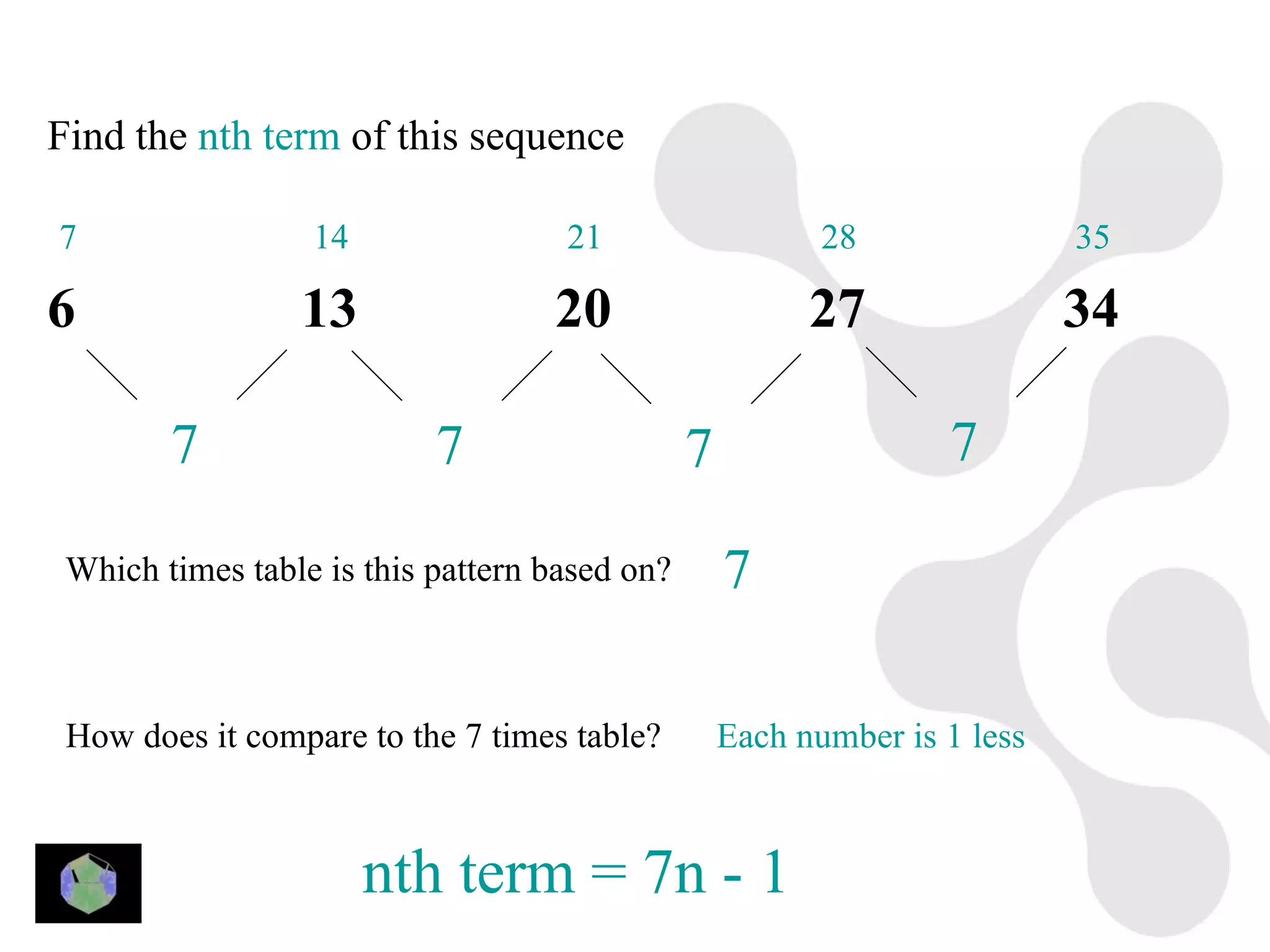
Find the nth term of this sequence

7                 14                21                    28               35

6                13                20                    27                34

        7                  7                   7                  7

 Which times table is this pattern based on?       7

 How does it compare to the 7 times table?         Each number is 1 less


                       nth term = 7n - 1
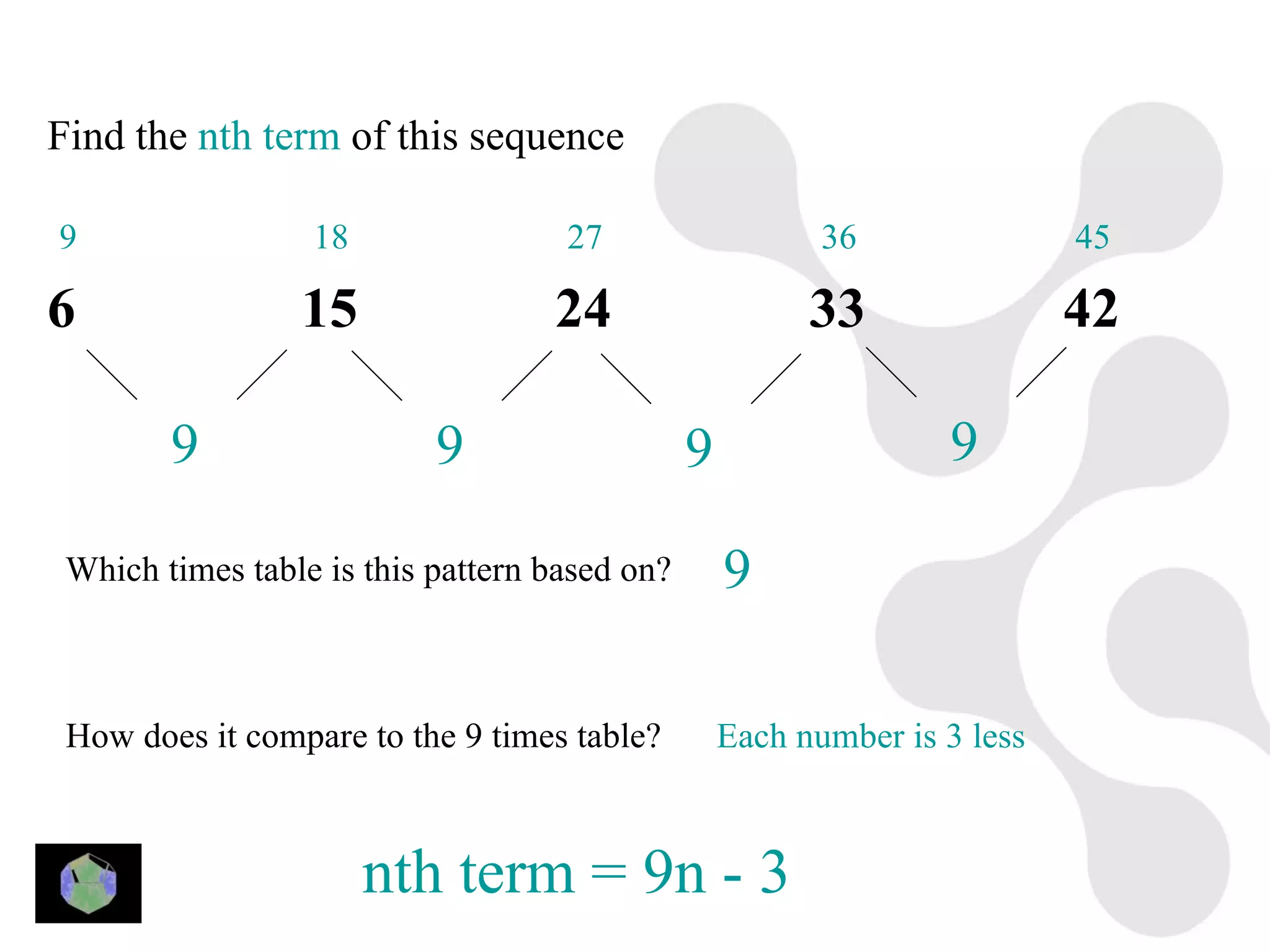
Find the nth term of this sequence

9                 18                27                    36               45

6                15                24                    33                42

        9                  9                   9                  9

 Which times table is this pattern based on?       9

 How does it compare to the 9 times table?         Each number is 3 less


                       nth term = 9n - 3
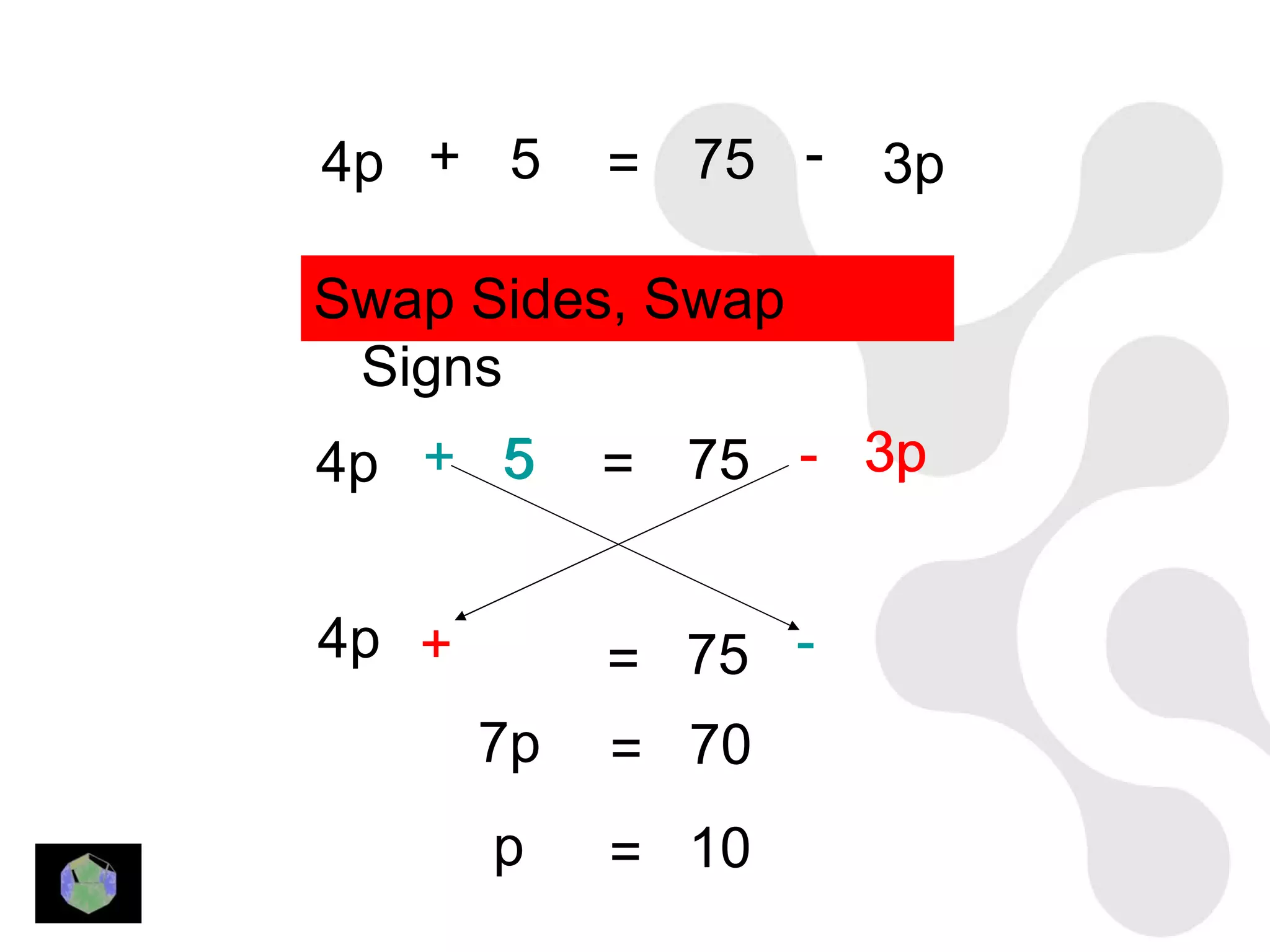
-   -
4p + 5      = 75 -   3p

Swap Sides, Swap
 Signs
4p + 5      = 75 - 3p


4p +        = 75 -
       7p   = 70
       p    = 10
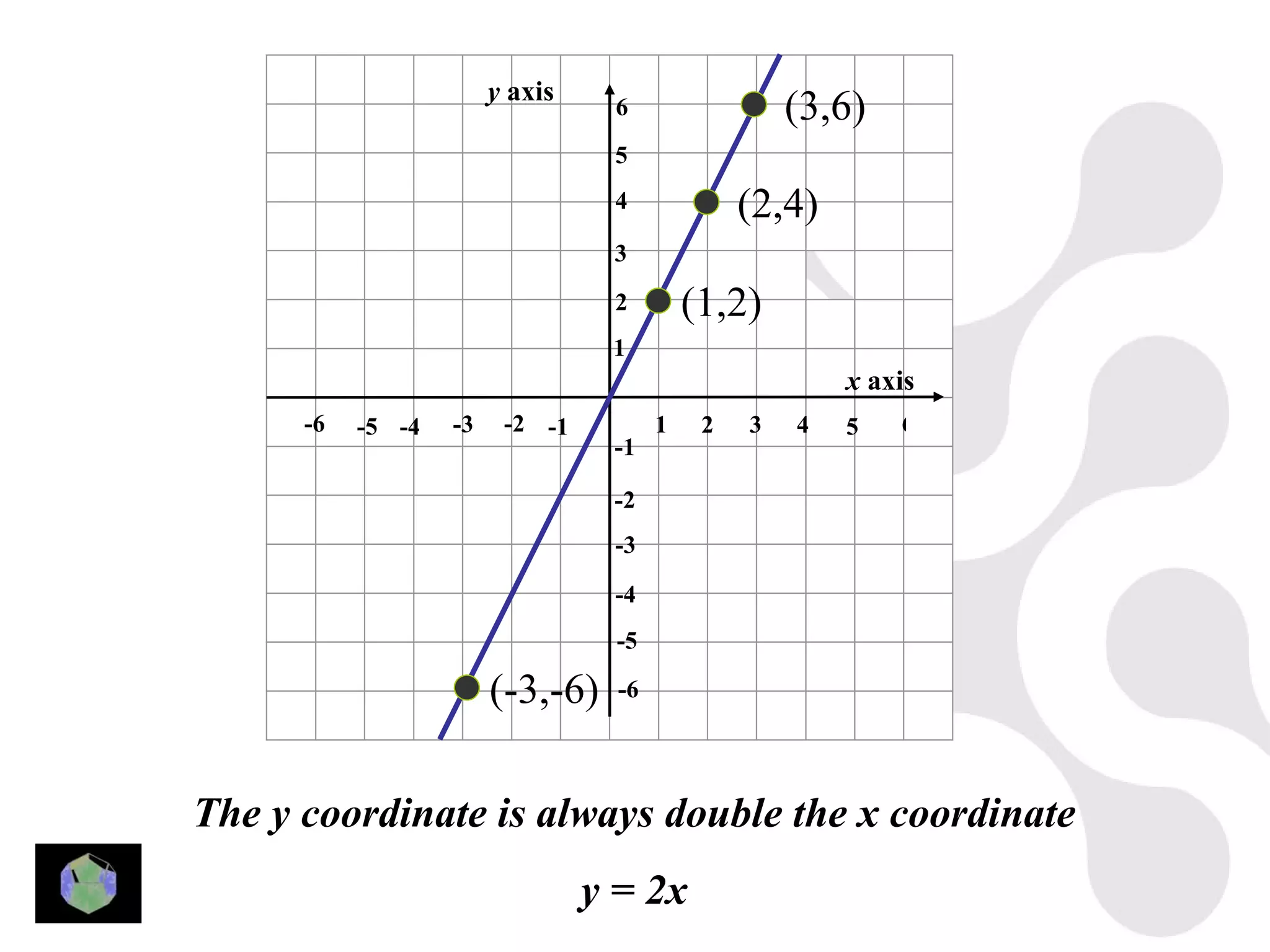
y axis
                                  6                  (3,6)
                                  5
                                  4              (2,4)
                                  3
                                  2         (1,2)
                                  1
                                                         x axis
      -6   -5 -4   -3    -2 -1          1    2   3   4   5   6
                                  -1

                                  -2
                                  -3

                                  -4
                                   -5

                        (-3,-6)    -6


The y coordinate is always double the x coordinate
                                 y = 2x
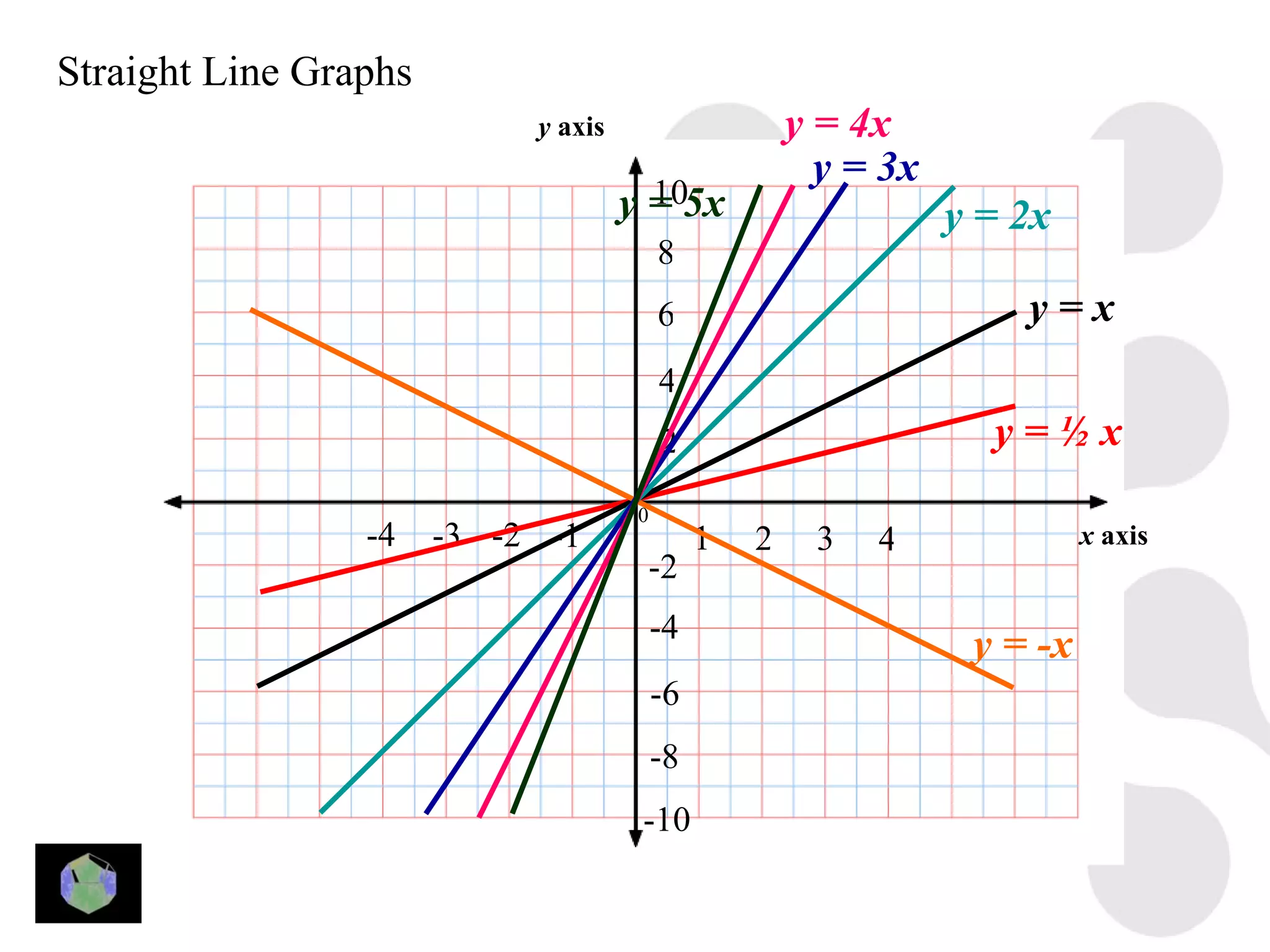
Straight Line Graphs
                            y axis                     y = 4x
                                                         y = 3x
                                       10
                                     y = 5x                       y = 2x
                                          8
                                          6                           y=x
                                          4
                                          2                         y=½x
                                      0
                 -4    -3 -2 -1                1   2    3   4               x axis
                                      -2
                                          -4
                                                                   y = -x
                                          -6
                                          -8
                                      -10
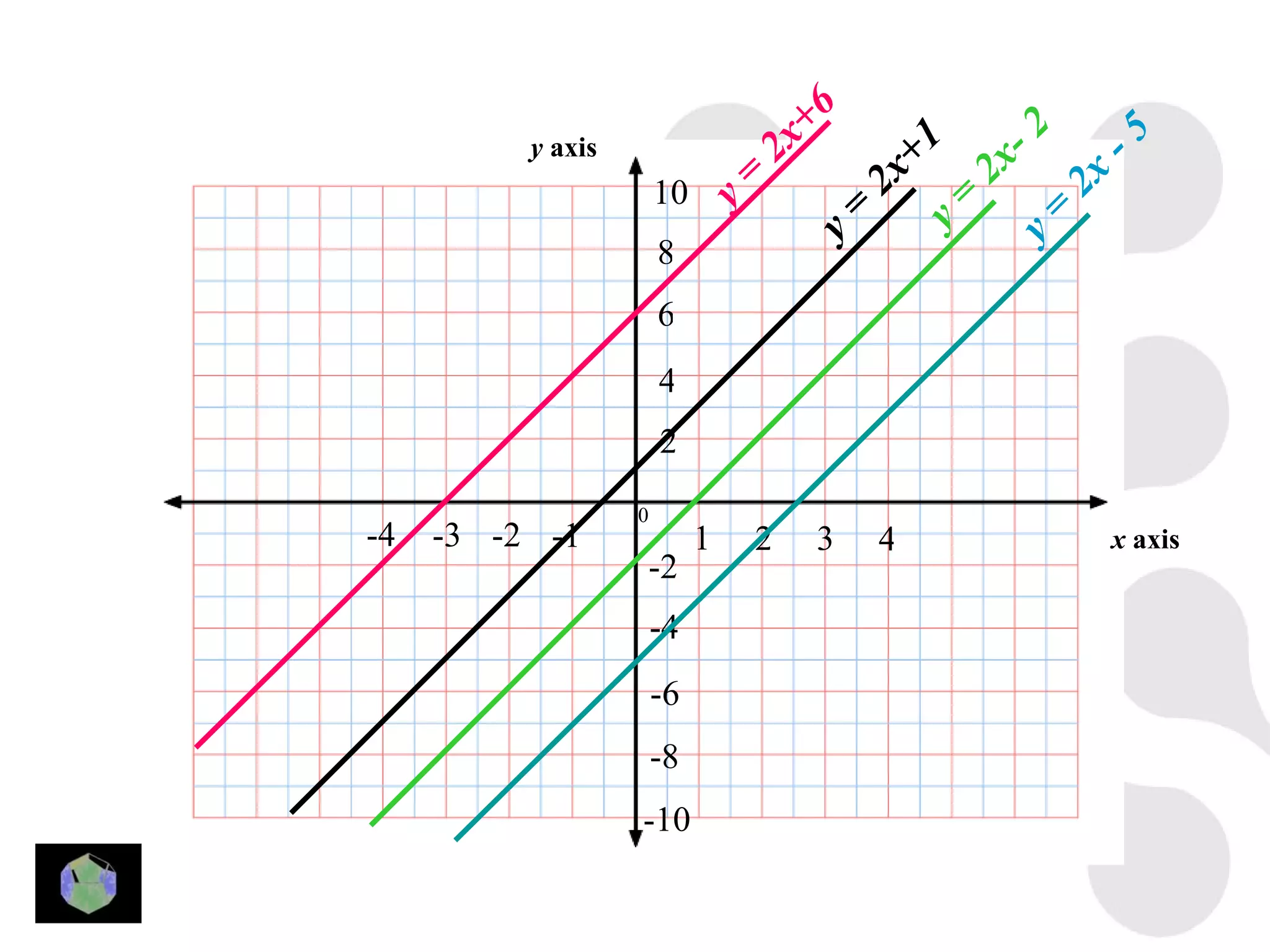
+6         1 x- 2
          y axis                    2x           + 2         -5
                       10 y =                  2x =       2x
                                            y=     y   y=
                       8
                       6
                       4
                       2
                   0
-4   -3 -2 -1               1   2       3     4             x axis
                   -2
                       -4
                       -6
                       -8
                   -10
All straight line graphs can be expressed in the form

                     y = mx + c

m is the gradient of the line
                       and c is the y intercept

The graph y = 5x + 4 has gradient 5 and cuts the
y axis at 4
Level 6


Shape, Space and Measures
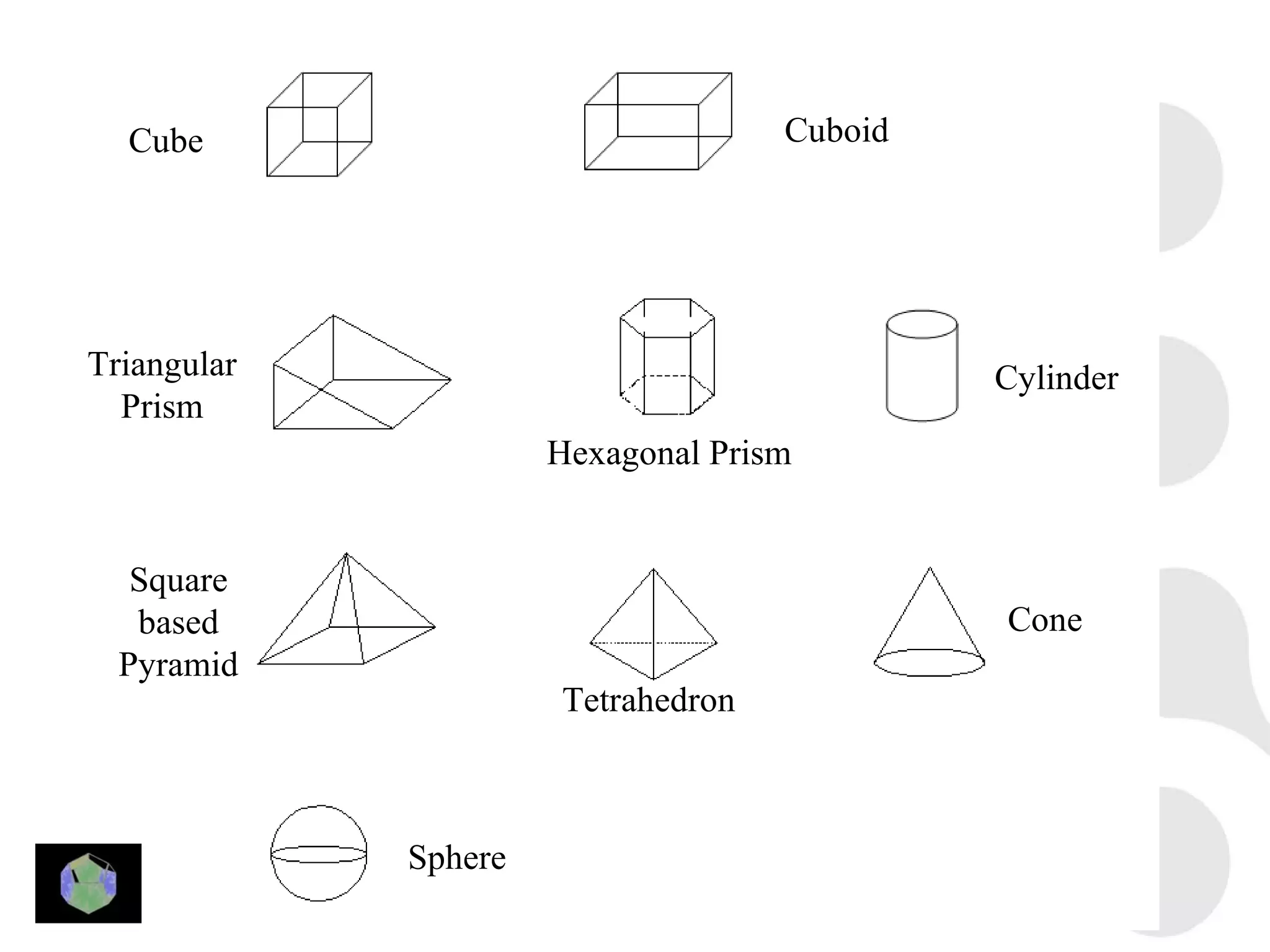
Cube                              Cuboid


Triangular                                   Cylinder
  Prism
                      Hexagonal Prism


   Square
   based                                     Cone
  Pyramid
                      Tetrahedron


             Sphere
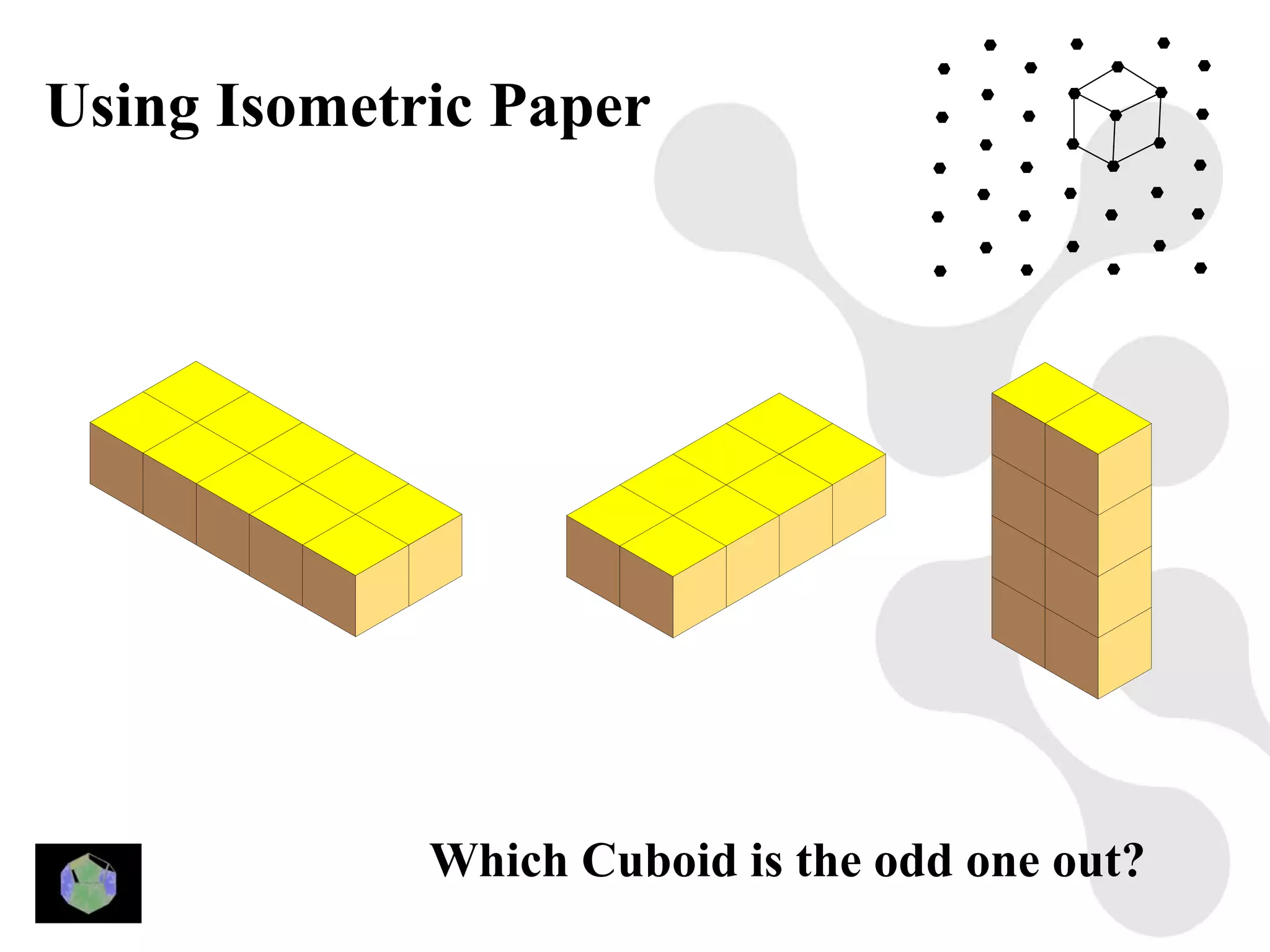
Using Isometric Paper


             Which Cuboid is the odd one out?
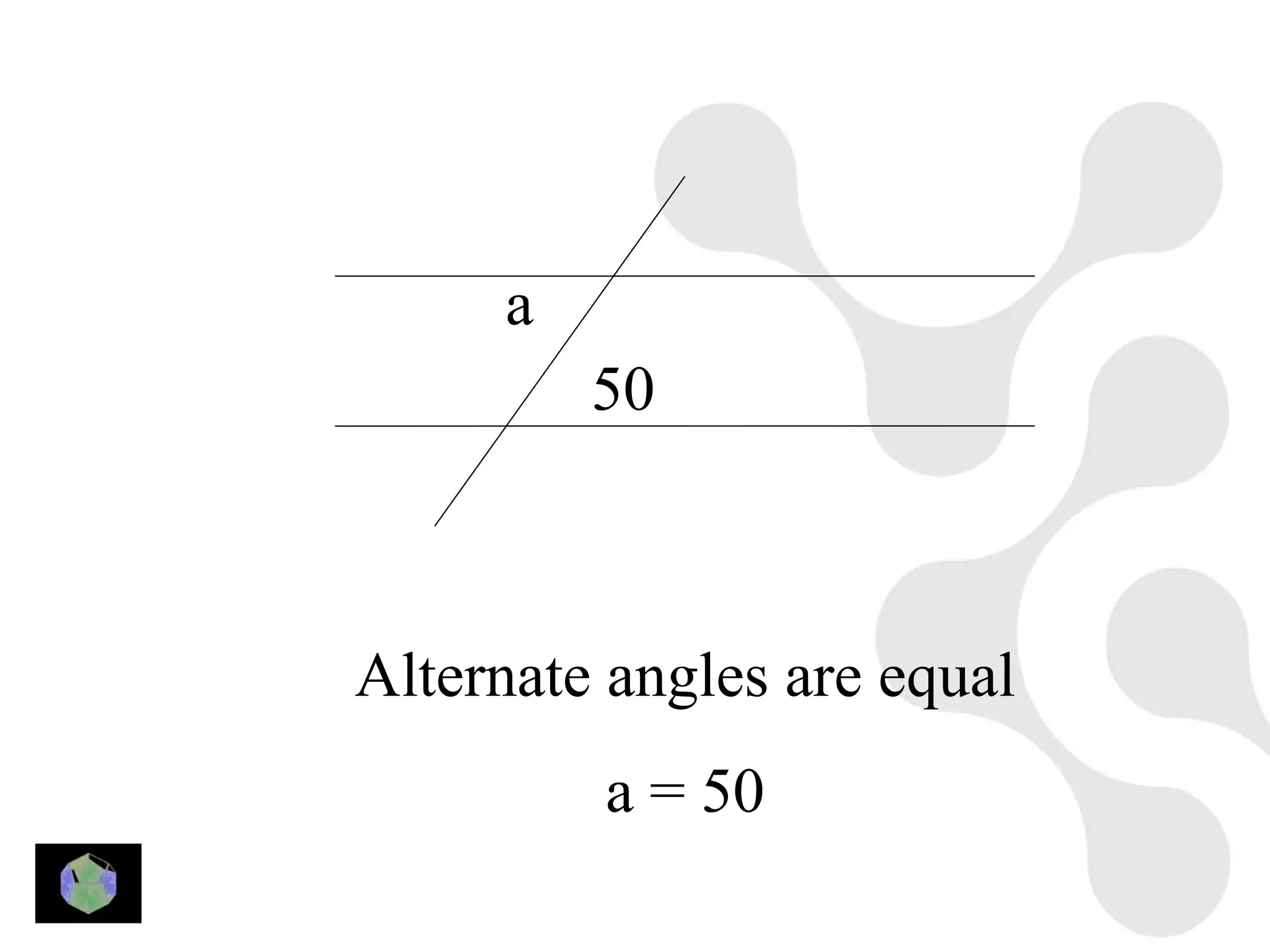
a
         50


Alternate angles are equal
         a = 50
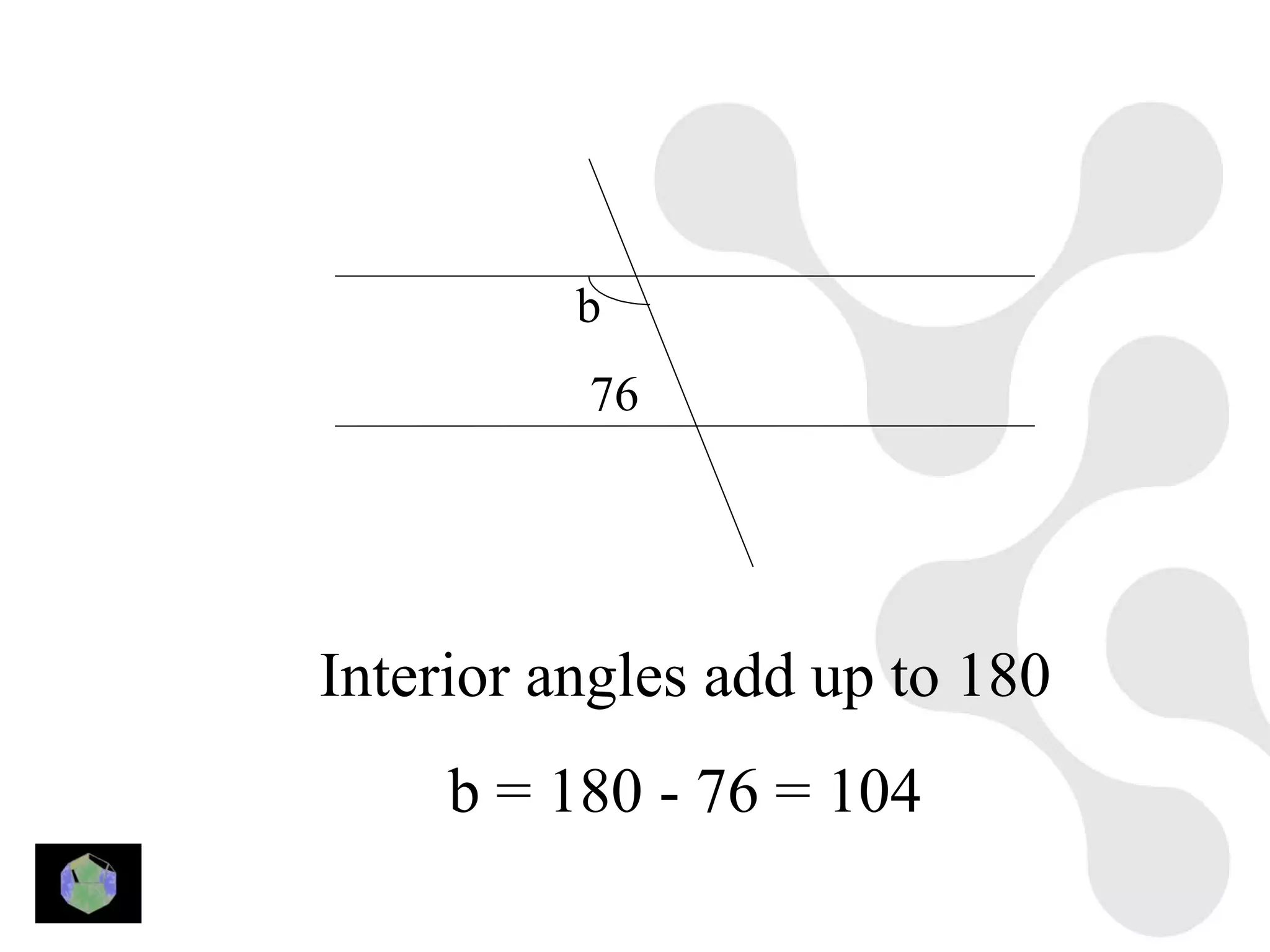
b
          76


Interior angles add up to 180
     b = 180 - 76 = 104
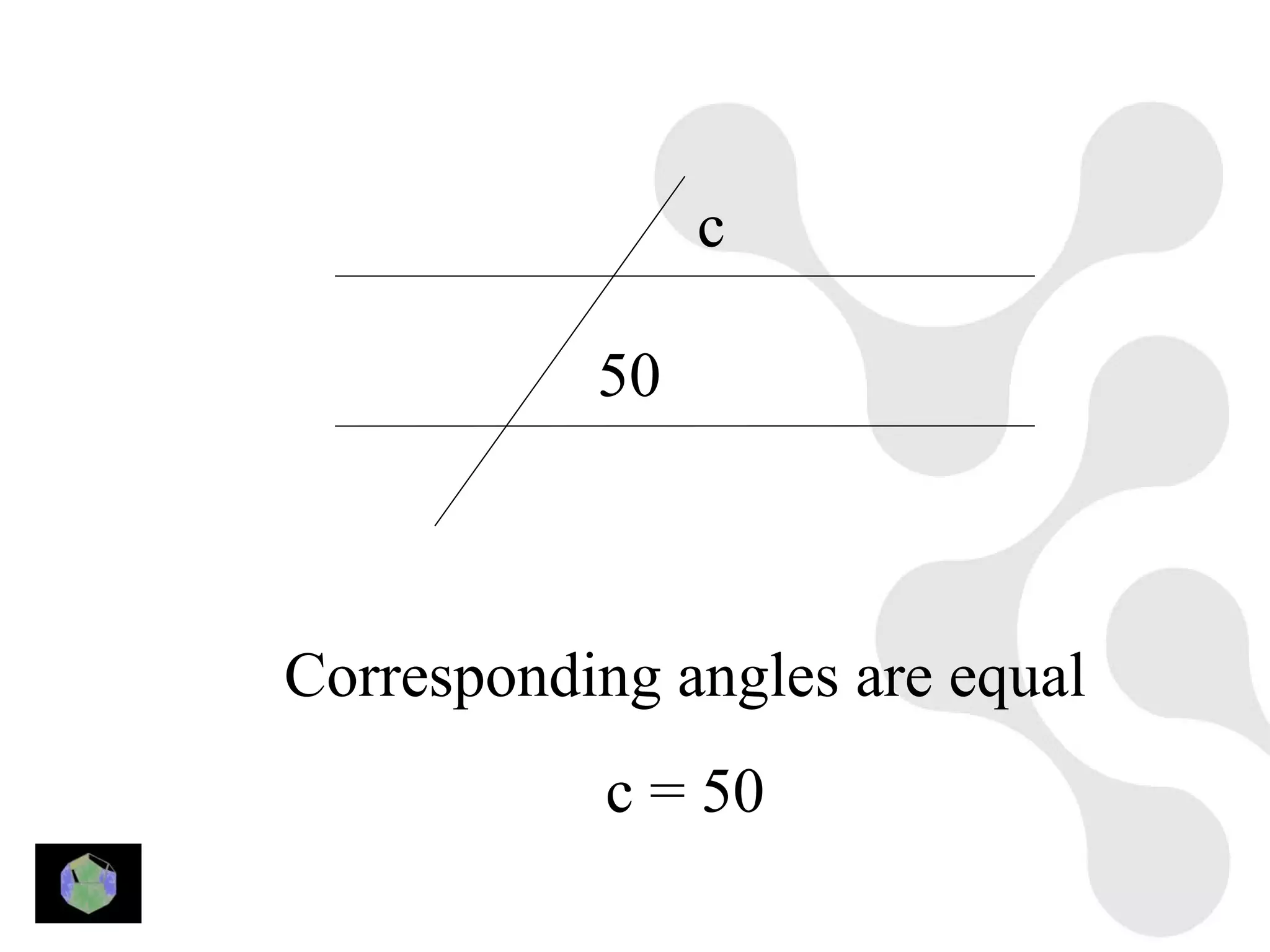
c

           50


Corresponding angles are equal
            c = 50
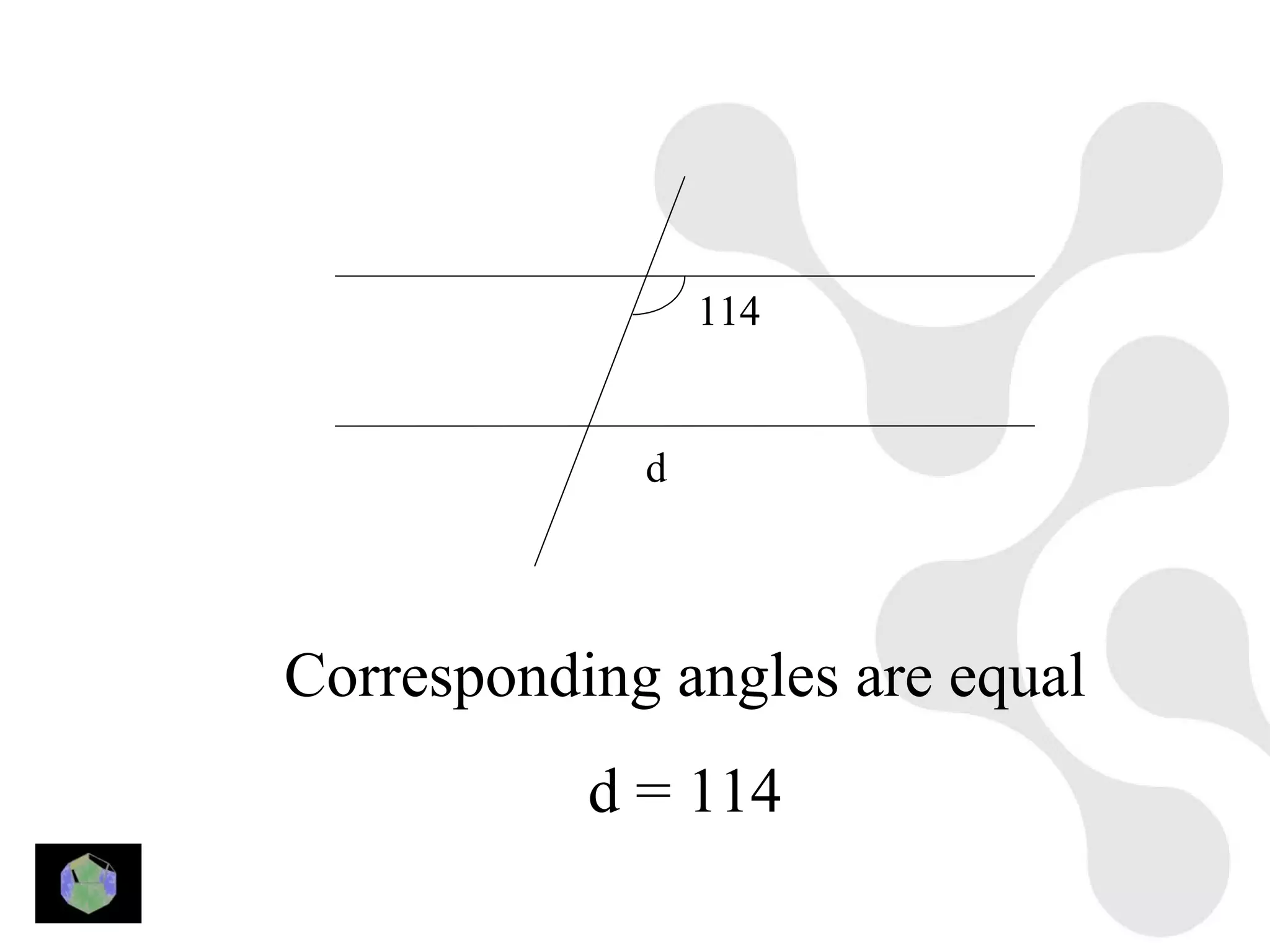
114


             d


Corresponding angles are equal
           d = 114
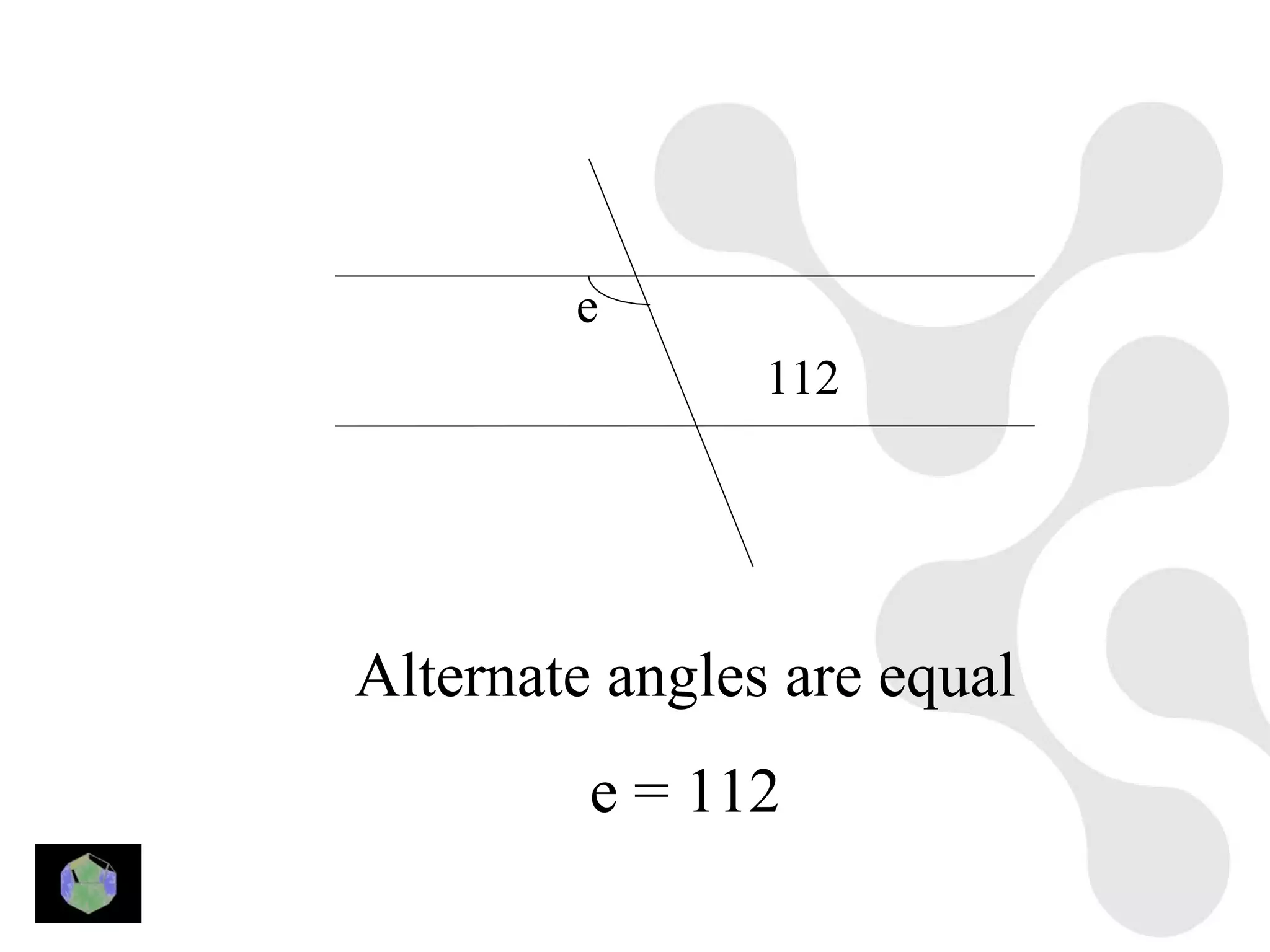
e
                112


Alternate angles are equal
         e = 112
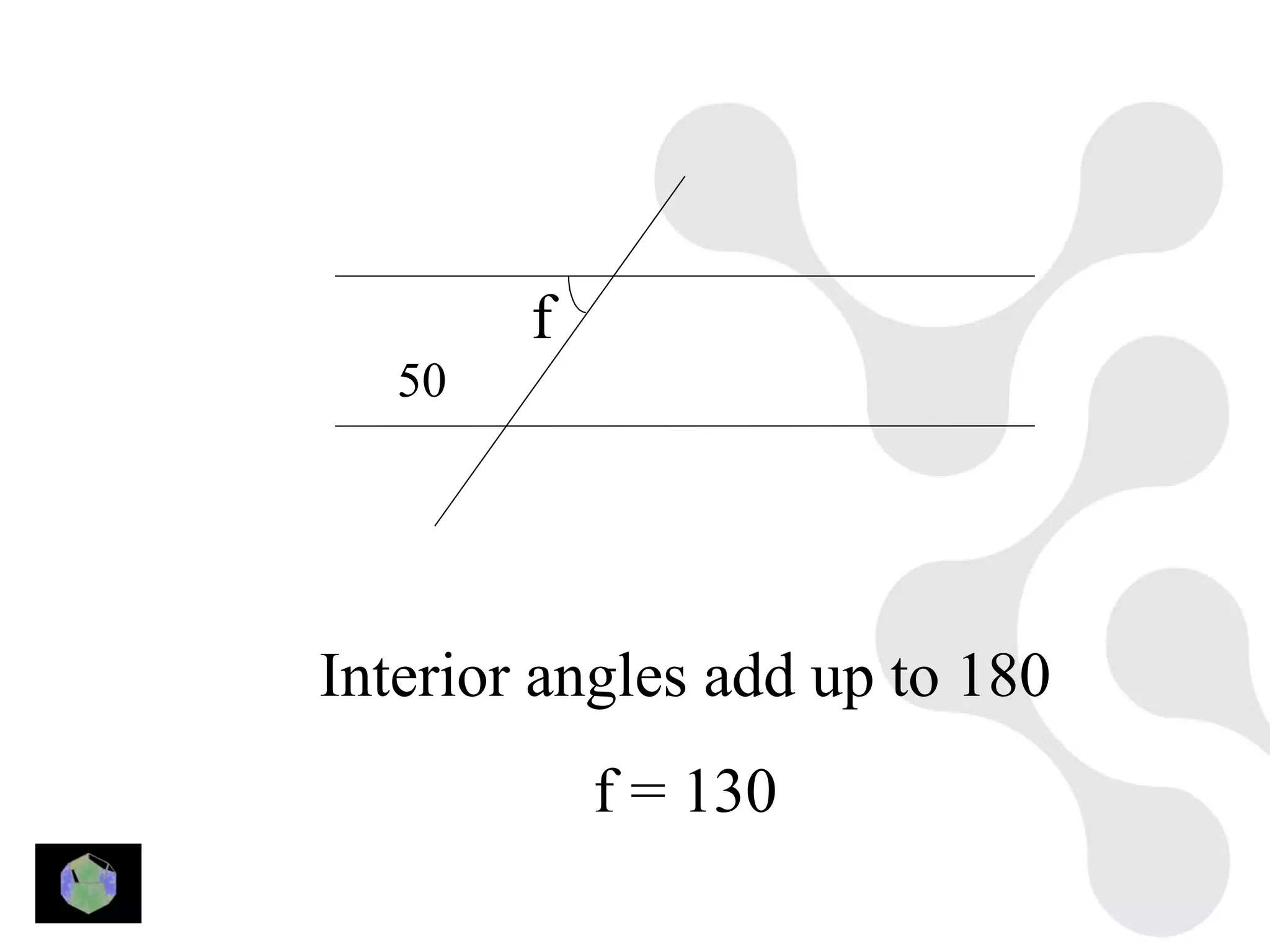
f
   50


Interior angles add up to 180
            f = 130
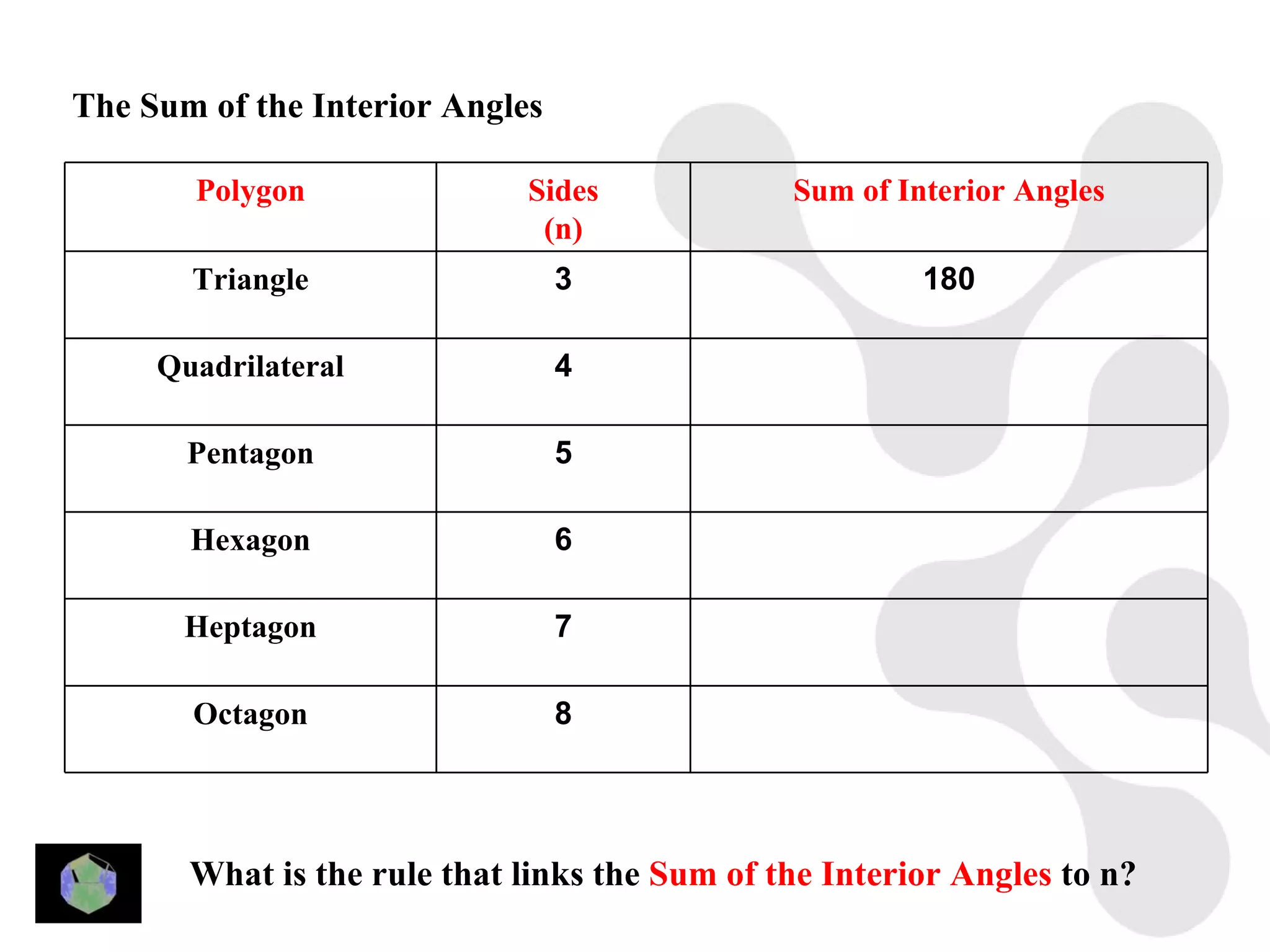
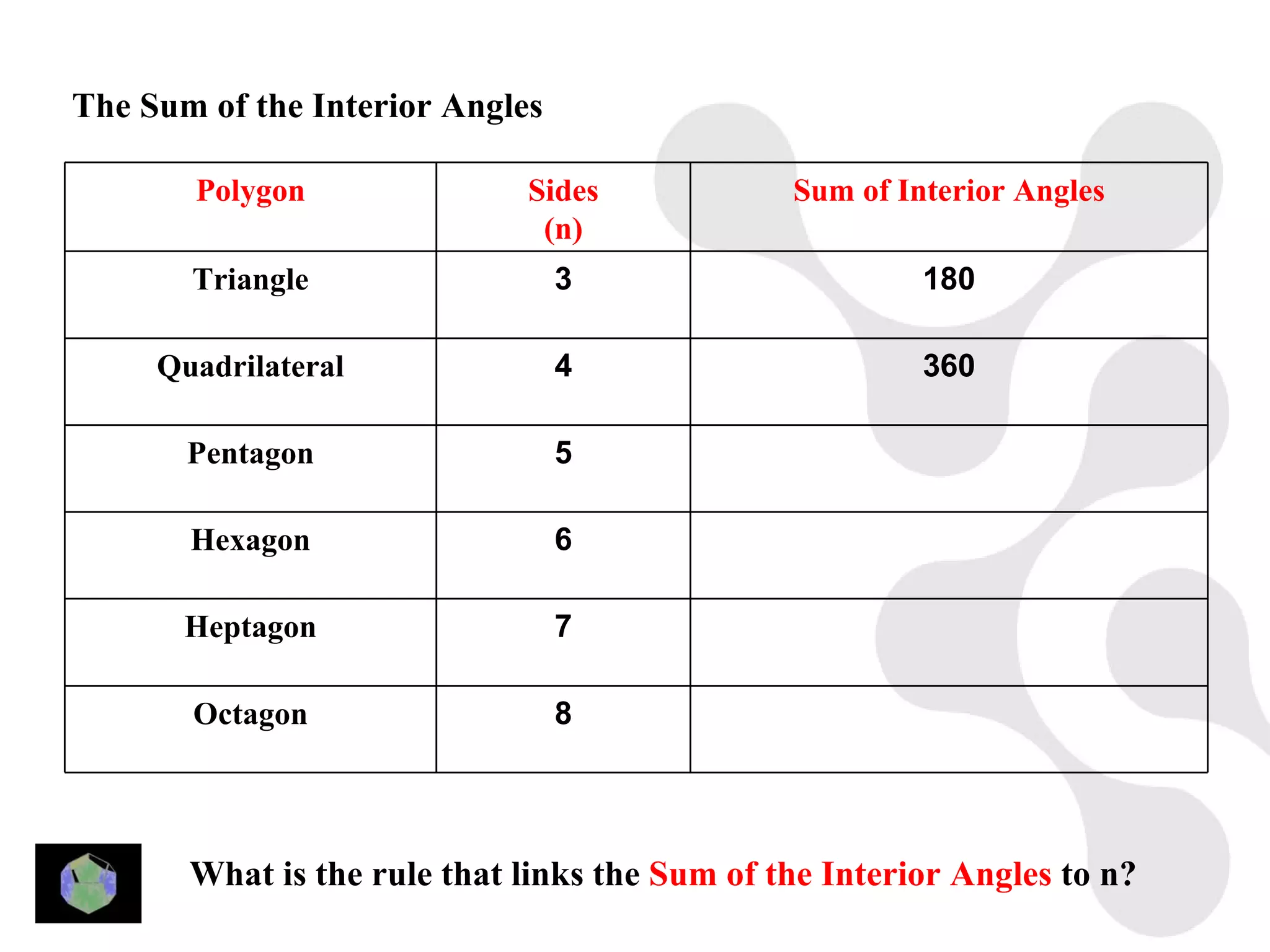
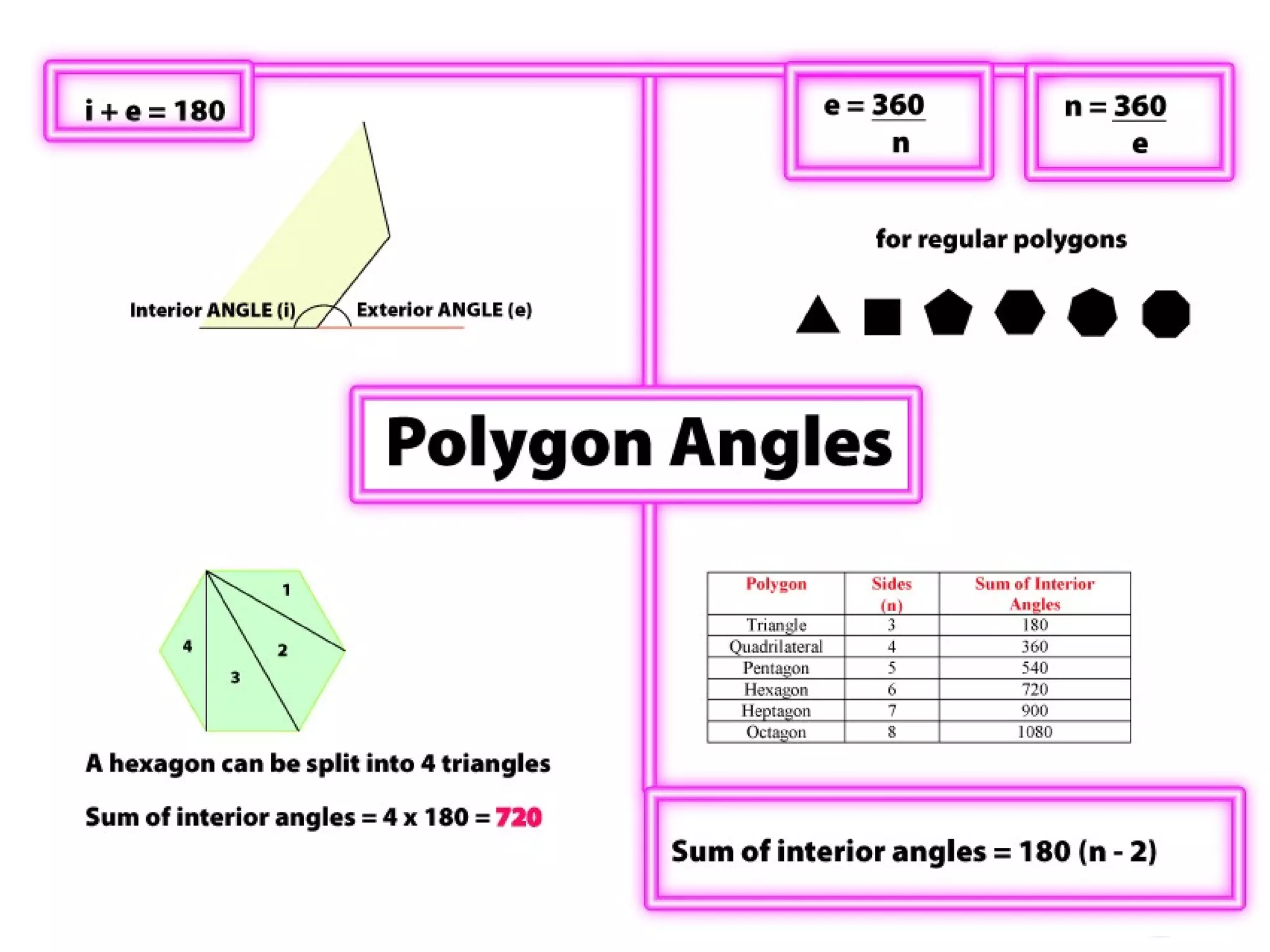
The Sum of the Interior Angles

       Polygon               Sides             Sum of Interior Angles
                              (n)
       Triangle                  3                      180

     Quadrilateral               4

       Pentagon                  5

       Hexagon                   6

       Heptagon                  7

       Octagon                   8


       What is the rule that links the Sum of the Interior Angles to n?
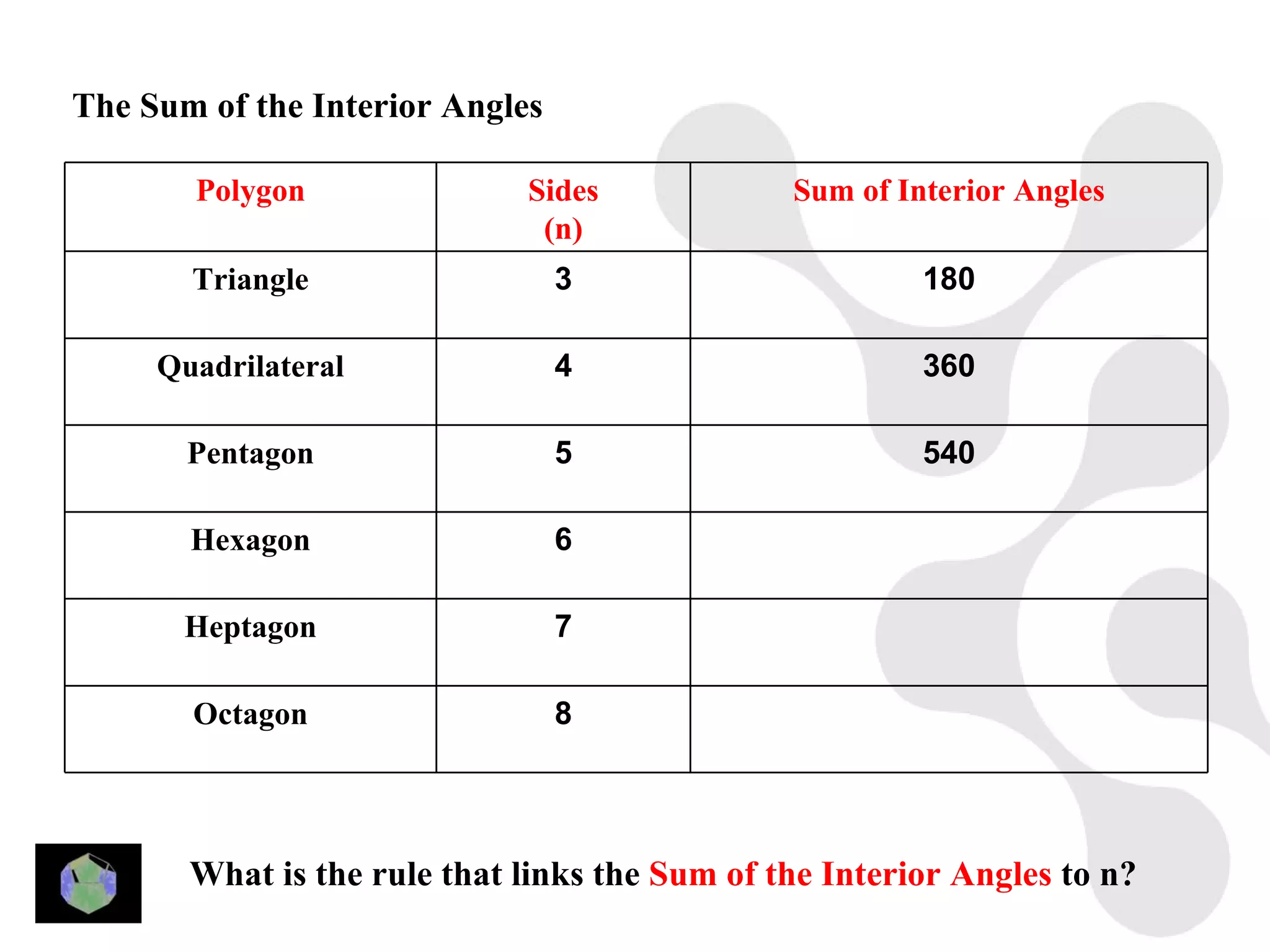
The Sum of the Interior Angles

       Polygon               Sides             Sum of Interior Angles
                              (n)
       Triangle                  3                      180

     Quadrilateral               4                      360

       Pentagon                  5

       Hexagon                   6

       Heptagon                  7

       Octagon                   8


       What is the rule that links the Sum of the Interior Angles to n?
The Sum of the Interior Angles

       Polygon               Sides             Sum of Interior Angles
                              (n)
       Triangle                  3                      180

     Quadrilateral               4                      360

       Pentagon                  5                      540

       Hexagon                   6

       Heptagon                  7

       Octagon                   8


       What is the rule that links the Sum of the Interior Angles to n?
The Sum of the Interior Angles

       Polygon               Sides             Sum of Interior Angles
                              (n)
       Triangle                  3                      180

     Quadrilateral               4                      360

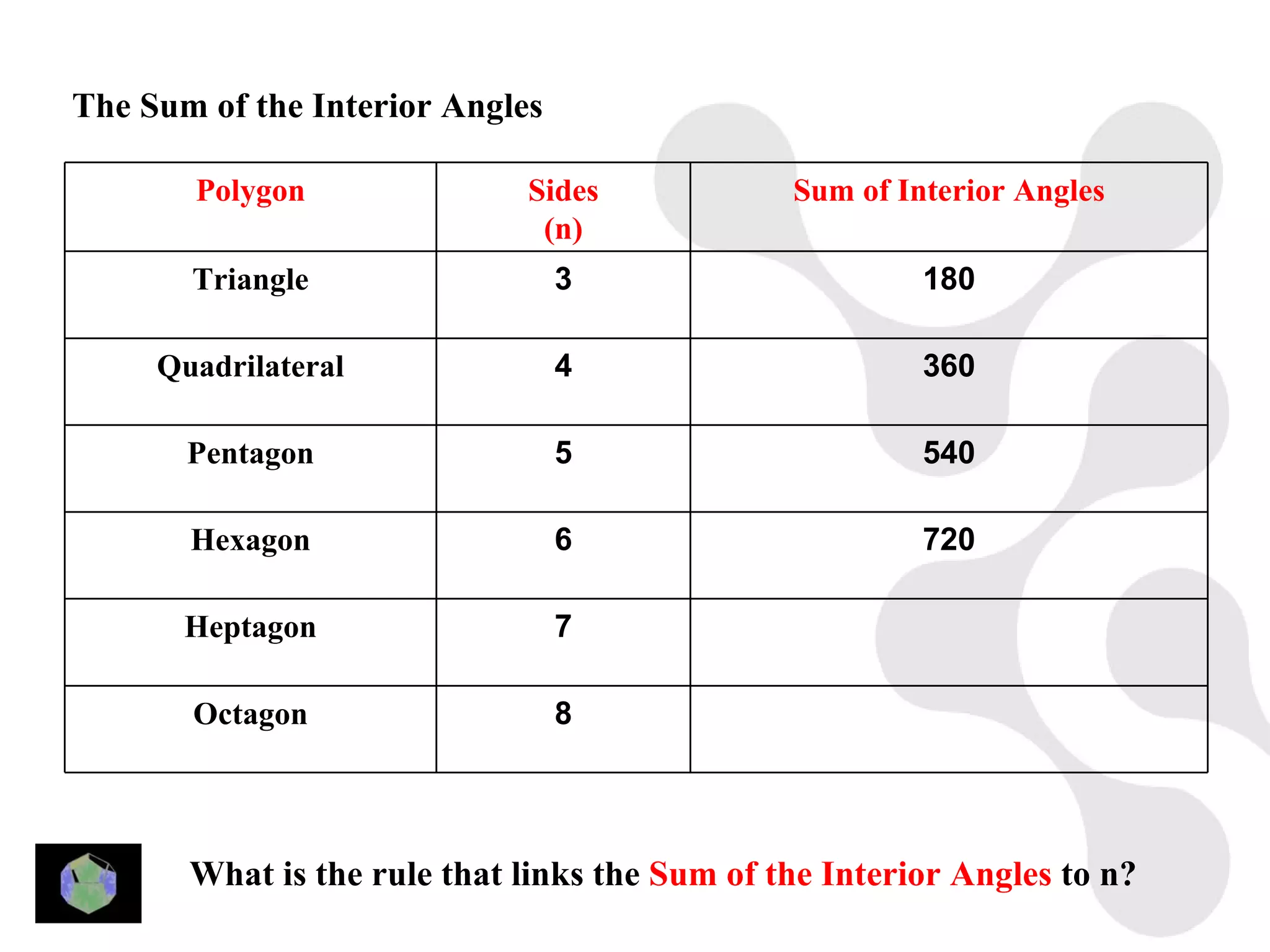
       Pentagon                  5                      540

       Hexagon                   6                      720

       Heptagon                  7

       Octagon                   8


       What is the rule that links the Sum of the Interior Angles to n?
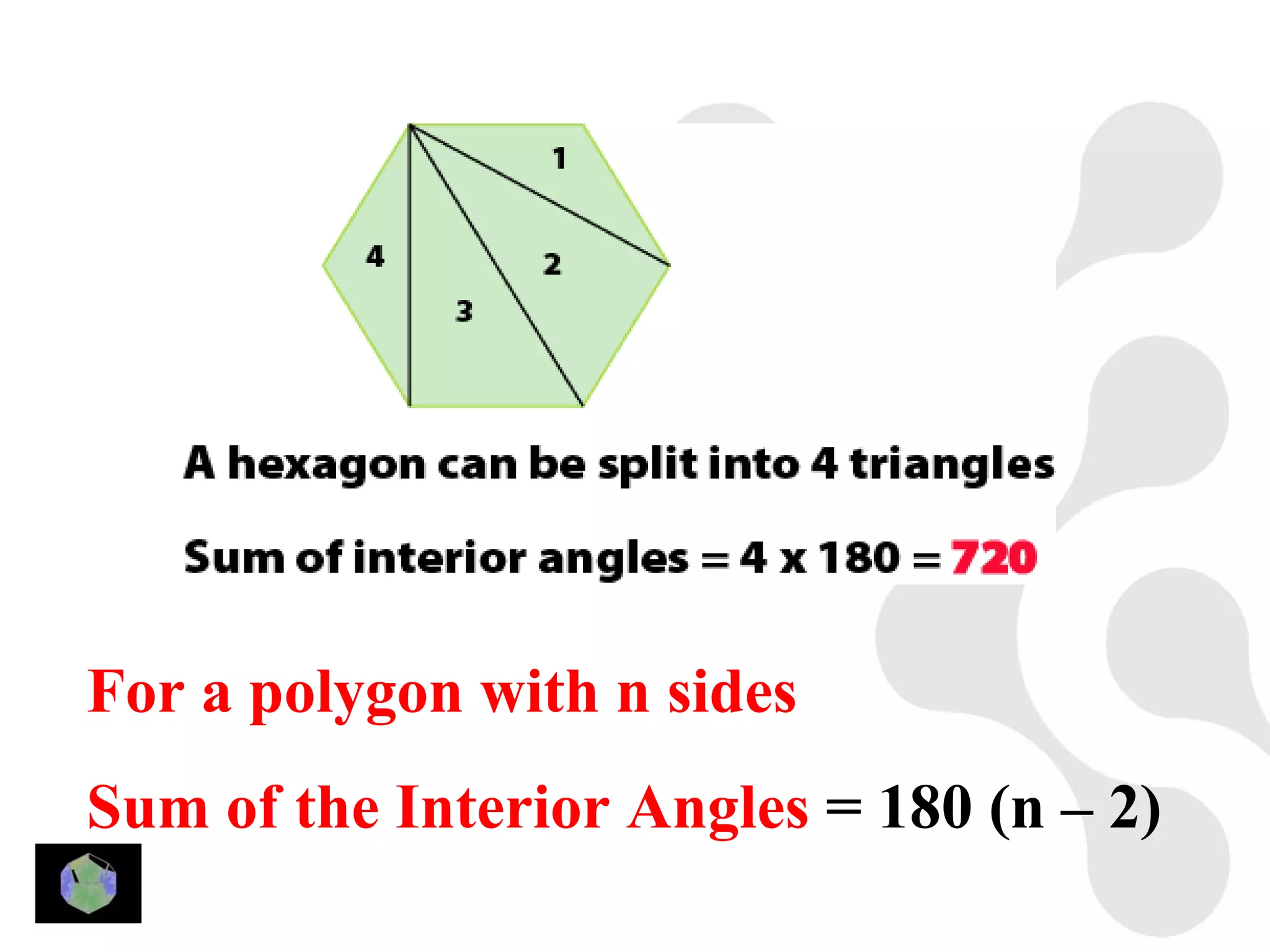
For a polygon with n sides
Sum of the Interior Angles = 180 (n – 2)
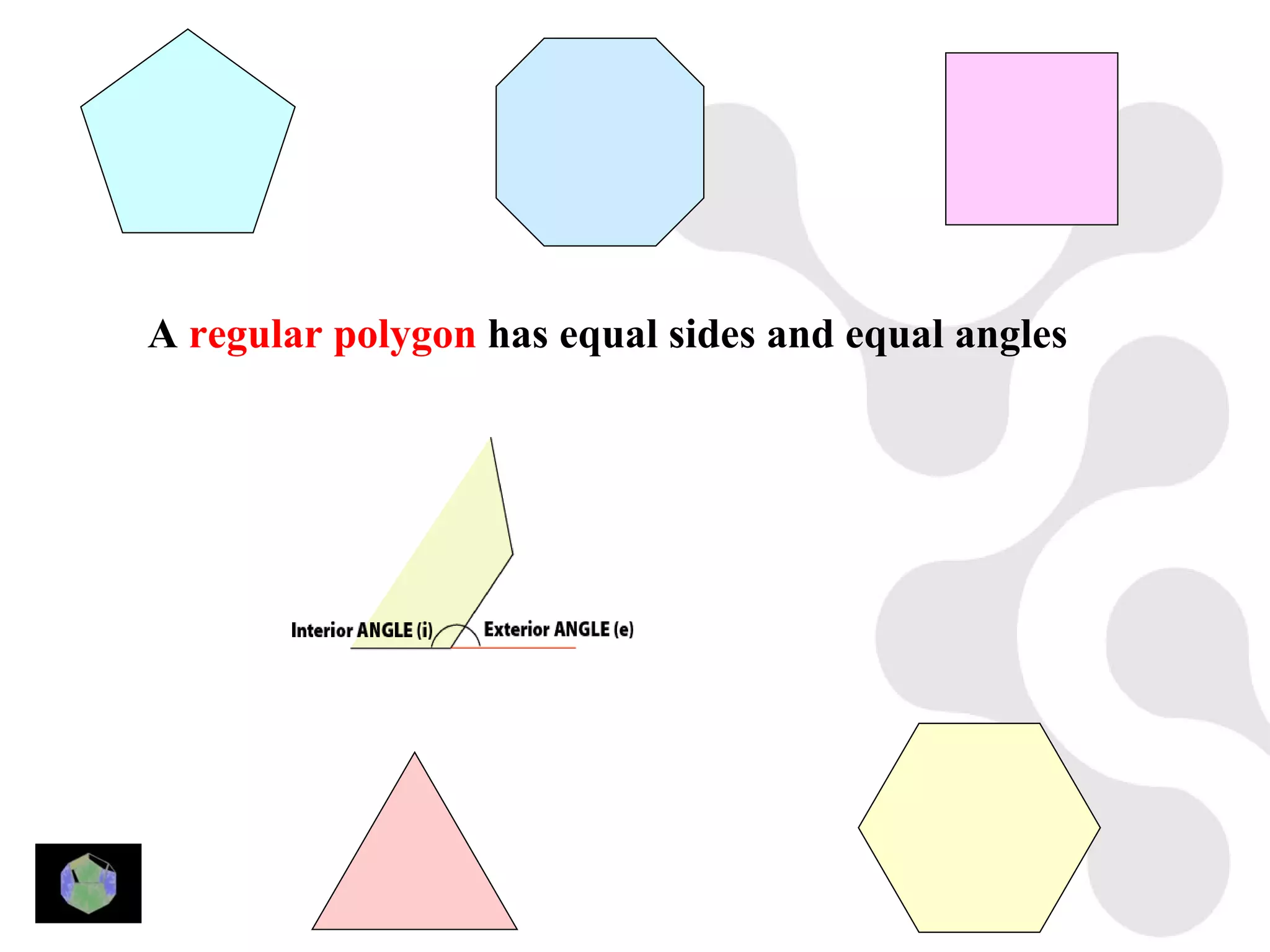
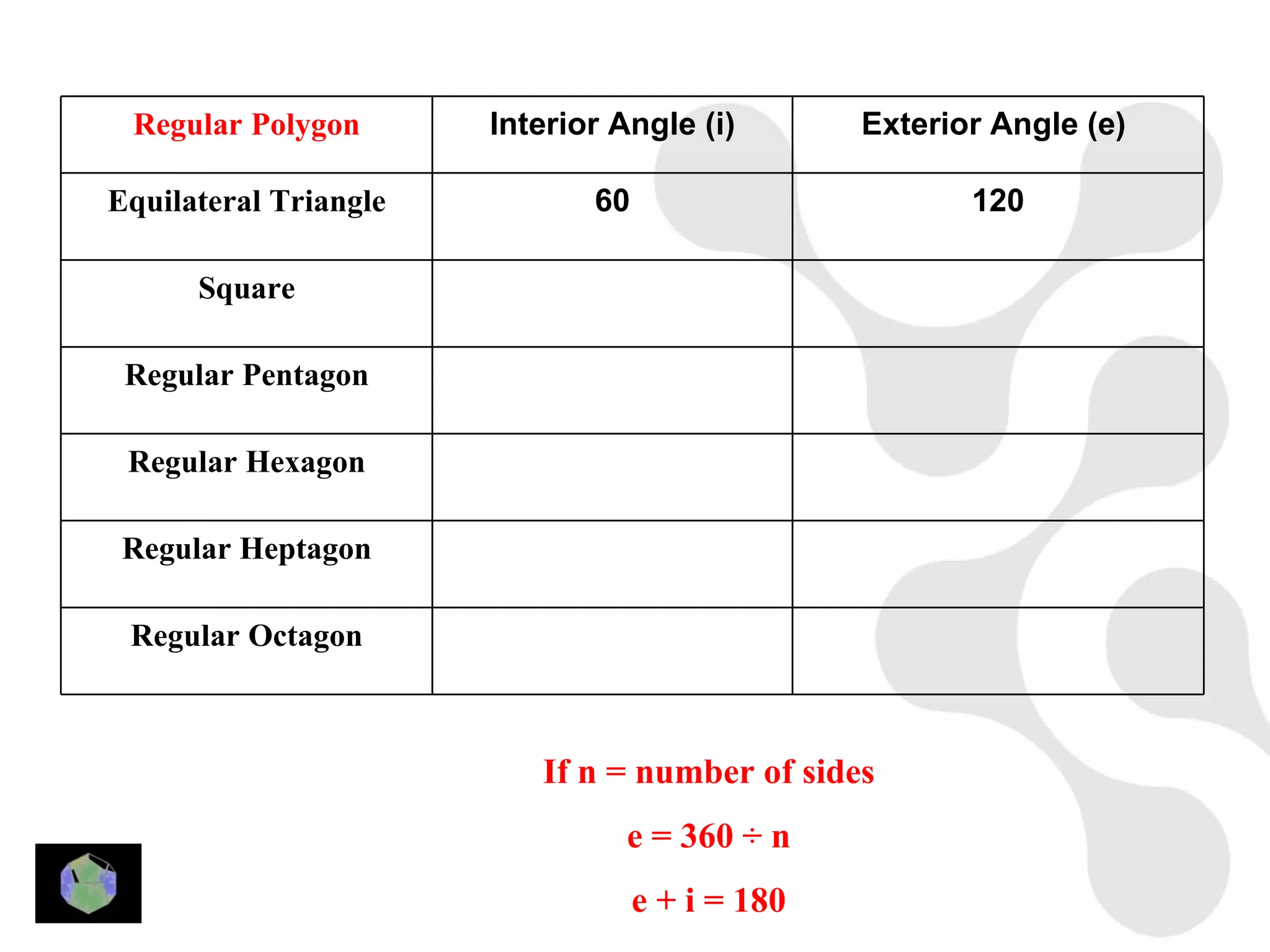
A regular polygon has equal sides and equal angles
Regular Polygon       Interior Angle (i)        Exterior Angle (e)

Equilateral Triangle          60                        120

      Square

 Regular Pentagon

 Regular Hexagon

 Regular Heptagon

 Regular Octagon


                          If n = number of sides
                                 e = 360 ÷ n
                                   e + i = 180
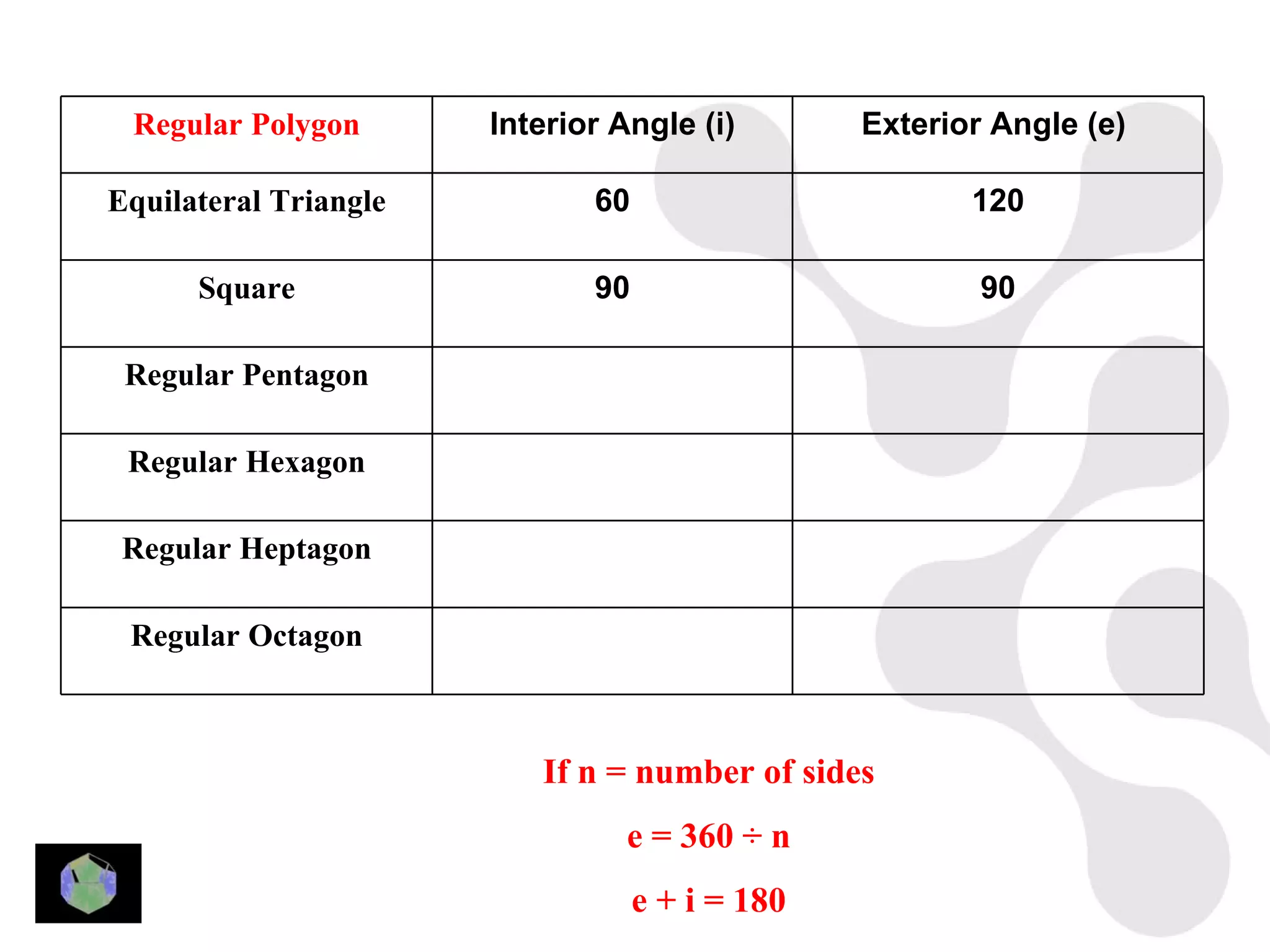
Regular Polygon       Interior Angle (i)        Exterior Angle (e)

Equilateral Triangle          60                        120

      Square                  90                         90

 Regular Pentagon

 Regular Hexagon

 Regular Heptagon

 Regular Octagon


                          If n = number of sides
                                 e = 360 ÷ n
                                   e + i = 180
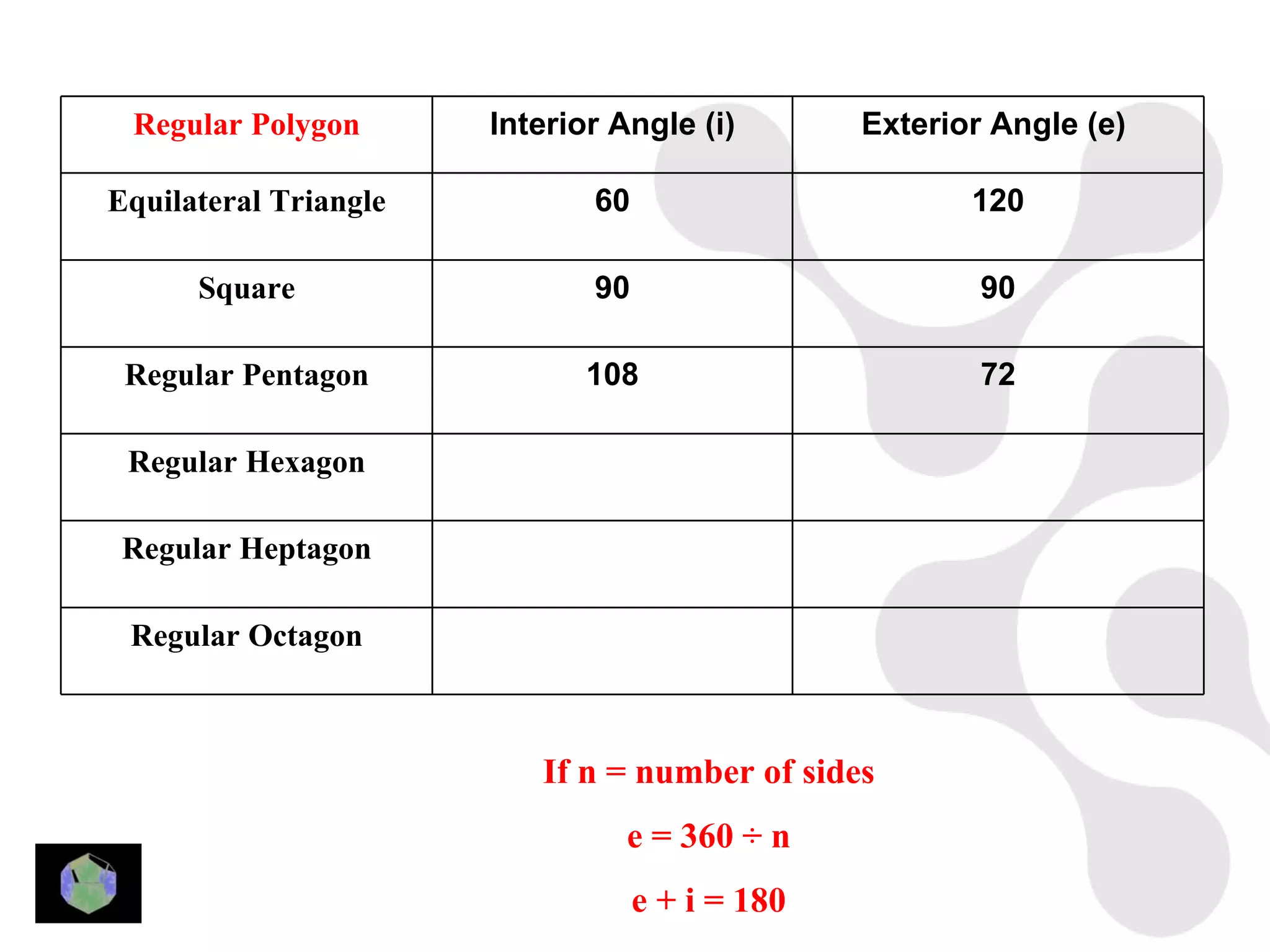
Regular Polygon       Interior Angle (i)        Exterior Angle (e)

Equilateral Triangle          60                        120

      Square                  90                         90

 Regular Pentagon             108                        72

 Regular Hexagon

 Regular Heptagon

 Regular Octagon


                          If n = number of sides
                                 e = 360 ÷ n
                                   e + i = 180
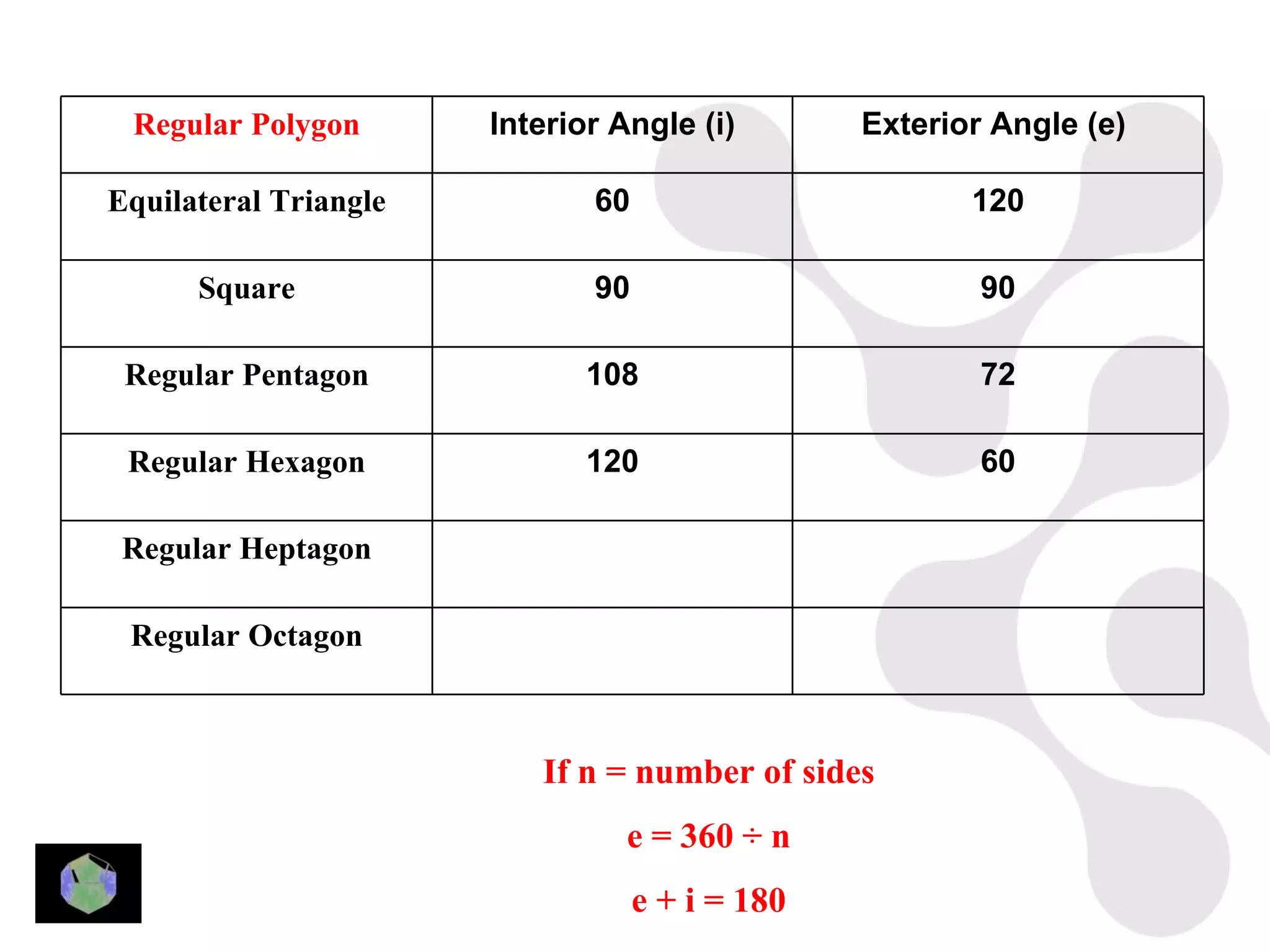
Regular Polygon       Interior Angle (i)        Exterior Angle (e)

Equilateral Triangle          60                        120

      Square                  90                         90

 Regular Pentagon             108                        72

 Regular Hexagon              120                        60

 Regular Heptagon

 Regular Octagon


                          If n = number of sides
                                 e = 360 ÷ n
                                   e + i = 180
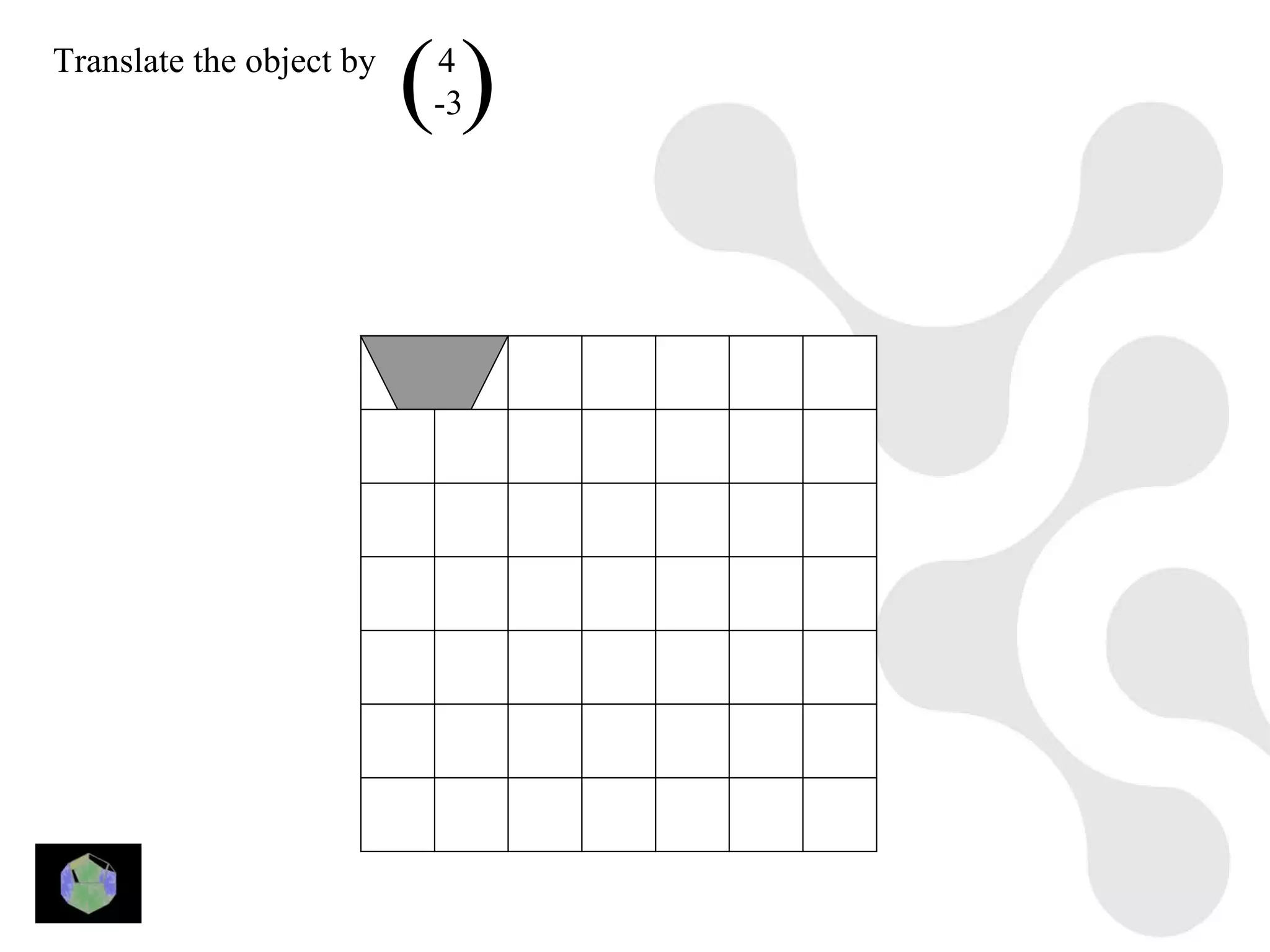
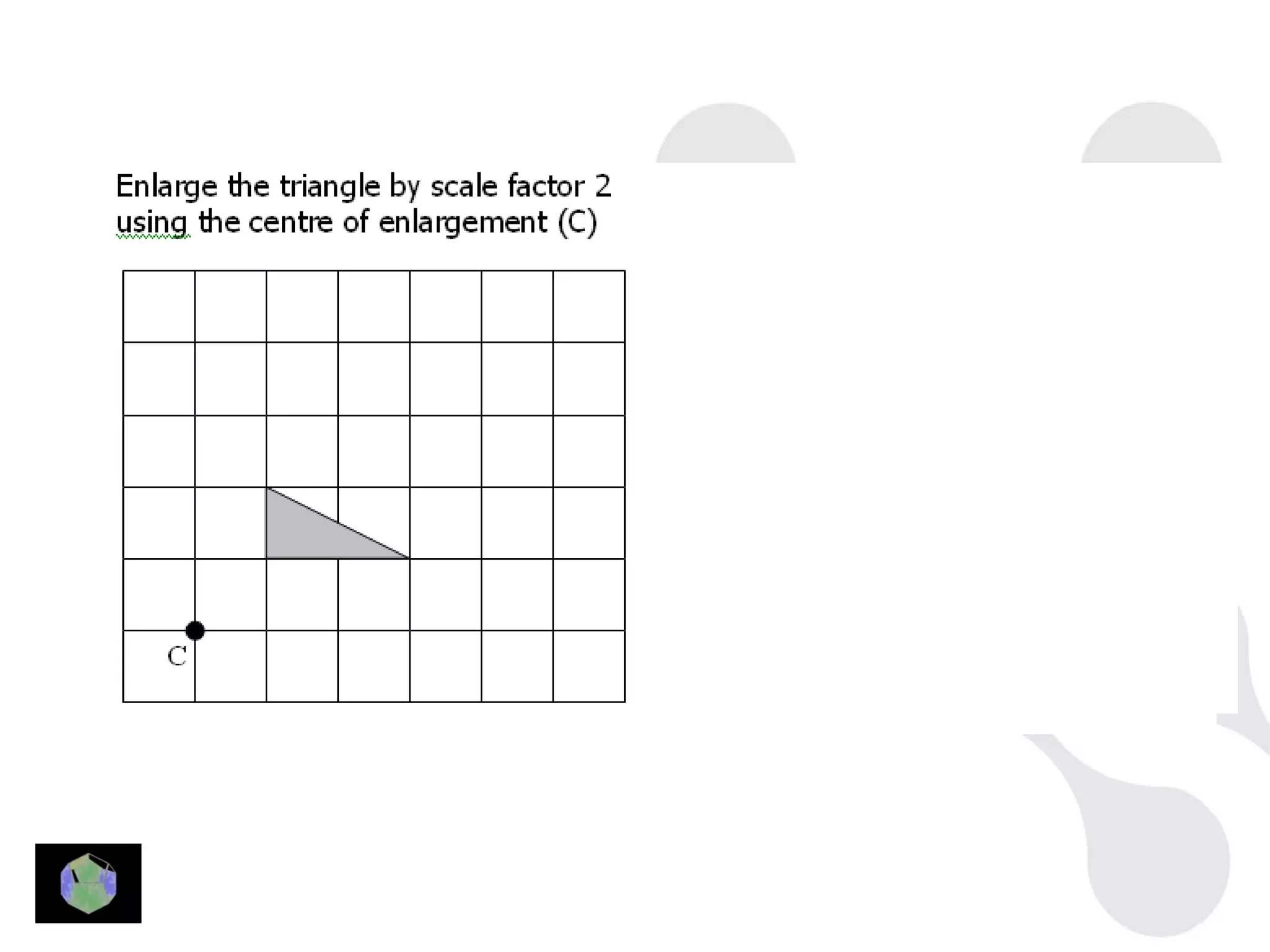
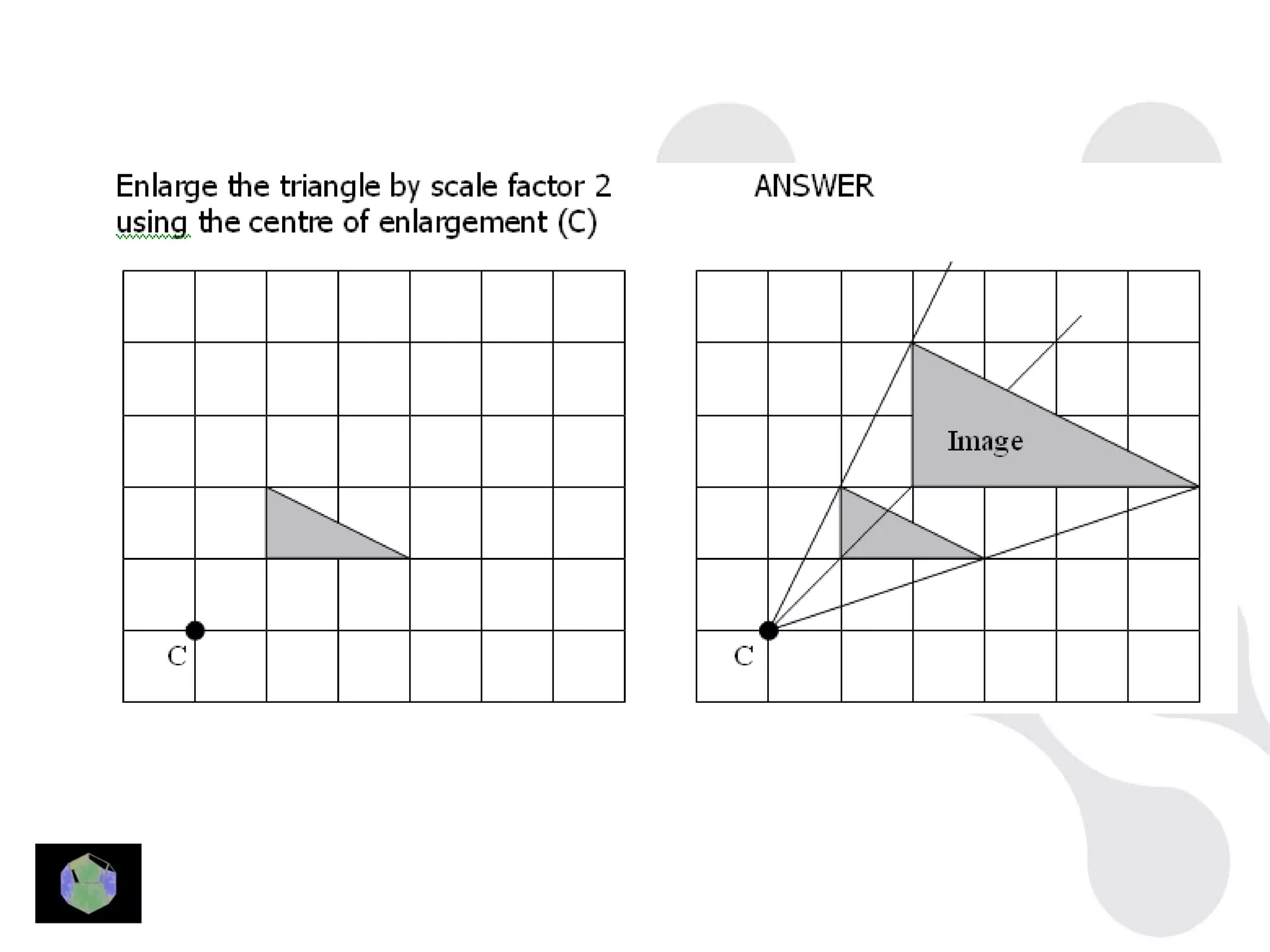
Translate the object by
                          ()
                          4
                          -3
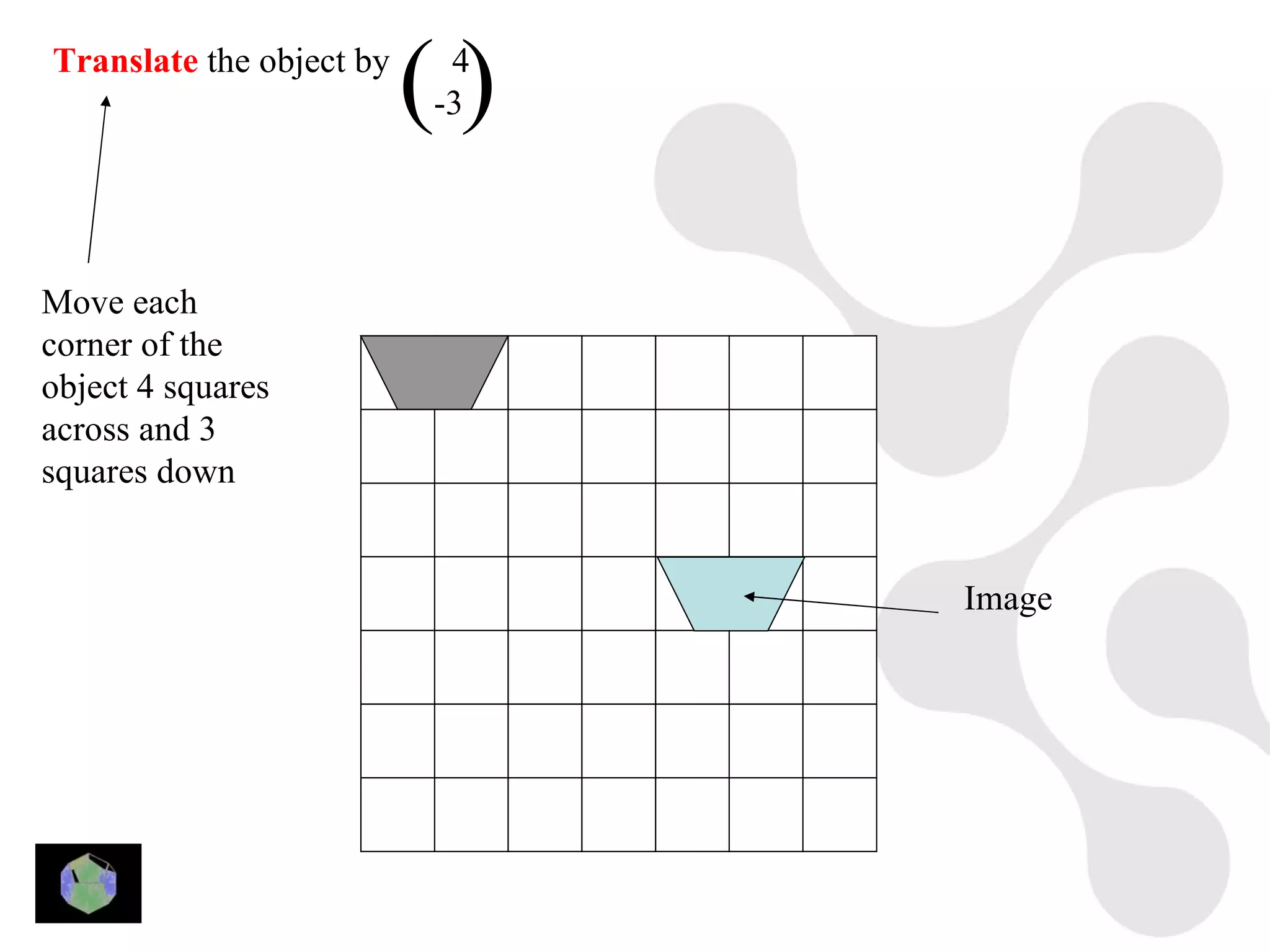
Translate the object by
                          ()
                           4
                          -3


Move each
corner of the
object 4 squares
across and 3
squares down


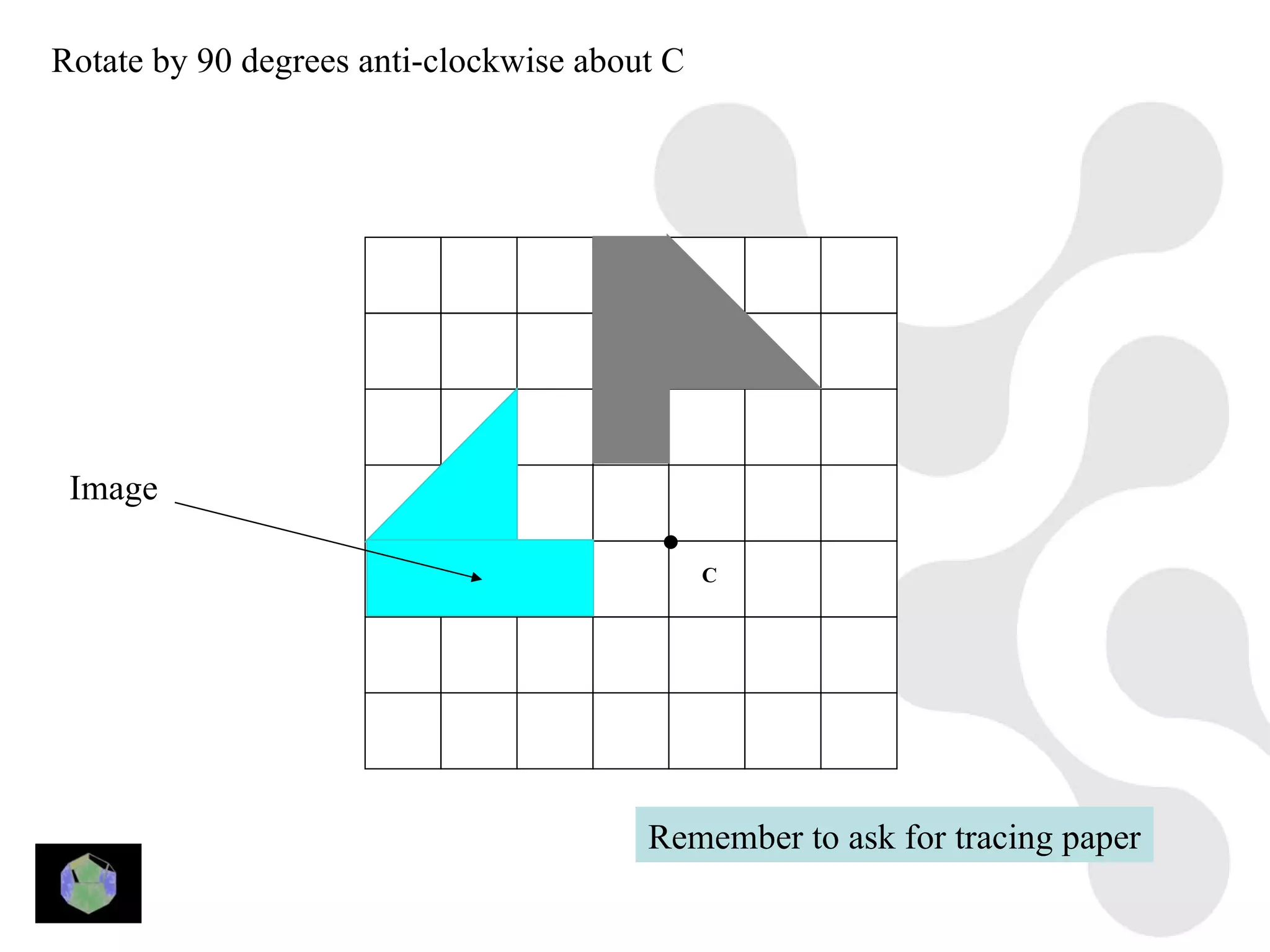
                               Image
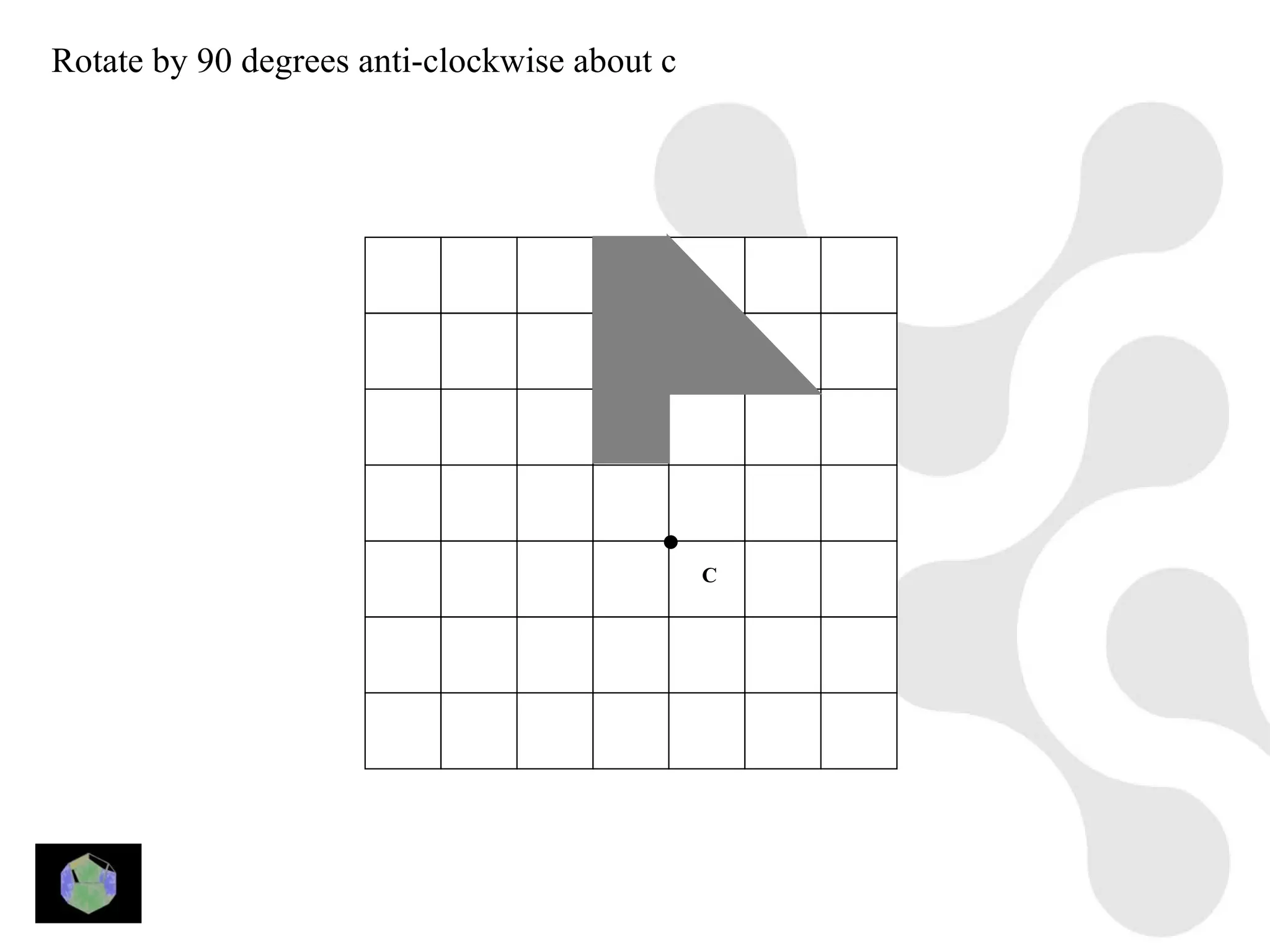
Rotate by 90 degrees anti-clockwise about c


                                              C
Rotate by 90 degrees anti-clockwise about C


 Image

                                              C


                                        Remember to ask for tracing paper
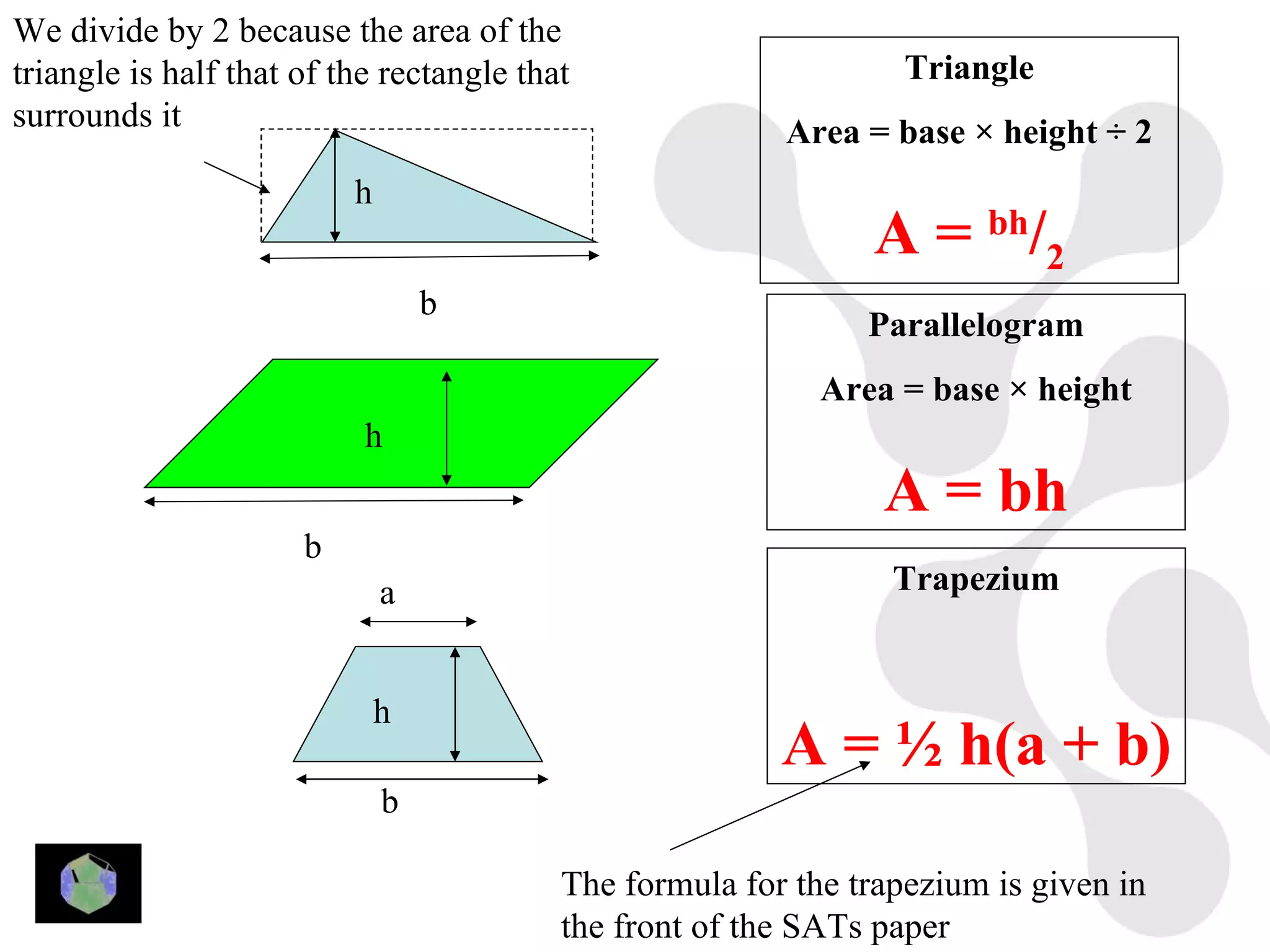
We divide by 2 because the area of the
triangle is half that of the rectangle that                       Triangle
surrounds it                                             Area = base × height ÷ 2
                          h
                                                               A = bh/2
                                  b
                                                               Parallelogram
                                                            Area = base × height
                           h
                                                                A = bh
                      b
                              a                                  Trapezium


                              h
                                                         A = ½ h(a + b)
                              b

                                          The formula for the trapezium is given in
                                          the front of the SATs paper
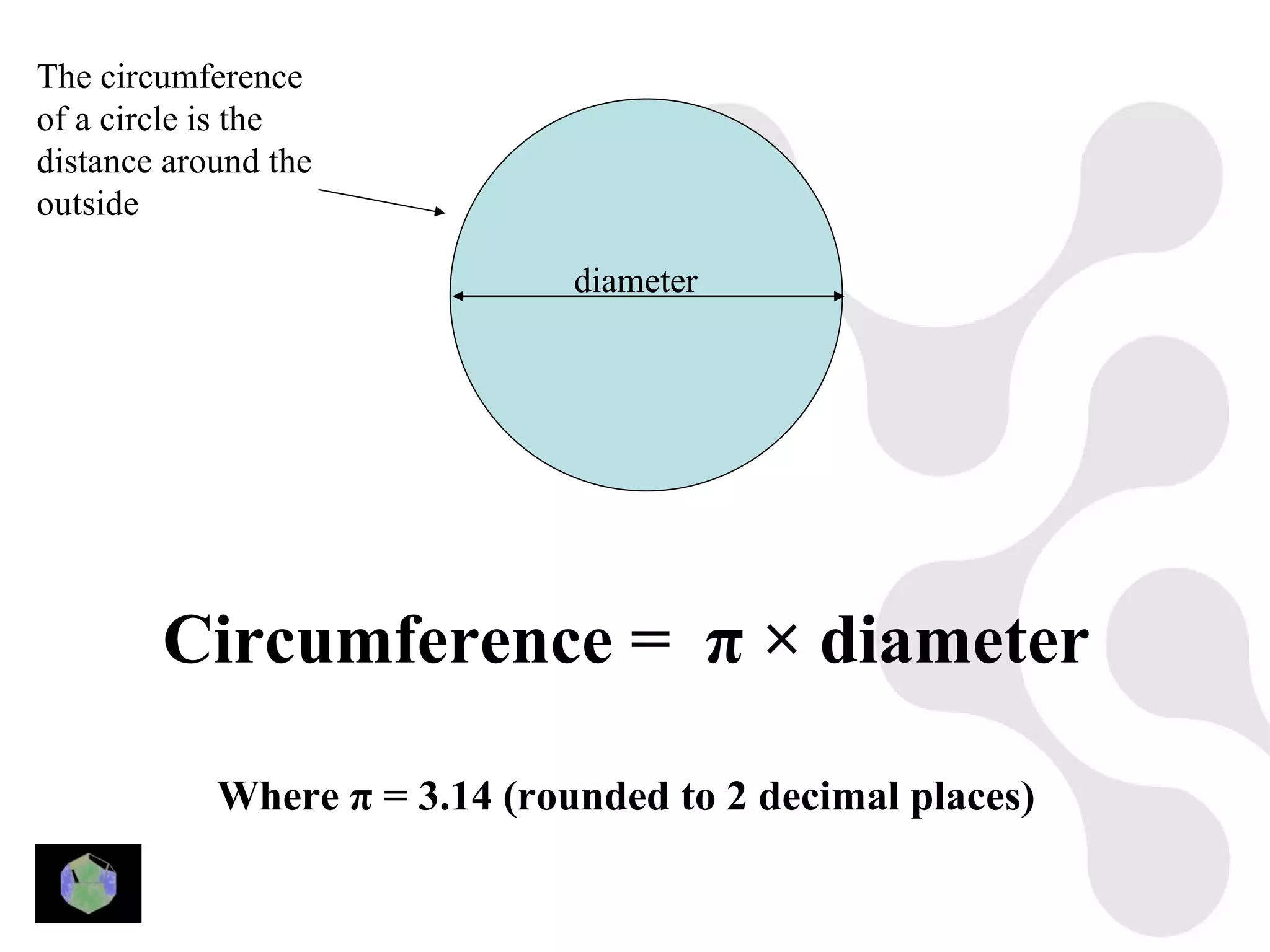
The circumference
of a circle is the
distance around the
outside

                               diameter


        Circumference = π × diameter

            Where π = 3.14 (rounded to 2 decimal places)
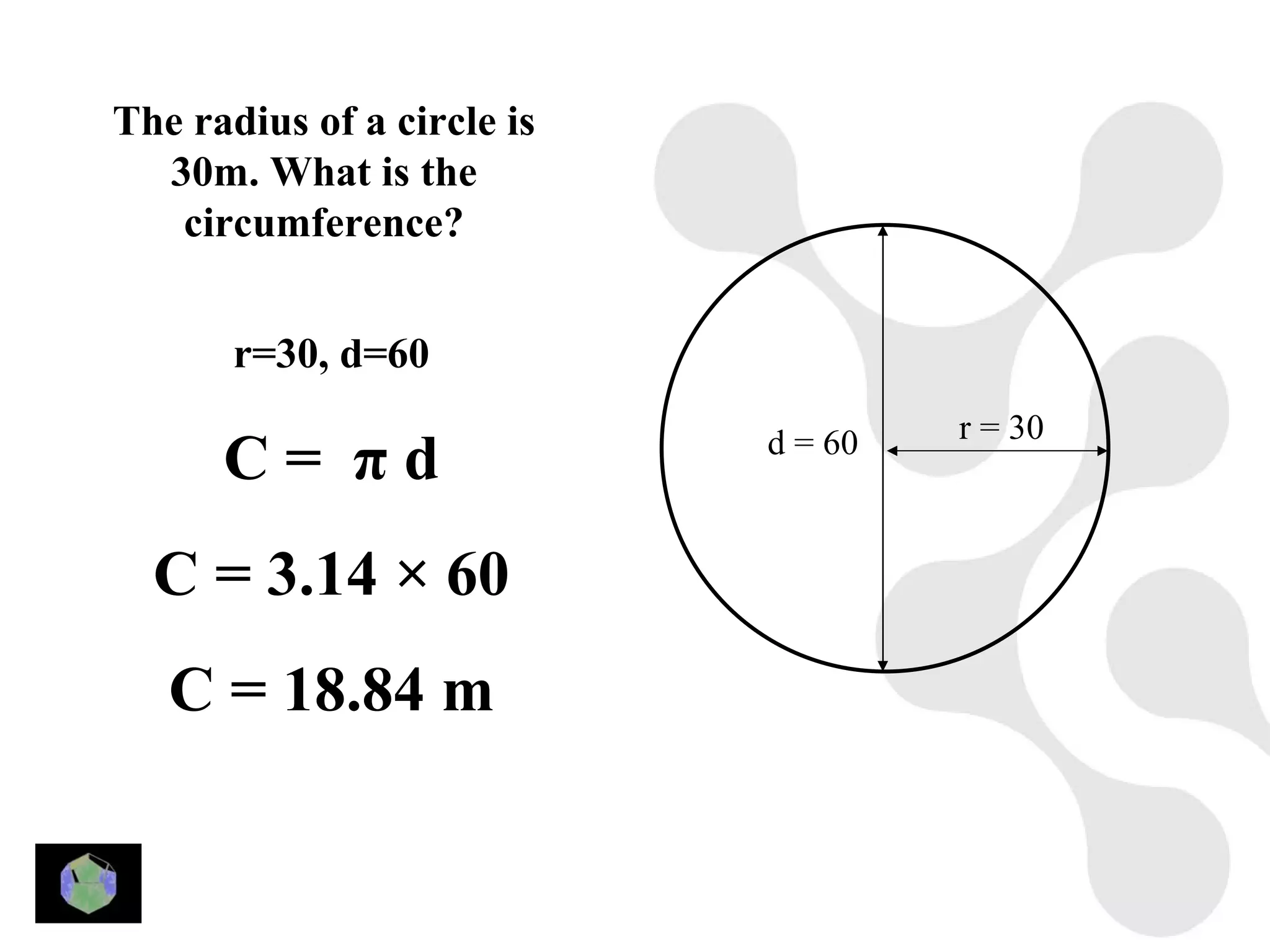
The radius of a circle is
  30m. What is the
   circumference?


       r=30, d=60
                                     r = 30
      C= πd                 d = 60


  C = 3.14 × 60
   C = 18.84 m
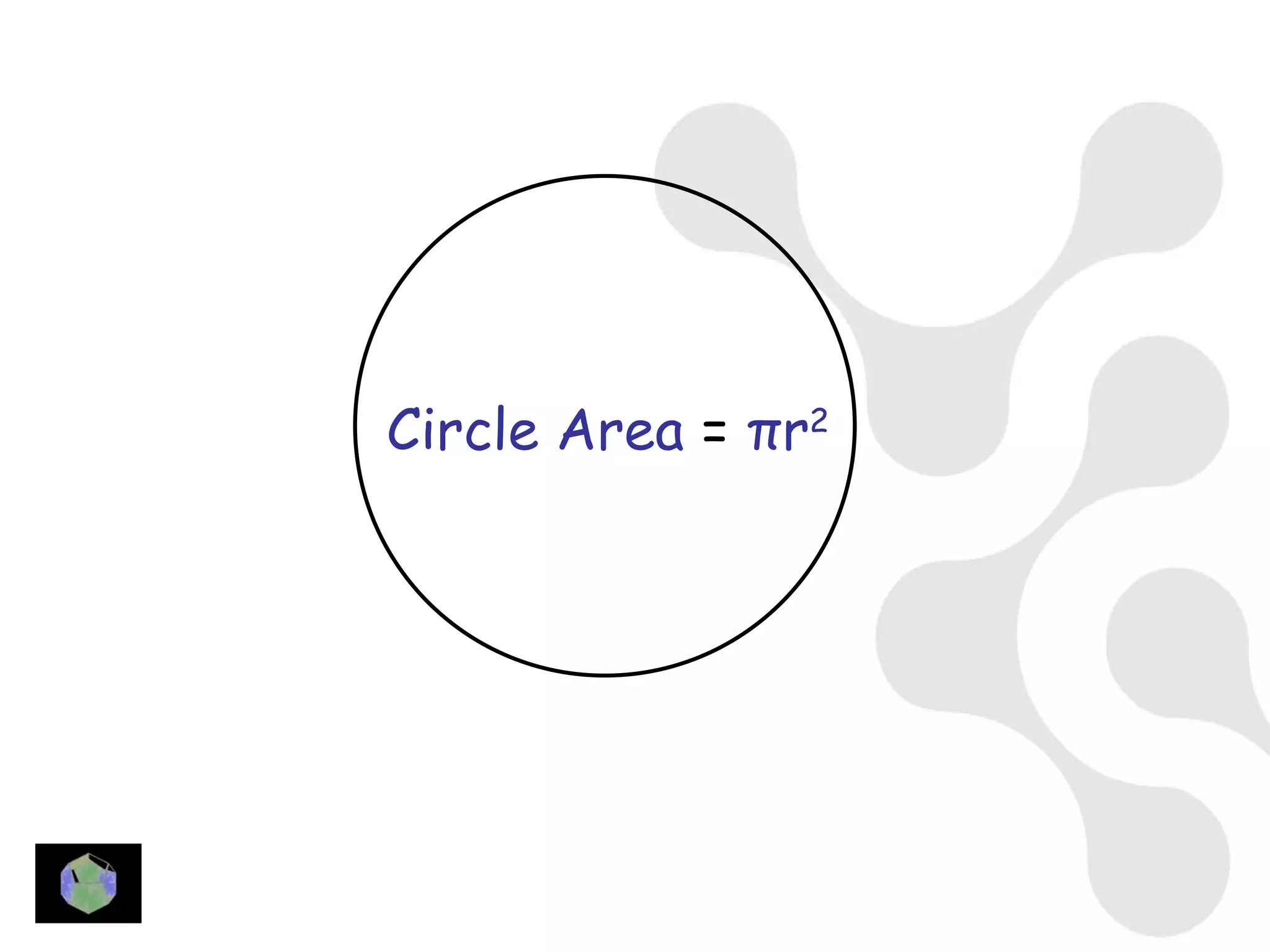
Circle Area = πr2
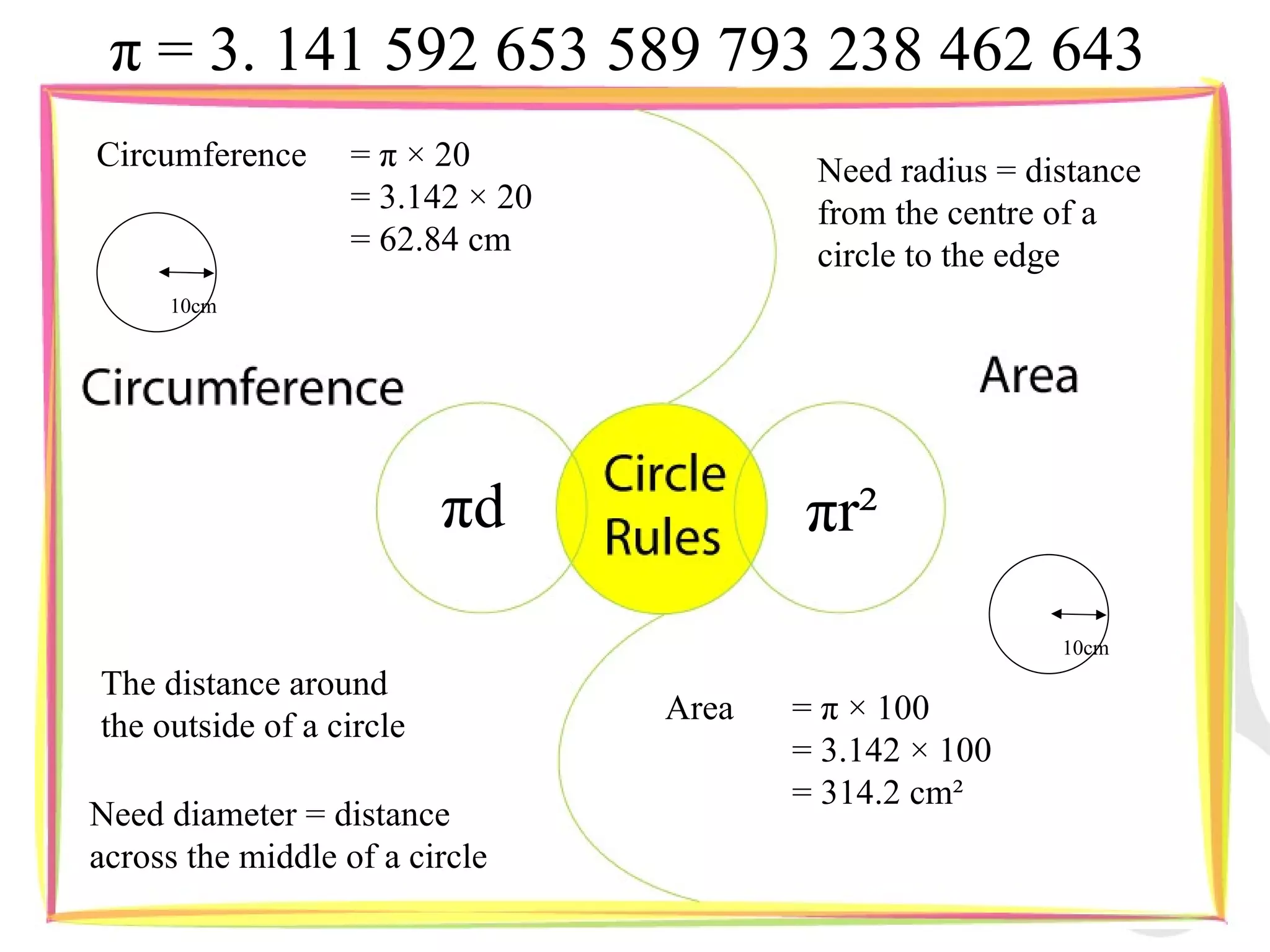
π = 3. 141 592 653 589 793 238 462 643
Circumference      = π × 20               Need radius = distance
                   = 3.142 × 20           from the centre of a
                   = 62.84 cm             circle to the edge
     10cm


                          πd             πr²
                                                          10cm
The distance around
                                  Area   = π × 100
the outside of a circle
                                         = 3.142 × 100
                                         = 314.2 cm²
Need diameter = distance
across the middle of a circle
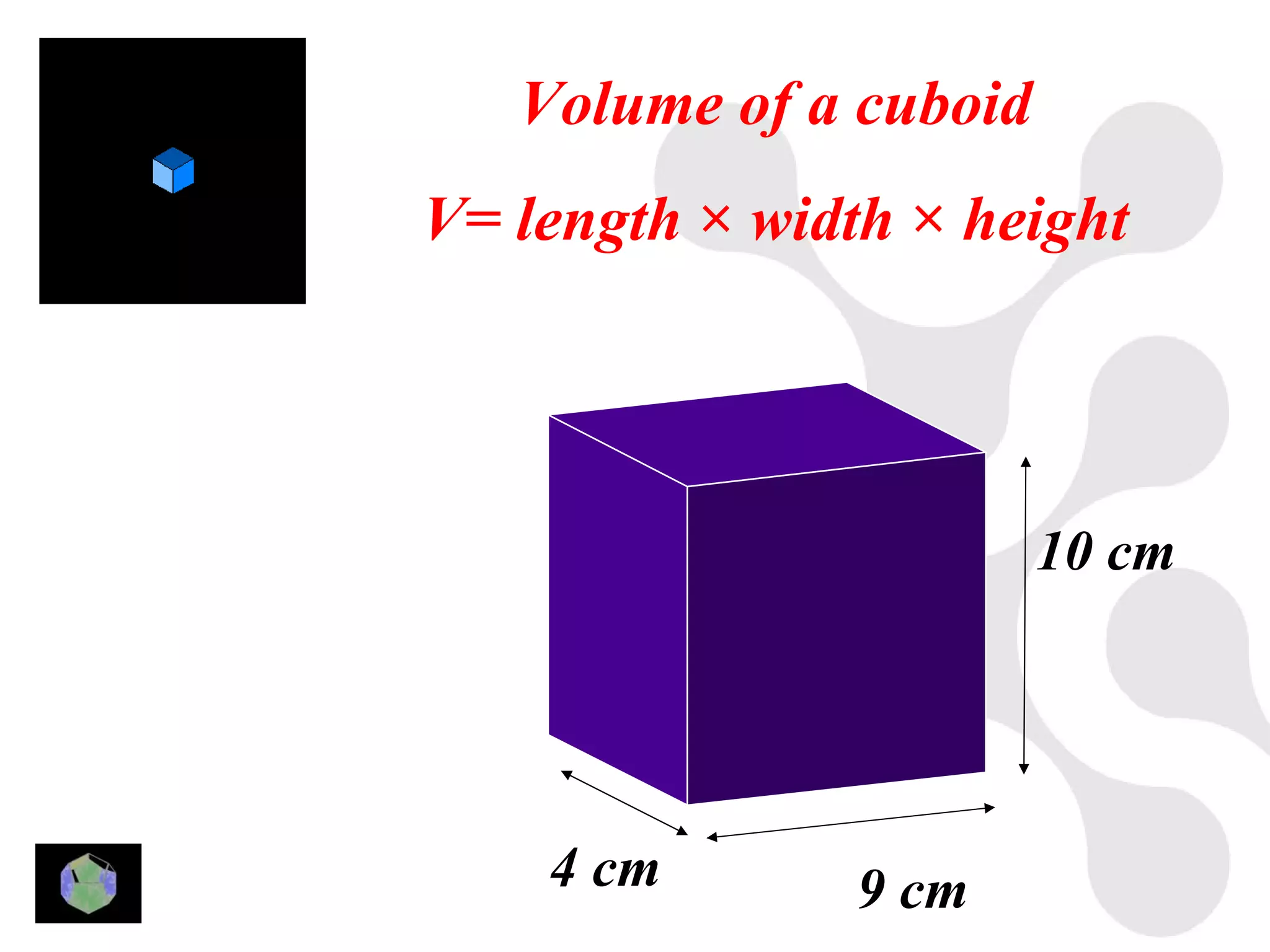
Volume of a cuboid
V= length × width × height


                        10 cm


    4 cm        9 cm
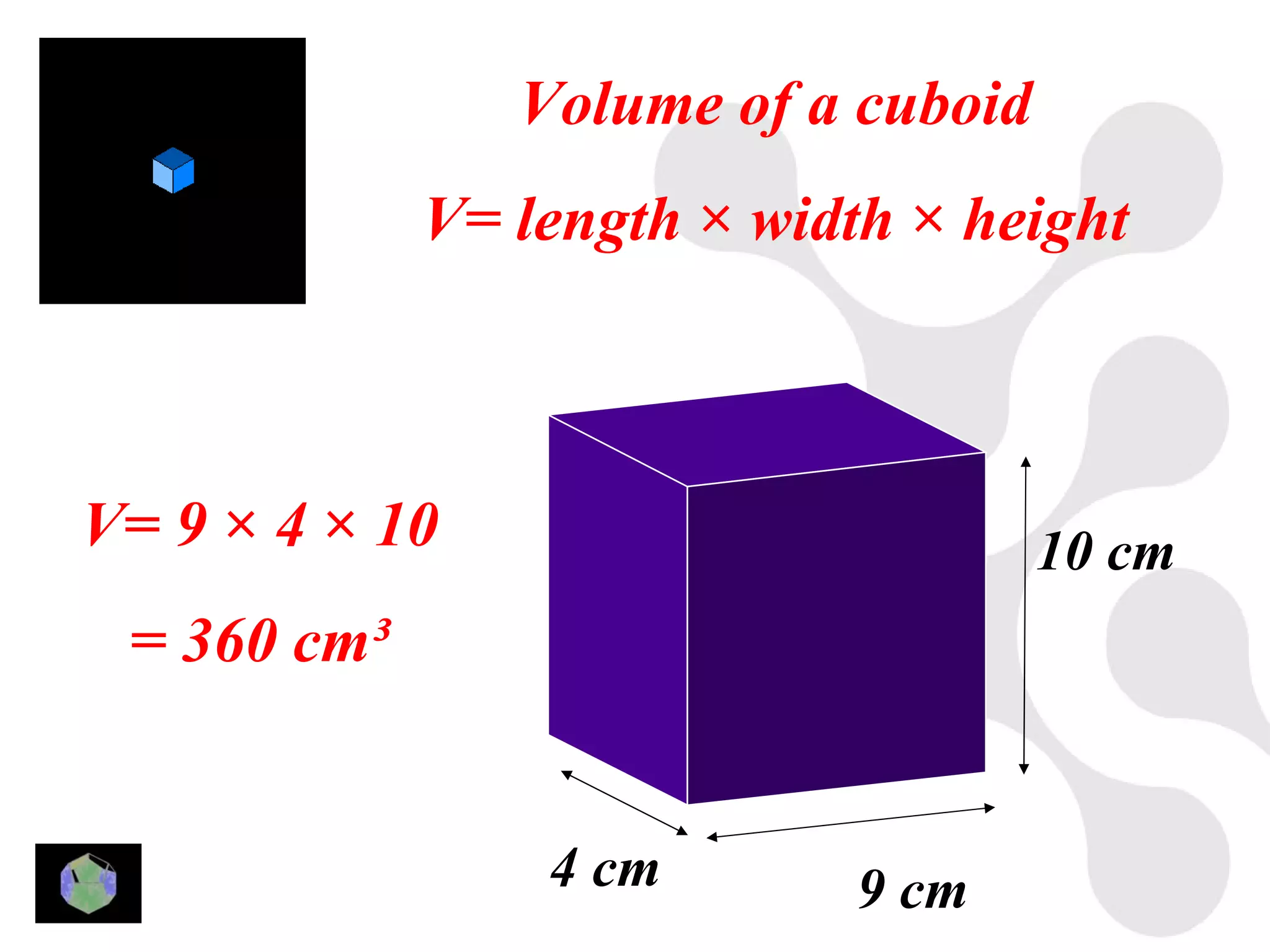
Volume of a cuboid
             V= length × width × height


V= 9 × 4 × 10                        10 cm
 = 360 cm³


                 4 cm        9 cm
Level 6


Data Handling
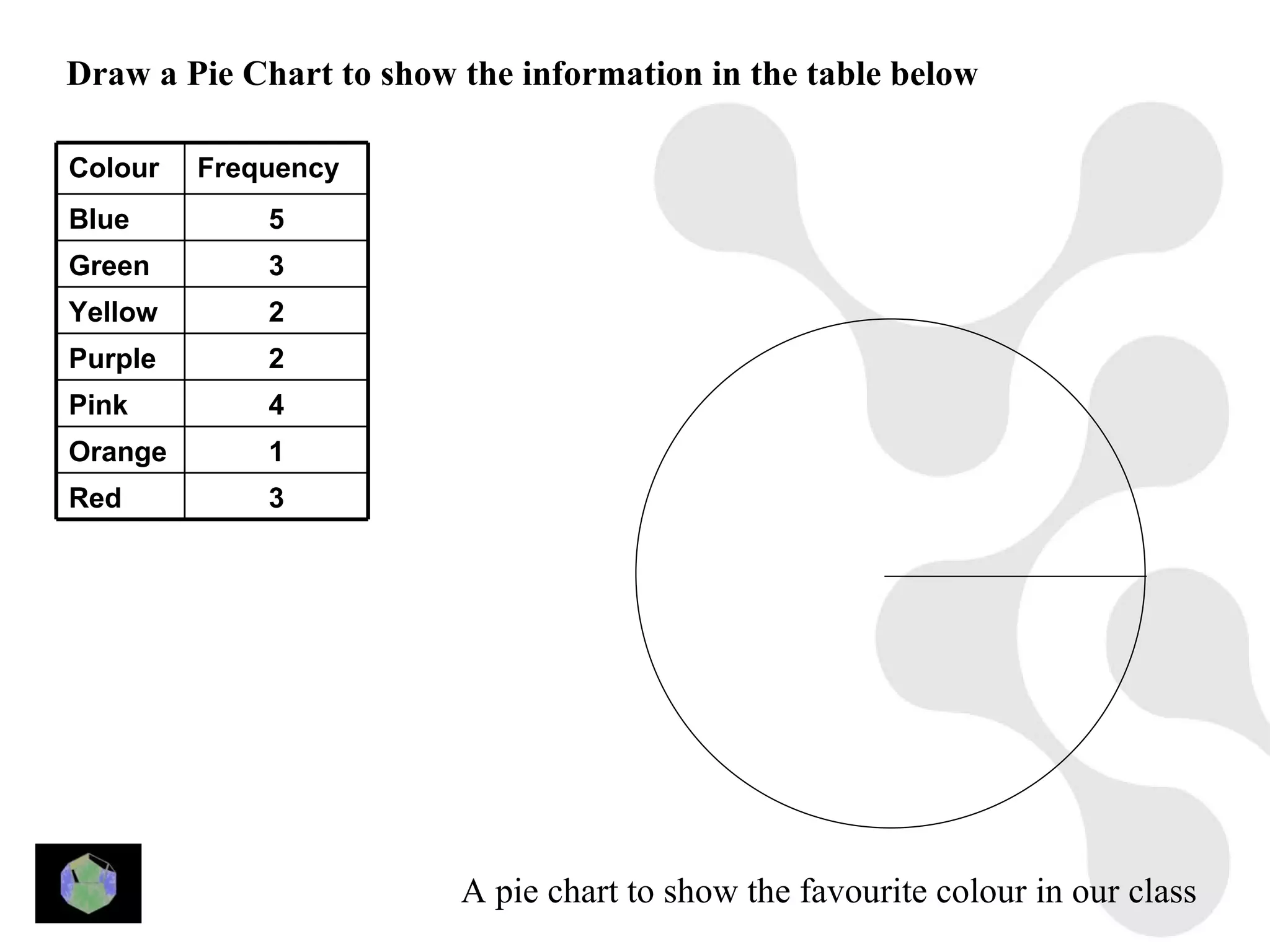
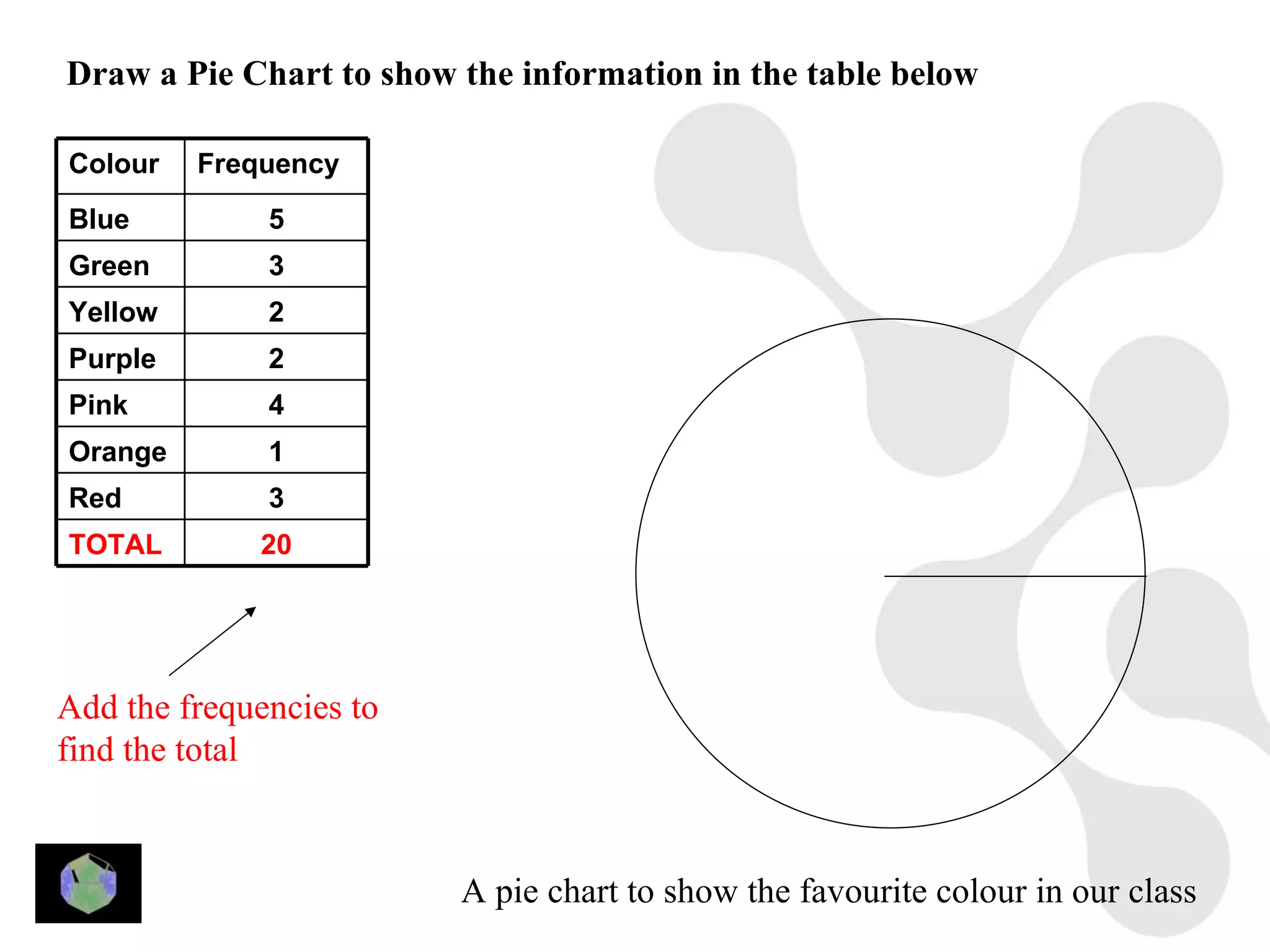
Draw a Pie Chart to show the information in the table below

Colour   Frequency
Blue         5
Green        3
Yellow       2
Purple       2
Pink         4
Orange       1
Red          3


                         A pie chart to show the favourite colour in our class
Draw a Pie Chart to show the information in the table below

Colour   Frequency
Blue          5
Green         3
Yellow        2
Purple        2
Pink          4
Orange        1
Red           3
TOTAL        20


Add the frequencies to
find the total


                         A pie chart to show the favourite colour in our class
Draw a Pie Chart to show the information in the table below

Colour   Frequency
Blue          5
Green         3
Yellow        2
Purple        2
Pink          4
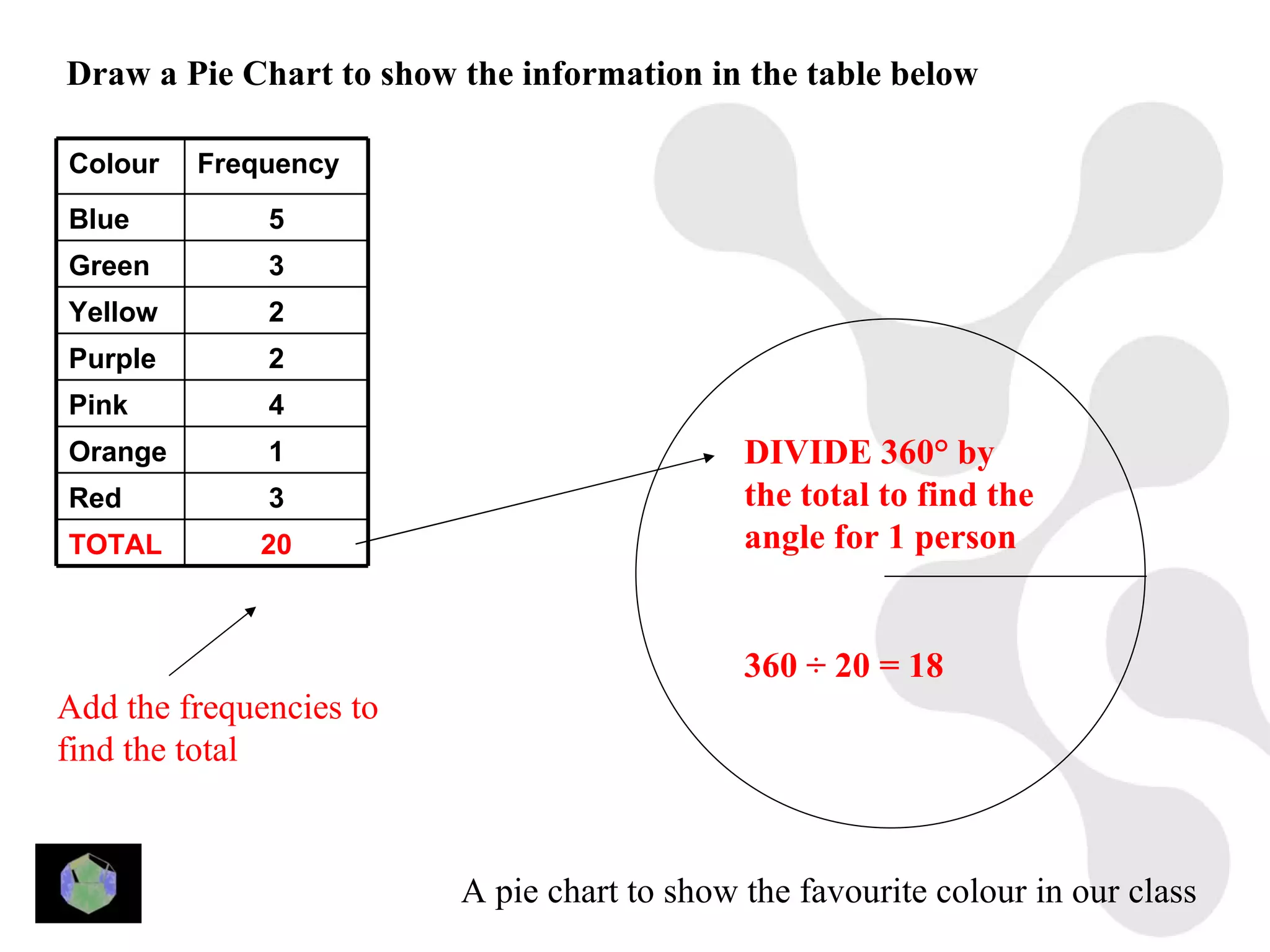
Orange        1                              DIVIDE 360° by
Red           3                              the total to find the
TOTAL        20                              angle for 1 person


                                             360 ÷ 20 = 18
Add the frequencies to
find the total


                         A pie chart to show the favourite colour in our class
Draw a Pie Chart to show the information in the table below

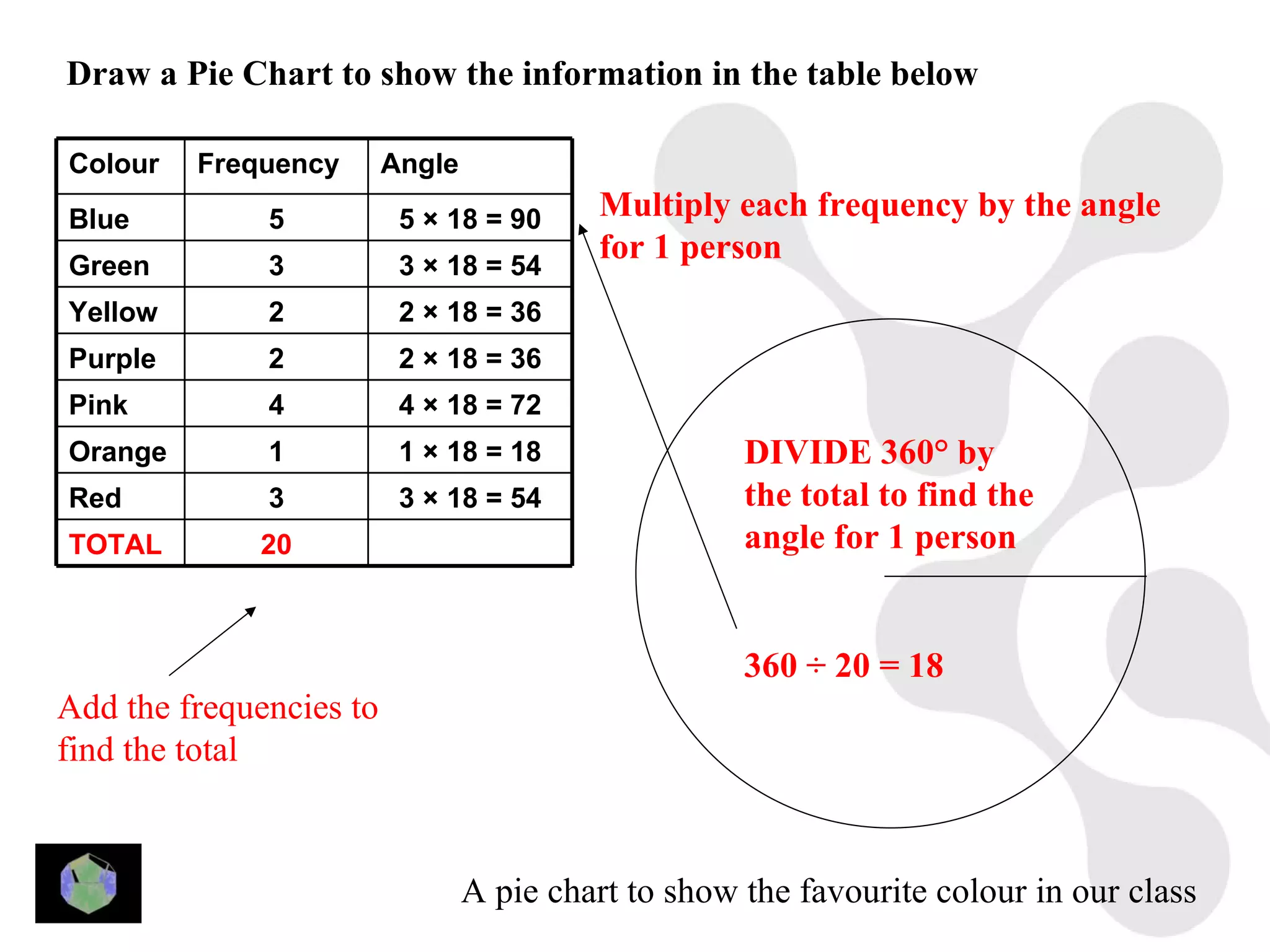
Colour   Frequency       Angle
Blue          5           5 × 18 = 90     Multiply each frequency by the angle
Green         3           3 × 18 = 54
                                          for 1 person
Yellow        2           2 × 18 = 36
Purple        2           2 × 18 = 36
Pink          4           4 × 18 = 72
Orange        1           1 × 18 = 18                DIVIDE 360° by
Red           3           3 × 18 = 54                the total to find the
TOTAL        20                                      angle for 1 person


                                                     360 ÷ 20 = 18
Add the frequencies to
find the total


                                 A pie chart to show the favourite colour in our class
Draw a Pie Chart to show the information in the table below


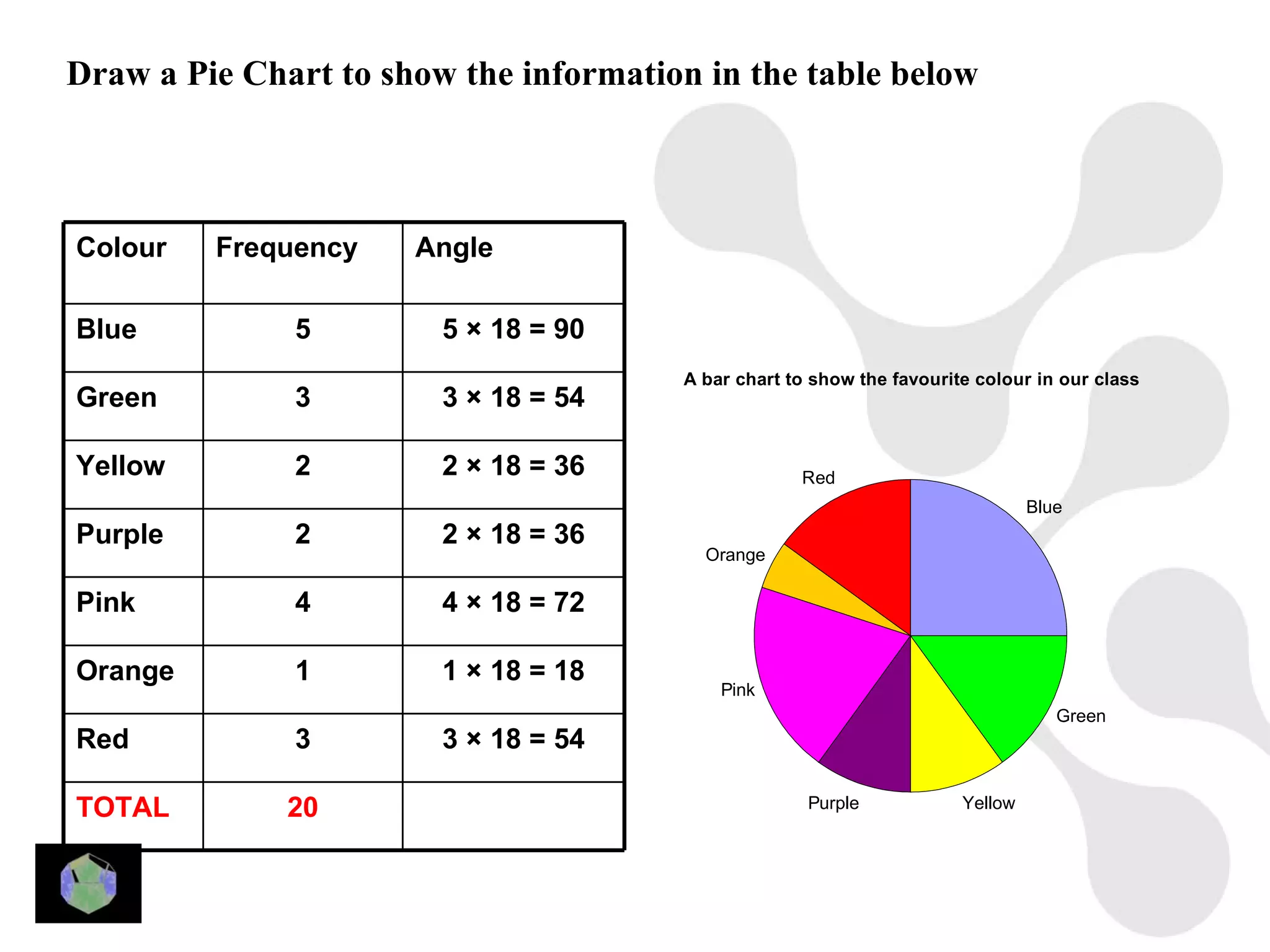
Colour   Frequency    Angle

Blue          5         5 × 18 = 90
                                       A bar chart to show the favourite colour in our class
Green         3         3 × 18 = 54

Yellow        2         2 × 18 = 36                 Red
                                                                                Blue
Purple        2         2 × 18 = 36
                                         Orange

Pink          4         4 × 18 = 72

Orange        1         1 × 18 = 18
                                           Pink
                                                                                   Green
Red           3         3 × 18 = 54

TOTAL         20                                     Purple            Yellow
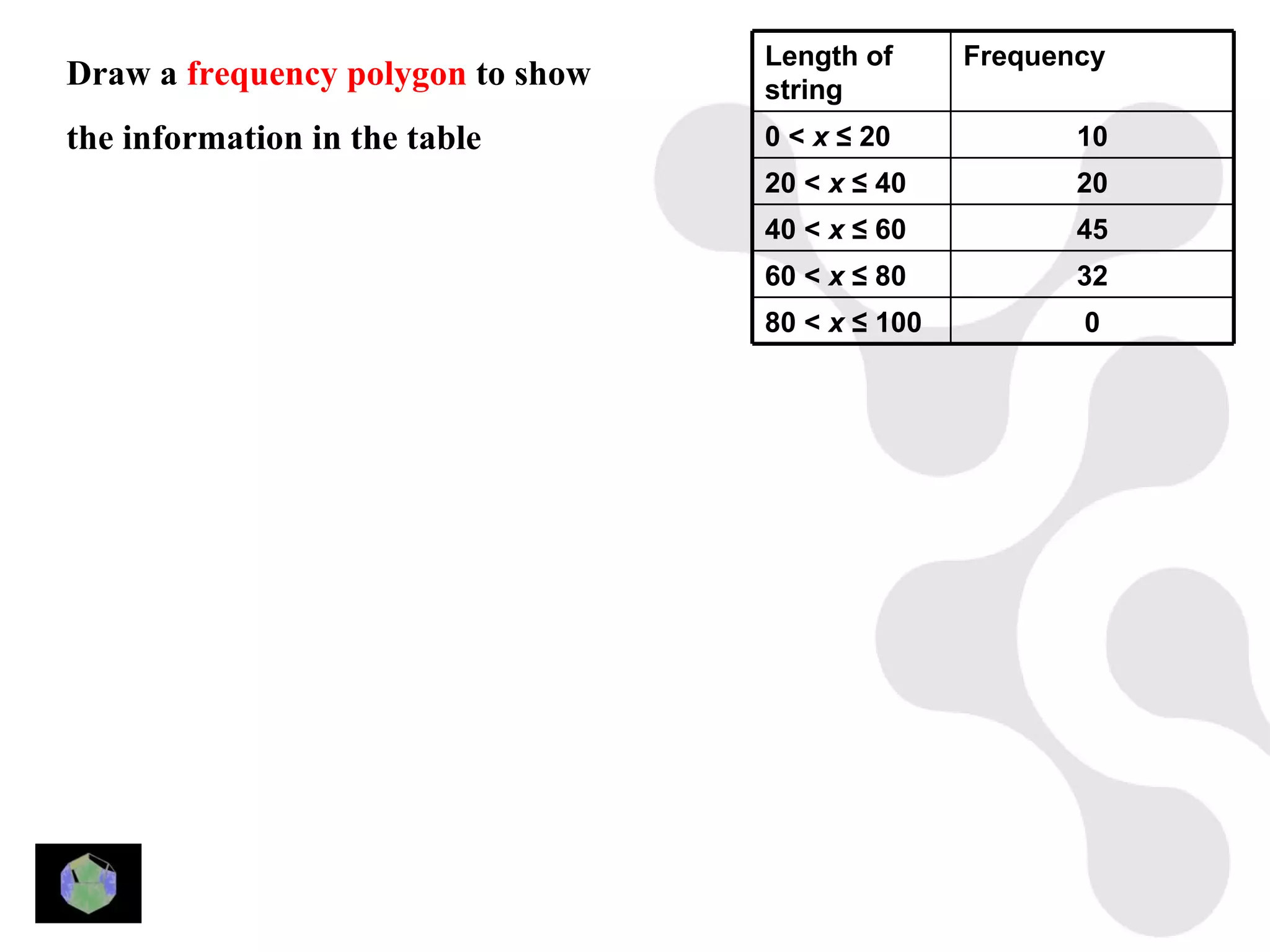
Length of      Frequency
Draw a frequency polygon to show   string
the information in the table       0 < x ≤ 20            10
                                   20 < x ≤ 40           20
                                   40 < x ≤ 60           45
                                   60 < x ≤ 80           32
                                   80 < x ≤ 100          0
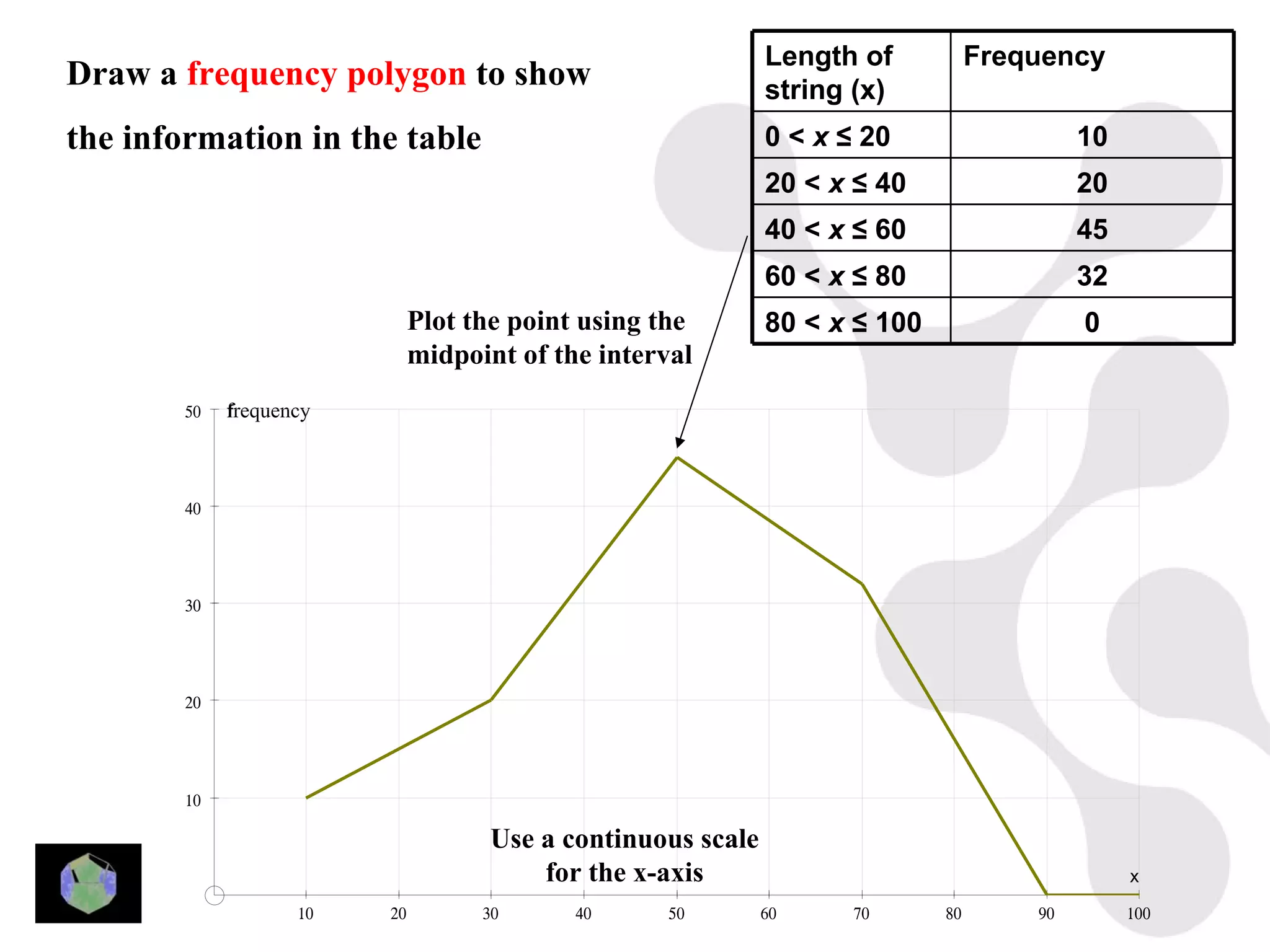
Length of           Frequency
Draw a frequency polygon to show                              string (x)
the information in the table                                  0 < x ≤ 20                   10
                                                              20 < x ≤ 40                  20
                                                              40 < x ≤ 60                  45
                                                              60 < x ≤ 80                  32
                              Plot the point using the        80 < x ≤ 100                 0
                              midpoint of the interval
        50   frequency
             f


        40


        30


        20


        10

                                     Use a continuous scale
                                         for the x-axis                                         x

                    10   20         30      40     50         60     70      80       90        100
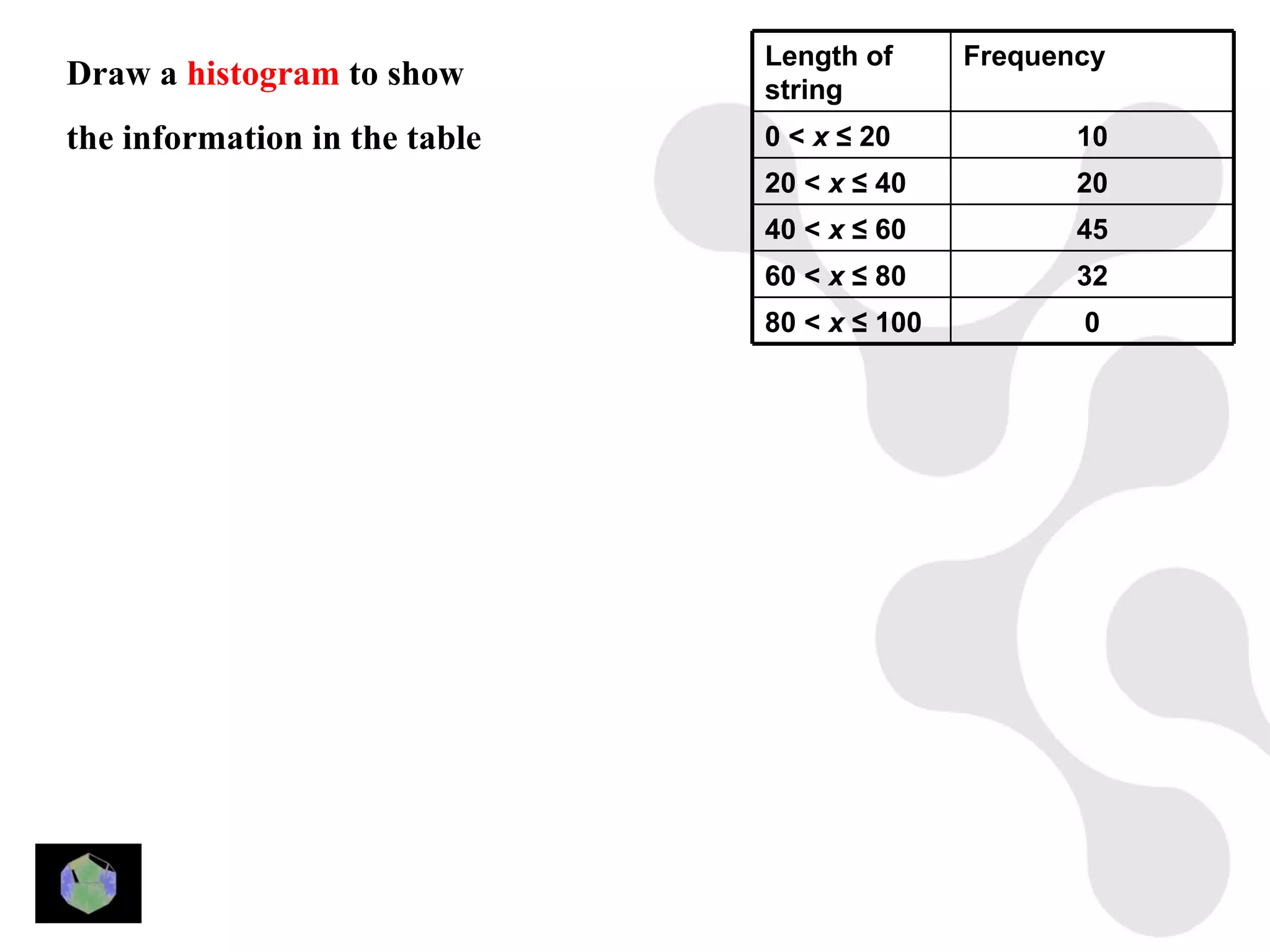
Length of      Frequency
Draw a histogram to show       string
the information in the table   0 < x ≤ 20            10
                               20 < x ≤ 40           20
                               40 < x ≤ 60           45
                               60 < x ≤ 80           32
                               80 < x ≤ 100          0
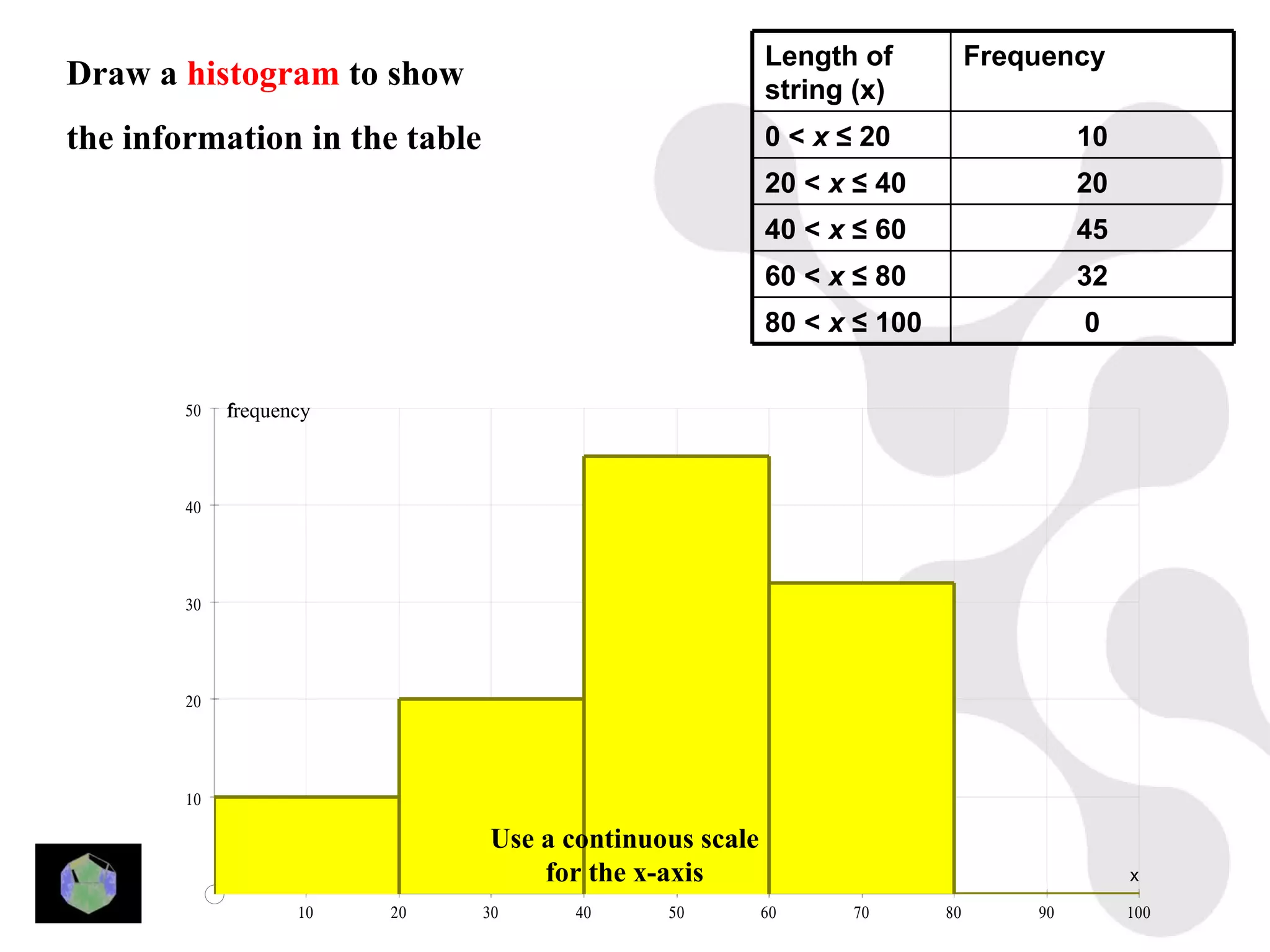
Length of           Frequency
Draw a histogram to show                                string (x)
the information in the table                            0 < x ≤ 20                   10
                                                        20 < x ≤ 40                  20
                                                        40 < x ≤ 60                  45
                                                        60 < x ≤ 80                  32
                                                        80 < x ≤ 100                 0

        50   frequency
             f


        40


        30


        20


        10

                               Use a continuous scale
                                   for the x-axis                                         x

                    10   20    30     40     50         60     70      80       90        100
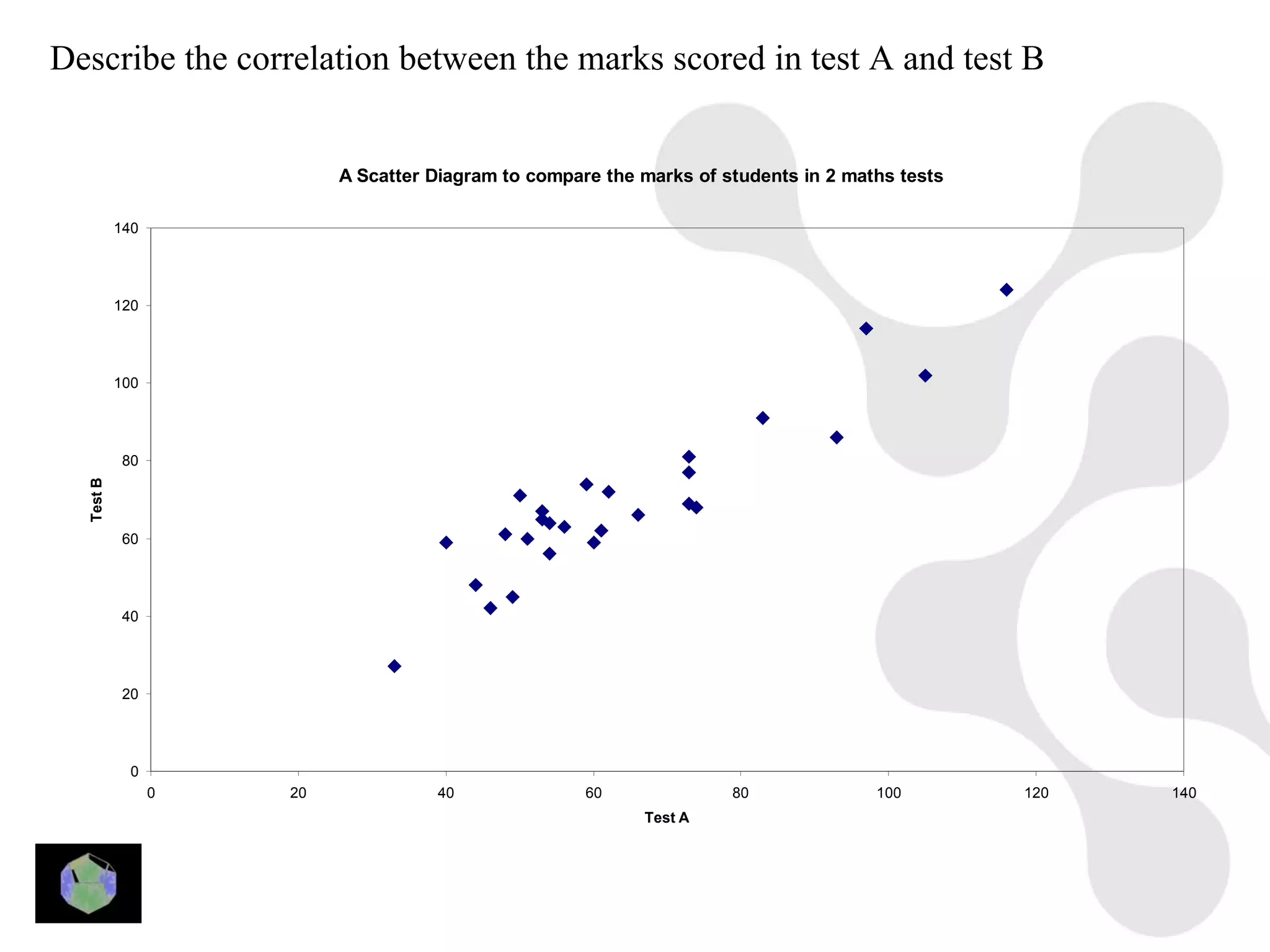
Describe the correlation between the marks scored in test A and test B


                          A Scatter Diagram to compare the marks of students in 2 maths tests

           140


           120


           100


            80
  Test B


            60


            40


            20


             0
                 0   20             40               60              80              100        120   140
                                                           Test A
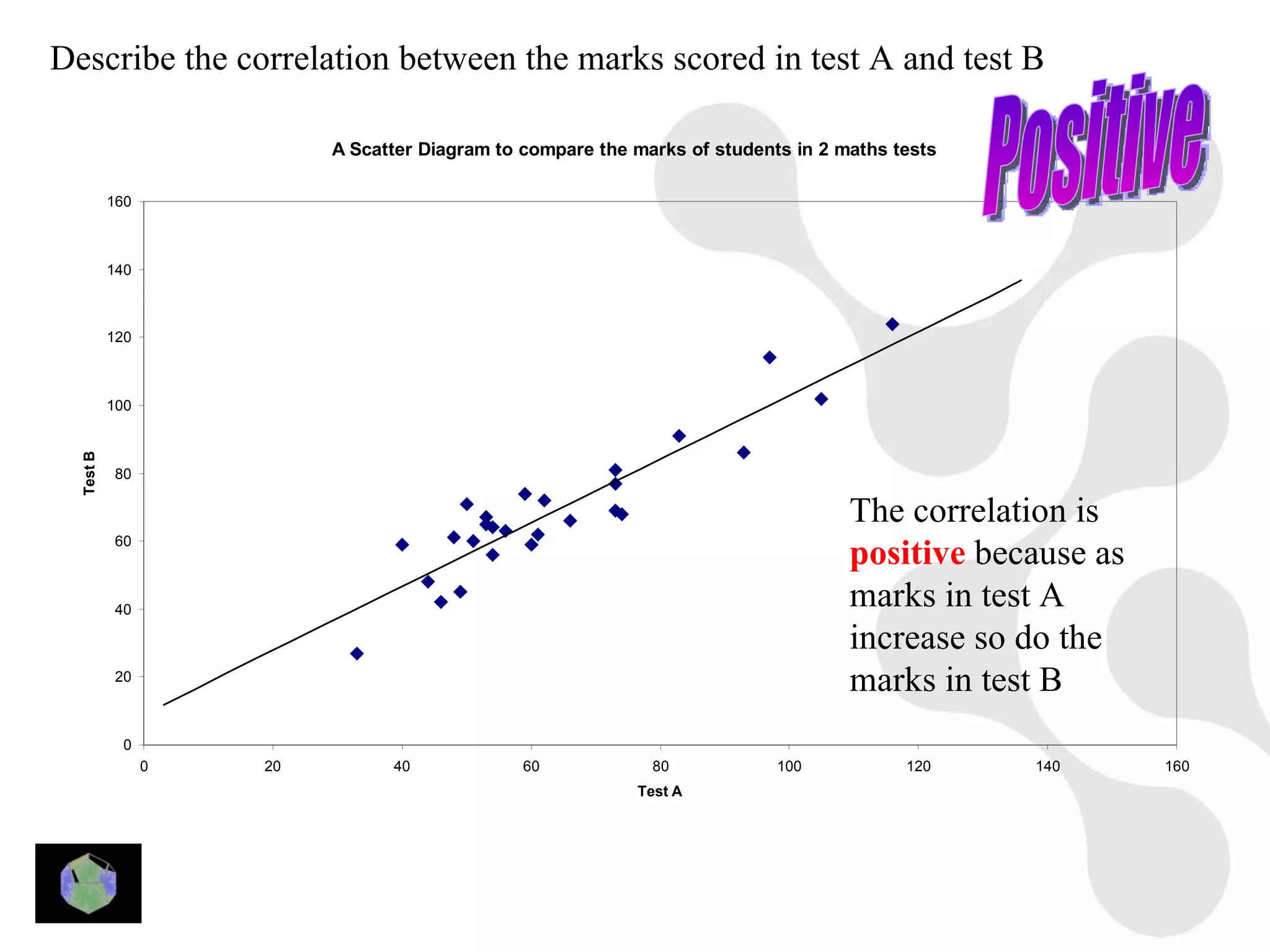
Describe the correlation between the marks scored in test A and test B

                          A Scatter Diagram to compare the marks of students in 2 maths tests

           160


           140


           120


           100
  Test B


            80

                                                                                   The correlation is
                                                                                   positive because as
            60


            40
                                                                                   marks in test A
                                                                                   increase so do the
            20
                                                                                   marks in test B
             0
                 0   20         40             60            80            100           120    140      160
                                                           Test A
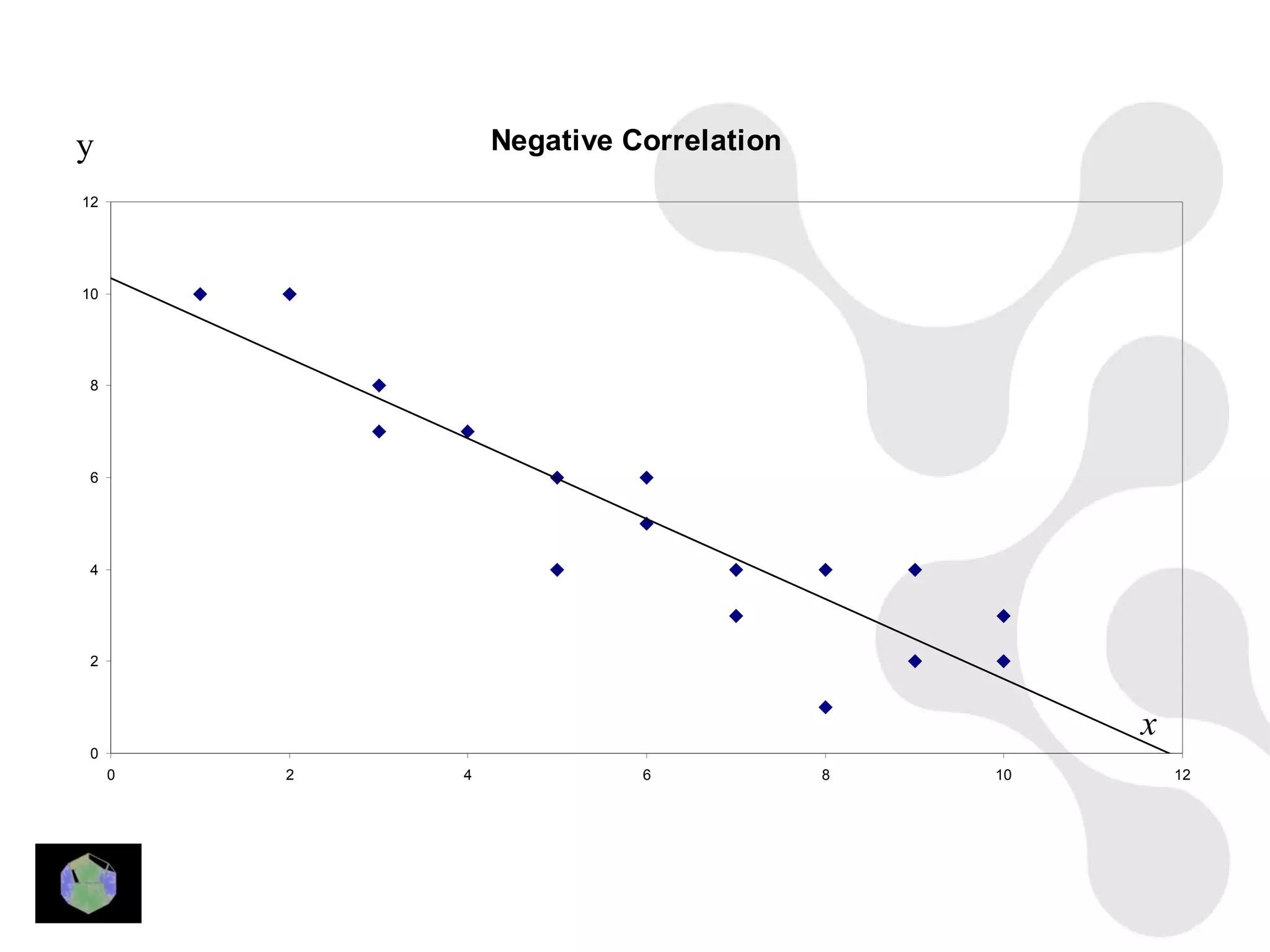
y                Negative Correlation
12


10


 8


 6


 4


 2


                                                 x
 0
     0   2   4             6            8   10       12
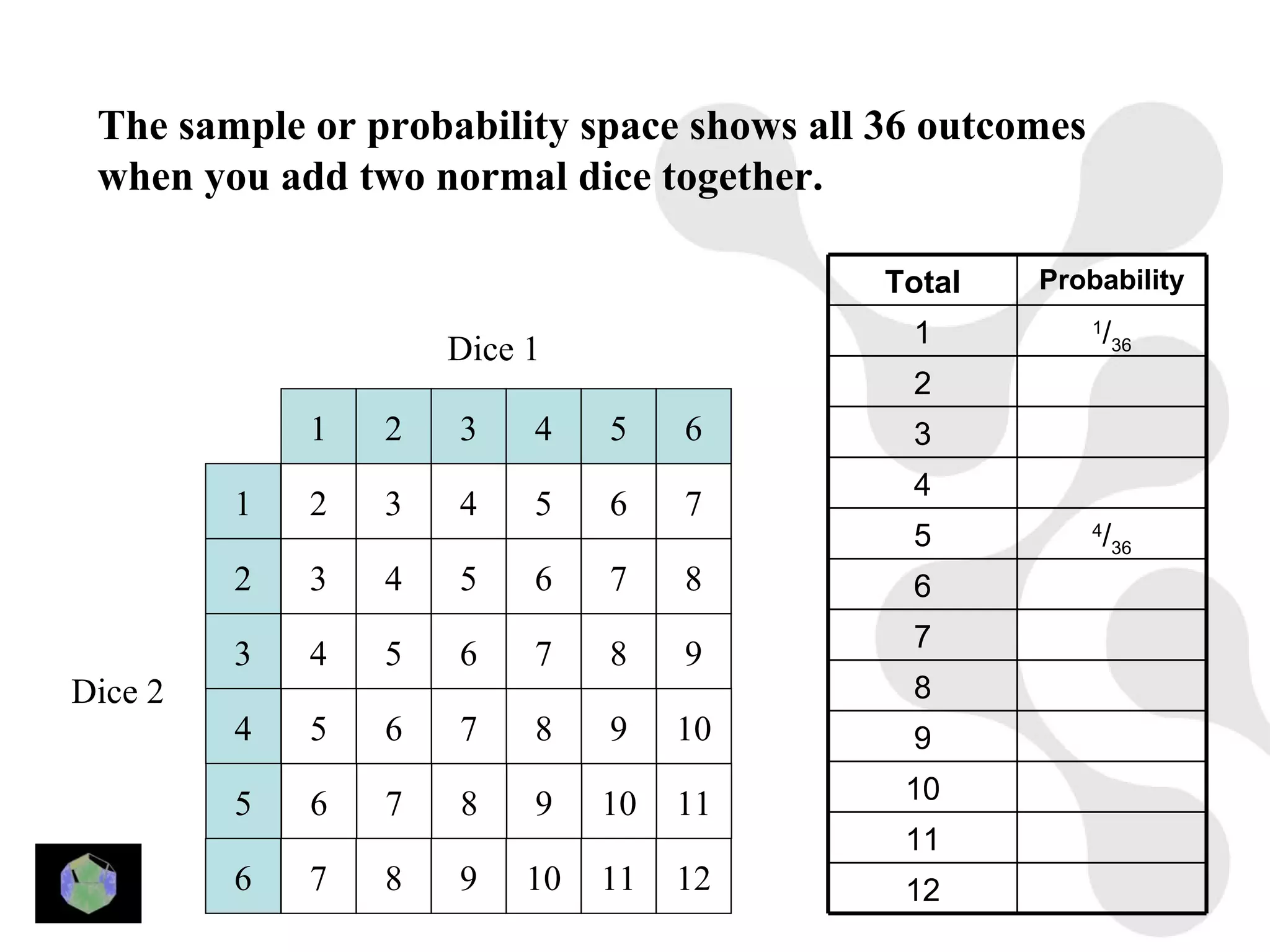
The sample or probability space shows all 36 outcomes
 when you add two normal dice together.

                                           Total   Probability
                                            1            1
                                                             /36
                     Dice 1
                                            2
             1   2   3    4    5    6       3
                                            4
         1   2   3   4    5    6    7
                                            5            4
                                                             /36
         2   3   4   5    6    7    8       6
                                            7
         3   4   5   6    7    8    9
Dice 2                                      8
         4   5   6   7    8    9    10      9

         5   6   7   8    9    10   11      10
                                            11
         6   7   8   9    10   11   12      12
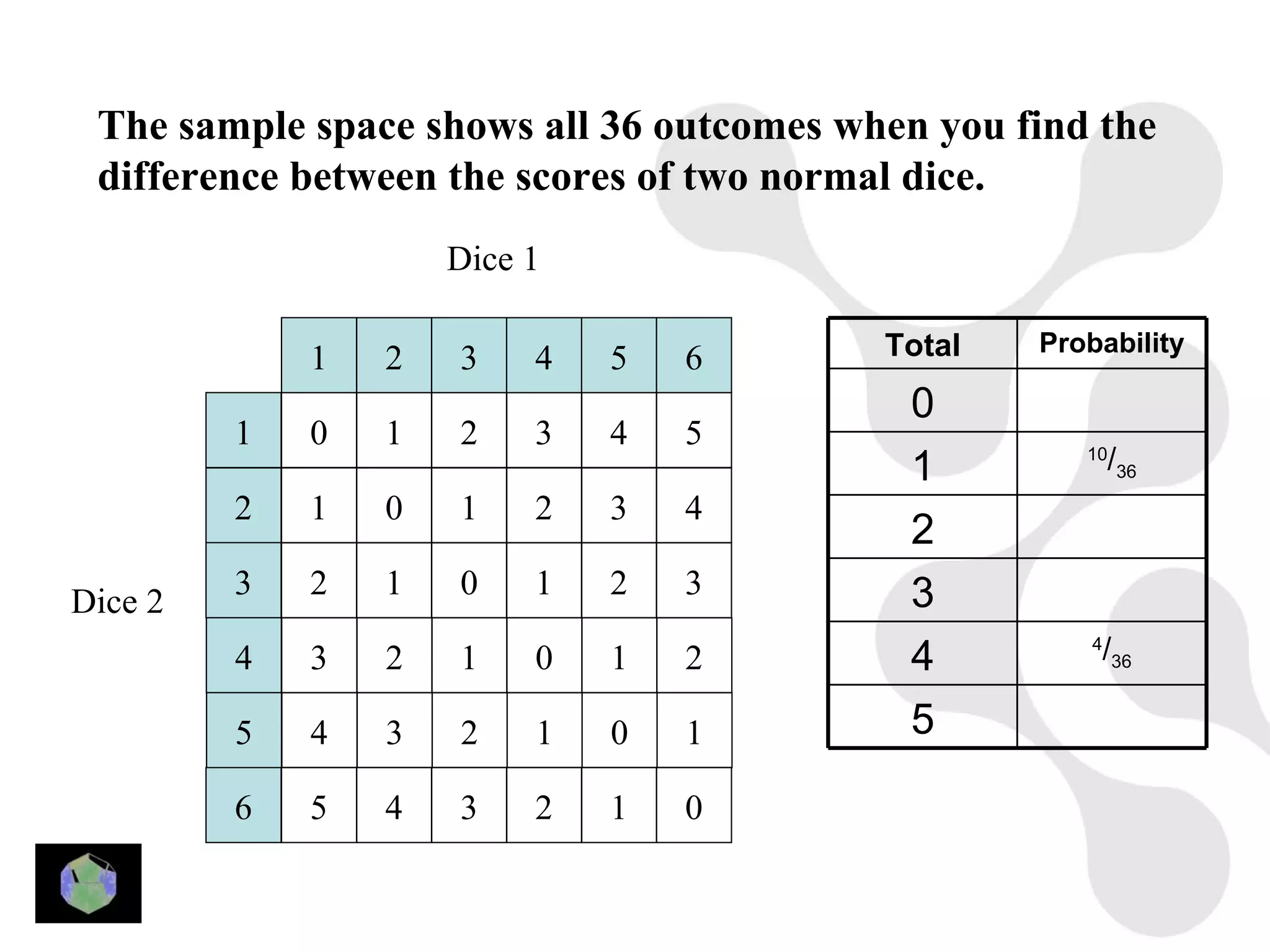
The sample space shows all 36 outcomes when you find the
 difference between the scores of two normal dice.
                     Dice 1

                                          Total   Probability
             1   2   3    4   5   6
                                            0
         1   0   1   2    3   4   5
                                            1        10
                                                          /36
         2   1   0   1    2   3   4
                                            2
         3   2   1   0    1   2   3         3
Dice 2
         4   3   2   1    0   1   2         4         4
                                                          /36

         5   4   3   2    1   0   1         5

         6   5   4   3    2   1   0
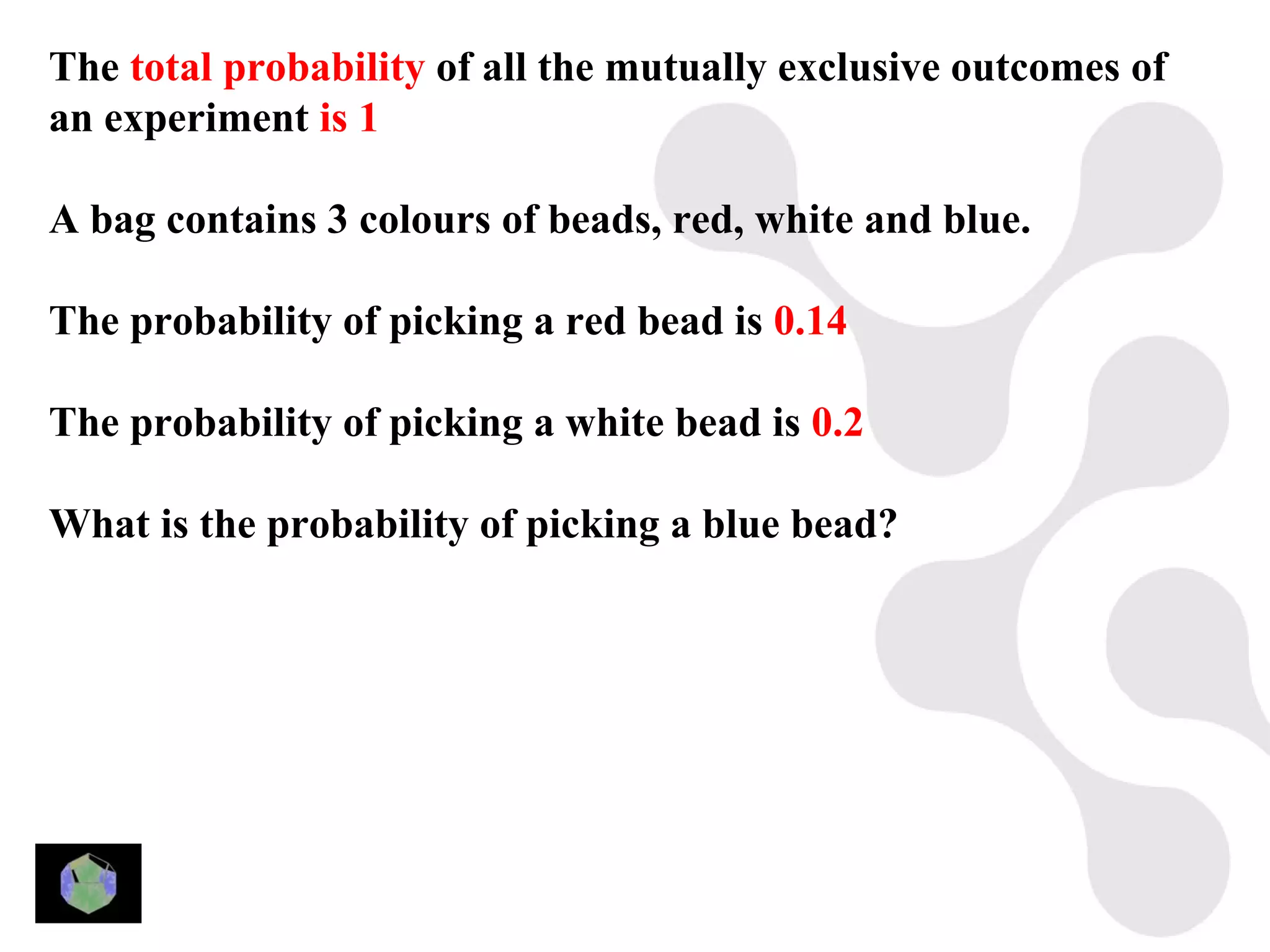
The total probability of all the mutually exclusive outcomes of
an experiment is 1

A bag contains 3 colours of beads, red, white and blue.

The probability of picking a red bead is 0.14

The probability of picking a white bead is 0.2

What is the probability of picking a blue bead?
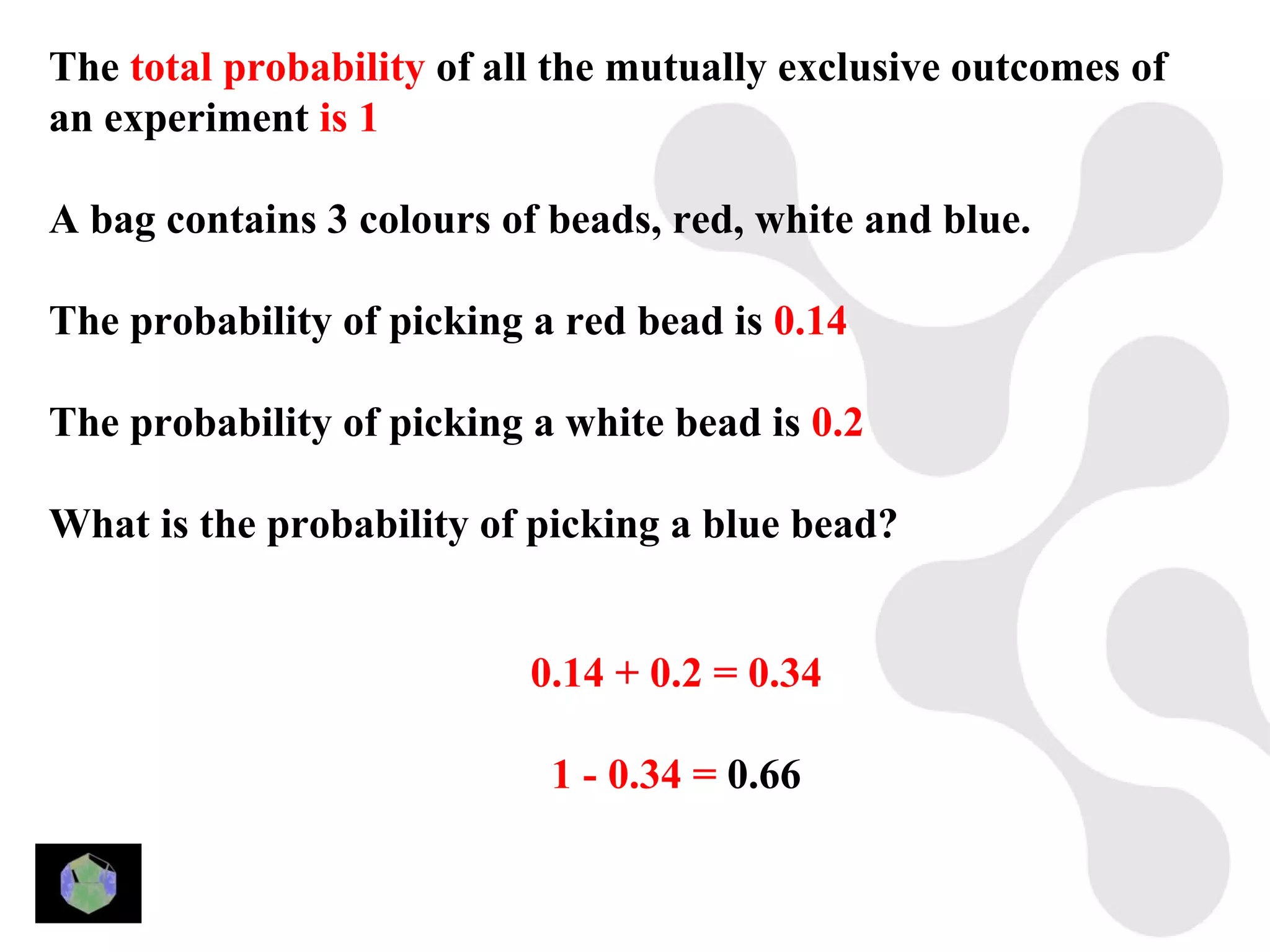
The total probability of all the mutually exclusive outcomes of
an experiment is 1

A bag contains 3 colours of beads, red, white and blue.

The probability of picking a red bead is 0.14

The probability of picking a white bead is 0.2

What is the probability of picking a blue bead?


                           0.14 + 0.2 = 0.34

                            1 - 0.34 = 0.66
© Dave Cavill

Level 6 Maths Revision

  • 1.
    Key Stage 3 Mathematics Key Facts Level 6
  • 2.
  • 3.
    Solve the equation x³ + x = 20 Using trial and improvement and give your answer to the nearest tenth Guess Check Too Big/Too Small/Correct
  • 4.
    Solve the equation x³ + x = 20 Using trial and improvement and give your answer to the nearest tenth Guess Check Too Big/Too Small/Correct 3 3³ + 3 = 30 Too Big
  • 5.
    Solve the equation x³ + x = 20 Using trial and improvement and give your answer to the nearest tenth Guess Check Too Big/Too Small/Correct 3 3³ + 3 = 30 Too Big 2 2³ + 2 = 10 Too Small
  • 6.
    Solve the equation x³ + x = 20 Using trial and improvement and give your answer to the nearest tenth Guess Check Too Big/Too Small/Correct 3 3³ + 3 = 30 Too Big 2 2³ + 2 = 10 Too Small 2.5 2.5³ + 2.5 =18.125 Too Small 2.6
  • 7.
    Amounts as a% • Fat in a mars bar 28g out of 35g. What percentage is this? Write as a fraction top ÷ bottom converts a fraction to a • =28/35 decimal Convert to a percentage (top ÷ bottom x 100) • 28 ÷ 35 x 100 = 80% Multiply by 100 to make a decimal into a percentage
  • 8.
    A percentage isa fraction out of 100
  • 11.
    The ratio ofboys to girls in a class is 3:2 Altogether there are 30 students in the class. How many boys are there?
  • 12.
    The ratio ofboys to girls in a class is 3:2 Altogether there are 30 students in the class. How many boys are there? The ratio 3:2 represents 5 parts (add 3 + 2) Divide 30 students by the 5 parts (divide) 30 ÷ 5 = 6 Multiply the relevant part of the ratio by the answer (multiply) 3 × 6 = 18 boys
  • 14.
    A common multipleof 3 and 11 is 33, so change both fractions to equivalent fractions with a denominator of 33 2 2 22 6 + = + 3 11 33 33 28 = 33
  • 15.
    A common multipleof 3 and 4 is 12, so change both fractions to equivalent fractions with a denominator of 12 2 1 8 3 - = - 3 4 12 12 5 = 12
  • 16.
    Find the nthterm of this sequence 7 14 21 28 35 6 13 20 27 34 7 7 7 7 Which times table is this pattern based on? 7 How does it compare to the 7 times table? Each number is 1 less nth term = 7n - 1
  • 17.
    Find the nthterm of this sequence 9 18 27 36 45 6 15 24 33 42 9 9 9 9 Which times table is this pattern based on? 9 How does it compare to the 9 times table? Each number is 3 less nth term = 9n - 3
  • 19.
    - -
  • 20.
    4p + 5 = 75 - 3p Swap Sides, Swap Signs 4p + 5 = 75 - 3p 4p + = 75 - 7p = 70 p = 10
  • 21.
    y axis 6 (3,6) 5 4 (2,4) 3 2 (1,2) 1 x axis -6 -5 -4 -3 -2 -1 1 2 3 4 5 6 -1 -2 -3 -4 -5 (-3,-6) -6 The y coordinate is always double the x coordinate y = 2x
  • 22.
    Straight Line Graphs y axis y = 4x y = 3x 10 y = 5x y = 2x 8 6 y=x 4 2 y=½x 0 -4 -3 -2 -1 1 2 3 4 x axis -2 -4 y = -x -6 -8 -10
  • 23.
    +6 1 x- 2 y axis 2x + 2 -5 10 y = 2x = 2x y= y y= 8 6 4 2 0 -4 -3 -2 -1 1 2 3 4 x axis -2 -4 -6 -8 -10
  • 24.
    All straight linegraphs can be expressed in the form y = mx + c m is the gradient of the line and c is the y intercept The graph y = 5x + 4 has gradient 5 and cuts the y axis at 4
  • 25.
  • 26.
    Cube Cuboid Triangular Cylinder Prism Hexagonal Prism Square based Cone Pyramid Tetrahedron Sphere
  • 27.
    Using Isometric Paper Which Cuboid is the odd one out?
  • 30.
    a 50 Alternate angles are equal a = 50
  • 31.
    b 76 Interior angles add up to 180 b = 180 - 76 = 104
  • 32.
    c 50 Corresponding angles are equal c = 50
  • 33.
    114 d Corresponding angles are equal d = 114
  • 34.
    e 112 Alternate angles are equal e = 112
  • 35.
    f 50 Interior angles add up to 180 f = 130
  • 36.
    The Sum ofthe Interior Angles Polygon Sides Sum of Interior Angles (n) Triangle 3 180 Quadrilateral 4 Pentagon 5 Hexagon 6 Heptagon 7 Octagon 8 What is the rule that links the Sum of the Interior Angles to n?
  • 37.
    The Sum ofthe Interior Angles Polygon Sides Sum of Interior Angles (n) Triangle 3 180 Quadrilateral 4 360 Pentagon 5 Hexagon 6 Heptagon 7 Octagon 8 What is the rule that links the Sum of the Interior Angles to n?
  • 38.
    The Sum ofthe Interior Angles Polygon Sides Sum of Interior Angles (n) Triangle 3 180 Quadrilateral 4 360 Pentagon 5 540 Hexagon 6 Heptagon 7 Octagon 8 What is the rule that links the Sum of the Interior Angles to n?
  • 39.
    The Sum ofthe Interior Angles Polygon Sides Sum of Interior Angles (n) Triangle 3 180 Quadrilateral 4 360 Pentagon 5 540 Hexagon 6 720 Heptagon 7 Octagon 8 What is the rule that links the Sum of the Interior Angles to n?
  • 40.
    For a polygonwith n sides Sum of the Interior Angles = 180 (n – 2)
  • 41.
    A regular polygonhas equal sides and equal angles
  • 42.
    Regular Polygon Interior Angle (i) Exterior Angle (e) Equilateral Triangle 60 120 Square Regular Pentagon Regular Hexagon Regular Heptagon Regular Octagon If n = number of sides e = 360 ÷ n e + i = 180
  • 43.
    Regular Polygon Interior Angle (i) Exterior Angle (e) Equilateral Triangle 60 120 Square 90 90 Regular Pentagon Regular Hexagon Regular Heptagon Regular Octagon If n = number of sides e = 360 ÷ n e + i = 180
  • 44.
    Regular Polygon Interior Angle (i) Exterior Angle (e) Equilateral Triangle 60 120 Square 90 90 Regular Pentagon 108 72 Regular Hexagon Regular Heptagon Regular Octagon If n = number of sides e = 360 ÷ n e + i = 180
  • 45.
    Regular Polygon Interior Angle (i) Exterior Angle (e) Equilateral Triangle 60 120 Square 90 90 Regular Pentagon 108 72 Regular Hexagon 120 60 Regular Heptagon Regular Octagon If n = number of sides e = 360 ÷ n e + i = 180
  • 47.
  • 48.
    Translate the objectby () 4 -3 Move each corner of the object 4 squares across and 3 squares down Image
  • 49.
    Rotate by 90degrees anti-clockwise about c C
  • 50.
    Rotate by 90degrees anti-clockwise about C Image C Remember to ask for tracing paper
  • 51.
    We divide by2 because the area of the triangle is half that of the rectangle that Triangle surrounds it Area = base × height ÷ 2 h A = bh/2 b Parallelogram Area = base × height h A = bh b a Trapezium h A = ½ h(a + b) b The formula for the trapezium is given in the front of the SATs paper
  • 52.
    The circumference of acircle is the distance around the outside diameter Circumference = π × diameter Where π = 3.14 (rounded to 2 decimal places)
  • 53.
    The radius ofa circle is 30m. What is the circumference? r=30, d=60 r = 30 C= πd d = 60 C = 3.14 × 60 C = 18.84 m
  • 54.
  • 55.
    π = 3.141 592 653 589 793 238 462 643 Circumference = π × 20 Need radius = distance = 3.142 × 20 from the centre of a = 62.84 cm circle to the edge 10cm πd πr² 10cm The distance around Area = π × 100 the outside of a circle = 3.142 × 100 = 314.2 cm² Need diameter = distance across the middle of a circle
  • 56.
    Volume of acuboid V= length × width × height 10 cm 4 cm 9 cm
  • 57.
    Volume of acuboid V= length × width × height V= 9 × 4 × 10 10 cm = 360 cm³ 4 cm 9 cm
  • 60.
  • 61.
    Draw a PieChart to show the information in the table below Colour Frequency Blue 5 Green 3 Yellow 2 Purple 2 Pink 4 Orange 1 Red 3 A pie chart to show the favourite colour in our class
  • 62.
    Draw a PieChart to show the information in the table below Colour Frequency Blue 5 Green 3 Yellow 2 Purple 2 Pink 4 Orange 1 Red 3 TOTAL 20 Add the frequencies to find the total A pie chart to show the favourite colour in our class
  • 63.
    Draw a PieChart to show the information in the table below Colour Frequency Blue 5 Green 3 Yellow 2 Purple 2 Pink 4 Orange 1 DIVIDE 360° by Red 3 the total to find the TOTAL 20 angle for 1 person 360 ÷ 20 = 18 Add the frequencies to find the total A pie chart to show the favourite colour in our class
  • 64.
    Draw a PieChart to show the information in the table below Colour Frequency Angle Blue 5 5 × 18 = 90 Multiply each frequency by the angle Green 3 3 × 18 = 54 for 1 person Yellow 2 2 × 18 = 36 Purple 2 2 × 18 = 36 Pink 4 4 × 18 = 72 Orange 1 1 × 18 = 18 DIVIDE 360° by Red 3 3 × 18 = 54 the total to find the TOTAL 20 angle for 1 person 360 ÷ 20 = 18 Add the frequencies to find the total A pie chart to show the favourite colour in our class
  • 65.
    Draw a PieChart to show the information in the table below Colour Frequency Angle Blue 5 5 × 18 = 90 A bar chart to show the favourite colour in our class Green 3 3 × 18 = 54 Yellow 2 2 × 18 = 36 Red Blue Purple 2 2 × 18 = 36 Orange Pink 4 4 × 18 = 72 Orange 1 1 × 18 = 18 Pink Green Red 3 3 × 18 = 54 TOTAL 20 Purple Yellow
  • 66.
    Length of Frequency Draw a frequency polygon to show string the information in the table 0 < x ≤ 20 10 20 < x ≤ 40 20 40 < x ≤ 60 45 60 < x ≤ 80 32 80 < x ≤ 100 0
  • 67.
    Length of Frequency Draw a frequency polygon to show string (x) the information in the table 0 < x ≤ 20 10 20 < x ≤ 40 20 40 < x ≤ 60 45 60 < x ≤ 80 32 Plot the point using the 80 < x ≤ 100 0 midpoint of the interval 50 frequency f 40 30 20 10 Use a continuous scale for the x-axis x 10 20 30 40 50 60 70 80 90 100
  • 68.
    Length of Frequency Draw a histogram to show string the information in the table 0 < x ≤ 20 10 20 < x ≤ 40 20 40 < x ≤ 60 45 60 < x ≤ 80 32 80 < x ≤ 100 0
  • 69.
    Length of Frequency Draw a histogram to show string (x) the information in the table 0 < x ≤ 20 10 20 < x ≤ 40 20 40 < x ≤ 60 45 60 < x ≤ 80 32 80 < x ≤ 100 0 50 frequency f 40 30 20 10 Use a continuous scale for the x-axis x 10 20 30 40 50 60 70 80 90 100
  • 70.
    Describe the correlationbetween the marks scored in test A and test B A Scatter Diagram to compare the marks of students in 2 maths tests 140 120 100 80 Test B 60 40 20 0 0 20 40 60 80 100 120 140 Test A
  • 71.
    Describe the correlationbetween the marks scored in test A and test B A Scatter Diagram to compare the marks of students in 2 maths tests 160 140 120 100 Test B 80 The correlation is positive because as 60 40 marks in test A increase so do the 20 marks in test B 0 0 20 40 60 80 100 120 140 160 Test A
  • 72.
    y Negative Correlation 12 10 8 6 4 2 x 0 0 2 4 6 8 10 12
  • 73.
    The sample orprobability space shows all 36 outcomes when you add two normal dice together. Total Probability 1 1 /36 Dice 1 2 1 2 3 4 5 6 3 4 1 2 3 4 5 6 7 5 4 /36 2 3 4 5 6 7 8 6 7 3 4 5 6 7 8 9 Dice 2 8 4 5 6 7 8 9 10 9 5 6 7 8 9 10 11 10 11 6 7 8 9 10 11 12 12
  • 74.
    The sample spaceshows all 36 outcomes when you find the difference between the scores of two normal dice. Dice 1 Total Probability 1 2 3 4 5 6 0 1 0 1 2 3 4 5 1 10 /36 2 1 0 1 2 3 4 2 3 2 1 0 1 2 3 3 Dice 2 4 3 2 1 0 1 2 4 4 /36 5 4 3 2 1 0 1 5 6 5 4 3 2 1 0
  • 75.
    The total probabilityof all the mutually exclusive outcomes of an experiment is 1 A bag contains 3 colours of beads, red, white and blue. The probability of picking a red bead is 0.14 The probability of picking a white bead is 0.2 What is the probability of picking a blue bead?
  • 76.
    The total probabilityof all the mutually exclusive outcomes of an experiment is 1 A bag contains 3 colours of beads, red, white and blue. The probability of picking a red bead is 0.14 The probability of picking a white bead is 0.2 What is the probability of picking a blue bead? 0.14 + 0.2 = 0.34 1 - 0.34 = 0.66
  • 77.