04/05/20
WALT: read and write co-ordinates
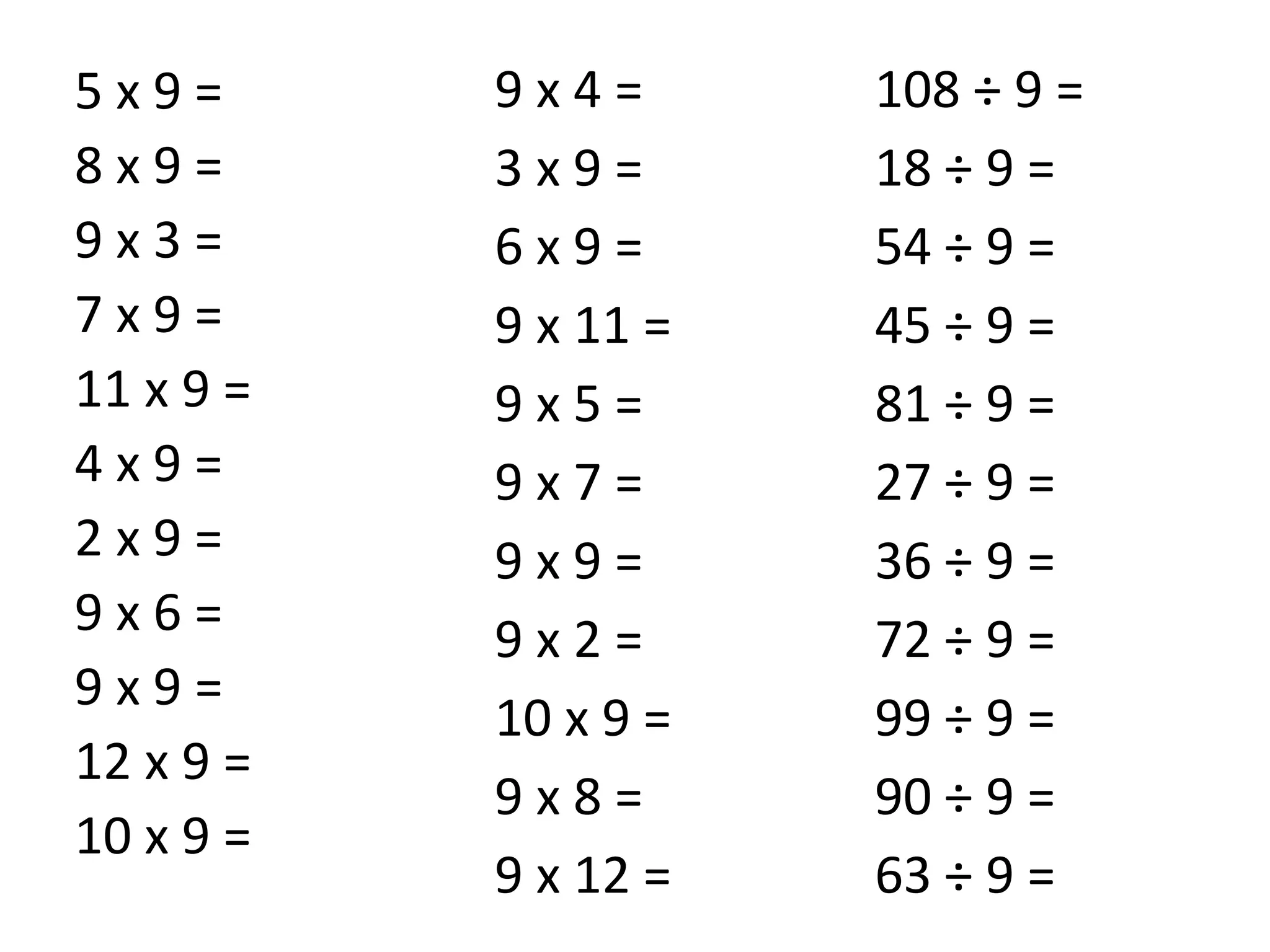
5 x 9 =
8 x 9 =
9 x 3 =
7 x 9 =
11 x 9 =
4 x 9 =
2 x 9 =
9 x 6 =
9 x 9 =
12 x 9 =
10 x 9 =
9 x 4 =
3 x 9 =
6 x 9 =
9 x 11 =
9 x 5 =
9 x 7 =
9 x 9 =
9 x 2 =
10 x 9 =
9 x 8 =
9 x 12 =
108 ÷ 9 =
18 ÷ 9 =
54 ÷ 9 =
45 ÷ 9 =
81 ÷ 9 =
27 ÷ 9 =
36 ÷ 9 =
72 ÷ 9 =
99 ÷ 9 =
90 ÷ 9 =
63 ÷ 9 =
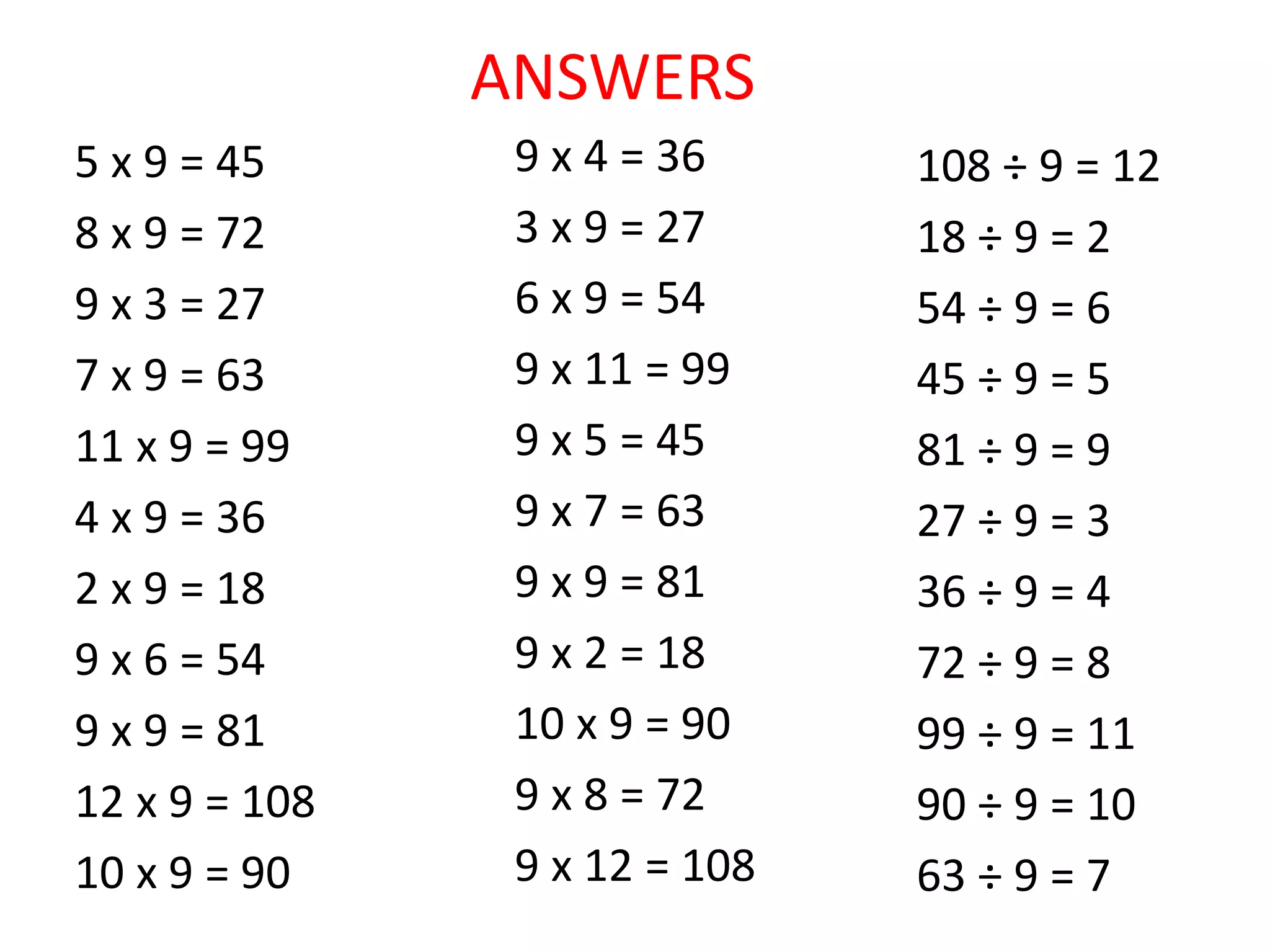
ANSWERS
5 x 9 = 45
8 x 9 = 72
9 x 3 = 27
7 x 9 = 63
11 x 9 = 99
4 x 9 = 36
2 x 9 = 18
9 x 6 = 54
9 x 9 = 81
12 x 9 = 108
10 x 9 = 90
9 x 4 = 36
3 x 9 = 27
6 x 9 = 54
9 x 11 = 99
9 x 5 = 45
9 x 7 = 63
9 x 9 = 81
9 x 2 = 18
10 x 9 = 90
9 x 8 = 72
9 x 12 = 108
108 ÷ 9 = 12
18 ÷ 9 = 2
54 ÷ 9 = 6
45 ÷ 9 = 5
81 ÷ 9 = 9
27 ÷ 9 = 3
36 ÷ 9 = 4
72 ÷ 9 = 8
99 ÷ 9 = 11
90 ÷ 9 = 10
63 ÷ 9 = 7
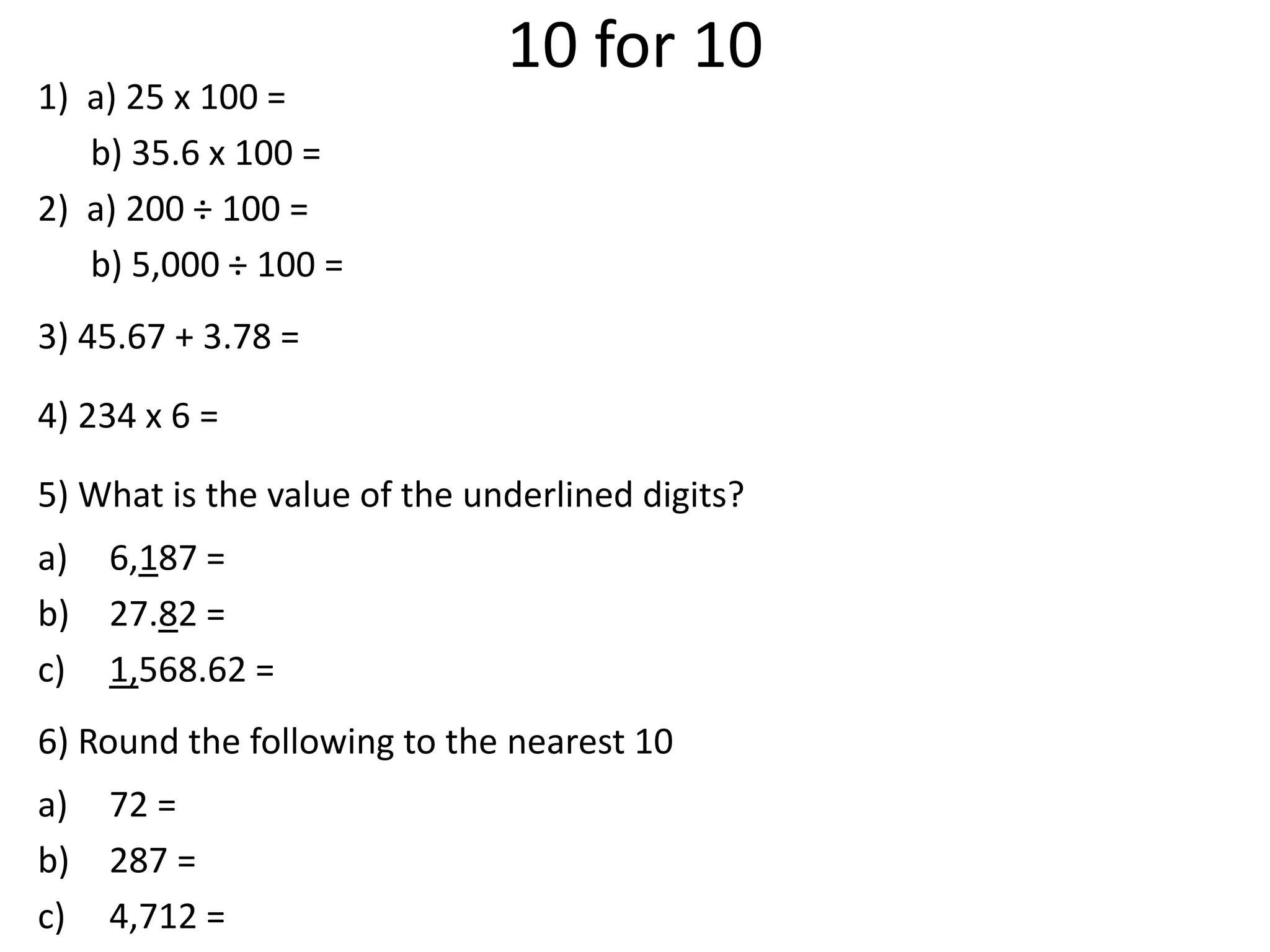
10 for 10
1) a) 25 x 100 =
b) 35.6 x 100 =
2) a) 200 ÷ 100 =
b) 5,000 ÷ 100 =
3) 45.67 + 3.78 =
4) 234 x 6 =
5) What is the value of the underlined digits?
a) 6,187 =
b) 27.82 =
c) 1,568.62 =
6) Round the following to the nearest 10
a) 72 =
b) 287 =
c) 4,712 =
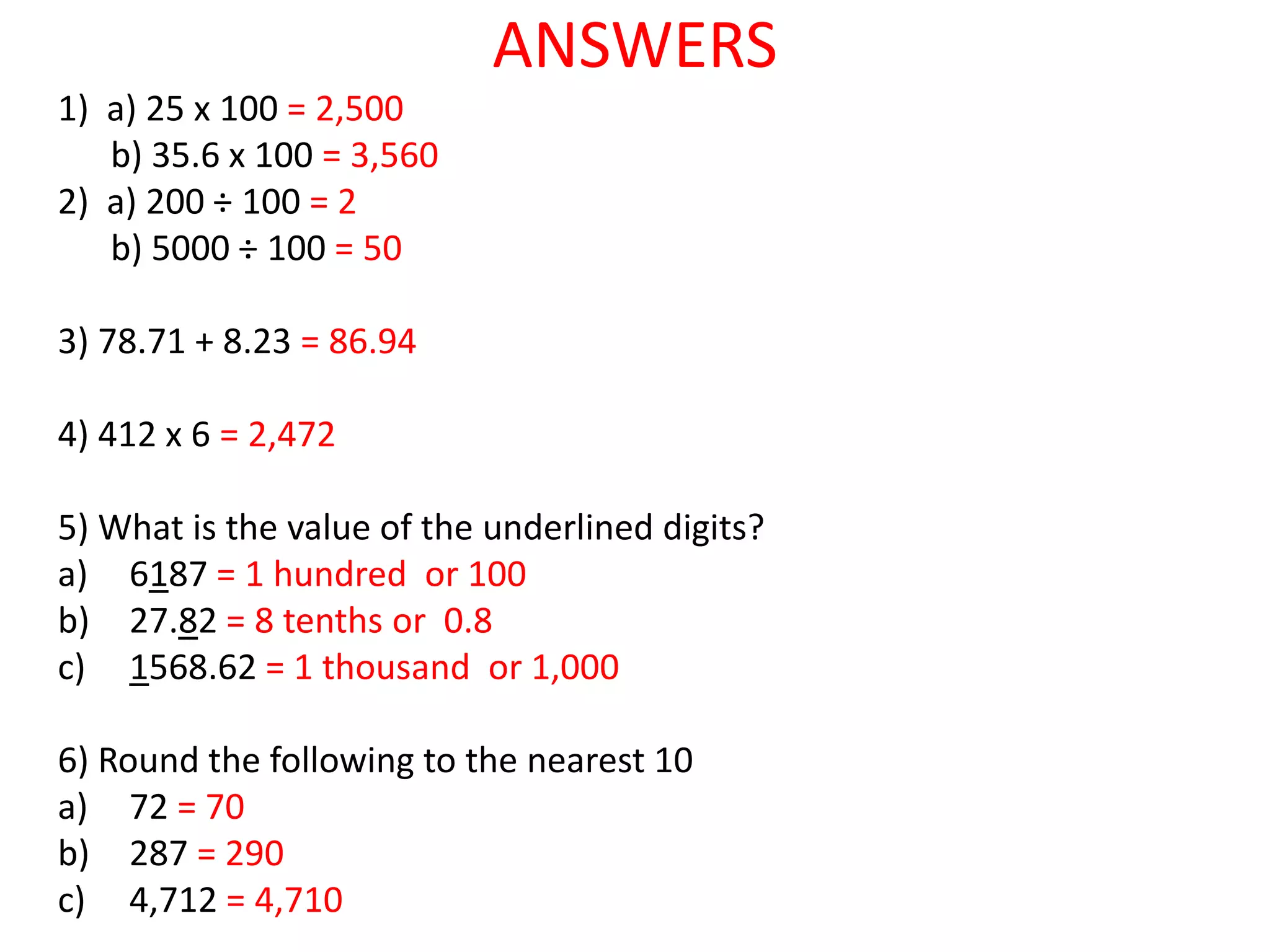
ANSWERS
1) a) 25 x 100 = 2,500
b) 35.6 x 100 = 3,560
2) a) 200 ÷ 100 = 2
b) 5000 ÷ 100 = 50
3) 78.71 + 8.23 = 86.94
4) 412 x 6 = 2,472
5) What is the value of the underlined digits?
a) 6187 = 1 hundred or 100
b) 27.82 = 8 tenths or 0.8
c) 1568.62 = 1 thousand or 1,000
6) Round the following to the nearest 10
a) 72 = 70
b) 287 = 290
c) 4,712 = 4,710
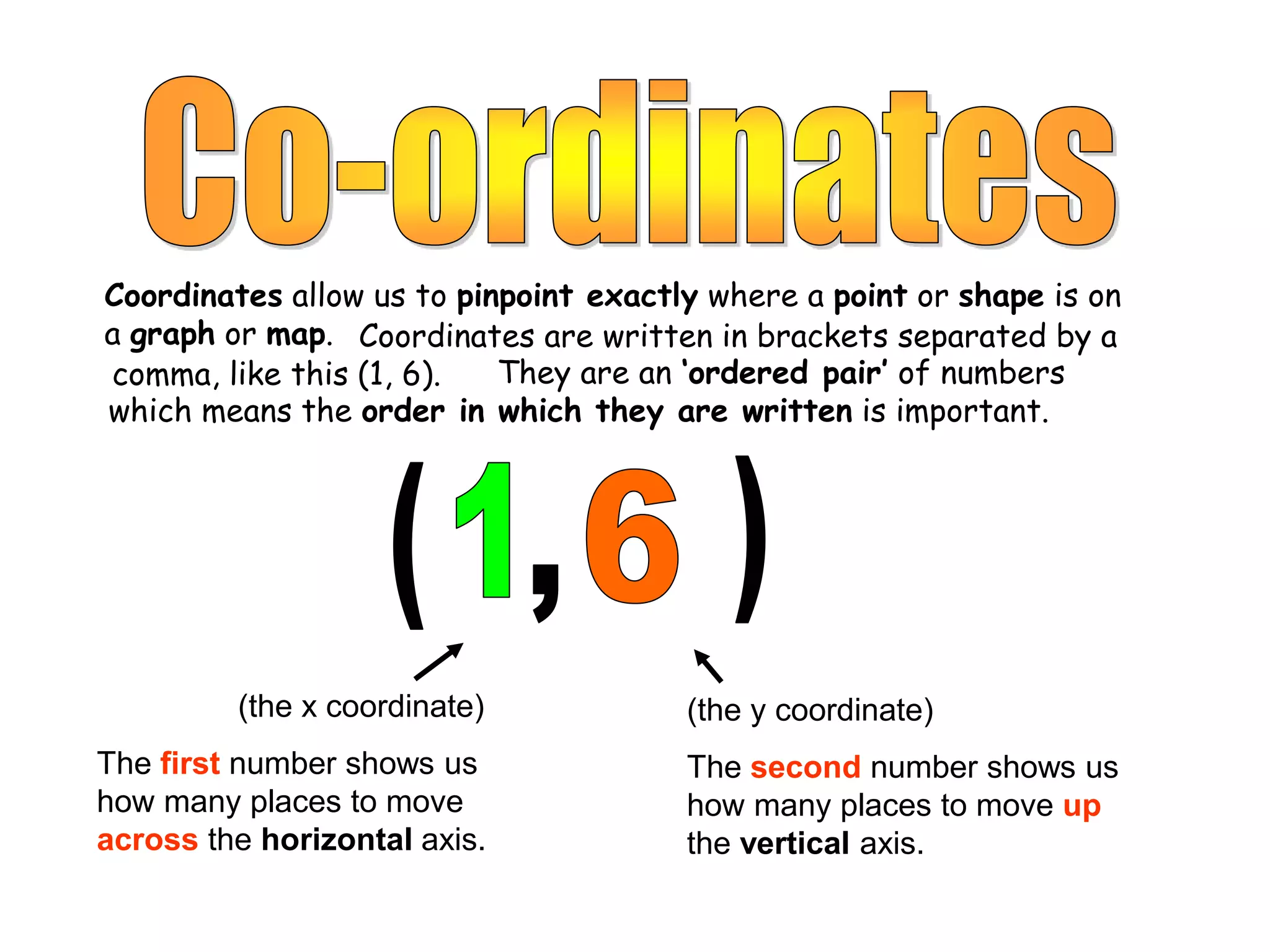
Coordinates allow us to pinpoint exactly where a point or shape is on
a graph or map.
(the x coordinate)
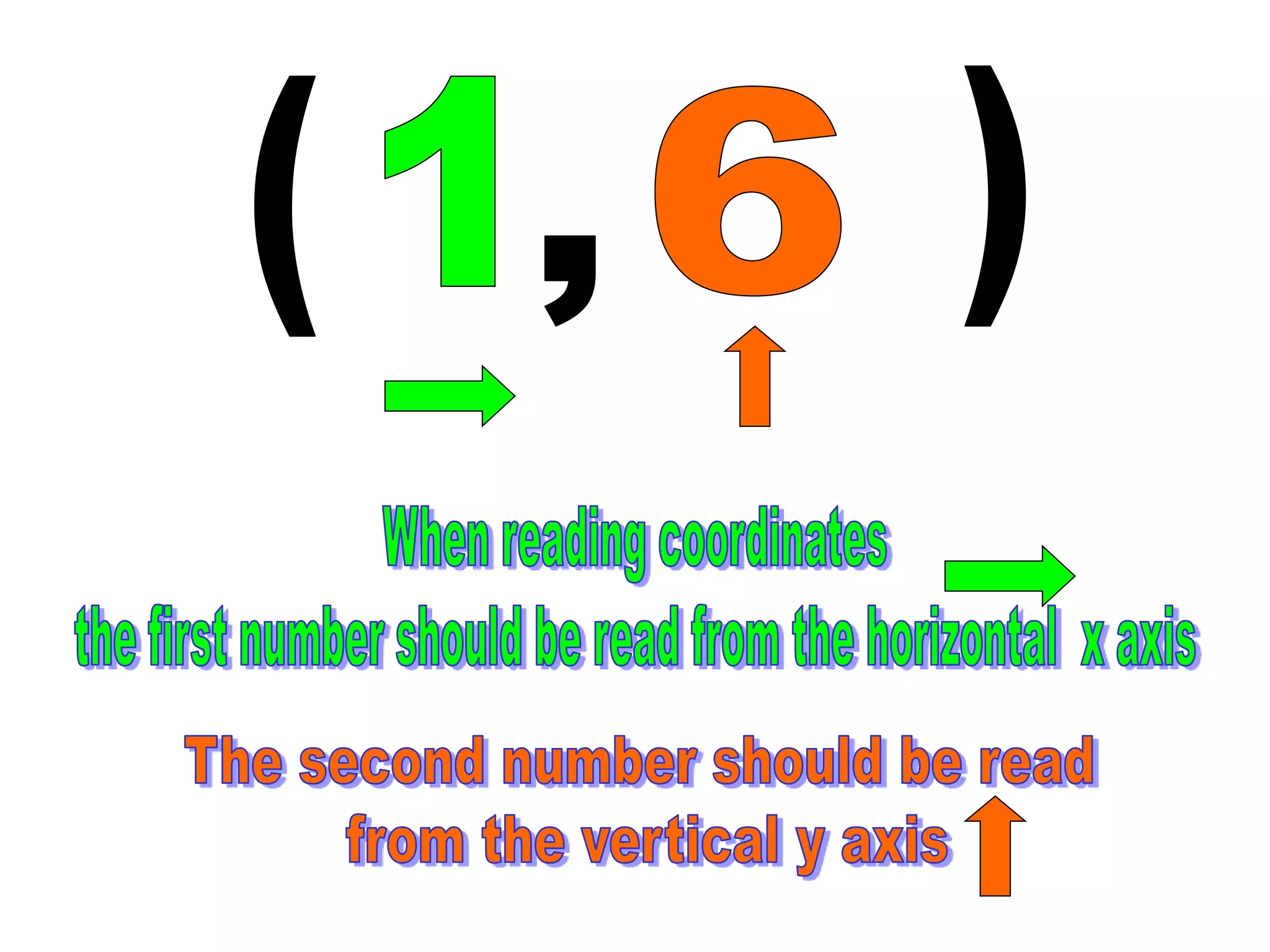
The first number shows us
how many places to move
across the horizontal axis.
(the y coordinate)
The second number shows us
how many places to move up
the vertical axis.
They are an ‘ordered pair’ of numbers
which means the order in which they are written is important.
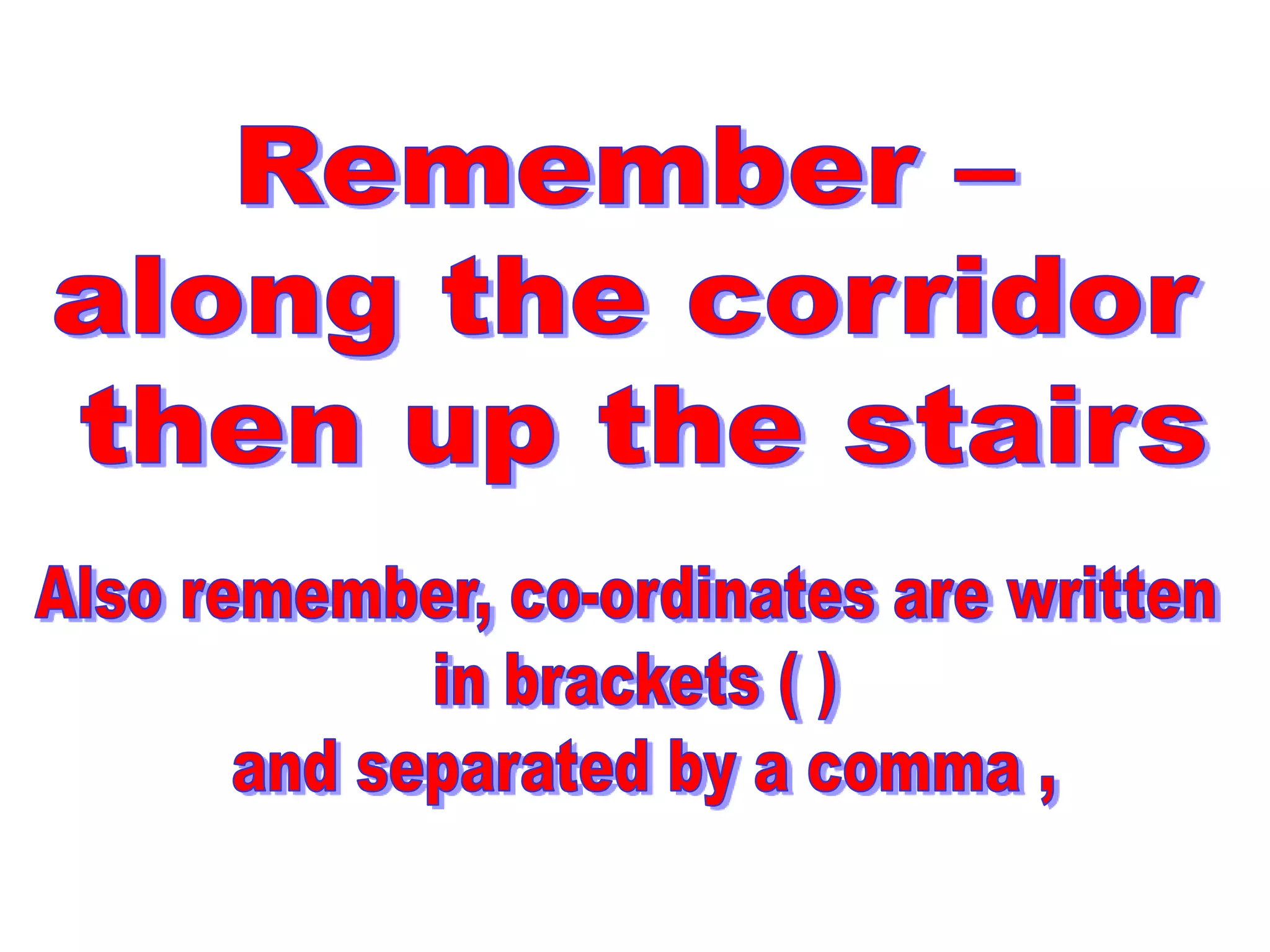
Coordinates are written in brackets separated by a
comma, like this (1, 6).
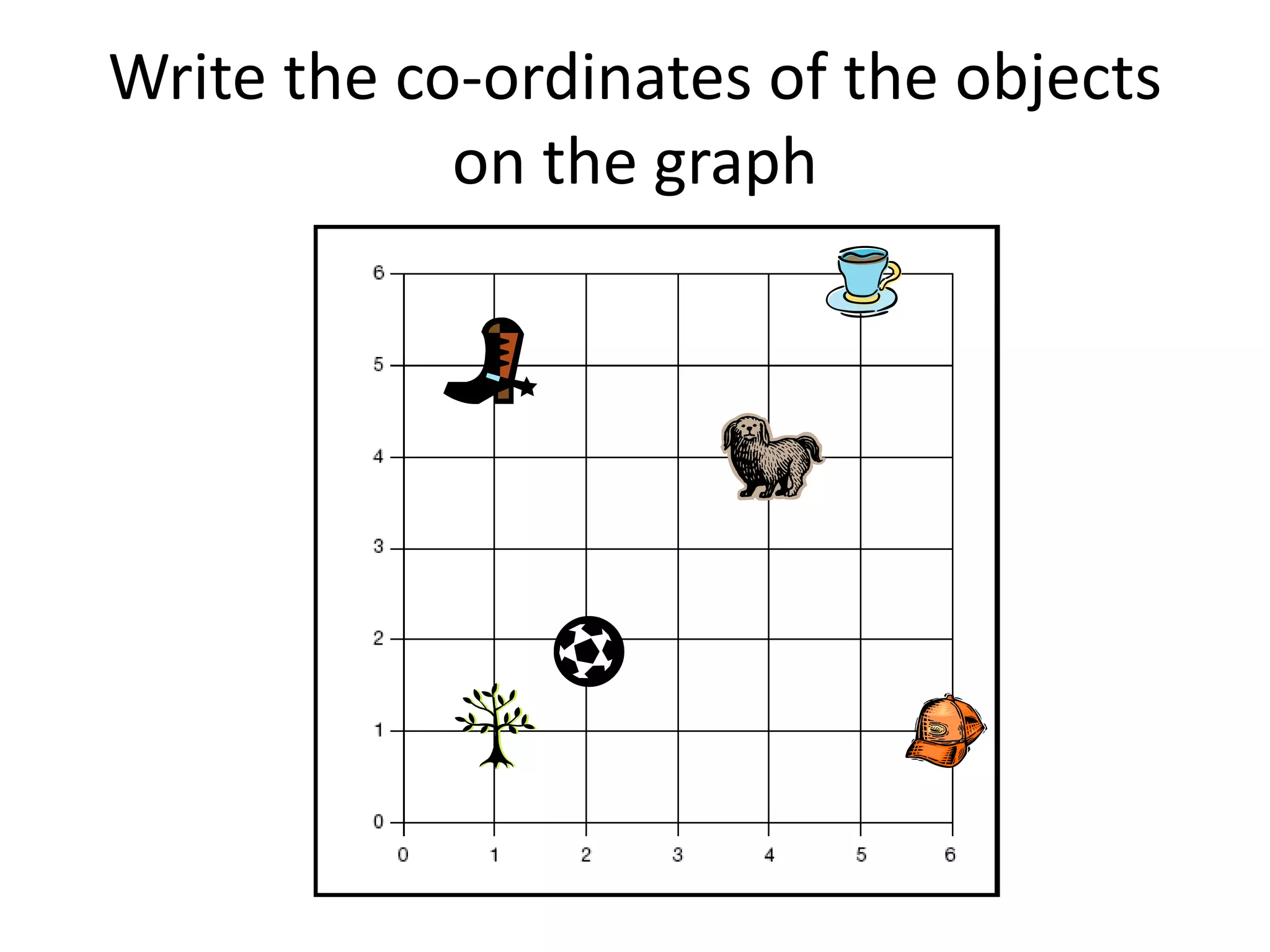
Write the co-ordinates of the objects
on the graph
ANSWERS
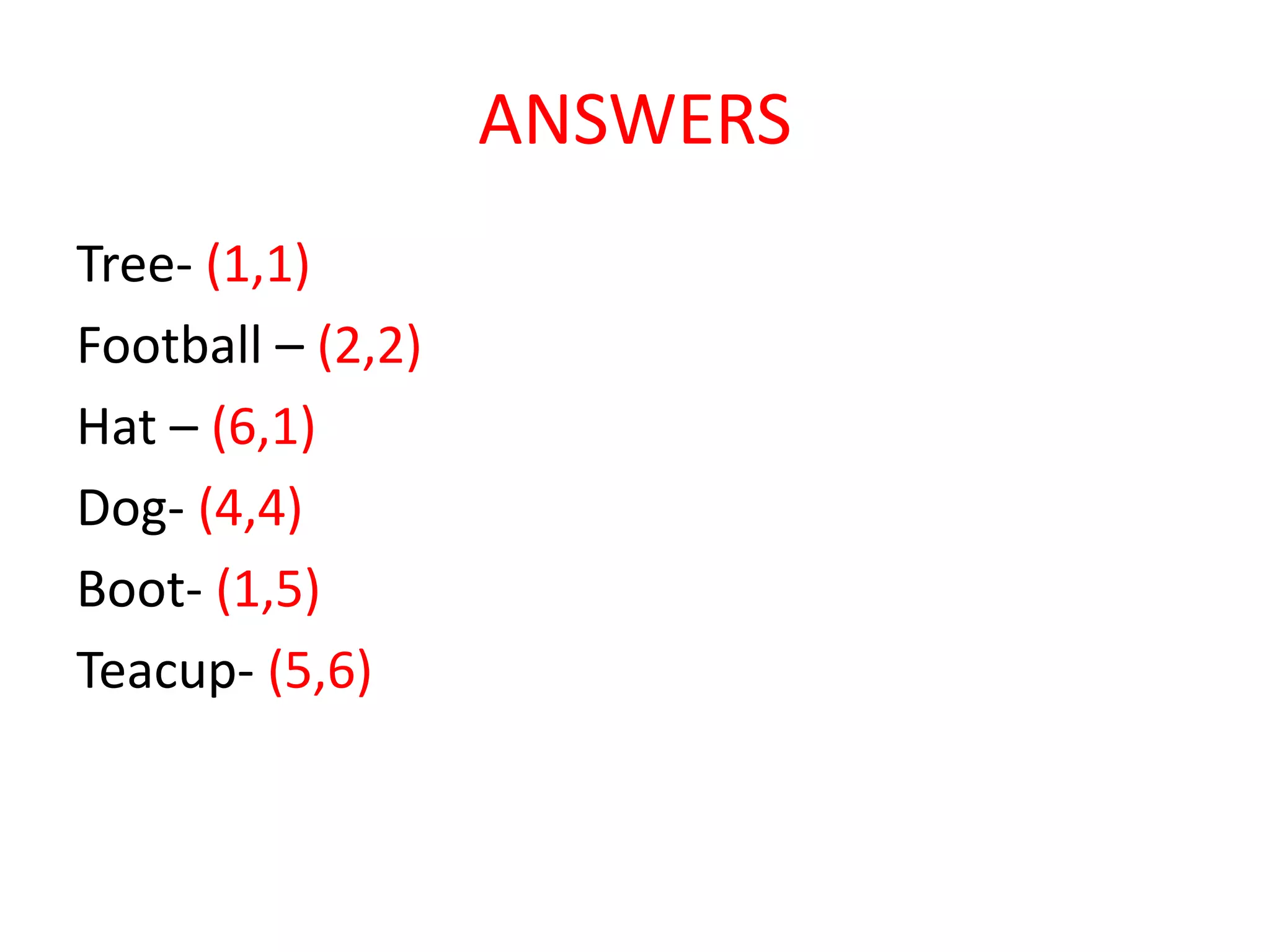
Tree- (1,1)
Football – (2,2)
Hat – (6,1)
Dog- (4,4)
Boot- (1,5)
Teacup- (5,6)
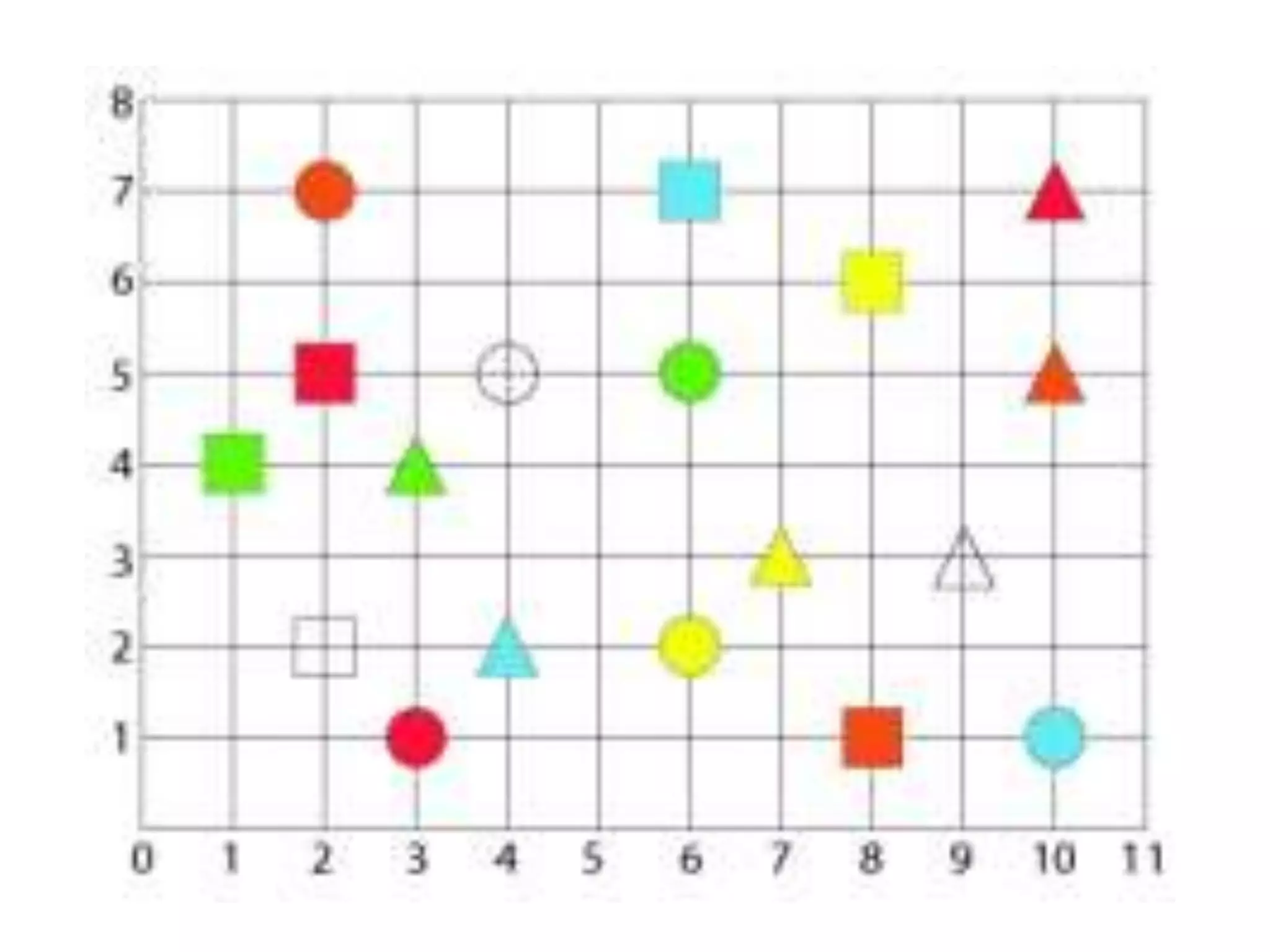
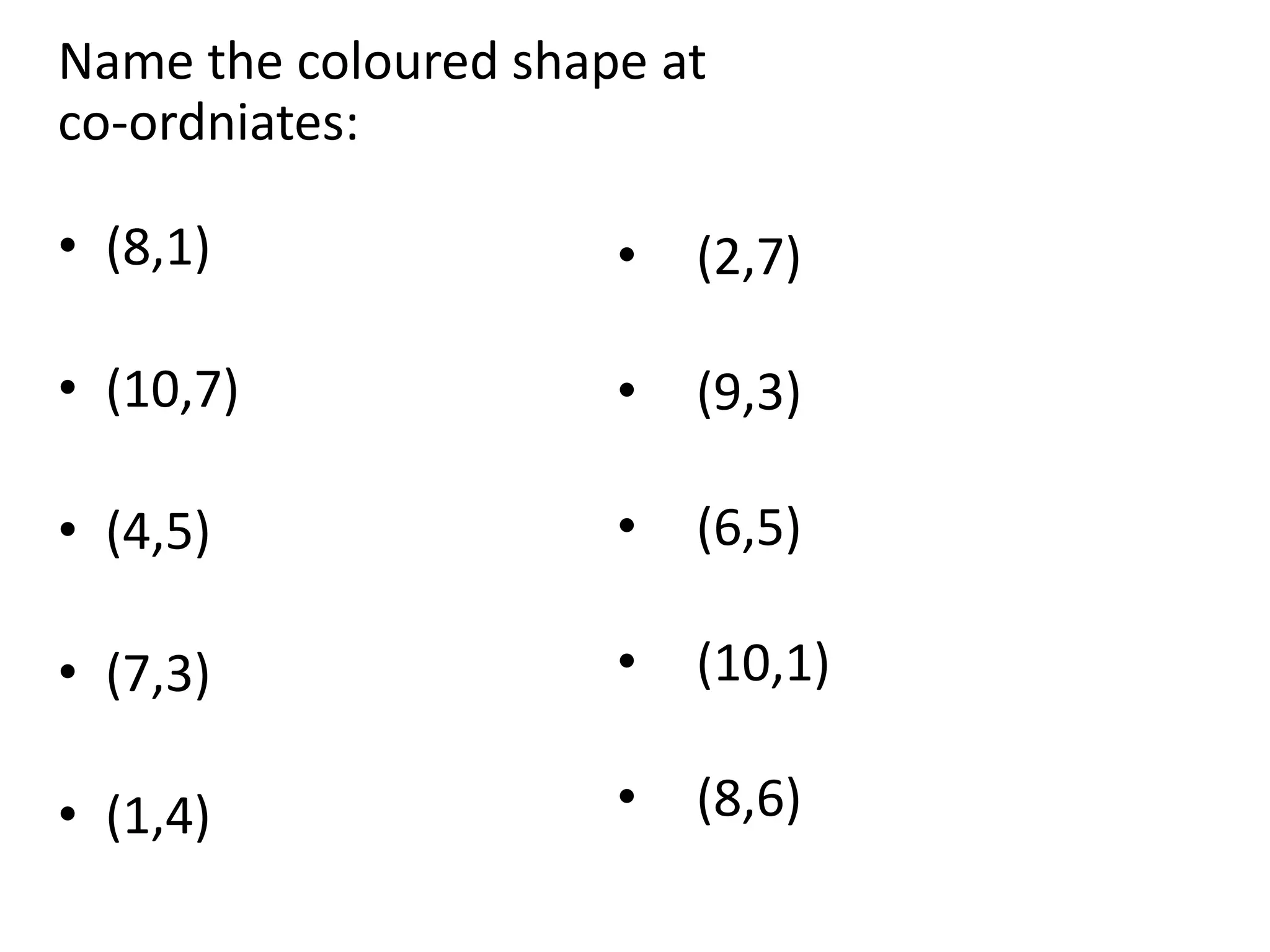
Name the coloured shape at
co-ordniates:
• (8,1)
• (10,7)
• (4,5)
• (7,3)
• (1,4)
• (2,7)
• (9,3)
• (6,5)
• (10,1)
• (8,6)
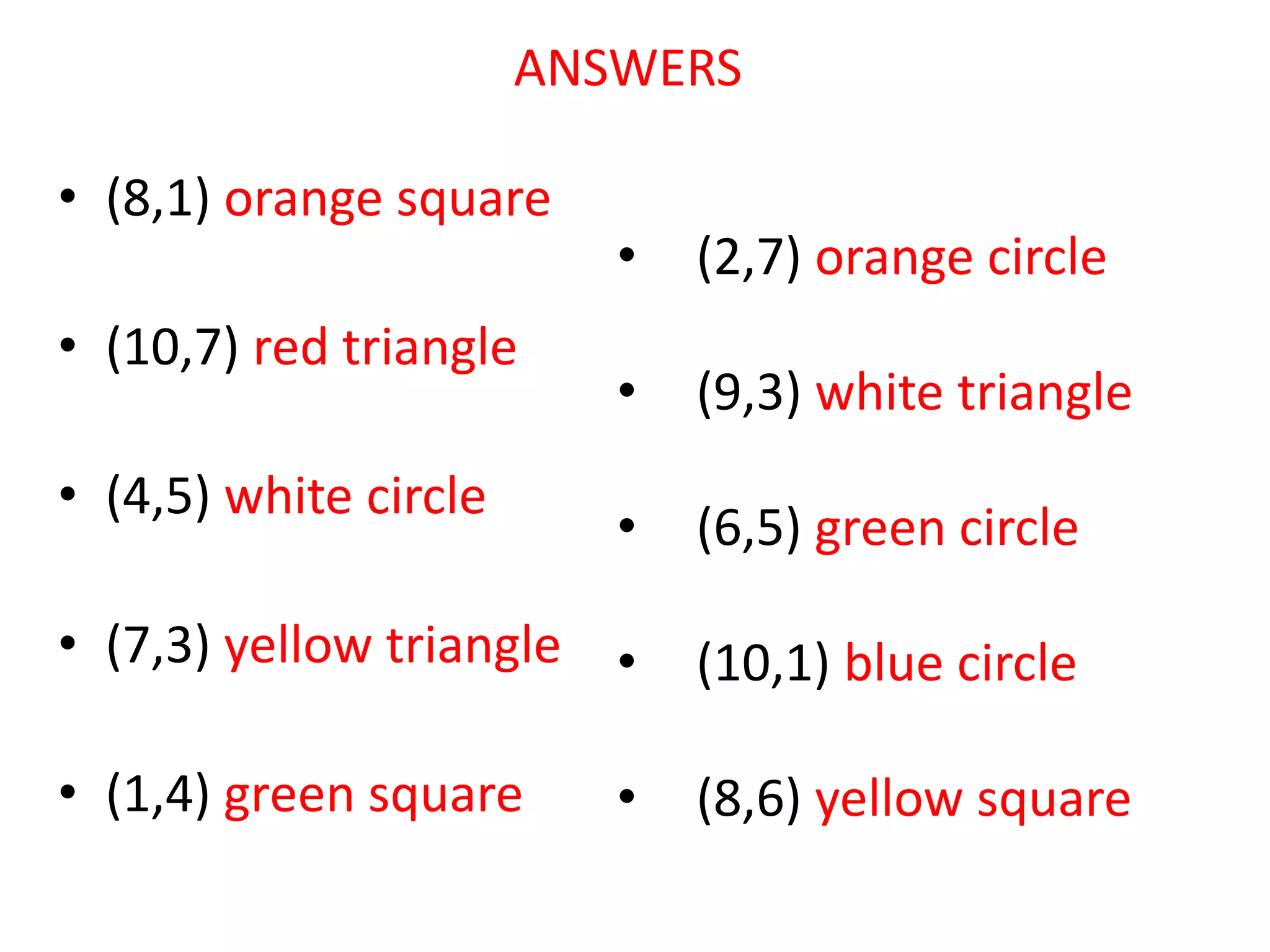
ANSWERS
• (8,1) orange square
• (10,7) red triangle
• (4,5) white circle
• (7,3) yellow triangle
• (1,4) green square
• (2,7) orange circle
• (9,3) white triangle
• (6,5) green circle
• (10,1) blue circle
• (8,6) yellow square
Extra Challenge!
Which coloured shape’s X (horizontal) co-
ordinate is double it’s Y (vertical) co-ordinate?
ANSWER
Orange triangle (10,5)
Why not have a go at drawing your own
co-ordinates treasure map?
05/05/20
WALT: use inverse operations
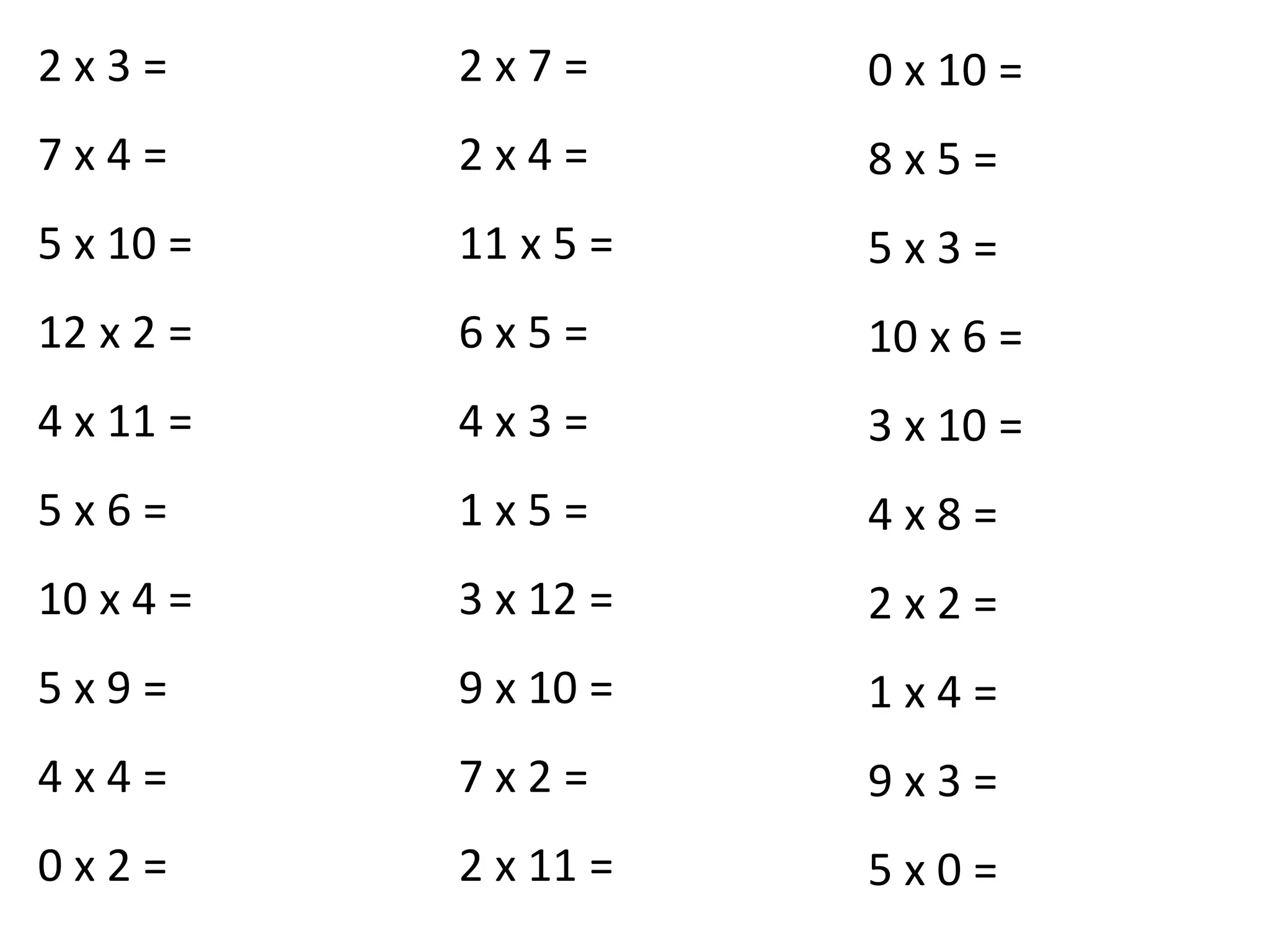
2 x 3 =
7 x 4 =
5 x 10 =
12 x 2 =
4 x 11 =
5 x 6 =
10 x 4 =
5 x 9 =
4 x 4 =
0 x 2 =
2 x 7 =
2 x 4 =
11 x 5 =
6 x 5 =
4 x 3 =
1 x 5 =
3 x 12 =
9 x 10 =
7 x 2 =
2 x 11 =
0 x 10 =
8 x 5 =
5 x 3 =
10 x 6 =
3 x 10 =
4 x 8 =
2 x 2 =
1 x 4 =
9 x 3 =
5 x 0 =
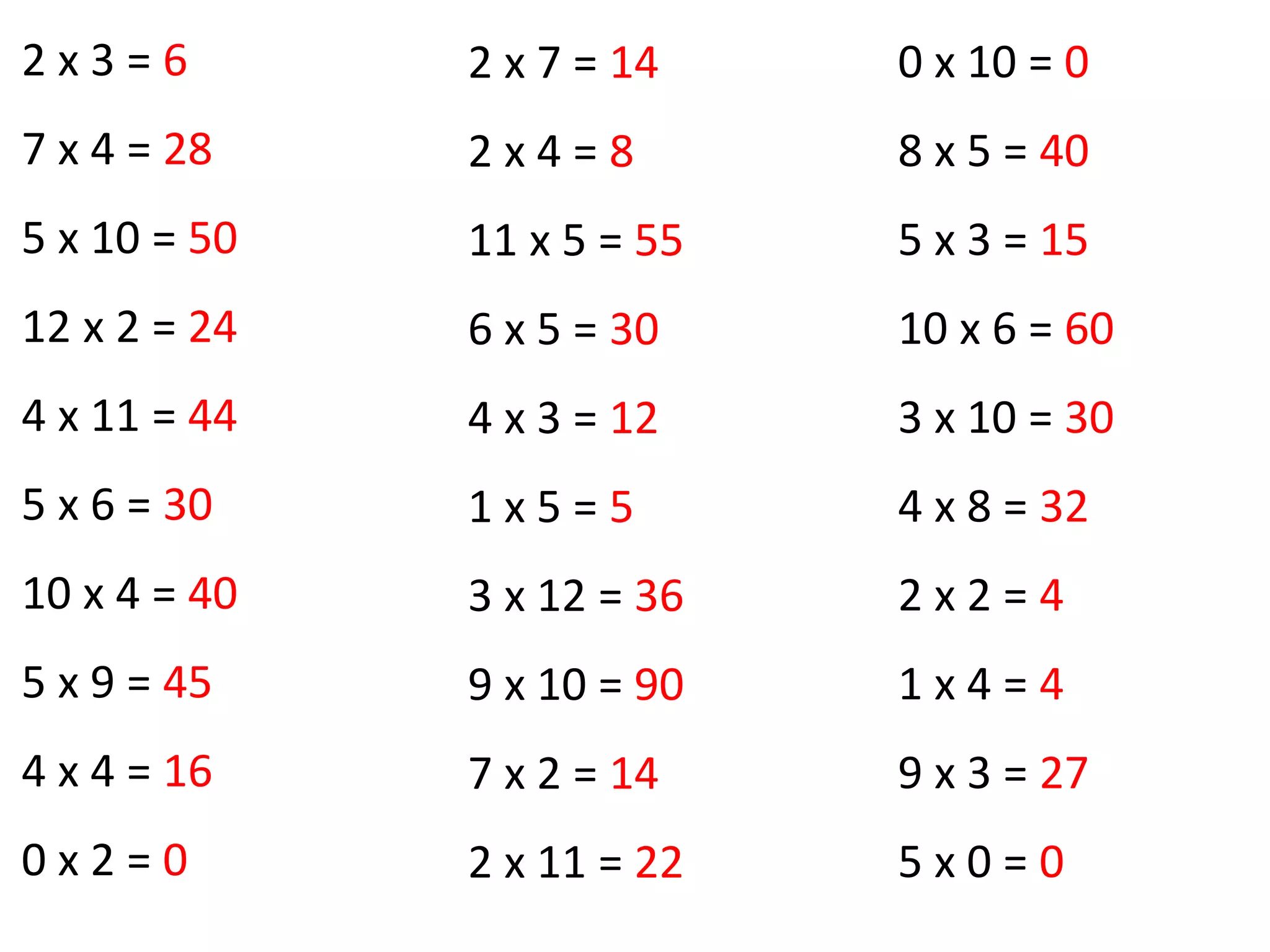
2 x 3 = 6
7 x 4 = 28
5 x 10 = 50
12 x 2 = 24
4 x 11 = 44
5 x 6 = 30
10 x 4 = 40
5 x 9 = 45
4 x 4 = 16
0 x 2 = 0
2 x 7 = 14
2 x 4 = 8
11 x 5 = 55
6 x 5 = 30
4 x 3 = 12
1 x 5 = 5
3 x 12 = 36
9 x 10 = 90
7 x 2 = 14
2 x 11 = 22
0 x 10 = 0
8 x 5 = 40
5 x 3 = 15
10 x 6 = 60
3 x 10 = 30
4 x 8 = 32
2 x 2 = 4
1 x 4 = 4
9 x 3 = 27
5 x 0 = 0
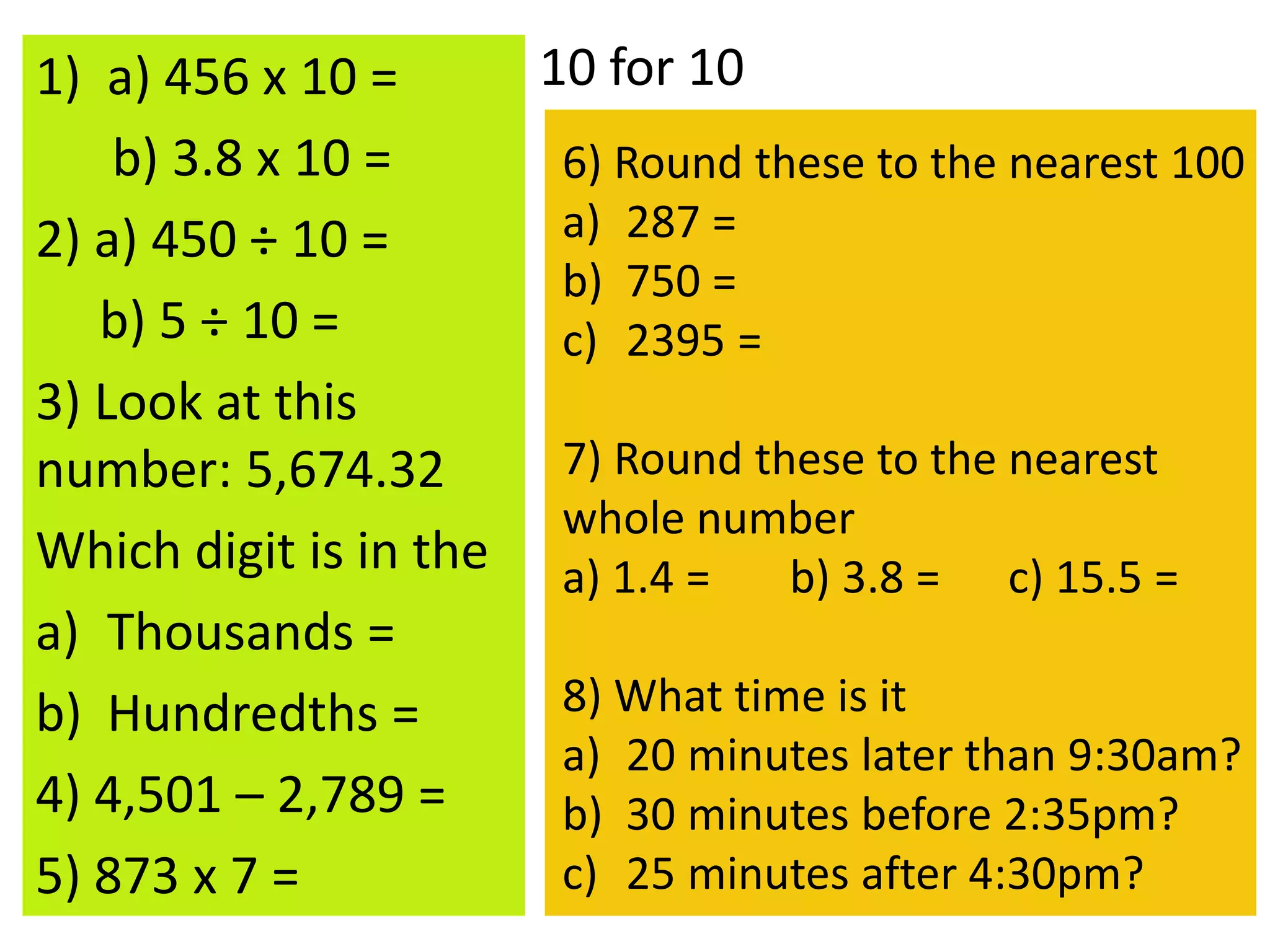
1) a) 456 x 10 =
b) 3.8 x 10 =
2) a) 450 ÷ 10 =
b) 5 ÷ 10 =
3) Look at this
number: 5,674.32
Which digit is in the
a) Thousands =
b) Hundredths =
4) 4,501 – 2,789 =
5) 873 x 7 =
10 for 10
6) Round these to the nearest 100
a) 287 =
b) 750 =
c) 2395 =
7) Round these to the nearest
whole number
a) 1.4 = b) 3.8 = c) 15.5 =
8) What time is it
a) 20 minutes later than 9:30am?
b) 30 minutes before 2:35pm?
c) 25 minutes after 4:30pm?
1) a) 456 x 10 = 4,560
b) 3.8 x 10 = 38
2) a) 450 ÷ 10 = 45
b) 5 ÷ 10 = 0.5
3) Look at this number:
5,674.32
Which digit is in the
a) Thousands = 5
b) Hundredths = 2
4) 4501 – 2789 = 1,712
5) 873 x 7 = 6,111
ANSWERS
6) Round these to the nearest 100
a) 287 = 300
b) 750 = 800
c) 2,395 = 2,400
7) Round these to the nearest whole
number
a) 1.4 = 1 b) 3.8 = 4 c) 15.5 = 16
8) What time is it
a) 20 minutes later than 9:30am?
9:50am
b) 30 minutes before 2:35pm?
2:05pm
c) 25 minutes after 4:30pm?
4:55pm
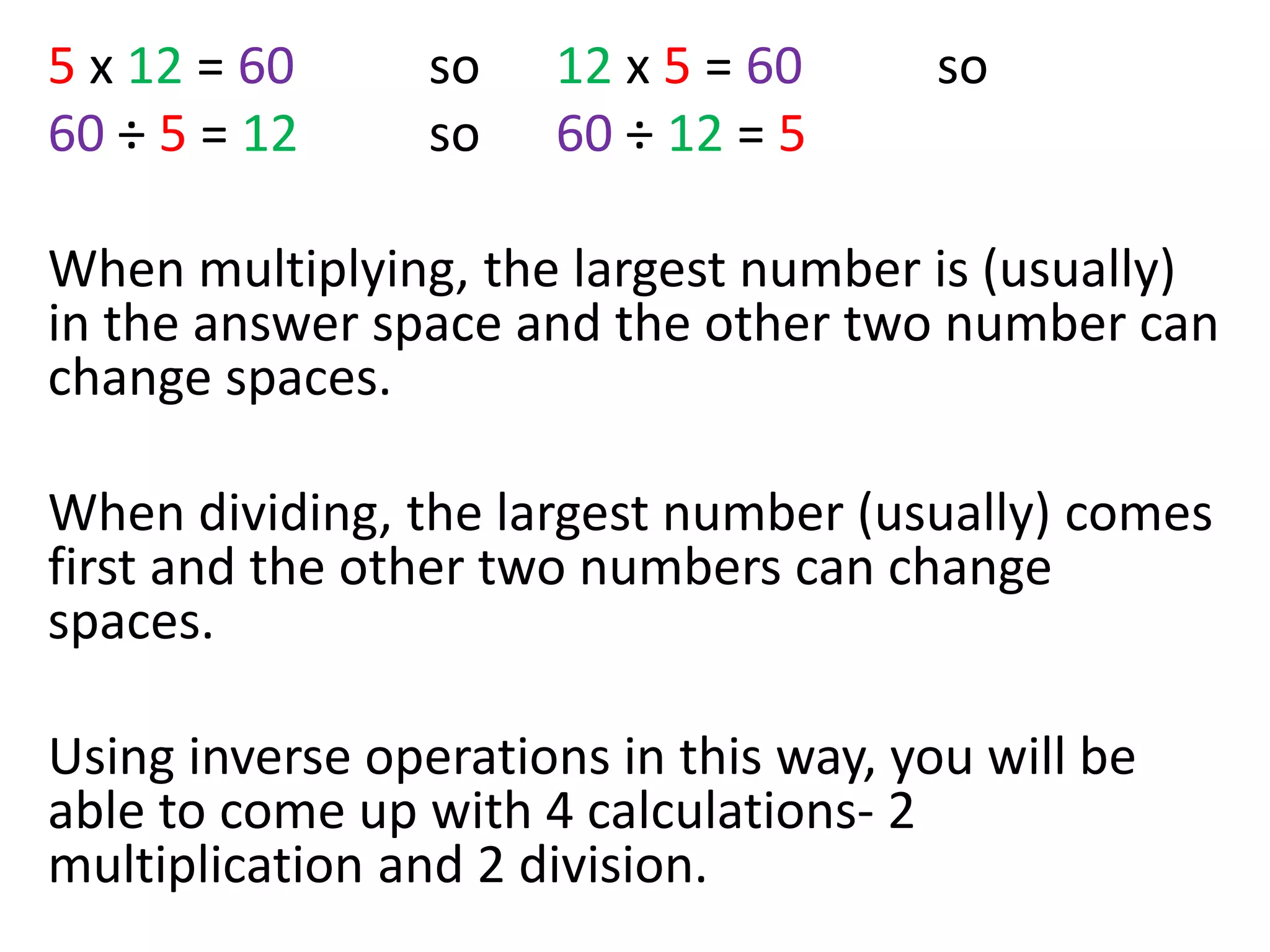
Division is the opposite (inverse) of multiplication,
and vice versa.
Therefore, if we know 1 calculation, we actually
know 4!
For example, if we know that 5 x 12 = 60
We also know that 12 x 5 = 60
And that 60 ÷ 5 = 12
And 60 ÷ 12 = 5
5 x 12 = 60 so 12 x 5 = 60 so
60 ÷ 5 = 12 so 60 ÷ 12 = 5
When multiplying, the largest number is (usually)
in the answer space and the other two number can
change spaces.
When dividing, the largest number (usually) comes
first and the other two numbers can change
spaces.
Using inverse operations in this way, you will be
able to come up with 4 calculations- 2
multiplication and 2 division.
If you know that 7 x 8 = 56…
…then you also know that:
__ x __ = ____ (the largest number is the answer when multiplying)
And
____ ÷ __ = __ (the largest number comes first when dividing)
And
____ ÷ __ = __
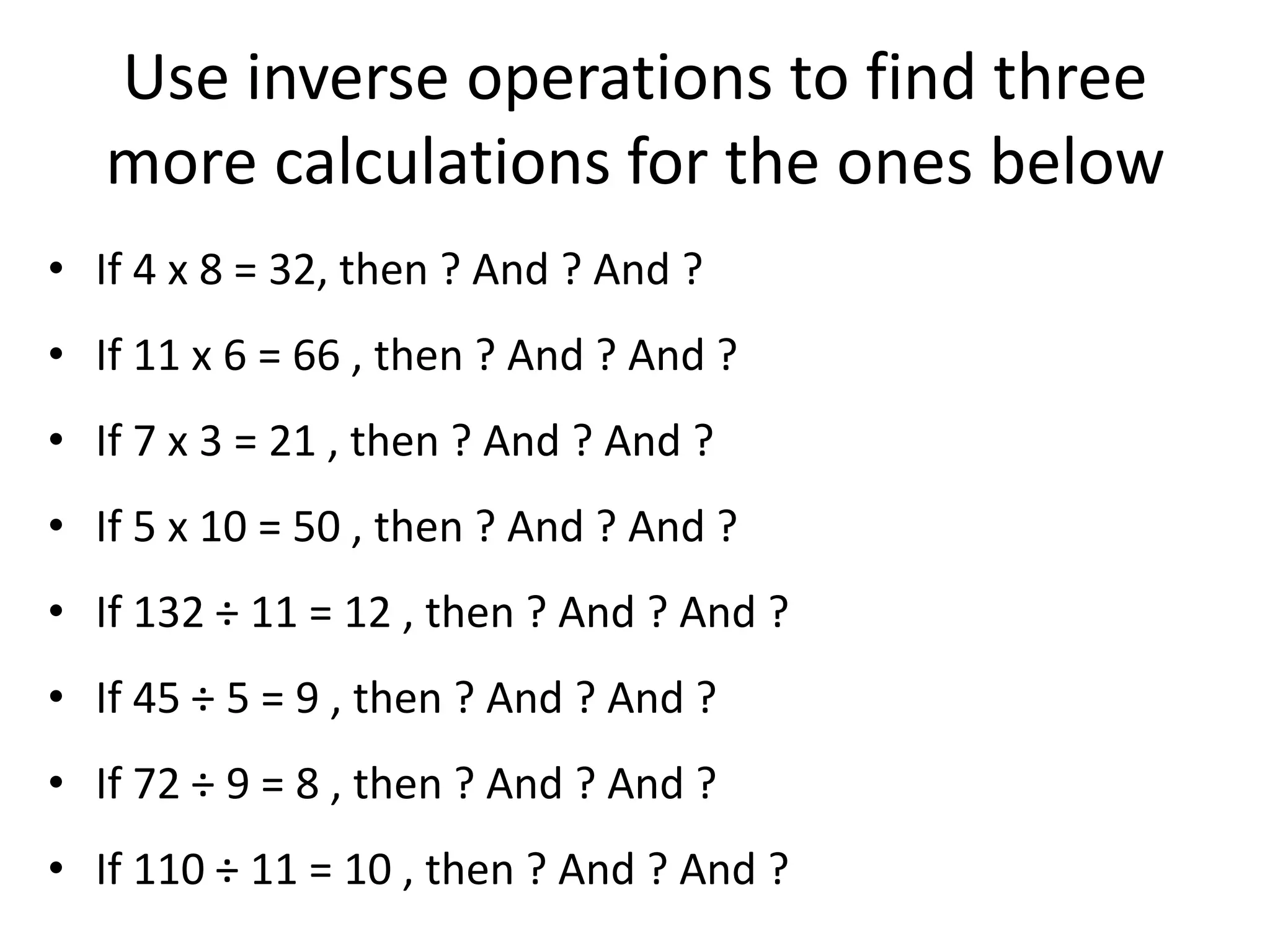
Use inverse operations to find three
more calculations for the ones below
• If 4 x 8 = 32, then ? And ? And ?
• If 11 x 6 = 66 , then ? And ? And ?
• If 7 x 3 = 21 , then ? And ? And ?
• If 5 x 10 = 50 , then ? And ? And ?
• If 132 ÷ 11 = 12 , then ? And ? And ?
• If 45 ÷ 5 = 9 , then ? And ? And ?
• If 72 ÷ 9 = 8 , then ? And ? And ?
• If 110 ÷ 11 = 10 , then ? And ? And ?
ANSWERS
• If 4 x 8 = 32, then 8 x 4 = 32 And 32 ÷ 4 = 8 And 32 ÷ 8 = 4
• If 11 x 6 = 66 , then 6 x 11 = 66 And 66 ÷ 11 = 6 And 66 ÷ 6 = 11
• If 7 x 3 = 21 , then 3 x 7 = 21 And 21 ÷ 7 = 3 And 21 ÷ 3 = 7
• If 5 x 10 = 50 , then 10 x 5 = 50 And 50 ÷ 10 = 5 And 50 ÷ 5 = 10
• If 132 ÷ 11 = 12 , then 132 ÷ 12 = 11 And 12 x 11 = 132 And 11 x 12 = 132
• If 45 ÷ 5 = 9 , then 45 ÷ 9 = 5 And 5 x 9 = 45 And 9 x 5 = 45
• If 72 ÷ 9 = 8 , then 72 ÷ 8 = 9 And 9 x 8 = 72 And 8 x 9 = 72
• If 110 ÷ 11 = 10 , then 110 ÷ 10 = 11 And 10 x 11 = 110 And 11 x 10 = 110
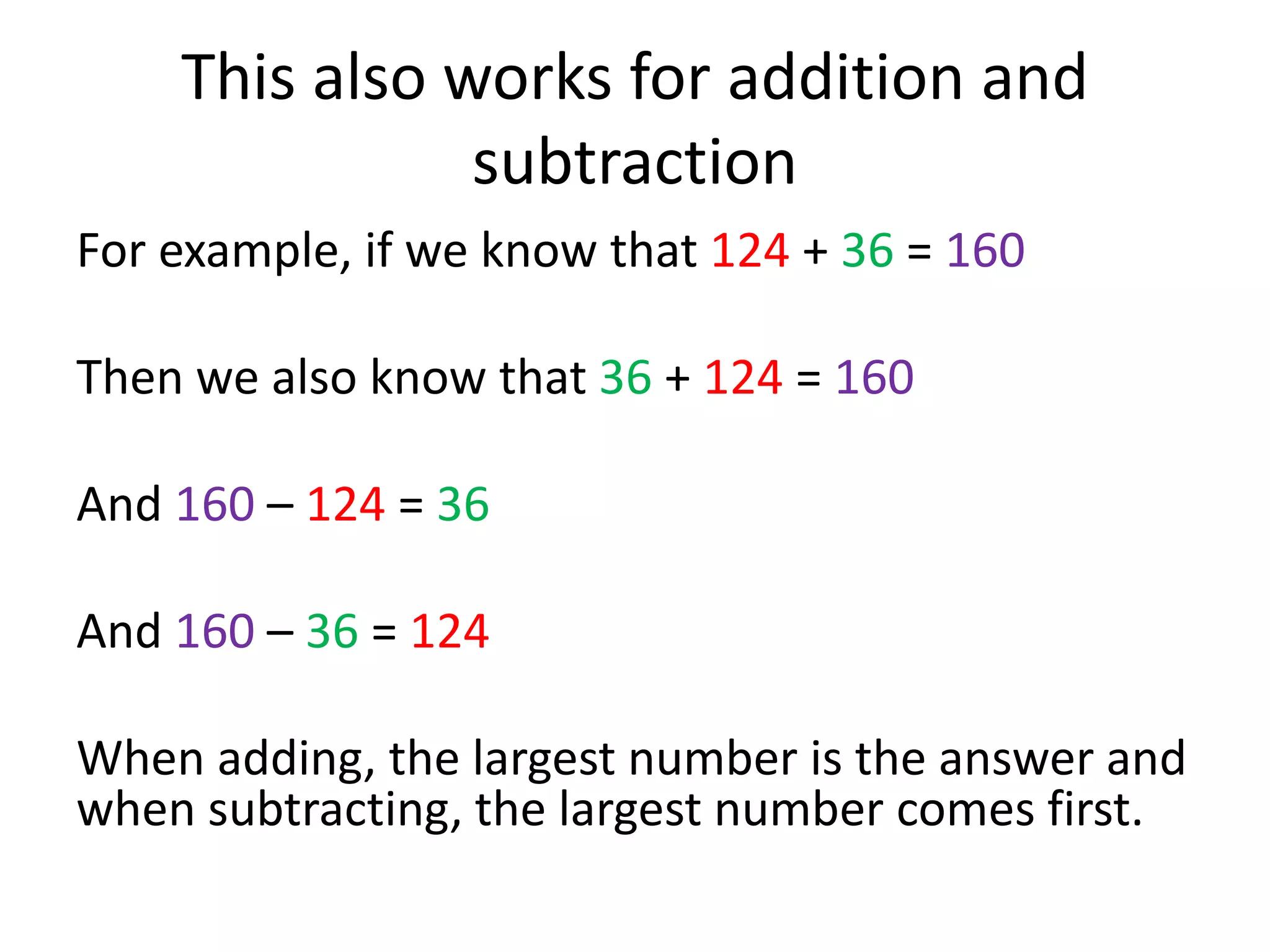
This also works for addition and
subtraction
For example, if we know that 124 + 36 = 160
Then we also know that 36 + 124 = 160
And 160 – 124 = 36
And 160 – 36 = 124
When adding, the largest number is the answer and
when subtracting, the largest number comes first.
Extra Challenge!
Come up with some of your own sets of addition
and subtraction calculations.
Remember, you only need to know the answer to
one calculation to know the other three.
To start you off…
If 150 + 34 = 184, then…
You could use a calculator to check your answers.
06/05/20
WALT: use bus stop division
10 for 10
1) 8,965 – 3,364 =
2) 543 + 212 + 420 =
3) 80, 77, 74, 71, _?_
4) 6,000 + 2 + five hundreds + eighty =
5) How many minutes are there in quarter of an hour?
6) Write three odd numbers which can be added
together to make 19
7) A ladder is 5….. mm cm m km tall
8) Half of 52 =
9) How many wheels do eight cars have?
10)If you have £1 and spend 36p, how much do you have
left?
10 for 10
1) 8,965 – 3,364 = 5,601
2) 543 + 212 + 420 = 1,175
3) 80, 77, 74, 71, _68_
4) 6,000 + 2 + five hundreds + eighty = 6,582
5) How many minutes are there in quarter of an hour? 15
minutes
6) Write three different odd numbers which can be added
together to make 19 9 + 7 + 3 or 13 + 1 + 5 or 15 + 3 + 1
7) A ladder is 5….. mm cm m km tall
8) Half of 52 = 26
9) How many wheels do eight cars have? 32
10) If you have £1 and spend 36p, how much do you have left?
64p
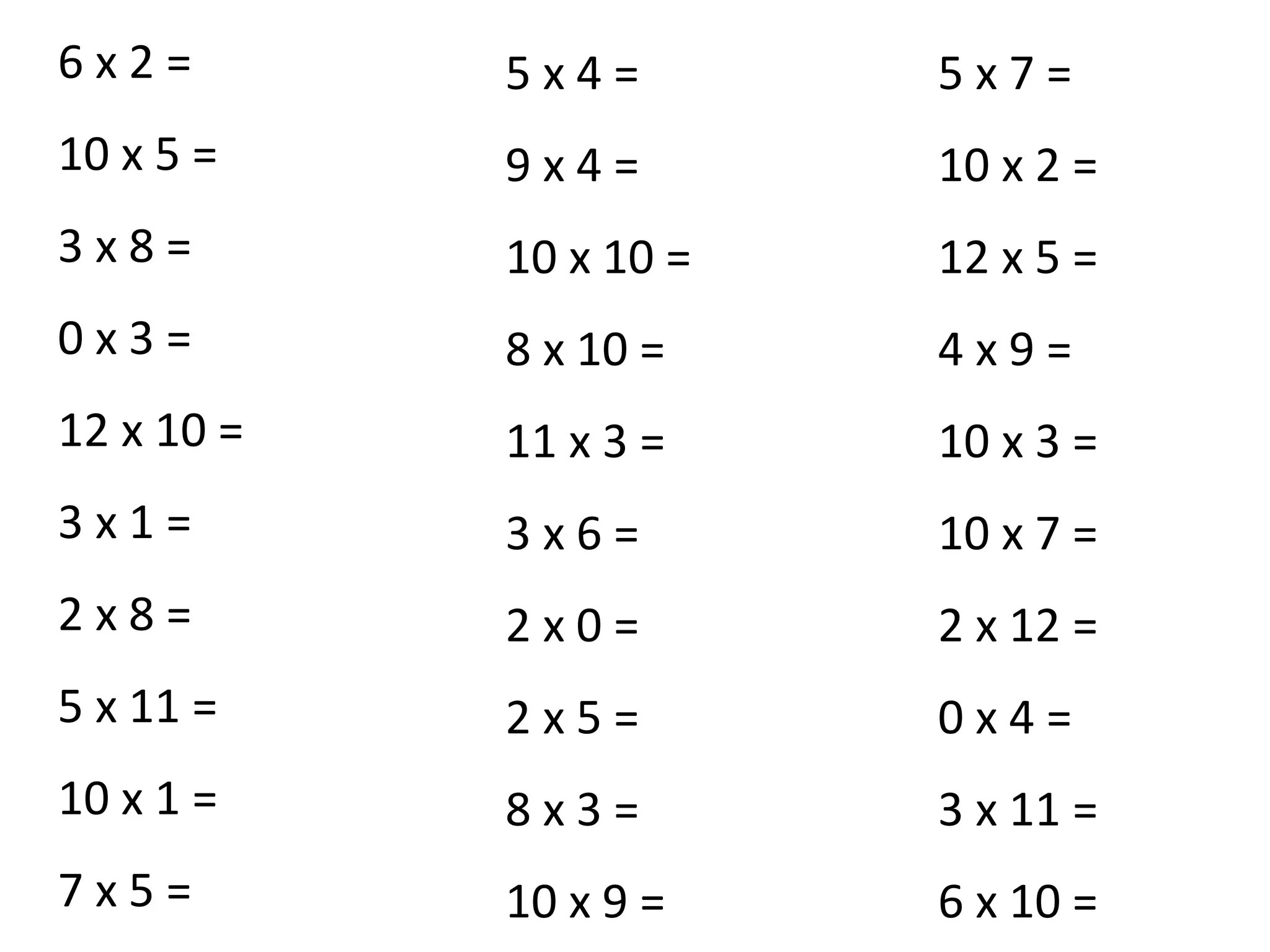
6 x 2 =
10 x 5 =
3 x 8 =
0 x 3 =
12 x 10 =
3 x 1 =
2 x 8 =
5 x 11 =
10 x 1 =
7 x 5 =
5 x 4 =
9 x 4 =
10 x 10 =
8 x 10 =
11 x 3 =
3 x 6 =
2 x 0 =
2 x 5 =
8 x 3 =
10 x 9 =
5 x 7 =
10 x 2 =
12 x 5 =
4 x 9 =
10 x 3 =
10 x 7 =
2 x 12 =
0 x 4 =
3 x 11 =
6 x 10 =
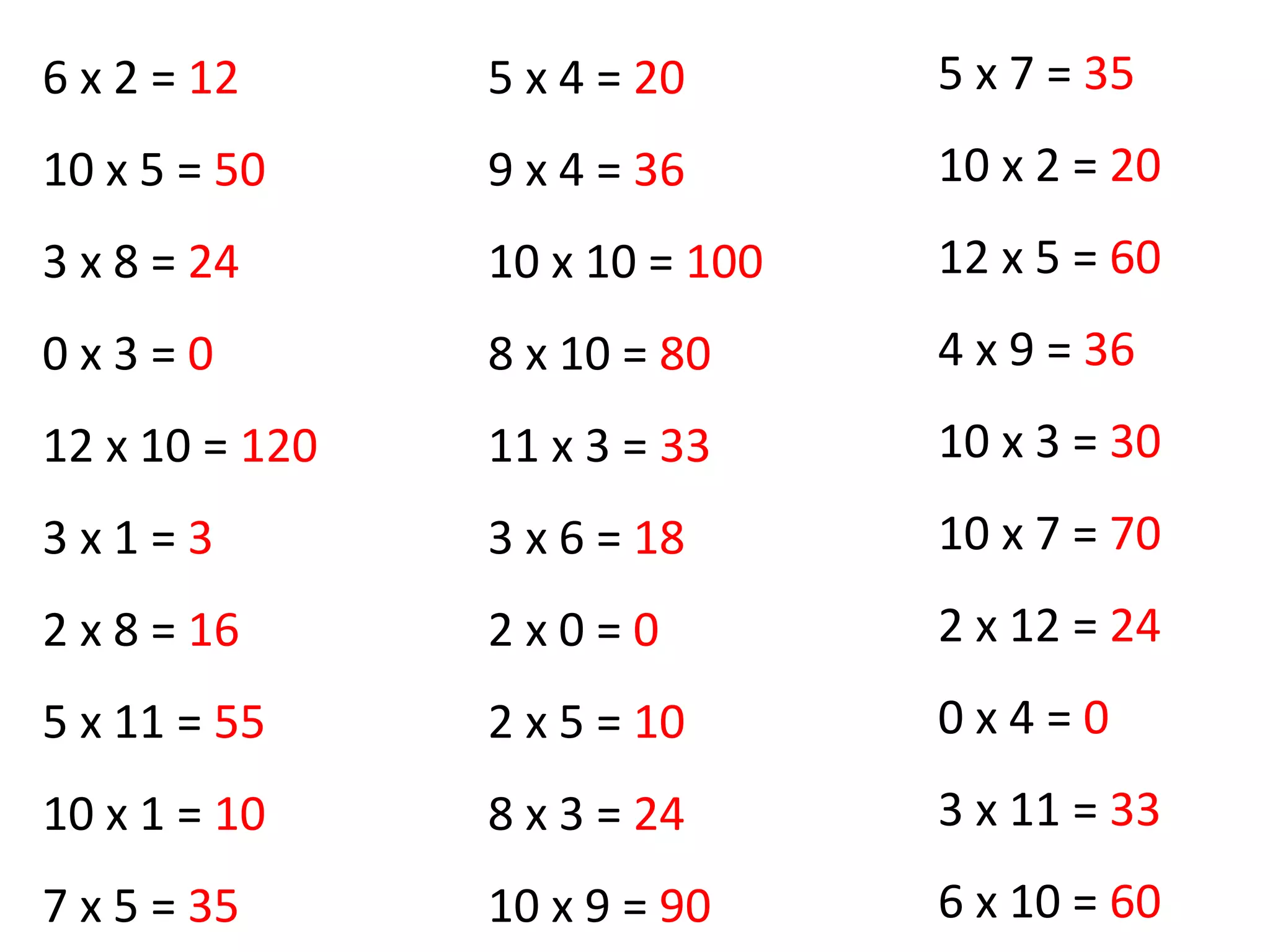
6 x 2 = 12
10 x 5 = 50
3 x 8 = 24
0 x 3 = 0
12 x 10 = 120
3 x 1 = 3
2 x 8 = 16
5 x 11 = 55
10 x 1 = 10
7 x 5 = 35
5 x 4 = 20
9 x 4 = 36
10 x 10 = 100
8 x 10 = 80
11 x 3 = 33
3 x 6 = 18
2 x 0 = 0
2 x 5 = 10
8 x 3 = 24
10 x 9 = 90
5 x 7 = 35
10 x 2 = 20
12 x 5 = 60
4 x 9 = 36
10 x 3 = 30
10 x 7 = 70
2 x 12 = 24
0 x 4 = 0
3 x 11 = 33
6 x 10 = 60
Starter- sort the factors
Factors of
30
Odd
12 1 4 30 14 10 15 2 5 6
Watch this short video to remind you
of how to use the bus stop method for
division
https://www.youtube.com/watch?v=SLze82Zcc4Y
Then have a go yourself using the calculations on
the following slides
Mild
78 ÷ 3 =
65 ÷ 5 =
84 ÷ 3 =
72 ÷ 3 =
105 ÷ 5 =
135 ÷ 3 =
Spicy
243 ÷ 3 =
300 ÷ 4 =
260 ÷ 4 =
384 ÷ 3 =
756 ÷ 4 =
579 ÷ 3 =
Hot
940 ÷ 4 =
726 ÷ 6 =
868 ÷ 4 =
936 ÷ 6 =
952 ÷ 4 =
972 ÷ 6 =
Extra Hot
2,289 ÷ 7 =
4,188 ÷ 6 =
3,432 ÷ 8 =
5,769 ÷ 9 =
3,528 ÷ 7 =
7,000 ÷ 8 =
ANSWERS
Mild
78 ÷ 3 = 26
65 ÷ 5 = 13
84 ÷ 3 = 28
72 ÷ 3 = 24
105 ÷ 5 = 21
135 ÷ 3 = 45
Spicy
243 ÷ 3 = 81
300 ÷ 4 = 75
260 ÷ 4 = 65
384 ÷ 3 = 128
756 ÷ 4 = 189
579 ÷ 3 = 193
Hot
940 ÷ 4 = 235
726 ÷ 6 = 121
868 ÷ 4 = 217
936 ÷ 6 = 156
952 ÷ 4 = 238
972 ÷ 6 = 162
Extra Hot
2,289 ÷ 7 = 327
4,188 ÷ 6 = 698
3,432 ÷ 8 = 429
5,769 ÷ 9 = 641
3,528 ÷ 7 = 504
7,000 ÷ 8 = 875
07/05/20
WALT: find the area of quadrilaterals
10 for 10
1) Find:
a) ½ of 120 b) ½ of 86 c) ¼ of 20 d) ¾ of 100
2) 246 ÷ 6 =
3) 3/8 + 4/8 – 5/8 =
4) 120 ÷ 10 =
5) 2,780 ÷ 100 =
6) A square has sides of 10cm. What is it’s perimeter?
7) If 1,000g = 1kg, then 13,000g = ?kg
10 for 10- ANSWERS
1) Find:
a) ½ of 120- 60 b) ½ of 86- 43 c) ¼ of 20- 5 d) ¾ of 100- 75
2) 246 ÷ 6 = 41
3) 3/8 + 4/8 – 5/8 = 2/8
4) 120 ÷ 10 = 12
5) 2,780 ÷ 100 = 27.8
6) A square has sides of 10cm. What is it’s perimeter? 40cm
7) If 1,000g = 1kg, then 13,000g = 13kg
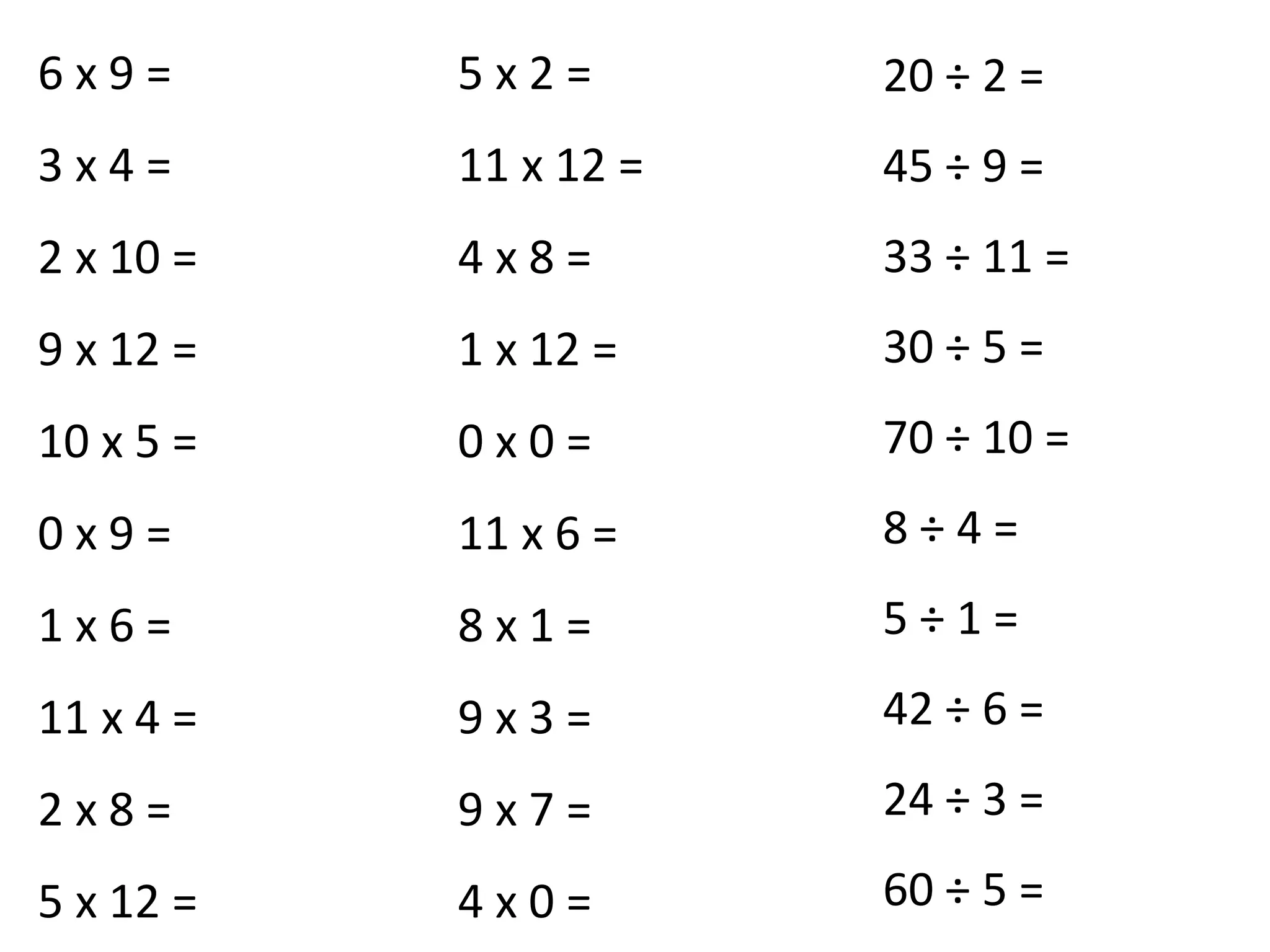
6 x 9 =
3 x 4 =
2 x 10 =
9 x 12 =
10 x 5 =
0 x 9 =
1 x 6 =
11 x 4 =
2 x 8 =
5 x 12 =
5 x 2 =
11 x 12 =
4 x 8 =
1 x 12 =
0 x 0 =
11 x 6 =
8 x 1 =
9 x 3 =
9 x 7 =
4 x 0 =
20 ÷ 2 =
45 ÷ 9 =
33 ÷ 11 =
30 ÷ 5 =
70 ÷ 10 =
8 ÷ 4 =
5 ÷ 1 =
42 ÷ 6 =
24 ÷ 3 =
60 ÷ 5 =
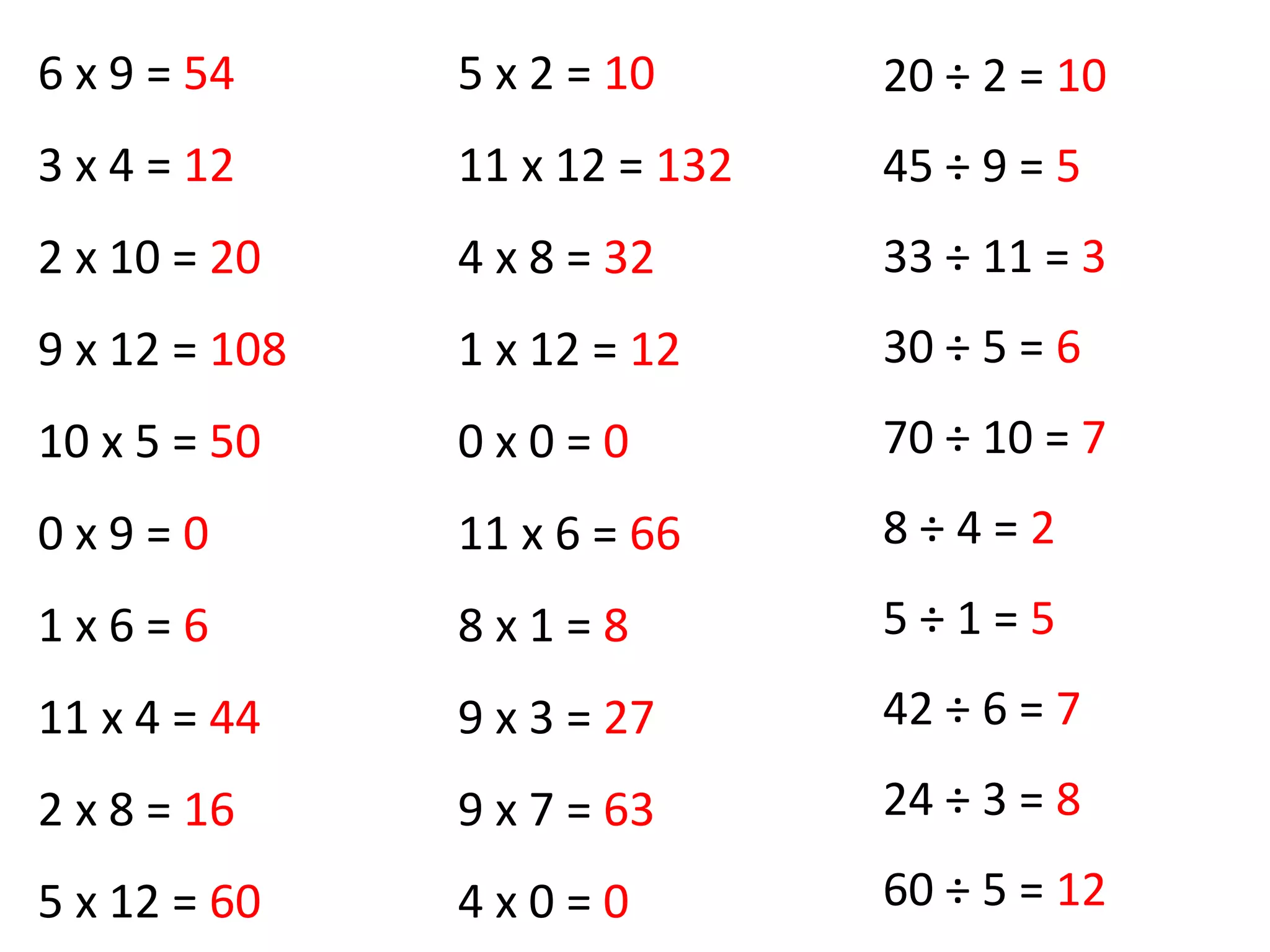
6 x 9 = 54
3 x 4 = 12
2 x 10 = 20
9 x 12 = 108
10 x 5 = 50
0 x 9 = 0
1 x 6 = 6
11 x 4 = 44
2 x 8 = 16
5 x 12 = 60
5 x 2 = 10
11 x 12 = 132
4 x 8 = 32
1 x 12 = 12
0 x 0 = 0
11 x 6 = 66
8 x 1 = 8
9 x 3 = 27
9 x 7 = 63
4 x 0 = 0
20 ÷ 2 = 10
45 ÷ 9 = 5
33 ÷ 11 = 3
30 ÷ 5 = 6
70 ÷ 10 = 7
8 ÷ 4 = 2
5 ÷ 1 = 5
42 ÷ 6 = 7
24 ÷ 3 = 8
60 ÷ 5 = 12
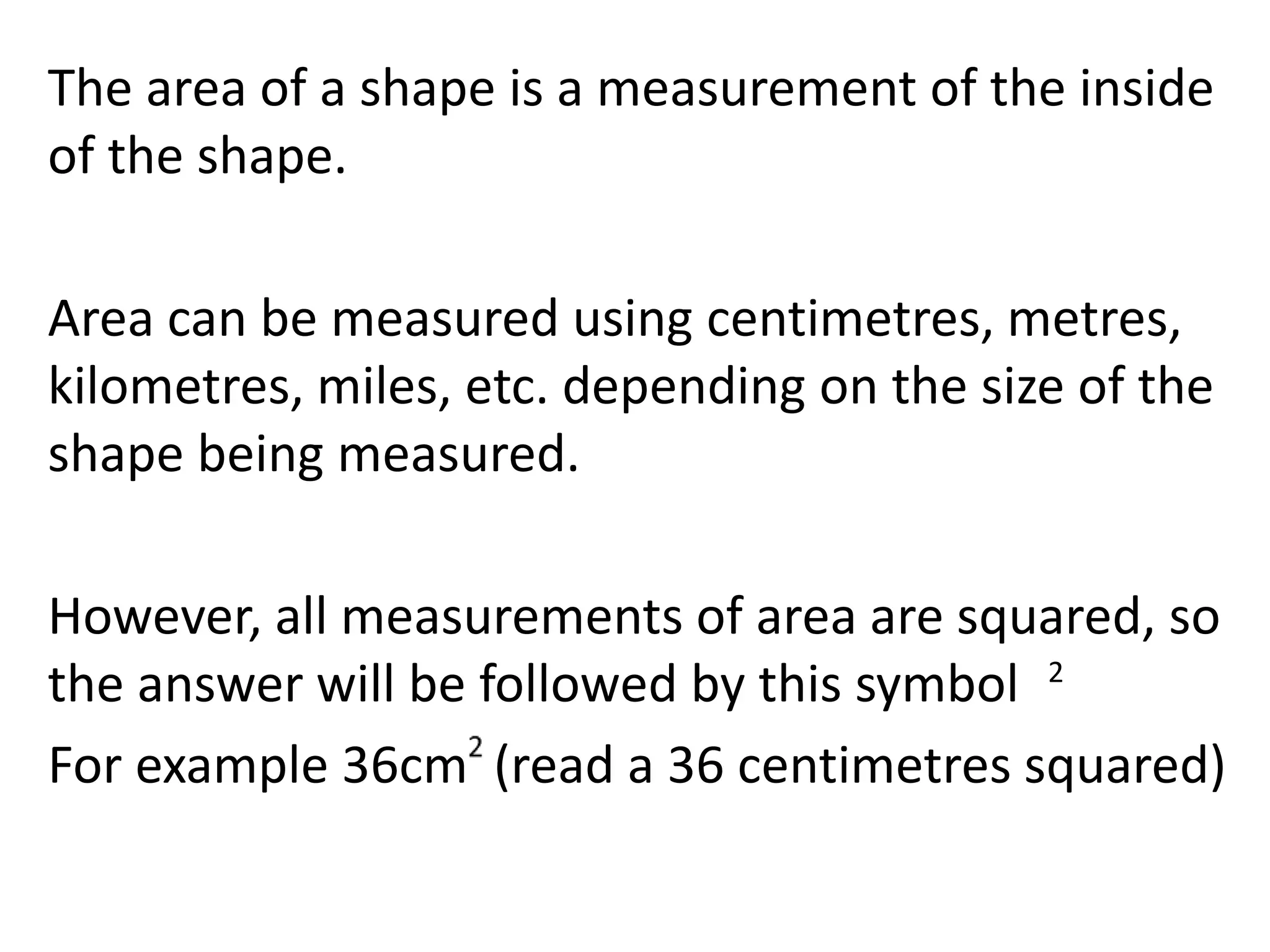
The area of a shape is a measurement of the inside
of the shape.
Area can be measured using centimetres, metres,
kilometres, miles, etc. depending on the size of the
shape being measured.
However, all measurements of area are squared, so
the answer will be followed by this symbol
For example 36cm (read a 36 centimetres squared)
2
Different shapes may share the same area
All of these shapes have an area of 9cm
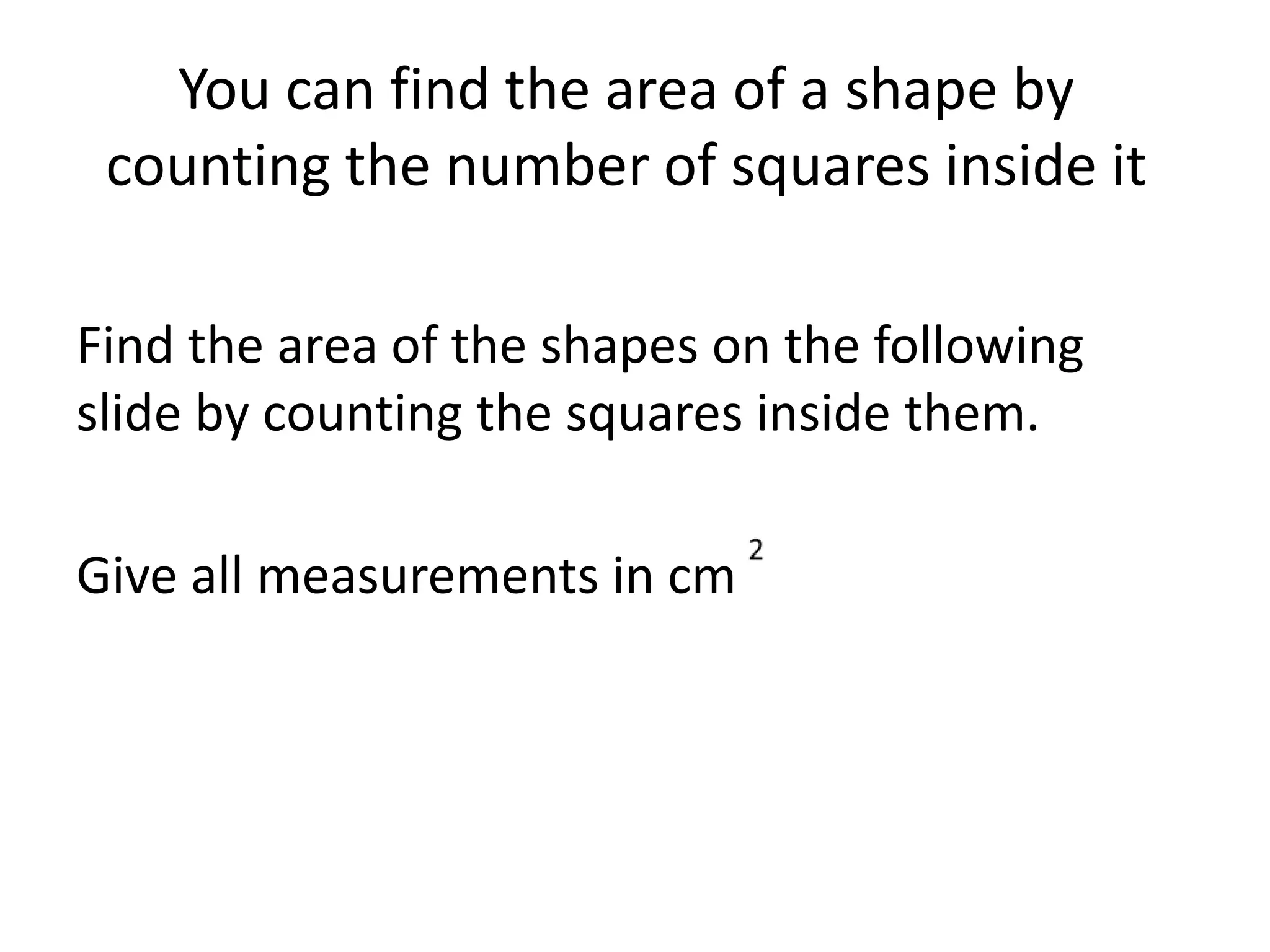
You can find the area of a shape by
counting the number of squares inside it
Find the area of the shapes on the following
slide by counting the squares inside them.
Give all measurements in cm
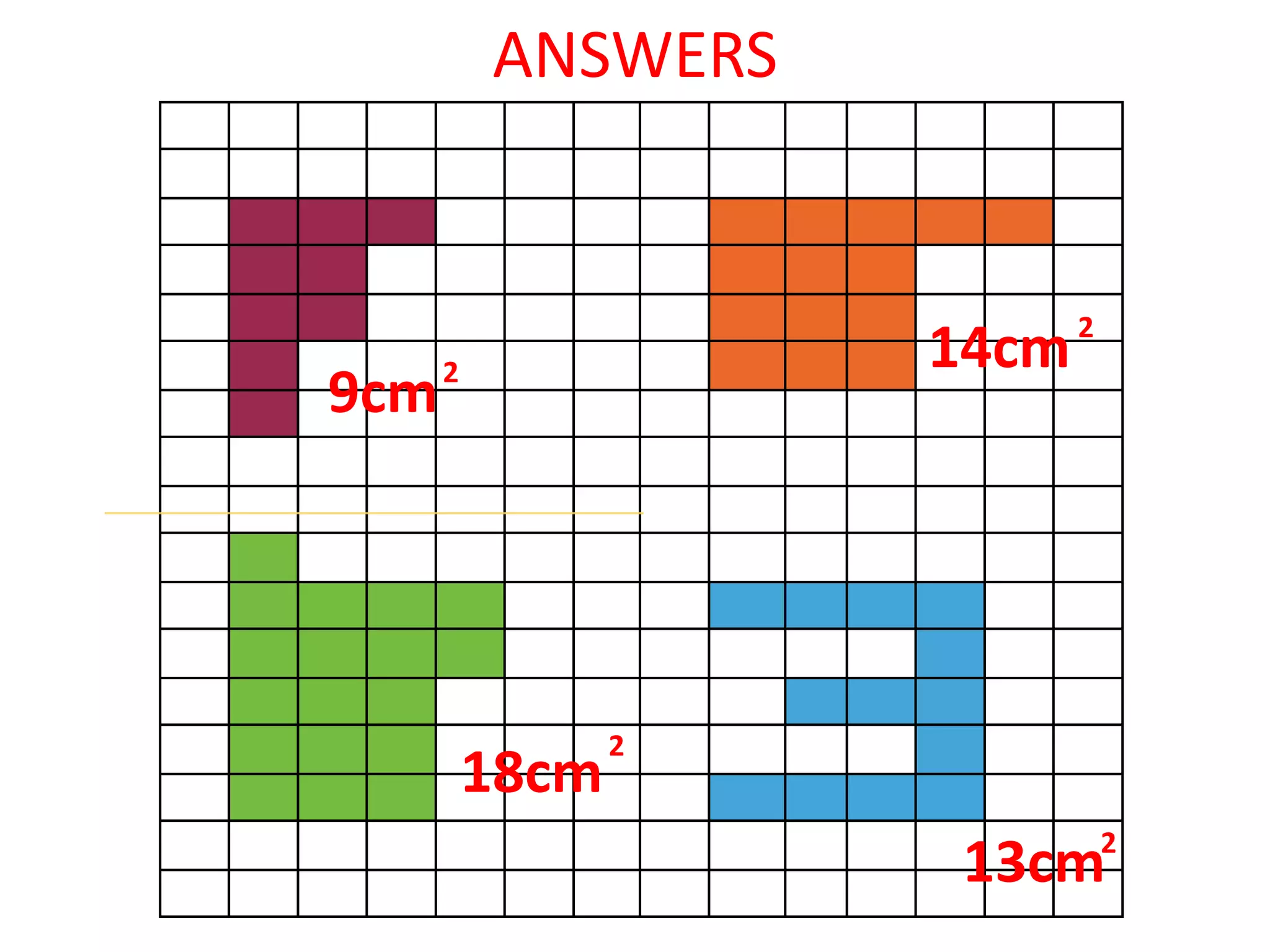
ANSWERS
9cm2 14cm2
18cm
2
13cm2
But what if there are no squares to count?
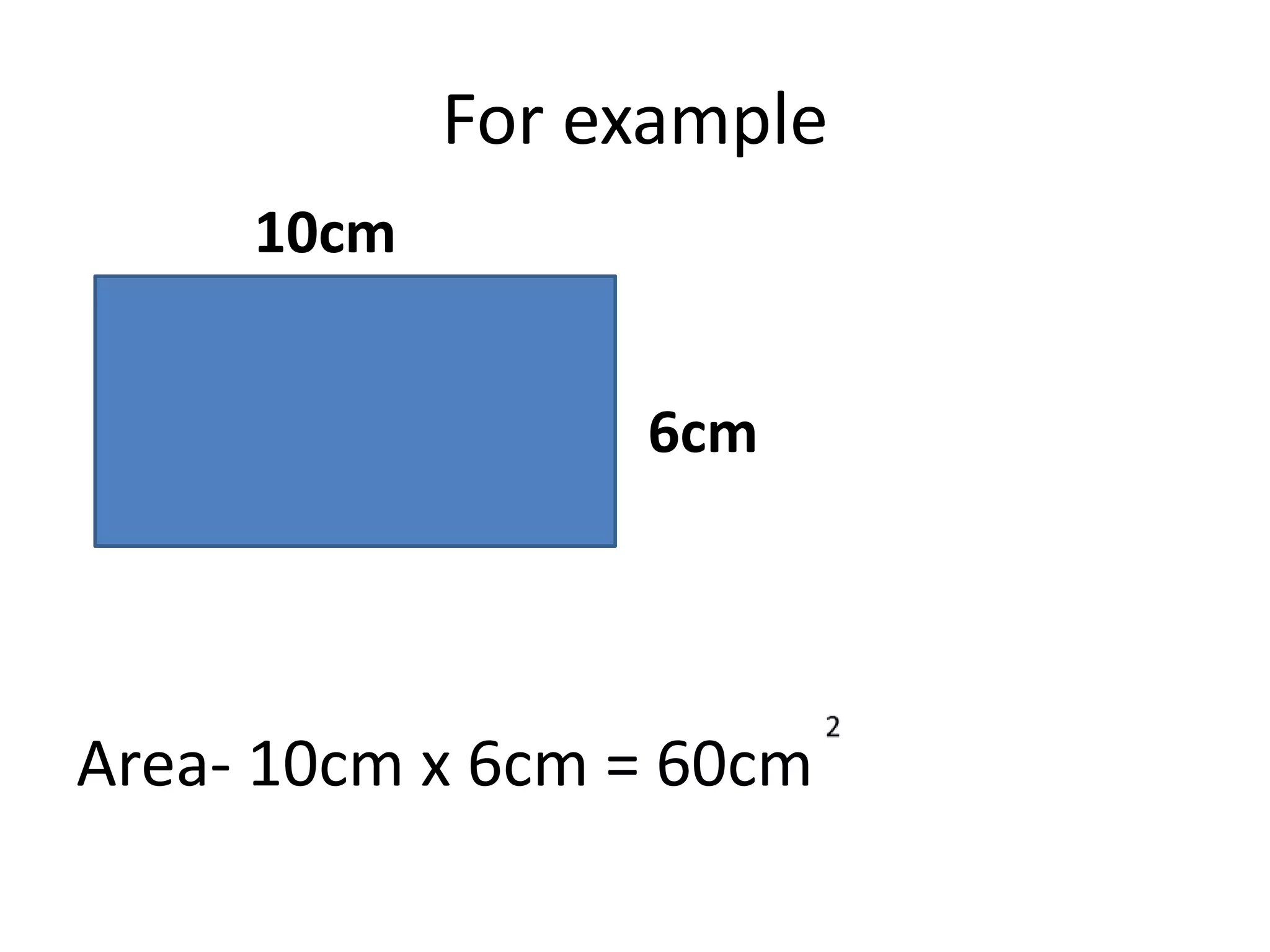
If you have a square or rectangular shape, and
you know the measurement for its width and
length, then you can figure out its area by
multiplying the measurements together.
width x length = area
For example
10cm
Area- 10cm x 6cm = 60cm
6cm
Find the area of the shapes below by multiplying their
width measurement by their height measurement
A
B
C
D
E
ANSWERS
A- 6cm x 3cm = 18cm
B- 6cm x 6cm = 36cm
C- 9cm x 5cm = 45cm
D- 2cm x 8cm = 16cm
E – 7cm x 8cm = 56cm
2
2
2
2
2
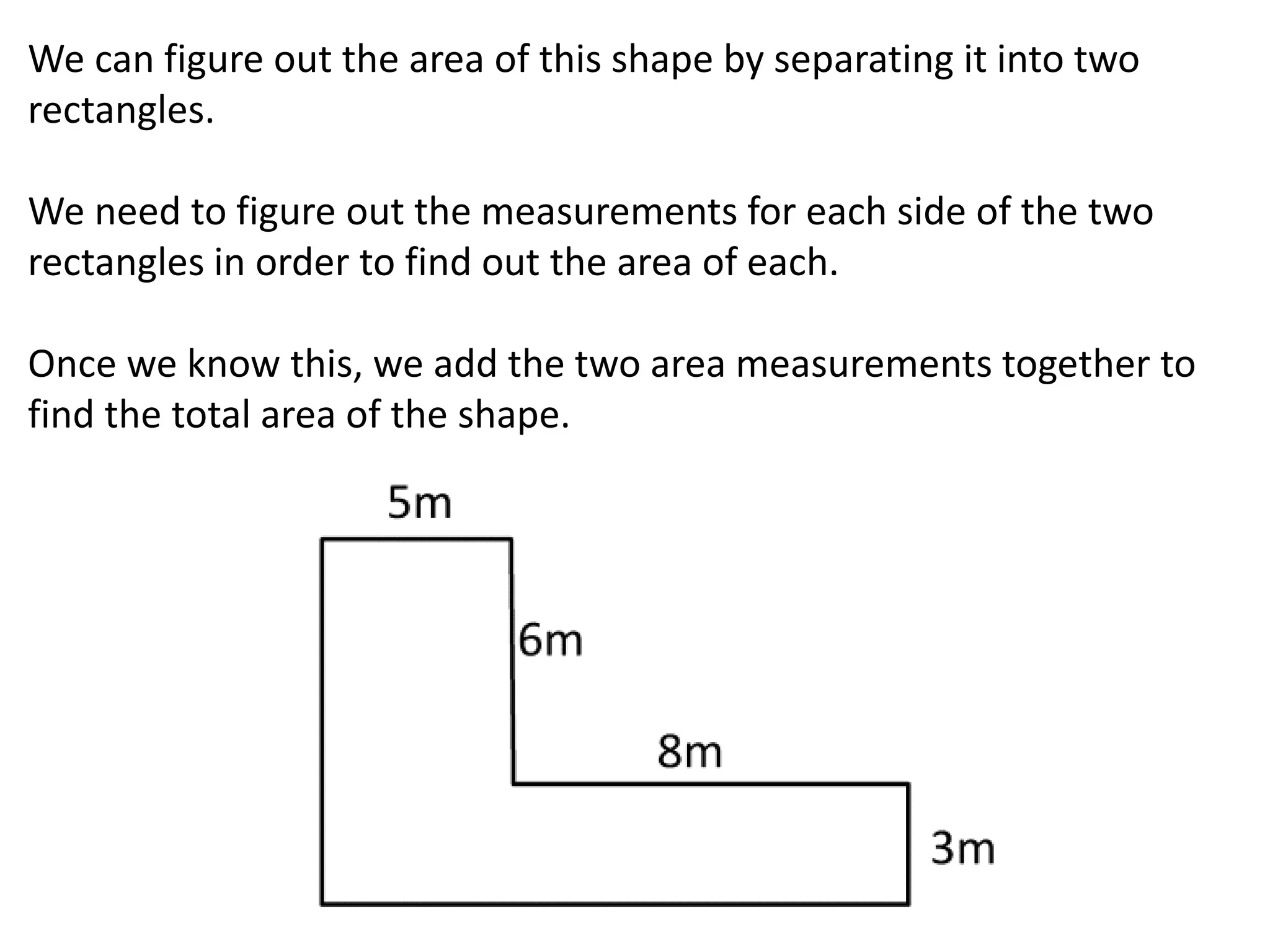
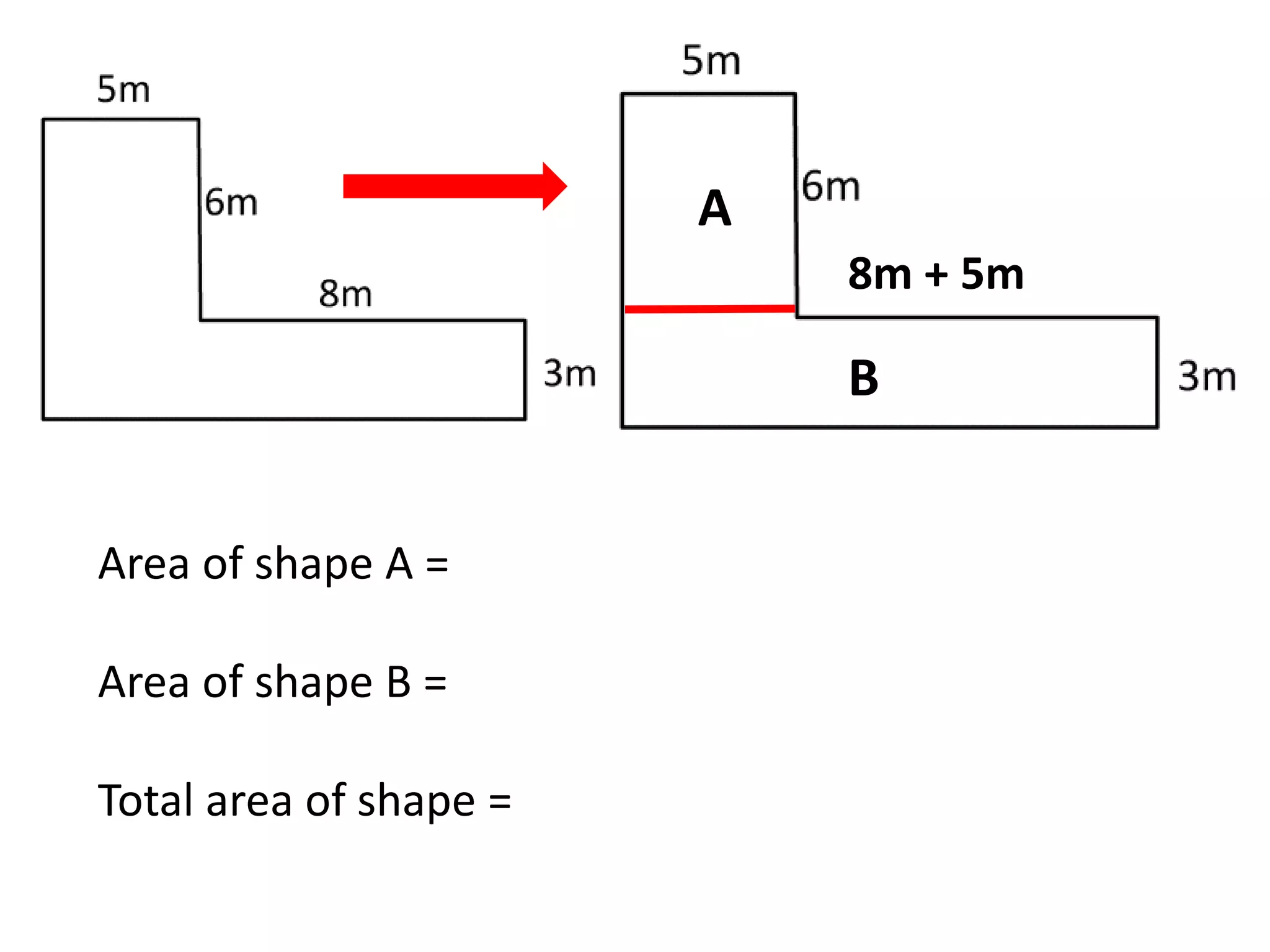
We can figure out the area of this shape by separating it into two
rectangles.
We need to figure out the measurements for each side of the two
rectangles in order to find out the area of each.
Once we know this, we add the two area measurements together to
find the total area of the shape.
8m + 5m
A
B
Area of shape A =
Area of shape B =
Total area of shape =
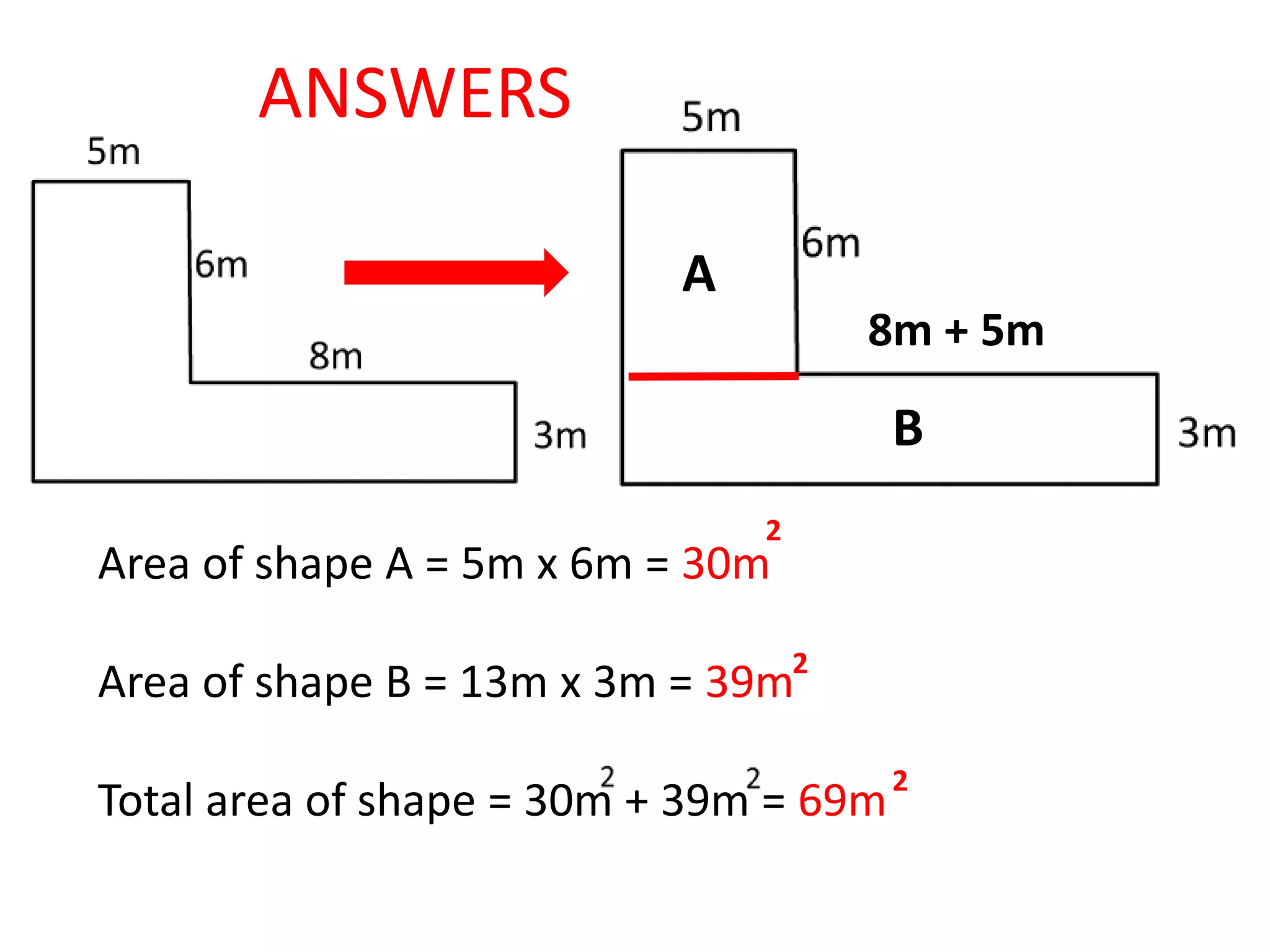
8m + 5m
A
B
Area of shape A = 5m x 6m = 30m
Area of shape B = 13m x 3m = 39m
Total area of shape = 30m + 39m = 69m
ANSWERS
2
2
2
Extra challenge!
Explain the difference between the perimeter of
a shape and the area of a shape.
How many different shapes can you draw with
an area of 20cm ? (you will need a ruler)
Can you draw a shape which has the same
perimeter as its area?
08/05/20
WALT: practice our maths skills
Use
https://mathsframe.co.uk/en/resources/resource/
477/Multiplication-Tables-Check to test your quick
fire times tables knowledge.
Then spend some time practicing using
https://www.topmarks.co.uk/maths-games/
and
https://www.mathshed.com/en-gb (your log in is
the same as for spelling shed. If you have any
problems with this, use the email form on the
website to get in touch with your class teacher).

Maths T5 W3

  • 1.
    04/05/20 WALT: read andwrite co-ordinates
  • 2.
    5 x 9= 8 x 9 = 9 x 3 = 7 x 9 = 11 x 9 = 4 x 9 = 2 x 9 = 9 x 6 = 9 x 9 = 12 x 9 = 10 x 9 = 9 x 4 = 3 x 9 = 6 x 9 = 9 x 11 = 9 x 5 = 9 x 7 = 9 x 9 = 9 x 2 = 10 x 9 = 9 x 8 = 9 x 12 = 108 ÷ 9 = 18 ÷ 9 = 54 ÷ 9 = 45 ÷ 9 = 81 ÷ 9 = 27 ÷ 9 = 36 ÷ 9 = 72 ÷ 9 = 99 ÷ 9 = 90 ÷ 9 = 63 ÷ 9 =
  • 3.
    ANSWERS 5 x 9= 45 8 x 9 = 72 9 x 3 = 27 7 x 9 = 63 11 x 9 = 99 4 x 9 = 36 2 x 9 = 18 9 x 6 = 54 9 x 9 = 81 12 x 9 = 108 10 x 9 = 90 9 x 4 = 36 3 x 9 = 27 6 x 9 = 54 9 x 11 = 99 9 x 5 = 45 9 x 7 = 63 9 x 9 = 81 9 x 2 = 18 10 x 9 = 90 9 x 8 = 72 9 x 12 = 108 108 ÷ 9 = 12 18 ÷ 9 = 2 54 ÷ 9 = 6 45 ÷ 9 = 5 81 ÷ 9 = 9 27 ÷ 9 = 3 36 ÷ 9 = 4 72 ÷ 9 = 8 99 ÷ 9 = 11 90 ÷ 9 = 10 63 ÷ 9 = 7
  • 4.
    10 for 10 1)a) 25 x 100 = b) 35.6 x 100 = 2) a) 200 ÷ 100 = b) 5,000 ÷ 100 = 3) 45.67 + 3.78 = 4) 234 x 6 = 5) What is the value of the underlined digits? a) 6,187 = b) 27.82 = c) 1,568.62 = 6) Round the following to the nearest 10 a) 72 = b) 287 = c) 4,712 =
  • 5.
    ANSWERS 1) a) 25x 100 = 2,500 b) 35.6 x 100 = 3,560 2) a) 200 ÷ 100 = 2 b) 5000 ÷ 100 = 50 3) 78.71 + 8.23 = 86.94 4) 412 x 6 = 2,472 5) What is the value of the underlined digits? a) 6187 = 1 hundred or 100 b) 27.82 = 8 tenths or 0.8 c) 1568.62 = 1 thousand or 1,000 6) Round the following to the nearest 10 a) 72 = 70 b) 287 = 290 c) 4,712 = 4,710
  • 6.
    Coordinates allow usto pinpoint exactly where a point or shape is on a graph or map. (the x coordinate) The first number shows us how many places to move across the horizontal axis. (the y coordinate) The second number shows us how many places to move up the vertical axis. They are an ‘ordered pair’ of numbers which means the order in which they are written is important. Coordinates are written in brackets separated by a comma, like this (1, 6).
  • 9.
    Write the co-ordinatesof the objects on the graph
  • 10.
    ANSWERS Tree- (1,1) Football –(2,2) Hat – (6,1) Dog- (4,4) Boot- (1,5) Teacup- (5,6)
  • 12.
    Name the colouredshape at co-ordniates: • (8,1) • (10,7) • (4,5) • (7,3) • (1,4) • (2,7) • (9,3) • (6,5) • (10,1) • (8,6)
  • 13.
    ANSWERS • (8,1) orangesquare • (10,7) red triangle • (4,5) white circle • (7,3) yellow triangle • (1,4) green square • (2,7) orange circle • (9,3) white triangle • (6,5) green circle • (10,1) blue circle • (8,6) yellow square
  • 14.
    Extra Challenge! Which colouredshape’s X (horizontal) co- ordinate is double it’s Y (vertical) co-ordinate?
  • 15.
    ANSWER Orange triangle (10,5) Whynot have a go at drawing your own co-ordinates treasure map?
  • 16.
  • 17.
    2 x 3= 7 x 4 = 5 x 10 = 12 x 2 = 4 x 11 = 5 x 6 = 10 x 4 = 5 x 9 = 4 x 4 = 0 x 2 = 2 x 7 = 2 x 4 = 11 x 5 = 6 x 5 = 4 x 3 = 1 x 5 = 3 x 12 = 9 x 10 = 7 x 2 = 2 x 11 = 0 x 10 = 8 x 5 = 5 x 3 = 10 x 6 = 3 x 10 = 4 x 8 = 2 x 2 = 1 x 4 = 9 x 3 = 5 x 0 =
  • 18.
    2 x 3= 6 7 x 4 = 28 5 x 10 = 50 12 x 2 = 24 4 x 11 = 44 5 x 6 = 30 10 x 4 = 40 5 x 9 = 45 4 x 4 = 16 0 x 2 = 0 2 x 7 = 14 2 x 4 = 8 11 x 5 = 55 6 x 5 = 30 4 x 3 = 12 1 x 5 = 5 3 x 12 = 36 9 x 10 = 90 7 x 2 = 14 2 x 11 = 22 0 x 10 = 0 8 x 5 = 40 5 x 3 = 15 10 x 6 = 60 3 x 10 = 30 4 x 8 = 32 2 x 2 = 4 1 x 4 = 4 9 x 3 = 27 5 x 0 = 0
  • 19.
    1) a) 456x 10 = b) 3.8 x 10 = 2) a) 450 ÷ 10 = b) 5 ÷ 10 = 3) Look at this number: 5,674.32 Which digit is in the a) Thousands = b) Hundredths = 4) 4,501 – 2,789 = 5) 873 x 7 = 10 for 10 6) Round these to the nearest 100 a) 287 = b) 750 = c) 2395 = 7) Round these to the nearest whole number a) 1.4 = b) 3.8 = c) 15.5 = 8) What time is it a) 20 minutes later than 9:30am? b) 30 minutes before 2:35pm? c) 25 minutes after 4:30pm?
  • 20.
    1) a) 456x 10 = 4,560 b) 3.8 x 10 = 38 2) a) 450 ÷ 10 = 45 b) 5 ÷ 10 = 0.5 3) Look at this number: 5,674.32 Which digit is in the a) Thousands = 5 b) Hundredths = 2 4) 4501 – 2789 = 1,712 5) 873 x 7 = 6,111 ANSWERS 6) Round these to the nearest 100 a) 287 = 300 b) 750 = 800 c) 2,395 = 2,400 7) Round these to the nearest whole number a) 1.4 = 1 b) 3.8 = 4 c) 15.5 = 16 8) What time is it a) 20 minutes later than 9:30am? 9:50am b) 30 minutes before 2:35pm? 2:05pm c) 25 minutes after 4:30pm? 4:55pm
  • 21.
    Division is theopposite (inverse) of multiplication, and vice versa. Therefore, if we know 1 calculation, we actually know 4! For example, if we know that 5 x 12 = 60 We also know that 12 x 5 = 60 And that 60 ÷ 5 = 12 And 60 ÷ 12 = 5
  • 22.
    5 x 12= 60 so 12 x 5 = 60 so 60 ÷ 5 = 12 so 60 ÷ 12 = 5 When multiplying, the largest number is (usually) in the answer space and the other two number can change spaces. When dividing, the largest number (usually) comes first and the other two numbers can change spaces. Using inverse operations in this way, you will be able to come up with 4 calculations- 2 multiplication and 2 division.
  • 23.
    If you knowthat 7 x 8 = 56… …then you also know that: __ x __ = ____ (the largest number is the answer when multiplying) And ____ ÷ __ = __ (the largest number comes first when dividing) And ____ ÷ __ = __
  • 24.
    Use inverse operationsto find three more calculations for the ones below • If 4 x 8 = 32, then ? And ? And ? • If 11 x 6 = 66 , then ? And ? And ? • If 7 x 3 = 21 , then ? And ? And ? • If 5 x 10 = 50 , then ? And ? And ? • If 132 ÷ 11 = 12 , then ? And ? And ? • If 45 ÷ 5 = 9 , then ? And ? And ? • If 72 ÷ 9 = 8 , then ? And ? And ? • If 110 ÷ 11 = 10 , then ? And ? And ?
  • 25.
    ANSWERS • If 4x 8 = 32, then 8 x 4 = 32 And 32 ÷ 4 = 8 And 32 ÷ 8 = 4 • If 11 x 6 = 66 , then 6 x 11 = 66 And 66 ÷ 11 = 6 And 66 ÷ 6 = 11 • If 7 x 3 = 21 , then 3 x 7 = 21 And 21 ÷ 7 = 3 And 21 ÷ 3 = 7 • If 5 x 10 = 50 , then 10 x 5 = 50 And 50 ÷ 10 = 5 And 50 ÷ 5 = 10 • If 132 ÷ 11 = 12 , then 132 ÷ 12 = 11 And 12 x 11 = 132 And 11 x 12 = 132 • If 45 ÷ 5 = 9 , then 45 ÷ 9 = 5 And 5 x 9 = 45 And 9 x 5 = 45 • If 72 ÷ 9 = 8 , then 72 ÷ 8 = 9 And 9 x 8 = 72 And 8 x 9 = 72 • If 110 ÷ 11 = 10 , then 110 ÷ 10 = 11 And 10 x 11 = 110 And 11 x 10 = 110
  • 26.
    This also worksfor addition and subtraction For example, if we know that 124 + 36 = 160 Then we also know that 36 + 124 = 160 And 160 – 124 = 36 And 160 – 36 = 124 When adding, the largest number is the answer and when subtracting, the largest number comes first.
  • 27.
    Extra Challenge! Come upwith some of your own sets of addition and subtraction calculations. Remember, you only need to know the answer to one calculation to know the other three. To start you off… If 150 + 34 = 184, then… You could use a calculator to check your answers.
  • 28.
  • 29.
    10 for 10 1)8,965 – 3,364 = 2) 543 + 212 + 420 = 3) 80, 77, 74, 71, _?_ 4) 6,000 + 2 + five hundreds + eighty = 5) How many minutes are there in quarter of an hour? 6) Write three odd numbers which can be added together to make 19 7) A ladder is 5….. mm cm m km tall 8) Half of 52 = 9) How many wheels do eight cars have? 10)If you have £1 and spend 36p, how much do you have left?
  • 30.
    10 for 10 1)8,965 – 3,364 = 5,601 2) 543 + 212 + 420 = 1,175 3) 80, 77, 74, 71, _68_ 4) 6,000 + 2 + five hundreds + eighty = 6,582 5) How many minutes are there in quarter of an hour? 15 minutes 6) Write three different odd numbers which can be added together to make 19 9 + 7 + 3 or 13 + 1 + 5 or 15 + 3 + 1 7) A ladder is 5….. mm cm m km tall 8) Half of 52 = 26 9) How many wheels do eight cars have? 32 10) If you have £1 and spend 36p, how much do you have left? 64p
  • 31.
    6 x 2= 10 x 5 = 3 x 8 = 0 x 3 = 12 x 10 = 3 x 1 = 2 x 8 = 5 x 11 = 10 x 1 = 7 x 5 = 5 x 4 = 9 x 4 = 10 x 10 = 8 x 10 = 11 x 3 = 3 x 6 = 2 x 0 = 2 x 5 = 8 x 3 = 10 x 9 = 5 x 7 = 10 x 2 = 12 x 5 = 4 x 9 = 10 x 3 = 10 x 7 = 2 x 12 = 0 x 4 = 3 x 11 = 6 x 10 =
  • 32.
    6 x 2= 12 10 x 5 = 50 3 x 8 = 24 0 x 3 = 0 12 x 10 = 120 3 x 1 = 3 2 x 8 = 16 5 x 11 = 55 10 x 1 = 10 7 x 5 = 35 5 x 4 = 20 9 x 4 = 36 10 x 10 = 100 8 x 10 = 80 11 x 3 = 33 3 x 6 = 18 2 x 0 = 0 2 x 5 = 10 8 x 3 = 24 10 x 9 = 90 5 x 7 = 35 10 x 2 = 20 12 x 5 = 60 4 x 9 = 36 10 x 3 = 30 10 x 7 = 70 2 x 12 = 24 0 x 4 = 0 3 x 11 = 33 6 x 10 = 60
  • 33.
    Starter- sort thefactors Factors of 30 Odd 12 1 4 30 14 10 15 2 5 6
  • 34.
    Watch this shortvideo to remind you of how to use the bus stop method for division https://www.youtube.com/watch?v=SLze82Zcc4Y Then have a go yourself using the calculations on the following slides
  • 35.
    Mild 78 ÷ 3= 65 ÷ 5 = 84 ÷ 3 = 72 ÷ 3 = 105 ÷ 5 = 135 ÷ 3 = Spicy 243 ÷ 3 = 300 ÷ 4 = 260 ÷ 4 = 384 ÷ 3 = 756 ÷ 4 = 579 ÷ 3 = Hot 940 ÷ 4 = 726 ÷ 6 = 868 ÷ 4 = 936 ÷ 6 = 952 ÷ 4 = 972 ÷ 6 = Extra Hot 2,289 ÷ 7 = 4,188 ÷ 6 = 3,432 ÷ 8 = 5,769 ÷ 9 = 3,528 ÷ 7 = 7,000 ÷ 8 =
  • 36.
    ANSWERS Mild 78 ÷ 3= 26 65 ÷ 5 = 13 84 ÷ 3 = 28 72 ÷ 3 = 24 105 ÷ 5 = 21 135 ÷ 3 = 45 Spicy 243 ÷ 3 = 81 300 ÷ 4 = 75 260 ÷ 4 = 65 384 ÷ 3 = 128 756 ÷ 4 = 189 579 ÷ 3 = 193 Hot 940 ÷ 4 = 235 726 ÷ 6 = 121 868 ÷ 4 = 217 936 ÷ 6 = 156 952 ÷ 4 = 238 972 ÷ 6 = 162 Extra Hot 2,289 ÷ 7 = 327 4,188 ÷ 6 = 698 3,432 ÷ 8 = 429 5,769 ÷ 9 = 641 3,528 ÷ 7 = 504 7,000 ÷ 8 = 875
  • 37.
    07/05/20 WALT: find thearea of quadrilaterals
  • 38.
    10 for 10 1)Find: a) ½ of 120 b) ½ of 86 c) ¼ of 20 d) ¾ of 100 2) 246 ÷ 6 = 3) 3/8 + 4/8 – 5/8 = 4) 120 ÷ 10 = 5) 2,780 ÷ 100 = 6) A square has sides of 10cm. What is it’s perimeter? 7) If 1,000g = 1kg, then 13,000g = ?kg
  • 39.
    10 for 10-ANSWERS 1) Find: a) ½ of 120- 60 b) ½ of 86- 43 c) ¼ of 20- 5 d) ¾ of 100- 75 2) 246 ÷ 6 = 41 3) 3/8 + 4/8 – 5/8 = 2/8 4) 120 ÷ 10 = 12 5) 2,780 ÷ 100 = 27.8 6) A square has sides of 10cm. What is it’s perimeter? 40cm 7) If 1,000g = 1kg, then 13,000g = 13kg
  • 40.
    6 x 9= 3 x 4 = 2 x 10 = 9 x 12 = 10 x 5 = 0 x 9 = 1 x 6 = 11 x 4 = 2 x 8 = 5 x 12 = 5 x 2 = 11 x 12 = 4 x 8 = 1 x 12 = 0 x 0 = 11 x 6 = 8 x 1 = 9 x 3 = 9 x 7 = 4 x 0 = 20 ÷ 2 = 45 ÷ 9 = 33 ÷ 11 = 30 ÷ 5 = 70 ÷ 10 = 8 ÷ 4 = 5 ÷ 1 = 42 ÷ 6 = 24 ÷ 3 = 60 ÷ 5 =
  • 41.
    6 x 9= 54 3 x 4 = 12 2 x 10 = 20 9 x 12 = 108 10 x 5 = 50 0 x 9 = 0 1 x 6 = 6 11 x 4 = 44 2 x 8 = 16 5 x 12 = 60 5 x 2 = 10 11 x 12 = 132 4 x 8 = 32 1 x 12 = 12 0 x 0 = 0 11 x 6 = 66 8 x 1 = 8 9 x 3 = 27 9 x 7 = 63 4 x 0 = 0 20 ÷ 2 = 10 45 ÷ 9 = 5 33 ÷ 11 = 3 30 ÷ 5 = 6 70 ÷ 10 = 7 8 ÷ 4 = 2 5 ÷ 1 = 5 42 ÷ 6 = 7 24 ÷ 3 = 8 60 ÷ 5 = 12
  • 42.
    The area ofa shape is a measurement of the inside of the shape. Area can be measured using centimetres, metres, kilometres, miles, etc. depending on the size of the shape being measured. However, all measurements of area are squared, so the answer will be followed by this symbol For example 36cm (read a 36 centimetres squared) 2
  • 43.
    Different shapes mayshare the same area All of these shapes have an area of 9cm
  • 44.
    You can findthe area of a shape by counting the number of squares inside it Find the area of the shapes on the following slide by counting the squares inside them. Give all measurements in cm
  • 46.
  • 47.
    But what ifthere are no squares to count? If you have a square or rectangular shape, and you know the measurement for its width and length, then you can figure out its area by multiplying the measurements together. width x length = area
  • 48.
  • 49.
    Find the areaof the shapes below by multiplying their width measurement by their height measurement A B C D E
  • 50.
    ANSWERS A- 6cm x3cm = 18cm B- 6cm x 6cm = 36cm C- 9cm x 5cm = 45cm D- 2cm x 8cm = 16cm E – 7cm x 8cm = 56cm 2 2 2 2 2
  • 51.
    We can figureout the area of this shape by separating it into two rectangles. We need to figure out the measurements for each side of the two rectangles in order to find out the area of each. Once we know this, we add the two area measurements together to find the total area of the shape.
  • 52.
    8m + 5m A B Areaof shape A = Area of shape B = Total area of shape =
  • 53.
    8m + 5m A B Areaof shape A = 5m x 6m = 30m Area of shape B = 13m x 3m = 39m Total area of shape = 30m + 39m = 69m ANSWERS 2 2 2
  • 54.
    Extra challenge! Explain thedifference between the perimeter of a shape and the area of a shape. How many different shapes can you draw with an area of 20cm ? (you will need a ruler) Can you draw a shape which has the same perimeter as its area?
  • 55.
  • 56.
    Use https://mathsframe.co.uk/en/resources/resource/ 477/Multiplication-Tables-Check to testyour quick fire times tables knowledge. Then spend some time practicing using https://www.topmarks.co.uk/maths-games/ and https://www.mathshed.com/en-gb (your log in is the same as for spelling shed. If you have any problems with this, use the email form on the website to get in touch with your class teacher).