
RFID Applications 
March/2014 
Presentation 
1 
• Introduction 
• components 
• Layers 
Presentation 
2 
• Regulations 
• Standards 
• Protocols 
Presentation 
3 
• RFID Software 
Developer 
• Middleware 
• Labs 
Presentation 
4 
• RIFIDI 
Emulator LAB 
Mouhanad Alkhaldi | Postgraduate Taught Part Time - Information Technology (SS), MSc |ma1049@hw.ac.uk
RFID Applications 
Introduction to RFID 
& 
System Components 
March/2014 
Mouhanad Alkhaldi | Postgraduate Taught Part Time - Information Technology (SS), MSc |ma1049@hw.ac.uk
Index 
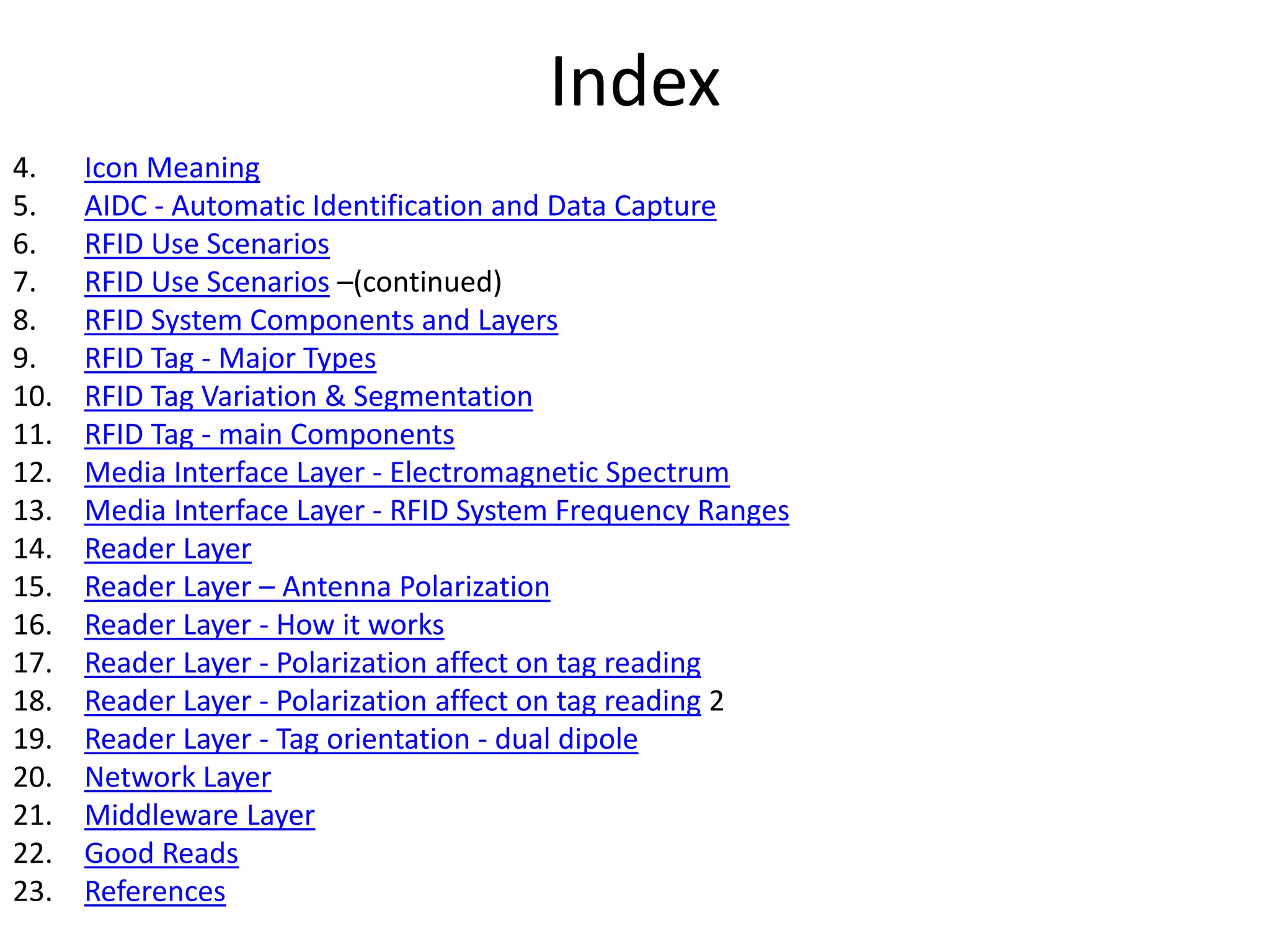
4. Icon Meaning 
5. AIDC - Automatic Identification and Data Capture 
6. RFID Use Scenarios 
7. RFID Use Scenarios –(continued) 
8. RFID System Components and Layers 
9. RFID Tag - Major Types 
10. RFID Tag Variation & Segmentation 
11. RFID Tag - main Components 
12. Media Interface Layer - Electromagnetic Spectrum 
13. Media Interface Layer - RFID System Frequency Ranges 
14. Reader Layer 
15. Reader Layer – Antenna Polarization 
16. Reader Layer - How it works 
17. Reader Layer - Polarization affect on tag reading 
18. Reader Layer - Polarization affect on tag reading 2 
19. Reader Layer - Tag orientation - dual dipole 
20. Network Layer 
21. Middleware Layer 
22. Good Reads 
23. References
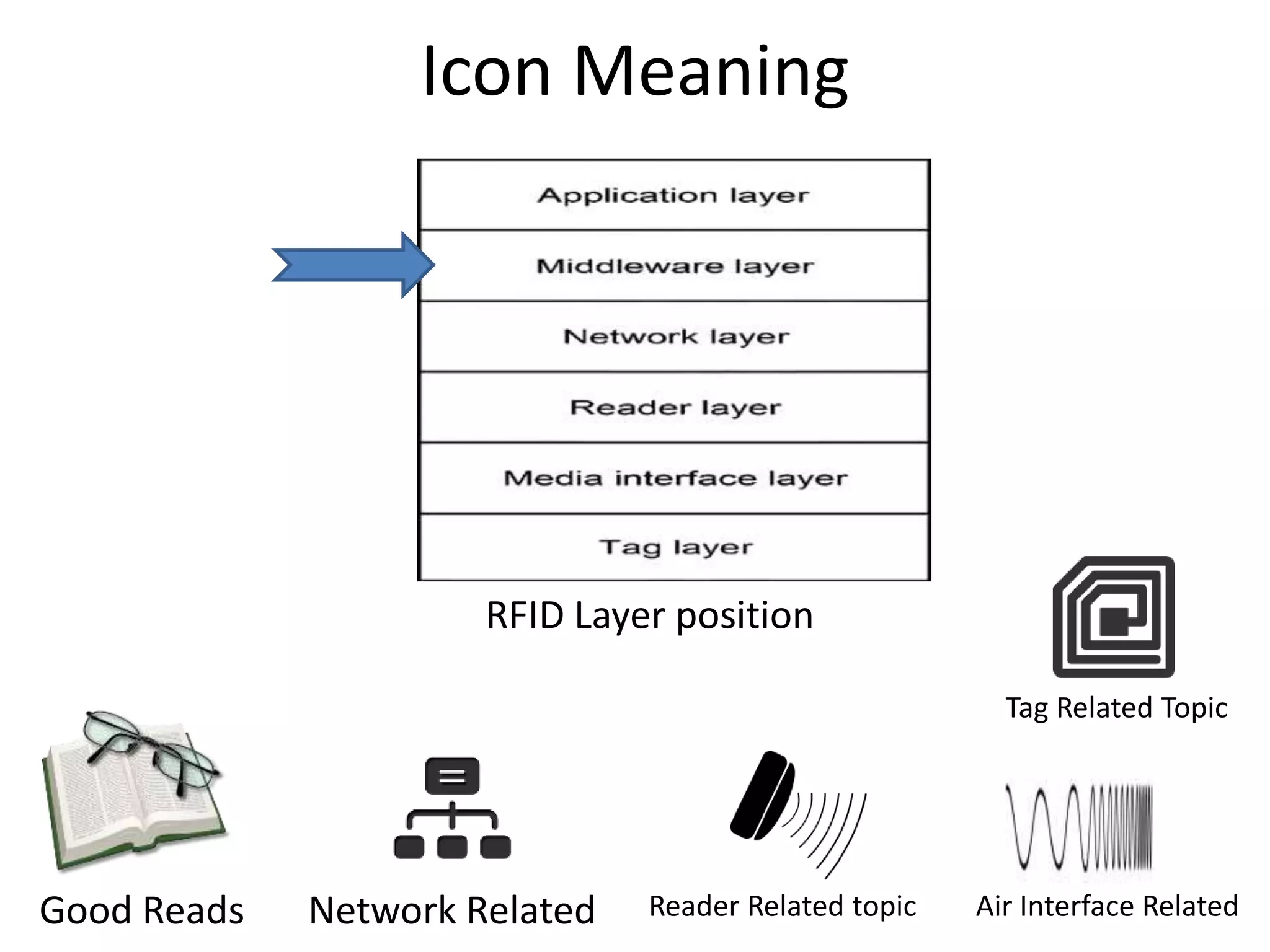
Icon Meaning 
RFID Layer position 
Good Reads Network Related Reader Related topic 
Tag Related Topic 
Air Interface Related
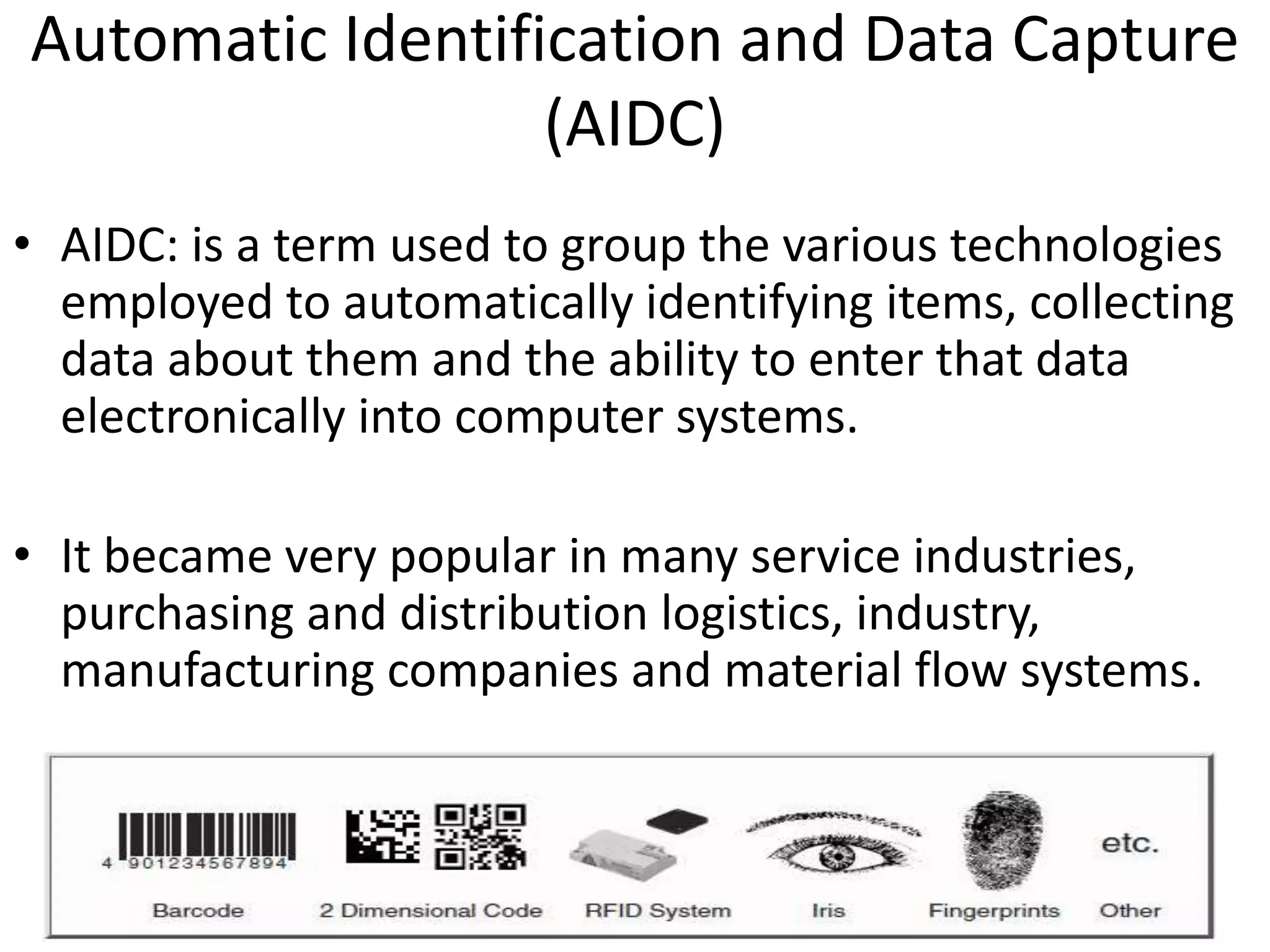
Automatic Identification and Data Capture 
(AIDC) 
• AIDC: is a term used to group the various technologies 
employed to automatically identifying items, collecting 
data about them and the ability to enter that data 
electronically into computer systems. 
• It became very popular in many service industries, 
purchasing and distribution logistics, industry, 
manufacturing companies and material flow systems.
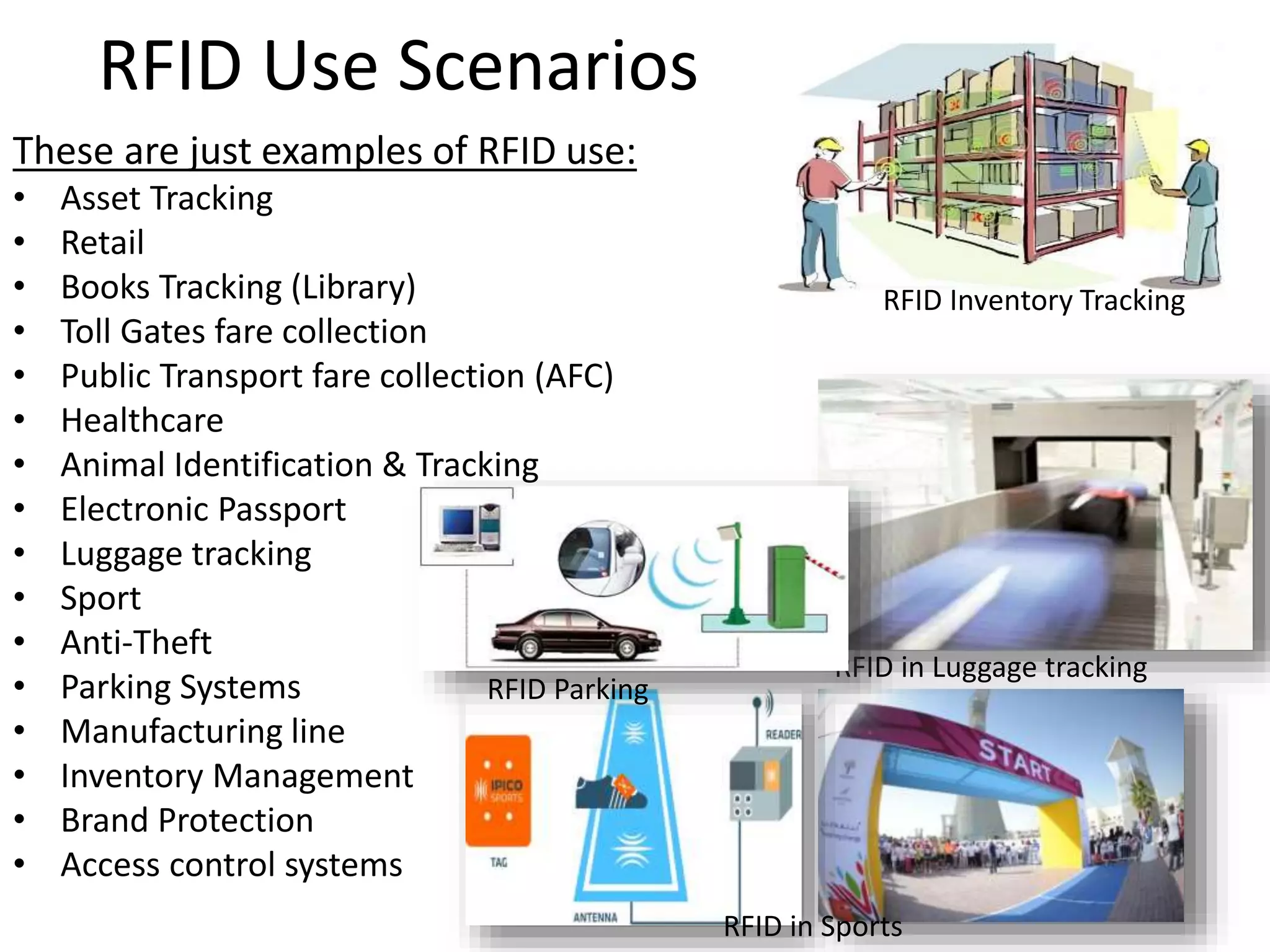
RFID Use Scenarios 
These are just examples of RFID use: 
• Asset Tracking 
• Retail 
• Books Tracking (Library) 
• Toll Gates fare collection 
• Public Transport fare collection (AFC) 
• Healthcare 
• Animal Identification & Tracking 
• Electronic Passport 
• Luggage tracking 
• Sport 
• Anti-Theft 
• Parking Systems 
• Manufacturing line 
• Inventory Management 
• Brand Protection 
• Access control systems 
RFID in Luggage tracking 
RFID in Sports 
RFID Parking 
RFID Inventory Tracking
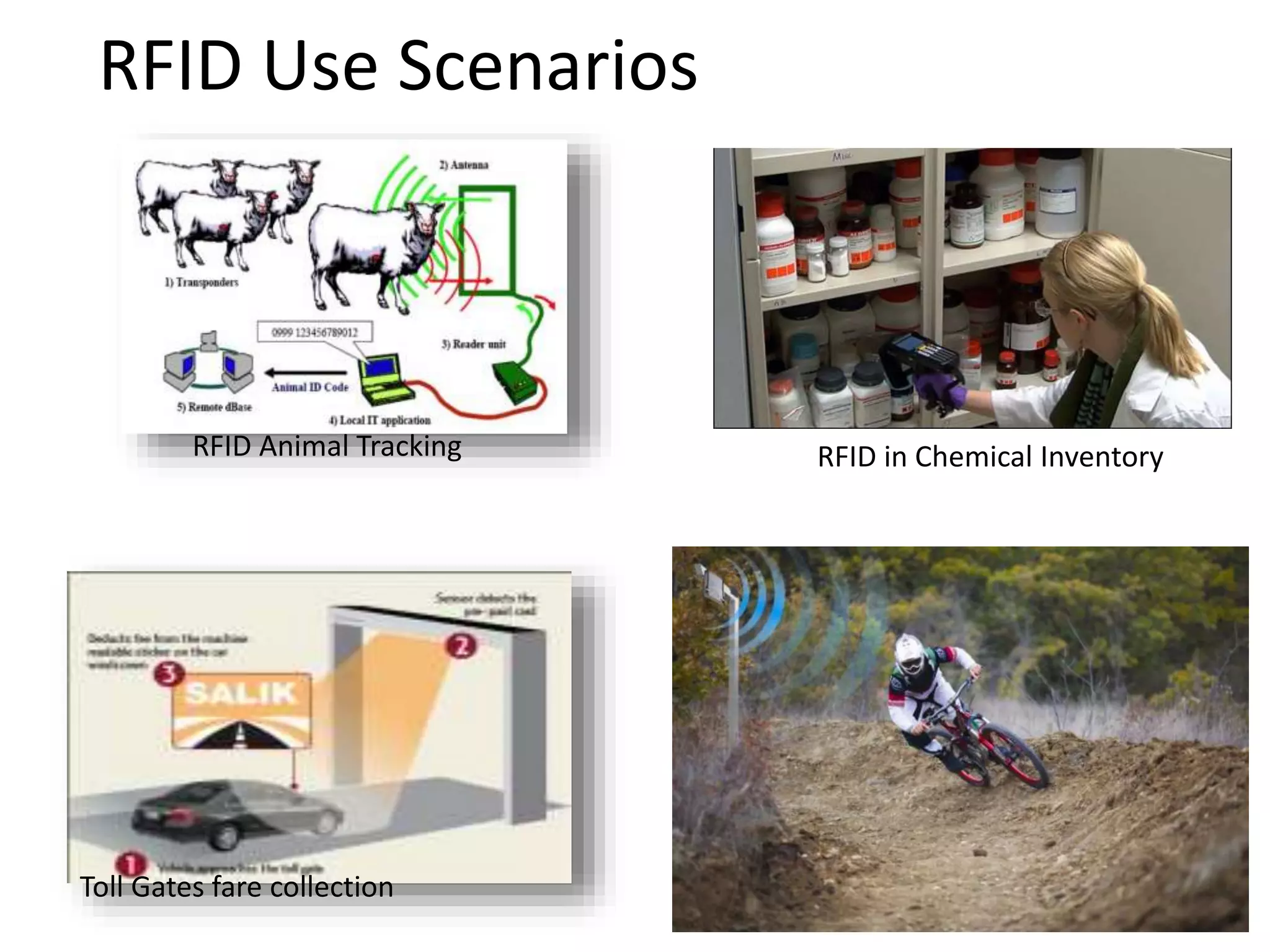
RFID Use Scenarios 
RFID in Chemical Inventory 
RFID Animal Tracking 
Toll Gates fare collection
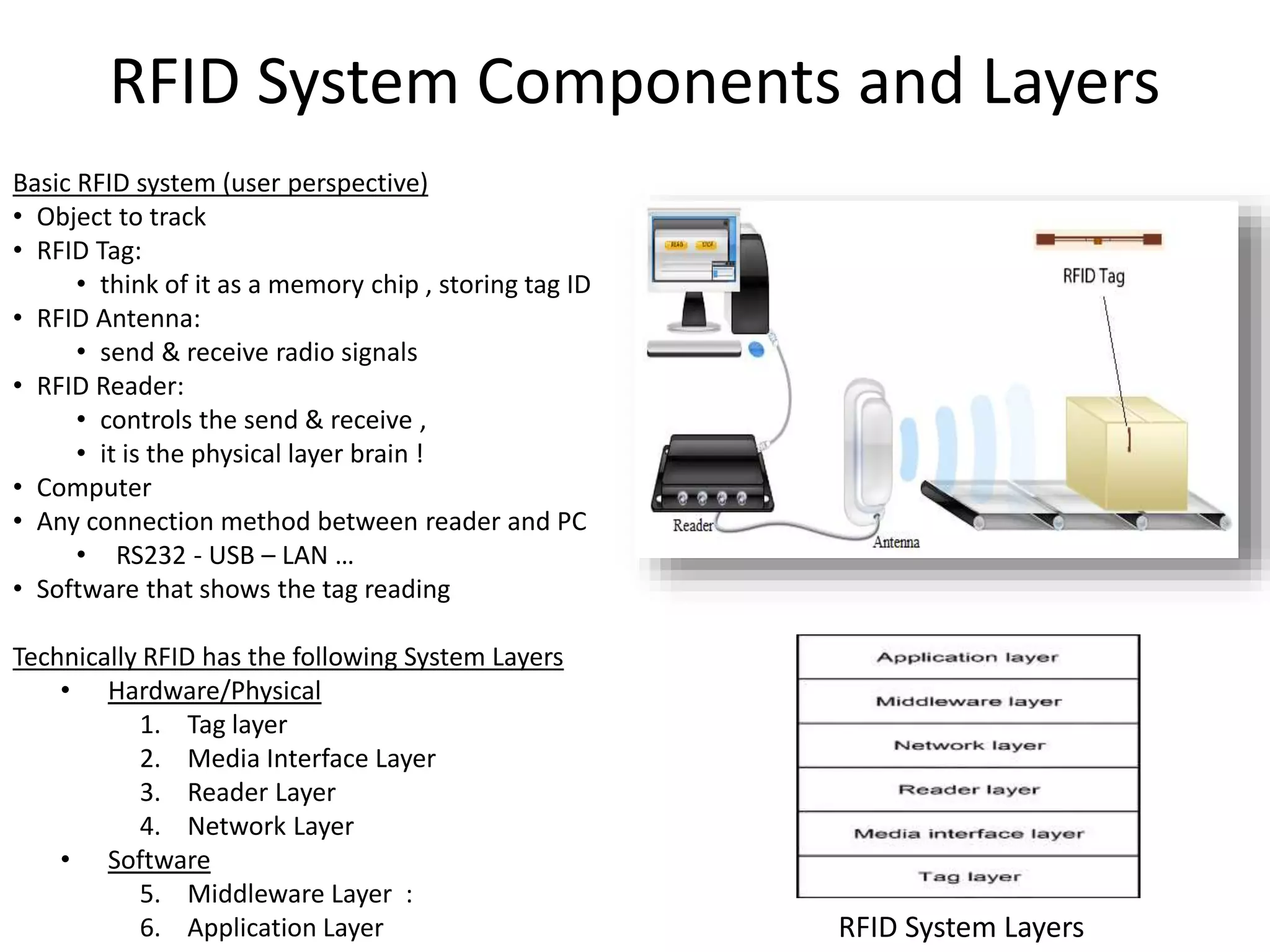
RFID System Components and Layers 
Basic RFID system (user perspective) 
• Object to track 
• RFID Tag: 
• think of it as a memory chip , storing tag ID 
• RFID Antenna: 
• send & receive radio signals 
• RFID Reader: 
• controls the send & receive , 
• it is the physical layer brain ! 
• Computer 
• Any connection method between reader and PC 
• RS232 - USB – LAN … 
• Software that shows the tag reading 
Technically RFID has the following System Layers 
• Hardware/Physical 
1. Tag layer 
2. Media Interface Layer 
3. Reader Layer 
4. Network Layer 
• Software 
5. Middleware Layer : 
6. Application Layer RFID System Layers
Tag Layer 
Major Types 
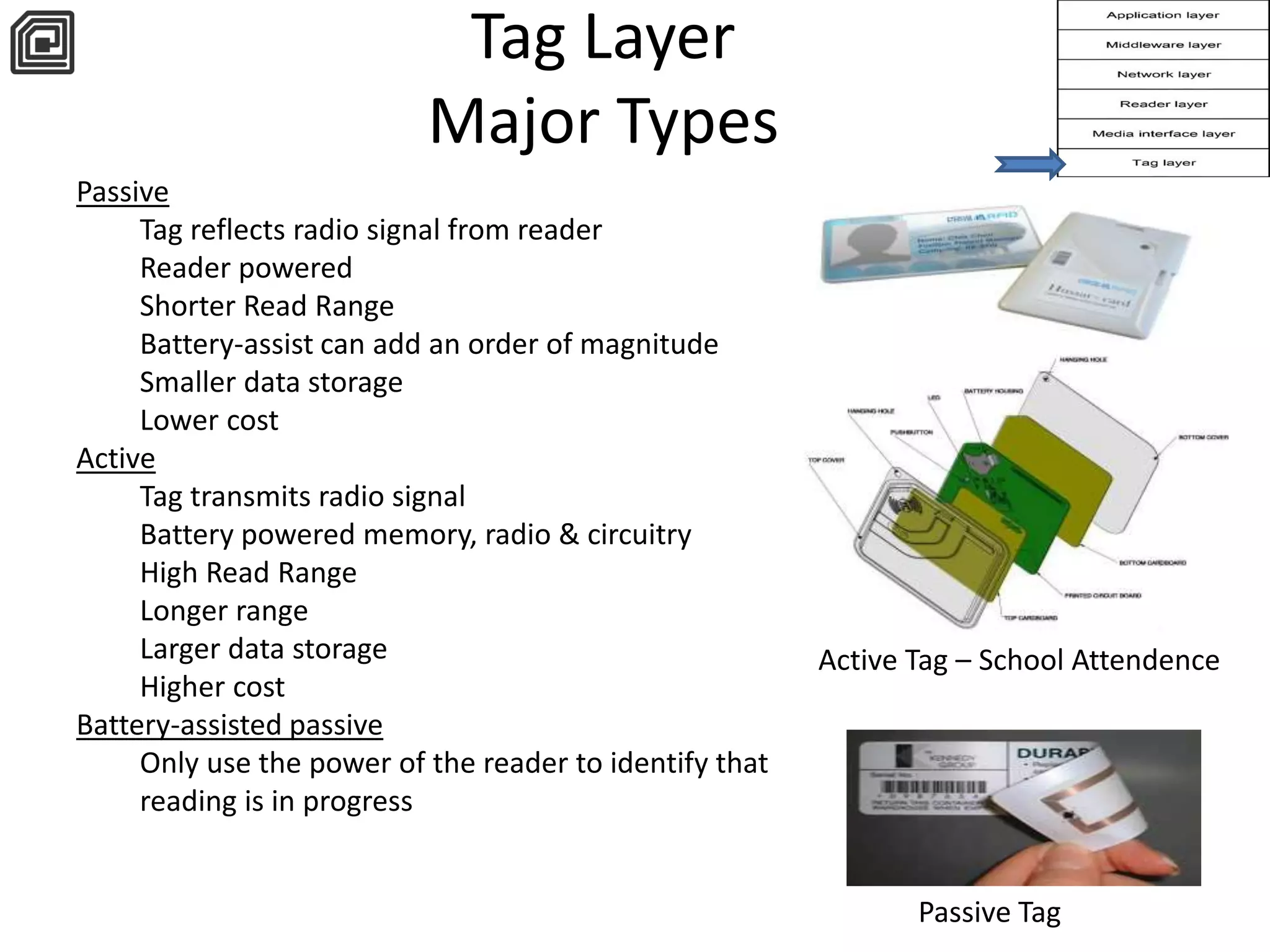
Passive 
Tag reflects radio signal from reader 
Reader powered 
Shorter Read Range 
Battery-assist can add an order of magnitude 
Smaller data storage 
Lower cost 
Active 
Tag transmits radio signal 
Battery powered memory, radio & circuitry 
High Read Range 
Longer range 
Larger data storage 
Higher cost 
Battery-assisted passive 
Only use the power of the reader to identify that 
reading is in progress 
Active Tag – School Attendence 
Passive Tag
Tag Layer 
Variation & Segmentation 
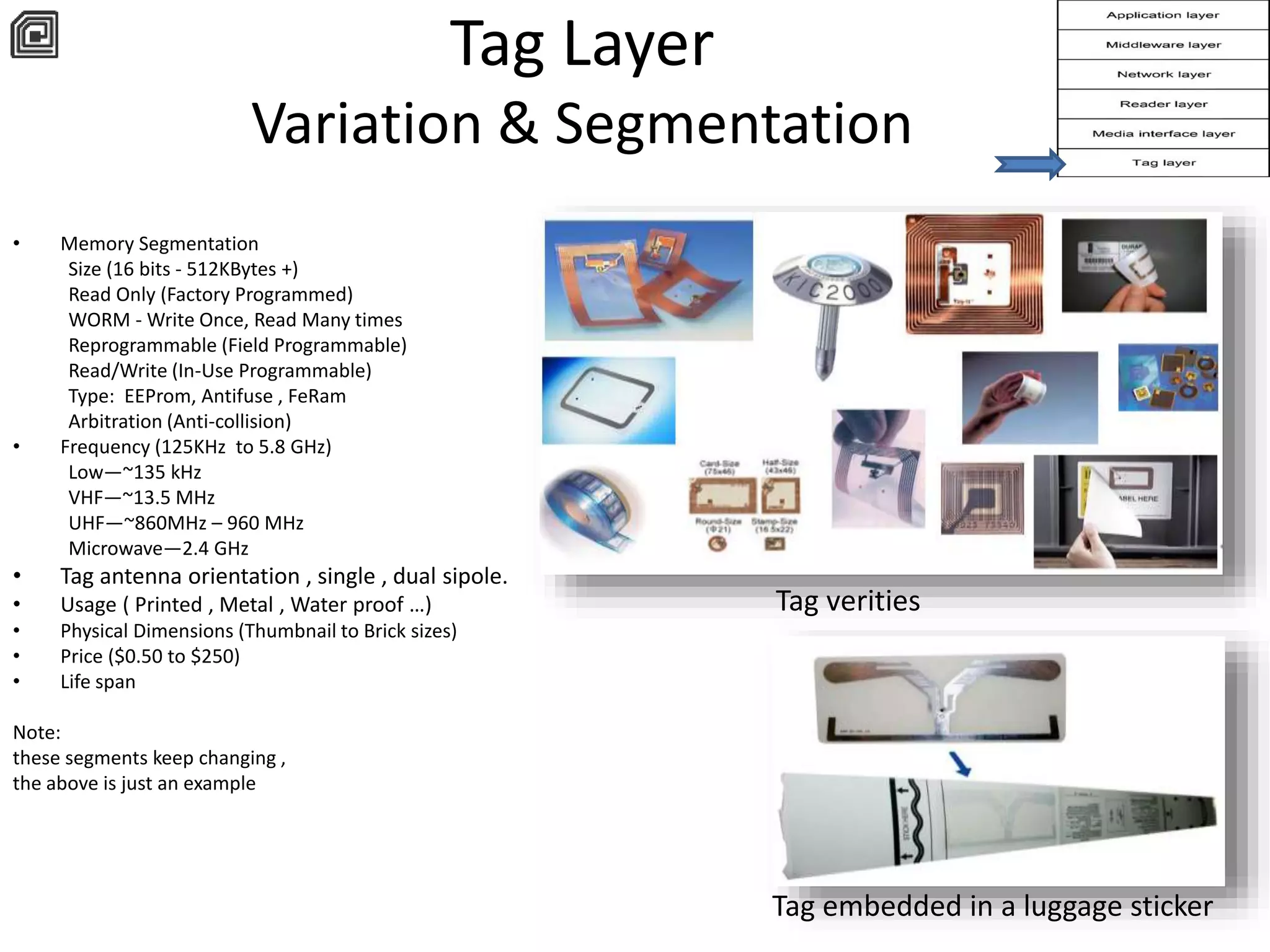
• Memory Segmentation 
Size (16 bits - 512KBytes +) 
Read Only (Factory Programmed) 
WORM - Write Once, Read Many times 
Reprogrammable (Field Programmable) 
Read/Write (In-Use Programmable) 
Type: EEProm, Antifuse , FeRam 
Arbitration (Anti-collision) 
• Frequency (125KHz to 5.8 GHz) 
Low—~135 kHz 
VHF—~13.5 MHz 
UHF—~860MHz – 960 MHz 
Microwave—2.4 GHz 
• Tag antenna orientation , single , dual sipole. 
• Usage ( Printed , Metal , Water proof …) 
• Physical Dimensions (Thumbnail to Brick sizes) 
• Price ($0.50 to $250) 
• Life span 
Note: 
these segments keep changing , 
the above is just an example 
Tag verities 
Tag embedded in a luggage sticker
Tag Layer 
Main Components 
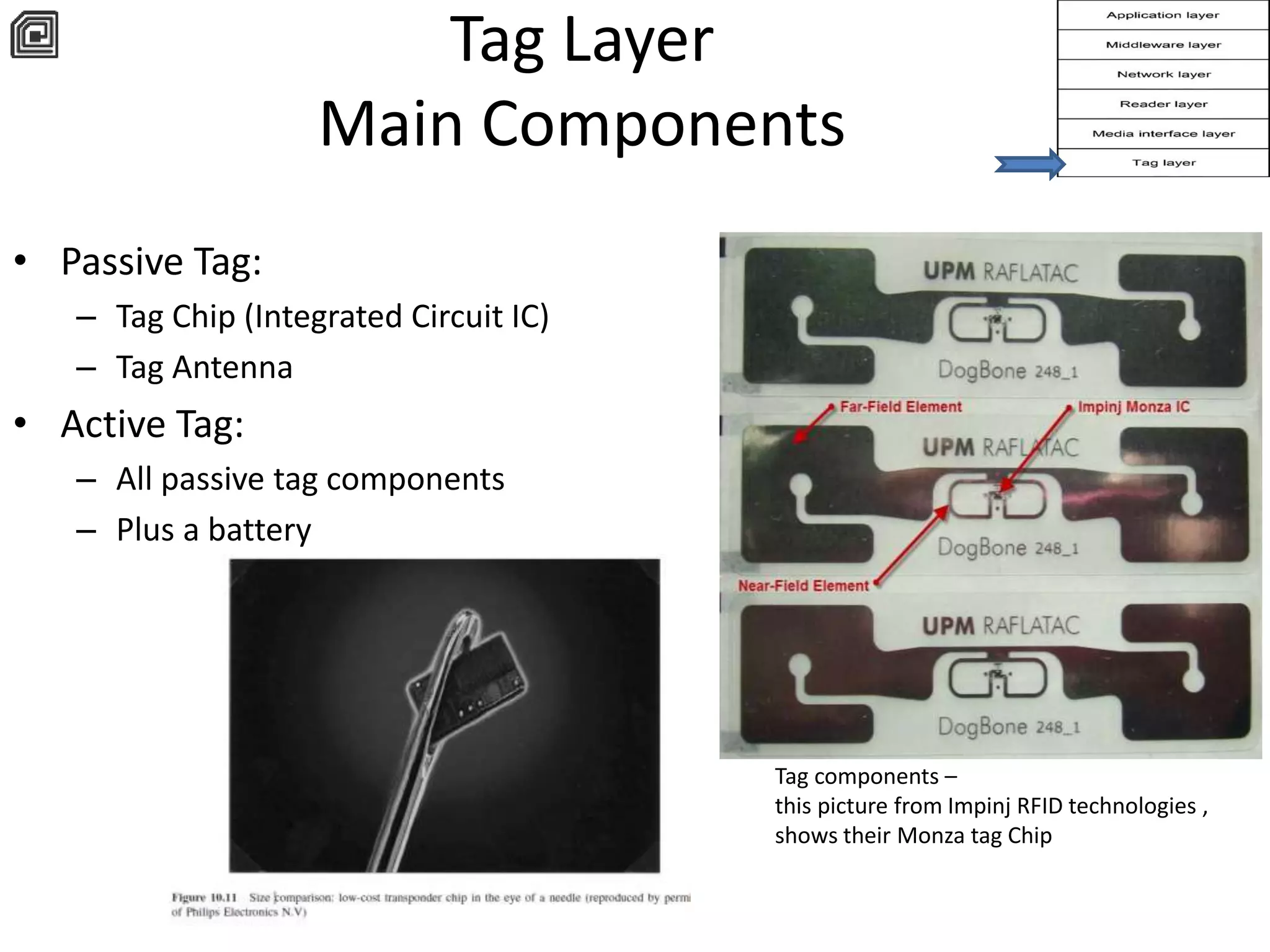
• Passive Tag: 
– Tag Chip (Integrated Circuit IC) 
– Tag Antenna 
• Active Tag: 
– All passive tag components 
– Plus a battery 
Tag components – 
this picture from Impinj RFID technologies , 
shows their Monza tag Chip
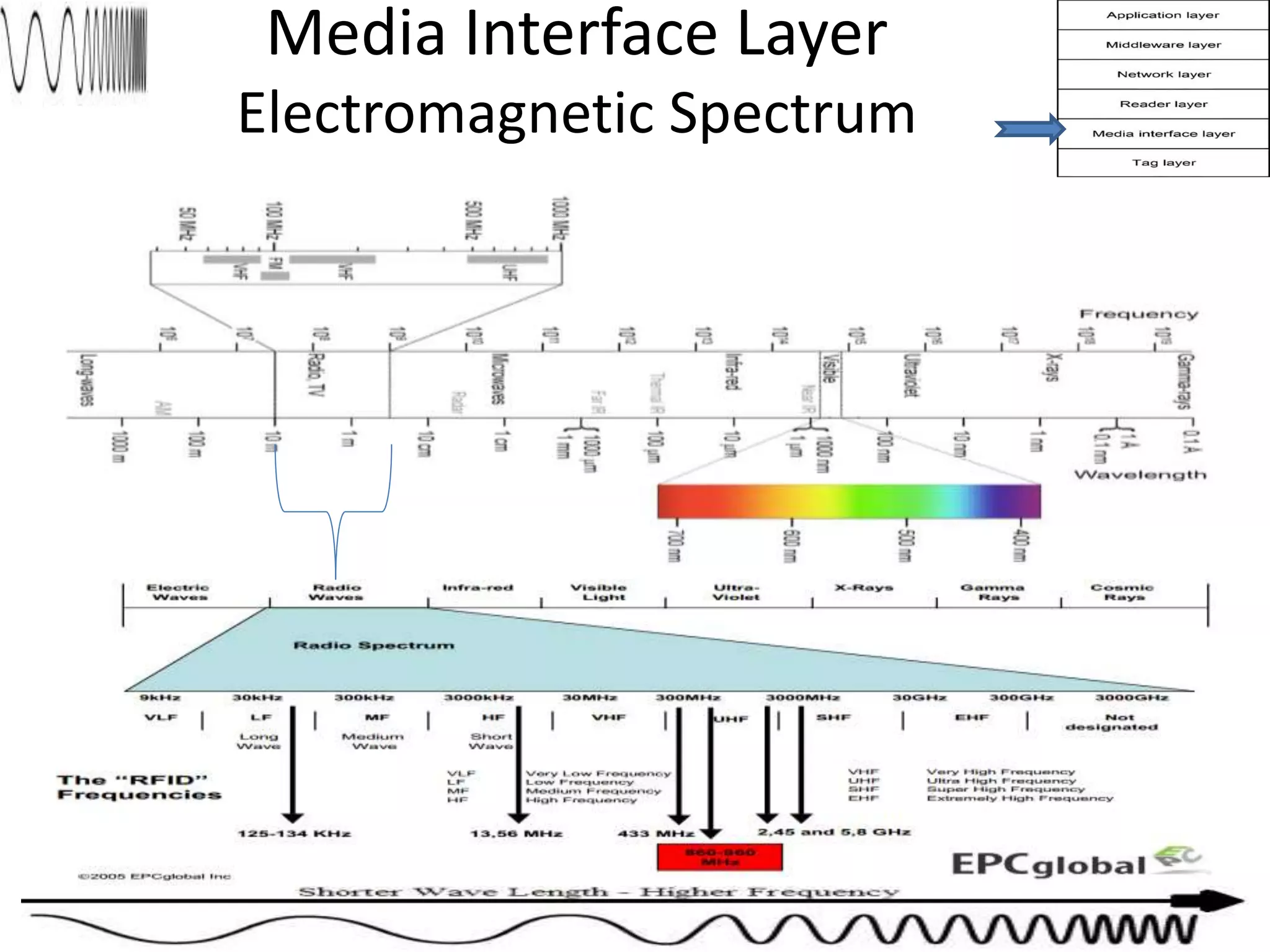
Media Interface Layer 
Electromagnetic Spectrum
Media Interface Layer 
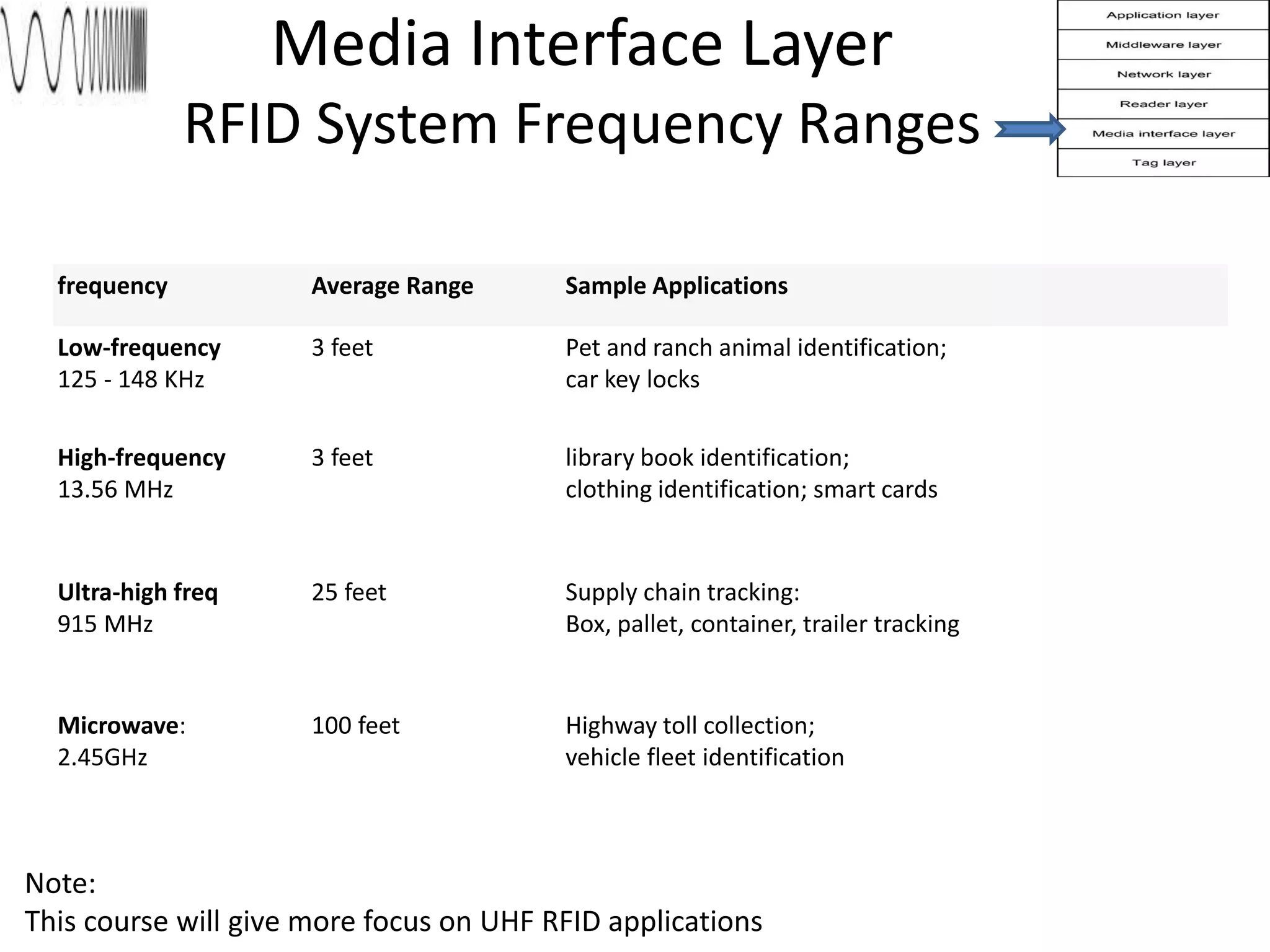
RFID System Frequency Ranges 
frequency Average Range Sample Applications 
Low-frequency 
125 - 148 KHz 
3 feet Pet and ranch animal identification; 
car key locks 
High-frequency 
13.56 MHz 
3 feet library book identification; 
clothing identification; smart cards 
Ultra-high freq 
915 MHz 
25 feet Supply chain tracking: 
Box, pallet, container, trailer tracking 
Microwave: 
2.45GHz 
100 feet Highway toll collection; 
vehicle fleet identification 
Note: 
This course will give more focus on UHF RFID applications
Reader Layer 
• This layer contains the reader & the RFID antenna 
• The reader controls one or more antenna, to send radio signal 
• The antenna has the ability to send radio signals in specific frequency 
• Some readers has embedded antenna 
Figure : The reader and transponder are the main components of every RFID system 
Image: RFID Readers
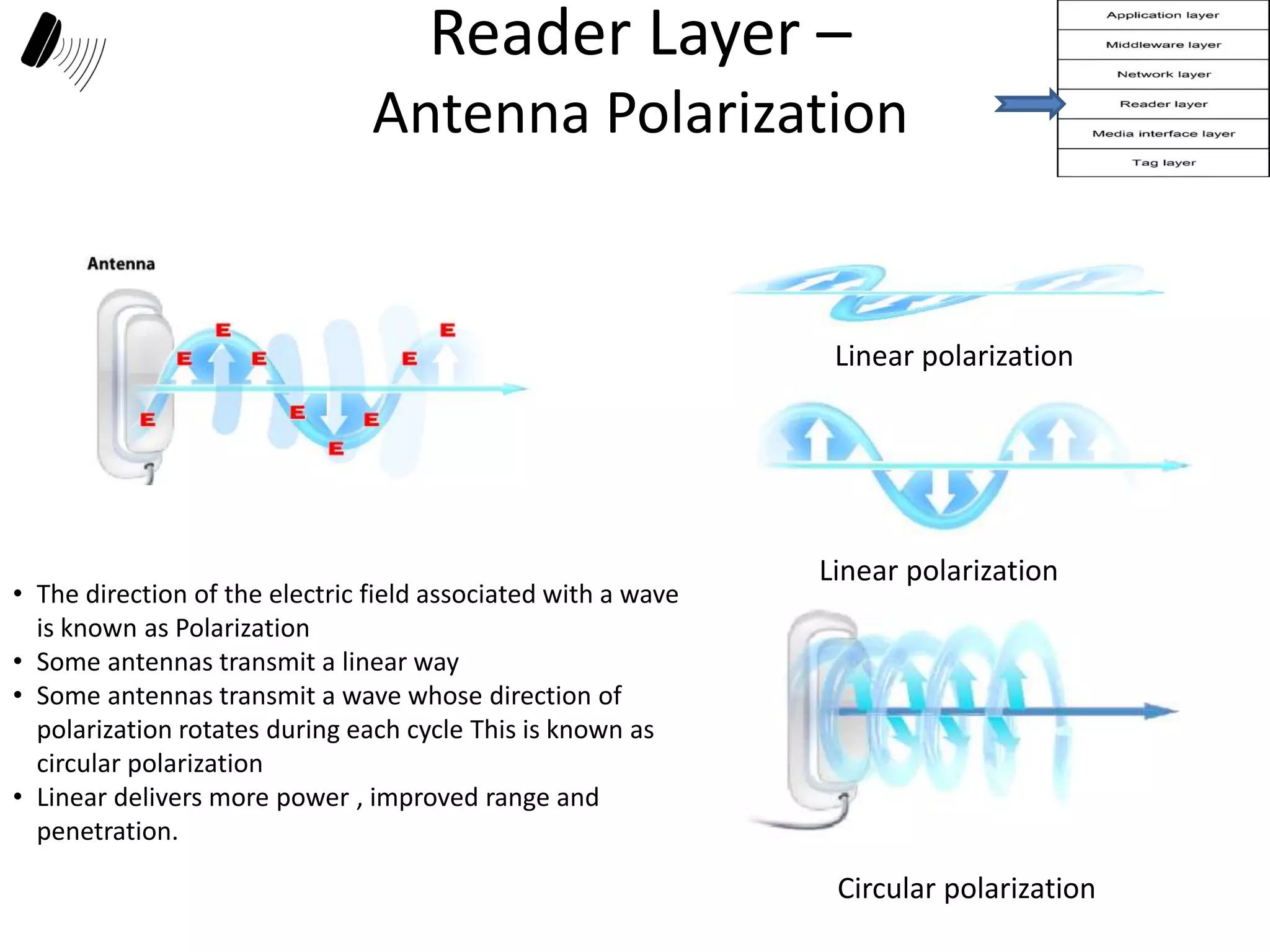
Reader Layer – 
Antenna Polarization 
Linear polarization 
• The direction of the electric field associated with a wave 
is known as Polarization 
• Some antennas transmit a linear way 
• Some antennas transmit a wave whose direction of 
polarization rotates during each cycle This is known as 
circular polarization 
• Linear delivers more power , improved range and 
penetration. 
Linear polarization 
Circular polarization
Reader Layer 
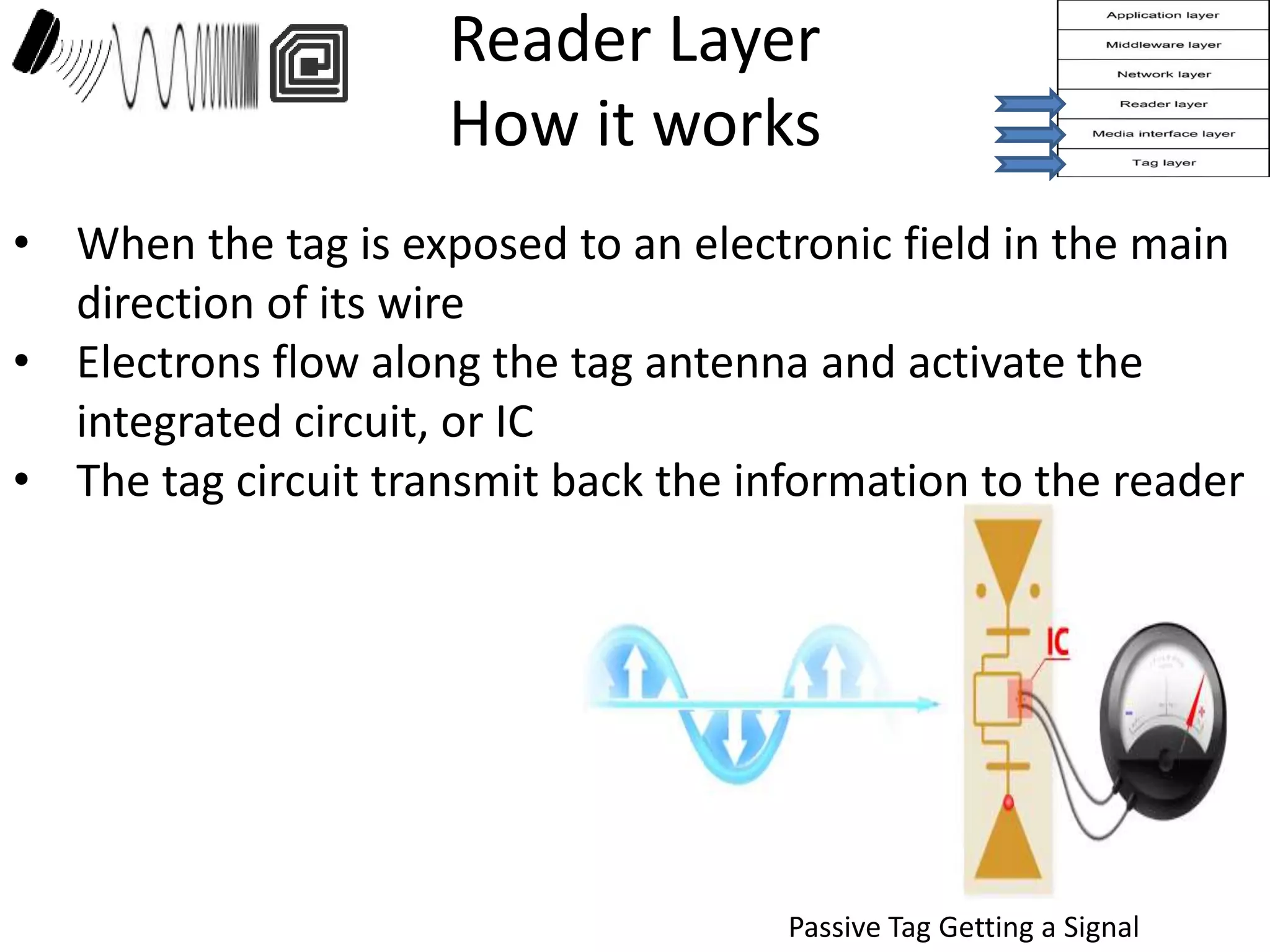
How it works 
• When the tag is exposed to an electronic field in the main 
direction of its wire 
• Electrons flow along the tag antenna and activate the 
integrated circuit, or IC 
• The tag circuit transmit back the information to the reader 
Passive Tag Getting a Signal
Reader Layer 
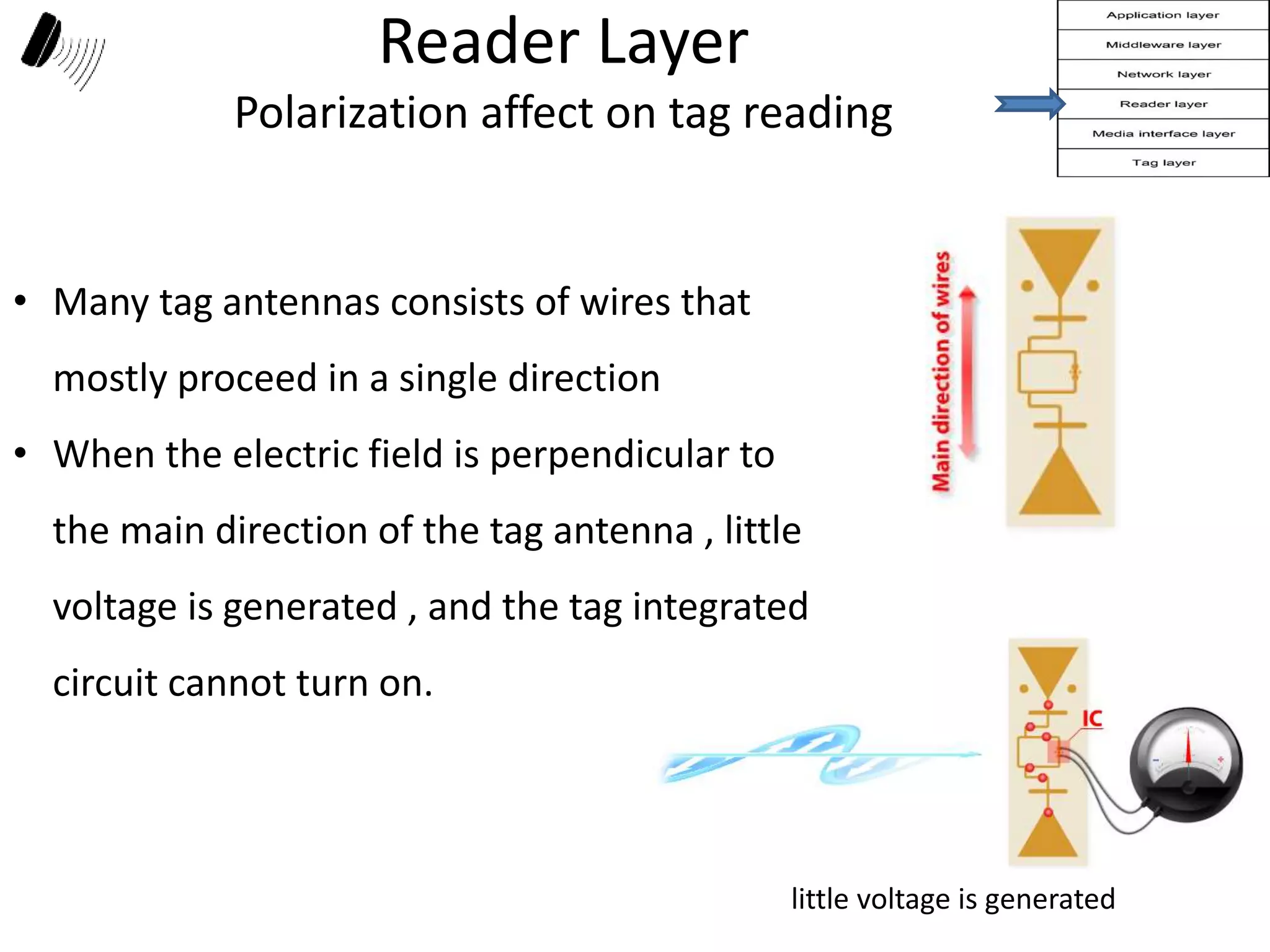
Polarization affect on tag reading 
• Many tag antennas consists of wires that 
mostly proceed in a single direction 
• When the electric field is perpendicular to 
the main direction of the tag antenna , little 
voltage is generated , and the tag integrated 
circuit cannot turn on. 
little voltage is generated
Reader Layer 
Polarization affect on tag reading 
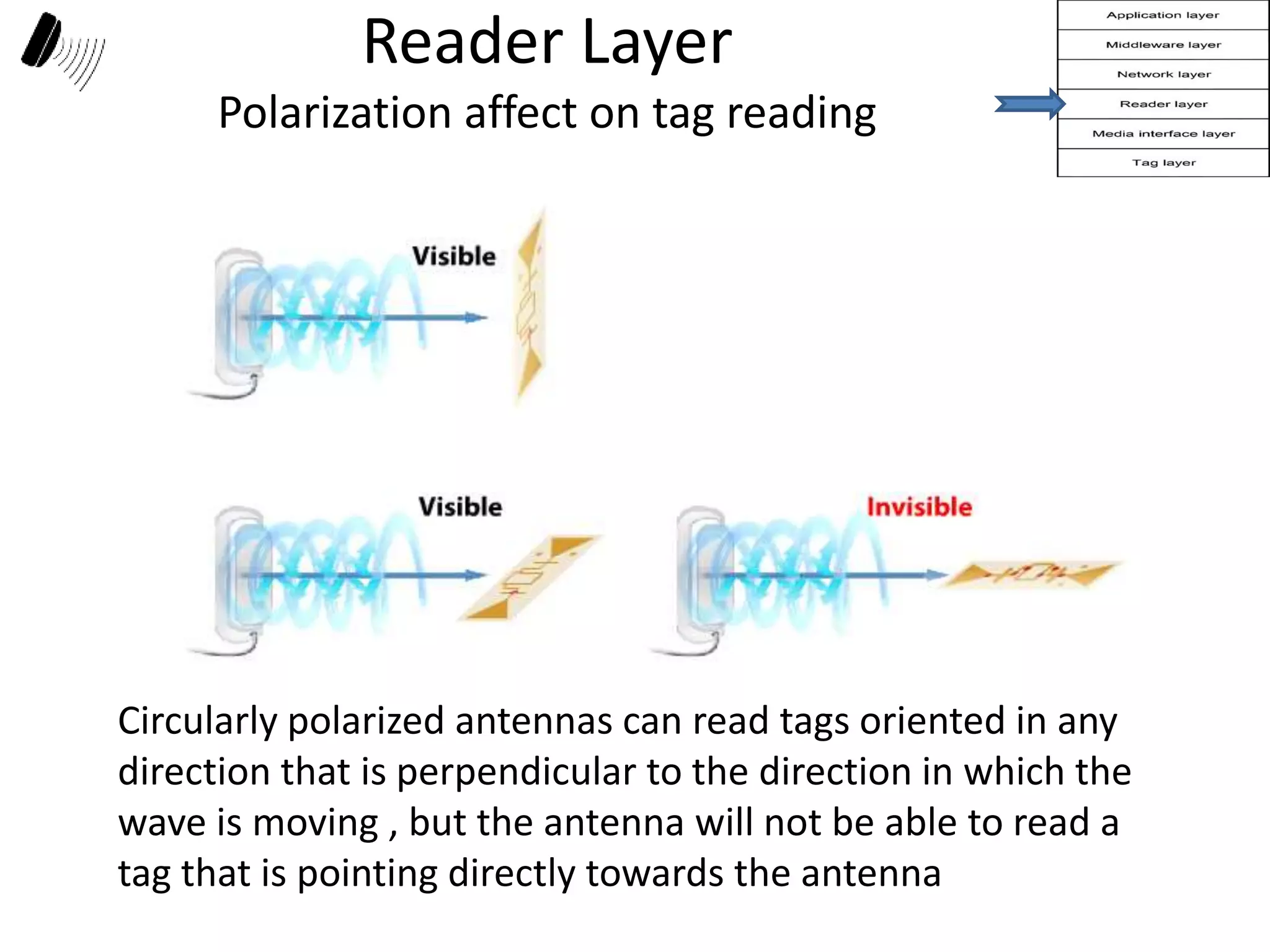
Circularly polarized antennas can read tags oriented in any 
direction that is perpendicular to the direction in which the 
wave is moving , but the antenna will not be able to read a 
tag that is pointing directly towards the antenna
Reader Layer 
Tag orientation - dual dipole 
• Some tags have two antennas oriented at 
right angles to one another 
• These are known as dual dipole tags 
• this is mostly for far field RFID usage
Network Layer 
• Network layer is the connection between the PC and 
the Reader 
• The network connectivity method can be: 
– Network cable Cat5 
– Wi-Fi connection (Wi-Fi enabled readers) 
– Serial cable RS 232 , RS 485 
– USB cable 
• The communication between the PC and Reader 
happens through standard network protocols like 
TCP/IP
Middleware Layer 
• Middleware is a software that talks directly to the reader , and facilitate an 
interface between the business software and readers. 
• In early days this functionality was part of the business application. 
• The elements of middleware include the following: 
– Reader and device management: 
RFID middleware allows users to configure, monitor, deploy, and issue commands directly to 
readers through a common interface. 
– Data management: 
As RFID middleware captures EPC data or other data from readers, it can intelligently filter 
and route it to the appropriate destinations. 
– Application integration: 
RFID middleware solutions provide messaging, routing, and connectivity features required to 
integrate RFID data into existing supply-chain management (SCM), enterprise resource 
planning (ERP), warehouse management (WMS), or customer relationship management 
(CRM) systems. 
– Partner integration: 
Middleware can provide collaborative solutions like business-to-business (B2B) integration 
between trading partners. 
• Note: we will talk in more details about this layer in later session.
Good Reads 
Book: RFID Handbook 3rd edition (2010) 
Klaus Finkenzeller Giesecke & Devrient GmbH, Munich, Germany 
Deploying RFID-Enabled Services in the Retail Supply Chain: 
Lessons Learned toward the Internet of Things 
Information Systems Management, 29:233–245, 2012 Copyright © Taylor & Francis Group, LLC 
ISSN: 1058-0530 print / 1934-8703 online 
DOI: 10.1080/10580530.2012.687317 
Cleopatra Bardaki1, Panos Kourouthanassis2, and Katerina Pramatari1 
1Athens University of Economics and Business, Athens, Greece 
2Ionian University, Corfu, Greece 
FNRFID : French National RFID Center 
http://www.centrenational-rfid.com/rfid-frequency-ranges-article-16-gb-ruid-202.html 
MSDN : Microsoft Developer Netwook - RFID: An Introduction 
http://msdn.microsoft.com/en-us/library/aa479355.aspx 
Simplified interactive introduction to RFID 
http://www.rfidrevolution.com/RFID-Essentials/demonstration/ 
RFID: An Introduction 
http://msdn.microsoft.com/en-us/library/aa479355.aspx
References 
Teaching RFID Information Systems Security 
Thompson, D.R.; Jia Di; Daugherty, M.K., "Teaching RFID Information Systems Security," Education, IEEE Transactions on , vol.57, no.1, pp.42,47, 
Feb. 2014 
doi: 10.1109/TE.2013.2264289 
URL: http://ieeexplore.ieee.org/stamp/stamp.jsp?tp=&arnumber=6524969&isnumber=6729118 
RFID Handbook 3rd edition (2010) 
Klaus Finkenzeller Giesecke & Devrient GmbH, Munich, Germany http://www.rfidhandbook.de 
https://www.impinj.com/ 
http://www.aidc.org/ 
http://www.rfidrevolution.com/RFID-Essentials/demonstration/
References 
Images 
RFID Sports: 
http://www.ipicosports.com/how-it-works/ 
http://rfid.thingmagic.com/rfid-blog/?Tag=Access+Control 
RFID Sport MotorCycler 
http://www.transcends.co/wp-content/uploads/2013/04/Rifidi-Asset-Tracking-datasheet-doublepage-C-low. 
pdf 
Tag dual dipole 
http://www.declarepeace.org.uk/captain/murder_inc/site/pics/nazirfidTag.jpg 
Tag Roll 
http://i01.i.aliimg.com/photo/v0/864297173/omnidirectional_RFID_tags_dual_dipole_RFID_labels.jpg 
Luggage tag: 
http://www.airport-int.com/suppliers/airline-printed-products.html 
Luggage Tracking 
http://phys.org/news128703805.html 
Animal Tracking 
http://www.scotland.gov.uk/Publications/2008/07/24102700/8 
Parking RFID 
http://iwatchsystems.com/technical/wp-content/uploads/2012/04/rfid_in_parking.jpg 
Electronic Spectrum Image 
http://cs.brown.edu/people/tld/note/blog/13/07/26/ Louis e. Keiner Coastal Carolina University 
http://www.fsec.ucf.edu/en/education/k-12/curricula/sm3/documents/SM3_ElectromagneticSpectrum.pdf 
http://www.oecd.org/sti/ieconomy/35472969.pdf
References 
Images 
RFID UHF Reader 
http://www.motorolasolutions.com/web/Business/Products/RFID/RFID%20Readers/FX7400/Images/Static%20Files/Merlin__ 
7_lg.jpg 
RFID Reader 
http://image.made-in-china.com/4f0j00bMtQCdUcnVqS/Desktop-Mifare-RFID-Card-Reader.jpg 
RFID Reader handheld 
http://www.gaorfid.com/images/RFID-Readers-900MHz(UHF)/RFID-Readers-900MHz(UHF)3.bmp 
Salik Tollgate 
http://www.salik.gov.ae/en/about/how-it-works 
To Make Animation 
http://www.gifmaker.me/ 
RFID System Components 
http://www.rfidrevolution.com/RFID-Essentials/demonstration/ 
AutoID Systems 
http://www.omron.com.au/service_support/technical_guide/rfid_system/index.asp 
Some pictures & ideas from 
RFID for dummies 2005 : http://www.dummies.com/ 
Patrick J. Sweeney II 
Some pictures & ideas from 
RFID Handbook, 3rd Edition
References 
Images 
RFID Inventory 
http://www.rfidbuzz.com/news/2004/goggleless_augmen 
ted_reality.html 
RFID Chemical Inventory 
http://www.rfidjournal.com/articles/view?10850
Thank You

Presentation 1 rfid introduction

  • 1.
    RFID Applications March/2014 Presentation 1 • Introduction • components • Layers Presentation 2 • Regulations • Standards • Protocols Presentation 3 • RFID Software Developer • Middleware • Labs Presentation 4 • RIFIDI Emulator LAB Mouhanad Alkhaldi | Postgraduate Taught Part Time - Information Technology (SS), MSc |ma1049@hw.ac.uk
  • 2.
    RFID Applications Introductionto RFID & System Components March/2014 Mouhanad Alkhaldi | Postgraduate Taught Part Time - Information Technology (SS), MSc |ma1049@hw.ac.uk
  • 3.
    Index 4. IconMeaning 5. AIDC - Automatic Identification and Data Capture 6. RFID Use Scenarios 7. RFID Use Scenarios –(continued) 8. RFID System Components and Layers 9. RFID Tag - Major Types 10. RFID Tag Variation & Segmentation 11. RFID Tag - main Components 12. Media Interface Layer - Electromagnetic Spectrum 13. Media Interface Layer - RFID System Frequency Ranges 14. Reader Layer 15. Reader Layer – Antenna Polarization 16. Reader Layer - How it works 17. Reader Layer - Polarization affect on tag reading 18. Reader Layer - Polarization affect on tag reading 2 19. Reader Layer - Tag orientation - dual dipole 20. Network Layer 21. Middleware Layer 22. Good Reads 23. References
  • 4.
    Icon Meaning RFIDLayer position Good Reads Network Related Reader Related topic Tag Related Topic Air Interface Related
  • 5.
    Automatic Identification andData Capture (AIDC) • AIDC: is a term used to group the various technologies employed to automatically identifying items, collecting data about them and the ability to enter that data electronically into computer systems. • It became very popular in many service industries, purchasing and distribution logistics, industry, manufacturing companies and material flow systems.
  • 6.
    RFID Use Scenarios These are just examples of RFID use: • Asset Tracking • Retail • Books Tracking (Library) • Toll Gates fare collection • Public Transport fare collection (AFC) • Healthcare • Animal Identification & Tracking • Electronic Passport • Luggage tracking • Sport • Anti-Theft • Parking Systems • Manufacturing line • Inventory Management • Brand Protection • Access control systems RFID in Luggage tracking RFID in Sports RFID Parking RFID Inventory Tracking
  • 7.
    RFID Use Scenarios RFID in Chemical Inventory RFID Animal Tracking Toll Gates fare collection
  • 8.
    RFID System Componentsand Layers Basic RFID system (user perspective) • Object to track • RFID Tag: • think of it as a memory chip , storing tag ID • RFID Antenna: • send & receive radio signals • RFID Reader: • controls the send & receive , • it is the physical layer brain ! • Computer • Any connection method between reader and PC • RS232 - USB – LAN … • Software that shows the tag reading Technically RFID has the following System Layers • Hardware/Physical 1. Tag layer 2. Media Interface Layer 3. Reader Layer 4. Network Layer • Software 5. Middleware Layer : 6. Application Layer RFID System Layers
  • 9.
    Tag Layer MajorTypes Passive Tag reflects radio signal from reader Reader powered Shorter Read Range Battery-assist can add an order of magnitude Smaller data storage Lower cost Active Tag transmits radio signal Battery powered memory, radio & circuitry High Read Range Longer range Larger data storage Higher cost Battery-assisted passive Only use the power of the reader to identify that reading is in progress Active Tag – School Attendence Passive Tag
  • 10.
    Tag Layer Variation& Segmentation • Memory Segmentation Size (16 bits - 512KBytes +) Read Only (Factory Programmed) WORM - Write Once, Read Many times Reprogrammable (Field Programmable) Read/Write (In-Use Programmable) Type: EEProm, Antifuse , FeRam Arbitration (Anti-collision) • Frequency (125KHz to 5.8 GHz) Low—~135 kHz VHF—~13.5 MHz UHF—~860MHz – 960 MHz Microwave—2.4 GHz • Tag antenna orientation , single , dual sipole. • Usage ( Printed , Metal , Water proof …) • Physical Dimensions (Thumbnail to Brick sizes) • Price ($0.50 to $250) • Life span Note: these segments keep changing , the above is just an example Tag verities Tag embedded in a luggage sticker
  • 11.
    Tag Layer MainComponents • Passive Tag: – Tag Chip (Integrated Circuit IC) – Tag Antenna • Active Tag: – All passive tag components – Plus a battery Tag components – this picture from Impinj RFID technologies , shows their Monza tag Chip
  • 12.
    Media Interface Layer Electromagnetic Spectrum
  • 13.
    Media Interface Layer RFID System Frequency Ranges frequency Average Range Sample Applications Low-frequency 125 - 148 KHz 3 feet Pet and ranch animal identification; car key locks High-frequency 13.56 MHz 3 feet library book identification; clothing identification; smart cards Ultra-high freq 915 MHz 25 feet Supply chain tracking: Box, pallet, container, trailer tracking Microwave: 2.45GHz 100 feet Highway toll collection; vehicle fleet identification Note: This course will give more focus on UHF RFID applications
  • 14.
    Reader Layer •This layer contains the reader & the RFID antenna • The reader controls one or more antenna, to send radio signal • The antenna has the ability to send radio signals in specific frequency • Some readers has embedded antenna Figure : The reader and transponder are the main components of every RFID system Image: RFID Readers
  • 15.
    Reader Layer – Antenna Polarization Linear polarization • The direction of the electric field associated with a wave is known as Polarization • Some antennas transmit a linear way • Some antennas transmit a wave whose direction of polarization rotates during each cycle This is known as circular polarization • Linear delivers more power , improved range and penetration. Linear polarization Circular polarization
  • 16.
    Reader Layer Howit works • When the tag is exposed to an electronic field in the main direction of its wire • Electrons flow along the tag antenna and activate the integrated circuit, or IC • The tag circuit transmit back the information to the reader Passive Tag Getting a Signal
  • 17.
    Reader Layer Polarizationaffect on tag reading • Many tag antennas consists of wires that mostly proceed in a single direction • When the electric field is perpendicular to the main direction of the tag antenna , little voltage is generated , and the tag integrated circuit cannot turn on. little voltage is generated
  • 18.
    Reader Layer Polarizationaffect on tag reading Circularly polarized antennas can read tags oriented in any direction that is perpendicular to the direction in which the wave is moving , but the antenna will not be able to read a tag that is pointing directly towards the antenna
  • 19.
    Reader Layer Tagorientation - dual dipole • Some tags have two antennas oriented at right angles to one another • These are known as dual dipole tags • this is mostly for far field RFID usage
  • 20.
    Network Layer •Network layer is the connection between the PC and the Reader • The network connectivity method can be: – Network cable Cat5 – Wi-Fi connection (Wi-Fi enabled readers) – Serial cable RS 232 , RS 485 – USB cable • The communication between the PC and Reader happens through standard network protocols like TCP/IP
  • 21.
    Middleware Layer •Middleware is a software that talks directly to the reader , and facilitate an interface between the business software and readers. • In early days this functionality was part of the business application. • The elements of middleware include the following: – Reader and device management: RFID middleware allows users to configure, monitor, deploy, and issue commands directly to readers through a common interface. – Data management: As RFID middleware captures EPC data or other data from readers, it can intelligently filter and route it to the appropriate destinations. – Application integration: RFID middleware solutions provide messaging, routing, and connectivity features required to integrate RFID data into existing supply-chain management (SCM), enterprise resource planning (ERP), warehouse management (WMS), or customer relationship management (CRM) systems. – Partner integration: Middleware can provide collaborative solutions like business-to-business (B2B) integration between trading partners. • Note: we will talk in more details about this layer in later session.
  • 22.
    Good Reads Book:RFID Handbook 3rd edition (2010) Klaus Finkenzeller Giesecke & Devrient GmbH, Munich, Germany Deploying RFID-Enabled Services in the Retail Supply Chain: Lessons Learned toward the Internet of Things Information Systems Management, 29:233–245, 2012 Copyright © Taylor & Francis Group, LLC ISSN: 1058-0530 print / 1934-8703 online DOI: 10.1080/10580530.2012.687317 Cleopatra Bardaki1, Panos Kourouthanassis2, and Katerina Pramatari1 1Athens University of Economics and Business, Athens, Greece 2Ionian University, Corfu, Greece FNRFID : French National RFID Center http://www.centrenational-rfid.com/rfid-frequency-ranges-article-16-gb-ruid-202.html MSDN : Microsoft Developer Netwook - RFID: An Introduction http://msdn.microsoft.com/en-us/library/aa479355.aspx Simplified interactive introduction to RFID http://www.rfidrevolution.com/RFID-Essentials/demonstration/ RFID: An Introduction http://msdn.microsoft.com/en-us/library/aa479355.aspx
  • 23.
    References Teaching RFIDInformation Systems Security Thompson, D.R.; Jia Di; Daugherty, M.K., "Teaching RFID Information Systems Security," Education, IEEE Transactions on , vol.57, no.1, pp.42,47, Feb. 2014 doi: 10.1109/TE.2013.2264289 URL: http://ieeexplore.ieee.org/stamp/stamp.jsp?tp=&arnumber=6524969&isnumber=6729118 RFID Handbook 3rd edition (2010) Klaus Finkenzeller Giesecke & Devrient GmbH, Munich, Germany http://www.rfidhandbook.de https://www.impinj.com/ http://www.aidc.org/ http://www.rfidrevolution.com/RFID-Essentials/demonstration/
  • 24.
    References Images RFIDSports: http://www.ipicosports.com/how-it-works/ http://rfid.thingmagic.com/rfid-blog/?Tag=Access+Control RFID Sport MotorCycler http://www.transcends.co/wp-content/uploads/2013/04/Rifidi-Asset-Tracking-datasheet-doublepage-C-low. pdf Tag dual dipole http://www.declarepeace.org.uk/captain/murder_inc/site/pics/nazirfidTag.jpg Tag Roll http://i01.i.aliimg.com/photo/v0/864297173/omnidirectional_RFID_tags_dual_dipole_RFID_labels.jpg Luggage tag: http://www.airport-int.com/suppliers/airline-printed-products.html Luggage Tracking http://phys.org/news128703805.html Animal Tracking http://www.scotland.gov.uk/Publications/2008/07/24102700/8 Parking RFID http://iwatchsystems.com/technical/wp-content/uploads/2012/04/rfid_in_parking.jpg Electronic Spectrum Image http://cs.brown.edu/people/tld/note/blog/13/07/26/ Louis e. Keiner Coastal Carolina University http://www.fsec.ucf.edu/en/education/k-12/curricula/sm3/documents/SM3_ElectromagneticSpectrum.pdf http://www.oecd.org/sti/ieconomy/35472969.pdf
  • 25.
    References Images RFIDUHF Reader http://www.motorolasolutions.com/web/Business/Products/RFID/RFID%20Readers/FX7400/Images/Static%20Files/Merlin__ 7_lg.jpg RFID Reader http://image.made-in-china.com/4f0j00bMtQCdUcnVqS/Desktop-Mifare-RFID-Card-Reader.jpg RFID Reader handheld http://www.gaorfid.com/images/RFID-Readers-900MHz(UHF)/RFID-Readers-900MHz(UHF)3.bmp Salik Tollgate http://www.salik.gov.ae/en/about/how-it-works To Make Animation http://www.gifmaker.me/ RFID System Components http://www.rfidrevolution.com/RFID-Essentials/demonstration/ AutoID Systems http://www.omron.com.au/service_support/technical_guide/rfid_system/index.asp Some pictures & ideas from RFID for dummies 2005 : http://www.dummies.com/ Patrick J. Sweeney II Some pictures & ideas from RFID Handbook, 3rd Edition
  • 26.
    References Images RFIDInventory http://www.rfidbuzz.com/news/2004/goggleless_augmen ted_reality.html RFID Chemical Inventory http://www.rfidjournal.com/articles/view?10850
  • 27.

Editor's Notes

  • #3 Slide Notes: Slide Resources:
  • #4 Slide Notes: Slide Resources:
  • #6 Slide Notes: Automatic identification procedures exist to provide information about people, animals, goods and products in transit. Slide Resources: http://www.aidc.org/ RFID Handbook, 3rd Edition AIDC Types http://www.biometricsinstitute.org/pages/types-of-biometrics.html RFID Handbook, 3rd Edition Optical character recognition (OCR) was first used in the 1960s OCR is used in production, service and administrative fields, and also in banks for the registration of cheques (personal data, such as name and account number, is printed on the bottom line of a cheque in OCR type). A smart card is an electronic data storage system, possibly with additional computing capacity (microprocessor card), which – for convenience – is incorporated into a plastic card the size of a credit card. The first smart cards in the form of prepaid telephone smart cards were launched in 1984. RFID systems are closely related to the smart cards. Like smart card systems, data is stored on an electronic data-carrying device – the transponder. However, unlike the smart card, the power supply to the data-carrying device and the data exchange between the data-carrying device and the reader are achieved without the use of galvanic contacts, using instead magnetic or electromagnetic fields. near-field communication (NFC) is not an RFID system, but a wireless data interface between devices, similar to Infrared or the well-known Bluetooth. However, NFC has several characteristics that are of interest in relation to RFID systems.
  • #7 Slide Notes: Good to show this video http://www.youtube.com/watch?v=jaHfVAbQJgY#t=91 It shows real case about RFID in retail… Slide Resources: http://www.ipicosports.com/how-it-works/ http://www.airport-int.com/suppliers/airline-printed-products.html http://rfid.thingmagic.com/rfid-blog/?Tag=Access+Control http://phys.org/news128703805.html http://www.scotland.gov.uk/Publications/2008/07/24102700/8 http://iwatchsystems.com/technical/wp-content/uploads/2012/04/rfid_in_parking.jpg
  • #8 Slide Notes: Good to show this video http://www.youtube.com/watch?v=jaHfVAbQJgY#t=91 It shows real case about RFID in retail… Slide Resources: http://www.ipicosports.com/how-it-works/ http://www.airport-int.com/suppliers/airline-printed-products.html http://rfid.thingmagic.com/rfid-blog/?Tag=Access+Control http://phys.org/news128703805.html http://www.scotland.gov.uk/Publications/2008/07/24102700/8 http://iwatchsystems.com/technical/wp-content/uploads/2012/04/rfid_in_parking.jpg
  • #9 Slide Notes: RFID Technical structure was not divided in this way initially …. It started in the simple diagram RFID Reference Model. Slide Resources: Teaching RFID Information Systems Security.pdf http://ezproxy1.hw.ac.uk:2065/stamp/stamp.jsp?tp=&arnumber=6524969 Education, IEEE Transactions on  (Volume:57 ,  Issue: 1 ) Date of Publication: Feb. 2014Page(s):42 - 47ISSN :0018-9359INSPEC Accession Number:14061516Digital Object Identifier :10.1109/TE.2013.2264289 http://www.rfidrevolution.com/RFID-Essentials/demonstration/
  • #10 Slide Notes: Slide Resources: http://www.corerfid.com/technology/RFIDtechnology/batteryassistedpassive.aspx RFID Journal 2006 : RFIDJournal2006.pdf RFID for dummies http://2.bp.blogspot.com/-81LqKfYKNwo/T8R8PvYwLYI/AAAAAAAAAdw/i2vFEesbWk8/s1600/P1020992_2.jpg http://www.harlandsimon.com/Images/RFID/RFID-Passive-Tag.jpg http://msdn.microsoft.com/en-us/library/aa479355.aspx#rfidintro_topic3
  • #11 Slide Notes: The Tag segments keep changing, the above is just an example Low Frequency (125/134KHz)—Most commonly used for access control, animal tracking, and asset tracking. High-Frequency (13.56 MHz)—Used where medium data rate and read ranges up to about 1.5 meters are acceptable. This frequency also has the advantage of not being susceptible to interference from the presence of water or metals. Ultra High-Frequency (850 MHz to 950 MHz)—offer the longest read ranges of up to approximately 3 meters and high reading speeds. Slide Resources: http://msdn.microsoft.com/en-us/library/aa479355.aspx#rfidintro_topic3
  • #12 Slide Notes: Slide Resources: https://www.impinj.com/ RFID Handbook, 3rd Edition
  • #13 Slide Notes: This slide speaks a lot about the transfer layer Speak about the electromagnet frequencies Speak about the visible frequencies Speak about the radio spectrum RFID Frequency Ranges LF, 125 KHz–134 KHz HF, 13.56 MHz UHF, 860 MHz–960 MHz microwave: 2.4 GHz and 5.8 GHz (Bluetooth: Bluetooth operates in the range of 2400–2483.5 MHz) Slide Resources: http://cs.brown.edu/people/tld/note/blog/13/07/26/ Louis e. Keiner Coastal Carolina University http://www.fsec.ucf.edu/en/education/k-12/curricula/sm3/documents/SM3_ElectromagneticSpectrum.pdf http://www.centrenational-rfid.com/rfid-frequency-ranges-article-16-gb-ruid-202.html http://www.oecd.org/sti/ieconomy/35472969.pdf http://msdn.microsoft.com/en-us/library/aa479355.aspx http://cs.brown.edu/people/tld/note/blog/13/07/26/
  • #14 Slide Notes: Slide Resources: http://www.rfid-101.com/rfid-frequencies.htm
  • #15 Slide Notes: Slide Resources: RFID Handbook, 3rd Edition The reader and transponder are the main components of every RFID system http://www.motorolasolutions.com/web/Business/Products/RFID/RFID%20Readers/FX7400/Images/Static%20Files/Merlin__7_lg.jpg http://image.made-in-china.com/4f0j00bMtQCdUcnVqS/Desktop-Mifare-RFID-Card-Reader.jpg http://www.gaorfid.com/images/RFID-Readers-900MHz(UHF)/RFID-Readers-900MHz(UHF)3.bmp
  • #16 Slide Notes: Slide Resources: http://www.rfidrevolution.com/RFID-Essentials/demonstration/
  • #17 Slide Notes: Slide Resources: http://www.rfidrevolution.com/RFID-Essentials/demonstration/
  • #18 Slide Notes: In real RFID far field implementation , you really need to pay attention to the polarization in both your antenna and the tag type you are using .. For that in this course I am giving a slight high level understanding of this physical concept Slide Resources: http://www.rfidrevolution.com/RFID-Essentials/demonstration/
  • #19 Slide Notes: Slide Resources: http://www.rfidrevolution.com/RFID-Essentials/demonstration/
  • #20 Slide Notes: Slide Resources: http://www.rfidrevolution.com/RFID-Essentials/demonstration/ http://www.declarepeace.org.uk/captain/murder_inc/site/pics/nazirfidTag.jpg http://i01.i.aliimg.com/photo/v0/864297173/omnidirectional_RFID_tags_dual_dipole_RFID_labels.jpg
  • #21 Slide Notes: Slide Resources: http://www.iconhot.com/icon/png/devine-icons-part-2/512/network-8.png
  • #22 Slide Notes: Slide Resources: RFID for dummies
  • #24 Slide Notes: Including images Slide Resources:
  • #25 Slide Notes: Including images Slide Resources:
  • #26 Slide Notes: Including images Slide Resources:
  • #27 Slide Notes: Including images Slide Resources:
  • #28 Slide Notes: